|
|

|
Source: Bosworth/Toller, page b0176, entry 16 View original page image as: [TIFF] [PNG] [View previous entry] [View next entry] |
[Comment on this entry] [View comments] |
The following entry has been hand-corrected once. |
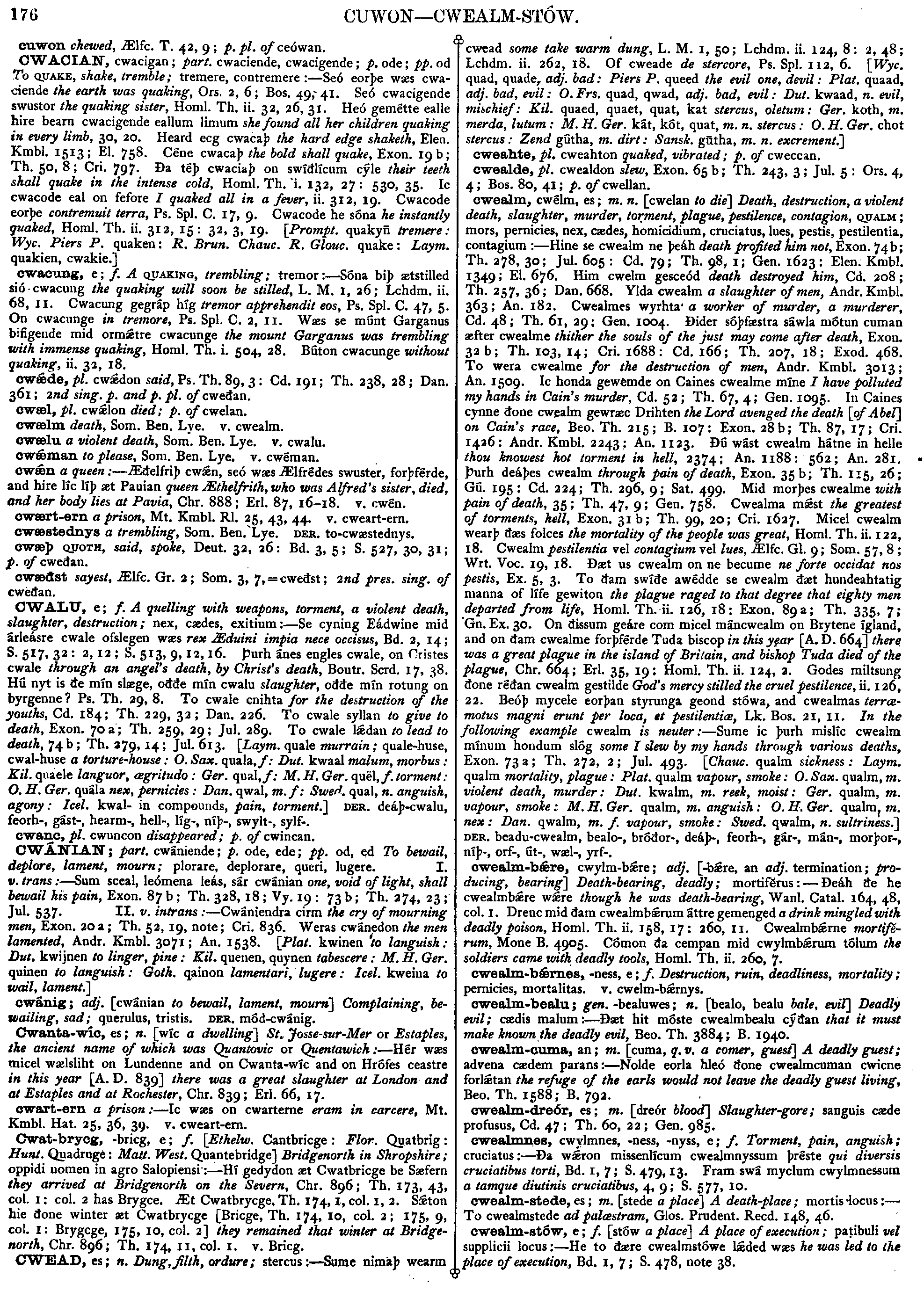
CWÁNIAN; part. cwániende; p. ode, ede; pp. od, ed To bewail, deplore, lament, mourn; plorare, deplorare, queri, lugere. I. v. trans :-- Sum sceal, leómena leás, sár cwánian one, void of light, shall bewail his pain, Exon. 87b; Th. 328, 18; Vy. 19: 73b; Th. 274, 23; Jul. 537. II. v. intrans :-- Cwániendra cirm the cry of mourning men, Exon. 20a; Th. 52, 19, note; Cri. 836. Weras cwánedon the men lamented, Andr. Kmbl. 3071; An. 1538. [Plat. kwinen to languish: Dut. kwijnen to linger, pine: Kil. quenen, quynen tabescere: M. H. Ger. quinen to languish: Goth. qainon lamentari, lugere: Icel. kweina to wail, lament.]
|
Source: Bosworth/Toller, page b0176, entry 21 View original page image as: [TIFF] [PNG] [View previous entry] [View next entry] |
[Comment on this entry] [View comments] |
The following entry has been hand-corrected once. |
CWEAD,
es;
n.
Dung,
filth,
ordure;
stercus
:--
Sume
nimaþ
wearm
cwead
some
take
warm
dung,
L.
M.
1,
50;
Lchdm.
ii.
124,
8:
2,
48;
Lchdm.
ii.
262,
18.
Of
cweade
de
stercore,
Ps.
Spl.
112,
6.
[Wyc.
quad,
quade,
adj.
bad:
Piers
P.
queed
the
evil
one,
devil:
Plat.
quaad,
adj.
bad,
evil:
O.
Frs.
quad,
qwad,
adj.
bad,
evil:
Dut.
kwaad,
n.
evil,
mischief:
Kil.
quaed,
quaet,
quat,
kat
stercus,
oletum:
Ger.
koth,
m.
merda,
lutum:
M.
H.
Ger.
kát,
kót,
quat,
m.
n.
stercus:
O.
H.
Ger.
chot
stercus:
Zend
gútha,
m.
dirt:
Sansk.
g tha,
m.
n.
execrement.]
tha,
m.
n.
execrement.]
|
Source: Bosworth/Toller, page b0177, entry 19 View original page image as: [TIFF] [PNG] [View previous entry] [View next entry] |
[Comment on this entry] [View comments (1)] |
The following entry has been hand-corrected once. |
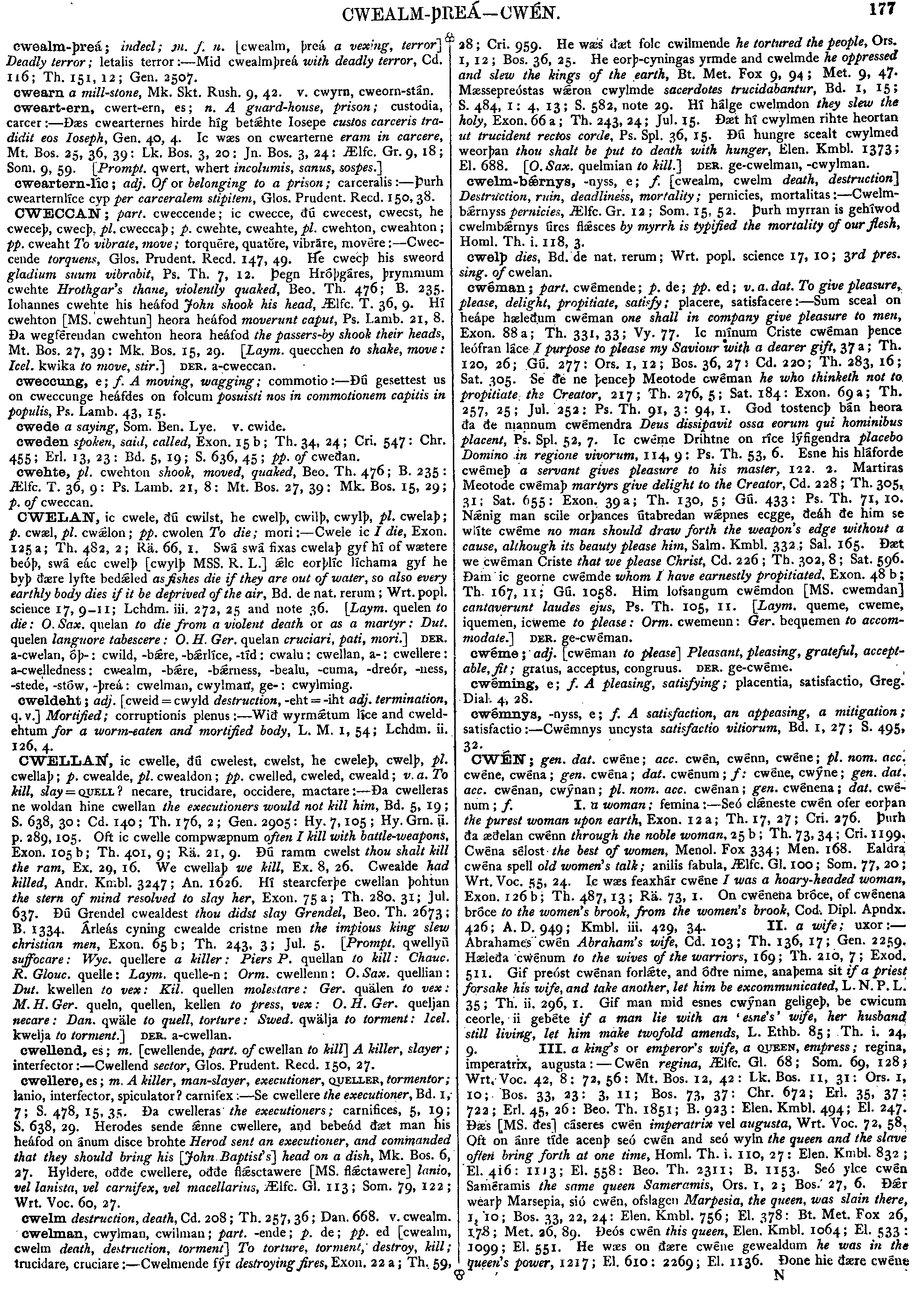
cwéman;
part.
cwémende;
p.
de;
pp.
ed;
v.
a.
dat.
To
give
pleasure,
please,
delight,
propitiate,
satisfy;
placere,
satisfacere
:--
Sum
sceal
on
heápe
hæleðum
cwéman
one
shall
in
company
give
pleasure
to
men,
Exon.
88a;
Th.
331,
33;
Vy.
77.
Ic
mínum
Criste
cwéman
þence
leófran
láce
I
purpose
to
please
my
Saviour
with
a
dearer
gift,
37a;
Th.
120,
26;
Gú.
277:
Ors.
1,
12;
Bos.
36,
27:
Cd.
220;
Th.
283,
16;
Sat.
305.
Se
ðe
ne
þenceþ
Meotode
cwéman
he
who
thinketh
not
to
propitiate
the
Creator,
217;
Th.
276,
5;
Sat.
184:
Exon.
69a;
Th.
257,
2S;
Jul.
252:
Ps.
Th.
91,
3:
94,
1.
God
tostencþ
bán
heora
ða
ðe
mannum
cwémendra
Deus
dissipavit
ossa
eorum
qui
hominibus
placent,
Ps.
Spl.
52,
7.
Ic
cwéme
UNCERTAIN
Drihtne
on
ríce
lýfigendra
placebo
Domino
in
regions
vivorum,
114,
9;
Ps.
Th.
53,
6.
Esne
his
hláforde
cwémeþ
a
servant
gives
pleasure
to
his
master,
122,
2.
Martiras
Meotode
cwémaþ
martyrs
give
delight
to
the
Creator,
Cd.
228;
Th.
305,
31;
Sae.
655:
Exon.
39a;
Th.
130,
5;
Gú.
433:
Ps.
Th.
71,
10.
N nig
man
scile
orþances
útabredan
wpnes
ecgge,
ðeáh
ðe
him
se
wlíte
UNCERTAIN
cwéme
no
man
should
draw
forth
the
weapon's
edge
without
a
cause,
although
its
beauty
please
him,
Salm.
Kmbl.
332;
Sal.
165.
Ðæt
we
cwéman
Criste
that
we
please
Christ,
Cd.
226;
Th.
302,
8;
Sat.
596.
Ðam
ic
georne
cwémde
whom
I
have
earnestly
propitiated,
Exon.
48b;
Th.
167,
11;
Gú.
1058.
Him
lofsangum
cwémdon
[MS.
cwemdan]
cantaverunt
laudes
ejus,
Ps.
Th.
105,
11.
[Laym.
queme,
cweme,
iquemen,
icweme
to
please:
Orm.
cwemenn:
Ger.
bequemen
to
accommodate.]
DER.
ge-cwéman.
nig
man
scile
orþances
útabredan
wpnes
ecgge,
ðeáh
ðe
him
se
wlíte
UNCERTAIN
cwéme
no
man
should
draw
forth
the
weapon's
edge
without
a
cause,
although
its
beauty
please
him,
Salm.
Kmbl.
332;
Sal.
165.
Ðæt
we
cwéman
Criste
that
we
please
Christ,
Cd.
226;
Th.
302,
8;
Sat.
596.
Ðam
ic
georne
cwémde
whom
I
have
earnestly
propitiated,
Exon.
48b;
Th.
167,
11;
Gú.
1058.
Him
lofsangum
cwémdon
[MS.
cwemdan]
cantaverunt
laudes
ejus,
Ps.
Th.
105,
11.
[Laym.
queme,
cweme,
iquemen,
icweme
to
please:
Orm.
cwemenn:
Ger.
bequemen
to
accommodate.]
DER.
ge-cwéman.
|
Source: Bosworth/Toller, page b0177, entry 23 View original page image as: [TIFF] [PNG] [View previous entry] [View next entry] |
[Comment on this entry] [View comments] |
The following entry has been hand-corrected once. |
CWÉN;
gen.
dat.
cwéne;
acc.
cwén,
cwénn,
cwéne;
pl.
nom.
acc.
cwéne,
cwéna;
gen.
cwéna;
dat.
cwénum;
f:
cwéne,
cwýne;
gen.
dat.
acc.
cwénan,
cwýnan;
pl.
nom.
acc.
cwénan;
gen.
cwénena;
dat.
cwénum;
f.
I.
a
woman;
femina
:--
Seó
clneste
cwén
ofer
eorþan
the
purest
woman
upon
earth,
Exon.
12a;
Th.
17,
27;
Cri.
276.
Þurh
ða
æðelan
cwénn
through
the
noble
woman,
25b;
Th.
73,
34;
Cri.
1199.
Cwéna
sélost
the
best
of
women,
Menol.
Fox
334;
Men.
168.
Ealdra
cwéna
spell
old
women's
talk;
anilis
fabula,
Ælfc.
Gl.
100;
Som.
77,
20;
Wrt.
Voc.
55,
24.
Ic
wæs
feaxhár
cwéne
I
was
a
hoary-headed
woman,
Exon.
126b;
Th.
487,
13;
Rä.
73,
1.
On
cwénena
bróce,
of
cwénena
bróce
to
the
women's
brook,
from
the
women's
brook,
Cod.
Dipl.
Apndx.
426;
A.
D.
949;
Kmbl.
iii.
429,
34.
II.
a
wife;
uxor
:--
Abrahames
cwén
Abraham's
wife,
Cd.
103;
Th.
136,
17;
Gen.
2259.
Hæleða
cwénum
to
the
wives
of
the
warriors,
169;
Th.
210,
7;
Exod.
511.
Gif
preóst
cwénan
forlte,
and
óðre
nime,
anaþema
sit
if
a
priest
forsake
his
wife,
and
take
another,
let
him
be
excommunicated,
L.
N.
P.
L.
35;
Th.
ii.
296,
1.
Gif
man
mid
esnes
cwýnan
geligeþ,
be
cwicum
ceorle,
ii
gebéte
if
a
man
lie
with
an
'esne's'
wife,
her
husband,
still
living,
let
him
make
twofold
amends,
L.
Ethb.
85;
Th.
i.
24,
9.
III.
a
king's
or
emperor's
wife,
a
QUEEN,
empress;
regina,
imperatrix,
augusta
:--
Cwén
regina,
Ælfc.
Gl.
68;
Som.
69,
128;
Wrt.
Voc.
42,
8:
72,
56:
Mt.
Bos.
12,
42:
Lk.
Bos.
11,
31:
Ors.
1,
10;
Bos.
33,
23:
3,
11;
Bos.
73,
37:
Chr.
672;
Erl.
35,
37:
722;
Erl.
45,
26:
Beo.
Th.
1851;
B.
923:
Elen.
Kmbl.
494;
El.
247.
Ðæs
[MS.
ðes]
cáseres
cwén
imperatrix
vel
augusta,
Wrt.
Voc.
72,
58.
Oft
on
ánre
tíde
acenþ
seó
cwén
and
seó
wyln
the
queen
and
the
slave
often
bring
forth
at
one
time,
Homl.
Th.
i.
110,
27:
Elen.
Kmbl.
832;
El.
416:
1113;
El.
558:
Beo.
Th.
2311;
B.
1153.
Seó
ylce
cwén
Sarméramis
the
same
queen
Sameramis,
Ors.
1,
2;
Bos.
27,
6.
Ðær
wearþ
Marsepia,
sió
cwén,
ofslagen
Marpesia,
the
queen,
was
slain
there,
1,
10;
Bos.
33,
22,
24:
Elen.
Kmbl.
756;
El.
378:
Bt.
Met.
Fox
26,
178;
Met.
26,
89.
Ðeós
cwén
this
queen,
Elen.
Kmbl.
1064;
El.
533:
1099;
El.
551.
He
wæs
on
ðære
cwéne
gewealdum
he
was
in
the
queen's
power,
1217;
El.
610:
2269;
El.
1136.
Ðone
hie
ðære
cwéne
|
Source: Bosworth/Toller, page b0179, entry 1 View original page image as: [TIFF] [PNG] [View previous entry] [View next entry] |
[Comment on this entry] [View comments] |
The following entry has been hand-corrected once. |
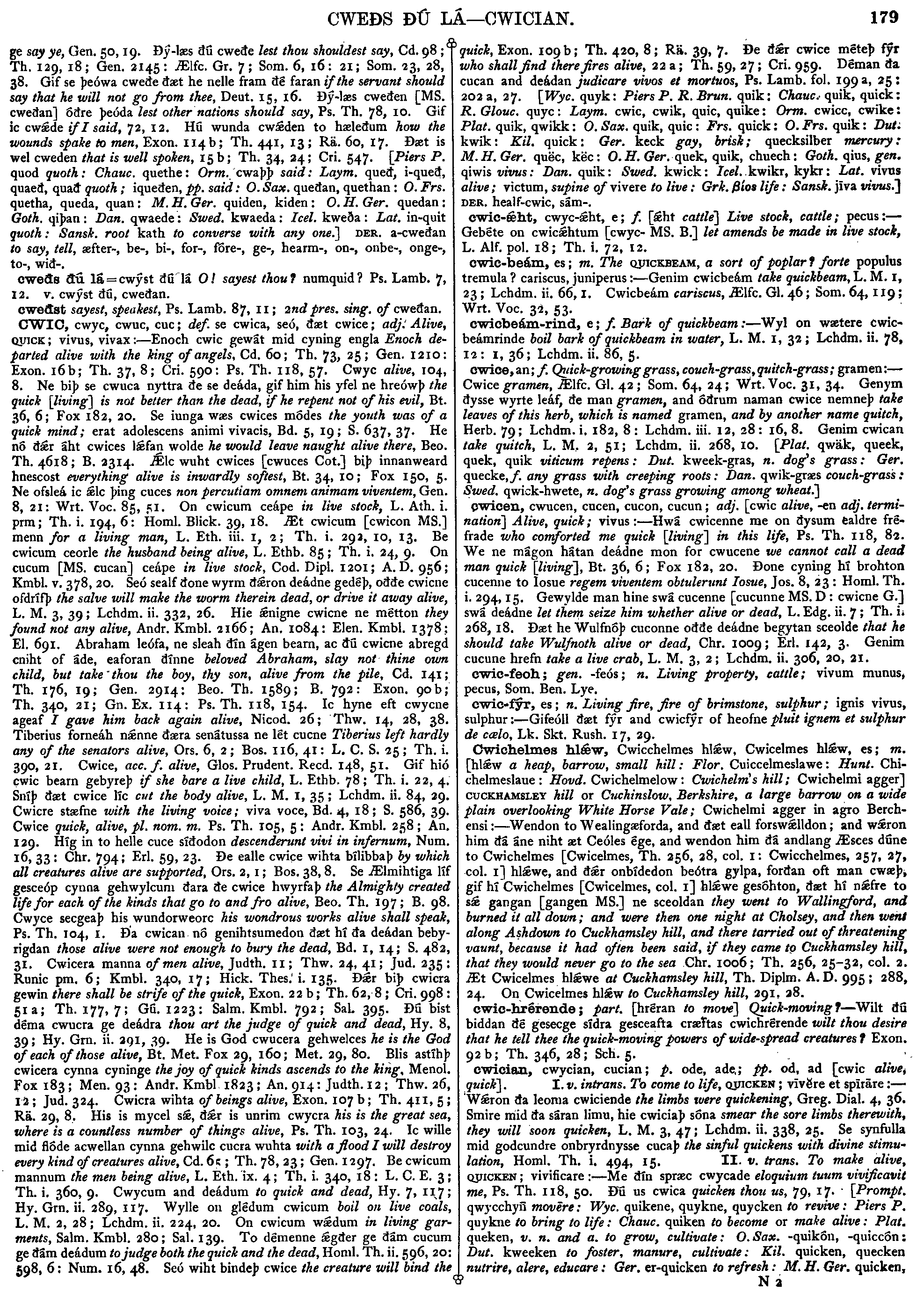
ge
say
ye,
Gen.
50,
19.
Ðý-læs
ðú
cweðe
lest
thou
shouldest
say,
Cd.
98;
Th.
129,
18;
Gen.
2145:
Ælfc.
Gr.
7;
Som.
6,
16:
21;
Som.
23,
28,
38.
Gif
se
þeówa
cweðe
ðæt
he
nelle
fram
ðé
faran
if
the
servant
should
say
that
he
will
not
go
from
thee,
Deut.
15,
16.
Ðý-læs
cweðen
[MS.
cweðan]
óðre
þeóda
lest
other
nations
should
say,
Ps.
Th.
78,
10.
Gif
ic
cwde
if
I
said,
72,
12.
Hú
wunda
cwden
to
hæleðum
how
the
wounds
spake
to
men,
Exon.
114b;
Th.
441,
13;
Rä.
60,
17.
Ðæt
is
wel
cweden
that
is
well
spoken,
15b;
Th.
34,
24;
Cri.
547.
[Piers
P.
quod
quoth:
Chauc.
quethe:
Orm.
cwaþþ
said:
Laym.
queð,
i-queð,
quaeð,
quað
quoth
;
iqueðen,
pp.
said:
O.
Sax.
queðan,
quethan:
O.
Frs.
quetha,
queda,
quan:
M.
H.
Ger.
quiden,
kiden:
O.
H.
Ger.
quedan:
Goth.
qiþan:
Dan.
qwaede:
Swed.
kwaeda:
Icel.
kweða:
Lat.
in-quit
quoth:
Sansk.
root
kath
to
converse
with
any
one.]
DER.
a-cweðan
to
say,
tell,
æfter-,
be-,
bi-,
for-,
fóre-,
ge-,
hearm-,
on-,
onbe-,
onge-,
to-,
wið-.
|
Source: Bosworth/Toller, page b0179, entry 12 View original page image as: [TIFF] [PNG] [View previous entry] [View next entry] |
[Comment on this entry] [View comments] |
The following entry has been hand-corrected once. |
Cwichelmes
hlw,
Cwicchelmes
hlw,
Cwicelmes
hlw,
es;
m.
[hlw
a
heap,
barrow,
small
hill:
Flor.
Cuiccelmeslawe:
Hunt.
Chichelmeslaue:
Hovd.
Cwichelmelow:
Cwichelm's
hill;
Cwichelmi
agger]
CUCKHAMSLEY
hill
or
Cuchinslow,
Berkshire,
a
large
barrow
on
a
wide
plain
overlooking
White
Horse
Vale;
Cwichelmi
agger
in
agro
Berchensi
:--
Wendon
to
Wealingæforda,
and
ðæt
eall
forswlldon;
and
wron
him
ðá
áne
niht
æt
Ceóles
ége,
and
wendon
him
ðá
andlang
Æsces
dúne
to
Cwichelmes
[Cwicelmes,
Th.
256,
28,
col.
1:
Cwicchelmes,
257,
27,
col.
1]
hlwe,
and
ðr
onbídedon
beótra
gylpa,
forðan
oft
man
cwæþ,
gif
hí
Cwichelmes
[Cwicelmes,
col.
1]
hlwe
gesóhton,
ðæt
hí
nfre
to
s
gangan
[gangen
MS.]
ne
sceoldan
they
went
to
Wallingford,
and
burned
it
all
down;
and
were
then
one
night
at
Cholsey,
and
then
went
along
Ashdown
to
Cuckhamsley
hill,
and
there
tarried
out
of
threatening
vaunt,
because
it
had
often
been
said,
if
they
came
to
Cuckhamsley
hill,
that
they
would
never
go
to
the
sea
Chr.
1006;
Th.
256,
25-32,
col.
2.
Æt
Cwicelmes
hlwe
at
Cuckhamsley
hill,
Th.
Diplm.
A.
D.
995;
288,
24.
On
Cwicelmes
hlw
to
Cuckhamsley
hill,
291,
28.
|
Source: Bosworth/Toller, page b0181, entry 15 View original page image as: [TIFF] [PNG] [View previous entry] [View next entry] |
[Comment on this entry] [View comments] |
The following entry has been hand-corrected once. |
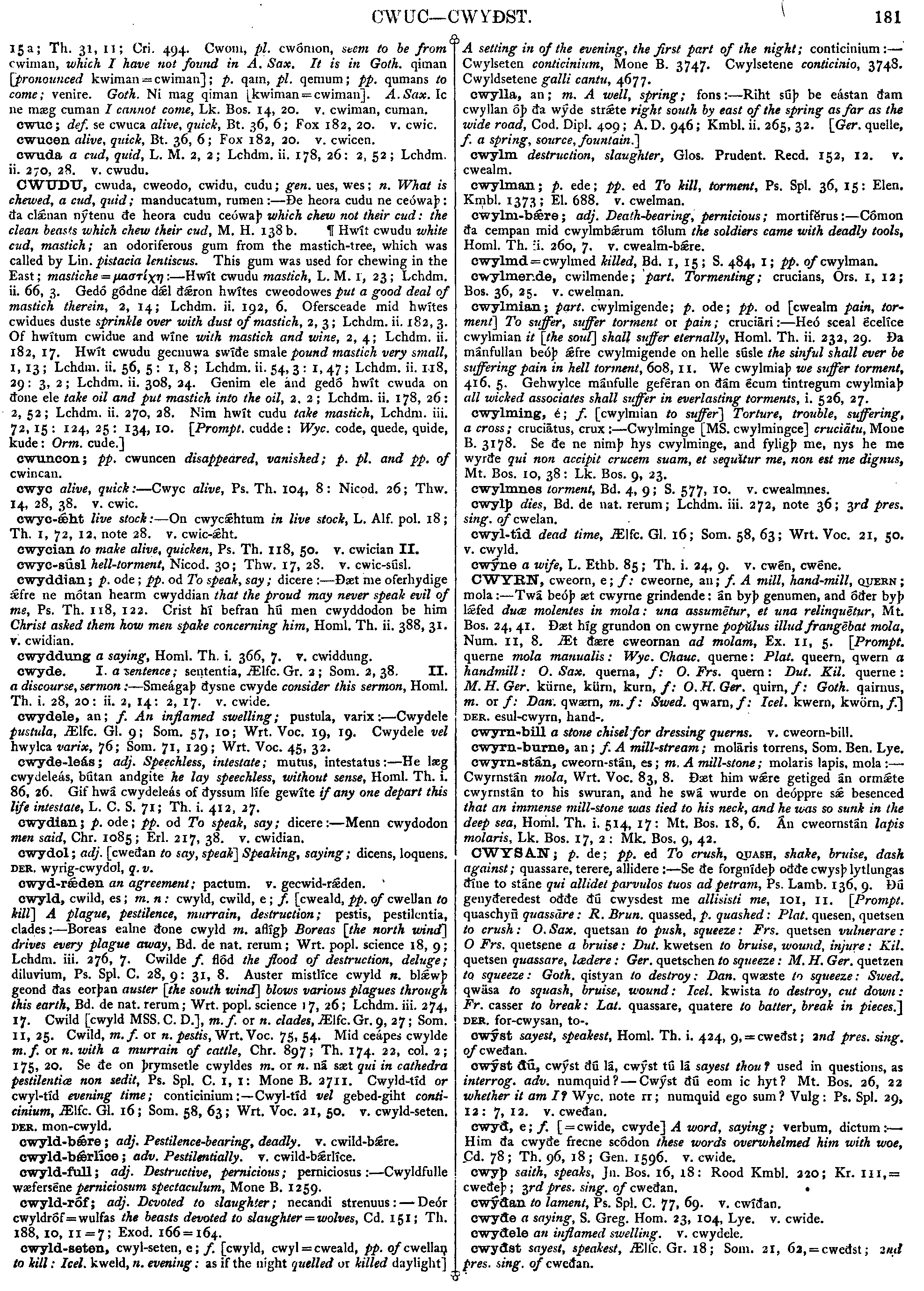
cwyde-leás; adj. Speechless, intestate; mutus, intestatus :-- He læg cwydeleás, bútan andgite he lay speechless, without sense, Homl. Th. i. 86, 26. Gif hwá cwydeleás of ðyssum lífe gewíte if any one depart this life intestate, L. C. S. 71; Th. i. 412, 27.
|
Source: Bosworth/Toller, page b0183, entry 11 View original page image as: [TIFF] [PNG] [View previous entry] [View next entry] |
[Comment on this entry] [View comments] |
The following entry has been hand-corrected once. |
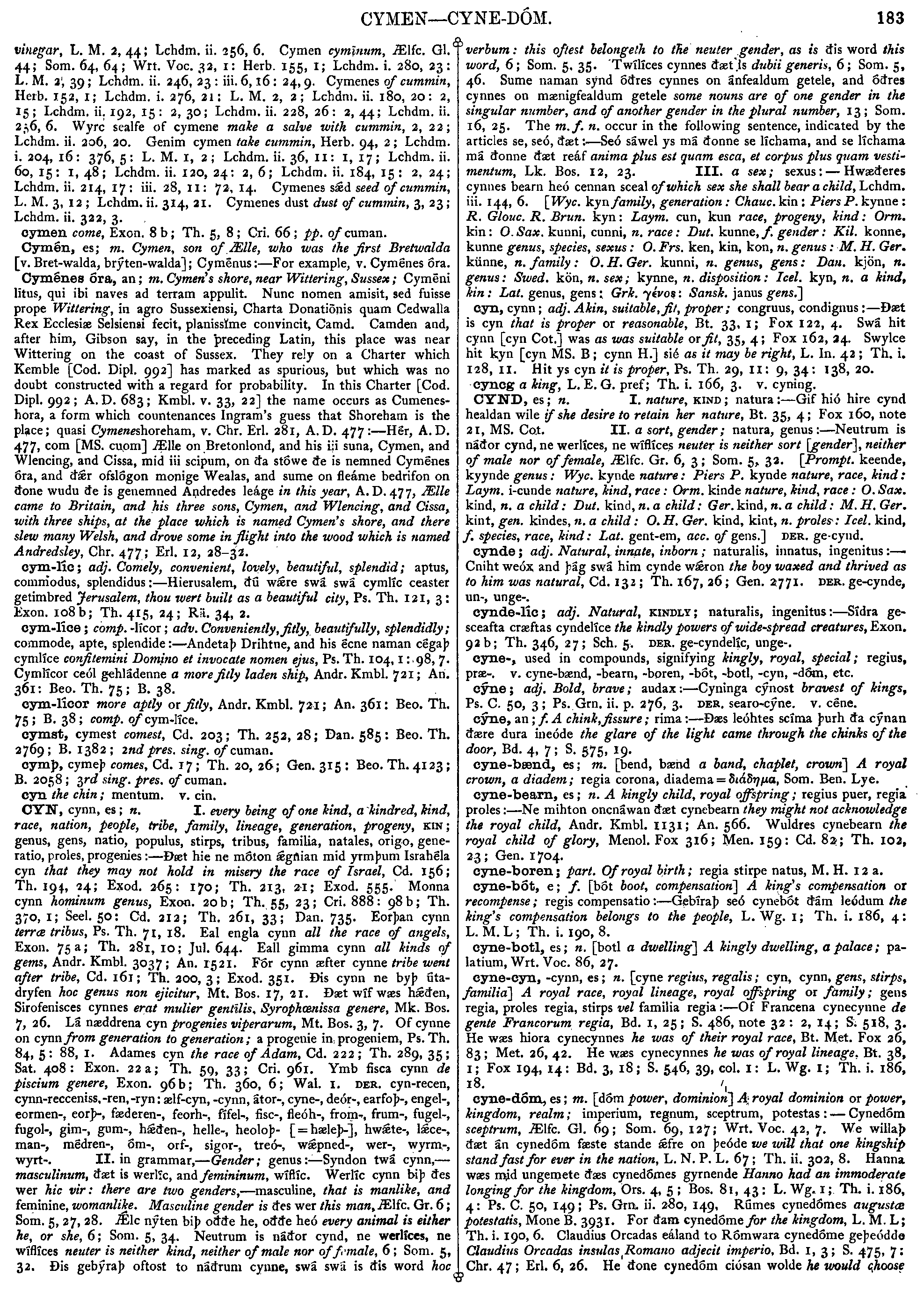
CYN,
cynn,
es;
n.
I.
every
being
of
one
kind,
a
kindred,
kind,
race,
nation,
people,
tribe,
family,
lineage,
generation,
progeny,
KIN;
genus,
gens,
natio,
populus,
stirps,
tribus,
familia,
natales,
origo,
generatio,
proles,
progenies
:--
Ðæt
hie
ne
móton
gnian
mid
yrmþum
Israhéla
cyn
that
they
may
not
hold
in
misery
the
race
of
Israel,
Cd.
156;
Th.
194,
24;
Exod.
265:
170;
Th.
213,
21;
Exod.
555.
Monna
cynn
hominum
genus,
Exon.
20b;
Th.
55,
23;
Cri.
888:
98b;
Th.
370,
1;
Seel.
50:
Cd.
212;
Th.
261,
33;
Dan.
735.
Eorþan
cynn
terræ
tribus,
Ps.
Th.
71,
18.
Eal
engla
cynn
all
the
race
of
angels,
Exon.
75a;
Th.
281,
10;
Jul.
644.
Eall
gimma
cynn
all
kinds
of
gems,
Andr.
Kmbl.
3037;
An.
1521.
Fór
cynn
æfter
cynne
tribe
went
after
tribe,
Cd.
161;
Th.
200,
3;
Exod.
351.
Ðis
cynn
ne
byþ
útadryfen
hoc
genus
non
ejicitur,
Mt.
Bos.
17,
21.
Ðæt
wíf
wæs
hðen,
Sirofenisces
cynnes
erat
mulier
gent lis,
Syrophœnissa
UNCERTAIN
genere,
Mk.
Bos.
7,
26.
Lá
næddrena
cyn
progenies
viperarum,
Mt.
Bos.
3,
7.
Of
cynne
on
cynn
from
generation
to
generation;
a
progenie
in,
progeniem,
Ps.
Th.
84,
5:
88,
1.
Adames
cyn
the
race
of
Adam,
Cd.
222;
Th.
289,
35;
Sat.
408:
Exon.
22a;
Th.
59,
33;
Cri.
961.
Ymb
fisca
cynn
de
piscium
genere,
Exon.
96b;
Th.
360,
6;
Wal.
1.
DER.
cyn-recen,
cynn-recceniss,
-ren,
-ryn:
ælf-cyn,
-cynn,
átor-,
cyne-,
deór-,
earfoþ-,
engel-,
eormen-,
eorþ-,
fæderen-,
feorh-,
fífel-,
fisc-,
fleóh-,
from-,
frum-,
fugel-,
fugol-,
gim-,
gum-,
hðen-,
helle-,
heoloþ-
[
=
hæleþ-],
hwte-,
lce-,
man-,
médren-,
óm-,
orf-,
sigor-,
treó-,
wpned-,
wer-,
wyrm-,
wyrt-.
II.
in
grammar,
--
Gender;
genus
:--
Syndon
twá
cynn,
--
masculinum,
ðæt
is
werlíc,
and
femininum,
wíflíc.
Werlíc
cynn
biþ
ðes
wer
hic
vir:
there
are
two
genders,
--
masculine,
that
is
manlike,
and
feminine,
womanlike.
Masculine
gender
is
ðes
wer
this
man,
Ælfc.
Gr.
6;
Som.
5,
27,
28.
Æ-acute;lc
nýten
biþ
oððe
he,
oððe
heó
every
animal
is
either
he,
or
she,
6;
Som.
5,
34.
Neutrum
is
náðor
cynd,
ne
werlíces,
ne
wíflíces
neuter
is
neither
kind,
neither
of
male
nor
of
female,
6;
Som.
5,
32.
Ðis
gebýraþ
oftost
to
náðrum
cynne,
swá
swá
is
ðis
word
hoc
verbum:
this
oftest
belongeth
to
the
neuter
gender,
as
is
ðis
word
this
word,
6;
Som.
5.
35.
Twílíces
cynnes
ðæt
Is
ILLEGIBLE
dubii
generis,
6;
Som.
5,
46.
Sume
naman
synd
óðres
cynnes
on
ánfealdum
getele,
and
óðres
cynnes
on
mænigfealdum
getele
some
nouns
are
of
one
gender
in
the
singular
number,
and
of
another
gender
in
the
plural
number,
13;
Som.
16,
25.
The
m.
f.
n.
occur
in
the
following
sentence,
indicated
by
the
articles
se,
seó,
ðæt
:--
Seó
sáwel
ys
má
ðonne
se
líchama,
and
se
líchama
má
ðonne
ðæt
reáf
anima
plus
est
guam
esca,
et
corpus
plus
quam
vestimentum,
Lk.
Bos.
12,
23.
III.
a
sex;
sexus
:--
Hwæðeres
cynnes
bearn
heó
cennan
sceal
of
which
sex
she
shall
bear
a
child,
Lchdm.
iii.
144,
6.
[Wyc.
kyn
family,
generation:
Chauc.
kin:
Piers
P.
kynne:
R.
Glouc.
R.
Brun.
kyn:
Laym.
cun,
kun
race,
progeny,
kind:
Orm.
kin:
O.
Sax.
kunni,
cunni,
n.
race:
Dut.
kunne,
f.
gender:
Kil.
konne,
kunne
genus,
species,
sexus:
O.
Frs.
ken,
kin,
kon,
n.
genus:
M.
H.
Ger.
künne,
n.
family:
O.
H.
Ger.
kunni,
n.
genus,
gens:
Dan.
kjön,
n.
genus:
Swed.
kön,
n.
sex;
kynne,
n.
disposition:
Icel.
kyn,
n.
a
kind,
kin:
Lat.
genus,
gens;
Grk.
GREEK
:
Sansk.
janus
gens.]
lis,
Syrophœnissa
UNCERTAIN
genere,
Mk.
Bos.
7,
26.
Lá
næddrena
cyn
progenies
viperarum,
Mt.
Bos.
3,
7.
Of
cynne
on
cynn
from
generation
to
generation;
a
progenie
in,
progeniem,
Ps.
Th.
84,
5:
88,
1.
Adames
cyn
the
race
of
Adam,
Cd.
222;
Th.
289,
35;
Sat.
408:
Exon.
22a;
Th.
59,
33;
Cri.
961.
Ymb
fisca
cynn
de
piscium
genere,
Exon.
96b;
Th.
360,
6;
Wal.
1.
DER.
cyn-recen,
cynn-recceniss,
-ren,
-ryn:
ælf-cyn,
-cynn,
átor-,
cyne-,
deór-,
earfoþ-,
engel-,
eormen-,
eorþ-,
fæderen-,
feorh-,
fífel-,
fisc-,
fleóh-,
from-,
frum-,
fugel-,
fugol-,
gim-,
gum-,
hðen-,
helle-,
heoloþ-
[
=
hæleþ-],
hwte-,
lce-,
man-,
médren-,
óm-,
orf-,
sigor-,
treó-,
wpned-,
wer-,
wyrm-,
wyrt-.
II.
in
grammar,
--
Gender;
genus
:--
Syndon
twá
cynn,
--
masculinum,
ðæt
is
werlíc,
and
femininum,
wíflíc.
Werlíc
cynn
biþ
ðes
wer
hic
vir:
there
are
two
genders,
--
masculine,
that
is
manlike,
and
feminine,
womanlike.
Masculine
gender
is
ðes
wer
this
man,
Ælfc.
Gr.
6;
Som.
5,
27,
28.
Æ-acute;lc
nýten
biþ
oððe
he,
oððe
heó
every
animal
is
either
he,
or
she,
6;
Som.
5,
34.
Neutrum
is
náðor
cynd,
ne
werlíces,
ne
wíflíces
neuter
is
neither
kind,
neither
of
male
nor
of
female,
6;
Som.
5,
32.
Ðis
gebýraþ
oftost
to
náðrum
cynne,
swá
swá
is
ðis
word
hoc
verbum:
this
oftest
belongeth
to
the
neuter
gender,
as
is
ðis
word
this
word,
6;
Som.
5.
35.
Twílíces
cynnes
ðæt
Is
ILLEGIBLE
dubii
generis,
6;
Som.
5,
46.
Sume
naman
synd
óðres
cynnes
on
ánfealdum
getele,
and
óðres
cynnes
on
mænigfealdum
getele
some
nouns
are
of
one
gender
in
the
singular
number,
and
of
another
gender
in
the
plural
number,
13;
Som.
16,
25.
The
m.
f.
n.
occur
in
the
following
sentence,
indicated
by
the
articles
se,
seó,
ðæt
:--
Seó
sáwel
ys
má
ðonne
se
líchama,
and
se
líchama
má
ðonne
ðæt
reáf
anima
plus
est
guam
esca,
et
corpus
plus
quam
vestimentum,
Lk.
Bos.
12,
23.
III.
a
sex;
sexus
:--
Hwæðeres
cynnes
bearn
heó
cennan
sceal
of
which
sex
she
shall
bear
a
child,
Lchdm.
iii.
144,
6.
[Wyc.
kyn
family,
generation:
Chauc.
kin:
Piers
P.
kynne:
R.
Glouc.
R.
Brun.
kyn:
Laym.
cun,
kun
race,
progeny,
kind:
Orm.
kin:
O.
Sax.
kunni,
cunni,
n.
race:
Dut.
kunne,
f.
gender:
Kil.
konne,
kunne
genus,
species,
sexus:
O.
Frs.
ken,
kin,
kon,
n.
genus:
M.
H.
Ger.
künne,
n.
family:
O.
H.
Ger.
kunni,
n.
genus,
gens:
Dan.
kjön,
n.
genus:
Swed.
kön,
n.
sex;
kynne,
n.
disposition:
Icel.
kyn,
n.
a
kind,
kin:
Lat.
genus,
gens;
Grk.
GREEK
:
Sansk.
janus
gens.]
|
Source: Bosworth/Toller, page b0183, entry 26 View original page image as: [TIFF] [PNG] [View previous entry] [View next entry] |
[Comment on this entry] [View comments] |
The following entry has been hand-corrected once. |
cyne-dóm,
es;
m.
[dóm
power,
dominion]
A;
royal
dominion
or
power,
kingdom,
realm;
imperium,
regnum,
sceptrum,
potestas
:--
Cynedóm
sceptrum,
Ælfc.
Gl.
69;
Som.
69,
127;
Wrt.
Voc.
42,
7.
We
willaþ
ðæt
án
cynedóm
fæste
stande
fre
on
þeóde
we
will
that
one
kingship
standfast
for
ever
in
the
nation,
L.
N.
P.
L.
67;
Th.
ii.
302,
8.
Hanna
wæs
mid
ungemete
ðæs
cynedómes
gyrnende
Hanno
had
an
immoderate
longing
for
the
kingdom,
Ors.
4,
5;
Bos.
81,
43:
L.
Wg.
1;
Th.
i.
186,
4:
Ps.
C.
50,
149;
Ps.
Grn.
ii.
280,
149,
Rúmes
cynedómes
augustæ
potestatis,
Mone
B.
3931.
For
ðam
cynedóme
for
the
kingdom,
L.
M.
L;
Th.
i.
190,
6.
Claudius
Orcadas
eáland
to
Rómwara
cynedóme
geþeódde
Claudius
Orcadas
insulas
Romano
adjecit
imperio,
Bd.
1,
3;
S.
475,
7:
Chr.
47;
Erl.
6,
26.
He
ðone
cynedóm
ciósan
wolde
he
would
choose
|
Source: Bosworth/Toller, page b0184, entry 5 View original page image as: [TIFF] [PNG] [View previous entry] [View next entry] |
[Comment on this entry] [View comments] |
The following entry has been hand-corrected once. |
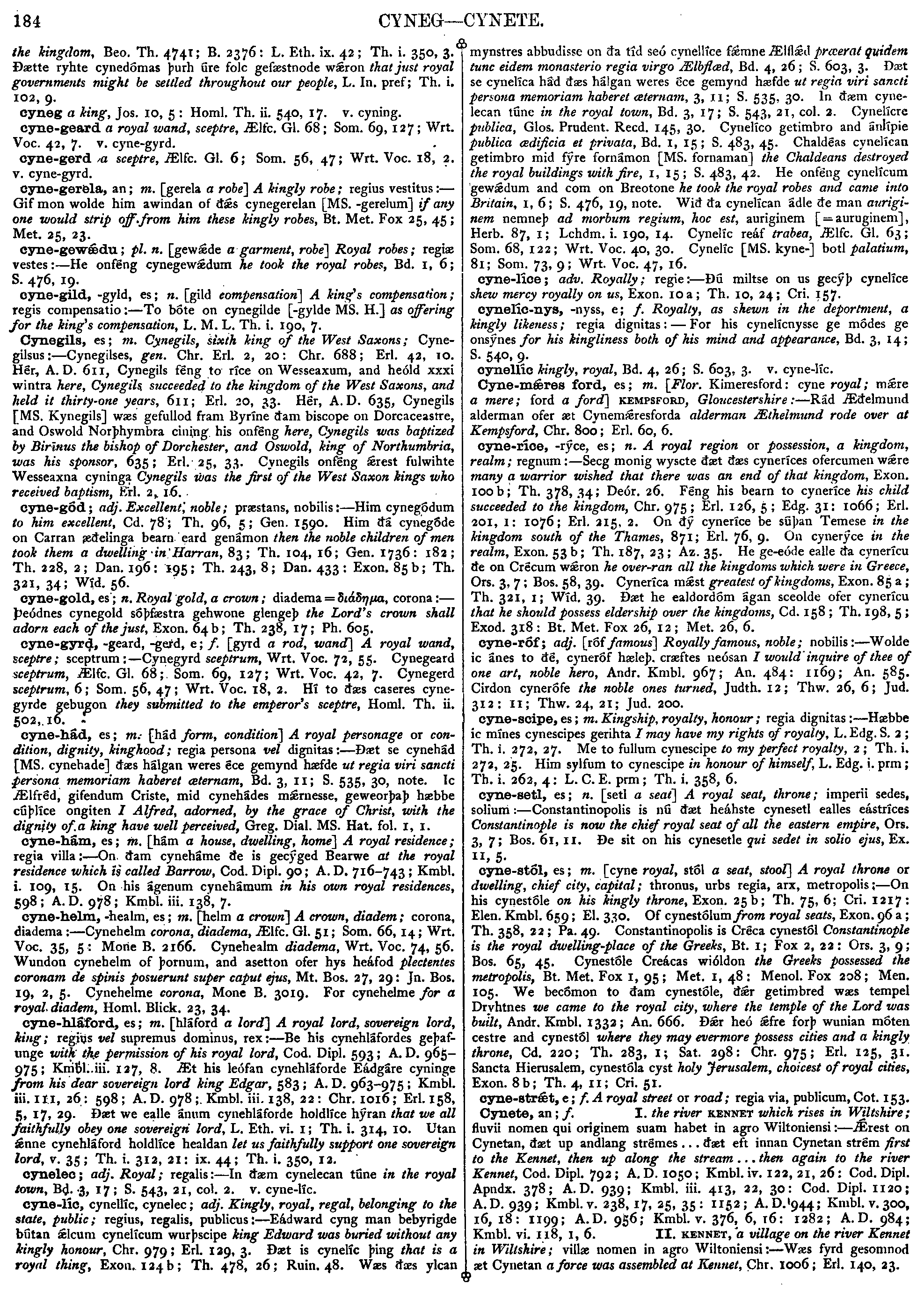
cyne-gerela,
an;
m.
[gerela
a
robe]
A
kingly
robe;
regius
vestitus
:--
Gif
mon
wolde
him
awindan
of
ðs
cynegerelan
[MS.
-gerelum]
if
any
one
would
strip
off
from
him
these
kingly
robes,
Bt.
Met.
Fox
25,
45;
Met.
25,
23.
| Result Page: |  |
Previous | 21 22 23 24 25 26 27 28 29 30 31 32 33 34 35 36 37 38 39 | Next |  |
Germanic Lexicon Project (main page)
This search system was written by
Sean Crist
Please consider
volunteering
to correct the data in these online dictionaries.
No rights reserved. Feel free to use these data in any way you please.