|
|

|
Source: Bosworth/Toller, page d0507, entry 3 View original page image as: [TIFF] [PNG] [View previous entry] [View next entry] |
[Comment on this entry] [View comments] |
The following entry has been hand-corrected once. |
hand-æx, e; f. An axe that could be used with one hand, a hatchet :-- Handæx dextralis (dextralis securis genus, idem quod manuaria, Migne. Cf. Spanish destral a small axe or little hatchet), Wrt. Voc. ii. . 140, 1. [v. N. E. D. hand-ax. Icel. hand-öx.]
|
Source: Bosworth/Toller, page d0507, entry 22 View original page image as: [TIFF] [PNG] [View previous entry] [View next entry] |
[Comment on this entry] [View comments] |
The following entry has been hand-corrected once. |
hand-gewrit.
[The
reference
for
the
last
passage
is
Hml.
Th.
i.
448,
14.]
I.
handwriting,
autograph,
signature
(cf.
N.
E.
D.
hand-writ)
:--
Sóðne
geleáfan
hé
wæs
andettende
and
mid
his
handgewrite
(cum
subscriptione
sua)
getrymede,
Bd.
5,
19;
Sch.
667,
9.
II.
a
document
in
a
person's
own
handwriting
:--
'
Þá
deóflu
habbað
him
on
hande
mín
ágen
handgewryt'
.
.
.
Cóm
se
deófol
.
.
.
þá
cwæð
se
hálga
wer,
'
Wé
clypiað
tó
ðám
H lende
.
.
.
oð
lende
.
.
.
oð
 þú
handgewryt
ágife'.
.
.
Æfter
fyrste
feól
ylce
gewryt
of
þre
lyfte
.
.
.
Se
biscop
áxode
one
cnapan
gif
hé
oncneówe
gewryt.
Hé
cwæð,
'
Ic
oncnáwe
þás
cartar,
UNCERTAIN
þis
ic
sylf
áwrát',
Hml.
S.
3,
423-457.
Drihten
sende
his
ágen
handgewrit
on
Ses
UNCERTAIN
Petrus
heáhaltare
.
.
.
Ðá
wæs
þæt
gewrit
áwriten
mid
gyldenum
stafum,
Wlfst.
212,
3.
þú
handgewryt
ágife'.
.
.
Æfter
fyrste
feól
ylce
gewryt
of
þre
lyfte
.
.
.
Se
biscop
áxode
one
cnapan
gif
hé
oncneówe
gewryt.
Hé
cwæð,
'
Ic
oncnáwe
þás
cartar,
UNCERTAIN
þis
ic
sylf
áwrát',
Hml.
S.
3,
423-457.
Drihten
sende
his
ágen
handgewrit
on
Ses
UNCERTAIN
Petrus
heáhaltare
.
.
.
Ðá
wæs
þæt
gewrit
áwriten
mid
gyldenum
stafum,
Wlfst.
212,
3.
|
Source: Bosworth/Toller, page d0508, entry 4 View original page image as: [TIFF] [PNG] [View previous entry] [View next entry] |
[Comment on this entry] [View comments] |
The following entry has been hand-corrected once. |
hand-hamer. Add: a hammer that can be used with one hand, a small hammer :-- Handhamur malleolus, Wrt. Voc. ii. 58, 1.
|
Source: Bosworth/Toller, page d0508, entry 13 View original page image as: [TIFF] [PNG] [View previous entry] [View next entry] |
[Comment on this entry] [View comments] |
The following entry has been hand-corrected once. |
hand-lín. Substitute: I. a napkin :-- Handlín maniterium, W t. Voc. ii. 56, 47. Handlín (-lind, MS. ) maniteorium, i. 290, 71. II. a maniple, one of the Eucharistic vestments :-- Albe alba, stole stola, sculdorhrægl superhumerale, cæppe planeta, handlín manualis, Wrt. Voc. i. 81, 41-46. Scrýde hine mid superhumerale and mid alban and stolan and handlíne and planétan, MS. Laud. 482, fol. 48 a. [Take here the two instances given in the Dictionary.] Ðonne þú handlín habban wille, ðonne stríc þú mid þínre swýðran handa eclinga ofer þíne wynstran, Tech, ii. 120, 1.
|
Source: Bosworth/Toller, page d0509, entry 8 View original page image as: [TIFF] [PNG] [View previous entry] [View next entry] |
[Comment on this entry] [View comments] |
The following entry has been hand-corrected once. |
hár-wenge.
Add:
grey-bearded
[cf.
wang
(wenge)]
:--
Cóm
sum
hárwencge
manu
(St.
Peter)
intó
þám
cwearterne
.
.
.
þá
cwð
se
hárwencga,
Hml.
S.
8,
131-138.
Sum
geleáfful
bócere
hárwencge
and
eald,
sé
hátte
Eleazarus
(Eleazar,
one
of
the
principal
scribes,
an
aged
man,
and
of
a
well-favoured
countenance,
2
Mace.
UNCERTAIN
vi.
18),
25,
33:
28,
91.
|
Source: Bosworth/Toller, page d0509, entry 18 View original page image as: [TIFF] [PNG] [View previous entry] [View next entry] |
[Comment on this entry] [View comments] |
The following entry has been hand-corrected once. |
hát;
adj.
Add:
I.
having
or
communicating
heat.
(1)
of
the
sun,
atmospheric
conditions,
&c.:--
Seó
háte
sunne
scíneþ,
E.
S.
viii.
478,
82.
Scíneð
sunne
swegle
hát,
Met.
28,
61.
Sceal
eft
cuman
sumor
swegle
hát,
Gn.
Ex.
78.
Se
háta
sumor
drýgþ
and
gearwaþ
sd
and
bléda,
Bt.
39,
13;
F.
234,
14.
Helle
þre
hátan,
Gen.
362.
Hátum
bærnete
torrido
solis
chaumate,
An.
Ox.
3243.
Twégen
dlas
(the
temperate
zones)
náðor
ne
tó
háte
ne
tó
cealde,
Lch.
iii.
260,
25.
Seó
sunne
mid
hyre
hátum
leómum,
252,
5.
Forbærned
hátum
heofoncolum,
Exod.
71.
Sumurlange
dagas
swíðe
háte,
Met.
4,
19.
Swegl
byð
hátost,
Gn.
C.
7.
(2)
of
fire,
or
anything
burning
or
glowing
:--
Líg
.
.
.
hát
ofer
helle,
Gen.
377.
Bryne
.
.
.
hát,
Cri.
1060.
Þone
deópan
grund
þæs
hátan
léges,
Bl.
103,
15.
Betwux
þre
cealdan
eorþan
and
þám
hátan
fýre,
Bt.
334;
F.
128,
38.
Hátum
mearcísene
torrido
(i.
ignito)
cauterio,
Hpt.
Gl.
453,
21.
Gá
hé
tó
þám
hátum
írene,
Ll.
Th.
i.
206,
22:
226,
7.
Wið
þone
hátan
bryne
þe
wealleð
on
helle,
424,
16.
Stæppe
on
hát
col
.
.
.
stæppe
on
swá
hát
swá
hé
hátost
mæge,
Lch.
ii.
124,
6.
Licgað
mé
ymbútan
heardes
írenes
háte
geslægene
(forged
while
the
iron
glowed)
grindlas
greáte,
Gn.
383.
Ær
hé
bl
cure,
háte
heaðowylmas,
B.
2819.
Lége
hátra,
Rä.
41,
57.
Bl,
háttost
heaðowelma,
El.
579.
(3)
of
material
affected
by
sun,
fire,
&c.
:--
Hé
geworhte
ánes
fearres
anlícnesse
of
áre,
tó
ðon
þonne
hit
hát
wre
.
.
.
,
Ors.
1,
12
;
S.
54,
24.
Gif
hit
wæter
sý,
hte
man
hit
oð
hit
hleówe
tó
wylme
.
.
.
hit
swá
hát
sý
swá
wé
r
cwdon,
Ll.
i
226,
13-20.
Wæs
þre
burnan
wælm
heaðofýrum
hát,
B.
2547.
Hé
of
þám
hátum
bæðe
(a
vat
of
boiling
oil)
eóde.
Hml.
Th.
i.
58,
29.
Wel
on
swá
hátum,
hafa
on
múþe
swá
hát
swá
þú
hátost
mæge,
Lch.
ii
50,
15.
Styre
mid
sticcan
gif
þú
háttre
wille,
76,
26.
Innon
ðone
hwær
þá
ðá
hé
háttost
wæs,
Hml.
S.
ix,
107.
(4)
of
the
heat
of
the
body
:--
Wæs
þæt
blód
tó
þæs
hát,
B.
1616.
Hát
heáfodwylm
hot
tears,
El.
1133.
Háte
hleórdropan,
Gú.
1315.
Þæt
blód
gesprang,
hátost
heaðoswáta,
B.
1668.
II.
of
a
person,
having
the
sensation
of
heat
:--
Ic
sceal
þysne
wítes
clom
beoran
beornende
.
.
.
hát
on
helle,
hyhtwillan
leás,
Sat.
159.
II
a.
where
the
sensation
is
caused
by
disease
:--
Þis
sint
tácn
þæs
hátan
magan
ómihtan,
Lch.
ii.
192,
24.
II
b.
of
bodily
conditions
producing
the
sensation
of
heat
:--
Se
ece
of
mínum
earme,
ðr
hé
háttra
wæs
and
byrnendra,
eall
áweg
álded
wæs
dolor
omnis
de
brachio,
ubi
ardentior
inerat,
funditus
ablatus
est,
Bd.
5,
3;
Sch.
566,
10.
III.
denoting
one
of
the
fundamental
qualities
of
elements
and
bodies
in
general
:--
Hwæt
is
heora
(the
four
elements)
lces
gecynd
?
Ðas
fýres
gecynd
is
hát
and
dríe
ignis
calidae
et
aridae
est
naturae,
Angl.
vii.
12,
105.
Be
wambe
missenlicre
gecyndo
.
.
.
Þonne
heó
beð
hátre
gebyrdo
and
gecyndo
.
.
.
Be
hátre
gecyndo
wambe.
Sió
womb
seó
þe
biþ
hátre
gecyndo,
sió
melt
mete
wel,
Lch.
ii.
220,
14-23.
IV.
of
persons
or
their
affections,
actions,
&c.
(1)
having
or
showing
intensity
of
feeling,
ardent,
fervent
:--
Eálá,
wre
hé
ánðer,
oððe
hát,
oððe
ceald,
Past.
445,
36.
Þr
manegum
wæs
hát
æt
heortan
hyge
weallende,
An.
1711.
Wæs
seó
treówlufu
hát
æt
heortan,
Cri.
539.
Him
wæs
geómor
sefa,
hát
æt
heortan
hyge
murnende,
500:
El.
628
:
Gú.
1182.
On
hátum
torrido
(castitatis
ardore),
An.
Ox.
1779.
Hé
gnornsorge
wæg
háte
æt
heortan,
Gú.
1310.
(2)
excited
with
anger,
wrathful,
fierce,
v.
hát-heort
:--
Hordweard
hát
and
hreóhmód
hlw
oft
ymbehwearf,
B.
2296.
Hát
and
heaðogrim,
2691.
Æt
helle
durn
dracan
eardigað
háte
on
hreðre,
Sat.
99:
281.
Is
onbærned
þín
yrre
fýre
hátre,
Ps.
Th.
78,
5.
V.
that
excites
strong
feeling.
(1)
in
a
favourable
sense
exciting
warm
feelings
of
affection,
dear
to
a
person
:--
Mé
hátran
sind
Dryhtnes
dreámas
þonne
þis
deáde
líf
lne
on
londe
dearer
to
me
are
the
joys
of
the
Lord
than
this
mortal
life
and
frail
on
earth,
Seef.
64.
(2)
unfavourable,
causing
pain,
suffering,
&c.,
severe,
violent,
intense
:--
Him
in
gesonc
hát
.
.
.
flacor
flánþracu,
Gú.
1116.
Se
grimma
hungor
ne
se
háta
þurst,
Rä.
44,
3.
Sume
hí
cuwon
heora
gescý
.
.
.
for
ðre
micclan
angsumnysse
ðæs
hátan
hungres,
Hml.
Th.
i.
404,
6.
Hátum
bryne
torrido
(coe nobialis
vitae)
rigore,
An.
Ox.
2705.
Þæt
mé
sorgna
is
hátost
on
hreðre,
Gú.
993.
v.
brand-,
bryne-,
fýr-,
ofer-,
ongemet-,
sunn-,
þurh-,
weall-,
wilm-hát.
nobialis
vitae)
rigore,
An.
Ox.
2705.
Þæt
mé
sorgna
is
hátost
on
hreðre,
Gú.
993.
v.
brand-,
bryne-,
fýr-,
ofer-,
ongemet-,
sunn-,
þurh-,
weall-,
wilm-hát.
|
Source: Bosworth/Toller, page d0510, entry 16 View original page image as: [TIFF] [PNG] [View previous entry] [View next entry] |
[Comment on this entry] [View comments] |
The following entry has been hand-corrected once. |
háw. Kemble says, ' In all probability, a look out, or prospect'; Middendorff compares the word with -hau in German place-names, and takes it to mean a clearing, a place where trees are cut down (cf. heáwan). But perhaps in the one passage where the word occurs hlawe should be read :-- Haec sunt supradictarum uocabula terrarum, aet Uuineshauue (cf. scuccanhlau, 196, 1), C. D. i. 195, 30.
|
Source: Bosworth/Toller, page d0511, entry 3 View original page image as: [TIFF] [PNG] [View previous entry] [View next entry] |
[Comment on this entry] [View comments] |
The following entry has been hand-corrected once. |
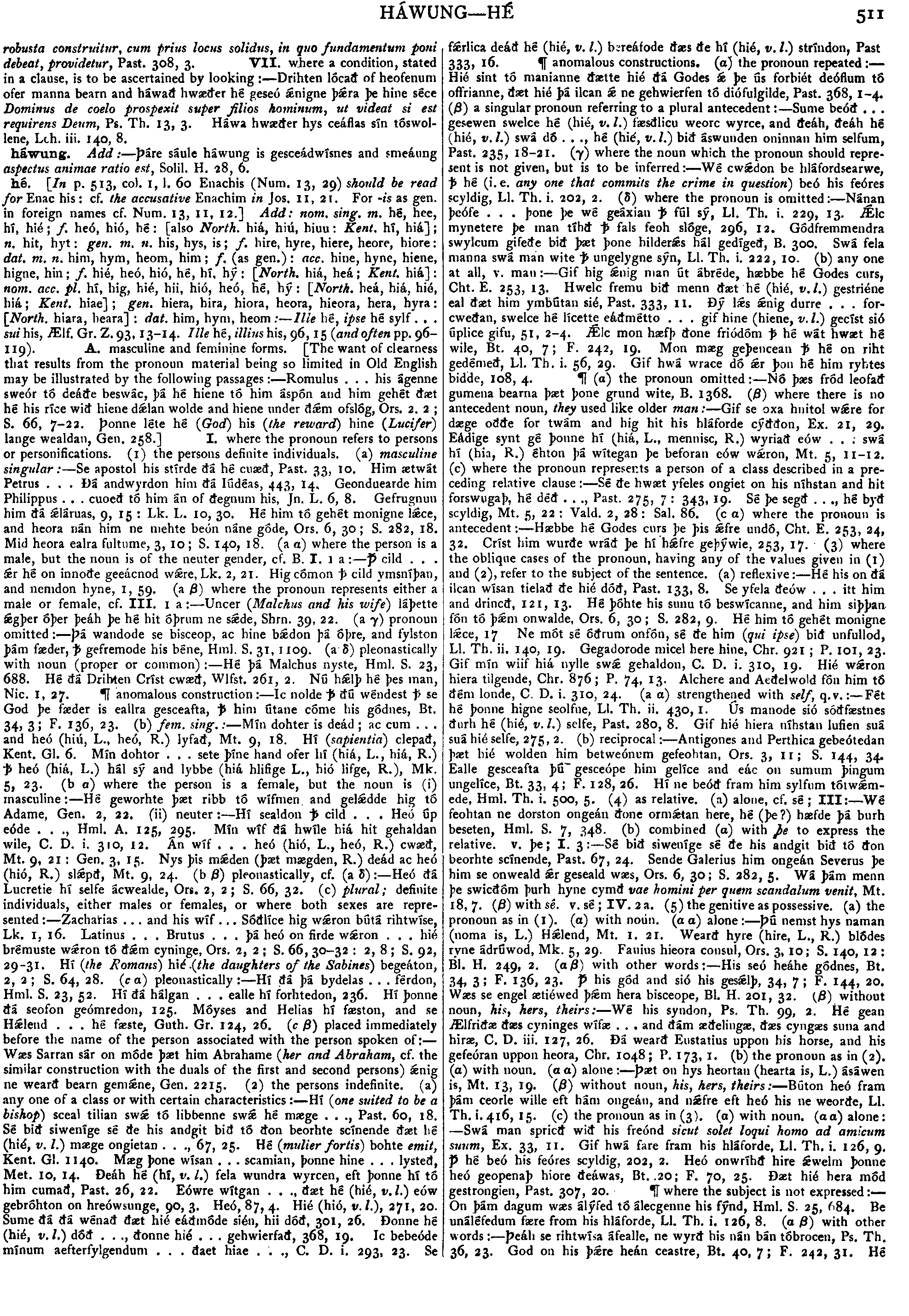
hé.
[In
p.
513,
col.
1.
l.
60
Enachis
(Num.
13,
29)
should
be
read
for
Enac
his:
cf.
the
accusative
Enachim
in
Jos.
11.
21.
For
-is
as
gen.
in
foreign
names
cf.
Num.
13,
11,
12.]
Add:
nom.
sing.
m.
hé,
hee,
hí,
hié;
f.
heó,
hió,
hé:
[also
North,
hiá,
hiú,
hiuu:
Kent.
hí,
hiá];
n.
hit,
hyt:
gen.
m.
n.
his,
hys,
is;
f.
hire,
hyre,
hiere,
heore,
hiore:
dat.
m.
n.
him,
hym,
heom,
him;
f.
(as
gen.):
acc.
hine,
hyne,
hiene,
higne,
hin;
f.
hié,
heó,
hió,
hé,
hí,
hý
:
[North,
hiá,
heá;
Kent.
hiá]
:
nom.
acc.
pl.
hí,
hig,
hié,
hii,
hió,
heó,
hé,
hý:
[North.
heá,
hiá,
hié,
hiá;
Kent,
hiae]
;
gen.
hiera,
hira,
hiora,
heora,
hieora,
hera,
hyra:
[North,
hiara,
heara]
:
dat.
him,
hym,
heom
:--
Ille
hé,
ipse
hé
sylf.
.
.
sui
his,
Ælf.
Gr.
Z.
93,
13-14.
Ille
hé,
illius
his,
96,
15
(and
often
pp.
96-119).
A.
masculine
and
feminine
forms.
[The
want
of
clearness
that
results
from
the
pronoun
material
being
so
limited
in
Old
English
may
be
illustrated
by
the
following
passages
:--
Romulus
.
.
.
his
ágenne
sweór
tó
deáðe
beswác,
þá
hé
hiene
tó
him
áspón
and
him
gehét
ðæt
hé
his
ríce
wið
hiene
dlan
wolde
and
hiene
under
ðm
ofslóg,
Ors.
2.
2
;
S.
66,
7-22.
Þonne
léte
hé
(God)
his
(the
reward)
hine
(Lucifer)
lange
wealdan,
Gen.
258.]
I.
where
the
pronoun
refers
to
persons
or
personifications.
(1)
the
persons
definite
individuals.
(a)
masculine
singular
:
--
Se
apostol
his
stírde
ðá
hé
cuæð,
Past.
33,
10.
Him
ætwát
Petrus
.
.
.
Ða
andwyrdon
him
ðá
Iúdéas,
443,
14.
Geonduearde
him
Philippus
.
.
.
cuoeð
tó
him
án
of
ðegnum
his,
Jn.
L.
6,
8.
Gefrugnun
him
ðá
láruas,
9,
15
:
Lk.
L.
10,
30.
Hé
him
tó
gehét
monigne
lce,
and
heora
nán
him
ne
mehte
beón
náne
góde,
Ors.
6,
30;
S.
282,
18.
Mid
heora
ealra
fultume,
3,
10;
S.
140,
18.
(a
 )
where
the
person
is
a
male,
but
the
noun
is
of
the
neuter
gender,
cf.
B.
I.
1
a
:--
Þ-bar;
cild
.
.
.
r
hé
on
innoðe
geeácnod
wre,
Lk.
2,
21.
Hig
cómon
cild
ymsníþan,
and
nemdon
hyne,
1.
59.
(a
)
where
the
person
is
a
male,
but
the
noun
is
of
the
neuter
gender,
cf.
B.
I.
1
a
:--
Þ-bar;
cild
.
.
.
r
hé
on
innoðe
geeácnod
wre,
Lk.
2,
21.
Hig
cómon
cild
ymsníþan,
and
nemdon
hyne,
1.
59.
(a
 )
where
the
pronoun
represents
either
a
male
or
female,
cf.
III.
1
a
:--
Uncer
(Malchus
and
his
wife)
láþette
gþer
óþer
þeáh
þe
hé
hit
óþrum
ne
sde,
Shrn.
39,
22.
(a
)
where
the
pronoun
represents
either
a
male
or
female,
cf.
III.
1
a
:--
Uncer
(Malchus
and
his
wife)
láþette
gþer
óþer
þeáh
þe
hé
hit
óþrum
ne
sde,
Shrn.
39,
22.
(a
 )
pronoun
omitted
:--
Þá
wandode
se
bisceop,
ac
hine
bdon
þá
óþre,
and
fylston
þám
fæder,
gefremode
his
béne,
Hml.
S.
31,
1109.
(a
)
pronoun
omitted
:--
Þá
wandode
se
bisceop,
ac
hine
bdon
þá
óþre,
and
fylston
þám
fæder,
gefremode
his
béne,
Hml.
S.
31,
1109.
(a
 )
pleonastically
with
noun
(proper
or
common)
:--
Hé
þá
Malchus
nyste,
Hml.
S.
23,
688.
Hé
ðá
Drihten
Críst
cwæð,
Wlfst.
261,
2.
Nú
hlþ
hé
þes
man,
Nic.
1.
27.

anomalous
construction
:--
Ic
nolde
ðu
wéndest
se
God
þe
fæder
is
eallra
gesceafta,
him
útane
cóme
his
gódnes,
Bt.
34,
3;
F.
136,
23.
(b)
fem.
sing.
:--
Mín
dohter
is
deád
;
ac
cum
.
.
.
and
heó
(hiú,
L.,
heó,
R.
)
lyfað,
Mt.
9,
18.
Hí
(sapientia)
clepað,
Kent.
Gl.
6.
Mín
dohtor
.
.
.
sete
þíne
hand
ofer
hí
(hiá,
L.,
hiá,
R.)
heó
(hiá,
L.)
hál
sý
and
lybbe
(hiá
hlifige
L.,
hió
lifge,
R.),
Mk.
5,
23.
(b
)
where
the
person
is
a
female,
but
the
noun
is
(i)
masculine
:--
Hé
geworhte
þæt
ribb
tó
wífmen
and
geldde
hig
tó
Adame,
Gen.
2,
22.
(ii)
neuter
:--
Hí
sealdon
cild
.
.
.
Heó
úp
eóde
.
.
.,
Hml.
A.
125,
295.
Mín
wíf
ðá
hwíle
hiá
hit
gehaldan
wile,
C.
D.
i.
310,
12.
Án
wíf
.
.
.
heó
(hió,
L.,
heó,
R.)
cwæð,
Mt.
9,
21:
Gen.
3,
15.
Nys
þis
mden
(þæt
mægden,
R.)
deád
ac
heó
(hió,
R.)
slpð,
Mt.
9,
24.
(b
)
pleonastically,
cf.
(a
)
:--
Heó
ðá
Lucretie
hi
selfe
ácwealde,
Ors.
2,
2;
S.
66,
32.
(c)
plural;
definite
individuals,
either
males
or
females,
or
where
both
sexes
are
represented
:--
Zacharias
.
.
.
and
his
wíf.
.
.
Sóðlíce
hig
wron
bútá
rihtwíse,
Lk.
1.
16.
Latinus
.
.
.
Brutus
.
.
.
þá
heó
on
firde
wron
.
.
.
hié
brémuste
wron
tó
ðm
cyninge,
Ors.
2,
2
;
S.
66,
30-32
:
2,
8
;
S.
92,
29-31.
Hí
(the
Romans)
hié
(the
daughters
of
the
Sabines)
begeáton,
2,
2;
S.
64,
28.
(c
)
pleonastically
:--
Hí
ðá
þá
bydelas
.
.
.
férdon,
Hml.
S.
23,
52.
Hí
ðá
hálgan
.
.
.
ealle
hí
forhtedon,
236.
Hí
þonne
ðá
seofon
geómredon,
125.
Móyses
and
Helias
hí
fæston,
and
se
Hlend
.
.
.
hé
fæste,
Guth.
Gr.
124,
26.
(c
)
placed
immediately
before
the
name
of
the
person
associated
with
the
person
spoken
of
:--
Wæs
Sarran
sár
on
móde
þæt
him
Abrahame
(her
and
Abraham,
cf.
the
similar
construction
with
the
duals
of
the
first
and
second
persons)
nig
ne
wearð
bearn
gemne,
Gen.
2215.
(2)
the
persons
indefinite.
(a)
any
one
of
a
class
or
with
certain
characteristics
:--
Hí
(one
suited
to
be
a
bishop)
sceal
tilian
sw
tó
libbenne
sw
hé
mæge
.
.
.,
Past.
60,
18.
Sé
bið
siweníge
sé
ðe
his
andgit
bið
tó
ðon
beorhte
scínende
ðæt
hé
(hié,
v.
l.)
mæge
ongietan
.
.
.,
67,
25.
Hé
(mulier
fortis)
bohte
emit,
Kent.
Gl.
1140.
Mæg
þone
wísan
.
.
.
scamian,
þonne
hine
.
.
.
lysteð,
Met.
10,
14.
Ðeáh
hé
(hí,
v.
l.)
fela
wundra
wyrcen,
eft
þonne
hí
tó
him
cumað,
Past.
26,
22.
Eówre
wítgan
.
.
.,
ðæt
hé
(hié,
v.
l.)
eów
gebróhton
on
hreówsunge,
90,
3.
Heó,
87,
4.
Hié
(hió,
v.
l.),
271,
20.
Sume
ðá
ðá
wénað
ðæt
hié
eáðmóde
sién,
hii
dóð,
301,
26.
Ðonne
hé
(hié,
v.
l.)
dóð
.
.
.,
ðonne
hié
.
.
.
gehwierfað,
368,
19.
Ic
bebeóde
mínum
aefterfylgendum
.
.
.
ðaet
hiae
.
.
.,
C.
D.
i.
293,
23.
Se
frlica
deáð
hé
(hié,
v.
l.)
bereáfode
ðæs
ðe
hí
(hié,
v.
l.)
stríndon,
Past
333,
16.

anomalous
constructions.
()
the
pronoun
repeated
:--
Hié
sint
tó
manianne
ðætte
hié
ðá
Godes
þe
ús
forbiét
deóflum
tó
offrianne,
ðæt
hié
þá
ilcan
ne
gehwierfen
tó
diófulgilde,
Past.
368,
1-4.
()
a
singular
pronoun
referring
to
a
plural
antecedent
:--
Sume
beóð
.
.
.
gesewen
swelce
hé
(hié,
v.
l.)
fæsðlicu
weorc
wyrce,
and
ðeáh,
ðeáh
hé
(hié,
v.
l.)
swá
dó
.
.
.,
hé
(hié,
v.
l.)
bið
áswunden
oninnan
him
selfum,
Past.
235,
18-21.
()
where
the
noun
which
the
pronoun
should
represent
is
not
given,
but
is
to
be
inferred
:--
Wé
cwdon
be
hláfordsearwe,
hé
(i.
e.
any
one
that
commits
the
crime
in
question)
beó
his
feóres
scyldig,
Ll.
Th.
i.
202,
2.
()
where
the
pronoun
is
omitted
:--
Nánan
þeófe
.
.
.
þone
þe
wé
geáxian
fúl
sý,
Ll.
Th.
i.
229,
13.
Æ-acute;lc
mynetere
þe
man
tíhð
fals
feoh
slóge,
296,
12.
Gódfremmendra
swylcum
gifeðe
bið
þæt
þone
hilders
hál
gedígeð,
B.
300.
Swá
fela
manna
swá
man
wite
ungelygne
sýn,
Ll.
Th.
i.
222,
10.
(b)
any
one
at
all,
v.
man
:--
Gif
hig
nig
man
út
ábréde,
hæbbe
hé
Godes
curs,
Cht.
E.
253,
13.
Hwelc
fremu
bið
menn
ðæt
hé
(hié,
v.
l.)
gestriéne
eal
ðæt
him
ymbútan
sié.
Past.
333,
11.
Ðý
ls
nig
durre
.
.
.
forcweðan,
swelce
hé
lícette
eáðmétto
.
.
.
gif
hine
(hiene,
v.
l.)
gecíst
sió
úplice
gifu,
51,
2-4.
Æ-acute;lc
mon
hæfþ
ðone
friódóm
hé
wát
hwæt
hé
wile,
Bt.
40,
7;
F.
242,
19.
Mon
mæg
geþencean
hé
on
riht
gedémeð,
Ll.
Th.
i.
56,
29.
Gif
hwá
wrace
dó
r
þon
hé
him
ryhtes
bidde,
108,
4.

()
the
pronoun
omitted
:--
Nó
þæs
fród
leofað
gumena
bearna
þæt
þone
grund
wite,
B.
1368.
()
where
there
is
no
antecedent
noun,
they
used
like
older
man:
--
Gif
se
oxa
hnitol
wre
for
dæge
oððe
for
twám
and
hig
hit
his
hláforde
cýððon,
Ex.
21,
29.
Eádige
synt
gé
þonne
hí
(hiá,
L.,
mennisc,
R.)
wyriað
eów
.
.
.
swá
hí
(hia,
R.)
éhton
þá
wítegan
þe
beforan
eów
wron,
Mt.
5,
11-12.
(c)
where
the
pronoun
represents
a
person
of
a
class
described
in
a
preceding
relative
clause
:--
Sé
ðe
hwæt
yfeles
ongiet
on
his
níhstan
and
hit
forswugaþ,
hé
déð
.
.
.,
Past.
275,
7:
343,
19.
Sé
þe
segð
.
.
.,
hé
byð
scyldig,
Mt.
5,
22
:
Vald.
2,
28
:
Sal.
86.
(c
)
where
the
pronoun
is
antecedent
:--
Hæbbe
hé
Godes
curs
þe
þis
fre
undó,
Cht.
E.
253,
24,
32.
Críst
him
wurðe
wráð
þe
hí
hfre
geþýwie,
253,
17.
(3)
where
the
oblique
cases
of
the
pronoun,
having
any
of
the
values
given
in
(1)
and
(2),
refer
to
the
subject
of
the
sentence.
(a)
reflexive
:--
Hé
his
on
ðá
ilcan
wísan
tielað
ðe
hié
dóð,
Past.
133,
8.
Se
yfela
ðeów
.
.
.
itt
him
and
drincð,
121,
13.
Hé
þohte
his
sunn
tó
beswícanne,
and
him
siþþan
fón
tó
þm
onwalde,
Ors.
6,
30
;
S.
282,
9.
Hé
him
tó
gehét
monigne
lce,
17
ERROR
Ne
mót
sé
óðrum
onfón,
sé
ðe
him
(qui
ipse)
bið
unfullod,
Ll.
Th.
ii.
140,
19.
Gegadorode
micel
here
hine,
Chr.
921;
P.
101,
23.
Gif
mín
wiif
hiá
nylle
sw
gehaldon,
C.
D.
i.
310,
19.
Hié
wron
hiera
tilgende,
Chr.
876;
P.
74,
13.
Alchere
and
Aeðelwold
fón
him
tó
ðém
londe,
C.
D.
i.
310,
24.
(a
)
strengthened
with
self,
q.
v.
:--
Fét
hé
þonne
higne
seolfne,
Ll.
Th.
ii.
430,
1.
Ús
manode
sió
sóðfæstnes
ðurh
hé
(hié,
v.
l.)
selfe,
Past.
280,
8.
Gif
hié
hiera
níhstan
lufien
suá
suá
hié
selfe,
275,
2.
(b)
reciprocal
:--
Antigones
and
Perthica
gebeótedan
þæt
hié
wolden
him
betweónum
UNCERTAIN
gefeohtan,
Ors.
3,
11;
S.
144,
34.
Ealle
gesceafta
þú
gesceópe
him
gelíce
and
eác
on
sumum
þingum
ungelíce,
Bt.
33,
4;
F.
128,
26.
Hí
ne
beóð
fram
him
sylfum
tótwmede,
Hml.
Th.
i.
500,
5.
(4)
as
relative.
(a)
alone,
cf.
sé
;
III
:--
Wé
feohtan
ne
dorston
ongeán
ðone
ormtan
here,
hé
(þe?)
hæfde
þá
burh
beseten,
Hml.
S.
7,
348.
(b)
combined
()
with
þe
to
express
the
relative.
v.
þe;
I.
3
:--
Sé
bið
siweníge
sé
ðe
his
andgit
bið
tó
ðon
beorhte
scínende,
Past.
67,
24.
Sende
Galerius
him
ongeán
Severus
þe
him
se
onweald
r
geseald
wæs,
Ors.
6,
30;
S.
282,
5.
Wá
þám
menn
þe
swicðóm
þurh
hyne
cymð
vae
homini
per
quem
scandalum
venit,
Mt.
18,
7.
()
with
sé.
v.
sé;
IV.
2
a.
(5)
the
genitive
as
possessive.
(a)
the
pronoun
as
in
(1).
()
with
noun,
(
)
alone
:--
Þú
nemst
hys
naman
(noma
is,
L.)
Hlend,
Mt.
1.
21.
Wearð
hyre
(hire,
L.,
R.)
blódes
ryne
ádrúwod,
Mk.
5,
29.
Fauius
hieora
consul,
Ors.
3,
10;
S.
140,
12
:
Bl.
H.
249,
2.
(
)
with
other
words
:--
His
seó
heáhe
gódnes,
Bt.
34,
3;
F.
136,
23.
Þ-bar;
his
gód
and
sió
his
geslþ,
34,
7
;
F.
144,
20.
Wæs
se
engel
ætiéwed
þm
hera
bisceope,
Bl.
H.
201,
32.
()
without
noun,
his,
hers,
theirs
:--
Wé
his
syndon,
Ps.
Th.
99,
2.
Hé
gean
Ælfriðæ
ðæs
cyninges
wífæ
.
.
.
and
ðám
æðelingæ,
ðæs
cyngæs
suna
and
hiræ,
C.
D.
iii.
127,
26.
Ðá
wearð
Eustatius
uppon
his
horse,
and
his
gefeóran
uppon
heora,
Chr.
1048;
P.
173,
1.
(b)
the
pronoun
as
in
(2).
()
with
noun.
(
)
alone
:--
Þæt
on
hys
heortan
(hearta
is,
L.
)
ásáwen
is,
Mt.
13,
19.
()
without
noun,
his,
hers,
theirs
:--
Búton
heó
fram
þám
ceorle
wille
eft
hám
ongeán,
and
nfre
eft
heó
his
ne
weorðe,
Ll.
Th.
i.
416,
15.
(c)
the
pronoun
as
in
(3).
()
with
noun.
(
)
alone:--
Swá
man
spricð
wið
his
freónd
sicut
solet
loqui
homo
ad
amicum
suum,
Ex.
33,
11.
Gif
hwá
fare
fram
his
hláforde,
Ll.
Th.
i.
126,
9.
Þ-bar;
hé
beó
his
feóres
scyldig,
202,
2.
Heó
onwríhð
hire
welm
þonne
heó
geopenaþ
hiore
ðeáwas,
Bt.
.
UNCERTAIN
20;
F.
70,
25.
Ðæt
hié
hera
mód
gestrongien,
Past.
307,
20.

where
the
subject
is
not
expressed:
--
On
þám
dagum
wæs
álýfed
tó
álecgenne
his
fýnd,
Hml.
S.
25,
684.
Be
unáléfedum
fære
from
his
hláforde,
Ll.
Th.
i.
126,
8.
(
)
with
other
words
:--
Þeáh
se
rihtwísa
áfealle,
ne
wyrð
his
nán
bán
tóbrocen,
Ps.
Th.
36,
23.
God
on
his
þre
heán
ceastre,
Bt.
40,
7;
F.
242,
31.
Hé
)
pleonastically
with
noun
(proper
or
common)
:--
Hé
þá
Malchus
nyste,
Hml.
S.
23,
688.
Hé
ðá
Drihten
Críst
cwæð,
Wlfst.
261,
2.
Nú
hlþ
hé
þes
man,
Nic.
1.
27.

anomalous
construction
:--
Ic
nolde
ðu
wéndest
se
God
þe
fæder
is
eallra
gesceafta,
him
útane
cóme
his
gódnes,
Bt.
34,
3;
F.
136,
23.
(b)
fem.
sing.
:--
Mín
dohter
is
deád
;
ac
cum
.
.
.
and
heó
(hiú,
L.,
heó,
R.
)
lyfað,
Mt.
9,
18.
Hí
(sapientia)
clepað,
Kent.
Gl.
6.
Mín
dohtor
.
.
.
sete
þíne
hand
ofer
hí
(hiá,
L.,
hiá,
R.)
heó
(hiá,
L.)
hál
sý
and
lybbe
(hiá
hlifige
L.,
hió
lifge,
R.),
Mk.
5,
23.
(b
)
where
the
person
is
a
female,
but
the
noun
is
(i)
masculine
:--
Hé
geworhte
þæt
ribb
tó
wífmen
and
geldde
hig
tó
Adame,
Gen.
2,
22.
(ii)
neuter
:--
Hí
sealdon
cild
.
.
.
Heó
úp
eóde
.
.
.,
Hml.
A.
125,
295.
Mín
wíf
ðá
hwíle
hiá
hit
gehaldan
wile,
C.
D.
i.
310,
12.
Án
wíf
.
.
.
heó
(hió,
L.,
heó,
R.)
cwæð,
Mt.
9,
21:
Gen.
3,
15.
Nys
þis
mden
(þæt
mægden,
R.)
deád
ac
heó
(hió,
R.)
slpð,
Mt.
9,
24.
(b
)
pleonastically,
cf.
(a
)
:--
Heó
ðá
Lucretie
hi
selfe
ácwealde,
Ors.
2,
2;
S.
66,
32.
(c)
plural;
definite
individuals,
either
males
or
females,
or
where
both
sexes
are
represented
:--
Zacharias
.
.
.
and
his
wíf.
.
.
Sóðlíce
hig
wron
bútá
rihtwíse,
Lk.
1.
16.
Latinus
.
.
.
Brutus
.
.
.
þá
heó
on
firde
wron
.
.
.
hié
brémuste
wron
tó
ðm
cyninge,
Ors.
2,
2
;
S.
66,
30-32
:
2,
8
;
S.
92,
29-31.
Hí
(the
Romans)
hié
(the
daughters
of
the
Sabines)
begeáton,
2,
2;
S.
64,
28.
(c
)
pleonastically
:--
Hí
ðá
þá
bydelas
.
.
.
férdon,
Hml.
S.
23,
52.
Hí
ðá
hálgan
.
.
.
ealle
hí
forhtedon,
236.
Hí
þonne
ðá
seofon
geómredon,
125.
Móyses
and
Helias
hí
fæston,
and
se
Hlend
.
.
.
hé
fæste,
Guth.
Gr.
124,
26.
(c
)
placed
immediately
before
the
name
of
the
person
associated
with
the
person
spoken
of
:--
Wæs
Sarran
sár
on
móde
þæt
him
Abrahame
(her
and
Abraham,
cf.
the
similar
construction
with
the
duals
of
the
first
and
second
persons)
nig
ne
wearð
bearn
gemne,
Gen.
2215.
(2)
the
persons
indefinite.
(a)
any
one
of
a
class
or
with
certain
characteristics
:--
Hí
(one
suited
to
be
a
bishop)
sceal
tilian
sw
tó
libbenne
sw
hé
mæge
.
.
.,
Past.
60,
18.
Sé
bið
siweníge
sé
ðe
his
andgit
bið
tó
ðon
beorhte
scínende
ðæt
hé
(hié,
v.
l.)
mæge
ongietan
.
.
.,
67,
25.
Hé
(mulier
fortis)
bohte
emit,
Kent.
Gl.
1140.
Mæg
þone
wísan
.
.
.
scamian,
þonne
hine
.
.
.
lysteð,
Met.
10,
14.
Ðeáh
hé
(hí,
v.
l.)
fela
wundra
wyrcen,
eft
þonne
hí
tó
him
cumað,
Past.
26,
22.
Eówre
wítgan
.
.
.,
ðæt
hé
(hié,
v.
l.)
eów
gebróhton
on
hreówsunge,
90,
3.
Heó,
87,
4.
Hié
(hió,
v.
l.),
271,
20.
Sume
ðá
ðá
wénað
ðæt
hié
eáðmóde
sién,
hii
dóð,
301,
26.
Ðonne
hé
(hié,
v.
l.)
dóð
.
.
.,
ðonne
hié
.
.
.
gehwierfað,
368,
19.
Ic
bebeóde
mínum
aefterfylgendum
.
.
.
ðaet
hiae
.
.
.,
C.
D.
i.
293,
23.
Se
frlica
deáð
hé
(hié,
v.
l.)
bereáfode
ðæs
ðe
hí
(hié,
v.
l.)
stríndon,
Past
333,
16.

anomalous
constructions.
()
the
pronoun
repeated
:--
Hié
sint
tó
manianne
ðætte
hié
ðá
Godes
þe
ús
forbiét
deóflum
tó
offrianne,
ðæt
hié
þá
ilcan
ne
gehwierfen
tó
diófulgilde,
Past.
368,
1-4.
()
a
singular
pronoun
referring
to
a
plural
antecedent
:--
Sume
beóð
.
.
.
gesewen
swelce
hé
(hié,
v.
l.)
fæsðlicu
weorc
wyrce,
and
ðeáh,
ðeáh
hé
(hié,
v.
l.)
swá
dó
.
.
.,
hé
(hié,
v.
l.)
bið
áswunden
oninnan
him
selfum,
Past.
235,
18-21.
()
where
the
noun
which
the
pronoun
should
represent
is
not
given,
but
is
to
be
inferred
:--
Wé
cwdon
be
hláfordsearwe,
hé
(i.
e.
any
one
that
commits
the
crime
in
question)
beó
his
feóres
scyldig,
Ll.
Th.
i.
202,
2.
()
where
the
pronoun
is
omitted
:--
Nánan
þeófe
.
.
.
þone
þe
wé
geáxian
fúl
sý,
Ll.
Th.
i.
229,
13.
Æ-acute;lc
mynetere
þe
man
tíhð
fals
feoh
slóge,
296,
12.
Gódfremmendra
swylcum
gifeðe
bið
þæt
þone
hilders
hál
gedígeð,
B.
300.
Swá
fela
manna
swá
man
wite
ungelygne
sýn,
Ll.
Th.
i.
222,
10.
(b)
any
one
at
all,
v.
man
:--
Gif
hig
nig
man
út
ábréde,
hæbbe
hé
Godes
curs,
Cht.
E.
253,
13.
Hwelc
fremu
bið
menn
ðæt
hé
(hié,
v.
l.)
gestriéne
eal
ðæt
him
ymbútan
sié.
Past.
333,
11.
Ðý
ls
nig
durre
.
.
.
forcweðan,
swelce
hé
lícette
eáðmétto
.
.
.
gif
hine
(hiene,
v.
l.)
gecíst
sió
úplice
gifu,
51,
2-4.
Æ-acute;lc
mon
hæfþ
ðone
friódóm
hé
wát
hwæt
hé
wile,
Bt.
40,
7;
F.
242,
19.
Mon
mæg
geþencean
hé
on
riht
gedémeð,
Ll.
Th.
i.
56,
29.
Gif
hwá
wrace
dó
r
þon
hé
him
ryhtes
bidde,
108,
4.

()
the
pronoun
omitted
:--
Nó
þæs
fród
leofað
gumena
bearna
þæt
þone
grund
wite,
B.
1368.
()
where
there
is
no
antecedent
noun,
they
used
like
older
man:
--
Gif
se
oxa
hnitol
wre
for
dæge
oððe
for
twám
and
hig
hit
his
hláforde
cýððon,
Ex.
21,
29.
Eádige
synt
gé
þonne
hí
(hiá,
L.,
mennisc,
R.)
wyriað
eów
.
.
.
swá
hí
(hia,
R.)
éhton
þá
wítegan
þe
beforan
eów
wron,
Mt.
5,
11-12.
(c)
where
the
pronoun
represents
a
person
of
a
class
described
in
a
preceding
relative
clause
:--
Sé
ðe
hwæt
yfeles
ongiet
on
his
níhstan
and
hit
forswugaþ,
hé
déð
.
.
.,
Past.
275,
7:
343,
19.
Sé
þe
segð
.
.
.,
hé
byð
scyldig,
Mt.
5,
22
:
Vald.
2,
28
:
Sal.
86.
(c
)
where
the
pronoun
is
antecedent
:--
Hæbbe
hé
Godes
curs
þe
þis
fre
undó,
Cht.
E.
253,
24,
32.
Críst
him
wurðe
wráð
þe
hí
hfre
geþýwie,
253,
17.
(3)
where
the
oblique
cases
of
the
pronoun,
having
any
of
the
values
given
in
(1)
and
(2),
refer
to
the
subject
of
the
sentence.
(a)
reflexive
:--
Hé
his
on
ðá
ilcan
wísan
tielað
ðe
hié
dóð,
Past.
133,
8.
Se
yfela
ðeów
.
.
.
itt
him
and
drincð,
121,
13.
Hé
þohte
his
sunn
tó
beswícanne,
and
him
siþþan
fón
tó
þm
onwalde,
Ors.
6,
30
;
S.
282,
9.
Hé
him
tó
gehét
monigne
lce,
17
ERROR
Ne
mót
sé
óðrum
onfón,
sé
ðe
him
(qui
ipse)
bið
unfullod,
Ll.
Th.
ii.
140,
19.
Gegadorode
micel
here
hine,
Chr.
921;
P.
101,
23.
Gif
mín
wiif
hiá
nylle
sw
gehaldon,
C.
D.
i.
310,
19.
Hié
wron
hiera
tilgende,
Chr.
876;
P.
74,
13.
Alchere
and
Aeðelwold
fón
him
tó
ðém
londe,
C.
D.
i.
310,
24.
(a
)
strengthened
with
self,
q.
v.
:--
Fét
hé
þonne
higne
seolfne,
Ll.
Th.
ii.
430,
1.
Ús
manode
sió
sóðfæstnes
ðurh
hé
(hié,
v.
l.)
selfe,
Past.
280,
8.
Gif
hié
hiera
níhstan
lufien
suá
suá
hié
selfe,
275,
2.
(b)
reciprocal
:--
Antigones
and
Perthica
gebeótedan
þæt
hié
wolden
him
betweónum
UNCERTAIN
gefeohtan,
Ors.
3,
11;
S.
144,
34.
Ealle
gesceafta
þú
gesceópe
him
gelíce
and
eác
on
sumum
þingum
ungelíce,
Bt.
33,
4;
F.
128,
26.
Hí
ne
beóð
fram
him
sylfum
tótwmede,
Hml.
Th.
i.
500,
5.
(4)
as
relative.
(a)
alone,
cf.
sé
;
III
:--
Wé
feohtan
ne
dorston
ongeán
ðone
ormtan
here,
hé
(þe?)
hæfde
þá
burh
beseten,
Hml.
S.
7,
348.
(b)
combined
()
with
þe
to
express
the
relative.
v.
þe;
I.
3
:--
Sé
bið
siweníge
sé
ðe
his
andgit
bið
tó
ðon
beorhte
scínende,
Past.
67,
24.
Sende
Galerius
him
ongeán
Severus
þe
him
se
onweald
r
geseald
wæs,
Ors.
6,
30;
S.
282,
5.
Wá
þám
menn
þe
swicðóm
þurh
hyne
cymð
vae
homini
per
quem
scandalum
venit,
Mt.
18,
7.
()
with
sé.
v.
sé;
IV.
2
a.
(5)
the
genitive
as
possessive.
(a)
the
pronoun
as
in
(1).
()
with
noun,
(
)
alone
:--
Þú
nemst
hys
naman
(noma
is,
L.)
Hlend,
Mt.
1.
21.
Wearð
hyre
(hire,
L.,
R.)
blódes
ryne
ádrúwod,
Mk.
5,
29.
Fauius
hieora
consul,
Ors.
3,
10;
S.
140,
12
:
Bl.
H.
249,
2.
(
)
with
other
words
:--
His
seó
heáhe
gódnes,
Bt.
34,
3;
F.
136,
23.
Þ-bar;
his
gód
and
sió
his
geslþ,
34,
7
;
F.
144,
20.
Wæs
se
engel
ætiéwed
þm
hera
bisceope,
Bl.
H.
201,
32.
()
without
noun,
his,
hers,
theirs
:--
Wé
his
syndon,
Ps.
Th.
99,
2.
Hé
gean
Ælfriðæ
ðæs
cyninges
wífæ
.
.
.
and
ðám
æðelingæ,
ðæs
cyngæs
suna
and
hiræ,
C.
D.
iii.
127,
26.
Ðá
wearð
Eustatius
uppon
his
horse,
and
his
gefeóran
uppon
heora,
Chr.
1048;
P.
173,
1.
(b)
the
pronoun
as
in
(2).
()
with
noun.
(
)
alone
:--
Þæt
on
hys
heortan
(hearta
is,
L.
)
ásáwen
is,
Mt.
13,
19.
()
without
noun,
his,
hers,
theirs
:--
Búton
heó
fram
þám
ceorle
wille
eft
hám
ongeán,
and
nfre
eft
heó
his
ne
weorðe,
Ll.
Th.
i.
416,
15.
(c)
the
pronoun
as
in
(3).
()
with
noun.
(
)
alone:--
Swá
man
spricð
wið
his
freónd
sicut
solet
loqui
homo
ad
amicum
suum,
Ex.
33,
11.
Gif
hwá
fare
fram
his
hláforde,
Ll.
Th.
i.
126,
9.
Þ-bar;
hé
beó
his
feóres
scyldig,
202,
2.
Heó
onwríhð
hire
welm
þonne
heó
geopenaþ
hiore
ðeáwas,
Bt.
.
UNCERTAIN
20;
F.
70,
25.
Ðæt
hié
hera
mód
gestrongien,
Past.
307,
20.

where
the
subject
is
not
expressed:
--
On
þám
dagum
wæs
álýfed
tó
álecgenne
his
fýnd,
Hml.
S.
25,
684.
Be
unáléfedum
fære
from
his
hláforde,
Ll.
Th.
i.
126,
8.
(
)
with
other
words
:--
Þeáh
se
rihtwísa
áfealle,
ne
wyrð
his
nán
bán
tóbrocen,
Ps.
Th.
36,
23.
God
on
his
þre
heán
ceastre,
Bt.
40,
7;
F.
242,
31.
Hé
|
Source: Bosworth/Toller, page d0512, entry 6 View original page image as: [TIFF] [PNG] [View previous entry] [View next entry] |
[Comment on this entry] [View comments] |
The following entry has been hand-corrected once. |
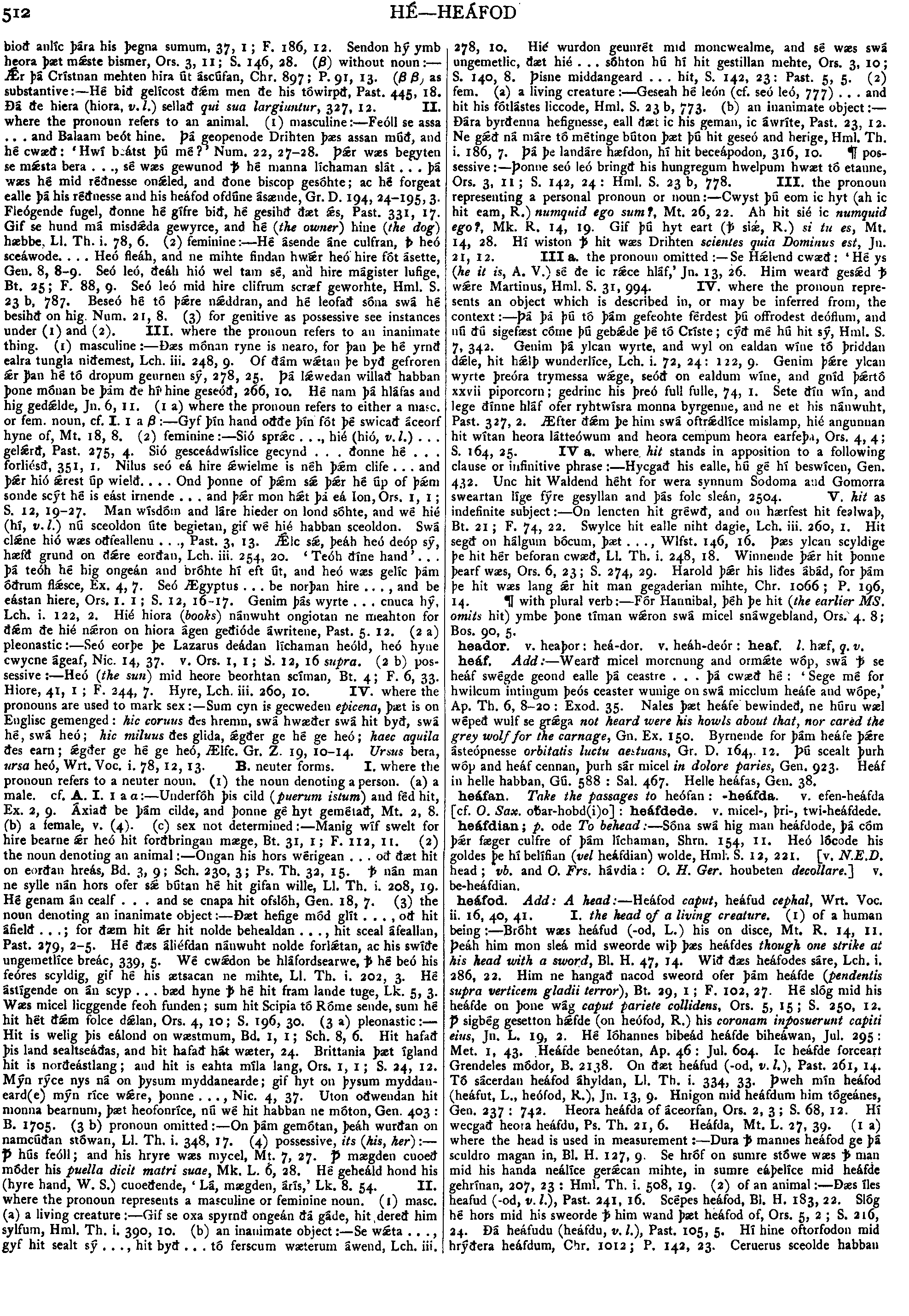
heáfod.
Add:
A
head
:--
Heáfod
caput,
heáfud
cephal,
Wrt.
Voc.
ii.
16,
40,
41.
I.
the
head
of
a
living
creature.
(1)
of
a
human
being
:--
Bróht
wæs
heáfud
(-od,
L.
)
his
on
disce,
Mt.
R.
14,
11.
Þeáh
him
mon
sleá
mid
sweorde
wiþ
þæs
heáfdes
though
one
strike
at
his
head
with
a
sword,
Bl.
H.
47,
14.
Wið
ðæs
heáfodes
sáre,
Lch.
i.
286,
22.
Him
ne
hangað
nacod
sweord
ofer
þám
heáfde
(pendentis
supra
verticem
gladii
terror),
Bt.
29,
1;
F.
102,
27.
Hé
slóg
mid
his
heáfde
on
þone
wág
caput
pariete
collidens,
Ors.
5,
15;
S.
250,
12.
Þ-bar;
sigbég
gesetton
hfde
(on
heófod,
R.
)
his
coronam
inposuerunt
capiti
eius,
Jn.
L.
19,
2.
Hé
Ióhannes
bibeád
heáfde
biheáwan,
Jul.
295
:
Met.
1.
43.
Heáfde
beneótan,
Ap.
46:
Jul.
604.
Ic
heáfde
forceart
Grendeles
módor,
B.
2138.
On
ðæt
heáfud
(-od,
v.
l.),
Past.
261,
14.
Tó
sácerdan
heáfod
áhyldan,
Ll.
Th.
i.
334,
33.
Þweh
mín
heáfod
(heáfut,
L.,
heófod,
R.
),
Jn.
13,
9.
Hnigon
mid
heáfdum
him
tógeánes,
Gen.
237
:
742.
Heora
heáfda
of
áceorfan,
Ors.
2,
3
;
S.
68,
12.
Hí
wecgað
heora
heáfdu,
Ps.
Th.
21,
6.
Heáfda,
Mt.
L.
27,
39.
(1
a)
where
the
head
is
used
in
measurement
:--
Dura
mannes
heáfod
ge
þá
sculdro
magan
in,
Bl.
H.
127,
9.
Se
hróf
on
sumre
stówe
wæs
man
mid
his
handa
neálíce
gercan
mihte,
in
sumre
eáþelíce
mid
heáfde
gehrínan,
207,
23
:
Hml.
Th.
i.
508,
19.
(2)
of
an
animal
:--
Ðæs
íles
heafud
(-od,
v.
l.),
Past.
241,
16.
Scépes
heáfod,
Bl.
H.
183,
22.
Slóg
hé
hors
mid
his
sweorde
him
wand
þæt
heáfod
of,
Ors.
5,
2
;
S.
216,
24.
Ðá
heáfudu
(heáfdu,
v.
l.),
Past.
105,
5.
Hí
hine
oftorfodon
mid
hrýðera
heáfdum,
Chr.
1012;
P.
142,
23.
Ceruerus
sceolde
habban
|
Source: Bosworth/Toller, page d0513, entry 1 View original page image as: [TIFF] [PNG] [View previous entry] [View next entry] |
[Comment on this entry] [View comments] |
The following entry has been hand-corrected once. |
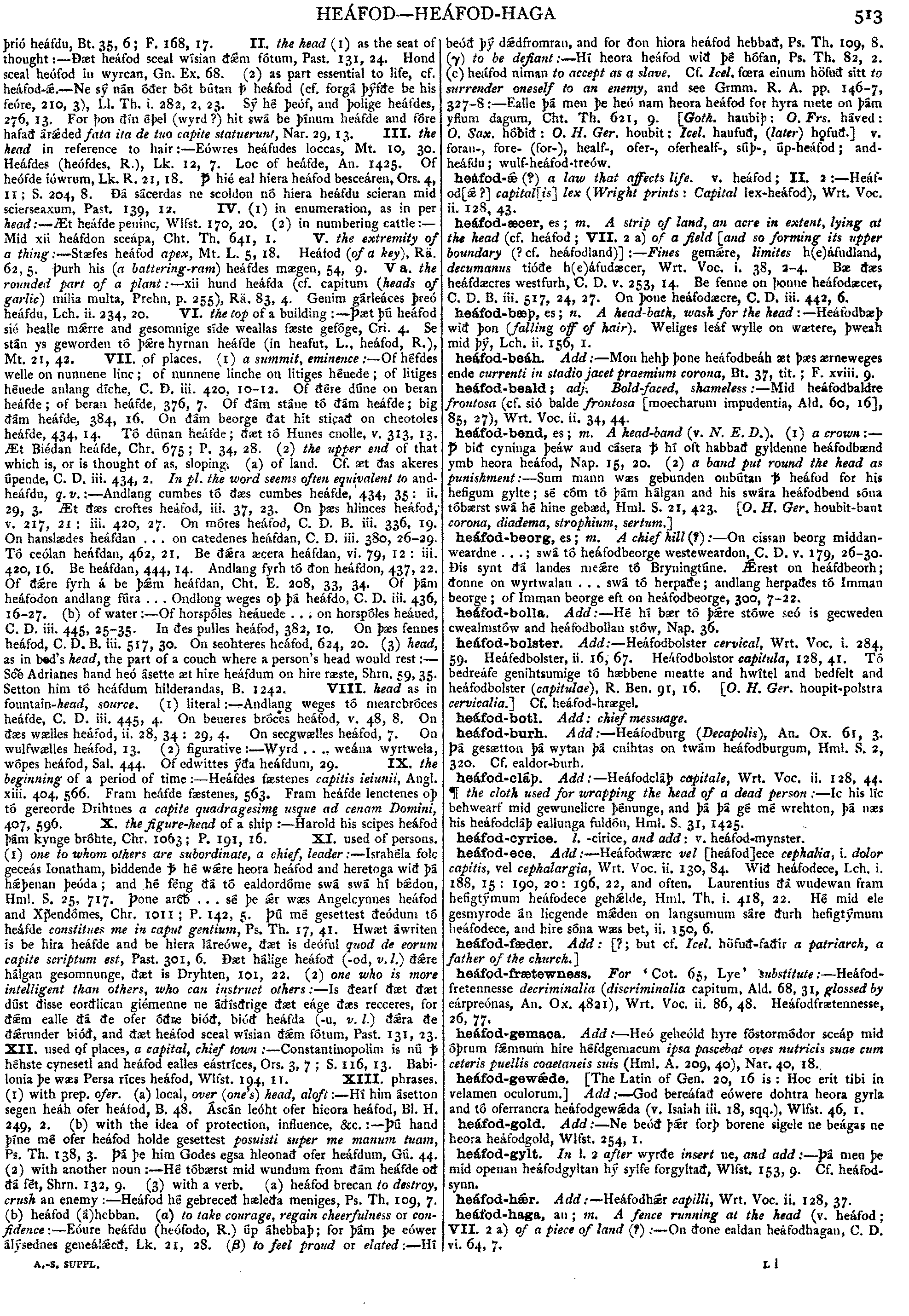
þrió
heáfdu,
Bt.
35,
6;
F.
168,
17.
II.
the
head
(1)
as
the
seat
of
thought
:--
Ðæt
heáfod
sceal
wísian
ðm
fótum,
Past.
131,
24.
Hond
sceal
heófod
in
wyrcan,
Gn.
Ex.
68.
(2)
as
part
essential
to
life,
cf.
heáfod-.
--
Ne
sý
nán
óðer
bót
bútan
heáfod
(cf.
forgá
þýfðe
be
his
feóre,
210,
3),
Ll.
Th.
i.
282,
2,
23.
Sý
hé
þeóf,
and
þolige
heáfdes,
276,
13.
For
þon
ðín
éþel
(wyrd
?)
hit
swá
be
þínum
heáfde
and
fóre
hafað
árded
fata
ita
de
tuo
capite
statuerunt,
Nar.
29,
13.
III.
the
head
in
reference
to
hair
:--
Eówres
heafudes
loccas,
Mt.
10,
30.
Heáfdes
(heófdes,
R.),
Lk.
12,
7.
Loc
of
heáfde,
An.
1425.
Of
heófde
iówrum,
Lk.
R.
21,
18.
Þ-bar;
hié
eal
hiera
heáfod
besceáren,
Ors.
4,
11;
S.
204,
8.
Ða
sácerdas
ne
scoldon
nó
hiera
heáfdu
scieran
mid
scierseaxum,
Past.
139,
12.
IV.
(1)
in
enumeration,
as
in
per
head
:--
Æt
heáfde
peninc,
Wlfst.
170,
20.
(2)
in
numbering
cattle
:--
Mid
xii
heáfdon
sceápa,
Cht.
Th.
641,
1.
V.
the
extremity
of
a
thing
:--
Stæfes
heáfod
apex,
Mt.
L.
5,
18.
Heáfod
(of
a
key),
Rä.
62,
5.
Þurh
his
(a
battering-ram)
heáfdes
mægen,
54,
9.
V
a.
the
rounded
part
of
a
plant
:--
xii
hund
heáfda
(cf.
capitum
(heads
of
garlic)
milia
multa,
Prehn,
p.
255),
Rä.
83,
4.
Genim
gárleáces
þreó
heáfdu,
Lch.
ii.
234,
20.
VI.
the
top
of
a
building
:--
Þæt
þú
heáfod
sié
healle
mrre
and
gesomnige
síde
weallas
fæste
gefóge,
Cri.
4.
Se
stán
ys
geworden
tó
þre
hyrnan
heáfde
(in
heafut,
L.,
heáfod,
R.),
Mt.
21,
42.
VII.
of
places.
(1)
a
summit,
eminence
:--
Of
héfdes
welle
on
nunnene
line;
of
nunnene
linche
on
litiges
héuede
;
of
litiges
héuede
anlang
díche,
C.
D.
iii.
420,
10-12.
Of
ðére
dúne
on
beran
heáfde
;
of
beran
heáfde,
376,
7.
Of
ðám
stáne
tó
ðám
heáfde;
big
ðám
heáfde,
384,
16.
On
ðam
beorge
ðat
hit
sticað
on
cheotoles
heáfde,
434,
14.
Tó
dúnan
heáfde;
ðæt
tó
Hunes
cnolle,
v.
313,
13.
Æt
Biédan
heáfde,
Chr.
675
;
P.
34,
28.
(2)
the
upper
end
of
that
which
is,
or
is
thought
of
as,
sloping.
(a)
of
land.
Cf.
æt
ðas
akeres
úpende,
C.
D.
iii.
434,
2.
In
pl.
the
word
seems
often
equivalent
to
andheáfdu,
q.
v.
:--
Andlang
cumbes
tó
ðæs
cumbes
heáfde,
434,
35
:
ii.
29,
3.
Æt
ðæs
croftes
heáfod,
iii.
37,
23.
On
þæs
hlinces
heáfod,
v.
217,
21
:
iii.
420,
27.
On
móres
heáfod,
C.
D.
B.
iii.
336,
19.
On
hanslædes
heáfdan
.
.
.
on
catedenes
heáfdan,
C.
D.
iii.
380,
26-29.
Tó
ceólan
heáfdan,
462,
21.
Be
ðra
æcera
heáfdan,
vi.
79,
12
:
iii.
420,
16.
Be
heáfdan,
444,
14.
Andlang
fyrh
tó
ðon
heáfdon,
437,
22.
Of
ðre
fyrh
á
be
þm
heáfdan,
Cht.
E.
208,
33,
34.
Of
þám
heáfodon
andlang
fúra
.
.
.
Ondlong
weges
oþ
þá
heáfdo,
C.
D.
iii.
436,
16-27.
(b)
of
water
:--
Of
horspóles
heáuede
.
.
.
on
horspóles
heáued,
C.
D.
iii.
445,
25-35.
In
ðes
pulles
heáfod,
382,
10.
On
þæs
fennes
heáfod,
C.
D.
B.
iii.
517,
30.
On
seohteres
heáfod,
624,
20.
(3)
head,
as
in
bed's
head,
the
part
of
a
couch
where
a
person's
head
would
rest
:--
Sce
UNCERTAIN
Adrianes
hand
heó
ásette
æt
hire
heáfdum
on
hire
ræste,
Shrn.
59,
35.
Setton
him
tó
heáfdum
hilderandas,
B.
1242.
VIII.
head
as
in
fountain-head,
source.
(1)
literal
:--
Andlang
weges
tó
mearcbróces
heáfde,
C.
D.
iii.
445,
4.
On
beueres
bróces
heáfod,
v.
48,
8.
On
ðæs
wælles
heáfod,
ii.
28,
34
:
29,
4.
On
secgwælles
heáfod,
7.
On
wulfwælles
heáfod,
13.
(2)
figurative
:--
Wyrd
.
.
.,
weána
wyrtwela,
wópes
heáfod,
Sal.
444.
Of
edwittes
ýða
heáfdum,
29.
IX.
the
beginning
of
a
period
of
time
:--
Heáfdes
fæstenes
capitis
ieiunii,
Angl.
xiii.
404,
566.
Fram
heáfde
fæstenes,
563.
Fram
heáfde
lenctenes
oþ
tó
gereorde
Drihtnes
a
capite
quadragesim usque
ad
cenam
Domini,
407,
596.
X.
the
figure-head
of
a
ship
:--
Harold
his
scipes
heáfod
þám
kynge
bróhte,
Chr.
1063;
P.
191,
16.
XI.
used
of
persons.
(1)
one
to
whom
others
are
subordinate,
a
chief,
leader
:--
Israhéla
folc
geceás
Ionatham,
biddende
hé
wre
heora
heáfod
and
heretoga
wið
þá
hþenan
þeóda
;
and
hé
féng
ðá
tó
ealdordóme
swá
swá
hí
bdon,
Hml.
S.
25,
717.
Þone
arcb
UNCERTAIN
.
.
.
sé
þe
r
wæs
Angelcynnes
heáfod
and
Xpendómes,
UNCERTAIN
Chr.
1011;
P.
142,
5.
Þú
mé
gesettest
ðeódum
tó
heáfde
constitues
me
in
caput
gentium,
Ps.
Th.
17,
41.
Hwæt
áwriten
is
be
hira
heáfde
and
be
hiera
láreówe,
ðæt
is
deóful
quod
de
eorum
capite
scriptum
est,
Past.
301,
6.
Ðæt
hálige
heáfoð
(-od,
v.
l.)
ðre
hálgan
gesomnunge,
ðæt
is
Dryhten,
101,
22.
(2)
one
who
is
more
intelligent
than
others,
who
can
instruct
others
:--
Is
ðearf
ðæt
ðæt
dúst
ðisse
eorðlican
giémenne
ne
áðísðrige
ðæt
eáge
ðæs
recceres,
for
ðm
ealle
ðá
ðe
ofer
óðre
bióð,
bióð
heáfda
(-u,
v.
l.)
ðra
ðe
ðrunder
bióð,
and
ðæt
heáfod
sceal
wísian
ðm
fótum,
Past.
131,
23.
XII.
used
of
places,
a
capital,
chief
town
:--
Constantinopolim
is
nú
héhste
cynesetl
and
heáfod
ealles
eástríces,
Ors.
3,
7
;
S.
116,
13.
Babilonia
þe
wæs
Persa
ríces
heáfod,
Wlfst.
194,
11.
XIII.
phrases.
(1)
with
prep.
ofer.
(a)
local,
over
(
one's)
head,
aloft
:--
Hí
him
ásetton
segen
heáh
ofer
heáfod,
B.
48.
Áscán
leóht
ofer
hieora
heáfod,
Bl.
H.
249,
2.
(b)
with
the
idea
of
protection,
influence,
&c.:--
Þú
hand
þíne
mé
ofer
heáfod
holde
gesettest
posuisti
super
me
manum
tuam,
Ps.
Th.
138,
3.
Þá
þe
him
Godes
egsa
hleonað
ofer
heáfdum,
Gú.
44.
(2)
with
another
noun
:--
Hé
tóbærst
mid
wundum
from
ðám
heáfde
oð
ðá
fét,
Shrn.
132,
9.
(3)
with
a
verb.
(a)
heáfod
brecan
to
destroy,
crush
an
enemy
:--
Heáfod
hé
gebreceð
hæleða
meniges,
Ps.
Th.
109,
7.
(b)
heáfod
(á)hebban.
()
to
take
courage,
regain
cheerfulness
or
confidence
:--
Eóure
heáfdu
(heófodo,
R.)
úp
áhebbaþ;
for
þám
þe
eówer
álýsednes
geneálcð,
Lk.
21,
28.
()
to
feel
proud
or
elated
:--
Hí
beóð
þý
ddfromran,
and
for
ðon
hiora
heáfod
hebbað,
Ps.
Th.
109,
8.
()
to
be
defiant
:--
Hí
heora
heáfod
wið
þé
hófan,
Ps.
Th.
82,
2.
(c)
heáfod
niman
to
accept
as
a
slave.
Cf.
Icel.
fœra
einum
höfuð
sitt
to
surrender
oneself
to
an
enemy,
and
see
Grmm.
R.
A.
pp.
146-7,
327-8
:--
Ealle
þá
men
þe
heó
nam
heora
heáfod
for
hyra
mete
on
þám
yflum
dagum,
Cht.
Th.
621,
9.
[Goth.
haubif:
O.
Frs.
háved:
O.
Sax.
hóbið:
O.
H.
Ger.
houbit:
Icel.
haufuð,
(later)
h
usque
ad
cenam
Domini,
407,
596.
X.
the
figure-head
of
a
ship
:--
Harold
his
scipes
heáfod
þám
kynge
bróhte,
Chr.
1063;
P.
191,
16.
XI.
used
of
persons.
(1)
one
to
whom
others
are
subordinate,
a
chief,
leader
:--
Israhéla
folc
geceás
Ionatham,
biddende
hé
wre
heora
heáfod
and
heretoga
wið
þá
hþenan
þeóda
;
and
hé
féng
ðá
tó
ealdordóme
swá
swá
hí
bdon,
Hml.
S.
25,
717.
Þone
arcb
UNCERTAIN
.
.
.
sé
þe
r
wæs
Angelcynnes
heáfod
and
Xpendómes,
UNCERTAIN
Chr.
1011;
P.
142,
5.
Þú
mé
gesettest
ðeódum
tó
heáfde
constitues
me
in
caput
gentium,
Ps.
Th.
17,
41.
Hwæt
áwriten
is
be
hira
heáfde
and
be
hiera
láreówe,
ðæt
is
deóful
quod
de
eorum
capite
scriptum
est,
Past.
301,
6.
Ðæt
hálige
heáfoð
(-od,
v.
l.)
ðre
hálgan
gesomnunge,
ðæt
is
Dryhten,
101,
22.
(2)
one
who
is
more
intelligent
than
others,
who
can
instruct
others
:--
Is
ðearf
ðæt
ðæt
dúst
ðisse
eorðlican
giémenne
ne
áðísðrige
ðæt
eáge
ðæs
recceres,
for
ðm
ealle
ðá
ðe
ofer
óðre
bióð,
bióð
heáfda
(-u,
v.
l.)
ðra
ðe
ðrunder
bióð,
and
ðæt
heáfod
sceal
wísian
ðm
fótum,
Past.
131,
23.
XII.
used
of
places,
a
capital,
chief
town
:--
Constantinopolim
is
nú
héhste
cynesetl
and
heáfod
ealles
eástríces,
Ors.
3,
7
;
S.
116,
13.
Babilonia
þe
wæs
Persa
ríces
heáfod,
Wlfst.
194,
11.
XIII.
phrases.
(1)
with
prep.
ofer.
(a)
local,
over
(
one's)
head,
aloft
:--
Hí
him
ásetton
segen
heáh
ofer
heáfod,
B.
48.
Áscán
leóht
ofer
hieora
heáfod,
Bl.
H.
249,
2.
(b)
with
the
idea
of
protection,
influence,
&c.:--
Þú
hand
þíne
mé
ofer
heáfod
holde
gesettest
posuisti
super
me
manum
tuam,
Ps.
Th.
138,
3.
Þá
þe
him
Godes
egsa
hleonað
ofer
heáfdum,
Gú.
44.
(2)
with
another
noun
:--
Hé
tóbærst
mid
wundum
from
ðám
heáfde
oð
ðá
fét,
Shrn.
132,
9.
(3)
with
a
verb.
(a)
heáfod
brecan
to
destroy,
crush
an
enemy
:--
Heáfod
hé
gebreceð
hæleða
meniges,
Ps.
Th.
109,
7.
(b)
heáfod
(á)hebban.
()
to
take
courage,
regain
cheerfulness
or
confidence
:--
Eóure
heáfdu
(heófodo,
R.)
úp
áhebbaþ;
for
þám
þe
eówer
álýsednes
geneálcð,
Lk.
21,
28.
()
to
feel
proud
or
elated
:--
Hí
beóð
þý
ddfromran,
and
for
ðon
hiora
heáfod
hebbað,
Ps.
Th.
109,
8.
()
to
be
defiant
:--
Hí
heora
heáfod
wið
þé
hófan,
Ps.
Th.
82,
2.
(c)
heáfod
niman
to
accept
as
a
slave.
Cf.
Icel.
fœra
einum
höfuð
sitt
to
surrender
oneself
to
an
enemy,
and
see
Grmm.
R.
A.
pp.
146-7,
327-8
:--
Ealle
þá
men
þe
heó
nam
heora
heáfod
for
hyra
mete
on
þám
yflum
dagum,
Cht.
Th.
621,
9.
[Goth.
haubif:
O.
Frs.
háved:
O.
Sax.
hóbið:
O.
H.
Ger.
houbit:
Icel.
haufuð,
(later)
h fuð.]
v.
foran-,
fore-
(for-),
healf-,
ofer-,
oferhealf-,
súþ-,
úp-heáfod;
and-heáfdu;
wulf-heáfod-treów.
fuð.]
v.
foran-,
fore-
(for-),
healf-,
ofer-,
oferhealf-,
súþ-,
úp-heáfod;
and-heáfdu;
wulf-heáfod-treów.
| Result Page: |  |
Previous | 184 185 186 187 188 189 190 191 192 193 194 195 196 197 198 199 200 201 202 | Next |  |
Germanic Lexicon Project (main page)
This search system was written by
Sean Crist
Please consider
volunteering
to correct the data in these online dictionaries.
No rights reserved. Feel free to use these data in any way you please.