|
|

|
Source: Cleasby/Vigfusson, page b0408, entry 12 View original page image as: [TIFF] [PNG] [View previous entry] [View next entry] |
[Comment on this entry] [View comments] |
The following entry has not been hand-corrected. However, the page is reserved and someone is correcting it. |
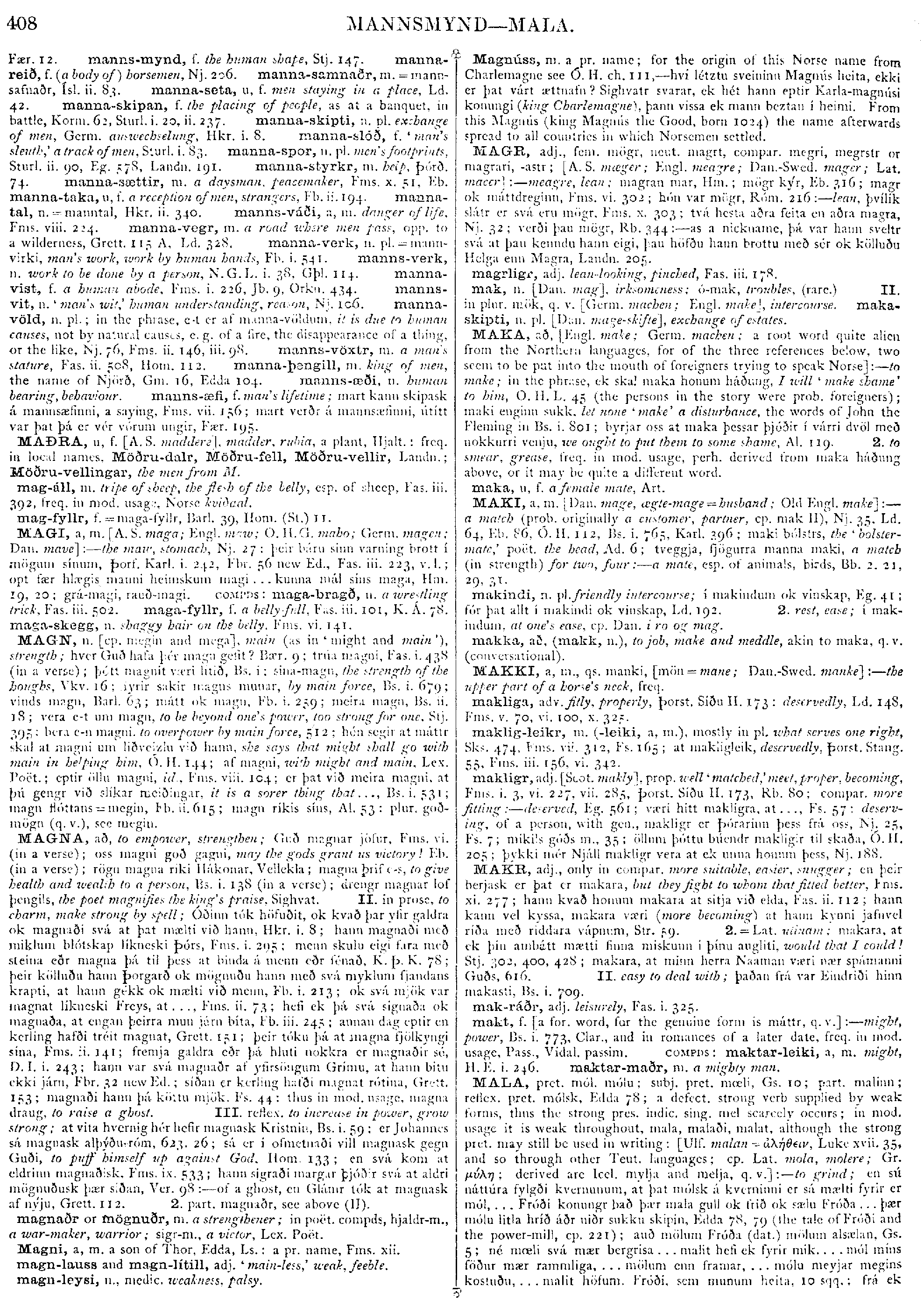
Magnúss, m. a pr. name; for the origin of this Norse name from Charlemagne see 0. H. ch. ill, -- hví létztu sveininn Magnus heita, ekki er þat várt ættnafn ? Sighvatr svarar, ek hot hann eplir Karla-rnagnusi konungi (king Charlemagne), þann vissa ek mann bezîan í heimi. From this Magnus (king Magmis the Good, born 1024) the name afterwards spread to all countries in which Norsemen settled.
|
Source: Cleasby/Vigfusson, page b0417, entry 23 View original page image as: [TIFF] [PNG] [View previous entry] [View next entry] |
[Comment on this entry] [View comments] |
The following entry has been hand-corrected once. |
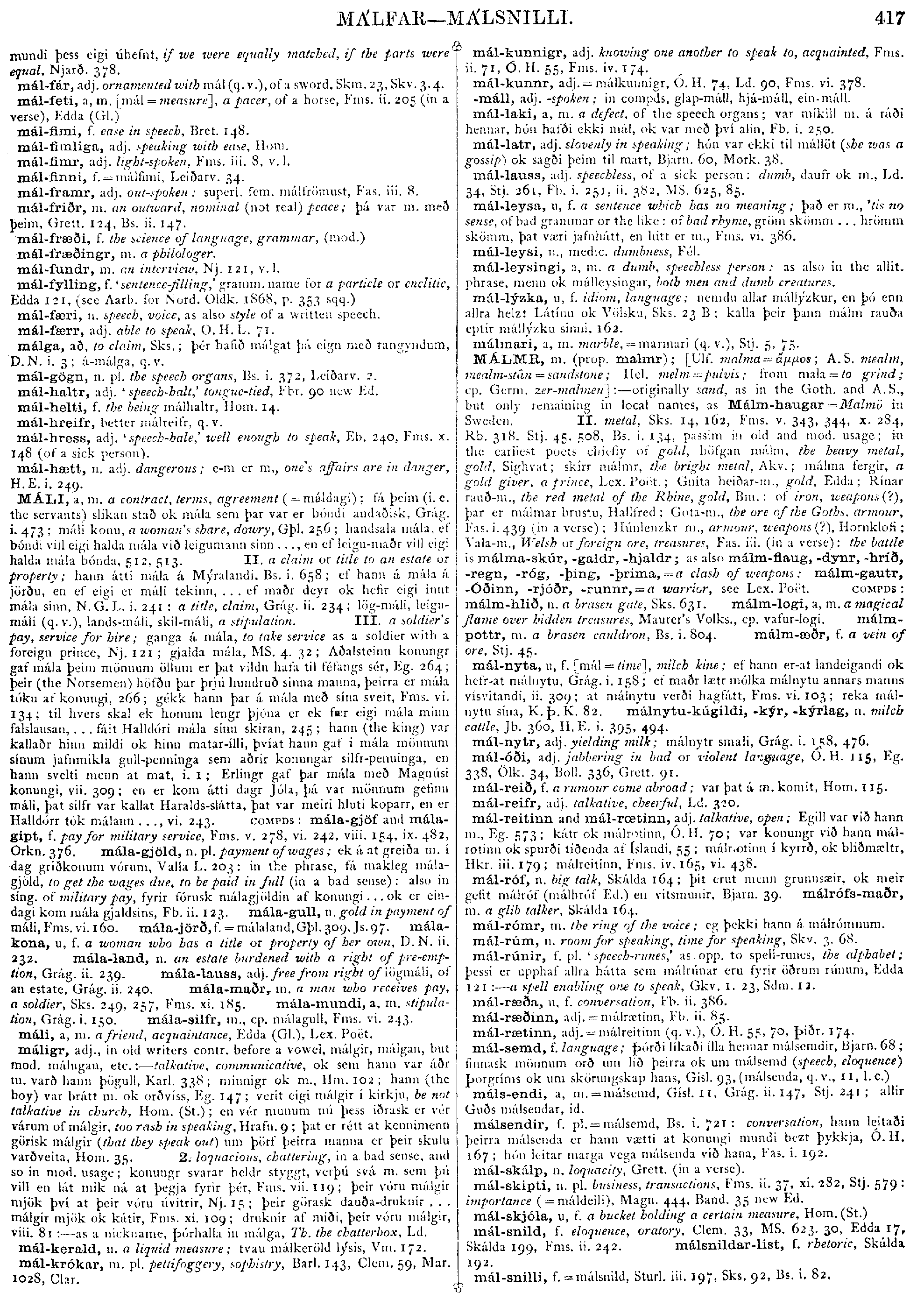
MÁLI, a, m. a contract, terms, agreement (= máldagi): fá þeim (i.e. the servants) slíkan stað ok mála sem þar var er bóndi andaðisk, Grág. i. 473; máli konu, a woman's share, dowry, Gþl. 256; handsala mála, ef bóndi vill eigi halda mála við leigumann sinn ..., en ef leigu-maðr vill eigi halda mála bónda, 512, 513. II. a claim or title to an estate or property; hann átti mála á Mýralandi, Bs. i. 658; ef hann á mála á jörðu, en ef eigi er máli tekinn, ... of maðr deyr ok hefir eigi innt mála sinn, N.G.L. i. 241: a title, claim, Grág. ii. 234; lög-máli, leign-máli (q.v.), lands-máli, skil-máli, a stipulation. III. a soldier's pay, service for hire; ganga á mála, to take service as a soldier with a foreign prince, Nj. 121; gjalda mála, MS. 4. 32; Aðalsteinn konungr gaf mála þeim mönnum öllum er þat vildu hafa til féfangs sér, Eg. 264; þeir (the Norsemen) höfðu þar þrjú hundruð sinna manna, þeirra er mála tóku af konungi, 266; gékk hann þar á mála með sína sveit, Fms. vi. 134; til hvers skal ek honum lengr þjóna er ek fær eigi mála minn falslausan, ... fáit Halldóri mála sinn skíran, 245; hann (the king) var kallaðr hinn mildi ok hinn matar-ílli, þvíat hann gaf í mála mönnum sínum jafnmikla gull-penninga sem aðrir konungar silfr-penninga, en hann svelti menn at mat, i. 1; Erlingr gaf þar mála með Magnúsi konungi, vii. 309; en er kom átti dagr Jóla, þá var mönnum gefinn máli, þat silfr var kallat Haralds-slátta, þat var meiri hluti koparr, en er Halldórr tók málann ..., vi. 243. COMPDS: mála-gjöf and mála-gipt, f. pay for military service, Fms. v. 278, vi. 242, viii. 154, ix. 482, Orkn. 376. mála-gjöld, n. pl. payment of wages; ek á at greiða m. í dag griðkonum vórum, Valla L. 203: in the phrase, fá makleg málagjöld, to get the wages due, to be paid in full (in a bad sense): also in sing. of military pay, fyrir fórusk málagjöldin af konungi ... ok er ein-dagi kom mála gjaldsins, Fb. ii. 123. mála-gull, n. gold in payment of máli, Fms. vi. 160. mála-jörð, f. = málaland, Gþl. 309, Js. 97. mála-kona, u, f. a woman who has a title or property of her own, D.N. ii. 232. mála-land, n. an estate burdened with a right of pre-emption, Grág. ii. 239. mala-lauss, adj. free from right of lögmáli, of an estate, Grág. ii. 240. mála-maðr, m. a man who receives pay, a soldier, Sks. 249, 257, Fms. xi. 185. mála-mundi, a, m. stipulation, Grág. i. 150. mála-silfr, m., cp. málagull, Fms. vi. 243.
|
Source: Cleasby/Vigfusson, page b0439, entry 18 View original page image as: [TIFF] [PNG] [View previous entry] [View next entry] |
[Comment on this entry] [View comments] |
The following entry has been hand-corrected once. |
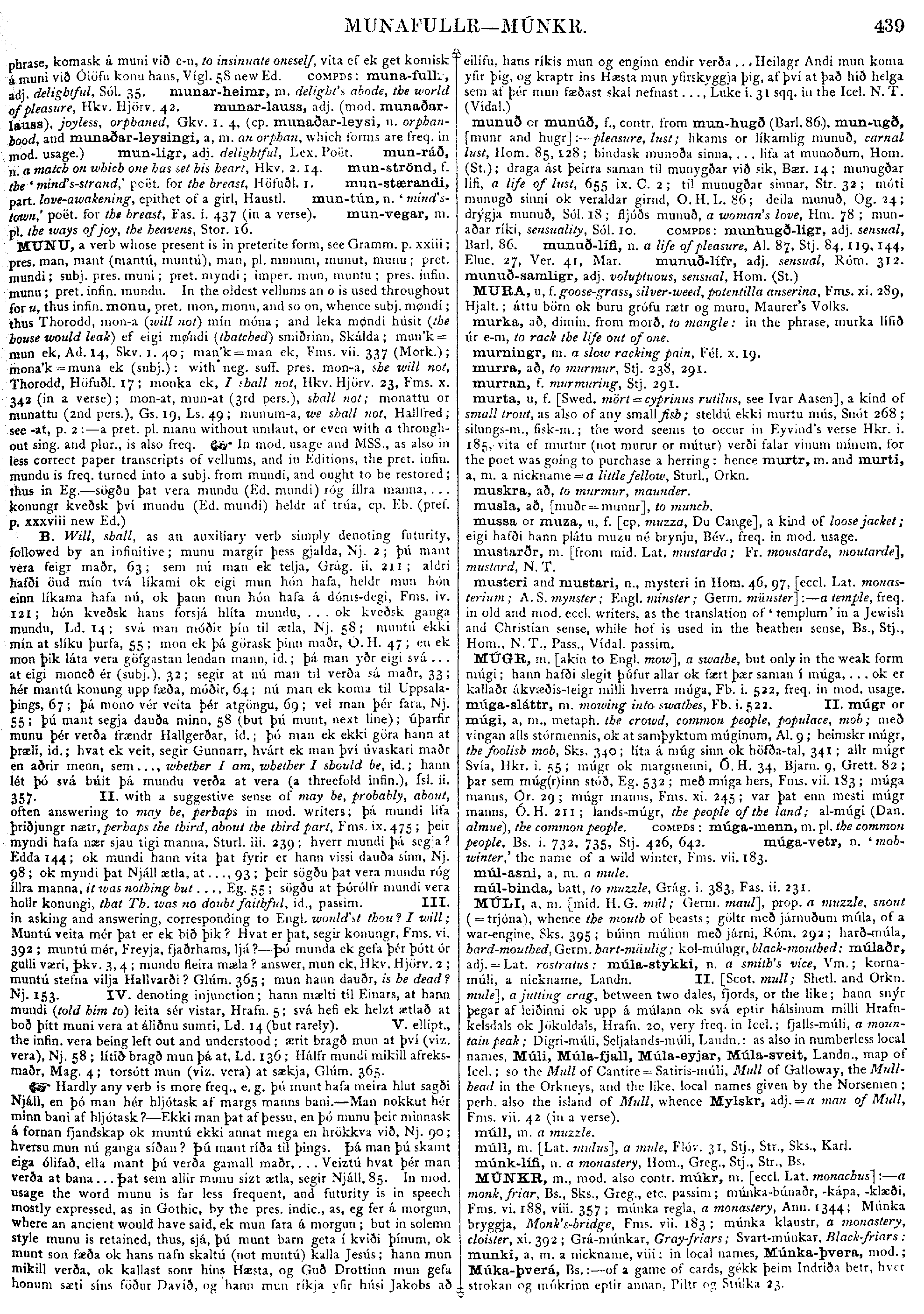
MÚLI, a, m. [mid.H.G. mûl; Germ. maul], prop, a muzzle, snout (= trjóna), whence the mouth of beasts; göltr með járnuðum múla, of a war-engine, Sks. 395; búinn múlinn með járni, Róm. 292; harð-múla, hard-mouthed. Germ. hart-mäulig; kol-múlugr, black-mouthed: múlaðr, adj. = Lat. rostratus: múla-stykki, n. a smith's vice, Vm.; korna-múli, a nickname, Landn. II. [Scot. mull; Shetl. and Orkn. mule], a jutting crag, between two dales, fjords, or the like; hann snýr þegar af leiðinni ok upp á múlann ok svá eptir hálsinum milli Hrafnkelsdals ok Jökuldals, Hrafn. 20, very freq. in Icel.; fjalls-múli, a mountain peak; Digri-múli, Seljalands-múli, Landn.: as also in numberless local names. Múli, Múla-fjall, Múla-eyjar, Múla-sveit, Landn., map of Icel.; so the Mull of Cantire = Satiris-múli, Mull of Galloway, the Mull-head in the Orkneys, and the like, local names given by the Norsemen; perh. also the island of Mull, whence Mylskr, adj. = a man of Mull, Fms. vii. 42 (in a verse).
|
Source: Cleasby/Vigfusson, page b0444, entry 17 View original page image as: [TIFF] [PNG] [View previous entry] [View next entry] |
[Comment on this entry] [View comments] |
The following entry has been hand-corrected once. |
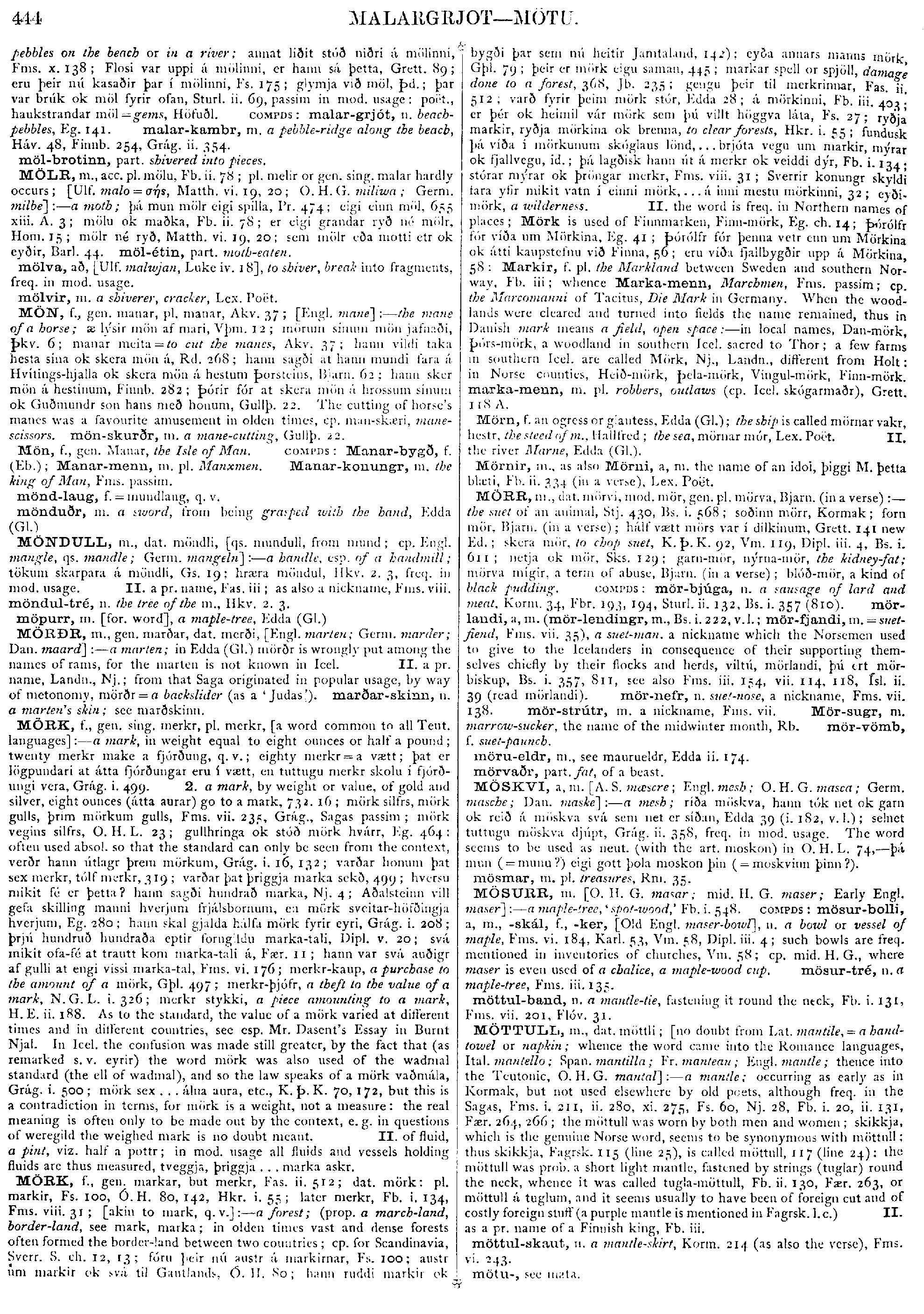
MÖRR, m., dat. mörvi, mod. mör, gen. pl. mörva, Bjarn. (in a verse) :-- the suet of an animal, Stj. 430, Bs. i. 568; soðinn mörr, Kormak; forn mör. Bjarn. (in a verse); hálf vætt mörs var í dilkinum, Grett. 141 new Ed.; skera mör, to chop suet, K.Þ.K. 92, Vm. 119, Dipl. iii. 4, Bs. i. 611; netja ok mör, Sks. 129; garn-mör, nýrna-mör, the kidney-fat; mörva mígir. a term of abuse, Bjarn. (in a verse); blóð-mör, a kind of black pudding. COMPDS: mör-bjúga, n. a sausage of lard and meat, Korm. 34, Fbr. 193, 194, Sturl. ii. 132, Bs. i. 357 (810). mör-landi, a, m. (mör-lendingr, m., Bs. i. 222, v.l.; mör-fjandi, m. = suet-fiend, Fms. vii. 35), a suet-man, a nickname which the Norsemen used to give to the Icelanders in consequence of their supporting themselves chiefly by their flocks and herds, viltú, mörlandi, þú ert mör-biskup, Bs. i. 357, 811, see also Fms. iii. 154, vii. 114, 118, Ísl. ii. 39 (read mörlandi). mör-nefr, n. suet-nose, a nickname, Fms. vii. 138. mör-strútr, m. a nickname, Fms. vii. Mör-sugr, m. marrow-sucker, the name of the midwinter month, Rb. mör-vömb, f. suet-paunch.
|
Source: Cleasby/Vigfusson, page b0448, entry 2 View original page image as: [TIFF] [PNG] [View previous entry] [View next entry] |
[Comment on this entry] [View comments] |
The following entry has been hand-corrected once. |
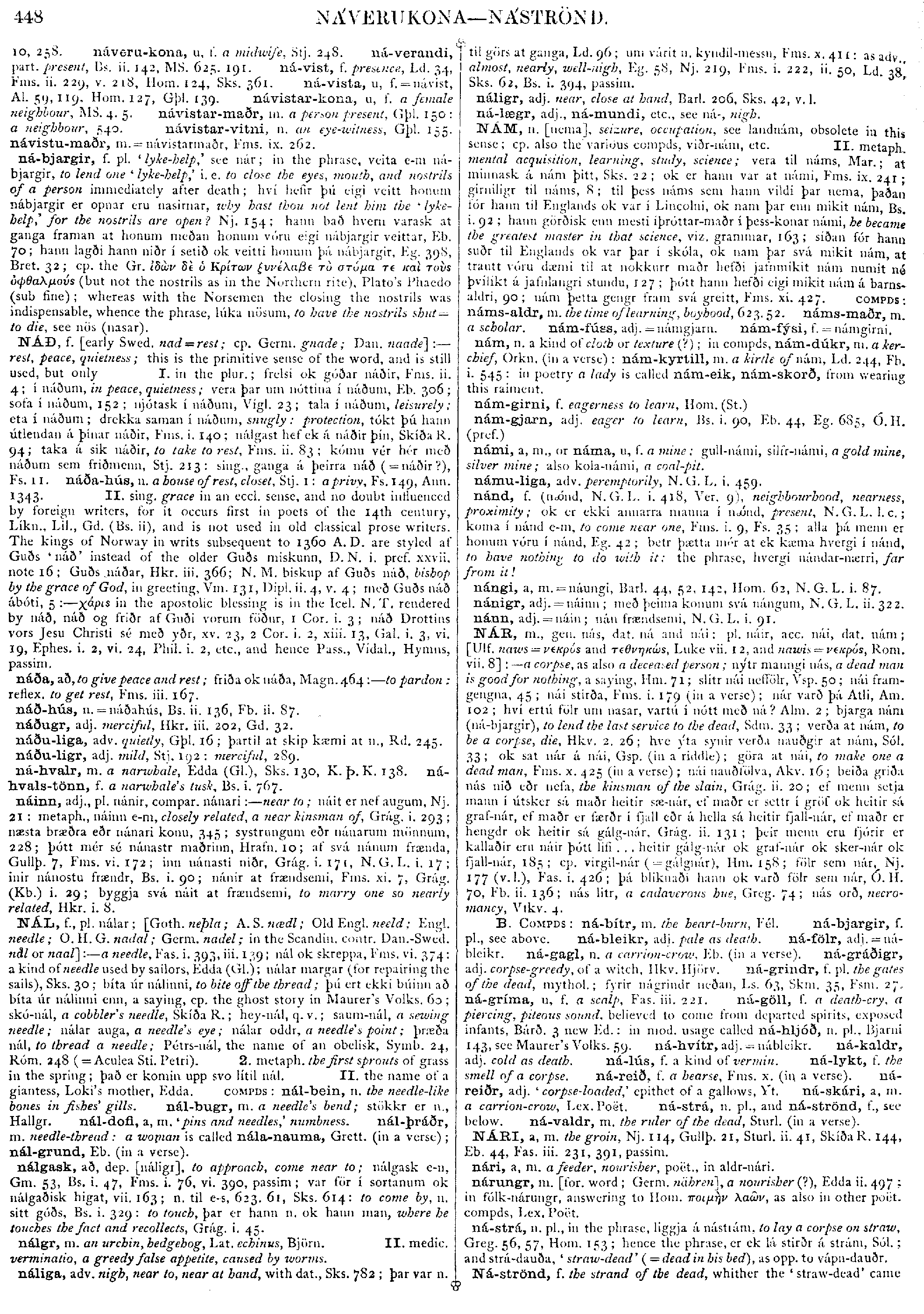
ná-bjargir, f. pl. 'lyke-help,' see nár; in the phrase, veita e-m nábjargir, to lend one 'lyke-help,' i. e. to close the eyes, mouth, and nostrils of a person immediately after death; hví hefir þú eigi veitt honum nábjargir er opnar eru nasirnar, why hast thou not lent him the 'lyke-help,' for the nostrils are open? Nj. 154; hann bað hvern varask at ganga framan at honum meðan honum vóru eigi nábjargir veittar, Eb. 70; hann lagði hann niðr í setið ok veitti honum þá nábjargir, Eg. 398, Bret. 32; cp. the Gr. GREEK (but not the nostrils as in the Northern rite), Plato's Phaedo (sub fine); whereas with the Norsemen the closing the nostrils was indispensable, whence the phrase, lúka nösum, to have the nostrils shut = to die, see nös (nasar).
|
Source: Cleasby/Vigfusson, page b0450, entry 9 View original page image as: [TIFF] [PNG] [View previous entry] [View next entry] |
[Comment on this entry] [View comments] |
The following entry has been hand-corrected once. |
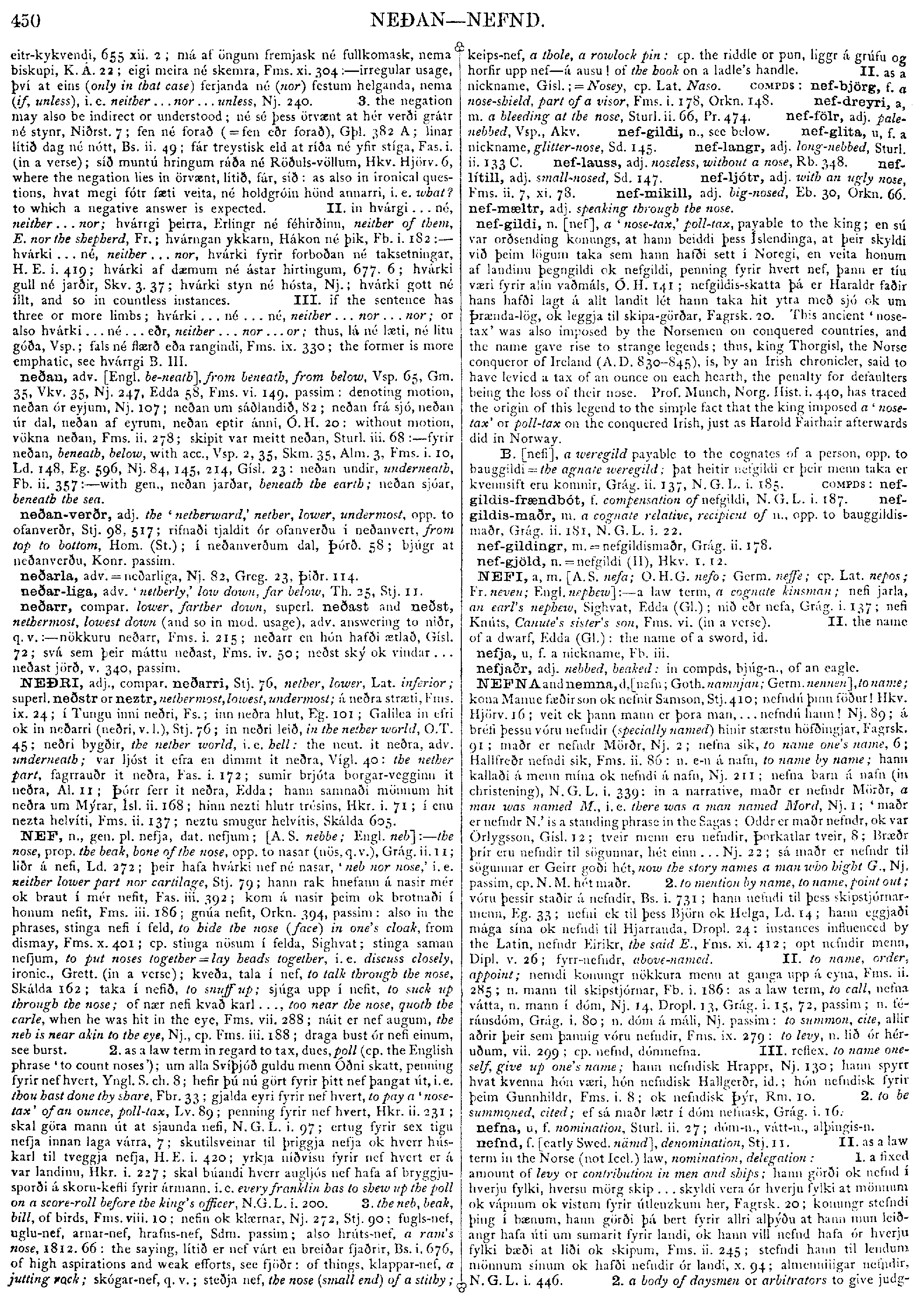
nef-gildi, n. [nef], a 'nose-tax,' poll-tax, payable to the king; en sú var orðsending konungs, at hann beiddi þess Íslendinga, at þeir skyldi við þeim lögum taka sem hann hafði sett í Noregi, en veita honum af landinu þegngildi ok nefgildi, penning fyrir hvert nef, þann er tíu væri fyrir alin vaðmáls, Ó. H. 141; nefgildis-skatta þá er Haraldr faðir hans hafði lagt á allt landit lét hann taka hit ytra með sjó ok um Þrænda-lög, ok leggja til skipa-görðar, Fagrsk. 20. This ancient 'nose-tax' was also imposed by the Norsemen on conquered countries, and the name gave rise to strange legends; thus, king Thorgisl, the Norse conqueror of Ireland (A.D. 830-845), is, by an Irish chronicler, said to have levied a tax of an ounce on each hearth, the penalty for defaulters being the loss of their nose. Prof. Munch, Norg. Hist. i. 440, has traced the origin of this legend to the simple fact that the king imposed a 'nose-tax' or poll-tax on the conquered Irish, just as Harold Fairhair afterwards did in Norway. B. [nefi], a weregild payable to the cognates of a person, opp. to bauggildi = the agnate weregild; þat heitir nefgildi er þeir menn taka er kvennsift eru komnir, Grág. ii. 137, N. G. L. i. 185. COMPDS: nefgildis-frændbót, f. compensation of nefgildi, N. G. L. i. 187. nefgildis-maðr, in. a cognate relative, recipient of n., opp. to bauggildis-maðr, Grág. ii. 181, N. G. L. i. 22.
|
Source: Cleasby/Vigfusson, page b0456, entry 42 View original page image as: [TIFF] [PNG] [View previous entry] [View next entry] |
[Comment on this entry] [View comments] |
The following entry has been hand-corrected once. |
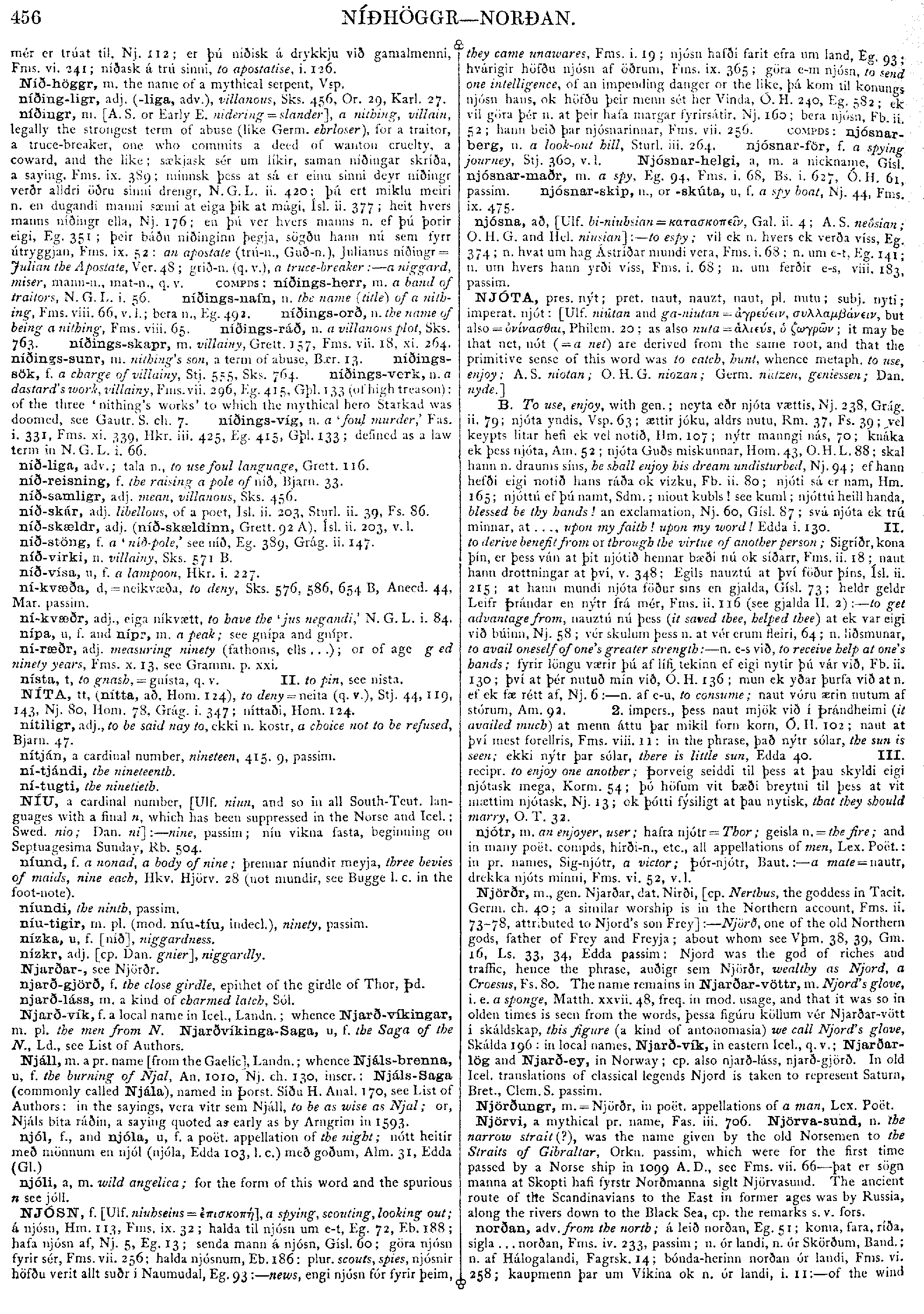
Njörvi, a mythical pr. name, Fas. iii. 706. Njörva-sund, n. the narrow strait (?), was the name given by the old Norsemen to the Straits of Gibraltar, Orkn. passim, which were for the first time passed by a Norse ship in 1099 A. D., see Fms. vii. 66 -- þat er sögn manna at Skopti hafi fyrstr Norðmanna siglt Njörvasund. The ancient route of the Scandinavians to the East in former ages was by Russia, along the rivers down to the Black Sea, cp. the remarks s. v. fors.
|
Source: Cleasby/Vigfusson, page b0462, entry 2 View original page image as: [TIFF] [PNG] [View previous entry] [View next entry] |
[Comment on this entry] [View comments] |
The following entry has been hand-corrected once. |
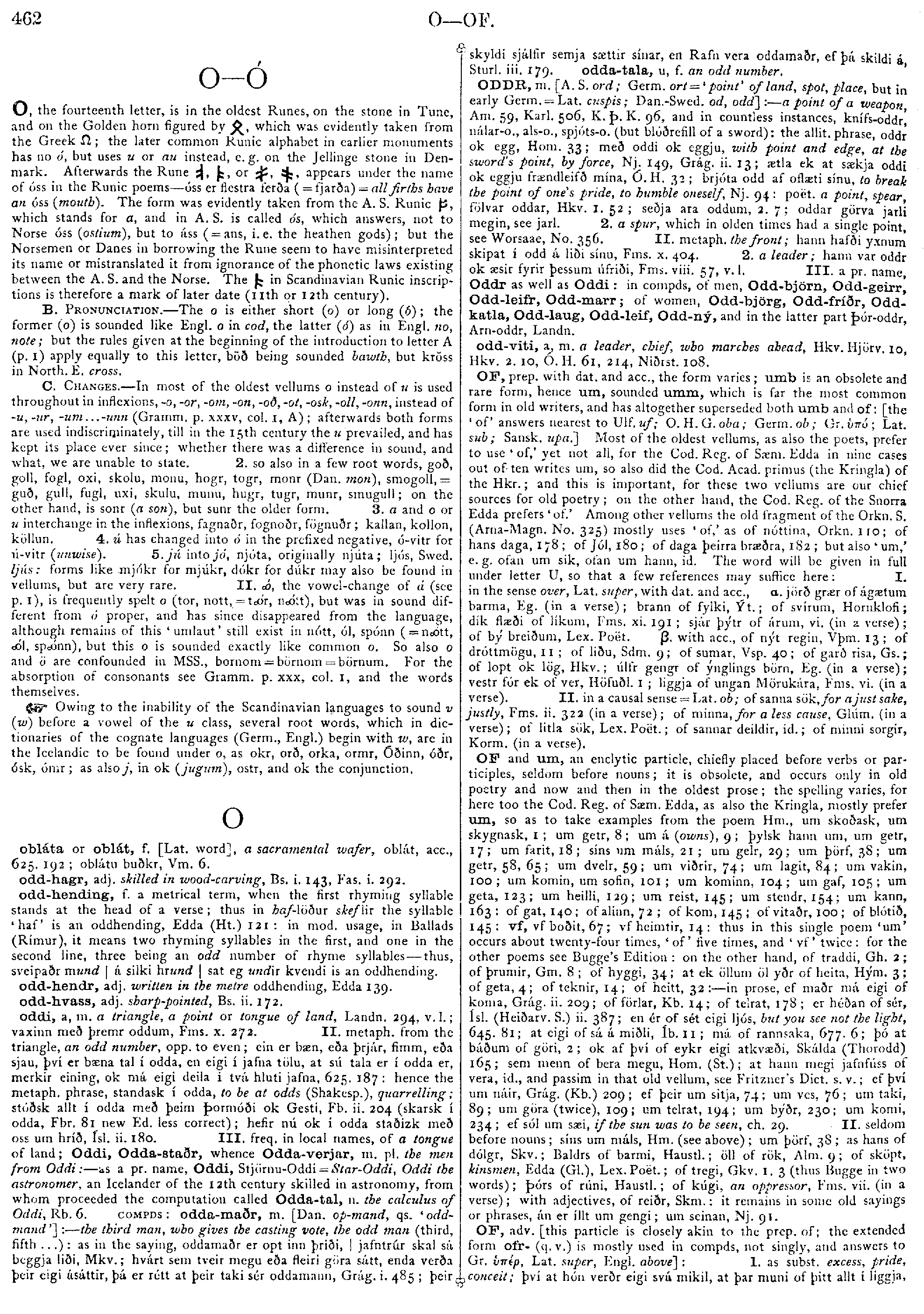
O,
the
fourteenth
letter,
is
in
the
oldest
Runes,
on
the
stone
in
Tune,
and
on
the
Golden
horn
figured
by
RUNE,
which
was
evidently
taken
from
the
Greek
Ω
the
later
common
Runic
alphabet
in
earlier
monuments
has
no
ó,
but
uses
u
or
au
instead,
e.g.
on
the
Jellinge
stone
in
Denmark.
Afterwards
the
Rune
RUNE,
RUNE,
or
RUNE,
RUNE,
appears
under
the
name
of
óss
in
the
Runic
poems
--
óss
er
flestra
ferða
(=
fjarða)
=
all
firths
have
an
óss
(mouth).
The
form
was
evidently
taken
from
the
A.S.
Runic
RUNE,
which
stands
for
a,
and
in
A.S.
is
called
ós,
which
answers,
not
to
Norse
óss
(ostium),
but
to
áss
(=
ans,
i.e.
the
heathen
gods);
but
the
Norsemen
or
Danes
in
borrowing
the
Rune
seem
to
have
misinterpreted
its
name
or
mistranslated
it
from
ignorance
of
the
phonetic
laws
existing
between
the
A.S.
and
the
Norse.
The
RUNE
in
Scandinavian
Runic
inscriptions
is
therefore
a
mark
of
later
date
(11th
or
12th
century).
B.
PRONUNCIATION.
--
The
o
is
either
short
(o)
or
long
(ó);
the
former
(o)
is
sounded
like
Engl.
o
in
cod,
the
latter
(ó)
as
in
Engl.
no,
note;
but
the
rules
given
at
the
beginning
of
the
introduction
to
letter
A
(p.
l)
apply
equally
to
this
letter,
b ð
being
sounded
bawth,
but
kr
ð
being
sounded
bawth,
but
kr ss
in
North.
E.
cross.
C.
CHANGES.
--
In
most
of
the
oldest
vellums
o
instead
of
u
is
used
throughout
in
inflexions,
-o,
-or,
-om,
-on,
-oð,
-ot,
-osk,
-oll,
-onn,
instead
of
-u,
-ur,
-um
...
-unn
(Gramm.
p.
xxxv,
col.
1,
A);
afterwards
both
forms
are
used
indiscriminately,
till
in
the
15th
century
the
u
prevailed,
and
has
kept
its
place
ever
since;
whether
there
was
a
difference
in
sound,
and
what,
we
are
unable
to
state.
2.
so
also
in
a
few
root
words,
goð,
goll,
fogl,
oxi,
skolu,
monu,
hogr,
togr,
monr
(Dan.
mon),
smogoll,
=
guð,
gull,
fugl,
uxi,
skulu,
munu,
hugr,
tugr,
munr,
smugull;
on
the
other
hand,
is
sonr
(a
son),
but
sunr
the
older
form.
3.
a
and
o
or
u
interchange
in
the
inflexions,
fagnaðr,
fognoðr,
fögnuðr;
kallan,
kollon,
köllun.
4.
ú
has
changed
into
ó
in
the
prefixed
negative,
ó-vitr
for
ú-vitr
(unwise).
5.
jú
into
jó,
njóta,
originally
njúta;
ljós,
Swed.
ljús:
forms
like
mjókr
for
mjúkr,
dókr
for
dúkr
may
also
be
found
in
vellums,
but
are
very
rare.
II.
ss
in
North.
E.
cross.
C.
CHANGES.
--
In
most
of
the
oldest
vellums
o
instead
of
u
is
used
throughout
in
inflexions,
-o,
-or,
-om,
-on,
-oð,
-ot,
-osk,
-oll,
-onn,
instead
of
-u,
-ur,
-um
...
-unn
(Gramm.
p.
xxxv,
col.
1,
A);
afterwards
both
forms
are
used
indiscriminately,
till
in
the
15th
century
the
u
prevailed,
and
has
kept
its
place
ever
since;
whether
there
was
a
difference
in
sound,
and
what,
we
are
unable
to
state.
2.
so
also
in
a
few
root
words,
goð,
goll,
fogl,
oxi,
skolu,
monu,
hogr,
togr,
monr
(Dan.
mon),
smogoll,
=
guð,
gull,
fugl,
uxi,
skulu,
munu,
hugr,
tugr,
munr,
smugull;
on
the
other
hand,
is
sonr
(a
son),
but
sunr
the
older
form.
3.
a
and
o
or
u
interchange
in
the
inflexions,
fagnaðr,
fognoðr,
fögnuðr;
kallan,
kollon,
köllun.
4.
ú
has
changed
into
ó
in
the
prefixed
negative,
ó-vitr
for
ú-vitr
(unwise).
5.
jú
into
jó,
njóta,
originally
njúta;
ljós,
Swed.
ljús:
forms
like
mjókr
for
mjúkr,
dókr
for
dúkr
may
also
be
found
in
vellums,
but
are
very
rare.
II.
 ,
the
vowel-change
of
á
(see
p.
1),
is
frequently
spelt
o
(tor,
nott,
=
tr,
ntt),
but
was
in
sound
different
from
ó
proper,
and
has
since
disappeared
from
the
language,
although
remains
of
this
'umlaut'
still
exist
in
nótt,
ól,
spónn
(=
ntt,
l,
spnn),
but
this
o
is
sounded
exactly
like
common
o.
So
also
o
and
ö
are
confounded
in
MSS.,
bornom
=
börnom
=börnum.
For
the
absorption
of
consonants
see
Gramm.
p.
xxx,
col.
1,
and
the
words
themselves.
&FINGER;
Owing
to
the
inability
of
the
Scandinavian
languages
to
sound
v
(w)
before
a
vowel
of
the
u
class,
several
root
words,
which
in
dictionaries
of
the
cognate
languages
(Germ.,
Engl.)
begin
with
w,
are
in
the
Icelandic
to
be
found
under
o,
as
okr,
orð,
orka,
ormr,
Óðinn,
óðr,
ósk,
ómr;
as
also
j,
in
ok
(jugum),
ostr,
and
ok
the
conjunction.
,
the
vowel-change
of
á
(see
p.
1),
is
frequently
spelt
o
(tor,
nott,
=
tr,
ntt),
but
was
in
sound
different
from
ó
proper,
and
has
since
disappeared
from
the
language,
although
remains
of
this
'umlaut'
still
exist
in
nótt,
ól,
spónn
(=
ntt,
l,
spnn),
but
this
o
is
sounded
exactly
like
common
o.
So
also
o
and
ö
are
confounded
in
MSS.,
bornom
=
börnom
=börnum.
For
the
absorption
of
consonants
see
Gramm.
p.
xxx,
col.
1,
and
the
words
themselves.
&FINGER;
Owing
to
the
inability
of
the
Scandinavian
languages
to
sound
v
(w)
before
a
vowel
of
the
u
class,
several
root
words,
which
in
dictionaries
of
the
cognate
languages
(Germ.,
Engl.)
begin
with
w,
are
in
the
Icelandic
to
be
found
under
o,
as
okr,
orð,
orka,
ormr,
Óðinn,
óðr,
ósk,
ómr;
as
also
j,
in
ok
(jugum),
ostr,
and
ok
the
conjunction.
|
Source: Cleasby/Vigfusson, page b0493, entry 35 View original page image as: [TIFF] [PNG] [View previous entry] [View next entry] |
[Comment on this entry] [View comments] |
The following entry has been hand-corrected once. |
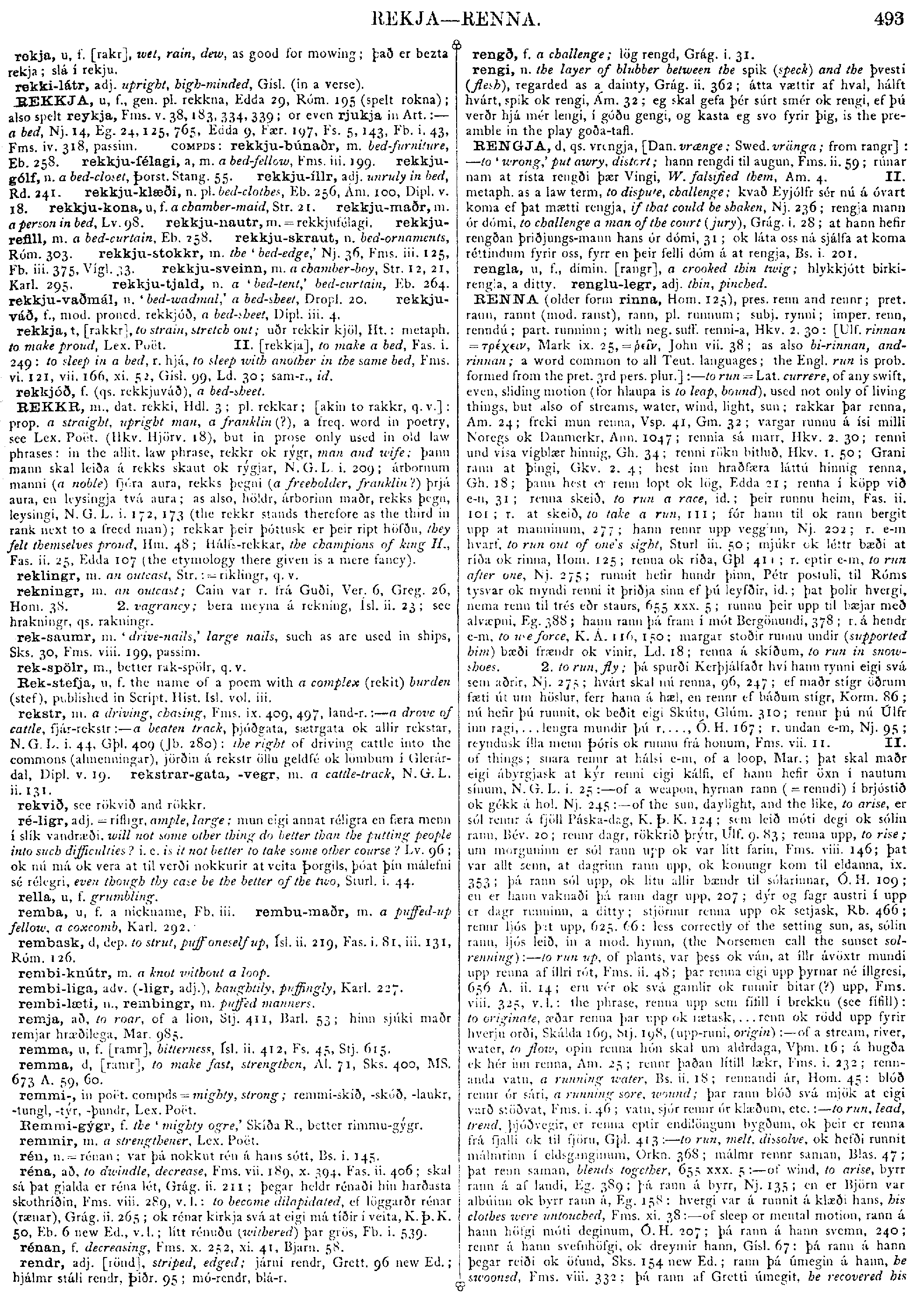
RENNA (older form rinna, Hom. 125), pres. renn and rennr; pret. raun, rannt (mod. ranst), rann, pl. runnum; subj. rynni; imper. renn, renndú; part. runninn; with neg. suff. renni-a, Hkv. 2. 30: [Ulf. rinnan = GREEK, Mark ix. 25, = GREEK, John vii. 38; as also bi-rinnan, and-rinnan; a word common to all Teut. languages; the Engl. run is prob. formed from the pret. 3rd pers. plur.] :-- to run = Lat. currere, of any swift, even, sliding motion (for hlaupa is to leap, bound), used not only of living things, but also of streams, water, wind, light, sun; rakkar þar renna, Am. 24; freki mun renna, Vsp. 41, Gm. 32; vargar runnu á ísi milli Noregs ok Daumerkr, Ann. 1047; rennia sá marr, Hkv. 2. 30; renni und vísa vígblær hinnig, Gh. 34; renni rökn bitluð, Hkv. i. 50; Grani rann at þingi, Gkv. 2. 4; hest inn hraðfæra láttú hinnig renna, Gh.18; þann hest er renn lopt ok lög, Edda 21; renna í köpp við e-n, 31; renna skeið, to run a race, id.; þeir runnu heim, Fas. ii. 101; r. at skeið, to take a run, 111; fór hann til ok rann bergit upp at manninum, 277; hann rennr upp vegginn, Nj. 202; r. e-m hvarf, to run out of one's sight, Sturl iii. 50; mjúkr ok léttr bæði at ríða ok rinna, Hom. 125; renna ok ríða, Gþl 411; r. eptir e-m, to run after one, Nj. 275; runnit hefir hundr þinn, Pétr postuli, til Róms tysvar ok myndi renni it þriðja sinn ef þú leyfðir, id.; þat þolir hvergi, nema renn til trés eðr staurs, 655 xxx. 5; runnu þeir upp til bæjar með alvæpni. Eg. 388; hann rann þá fram í mót Bergönundi, 378; r. á hendr e-m, to use force, K.Á. 116, 150; margar stoðir runnu undir (supported him) bæði frændr ok vinir, Ld. 18; renna á skíðum, to run in snow-shoes. 2. to run, fly; þá spurði Kerþjálfaðr hví hann rynni eigi svá sem aðrir, Nj. 275; hvárt skal nú renna, 96, 247; ef maðr stígr öðrum fæti út um höslur, ferr hann á hæl, en rennr ef báðum stígr, Korm. 86; nú hefir þú runnit, ok beðit eigi Skútu, Glúm. 310; rennr þú nú Úlfr inn ragi, ... lengra mundir þú r. ..., Ó.H. 167; r. undan e-m, Nj. 95; reyndusk ílla menn Þóris ok runnu frá honum, Fms. vii. 11. II. of things; snara rennr at hálsi e-m, of a loop, Mar.; þat skal maðr eigi ábyrgjask at kýr renni eigi kálfi, ef hann hefir öxn í nautum sínum, N.G.L. i. 25 :-- of a weapon, hyrnan rann (= renndi) í brjóstið ok gékk á hol, Nj. 245 :-- of the sun, daylight, and the like, to arise, er sól rennr á fjöll Páska-dag, K.Þ.K. 124; sem leið móti degi ok sólin rann, Bév. 20; rennr dagr, rökkrið þrýtr, Úlf. 9. 83; renna upp, to rise; um mörguninn er sól rann upp ok var lítt farin, Fms. viii. 146; þat var allt senn, at dagrinn rann upp, ok konungr kom til eldanna, ix. 353; þá rann söl upp, ok litu allir bændr til sölarinnar, Ó.H. 109; en er hann vaknaði þa rann dagr upp, 207; dýr og fagr austri í upp er dagr renninn, a ditty; stjörnur renna upp ok setjask, Rb. 466; rennr ljós þat upp, 625. 66: less correctly of the setting sun, as, sólin rann, ljós leið, in a mod. hymn, (the Norsemen call the sunset sol-renning) :-- to run up, of plants, var þess ok ván, at íllr ávöxtr mundi upp renna af íllri rót, Fms. ii. 48; þar renna eigi upp þyrnar né íllgresi, 656 A. ii. 14; eru vér ok svá gamlir ok runnir bitar(?) upp, Fms. viii. 325, v.l.: the phrase, renna upp sem fífill í brekku (see fífill): to originate, æðar renna þar upp ok nætask, ... renn ok rödd upp fyrir hverju orði, Skálda 169, Stj. 198, (upp-runi, origin) :-- of a stream, river, water, to flow, opin renna hón skal um aldrdaga, Vþm, 16; á hugða ek hér inn renna, Am. 25; rennr þaðan lítill lækr, Fms. i. 232; rennanda vatn, a running water, Bs. ii. 18; rennandi ár, Hom. 45: blóð rennr ór sári, a running sore, wound; þar rann blóð svá mjök at eigi varð stöðvat, Fms. i. 46; vatn, sjór rennr ór klæðum, etc. :-- to run, lead, trend. þjóðvegir, er renna eptir endilöngum bygðum, ok þeir er renna frá fjalli ok til fjörn, Gþl. 413 :-- to run, melt, dissolve, ok hefði runnit málmrinn í eldsganginum, Orkn. 368; málmr rennr saman, Blas. 47; þat renn saman, blends together, 655, xxx. 5 :-- of wind, to arise, byrr rann á af landi, Eg. 389; þá rann á byrr, Nj. 135; en er Björn var albúinn ok byrr rann á, Eg. 158: hvergi var á runnit á klaæeth;i hans, his clothes were untouched, Fms. xi. 38 :-- of sleep or mental motion, rann á hann höfgi móti deginum, Ó.H. 207; þá rann á hann svemn, 240; rennr á hann svefnhöfgi, ok dreymir hann, Gísl. 67; þá rann á hann þegar reiði ok öfund, Sks. 154 new Ed.; rann þá úmegin á hann, he swooned, Fms. viii. 332: þá rann af Gretti úmegit, he recovered his
|
Source: Cleasby/Vigfusson, page b0550, entry 19 View original page image as: [TIFF] [PNG] [View previous entry] [View next entry] |
[Comment on this entry] [View comments] |
The following entry has been hand-corrected once. |
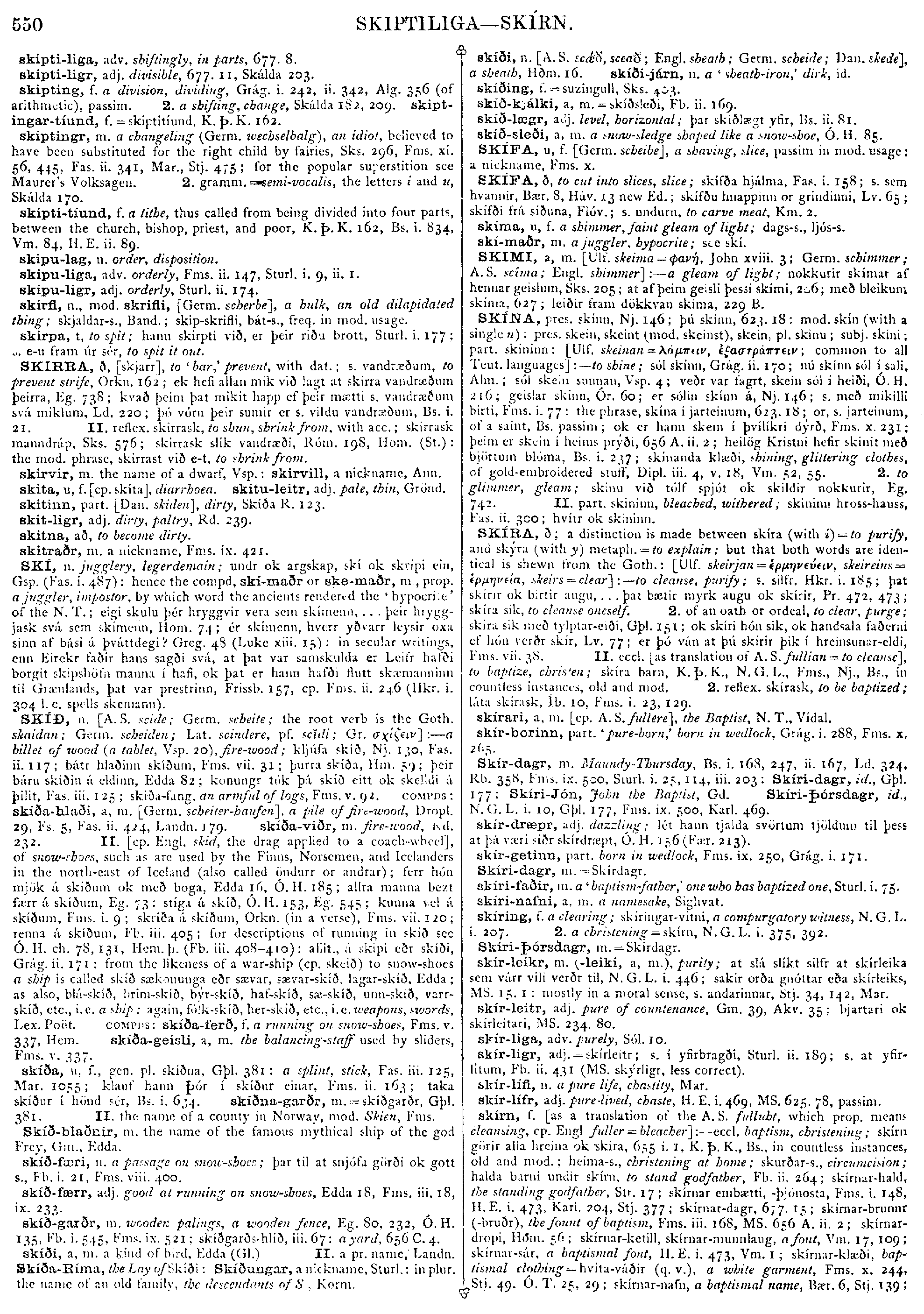
SKÍÐ,
n.
[A.S.
scide;
Germ.
scheite;
the
root
verb
is
the
Goth.
skaidan;
Germ.
scheiden;
Lat.
scindere,
pf.
sc di;
Gr.
GREEK]
:--
a
billet
of
wood
(a
tablet,
Vsp.
20),
fire-wood;
kljúfa
skíð,
Nj.
130,
Fas.
ii.
117;
bátr
hlaðinn
skíðum,
Fms.
vii.
31;
þurra
skíða,
Hm.
59;
þeir
báru
skíðin
á
eldinn,
Edda
82;
konungr
tók
þá
skíð
eitt
ok
skelldi
á
þilit,
Fas.
iii.
125;
skíða-fang,
an
armful
of
logs,
Fms.
v.
92.
COMPDS:
skíða-hlaði,
a,
m.
[Germ.
scheiter-haufen],
a
pile
of
fire-wood,
Dropl.
29,
Fs.
5,
Fas.
ii.
424,
Landn.
179.
skíða-viðr,
m.
fire-wood,
Kd.
232.
II.
[cp.
Engl.
skid,
the
drag
applied
to
a
coach-wheel],
of
snow-shoes,
such
as
are
used
by
the
Finns,
Norsemen,
and
Icelanders
in
the
north-east
of
Iceland
(also
called
öndurr
or
andrar);
ferr
hón
mjök
á
skíðum
ok
með
boga,
Edda
16,
Ó.H.
185;
allra
manna
bezt
færr
á
skíðum,
Eg.
73:
stíga
á
skíð,
Ó.H.
153,
Eg.
545;
kunna
vel
á
skíðum,
Fms.
i.
9;
skríða
á
skíðum,
Orkn.
(in
a
verse),
Fms.
vii.
120;
renna
á
skíðum,
Fb.
iii.
405;
for
descriptions
of
running
in
skíð
see
Ó.H.
ch.
78,
131,
Hem.
þ.
(Fb.
iii.
408-410):
allit.,
á
skipi
eðr
skíði,
Grág.
ii.
171:
from
the
likeness
of
a
war-ship
(cp.
skeið)
to
snow-shoes
a
ship
is
called
skíð
sækonunga
eðr
sævar,
sævar-skíð.
lagar-skíð,
Edda;
as
also,
blá-skíð,
brim-skíð,
býr-skíð,
haf-skíð,
sæ-skíð,
unn-skið,
varr-skíð,
etc.,
i.e.
a
ship:
again,
fólk-skíð,
her-skíð,
etc.,
i.e.
weapons,
swords,
Lex.
Poët.
COMPDS:
skíða-ferð,
f.
a
running
on
snow-shoes,
Fms.
v.
337,
Hem.
skíða-geisli,
a,
m.
the
balancing-staff
used
by
sliders,
Fms.
v.
337.
di;
Gr.
GREEK]
:--
a
billet
of
wood
(a
tablet,
Vsp.
20),
fire-wood;
kljúfa
skíð,
Nj.
130,
Fas.
ii.
117;
bátr
hlaðinn
skíðum,
Fms.
vii.
31;
þurra
skíða,
Hm.
59;
þeir
báru
skíðin
á
eldinn,
Edda
82;
konungr
tók
þá
skíð
eitt
ok
skelldi
á
þilit,
Fas.
iii.
125;
skíða-fang,
an
armful
of
logs,
Fms.
v.
92.
COMPDS:
skíða-hlaði,
a,
m.
[Germ.
scheiter-haufen],
a
pile
of
fire-wood,
Dropl.
29,
Fs.
5,
Fas.
ii.
424,
Landn.
179.
skíða-viðr,
m.
fire-wood,
Kd.
232.
II.
[cp.
Engl.
skid,
the
drag
applied
to
a
coach-wheel],
of
snow-shoes,
such
as
are
used
by
the
Finns,
Norsemen,
and
Icelanders
in
the
north-east
of
Iceland
(also
called
öndurr
or
andrar);
ferr
hón
mjök
á
skíðum
ok
með
boga,
Edda
16,
Ó.H.
185;
allra
manna
bezt
færr
á
skíðum,
Eg.
73:
stíga
á
skíð,
Ó.H.
153,
Eg.
545;
kunna
vel
á
skíðum,
Fms.
i.
9;
skríða
á
skíðum,
Orkn.
(in
a
verse),
Fms.
vii.
120;
renna
á
skíðum,
Fb.
iii.
405;
for
descriptions
of
running
in
skíð
see
Ó.H.
ch.
78,
131,
Hem.
þ.
(Fb.
iii.
408-410):
allit.,
á
skipi
eðr
skíði,
Grág.
ii.
171:
from
the
likeness
of
a
war-ship
(cp.
skeið)
to
snow-shoes
a
ship
is
called
skíð
sækonunga
eðr
sævar,
sævar-skíð.
lagar-skíð,
Edda;
as
also,
blá-skíð,
brim-skíð,
býr-skíð,
haf-skíð,
sæ-skíð,
unn-skið,
varr-skíð,
etc.,
i.e.
a
ship:
again,
fólk-skíð,
her-skíð,
etc.,
i.e.
weapons,
swords,
Lex.
Poët.
COMPDS:
skíða-ferð,
f.
a
running
on
snow-shoes,
Fms.
v.
337,
Hem.
skíða-geisli,
a,
m.
the
balancing-staff
used
by
sliders,
Fms.
v.
337.
| Result Page: |  |
Previous | 1 2 3 | Next |  |
Germanic Lexicon Project (main page)
This search system was written by
Sean Crist
Please consider
volunteering
to correct the data in these online dictionaries.
No rights reserved. Feel free to use these data in any way you please.