|
|

Tip: In the search results, you can click on any word or abbreviation for more information.
|
Source: Bosworth/Toller, page b1102, entry 2 View original page image as: [TIFF] [PNG] [View previous entry] [View next entry] |
[Comment on this entry] [View comments] |
The following entry has been hand-corrected once. |
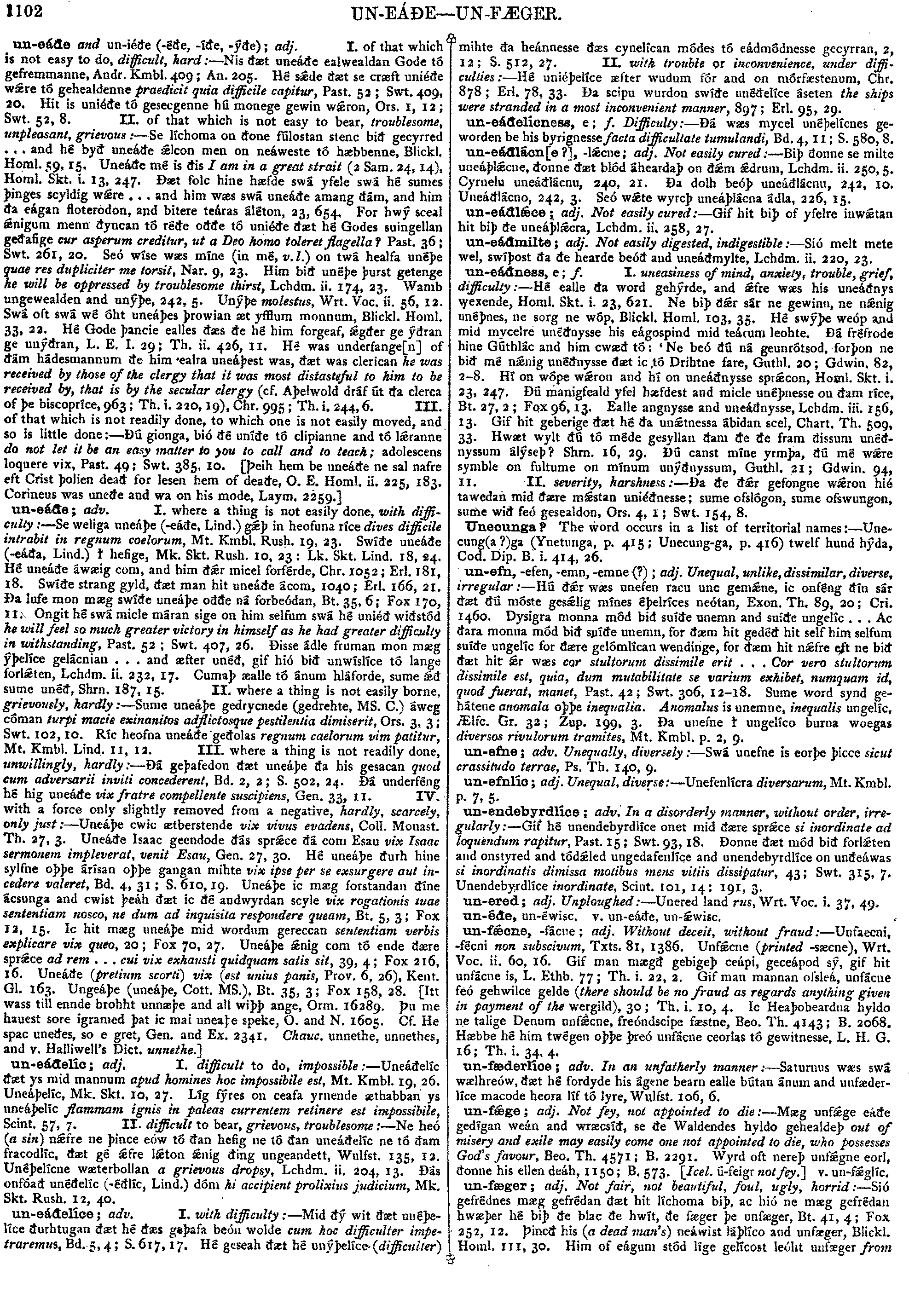
un-eáðe;
adv.
I.
where
a
thing
is
not
easily
done,
with
difficulty
:--
Se
weliga
uneáþe
(-eáðe,
Lind.)
g þ
in
heofuna
ríce
dives
difficule
intrabit
in
regnum
coelorum,
Mt.
Kmbl.
Rush.
19,
23.
Swíðe
uneáðe
(-eáða,
Lind.)
þ
in
heofuna
ríce
dives
difficule
intrabit
in
regnum
coelorum,
Mt.
Kmbl.
Rush.
19,
23.
Swíðe
uneáðe
(-eáða,
Lind.)
 hefige,
Mk.
Skt.
Rush.
10,
23:
Lk.
Skt.
Lind.
18,
24.
Hé
uneáðe
áwæig
com,
and
him
ðr
micel
forférde,
Chr.1052;
Erl.
181,
18.
Swíðe
strang
gyld,
ðæt
man
hit
uneáðe
ácom,
1040;
Erl.
166,
21.
Ða
lufe
mon
mæg
swíðe
uneáþe
oððe
ná
forbeódan,
Bt.
35,
6;
Fox
170,
11.
Ongit
hé
swá
micle
máran
sige
on
him
selfum
swá
hé
uniéð
wiðstód
he
will
feel
so
much
greater
victory
in
himself
as
he
had
greater
difficulty
in
withstanding,
Past.
52;
Swt.
407,
26.
Ðisse
ádle
fruman
mon
mæg
ýþelíce
gelácnian
...
and
æfter
unéð,
gif
hió
bið
unwíslíce
tó
lange
forlten,
Lchdm.
ii.
232,
17.
Cumaþ
æalle
tó
ánum
hláforde,
sume
ð
sume
unéð,
Shrn.
187,
15.
II.
where
a
thing
is
not
easily
borne,
grievously,
hardly
:--
Sume
uneáþe
gedrycnede
(gedrehte,
MS.
C.)
áweg
cóman
turpi
macie
exinanitos
adflictosque
pestilentia
dimiserit,
Ors.
3,
3;
Swt.
102,
10.
Ríc
heofna
uneáðe
geðolas
regnum
caelorum
vim
patitur,
Mt.
Kmbl.
Lind.
11,
12.
III.
where
a
thing
is
not
readily
done,
unwillingly,
hardly
:--
Ðá
geþafedon
ðæt
uneáþe
ða
his
gesacan
quod
cum
adversarii
inviti
concederent,
Bd.
2,
2;
S.
502,
24.
Ðá
underféng
hé
hig
uneáðe
vix
fratre
compellente
suscipiens,
Gen.
33,
11.
IV.
with
a
force
only
slightly
removed
from
a
negative,
hardly,
scarcely,
only
just
:--
Uneáþe
cwic
ætberstende
vix
vivus
evadens,
Coll.
Monast.
Th.
27,
3.
Uneáðe
Isaac
geendode
ðás
sprce
ðá
com
Esau
vix
Isaac
sermonem
impleverat,
venit
Esau,
Gen.
27,
30.
Hé
uneáþe
ðurh
hine
sylfne
oþþe
árísan
oþþe
gangan
mihte
vix
ipse
per
se
exsurgere
aut
incedere
valeret,
Bd.
4,
31;
S.
610,
19.
Uneáþe
ic
mæg
forstandan
ðíne
ácsunga
and
cwist
þeáh
ðæt
ic
ðé
andwyrdan
scyle
vix
rogationis
tuae
sententiam
nosco,
ne
dum
ad
inquisita
respondere
queam,
Bt.
5,
3;
Fox
12,
15.
Ic
hit
mæg
uneáþe
mid
wordum
gereccan
sententiam
verbis
explicare
vix
queo,
20;
Fox
70,
27.
Uneáþe
nig
com
tó
ende
ðære
sprce
ad
rem
...
cui
vix
exhausti
quidquam
satis
sit,
39,
4;
Fox
216,
16.
Uneáðe
(pretium
scorti)
vix
(est
unius
panis,
Prov.
6,
26),
Kent.
Gl.
163.
Ungeáþe
(uneáþe,
Cott.
MS.),
Bt.
35,
3;
Fox
158,
28.
[Itt
wass
till
ennde
brohht
unnæþe
and
all
wiþþ
ange,
Orm.
16289.
Þu
me
hauest
sore
igramed
þat
ic
mai
uneaþe
speke,
O.
and
N.
1605.
Cf.
He
spac
uneðes,
so
e
gret,
Gen.
and
Ex.
2341.
Chauc.
unnethe,
unnethes,
and
v.
Halliwell's
Dict.
unnethe.]
hefige,
Mk.
Skt.
Rush.
10,
23:
Lk.
Skt.
Lind.
18,
24.
Hé
uneáðe
áwæig
com,
and
him
ðr
micel
forférde,
Chr.1052;
Erl.
181,
18.
Swíðe
strang
gyld,
ðæt
man
hit
uneáðe
ácom,
1040;
Erl.
166,
21.
Ða
lufe
mon
mæg
swíðe
uneáþe
oððe
ná
forbeódan,
Bt.
35,
6;
Fox
170,
11.
Ongit
hé
swá
micle
máran
sige
on
him
selfum
swá
hé
uniéð
wiðstód
he
will
feel
so
much
greater
victory
in
himself
as
he
had
greater
difficulty
in
withstanding,
Past.
52;
Swt.
407,
26.
Ðisse
ádle
fruman
mon
mæg
ýþelíce
gelácnian
...
and
æfter
unéð,
gif
hió
bið
unwíslíce
tó
lange
forlten,
Lchdm.
ii.
232,
17.
Cumaþ
æalle
tó
ánum
hláforde,
sume
ð
sume
unéð,
Shrn.
187,
15.
II.
where
a
thing
is
not
easily
borne,
grievously,
hardly
:--
Sume
uneáþe
gedrycnede
(gedrehte,
MS.
C.)
áweg
cóman
turpi
macie
exinanitos
adflictosque
pestilentia
dimiserit,
Ors.
3,
3;
Swt.
102,
10.
Ríc
heofna
uneáðe
geðolas
regnum
caelorum
vim
patitur,
Mt.
Kmbl.
Lind.
11,
12.
III.
where
a
thing
is
not
readily
done,
unwillingly,
hardly
:--
Ðá
geþafedon
ðæt
uneáþe
ða
his
gesacan
quod
cum
adversarii
inviti
concederent,
Bd.
2,
2;
S.
502,
24.
Ðá
underféng
hé
hig
uneáðe
vix
fratre
compellente
suscipiens,
Gen.
33,
11.
IV.
with
a
force
only
slightly
removed
from
a
negative,
hardly,
scarcely,
only
just
:--
Uneáþe
cwic
ætberstende
vix
vivus
evadens,
Coll.
Monast.
Th.
27,
3.
Uneáðe
Isaac
geendode
ðás
sprce
ðá
com
Esau
vix
Isaac
sermonem
impleverat,
venit
Esau,
Gen.
27,
30.
Hé
uneáþe
ðurh
hine
sylfne
oþþe
árísan
oþþe
gangan
mihte
vix
ipse
per
se
exsurgere
aut
incedere
valeret,
Bd.
4,
31;
S.
610,
19.
Uneáþe
ic
mæg
forstandan
ðíne
ácsunga
and
cwist
þeáh
ðæt
ic
ðé
andwyrdan
scyle
vix
rogationis
tuae
sententiam
nosco,
ne
dum
ad
inquisita
respondere
queam,
Bt.
5,
3;
Fox
12,
15.
Ic
hit
mæg
uneáþe
mid
wordum
gereccan
sententiam
verbis
explicare
vix
queo,
20;
Fox
70,
27.
Uneáþe
nig
com
tó
ende
ðære
sprce
ad
rem
...
cui
vix
exhausti
quidquam
satis
sit,
39,
4;
Fox
216,
16.
Uneáðe
(pretium
scorti)
vix
(est
unius
panis,
Prov.
6,
26),
Kent.
Gl.
163.
Ungeáþe
(uneáþe,
Cott.
MS.),
Bt.
35,
3;
Fox
158,
28.
[Itt
wass
till
ennde
brohht
unnæþe
and
all
wiþþ
ange,
Orm.
16289.
Þu
me
hauest
sore
igramed
þat
ic
mai
uneaþe
speke,
O.
and
N.
1605.
Cf.
He
spac
uneðes,
so
e
gret,
Gen.
and
Ex.
2341.
Chauc.
unnethe,
unnethes,
and
v.
Halliwell's
Dict.
unnethe.]
|
Source: Bosworth/Toller, page b1102, entry 3 View original page image as: [TIFF] [PNG] [View previous entry] [View next entry] |
[Comment on this entry] [View comments] |
The following entry has been hand-corrected once. |
un-eáðelíc;
adj.I.
difficult
to
do,
impossible
:--
Uneáðelíc
ðæt
ys
mid
mannum
apud
homines
hoc
impossibile
est,
Mt.
Kmbl.
19,
26.
Uneáþelíc,
Mk.
Skt.
10,
27.
Líg
fýres
on
ceafa
yrnende
æthabban
ys
uneáþelíc
flammam
ignis
in
paleas
currentem
retinere
est
impossibile,
Scint.
57,
7.
II.
difficult
to
bear,
grievous,
troublesome
:--
Ne
heó
(a
sin)
nfre
ne
þince
eów
tó
ðan
hefig
ne
tó
ðan
uneáðelíc
ne
tó
ðam
fracodlíc,
ðæt
gé
fre
lton
nig
ðing
ungeandett,
Wulfst.
135,
12.
Unéþelícne
wæterbollan
a
grievous
dropsy,
Lchdm.
ii.
204,
13.
Ðás
onfóað
unéðelíc
(-éðlíc,
Lind.)
dóm
hi
accipient
prolixius
judicium,
Mk.
Skt.
Rush.
12,
40.
|
Source: Bosworth/Toller, page b1102, entry 11 View original page image as: [TIFF] [PNG] [View previous entry] [View next entry] |
[Comment on this entry] [View comments] |
The following entry has been hand-corrected once. |
un-efn,
-efen,
-emn,
-emne(?);
adj.
Unequal,
unlike,
dissimilar,
diverse,
irregular
:--
Hú
ðr
wæs
unefen
racu
unc
gemne,
ic
onféng
ðín
sár
ðæt
ðú
móste
geslig
mínes
éþelríces
neótan,
Exon.
Th.
89,
20;
Cri.
1460.
Dysigra
monna
mód
bið
suíðe
unemn
and
suíðe
ungelíc
...
Ac
ðara
monna
mód
bið
suíðe
unemn,
for
ðæm
hit
gedéð
hit
self
him
selfum
suíðe
ungelíc
for
ðære
gelómlícan
wendinge,
for
ðæm
hit
nfre
eft
ne
bið
ðæt
hit
r
wæs
cor
stultorum
dissimile
erit
...
Cor
vero
stultorum
dissimile
est,
quia,
dum
mutabilitate
se
varium
exhibet,
numquam
id,
quod
fuerat,
manet,
Past.
42;
Swt.
306,
12-18.
Sume
word
synd
gehátene
anomala
oþþe
inequalia.
Anomalus
is
unemne,
inequalis
ungelíc,
Ælfc.
Gr.
32;
Zup.
199,
3.
Ða
unefne
ungelíco
burna
woegas
diversos
rivulorum
tramites,
Mt.
Kmbl.
p.
2,
9.
|
Source: Bosworth/Toller, page b1102, entry 13 View original page image as: [TIFF] [PNG] [View previous entry] [View next entry] |
[Comment on this entry] [View comments] |
The following entry has been hand-corrected once. |
un-efnlíc; adj. Unequal, diverse :-- Unefenlícra diversarum, Mt. Kmbl. p. 7, 5.
|
Source: Bosworth/Toller, page b1103, entry 2 View original page image as: [TIFF] [PNG] [View previous entry] [View next entry] |
[Comment on this entry] [View comments] |
The following entry has been hand-corrected once. |
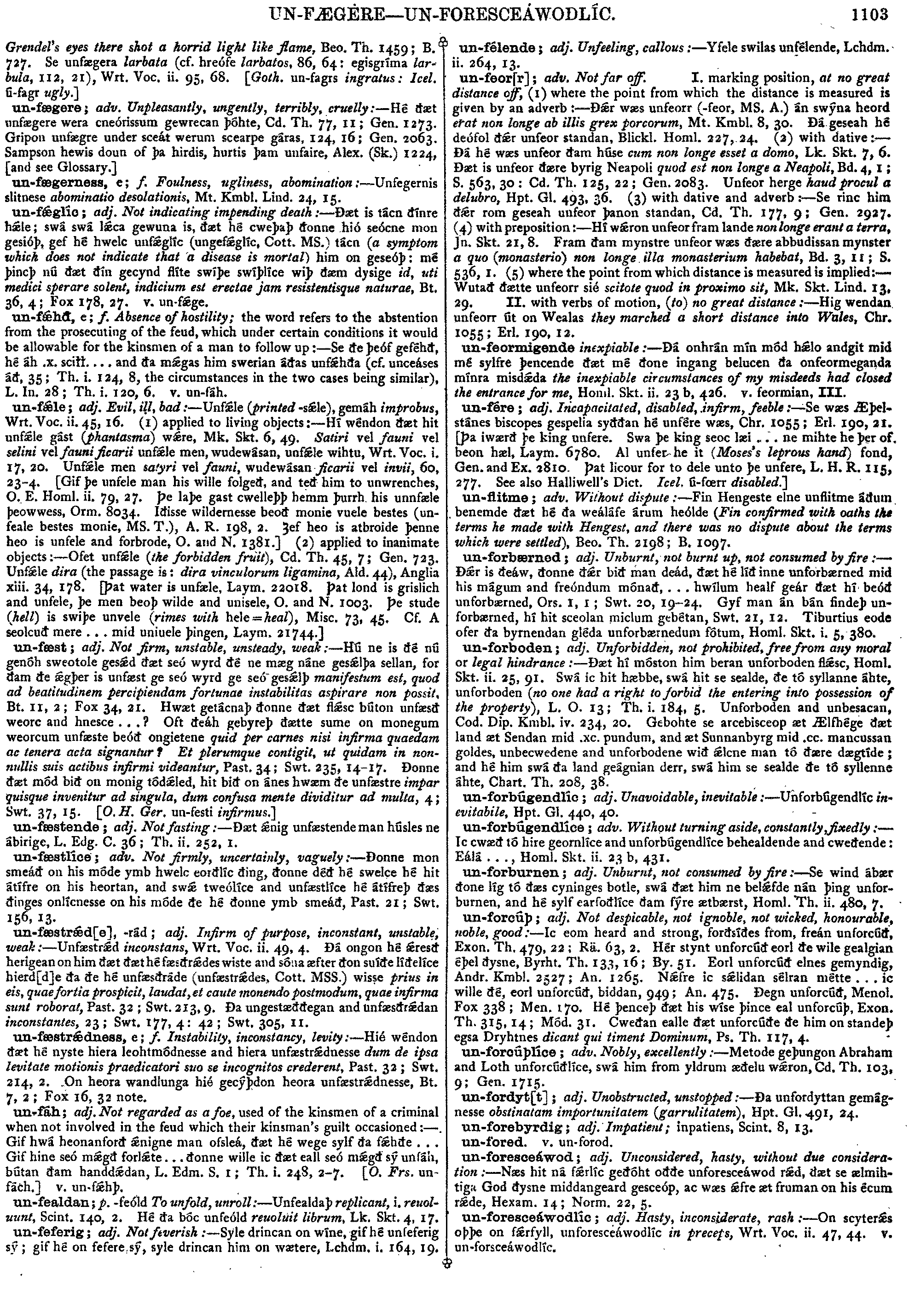
un-fægerness, e; f. Foulness, ugliness, abomination :-- Unfegernis slitnese abominatio desolationis, Mt. Kmbl. Lind. 24, 15.
|
Source: Bosworth/Toller, page b1103, entry 15 View original page image as: [TIFF] [PNG] [View previous entry] [View next entry] |
[Comment on this entry] [View comments] |
The following entry has been hand-corrected once. |
un-feor[r];
adv.
Not
far
off.
I.
marking
position,
at
no
great
distance
off,
(1)
where
the
point
from
which
the
distance
is
measured
is
given
by
an
adverb
:--
Ðr
wæs
unfeorr
(-feor,
MS.
A.)
án
swýna
heord
erat
non
longe
ab
illis
grex
porcorum,
Mt.
Kmbl.
8,
30.
Ðá
geseah
hé
deófol
ðr
unfeor
standan,
Blickl.
Homl.
227,
24.
(2)
with
dative
:--
Ðá
hé
wæs
unfeor
ðam
húse
cum
non
longe
esset
a
domo,
Lk.
Skt.
7,
6.
Ðæt
is
unfeor
ðære
byrig
Neapoli
quod
est
non
longe
a
Neapoli,
Bd.
4,
1;
S.
563,
30:
Cd.
Th.
125,
22;
Gen.
2083.
Unfeor
herge
haud
procul
a
delubro,
Hpt.
Gl.
493,
36.
(3)
with
dative
and
adverb
:--
Se
rinc
him
ðr
rom
geseah
unfeor
þanon
standan,
Cd.
Th.
177,
9;
Gen.
2927.
(4)
with
preposition
:--
Hí
wron
unfeor
fram
lande
non
longe
erant
a
terra,
Jn.
Skt.
21,
8.
Fram
ðam
mynstre
unfeor
wæs
ðære
abbudissan
mynster
a
quo
(monasterio)
non
longe,
illa
monasterium
habebat,
Bd.
3,
11;
S.
536,
1.
(5)
where
the
point
from
which
distance
is
measured
is
implied
:--
Wutað
ðætte
unfeorr
sié
scitote
quod
in
proximo
sit,
Mk.
Skt.
Lind.
13,
29.
II.
with
verbs
of
motion,
(to)
no
great
distance
:--
Hig
wendan,
unfeorr
út
on
Wealas
they
marched
a
short
distance
into
Wales,
Chr.
1055;
Erl.
190,
12.
|
Source: Bosworth/Toller, page b1107, entry 41 View original page image as: [TIFF] [PNG] [View previous entry] [View next entry] |
[Comment on this entry] [View comments] |
The following entry has been hand-corrected once. |
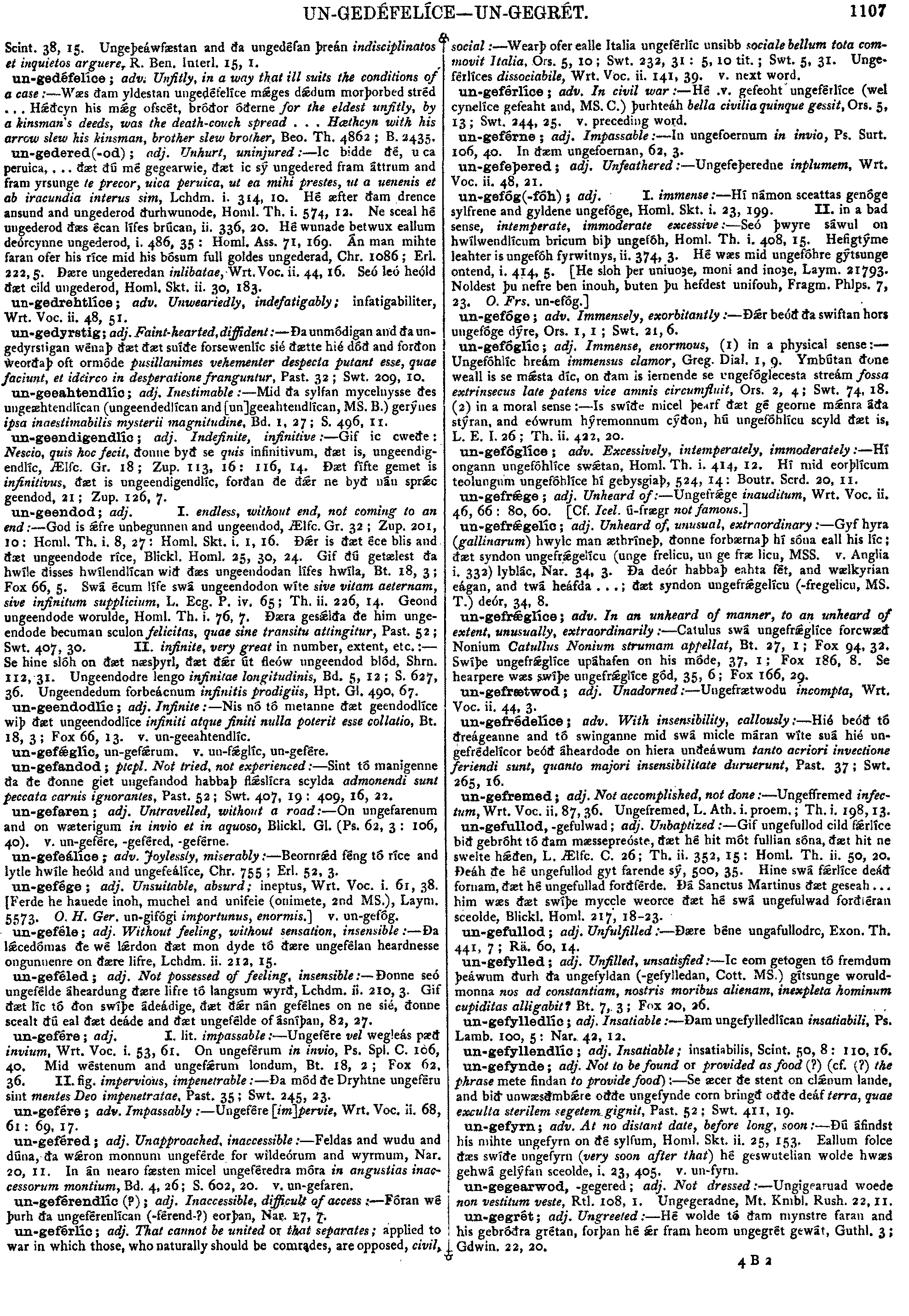
un-gegearwod, -gegered; adj. Not dressed :-- Ungigearuad woede non vestitum veste, Rtl. 108, 1. Ungegeradne, Mt. Kmbl. Rush. 22, 11.
|
Source: Bosworth/Toller, page b1108, entry 17 View original page image as: [TIFF] [PNG] [View previous entry] [View next entry] |
[Comment on this entry] [View comments] |
The following entry has been hand-corrected once. |
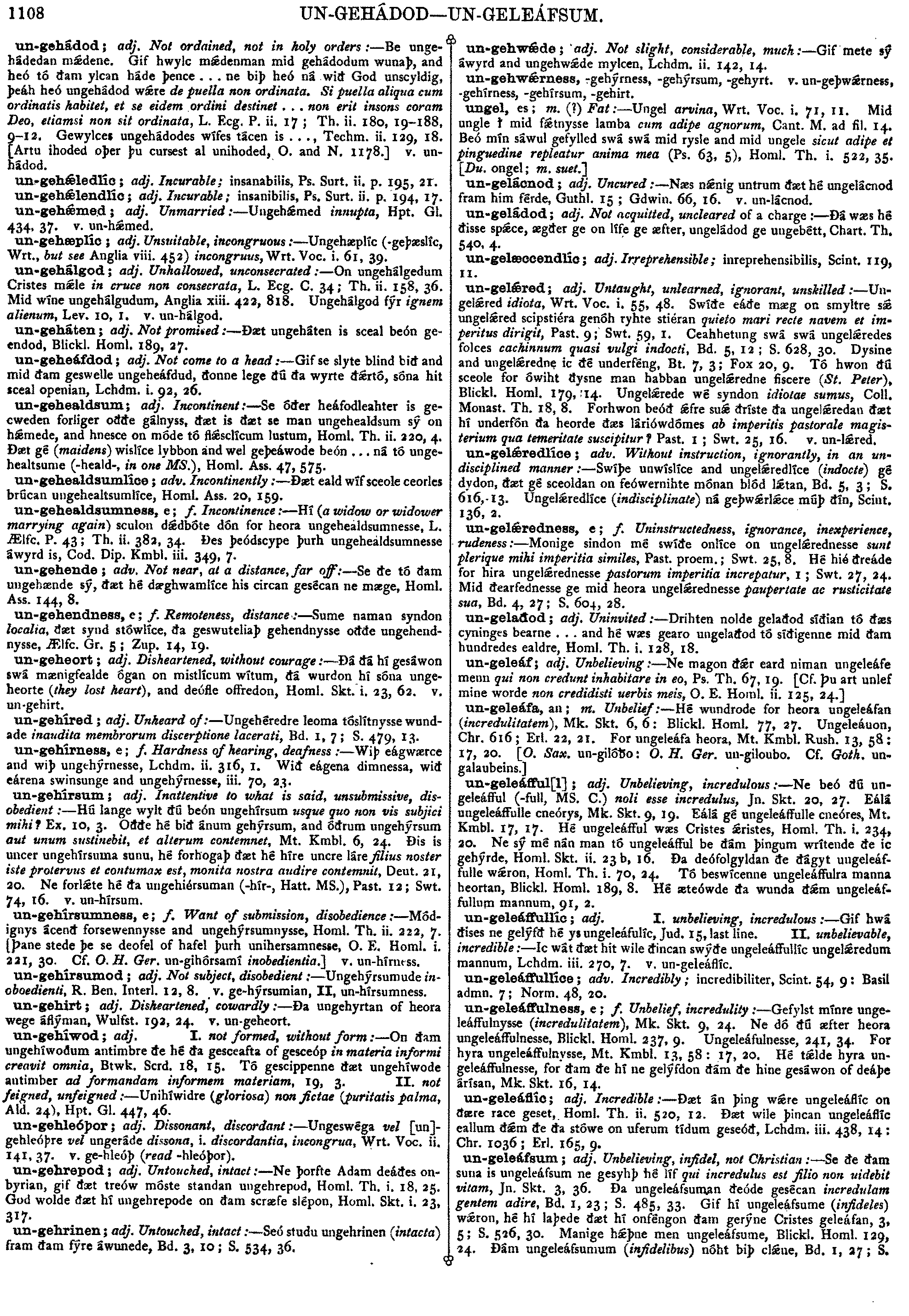
un-gehírsum;
adj.
Inattentive
to
what
is
said,
unsubmissive,
disobedient
:--
Hú
lange
wylt
ðú
beón
ungehírsum
usque
quo
non
vis
subjici
mihi?
Ex.
10,
3.
Oððe
hé
bið
ánum
gehýrsum,
and
óðrum
ungehýrsum
aut
unum
sustinebit,
et
alterum
contemnet,
Mt.
Kmbl.
6,
24.
Ðis
is
uncer
ungehírsuma
sunu,
hé
forhogaþ
ðæt
hé
híre
uncre
láre
filius
noster
iste
protervus
et
contumax
est,
monita
nostra
audire
contemnit,
Deut.
21,
20.
Ne
forlte
hé
ða
ungehiérsuman
(-hír-,
Hatt.
MS.),
Past.
12;
Swt.
74,
16.
v.
un-hírsum.
|
Source: Bosworth/Toller, page b1108, entry 36 View original page image as: [TIFF] [PNG] [View previous entry] [View next entry] |
[Comment on this entry] [View comments] |
The following entry has been hand-corrected once. |
un-geleáfa,
an;
m.
Unbelief
:--
Hé
wundrode
for
heora
ungeleáfan
(incredulitatem),
Mk.
Skt.
6,
6:
Blickl.
Homl.
77,
27.
Ungeleáuon,
Chr.
616;
Erl.
22,
21.
For
ungeleáfa
heora,
Mt.
Kmbl.
Rush.
13,
58:
17,
20.
[O.
Sax.
un-giló o:
O.
H.
Ger.
un-giloubo.
Cf.
Goth.
ungalaubeins.]
o:
O.
H.
Ger.
un-giloubo.
Cf.
Goth.
ungalaubeins.]
|
Source: Bosworth/Toller, page b1108, entry 37 View original page image as: [TIFF] [PNG] [View previous entry] [View next entry] |
[Comment on this entry] [View comments] |
The following entry has been hand-corrected once. |
un-geleáful[l];
adj.
Unbelieving,
incredulous
:--
Ne
beó
ðú
ungeleáfful
(-full,
MS.
C.)
noli
esse
incredulus,
Jn.
Skt.
20,
27.
Eálá
ungeleáffulle
cneórys,
Mk.
Skt.
9,
19.
Eálá
gé
ungeleáffulle
cneóres,
Mt.
Kmbl.
17,
17.
Hé
ungeleáfful
wæs
Cristes
ristes,
Homl.
Th.
i.
234,
20.
Ne
sý
mé
nán
man
tó
ungeleáfful
be
ðám
þingum
wrítende
ðe
ic
gehýrde,
Homl.
Skt.
ii.
23
b,
16.
Ða
deófolgyldan
ðe
ðágyt
ungeleáffulle
wron,
Homl.
Th.
i.
70,
24.
Tó
beswícenne
ungeleáffulra
manna
heortan,
Blickl.
Homl.
189,
8.
Hé
æteówde
ða
wunda
ðm
ungeleáffullum
mannum,
91,
2.
| Result Page: |  |
Previous | 200 201 202 203 204 205 206 207 208 209 210 211 212 213 214 215 216 217 218 | Next |  |
Germanic Lexicon Project (main page)
This search system was written by
Sean Crist
Please consider
volunteering
to correct the data in these online dictionaries.
No rights reserved. Feel free to use these data in any way you please.