|
|

Search for Men again, using less strict matching (3247 results)
|
Source: Bosworth/Toller, page b0760, entry 4 View original page image as: [TIFF] [PNG] [View previous entry] [View next entry] |
[Comment on this entry] [View comments] |
The following entry has been hand-corrected once. |
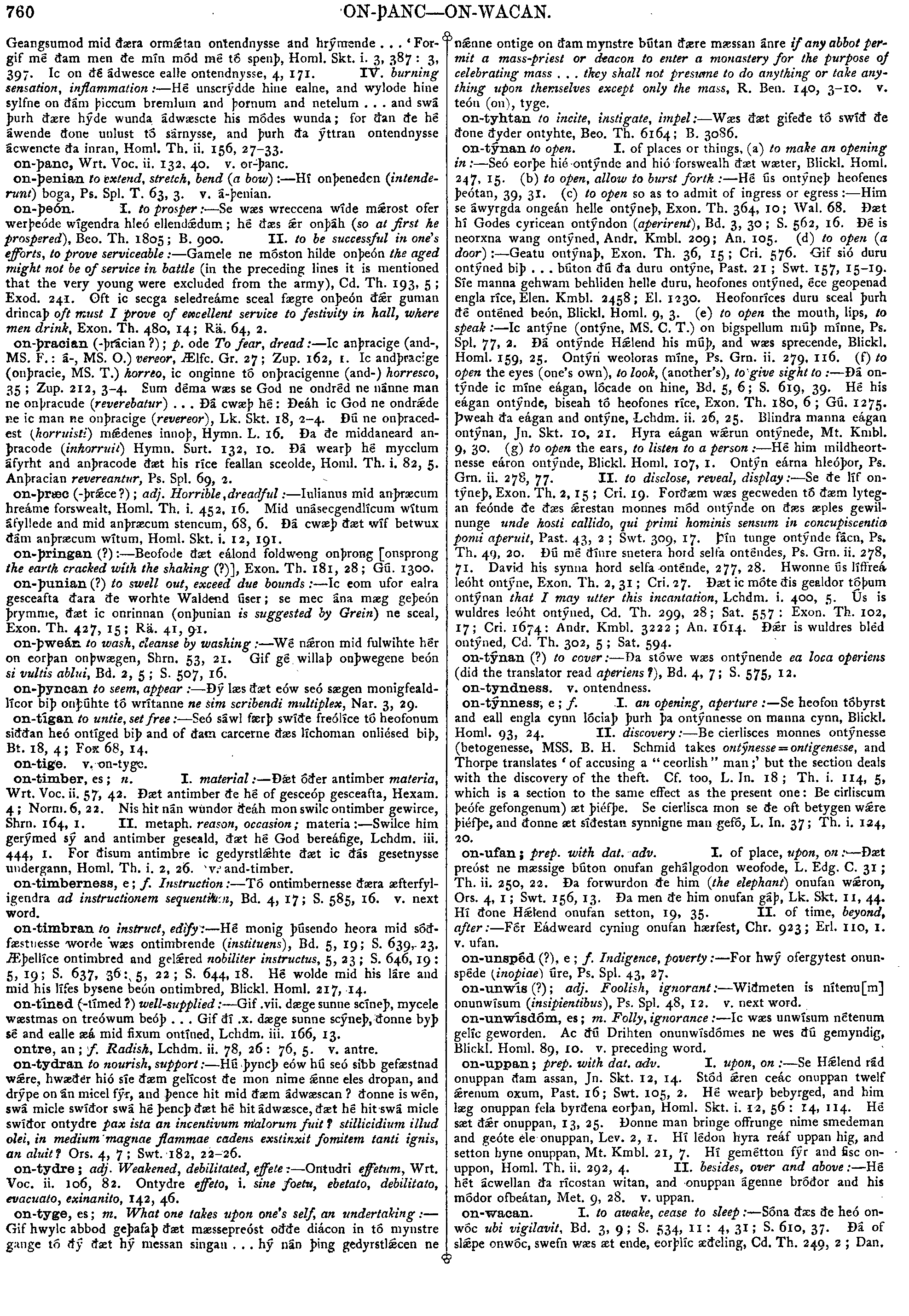
on-þeón.
I.
to
prosper
:--
Se
wæs
wreccena
wíde
m rost
ofer
werþeóde
wígendra
hleó
ellenddum;
hé
ðæs
r
onþáh
(so
at
first
he
prospered),
Beo.
Th.
1805;
B.
900.
II.
to
be
successful
in
one's
efforts,
to
prove
serviceable
:--
Gamele
ne
móston
hilde
onþeón
the
aged
might
not
be
of
service
in
battle
(in
the
preceding
lines
it
is
mentioned
that
the
very
young
were
excluded
from
the
army),
Cd.
Th.
193,
5;
Exod.
241.
Oft
ic
secga
seledreáme
sceal
fægre
onþeón
ðr
guman
drincaþ
oft
must
I
prove
of
excellent
service
to
festivity
in
hall,
where
men
drink,
Exon.
Th.
480,
14;
Rä.
64,
2.
rost
ofer
werþeóde
wígendra
hleó
ellenddum;
hé
ðæs
r
onþáh
(so
at
first
he
prospered),
Beo.
Th.
1805;
B.
900.
II.
to
be
successful
in
one's
efforts,
to
prove
serviceable
:--
Gamele
ne
móston
hilde
onþeón
the
aged
might
not
be
of
service
in
battle
(in
the
preceding
lines
it
is
mentioned
that
the
very
young
were
excluded
from
the
army),
Cd.
Th.
193,
5;
Exod.
241.
Oft
ic
secga
seledreáme
sceal
fægre
onþeón
ðr
guman
drincaþ
oft
must
I
prove
of
excellent
service
to
festivity
in
hall,
where
men
drink,
Exon.
Th.
480,
14;
Rä.
64,
2.
|
Source: Bosworth/Toller, page b0760, entry 26 View original page image as: [TIFF] [PNG] [View previous entry] [View next entry] |
[Comment on this entry] [View comments] |
The following entry has been hand-corrected once. |
on-ufan;
prep.
with
dat.
adv.
I.
of
place,
upon,
on
:--
Ðæt
preóst
ne
mæssige
búton
onufan
gehálgodon
weofode,
L.
Edg.
C.
31;
Th.
ii.
250,
22.
Ða
forwurdon
ðe
him
(the
elephant)
onufan
wron,
Ors.
4,
1;
Swt.
156,
13.
Ða
men
ðe
him
onufan
gáþ,
Lk.
Skt.
ii.
44.
Hí
ðone
Hlend
onufan
setton,
19,
35.
II.
of
time,
beyond,
after
:--
Fór
Eádweard
cyning
onufan
hærfest,
Chr.
923;
Erl.
110,
1.
v.
ufan.
|
Source: Bosworth/Toller, page b0761, entry 1 View original page image as: [TIFF] [PNG] [View previous entry] [View next entry] |
[Comment on this entry] [View comments] |
The following entry has been hand-corrected once. |
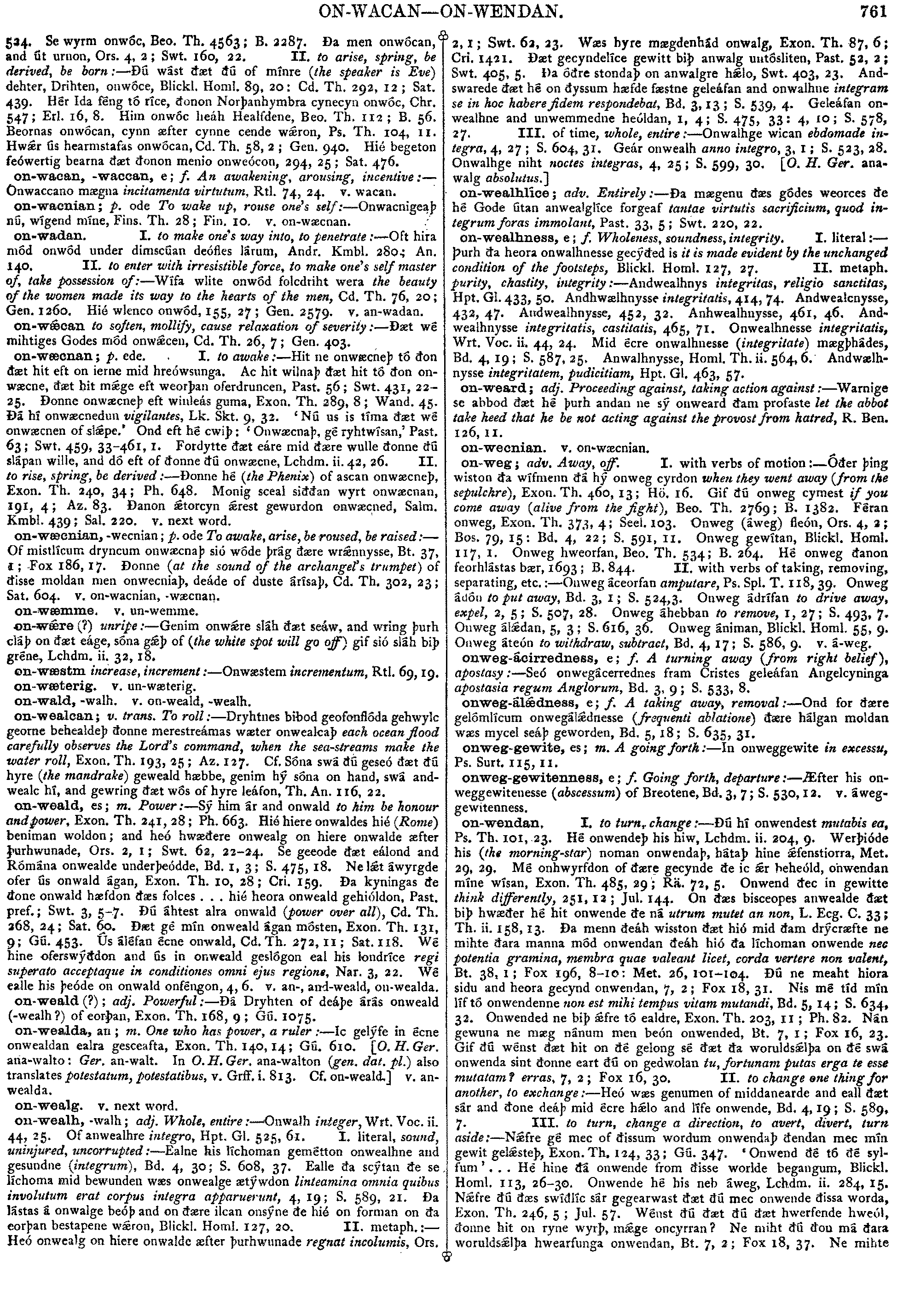
524.
Se
wyrm
onwóc,
Beo.
Th.
4563;
B.
2287.
Ða
men
onwócan,
and
út
urnon,
Ors.
4,
2;
Swt.
160,
22.
II.
to
arise,
spring,
be
derived,
be
born
:--
Ðú
wást
ðæt
ðú
of
mínre
(the
speaker
is
Eve)
dehter,
Drihten,
onwóce,
Blickl.
Homl.
89,
20:
Cd.
Th.
292,
12;
Sat.
439.
Hér
Ida
féng
tó
ríce,
ðonon
Norþanhymbra
cynecyn
onwóc,
Chr.
547;
Erl.
16,
8.
Him
onwóc
heáh
Healfdene,
Beo.
Th.
112;
B.
56.
Beornas
onwócan,
cynn
æfter
cynne
cende
wron,
Ps.
Th.
104,
11.
Hwr
ús
hearmstafas
onwócan,
Cd.
Th.
58,
2;
Gen.
940.
Hié
begeton
feówertíg
bearna
ðæt
ðonon
menio
onweócon,
294,
25;
Sat.
476.
|
Source: Bosworth/Toller, page b0761, entry 4 View original page image as: [TIFF] [PNG] [View previous entry] [View next entry] |
[Comment on this entry] [View comments] |
The following entry has been hand-corrected once. |
on-wadan. I. to make one's way into, to penetrate :-- Oft hira mód onwód under dimscúan deófles lárum, Andr. Kmbl. 280; An. 140. II. to enter with irresistible force, to make one's self master of, take possession of :-- Wífa wlite onwód folcdriht wera the beauty of the women made its way to the hearts of the men, Cd. Th. 76, 20; Gen. 1260, Hié wlenco onwód, 155, 27; Gen. 2579. v. an-wadan.
|
Source: Bosworth/Toller, page b0761, entry 7 View original page image as: [TIFF] [PNG] [View previous entry] [View next entry] |
[Comment on this entry] [View comments] |
The following entry has been hand-corrected once. |
on-wæcnian,
-wecnian;
p.
ode
To
awake,
arise,
be
roused,
be
raised
:--
Of
mistlícum
dryncum
onwæcnaþ
sió
wóde
þrág
ðære
wrnnysse,
Bt.
37,
1;
Fox
186,
17.
Ðonne
(at
the
sound
of
the
archangel's
trumpet)
of
ðisse
moldan
men
onwecniaþ,
deáde
of
duste
árísaþ,
Cd.
Th.
302,
23;
Sat.
604.
v.
on-wacnian,
-wæcnan.
|
Source: Bosworth/Toller, page b0761, entry 28 View original page image as: [TIFF] [PNG] [View previous entry] [View next entry] |
[Comment on this entry] [View comments] |
The following entry has been hand-corrected once. |
on-wendan.
I.
to
turn,
change
:--
Ðú
hí
onwendest
mutabis
ea,
Ps.
Th.
101,
23.
Hé
onwendeþ
his
hiw,
Lchdm.
ii.
204,
9.
Werþióde
his
(the
morning-star)
noman
onwendaþ,
hátaþ
hine
fenstiorra,
Met.
29,
29.
Mé
onhwyrfdon
of
ðære
gecynde
ðe
ic
r
beheóld,
onwendan
míne
wísan,
Exon.
Th.
485,
29;
Rä.
72,
5.
Onwend
ðec
in
gewitte
think
differently,
251,
12;
Jul.
144.
On
ðæs
bisceopes
anwealde
ðæt
biþ
hwæðer
hé
hit
onwende
ðe
ná
utrum
mutet
an
non,
L.
Ecg.
C.
33;
Th.
ii.
158,
13.
Ða
menn
ðeáh
wisston
ðæt
hió
mid
ðam
drýcræfte
ne
mihte
ðara
manna
mód
onwendan
ðeáh
hió
ða
líchoman
onwende
nec
potentia
gramina,
membra
quae
valeant
licet,
corda
vertere
non
valent,
Bt.
38,
1;
Fox
196,
8-10:
Met.
26,
101-104.
Ðú
ne
meaht
hiora
sidu
and
heora
gecynd
onwendan,
7,
2;
Fox
18,
31.
Nis
mé
tíd
mín
líf
tó
onwendenne
non
est
mihi
tempus
vitam
mutandi,
Bd.
5,
14.
S.
634,
32.
Onwended
ne
biþ
fre
tó
ealdre,
Exon.
Th.
203,
11;
Ph.
82.
Nán
gewuna
ne
mæg
nánum
men
beón
onwended,
Bt.
7,
1;
Fox
16,
23.
Gif
ðú
wénst
ðæt
hit
on
ðé
gelong
sé
ðæt
ða
woruldslþa
on
ðé
swá
onwenda
sint
ðonne
eart
dú
on
gedwolan
tu,
fortunam
putas
erga
te
esse
mutatam?
erras,
7,
2;
Fox
16,
30.
II.
to
change
one
thing
for
another,
to
exchange
:--
Heó
wæs
genumen
of
middanearde
and
eall
ðæt
sár
and
ðone
deáþ
mid
écre
hlo
and
lífe
onwende,
Bd.
4,
19;
S.
589,
7.
III.
to
turn,
change
a
direction,
to
avert,
divert,
turn
aside
:--
Nfre
gé
mec
of
ðissum
wordum
onwendaþ
ðendan
mec
mín
gewit
gelsteþ,
Exon.
Th.
124,
33;
Gú.
347.
'Onwend
ðé
tó
ðé
sylfum'
...
Hé
hine
ðá
onwende
from
ðisse
worlde
begangum,
Blickl.
Homl.
113,
26-30.
Onwende
hé
his
neb
áweg,
Lchdm.
ii.
284,
15.
Nfre
ðú
ðæs
swíðlíc
sár
gegearwast
ðæt
ðú
mec
onwende
ðissa
worda,
Exon.
Th.
246,
5;
Jul.
57.
Wénst
ðú
ðæt
ðú
ðæt
hwerfende
hweól,
ðonne
hit
on
ryne
wyrþ,
mge
oncyrran?
Ne
miht
ðú
ðon
má
ðara
woruldslþa
hwearfunga
onwendan,
Bt.
7,
2;
Fox
18,
37.
Ne
mihte
|
Source: Bosworth/Toller, page b0763, entry 6 View original page image as: [TIFF] [PNG] [View previous entry] [View next entry] |
[Comment on this entry] [View comments] |
The following entry has been hand-corrected once. |
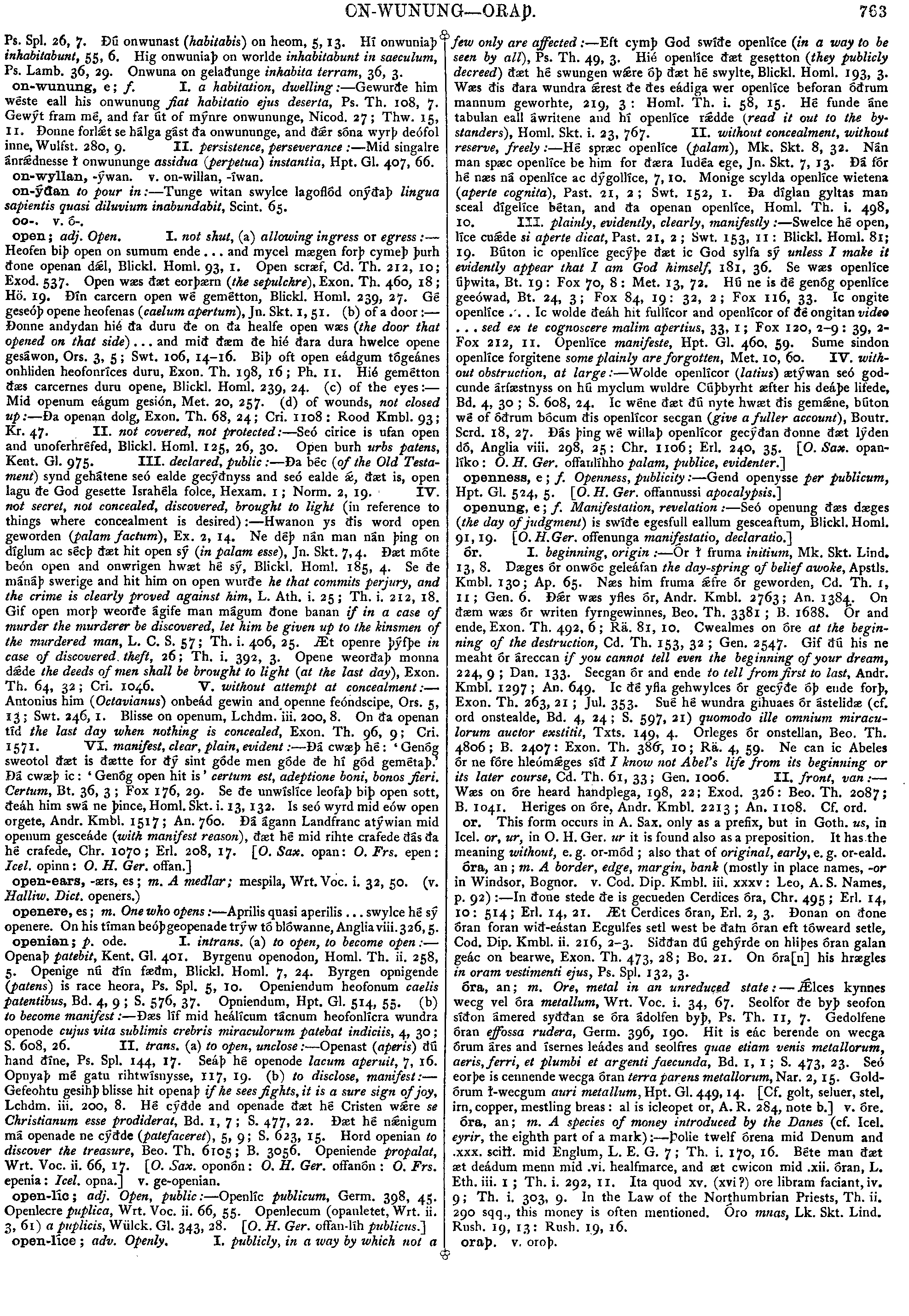
open;
adj.
Open.
I.
not
shut,
(a)
allowing
ingress
or
egress
:--
Heofen
biþ
open
on
sumum
ende
.
.
.
and
mycel
mægen
forþ
cymeþ
þurh
ðone
openan
dl.
Blickl.
Homl.
93,
l.
Open
scræf.
Cd.
Th.
212,
10;
Exod.
537.
Open
wæs
ðæt
eorþærn
(the
sepulchre).
Exon.
Th.
460,
18;
Hö.
19.
Ðín
carcern
open
wé
gemétton,
Blickl.
Homl.
239,
27.
Gé
geseóþ
opene
heofenas
(caelum
apertum),
Jn.
Skt.
1,
51.
(b)
of
a
door
:--
Ðonne
andydan
hié
ða
duru
ðe
on
ða
healfe
open
wæs
(the
door
that
opened
on
that
side).
.
.
and
mið
ðæm
ðe
hié
ðara
dura
hwelce
opene
gesáwon.
Ors.
3,
5;
Swt.
106,
14-16.
Biþ
oft
open
eádgum
tðgeánes
onhliden
heofonríces
duru.
Exon.
Th.
198,
16;
Ph.
11.
Hié
gemétton
ðæs
carcernes
duru
opene.
Blickl.
Homl.
239,
24.
(c)
of
the
eyes
:--
Mid
openum
eágum
gesión.
Met.
20,
257.
(d)
of
wounds,
not
closed
up
:--
Ða
openan
dolg,
Exon.
Th.
68,
24;
Cri.
1108
:
Rood
Kmbl.
93;
Kr.
47
II.
not
covered,
not
protected
:--
Seó
cirice
is
ufan
open
and
noferhréfed,
Blickl.
Homl.
125,
26,
30.
Open
burh
urbs
patens,
Kent.
Gl.
975.
III.
declared,
public
:--
Ða
béc
(of
the
Old
Testament)
synd
gehátene
seó
ealde
gecýðnyss
and
seó
ealde
,
ðæt
is,
open
lagu
ðe
God
gesette
Israhéla
folce.
Hexam.
l;
Norm.
2,
19.
IV.
not
secret,
not
concealed,
discovered,
brought
to
light
(in
reference
to
things
where
concealment
is
desired)
:--
Hwanon
ys
ðis
word
open
geworden
(palam
Jactitm),
Ex.
2,
14.
Ne
déþ
nán
man
nán
þing
on
díglum
ac
sécþ
ðæt
hit
open
sý
(in
palam
esse),
Jn.
Skt.
7,
4.
Ðæt
móte
beón
open
and
onwrigen
hwæt
hé
sý,
Blickl.
Homl.
185,
4.
Se
ðe
mánaþ
swerige
and
hit
him
on
open
wurðe
he
that
commits
perjury,
and
the
crime
is
clearly
proved
against
him,
L.
Ath.
i.
25;
Th.
i.
212,
18.
Gif
open
morþ
weorðe
ágife
man
mágum
ðone
banan
if
in
a
case
of
murder
the
murderer
be
discovered,
let
him
be
given
up
to
the
kinsmen
of
the
murdered
man,
L.
C.
S.
57;
Th.
i.
406,
25.
Æt
openre
þýfþe
in
case
of
discovered,
theft,
26;
Th.
i.
392,
3.
Opene
weorðaþ
monna
dde
the
deeds
of
men
shall
be
brought
to
light
(at
the
last
day),
Exon.
Th.
64,
32;
Cri.
1046.
V.
without
attempt
at
concealment:--
Antonius
him
(Octavianus)
onbeád
gewin
and
openne
feóndscipe,
Ors.
5,
13;
Swt.
146,
l.
Blisse
on
openum,
Lchdm.
iii.
200,
8.
On
ða
openan
tíd
the
last
day
when
nothing
is
concealed,
Exon.
Th.
96,
9;
Cri.
1571.
VI.
manifest,
clear,
plain,
evident
:--
Ðá
cwæþ
hé
:
'Genóg
sweotol
ðæt
is
ðætte
for
ðý
sint
góde
men
góde
ðe
hí
gód
gemétaþ'
Ðá
cwæþ
ic
:
'
Genóg
open
hit
is
'
certum
est,
adeptione
boni,
bonos
fieri.
Certum,
Bt.
36,
3
;
Fox
176,
29.
Se
ðe
unwíslíce
leofaþ
biþ
open
sott,
ðeáh
him
swá
ne
þince,
Homl.
Skt.
i.
13,
132.
Is
seó
wyrd
mid
eów
open
orgete,
Andr.
Kmbl.
1517;
An.
760.
Ðá
ágann
Landfranc
atýwian
mid
openum
gesceáde
(with
manifest
reason),
ðæt
hé
mid
rihte
crafede
ðás
ða
hé
crafede,
Chr.
1070;
Erl.
208,
17.
[O.
Sax.
opan:
O.
Frs.
epen:
Icel.
opinn:
O.
H.
Ger.
offan.]
|
Source: Bosworth/Toller, page b0764, entry 11 View original page image as: [TIFF] [PNG] [View previous entry] [View next entry] |
[Comment on this entry] [View comments] |
The following entry has been hand-corrected once. |
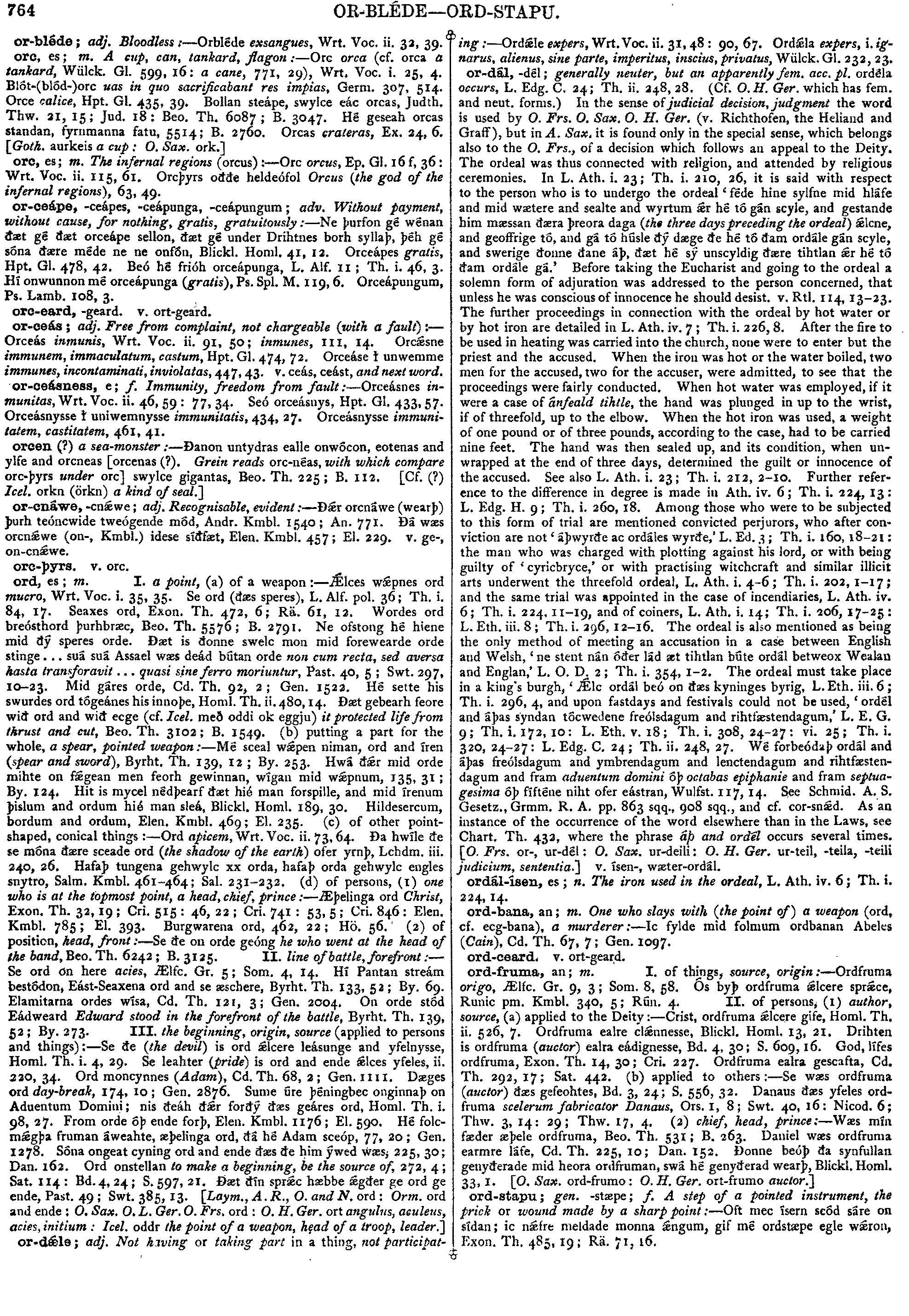
ord,
es;
m.
I.
a
point,
(a)
of
a
weapon
:--
Æ-acute;lces
wpnes
ord
mucro,
Wrt.
Voc.
i.
35,
35.
Se
ord
(ðæs
speres),
L.
Alf.
pol.
36;
Th.
i.
84,
17.
Seaxes
ord,
Exon.
Th.
472,
6;
Rä.
61,
12.
Wordes
ord
breósthord
þurhbræc,
Beo.
Th.
5576;
B.
2791.
Ne
ofstong
hé
hiene
mid
dý
speres
orde.
Ðæt
is
ðonne
swelc
mon
mid
forewearde
orde
stinge
...
suá
suá
Assael
wæs
deád
bútan
orde
non
cum
recta,
sed
aversa
hasta
transforavit
...
quasi
sine
ferro
moriuntur,
Past.
40,
5;
Swt.
297,
10-23.
Mid
gáres
orde,
Cd.
Th.
92,
2;
Gen.
1522.
Hé
sette
his
swurdes
ord
tógeánes
his
innoþe,
Homl.
Th.
ii.
480,
14.
Ðæt
gebearh
feore
wið
ord
and
wið
ecge
(cf.
Icel.
með
oddi
ok
eggju)
it
protected
life
from
thrust
and
cut,
Beo.
Th.
3102;
B.
1549.
(b)
putting
a
part
for
the
whole,
a
spear,
pointed
weapon
:--
Mé
sceal
wpen
niman,
ord
and
íren
(spear
and
sword),
Byrht.
Th.
139,
12;
By.
253.
Hwá
ðr
mid
orde
mihte
on
fgean
men
feorh
gewinnan,
wígan
mid
wpnum,
135,
31;
By.
124.
Hit
is
mycel
nédþearf
ðæt
hié
man
forspille,
and
mid
írenum
þislum
and
ordum
hié
man
sleá,
Blickl.
Homl.
189,
30.
Hildesercum,
bordum
and
ordum,
Elen.
Kmbl.
469;
El.
235.
(c)
of
other
point-shaped,
conical
things
:--
Ord
apicem,
Wrt.
Voc.
ii.
73,
64.
Ða
hwíle
ðe
se
móna
ðære
sceade
ord
(the
shadow
of
the
earth)
ofer
yrnþ,
Lchdm.
iii.
240,
26.
Hafaþ
tungena
gehwylc
xx
orda,
hafaþ
orda
gehwylc
engles
snytro,
Salm.
Kmbl.
461-464;
Sal.
231-232.
(d)
of
persons,
(1)
one
who
is
at
the
topmost
point,
a
head,
chief,
prince
:--
Æþelinga
ord
Christ,
Exon.
Th.
32,
19;
Cri.
515:
46,
22;
Cri.
741:
53,
5;
Cri.
846:
Elen.
Kmbl.
785;
El.
393.
Burgwarena
ord,
462,
22;
Hö.
56.
(2)
of
position,
head,
front
:--
Se
ðe
on
orde
geóng
he
who
went
at
the
head
of
the
band,
Beo.
Th.
6242;
B.
3125.
II.
line
of
battle,
forefront
:--
Se
ord
on
here
acies,
Ælfc.
Gr.
5;
Som.
4,
14.
Hí
Pantan
streám
bestódon,
Eást-Seaxena
ord
and
se
æschere,
Byrht.
Th.
133,
52;
By.
69.
Elamitarna
ordes
wísa,
Cd.
Th.
121,
3;
Gen.
2004.
On
orde
stód
Eádweard
Edward
stood
in
the
forefront
of
the
battle,
Byrht.
Th.
139,
52;
By.
273.
III.
the
beginning,
origin,
source
(applied
to
persons
and
things)
:--
Se
ðe
(the
devil)
is
ord
lcere
leásunge
and
yfelnysse,
Homl.
Th.
i.
4,
29.
Se
leahter
(pride)
is
ord
and
ende
lces
yfeles,
ii.
220,
34.
Ord
moncynnes
(Adam),
Cd.
Th.
68,
2;
Gen.
1111.
Dæges
ord
day-break,
174,
10;
Gen.
2876.
Sume
úre
þéningbec
onginnaþ
on
Aduentum
Domini;
nis
ðeáh
ðr
forðý
ðæs
geáres
ord,
Homl.
Th.
i.
98,
27.
From
orde
óþ
ende
forþ,
Elen.
Kmbl.
1176;
El.
590.
Hé
folcmgþa
fruman
áweahte,
æþelinga
ord,
ðá
hé
Adam
sceóp,
77,
20;
Gen.
1278.
Sóna
ongeat
cyning
ord
and
ende
ðæs
ðe
him
ýwed
wæs,
225,
30;
Dan.
162.
Ord
onstellan
to
make
a
beginning,
be
the
source
of,
272,
4;
Sat.
114:
Bd.
4,
24;
S.
597,
21.
Ðæt
ðín
sprc
hæbbe
gðer
ge
ord
ge
ende,
Past.
49;
Swt.
385,
13.
[Laym.,
A.
R.,
O.
and
N.
ord:
Orm.
ord
and
ende:
O.
Sax.
O.
L.
Ger.
O.
Frs.
ord:
O.
H.
Ger.
ort
angulus,
aculeus,
acies,
initium:
Icel.
oddr
the
point
of
a
weapon,
head
of
a
troop,
leader.]
|
Source: Bosworth/Toller, page b0764, entry 13 View original page image as: [TIFF] [PNG] [View previous entry] [View next entry] |
[Comment on this entry] [View comments] |
The following entry has been hand-corrected once. |
or-dál,
-dél;
generally
neuter,
but
an
apparently
fem.
acc.
pl.
ordéla
occurs,
L.
Edg.
C.
24;
Th.
ii.
248,
28.
(Cf.
O.
H.
Ger.
which
has
fem.
and
neut.
forms.)
In
the
sense
of
judicial
decision,
judgment
the
word
is
used
by
O.
Frs.
O.
Sax.
O.
H.
Ger.
(v.
Richthofen,
the
Heliand
and
Graff),
but
in
A.
Sax.
it
is
found
only
in
the
special
sense,
which
belongs
also
to
the
O.
Frs.,
of
a
decision
which
follows
an
appeal
to
the
Deity.
The
ordeal
was
thus
connected
with
religion,
and
attended
by
religious
ceremonies.
In
L.
Ath.
i.
23;
Th.
i.
210,
26,
it
is
said
with
respect
to
the
person
who
is
to
undergo
the
ordeal
'féde
hine
sylfne
mid
hláfe
and
mid
wætere
and
sealte
and
wyrtum
r
hé
tó
gán
scyle,
and
gestande
him
mæssan
ðæra
þreora
daga
(the
three
days
preceding
the
ordeal)
lcne,
and
geoffrige
tó,
and
gá
tó
húsle
ðý
dæge
ðe
hé
tó
ðam
ordále
gán
scyle,
and
swerige
ðonne
ðane
áþ,
ðæt
hé
sý
unscyldig
ðære
tihtlan
r
hé
tó
ðam
ordále
gá.'
Before
taking
the
Eucharist
and
going
to
the
ordeal
a
solemn
form
of
adjuration
was
addressed
to
the
person
concerned,
that
unless
he
was
conscious
of
innocence
he
should
desist,
v.
Rtl.
114,
13-23.
The
further
proceedings
in
connection
with
the
ordeal
by
hot
water
or
by
hot
iron
are
detailed
in
L.
Ath.
iv.
7;
Th.
i.
226,
8.
After
the
fire
to
be
used
in
heating
was
carried
into
the
church,
none
were
to
enter
but
the
priest
and
the
accused.
When
the
iron
was
hot
or
the
water
boiled,
two
men
for
the
accused,
two
for
the
accuser,
were
admitted,
to
see
that
the
proceedings
were
fairly
conducted.
When
hot
water
was
employed,
if
it
were
a
case
of
ánfeald
tihtle,
the
hand
was
plunged
in
up
to
the
wrist,
if
of
threefold,
up
to
the
elbow.
When
the
hot
iron
was
used,
a
weight
of
one
pound
or
of
three
pounds,
according
to
the
case,
had
to
be
carried
nine
feet.
The
hand
was
then
sealed
up,
and
its
condition,
when
unwrapped
at
the
end
of
three
days,
determined
the
guilt
or
innocence
of
the
accused.
See
also
L.
Ath.
i.
23;
Th.
i.
212,
2-10.
Further
reference
to
the
difference
in
degree
is
made
in
Ath.
iv.
6;
Th.
i.
224,
13:
L.
Edg.
H.
9;
Th.
i.
260,
18.
Among
those
who
were
to
be
subjected
to
this
form
of
trial
are
mentioned
convicted
perjurors,
who
after
conviction
are
not
'áþwyrðe
ac
ordáles
wyrðe,'
L.
Ed.
3;
Th.
i.
160,
18-21:
the
man
who
was
charged
with
plotting
against
his
lord,
or
with
being
guilty
of
'cyricbryce,'
or
with
practising
witchcraft
and
similar
illicit
arts
underwent
the
threefold
ordeal,
L.
Ath.
i.
4-6;
Th.
i.
202,
1-17;
and
the
same
trial
was
appointed
in
the
case
of
incendiaries,
L.
Ath.
iv.
6;
Th.
i.
224,
11-19,
and
of
coiners,
L.
Ath.
i.
14;
Th.
i.
206,
17-25:
L.
Eth.
iii.
8;
Th.
i.
296,
12-16.
The
ordeal
is
also
mentioned
as
being
the
only
method
of
meeting
an
accusation
in
a
case
between
English
and
Welsh,
'ne
stent
nán
óðer
lád
æt
tihtlan
búte
ordál
betweox
Wealan
and
Englan,'
L.
O.
D.
2;
Th.
i.
354,
1-2.
The
ordeal
must
take
place
in
a
king's
burgh,
'Æ-acute;lc
ordál
beó
on
ðæs
kyninges
byrig,'
L.
Eth.
iii.
6;
Th.
i.
296,
4,
and
upon
fastdays
and
festivals
could
not
be
used,
'ordél
and
áþas
syndan
tócwedene
freólsdagum
and
rihtfæstendagum,'
L.
E.
G.
9;
Th.
i.
172,
10:
L.
Eth.
v.
18;
Th.
i.
308,
24-27:
vi.
25;
Th.
i.
320,
24-27:
L.
Edg.
C.
24;
Th.
ii.
248,
27.
Wé
forbeódaþ
ordál
and
áþas
freólsdagum
and
ymbrendagum
and
lenctendagum
and
rihtfæstendagum
and
fram
aduentum
domini
óþ
octabas
epiphanie
and
fram
septuagesima
óþ
fífténe
niht
ofer
eástran,
Wulfst.
117,
14.
See
Schmid.
A.
S.
Gesetz.,
Grmm.
R.
A.
pp.
863
sqq.,
908
sqq.,
and
cf.
cor-snd.
As
an
instance
of
the
occurrence
of
the
word
elsewhere
than
in
the
Laws,
see
Chart.
Th.
432,
where
the
phrase
áþ
and
ordél
occurs
several
times.
[O.
Frs.
or-,
ur-dél:
O.
Sax.
ur-deili:
O.
H.
Ger.
ur-teil,
-teila,
-teili
judicium,
sentential.]
v.
ísen-,
wæter-ordál.
|
Source: Bosworth/Toller, page b0765, entry 10 View original page image as: [TIFF] [PNG] [View previous entry] [View next entry] |
[Comment on this entry] [View comments] |
The following entry has been hand-corrected once. |
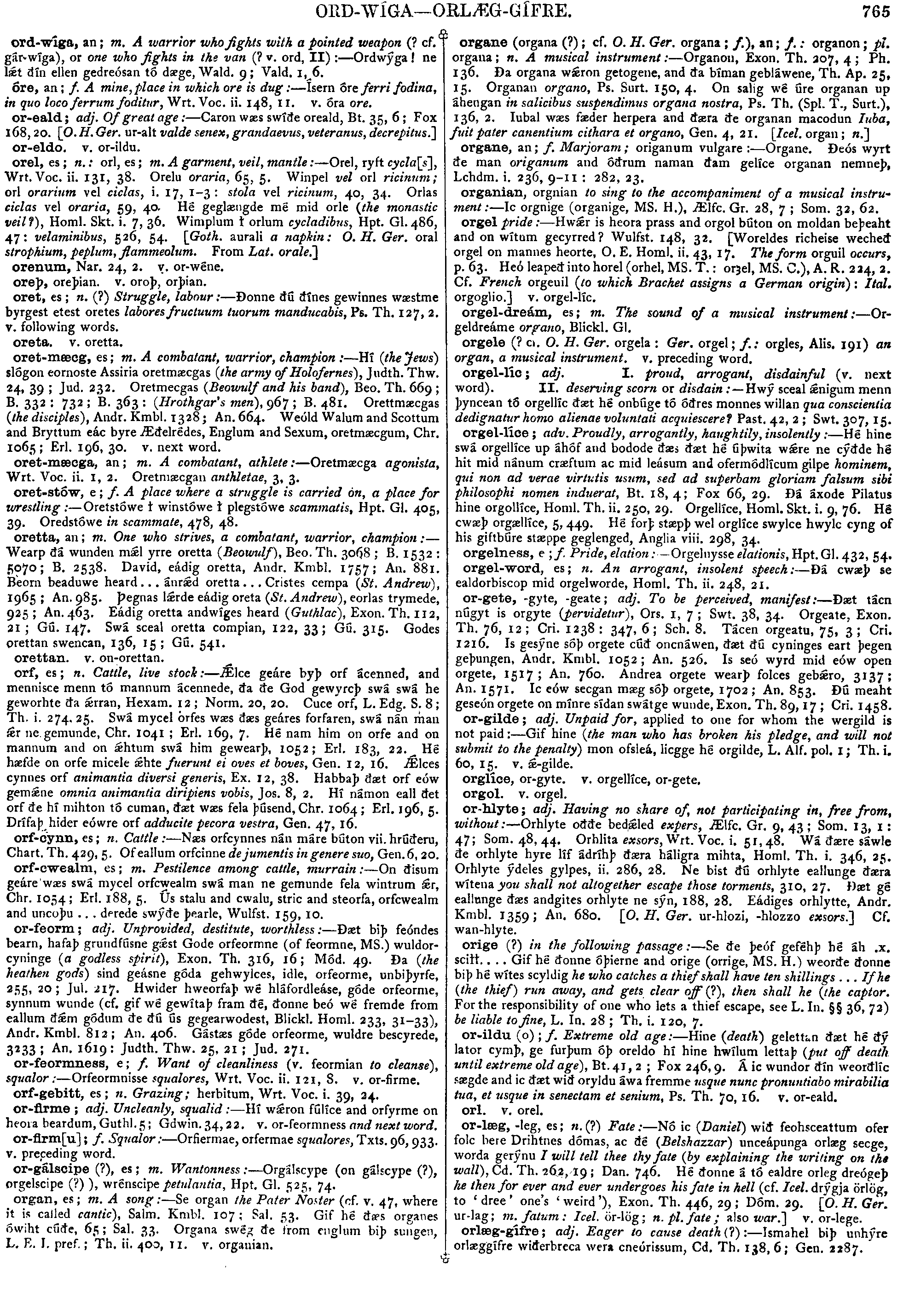
oret-mæcg, es; m. A combatant, warrior, champion :-- Hî (the Jews) slógon eornoste Assiria oretmæcgas (the army of Holofernes), Judth. Thw. 24, 39 ; Jud. 232. Oretmecgas (Beowulf and his band), Beo. Th. 669 ; B. 332 : 732 ; B. 363 : (Hrothgar's men), 967 ; B. 481. Orettmæcgas (the disciples), Andr. Kmbl. 1328; An. 664. Weóld Walum and Scottum and Bryttum eác byre Æðelrédes, Englum and Sexum, oretmæcgum. Chr. 1065 ; Erl. 196, 30. v. next word.
| Result Page: |  |
Previous | 107 108 109 110 111 112 113 114 115 116 117 118 119 120 121 122 123 124 125 | Next |  |
Germanic Lexicon Project (main page)
This search system was written by
Sean Crist
Please consider
volunteering
to correct the data in these online dictionaries.
No rights reserved. Feel free to use these data in any way you please.