|
|

|
Source: Bosworth/Toller, page b1300, entry 30 View original page image as: [TIFF] [PNG] [View previous entry] [View next entry] |
[Comment on this entry] [View comments] |
The following entry has been hand-corrected once. |
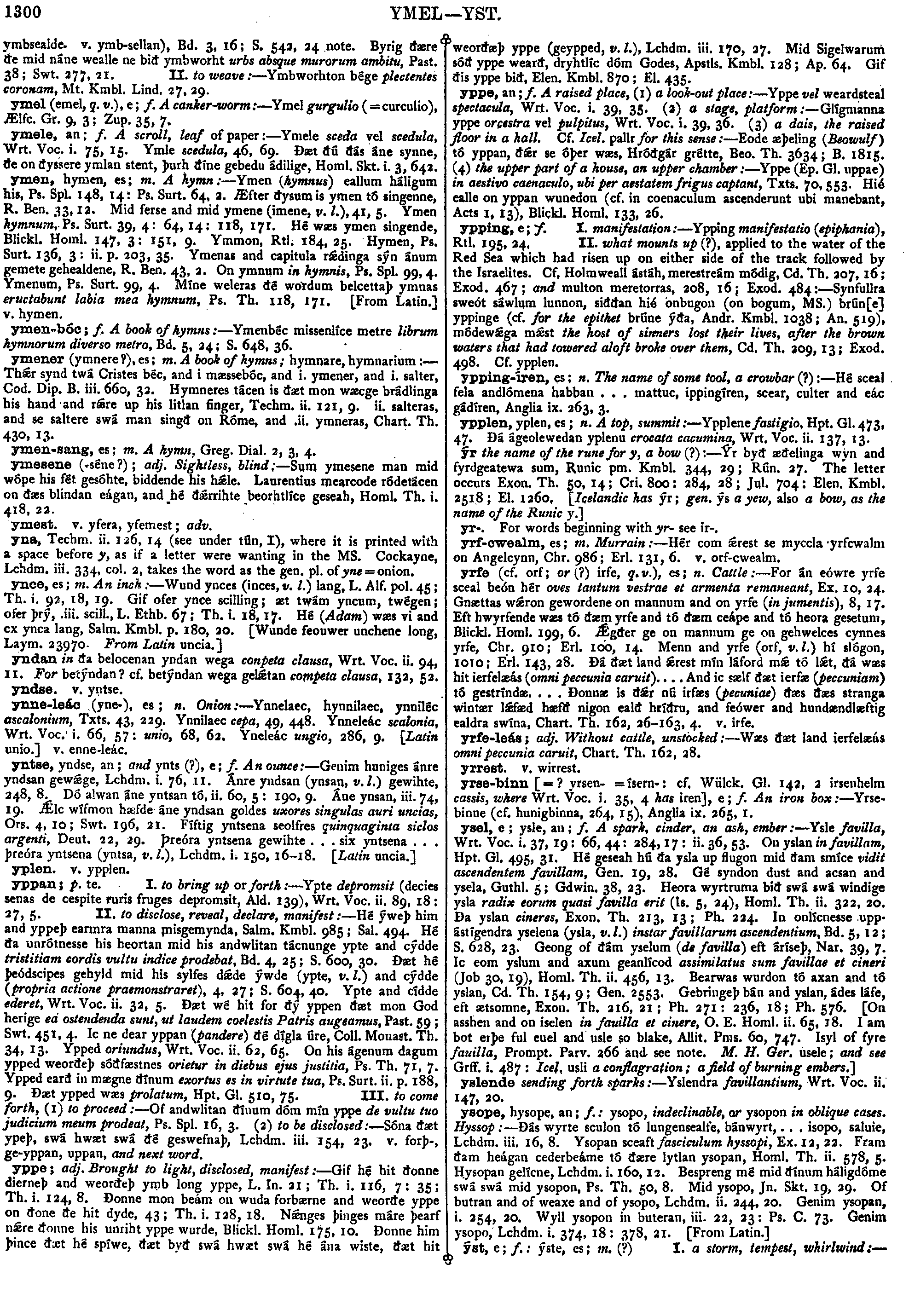
ysel, e; ysle, an; f. A spark, cinder, an ash, ember :-- Ysle favilla, Wrt. Voc. i. 37, 19: 66, 44: 284, 17: ii. 36, 53. On yslan in favillam, Hpt. Gl. 495, 31. Hé geseah hú ða ysla up flugon mid ðam smíce vidit ascendentem favillam, Gen. 19, 28. Gé syndon dust and acsan and ysela, Guthl. 5; Gdwin. 38, 23. Heora wyrtruma bið swá swá windige ysla radix eorum quasi favilla erit (ls. 5, 24), Homl. Th. ii. 322, 20. Ða yslan cineres, Exon. Th. 213, 13; Ph. 224. In onlícnesse uppástigendra yselena (ysla, v. l.) instar favillarum ascendentium, Bd. 5, 12; S. 628, 23. Geong of ðám yselum (de favilla) eft áríseþ, Nar. 39, 7. Ic eom yslum and axum geanlícod assimilatus sum favillae et cineri (Job 30, 19), Homl. Th. ii. 456, 13. Bearwas wurdon tó axan and tó yslan, Cd. Th. 154, 9; Gen. 2553. Gebringeþ bán and yslan, ádes láfe, eft ætsomne, Exon. Th. 216, 21; Ph. 271: 236, 18; Ph. 576. [On asshen and on iselen in fauilla et cinere, O. E. Homl. ii. 65, 18. I am bot erþe ful euel and usle so blake, Allit. Pms. 60, 747. Isyl of fyre fauilla, Prompt. Parv. 266 and see note. M. H. Ger. usele; and see Grff. i. 487: Icel. usli a conflagration; a field of burning embers.]
|
Source: Cleasby/Vigfusson, page b0002, entry 3 View original page image as: [TIFF] [PNG] [View previous entry] [View next entry] |
[Comment on this entry] [View comments] |
The following entry has been hand-corrected once. |
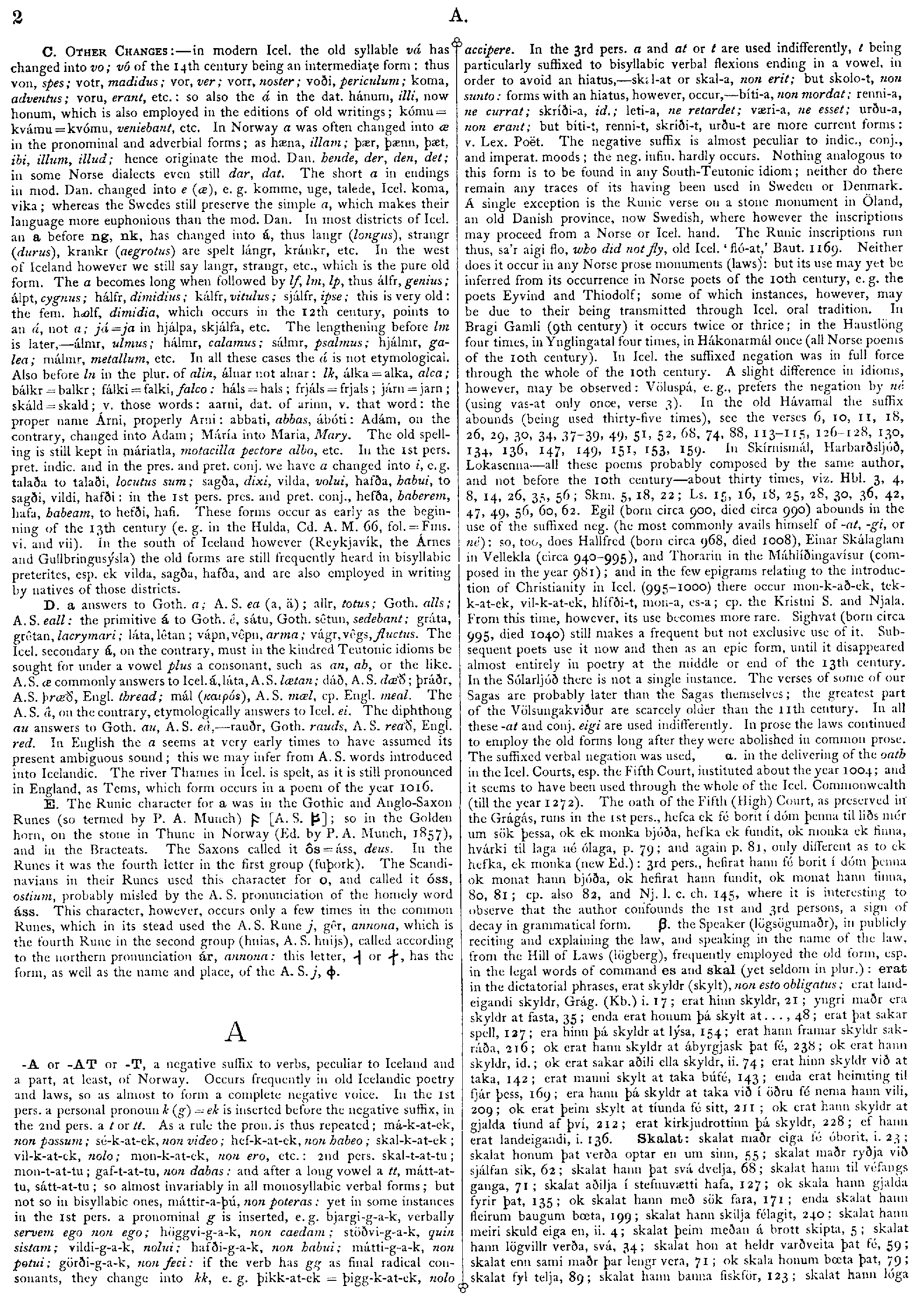
-A
or
-AT
or
-T,
a
negative
suffix
to
verbs,
peculiar
to
Iceland
and
a
part,
at
least,
of
Norway.
Occurs
frequently
in
old
Icelandic
poetry
and
laws,
so
as
almost
to
form
a
complete
negative
voice.
In
the
1st
pers.
a
personal
pronoun
k
(g)
=
ek
is
inserted
before
the
negative
suffix,
in
the
2nd
pers.
a
t
or
tt.
As
a
rule
the
pron.
as
thus
repeated;
má-k-at-ek,
non
possum;
sé-k-at-ek,
non
video;
hef-k-at-ek,
non
habeo;
skal-k-at-ek;
vil-k-at-ek,
nolo;
mon-k-at-ek,
non
ero,
etc.:
2nd
pers.
skal-t-at-tu;
mon-t-at-tu;
gaf-t-at-tu,
non
dabas:
and
after
a
long
vowel
a
tt,
mátt-at-
tu,
sátt-at-tu;
so
almost
invariably
in
all
monosyllabic
verbal
forms;
but
not
so
in
bisyllabic
ones,
máttir-a-þú,
non
poteras:
yet
in
some
instances
in
the
1st
pers.
a
pronominal
g
is
inserted,
e.
g.
bjargi-g-a-k,
verbally
servem
ego
non
ego;
höggvi-g-a-k,
non
cædam;
stöðvi-g-a-k,
quin
sistam;
vildi-g-a-k,
nolui;
hafði-g-a-k,
non
babui;
mátti-g-a-k,
non
potui;
görði-g-a-k,
non
feci:
if
the
verb
has
gg
as
final
radical
con-
sonants,
they
change
into
kk,
e.
g.
þikk-at-ek
=
þigg-k-at-ek,
nolo
accipere.
In
the
3rd
pers.
a
and
at
or
t
are
used
indifferently,
t
being
particularly
suffixed
to
bisyllabic
verbal
flexions
ending
in
a
vowel,
in
order
to
avoid
an
hiatus,
--
skal-at
or
skal-a,
non
erit;
but
skolo-t,
non
sunto:
forms
with
an
hiatus,
however,
occur,
--
bítí-a,
non
mordat;
renni-a,
ne
currat;
skríði-a,
id.;
leti-a,
ne
retardet;
vaeri-a,
ne
esset;
urðu-a,
non
erant;
but
bíti-t,
renni-t,
skríði-t,
urðu-t
are
more
current
forms:
v.
Lex.
Poët.
The
negative
suffix
is
almost
peculiar
to
indic.,
conj.,
and
imperat.
moods;
the
neg.
infin.
hardly
occurs.
Nothing
analogous
to
this
form
is
to
be
found
in
any
South-Teutonic
idiom;
neither
do
there
remain
any
traces
of
its
having
been
used
in
Sweden
or
Denmark.
A
single
exception
is
the
Runic
verse
on
a
stone
monument
in
Öland,
an
old
Danish
province,
now
Swedish,
where
however
the
inscriptions
may
proceed
from
a
Norse
or
Icel.
hand.
The
Runic
inscriptions
run
thus,
sár
aigi
flo,
who
did
not
fly,
old
Icel.
'flo-at,'
Baut.
1169.
Neither
does
it
occur
in
any
Norse
prose
monuments
(laws):
but
its
use
may
yet
be
inferred
from
its
occurrence
in
Norse
poets
of
the
10th
century,
e.
g.
the
poets
Eyvind
and
Thiodolf;
some
of
which
instances,
however,
may
be
due
to
their
being
transmitted
through
Icel.
oral
tradition.
In
Bragi
Gamli
(9th
century)
it
occurs
twice
or
thrice;
in
the
Haustlöng
four
times,
in
Ynglingatal
four
times,
in
Hákonarmál
once
(all
Norse
poems
of
the
10th
century).
In
Icel.
the
suffixed
negation
was
in
full
force
through
the
whole
of
the
10th
century.
A
slight
difference
in
idioms,
however,
may
be
observed:
Völuspá,
e.
g.,
prefers
the
negation
by
né
(using
vas-at
only
once,
verse
3).
In
the
old
Hávamal
the
suffix
abounds
(being
used
thirty-five
times),
see
the
verses
6,
10,
11,
18,
26,
29,
30,
34,
37-39,
49,
51,
52,
68,
74,
88,
113-115,
126-128,
130,
134,
136,
147,
149,
151,
153,
159.
In
Skírnismál,
Harbarðsljóð,
Lokasenna
--
all
these
poems
probably
composed
by
the
same
author,
and
not
before
the
loth
century
--
about
thirty
times,
viz.
Hbl.
3,
4,
8,
14,
26,
35,
56;
Skm.
5,
18,
22;
Ls.
15,
16,
18,
25,
28,
30,
36,
42,
47,
49,
56,
60,
62.
Egil
(born
circa
900,
died
circa
990)
abounds
in
the
use
of
the
suffixed
neg.
(he
most
commonly
avails
himself
of
-at,
-gi,
or
né;
so,
too,
does
Hallfred
(born
circa
968,
died
1008),
Einar
Skálaglam
in
Vellekla
(circa
940-995),
and
Thorarin
in
the
Máhlíðingavísur
(com-
posed
in
the
year
981);
and
in
the
few
epigrams
relating
to
the
introduc-
tion
of
Christianity
in
Icel.
(995-1000)
there
occur
mon-k-að-ek,
tek-
k-at-ek,
vil-k-at-ek,
hlífði-t,
mon-a,
es-a;
cp.
the
Kristni
S.
and
Njala.
From
this
time,
however,
its
use
becomes
more
rare.
Sighvat
(born
circa
995,
died
1040)
still
makes
a
frequent
but
not
exclusive
use
of
it.
Sub-
sequent
poets
use
it
now
and
then
as
an
epic
form,
until
it
disappeared
almost
entirely
in
poetry
at
the
middle
or
end
of
the
13th
century.
In
the
Sólarljóð
there
is
not
a
single
instance.
The
verses
of
some
of
our
Sagas
are
probably
later
than
the
Sagas
themselves;
the
greatest
part
of
the
Völsungakviður
are
scarcely
older
than
the
11th
century.
In
all
these
-at
and
conj.
eigi
are
used
indifferently.
In
prose
the
laws
continued
to
employ
the
old
forms
long
after
they
were
abolished
in
common
prose.
The
suffixed
verbal
negation
was
used,
a.
in
the
delivering
of
the
oath
in
the
Icel.
Courts,
esp.
the
Fifth
Court,
instituted
about
the
year
1004;
and
it
seems
to
have
been
used
through
the
whole
of
the
Icel.
Commonwealth
(till
the
year
1272).
The
oath
of
the
Fifth
(High)
Court,
as
preserved
in
the
Grágás,
runs
in
the
1st
pers.,
hefka
ek
fé
borit
í
dóm
þenna
til
liðs
mér
um
sök
þessa,
ok
ek
monka
bjóða,
hefka
ek
fundit,
ok
monka
ek
finna,
hvárki
til
laga
né
ólaga,
p.
79;
and
again
p.
81,
only
different
as
to
ek
hefka,
ek
monka
(new
Ed.):
3rd
pers.,
hefirat
hann
fé;
borit
í
dóm
þenna
ok
monat
hann
bjóða,
ok
hefirat
hann
fundit,
ok
monat
hann
tinna,
80,
81;
cp.
also
82,
and
Nj.
l.
c.
ch.
145,
where
it
is
interesting
to
observe
that
the
author
confounds
the
ist
and
3rd
persons,
a
sign
of
decay
in
grammatical
form.
 .
the
Speaker
(lögsögumaðr),
in
publicly
reciting
and
explaining
the
law,
and
speaking
in
the
name
of
the
law,
from
the
Hill
of
Laws
(lögberg),
frequently
employed
the
old
form,
esp.
in
the
legal
words
of
command
es
and
skal
(yet
seldom
in
plur.):
erat
in
the
dictatorial
phrases,
erat
skyldr
(skylt),
non
esto
obligatus;
erat
land-
eigandi
skyldr,
Grág.
(Kb.)
i.
17;
erat
hinn
skyldr,
21;
yngri
maðr
era
skyldr
at
fasta,
35;
enda
erat
honum
þá
skylt
at
...,
48;
erat
þat
sakar
spell,
127;
era
hinn
þá
skyldr
at
lýsa,
154;
erat
hann
framar
skyldr
sak-
ráða,
216;
ok
erat
hann
skyldr
at
ábyrgjask
þat
fé,
238;
ok
erat
hann
skyldr,
id.;
ok
erat
sakar
aðili
ella
skyldr,
ii.
74;
erat
hinn
skyldr
við
at
taka,
142;
erat
manni
skylt
at
taka
búfé,
143;
enda
erat
heimting
til
fjár
þess,
169;
era
hann
þá
skyldr
at
taka
við
í
öðru
fé
nema
hann
vili,
209;
ok
erat
þeim
skylt
at
tíunda
fé
sitt,
211;
ok
erat
hann
skyldr
at
gjalda
tíund
af
því,
212;
erat
kirkjudrottinn
þá
skyldr,
228;
ef
hann
erat
landeigaadi,
i.
136.
Skalat:
skalat
maðr
eiga
fó
óborit,
i.
23;
skalat
homum
þat
verða
optar
en
um
siun,
55;
skalat
maðr
ryðja
við
sjálfan
sik,
62;
skalat
hann
þat
svá
dvelja,
68;
skalat
hann
til
véfangs
ganga,
71;
skalat
aðilja
í
stefnuvætti
hafa,
127;
ok
skala
hann
gjalda
fyrir
þat,
135;
ok
skalat
hann
með
sök
fara,
171;
enda
skalat
hann
fleirum
baugum
bœta,
199;
skalat
hann
skilja
félagit,
240;
skalat
hann
meiri
skuld
eiga
en,
ii.
4;
skalat
þeim
meðan
á
brott
skipta,
5;
skalat
hann
lögvillr
verða,
svá,
34;
skalat
hon
at
heldr
varðveita
þat
fé,
59;
í
skalat
enn
sami
maðr
þar
lengr
vera,
71;
ok
skala
honum
bæta
þat,
79;
skalat
fyl
telja,
89;
skalat
hann
banna
fiskför,
123;
skalat
hann
lóga
.
the
Speaker
(lögsögumaðr),
in
publicly
reciting
and
explaining
the
law,
and
speaking
in
the
name
of
the
law,
from
the
Hill
of
Laws
(lögberg),
frequently
employed
the
old
form,
esp.
in
the
legal
words
of
command
es
and
skal
(yet
seldom
in
plur.):
erat
in
the
dictatorial
phrases,
erat
skyldr
(skylt),
non
esto
obligatus;
erat
land-
eigandi
skyldr,
Grág.
(Kb.)
i.
17;
erat
hinn
skyldr,
21;
yngri
maðr
era
skyldr
at
fasta,
35;
enda
erat
honum
þá
skylt
at
...,
48;
erat
þat
sakar
spell,
127;
era
hinn
þá
skyldr
at
lýsa,
154;
erat
hann
framar
skyldr
sak-
ráða,
216;
ok
erat
hann
skyldr
at
ábyrgjask
þat
fé,
238;
ok
erat
hann
skyldr,
id.;
ok
erat
sakar
aðili
ella
skyldr,
ii.
74;
erat
hinn
skyldr
við
at
taka,
142;
erat
manni
skylt
at
taka
búfé,
143;
enda
erat
heimting
til
fjár
þess,
169;
era
hann
þá
skyldr
at
taka
við
í
öðru
fé
nema
hann
vili,
209;
ok
erat
þeim
skylt
at
tíunda
fé
sitt,
211;
ok
erat
hann
skyldr
at
gjalda
tíund
af
því,
212;
erat
kirkjudrottinn
þá
skyldr,
228;
ef
hann
erat
landeigaadi,
i.
136.
Skalat:
skalat
maðr
eiga
fó
óborit,
i.
23;
skalat
homum
þat
verða
optar
en
um
siun,
55;
skalat
maðr
ryðja
við
sjálfan
sik,
62;
skalat
hann
þat
svá
dvelja,
68;
skalat
hann
til
véfangs
ganga,
71;
skalat
aðilja
í
stefnuvætti
hafa,
127;
ok
skala
hann
gjalda
fyrir
þat,
135;
ok
skalat
hann
með
sök
fara,
171;
enda
skalat
hann
fleirum
baugum
bœta,
199;
skalat
hann
skilja
félagit,
240;
skalat
hann
meiri
skuld
eiga
en,
ii.
4;
skalat
þeim
meðan
á
brott
skipta,
5;
skalat
hann
lögvillr
verða,
svá,
34;
skalat
hon
at
heldr
varðveita
þat
fé,
59;
í
skalat
enn
sami
maðr
þar
lengr
vera,
71;
ok
skala
honum
bæta
þat,
79;
skalat
fyl
telja,
89;
skalat
hann
banna
fiskför,
123;
skalat
hann
lóga
|
Source: Cleasby/Vigfusson, page b0003, entry 7 View original page image as: [TIFF] [PNG] [View previous entry] [View next entry] |
[Comment on this entry] [View comments] |
The following entry has been hand-corrected once. |
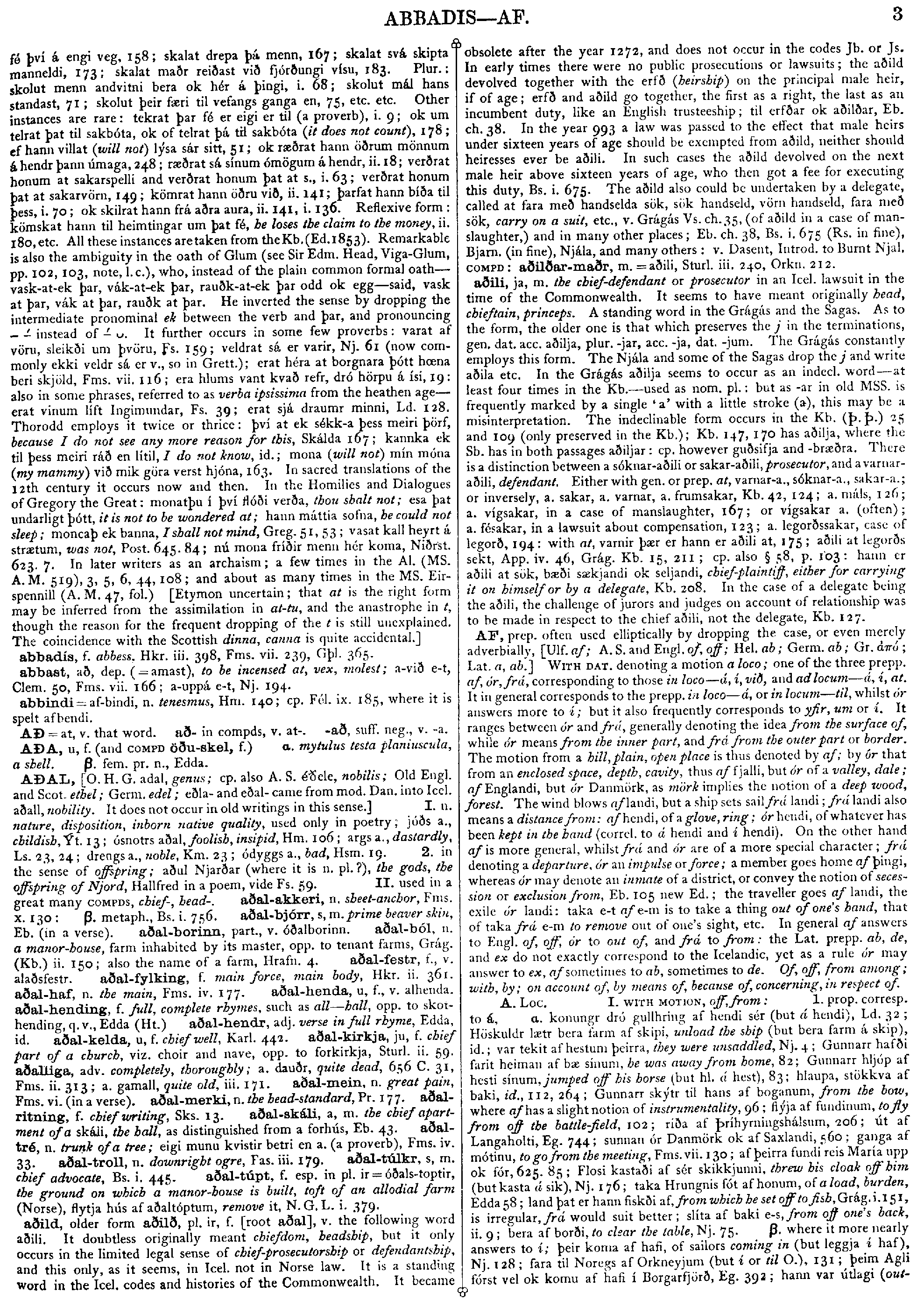
AÐAL,
[O.
H.
G.
adal,
genus;
cp.
also
A.
S.
éðele,
nobilis;
Old
Engl.
and
Scot,
ethel;
Germ,
edel;
eðla-
and
eðal-
came
from
mod.
Dan.
into
Icel.
aðall,
nobility.
It
does
not
occur
in
old
writings
in
this
sense.]
I.
n.
nature,
disposition,
inborn
native
quality,
used
only
in
poetry;
jóðs
a.,
childish,
Ýt.
13;
ósnotrs
aðal,
foolish,
insipid,
Hm.
106;
args
a.,
dastardly,
Ls.
23,
24;
drengs
a.,
noble,
Km.
23;
ódyggs
a.,
bad,
Hsm.
19.
2.
in
the
sense
of
offspring;
aðul
Njarðar
(where
it
is
n.
pl.?),
the
gods,
the
offspring
of
Njord,
Hallfred
in
a
poem,
vide
Fs.
59.
II.
used
in
a
great
many
COMPDS,
chief-,
head-.
aðal-akkeri,
n.
sheet-anchor,
Fms.
x.
130:
.
metaph.,
Bs.
i.
756.
aðal-bjórr,
s,
m.
prime
beaver
skin,
Eb.
(in
a
verse).
aðal-borinn,
part.,
v.
óðalborinn.
aðal-ból,
n.
a
manor-house,
farm
inhabited
by
its
master,
opp.
to
tenant
farms,
Grág.
(Kb.)
ii.
150;
also
the
name
of
a
farm,
Hrafn.
4.
aðal-festr,
f.,
v.
alaðsfestr.
aðal-fylking,
f.
main
force,
main
body,
Hkr.
ii.
361.
aðal-haf,
n.
the
main,
Fms.
iv.
177.
aðal-henda,
u,
f.,
v.
alhenda.
aðal-hending,
f.
full,
complete
rhymes,
such
as
all
--
hall,
opp.
to
skot-
hending,
q.
v.,
Edda
(Ht.)
aðal-hendr,
adj.
verse
in
full
rhyme,
Edda,
id.
aðal-kelda,
u,
f.
chief
well,
Karl.
442.
aðal-kirkja,
ju,
f.
chief
part
of
a
church,
viz.
choir
and
nave,
opp.
to
forkirkja,
Sturl.
ii.
59.
aðalliga,
adv.
completely,
thoroughly;
a.
dauðr,
quite
dead,
656
C.
31,
Fms.
ii.
313;
a.
gamall,
quite
old,
iii.
171.
aðal-mein,
n.
great
pain,
Fms.
vi.
(in
a
verse),
aðal-merki,
n.
the
head-standard,
Pr.
177.
aðal-
ritning,
f.
chief
writing,
Sks.
13.
aðal-skáli,
a,
m.
the
chief
apart-
ment
of
a
skáli,
the
hall,
as
distinguished
from
a
forhús,
Eb.
43.
aðal-
tré,
n.
trunk
of
a
tree;
eigi
munu
kvistir
betri
en
a.
(a
proverb),
Fms.
iv.
33.
aðal-troll,
n.
downright
ogre,
Fas.
iii.
179.
aðal-túlkr,
s,
m.
chief
advocate,
Bs.
i.
445.
aðal-túpt,
f.
esp.
in
pl.
ir
=
óðals-toptir,
the
ground
on
which
a
manor-bouse
is
built,
toft
of
an
allodial
farm
(Norse),
flytja
hús
af
aðaltóptum,
remove
it,
N.
G.
L.
i.
|
Source: Cleasby/Vigfusson, page b0005, entry 2 View original page image as: [TIFF] [PNG] [View previous entry] [View next entry] |
[Comment on this entry] [View comments] |
The following entry has been hand-corrected once. |
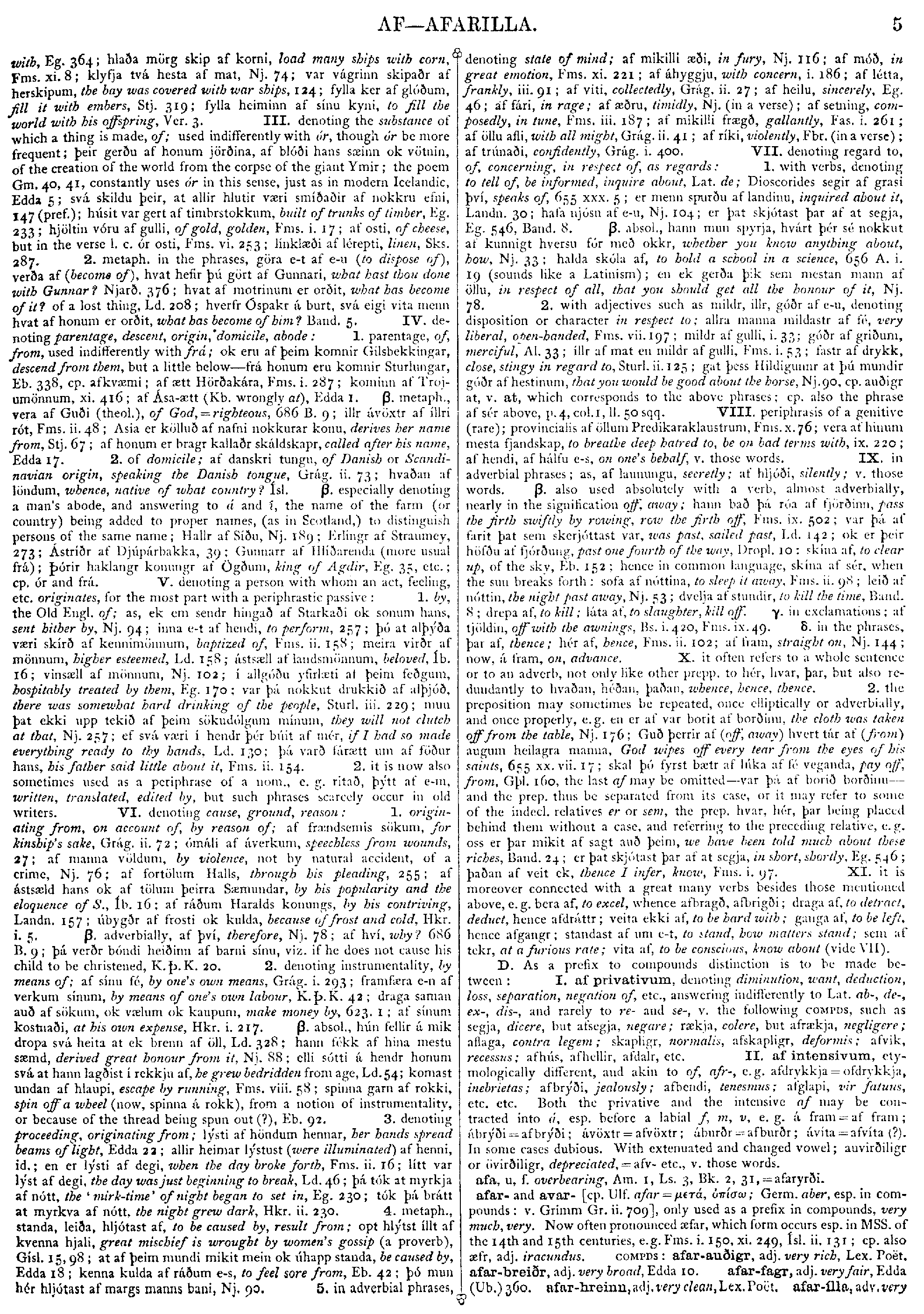
afa, u, f. overbearing. Am. 1, Ls. 3, Bk. 2, 31, = afaryrði.
|
Source: Cleasby/Vigfusson, page b0024, entry 56 View original page image as: [TIFF] [PNG] [View previous entry] [View next entry] |
[Comment on this entry] [View comments] |
The following entry has been hand-corrected once. |
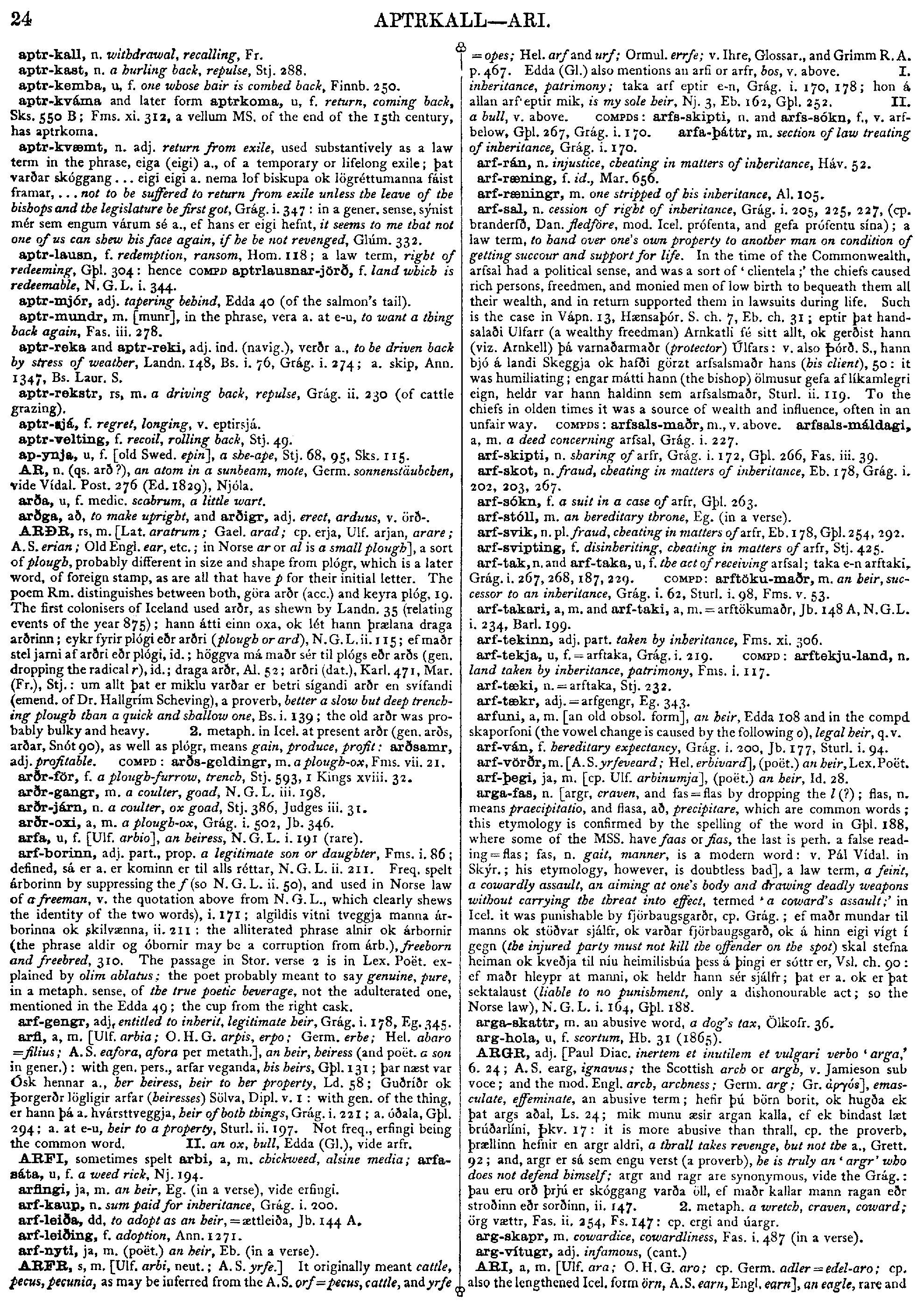
ARGR, adj. [Paul Diac. inertem et inutilem et vulgari verbo 'arga,' 6. 24; A. S. earg, ignavus; the Scottish arch or argh, v. Jamieson sub voce; and the mod. Engl. arch, archness; Germ. arg; Gr. GREEK], emasculate, effeminate, an abusive term; hefir þú börn borit, ok hugða ek þat args aðal, Ls. 24; mik munu æsir argan kalla, ef ek bindast læt brúðarlíni, Þkv. 17: it is more abusive than thrall, cp. the proverb, þrællinn hefnir en argr aldri, a thrall takes revenge, but not the a., Grett. 92; and, argr er sá sem engu verst (a proverb), he is truly an 'argr' who does not defend himself; argr and ragr are synonymous, vide the Grág.: þau eru orð þrjrú er skóggang varða öll, ef maðr kallar mann ragan eðr stroðinn eðr sorðinn, ii. 147. 2. metaph. a wretch, craven, coward; örg vættr, Fas. ii. 254, Fs. 147: cp. ergi and úargr.
|
Source: Cleasby/Vigfusson, page b0025, entry 12 View original page image as: [TIFF] [PNG] [View previous entry] [View next entry] |
[Comment on this entry] [View comments] |
The following entry has been hand-corrected once. |
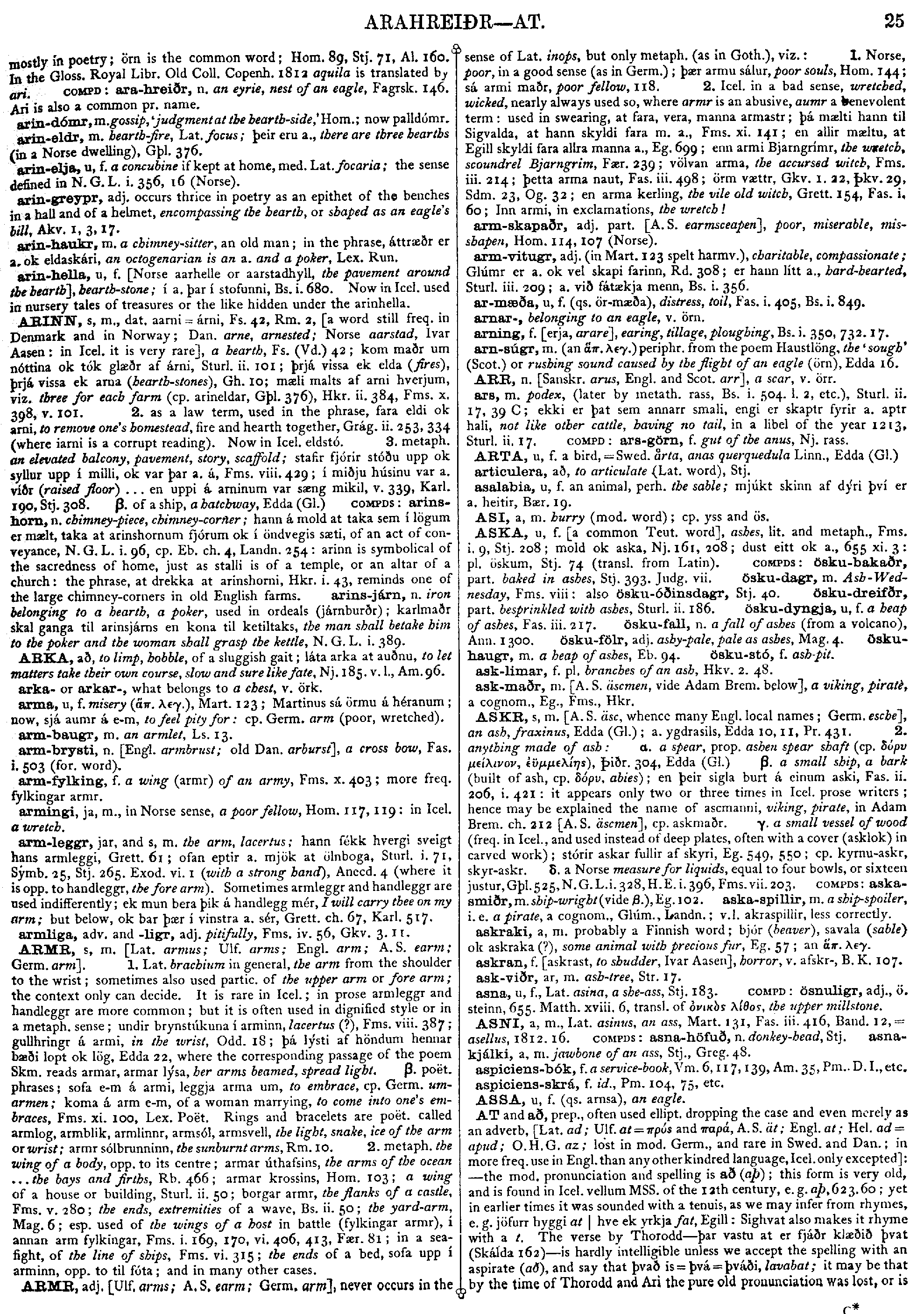
arm-baugr, m. an armlet, Ls. 13.
|
Source: Cleasby/Vigfusson, page b0034, entry 28 View original page image as: [TIFF] [PNG] [View previous entry] [View next entry] |
[Comment on this entry] [View comments] |
The following entry has been hand-corrected once. |
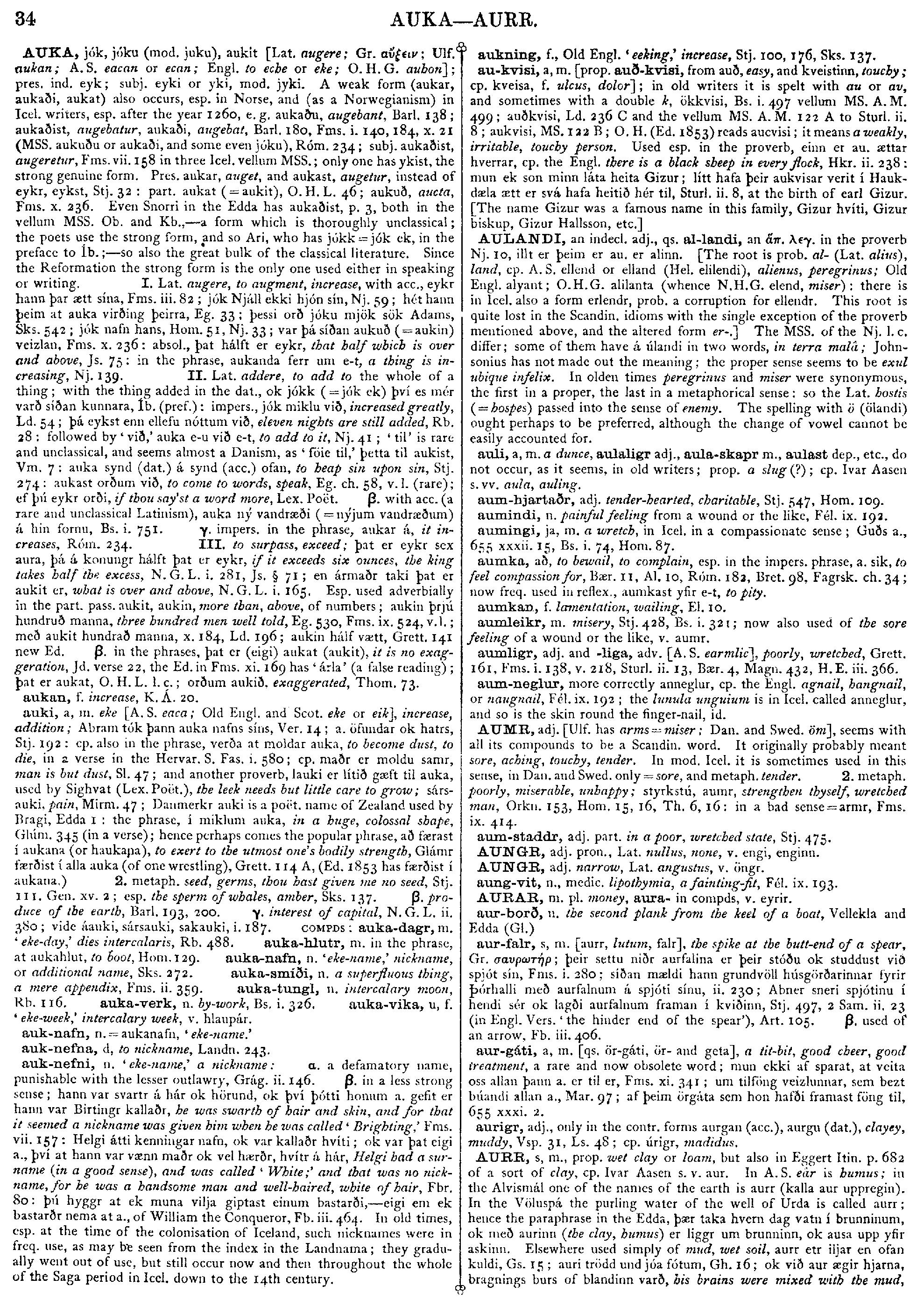
aurigr, adj., only in the contr. forms aurgan (acc.), aurgu (dat.), clayey, muddy, Vsp. 31, Ls. 48; cp. úrigr, madidus.
|
Source: Cleasby/Vigfusson, page b0034, entry 35 View original page image as: [TIFF] [PNG] [View previous entry] [View next entry] |
[Comment on this entry] [View comments (1)] |
The following entry has been hand-corrected once. |
AUSA,
jós,
josu
(mod.
jusu),
ausit;
pres.
ind.
eyss;
subj.
eysi
or
ysi,
mod.
jysi
(hauriret),
cp.
Lat.
haurio,
haus-it;
not
found
in
Goth,
or
in
Germ.
I.
to
sprinkle,
with
dat.
of
the
liquid,
and
the
object
in
acc.
or
with
a
prep.;
Þær
taka
hvern
dag
vatn
í
brunninum,
ok
ausa
(viz.
Því)
upp
yfir
askinn,
.
.
.
pour
it
over
the
ash-boughs,
Edda.
II;
ef
maðr
eyss
eldi
(fire,
embers,)
Grág.
ii.
128;
a.
síld
ór
netjum,
to
empty
the
nets
of
the
herrings,
GÞl.
427:
a.
út,
to
pour
out,
fé,
Grett.
126.
2.
ausa
moldu,
to
sprinkle
with
mould,
bury;
hlóðu
Þeir
at
grjóti
ok
jósu
at
moldu,
Eg.
300;
er
hann
höfðu
moldu
ausit,
Bjarn.
II;
salr
ausinn
moldu,
his
chamber
sprinkled
with
mould
(poët.),
Hervar.
S.;
ausinn
haugi,
Ýt.
26.
.
ausa
vatni
is
a
standing
phrase
for
a
sort
of
baptism
used
in
the
last
centuries,
at
least,
of
the
heathen
age.
The
child
when
born
was
sprinkled
with
water
and
named,
yet
without
the
intervention
of
a
priest;
this
rite
is
mentioned
as
early
as
in
the
Hávamál,
one
of
the
very
oldest
mythological
didactic
poems
on
record,
where
it
is
attributed
even
to
Odin;
ef
ek
skal
Þegn
ungan
verpa
vatni
á,
if
I
am
to
throw
water
on
a
young
thane,
159;
Jósu
vatni
Jarl
létu
heita,
Jóð
ól
Edda
jósu
vatni,
hörvi
svartan,
hétu
Þræl,
Rm.
7,
31;
sá
var
siðr
göfigra
manna,
at
vanda
menn
mjök
til
at
ausa
vatni
ok
gefa
nafn;...
Sigurðr
jarl
jós
sveininn
vatni
ok
kallaði
Hákon,
Hkr.
i.
118;
Eiríkr
ok
Gunn-
hildr
áttu
son
er
Haraldr
konungr
jós
vatni
ok
gaf
nafn
sitt,
122;
eptir
um
daginn
jós
Hákon
konungr
Þann
svein
vatni
ok
gaf
nafn
sitt,
135,
Fms.
i.
66,
xi.
2;
fæddi
Þóra
sveinbarn
ok
var
Grimr
nefndr
er
vatni
var
ausinn,
Eb.
26;
enn
áttu
Þau
Skallagrímr
son,
sá
var
vatni
ausinn
ok
nafn
gefit
ok
kallaðr
Egill,
Eg.
146,
147,
166,
Ld.
108,
Gísl.
32
(of
Snorre
Gode);
and
so
in
many
instances
from
Icel.,
Norway,
and
the
Orkneys,
all
of
them
of
the
heathen
age.
The
Christian
term
is
skíra,
q.
v.
3.
metaph.
of
scolding
or
abuse;
hrópi
ok
rógi
ef
Þú
eyss
á
holl
regin,
Ls.
4;
ausa
sauri
á
e-n,
to
bespatter
with
foul
language,
ausask
sauri
á
(recipr.),
Bjarn.
33;
a.
e-m
e-u
í
augu
upp,
to
throw
in
one's
face,
Eg.
576;
hann
jós
upp
(poured
out)
Þar
fyrir
alÞýðu
öllum
glæpum
föður
síns,
Mart.
80;
um
verka
Þann
er
hverr
jós
á
annan,
Bjarn.
42.
II.
of
a
horse,
to
kick
or
lash
out
with
his
hinder
feet,
opp.
to
prjóna,
to
rear
up
and
strike
with
the
fore
feet;
hestrinn
tók
at
frýsa,
blása
ok
ausa,
Greg.
49;
at
merrin
eysi,
Sturl.
ii.
40
C.
III.
to
pump,
esp.
a
ship,
with
the
ship
in
acc.;
Hallfreðr
jós
at
sínum
hlut,
Fs.
113,
Grett.
95
A,
Fbr.
173,
N.
G.
L.
i.
102:
a.
bát
sinn,
to
make
water,
Fms.
vii.
331.
|
Source: Cleasby/Vigfusson, page b0034, entry 58 View original page image as: [TIFF] [PNG] [View previous entry] [View next entry] |
[Comment on this entry] [View comments] |
The following entry has been hand-corrected once. |
austr-ferð and austr-för, f. voyage to the east, esp. to Russia or the east Baltic, Fb. i. 130, Ls. 60, the last passage in a mythical sense. COMPDS: austrfarar-knorr, m. a vessel bound for the Baltic, Fms. vii. 256. austrfarar-skip, n. id., Fms. viii. 61, Orkn. 274 old Ed., where the new Ed. 334 has útfararskip, a ship bound for the Mediterranean (better).
|
Source: Cleasby/Vigfusson, page b0036, entry 2 View original page image as: [TIFF] [PNG] [View previous entry] [View next entry] |
[Comment on this entry] [View comments] |
The following entry has been hand-corrected once. |
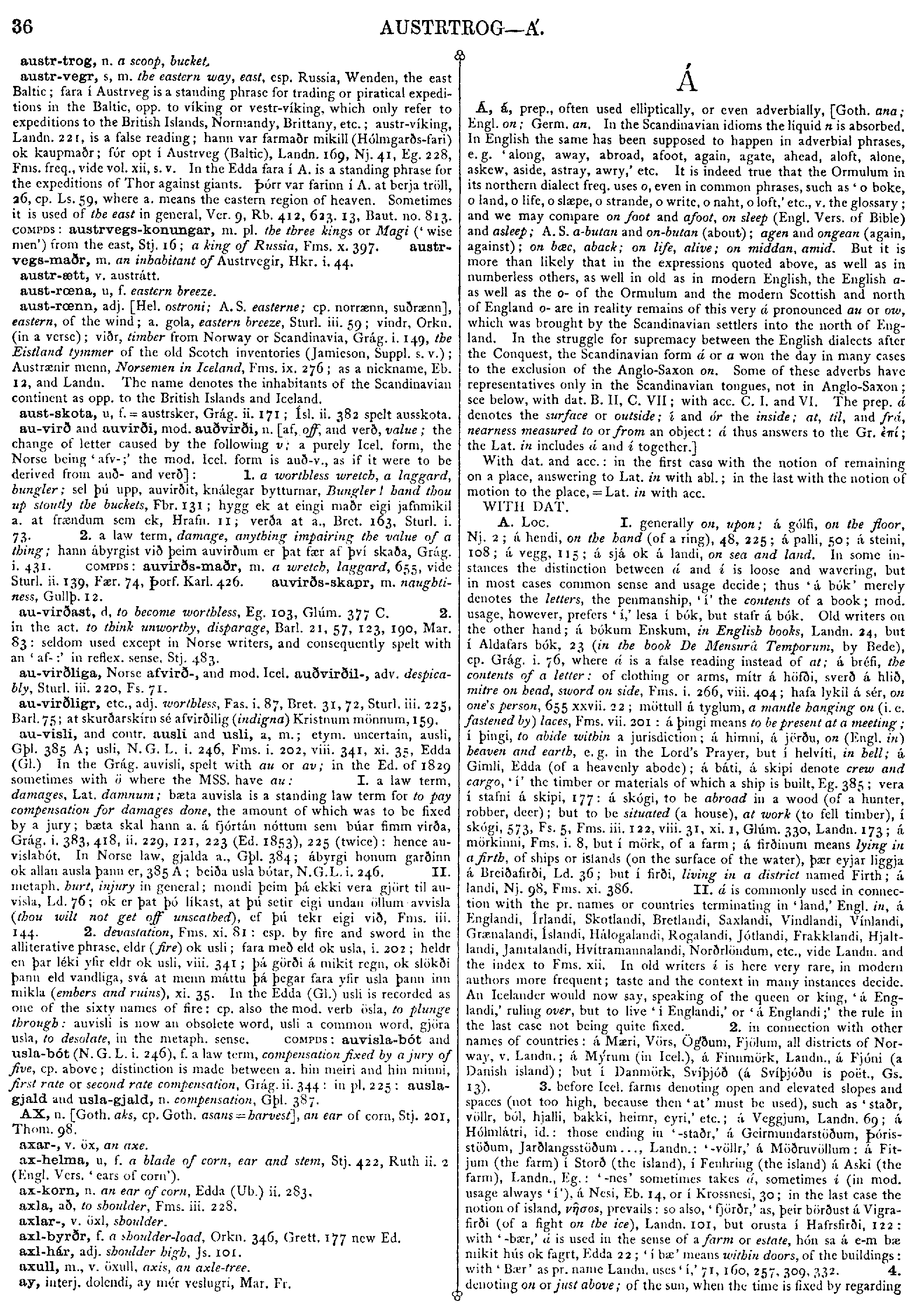
austr-vegr, s, m. the eastern way, east, esp. Russia, Wenden, the east Baltic; fara í Austrveg is a standing phrase for trading or piratical expeditions in the Baltic, opp. to víking or vestr-víking, which only refer to expeditions to the British Islands, Normandy, Brittany, etc.; austr-víking, Landn. 221, is a false reading; hann var farmaðr mikill (Hólmgarðs-fari) ok kaupmaðr; fór opt í Austrveg (Baltic), Landn. 169, Nj. 41, Eg. 228, Fms. freq., vide vol. xii, s. v. In the Edda fara í A. is a standing phrase for the expeditions of Thor against giants, Þórr var farinn í A. at berja tröll, 26, cp. Ls. 59, where a. means the eastern region of heaven. Sometimes it is used of the east in general, Ver. 9, Rb. 412, 623. 13, Baut. no. 813. COMPDS: austrvegs-konungar, m. pl. the three kings or Magi ('wise men') from the east, Stj. 16; a king of Russia, Fms. x. 397. austrvegs-maðr, m. an inhabitant of Austrvegir, Hkr. i. 44.
| Result Page: | 1 2 3 4 5 6 7 8 9 10 | Next |  |
Germanic Lexicon Project (main page)
This search system was written by
Sean Crist
Please consider
volunteering
to correct the data in these online dictionaries.
No rights reserved. Feel free to use these data in any way you please.