|
|

liþ (21 results)
lið (166 results)
Search for Lith again, using less strict matching (292 results)
|
Source: Torp, page b0111, entry 10 View original page image as: [TIFF] [PNG] [View previous entry] [View next entry] |
[Comment on this entry] [View comments] |
The following entry has been hand-corrected once. |
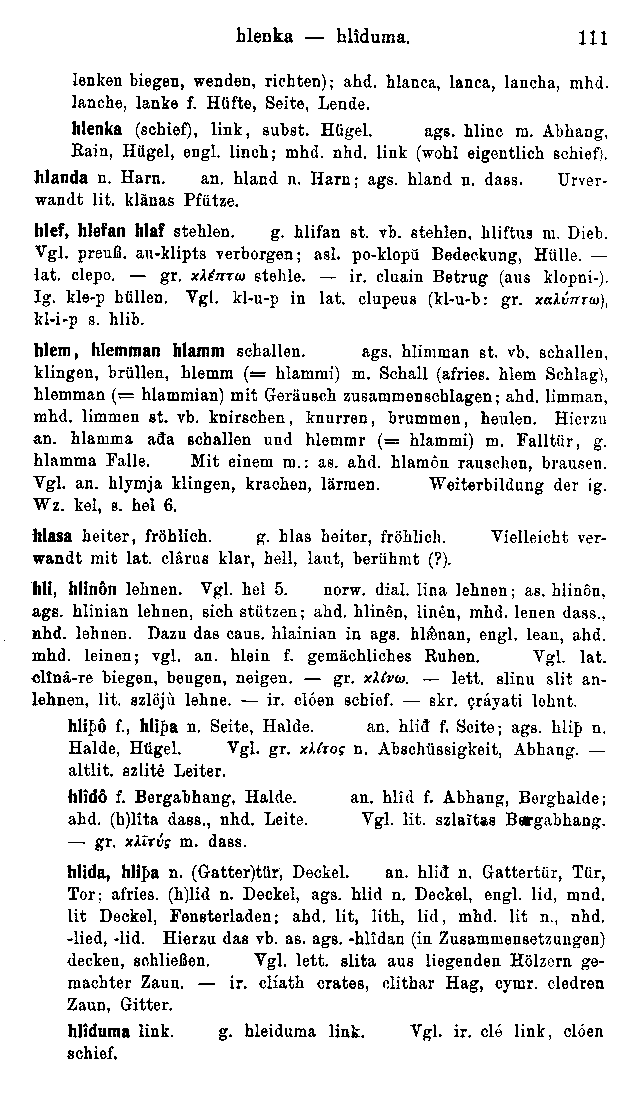
hlida,
hliþa
n.
(Gatter)tür,
Deckel.
an.
hli n.
Gattertür,
Tür,
Tor;
afries.
(h)lid
n.
Deckel,
ags.
hlid
n.
Deckel,
engl.
lid,
mnd.
lit
Deckel,
Fensterladen;
ahd.
lit,
lith,
lid,
mhd.
lit
n.,
nhd.
-lied,
-lid.
Hierzu
das
vb.
as.
ags.
-hlîdan
(in
Zusammensetzungen)
decken,
schließen.
Vgl.
lett.
slita
aus
liegenden
Hölzern
gemachter
Zaun.
-
ir.
clíath
crates,
clithar
Hag,
cymr.
cledren
Zaun,
Gitter.
n.
Gattertür,
Tür,
Tor;
afries.
(h)lid
n.
Deckel,
ags.
hlid
n.
Deckel,
engl.
lid,
mnd.
lit
Deckel,
Fensterladen;
ahd.
lit,
lith,
lid,
mhd.
lit
n.,
nhd.
-lied,
-lid.
Hierzu
das
vb.
as.
ags.
-hlîdan
(in
Zusammensetzungen)
decken,
schließen.
Vgl.
lett.
slita
aus
liegenden
Hölzern
gemachter
Zaun.
-
ir.
clíath
crates,
clithar
Hag,
cymr.
cledren
Zaun,
Gitter.
[Translate the German words]
|
Source: Torp, page b0365, entry 10 View original page image as: [TIFF] [PNG] [View previous entry] [View next entry] |
[Comment on this entry] [View comments] |
The following entry has been hand-corrected once. |
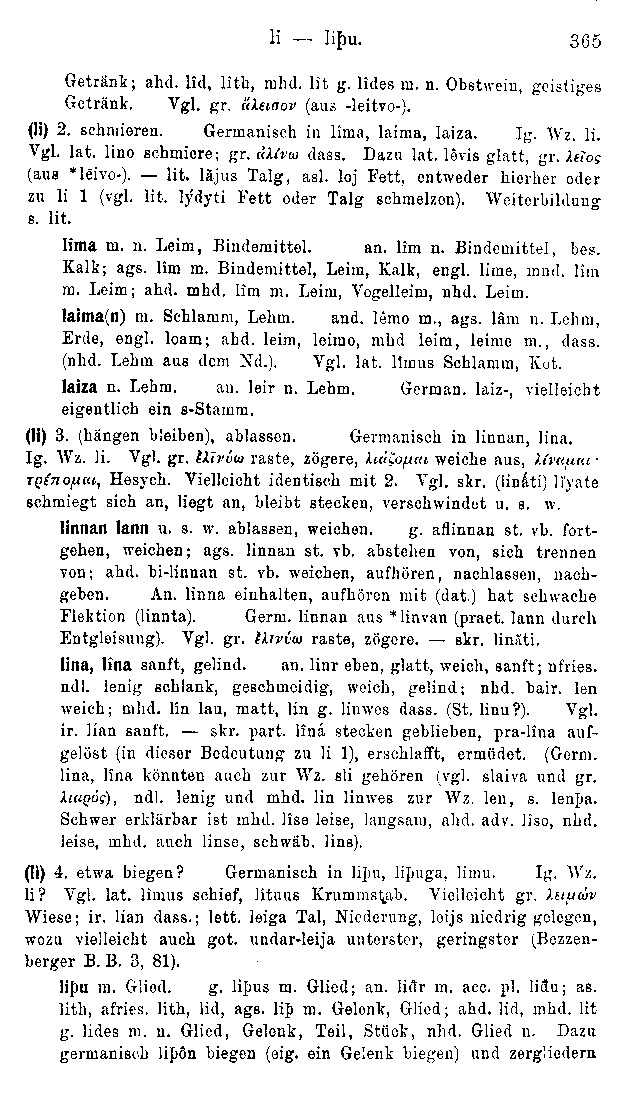
liþu
m.
Glied.
g.
liþus
m.
Glied;
an.
lir
m.
acc.
pl.
liu;
as.
lith,
afries.
lith,
lid,
ags.
liþ
m.
Gelenk,
Glied;
ahd.
lid,
mhd.
lit
g.
lides
m.
n.
Glied,
Gelenk,
Teil,
Stück,
nhd.
Glied
n.
Dazu
germanisch
liþôn
biegen
(eig.
ein
Gelenk
biegen)
und
zergliedern
a
biegen,
ags.
â-liþian
zergliedern,
trennen
(auch
â-liþrian),
ahd.
lidôn
in
Stücke
schneiden.
[Translate the German words]
|
Source: Torp, page b0367, entry 6 View original page image as: [TIFF] [PNG] [View previous entry] [View next entry] |
[Comment on this entry] [View comments] |
The following entry has been hand-corrected once. |
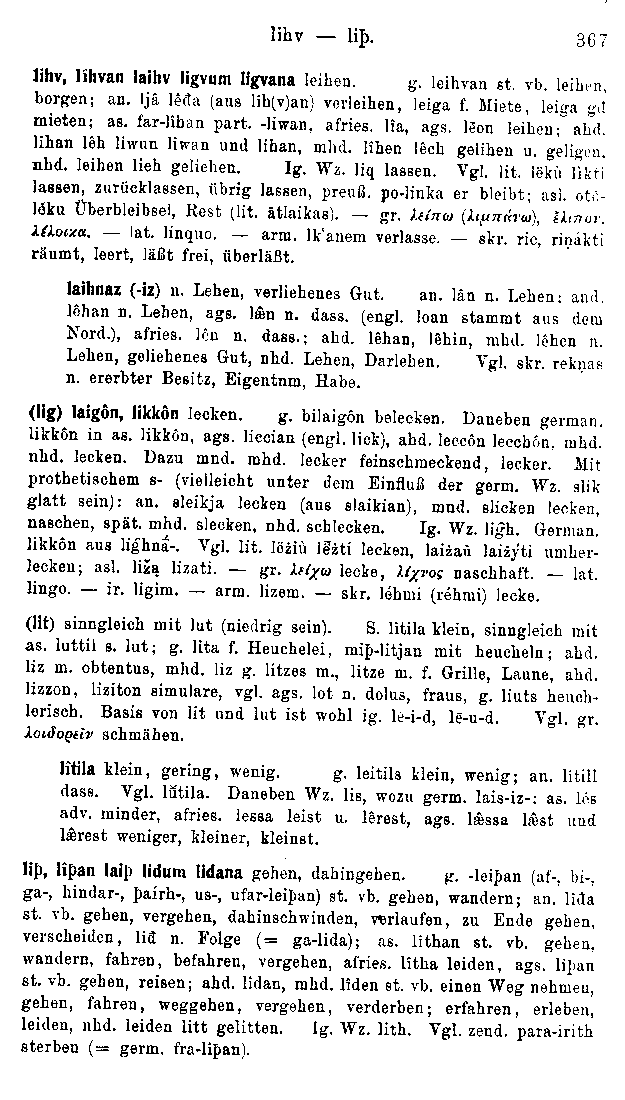
liþ,
lîþan
laiþ
lidum
lidana
gehen,
dahingehen.
g.
-leiþan
(af-,
bi-,
ga-,
hindar-,
þaírh-,
us-,
ufar-leiþan)
st.
vb.
gehen,
wandern;
an.
lîa
st.
vb.
gehen,
vergehen,
dahinschwinden,
verlaufen,
zu
Ende
gehen,
verscheiden,
li
n.
Folge
(=
ga-lida);
as.
lîthan
st.
vb.
gehen,
wandern,
fahren,
befahren,
vergehen,
afries.
lîtha
leiden,
ags.
lîþan
st.
vb.
gehen,
reisen;
ahd.
lîdan,
mhd.
lîden
st.
vb.
einen
Weg
nehmen,
gehen,
fahren,
weggehen,
vergehen,
verderben;
erfahren,
erleben,
leiden,
nhd.
leiden
litt
gelitten.
Ig.
Wz.
lith.
Vgl.
zend.
para-irith
sterben
(=
germ.
fra-lîþan).
[Translate the German words]
|
Source: Bosworth/Toller, page b0016, entry 56 View original page image as: [TIFF] [PNG] [View previous entry] [View next entry] |
[Comment on this entry] [View comments] |
The following entry has been hand-corrected once. |
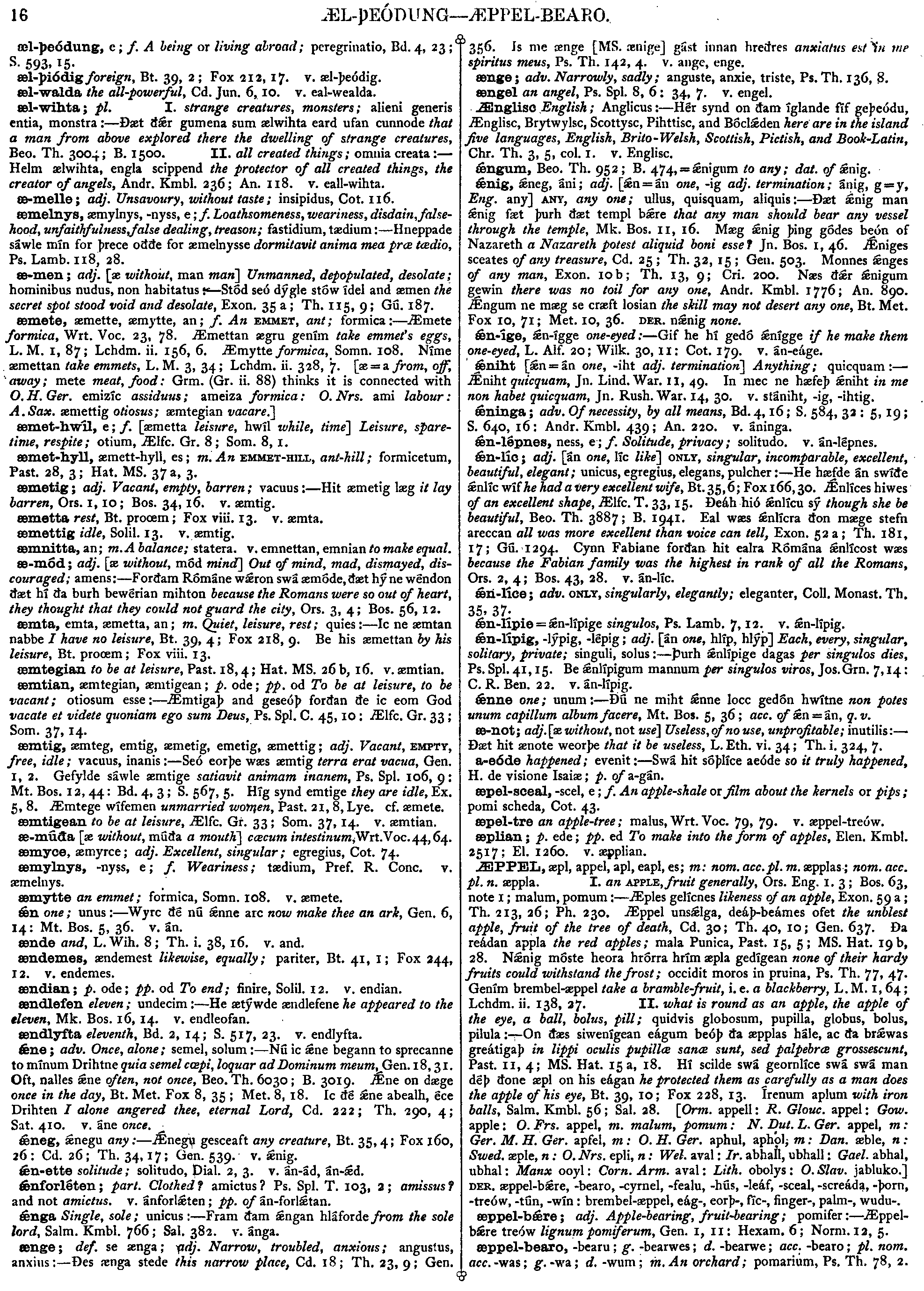
ÆPPEL,
æpl,
appel,
apl,
eapl,
es;
m;
nom.
acc.
pl.
m.
æpplas;
nom.
acc.
pl.
n.
æppla.
I.
an
APPLE,
fruit
generally,
Ors.
Eng.
1.
3;
Bos.
63,
note
I;
malum,
pomum
:--
Æples
gelícnes
likeness
of
an
apple,
Exon.
59
a;
Th.
213,
26;
Ph.
230.
Æppel
uns lga,
deáþ-beámes
ofet
the
unblest
apple,
fruit
of
the
tree
of
death,
Cd.
30;
Th.
40,
10;
Gen.
637.
Da
reádan
appla
the
red
apples;
mala
Punica,
Past.
15,
5;
MS.
Hat.
19b,
28.
Nnig
móste
heora
hrórra
hrím
æpla
gedígean
none
of
their
hardy
fruits
could
withstand
the
frost;
occidit
moros
in
pruina.
Ps.
Th.
77,
47.
Gením
brembel-æppel
take
a
bramble-fruit,
i.
e.
a
blackberry,
L.M.
1,
64;
Lchdm,
ii.
138,
27.
II.
what
is
round
as
an
apple,
the
apple
of
the
eye,
a
ball,
bolus,
pill;
quidvis
globosum,
pupilla,
globus,
bolus,
pilula
:--
On
ðæs
siwenígean
eágum
beóþ
ða
æpplas
hále,
ac
ða
brwas
greátigaþ
in
lippi
oculis
pupillæ
sanæ
sunt,
sed
palpebræ
grossescunt,
Past.
11,
4;
MS.
Hat.
15a,
18.
Hí
scilde
swá
geornlíce
swá
swá
man
déþ
ðone
æpl
on
his
eágan
he
protected
them
as
carefully
as
a
man
does
the
apple
of
his
eye,
Bt.
39,
10;
Fox
228,
13.
Írenum
aplum
with
iron
balls,
Salm.
Kmbl.
56;
Sal.
28.
[Orm.
appell:
R.
Gloac.
appel:
Gow.
apple:
O.
Frs.
appel,
m.
malum,
pomum:
N.
Out.
L.
Ger.
appel,
m:
Ger.
M.
H.
Ger.
apfel,
m:
O.
H.
Ger.
aphul,
aphol;
m:
Dan.
æble,
n:
Swed,
æple,
n:
O.
Nrs.
epli,
n:
Wel.
aval:
Ir.
abhall,
ubhall:
Gael,
abhal,
ubhal:
Manx
ooyl:
Corn.
Arm.
aval:
Lith.
obolys:
O.
Slav.
jabluko.]
DER.
æppel-bre,
-bearo,
-cyrnel,
-fealu,
-hús,
-leáf,
-sceal,
-screáda,
-þorn,
-treów,
-tún,
-wín:
brembel-æppel,
eág-,
eorþ-,
fíc-,
finger-,
palm-,
wudu-.
lga,
deáþ-beámes
ofet
the
unblest
apple,
fruit
of
the
tree
of
death,
Cd.
30;
Th.
40,
10;
Gen.
637.
Da
reádan
appla
the
red
apples;
mala
Punica,
Past.
15,
5;
MS.
Hat.
19b,
28.
Nnig
móste
heora
hrórra
hrím
æpla
gedígean
none
of
their
hardy
fruits
could
withstand
the
frost;
occidit
moros
in
pruina.
Ps.
Th.
77,
47.
Gením
brembel-æppel
take
a
bramble-fruit,
i.
e.
a
blackberry,
L.M.
1,
64;
Lchdm,
ii.
138,
27.
II.
what
is
round
as
an
apple,
the
apple
of
the
eye,
a
ball,
bolus,
pill;
quidvis
globosum,
pupilla,
globus,
bolus,
pilula
:--
On
ðæs
siwenígean
eágum
beóþ
ða
æpplas
hále,
ac
ða
brwas
greátigaþ
in
lippi
oculis
pupillæ
sanæ
sunt,
sed
palpebræ
grossescunt,
Past.
11,
4;
MS.
Hat.
15a,
18.
Hí
scilde
swá
geornlíce
swá
swá
man
déþ
ðone
æpl
on
his
eágan
he
protected
them
as
carefully
as
a
man
does
the
apple
of
his
eye,
Bt.
39,
10;
Fox
228,
13.
Írenum
aplum
with
iron
balls,
Salm.
Kmbl.
56;
Sal.
28.
[Orm.
appell:
R.
Gloac.
appel:
Gow.
apple:
O.
Frs.
appel,
m.
malum,
pomum:
N.
Out.
L.
Ger.
appel,
m:
Ger.
M.
H.
Ger.
apfel,
m:
O.
H.
Ger.
aphul,
aphol;
m:
Dan.
æble,
n:
Swed,
æple,
n:
O.
Nrs.
epli,
n:
Wel.
aval:
Ir.
abhall,
ubhall:
Gael,
abhal,
ubhal:
Manx
ooyl:
Corn.
Arm.
aval:
Lith.
obolys:
O.
Slav.
jabluko.]
DER.
æppel-bre,
-bearo,
-cyrnel,
-fealu,
-hús,
-leáf,
-sceal,
-screáda,
-þorn,
-treów,
-tún,
-wín:
brembel-æppel,
eág-,
eorþ-,
fíc-,
finger-,
palm-,
wudu-.
|
Source: Bosworth/Toller, page b0039, entry 1 View original page image as: [TIFF] [PNG] [View previous entry] [View next entry] |
[Comment on this entry] [View comments] |
The following entry has been hand-corrected once. |
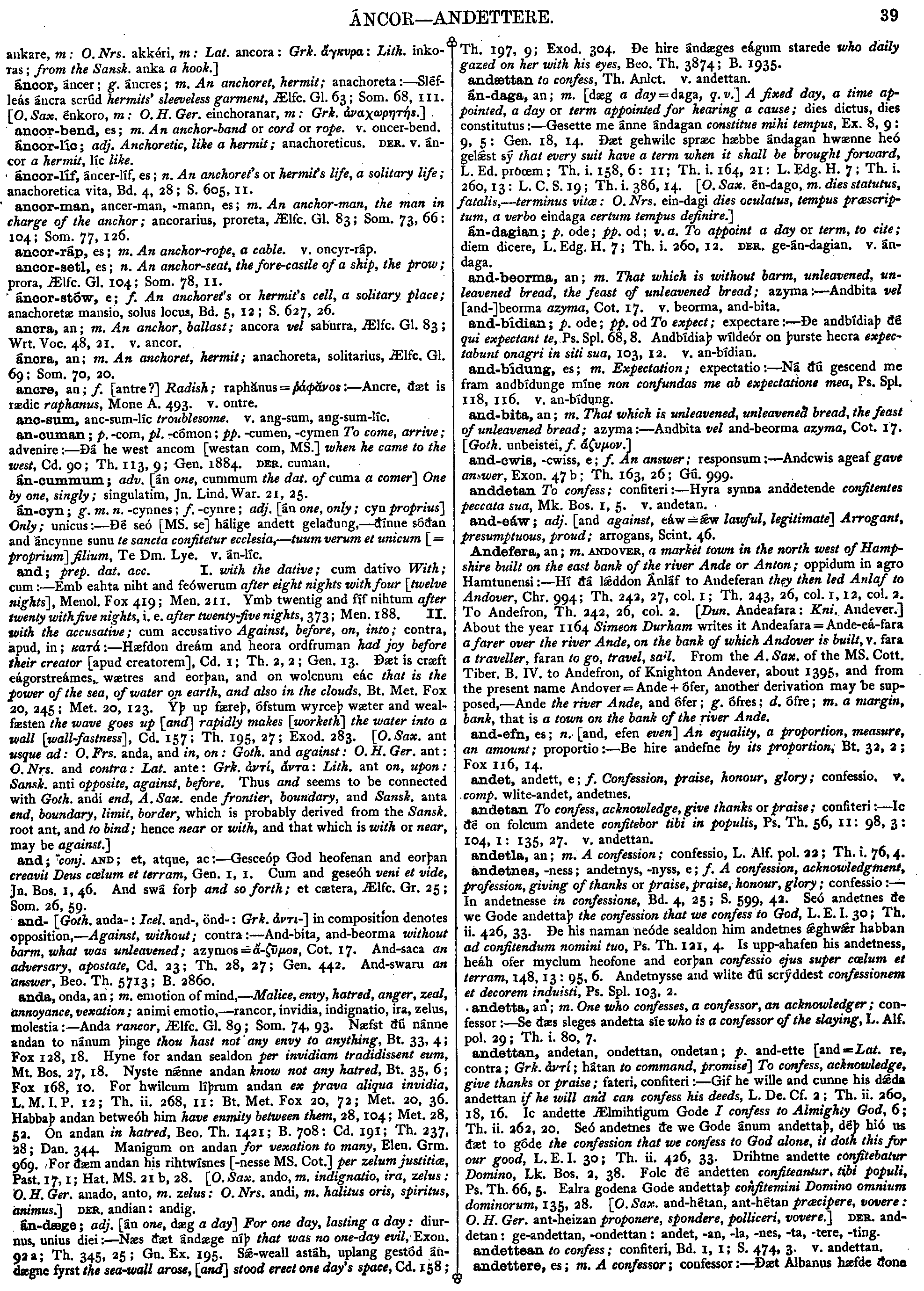
ankare, m: O. Nrs. akkéri, m: Lat. ancora: Grk. GREEK: Lith. inkoras; from the Sansk. anka a hook.]
|
Source: Bosworth/Toller, page b0039, entry 17 View original page image as: [TIFF] [PNG] [View previous entry] [View next entry] |
[Comment on this entry] [View comments] |
The following entry has been hand-corrected once. |
and;
prep.
dat.
acc.
I.
with
the
dative;
cum
dativo
With;
cum
:--
Emb
eahta
niht
and
feówerum
after
eight
nights
with
four
[twelve
nights],
Menol.
Fox
419;
Men.
211.
Ymb
twentig
and
fíf
nihtum
after
twenty
with
five
nights,
i.
e.
after
twenty-five
nights,
373;
Men.
188.
II.
with
the
accusative;
cum
accusativo
Against,
before,
on,
into;
contra,
apud,
in;
GREEK
:--
Hæfdon
dreám
and
heora
ordfruman
had
joy
before
their
creator
[apud
creatorem],
Cd.
1;
Th.
2,
2;
Gen.
13.
Ðæt
is
cræft
eágorstreámes,
wætres
and
eorþan,
and
on
wolcnum
eác
that
is
the
power
of
the
sea,
of
water
on
earth,
and
also
in
the
clouds,
Bt.
Met.
Fox
20,
245;
Met.
20,
123.
Ýþ
up
færeþ,
ófstum
wyrceþ
wæter
and
weal fæsten
the
wave
goes
up
[and]
rapidly
makes
[worketh]
the
water
into
a
wall
[wall-fastness],
Cd.
157;
Th.
195,
27;
Exod.
283.
[O.
Sax.
ant
usque
ad:
O.
Frs.
anda,
and
in,
on:
Goth.
and
against:
O.
H.
Ger.
ant:
O.
Nrs.
and
contra:
Lat.
ante:
Grk.
GREEK:
Lith.
ant
on,
upon:
Sansk.
anti
opposite,
against,
before.
Thus
and
seems
to
be
connected
with
Goth.
andi
end,
A.
Sax.
ende
frontier,
boundary,
and
Sansk.
anta
end,
boundary,
limit,
border,
which
is
probably
derived
from
the
Sansk.
root
ant,
and
to
bind;
hence
near
or
with,
and
that
which
is
with
or
near,
may
be
against.]
fæsten
the
wave
goes
up
[and]
rapidly
makes
[worketh]
the
water
into
a
wall
[wall-fastness],
Cd.
157;
Th.
195,
27;
Exod.
283.
[O.
Sax.
ant
usque
ad:
O.
Frs.
anda,
and
in,
on:
Goth.
and
against:
O.
H.
Ger.
ant:
O.
Nrs.
and
contra:
Lat.
ante:
Grk.
GREEK:
Lith.
ant
on,
upon:
Sansk.
anti
opposite,
against,
before.
Thus
and
seems
to
be
connected
with
Goth.
andi
end,
A.
Sax.
ende
frontier,
boundary,
and
Sansk.
anta
end,
boundary,
limit,
border,
which
is
probably
derived
from
the
Sansk.
root
ant,
and
to
bind;
hence
near
or
with,
and
that
which
is
with
or
near,
may
be
against.]
|
Source: Bosworth/Toller, page b0066, entry 37 View original page image as: [TIFF] [PNG] [View previous entry] [View next entry] |
[Comment on this entry] [View comments] |
The following entry has been hand-corrected once. |
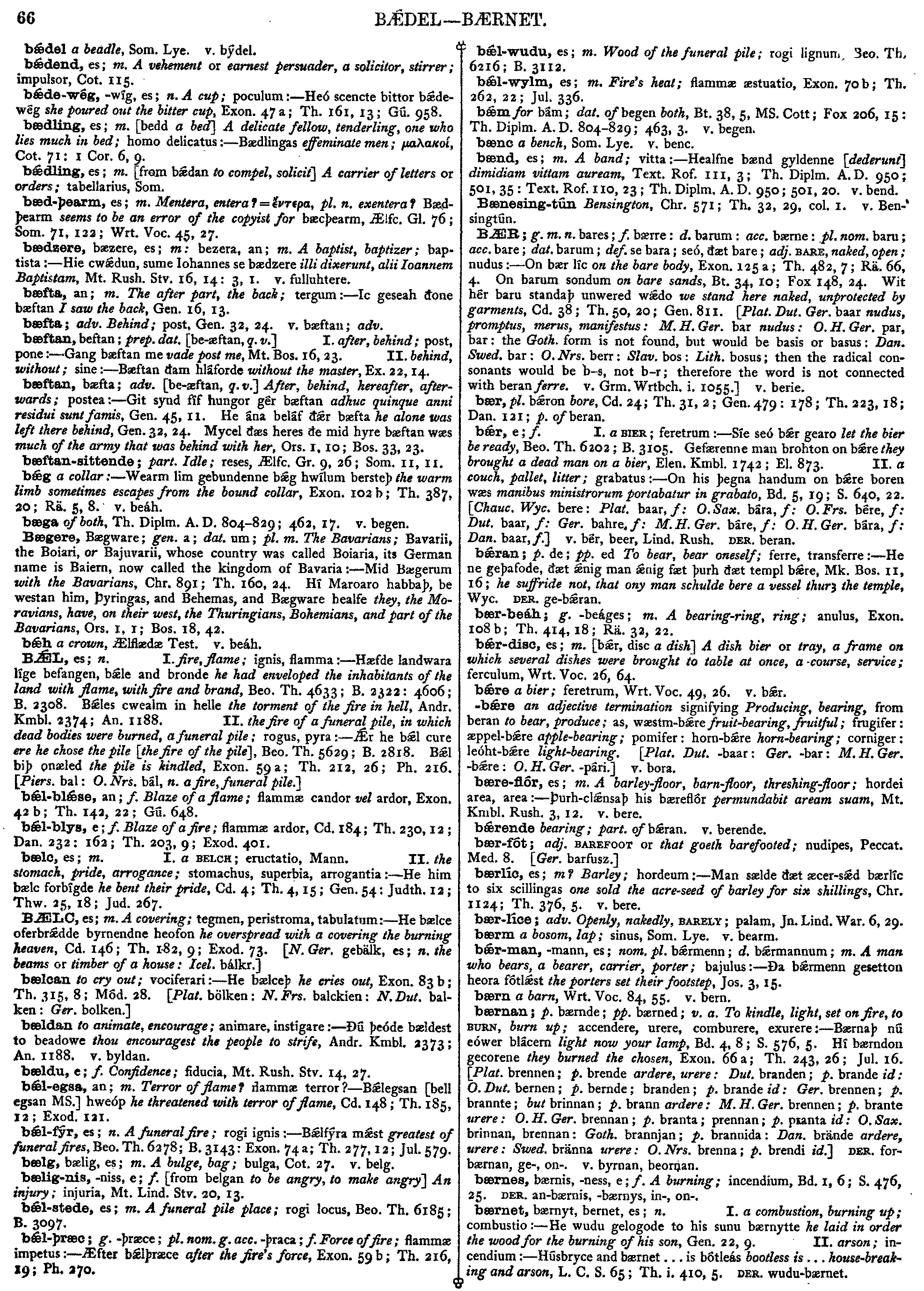
BÆR;
g.
m.
n.
bares;
f.
bærre:
d.
barum:
acc.
bærne:
pl.
nom.
baru;
acc.
bare;
dat.
barum;
def.
se
bara;
seó,
ðæt
bare;
adj.
BARE,
naked,
open;
nudus
:--
On
bær
líc
on
the
bare
body,
Exon.
125a;
Th.
482,
7;
Rä.
66,
4.
On
barum
sondum
on
bare
sands,
Bt.
34,
10;
Fox
148,
24.
Wit
hér
baru
standaþ
unwered
wdo
we
stand
here
naked,
unprotected
by
garments,
Cd.
38;
Th.
50,
20;
Gen.
811.
[Plat.
Dut.
Ger.
baar
nudus,
promptus,
merus,
manifestus:
M.
H.
Ger.
bar
nudus:
O.
H.
Ger.
par,
bar:
the
Goth.
form
is
not
found,
but
would
be
basis
or
basus:
Dan.
Swed.
bar:
O.
Nrs.
berr:
Slav.
bos:
Lith.
bosus;
then
the
radical
consonants
would
be
b-s,
not
b-r;
therefore
the
word
is
not
connected
with
beran
ferre.
v.
Grm.
Wrtbch.
i.
1055.]
v.
berie.
|
Source: Bosworth/Toller, page b0078, entry 14 View original page image as: [TIFF] [PNG] [View previous entry] [View next entry] |
[Comment on this entry] [View comments] |
The following entry has been hand-corrected once. |
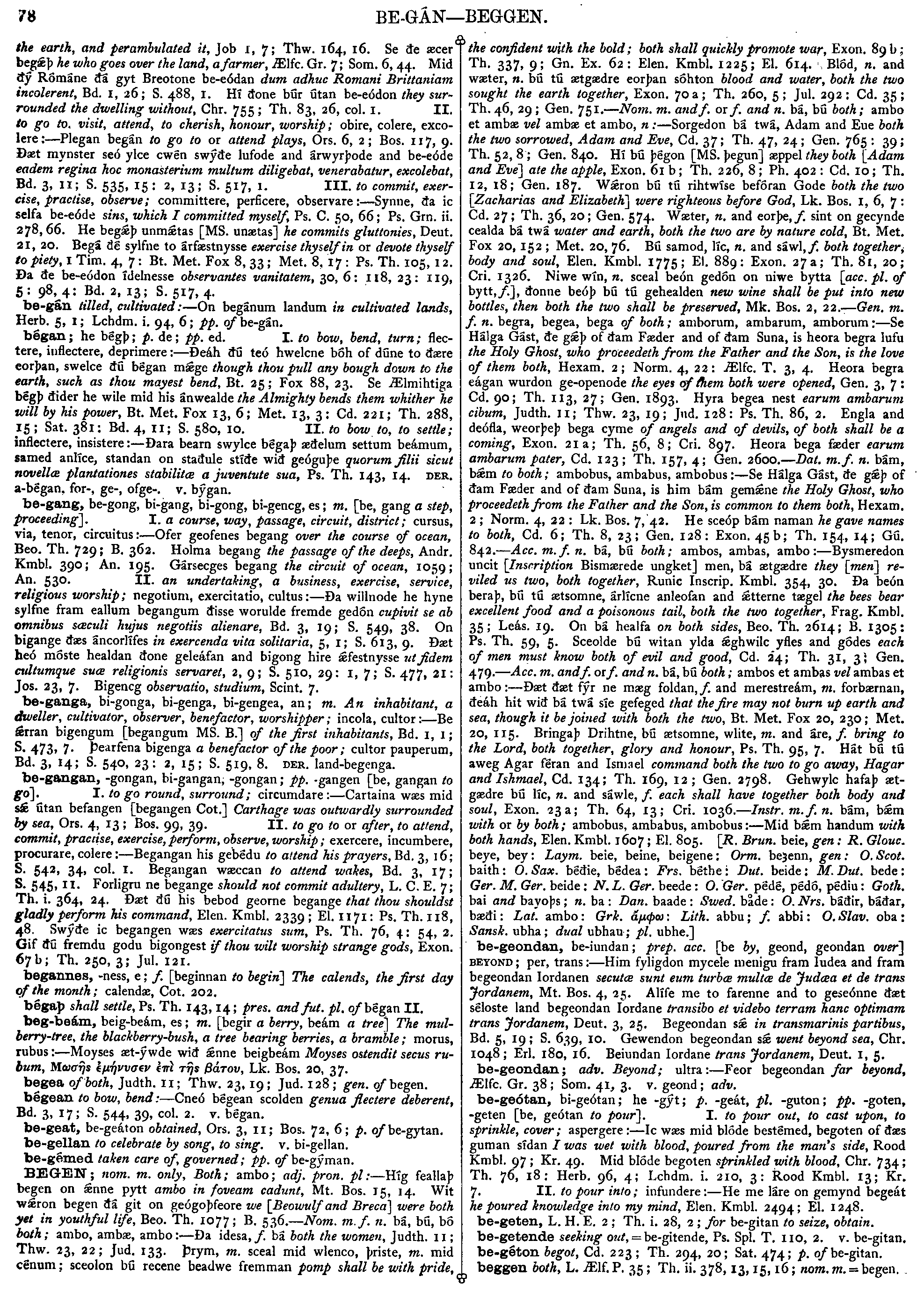
BEGEN;
nom.
m.
only,
Both;
ambo;
adj.
pron.
pl
:--
Híg
feallaþ
begen
on
nne
pytt
ambo
in
foveam
cadunt,
Mt.
Bos.
15,
14.
Wit
wron
begen
ðá
git
on
geógoþfeore
we
[Beowulf
and
Breca]
were
both
yet
in
youthful
life,
Beo.
Th.
1077;
B.
536.
-
Nom.
m.
f.
n.
bá,
bú,
bó
both;
ambo,
ambæ,
ambo
:--
Ða
idesa,
f.
bá
both
the
women,
Judth.
11;
Thw.
23,
22;
Jud.
133.
Þrym,
m.
sceal
mid
wlenco,
þriste,
m.
mid
cénum;
sceolon
bú
recene
beadwe
fremman
pomp
shall
be
with
pride,
the
confident
with
the
bold;
both
shall
quickly
promote
war,
Exon.
89
b
;
Th.
337,
9;
Gn.
Ex.
62
:
Elen.
Kmbl.
1225;
El.
614.
Blód,
n.
and
wæter,
n.
bú
tú
ætgædre
eorþan
sóhton
blood
and
water,
both
the
two
sought
the
earth
together,
Exon.
70
a;
Th.
260,
5
;
Jul.
292
:
Cd.
35;
Th.
46,
29;
Gen.
751.
-
Nom.
m.
and
f.
or
f.
and
n.
bá,
bú
both;
ambo
et
ambæ
vel
ambæ
et
ambo,
n
:--
Sorgedon
bá
twá,
Adam
and
Eue
both
the
two
sorrowed,
Adam
and
Eve,
Cd.
37;
Th.
47,
24;
Gen.
765
:
39;
Th.
52,
8;
Gen.
840.
Hí
bú
þégon
[MS.
þegun]
æppel
they
both
[Adam
and
Eve]
ate
the
apple,
Exon.
61
b
;
Th.
226,
8
;
Ph.
402
:
Cd.
10
;
Th.
12,
18;
Gen.
187.
Wron
bú
tú
rihtwíse
befóran
Gode
both
the
two
[Zacharias
and
Elizabeth]
were
righteous
before
God,
Lk.
Bos.
1,
6,
7
:
Cd.
27;
Th.
36,
20;
Gen.
574.
Wæter,
n.
and
eorþe,
f.
sint
on
gecynde
cealda
bá
twá
water
and
earth,
both
the
two
are
by
nature
cold,
Bt.
Met.
Fox
20,
152
;
Met.
20,
76.
Bú
samod,
líc,
n.
and
sáwl,
f.
both
together,
body
and
soul,
Elen.
Kmbl.
1775;
El.
889
:
Exon.
27
a
;
Th.
81,
20;
Cri.
1326.
Niwe
wín,
n.
sceal
beón
gedón
on
niwe
bytta
[acc.
pl.
of
bytt,
f.],
ðonne
beóþ
bú
tú
gehealden
new
wine
shall
be
put
into
new
bottles,
then
both
the
two
shall
be
preserved,
Mk.
Bos.
2,
22.
-
Gen.
m.
f.
n.
begra,
begea,
bega
of
both;
amborum,
ambarum,
amborum
:--
Se
Hálga
Gást,
ðe
gþ
of
ðam
Fæder
and
of
ðam
Suna,
is
heora
begra
lufu
the
Holy
Ghost,
who
proceedeth
from
the
Father
and
the
Son,
is
the
love
of
them
both,
Hexam.
2
;
Norm.
4,
22
:
Ælfc.
T.
3,
4.
Heora
begra
eágan
wurdon
ge-openode
the
eyes
of
them
both
were
opened,
Gen.
3,
7
:
Cd.
90;
Th.
113,
27;
Gen.
1893.
Hyra
begea
nest
earum
ambarum
cibum,
Judth.
11;
Thw.
23,
19;
Jud.
128
:
Ps.
Th.
86,
2.
Engla
and
deófla,
weorþeþ
bega
cyme
of
angels
and
of
devils,
of
both
shall
be
a
coming,
Exon.
21
a;
Th.
56,
8;
Cri.
897.
Heora
bega
fæder
earum
ambarum
pater,
Cd.
123;
Th.
157,
4
;
Gen.
2600.
-
Dat.
m.
f.
n.
bám,
bm
to
both;
ambobus,
ambabus,
ambobus
:--
Se
Hálga
Gást,
ðe
gþ
of
ðam
Fæder
and
of
ðam
Suna,
is
him
bám
gemne
the
Holy
Ghost,
who
proceedeth
from
the
Father
and
the
Son,
is
common
to
them
both,
Hexam.
2
;
Norm.
4,
22
:
Lk.
Bos.
7,
42.
He
sceóp
bám
naman
he
gave
names
to
both,
Cd.
6;
Th.
8,
23;
Gen.
128
:
Exon.
45
b;
Th.
154,
14;
Gú.
842.
-
Acc.
m.
f.
n.
bá,
bú
both;
ambos,
ambas,
ambo
:--
Bysmeredon
uncit
[Inscription
Bismærede
ungket]
men,
bá
ætgædre
they
[men]
reviled
us
two,
both
together,
Runic
Inscrip.
Kmbl.
354,
30.
Ða
beón
beraþ,
bú
tú
ætsomne,
árlícne
anleofan
and
tterne
tægel
the
bees
bear
excellent
food
and
a
poisonous
tail,
both
the
two
together,
Frag.
Kmbl.
35;
Leás.
19.
On
bá
healfa
on
both
sides,
Beo.
Th.
2614;
B.
1305
:
Ps.
Th.
59,
5.
Sceolde
bú
witan
ylda
ghwilc
yfles
and
gódes
each
of
men
must
know
both
of
evil
and
good,
Cd.
24;
Th.
31,
3;
Gen.
479.
-
Acc.
m.
and
f.
or
f.
and
n.
bá,
bú
both;
ambos
et
ambas
vel
ambas
et
ambo
:--
Ðæt
ðæt
fýr
ne
mæg
foldan,
f.
and
merestreám,
m.
forbærnan,
ðeáh
hit
wið
bá
twá
síe
gefeged
that
the
fire
may
not
burn
up
earth
and
sea,
though
it
be
joined
with
both
the
two,
Bt.
Met.
Fox
20,
230;
Met.
20,
115.
Bringaþ
Drihtne,
bú
ætsomne,
wlite,
m.
and
áre,
f.
bring
to
the
Lord,
both
together,
glory
and
honour,
Ps.
Th.
95,
7.
Hát
bú
tú
aweg
Agar
féran
and
Ismael
command
both
the
two
to
go
away,
Hagar
and
Ishmael,
Cd.
134;
Th.
169,
12
;
Gen.
2798.
Gehwylc
hafaþ
ætgædre
bú
líc,
n.
and
sáwle,
f.
each
shall
have
together
both
body
and
soul,
Exon.
23
a
;
Th.
64,
13;
Cri.
1036.
-
Instr.
m.
f.
n.
bám,
bm
with
or
by
both;
ambobus,
ambabus,
ambobus
:--
Mid
bm
handum
with
both
hands,
Elen.
Kmbl.
1607;
El.
805.
[R.
Brun.
beie,
gen
:
R.
Glouc.
beye,
bey
:
Laym.
beie,
beine,
beigene
:
Orm.
be enn,
gen
:
O.
Scot.
baith
:
O.
Sax.
béðie,
bédea
:
Frs.
béthe
:
Dut.
beide
:
M.
Dut.
bede
:
Ger.
M.
Ger.
beide
:
N.
L.
Ger.
beede
:
O.
Ger.
pédé,
pédó,
pédiu
:
Goth.
bai
and
bayoþs
;
n.
ba
:
Dan.
baade
:
Swed.
både
:
O.
Nrs.
báðir,
báðar,
bæði
:
Lat.
ambo
:
Grk.
&alpha-tonos;
enn,
gen
:
O.
Scot.
baith
:
O.
Sax.
béðie,
bédea
:
Frs.
béthe
:
Dut.
beide
:
M.
Dut.
bede
:
Ger.
M.
Ger.
beide
:
N.
L.
Ger.
beede
:
O.
Ger.
pédé,
pédó,
pédiu
:
Goth.
bai
and
bayoþs
;
n.
ba
:
Dan.
baade
:
Swed.
både
:
O.
Nrs.
báðir,
báðar,
bæði
:
Lat.
ambo
:
Grk.
&alpha-tonos;

 :
Lith.
abbu
;
f.
abbi
:
O.
Slav.
oba
:
Sansk.
ubha;
dual
ubhau;
pl.
ubhe.]
:
Lith.
abbu
;
f.
abbi
:
O.
Slav.
oba
:
Sansk.
ubha;
dual
ubhau;
pl.
ubhe.]
|
Source: Bosworth/Toller, page b0103, entry 11 View original page image as: [TIFF] [PNG] [View previous entry] [View next entry] |
[Comment on this entry] [View comments] |
The following entry has been hand-corrected once. |
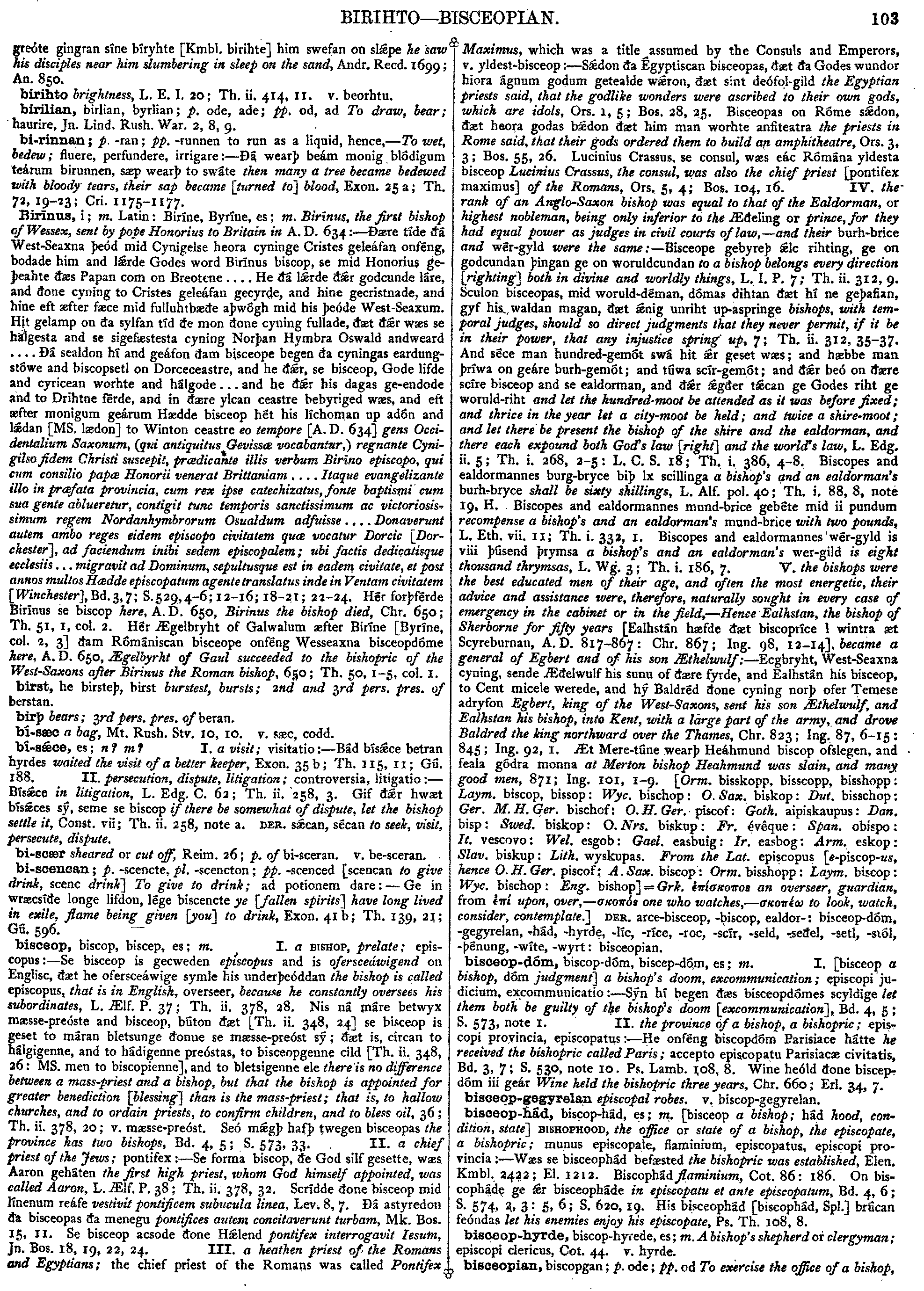
bisceop,
biscop,
biscep,
es;
m.
I.
a
BISHOP,
prelate;
episcopus
:--
Se
bisceop
is
gecweden
episcopus
and
is
ofersceáwigend
on
Englisc,
ðæt
he
ofersceáwige
symle
his
underþeóddan
the
bishop
is
called
episcopus,
that
is
in
English,
overseer,
because
he
constantly
oversees
his
subordinates,
L.
Ælf.
P.
37;
Th.
ii.
378,
28.
Nis
ná
máre
betwyx
mæsse-preóste
and
bisceop,
búton
ðæt
[Th.
ii.
348,
24]
se
bisceop
is
geset
to
máran
bletsunge
ðonne
se
mæsse-preóst
sý;
ðæt
is,
circan
to
hálgigenne,
and
to
hádigenne
preóstas,
to
bisceopgenne
cild
[Th.
ii.
348,
26:
MS.
men
to
biscopienne],
and
to
bletsigenne
ele
there
is
no
difference
between
a
mass-priest
and
a
bishop,
but
that
the
bishop
is
appointed
for
greater
benediction
[blessing]
than
is
the
mass-priest;
that
is,
to
hallow
churches,
and
to
ordain
priests,
to
confirm
children,
and
to
bless
oil,
36;
Th.
ii.
378,
20;
v.
mæsse-preóst.
Seó
mgþ
hafþ
twegen
bisceopas
the
province
has
two
bishops,
Bd.
4,
5;
S.
573,
33.
II.
a
chief
priest
of
the
Jews;
pontifex
:--
Se
forma
biscop,
ðe
God
silf
gesette,
wæs
Aaron
geháten
the
first
high
priest,
whom
God
himself
appointed,
was
called
Aaron,
L.
Ælf.
P.
38;
Th.
ii.
378,
32.
Scrídde
ðone
bisceop
mid
línenum
reáfe
vestivit
pontificem
subucula
linea,
Lev.
8,
7.
Ðá
astyredon
ða
bisceopas
ða
menegu
pontifices
autem
concitaverunt
turbam,
Mk.
Bos.
15,
11.
Se
bisceop
acsode
ðone
Hlend
pontifex
interrogavit
Iesum,
Jn.
Bos.
18,
19,
22,
24.
III.
a
heathen
priest
of
the
Romans
and
Egyptians;
the
chief
priest
of
the
Romans
was
called
Pontifex
Maximus,
which
was
a
title
assumed
by
the
Consuls
and
Emperors,
v.
yldest-bisceop
:--
Sdon
ða
Égyptiscan
bisceopas,
ðæt
ða
Godes
wundor
hiora
ágnum
godum
getealde
wron,
ðæt
sint
deófol-gild
the
Egyptian
priests
said,
that
the
godlike
wonders
were
ascribed
to
their
own
gods,
which
are
idols,
Ors.
1,
5;
Bos.
28,
25.
Bisceopas
on
Róme
sdon,
ðæt
heora
godas
bdon
ðæt
him
man
worhte
anfiteatra
the
priests
in
Rome
said,
that
their
gods
ordered
them
to
build
an
amphitheatre,
Ors.
3,
3;
Bos.
55,
26.
Lucinius
Crassus,
se
consul,
wæs
eác
Rómána
yldesta
bisceop
Lucinius
Crassus,
the
consul,
was
also
the
chief
priest
[pontifex
maximus]
of
the
Romans,
Ors.
5,
4;
Bos.
104,
16.
IV.
the
rank
of
an
Anglo-Saxon
bishop
was
equal
to
that
of
the
Ealdorman,
or
highest
nobleman,
being
only
inferior
to
the
Æðeling
or
prince,
for
they
had
equal
power
as
judges
in
civil
courts
of
law,-and
their
burh-brice
and
wér-gyld
were
the
same
:--
Bisceope
gebyreþ
lc
rihting,
ge
on
godcundan
þingan
ge
on
woruldcundan
to
a
bishop
belongs
every
direction
[righting]
both
in
divine
and
worldly
things,
L.
I.
P.
7;
Th.
ii.
312,
9.
Sculon
bisceopas,
mid
woruld-déman,
dómas
dihtan
ðæt
hí
ne
geþafian,
gyf
his
waldan
magan,
ðæt
nig
unriht
up-aspringe
bishops,
with
temporal
judges,
should
so
direct
judgments
that
they
never
permit,
if
it
be
in
their
power,
that
any
injustice
spring
up,
7;
Th.
ii.
312,
35-37.
And
séce
man
hundred-gemót
swá
hit
r
geset
wæs;
and
hæbbe
man
þríwa
on
geáre
burh-gemót;
and
túwa
scír-gemót;
and
ðr
beó
on
ðære
scíre
bisceop
and
se
ealdorman,
and
ðr
gðer
tcan
ge
Godes
riht
ge
woruld-riht
and
let
the
hundred-moot
be
attended
as
it
was
before
fixed;
and
thrice
in
the
year
let
a
city-moot
be
held;
and
twice
a
shire-moot;
and
let
there
be
present
the
bishop
of
the
shire
and
the
ealdorman,
and
there
each
expound
both
God's
law
[right]
and
the
world's
law,
L.
Edg.
ii.
5;
Th.
i.
268,
2-5:
L.
C.
S.
18;
Th.
i.
386,
4-8.
Biscopes
and
ealdormannes
burg-bryce
biþ
lx
scillinga
a
bishop's
and
an
ealdorman's
burh-bryce
shall
be
sixty
shillings,
L.
Alf.
pol.
40;
Th.
i.
88,
8,
note
19,
H.
Biscopes
and
ealdormannes
mund-brice
gebéte
mid
ii
pundum
recompense
a
bishop's
and
an
ealdorman's
mund-brice
with
two
pounds,
L.
Eth,
vii.
11;
Th.
i.
332,
1.
Biscopes
and
ealdormannes
wér-gyld
is
viii
þúsend
þrymsa
a
bishop's
and
an
ealdorman's
wer-gild
is
eight
thousand
thrymsas,
L.
Wg.
3;
Th.
i.
186,
7.
V.
the
bishops
were
the
best
educated
men
of
their
age,
and
often
the
most
energetic,
their
advice
and
assistance
were,
therefore,
naturally
sought
in
every
case
of
emergency
in
the
cabinet
or
in
the
field,-Hence
Ealhstan,
the
bishop
of
Sherborne
for
fifty
years
[Ealhstán
hæfde
ðæt
biscopríce
l
wintra
æt
Scyreburnan,
A.
D.
817-867:
Chr.
867;
Ing.
98,
12-14],
became
a
general
of
Egbert
and
of
his
son
Æthelwulf
:--
Ecgbryht,
West-Seaxna
cyning,
sende
Æðelwulf
his
sunu
of
ðære
fyrde,
and
Ealhstán
his
bisceop,
to
Cent
micele
werede,
and
hý
Baldréd
ðone
cyning
norþ
ofer
Temese
adryfon
Egbert,
king
of
the
West-Saxons,
sent
his
son
Æthelwulf,
and
Ealhstan
his
bishop,
into
Kent,
with
a
large
part
of
the
army,,
and
drove
Baldred
the
king
northward
over
the
Thames,
Chr.
823;
Ing.
87,
6-15:
845;
Ing.
92,
1.
Æt
Mere-túne
wearþ
Heáhmund
biscop
ofslegen,
and
feala
gódra
monna
at
Merton
bishop
Heahmund
was
slain,
and
many
good
men,
871;
Ing.
101,
1-9.
[Orm.
bisskopp,
bisscopp,
bisshopp:
Laym.
biscop,
bissop:
Wyc.
bischop:
O.
Sax.
biskop:
Dut.
bisschop:
Ger.
M.
H.
Ger.
bischof:
O.
H.
Ger.
piscof:
Goth.
aipiskaupus:
Dan.
bisp:
Swed.
biskop:
O.
Nrs.
biskup:
Fr.
évêque:
Span.
obispo:
It.
vescovo:
Wel.
esgob:
Gael.
easbuig:
Ir.
easbog:
Arm.
eskop:
Slav.
biskup:
Lith.
wyskupas.
From
the
Lat.
episcopus
[e-piscop-us,
hence
O.
H.
Ger.
piscof:
A.
Sax.
biscop:
Orm.
bisshopp:
Laym.
biscop:
Wyc.
bischop:
Eng.
bishop]
=
Grk.
&epsilon-tonos; &iota-tonos;
 oos
an
overseer,
guardian,
from
&epsilon-tonos;&iota-tonos;
upon,
over,-oós
one
who
watches,-o&epsilon-tonos;
to
look,
watch,
consider,
contemplate.]
DER.
arce-bisceop,
-biscop,
ealdor-:
bisceop-dóm,
-gegyrelan,
,hád,
-hyrde,
-líc,
-ríce,
-roc,
-scír,
-seld,
-seðel,
-setl,
-stól,
-þénung,
-wíte,
-wyrt:
bisceopian.
oos
an
overseer,
guardian,
from
&epsilon-tonos;&iota-tonos;
upon,
over,-oós
one
who
watches,-o&epsilon-tonos;
to
look,
watch,
consider,
contemplate.]
DER.
arce-bisceop,
-biscop,
ealdor-:
bisceop-dóm,
-gegyrelan,
,hád,
-hyrde,
-líc,
-ríce,
-roc,
-scír,
-seld,
-seðel,
-setl,
-stól,
-þénung,
-wíte,
-wyrt:
bisceopian.
|
Source: Bosworth/Toller, page b0109, entry 38 View original page image as: [TIFF] [PNG] [View previous entry] [View next entry] |
[Comment on this entry] [View comments] |
The following entry has been hand-corrected once. |
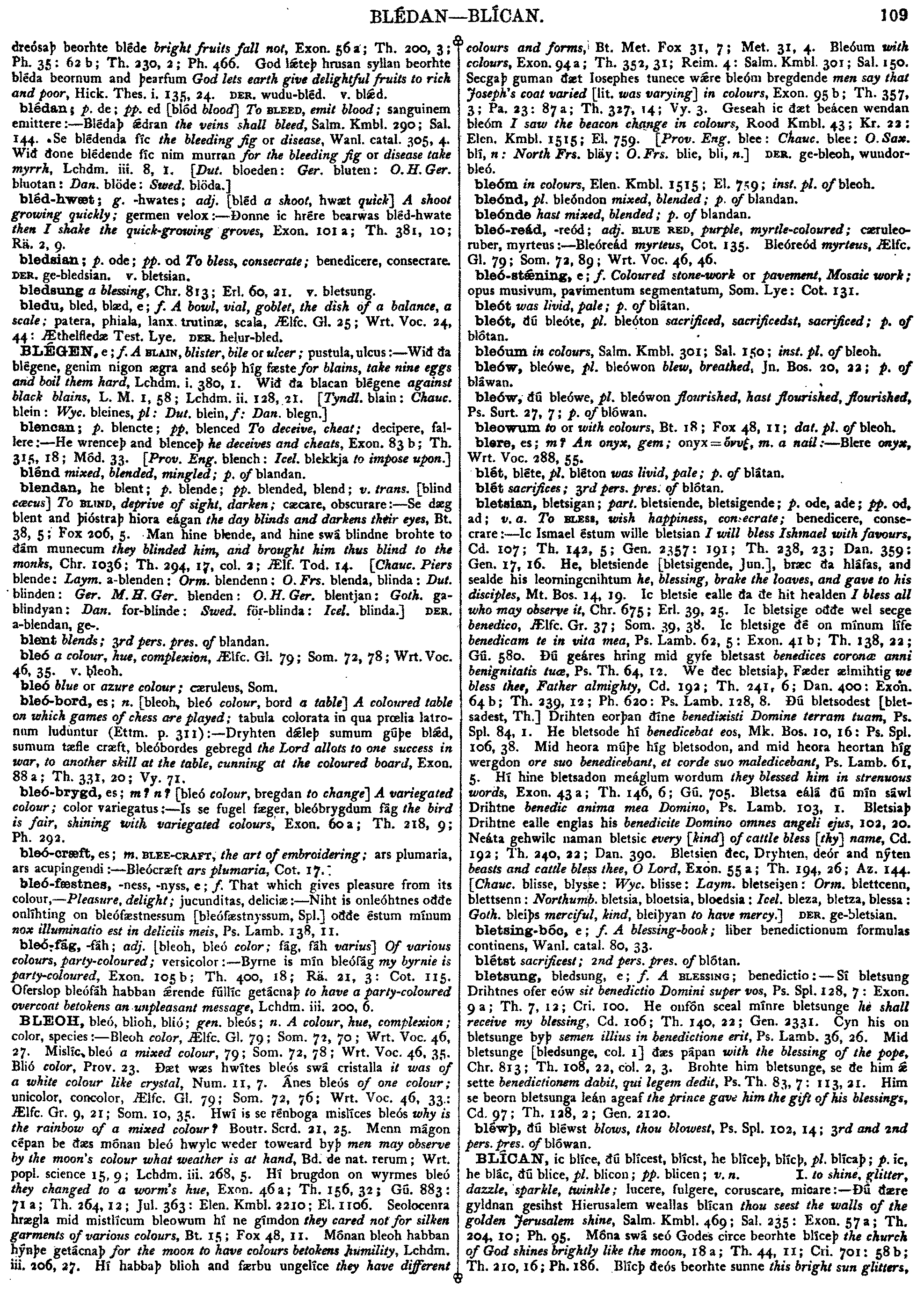
BLÍCAN,
ic
blíce,
ðú
blícest,
blícst,
he
blíceþ,
blícþ,
pl.
blícaþ;
p.
ic,
he
blác,
ðú
blice,
pl.
blicon;
pp.
blicen;
v.
n.
I.
to
shine,
glitter,
dazzle,
sparkle,
twinkle;
lucere,
fulgere,
coruscare,
micare
:--
Ðú
ðære
gyldnan
gesihst
Hierusalem
weallas
blícan
thou
seest
the
walls
of
the
golden
Jerusalem
shine,
Salm.
Kmbl.
469;
Sal.
235:
Exon.
57
a;
Th.
204,
10;
Ph.
95.
Móna
swá
seó
Godes
circe
beorhte
blíceþ
the
church
of
God
shines
brightly
like
the
moon,
18
a;
Th.
44,
11;
Cri.
701:
58
b;
Th.
210,
16;
Ph.
186.
Blícþ
ðeós
beorhte
sunne
this
bright
sun
glitters,
Cd.
38;
Th.
50,
19;
Gen.
811,
Hý
fóre
leódum
leóhte
blícaþ
they
with
light
shall
shine
before
the
people,
Exon.
26
a;
Th.
76,
14;
Cri.
1239.
Heofoncandel
blác
ofer
lagoflódas
the
sun
[lit.
heaven's
candle]
shone
over
the
water-floods,
Andr.
Kmbl.
486;
An.
243.
Blicon
bordhreóðan
bucklers
glittered,
Cd.
149;
Th.
187,
30;
Exod.
160.
Hwonne
swegles
tapur
hdre
blíce
when
the
sun
[lit.
heaven's
taper]
serenely
shines,
Exon.
57
b;
Th.
205,
20;
Ph.
115.
II.
to
shine
by
exposure,
as
the
bones;
denudando
in
conspectum
dari
:--
Hí
twigena
ordum
hine
weallaþ
óþ
ðæt
him
bán
blícaþ
they
shall
vex
him
with
points
of
twigs
until
his
bones
appear
[shine],
Salm.
Kmbl.
289;
Sal.
144.
[Laym.
blikien:
O.
Sax.
blíkan:
Frs.
blike
apparere:
O.
Frs.
blíka:
Ger.
er-bleichen
pallescere:
M.
H.
Ger.
blíchen
fulgere:
O.
H.
Ger.
ar-blíchan
pallescere:
O.
Nrs.
blika,
blíkja:
Lat.
flag-ra-re:
Grk.
 &epsilon-tonos;
 -:
Lith.
blizg-ù
I
shine:
Sansk.
bhr
-:
Lith.
blizg-ù
I
shine:
Sansk.
bhr j
to
shine.]
DER.
a-blícan.
j
to
shine.]
DER.
a-blícan.
| Result Page: | 1 2 3 4 | Next |  |
Germanic Lexicon Project (main page)
This search system was written by
Sean Crist
Please consider
volunteering
to correct the data in these online dictionaries.
No rights reserved. Feel free to use these data in any way you please.