|
|

Tip: In the search results, you can click on any word or abbreviation for more information.
|
Source: Bosworth/Toller, page b0562, entry 28 View original page image as: [TIFF] [PNG] [View previous entry] [View next entry] |
[Comment on this entry] [View comments] |
The following entry has been hand-corrected once. |
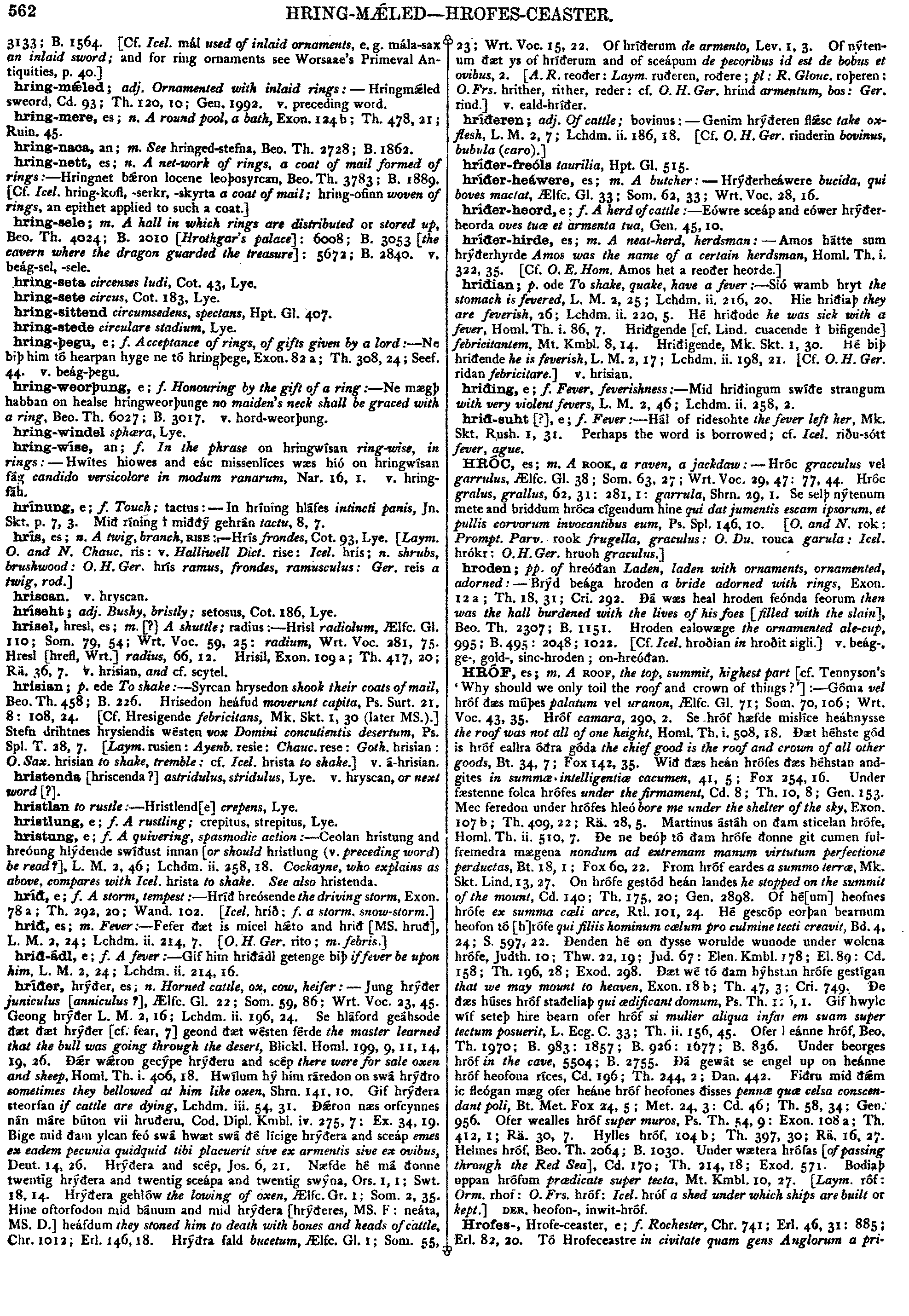
hríðer,
hrýðer,
es;
n.
Horned
cattle,
ox,
cow,
heifer
:--
Jung
hrýðer
juniculus
[anniculus
?],
Ælfc.
Gl.
22;
Som.
59,
86;
Wrt.
Voc.
23,
45.
Geong
hrýðer
L.
M.
2,
16;
Lchdm.
ii.
196,
24.
Se
hláford
geáhsode
ðæt
ðæt
hrýðer
[cf.
fear,
7]
geond
ðæt
wésten
férde
the
master
learned
that
the
bull
was
going
through
the
desert,
Blickl.
Homl.
199,
9,
11,
14,
19,
26.
Ð r
wron
gecýpe
hrýðeru
and
scép
there
were
for
sale
oxen
and
sheep,
Homl.
Th.
i.
406,
18.
Hwílum
hý
him
ráredon
on
swá
hrýðro
sometimes
they
bellowed
at
him
like
oxen,
Shrn.
141,
10.
Gif
hrýðera
steorfan
if
cattle
are
dying,
Lchdm.
iii.
54,
31.
Ðron
næs
orfcynnes
nán
máre
búton
vii
hruðeru,
Cod.
Dipl.
Kmbl.
iv.
275,
7:
Ex.
34,
19.
Bige
mid
ðam
ylcan
feó
swá
hwæt
swá
ðé
lícige
hrýðera
and
sceáp
emes
ex
eadem
pecunia
quidquid
tibi
placuerit
sive
ex
armentis
sive
ex
ovibus,
Deut.
14,
26.
Hrýðera
and
scép,
Jos.
6,
21.
Næfde
hé
má
ðonne
twentig
hrýðera
and
twentig
sceápa
and
twentig
swýna,
Ors.
1,
1;
Swt.
18,
14.
Hrýðera
gehlów
the
lowing
of
oxen,
Ælfc.
Gr.
1;
Som.
2,
35.
Hine
oftorfodon
mid
bánum
and
mid
hrýðera
[hrýðeres,
MS.
F:
neáta,
MS.
D.]
heáfdum
they
stoned
him
to
death
with
bones
and
heads
of
cattle,
Chr.
1012;
Erl.
146,
18.
Hrýðra
fald
bucetum,
Ælfc.
Gl.
1;
Som.
55,
23;
Wrt.
Voc.
15,
22.
Of
hríðerum
de
armento,
Lev.
1,
3.
Of
nýtenum
ðæt
ys
of
hríðerum
and
of
sceápum
de
pecoribus
id
est
de
bobus
et
ovibus,
2.
[A.
R.
reoðer:
Laym.
ruðeren,
roðere;
pl:
R.
Glouc.
roþeren:
O.
Frs.
hrither,
rither,
reder:
cf.
O.
H.
Ger.
hrind
armentum,
bos:
Ger.
rind.]
v.
eald-hríðer.
r
wron
gecýpe
hrýðeru
and
scép
there
were
for
sale
oxen
and
sheep,
Homl.
Th.
i.
406,
18.
Hwílum
hý
him
ráredon
on
swá
hrýðro
sometimes
they
bellowed
at
him
like
oxen,
Shrn.
141,
10.
Gif
hrýðera
steorfan
if
cattle
are
dying,
Lchdm.
iii.
54,
31.
Ðron
næs
orfcynnes
nán
máre
búton
vii
hruðeru,
Cod.
Dipl.
Kmbl.
iv.
275,
7:
Ex.
34,
19.
Bige
mid
ðam
ylcan
feó
swá
hwæt
swá
ðé
lícige
hrýðera
and
sceáp
emes
ex
eadem
pecunia
quidquid
tibi
placuerit
sive
ex
armentis
sive
ex
ovibus,
Deut.
14,
26.
Hrýðera
and
scép,
Jos.
6,
21.
Næfde
hé
má
ðonne
twentig
hrýðera
and
twentig
sceápa
and
twentig
swýna,
Ors.
1,
1;
Swt.
18,
14.
Hrýðera
gehlów
the
lowing
of
oxen,
Ælfc.
Gr.
1;
Som.
2,
35.
Hine
oftorfodon
mid
bánum
and
mid
hrýðera
[hrýðeres,
MS.
F:
neáta,
MS.
D.]
heáfdum
they
stoned
him
to
death
with
bones
and
heads
of
cattle,
Chr.
1012;
Erl.
146,
18.
Hrýðra
fald
bucetum,
Ælfc.
Gl.
1;
Som.
55,
23;
Wrt.
Voc.
15,
22.
Of
hríðerum
de
armento,
Lev.
1,
3.
Of
nýtenum
ðæt
ys
of
hríðerum
and
of
sceápum
de
pecoribus
id
est
de
bobus
et
ovibus,
2.
[A.
R.
reoðer:
Laym.
ruðeren,
roðere;
pl:
R.
Glouc.
roþeren:
O.
Frs.
hrither,
rither,
reder:
cf.
O.
H.
Ger.
hrind
armentum,
bos:
Ger.
rind.]
v.
eald-hríðer.
|
Source: Bosworth/Toller, page b0562, entry 29 View original page image as: [TIFF] [PNG] [View previous entry] [View next entry] |
[Comment on this entry] [View comments] |
The following entry has been hand-corrected once. |
hríðeren;
adj.
Of
cattle;
bovinus
:--
Genim
hrýðeren
flsc
take
ox-flesh,
L.
M.
2,
7;
Lchdm.
ii.
186,
18.
[Cf.
O.
H.
Ger.
rinderin
bovinus,
bubula
(caro).]
|
Source: Bosworth/Toller, page b0562, entry 34 View original page image as: [TIFF] [PNG] [View previous entry] [View next entry] |
[Comment on this entry] [View comments] |
The following entry has been hand-corrected once. |
hriðian;
p.
ode
To
shake,
quake,
have
a
fever:
--
Sió
wamb
hryt
the
stomach
is
fevered,
L.
M.
2,
25;
Lchdm.
ii.
216,
20.
Hie
hriðiaþ
they
are
feverish,
26;
Lchdm.
ii.
220,
5.
Hé
hriðode
he
was
sick
with
a
fever,
Homl.
Th.
i.
86,
7.
Hriðgende
[cf.
Lind.
cuacende
 bifigende]
febricitantem,
Mt.
Kmbl.
8,
14.
Hriðigende,
Mk.
Skt.
1,
30.
Hé
biþ
hriðende
he
is
feverish,
L.
M.
2,
17;
Lchdm.
ii.
198,
21.
[Cf.
O.
H.
Ger.
ridan
febricitare.]
v.
hrisian.
bifigende]
febricitantem,
Mt.
Kmbl.
8,
14.
Hriðigende,
Mk.
Skt.
1,
30.
Hé
biþ
hriðende
he
is
feverish,
L.
M.
2,
17;
Lchdm.
ii.
198,
21.
[Cf.
O.
H.
Ger.
ridan
febricitare.]
v.
hrisian.
|
Source: Bosworth/Toller, page b0562, entry 35 View original page image as: [TIFF] [PNG] [View previous entry] [View next entry] |
[Comment on this entry] [View comments] |
The following entry has been hand-corrected once. |
hriðing, e; f. Fever, feverishness :-- Mid hriðingum swíðe strangum with very violent fevers, L. M. 2, 46; Lchdm. ii. 258, 2.
|
Source: Bosworth/Toller, page b0563, entry 17 View original page image as: [TIFF] [PNG] [View previous entry] [View next entry] |
[Comment on this entry] [View comments] |
The following entry has been hand-corrected once. |
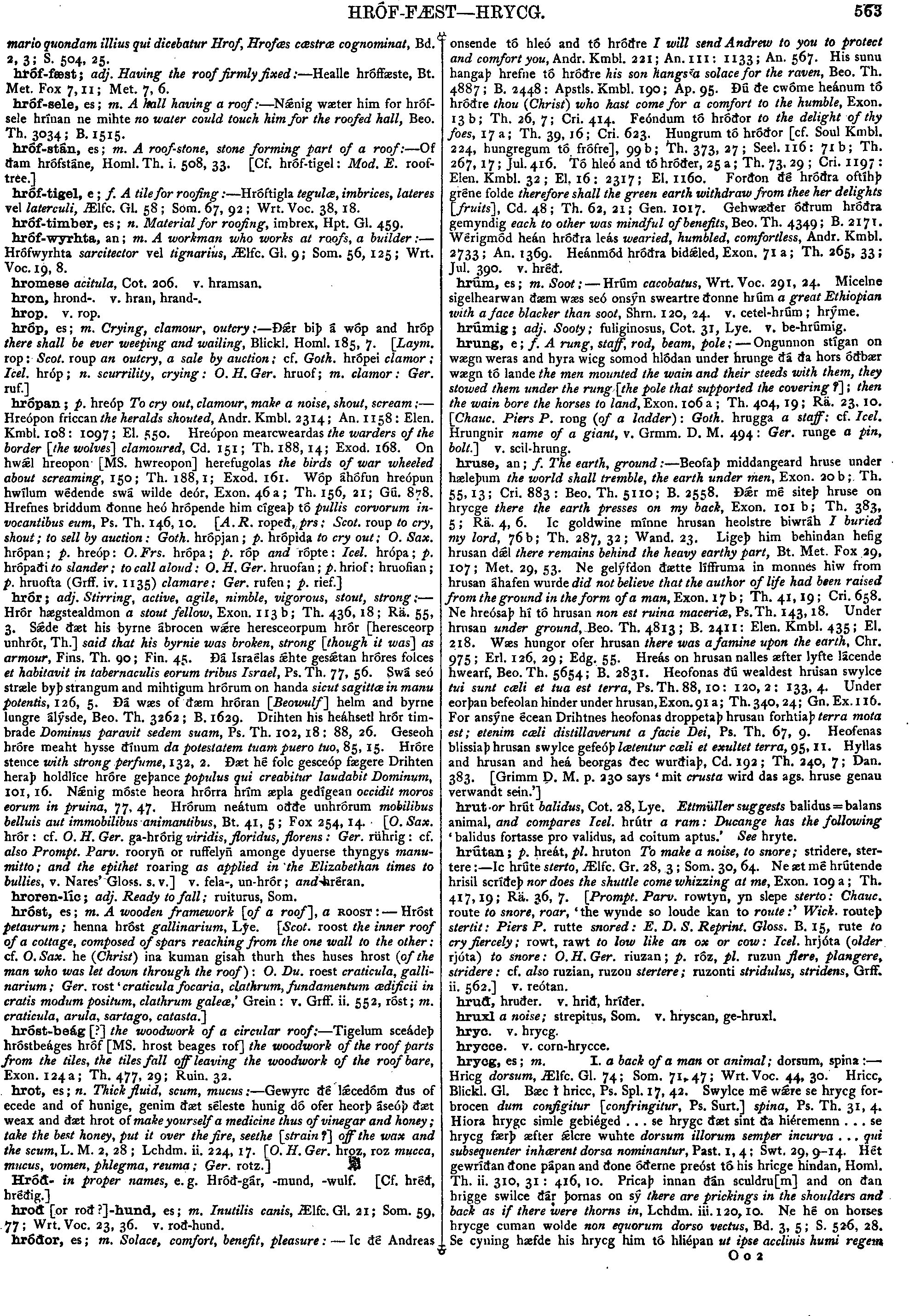
hrot,
es;
n.
Thick
fluid,
scum,
mucus
:--
Gewyrc
ðé
lcedóm
ðus
of
ecede
and
of
hunige,
genim
ðæt
séleste
hunig
dó
ofer
heorþ
áseóþ
ðæt
weax
and
ðæt
hrot
of
make
yourself
a
medicine
thus
of
vinegar
and
honey;
take
the
best
honey,
put
it
over
the
fire,
seethe
[strain
?]
off
the
wax
and
the
scum,
L.
M.
2,
28;
Lchdm.
ii.
224,
17.
[O.
H.
Ger.
hroz,
roz
mucca,
mucus,
vomen,
phlegma,
reuma;
Ger.
rotz.]
|
Source: Bosworth/Toller, page b0564, entry 1 View original page image as: [TIFF] [PNG] [View previous entry] [View next entry] |
[Comment on this entry] [View comments] |
The following entry has been hand-corrected once. |
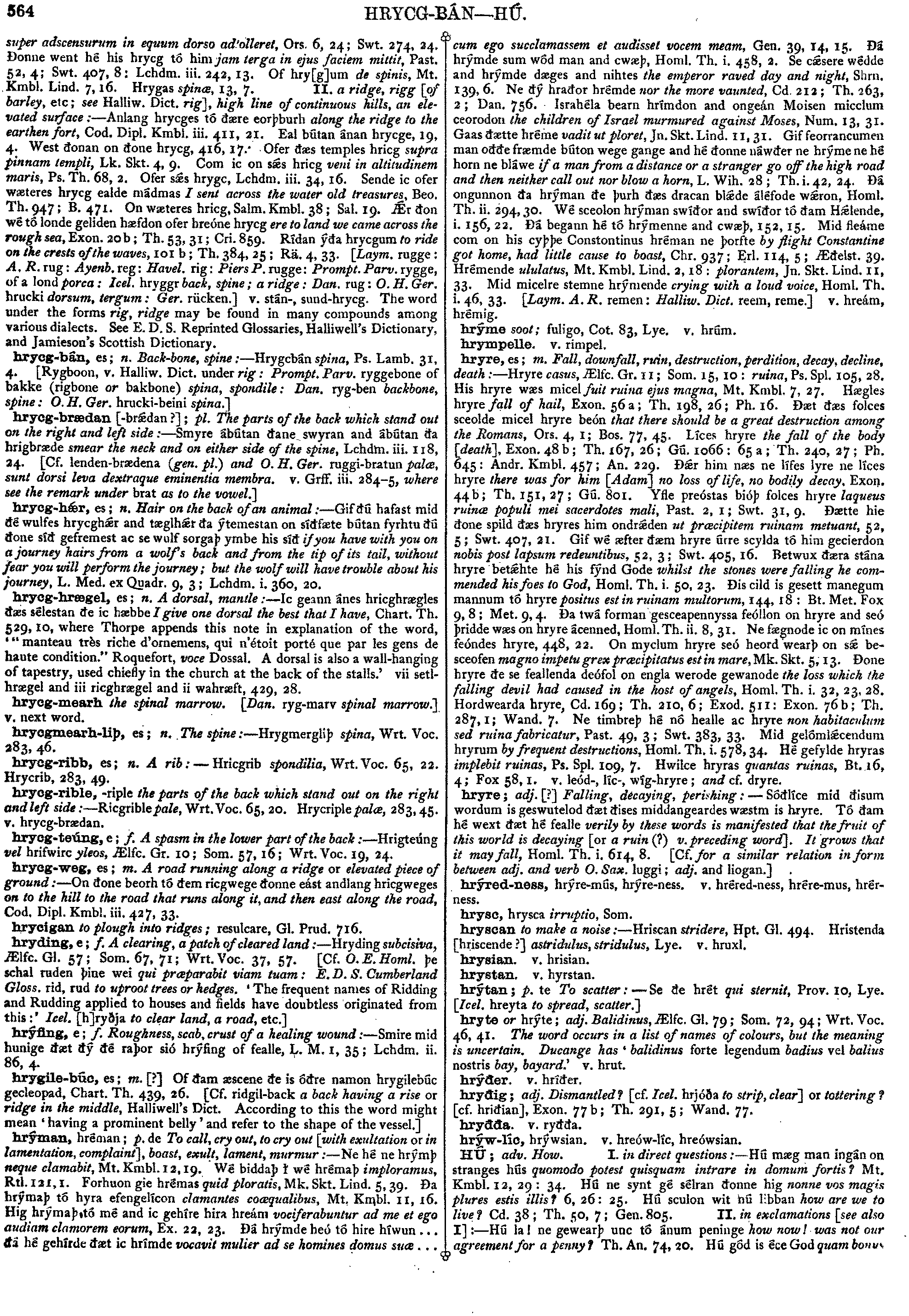
super
adscensurum
in
equum
dorso
adtolleret,
Ors.
6,
24;
Swt.
274,
24.
Ðonne
went
hé
his
hrycg
tó
him
jam
terga
in
ejus
faciem
mittit,
Past.
52,
4;
Swt.
407,
8:
Lchdm.
iii.
242,
13.
Of
hry[g]um
de
spinis,
Mt.
Kmbl.
Lind.
7,
16.
Hrygas
spinæ,
13,
7.
II.
a
ridge,
rigg
[of
barley,
etc;
see
Halliw.
Dict.
rig],
high
line
of
continuous
hills,
an
elevated
surface
:--
Anlang
hrycges
tó
ðære
eorþburh
along
the
ridge
to
the
earthen
fort,
Cod.
Dipl.
Kmbl.
iii.
411,
21.
Eal
bútan
ánan
hrycge,
19,
4.
West
ðonan
on
ðone
hrycg,
416,
17.
Ofer
ðæs
temples
hricg
supra
pinnam
templi,
Lk.
Skt.
4,
9.
Com
ic
on
ss
hricg
veni
in
altitudinem
maris,
Ps.
Th.
68,
2.
Ofer
ss
hrygc,
Lchdm.
iii.
34,
16.
Sende
ic
ofer
wæteres
hrycg
ealde
mádmas
I
sent
across
the
water
old
treasures,
Beo.
Th.
947;
B.
471.
On
wæteres
hricg,
Salm.
Kmbl.
38;
Sal.
19.
Æ-acute;r
ðon
wé
tó
londe
geliden
hæfdon
ofer
breóne
hrycg
ere
to
land
we
came
across
the
rough
sea,
Exon.
20
b;
Th.
53,
31;
Cri.
859.
Rídan
ýða
hrycgum
to
ride
on
the
crests
of
the
waves,
101
b;
Th.
384,
25;
Rä.
4,
33.
[Laym.
rugge:
A.
R.
rug:
Ayenb.
reg:
Havel.
rig:
Piers
P.
rugge:
Prompt.
Parv.
rygge,
of
a
lond
porca:
Icel.
hryggr
back,
spine;
a
ridge:
Dan.
rug:
O.
H.
Ger.
hrucki
dorsum,
tergum:
Ger.
rücken.]
v.
stán-,
sund-hrycg.
The
word
under
the
forms
rig,
ridge
may
be
found
in
many
compounds
among
various
dialects.
See
E.
D.
S.
Reprinted
Glossaries,
Halliwell's
Dictionary,
and
Jamieson's
Scottish
Dictionary.
|
Source: Bosworth/Toller, page b0564, entry 3 View original page image as: [TIFF] [PNG] [View previous entry] [View next entry] |
[Comment on this entry] [View comments] |
The following entry has been hand-corrected once. |
hrycg-brædan
[-brdan
?];
pl.
The
parts
of
the
back
which
stand
out
on
the
right
and
left
side
:--
Smyre
ábútan
ðane
swyran
and
ábútan
ða
hrigbræde
smear
the
neck
and
on
either
side
of
the
spine,
Lchdm.
iii.
118,
24.
[Cf.
lenden-brædena
(gen.
pl.)
and
O.
H.
Ger.
ruggi-bratun
palæ,
sunt
dorsi
leva
dextraque
eminentia
membra,
v.
Grff.
iii.
284-5,
where
see
the
remark
under
brat
as
to
the
vowel.]
|
Source: Bosworth/Toller, page b0564, entry 4 View original page image as: [TIFF] [PNG] [View previous entry] [View next entry] |
[Comment on this entry] [View comments] |
The following entry has been hand-corrected once. |
hrycg-hr,
es;
n.
Hair
on
the
back
of
an
animal
:--
Gif
ðú
hafast
mid
ðé
wulfes
hrycghr
and
tæglhr
ða
ýtemestan
on
síðfæte
bútan
fyrhtu
ðú
ðone
síð
gefremest
ac
se
wulf
sorgaþ
ymbe
his
síð
if
you
have
with
you
on
a
journey
hairs
from
a
wolf's
back
and
from
the
tip
of
its
tail,
without
fear
you
will
perform
the
journey;
but
the
wolf
will
have
trouble
about
his
journey,
L.
Med.
ex
Quadr.
9,
3;
Lchdm.
i.
360,
20.
|
Source: Bosworth/Toller, page b0564, entry 14 View original page image as: [TIFF] [PNG] [View previous entry] [View next entry] |
[Comment on this entry] [View comments] |
The following entry has been hand-corrected once. |
hrýfing, e; f. Roughness, scab, crust of a healing wound :-- Smire mid hunige ðæt ðý ðé raþor sió hrýfing of fealle, L. M. 1, 35; Lchdm. ii. 86, 4.
|
Source: Bosworth/Toller, page b0565, entry 1 View original page image as: [TIFF] [PNG] [View previous entry] [View next entry] |
[Comment on this entry] [View comments] |
The following entry has been hand-corrected once. |
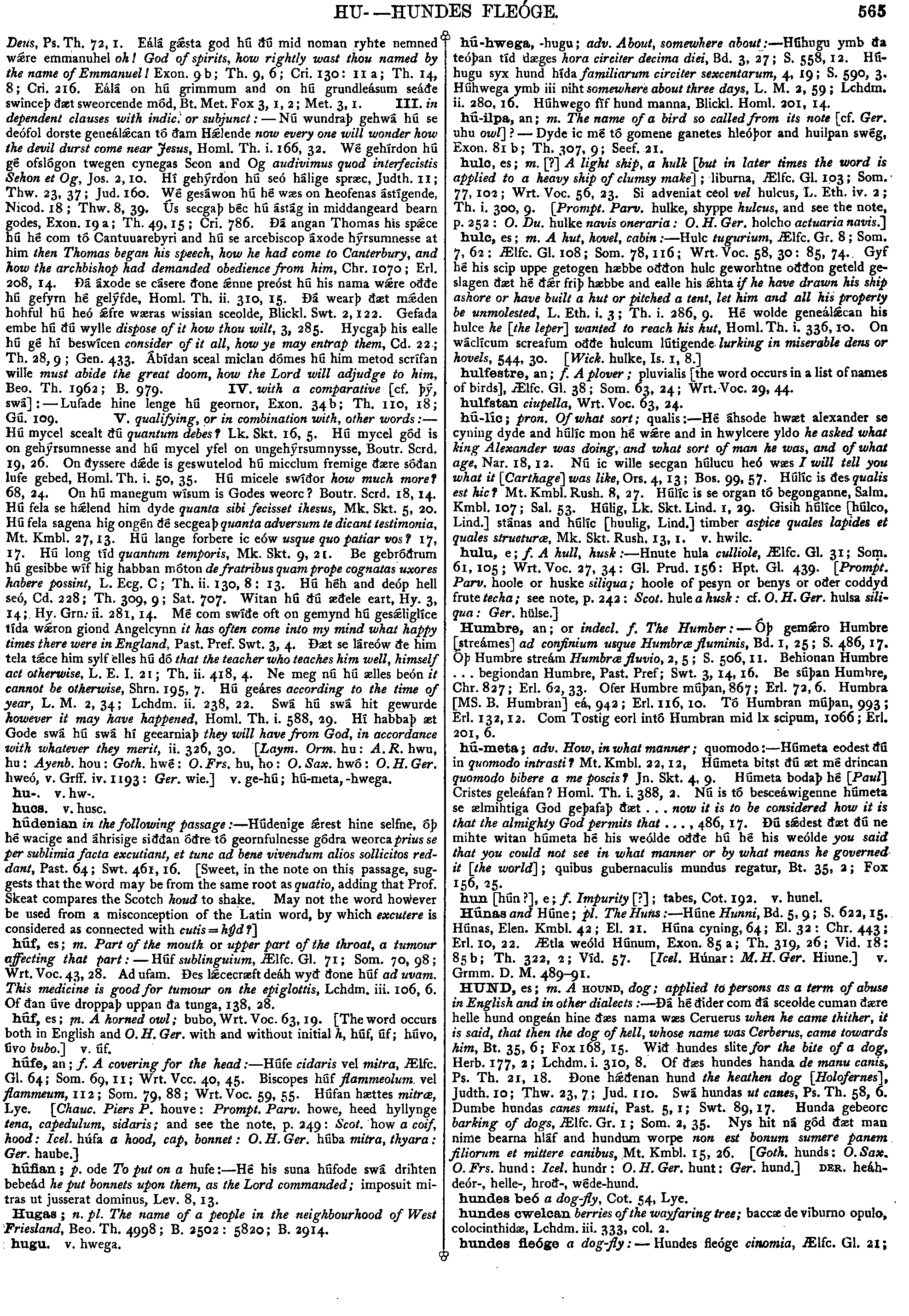
Deus,
Ps.
Th.
72,
1.
Eálá
gsta
god
hú
ðú
mid
noman
ryhte
nemned
wre
emmanuhel
oh!
God
of
spirits,
how
rightly
wast
thou
named
by
the
name
of
Emmanuel!
Exon.
9
b;
Th.
9,
6;
Cri.
130:
11
a;
Th.
14,
8;
Cri.
216.
Eálá
on
hú
grimmum
and
on
hú
grundleásum
seáðe
swinceþ
ðæt
sweorcende
mód,
Bt.
Met.
Fox
3,
1,
2;
Met.
3,
1.
III.
in
dependent
clauses
with
indic.
or
subjunct
:--
Nú
wundraþ
gehwá
hú
se
deófol
dorste
geneálcan
tó
ðam
Hlende
now
every
one
will
wonder
how
the
devil
durst
come
near
Jesus,
Homl.
Th.
i.
166,
32.
Wé
gehírdon
hú
gé
ofslógon
twegen
cynegas
Seon
and
Og
audivimus
quod
interfecistis
Sehon
et
Og,
Jos.
2,
10.
Hí
gehýrdon
hú
seó
hálige
spræc.
Judth.
11;
Thw.
23,
37;
Jud.
160.
Wé
gesáwon
hú
hé
wæs
on
heofenas
ástígende,
Nicod.
18;
Thw.
8,
39.
Ús
secgaþ
béc
hú
ástág
in
middangeard
bearn
godes,
Exon.
19
a;
Th.
49,
15;
Cri.
786.
Ðá
angan
Thomas
his
spce
hú
hé
com
tó
Cantuuarebyri
and
hú
se
arcebiscop
áxode
hýrsumnesse
at
him
then
Thomas
began
his
speech,
how
he
had
come
to
Canterbury,
and
how
the
archbishop
had
demanded
obedience
from
him,
Chr.
1070;
Erl.
208,
14.
Ðá
áxode
se
cásere
ðone
nne
preóst
hú
his
nama
wre
oððe
hú
gefyrn
hé
gelýfde,
Homl.
Th.
ii.
310,
15.
Ðá
wearþ
ðæt
mden
hohful
hú
heó
fre
wæras
wissian
sceolde,
Blickl.
Swt.
2,
122.
Gefada
embe
hú
ðú
wylle
dispose
of
it
how
thou
wilt,
3,
285.
Hycgaþ
his
ealle
hú
gé
hí
beswícen
consider
of
it
all,
how
ye
may
entrap
them,
Cd.
22;
Th.
28,
9;
Gen.
433.
Ábídan
sceal
miclan
dómes
hú
him
metod
scrífan
wille
must
abide
the
great
doom,
how
the
Lord
will
adjudge
to
him,
Beo.
Th.
1962;
B.
979.
IV.
with
a
comparative
[cf.
þý,
swá]
:--
Lufade
hine
lenge
hú
geornor,
Exon.
34
b;
Th.
110,
18;
Gú.
109.
V.
qualifying,
or
in
combination
with,
other
words
:--
Hú
mycel
scealt
ðú
quantum
debes?
Lk.
Skt.
16,
5.
Hú
mycel
gód
is
on
gehyrsumnesse
and
hú
mycel
yfel
on
ungehyrsumnysse.
Boutr.
Scrd.
19,
26.
On
ðyssere
dde
is
geswutelod
hú
micclum
fremige
ðære
sóðan
lufe
gebed.
Homl.
Th.
i.
50,
35.
Hú
micele
swíðor
how
much
more?
68,
24.
On
hú
manegum
wísum
is
Godes
weorc?
Boutr.
Scrd.
18,
14.
Hú
fela
se
hlend
him
dyde
quanta
sibi
fecisset
ihesus,
Mk.
Skt.
5,
20.
Hú
fela
sagena
hig
ongén
ðé
secgeaþ
quanta
adversum
te
dicant
testimonia,
Mt.
Kmbl.
27,
13.
Hú
lange
forbere
ic
eów
usque
quo
patiar
vos?
17,
17.
Hú
long
tíd
quantum
temporis,
Mk.
Skt.
9,
21.
Be
gebróðrum
hú
gesibbe
wíf
hig
habban
móton
de
fratribus
quam
prope
cognatas
uxores
habere
possint,
L.
Ecg.
C;
Th.
ii.
130,
8:
13.
Hú
héh
and
deóp
hell
seó,
Cd.
228;
Th.
309,
9;
Sat.
707.
Witan
hú
ðú
æðele
eart,
Hy.
3,
14;
Hy.
Grn:
ii.
281,
14.
Mé
com
swíðe
oft
on
gemynd
hú
gesliglíce
tída
wron
giond
Angelcynn
it
has
often
come
into
my
mind
what
happy
times
there
were
in
England,
Past.
Pref.
Swt.
3,
4.
Ðæt
se
láreów
ðe
him
tela
tce
him
sylf
elles
hú
dó
that
the
teacher
who
teaches
him
well,
himself
act
otherwise,
L.
E.
I.
21;
Th.
ii.
418,
4.
Ne
meg
nú
hú
ælles
beón
it
cannot
be
otherwise,
Shrn.
195,
7.
Hú
geáres
according
to
the
time
of
year,
L.
M.
2,
34;
Lchdm.
ii.
238,
22.
Swá
hú
swá
hit
gewurde
however
it
may
have
happened,
Homl.
Th.
i.
588,
29.
Hí
habbaþ
æt
Gode
swá
hú
swá
hí
geearniaþ
they
will
have
from
God,
in
accordance
with
whatever
they
merit,
ii.
326,
30.
[Laym.
Orm.
hu:
A.
R.
hwu,
hu:
Ayenb.
hou:
Goth.
hwé:
O.
Frs.
hu,
ho:
O.
Sax.
hwó:
O.
H.
Ger.
hweó,
v.
Grff.
iv.
1193:
Ger.
wie.]
v.
ge-hú;
hú-meta,
-hwega.
| Result Page: |  |
Previous | 109 110 111 112 113 114 115 116 117 118 119 120 121 122 123 124 125 126 127 | Next |  |
Germanic Lexicon Project (main page)
This search system was written by
Sean Crist
Please consider
volunteering
to correct the data in these online dictionaries.
No rights reserved. Feel free to use these data in any way you please.