|
|

Tip: In the search results, you can click on any word or abbreviation for more information.
|
Source: Bosworth/Toller, page b1000, entry 15 View original page image as: [TIFF] [PNG] [View previous entry] [View next entry] |
[Comment on this entry] [View comments] |
The following entry has been hand-corrected once. |
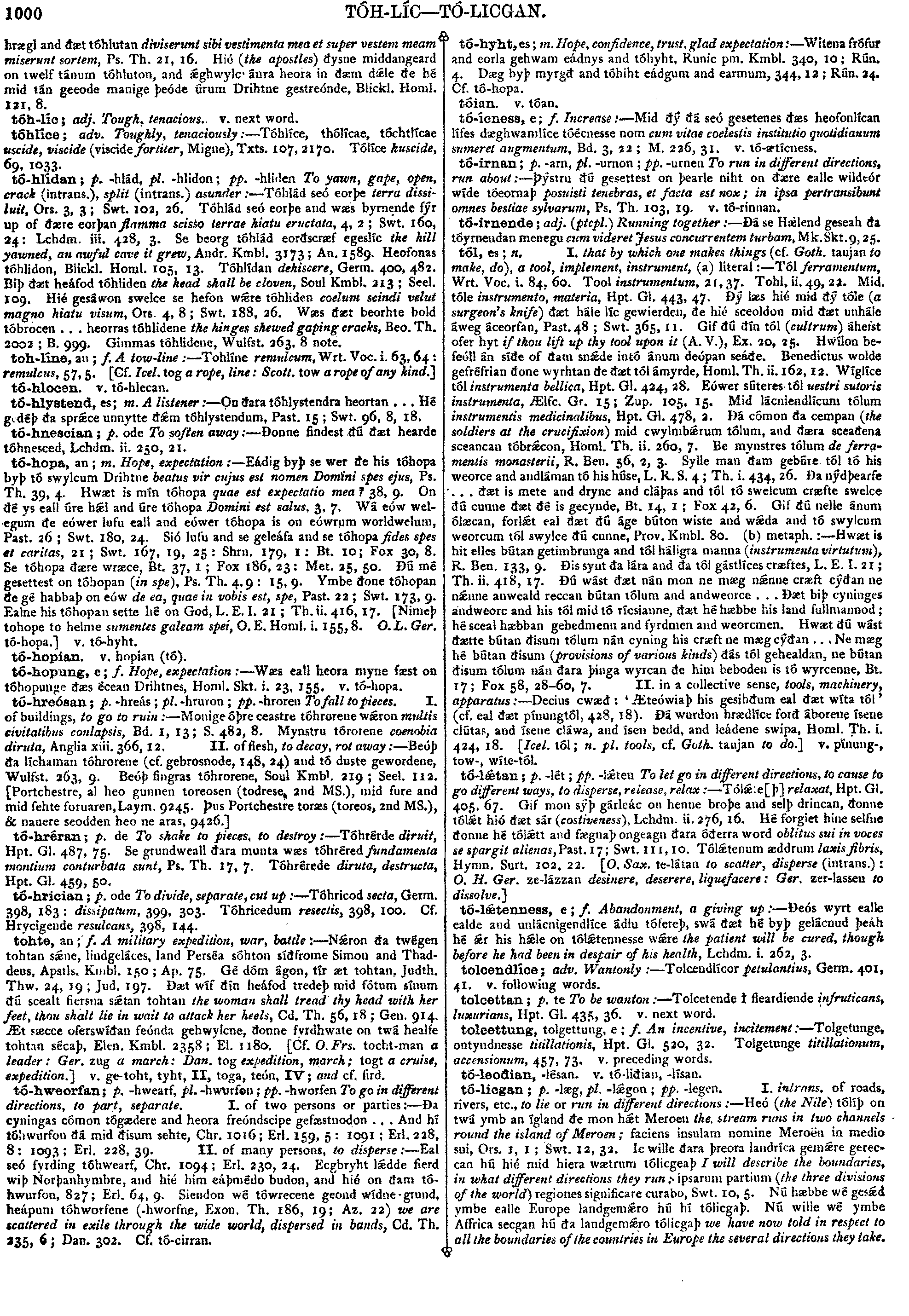
tohte,
an;
f.
A
military
expedition,
war,
battle
:--N ron
ða
twégen
tohtan
sne,
lindgeláces,
land
Perséa
sóhton
síðfrome
Simon
and
Thaddeus,
Apstls.
Kmbl.
150
;
Ap.
75.
G
ron
ða
twégen
tohtan
sne,
lindgeláces,
land
Perséa
sóhton
síðfrome
Simon
and
Thaddeus,
Apstls.
Kmbl.
150
;
Ap.
75.
G dóm
ágon,
tîr
æt
tohtan,
Judth.
Thw.
24,
19
;
Jud.
197.
Ðæt
wíf
ð
dóm
ágon,
tîr
æt
tohtan,
Judth.
Thw.
24,
19
;
Jud.
197.
Ðæt
wíf
ð n
heáfod
tredeþ
mid
fótum
sínum
ðú
scealt
fiersna
stan
tohtan
the
woman
shall
tread
thy
head
with
her
feet,
tkou
shalt
lie
in
wait
to
attack
her
heels,
Cd.
Th.
56,
18
;
Gen.
914.
Æt
sæcce
oferswíðan
feónda
gehwylcne,
ðonne
fvrdhwate
on
twá
healfe
tohtan
sécaþ,
Elen.
Kmbl.
2358;
El.
1180.
[Cf.
O.
Frs.
tocht-man
a
leader:
Ger.
zug
a
march:
Dan.
tog
expedition,
march;
togt
a
cruise,
expedition.]
v.
getoht,
tyht,
II,
toga,
teón,
IV;
and
cf.
fird.
n
heáfod
tredeþ
mid
fótum
sínum
ðú
scealt
fiersna
stan
tohtan
the
woman
shall
tread
thy
head
with
her
feet,
tkou
shalt
lie
in
wait
to
attack
her
heels,
Cd.
Th.
56,
18
;
Gen.
914.
Æt
sæcce
oferswíðan
feónda
gehwylcne,
ðonne
fvrdhwate
on
twá
healfe
tohtan
sécaþ,
Elen.
Kmbl.
2358;
El.
1180.
[Cf.
O.
Frs.
tocht-man
a
leader:
Ger.
zug
a
march:
Dan.
tog
expedition,
march;
togt
a
cruise,
expedition.]
v.
getoht,
tyht,
II,
toga,
teón,
IV;
and
cf.
fird.
|
Source: Bosworth/Toller, page b1003, entry 4 View original page image as: [TIFF] [PNG] [View previous entry] [View next entry] |
[Comment on this entry] [View comments] |
The following entry has been hand-corrected once. |
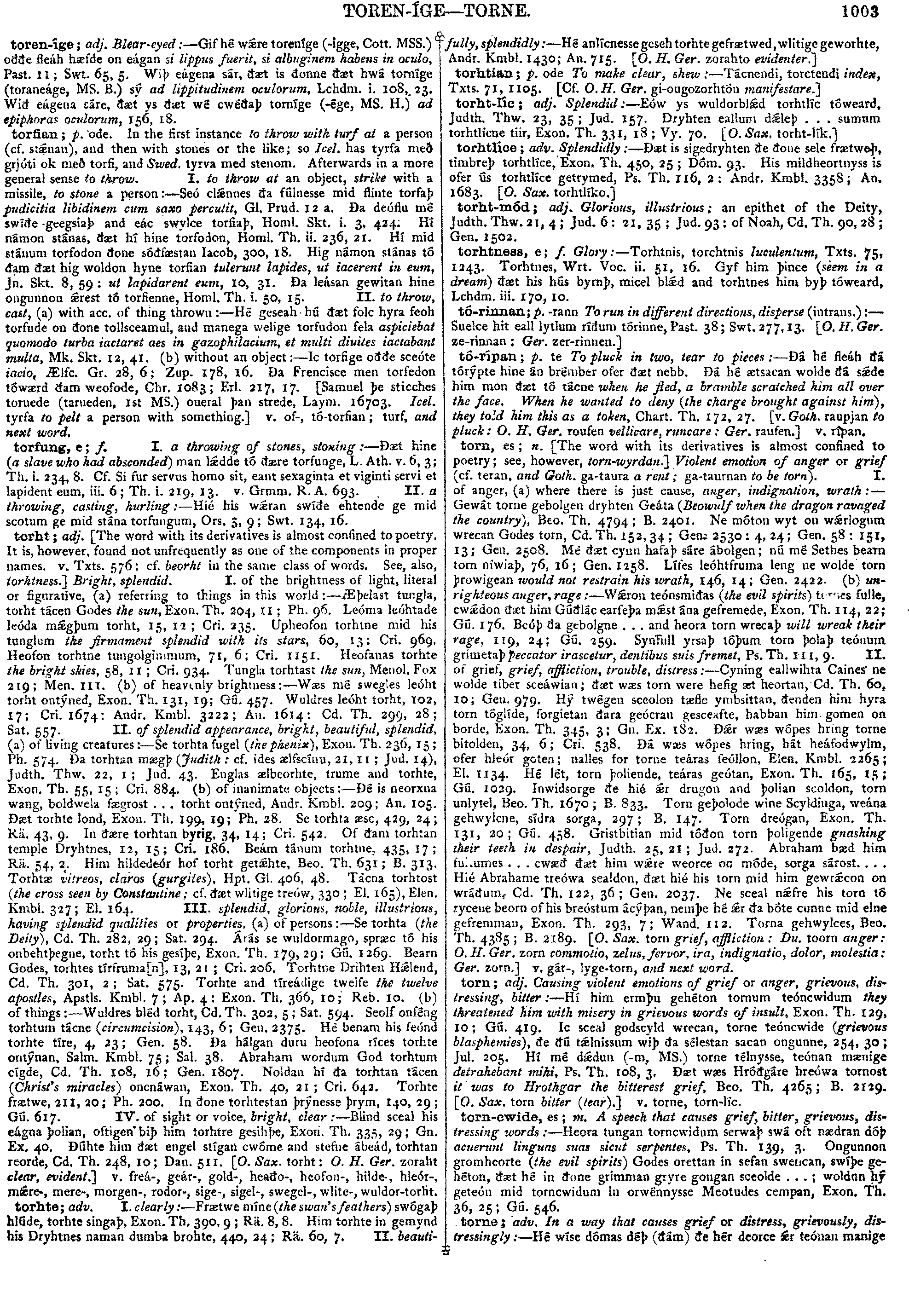
torht;
adj.
[The
word
with
its
derivatives
is
almost
confined
to
poetry.
It
is,
however,
found
not
unfrequently
as
one
of
the
components
in
proper
names.
v.
Txts.
576:
cf.
beorht
in
the
same
class
of
words.
See,
also,
torhtness.]
Bright,
splendid.
I.
of
the
brightness
of
light,
literal
or
figurative,
(a)
referring
to
things
in
this
world
:--
Æþelast
tungla,
torht
tácen
Godes
the
sun,
Exon.
Th.
204,
11;
Ph.
96.
Leóma
leóhtade
leóda
mgþum
torht,
15,
12;
Cri.
235.
Upheofon
torhtne
mid
his
tunglum
the
firmament
splendid
with
its
stars,
60,
13;
Cri.
969.
Heofon
torhtne
tungolgimmum,
71,
6;
Cri.
1151.
Heofanas
torhte
the
bright
skies,
58,
11;
Cri.
934.
Tungla
torhtast
the
sun,
Menol.
Fox
219;
Men.
111.
(b)
of
heavenly
brightness
:--
Wæs
mé
swegles
leóht
torht
ontýned,
Exon.
Th.
131,
19;
Gú.
457.
Wuldres
leóht
torht,
102,
17;
Cri.
1674:
Andr.
Kmbl.
3222;
An.
1614:
Cd.
Th.
299,
28;
Sat.
557.
II.
of
splendid
appearance,
bright,
beautiful,
splendid,
(a)
of
living
creatures
:--
Se
torhta
fugel
(the
phenix),
Exon.
Th.
236,
15;
Ph.
574.
Ða
torhtan
mægþ
(Judith:
cf.
ides
ælfscínu,
21,
11;
Jud.
14),
Judth.
Thw.
22,
1;
Jud.
43.
Englas
ælbeorhte,
trume
and
torhte,
Exon.
Th.
55,
15;
Cri.
884.
(b)
of
inanimate
objects
:--
Ðé
is
neorxna
wang,
boldwela
fegrost
...
torht
ontýned,
Andr.
Kmbl.
209;
An.
105.
Ðæt
torhte
lond,
Exon.
Th.
199,
19;
Ph.
28.
Se
torhta
æsc,
429,
24;
Rä.
43,
9.
In
ðære
torhtan
byrig,
34,
14;
Cri.
542.
Of
ðam
torhtan
temple
Dryhtnes,
12,
15;
Cri.
186.
Beám
tánum
torhtne,
435,
17;
Rä.
54,
2.
Him
hildedeór
hof
torht
gethte,
Beo.
Th.
631;
B.
313.
Torhtæ
vilreos,
claros
(gurgites).
Hpt.
Gl.
406,
48.
Tácna
torhtost
(the
cross
seen
by
Constantine;
cf.
ðæt
wlitige
treów,
330;
El.
165),
Elen.
Kmbl.
327;
El.
164.
III.
splendid,
glorious,
noble,
illustrious,
having
splendid
qualities
or
properties,
(a)
of
persons
:--
Se
torhta
(the
Deity),
Cd.
Th.
282,
29;
Sat.
294.
Árás
se
wuldormago,
spræc
tó
his
onbehtþegne,
torht
tó
his
gesíþe,
Exon.
Th.
179,
29;
Gú.
1269.
Bearn
Godes,
torhtes
tírfruma[n],
13,
21;
Cri.
206.
Torhtne
Drihten
Hlend,
Cd.
Th.
301,
2;
Sat.
575.
Torhte
and
tíreádige
twelfe
the
twelve
apostles,
Apstls.
Kmbl.
7;
Ap.
4:
Exon.
Th.
366,
10;
Reb.
10.
(b)
of
things
:--
Wuldres
bléd
torht,
Cd.
Th.
302,
5;
Sat.
594.
Seolf
onféng
torhtum
tácne
(circumcision),
143,
6;
Gen.
2375.
Hé
benam
his
feónd
torhte
tíre,
4,
23;
Gen.
58.
Ða
hálgan
duru
heofona
ríces
torhte
ontýnan.
Salm.
Kmbl.
75;
Sal.
38.
Abraham
wordum
God
torhtum
cígde,
Cd.
Th.
108,
16;
Gen.
1807.
Noldan
hí
ða
torhtan
tácen
(Christ's
miracles)
oncnáwan,
Exon.
Th.
40,
21;
Cri.
642.
Torhte
frætwe,
211,
20;
Ph.
200.
In
ðone
torhtestan
þrýnesse
þrym,
140,
29;
Gú.
617.
IV.
of
sight
or
voice,
bright,
clear
:--
Blind
sceal
his
eágna
þolian,
oftigen
biþ
him
torhtre
gesihþe,
Exon.
Th.
335,
29;
Gn.
Ex.
40.
Ðúhte
him
ðæt
engel
stígan
cwóme
and
stefne
ábeád,
torhtan
reorde,
Cd.
Th.
248,
10;
Dan.
511.
[O.
Sax.
torht:
O.
H.
Ger.
zoraht
clear,
evident.]
v.
freá-,
geár-,
gold-,
heaðo-,
heofon-,
hilde-,
hleór-,
mre-,
mere-,
morgen-,
rodor-,
sige-,
sigel-,
swegel-,
wlite-,
wuldor-torht.
|
Source: Bosworth/Toller, page b1003, entry 7 View original page image as: [TIFF] [PNG] [View previous entry] [View next entry] |
[Comment on this entry] [View comments] |
The following entry has been hand-corrected once. |
torht-líc;
adj.
Splendid
:--
Eów
ys
wuldorbld
torhtlíc
tóweard,
Judth.
Thw.
23,
35;
Jud.
157.
Dryhten
eallum
dleþ
...
sumum
torhtlícne
tiir,
Exon.
Th.
331,
18;
Vy.
70.
[O.
Sax.
torht-lík.]
|
Source: Bosworth/Toller, page b1003, entry 9 View original page image as: [TIFF] [PNG] [View previous entry] [View next entry] |
[Comment on this entry] [View comments] |
The following entry has been hand-corrected once. |
torht-mód; adj. Glorious, illustrious; an epithet of the Deity, Judth. Thw. 21, 4; Jud. 6: 21, 35; Jud. 93: of Noah, Cd. Th. 90, 28; Gen. 1502.
|
Source: Bosworth/Toller, page b1003, entry 13 View original page image as: [TIFF] [PNG] [View previous entry] [View next entry] |
[Comment on this entry] [View comments] |
The following entry has been hand-corrected once. |
torn,
es;
n.
[The
word
with
its
derivatives
is
almost
confined
to
poetry;
see,
however,
torn-wyrdan.]
Violent
emotion
of
anger
or
grief
(cf.
teran,
and
Goth.
ga-taura
a
rent;
ga-tauman
to
be
torn).
I.
of
anger,
(a)
where
there
is
just
cause,
anger,
indignation,
wrath
:--
Gewát
torne
gebolgen
dryhten
Geáta
(Beowulf
when
the
dragon
ravaged
the
country),
Beo.
Th.
4794;
B.
2401.
Ne
móton
wyt
on
wrlogum
wrecan
Godes
torn,
Cd.
Th.
152,
34;
Gen.
2530:
4,
24;
Gen.
58:
151,
13;
Gen.
2508.
Mé
ðæt
cynn
hafaþ
sáre
ábolgen;
nú
mé
Sethes
bearn
torn
níwiaþ,
76,
16;
Gen.
1258.
Lífes
leóhtfruma
leng
ne
wolde
torn
þrowigean
would
not
restrain
his
wrath,
146,
14;
Gen.
2422.
(b)
unrighteous
anger,
rage
:--
Wron
teónsmiðas
(the
evil
spirits)
tornes
fulle,
cwdon
ðæt
him
Gúðlác
earfeþa
mst
ána
gefremede,
Exon.
Th.
114,
22;
Gú.
176.
Beóþ
ða
gebolgne
...
and
heora
torn
wrecaþ
will
wreak
their
rage,
119,
24;
Gú.
259.
Synfull
yrsaþ
tóþum
torn
þolaþ
teónum
grimetaþ
peccator
irascetur,
dentibus
suis
fremet,
Ps.
Th.
111,
9.
II.
of
grief,
grief,
affliction,
trouble,
distress
:--
Cyning
eallwihta
Caines
ne
wolde
tiber
sceáwian;
ðæt
wæs
torn
were
hefig
æt
heortan,
Cd.
Th.
60,
10;
Gen.
979.
Hý
twégen
sceolon
tæfle
ymbsittan,
ðenden
him
hyra
torn
tóglíde,
forgietan
ðara
geócran
gesceafte,
habban
him
gomen
on
borde,
Exon.
Th.
345,
3;
Gn.
Ex.
182.
Ðr
wæs
wópes
hring
torne
bitolden,
34,
6;
Cri.
538.
Ðá
wæs
wópes
hring,
hát
heáfodwylm,
ofer
hleór
goten;
nalles
for
torne
teáras
feóllon,
Elen.
Kmbl.
2265;
El.
1134.
Hé
lét,
torn
þoliende,
teáras
geótan,
Exon.
Th.
165,
15;
Gú.
1029.
Inwidsorge
ðe
hié
r
drugon
and
þolian
scoldon,
torn
unlytel,
Beo.
Th.
1670;
B.
833.
Torn
geþolode
wine
Scyldinga,
weána
gehwylcne,
sídra
sorga,
297;
B.
147.
Torn
dreógan,
Exon.
Th.
131,
20;
Gú.
458.
Gristbitian
mid
tóðon
torn
þoligende
gnashing
their
teeth
in
despair,
Judth.
25,
21;
Jud.
272.
Abraham
bæd
him
fultumes
...
cwæð
ðæt
him
wre
weorce
on
móde,
sorga
sárost
...
Hié
Abrahame
treówa
sealdon,
ðæt
hié
his
torn
mid
him
gewrcon
on
wráðum,
Cd.
Th.
122,
36;
Gen.
2037.
Ne
sceal
nfre
his
torn
tó
rycene
beorn
of
his
breóstum
ácýþan,
nemþe
hé
r
ða
bóte
cunne
mid
elne
gefremman,
Exon.
Th.
293,
7;
Wand.
112.
Torna
gehwylces,
Beo.
Th.
4385;
B.
2189.
[O.
Sax.
torn
grief,
affliction:
Du.
toorn
anger:
O.
H.
Ger.
zorn
commotio,
zelus,
fervor,
ira,
indignatio,
dolor,
molestia:
Ger.
zorn.]
v.
gár-,
lyge-torn,
and
next
word.
|
Source: Bosworth/Toller, page b1004, entry 1 View original page image as: [TIFF] [PNG] [View previous entry] [View next entry] |
[Comment on this entry] [View comments] |
The following entry has been hand-corrected once. |
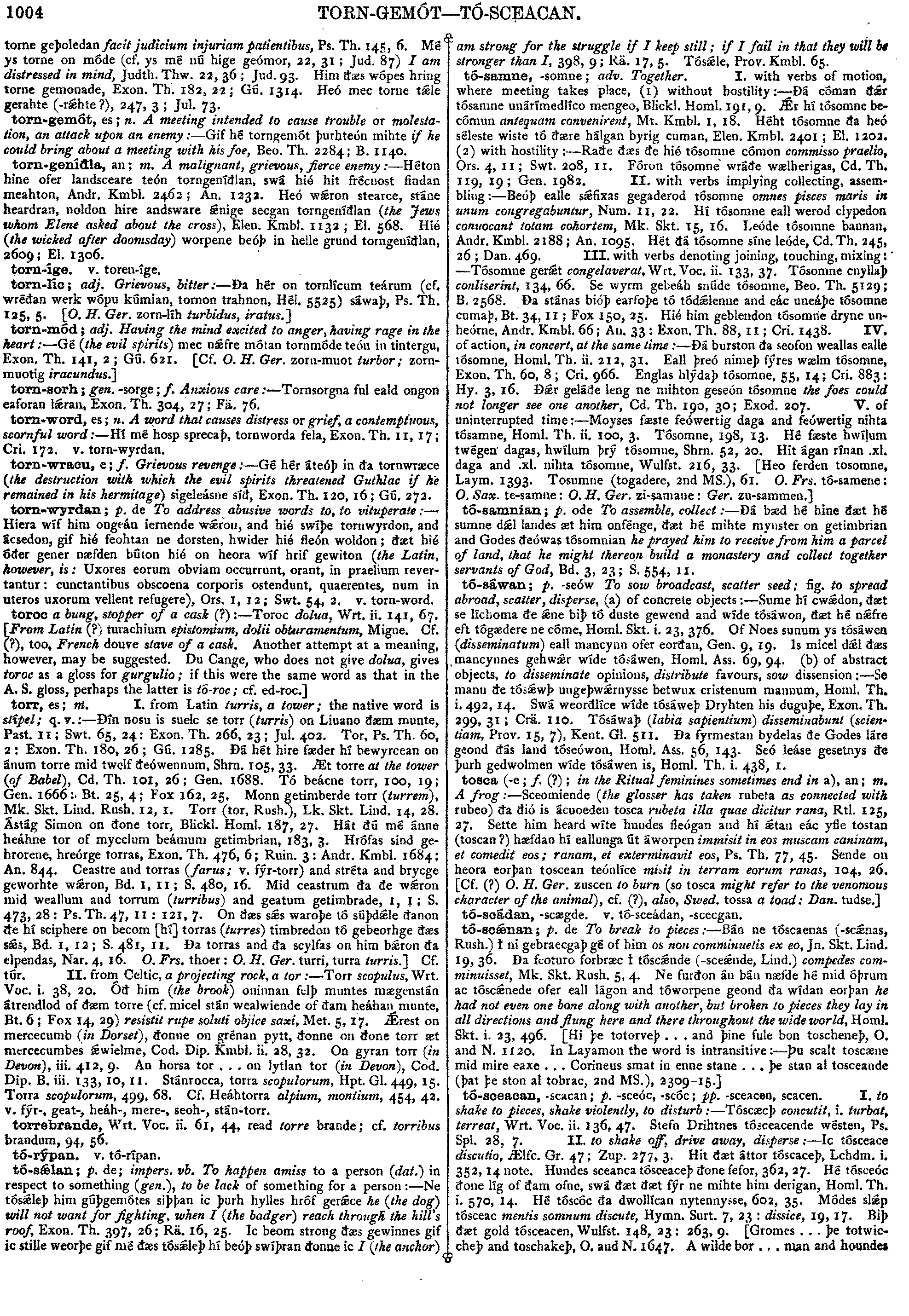
torne
geþoledan
facit
judicium
injuriam
patientibus,
Ps.
Th.
145,
6.
Mé
ys
torne
on
móde
(cf.
ys
mé
nú
hige
geómor,
22,
31;
Jud.
87)
I
am
distressed
in
mind,
Judth.
Thw.
22,
36;
Jud.
93.
Him
ðæs
wópes
hring
torne
gemonade,
Exon.
Th.
182,
22;
Gú.
1314.
Heó
mec
torne
tle
gerahte
(-rhte?),
247,
3;
Jul.
73.
|
Source: Bosworth/Toller, page b1008, entry 14 View original page image as: [TIFF] [PNG] [View previous entry] [View next entry] |
[Comment on this entry] [View comments (1)] |
The following entry has been hand-corrected once. |
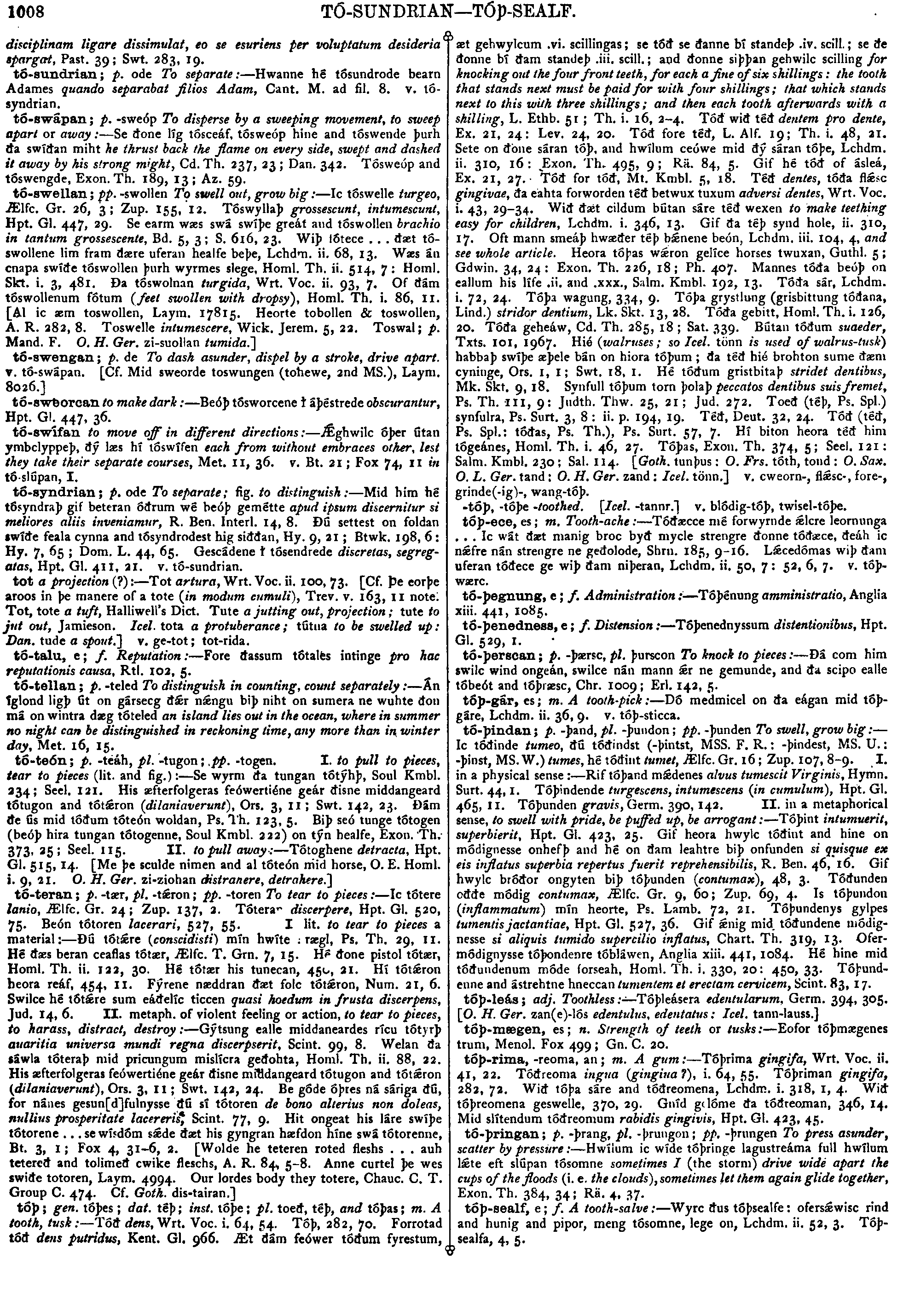
tóþ
gen.
tóþes;
dat.
téþ,
inst.
tóþe;
pl.
toeð,
téþ,
and
tóþas;
m.
A
tooth,
tusk
:--
Tóð
dens,
Wrt.
Voc.
i.
64,
54.
Tóþ,
282,
70.
Forrotad
tóð
dens
putridus,
Kent.
Gl.
966.
Æt
ðám
feówer
tóðum
fyrestum,
æt
gehwylcum
.
vi.
scillingas;
se
tóð
se
ðanne
bí
standeþ
.
iv.
scill
;
se
ðe
ðonne
bí
dam
standeþ
.
iii.
scill.
;
and
ðonne
siþþan
gehwilc
scilling
for
knocking
out
the
four
front
teeth,
for
each
a
fine
of
six
shillings:
the
tooth
that
stands
next
must
be
paid
for
with
four
shillings;
that
which
stands
next
to
this
with
three
shillings;
and
then
each
tooth
afterwards
with
a
shilling,
L.
Ethb.
51;
Th.
i.
16,
2-4.
Tóð
wið
téð
dentem
pro
dente,
Ex.
21,
24:
Lev.
24,
20.
Tóð
fore
téð,
L.
Alf.
19;
Th.
i.
48,
21.
Sete
on
ðone
sáran
tóþ,
and
hwílum
ceówe
mid
ðý
sáran
tóþe,
Lchdm.
ii.
310,
16
:
.
Exon.
Th.
495,
9
;
Ra.
84,
5.
Gif
hé
tóð
of
ásleá,
Ex.
21,
27.
Tóð
for
tóð,
Mt.
Kmbl.
5,
18.
Téð
dentes,
tóða
flsc
gingivae,
ða
eahta
forworden
téð
betwux
tuxum
adversi
dentes,
Wrt.
Voc.
i.
43,
29-34.
Wið
ðaét
cildum
bútan
sáre
téð
wexen
to
make
teething
easy
for
children,
Lchdm.
i.
346,
13.
Gif
ða
téþ
synd
hole,
ii.
310,
17.
Oft
mann
smeáþ
hwæðer
téþ
bnene
beón,
Lchdm.
iii.
104,
4,
and
see
whole
article.
Heora
tóþas
wron
gelíce
horses
twuxan.
Guthl.
5
;
Gdwin.
34,
24:
Exon.
Th.
226,
18;
Ph.
407.
Mannes
tóða
beóþ
on
eallum
his
lífe
.
ii.
and
.xxx.
,
Salm.
Kmbl.
192,
13.
Tóða
sár.
Lchdm.
i.
72,
24.
Tóþa
wagung,
334,
9.
Tóþa
grystlung
(grisbittung
tóðana,
Lind.
)
stridor
dentium,
Lk.
Skt.
13,
28.
Tóða
gebitt.
Homl.
Th.
i.
126,
20.
Tóða
geheáw,
Cd.
Th.
285,
18
;
Sae.
339.
Bútan
tóðum
suaeder,
Txts.
101,
1967.
Hié
(walruses;
so
Icel.
tonn
is
used
of
walrus-tusk)
habbaþ
swíþe
æþele
bán
on
hiora
tóðum
;
ða
téð
hié
brohton
sume
ðæm
cyninge.
Ors.
1.
1;
Swt.
18,
1.
Hé
tóðum
gristbitaþ
stridet
dentibus,
Mk.
Skt.
9,
18.
Synfull
toþum
torn
þolaþ
peccatos
dentibus
suis
fremet,
Ps.
Th.
in,
9:
Judth.
Thw.
25,
21;
Jud.
272.
Toeð
(téþ,
Ps.
Spl.
)
synfulra.
Ps.
Surt.
3,
8
:
ii.
p.
194,
19.
Téð,
Deut.
32,
24.
Tóð
(téð,
Ps.
Spl.
:
tóðas,
Ps.
Th.
),
Ps.
Surt.
57,
7.
Hí
biton
heora
téð
him
tógeánes,
Homl.
Th.
i.
46,
27.
Tóþas,
Exon.
Th.
374,
5;
Seel.
121:
Salm.
Kmbl.
230;
Sal.
114.
[Goth.
tunþus:
O.
Frs.
tóth,
tond
:
O.
Sax.
O.
L.
Ger.
zand:
O.
H.
Ger.
zand:
Icel.
tonn.]
v.
cweorn-,
flsc-,
fore-,
grinde(-ig)-,
wang-tóþ.
|
Source: Bosworth/Toller, page b1009, entry 19 View original page image as: [TIFF] [PNG] [View previous entry] [View next entry] |
[Comment on this entry] [View comments] |
The following entry has been hand-corrected once. |
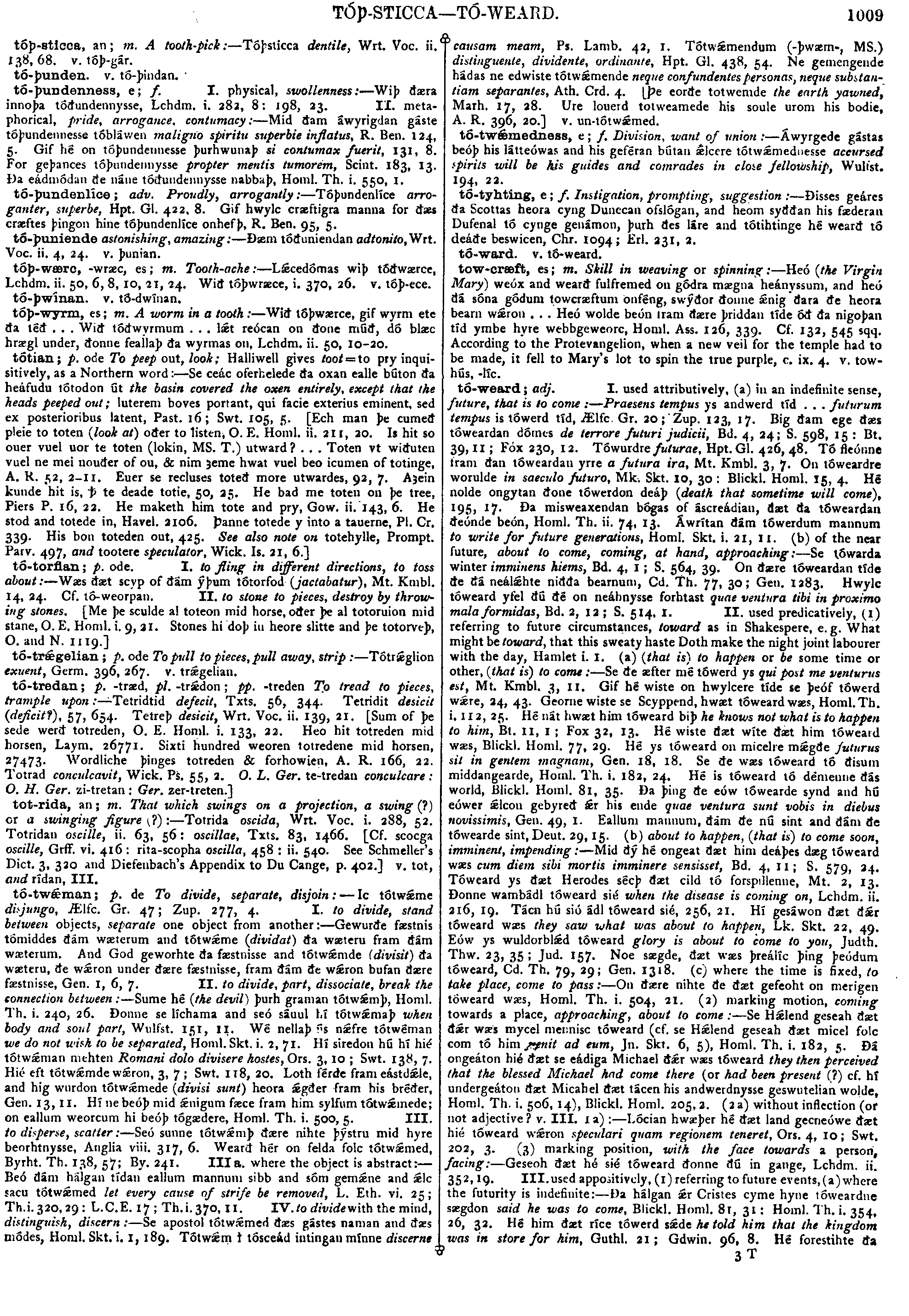
tó-weard;
adj.
I.
used
attributively,
(a)
in
an
indefinite
sense,
future,
that
is
to
come
:--
Praesens
tempus
ys
andwerd
tíd
.
.
.
fufurum
tempus
is
tówerd
tíd,
Ælfc.
Gr.
20;
'Zup.
123,
17.
Big
ðam
ege
ðæs
tóweardan
dómes
de
terrore
futuri
judicii,
Bd.
4,
24;
S.
598,
15:
Bt.
39,
ll;
Fóx
230,
12.
Tówurdre
futurae,
Hpt.
Gl.
426,
48.
Tó
fleónne
tram
ðan
tóweardan
yrre
a
futura
ira.
Mt.
Kmbl.
3,
7.
On
tóweardre
worulde
in
saeculo
futuro
Mk.
Skt.
10,
30
:
Blickl.
Homl.
15,
4.
Hé
nolde
ongytan
ðone
tówerdon
deáþ
(death
that
sometime
will
come),
195,
17.
Ða
misweaxendan
bógas
of
áscreádian,
ðæt
ða
tóweardan
ðeónde
beón,
Homl.
Th.
ii.
74,
13.
Áwrítan
ðám
tówerdum
mannum
to
write
for
future
generations,
Homl.
Skt.
i.
21,
II.
(b)
of
the
near
future,
about
to
come,
coming,
at
hand,
approaching
:--
Se
tówarda
winter
imminens
hiems,
Bd.
4,
1;
S.
564,
39.
On
ðære
tóweardan
tíde
ðe
ðá
neálhte
niðða
bearnum,
Cd.
Th.
77,
30;
Gen.
1283.
Hwylc
tóweard
yfel
ðú
ðé
on
neáhnysse
forhtast
quae
ventura
tibi
in
proximo
mala
formidas,
Bd.
2,
12
;
S.
514,
1.
II.
used
predicatively,
(l)
referring
to
future
circumstances,
toward
as
in
Shakespere,
e.
g.
What
might
be
toward,
that
this
sweaty
haste
Doth
make
the
night
joint
labourer
with
the
day,
Hamlet
i.
I.
(a)
(that
is)
to
happen
or
be
some
time
or
other,
(that
is)
to
come
:--
Se
ðe
æfter
mé
tówerd
ys
qui
post
me
venturus
est,
Mt.
Kmbl.
3,
11.
Gif
hé
wiste
on
hwylcere
tíde
se
þeóf
tówerd
wre,
24,
43.
Georne
wiste
se
Scyppend,
hwæt
tóweard
wæs,
Homl.
Th.
i.
112,
25.
Hé
nát
hwæt
him
tóweard
biþ
he
knows
not
what
is
to
happen
to
him,
Bt.
ll,
I
;
Fox
32,
13.
He
wiste
ðæt
wíte
ðæt
him
tóweard
wæs,
Blick.
Homl.
77,
29.
Hé
ys
tóweard
on
micelre
mgðe
futurus
sit
in
gentem
magnam,
Gen.
18,
18.
Se
ðe
waes
tóweard
tó
ðisum
middangearde,
Homl.
Th.
i.
182,
24.
Hé
is
tóweard
tó
démenne
ðás
world,
Blickl.
Homl.
81,
35.
Ða
þing
ðe
eów
tówearde
synd
and
hú
eówer
lcon
gebyreð
r
his
ende
quae
ventura
sunt
vobis
in
diebus
novissimis.
Gen.
49,
Eallum
mannum,
ðám
ðe
nú
sint
and
ðám
ðe
tówearde
sint.
Deut.
29,
15.
(b)
about
to
happen,
(that
is)
to
come
soon,
imminent,
impending
:--
Mid
ðý
hé
ongeat
ðæt
him
deáþes
dæg
tóweard
wæs
cum
diem
sibi
mortis
imminere
sensisset,
Bd.
4,
11;
S.
579,
24.
Tóweard
ys
ðæt
Herodes
sécþ
ðæt
cild
tó
forspillenne,
Mt.
2,
13.
Ðonne
wambádl
tóweard
sié
when
the
disease
is
coming
on,
Lchdm.
ii.
216,
19.
Tácn
hú
sió
ádl
tóweard
sié,
256,
21.
Hí
gesáwon
ðæt
ðár
tóweard
wæs
they
saw
what
was
about
to
happen,
Lk.
Skt.
22,
49.
Eów
ys
wuldorbld
tóweard
glory
is
about
to
come
to
you,
Judth.
Thw.
23,
35
;
Jud.
157.
Noe
sægde,
ðæt
wæs
þreálíc
þing
þeódum
tóweard,
Cd.
Th.
79,
29;
Gen.
1318.
(c)
where
the
time
is
fixed,
to
take
place,
come
to
pass
:--
On
ðære
nihte
ðe
ðæt
gefeoht
on
merigen
tóweard
wæs,
Homl.
Th.
i.
504,
21.
(2)
marking
motion,
coming
towards
a
place,
approaching,
about
to
come
:--
Se
Hlend
geseah
ðæt
ðr
wæs
mycel
mennisc
tóweard
(cf.
se
Hlend
geseah
ðæt
micel
folc
com
to
him
renit
ad
eum,
Jn.
Skt.
6,
5),
Homl.
Th.
i.
182,
5.
Ða
ongeáton
hié
ðæt
se
eádiga
Michael
ðr
wæs
tóweard
they
then
perceived
that
the
blessed
Michael
had
come
there
(or
had
been
present
cf.
hí
undergeaton
ðæt
Michael
ðæt
tácen
his
andwerdnysse
geswutelian
wolde,
Homl.
Th.
i.
506,
14),
Blickl.
Homl.
205,
2.
(2
a)
without
inflection
(or
not
adjective
?
v.
III.
1
a)
:--
Lócian
hwæþer
hé
ðæt
land
gecneowe
ðæt
hié
tóweard
wron
speculari
quam
regionem
teneret.
Ors.
4,
10;
Swt.
202,
3.
(3)
marking
position,
with
the
face
towards
a
person,
facing
:--
Geseoh
ðæt
hé
sié
tóweard
ðonne
ðú
in
gange,
Lchdm.
ii.
352,
19,
III
used
appositively,
(l)
referring
to
future
events,
(a)
where
the
futurity
is
indefinite
:--
Ða
hálgan
r
Cristes
cyme
hyne
tóweardne
sægdon
said
he
was
to
come,
Blickl.
Homl.
81,
31:
Homl.
Th.
i.
354,
26,
32.
Hé
him
ðæt
ríce
tówerd
sde
he
told
him
that
the
kingdom
was
in
store
for
him,
Guthl.
21;
Gdwin.
96,
8.
Hé
forestihte
ða
|
Source: Bosworth/Toller, page b1010, entry 1 View original page image as: [TIFF] [PNG] [View previous entry] [View next entry] |
[Comment on this entry] [View comments] |
The following entry has been hand-corrected once. |
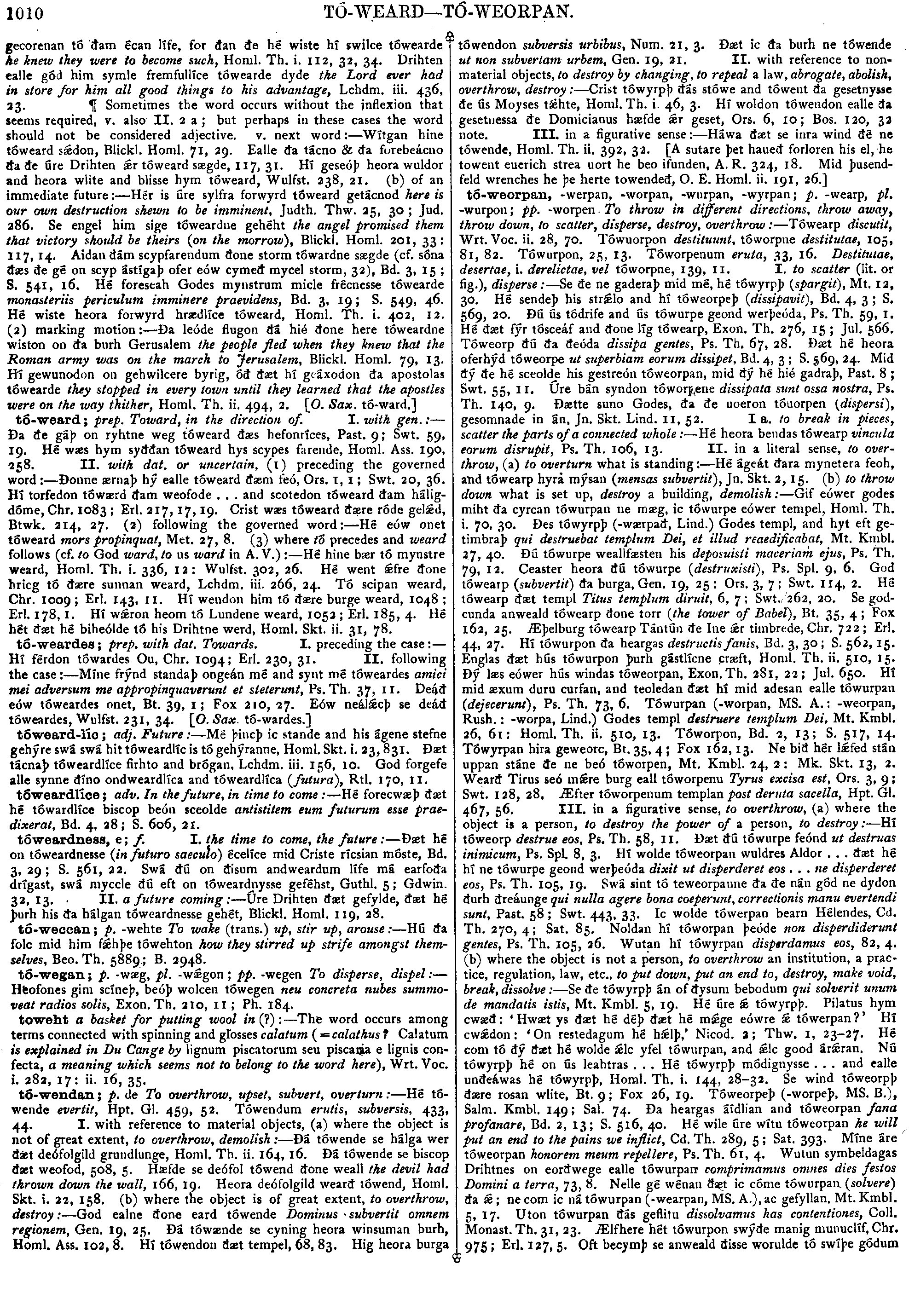
gecorenan
tó
ðam
écan
lífe,
for
ðan
ðe
hé
wiste
hí
swilce
tówearde
he
knew
they
were
to
become
such,
Homl.
Th.
i.
112,
32,
34.
Drihten
ealle
gód
him
symle
fremfullíce
tówearde
dyde
the
Lord
ever
had
in
store
for
him
all
good
things
to
his
advantage,
Lchdm.
iii.
436,
23.
Sometimes
the
word
occurs
without
the
inflexion
that
seems
required,
v.
also
II.
2
a;
but
perhaps
in
these
cases
the
word
should
not
be
considered
adjective.
v.
next
word
:--
Wítgan
hine
tóweard
sdon,
Blickl.
Homl.
71,
29.
Ealle
ða
tácno
&
ða
forebeácno
ía
ðe
úre
Drihten
r
tóweard
sægde,
117,
31.
Hí
geseóþ
heora
wuldor
and
heora
wlite
and
blisse
hym
tóweard,
Wulfst.
238,
21.
(b)
of
an
immediate
future
:--
Her
is
úre
sylfra
forwyrd
tóweard
getácnod
here
is
our
own
destruction
shewn
to
be
imminent,
Judth.
Thw.
25,
30
;
Jud.
286.
Se
engel
him
sige
tóweardne
gehéht
the
angel
promised
them
that
victory
should
be
theirs
(on
the
morrow).
Blickl.
Homl.
201,
33:
117,
14.
Aidan
dam
scypfarendum
ðone
storm
tówardne
sægde
(cf.
sóna
ðæs
ðe
gé
on
scyp
ástígaþ
ofer
eów
cymeð
mycel
storm,
32),
Bd.
3,
15
;
S.
541,
16.
Hé
foreseah
Godes
mynstrum
micle
frécnesse
tówearde
monasteriis
periculum
imminere
praevidens,
Bd.
3,
19;
S.
549,
46.
Hé
wiste
heora
forwyrd
hrædlíce
tóweard,
Homl.
Th.
i.
402,
12.
(2)
marking
motion
:--
Ða
leóde
flugon
ðá
hié
ðone
here
tóweardne
wiston
on
ða
burh
Gerusalem
the
people
fled
when
they
knew
that
the
Roman
army
was
on
the
march
to
Jerusalem,
Blickl.
Homl.
79,
13.
Hí
gewunodon
on
gehwilcere
byrig,
óð
dæt
hí
geáxodon
ða
apostolas
tówearde
they
stopped
in
every
town
until
they
learned
that
the
apostles
were
on
the
way
thither,
Homl.
Th.
ii.
494,
2.
[O.
Sax.
tó-ward.]
|
Source: Bosworth/Toller, page b1011, entry 19 View original page image as: [TIFF] [PNG] [View previous entry] [View next entry] |
[Comment on this entry] [View comments (1)] |
The following entry has been hand-corrected once. |
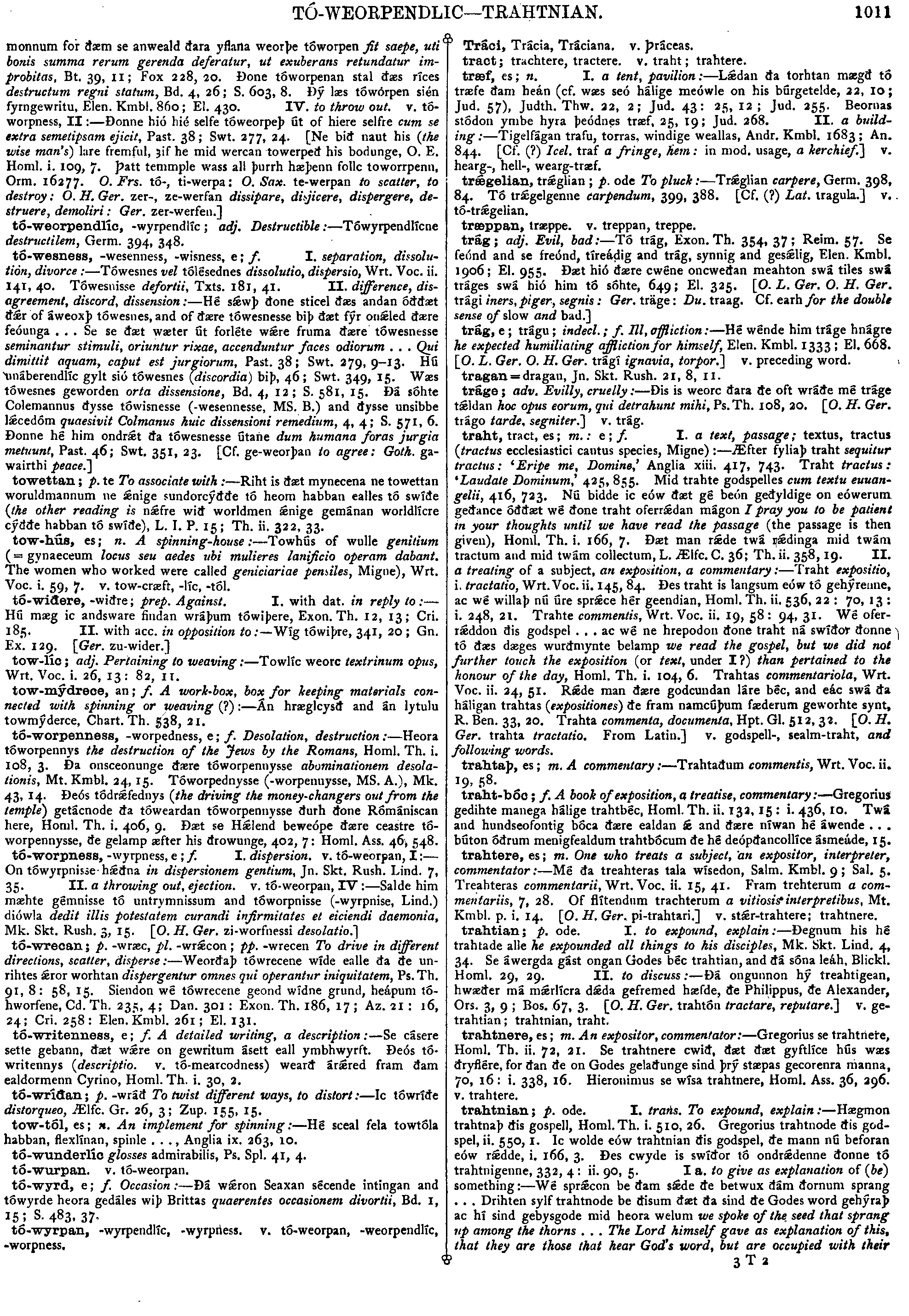
træf,
es;
n.
I.
a
tent,
pavilion
:--
Ldan
ita
torhtan
mægð
tó
træfe
ðam
heán
(cf.
wæs
seó
hálige
meówle
on
his
búrgetelde,
22,
10;
Jud.
57),
Judth.
Thw.
22,
2;
Jud.
43:
25,
12;
Jud.
255.
Beornas
stódon
ymbe
hyra
þeódnes
træf,
25,
19;
Jud.
268.
II.
a
building
:--
Tigelfágan
trafu,
torras,
windige
weallas,
Andr.
Kmbl.
1683;
An.
844.
[Cf.
(?)
Icel.
traf
a
fringe,
hem:
in
mod.
usage,
a
kerchief]
v.
hearg-,
hell-,
wearg-træf.
| Result Page: |  |
Previous | 30 31 32 33 34 35 36 37 38 39 40 41 42 43 44 45 46 47 48 | Next |  |
Germanic Lexicon Project (main page)
This search system was written by
Sean Crist
Please consider
volunteering
to correct the data in these online dictionaries.
No rights reserved. Feel free to use these data in any way you please.