|
|

Search for Ivar again, using less strict matching (261 results)
|
Source: Cleasby/Vigfusson, page b0426, entry 15 View original page image as: [TIFF] [PNG] [View previous entry] [View next entry] |
[Comment on this entry] [View comments] |
The following entry has been hand-corrected once. |
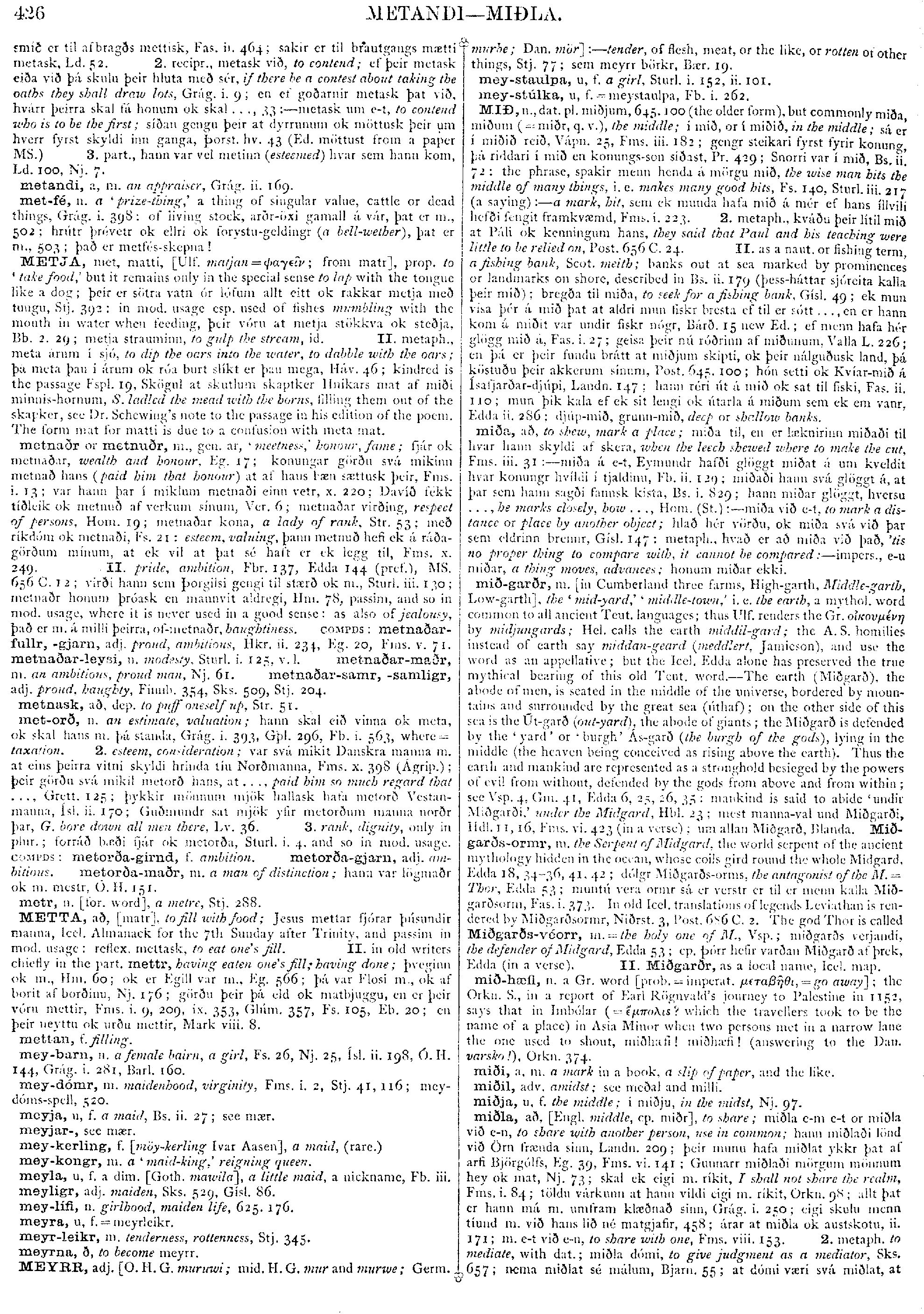
mey-kerling, f. [möy-kerling Ivar Aasen], a maid, (rare.)
|
Source: Cleasby/Vigfusson, page b0427, entry 8 View original page image as: [TIFF] [PNG] [View previous entry] [View next entry] |
[Comment on this entry] [View comments] |
The following entry has been hand-corrected once. |
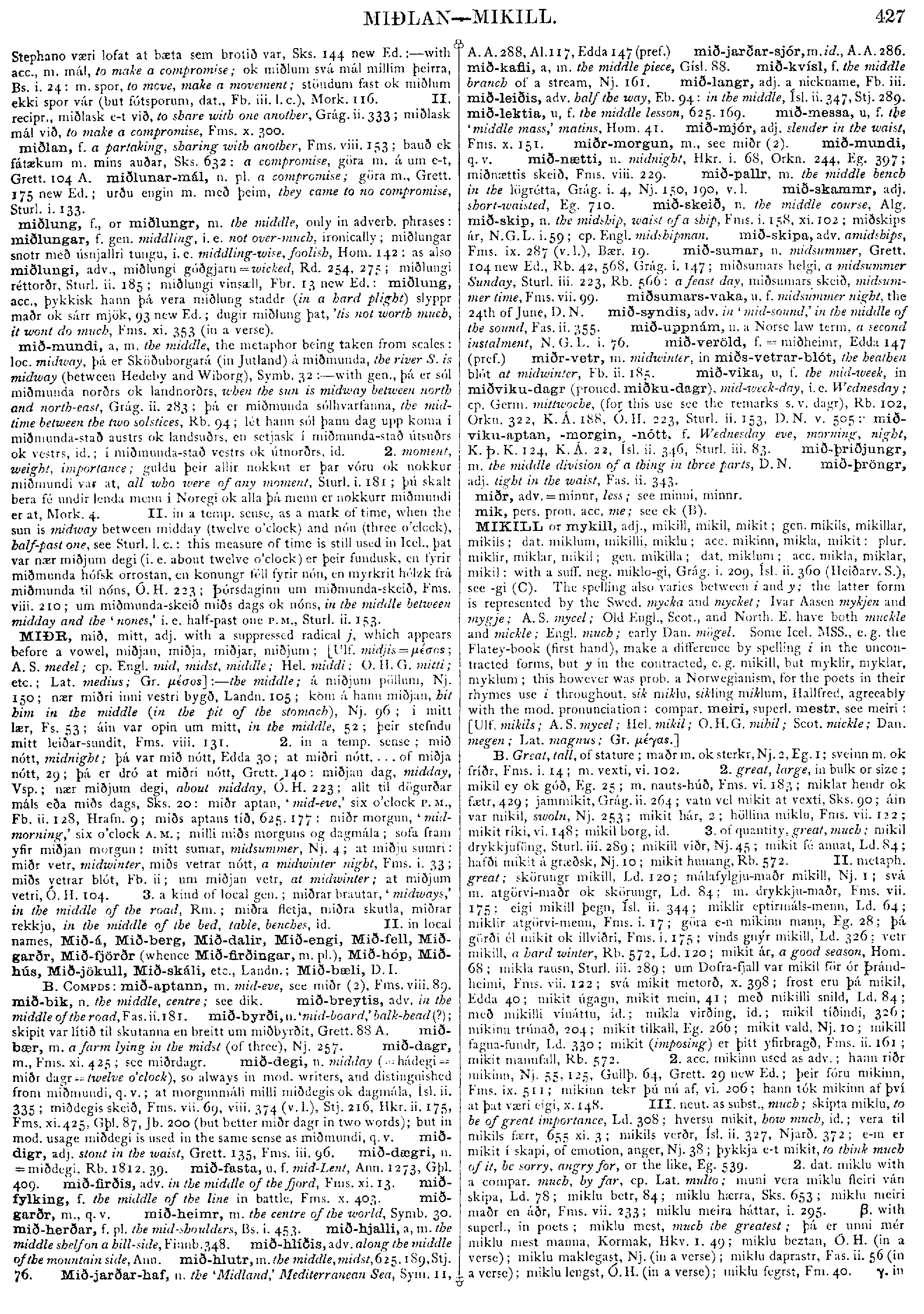
MIKILL
or
mykill,
adj.,
mikill,
mikil,
mikit;
gen.
mikils,
mikillar,
mikils;
dat.
miklum,
mikilli,
miklu;
acc.
mikinn,
mikla,
mikit:
plur.
miklir,
miklar,
mikil;
gen.
mikilla;
dat.
miklum;
acc.
mikla,
miklar,
mikil:
with
a
suff.
neg.
miklo-gi,
Grág.
i.
209,
Ísl.
ii.
360
(Heiðarv.
S.),
see
-gi
(C).
The
spelling
also
varies
between
i
and
y;
the
latter
form
is
represented
by
the
Swed.
mycka
and
mycket;
Ivar
Aasen
mykjen
and
mygje;
A.S.
mycel;
Old
Engl.,
Scot.,
and
North.
E.
have
both
muckle
and
mickle;
Engl.
much;
early
Dan.
mögel.
Some
Icel.
MSS.,
e.g.
the
Flatey-book
(first
hand),
make
a
difference
by
spelling
i
in
the
uncontractcd
forms,
but
y
in
the
contracted,
e.g.
mikill,
but
myklir,
myklar,
myklum;
this
however
was
prob.
a
Norwegianism,
for
the
poets
in
their
rhymes
use
i
throughout,
sik
miklu,
sikling
miklum,
Hallfred,
agreeably
with
the
mod.
pronunciation:
compar.
meiri,
superl.
mestr,
see
meiri:
[Ulf.
mikils;
A.S.
mycel;
Hel.
mikil;
O.H.G.
mihil;
Scot.
mickle;
Dan.
megen;
Lat.
magnus;
Gr.
GREEK.]
B.
Great,
tall,
of
stature;
maðr
m.
ok
sterkr,
Nj.
2,
Eg.
1;
sveinn
m.
ok
fríðr,
Fms.
i.
14;
m.
vexti,
vi.
102.
2.
great,
large,
in
bulk
or
size;
mikil
ey
ok
góð,
Eg.
25;
m.
nauts-húð,
Fms.
vi.
183;
miklar
hendr
ok
fætr,
429;
jammikit,
Grág.
ii.
264;
vatn
vel
mikit
at
vexti,
Sks.
90;
áin
var
mikil,
swoln,
Nj.
253;
mikit
hár,
2;
höllina
miklu,
Fms.
vii.
122;
mikit
ríki,
vi.
148;
mikil
borg,
id.
3.
of
quantity,
great,
much;
mikil
drykkjuföng,
Sturl.
iii.
289;
mikill
viðr,
Nj.
45;
mikit
fé
annat,
Ld.
84;
hafði
mikit
á
græðsk,
Nj.
10;
mikit
hunang,
Rb.
572.
II.
metaph.
great;
skörungr
mikill,
Ld.
120;
málafylgju-maðr
mikill,
Nj.
i;
svá
m.
atgörvi-maðr
ok
skörungr,
Ld.
84;
m.
drykkju-maðr,
Fms.
vii.
175:
eigi
mikill
þegn,
Ísl.
ii.
344;
miklir
eptirmáls-menn,
Ld.
64;
miklir
atgörvi-menn,
Fms.
i.
17;
göra
e-n
mikinn
mann,
Eg.
28;
þá
görði
él
mikit
ok
íllviðri,
Fms.
i.
175;
vinds
gnýr
mikill,
Ld.
326:
vetr
mikill,
a
hard
winter,
Rb.
572,
Ld.
120;
mikit
ár,
a
good
season,
Hom.
68;
mikla
rausn,
Sturl.
iii.
289;
um
Dofra-fjall
var
mikil
fór
ór
Þrándheimi,
Fms.
vii.
122;
svá
mikit
metorð,
x.
398;
frost
eru
þá
mikil,
Edda
40;
mikit
úgagn,
mikit
mein,
41;
með
mikilli
snild,
Ld.
84;
með
mikilli
vínáttu,
id.;
mikla
virðing,
id.;
mikil
tíðindi,
326;
mikinn
trúnað,
204;
mikit
tilkall,
Eg.
266;
mikit
vald,
Nj.
10;
mikill
fagna-fundr,
Ld.
330;
mikit
(imposing)
er
þitt
yfirbragð,
Fms.
ii.
161;
mikit
mannfall,
Rb.
572.
2.
acc.
mikinn
used
as
adv.;
hann
ríðr
mikinn,
Nj.
55,
125,
Gullþ.
64,
Grett.
29
new
Ed.;
þeir
fóru
mikinn.
Fms.
ix.
511;
mikinn
tekr
þú
nú
af,
vi.
206;
hann
tók
mikinn
af
því
at
þat
væri
eigi,
x.
148.
III.
neut.
as
subst.,
much;
skipta
miklu,
to
be
of
great
importance,
Ld.
308;
hversu
mikit,
how
much,
id.;
vera
til
mikils
ferr,
655
xi.
3;
mikils
verðr,
Ísl.
ii.
327,
Njarð.
372;
e-m
er
mikit
í
skapi,
of
emotion,
anger,
Nj.
38;
þykkja
e-t
mikit,
to
think
much
of
it,
be
sorry,
angry
for,
or
the
like,
Eg.
539.
2.
dat.
miklu
with
a
compar.
much,
by
far,
cp.
Lat.
multo;
muni
vera
miklu
fleiri
ván
skipa,
Ld.
78;
miklu
betr,
84;
miklu
hærra,
Sks.
653;
miklu
meiri
maðr
en
áðr,
Fms.
vii.
233;
miklu
meira
háttar,
i.
295.
 .
with
superl.,
in
poets;
miklu
mest,
much
the
greatest;
þá
er
unni
mér
miklu
mest
manna,
Kormak,
Hkv.
1.
49;
miklu
beztan,
Ó.H.
(in
a
verse);
miklu
maklegast,
Nj.
(in
a
verse);
miklu
daprastr,
Fas.
ii.
56
(in
a
verse);
miklu
lengst,
Ó.H.
(in
a
verse);
miklu
fegrst,
Fm.
40.
.
with
superl.,
in
poets;
miklu
mest,
much
the
greatest;
þá
er
unni
mér
miklu
mest
manna,
Kormak,
Hkv.
1.
49;
miklu
beztan,
Ó.H.
(in
a
verse);
miklu
maklegast,
Nj.
(in
a
verse);
miklu
daprastr,
Fas.
ii.
56
(in
a
verse);
miklu
lengst,
Ó.H.
(in
a
verse);
miklu
fegrst,
Fm.
40.
 .
in
.
in
|
Source: Cleasby/Vigfusson, page b0433, entry 9 View original page image as: [TIFF] [PNG] [View previous entry] [View next entry] |
[Comment on this entry] [View comments] |
The following entry has been hand-corrected once. |
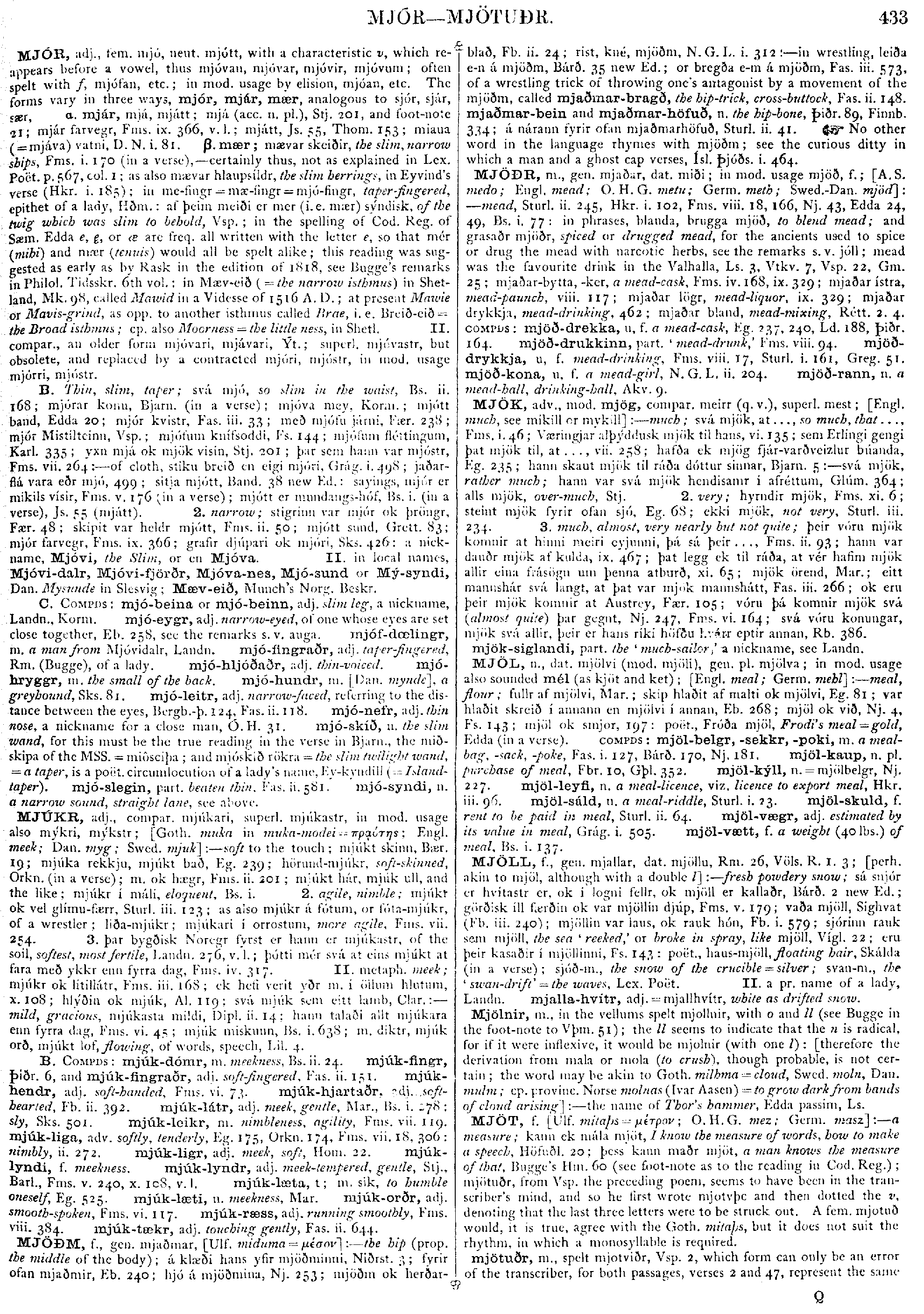
Mjölnir, m., in the vellums spelt mjollnir, with o and ll (see Bugge in the foot-note to Vþm. 51); the ll seems to indicate that the n is radical, for if it were inflexive, it would be mjolnir (with one l): [therefore the derivation from mala or mola (to crush), though probable, is not certain; the word may be akin to Goth. milhma = cloud, Swed. moln, Dan. mulm; cp. provinc. Norse molnas (Ivar Aasen) = to grow dark from bands of cloud arising] :-- the name of Thor's hammer, Edda passim, Ls.
|
Source: Cleasby/Vigfusson, page b0435, entry 19 View original page image as: [TIFF] [PNG] [View previous entry] [View next entry] |
[Comment on this entry] [View comments] |
The following entry has been hand-corrected once. |
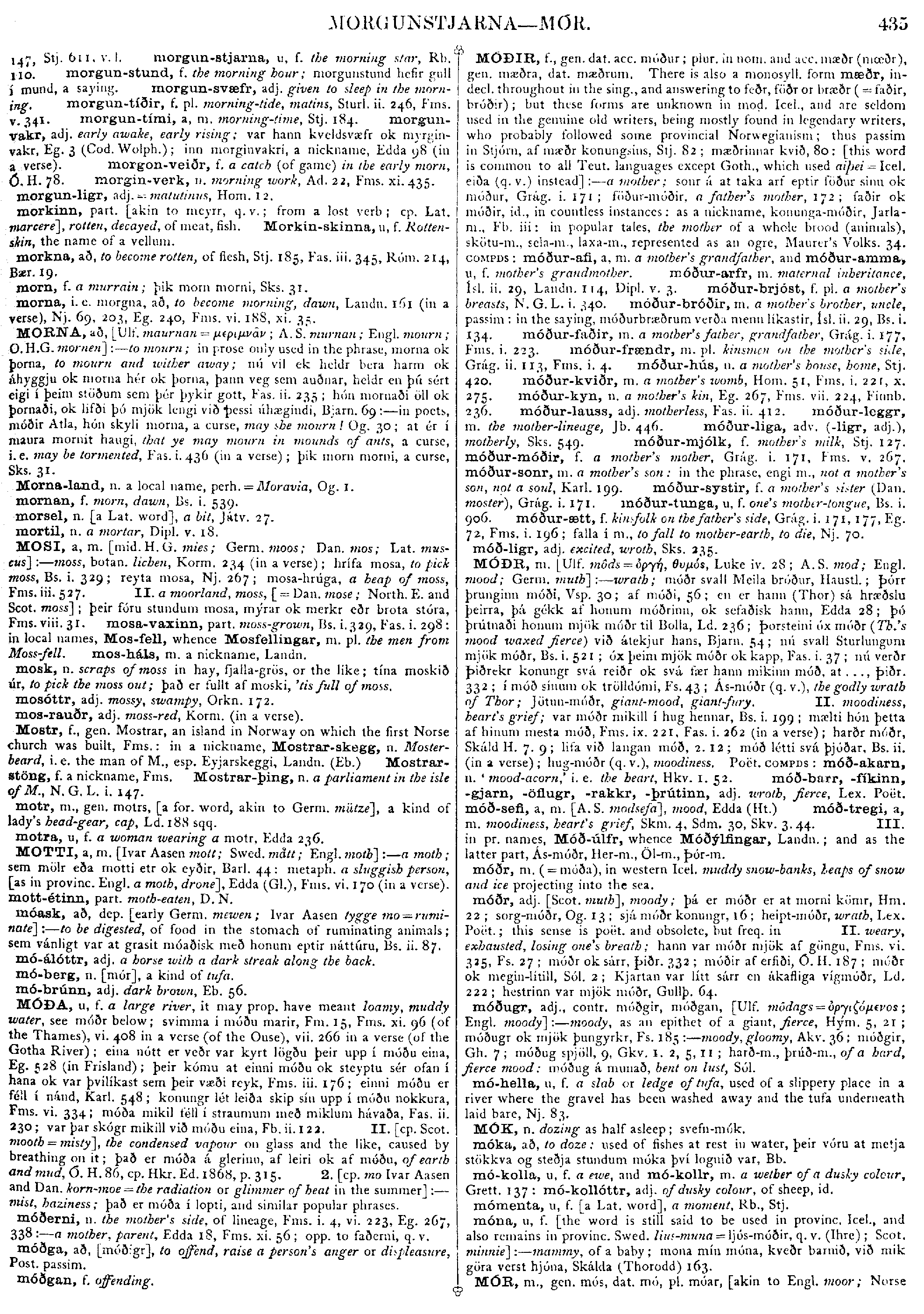
MOTTI, a, m. [Ivar Aasen mott; Swed. mått; Engl. moth] :-- a moth; sem mölr eða motti etr ok eyðir, Barl. 44: metaph. a sluggish person, [as in provinc. Engl. a moth, drone], Edda (Gl.), Fms. vi. 170 (in a verse). mott-étinn, part. moth-eaten, D.N.
|
Source: Cleasby/Vigfusson, page b0435, entry 20 View original page image as: [TIFF] [PNG] [View previous entry] [View next entry] |
[Comment on this entry] [View comments] |
The following entry has been hand-corrected once. |
móask, að, dep. [early Germ. mewen; Ivar Aasen tygge mo = ruminate] :-- to be digested, of food in the stomach of ruminating animals; sem vánligt var at grasit móaðisk með honum eptir náttúru, Bs. ii. 87.
|
Source: Cleasby/Vigfusson, page b0435, entry 24 View original page image as: [TIFF] [PNG] [View previous entry] [View next entry] |
[Comment on this entry] [View comments] |
The following entry has been hand-corrected once. |
MÓÐA, u, f. a large river, it may prop. have meant loamy, muddy water, see móðr below; svimma í móðu marir, Fm. 15, Fms. xi. 96 (of the Thames), vi. 408 in a verse (of the Ouse), vii. 266 in a verse (of the Gotha River); eina nótt er veðr var kyrt lögðu þeir upp í móðu eina, Eg. 528 (in Frisland); þeir kómu at einni móðu ok steyptu sér ofan í hana ok var þvílíkast sem þeir væði reyk, Fms. iii. 176; einni móðu er féll í nánd, Karl. 548; konungr lét leiða skip sín upp í móðu nokkura, Fms. vi. 334; móða mikil féll í straumum með miklum hávaða, Fas. ii. 230; var þar skógr mikill við móðu eina, Fb. ii. 122. II. [cp. Scot. mooth = misty], the condensed vapour on glass and the like, caused by breathing on it; það er móða á glerinn, af leiri ok af móðu, of earth and mud, Ó.H. 86, cp. Hkr. Ed. 1868, p. 315. 2. [cp. mo Ivar Aasen and Dan. korn-moe = the radiation or glimmer of heat in the summer] :-- mist, haziness; það er móða í lopti, and similar popular phrases.
|
Source: Cleasby/Vigfusson, page b0439, entry 9 View original page image as: [TIFF] [PNG] [View previous entry] [View next entry] |
[Comment on this entry] [View comments] |
The following entry has been hand-corrected once. |
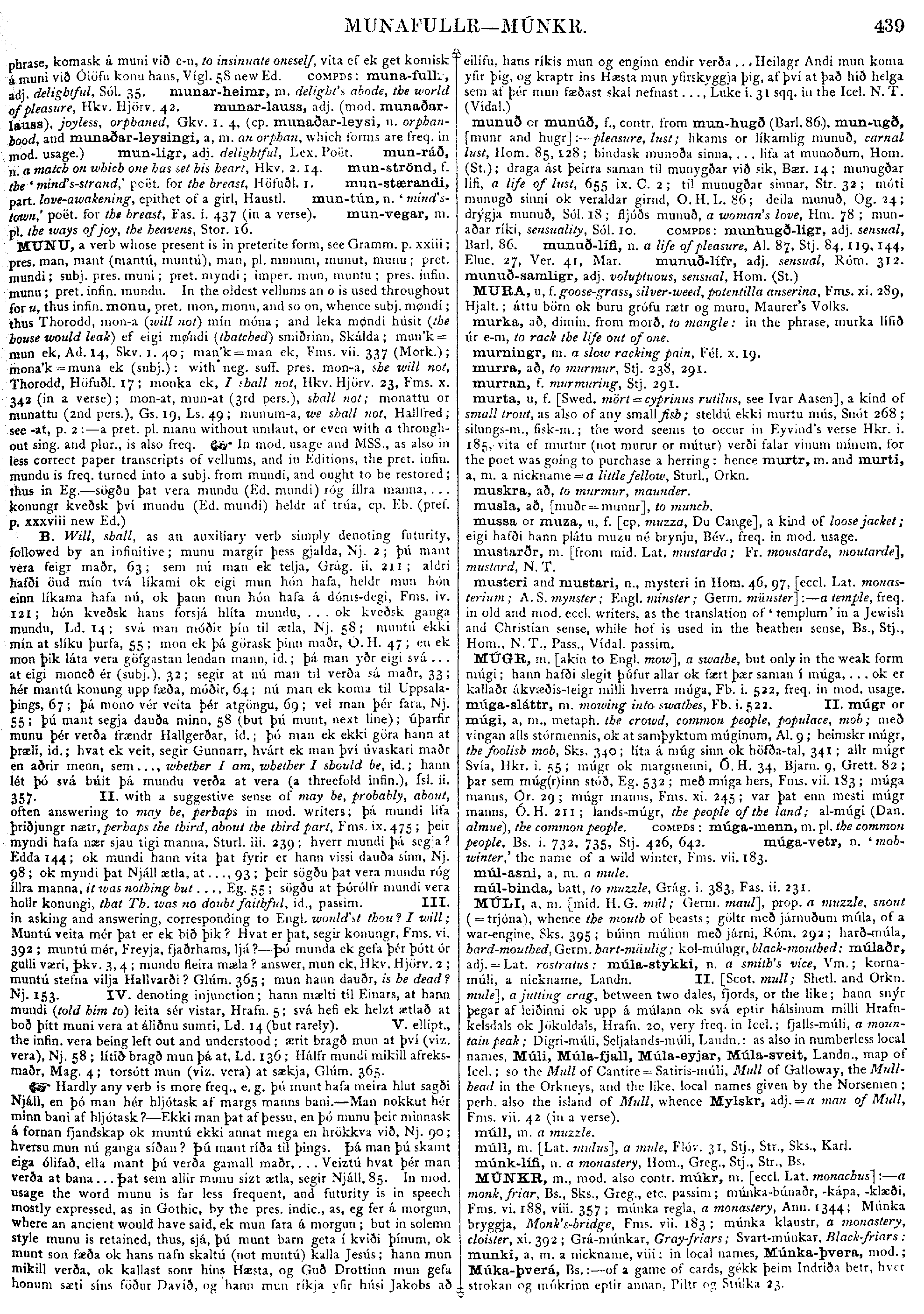
murta, u, f. [Swed. mört = cyprinus rutilus, see Ivar Aasen], a kind of small trout, as also of any small fish; steldú ekki murtu mús, Snót 268; silungs-m., fisk-m.; the word seems to occur in Eyvind's verse Hkr. i. 185, vita ef murtur (not murur or mútur) verði falar vinum mínum, for the poet was going to purchase a herring: hence murtr, m. and murti, a, m. a nickname = a little fellow, Sturl., Orkn.
|
Source: Cleasby/Vigfusson, page b0454, entry 26 View original page image as: [TIFF] [PNG] [View previous entry] [View next entry] |
[Comment on this entry] [View comments (2)] |
The following entry has been hand-corrected once. |
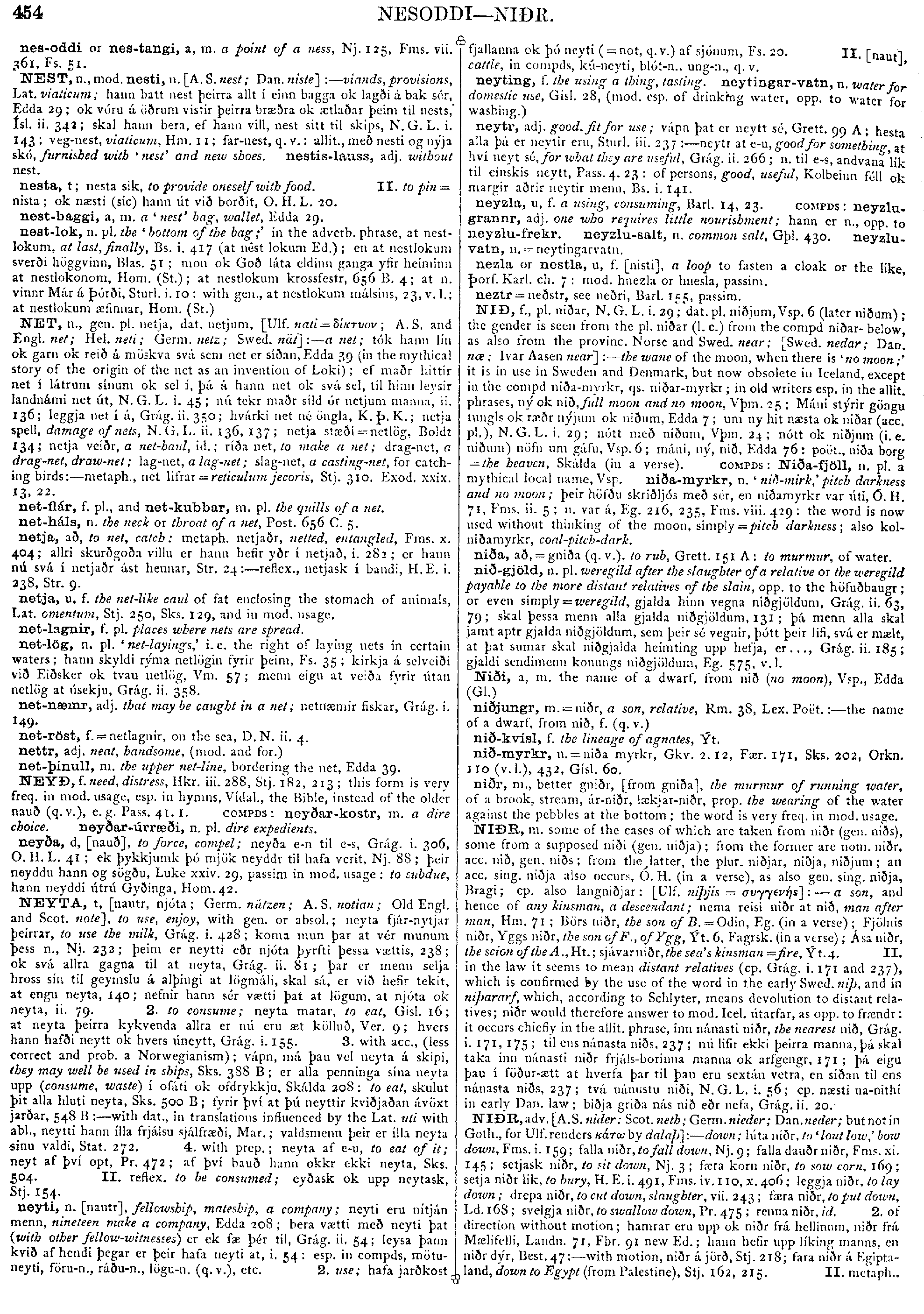
NIÐ, f., pl. niðar, N. G. L. i. 29; dat. pl. niðjum, Vsp. 6 (later niðum); the gender is seen from the pl. niðar (l. c.) from the compd niðar- below, as also from the provinc. Norse and Swed. near; [Swed. nedar; Dan. næ; Ivar Aasen near] :-- the wane of the moon, when there is 'no moon;' it is in use in Sweden and Denmark, but now obsolete in Iceland, except in the compd niða-myrkr, qs. niðar-myrkr; in old writers esp. in the allit. phrases, ný ok nið, full moon and no moon, Vþm. 25; Máni stýrir göngu tungls ok ræðr nýjum ok niðum, Edda 7; um ny hit næsta ok niðar (acc. pl.), N. G. L. i. 29; nótt með niðum, Vþm. 24; nótt ok niðjum (i. e. niðum) nöfn um gáfu, Vsp. 6; máni, ný, nið, Edda 76: poët., niða borg = the heaven, Skálda (in a verse). COMPDS: Nlða-fjöll, n. pl. a mythical local name, Vsp. niða-myrkr, n. ' nið-mirk,' pitch darkness and no moon; þeir höfðu skriðljós með sér, en niðamyrkr var úti, Ó. H. 71, Fms. ii. 5; n. var á, Eg. 216, 235, Fms. viii. 429: the word is now used without thinking of the moon, simply = pitch darkness; also kol-niðamyrkr, coal-pitch-dark.
|
Source: Cleasby/Vigfusson, page b0459, entry 5 View original page image as: [TIFF] [PNG] [View previous entry] [View next entry] |
[Comment on this entry] [View comments] |
The following entry has been hand-corrected once. |
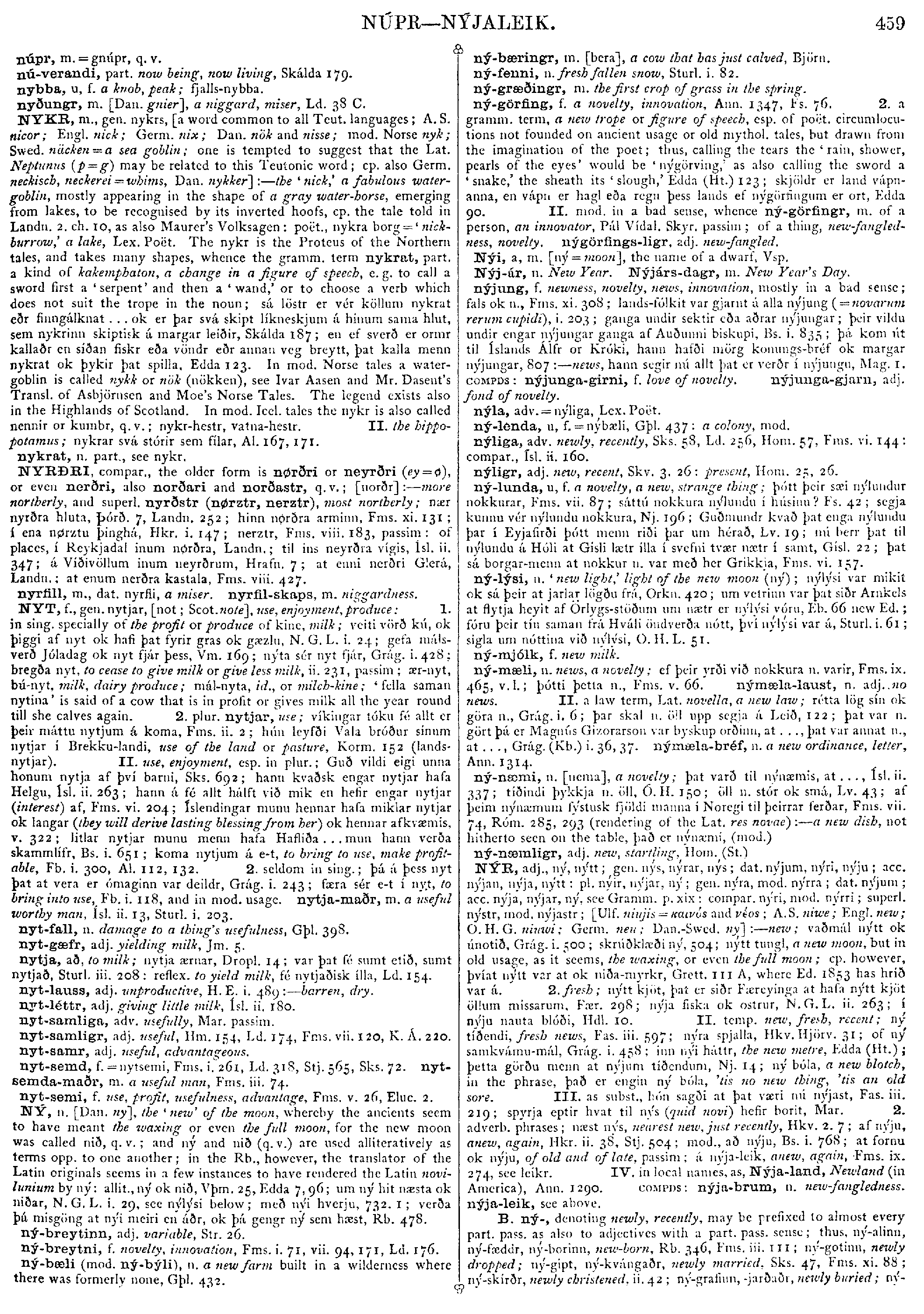
NYKR, m., gen. nykrs, [a word common to all Teut. languages; A. S. nicor; Engl. nick; Germ. nix; Dan. nök and nisse; mod. Norse nyk; Swed. näcken = a sea goblin; one is tempted to suggest that the Lat. Neptunus (p = g) may be related to this Teutonic word; cp. also Germ. neckisch, neckerei = whims, Dan. nykker] :-- the 'nick,' a fabulous water-goblin, mostly appearing in the shape of a gray water-horse, emerging from lakes, to be recognised by its inverted hoofs, cp. the tale told in Landn. 2. ch. 10, as also Maurer's Volksagen: poët., nykra borg = 'nick-burrow,' a lake, Lex. Poët. The nykr is the Proteus of the Northern tales, and takes many shapes, whence the gramm. term nykrat, part. a kind of kakemphaton, a change in a figure of speech, e. g. to call a sword first a 'serpent' and then a 'wand,' or to choose a verb which does not suit the trope in the noun; sá löstr er vér köllum nykrat eðr finngálknat . . . ok er þar svá skipt líkneskjum á hinum sama hlut, sem nykrinn skiptisk á margar leiðir, Skálda 187; en ef sverð er ormr kallaðr en síðan fiskr eða vöndr eðr annan veg breytt, þat kalla menn nykrat ok þykir þat spilla, Edda 123. In mod. Norse tales a water-goblin is called nykk or nök (nökken), see Ivar Aasen and Mr. Dasent's Transl. of Asbjörnsen and Moe's Norse Tales. The legend exists also in the Highlands of Scotland. In mod. Icel. tales the nykr is also called nennir or kumbr, q. v.; nykr-hestr, vatna-hestr. II. the hippopotamus; nykrar svá stórir sem fílar, Al. 167, 171.
|
Source: Cleasby/Vigfusson, page b0469, entry 21 View original page image as: [TIFF] [PNG] [View previous entry] [View next entry] |
[Comment on this entry] [View comments] |
The following entry has been hand-corrected once. |
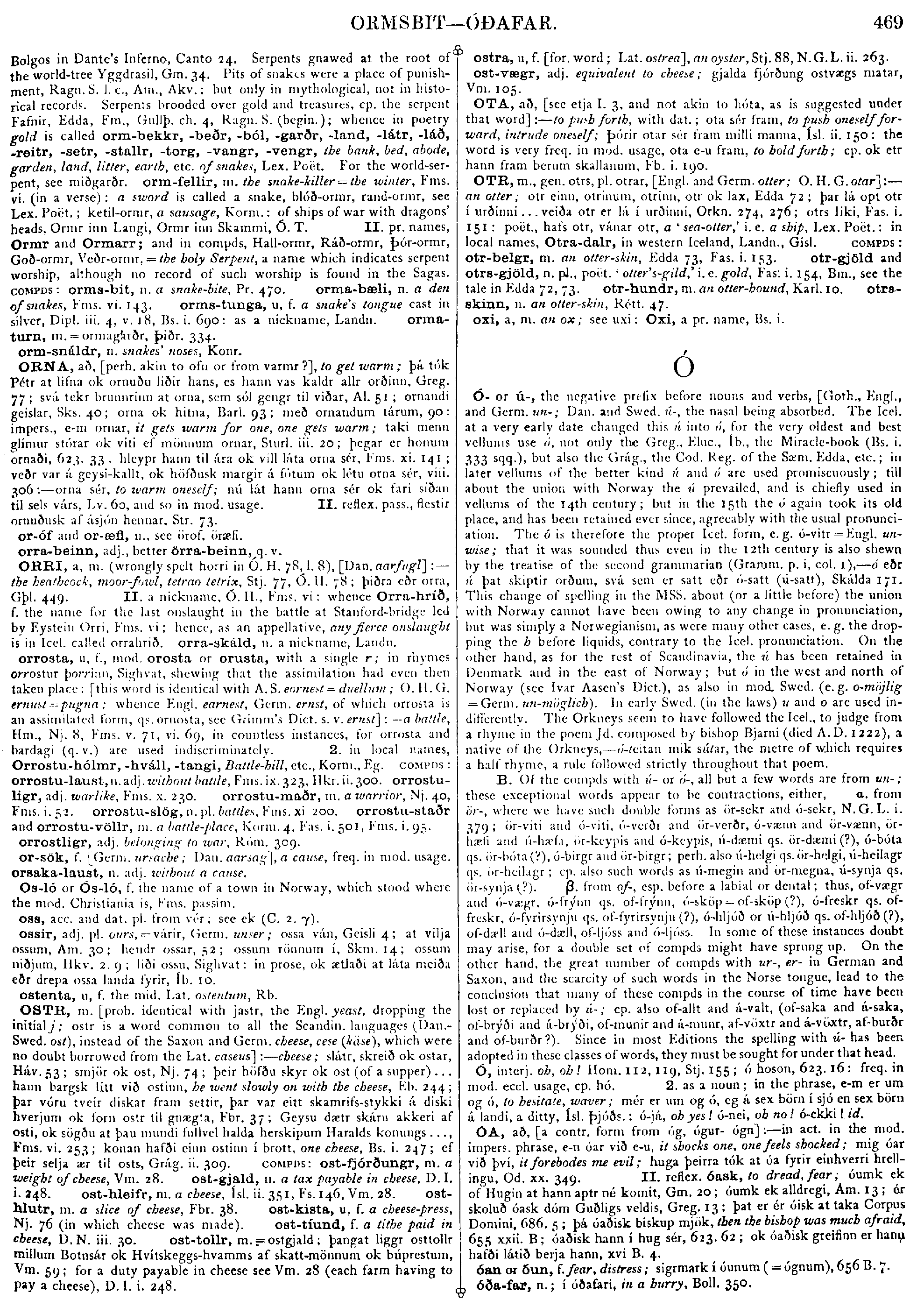
Ó-
or
ú-,
the
negative
prefix
before
nouns
and
verbs,
[Goth.,
Engl.,
and
Germ.
un-;
Dan.
and
Swed.
û-,
the
nasal
being
absorbed.
The
Icel.
at
a
very
early
date
changed
this
ú
into
ó,
for
the
very
oldest
and
best
vellums
use
ó,
not
only
the
Greg.,
Eluc.,
Íb.,
the
Miracle-book
(Bs.
i.
333
sqq.),
but
also
the
Grág.,
the
Cod.
Reg.
of
the
Sæm.
Edda,
etc.;
in
later
vellums
of
the
better
kind
ú
and
ó
are
used
promiscuously;
till
about
the
union
with
Norway
the
ú
prevailed,
and
is
chiefly
used
in
vellums
of
the
14th
century;
but
in
the
15th
the
ó
again
took
its
old
place,
and
has
been
retained
ever
since,
agreeably
with
the
usual
pronunciation.
The
ó
is
therefore
the
proper
Icel.
form,
e.g.
ó-vitr
=
Engl.
un-wise;
that
it
was
sounded
thus
even
in
the
12th
century
is
also
shewn
by
the
treatise
of
the
second
grammarian
(Gramm.
p.
i,
col.
1),
--
ó
eðr
ú
þat
skiptir
orðum,
svá
sem
er
satt
eðr
ó-satt
(ú-satt),
Skálda
171.
This
change
of
spelling
in
the
MSS.
about
(or
a
little
before)
the
union
with
Norway
cannot
have
been
owing
to
any
change
in
pronunciation,
but
was
simply
a
Norwegianism,
as
were
many
other
cases,
e.g.
the
dropping
the
h
before
liquids,
contrary
to
the
Icel.
pronunciation.
On
the
other
hand,
as
for
the
rest
of
Scandinavia,
the
ú
has
been
retained
in
Denmark
and
in
the
east
of
Norway;
but
ó
in
the
west
and
north
of
Norway
(see
Ivar
Aasen's
Dict.),
as
also
in
mod,
Swed.
(e.g.
o-möjlig
=
Germ.
un-möglich).
In
early
Swed.
(in
the
laws)
u
and
o
are
used
indifferently.
The
Orkneys
seem
to
have
followed
the
Icel.,
to
judge
from
a
rhyme
in
the
poem
Jd.
composed
by
bishop
Bjarni
(died
A.D.
1222),
a
native
of
the
Orkneys,
--
ó-teitan
mik
sútar,
the
metre
of
which
requires
a
half
rhyme,
a
rule
followed
strictly
throughout
that
poem.
B.
Of
the
compds
with
ú-
or
ó-,
all
but
a
few
words
are
from
un-;
these
exceptional
words
appear
to
be
contractions,
either,
 .
from
ör-,
where
we
have
such
double
forms
as
ör-sekr
and
ó-sekr,
N.G.L.
i.
379;
ör-viti
and
ó-viti,
ó-verðr
and
ör-verðr,
ó-vænn
and
ör-vænn,
ör-hæfi
and
ú-hæfa,
ör-keypis
and
ó-keypis,
ú-dæmi
qs.
ör-dæmi(?),
ó-bóta
qs.
ör-bóta(?),
ó-birgr
and
ör-birgr;
perh.
also
ú-helgi
qs.
ör-helgi,
ú-heilagr
qs.
ör-heilagr;
cp.
also
such
words
as
ú-megin
and
ör-megna,
ú-synja
qs.
ör-synja(?).
.
from
of-,
esp.
before
a
labial
or
dental;
thus,
of-vægr
and
ó-vægr,
ó-frýnn
qs.
of-frýnn,
ó-skö;p
=
of-sköp(?),
ó-freskr
qs.
of-freskr,
ó-fyrirsynju
qs.
of-fyrirsynju(?),
ó-hljóð
or
ú-hljóð
qs.
of-hljóð(?),
of-dæll
and
ó-dæll,
of-ljóss
and
ó-ljóss.
In
some
of
these
instances
doubt
may
arise,
for
a
double
set
of
compds
might
have
sprung
up.
On
the
other
hand,
the
great
number
of
compds
with
ur-,
er-
in
German
and
Saxon,
and
the
scarcity
of
such
words
in
the
Norse
tongue,
lead
to
the
conclusion
that
many
of
these
compds
in
the
course
of
time
have
been
lost
or
replaced
by
ú-;
cp.
also
of-allt
and
á-valt,
(of-saka
and
á-saka,
of-brýði
and
á-brýði,
of-munir
and
á-munr,
af-vöxtr
and
á-vöxtr,
af-burðr
and
of-burðr?).
Since
in
most
Editions
the
spelling
with
ú-
has
been
adopted
in
these
classes
of
words,
they
must
be
sought
for
under
that
head.
.
from
ör-,
where
we
have
such
double
forms
as
ör-sekr
and
ó-sekr,
N.G.L.
i.
379;
ör-viti
and
ó-viti,
ó-verðr
and
ör-verðr,
ó-vænn
and
ör-vænn,
ör-hæfi
and
ú-hæfa,
ör-keypis
and
ó-keypis,
ú-dæmi
qs.
ör-dæmi(?),
ó-bóta
qs.
ör-bóta(?),
ó-birgr
and
ör-birgr;
perh.
also
ú-helgi
qs.
ör-helgi,
ú-heilagr
qs.
ör-heilagr;
cp.
also
such
words
as
ú-megin
and
ör-megna,
ú-synja
qs.
ör-synja(?).
.
from
of-,
esp.
before
a
labial
or
dental;
thus,
of-vægr
and
ó-vægr,
ó-frýnn
qs.
of-frýnn,
ó-skö;p
=
of-sköp(?),
ó-freskr
qs.
of-freskr,
ó-fyrirsynju
qs.
of-fyrirsynju(?),
ó-hljóð
or
ú-hljóð
qs.
of-hljóð(?),
of-dæll
and
ó-dæll,
of-ljóss
and
ó-ljóss.
In
some
of
these
instances
doubt
may
arise,
for
a
double
set
of
compds
might
have
sprung
up.
On
the
other
hand,
the
great
number
of
compds
with
ur-,
er-
in
German
and
Saxon,
and
the
scarcity
of
such
words
in
the
Norse
tongue,
lead
to
the
conclusion
that
many
of
these
compds
in
the
course
of
time
have
been
lost
or
replaced
by
ú-;
cp.
also
of-allt
and
á-valt,
(of-saka
and
á-saka,
of-brýði
and
á-brýði,
of-munir
and
á-munr,
af-vöxtr
and
á-vöxtr,
af-burðr
and
of-burðr?).
Since
in
most
Editions
the
spelling
with
ú-
has
been
adopted
in
these
classes
of
words,
they
must
be
sought
for
under
that
head.
| Result Page: |  |
Previous | 9 10 11 12 13 14 15 16 17 18 19 20 21 22 23 24 25 26 | Next |  |
Germanic Lexicon Project (main page)
This search system was written by
Sean Crist
Please consider
volunteering
to correct the data in these online dictionaries.
No rights reserved. Feel free to use these data in any way you please.