|
|

Search for Ira again, using less strict matching (82 results)
|
Source: Bosworth/Toller, page d0437, entry 5 View original page image as: [TIFF] [PNG] [View previous entry] [View next entry] |
[Comment on this entry] [View comments] |
The following entry has been hand-corrected once. |
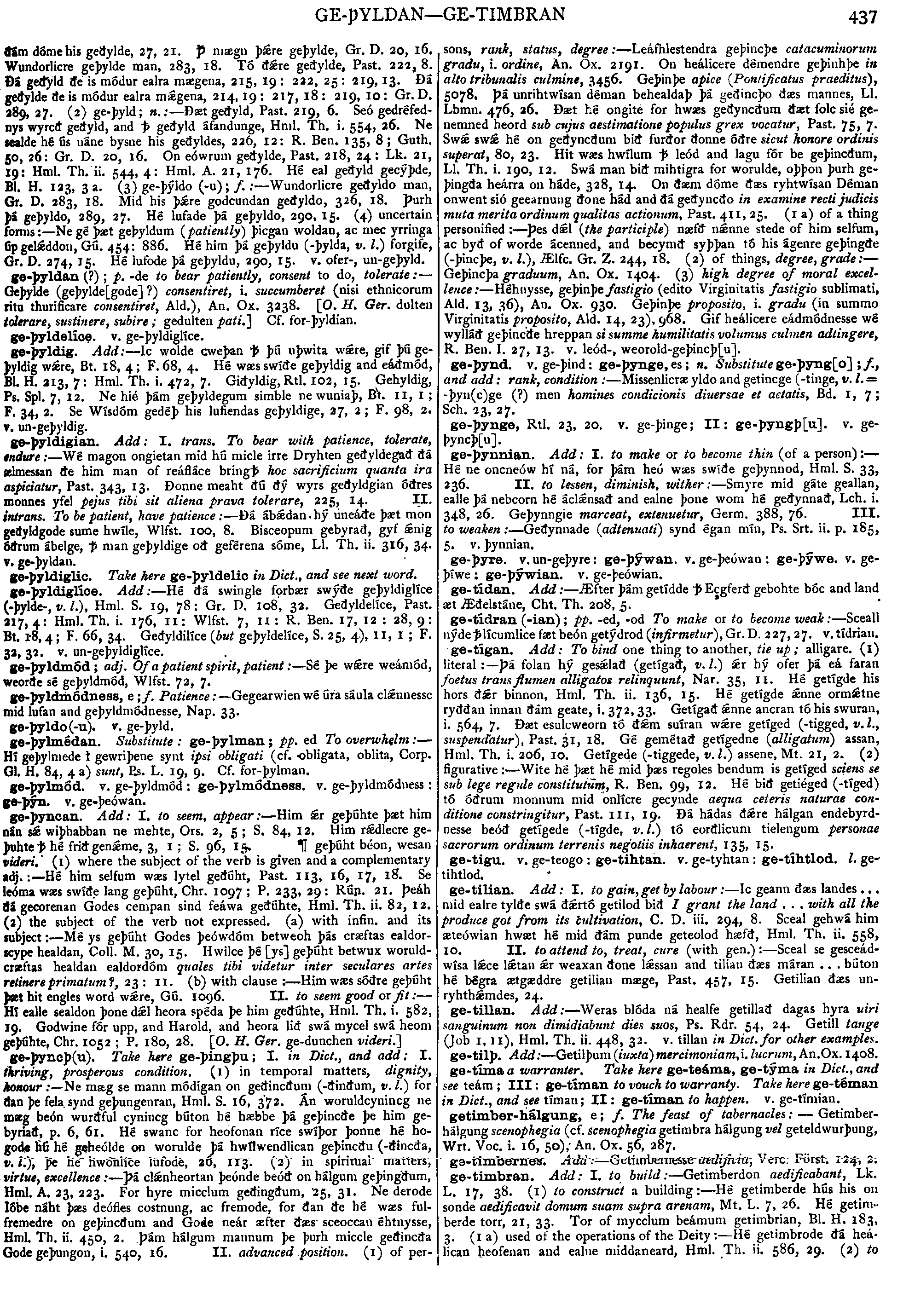
ge-þyldigian.
Add:
I.
trans.
To
bear
with
patience,
tolerate,
endure
:--
Wé
magon
ongietan
mid
hú
micle
irre
Dryhten
geðyldegað
ðá
ælmessan
ðe
him
man
of
reáfláce
bringþ
hoc
sacrificium
quanta
ira
aspiciatur,
Past.
343,
13.
Ðonne
meaht
ðú
ðý
wyrs
geðyldgian
óðres
monnes
yfel
pejus
tibi
sit
aliena
prava
tolerare,
225,
14.
II.
intrans.
To
be
patient,
have
patience
:--
Ðá
áb dan
hý
uneáðe
þæt
mon
geðyldgode
sume
hwíle,
Wlfst.
100,
8.
Bisceopum
gebyrað,
gyf
nig
óðrum
ábelge,
dan
hý
uneáðe
þæt
mon
geðyldgode
sume
hwíle,
Wlfst.
100,
8.
Bisceopum
gebyrað,
gyf
nig
óðrum
ábelge,
 man
geþyldige
oð
geférena
sóme,
Ll.
Th.
ii.
316,
34.
v.
ge-þyldan.
man
geþyldige
oð
geférena
sóme,
Ll.
Th.
ii.
316,
34.
v.
ge-þyldan.
|
Source: Bosworth/Toller, page d0485, entry 9 View original page image as: [TIFF] [PNG] [View previous entry] [View next entry] |
[Comment on this entry] [View comments] |
The following entry has been hand-corrected once. |
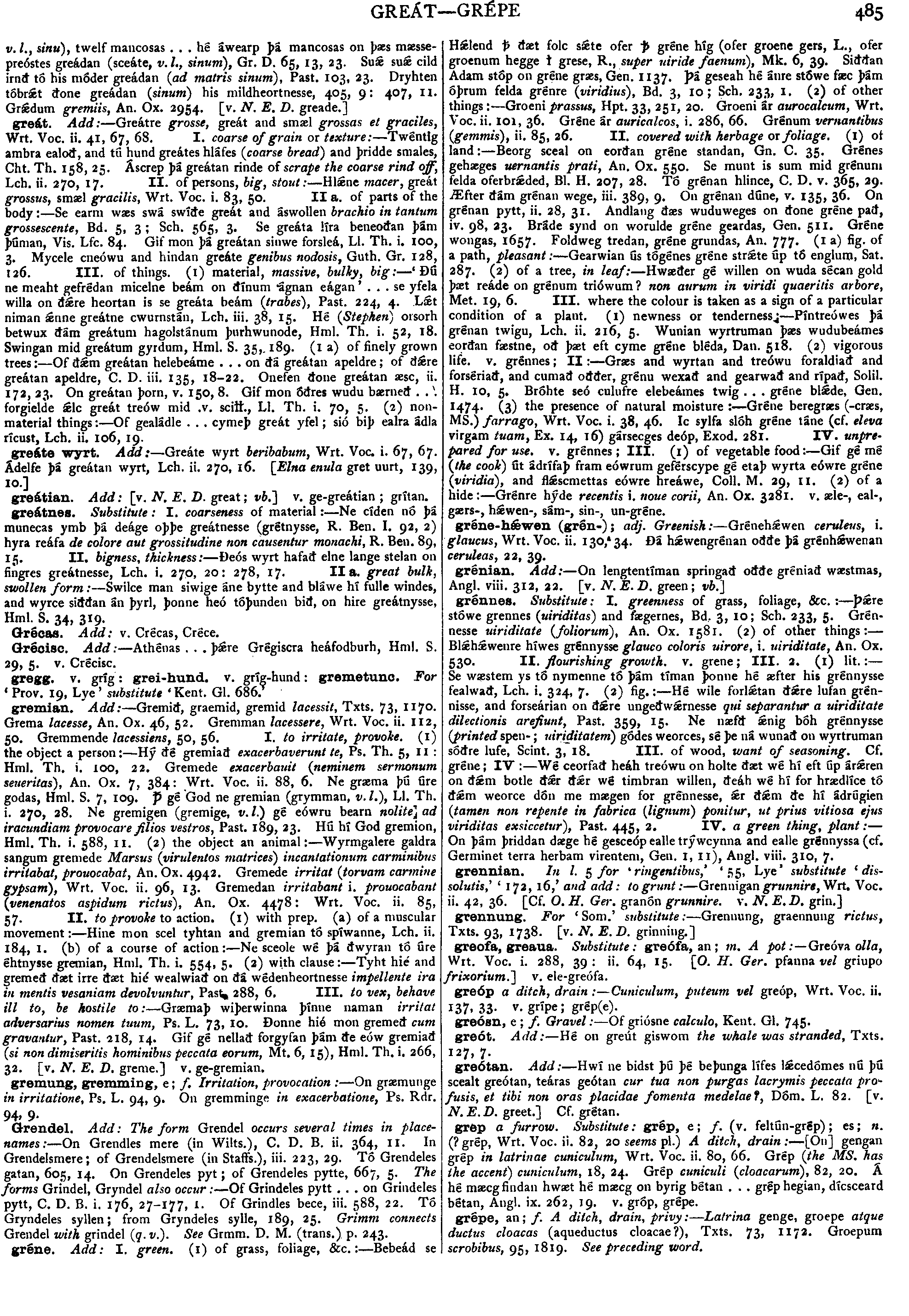
gremian. Add :-- Gremið, graemid, gremid lacessit, Txts. 73, 1170. Grema lacesse, An. Ox. 46, 52. Gremman lacessere, Wrt. Voc. ii. 112, 50. Gremmende lacessiens, 50, 56. I. to irritate, provoke. (1) the object a person :-- Hý ðé gremiað exacerbaverunt te, Ps. Th. 5, 11: Hml. Th. i. 100, 22. Gremede exacerbauit (neminem sermonum seueritas), An. Ox. 7, 384: Wrt. Voc. ii. 88, 6. Ne græma þú úre godas, Hml. S. 7, 109. Þ-bar; gé God ne gremian (grymman, v. l.), Ll. Th. i. 270, 28. Ne gremigen (gremige, v. l.) gé eówru bearn nolite ad iracundiam provocare filios vestros, Past. 189, 23. Hú hí God gremion, Hml. Th. i. 588, 11. (2) the object an animal :-- Wyrmgalere galdra sangum gremede Marsus (virulentos matrices) incantationum carminibus irritabat, prouocabat, An. Ox. 4942. Gremede irritat (torvam carmine gypsam), Wrt. Voc. ii. 96, 13. Gremedan irritabant i. prouocabant (venenatos aspidum rictus), An. Ox. 4478: Wrt. Voc. ii. 85, 57. II. to provoke to action. (1) with prep, (a) of a muscular movement :-- Hine mon scel tyhtan and gremian tó spíwanne, Lch. ii. 184, 1. (b) of a course of action :-- Ne sceole wé þá ðwyran tó úre éhtnysse gremian, Hml. Th. i. 554, 5. (2) with clause :-- Tyht hié and gremeð ðæt irre ðæt hié wealwiað on ðá wédenheortnesse impellente ira in mentis vesaniam devolvuntur, Past. 288, 6. III. to vex, behave ill to, be hostile to :-- Græmaþ wiþerwinna þínne naman irritat adversarius nomen tuum, Ps. L. 73, 10. Ðonne hié mon gremeð cum gravantur, Past. 218, 14. Gif gé nellað forgyfan þám ðe eów gremiað (si non dimiseritis hominibus peccata eorum, Mt. 6, 15), Hml. Th. i. 266, 32. [v. N. E. D. greme.] v. ge-gremian.
|
Source: Bosworth/Toller, page d0562, entry 3 View original page image as: [TIFF] [PNG] [View previous entry] [View next entry] |
[Comment on this entry] [View comments] |
The following entry has been hand-corrected once. |
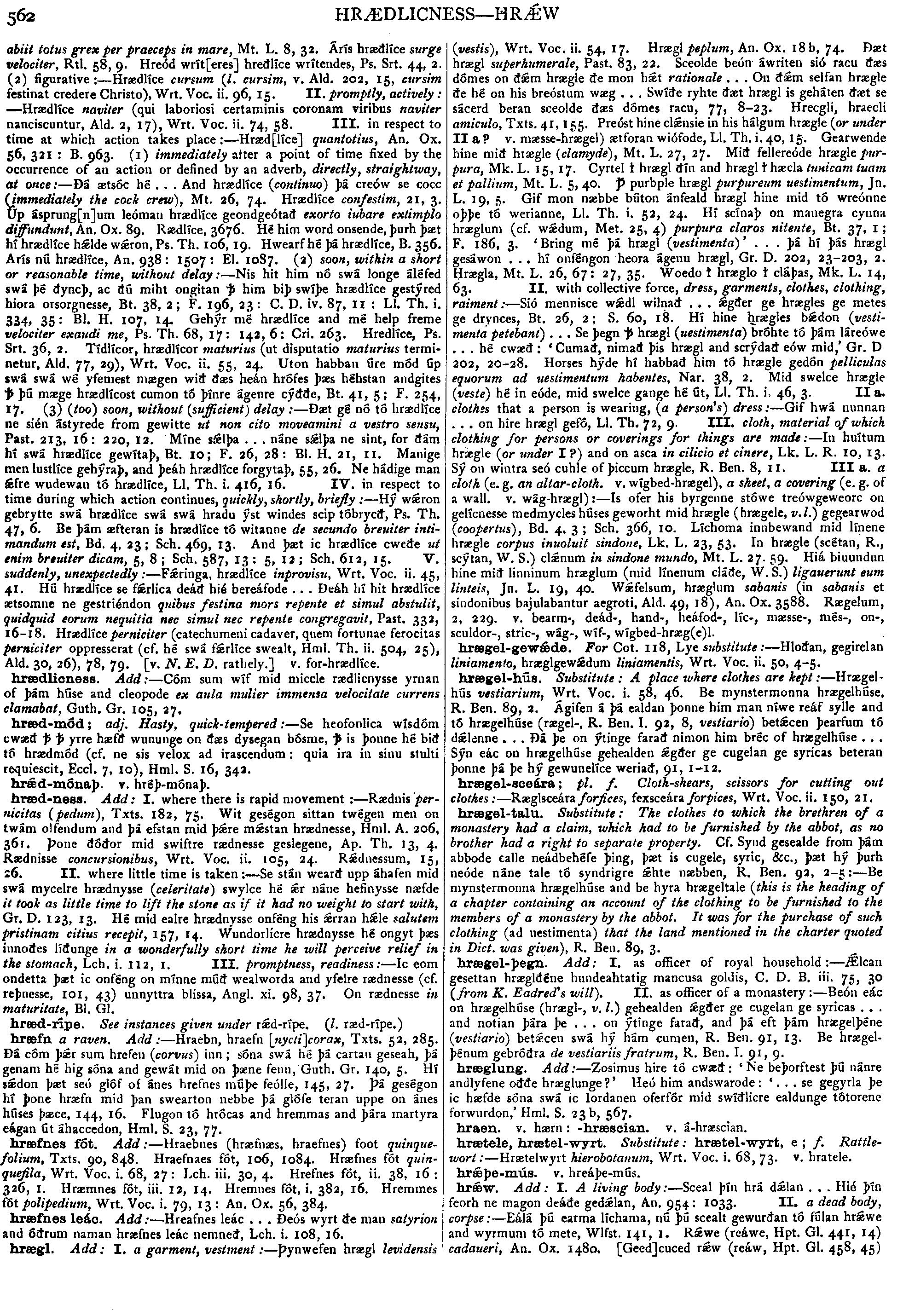
hræd-mód;
adj.
Hasty,
quick-tempered:--Se
heofonlica
wísdóm
cwæð
yrre
hæfð
wununge
on
ðæs
dysegan
bósme,
is
þonne
hé
bið
tó
hrædmód
(cf.
ne
sis
velox
ad
irascendum:
quia
ira
in
sinu
stulti
requiescit,
Eccl.
7,
10),
Hml.
S.
16,
342.
|
Source: Bosworth/Toller, page d0597, entry 2 View original page image as: [TIFF] [PNG] [View previous entry] [View next entry] |
[Comment on this entry] [View comments] |
The following entry has been hand-corrected once. |
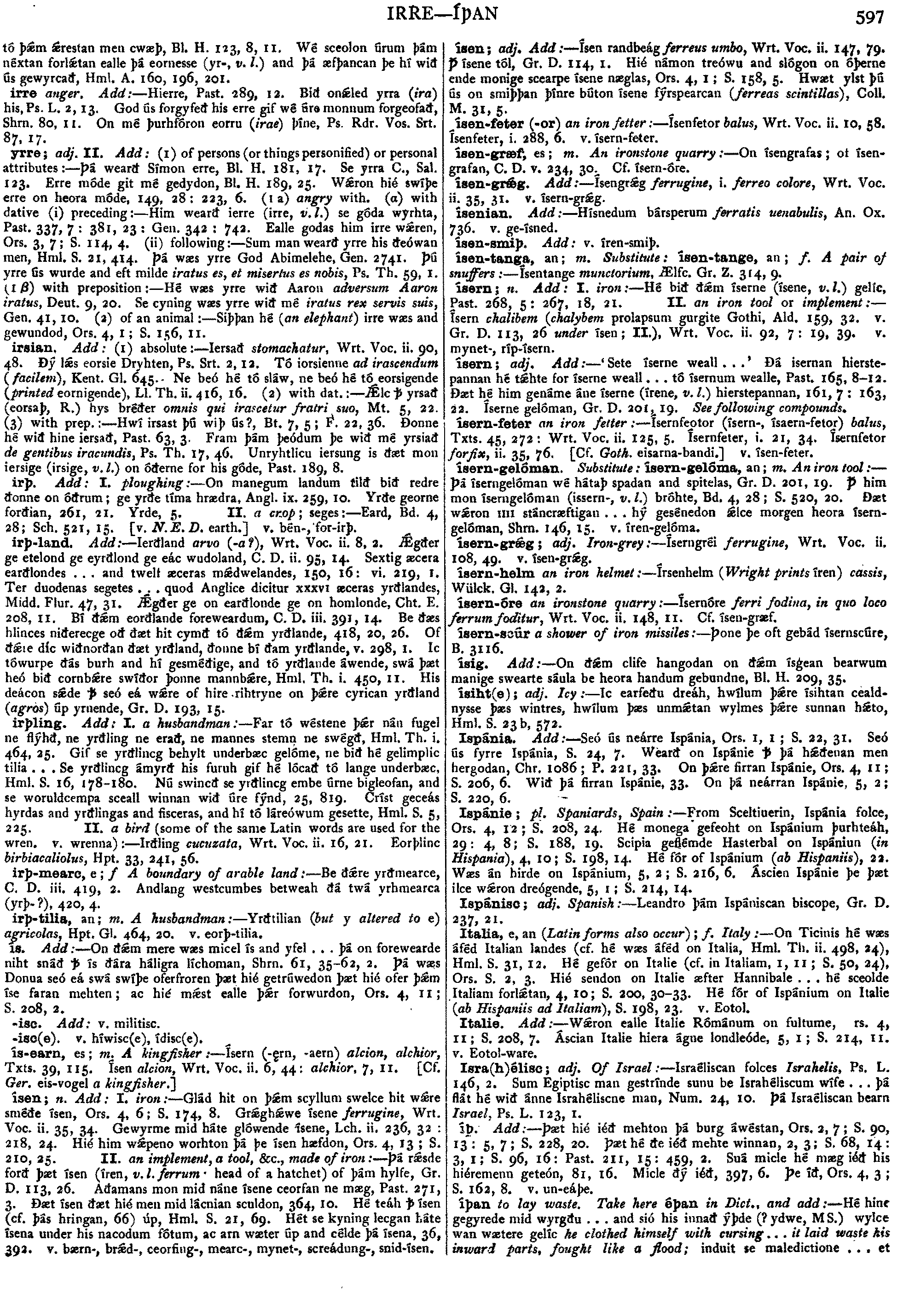
irre
anger.
Add
:--
Hierre,
Past.
289,
12.
Bið
onled
yrra
(ira)
his.
Ps.
L.
2,
13.
God
ús
forgyfeð
his
erre
gif
wé
úre
UNCERTAIN
monnum
forgeofað,
Shrn.
80,
ii.
On
mé
þurhfóron
eorru
(irae)
þíne.
Ps.
Rdr.
Vos.
Srt.
87,
17.
|
Source: Bosworth/Toller, page d0663, entry 10 View original page image as: [TIFF] [PNG] [View previous entry] [View next entry] |
[Comment on this entry] [View comments (1)] |
The following entry has been hand-corrected once. |
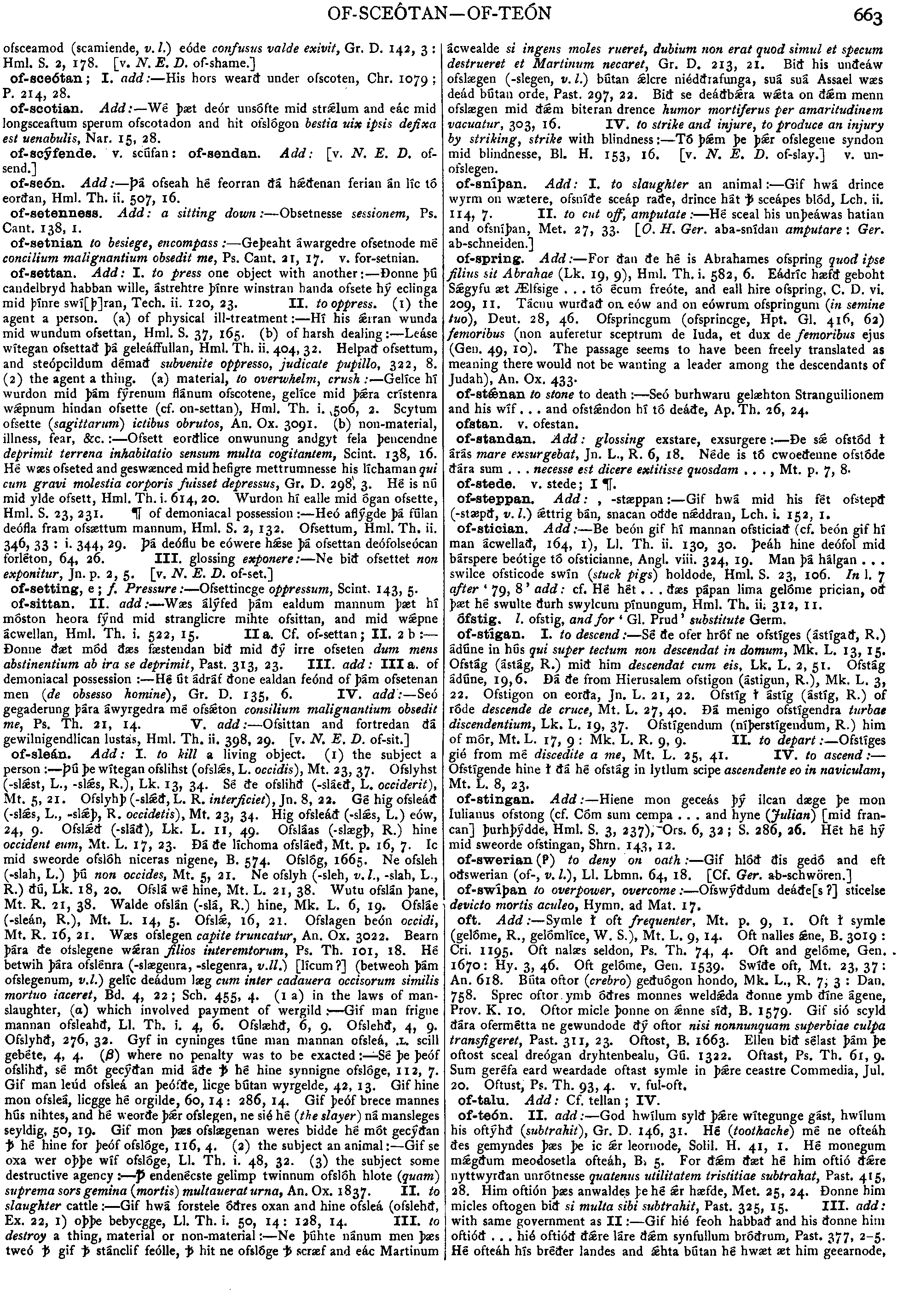
of-sittan.
II.
add
:--
Wæs
álýfed
þám
ealdum
mannum
þæt
hí
móston
heora
fýnd
mid
stranglicre
mihte
ofsittan,
and
mid
wpne
ácwellan,
Hml.
Th.
i.
522,
15.
II
a.
Cf.
of-settan;
II.
2
b
:--
Ðonne
ðæt
mód
dæs
fæstendan
bið
mid
ðý
irre
ofseten
dum
mens
abstinentium
ab
ira
se
deprimit,
Past.
313,
23.
III.
add:
III
a.
of
demoniacal
possession
:--
Hé
út
ádráf
ðone
ealdan
feónd
of
þám
ofsetenan
men
(de
obsesso
homine),
Gr.
D.
135,
6.
IV.
add
:--
Seó
gegaderung
þára
áwyrgedra
mé
ofston
consilium
malignantium
obsedit
me,
Ps.
Th.
21,
14.
V.
add:--
Ofsittan
and
fortredan
ðá
gewilnigendlican
lustas,
Hml.
Th.
ii.
398,
29.
[v.
N.
E.
D.
of-sit.]
|
Source: Bosworth/Toller, page d0730, entry 20 View original page image as: [TIFF] [PNG] [View previous entry] [View next entry] |
[Comment on this entry] [View comments] |
The following entry has been hand-corrected once. |
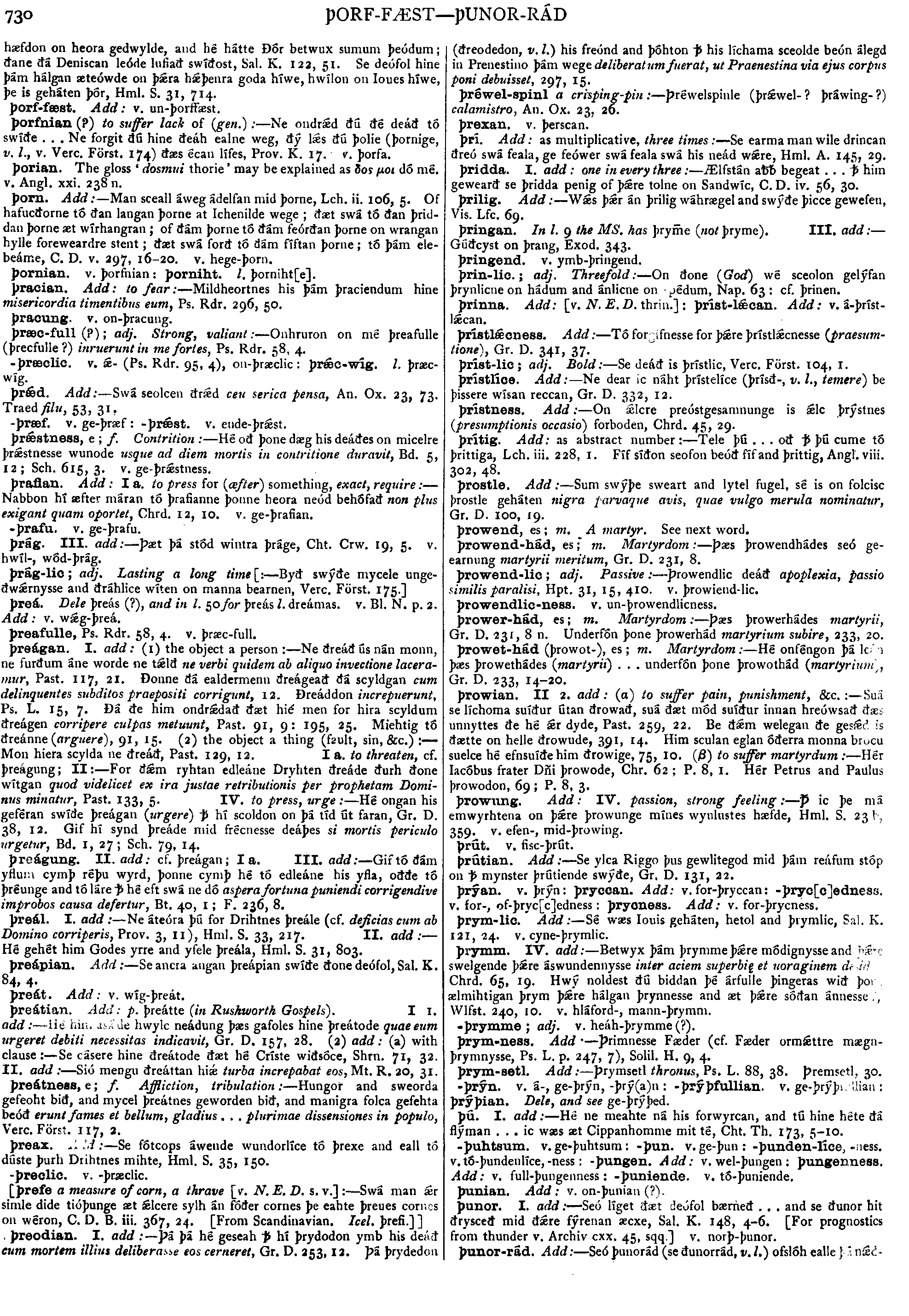
þreágan.
I.
add:
(i)
the
object
a
person
:--
Ne
ðreáð
ús
nán
monn,
ne
furðum
áne
worde
ne
tlð
ne
verbi
quidem
ab
aliquo
invectione
laceramiur,
Past.
117,
21.
Ðonne
ðá
ealdermenn
ðreágeað
ðá
scyldgan
cum
delinquentes
subditos
praepositi
corrigtint,
12.
Ðreáddon
increpuerunt,
Ps.
L.
15,
7.
Ðá
ðe
him
ondrdað
ðæt
hié
men
for
hira
scyldum
ðreágen
corripere
culpas
metuunt,
Past.
91,
9:
195,
25.
Miehtig
tó
ðreánne
(arguere),
91,
15.
(2)
the
object
a
thing
(fault,
sin,
&c.
)
:--
Mon
hiera
scylda
ne
ðreáð,
Past.
129,
12.
la.
to
threaten,
cf.
þreágung;
II
:--
For
ðæm
ryhtan
edleáne
Dryhten
ðreáde
ðurh
ðone
wítgan
quod
videlicet
ex
ira
justae
retributionis
per
prophetam
Dominus
minatur,
Past.
133,
5.
IV.
to
press,
urge
:--
Hé
ongan
his
geféran
swíðe
þreágan
(urgere)
hí
scoldon
on
þá
tíd
út
faran,
Gr.
D.
38,
12.
Gif
hí
synd
þreáde
mid
frécnesse
deáþes
si
mortis
periculo
urgetur,
Bd.
l,
27;
Sch.
79,
14.
|
Source: Cleasby/Vigfusson, page b0408, entry 7 View original page image as: [TIFF] [PNG] [View previous entry] [View next entry] |
[Comment on this entry] [View comments] |
The following entry has not been hand-corrected. However, the page is reserved and someone is correcting it. |
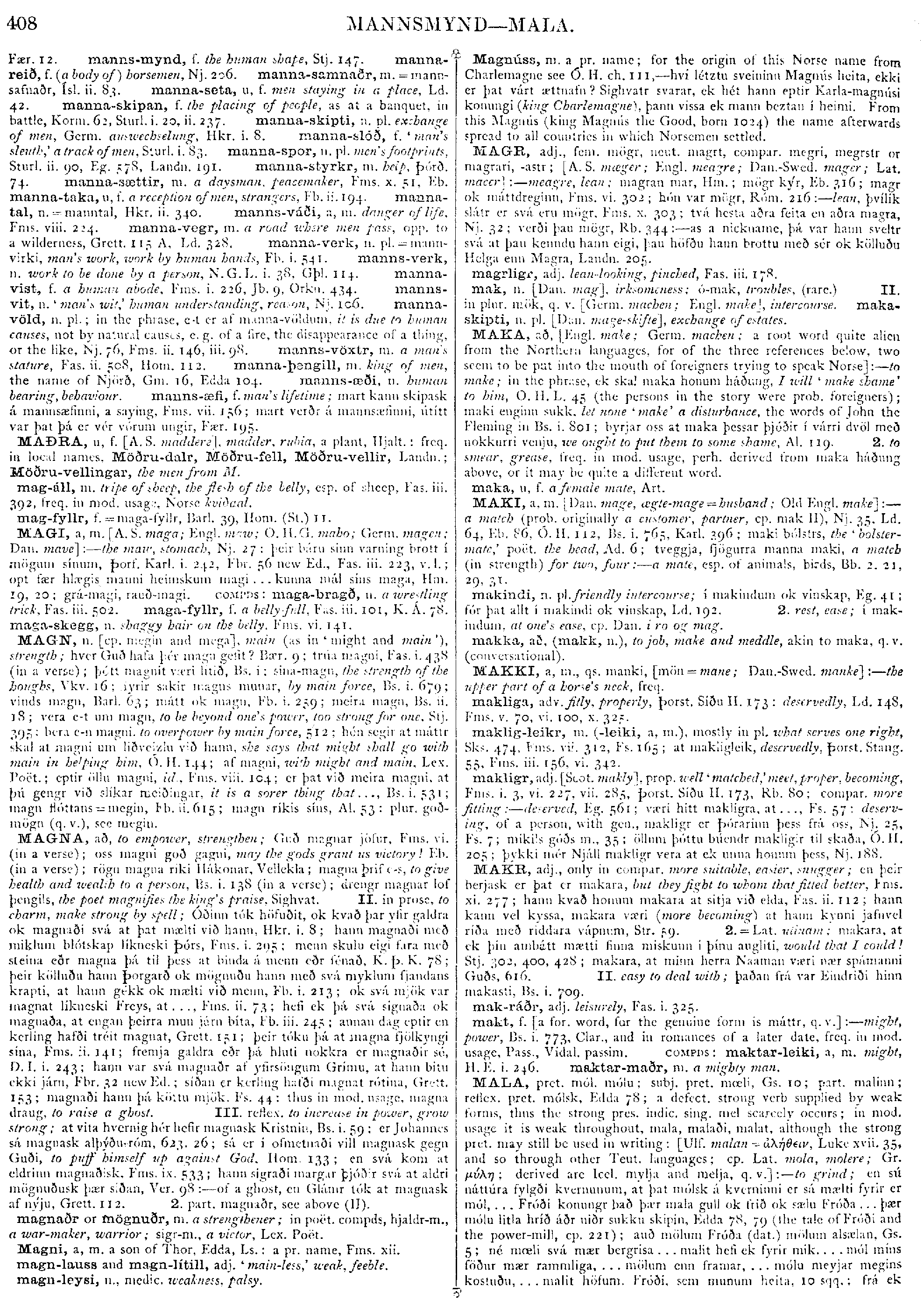
MAGNA, að, to empower, strengthen; Gr. ð magnar jófur, Fms. vi. (in a verse); oss magni goð gagni, may the gods grant ns victory ! Kb. (in a verse); rogn magna riki llákonar, Vellekla; magua þrif e-s, to give health and wealth to a person, Ib. i. 138 (in a verse); tirengr magnar lof þengils, /he poet magnifies the king's praise, Sighvat. II. in prose, to charm, make strong by spell; O. ûinn tók höfuðit, ok kvað þar yiir galdra ok magnaði svá at þat mælti við hann, Hkr. i. 8; hann magnaði með mikhim blótskap líkncski jbórs, Fnis. i. 2(15; menu skulu eigi f. ira nieð steina eðr magna þá til þess at binda á menn eðr û'nað, K. þ. K. 78; þeir kölluðu hann þorgarð ok mögnuðu haim með svá niyklum fjaiulans krapti, at hann gt'-kk ok mælti við menu, Fb. i. 213; ok svá m;ök var magnat líkncski Freys, at..., Fms. ii. 73; hefi ek þá svá signaða ok magnaða, at engan þeirra mun iárn bíta, Fb. iii. 245; annan dag eptir en keriing hafði tr(''it inagnat, Grett. !=, !; þeir tóku þá at jnagna fjölkyngi sina, Fms. ii. 141; fremja galdra eðr þá hluti nokkra er magnaðir sé, D. I. i. 243; hann var svá m. ignaðr af yfirsiiugum Grírnu, at hann bitn ekki járn, Fbr. 32 newKi!.; síðan er kerling hafði magnat rótina, Gr-. -U. 1. ^3; magnaði harm þá köítu mjük. l''s. 44: thus in mod. usage, magna ilraug, to raise a ghost. III. reHex. to increase in power, grow strong; at vita hvernig her hefir magnask Kristnin, Bs. i. 59; er Johannes sá magnask alþyðurróm, 623. 26; sá er í ofmctnaði vill magnask gegn Guði, to puff himself up against God. Hom. 133; en svá kom at eldrinn inagnadisk, Fms. ix. 533; hann sigraði inarg. ir þjó5:r svá at aldri mögnuðusk þær síðan, Ver. 98 :-- of a ghost, cn Glánir lók at magnask af nyju, Grett. 112. 2. part, magiuðr, see above (II).
|
Source: Cleasby/Vigfusson, page b0490, entry 6 View original page image as: [TIFF] [PNG] [View previous entry] [View next entry] |
[Comment on this entry] [View comments] |
The following entry has been hand-corrected once. |
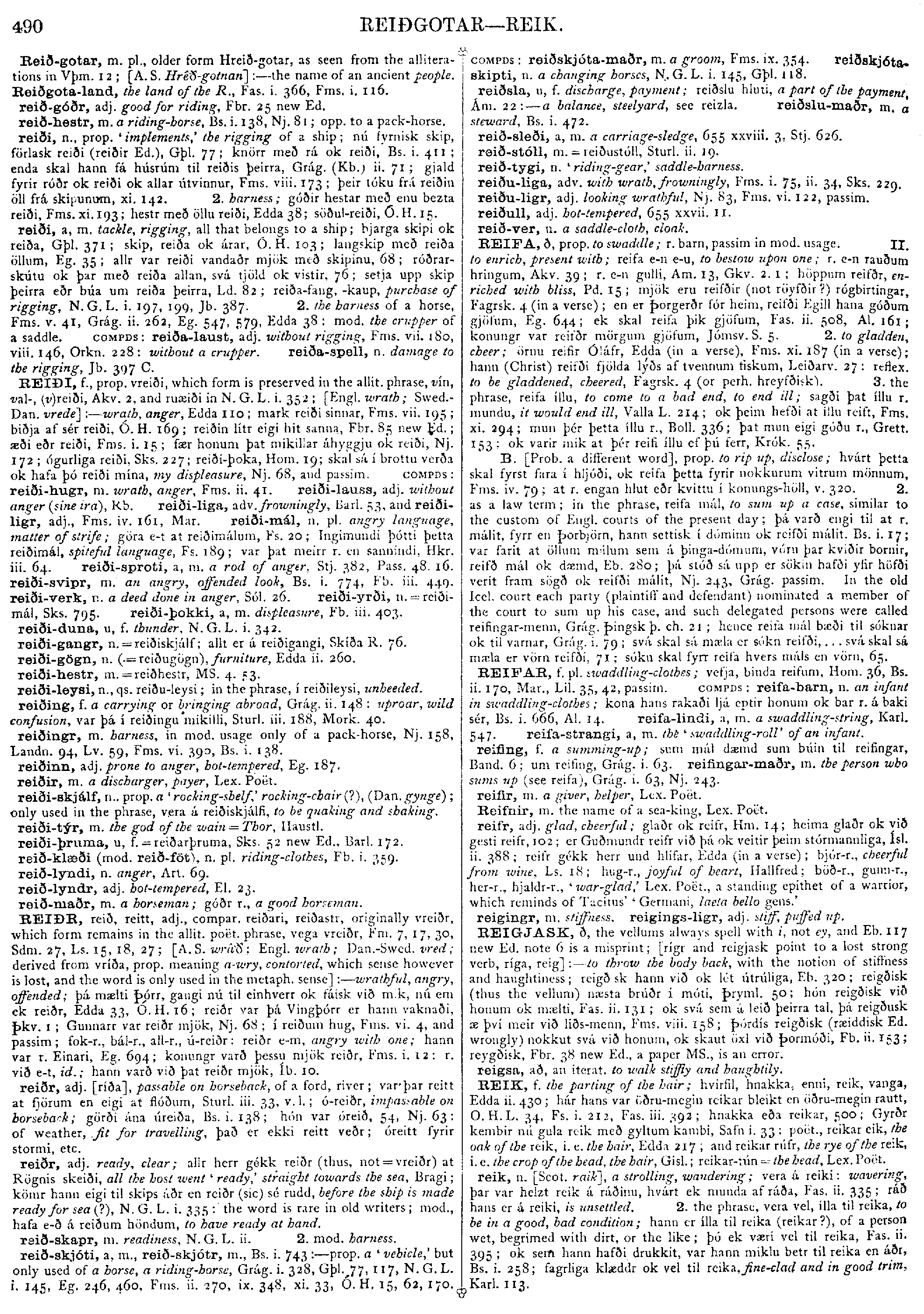
REIÐI, f., prop. vreiði, which form is preserved in the allit. phrase,vín, val-, (v)reiði, Akv. 2, and ruæiði in N.G.L. i. 352; [Engl. wrath; Swed.-Dan. vrede] :-- wrath, anger, Edda 110; mark reiði sinnar, Fms. vii. 195; biðja af sér reiði, Ó.H. 169; reiðin lítr eigi hit sanna, Fbr. 85 new Ed.; æði eðr reiði, Fms. i. 15; fær honum þat mikillar áhyggju ok reiði, Nj. 172; ógurliga reiði, Sks. 227; reiði-þoka, Hom. 19; skal sá í brottu verða ok hafa þó reiði mína, my displeasure, Nj. 68, and passim. COMPDS: reiði-hugr, m. wrath, anger, Fms. ii. 41. reiði-lauss, adj. without anger (sine ira), Rb. reiði-liga, adv. frowningly, Barl. 53, and reiði-ligr, adj., Fms. iv. 161, Mar. reiði-mál, n. pl. angry language, matter of strife; göra e-t at reiðimálum, Fs. 20; Ingimundi þótti þetta reiðimál, spiteful language, Fs. 189; var þat meirr r. en sannindi, Hkr. iii. 64. reiði-sproti, a, m. a rod of anger, Stj. 382, Pass. 48. 16. reiði-svipr, m. an angry, offended look, Bs. i. 774, Fb. iii. 449. reiði-verk, n. a deed done in anger, Sól. 26. reiði-yrði, n. = reiðimál, Sks. 795. reiði-þokki, a, m. displeasure, Fb. iii. 403.
| Result Page: |  |
Previous | 1 2 3 4 5 6 7 |
Germanic Lexicon Project (main page)
This search system was written by
Sean Crist
Please consider
volunteering
to correct the data in these online dictionaries.
No rights reserved. Feel free to use these data in any way you please.