|
|

Tip: In the search results, you can click on any word or abbreviation for more information.
|
Source: Cleasby/Vigfusson, page b0407, entry 7 View original page image as: [TIFF] [PNG] [View previous entry] [View next entry] |
[Comment on this entry] [View comments] |
The following entry has not been hand-corrected. However, the page is reserved and someone is correcting it. |
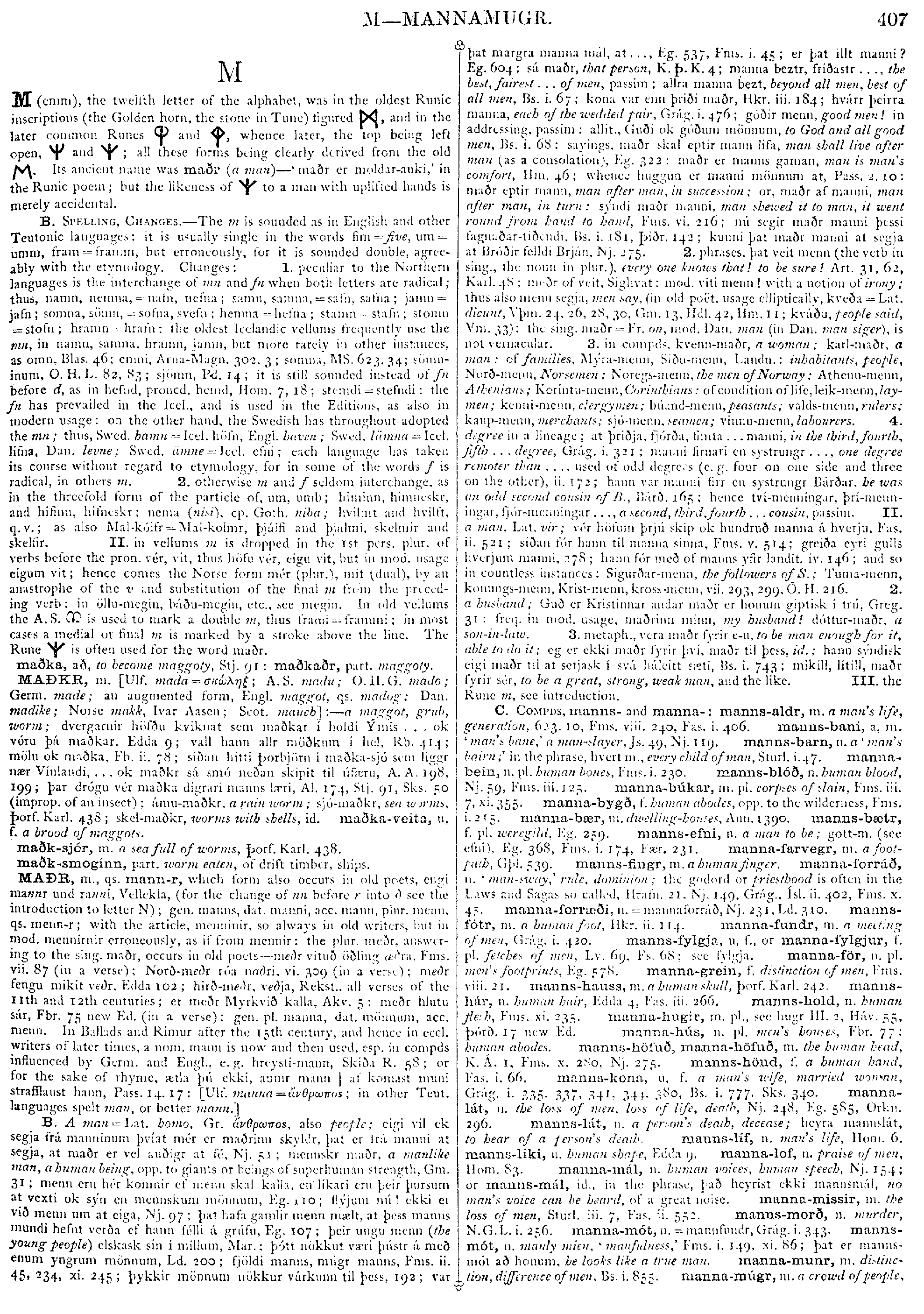
MAÐR, m., qs. mann-r, which form also occurs in old poets, cr. !'i mattnr und nrini, velltkla, (for the change of nn before r into ') see the introduction to letter N); gen. nianns, dat. maiuii, acc. maun, plur. menu, qs. menn-r; with the article, menninir, so always in old writers, but in mod. mennirnir erroneously, as if from niennir: the plur. meðr. answer- ing to the sing, maðr, occurs in old poets -- m e f)r vituð öðlin:; rfj-'Va, P'ms. vii. 87 (in a verse); Norð-m e()r róa nnf)ri. vi. 309 (in a verse); m?()r fengu mikit ve*)r, Edda 102; hirð-m e dr, v e dja, Rekst., all verses of the Ilth and 12th centuries; er ineîSr Myrkvið kalla, Akv. 5: meðr hlutu sár, Fbr. 75 new Ed. (in a verse): gen. pl. manna, dat. iiuiiinmn, acc. menu. In Ballads and Rimur after the 15th century, and hence in eccl. writers of later times, a noni. mann is now and then used, esp. in compels influenced by Germ, and Engl., e. g. hreysti-mann, Skiða R. 58; or for the sake of rhyme, ætla Ju'i ekki, aumr maim | af koinast muni strafflaust hann, Pass. 14. 17: [Ulf. manna = ('w6paiiros; in other Teut. languages spelt man, or better mann. '] B. A man -- Lat. bomo, Gr. avOpu-rros, also people; eigi vil ek segja frá manninum þvíat mér er niaðrinn skyKlr, þat er frá nianni at segja, at maðr er vel auðigr at K, Nj. s; j; n:cnnskr niaðr, a manlike man, ahnman being, opp. to giants or beings of superhuman strength. Gin. 31; menu eru her koinnir ef menu skal kalla, en líkari crn þeir þursum at vexti ok sy'n en mennskum monnum, Eg. ïio; flvjuin mi! ekki er við menn um at eiga, Nj. 97; bat hafa ganilir menn niælî, at þess maims mundi hefnt verôa cf hann fï'lli á gn'tfu, Eg. 107; þeir UUEJU menn (the young people) elskask sin í millum, Mar.; þótt nökkut væri þústr á með enum yngrum münnum, Ld. -200; fjöldi manns, múgr manns, Ems. ii. 45i 234, xi. 245; þykkir mönnum nükkur várkunn til þess, 192; var bat niargra manna nuii, at..., Eg. 537, Eniï. i. 45; er þat illt manni ? Eg. 604; sá maðr, that person, K. p. K. 4; manna beztr, fríðastr ..., the best, fairest... of men, passim; allra manna bezt, beyond all men, best of all men, Bs. i. 67; kona var enn þriði maðr, Hkr. iii. 184; hvárr þeirra manna, each ofthe wedded fair. Gray;, i. 476; góðir menu, good men ! in addressing, passim: allit., Guði ok gúðuni niönnum, to God and all good men, Bs. i. 68: sayings, maðr skal eptir mann lifa, man shall live after man (as a consolation), Eg. 322: maðr er maims gaman, man is man's comfort, 11111. 46; whence huggun er manni monnum at, Pass. 2. 10: maðr eptir mann, man after man, in succession; or, niaðr af manni, man after man, in turn: svndi maðr manni, man shewed it to man, it went round from band to hand, Ems. vi. 216; mi segir maðr manni þessi iagnaðar-tiðendi. Bs. i. 181, foiðr. 142; kunni þat inaðr manni at segja at Bróöir felldi Brjan, Nj. 275. 2. phrases, þat veil menu (the verb in sing., the noun in plur.), every one knows that! to be sure ! Art. 31, 62, Karl. 48; nicôr of veil, Sighvat: mod. viti menn ! with a notion of irony; thus also menu segja, men say, (in old pout, usage elliptically, kveða -- Lat. dicunt, Ybm. 24, 26, 28, 30. Gin. 13, lldl. 42, llni. í I; k'iib'J, people said, Ym. 33): the sing, maör -- Er. on, mod. Dan. man (in Dan. man siger), is not vernacular. 3. in compds. kvenn-maðr, a woman; karl-maðr, a man: (. ii families, Alyra-inenn, Síðu-nicnn, Landn.: inhabitants, people, Norð-menu, Norsemen; Noregs-ineni), / he men of Norway; Athenu-nienn, Athenians; Kcrintu-meim. Oj rin/ h iVi ns; of condition of life, leik-menn, lay- m ew; kenni-ineun, clergymen; biiand-rncnn, pea s ants; valds-rncnn, rulers; kaup-nienn, merchants; sjo-inenn, seamen; vinnu-inenn, labourers. 4. degree in a lineage: at þriðja, fjóröa, iînita ... manni, in the third, fourth, fifth ... degree, Gn'ig. i. 321; manni firnari en systrungr ..., one degree remoter than ... . used ot odd degrees (e. g. four on one side and three on the other), ii. 172; hann var manni firr en systrungr Bárðar, hewax an oild iccond cousin of 1!. . lîárð. 165; hence tvi-inenningar, þrí-incnn- ingar, fjor-menningar ..., a second, third, fourth ... cousin, passim. II. a man. Lat. vir; vi'-r liofum brjii skip ok hundruð manna á hverju. Eas. ii. 521; síðan tor hann til manna sinna, Fms. v. 514; grciða e)-ri gulls hverjum manni,, 178; hann for nicð of maims yfir landit, iv. 146; and so in countless instances: Sigurðar-menn, the followers ofS.; Tuina-ineiin, konungb-inenn, Krist-menn, kross-inenn, vii. 293, 299, 0. II. 216. 2. a husband; Guð er Kristinnar andar inaðr er honum giptisk í tru, Greg. 31: freq. in mod. usage, maðrinn minii, w y husband! dóttur-maðr, a son-in-law. 3. metaph., vera maðr fyrir e-u, to be man enough for it, able to do it; eg er ekki maðr f-rir því, inaðr til þess, id.; hann svndisk eigi maðr til at setja. sk í svá háíeitt sreti, Bs. i. 743; mikill, lítill, niaðr fyrir sur, to be a great, strong, weak man, and the like. III. the Rune m, see introduction. C. COMPDS, inarms- and manna-: manns-aldr, in. a man's life, generation. 6. ', 3. 10, Ems. viii. 240, Eas. i. 406. mauns-bani, a, in. ' man's bane, ' a man-slayer. Js. 49, Ni. 119. manns-barn, n. a ' man's bairn;' in the phrase, hvert in., every child of man, Stud. 1. 47. maniia- bein, n. pl. human bones, Fms. i. 230. manns-blóð, n. human blood, Nj. 59, Ems. iii. j 25. manna-bukar, m. pl. corpses of slain, Ems. iii. 7' x'- 355- manna-bygð, f. human abodes, opp. to the wilderness, Ems. i. 2 15. marma-bter, in. tlwclling-bo;i?ef, Ann. 1390. manns-bsotr, f. pl. weregrlil. Eg. 259. manns-efni, n. a;;; an to be; gott-m. (see efni Eg. 368, Ems. i. 174, Eær. 231. manna-farvegr, in. a foot- pa:h, ('îþi. 539. manns-fmgr, m. a human finger. nianna-forráð, n. ' man-sway ' rule, dominion; the g^dord or priesthood is often in the Laws and Sagas so called, Hrafn. 21, Nj. 149, Gn'ig., Ísl. ii. 402, Ems. x. 45. manna-forrœði. n. -- niannaforráð, Nj. 231, Ld. 3. 10. manns- fótr, m. a human foot, Hkr. ii. 114. inaiina-fundr, m. a meeting of men, (în'ig. i. 420. manns-fylgja, u, f., or manna-i'ylgjur, f. pl. fetches of men, I. v. 69, Es. 68; see íylgja. manna-för, n. pl. men's footprints, Eg. 578. manna-grein, f. distinction of men, Ems. viii. 21. inanns-hauss, m. a human skull, borf. Karl. 242. manns- liar, n. human hair, Edda 4, Eas. iii. 266. manns-hold, n. human Jie:h, Ems. xi. 235. manna-hugir, m. pl., see hugr III. 2, lláv. 55, Jjórð. 17 new Ed. manna-hús, n. pl. men's bonset, Fbr. 77: human abodes. manns-höíuð, manna-höfuð, m. (he human head, K. Á. i. Ems. x. 280, Nj. 275. manns-hönd, f. a human hand, Fas. i. 66. mo. nua-kona, u, f. a man's wife, married w)ii*nn, Gn'ig. i. 335. 337, 34r, 341, 380, Bs. i. 777, Sks. 340. manna- lát, n. the loss of men. loss af life, death, Nj. 248, Eg. 585, Orkn. 296. marms-lát, n. a person's death, decease; heyra inannslut, to bear of a person's ch-atb. raanns-lif, n. man's life, Honi. 6. manns-liki, n. human shape, Edda 9. manna-lof, n. praise of men, Hom. 83. manna-inal, n. human voices, human speech, Nj. 154; or manns-rnal, id., in the phrase, að heyrist ekki inanusmal, no man's voice can be heard, of a great noise. inanna-missir, in. the loss of men, Sturl. iii. 7, Eas. ii. 552. manns-morð, n. murder, N. G. L. i. 256. manna-mót, n. -- mar. nfuudr, (jrag. i. 343. manns- mót, n. manly mien, ' manfnlness, ' Ems. i. 149, xi. 86; þat er inanns- niót að honum, he looks like a true man. manna-munr, m. distinc- ^ /ion, difference of men. 13s. i. 85. 5. mauna-mxigr, m. a crcwd of people.
|
Source: Cleasby/Vigfusson, page b0409, entry 12 View original page image as: [TIFF] [PNG] [View previous entry] [View next entry] |
[Comment on this entry] [View comments] |
The following entry has not been hand-corrected. However, the page is reserved and someone is correcting it. |
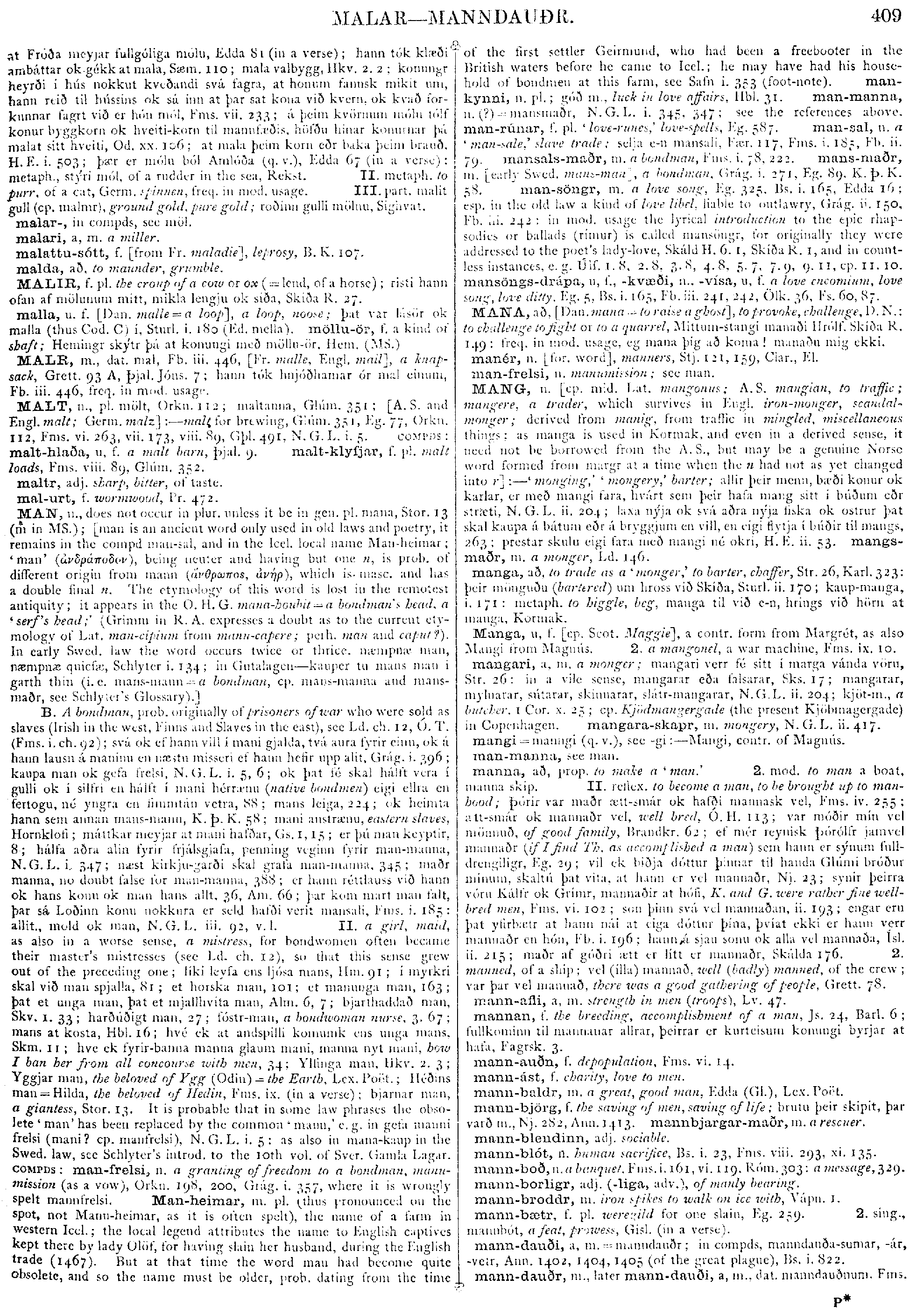
MAN, n., does not occur in piur. unless it be in gen. pl. niana, Stor. 13 (ni in MS.); [man is an ancient word only used in old laws and poetry, it remains in the compd man-sal, and in the Icel. local name Man-heimar; 'man' (åvðpáiroSov'), being neuter and having but one;;, is prob. of different origin from maim (iii'Opcurros, avrjp), which is. masc. and has a double final n. The etymology of this word is lost in the remotest antiquity; it appears in the O. M. G. m a n a -b o ulnt -- -- -a bondman's bead, a 'serf's bead;' (Grimm in R. A. expresses a doubt as to the current ety- mology of Lat. man-cipium from mann-capere; peril, man and capnt"!). In early Swed. law the- word occurs twice or thrice, næmpna' man, naempnæ quicfic, Schlyter i. 134; in Cïutalagen -- kauper tu mans man i garth thin (i. e. mans-mann -- -- a bond/nan, cp. maus-manna and mans- inaðr, see Schly'. er's Glossary).] B. A bondman, prob. originally of prisoners of war who were sold as slaves (Irish in the west, Finns and Slaves in the east), see Ld. ch. 12, O. T. (Fms. i. ch. 92); svá ok ef hann vill i mani gjalda, tva aura fyrir einn, ok a hann lausn á maninu en i;æ. stn misseri ef haun heiir upp alit, Gr;i. g. i. 396; kaupa man ok gefa frelsi, N. G. L. i. 5, 6; ok þat ie skal liáift vera í gulli ok i silfri en hálit i mani herru'nu (n a tive bondmen) eigi cilia en fertogu, ne yngra en iimmtan vetra, SS; mans leiga, 224; ok heiiuta hann sein annan mans-mann, K. þ. K. 58; mani aiistrænu, eastern s lave s, Hornkloii; maukar nicyjar at mani hal'ðar, Gs. 1, 15; er |m man keyptir, 8; hálta aðra alin íyrir trjúlsgiafa, penning veginn fyrir man-manna, N. G. L. i, 347; næst kiikju-garði skal grata man-manna, 345; maðr manna, no doubt false for man-manna, 388; er hann réttlauss við hann ok hans konu ok man hans allt, 36, Am. 66; J-ar koin mart man fait, þar sá Loðinn konu nokkura er seld hafði verit mansali, Fms. i. 185: allit., mold ok man, N. G. L. iii. 92, v. 1. II. a girl, maid, as also in a worse sense, a mistress, for bondwomen often became their master's mistresses (see Ld. ch. 12), so that this sense grew out of the preceding one; liki ley fa ens Ijosa mans, Hm. 91; í myrkri skal við man spjalla, 81; et horska man, 101; et manunga man, 163; bat et unga man, þat et mjallhvita man, Aim. 6, 7; bjarthaddað man, Skv. I. 33; harðúðigt man, 27; tostr-man, a bondwoman mine, 3. 67; mans at kosta, Hbl. 16; live ek at andspilli komumk ens unga mans, Skm. 11; hve ek fyrir-banna manna glaum mani, manna nyt mani, bow I ban her from all concourse with men, 34; Ylfinga man, Hkv. 2. 3; Yggjar man, the beloved of Ygg (Odin) -- the Earth, Lex. l'oi-t.; HOðins man = Hilda, the beloved of lied in, Fms. ix. (in a verse); bjarnar man, a giantess, Stor. 13. It is probable that in some law phrases the obso- lete ' man' has been replaced by the common ' maim, ' e. g. in gefa manni frelsi (mani? cp. manfrelsi), N. G. L. i. 5: as also in mana-kaup in the Swed. law, see Schlyter's introd. to the loth vol. of Sver. (Manila Lag. ir. COMPDS: man-frelsi., n. a granting of freedom to a bondman, manu- mission (as a vow), Orkn. 198, 200, Gr;ig. i. 357, where it is wrongly spelt mannfrelsi. Man-heimar, in. pl. (thus pronounce;! on the spot, not Mann-heimar, as it is often spelt), the name of a farm in western Icel.; the local legend attributes the name to English captives kept there by lady Olo'f, for having slain her husband, during the Fnglish trade (1467). But at that time the word man had become quite obsolete, and so the name must be older, prob. dating from the time of the first settler Geirmund, who had been a freebooter in the British waters before he came to Icel.; he may have had his house- hold of bondmen at this farm, see Safn i. 353 (foot-note). man- kynni, n. pl.; gócî in., luck in love affairs, Hbl. 31. man-manna, n. (?) -- •- mansmaðr, N. G. L. i. 345, 347; see the references above. man-runar, f. pl. 'love-runes, ' love-spells, Eg. 587. man-sal, n. n 'man-sale. ' slave trade; selia e-n mansali, Fær. 117, Fms. i. 185, Fb. ii. 79. mansals-maðr, in. a bondman, Fms. i. 78, 22:. mans-maðr, m. [earh Swed. mam-man'', a bondman, (îrúg. i. 271. Eg. 89, K. p. K. 58. man-scmgr, m. a love song, Fig. 325. Bs. i. 165, Edda 16; esp. in the old law a kind of loi-f libel, liable to outlawry, Grug. ii. 150, Fb. ui. 242: in mod. usage the lyrical introduction to the epic rhap- sodies or ballads (rimur) is called manscingr, tor originally they were addressed to the poet's lady-love, Skald H. 6. i, SkíðaK. i, and in count- less instances, e. g. Ú If. I. H, 2. 8, 3. 8, 4, 8, 5. 7, 7. 9, 9. 11, cp. ii. 10. mansöngs-drápa, u, f., -kvœði, n., -visa, u, f. a love encomium, love song, lore di. 'ty. Eg. 5, Bs. i. 165, Fb. iii. 241, 242, Oik. 36, Fs. 60, 87.
|
Source: Cleasby/Vigfusson, page b0429, entry 6 View original page image as: [TIFF] [PNG] [View previous entry] [View next entry] |
[Comment on this entry] [View comments] |
The following entry has been hand-corrected once. |
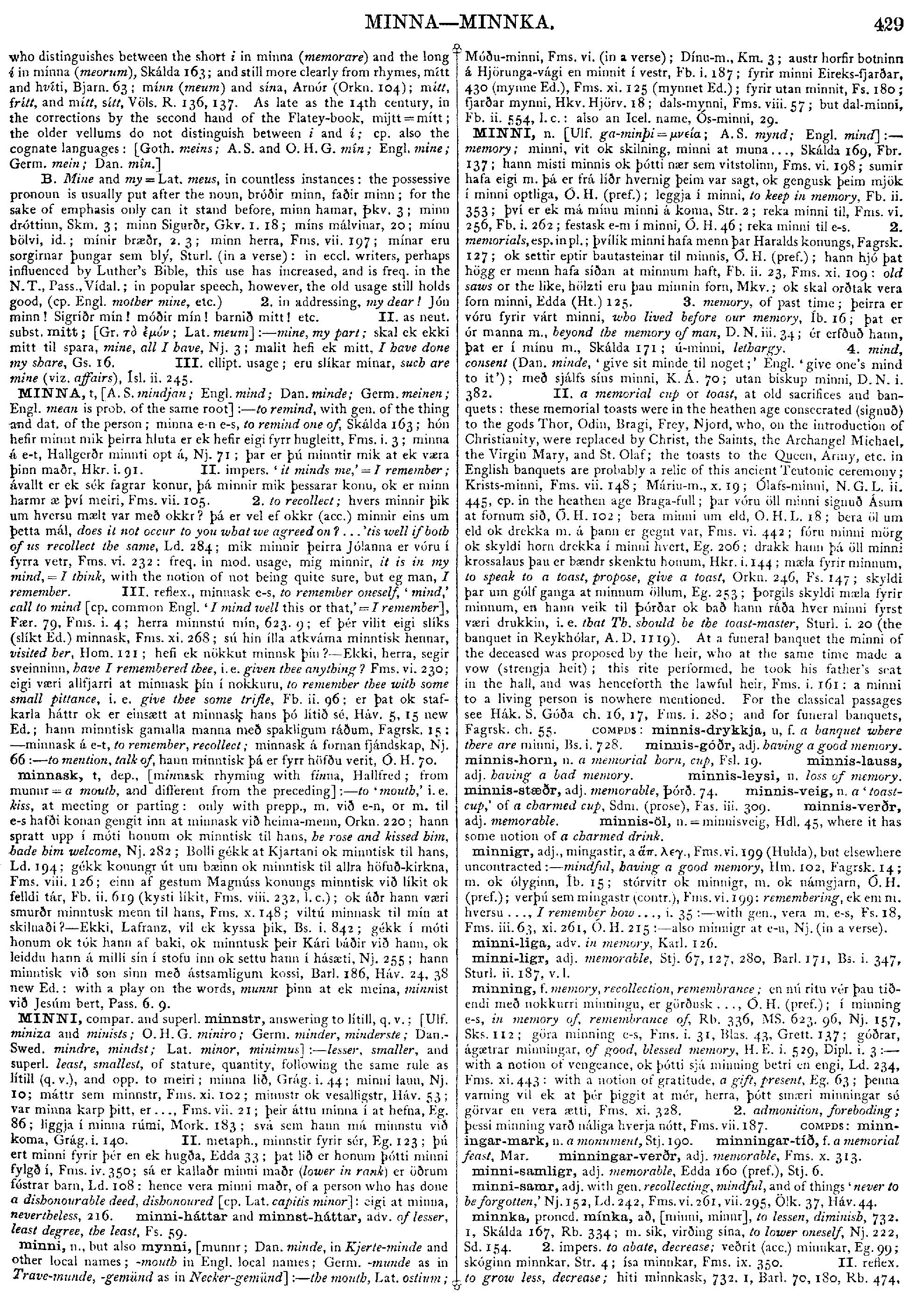
MINNI, n. [Ulf. ga-minþi = GREEK; A. S. mynd; Engl. mind] :-- memory; minni, vit ok skilning, minni at muna..., Skálda 169, Fbr. 137; hann misti minnis ok þótti nær sem vitstolinn, Fms. vi. 198; sumir hafa eigi m. þá er frá liðr hvernig þeim var sagt, ok gengusk þeim mjök í minni optliga, Ó. H. (pref.); leggja í minni, to keep in memory, Fb. ii. 353; því er ek má mínu minni á koma, Str. 2; reka minni til, Fms. vi. 256, Fb. i. 262; festask e-m í minni, Ó. H. 46; reka minni til e-s. 2. memorials, esp. in pl.; þvílík minni hafa menn þar Haralds konungs, Fagrsk. 127; ok settir eptir bautasteinar til minnis, Ó. H. (pref.); hann hjó þat högg er menn hafa síðan at minnum haft, Fb. ii. 23, Fms. xi. 109: old saws or the like, hölzti eru þau minnin forn, Mkv.; ok skal orðtak vera forn minni, Edda (Ht.) 125. 3. memory, of past time; þeirra er vóru fyrir várt minni, who lived before our memory, Íb. 16; þat er ór manna m., beyond the memory of man, D. N. iii. 34; ér erfðuð hann, þat er í mínu m., Skálda 171; ú-minni, lethargy. 4. mind, consent (Dan. minde, 'give sit minde til noget;' Engl. 'give one's mind to it'); með sjálfs síns minni, K. Á. 70; utan biskup minni, D. N. i. 382. II. a memorial cup or toast, at old sacrifices and banquets: these memorial toasts were in the heathen age consecrated (signuð) to the gods Thor, Odin, Bragi, Frey, Njord, who, on the introduction of Christianity, were replaced by Christ, the Saints, the Archangel Michael, the Virgin Mary, and St. Olaf; the toasts to the Queen, Army, etc. in English banquets are probably a relic of this ancient Teutonic ceremony; Krists-minni, Fms. vii. 148; Máriu-m., x. 19; Ólafs-minni, N. G. L. ii. 445, cp. in the heathen age Braga-full; þar vóru öll minni signuð Ásum at fornum sið, Ó. H. 102; bera minni um eld, O. H. L. 18; bera öl um eld ok drekka m. á þann er gegnt var, Fms. vi. 442; fóru minni mörg ok skyldi horn drekka í minni hvert, Eg. 206; drakk hann þá öll minni krossalaus þau er bændr skenktu honum, Hkr. i. 144; mæla fyrir minnum, to speak to a toast, propose, give a toast, Orkn. 246, Fs. 147; skyldi þar um gólf ganga at minnum öllum, Eg. 253; Þorgils skyldi mæla fyrir minnum, en hann veik til Þórðar ok bað hann ráða hver minni fyrst væri drukkin, i. e. that Th. should be the toast-master, Sturl. i. 20 (the banquet in Reykhólar, A. D. 1119). At a funeral banquet the minni of the deceased was proposed by the heir, who at the same time made a vow (strengja heit); this rite performed, he took his father's scat in the hall, and was henceforth the lawful heir, Fms. i. 161: a minni to a living person is nowhere mentioned. For the classical passages see Hák. S. Góða ch. 16, 17, Fms. i. 280; and for funeral banquets, Fagrsk. ch. 55. COMPDS: minnis-drykkja, u, f. a banquet where there are minni, Bs. i. 728. minnis-góðr, adj. having a good memory. minnis-horn, n. a memorial horn, cup, Fsl. 19. minnis-lauss, adj. having a bad memory. minnis-leysi, n. loss of memory. minnis-stæðr, adj. memorable, Þórð. 74. minnis-veig, n. a 'toast-cup,' of a charmed cup, Sdm. (prose), Fas. iii. 309. minnis-verðr, adj. memorable. minnis-öl, n. = minnisveig, Hdl. 45, where it has some notion of a charmed drink.
|
Source: Cleasby/Vigfusson, page b0446, entry 14 View original page image as: [TIFF] [PNG] [View previous entry] [View next entry] |
[Comment on this entry] [View comments] |
The following entry has been hand-corrected once. |
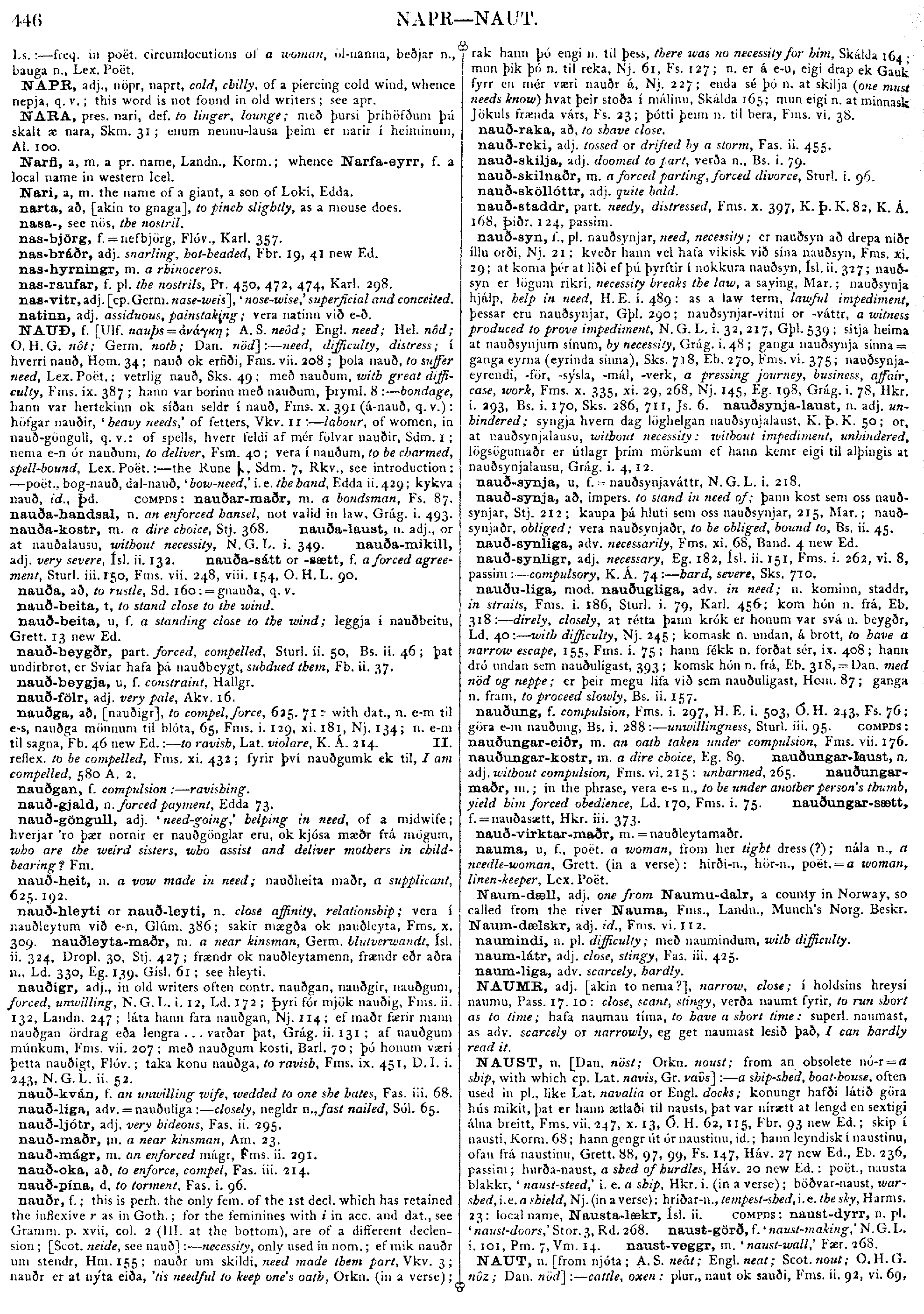
NAUÐ, f. [Ulf. nauþs = GREEK; A.S. neôd; Engl. need; Hel. nôd; O.H.G. nôt; Germ. noth; Dan. nöd] :-- need, difficulty, distress; í hverri nauð, Hom. 34; nauð ok erfiði, Fms. vii. 208; þola nauð, to suffer need, Lex. Poët.; vetrlig nauð, Sks. 49; með nauðum, with great difficulty, Fms. ix. 387; hann var borinn með nauðum, Þryml. 8 :-- bondage, hann var hertekinn ok síðan seldr í nauð, Fms. x. 391 (á-nauð, q.v.): höfgar nauðir, 'heavy needs,' of fetters, Vkv. 11 :-- labour, of women, in nauð-göngull, q.v.: of spells, hverr feldi af mér fölvar nauðir, Sdm. 1; nema e-n ór nauðum, to deliver, Fsm. 40; vera í nauðum, to be charmed, spell-bound, Lex. Poët. :-- the Rune RUNE, Sdm. 7, Rkv., see introduction :-- poët., bog-nauð, dal-nauð, 'bow-need,' i.e. the hand, Edda ii. 429; kykva nauð, id., Þd. COMPDS: nauðar-maðr, m. a bondsman, Fs. 87. nauða-handsal, n. an enforced hansel, not valid in law, Grág. i. 493. nauða-kostr, m. a dire choice, Stj. 368. nauða-laust, n. adj., or at nauðalausu, without necessity, N.G.L. i. 349. nauða-mikill, adj. very severe, Ísl. ii. 132. nauða-sátt or -sætt, f. a forced agreement, Sturl. iii. 150, Fms. vii. 248, viii. 154, O.H.L. 90.
|
Source: Cleasby/Vigfusson, page b0452, entry 3 View original page image as: [TIFF] [PNG] [View previous entry] [View next entry] |
[Comment on this entry] [View comments] |
The following entry has been hand-corrected once. |
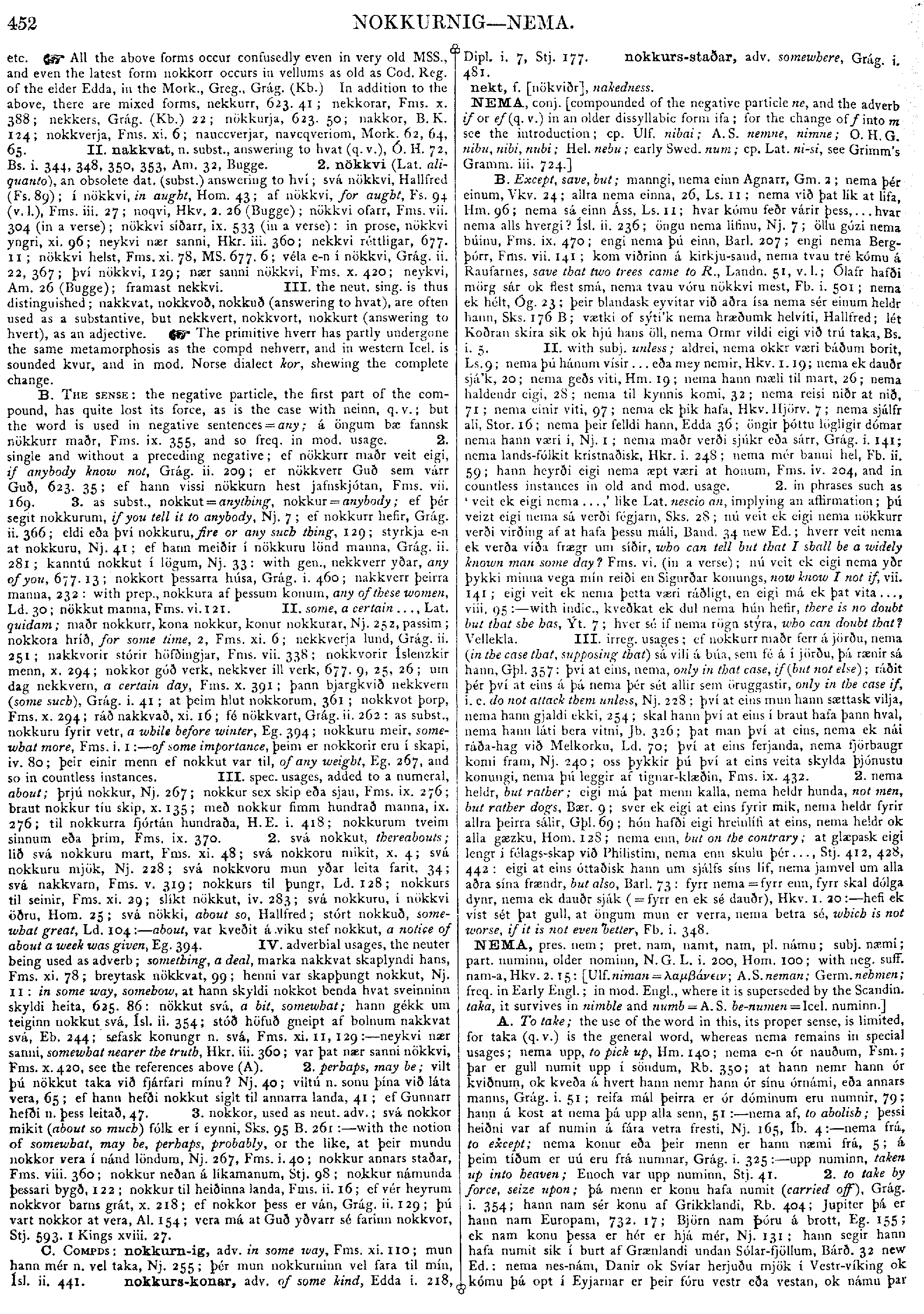
NEMA, conj. [compounded of the negative particle ne, and the adverb if or ef (q. v.) in an older dissyllabic form ifa; for the change of f into m see the introduction; cp. Ulf. nibai; A. S. nemne, nimne; O. H. G. nibu, nibi, nubi; Hel. nebu; early Swed. num; cp. Lat. ni-si, see Grimm's Gramm. iii. 724.] B. Except, save, but; manngi, nema einn Agnarr, Gm. 2; nema þér einum, Vkv. 24; allra nema einna, 26, Ls. 11; nema við þat lík at lifa, Hm. 96; nema sá einn Áss, Ls. 11; hvar kómu feðr várir þess, . . . hvar nema alls hvergi? Ísl. ii. 236; öngu nema lífinu, Nj. 7; öllu gózi nema búinu, Fms. ix. 470; engi nema þú einn, Barl. 207; engi nema Bergþórr, Fms. vii. 141; kom viðrinn á kirkju-sand, nema tvau tré kómu á Raufarnes, save that two trees came to R., Landn. 51, v. l.; Ólafr hafði mörg sár ok flest smá, nema tvau vóru nökkvi mest, Fb. i. 501; nema ek hélt, Óg. 23; þeir blandask eyvitar við aðra ísa nema sér einum heldr hann, Sks. 176 B; vætki of sýti'k nema hræðumk helvíti, Hallfred; lét Koðran skíra sik ok hjú hans öll, nema Ormr vildi eigi við trú taka, Bs. i. 5. II. with subj. unless; aldrei, nema okkr væri báðum borit, Ls 9; nema þú hánum vísir . . . eða mey nemir, Hkv. 1. 19; nema ek dauðr sjá'k, 20; nema geðs viti, Hm. 19; nema hann mæli til mart, 26; nema haldendr eigi, 28; nema til kynnis komi, 32; nema reisi niðr at nið, 71; nema einir viti, 97; nema ek þik hafa, Hkv. Hjörv. 7; nema sjálfr ali, Stor. 16; nema þeir felldi hann, Edda 36; öngir þóttu lögligir dómar nema hann væri í, Nj. 1; nema maðr verði sjúkr eða sárr, Grág. i. 141; nema lands-fólkit kristnaðisk, Hkr. i. 248; nema mér banni hel, Fb. ii. 59; hann heyrði eigi nema æpt væri at honum, Fms. iv. 204, and in countless instances in old and mod. usage. 2. in phrases such as 'veit ek eigi nema . . .,' like Lat. nescio an, implying an affirmation; þú veizt eigi nema sá verði fégjarn, Sks. 28; nú veit ek eigi nema nökkurr verði virðing af at hafa þessu máli, Band. 34 new Ed.; hverr veit nema ek verða víða frægr um síðir, who can tell but that I shall be a widely known man some day? Fms. vi. (in a verse); nú veit ek eigi nema yðr þykki minna vega mín reiði en Sigurðar konungs, now know I not if, vii. 141; eigi veit ek nema þetta væri ráðligt, en eigi má ek þat vita . . ., viii. 95 :-- with indic., kveðkat ek dul nema hún hefir, there is no doubt but that she has, Ýt. 7; hver sé if nema rögn stýra, who can doubt that ? Vellekla. III. irreg. usages; ef nokkurr maðr ferr á jörðu, nema (in the case that, supposing that) sá vili á búa, sem fé á í jörðu, þá rænir sá hann, Gþl. 357: því at eins, nema, only in that case, if (but not else); ráðit þér því at eins á þá nema pér sét allir sem öruggastir, only in the case if, i. e. do not attack them unless, Nj. 228; því at eins mun hann sættask vilja, nema hann gjaldi ekki, 254; skal hann því at eins í braut hafa þann hval, nema hann láti bera vitni, Jb. 326: þat man því at eins, nema ek nái ráða-hag við Melkorku, Ld. 70; því at eins ferjanda, nema fjörbaugr komi fram, Nj. 240; oss þykkir þú því at eins veita skylda þjónustu konungi, nema þú leggir af tignar-klæðin, Fms. ix. 432. 2. nema heldr, but rather; eigi má þat menn kalla, nema heldr hunda, not men, but rather dogs, Bær. 9; sver ek eigi at eins fyrir mik, nema heldr fyrir allra þeirra sálir, Gþl. 69; hón hafði eigi hreinlífi at eins, nema heldr ok alla gæzku, Hom. 128; nema enn, but on the contrary; at glæpask eigi lengr í félags-skap við Philistim, nema enn skulu þér . . ., Stj. 412, 428, 442: eigi at eins óttaðisk hann um sjálfs síns líf, nema jamvel um alla aðra sína frændr, but also, Barl. 73: fyrr nema = fyrr enn, fyrr skal dólga dynr, nema ek dauðr sják (= fyrr en ek sé dauðr), Hkv. 1. 20 :-- hefi ek vist sét þat gull, at öngum mun er verra, nema betra sé, which is not worse, if it is not even better, Fb. i. 348.
|
Source: Cleasby/Vigfusson, page b0459, entry 46 View original page image as: [TIFF] [PNG] [View previous entry] [View next entry] |
[Comment on this entry] [View comments] |
The following entry has been hand-corrected once. |
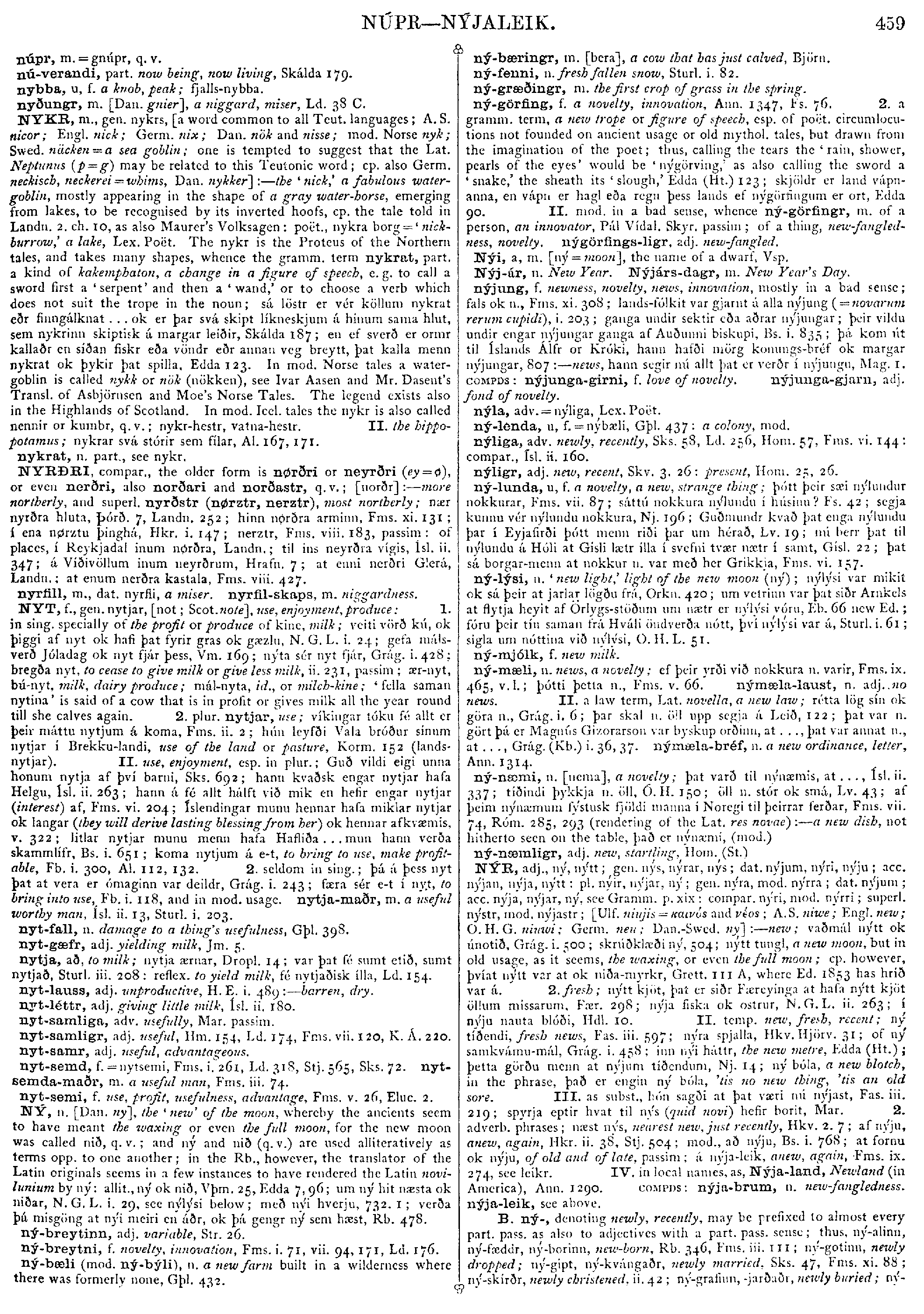
NÝSA,
t,
mod.
form
hnýsa,
see
introduction
to
letter
H
(B.
II.
2.
 );
[akin
to
njósn]
:--
to
pry,
enquire;
nýsta
ek
niðr,
Hm.
140;
svá
nýsisk
fróðra
hverr
fyrr,
7;
nýsumk
hins,
ok
hygg
at
því,
Stor.
13:
mod.
hnýsa,
forvitnin
holdsins
hnýsir
þrátt
í
Herrans
leyndar-dóma,
Pass.
21.
2.
II.
reflex.,
hnýsast
í
e-ð,
to
pry
into;
hnýsast
í
bréfið,
to
pry
into
a
letter;
hence
hnýsinn,
adj.
curious,
in
a
bad
sense;
hnýsni,
curiosity.
);
[akin
to
njósn]
:--
to
pry,
enquire;
nýsta
ek
niðr,
Hm.
140;
svá
nýsisk
fróðra
hverr
fyrr,
7;
nýsumk
hins,
ok
hygg
at
því,
Stor.
13:
mod.
hnýsa,
forvitnin
holdsins
hnýsir
þrátt
í
Herrans
leyndar-dóma,
Pass.
21.
2.
II.
reflex.,
hnýsast
í
e-ð,
to
pry
into;
hnýsast
í
bréfið,
to
pry
into
a
letter;
hence
hnýsinn,
adj.
curious,
in
a
bad
sense;
hnýsni,
curiosity.
|
Source: Cleasby/Vigfusson, page b0462, entry 2 View original page image as: [TIFF] [PNG] [View previous entry] [View next entry] |
[Comment on this entry] [View comments] |
The following entry has been hand-corrected once. |
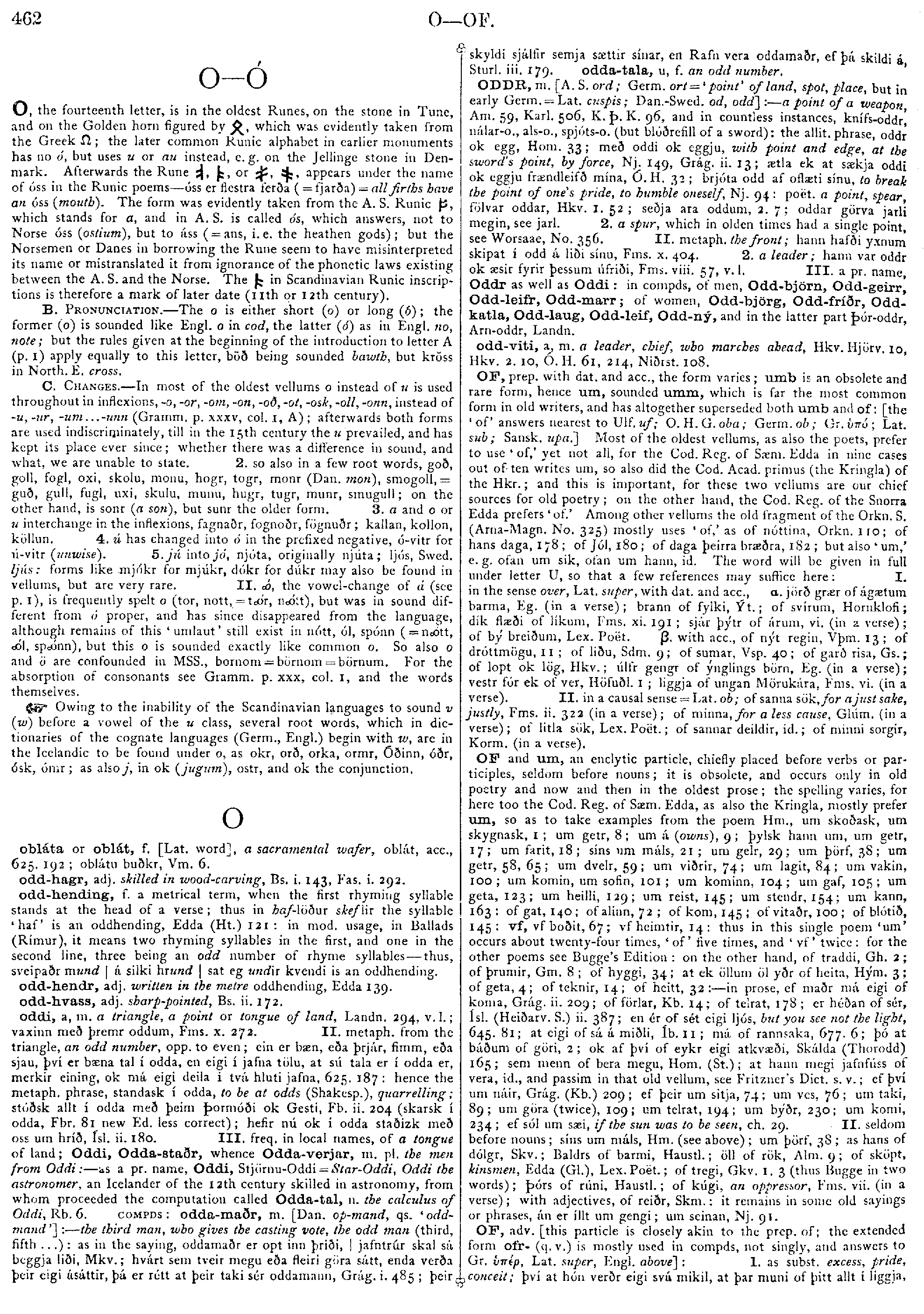
O,
the
fourteenth
letter,
is
in
the
oldest
Runes,
on
the
stone
in
Tune,
and
on
the
Golden
horn
figured
by
RUNE,
which
was
evidently
taken
from
the
Greek
Ω
the
later
common
Runic
alphabet
in
earlier
monuments
has
no
ó,
but
uses
u
or
au
instead,
e.g.
on
the
Jellinge
stone
in
Denmark.
Afterwards
the
Rune
RUNE,
RUNE,
or
RUNE,
RUNE,
appears
under
the
name
of
óss
in
the
Runic
poems
--
óss
er
flestra
ferða
(=
fjarða)
=
all
firths
have
an
óss
(mouth).
The
form
was
evidently
taken
from
the
A.S.
Runic
RUNE,
which
stands
for
a,
and
in
A.S.
is
called
ós,
which
answers,
not
to
Norse
óss
(ostium),
but
to
áss
(=
ans,
i.e.
the
heathen
gods);
but
the
Norsemen
or
Danes
in
borrowing
the
Rune
seem
to
have
misinterpreted
its
name
or
mistranslated
it
from
ignorance
of
the
phonetic
laws
existing
between
the
A.S.
and
the
Norse.
The
RUNE
in
Scandinavian
Runic
inscriptions
is
therefore
a
mark
of
later
date
(11th
or
12th
century).
B.
PRONUNCIATION.
--
The
o
is
either
short
(o)
or
long
(ó);
the
former
(o)
is
sounded
like
Engl.
o
in
cod,
the
latter
(ó)
as
in
Engl.
no,
note;
but
the
rules
given
at
the
beginning
of
the
introduction
to
letter
A
(p.
l)
apply
equally
to
this
letter,
b ð
being
sounded
bawth,
but
kr
ð
being
sounded
bawth,
but
kr ss
in
North.
E.
cross.
C.
CHANGES.
--
In
most
of
the
oldest
vellums
o
instead
of
u
is
used
throughout
in
inflexions,
-o,
-or,
-om,
-on,
-oð,
-ot,
-osk,
-oll,
-onn,
instead
of
-u,
-ur,
-um
...
-unn
(Gramm.
p.
xxxv,
col.
1,
A);
afterwards
both
forms
are
used
indiscriminately,
till
in
the
15th
century
the
u
prevailed,
and
has
kept
its
place
ever
since;
whether
there
was
a
difference
in
sound,
and
what,
we
are
unable
to
state.
2.
so
also
in
a
few
root
words,
goð,
goll,
fogl,
oxi,
skolu,
monu,
hogr,
togr,
monr
(Dan.
mon),
smogoll,
=
guð,
gull,
fugl,
uxi,
skulu,
munu,
hugr,
tugr,
munr,
smugull;
on
the
other
hand,
is
sonr
(a
son),
but
sunr
the
older
form.
3.
a
and
o
or
u
interchange
in
the
inflexions,
fagnaðr,
fognoðr,
fögnuðr;
kallan,
kollon,
köllun.
4.
ú
has
changed
into
ó
in
the
prefixed
negative,
ó-vitr
for
ú-vitr
(unwise).
5.
jú
into
jó,
njóta,
originally
njúta;
ljós,
Swed.
ljús:
forms
like
mjókr
for
mjúkr,
dókr
for
dúkr
may
also
be
found
in
vellums,
but
are
very
rare.
II.
ss
in
North.
E.
cross.
C.
CHANGES.
--
In
most
of
the
oldest
vellums
o
instead
of
u
is
used
throughout
in
inflexions,
-o,
-or,
-om,
-on,
-oð,
-ot,
-osk,
-oll,
-onn,
instead
of
-u,
-ur,
-um
...
-unn
(Gramm.
p.
xxxv,
col.
1,
A);
afterwards
both
forms
are
used
indiscriminately,
till
in
the
15th
century
the
u
prevailed,
and
has
kept
its
place
ever
since;
whether
there
was
a
difference
in
sound,
and
what,
we
are
unable
to
state.
2.
so
also
in
a
few
root
words,
goð,
goll,
fogl,
oxi,
skolu,
monu,
hogr,
togr,
monr
(Dan.
mon),
smogoll,
=
guð,
gull,
fugl,
uxi,
skulu,
munu,
hugr,
tugr,
munr,
smugull;
on
the
other
hand,
is
sonr
(a
son),
but
sunr
the
older
form.
3.
a
and
o
or
u
interchange
in
the
inflexions,
fagnaðr,
fognoðr,
fögnuðr;
kallan,
kollon,
köllun.
4.
ú
has
changed
into
ó
in
the
prefixed
negative,
ó-vitr
for
ú-vitr
(unwise).
5.
jú
into
jó,
njóta,
originally
njúta;
ljós,
Swed.
ljús:
forms
like
mjókr
for
mjúkr,
dókr
for
dúkr
may
also
be
found
in
vellums,
but
are
very
rare.
II.
 ,
the
vowel-change
of
á
(see
p.
1),
is
frequently
spelt
o
(tor,
nott,
=
tr,
ntt),
but
was
in
sound
different
from
ó
proper,
and
has
since
disappeared
from
the
language,
although
remains
of
this
'umlaut'
still
exist
in
nótt,
ól,
spónn
(=
ntt,
l,
spnn),
but
this
o
is
sounded
exactly
like
common
o.
So
also
o
and
ö
are
confounded
in
MSS.,
bornom
=
börnom
=börnum.
For
the
absorption
of
consonants
see
Gramm.
p.
xxx,
col.
1,
and
the
words
themselves.
&FINGER;
Owing
to
the
inability
of
the
Scandinavian
languages
to
sound
v
(w)
before
a
vowel
of
the
u
class,
several
root
words,
which
in
dictionaries
of
the
cognate
languages
(Germ.,
Engl.)
begin
with
w,
are
in
the
Icelandic
to
be
found
under
o,
as
okr,
orð,
orka,
ormr,
Óðinn,
óðr,
ósk,
ómr;
as
also
j,
in
ok
(jugum),
ostr,
and
ok
the
conjunction.
,
the
vowel-change
of
á
(see
p.
1),
is
frequently
spelt
o
(tor,
nott,
=
tr,
ntt),
but
was
in
sound
different
from
ó
proper,
and
has
since
disappeared
from
the
language,
although
remains
of
this
'umlaut'
still
exist
in
nótt,
ól,
spónn
(=
ntt,
l,
spnn),
but
this
o
is
sounded
exactly
like
common
o.
So
also
o
and
ö
are
confounded
in
MSS.,
bornom
=
börnom
=börnum.
For
the
absorption
of
consonants
see
Gramm.
p.
xxx,
col.
1,
and
the
words
themselves.
&FINGER;
Owing
to
the
inability
of
the
Scandinavian
languages
to
sound
v
(w)
before
a
vowel
of
the
u
class,
several
root
words,
which
in
dictionaries
of
the
cognate
languages
(Germ.,
Engl.)
begin
with
w,
are
in
the
Icelandic
to
be
found
under
o,
as
okr,
orð,
orka,
ormr,
Óðinn,
óðr,
ósk,
ómr;
as
also
j,
in
ok
(jugum),
ostr,
and
ok
the
conjunction.
|
Source: Cleasby/Vigfusson, page b0472, entry 16 View original page image as: [TIFF] [PNG] [View previous entry] [View next entry] |
[Comment on this entry] [View comments] |
The following entry has been hand-corrected once. |
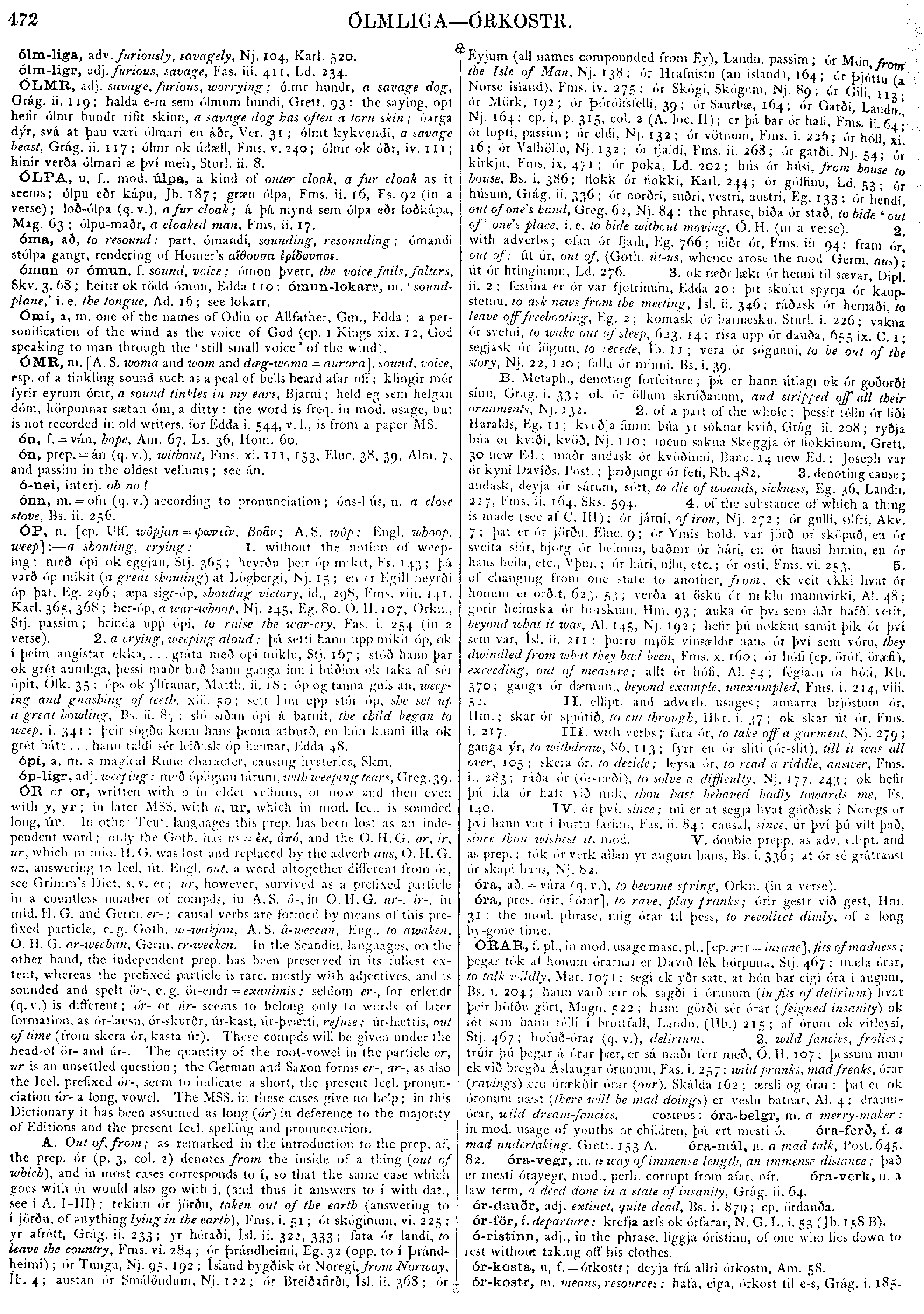
ÓR or or, written with o in older vellums, or now and then even with y, yr; in later MSS. with u, ur, which in mod. Icel. is sounded long, úr. In other Teut. languages this prep. has been lost as an independent word; only the Goth. has us = GREEK, and the O.H.G. ar, ir, ur, which in mid. H.G. was lost and replaced by the adverb aus, O.H.G. uz, answering to Icel. út. Engl. out, a word altogether different from ór, see Grimm's Dict. s.v. er; ur, however, survived as a prefixed particle in a countless number of compds, in A.S. â-, in O.H.G. ar-, ir-, in mid. H.G. and Germ. er-; causal verbs are formed by means of this prefixed particle, e.g. Goth. us-wakjan, A.S. â-weccan, Engl. to awaken, O.H.G. ar-wechan, Germ. er-wecken. In the Scandin. languages, on the other hand, the independent prep. has been preserved in its fullest extent, whereas the prefixed particle is rare, mostly wiih adjectives, and is sounded and spelt ör-, e.g. ör-endr = exanimis; seldom er-, for erlendr (q.v.) is different; ór- or úr- seems to belong only to words of later formation, as ór-lausn, ór-skurðr, úr-kast, úr-þvætti, refuse; úr-hættis, out of time (from skera ór, kasta úr). These compds will be given under the head of ör- and úr-. The quantity of the root-vowel in the particle or, ur is an unsettled question; the German and Saxon forms er-, ar-, as also the Icel. prefixed ör-, seem to indicate a short, the present Icel. pronunciation úr- a long, vowel. The MSS. in these cases give no help; in this Dictionary it has been assumed as long (ór) in deference to the majority of Editions and the present Icel. spelling and pronunciation. A. Out of, from; as remarked in the introduction to the prep. af, the prep. ór (p. 3, col. 2) denotes from the inside of a thing (out of which), and in most cases corresponds to í, so that the same case which goes with ór would also go with í, (and thus it answers to í with dat., see í A. I-III); tekinn ór jörðu, taken out of the earth (answering to í jörðu, of anything lying in the earth), Fms. i. 51; ór skóginum, vi. 225; yr afrétt, Grág. ii. 233; yr héraði, Ísl. ii. 322, 333; fara ór landi, to leave the country, Fms. vi. 284; ór Þrándheimi, Eg. 32 (opp. to í Þrándheimi); ór Tungu, Nj. 95, 192; Ísland bygðisk ór Noregi. from Norway, Íb. 4; austan ór Smálöndum, Nj. 122; ór Breiðafirði, Ísl. ii. 368; ór Eyjum (all names compounded from Ey), Landn. passim; ór Mön, from the Isle of Man, Nj. 138; ór Hrafnistu (an island), 164; ór Þjóttu (a Norse island), Fms. iv. 275; ór Skógi, Skógum, Nj. 89; ór Gili, 113; ór Mörk, 192; ór Þórólfsfelli, 39; ór Saurbæ, 164; ór Garði, Landn., Nj. 164; cp. i, p. 315, col. 2 (A. loc. II); er þá bar ór hafi, Fms. ii. 64; ór lopti, passim; úr eldi, Nj. 132; ór vötnum, Fms. i. 226; ór höll, xi. 16; ór Valhöllu, Nj. 132; ór tjaldi, Fms. ii. 268; ór garði, Nj. 54; ór kirkju, Fms. ix. 471; ór poka, Ld. 202; hús ór húsi, from house to house, Bs. i. 386; flokk ór flokki, Karl. 244; ór gólfinu, Ld. 53; ór húsum, Grág. ii. 336; ór norðri, suðri, vestri, austri, Eg. 133: ór hendi, out of one's hand, Greg. 62, Nj. 84: the phrase, bíða ór stað, to bide 'out of' one's place, i.e. to bide without moving, Ó.H. (in a verse). 2. with adverbs; ofan ór fjalli, Eg. 766: niðr ór, Fms. iii 94; fram ór, out of; út úr, out of, (Goth. ût-;us, whence arose the mod Germ. aus); út ór hringinum, Ld. 276. 3. ok ræðr lækr ór henni til sævar, Dipl. ii. 2; festina er ór var fjötrinum, Edda 20; þit skulut spyrja ór kaupstefnu, to ask news from the meeting, Ísl. ii. 346; ráðask ór hernaði, to leave off freebooting, Eg. 2; komask ór barnæsku, Sturl. i. 226; vakna ór svefni, to wake out of sleep, 623. 14; rísa upp ór dauða, 655 ix. C. 1; segjask ór lögum, to secede, Íb. 11; vera ór sögunni, to be out of the story, Nj. 22, 120; falla ór minni, Bs. i. 39. B. Metaph., denoting forfeiture; þá er hann útlagr ok ór goðorði sínu, Grág. i. 33; ok ór öllum skrúðanum, and stripped off all their ornaments, Nj. 132. 2. of a part of the whole; þessir téllu ór liði Haralds, Eg. 11; kveðja fimm búa yr sóknar kvið, Grág ii. 208; ryðja búa ór kviði, kvöð, Nj. 110; menn sakna Skeggja ór flokkinum, Grett. 30 new Ed.; maðr andask ór kvöðinni, Band. 14 new Ed.; Joseph var ór kyni Davíðs, Post.; þriðjungr ór feti, Rb. 482. 3. denoting cause; andask, deyja ór sárum, sótt, to die of wounds, sickness. Eg. 36, Landn. 217, Fms. ii. 164, Sks. 594. 4. of the substance of which a thing is made (see af C. III); ór járni, of iron, Nj. 272; ór gulli, silfri, Akv. 7; þat er ór jörðu, Eluc. 9; ór Ymis holdi var jörð of sköpuð, en ór sveita siár, björg or beinum, baðinr ór hari, en or hausi himin, en or hans heila, etc., Vþm.; úr hári, ullu, etc.; ór osti, Fms. vi. 253. 5. of changing from one state to another, from; ek veil ekki hvat ór honum er orðit, 623. 53; verða at ösku ór miklu mannvirki, Al. 48; görir heimska ór herskum, Hm. 93; auka ór því sem áðr hafði verit, beyond what it was, Al. 145, Nj. 192; hefir þú nokkut samit þik ór því sem var, Ísl. ii. 211: þurru mjök vinsældir hans ór því sem vóru, they dwindled from what they had been, Fms. x. 160; ór hófi (cp. öróf, öræfi), exceeding, out of measure; allt ór hófi, Al. 54; fégjarn ór hófi, Rb. 370; ganga ór dæmum, beyond example, unexampled. Fms. i. 214, viii. 52. II. ellipt. and adverb. usages; annarra brjóstum ór, Hm.; skar ór spjótið, to cut through, Hkr. i. 37; ok skar út ór, Fms. i. 217. III. with verbs; fara ór, to take off a garment, Nj. 279; ganga ýr, to withdraw, 86, 113; fyrr en ór sliti (ór-slit), till it was all over, 105; skera ór, to decide; leysa ór, to read a riddle, answer, Fms. ii. 283; ráða ór (ór-ræði), to solve a difficulty, Nj. 177, 243; ok hefir þú ílla ór haft við mik, thou hast behaved badly towards me, Fs. 140. IV. ór því, since; nú er at segja hvat görðisk í Noregs ór því hann var í burtu farinn, Fas. ii. 84: causal, since, úr því þú vilt það, since thou wishest it, mod. V. double prepp. as adv. ellipt. and as prep.; tók ór verk allan yr augum hans, Bs. i. 336; at ór sé grátraust ór skapi hans, Nj. 82.
|
Source: Cleasby/Vigfusson, page b0473, entry 22 View original page image as: [TIFF] [PNG] [View previous entry] [View next entry] |
[Comment on this entry] [View comments] |
The following entry has been hand-corrected once. |
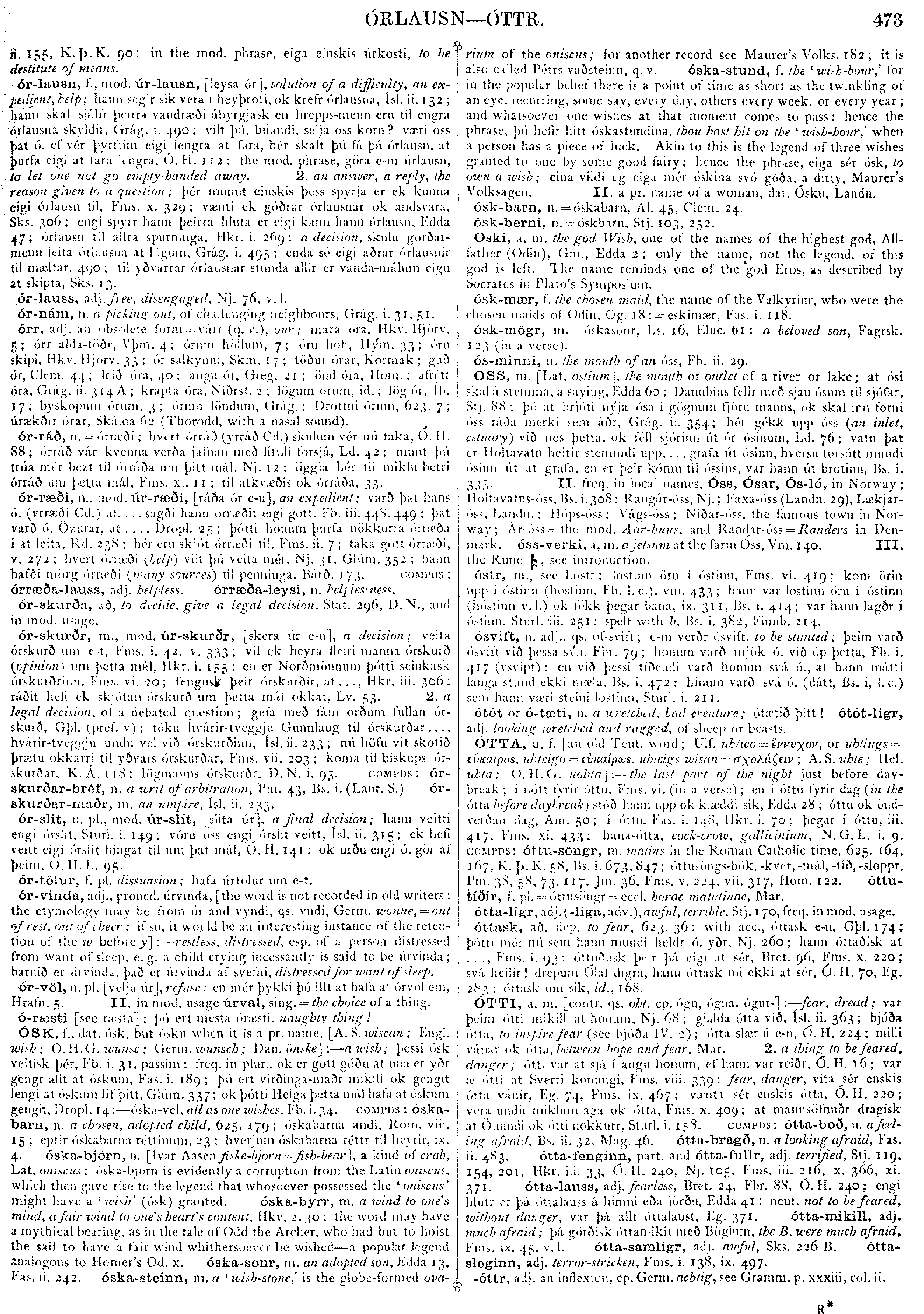
ÓSS, m. [Lat. ostium], the mouth or outlet of a river or lake; at ósi skal á stemma, a saying;, Edda 60; Danubius fellr með sjau ósum til sjófar, Stj. 88; þó at brjóti nýja ósa í gögnum fjöru manns, ok skal inn forni óss ráða merki sem áðr, Grág. ii. 354; hér gékk upp óss (an inlet, estuary) við nes þetta, ok féll sjórinn út ór ósinum, Ld. 76; vatn þat er Holtavatn heitir stemmdi upp, ... grafa út ósinn, hversu torsótt mundi ósinn út at grafa, en er þeir kómu til óssins, var hann út brotinn, Bs. i. 333. II. freq. in local names. Óss, Ósar, Ós-ló, in Norway; Holtavatns-óss, Bs. i. 308; Rangár-óss, Nj.; Faxa-óss (Landn. 29), Lækjar-óss, Landn.; Hóps-óss; Vágs-óss; Niðar-óss, the famous town in Norway; Ár-óss = the mod. Aar-huus, and Randar-óss = Randers in Denmark, óss-verki, a, m. a jetsum at the farm Óss, Vm. 140. III. the Rune RUNE, see introduction.
|
Source: Cleasby/Vigfusson, page b0474, entry 2 View original page image as: [TIFF] [PNG] [View previous entry] [View next entry] |
[Comment on this entry] [View comments] |
The following entry has been hand-corrected once. |
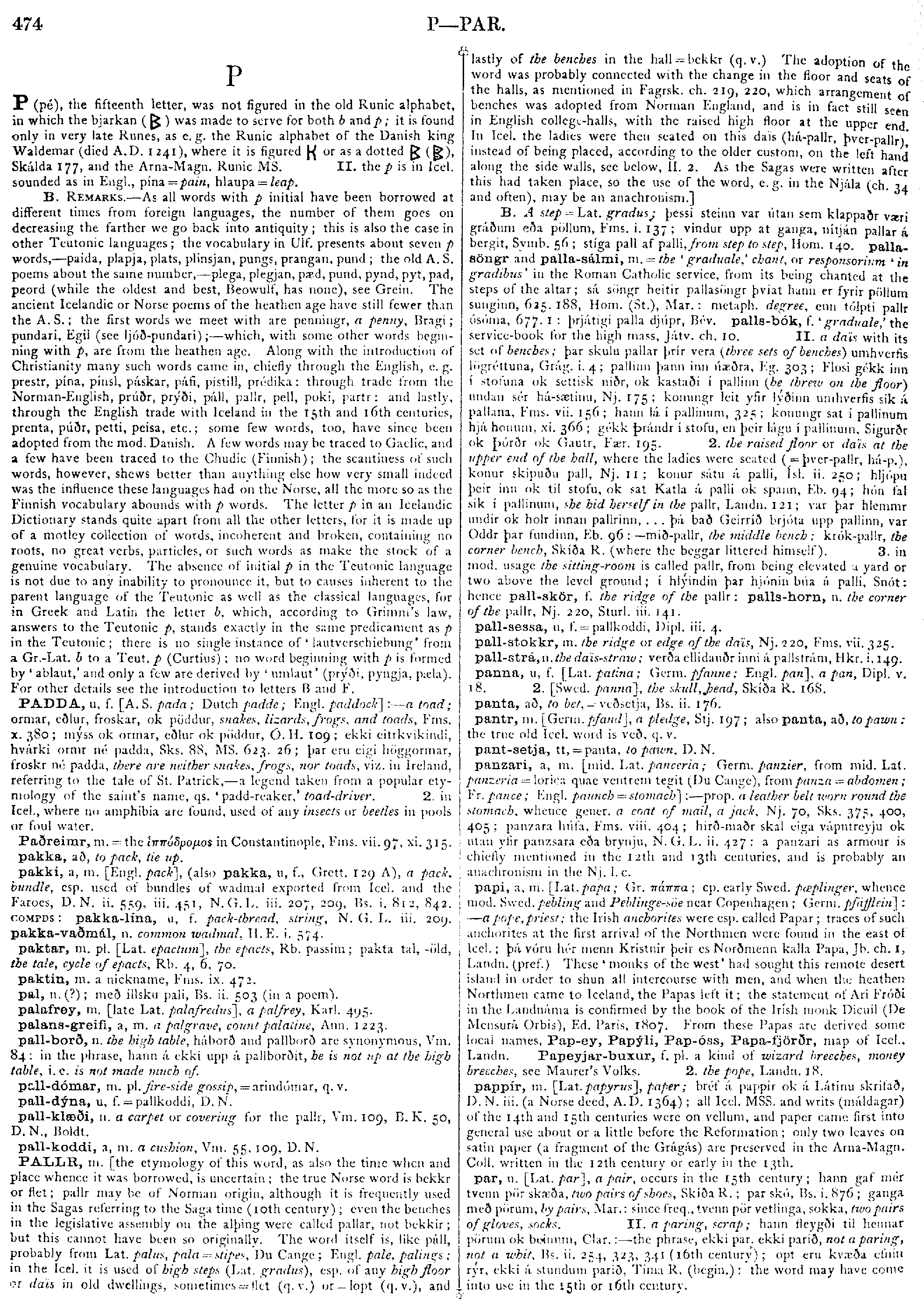
P (pé), the fifteenth letter, was not figured in the old Runic alphabet, in which the bjarkan (RUNE) was made to serve for both b and p; it is found only in very late Runes, as e.g. the Runic alphabet of the Danish king Waldemar (died A.D. 1241), where it is figured RUNE or as a dotted RUNE (RUNE), Skálda 177, and the Arna-Magn. Runic MS. II. the p is in Icel. sounded as in Engl., pína = pain, hlaupa = leap. B. REMARKS. -- As all words with p initial have been borrowed at different times from foreign languages, the number of them goes on decreasing the farther we go back into antiquity; this is also the case in other Teutonic languages; the vocabulary in Ulf. presents about seven p words, -- paida, plapja, plats, plinsjan, pungs, prangan, pund; the old A.S. poems about the same number, -- plega, plegjan, pæd, pund, pynd, pyt, pad, peord (while the oldest and best, Beowulf, has none), see Grein. The ancient Icelandic or Norse poems of the heathen age have still fewer than the A.S.; the first words we meet with are penningr, a penny, Bragi; pundari, Egil (see ljóð-pundari); -- which, with some other words beginning with p, are from the heathen age. Along with the introduction of Christianity many such words came in, chiefly through the English, e.g. prestr, pína, pínsl, páskar, páfi, pistill, prédika: through trade from the Norman-English, prúðr, prýði, páll, pallr, pell, poki, partr: and lastly, through the English trade with Iceland in the 15th and 16th centuries, prenta, púðr, petti, peisa, etc.: some few words, too, have since been adopted from the mod. Danish. A few words may be traced to Gaelic, and a few have been traced to the Chudic (Finnish); the scantiness of such words, however, shews better than anything else how very small indeed was the influence these languages had on the Norse, all the more so as the Finnish vocabulary abounds with p words. The letter p in an Icelandic Dictionary stands quite apart from all the other letters, for it is made up of a motley collection of words, incoherent and broken, containing no roots, no great verbs, particles, or such words as make the stock of a genuine vocabulary. The absence of initial p in the Teutonic language is not due to any inability to pronounce it, but to causes inherent to the parent language of the Teutonic as well as the classical languages, for in Greek and Latin the letter b, which, according to Grimm's law, answers to the Teutonic p, stands exactly in the same predicament as p in the Teutonic; there is no single instance of 'lautverschiebung' from a Gr.-Lat. b to a Teut. p (Curtius): no word beginning with p is formed by 'ablaut,' and only a few are derived by 'umlaut' (prýði, pyngja, pæla). For other details see the introduction to letters B and F.
| Result Page: |  |
Previous | 1 2 3 4 5 6 7 8 9 | Next |  |
Germanic Lexicon Project (main page)
This search system was written by
Sean Crist
Please consider
volunteering
to correct the data in these online dictionaries.
No rights reserved. Feel free to use these data in any way you please.