|
|

Search for I- again, using less strict matching (19 results)
|
Source: Cleasby/Vigfusson, page b0115, entry 13 View original page image as: [TIFF] [PNG] [View previous entry] [View next entry] |
[Comment on this entry] [View comments] |
The following entry has not been hand-corrected. However, the page is reserved and someone is correcting it. |
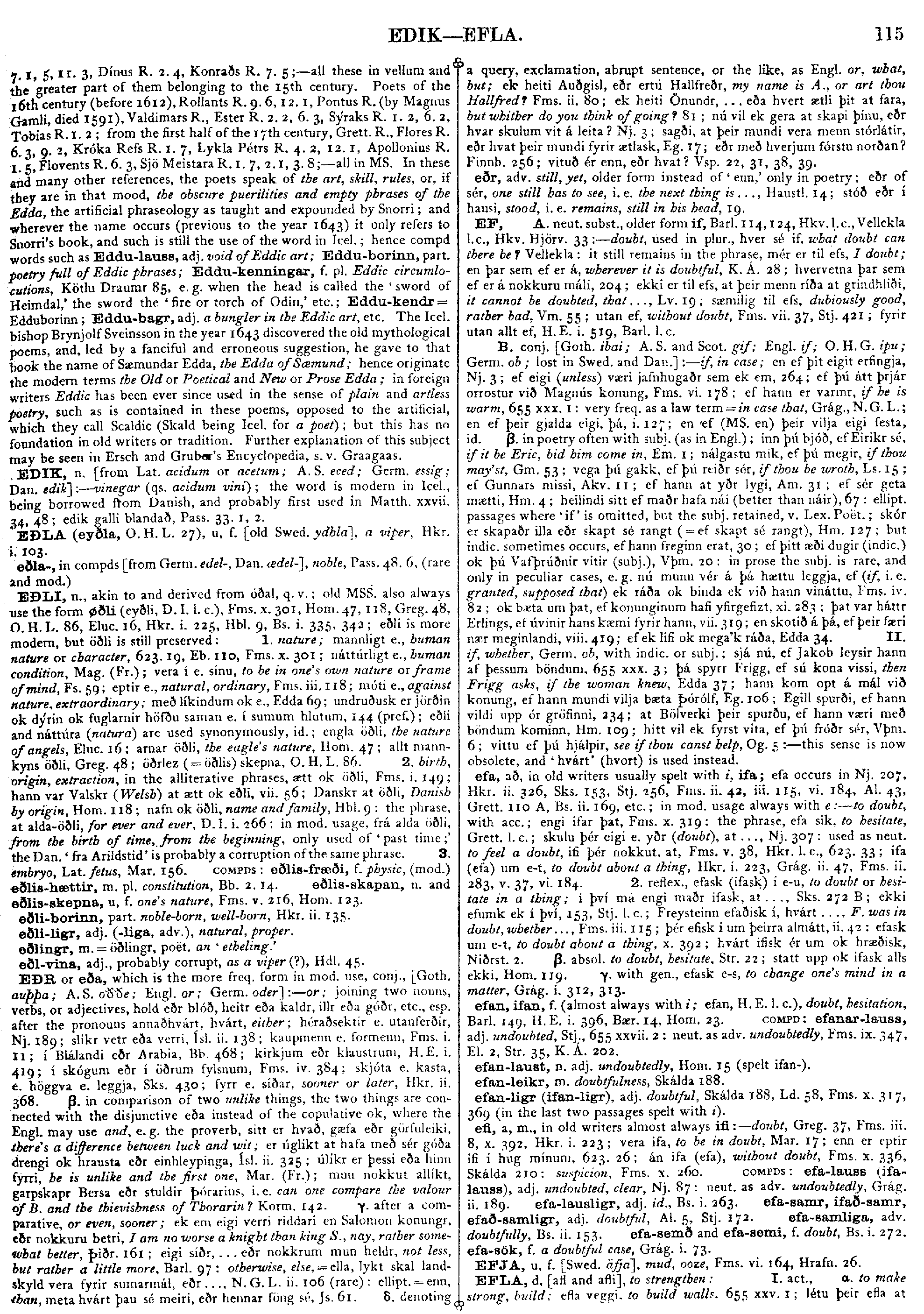
efa, að, in old writers usually spelt with i, ifa; efa occurs in Nj. 207, Hkr. ii. 326, Sks. 153, Stj. 256, Fms. ii. 42, iii. 115, vi. 184, Al. 43, Grett. no A, Bs. ii. 169, etc.; in mod. usage always with e :-- to doubt, with acc.; engi ifar þat, Fms. x. 319: the phrase, efa sik, to hesitate, Grett. 1. c.; skulu þér eigi e. yðr (doubt), at ..., Nj. 307: used as neut. to feel a doubt, ifi þér nokkut, at, Fms. v. 38, Hkr. I. e., 623. 33; ifa (efa) um e-t, to doubt about a thing, Hkr. i. 223, Grág. ii. 47, Fms. ii. 283, v. 37, vi. 184. 2. reflex., efask (ifask) í e-u, to doubt or he s i- tate in a thing; í því má engi maðr ifask, at ..., Sks. 272 B; ekki efumk ek í því, 153, Stj. 1. c.; Freysteinn efaðisk í, hvárt ..., F. was in doubt, whether..., Fms. iii. 115; þér efisk í um þeirra almátt, ü. 42: efask um e-t, to doubt about a thing, x. 392; hvárt ifisk er um ok hræðisk, Niðrst. 2. p. absol. to doubt, hesitate, Sir. 22; statt upp ok ifask alls ekki, Hom. 119. y. with gen., efask e-s, to change one's mind in a matter, Grág. i. 312, 313.
|
Source: Cleasby/Vigfusson, page b0248, entry 23 View original page image as: [TIFF] [PNG] [View previous entry] [View next entry] |
[Comment on this entry] [View comments] |
The following entry has not been hand-corrected. However, the page is reserved and someone is correcting it. |
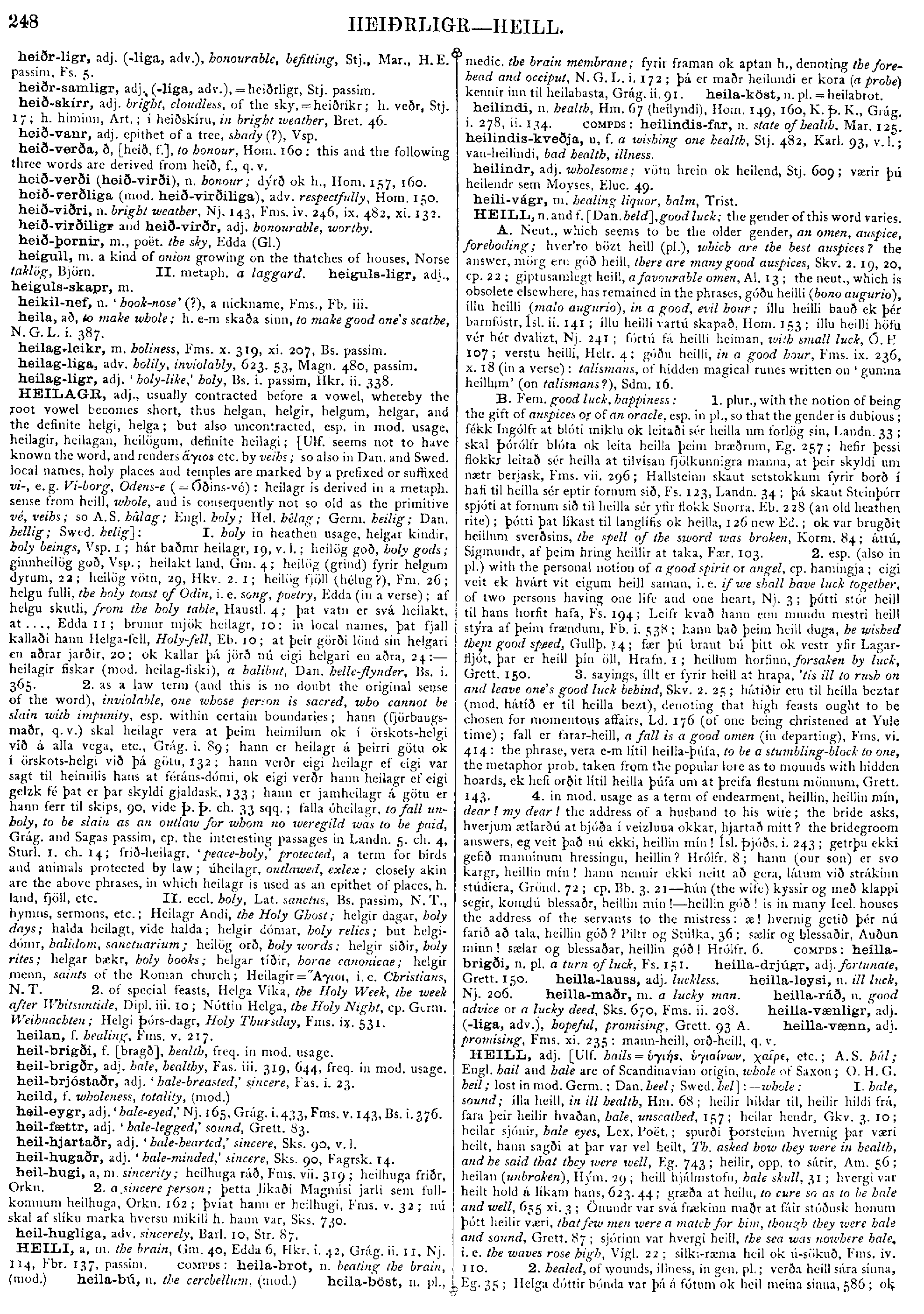
heil-eygr, adj. 'hale-eyed, ' Nj. 165, Grág. 1. 433, Fms. v. 143, Bs. i-376.
|
Source: Cleasby/Vigfusson, page b0380, entry 6 View original page image as: [TIFF] [PNG] [View previous entry] [View next entry] |
[Comment on this entry] [View comments] |
The following entry has not been hand-corrected. However, the page is reserved and someone is correcting it. |
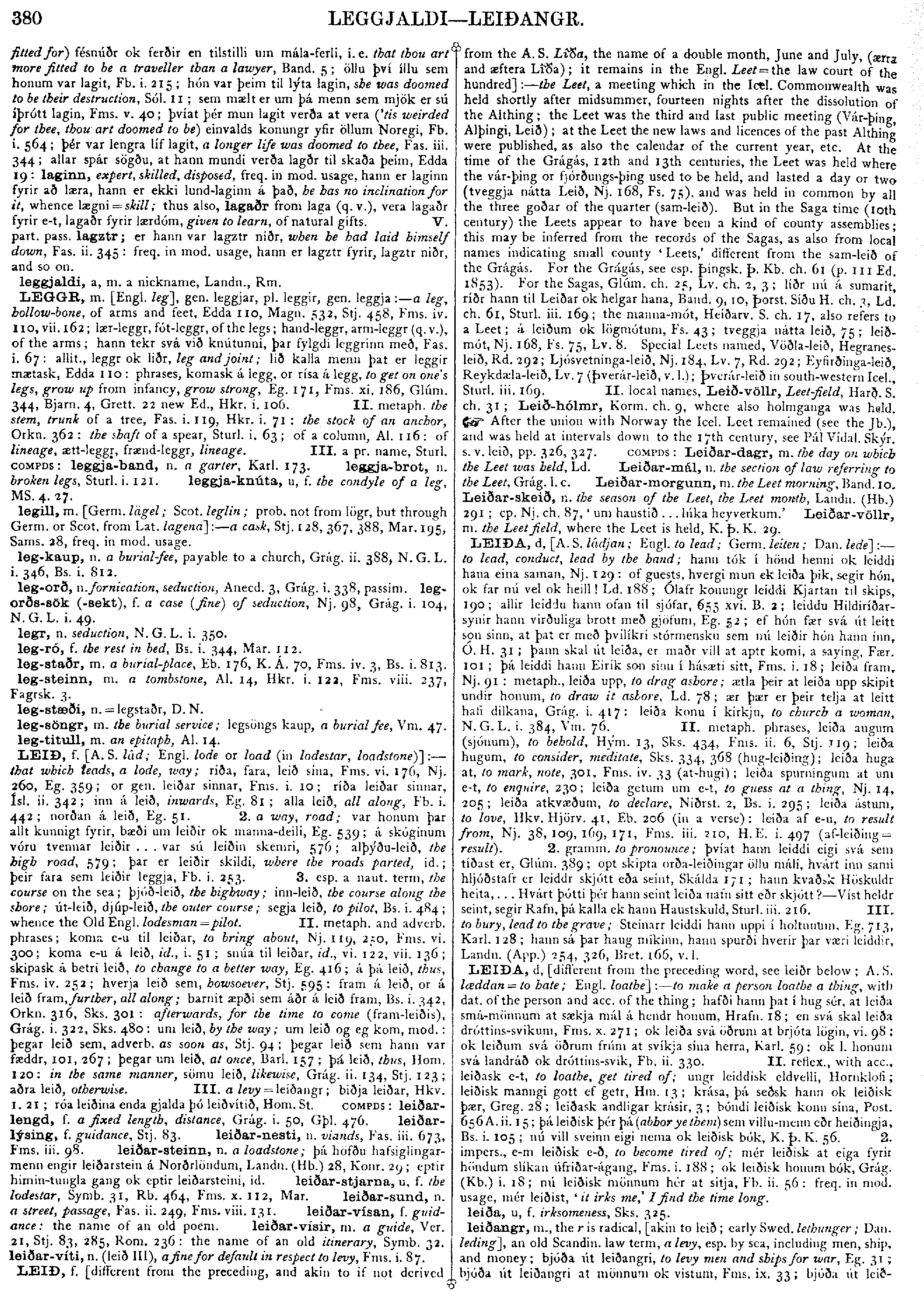
leg-orð, n. fornication, seduction, Anecd. 3, Grág. i. 338, passim, leg- orðs-sök (-sekt), f. a ca s e (fine) of seduction, Nj. 98, Grág. i. 104, N. G. L. i-49.
|
Source: Cleasby/Vigfusson, page b0387, entry 3 View original page image as: [TIFF] [PNG] [View previous entry] [View next entry] |
[Comment on this entry] [View comments] |
The following entry has not been hand-corrected. However, the page is reserved and someone is correcting it. |
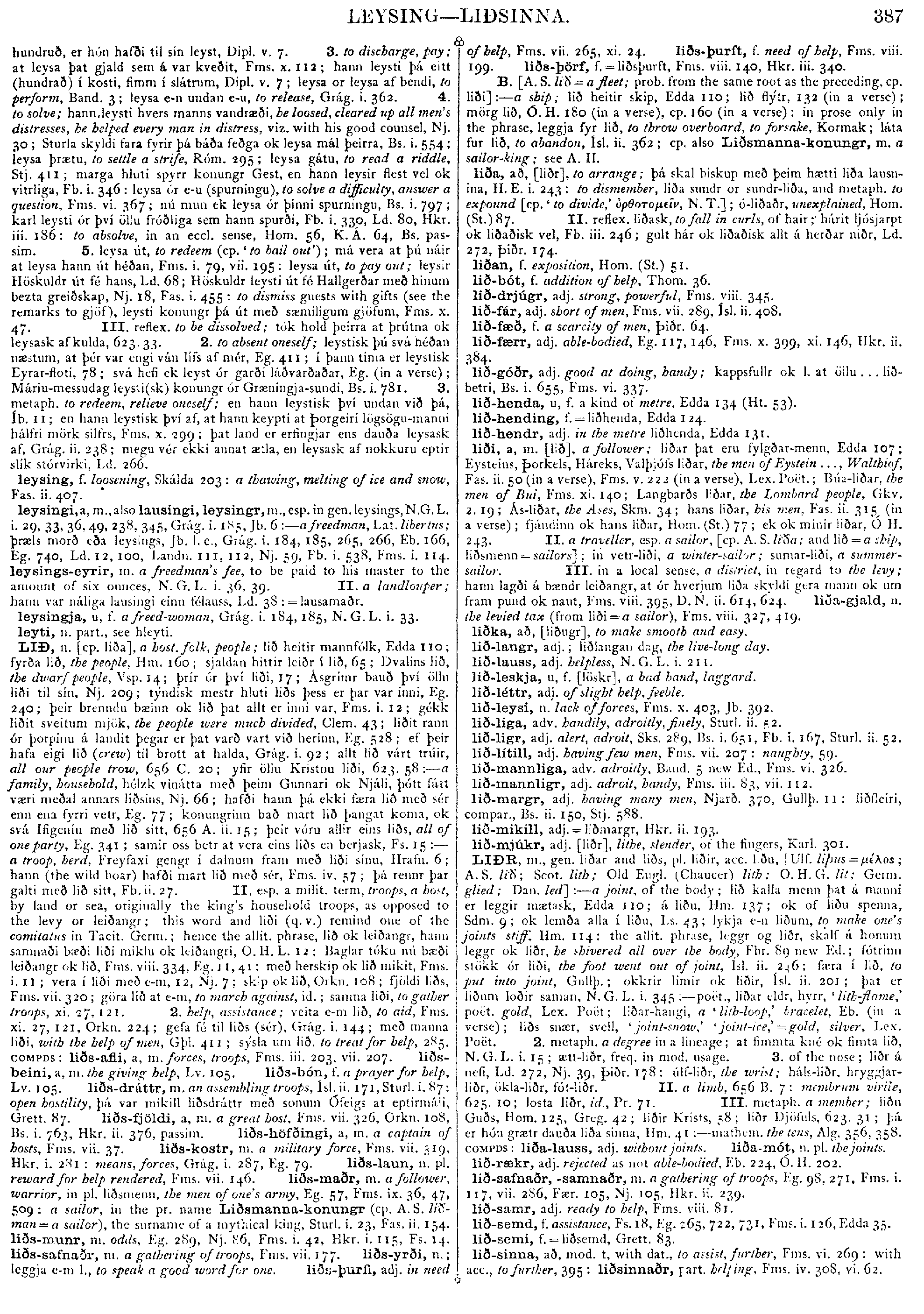
leysingi, a, m., a!solaitsingi, leysmgr, m., esp. in gen. leysings, N. G. L. i- 29. 33) 36, 49, 238, 345, Grág. i. 185, Jb. 6 :-- afreedman, Lat. libertus; þræls morð cða leysings, Jb. I. e., Grág. i. 184, 185, 265, 266, Eb. 166, Eg. 740, Ld. 12, 100, Landn. ill, 112, Nj. 59, Fb. i. 538, Fms. i. 114. leysings-eyrir, m. a freedman's fee, to be paid to his master to the amount of six ounces, N. G. I/, i. 36, 39. II. a landlouper; harm var náliga lausingi einn fclauss, Ld. 38: =
|
Source: Cleasby/Vigfusson, page b0408, entry 6 View original page image as: [TIFF] [PNG] [View previous entry] [View next entry] |
[Comment on this entry] [View comments] |
The following entry has not been hand-corrected. However, the page is reserved and someone is correcting it. |
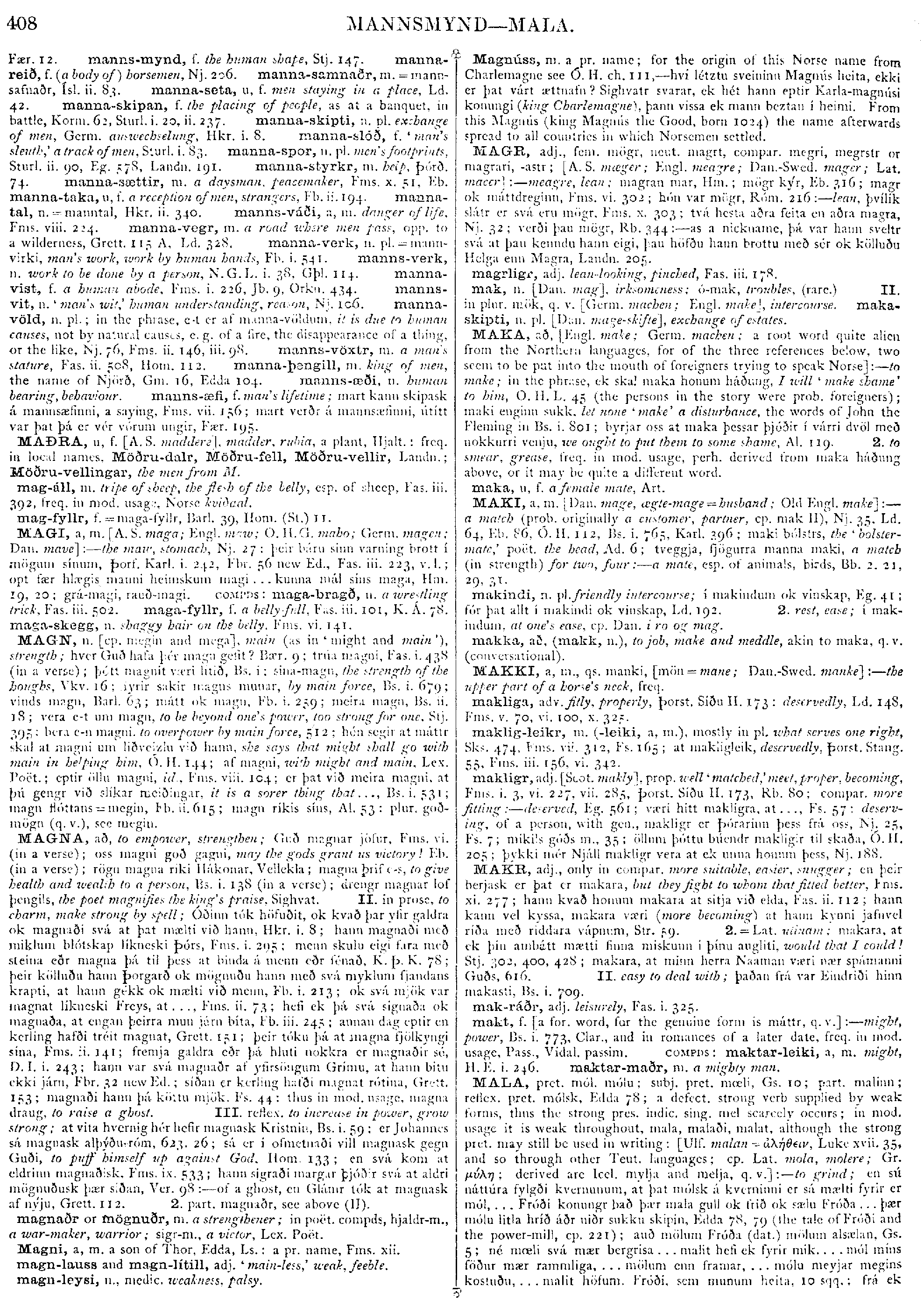
MAGN, n. [cp. mcgin and mega], main (as in 'might and main'), strength; hver Guð ha fa Jx'r inagu gefit? Birr. 9; tnia njagni, Fas. i-438 (in a verse); þett mas;nit VHTÍ litið, Bs. i; lina-magn, /be strength of the boughs, Vkv. 16; ivrir sakir ir. aims munar, by main force, Bs. i. 679; vinds inp. gn, Barl. 63; matt ok inagn, Fb. i. 25. 9; meira magn, Bs. ii. 18; vera e-t uni magn, to be beyond one's power, loo strong for one, Stj. 395: bi-ru e-n magni, to overpower by main force, 51 2; hen segir at mattr ska) at Jiiagni um liðvcivciu v^ð hann, she says that might shall go with main in he'ping him, O. II. 144; af maimi, wi'h might and main. Lex. Poët.; eptir öllu magni, id., Fms. viii. 104; er bat við ineira magni, at Jjú gengr við r-líkar ruciðingar, it i s a sorer thing that..., Bs. i. 531; magn tíóttans -- megin, frb. ii. 6i5; magn rikis sins, Al. 53: plur. goð- inögn (q. v.), see megin.
|
Source: Cleasby/Vigfusson, page b0408, entry 15 View original page image as: [TIFF] [PNG] [View previous entry] [View next entry] |
[Comment on this entry] [View comments] |
The following entry has not been hand-corrected. However, the page is reserved and someone is correcting it. |
mak, n. [Dan. mag] , irk^omeness: ó-mak, troubles, (rare.) II. in plur. iHok, (]. v. [Germ, machen; Engl. mn~i:e, intercourse. maka- skipti, n. pl. [I);-. n. nui^e-skifie'] , exchange of estates.
|
Source: Cleasby/Vigfusson, page b0409, entry 1 View original page image as: [TIFF] [PNG] [View previous entry] [View next entry] |
[Comment on this entry] [View comments] |
The following entry has not been hand-corrected. However, the page is reserved and someone is correcting it. |
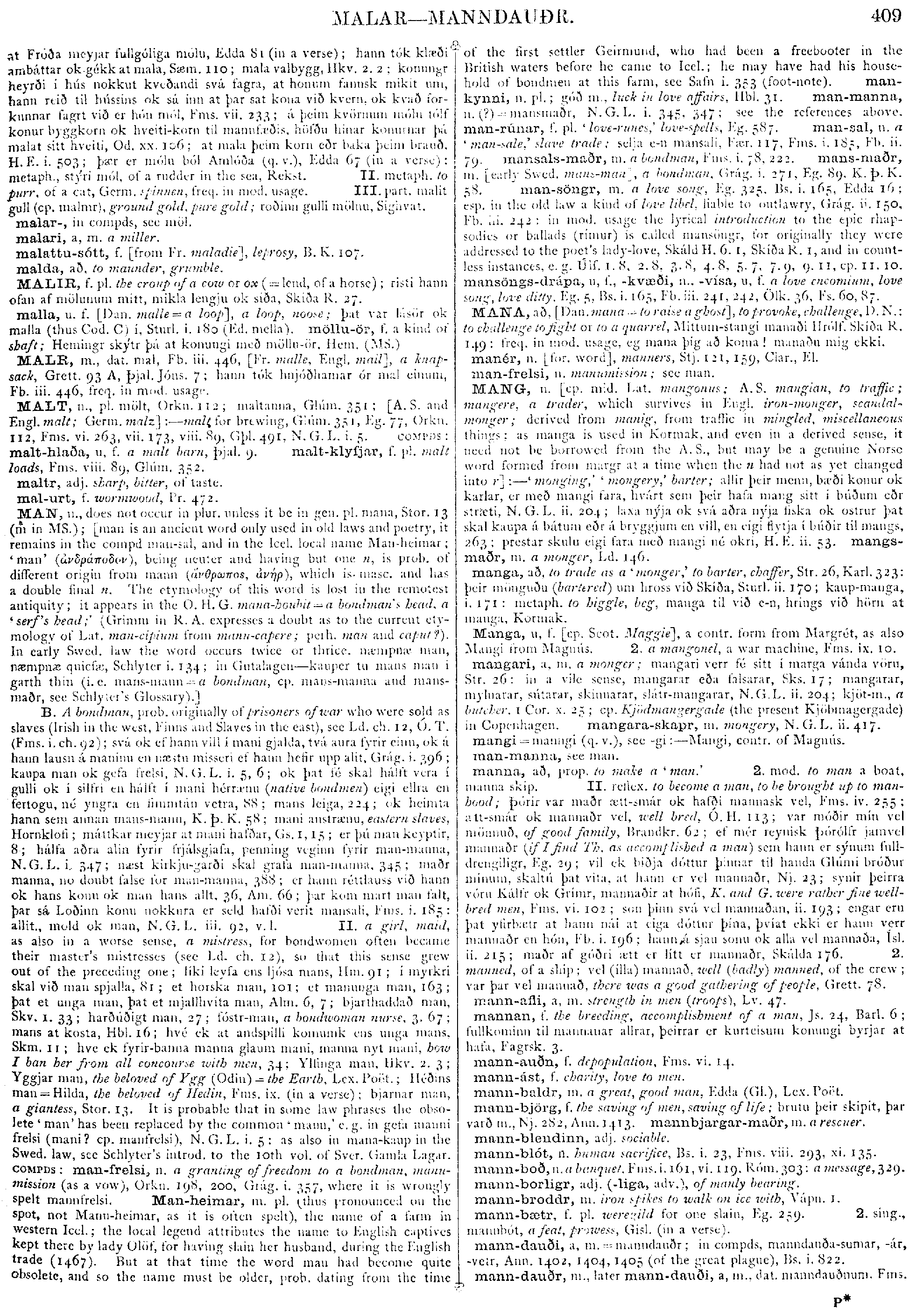
at Froða meyjar fullgóliga niolu, Edda Si (in a verse); hann tók klæði" ambáttar ok-gókk at mala, Sæin. 110; mala valbygg, Ilkv. 2. 2; konungr heyrði í hús nokkut kvtðandi svá, fagra, at honum fannsk mikit um, hann reið til hiissins ok sá inn at þar sat kona við kvern. ok kvað for- knnnar fagrt við er lion nu'-l, Fms. vii. 233; tl beim kvöriuun móln tólf konur byggkorn ok hveiti-korn til mannfæðis, hiifðu hinar konurnar þú malat sitt hveiti, Od. xx. 106; at mala þeim korn eðr baka þeim brauð, H. F. . i- 503; þ*r er mólu ból Arnlóôa (q. v.), Edda 67 (in a verse): nietaph., styri mól, of a rudder in the sea, Rek. it. II. metaph. to purr, ot a cat, Germ, spinnen, fre(]. in mod. usage. III. part, malit gull (cp. malmr), ground gold, pure gold; roðinn gulli miilnu, Sighvat.
| Result Page: |  |
Previous | 1 2 |
Germanic Lexicon Project (main page)
This search system was written by
Sean Crist
Please consider
volunteering
to correct the data in these online dictionaries.
No rights reserved. Feel free to use these data in any way you please.