|
|

Search for Hyre again, using less strict matching (556 results)
|
Source: Bosworth/Toller, page b0975, entry 6 View original page image as: [TIFF] [PNG] [View previous entry] [View next entry] |
[Comment on this entry] [View comments] |
The following entry has been hand-corrected once. |
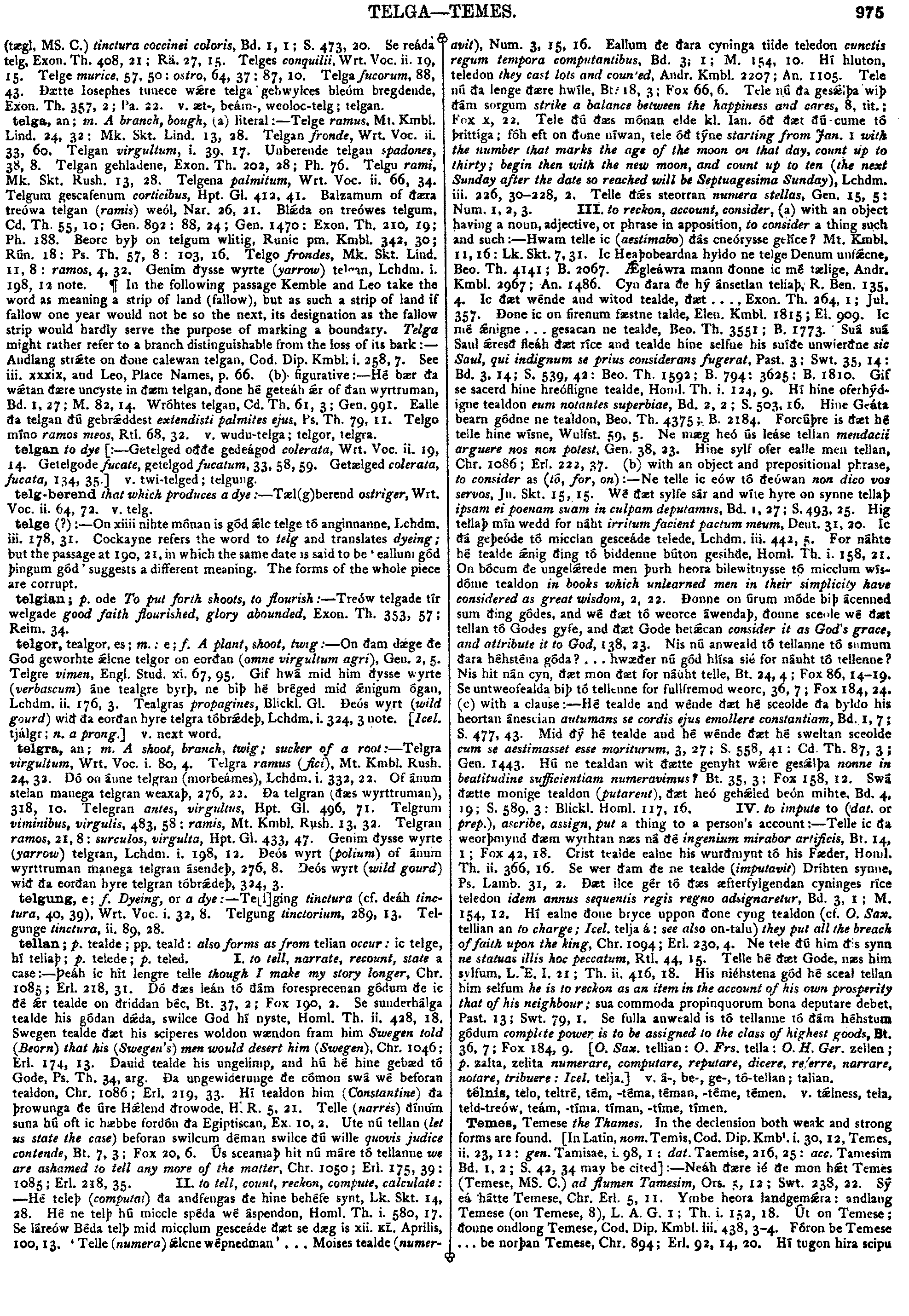
telgor,
tealgor,
es;
m.:
e;
f.
A
plant,
shoot,
twig
:--
On
ðam
dæge
ðe
God
geworhte
 lcne
telgor
on
eorðan
(omne
virgultum
agri),
Gen.
2,
5.
Telgre
vimen,
Engl.
Stud.
xi.
67,
95.
Gif
hwá
mid
him
ðysse
wyrte
(verbascum)
áne
tealgre
byrþ,
ne
biþ
hé
bréged
mid
nigum
ógan,
Lchdm.
ii.
176,
3.
Tealgras
propagines,
Blickl.
Gl.
Ðeós
wyrt
(wild
gourd)
wið
ða
eorðan
hyre
telgra
tóbrdeþ,
Lchdm.
i.
324,
3
note.
[Icel.
tjálgr;
n.
a
prong.]
v.
next
word.
lcne
telgor
on
eorðan
(omne
virgultum
agri),
Gen.
2,
5.
Telgre
vimen,
Engl.
Stud.
xi.
67,
95.
Gif
hwá
mid
him
ðysse
wyrte
(verbascum)
áne
tealgre
byrþ,
ne
biþ
hé
bréged
mid
nigum
ógan,
Lchdm.
ii.
176,
3.
Tealgras
propagines,
Blickl.
Gl.
Ðeós
wyrt
(wild
gourd)
wið
ða
eorðan
hyre
telgra
tóbrdeþ,
Lchdm.
i.
324,
3
note.
[Icel.
tjálgr;
n.
a
prong.]
v.
next
word.
|
Source: Bosworth/Toller, page b0975, entry 7 View original page image as: [TIFF] [PNG] [View previous entry] [View next entry] |
[Comment on this entry] [View comments] |
The following entry has been hand-corrected once. |
telgra,
an;
m.
A
shoot,
branch,
twig;
sucker
of
a
root
:--
Telgra
virgultum,
Wrt.
Voc.
i.
80,
4.
Telgra
ramus
(fici),
Mt.
Kmbl.
Rush.
24,
32.
Dó
on
ánne
telgran
(morbeámes),
Lchdm.
i.
332,
22.
Of
ánum
stelan
manega
telgran
weaxaþ,
276,
22.
Ða
telgran
(ðæs
wyrttruman),
318,
10.
Telegran
antes,
virgultus,
Hpt.
Gl.
496,
71.
Telgrum
viminibus,
virgulis,
483,
58:
ramis,
Mt.
Kntbl.
Rush.
13,
32.
Telgran
ramos,
21,
8:
surculos,
virgulta,
Hpt.
Gl.
433,
47.
Genim
ðysse
wyrte
(yarrow)
telgran,
Lchdnr.
i.
198,
12.
Ðeós
wyrt
(polium)
of
ánum
wyrttruman
manega
telgran
ásendeþ,
276,
8.
Ðeós
wyrt
(wild
gourd)
wið
ða
eorðan
hyre
telgran
tóbrdeþ,
324,
3.
|
Source: Bosworth/Toller, page b0975, entry 9 View original page image as: [TIFF] [PNG] [View previous entry] [View next entry] |
[Comment on this entry] [View comments] |
The following entry has been hand-corrected once. |
tellan;
p.
tealde;
pp.
teald:
also
forms
as
from
telian
occur:
ic
telge,
hí
teliaþ;
p.
telede;
p.
teled.
I.
to
tell,
narrate,
recount,
state
a
case
:--
Þeáh
ic
hit
lengre
telle
though
I
make
my
story
longer,
Chr.
1085;
Erl.
218,
31.
Dó
ðæs
lean
tó
ðám
foresprecenan
gódum
ðe
ic
ðe
r
tealde
on
ðriddan
béc,
Bt.
37,
2;
Fox
190,
2.
Se
sunderhálga
tealde
his
gódan
dda,
swilce
God
hí
nyste,
Homl.
Th.
ii.
428,
18.
Swegen
tealde
ðæt
his
sciperes
woldon
wændon
fram
him
Swegen
told
(Beorn)
that
his
(Swegen's)
men
would
desert
him
(Swegen),
Chr.
1046;
Erl.
174,
13.
Dauid
tealde
his
ungelimp,
and
hú
hé
hine
gebæd
tó
Gode,
Ps.
Th.
34,
arg.
Ða
ungewideruuge
ðe
cómon
swá
wé
beforan
tealdon,
Chr.
1086;
Erl.
219,
33.
Hí
tealdon
him
(Constantine)
ða
þrowunga
ðe
úre
Hlend
ðrowode,
H.
R.
5,
21.
Telle
(narres)
ðínum
suna
hú
oft
ic
hæbbe
fordón
ða
Egiptiscan,
Ex.
10,
2.
Ute
nú
tellan
(let
us
state
the
case)
beforan
swilcum
déman
swilce
ðú
wille
quovis
judice
contende,
Bt.
7,
3;
Fox
20,
6.
Ús
sceamaþ
hit
nú
máre
tó
tellanne
we
are
ashamed
to
tell
any
more
of
the
matter,
Chr.
1050;
Erl.
175,
39:
1085;
Erl.
218,
35.
II.
to
tell,
count,
reckon,
compute,
calculate
:--
Hé
teleþ
(computat)
ða
andfengas
ðe
hine
behéfe
synt,
Lk.
Skt.
14,
28.
Hé
ne
telþ
hú
miccle
spéda
wé
áspendon,
Homl.
Th.
i.
580,
17.
Se
láreów
Béda
telþ
mid
micclum
gesceáde
ðæt
se
dæg
is
xii.
KL.
Aprilis,
100,
13.
'Telle
(numera)
lcne
wépnedman'
...
Moises
tealde
(numeravit),
Num.
3,
15,
16.
Eallum
ðe
ðara
cyninga
tiide
teledon
cunctis
regum
tempora
computantibus,
Bd.
3;
1;
M.
154,
10.
Hí
hluton,
teledon
they
cast
lots
and
counted,
Andr.
Kmbl.
2207;
An.
1105.
Tele
nú
ða
lenge
ðære
hwíle,
Bt.
18,
3;
Fox
66,
6.
Tele
ðú
ða
geslþa
wiþ
ðám
sorgum
strike
a
balance
between
the
happiness
and
cares,
8,
tit.;
Fox
x,
22.
Tele
ðú
ðæs
mónan
elde
kl.
Ian.
ód
ðæt
ðú
cume
tó
þrittiga;
fóh
eft
on
ðone
níwan,
tele
óð
týne
starting
from
Jan.
1
with
the
number
that
marks
the
age
of
the
moon
on
that
day,
count
up
to
thirty;
begin
then
with
the
new
moon,
and
count
up
to
ten
(the
next
Sunday
after
the
date
so
reached
will
be
Septuagesima
Sunday),
Lchdm.
iii.
226,
30-228,
2.
Telle
ðs
steorran
numera
stellas,
Gen.
15,
5:
Num.
1,
2,
3.
III.
to
reckon,
account,
consider,
(a)
with
an
object
having
a
noun,
adjective,
or
phrase
in
apposition,
to
consider
a
thing
such
and
such
:--
Hwam
telle
ic
(aestimabo)
ðás
cneórysse
gelíce?
Mt.
Kmbl.
11,
16:
Lk.
Skt.
7,
31.
Ic
Heaþobeardna
hyldo
ne
telee
Denum
unfcne,
Beo.
Th.
4141;
B.
2067.
Æ-acute;gleáwra
mann
ðonne
ic
mé
tælige,
Andr.
Kmbl.
2967;
An.
1486.
Cyn
ðara
ðe
hý
ánsetlan
teliaþ;
R.
Ben.
135,
4.
Ic
ðæt
wénde
and
witod
tealde,
ðæt...,
Exon.
Th.
264,
1;
Jul.
357.
Ðone
ic
on
firenum
fæstne
talde,
Elen.
Kmbl.
1815;
El.
909.
Ic
mé
nigne
...
gesacan
ne
tealde,
Beo.
Th.
3551;
B.
1773.
'
Suá
suá
Saul
resð
fleáh
ðæt
ríce
said
tealde
hine
selfne
his
suíðe
unwierðne
sic
Saul,
qui
indignum
se
prius
considerans
fugerat,
Past.
3;
Swt.
35,
14:
Bd.
3,
14;
S.
539,
42:
Beo.
Th.
1592;
B.
794:
3625.
B.
1810.
Gif
se
sacerd
hine
hreófligne
tealde,
Homl.
Th.
i.
124,
9.
Hí
hine
oferhýdigne
tealdon
eum
notantes
superbiae,
Bd.
2,
2;
S.
503,
16.
Hine
Geáta
bearn
gódne
ne
tealdon,
Beo.
Th.
4375;
B.
2184.
Forcúþre
is
ðæt
hé
telle
hine
wísne,
Wulfst.
59,
5.
Ne
mæg
heó
ús
leáse
tellan
mendacii
arguere
nos
non
potest,
Gen.
38,
23.
Hine
sylf
ofer
ealle
men
tellan,
Chr.
1086;
Erl.
222,
37.
(b)
with
an
object
and
prepositional
phrase,
to
consider
as
(tó,
for,
on)
:--
Ne
telle
ic
eów
tó
ðeówan
non
dico
vos
servos,
Jn.
Skt.
15,
15.
Wé
ðæt
sylfe
sár
and
wíte
hyre
on
synne
tellaþ
ipsam
ei
poenam
suam
in
culpam
deputamus,
Bd.
1,
27;
S.
493,
25.
Hig
tellaþ
mín
wedd
for
náht
irritum
facient
pactum
meum,
Deut.
31,
20.
Ic
ðá
geþeóde
tó
micclan
gesceáde
telede,
Lchdm.
iii.
442,
5.
For
náhte
hé
tealde
nig
ðing
tó
biddenne
búton
gesihðe,
Homl.
Th.
i.
158,
21.
On
bócum
ðe
ungelrede
men
þurh
heora
bilewitnysse
tó
micclum
wísdóme
tealdon
in
books
which
unlearned
men
in
their
simplicity
have
considered
as
great
wisdom,
2,
22.
Ðonne
on
úrum
móde
biþ
ácenned
sum
ðing
gódes,
and
wé
ðæt
tó
weorce
áwendaþ,
ðonne
sceole
wé
ðæt
tellan
tó
Godes
gyfe,
and
ðæt
Gode
betcan
consider
it
as
God's
grace,
and
attribute
it
to
God,
138,
23.
Nis
nú
anweald
tó
tellanne
tó
sumum
ðara
héhsténa
góda?
...
hwæðer
nú
gód
hlísa
sié
for
náuht
tó
tellenne?
Nis
hit
nán
cyn,
ðæt
mon
ðæt
for
náuht
telle,
Bt.
24,
4;
Fox
86,
14-19.
Se
untweofealda
biþ
tó
tellenne
for
fullfremod
weorc,
36,
7;
Fox
184,
24.
(c)
with
a
clause
:--
Hé
tealde
and
wénde
ðæt
hé
sceolde
ða
byldo
his
heortan
ánescian
autumans
se
cordis
ejus
emollere
constantiam,
Bd.,
1,
7;
S.
477,
43.
Mid
ðý
hé
tealde
and
hé
wénde
ðæt
hé
sweltan
sceolde
cum
se
aestimasset
esse
moriturum,
3,
27;
S.
558,
41:
Cd.
Th.
87,
3;
Gen.
1443.
Hú
ne
tealdan
wit
ðætte
genyht
wre
geslþa
nonne
in
beatitudine
sufficientiam
numeravimus?
Bt.
35,
3;
Fox
158,
12.
Swá
ðætte
monige
tealdon
(putarent),
ðæt
heó
gehled
beón
mihte,
Ed.
4,
19;
S.
589,
3:
Blickl.
Homl.
117,
16.
IV.
to
impute
to
(dat.
or
prep.),
ascribe,
assign,
put
a
thing
to
a
person's
account
:--
Telle
ic
ða
weorþmynd
ðæm
wyrhtan
næs
ná
ðé
ingenium
mirabor
artificis,
Bt.
14,
1;
Fox
42,
18.
Crist
tealde
ealne
his
wurðmynt
tó
his
Fæder,
Homl.
Th.
ii.
366,
16.
Se
wer
ðam
ðe
ne
tealde
(imputavit)
Drihten
synne,
Ps.
Lamb.
31,
2.
Ðæt
ilce
gér
tó
ðæs
afterfylgendan
cyninges
ríce
teledon
idem
annus
sequentis
regis
regno
adsignaretur,
Bd.
3,
1;
M.
154,
12.
Hí
ealne
ðone
bryce
uppon
ðone
cyng
tealdon
(cf.
O.
Sax.
tellian
an
to
charge;
Icel.
telja
á:
see
also
on-talu)
they
put
all
the
breach
of
faith
upon
the
king,
Chr.
1094;
Erl.
230,
4.
Ne
tele
ðú
him
ðis
synn
ne
statuas
illis
hoc
peccatum,
Rtl.
44,
15.
Telle
hé
ðæt
Gode,
næs
him
sylfum,
L.
E.
I.
21;
Th.
ii.
416,
18.
His
niéhstena
gód
hé
sceal
tellan
him
selfum
he
is
to
reckon
as
an
item
in
the
account
of
his
own
prosperity
that
of
his
neighbour;
sua
commoda
propinquorum
bona
deputare
debet,
Past.
13;
Swt.
79,
1.
Se
fulla
anweald
is
tó
tellanne
tó
ðám
héhstum
gódum
complete
power
is
to
be
assigned
to
the
class
of
highest
goods,
Bt.
36,
7;
Fox
184,
9.
[O.
Sax.
tellian:
O.
Frs.
tella:
O.
H.
Ger.
zellen;
p.
zalta,
zelita
numerare,
computare,
reputare,
dicere,
referre,
narrare,
notare,
tribuere:
Icel.
telja.]
v.
á-,
be-,
ge-,
tó-tellan;
talian.
|
Source: Bosworth/Toller, page b0977, entry 4 View original page image as: [TIFF] [PNG] [View previous entry] [View next entry] |
[Comment on this entry] [View comments (2)] |
The following entry has been hand-corrected once. |
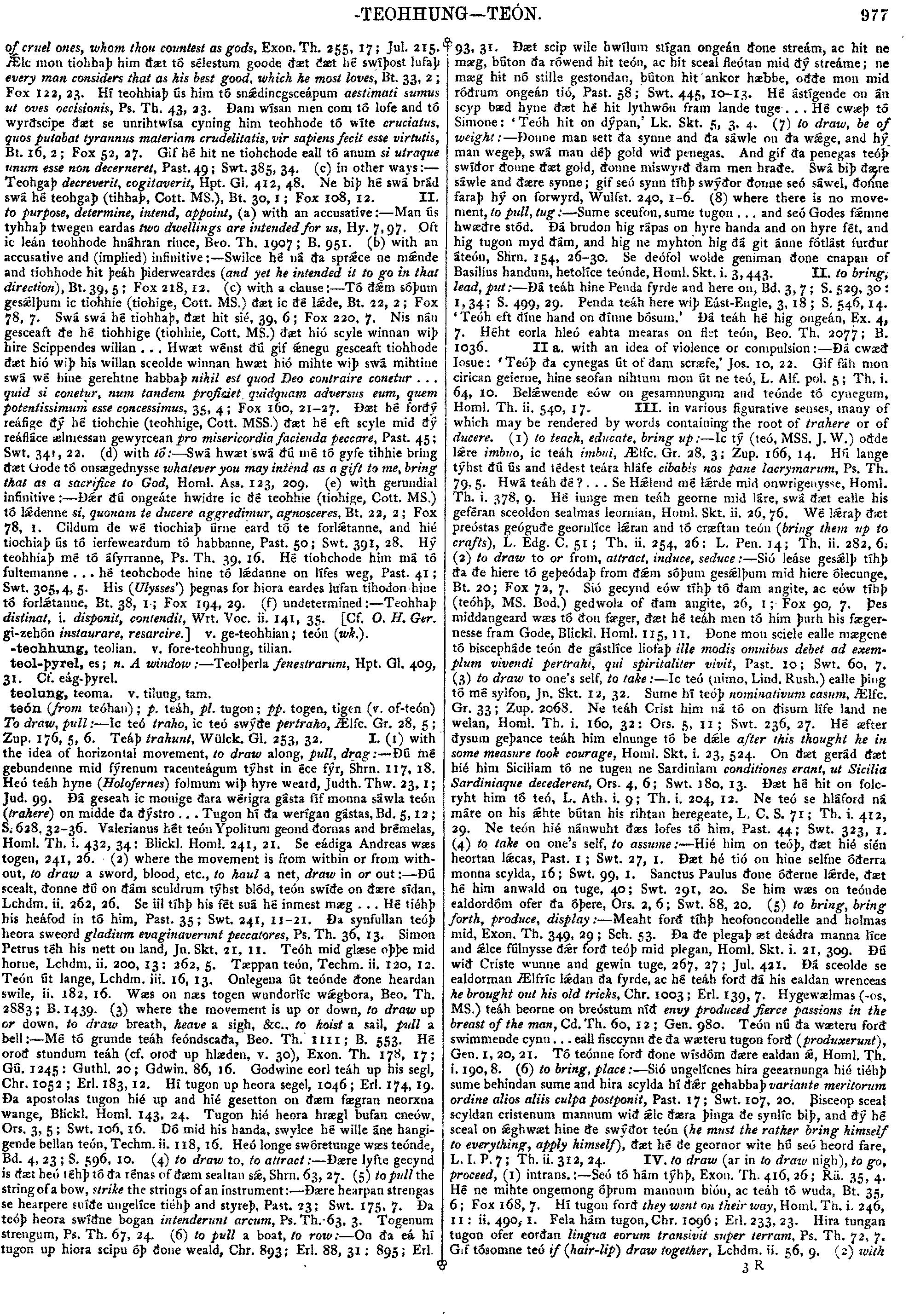
teón
(from
teóhan);
p.
teáh,
pl.
tugon;
pp.
togen,
tigen
(v.
of-teón)
To
draw,
pull:--Ic
teó
traho,
ic
teó
swýðe
pertraho,
Ælfc.
Gr.
28,
5;
Zup.
176,
5,
6.
Teáþ
trahunt,
Wülck.
Gl.
253,
32.
I.
(1)
with
the
idea
of
horizontal
movement,
to
draw
along,
pull,
drag:--Ðú
mé
gebundenne
mid
fýrenum
racenteágum
týhst
in
éce
fýr,
Shrn.
117,
18.
Heó
teáh
hyne
(Holofernes)
folmum
wiþ
hyre
weard,
Judth.
Thw.
23,
1;
Jud.
99.
Ðá
geseah
ic
monige
ðara
wérigra
gásta
fíf
monna
sáwla
teón
(trahere)
on
midde
ða
ðýstro
.
.
.
Tugon
hí
ða
werígan
gástas,
Bd.
5,
12;
S.
628,
32-36.
Valerianus
hét
teón
Ypolitum
geond
ðornas
and
brémelas,
Homl.
Th.
i.
432,
34:
Blickl.
Homl.
241,
21.
Se
eádiga
Andreas
wæs
togen,
241,
26.
(2)
where
the
movement
is
from
within
or
from
without,
to
draw
a
sword,
blood,
etc.,
to
haul
a
net,
draw
in
or
out:--Ðú
scealt,
ðonne
ðú
on
ðám
sculdrum
týhst
blód,
teón
swíðe
on
ðære
sídan,
Lchdm.
ii.
262,
26.
Se
iil
tíhþ
his
fét
suá
hé
inmest
mæg
.
.
.
Hé
tiéhþ
his
heáfod
in
tó
him,
Past.
35;
Swt.
241,
11-21.
Ða
synfullan
teóþ
heora
sweord
gladium
evaginaverunt
peccatores,
Ps.
Th.
36,
13.
Simon
Petrus
téh
his
nett
on
land,
Jn.
Skt.
21,
11.
Teóh
mid
glæse
oþþe
mid
horne,
Lchdm.
ii.
200,
13:
262,
5.
Tæppan
teón,
Techm.
ii.
120,
12.
Teón
út
lange,
Lchdm.
iii.
16,
13.
Onlegena
út
teónde
ðone
heardan
swile,
ii.
182,
16.
Wæs
on
næs
togen
wundorlíc
wgbora,
Beo.
Th.
2883;
B.
1439.
(3)
where
the
movement
is
up
or
down,
to
draw
up
or
down,
to
draw
breath,
heave
a
sigh,
&c.,
to
hoist
a
sail,
pull
a
bell:--Mé
tó
grunde
teáh
feóndscaða,
Beo.
Th.
1111;
B.
553.
Hé
oroð
stundum
teáh
(cf.
oroð
up
hlæden,
v.
30),
Exon.
Th.
178,
17;
Gú.
1245:
Guthl.
20;
Gdwin.
86,
16.
Godwine
eorl
teáh
up
his
segl,
Chr.
1052;
Erl.
183,
12.
Hí
tugon
up
heora
segel,
1046;
Erl.
174,
19.
Ða
apostolas
tugon
hié
up
and
hié
gesetton
on
ðæm
fægran
neorxna
wange,
Blickl.
Homl.
143,
24.
Tugon
hié
heora
hrægl
bufan
cneów,
Ors.
3,
5;
Swt.
106,
16.
Dó
mid
his
handa,
swylce
hé
wille
áne
hangi gende
bellan
teón,
Techm.
ii.
118,
16.
Heó
longe
swóretunge
wæs
teónde,
Bd.
4,
23;
S.
596,
10.
(4)
to
draw
to,
to
attract:--Ðære
lyfte
gecynd
is
ðæt
heó
téhþ
tó
ða
rénas
of
ðæm
sealtan
s,
Shrn.
63,
27.
(5)
to
pull
the
string
of
a
bow,
strike
the
strings
of
an
instrument:--Ðære
hearpan
strengas
se
hearpere
suíðe
ungelíce
tiéhþ
and
styreþ,
Past.
23;
Swt.
175,
7.
Ða
teóþ
heora
swíðne
bogan
intenderunt
arcum,
Ps.
Th.
63,
3.
Togenum
strengum,
Ps.
Th.
67,
24.
(6)
to
pull
a
boat,
to
row:--On
ða
eá
hí
tugon
up
hiora
scipu
óþ
ðone
weald,
Chr.
893;
Erl.
88,
31:
895;
Erl.
93,
31.
Ðæt
scip
wile
hwílum
stígan
ongeán
ðone
streám,
ac
hit
ne
mæg,
búton
ða
rówend
hit
teón,
ac
hit
sceal
fleótan
mid
ðý
streáme;
ne
mæg
hit
nó
stille
gestondan,
búton
hit
ankor
hæbbe,
oððe
mon
mid
róðrum
ongeán
tió,
Past.
58;
Swt.
445,
10-13.
Hé
ástígende
on
án
scyp
bæd
hyne
ðæt
hé
hit
lythwón
fram
lande
tuge
.
.
.
Hé
cwæþ
tó
Simone:
'Teóh
hit
on
dýpan,'
Lk.
Skt.
5,
3,
4.
(7)
to
draw,
be
of
weight:--Ðonne
man
sett
ða
synne
and
ða
sáwle
on
ða
wge,
and
hý
man
wegeþ,
swá
man
déþ
gold
wið
penegas.
And
gif
ða
penegas
teóþ
swíðor
ðonne
ðæt
gold,
ðonne
miswyrð
ðam
men
hraðe.
Swá
biþ
ðære
sáwle
and
ðære
synne;
gif
seó
synn
tíhþ
swýðor
ðonne
seó
sáwel,
ðonne
faraþ
hý
on
forwyrd,
Wulfst.
240,
1-6.
(8)
where
there
is
no
movement,
to
pull,
tug:--Sume
sceufon,
sume
tugon
.
.
.
and
seó
Godes
fmne
hwæðre
stód.
Ðá
brudon
hig
rápas
on
hyre
handa
and
on
hyre
fét,
and
hig
tugon
myd
ðám,
and
hig
ne
myhton
hig
ðá
git
ánne
fótlást
furður
áteón,
Shrn.
154,
26-30.
Se
deófol
wolde
geniman
ðone
cnapan
of
Basilius
handum,
hetolíce
teónde,
Homl.
Skt.
i.
3,
443.
II.
to
bring,
lead,
put:--Ðá
teáh
hine
Penda
fyrde
and
here
on,
Bd.
3,
7;
S.
529,
30:
1,
34;
S.
499,
29.
Penda
teáh
here
wiþ
Eást-Engle,
3,
18;
S.
546,
14.
'Teóh
eft
ðíne
hand
on
ðínne
bósum.'
Ðá
teáh
hé
hig
ongeán,
Ex.
4,
7.
Héht
eorla
hleó
eahta
mearas
on
flet
teón,
Beo.
Th.
2077;
B.
1036.
II
a.
with
an
idea
of
violence
or
compulsion:--Ðá
cwæð
Iosue:
'Teóþ
ða
cynegas
út
of
ðam
scræfe,'
Jos.
10,
22.
Gif
fáh
mon
cirican
geierne,
hine
seofan
nihtum
mon
út
ne
teó,
L.
Alf.
pol.
5;
Th.
i.
64,
10.
Belwende
eów
on
gesamnungum
and
teónde
tó
cynegum,
Homl.
Th.
ii.
540,
17.
III.
in
various
figurative
senses,
many
of
which
may
be
rendered
by
words
containing
the
root
of
trahere
or
of
ducere.
(1)
to
teach,
educate,
bring
up:--Ic
tý
(teó,
MSS.
J.
W.)
oðde
lre
imbuo,
ic
teáh
imbui,
Ælfc.
Gr.
28,
3;
Zup.
166,
14.
Hú
lange
týhst
ðú
ús
and
tédest
teára
hláfe
cibabis
nos
pane
lacrymarum,
Ps.
Th.
79,
5.
Hwá
teáh
ðé
?
.
.
.
Se
Hlend
mé
lrde
mid
onwrigenysse,
Homl.
Th.
i.
378,
9.
Hé
iunge
men
teáh
georne
mid
láre,
swá
ðæt
ealle
his
geféran
sceoldon
sealmas
leornian,
Homl.
Skt.
ii.
26,
76,
Wé
lraþ
ðæt
preóstas
geóguðe
geornlíce
lran
and
tó
cræftan
teón
(bring
them
up
to
crafts),
L.
Edg.
C.
51;
Th.
ii.
254,
26:
L.
Pen.
14;
Th.
ii.
282,
6.
(2)
to
draw
to
or
from,
attract,
induce,
seduce:--Sió
leáse
geslþ
tíhþ
ða
ðe
hiere
tó
geþeódaþ
from
ðm
sóþum
geslþum
mid
hiere
ólecunge,
Bt.
20;
Fox
72,
7.
Sió
gecynd
eów
tíhþ
tó
ðam
angite,
ac
eów
tíhþ
(teóhþ,
MS.
Bod.)
gedwola
of
ðam
angite,
26,
1;
Fox
90,
7.
Þes
middangeard
wæs
tó
ðon
fæger,
ðæt
hé
teáh
men
tó
him
þurh
his
fægernesse
fram
Gode,
Blickl.
Homl.
115,
11.
Ðone
mon
sciele
ealle
mægene
tó
biscepháde
teón
ðe
gástlíce
liofaþ
ille
modis
omnibus
debet
ad
exemplum
vivendi
pertrahi,
qui
spiritaliter
vivit,
Past.
10;
Swt.
60,
7.
(3)
to
draw
to
one's
self,
to
take:--Ic
teó
(nimo,
Lind.
Rush.)
ealle
þing
tó
mé
sylfon,
Jn.
Skt.
12,
32.
Sume
hí
teóþ
nominativum
casum,
Ælfc.
Gr.
33;
Zup.
2068.
Ne
teáh
Crist
him
ná
tó
on
ðisum
lífe
land
ne
welan,
Homl.
Th.
i.
160,
32:
Ors.
5,
11;
Swt.
236,
27.
Hé
æfter
ðysum
geþance
teáh
him
elnunge
tó
be
dle
after
this
thought
he
in
some
measure
took
courage,
Homl.
Skt.
i.
23,
524.
On
ðæt
gerád
ðæt
hié
him
Siciliam
tó
ne
tugen
ne
Sardiniam
conditiones
erant,
ut
Sicilia
Sardiniaque
decederent,
Ors.
4,
6;
Swt.
180,
13.
Ðæt
hé
hit
on
folcryht
him
tó
teó,
L.
Ath.
i.
9;
Th.
i.
204,
12.
Ne
teó
se
hláford
ná
máre
on
his
hte
bútan
his
rihtan
heregeate,
L.
C.
S.
71;
Th.
i.
412,
29.
Ne
teón
hié
nánwuht
ðæs
lofes
tó
him,
Past.
44;
Swt.
323,
1.
(4)
to
take
on
one's
self,
to
assume:--Hié
him
on
teóþ,
ðæt
hié
sién
heortan
lcas,
Past.
1;
Swt.
27,
1.
Ðæt
hé
tió
on
hine
selfne
óðerra
monna
scylda,
16;
Swt.
99,
1.
Sanctus
Paulus
ðone
óðerne
lrde,
ðæt
hé
him
anwald
on
tuge,
40;
Swt.
291,
20.
Se
him
wæs
on
teónde
ealdordóm
ofer
ða
óþere,
Ors.
2,
6;
Swt.
88,
20.
(5)
to
bring,
bring
forth,
produce,
display:--Meaht
forð
tíhþ
heofoncondelle
and
holmas
mid,
Exon.
Th.
349,
29;
Sch.
53.
Ða
ðe
plegaþ
æt
deádra
manna
líce
and
lce
fúlnysse
ðr
forð
teóþ
mid
plegan,
Homl.
Skt.
i.
21,
309.
Ðú
wið
Criste
wunne
and
gewin
tuge,
267,
27;
Jul.
421.
Ðá
sceolde
se
ealdorman
Ælfríc
ldan
ða
fyrde,
ac
hé
teáh
forð
ðá
his
ealdan
wrenceas
he
brought
out
his
old
tricks,
Chr.
1003;
Erl.
139,
7.
Hygewælmas
(-os,
MS.)
teáh
beorne
on
breóstum
níð
envy
produced
fierce
passions
in
the
breast
of
the
man,
Cd.
Th.
60,
12;
Gen.
980.
Teón
nú
ða
wæteru
forð
swimmende
cynn
.
.
.
eáll
fisccynn
ðe
ða
wæteru
tugon
forð
(produxerunt),
Gen.
1,
20,
21.
Tó
teónne
forð
ðone
wísdóm
ðære
ealdan
,
Homl.
Th.
i.
190,
8.
(6)
to
bring,
place:--Sió
ungelícnes
hira
geearnunga
hié
tiéhþ
sume
behindan
sume
and
hira
scylda
hí
ðr
gehabbaþ
variante
meritorum
ordine
alios
aliis
culpa
postponit,
Past.
17;
Swt.
107,
20.
Bisceop
sceal
scyldan
cristenum
mannum
wið
lc
ðæra
þinga
ðe
synlíc
biþ,
and
ðý
hé
sceal
on
ghwæt
hine
ðe
swýðor
teón
(he
must
the
rather
bring
himself
to
everything,
apply
himself),
ðæt
hé
ðe
geornor
wite
hú
seó
heord
fare,
L.
I.
P.
7;
Th.
ii.
312,
24.
IV.
to
draw
(ar
in
to
draw
nigh),
to
go,
proceed,
(1)
intrans.:--Seó
tó
hám
týhþ,
Exon.
Th.
416,
26;
Rä.
35,
4.
Hé
ne
mihte
ongemong
óþrum
mannum
bión,
ac
teáh
tó
wuda,
Bt.
35,
6;
Fox
168,
7.
Hí
tugon
forð
they
went
on
their
way,
Homl.
Th.
i.
246,
11:
ii.
490,
1.
Fela
hám
tugon,
Chr.
1096;
Erl.
233,
23.
Hira
tungan
tugon
ofer
eorðan
lingua
eorum
transivit
super
terram,
Ps.
Th.
72,
7.
Gif
tósomne
teó
if
(hair-lip)
draw
together,
Lchdm.
ii.
56,
9.
(2)
with
3
R
gende
bellan
teón,
Techm.
ii.
118,
16.
Heó
longe
swóretunge
wæs
teónde,
Bd.
4,
23;
S.
596,
10.
(4)
to
draw
to,
to
attract:--Ðære
lyfte
gecynd
is
ðæt
heó
téhþ
tó
ða
rénas
of
ðæm
sealtan
s,
Shrn.
63,
27.
(5)
to
pull
the
string
of
a
bow,
strike
the
strings
of
an
instrument:--Ðære
hearpan
strengas
se
hearpere
suíðe
ungelíce
tiéhþ
and
styreþ,
Past.
23;
Swt.
175,
7.
Ða
teóþ
heora
swíðne
bogan
intenderunt
arcum,
Ps.
Th.
63,
3.
Togenum
strengum,
Ps.
Th.
67,
24.
(6)
to
pull
a
boat,
to
row:--On
ða
eá
hí
tugon
up
hiora
scipu
óþ
ðone
weald,
Chr.
893;
Erl.
88,
31:
895;
Erl.
93,
31.
Ðæt
scip
wile
hwílum
stígan
ongeán
ðone
streám,
ac
hit
ne
mæg,
búton
ða
rówend
hit
teón,
ac
hit
sceal
fleótan
mid
ðý
streáme;
ne
mæg
hit
nó
stille
gestondan,
búton
hit
ankor
hæbbe,
oððe
mon
mid
róðrum
ongeán
tió,
Past.
58;
Swt.
445,
10-13.
Hé
ástígende
on
án
scyp
bæd
hyne
ðæt
hé
hit
lythwón
fram
lande
tuge
.
.
.
Hé
cwæþ
tó
Simone:
'Teóh
hit
on
dýpan,'
Lk.
Skt.
5,
3,
4.
(7)
to
draw,
be
of
weight:--Ðonne
man
sett
ða
synne
and
ða
sáwle
on
ða
wge,
and
hý
man
wegeþ,
swá
man
déþ
gold
wið
penegas.
And
gif
ða
penegas
teóþ
swíðor
ðonne
ðæt
gold,
ðonne
miswyrð
ðam
men
hraðe.
Swá
biþ
ðære
sáwle
and
ðære
synne;
gif
seó
synn
tíhþ
swýðor
ðonne
seó
sáwel,
ðonne
faraþ
hý
on
forwyrd,
Wulfst.
240,
1-6.
(8)
where
there
is
no
movement,
to
pull,
tug:--Sume
sceufon,
sume
tugon
.
.
.
and
seó
Godes
fmne
hwæðre
stód.
Ðá
brudon
hig
rápas
on
hyre
handa
and
on
hyre
fét,
and
hig
tugon
myd
ðám,
and
hig
ne
myhton
hig
ðá
git
ánne
fótlást
furður
áteón,
Shrn.
154,
26-30.
Se
deófol
wolde
geniman
ðone
cnapan
of
Basilius
handum,
hetolíce
teónde,
Homl.
Skt.
i.
3,
443.
II.
to
bring,
lead,
put:--Ðá
teáh
hine
Penda
fyrde
and
here
on,
Bd.
3,
7;
S.
529,
30:
1,
34;
S.
499,
29.
Penda
teáh
here
wiþ
Eást-Engle,
3,
18;
S.
546,
14.
'Teóh
eft
ðíne
hand
on
ðínne
bósum.'
Ðá
teáh
hé
hig
ongeán,
Ex.
4,
7.
Héht
eorla
hleó
eahta
mearas
on
flet
teón,
Beo.
Th.
2077;
B.
1036.
II
a.
with
an
idea
of
violence
or
compulsion:--Ðá
cwæð
Iosue:
'Teóþ
ða
cynegas
út
of
ðam
scræfe,'
Jos.
10,
22.
Gif
fáh
mon
cirican
geierne,
hine
seofan
nihtum
mon
út
ne
teó,
L.
Alf.
pol.
5;
Th.
i.
64,
10.
Belwende
eów
on
gesamnungum
and
teónde
tó
cynegum,
Homl.
Th.
ii.
540,
17.
III.
in
various
figurative
senses,
many
of
which
may
be
rendered
by
words
containing
the
root
of
trahere
or
of
ducere.
(1)
to
teach,
educate,
bring
up:--Ic
tý
(teó,
MSS.
J.
W.)
oðde
lre
imbuo,
ic
teáh
imbui,
Ælfc.
Gr.
28,
3;
Zup.
166,
14.
Hú
lange
týhst
ðú
ús
and
tédest
teára
hláfe
cibabis
nos
pane
lacrymarum,
Ps.
Th.
79,
5.
Hwá
teáh
ðé
?
.
.
.
Se
Hlend
mé
lrde
mid
onwrigenysse,
Homl.
Th.
i.
378,
9.
Hé
iunge
men
teáh
georne
mid
láre,
swá
ðæt
ealle
his
geféran
sceoldon
sealmas
leornian,
Homl.
Skt.
ii.
26,
76,
Wé
lraþ
ðæt
preóstas
geóguðe
geornlíce
lran
and
tó
cræftan
teón
(bring
them
up
to
crafts),
L.
Edg.
C.
51;
Th.
ii.
254,
26:
L.
Pen.
14;
Th.
ii.
282,
6.
(2)
to
draw
to
or
from,
attract,
induce,
seduce:--Sió
leáse
geslþ
tíhþ
ða
ðe
hiere
tó
geþeódaþ
from
ðm
sóþum
geslþum
mid
hiere
ólecunge,
Bt.
20;
Fox
72,
7.
Sió
gecynd
eów
tíhþ
tó
ðam
angite,
ac
eów
tíhþ
(teóhþ,
MS.
Bod.)
gedwola
of
ðam
angite,
26,
1;
Fox
90,
7.
Þes
middangeard
wæs
tó
ðon
fæger,
ðæt
hé
teáh
men
tó
him
þurh
his
fægernesse
fram
Gode,
Blickl.
Homl.
115,
11.
Ðone
mon
sciele
ealle
mægene
tó
biscepháde
teón
ðe
gástlíce
liofaþ
ille
modis
omnibus
debet
ad
exemplum
vivendi
pertrahi,
qui
spiritaliter
vivit,
Past.
10;
Swt.
60,
7.
(3)
to
draw
to
one's
self,
to
take:--Ic
teó
(nimo,
Lind.
Rush.)
ealle
þing
tó
mé
sylfon,
Jn.
Skt.
12,
32.
Sume
hí
teóþ
nominativum
casum,
Ælfc.
Gr.
33;
Zup.
2068.
Ne
teáh
Crist
him
ná
tó
on
ðisum
lífe
land
ne
welan,
Homl.
Th.
i.
160,
32:
Ors.
5,
11;
Swt.
236,
27.
Hé
æfter
ðysum
geþance
teáh
him
elnunge
tó
be
dle
after
this
thought
he
in
some
measure
took
courage,
Homl.
Skt.
i.
23,
524.
On
ðæt
gerád
ðæt
hié
him
Siciliam
tó
ne
tugen
ne
Sardiniam
conditiones
erant,
ut
Sicilia
Sardiniaque
decederent,
Ors.
4,
6;
Swt.
180,
13.
Ðæt
hé
hit
on
folcryht
him
tó
teó,
L.
Ath.
i.
9;
Th.
i.
204,
12.
Ne
teó
se
hláford
ná
máre
on
his
hte
bútan
his
rihtan
heregeate,
L.
C.
S.
71;
Th.
i.
412,
29.
Ne
teón
hié
nánwuht
ðæs
lofes
tó
him,
Past.
44;
Swt.
323,
1.
(4)
to
take
on
one's
self,
to
assume:--Hié
him
on
teóþ,
ðæt
hié
sién
heortan
lcas,
Past.
1;
Swt.
27,
1.
Ðæt
hé
tió
on
hine
selfne
óðerra
monna
scylda,
16;
Swt.
99,
1.
Sanctus
Paulus
ðone
óðerne
lrde,
ðæt
hé
him
anwald
on
tuge,
40;
Swt.
291,
20.
Se
him
wæs
on
teónde
ealdordóm
ofer
ða
óþere,
Ors.
2,
6;
Swt.
88,
20.
(5)
to
bring,
bring
forth,
produce,
display:--Meaht
forð
tíhþ
heofoncondelle
and
holmas
mid,
Exon.
Th.
349,
29;
Sch.
53.
Ða
ðe
plegaþ
æt
deádra
manna
líce
and
lce
fúlnysse
ðr
forð
teóþ
mid
plegan,
Homl.
Skt.
i.
21,
309.
Ðú
wið
Criste
wunne
and
gewin
tuge,
267,
27;
Jul.
421.
Ðá
sceolde
se
ealdorman
Ælfríc
ldan
ða
fyrde,
ac
hé
teáh
forð
ðá
his
ealdan
wrenceas
he
brought
out
his
old
tricks,
Chr.
1003;
Erl.
139,
7.
Hygewælmas
(-os,
MS.)
teáh
beorne
on
breóstum
níð
envy
produced
fierce
passions
in
the
breast
of
the
man,
Cd.
Th.
60,
12;
Gen.
980.
Teón
nú
ða
wæteru
forð
swimmende
cynn
.
.
.
eáll
fisccynn
ðe
ða
wæteru
tugon
forð
(produxerunt),
Gen.
1,
20,
21.
Tó
teónne
forð
ðone
wísdóm
ðære
ealdan
,
Homl.
Th.
i.
190,
8.
(6)
to
bring,
place:--Sió
ungelícnes
hira
geearnunga
hié
tiéhþ
sume
behindan
sume
and
hira
scylda
hí
ðr
gehabbaþ
variante
meritorum
ordine
alios
aliis
culpa
postponit,
Past.
17;
Swt.
107,
20.
Bisceop
sceal
scyldan
cristenum
mannum
wið
lc
ðæra
þinga
ðe
synlíc
biþ,
and
ðý
hé
sceal
on
ghwæt
hine
ðe
swýðor
teón
(he
must
the
rather
bring
himself
to
everything,
apply
himself),
ðæt
hé
ðe
geornor
wite
hú
seó
heord
fare,
L.
I.
P.
7;
Th.
ii.
312,
24.
IV.
to
draw
(ar
in
to
draw
nigh),
to
go,
proceed,
(1)
intrans.:--Seó
tó
hám
týhþ,
Exon.
Th.
416,
26;
Rä.
35,
4.
Hé
ne
mihte
ongemong
óþrum
mannum
bión,
ac
teáh
tó
wuda,
Bt.
35,
6;
Fox
168,
7.
Hí
tugon
forð
they
went
on
their
way,
Homl.
Th.
i.
246,
11:
ii.
490,
1.
Fela
hám
tugon,
Chr.
1096;
Erl.
233,
23.
Hira
tungan
tugon
ofer
eorðan
lingua
eorum
transivit
super
terram,
Ps.
Th.
72,
7.
Gif
tósomne
teó
if
(hair-lip)
draw
together,
Lchdm.
ii.
56,
9.
(2)
with
3
R
|
Source: Bosworth/Toller, page b0989, entry 17 View original page image as: [TIFF] [PNG] [View previous entry] [View next entry] |
[Comment on this entry] [View comments] |
The following entry has been hand-corrected once. |
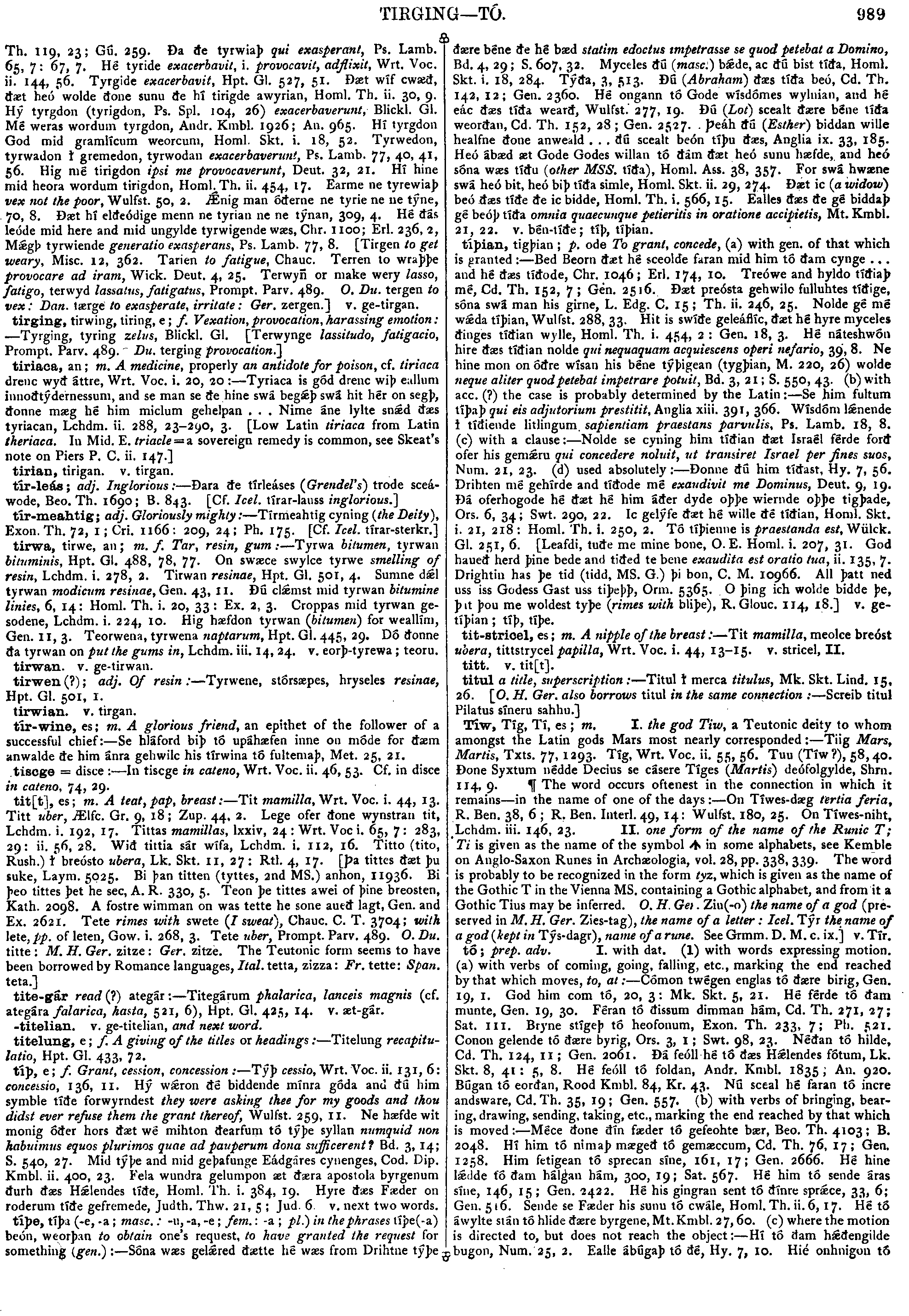
tíþ,
e;
f.
Grant,
cession,
concession:--Týþ
cessio,
Wrt.
Voc.
ii.
131,
6:
concessio,
136,
11.
Hý
wron
ðé
biddende
mínra
góda
and
ðú
him
symble
tíðe
forwyrndest
they
were
asking
thee
for
my
goods
and
thou
didst
ever
refuse
them
the
grant
thereof,
Wulfst.
259,
11.
Ne
hæfde
wit
monig
óðer
hors
ðæt
wé
mihton
ðearfum
tó
týþe
syllan
numquid
non
habuimus
equos
plurimos
quae
ad
pauperum
dona
sufficerent?
Bd.
3,
14;
S.
540,
27.
Mid
týþe
and
mid
geþafunge
Eádgáres
cynenges,
Cod.
Dip.
Kmbl.
ii.
400,
23.
Fela
wundra
gelumpon
æt
ðæra
apostola
byrgenum
ðurh
ðæs
Hlendes
tíðe,
Homl.
Th.
i.
384,
19.
Hyre
ðæs
Fæder
on
roderum
tíðe
gefremede,
Judth.
Thw.
21,
5;
Jud.
6.
v.
next
two
words.
|
Source: Bosworth/Toller, page b0989, entry 19 View original page image as: [TIFF] [PNG] [View previous entry] [View next entry] |
[Comment on this entry] [View comments] |
The following entry has been hand-corrected once. |
tíþian,
tigþian;
p.
ode
To
grant,
concede,
(a)
with
gen.
of
that
which
is
granted:--Bed
Beorn
ðæt
hé
sceolde
faran
mid
him
tó
ðam
cynge
.
.
.
and
hé
ðæs
tíðode,
Chr.
1046;
Erl.
174,
10.
Treówe
and
hyldo
tíðiaþ
mé,
Cd.
Th.
152,
7;
Gen.
2516.
Ðæt
preósta
gehwilc
fulluhtes
tíðige,
sóna
swá
man
his
girne,
L.
Edg.
C.
15;
Th.
ii.
246,
25.
Nolde
gé
mé
wda
tíþian,
Wulfst.
288,
33.
Hit
is
swíðe
geleáflíc,
ðæt
hé
hyre
myceles
ðinges
tíðian
wylle,
Homl.
Th.
i.
454,
2:
Gen.
18,
3.
Hé
náteshwón
hire
ðæs
tíðian
nolde
dui
nequaquam
acquiescens
operi
nefario,
39,
8.
Ne
hine
mon
on
óðre
wísan
his
béne
týþigean
(tygþian,
M.
220,
26)
wolde
neque
aliter
quod
petebat
impetrare
potuit,
Bd.
3,
21;
S.
550,
43.
(b)
with
acc.
(?)
the
case
is
probably
determined
by
the
Latin:--Se
him
fultum
tíþaþ
qui
eis
adjutorium
prestitit,
Anglia
xiii.
391,
366.
Wísdóm
lnende
 tíðiende
litlingum
sapientiam
praestans
parvulis,
Ps.
Lamb.
18,
8.
(c)
with
a
clause:--Nolde
se
cyning
him
tíðian
ðæt
Israel
férde
forð
ofer
his
gemru
qui
concedere
noluit,
ut
transiret
Israel
per
fines
suos,
Num.
21,
23.
(d)
used
absolutely:--Ðonne
ðú
him
tíðast,
Hy.
7,
56.
Drihten
mé
gehírde
and
tíðode
mé
exaudivit
me
Dominus,
Deut.
9,
19.
Ðá
oferhogode
hé
ðæt
hé
him
áðer
dyde
oþþe
wiernde
oþþe
tigþade,
Ors.
6,
34;
Swt.
290,
22.
Ic
gelýfe
ðæt
hé
wille
ðé
tíðian,
Homl.
Skt.
i.
21,
218:
Homl.
Th.
i.
250,
2.
Tó
tíþienne
is
praestanda
est,
Wülck.
Gl.
251,
6.
[Leafdi,
tuðe
me
mine
bone,
O.
E.
Homl.
i.
207,
31.
God
haueð
herd
þine
bede
and
tiðed
te
bene
exaudita
est
oratio
tua,
ii.
135,
7.
Drightin
has
þe
tid
(tidd,
MS.
G.)
þi
bon,
C.
M.
10966.
All
þatt
ned
uss
iss
Godess
Gast
uss
tiþeþþ,
Orm.
5365.
O
þing
ich
wolde
bidde
þe,
þit
þou
me
woldest
tyþe
(rimes
with
bliþe),
R.
Glouc.
114,
18.]
v.
getíþian;
tíþ,
tíþe.
tíðiende
litlingum
sapientiam
praestans
parvulis,
Ps.
Lamb.
18,
8.
(c)
with
a
clause:--Nolde
se
cyning
him
tíðian
ðæt
Israel
férde
forð
ofer
his
gemru
qui
concedere
noluit,
ut
transiret
Israel
per
fines
suos,
Num.
21,
23.
(d)
used
absolutely:--Ðonne
ðú
him
tíðast,
Hy.
7,
56.
Drihten
mé
gehírde
and
tíðode
mé
exaudivit
me
Dominus,
Deut.
9,
19.
Ðá
oferhogode
hé
ðæt
hé
him
áðer
dyde
oþþe
wiernde
oþþe
tigþade,
Ors.
6,
34;
Swt.
290,
22.
Ic
gelýfe
ðæt
hé
wille
ðé
tíðian,
Homl.
Skt.
i.
21,
218:
Homl.
Th.
i.
250,
2.
Tó
tíþienne
is
praestanda
est,
Wülck.
Gl.
251,
6.
[Leafdi,
tuðe
me
mine
bone,
O.
E.
Homl.
i.
207,
31.
God
haueð
herd
þine
bede
and
tiðed
te
bene
exaudita
est
oratio
tua,
ii.
135,
7.
Drightin
has
þe
tid
(tidd,
MS.
G.)
þi
bon,
C.
M.
10966.
All
þatt
ned
uss
iss
Godess
Gast
uss
tiþeþþ,
Orm.
5365.
O
þing
ich
wolde
bidde
þe,
þit
þou
me
woldest
tyþe
(rimes
with
bliþe),
R.
Glouc.
114,
18.]
v.
getíþian;
tíþ,
tíþe.
|
Source: Bosworth/Toller, page b0990, entry 2 View original page image as: [TIFF] [PNG] [View previous entry] [View next entry] |
[Comment on this entry] [View comments] |
The following entry has been hand-corrected once. |
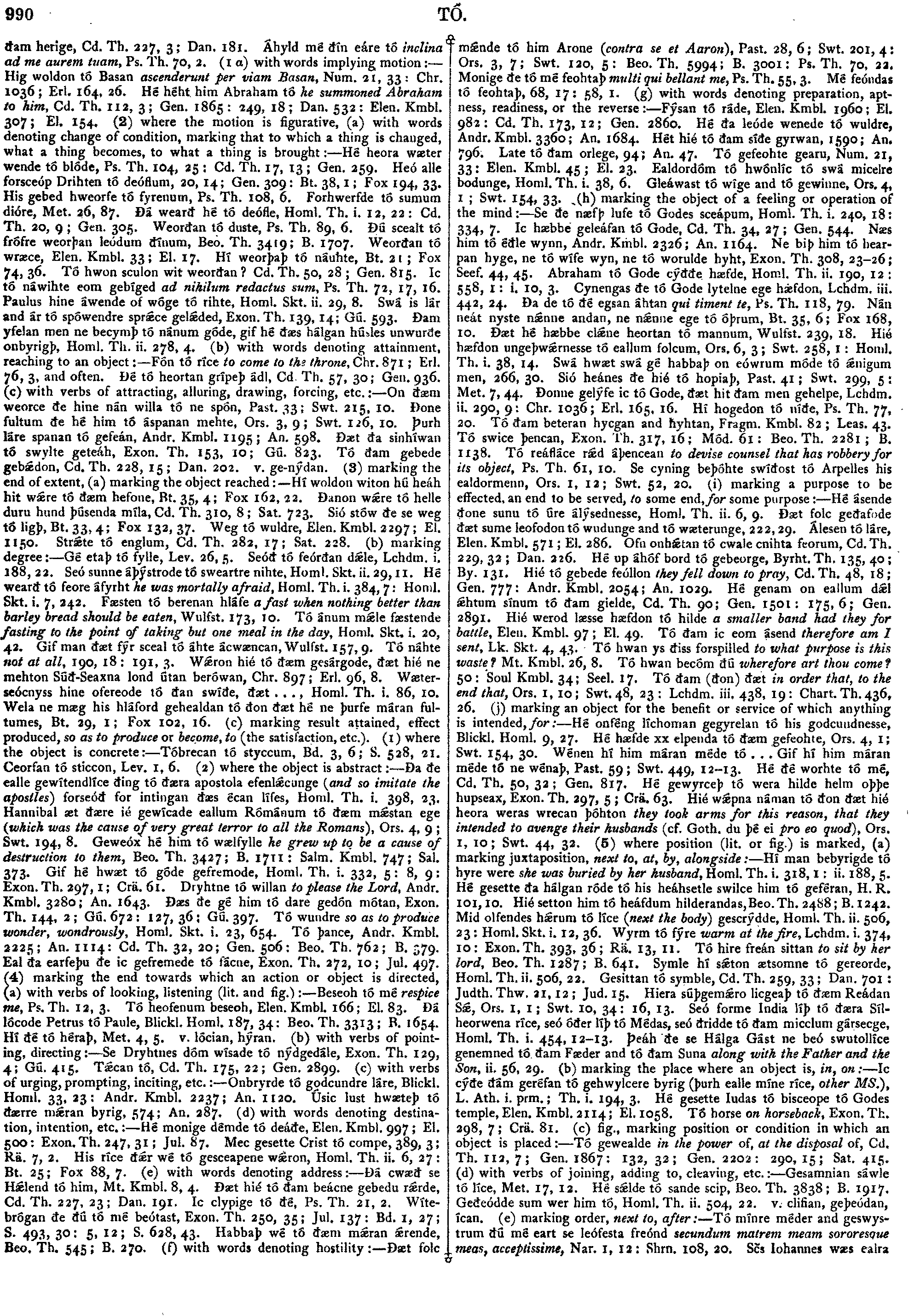
mnde
tó
him
Arone
(contra
se
et
Aaron),
Past.
28,
6;
Swt.
201,
4:
Ors.
3,
7;
Swt.
120,
5:
Beo.
Th.
5994;
B.
3001:
Ps.
Th.
70,
22.
Monige
ðe
tó
mé
feohtaþ
multi
qui
bellant
me,
Ps.
Th.
55,
3.
Mé
feóndas
tó
feohtaþ,
68,
17:
58,
I.
(g)
with
words
denoting
preparation,
aptness,
readiness,
or
the
reverse
:--
Fýsan
tó
ráde.
Elen.
Kmbl.
1960;
El.
982:
Cd.
Th.
173,
12;
Gen.
2860.
Hé
ða
leóde
wenede
tó
wuldre,
Andr.
Kmbl.
3360;
An.
1684.
Hét
hié
tó
ðam
síðe
gyrwan,
1590;
An.
796.
Late
tó
ðam
orlege,
94;
An.
47.
Tó
gefeohte
gearu,
Num.
21,
33:
Elen.
Kmbl.
45;
El.
23.
Ealdordóm
tó
hwónlíc
tó
swá
micelre
bodunge,
Homl.
Th.
i.
38,
6.
Gleáwast
tó
wÍge
and
to
gewinne.
Ors.
4,
l
;
Swt.
154,
33.
,
(h)
marking
the
object
of
a
feeling
or
operation
of
the
mind
:--
Se
ðe
næfþ.
lufe
tó
Godes
sceápum,
Homl.
Th.
i.
240,
18:
334,
7.
Ic
hæbbe
geleáfan
to
Gode,
Cd.
Th.
34,
27;
Gen.
544.
Næs
him
tó
éðle
wynn,
Andr.
Kmbl.
2326;
An.
1164.
Ne
biþ
him
tó
hear-pan
hyge,
ne
tó
wífe
wyn,
ne
tó
worulde
hyht,
Exon.
Th.
308,
23-26;
Scef.
44,
45.
Abraham
tó
Gode
cýððe
hæfde.
Homl.
Th.
ii.
190,
12
:
558,
l:
i.
ID,
3.
Cynengas
ðe
tó
Gode
lytelne
ege
hæfdon,
Lchdm.
iii.
442,
24.
Ða
de
tó
ðé
egsanáhtan
qui
timent
te,
Ps.
Th.
118,
79.
Nán
neát
nyste
nnne
andan,
ne
nnne
ege
tó
óþrum.
Bt.
35,
6;
Fox
168,
10.
Ðæt
hé
hæbbe
clne
heortan
tó
mannum,
Wulfst.
239,
18.
Hié
hæfdon
ungeþwrnesse
tó
eallum
folcum,
Ors.
6,
3;
Swt.
258,
I
:
Homl.
Th.
i.
38,
14.
Swá
hwæt
swá
gé
habbaþ
on
eówrum
móde
tó
nigum
men,
266,
30.
Sió
heánes
ðe
hié
tó
hopiaþ,
Past.
41;
Swt.
299,
5
:
Met.
7,
44.
Ðonne
gelýfe
ic
tó
Gode,
ðæt
hit
ðam
men
gehelpe,
Lchdm.
11.
290,
9:
Chr.
1036;
Erl.
165,
16.
Hi
hogedon
tó
níðe,
Ps.
Th.
77,
20.
Tó
ðam
beteran
hycgan
and
hyhtan,
Fragm.
Kmbl.
82
;
Leas.
43.
Tó
swice
þencan,
Exon.
Th.
317,
16;
Mód.
61:
Beo.
Th.
2281
;
B.
1138.
Tó
reáfláce
rd
áþencean
to
devise
counsel
that
has
robbery
for
its
object,
Ps.
Th.
61,
10.
Se
cyning
beþóhte
swíðost
tó
Arpelles
his
ealdormenn,
Ors.
I.
12;
Swt.
52,
20.
(i)
marking
a
purpose
to
be
effected,
an
end
to
be
served,
to
some
end,
for
some
purpose
:--
Hé
ásende
ðone
sunn
tó
úre
álýsednesse,
Homl.
Th.
ii.
6,
9.
Ðæt
folc
geðafode
ðæt
sume
leofodon
tó
wudunge
and
tó
wæterunge,
222,
29.
Álesen
tó
láre,
Elen.
Kmbl.
571;
El.
286.
Ofu
onhtan
tó
cwale
cnihta
feorum.
Cd.
Th.
229,
32
;
Dan.
226.
Hé
up
áhóf
bord
tó
gebeorge,
Byrht.
Th.
135,
40;
By.
131.
Hié
tó
gebede
feóllon
they
fell
down
to
pray,
Cd.
Th.
48,
18;
Gen.
777:
Andr.
Kmbl.
2054;
An.
1029.
Hé
genam
on
eallum
dl
htum
sínum
tó
ðam
gielde,
Cd.
Th.
90;
Gen.
1501:
175,
6;
Gen.
2891.
Hié
werod
læsse
hæfdon
tó
hilde
a
smaller
band
had
they
for
battle.
Elen.
Kmbl.
97
;
El.
49.
Tó
ðam
ic
eom
ásend
therefore
am
I
sent.
Lk.
Skt.
4,
4.
-;
.
Tó
hwan
ys
ðiss
forspilled
to
what
purpose
is
this
waste?
Mt.
Kmbl.
26,
8.
Tó
hwan
becóm
ðú
wherefore
art
thou
come?
50:
Soul
Kmbl.
34;
Seel.
17.
Tó
ðam
(ðon)
ðæt
in
order
that,
to
the
end
that,
Ors.
1,
10;
Swt.
48,
23
:
Lchdm.
iii.
438,
19:
Chart.
Th.
436,
26.
(j)
marking
an
object
for
the
benefit
or
service
of
which
anything
is
intended,
for
:--
Hé
onféng
líchoman
gegyrelan
tó
his
godcundnesse.
Blickl.
Homl.
9,
27.
Hé
hæfde
xx
elpenda
tó
ðæm
gefeohte,
Ors.
4,
i;
Swt.
154,
30.
Wénen
hí
him
máran
méde
tó
.
.
.
Gif
hí
him
máran
méde
tó
ne
wénaþ.
Past.
59;
Swt.
449,
12-13.
Hé
ðé
worhte
tó
me,
Cd.
Th.
50,
32;
Gen.
817.
Hé
gewyrceþ
to
wera
hilde
helm
oþþe
hupseax,
Exon.
Th.
297,
5
;
Crii.
63.
Hié
wpna
náman
tó
ðon
ðæt
hié
heora
weras
wrecan
þóhton
they
took
arms
for
this
reason,
that
they
intended
to
avenge
their
husbands
(
cf.
Goth.
du
þé
ci
pro
eo
quod).
Ors.
l,
10;
Swt.
44,
32.
(5)
where
position
(lit.
or
fig.
)
is
marked,
(a)
marking
juxtaposition,
next
to,
at,
by,
alongside
:--
Hí
man
bebyrigde
tó
hyre
were
she
was
buried
by
her
husband,
Homl.
Th.
i.
318,
l:
ii.
188,
5.
Hé
gesette
ða
hálgan
róde
tó
his
heáhsetle
swilce
him
tó
geféran,
H.
R.
loi,
10.
Hié
setton
him
tó
heáfdum
hilderandas.
Beo.
Th.
2488;
B.
1242.
Mid
olfendes
hrum
tó
líce
(next
the
body)
gescrýdde,
Homl.
Th.
ii.
506,
23:
Homl.
Skt.
i.
12,
36.
Wyrm
tó
fýre
warm
at
the
fire,
Lchdm.
i.
374,
10:
Exon.
Th.
393,
36
;
Ru.
13,
ll.
Tó
hire
freán
sittan
to
sit
by
her
lord.
Beo.
Th.
1287;
B.
641.
Symle
hí
ston
ætsomne
tó
gereorde.
Homl.
Th.
ii.
506,
22.
Gesittan
tó
symble,
Cd.
Th.
259,
33;
Dan.
701
:
Judth.
Thw.
21,
12
;
Jud.
15.
Hiera
súþgemro
licgeaþ
tó
ðæm
Reádan
S,
Ors.
l,
l;
Swt.
lo,
34:
16,
13.
Seó
forme
India
líþ
tó
ðæra
Síl-heorwena
ríce,
seó
óðer
líþ
tó
Médas,
seóðridde
tó
ðam
micclum
gársecge,
Homl.
Th.
i.
454,
12-13.
Þeáh
ðe
se
Hálga
Gást
ne
beó
swutollíce
genemned
tó
ðam
Fæder
and
tó
ðam
Suna
along
with
the
Father
and
the
Son,
ii.
56,
29.
(b)
marking
the
place
where
an
object
is,
in,
on
:--
Ic
cýðe
ðám
geréfan
tó
gehwylcere
byrig
(þurh
ealle
míne
ríce,
other
MS.
),
L.
Ath.
i.
prm.
;
Th.
i.
194,
3.
Hé
gesette
ludas
tó
bisceope
tó
Godes
temple.
Elen.
Kmbl.
2114;
1.
1058.
tó
horse
on
horseback.
Exon.
Th.
298,
7a
Crä.
81.
(c)
fig.
,
marking
position
or
condition
in
which
an
object
is
placed
:--
Tó
gewealde
in
the
power
of,
at
the
disposal
of,
Cd.
Th.
112,
7;
Gen.
1867:
132,
32;
Gen.
220.
.
:
290,
15;
831.
415.
(d)
with
verbs
of
joining,
adding
to,
cleaving,
etc.
:--
Gesamnian
sáwle
tó
líce.
Met.
17,
12.
Hé
slde
tó
sande
scip.
Beo.
Th.
3838;
B.
1917.
Geðeódde
sum
wer
him
tó,
Homl.
Th.
ii.
504,
22.
v.
clifian,
geþeódan,
ícan,
(e)
marking
order,
next
to,
after
:--
Tó
mínre
méder
and
geswys-trum
ðú
mé
eart
se
leófesta
freónd
secundum
matrem
meam
sororesque
.
meas,
acceptissime,
Nar.
i.
12:
Shrn.
108,
20.
S s
lohannes
wæs
ealra
s
lohannes
wæs
ealra
|
Source: Bosworth/Toller, page b0993, entry 6 View original page image as: [TIFF] [PNG] [View previous entry] [View next entry] |
[Comment on this entry] [View comments (1)] |
The following entry has been hand-corrected once. |
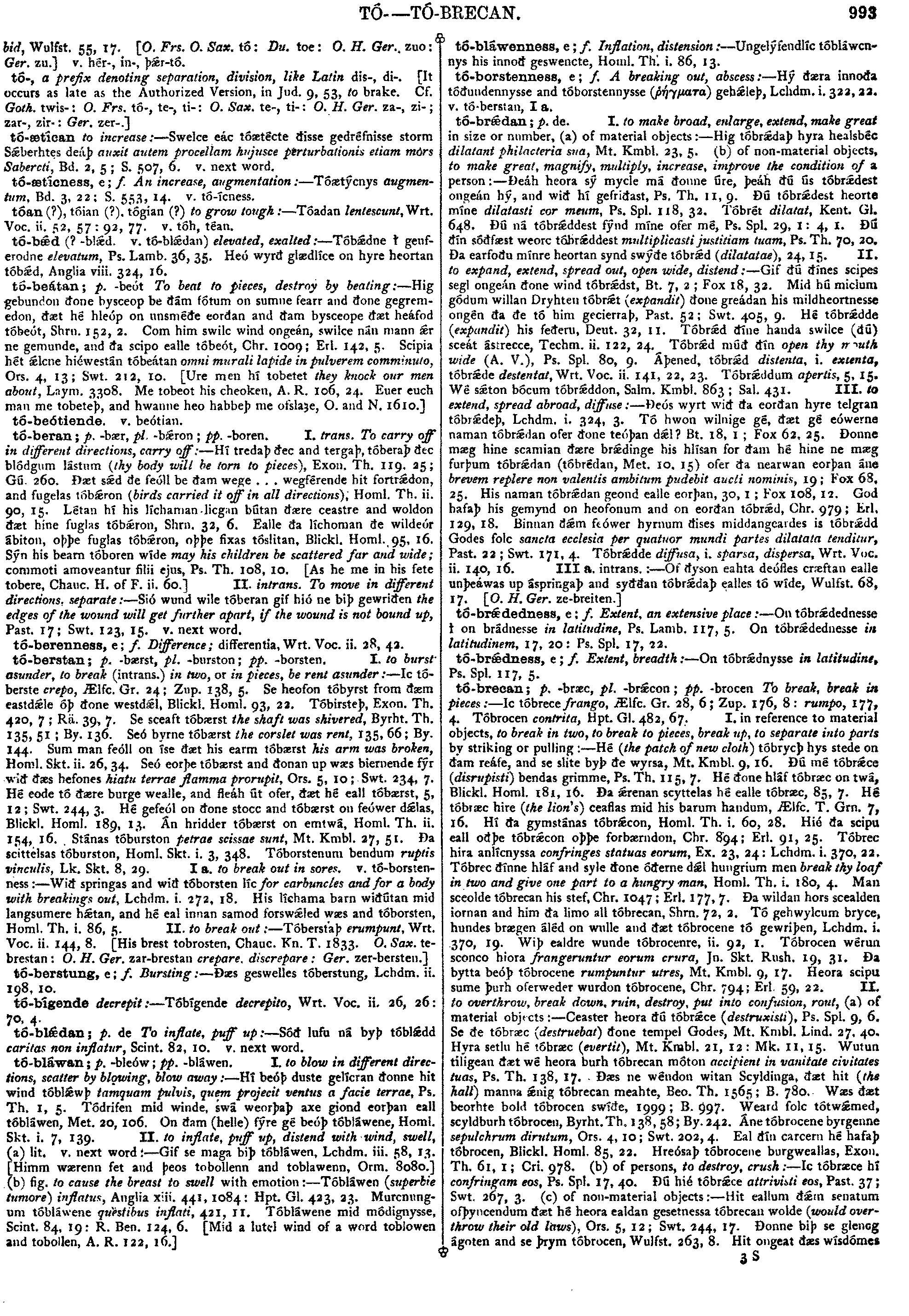
tó-bd
(?
-bld.
v.
tó-bldan)
elevated,
exalted
:--
Tóbdne
RUNE
genferodne
elevatum,
Ps.
Lamb.
36,
35.
Heó
wyrð
glædlíce
on
hyre
heortan
tóbd,
Anglia
viii.
324,
16.
|
Source: Bosworth/Toller, page b0993, entry 18 View original page image as: [TIFF] [PNG] [View previous entry] [View next entry] |
[Comment on this entry] [View comments (1)] |
The following entry has been hand-corrected once. |
tó-brdan;
p.
de.
I.
to
make
broad,
enlarge,
extend,
make
great
in
size
or
number,
(a)
of
material
objects
:--
Hig
tóbrdaþ
hyra
healsbéc
dilatant
philacieria
sua,
Mt.
Kmbl.
23,
5.
(b)
of
non-material
objects,
to
make
great,
magnify,
multiply,
increase,
improve
the
condition
of
a
person
:--
Ðeáh
heora
sý
mycle
má
ðonne
úre,
þeáh
ðú
ús
tóbrdest
ongeán
hý,
and
wið
hí
gefriðast,
Ps.
Th.
ii.
9.
Ðú
tóbrdest
heorte
míne
dilatasti
cor
meum,
Ps.
Spl.
118,
32.
Tðbrét
dilatat,
Kent.
Gl.
648.
Ðú
ná
tóbræddest
fýnd
mine
ofer
mé,
Ps.
Spl.
29,
l:
4,
Ðú
ðín
sóðfæst
weorc
tóbrddest
multiplicasti
justitiam
luam.
Ps.
Th.
70,
20.
Ða
earfoðu
mínre
heortan
synd
swýðe
tóbrd
(dilatatae),
24,
15.
II.
to
expand,
extend,
spread
out,
open
wide,
distend
:--
Gif
ðú
ðínes
scipes
segl
ongeán
ðone
wind
tóbrdst,
Bt.
7,
2
;
Fox
18,
32.
Mid
hú
miclum
gódum
willan
Dryhten
tóbrt
(expandit)
ðone
greádan
his
mildheortnesse
ongén
ða
ðe
tó
him
gecierraþ.
Past.
52;
Swt.
405,
9.
Hé
tóbrdde
(expandit)
his
feðeru.
Deut.
32,
ii.
Tóbrd
ðíne
handa
swilce
(dú)
sceát
ástrecce,
Techm.
ii.
122,
24.
Tóbrd
múð
ðín
open
thy
mouth
wide
(A.
V.
),
Ps.
Spl.
80,
9.
Áþened,
tóbrd
distenta,
i
extenta,
tóbrde
destentat.
Wrt.
Voc.
ii.
141,
22,
23.
Tóbrddum
apertis,
5,
15.
Wé
ston
bócum
tóbrddon.
Salm.
Kmbl.
863
;
Sal.
431.
III.
to
extend,
spread
abroad,
diffuse
:--
Ðeós
wyrt
wið
ða
eorðan
hyre
telgran
tóbrdeþ,
Lchdm.
i.
324,
3.
Tó
hwon
wilnige
gé,
ðæt
gé
eówerne
naman
tóbrdan
ofer
ðone
teóþan
dl?
Bt.
18,
I
;
Fox
62,
25.
Ðonne
mæg
hine
scamian
ðære
brdinge
his
hlísan
for
ðam
hé
hine
ne
mæg
furþum
tóbrdan
(tóbrédan,
Met.
10.
15)
ofer
ða
nearwan
eorþan
áne
brevem
replere
non
valentis
ambitum
piidebit
aucli
nominis,
19;
Fox
68,
25.
His
naman
tóbrdan
geond
ealle
eorþan,
30,
I
;
Fox
108,
12.
God
hafaþ
his
gemynd
on
heofonum
and
on
eorðan
tóbrd.
Chr.
979;
Erl.
129,
18.
Binnan
ðm
feówer
hyrnum
ðises
middangeaides
is
tóbrdd
Godes
folc
sancta
ecclesia
per
quatnor
mundi
partes
dilatata
tenditur,
Past.
22
;
Swt.
171,
4.
Tóbrdde
diffusa,
i.
sparsa,
dispersa.
Wrt.
Voc.
ii.
140,
16.
Ill
a.
intrans.
:--
Of
ðyson
eahta
deófles
cræftan
ealle
unþeáwas
up
áspringaþ
and
syððan
tóbrdaþ
ealles
tó
wide,
Wulfst.
68,
17.
[O.
H.
Ger.
ze-breiten
|
Source: Bosworth/Toller, page b1009, entry 14 View original page image as: [TIFF] [PNG] [View previous entry] [View next entry] |
[Comment on this entry] [View comments] |
The following entry has been hand-corrected once. |
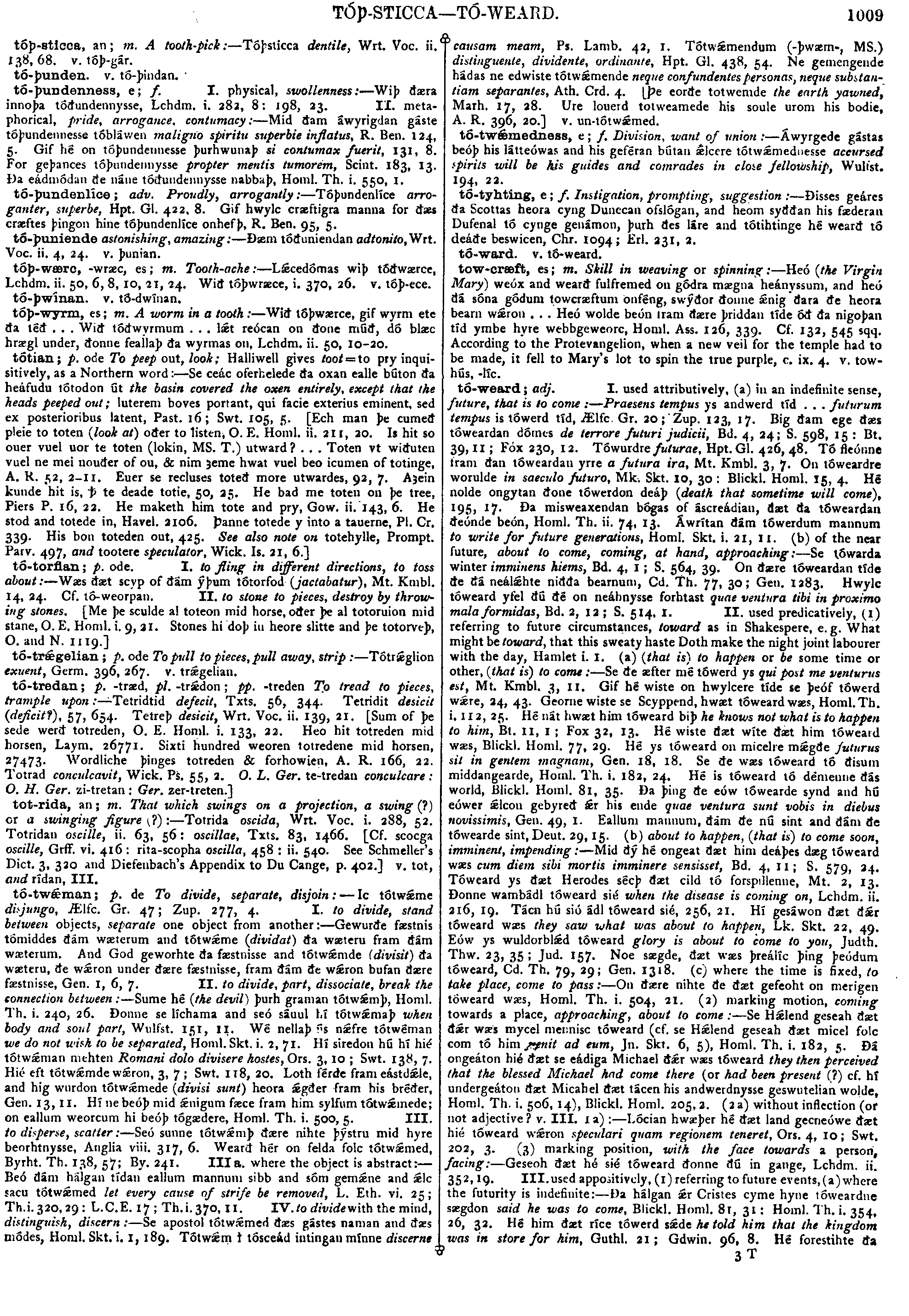
tó-twman
;
p.
de
To
divide,
separate,
disjoin
:--
Ic
tótwme
disjungo,
Ælfc.
Gr.
47;
Zup.
277,
4.
I.
to
divide,
stand
between
objects,
separate
one
object
from
another
:--
Gewurðe
fæstnis
tómiddes
ðám
wæterum
and
tótwme
(dividat)
ða
wæteru
fram
ðám
wæterum.
And
God
geworhte
ða
fæstnisse
and
tótwmde
(divisit)
ða
wæteru,
ðe
wron
under
ðære
fæstnisse,
fram
ðám
ðe
wron
bufan
ðære
fæstnisse,
Gen.
1.
6,
7.
II.
to
divide,
part,
dissociate,
break
the
connection
between
:--
Sume
hé
(the
devil)
þurh
graman
tótwmþ,
Homl.
Th.
i.
240,
26.
Ðonne
se
lichama
and
seó
sánul
hí
tótwmaþ
when
body
and
soul
part,
Wulfst.
151,
ll.
Wé
nellaþ
ús
nfre
tótwéman
we
do
not
wish
to
be
separated,
Homl.
Skt.
i.
2,
71.
Hí
siredon
hú
hí
hié
tótwman
mehten
Romani
dolo
divisere
hostes,
Ors.
3,
10
;
Swt.
138,
7.
Hié
eft
tótwmde
wron,
3,
7
;
Swt.
118,
20.
Loth
férde
fram
eástdle,
and
hig
wurdon
tótwmede
(divisi
sunt)
heora
gðer
fram
his
bréðer,
Gen.
13,
11.
Hí
ne
beóþ
mid
nigum
fæce
fram
him
sylfum
tótwmede;
on
eallum
weorcum
hi
beóþ
tógædere,
Homl.
Th.
i.
500,
5.
III.
to
disperse,
scatter
:--
Seó
sunne
tótwmþ
ðære
nihte
þýstru
mid
hyre
beorhtnysse,
Anglia
viii.
317,
6.
Wearð
her
on
felda
folc
tótwmed,
Byrht.
Th.
138,
57;
By.
241.
III
a,
where
the
object
is
abstract
:--
Beó
dám
hálgan
tídan
eallum
mannum
sibb
and
sóm
gemne
and
lc
sacu
tótwmed
let
every
cause
of
strife
be
removed,
L.
Eth.
vi.
25;
Th.
i.
320,
29:
L.
C.
E.
17;
Th.
i.
370,
II.
IV.
to
divide
with
the
mind,
distinguish,
discern
:--
Se
apostol
tótwmed
ðæs
gástes
naman
and
ðæs
módes,
Homl.
Skt.
i.
1,
189.
Tótwm
tósceád
intingan
mínne
discerne
causam
meam,
Ps.
Lamb.
42,
1.
Tótwmendum
(-þwæm-,
MS.
)
distinguente,
dividente,
ordinante.
Hpt.
Gl.
438,
54.
Ne
gemengende
hádas
ne
edwiste
tótwmende
neque
confundentes
personas,
neque
substantiam
separantes,
Ath.
Crd.
4.
[þe
eorðe
totwemde
the
earth
yawned,
Marh.
17,
28.
Ure
louerd
totweamede
his
soule
urom
his
bodie,
A.
R.
396,
20.]
v.
un-tótwsmed.
| Result Page: |  |
Previous | 12 13 14 15 16 17 18 19 20 21 22 23 24 25 26 27 28 29 30 | Next |  |
Germanic Lexicon Project (main page)
This search system was written by
Sean Crist
Please consider
volunteering
to correct the data in these online dictionaries.
No rights reserved. Feel free to use these data in any way you please.