|
|

 ar
(1 result)
ar
(1 result)Search for Hwar again, using less strict matching (33 results)
|
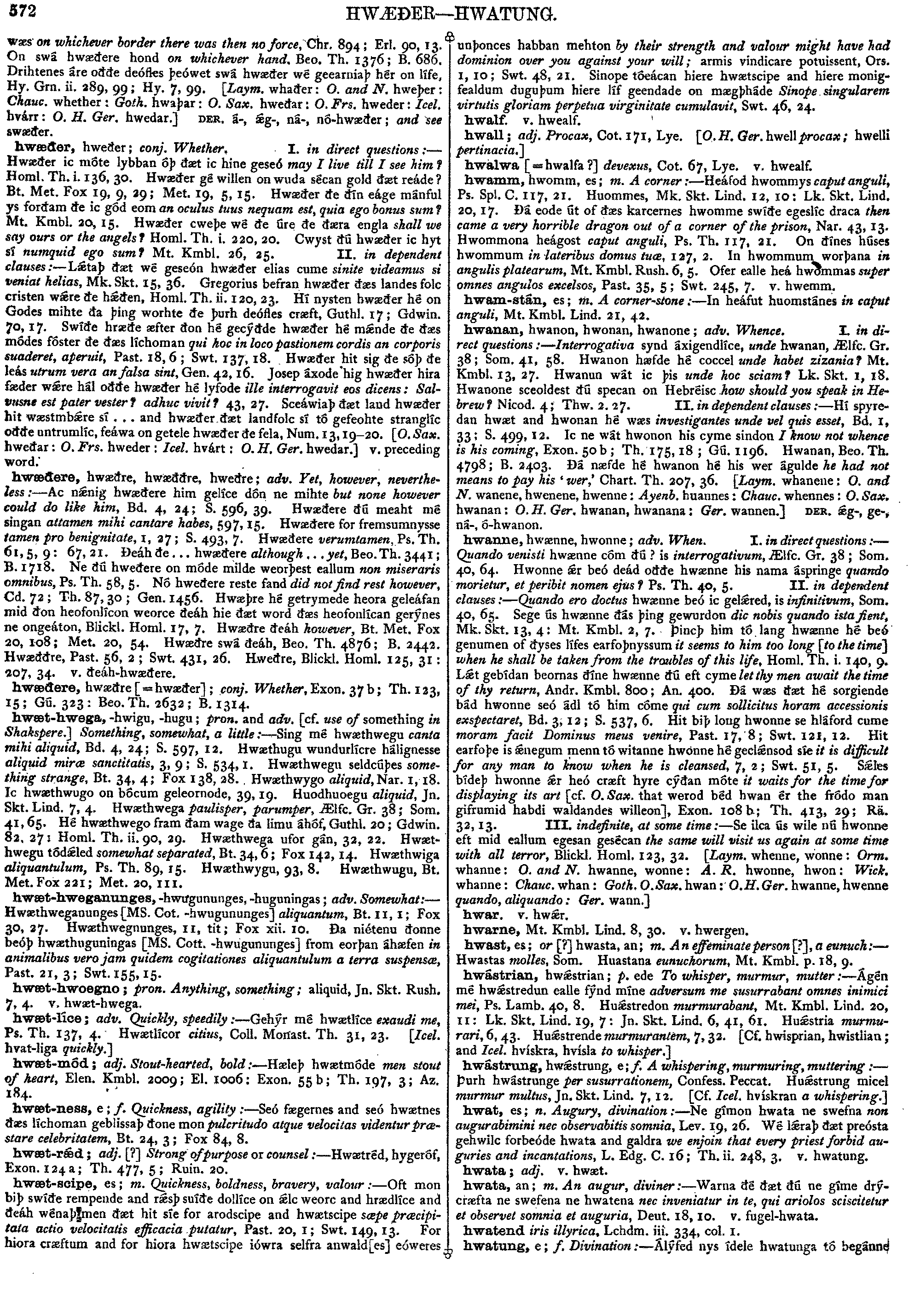
Source: Bosworth/Toller, page b0572, entry 19 View original page image as: [TIFF] [PNG] [View previous entry] [View next entry] |
[Comment on this entry] [View comments] |
The following entry has been hand-corrected once. |
|
Source: Torp, page b0114, entry 6 View original page image as: [TIFF] [PNG] [View previous entry] [View next entry] |
[Comment on this entry] [View comments] |
The following entry has been hand-corrected once. |

hvar,
hvêr
wo
?
g.
hvar
wo;
an.
hvar
wo;
as.
hwar
wohin;
ahd.
wara,
mhd.
ware,
war
wohin.
Ablaut
hvêr:
as.
hwâr
wo,
afries.
hwâr,
ags.
hwâr
wo,
wohin,
engl.
where;
ahd.
hwâr,
wâr,
wâ,
mhd.
wâ,
nhd.
wo.
Vgl.
lit.
ku wo.
-
lat.
cûr
(aus
quôr)
warum.
-
skr.
kár-hi
wann.
wo.
-
lat.
cûr
(aus
quôr)
warum.
-
skr.
kár-hi
wann.
[Translate the German words]
|
Source: Bosworth/Toller, page b0571, entry 6 View original page image as: [TIFF] [PNG] [View previous entry] [View next entry] |
[Comment on this entry] [View comments] |
The following entry has been hand-corrected once. |
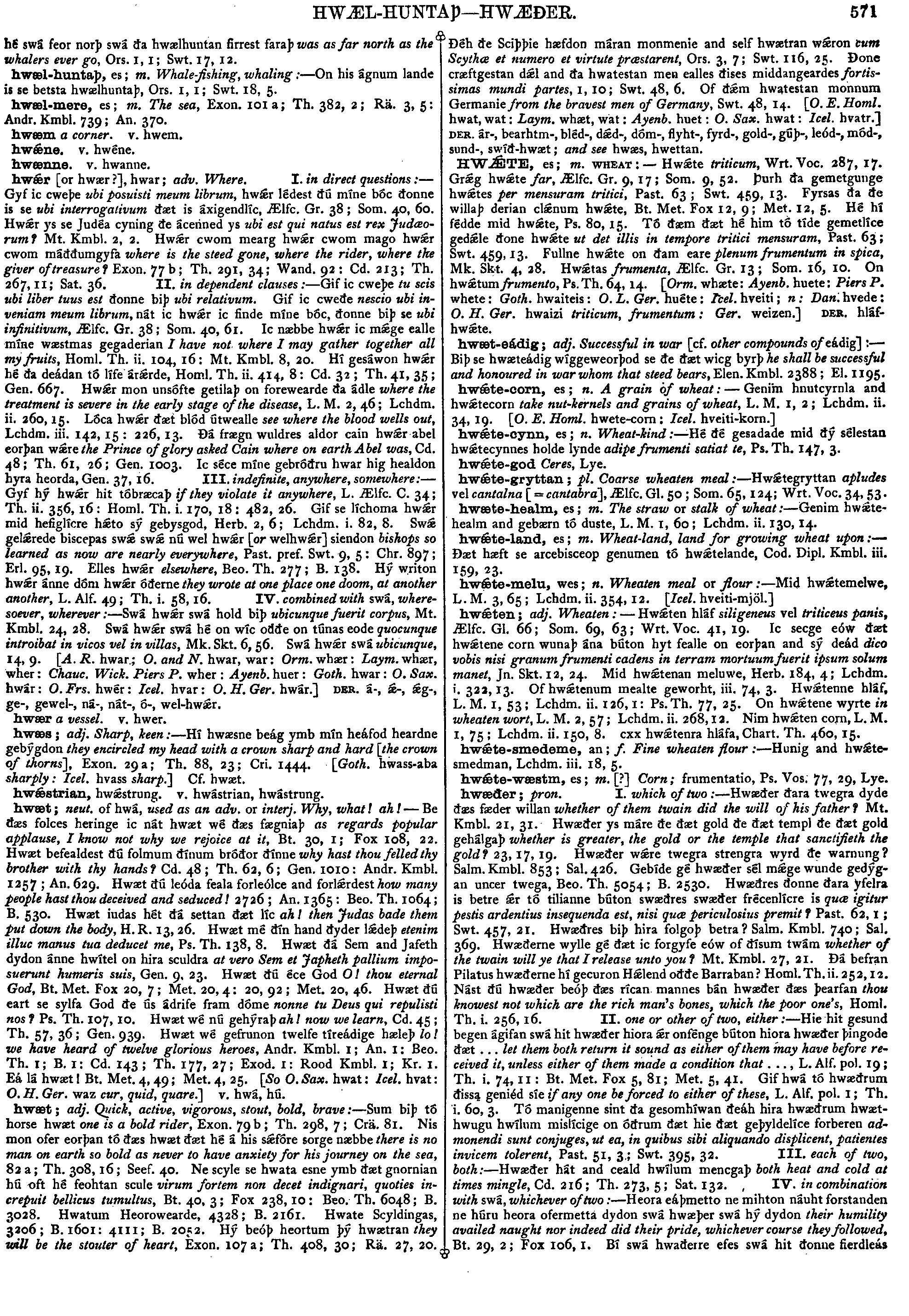
hw r
[or
hwær?],
hwar;
adv.
Where.
I.
in
direct
questions
:--
Gyf
ic
cweþe
ubi
posuisti
meum
librum,
hwr
lédest
ðú
míne
bóc
ðonne
is
se
ubi
interrogativum
ðæt
is
áxigendlíc,
Ælfc.
Gr.
38;
Som.
40,
60.
Hwr
ys
se
Judéa
cyning
ðe
ácenned
ys
ubi
est
qui
natus
est
rex
Judæorum?
Mt.
Kmbl.
2,
2.
Hwr
cwom
mearg
hwr
cwom
mago
hwr
cwom
máððumgyfa
where
is
the
steed
gone,
where
the
rider,
where
the
giver
of
treasure?
Exon.
77
b;
Th.
291,
34;
Wand.
92:
Cd.
213;
Th.
267,
11;
Sat.
36.
II.
in
dependent
clauses
:--
Gif
ic
cweþe
tu
scis
ubi
liber
tuus
est
ðonne
biþ
ubi
relativum.
Gif
ic
cweðe
nescio
ubi
inveniam
meum
librum,
nát
ic
hwr
ic
finde
míne
bóc,
ðonne
biþ
se
ubi
infinitivum,
Ælfc.
Gr.
38;
Som.
40,
61.
Ic
næbbe
hwr
ic
mge
ealle
míne
wæstmas
gegaderian
I
have
not
where
I
may
gather
together
all
my
fruits,
Homl.
Th.
ii.
104,
16:
Mt.
Kmbl.
8,
20.
Hí
gesáwon
hwr
hé
ða
deádan
tó
lífe
árrde,
Homl.
Th.
ii.
414,
8:
Cd.
32;
Th.
41,
35;
Gen.
667.
Hwr
mon
unsófte
getilaþ
on
forewearde
ða
ádle
where
the
treatment
is
severe
in
the
early
stage
of
the
disease,
L.
M.
2,
46;
Lchdm.
ii.
260,
15.
Lóca
hwr
ðæt
blód
útwealle
see
where
the
blood
wells
out,
Lchdm.
iii.
142,
15:
226,
13.
Ðá
frægn
wuldres
aldor
cain
hwr
abel
eorþan
wre
the
Prince
of
glory
asked
Cain
where
on
earth
Abel
was,
Cd.
48;
Th.
61,
26;
Gen.
1003.
Ic
séce
míne
gebróðru
hwar
hig
healdon
hyra
heorda,
Gen.
37,
16.
III.
indefinite,
anywhere,
somewhere
:--
Gyf
hý
hwr
hit
tóbræcaþ
if
they
violate
it
anywhere,
L.
Ælfc.
C.
34;
Th.
ii.
356,
16:
Homl.
Th.
i.
170,
18:
482,
26.
Gif
se
líchoma
hwr
mid
hefiglícre
hto
sý
gebysgod,
Herb.
2,
6;
Lchdm.
i.
82,
8.
Sw
gelrede
biscepas
sw
sw
nú
wel
hwr
[or
welhwr]
siendon
bishops
so
learned
as
now
are
nearly
everywhere,
Past.
pref.
Swt.
9,
5:
Chr.
897;
Erl.
95,
19.
Elles
hwr
elsewhere,
Beo.
Th.
277;
B.
138.
Hý
writon
hwr
ánne
dóm
hwr
óðerne
they
wrote
at
one
place
one
doom,
at
another
another,
L.
Alf.
49;
Th.
i.
58,
16.
IV.
combined
with
swá,
wheresoever,
wherever
:--
Swá
hwr
swá
hold
biþ
ubicunque
fuerit
corpus,
Mt.
Kmbl.
24,
28.
Swá
hwr
swá
hé
on
wíc
oððe
on
túnas
eode
quocunque
introibat
in
vicos
vel
in
villas,
Mk.
Skt.
6,
56.
Swá
hwr
swá
ubicunque,
14,
9.
[A.
R.
hwar;
O.
and
N.
hwar,
war:
Orm.
whær:
Laym.
whær,
wher:
Chauc.
Wick.
Piers
P.
wher:
Ayenb.
huer:
Goth.
hwar:
O.
Sax.
hwár:
O.
Frs.
hwér:
Icel.
hvar:
O.
H.
Ger.
hwár.]
DER.
á-,
-,
g-,
ge-,
gewel-,
ná-,
nát-,
ó-,
wel-hwr.
r
[or
hwær?],
hwar;
adv.
Where.
I.
in
direct
questions
:--
Gyf
ic
cweþe
ubi
posuisti
meum
librum,
hwr
lédest
ðú
míne
bóc
ðonne
is
se
ubi
interrogativum
ðæt
is
áxigendlíc,
Ælfc.
Gr.
38;
Som.
40,
60.
Hwr
ys
se
Judéa
cyning
ðe
ácenned
ys
ubi
est
qui
natus
est
rex
Judæorum?
Mt.
Kmbl.
2,
2.
Hwr
cwom
mearg
hwr
cwom
mago
hwr
cwom
máððumgyfa
where
is
the
steed
gone,
where
the
rider,
where
the
giver
of
treasure?
Exon.
77
b;
Th.
291,
34;
Wand.
92:
Cd.
213;
Th.
267,
11;
Sat.
36.
II.
in
dependent
clauses
:--
Gif
ic
cweþe
tu
scis
ubi
liber
tuus
est
ðonne
biþ
ubi
relativum.
Gif
ic
cweðe
nescio
ubi
inveniam
meum
librum,
nát
ic
hwr
ic
finde
míne
bóc,
ðonne
biþ
se
ubi
infinitivum,
Ælfc.
Gr.
38;
Som.
40,
61.
Ic
næbbe
hwr
ic
mge
ealle
míne
wæstmas
gegaderian
I
have
not
where
I
may
gather
together
all
my
fruits,
Homl.
Th.
ii.
104,
16:
Mt.
Kmbl.
8,
20.
Hí
gesáwon
hwr
hé
ða
deádan
tó
lífe
árrde,
Homl.
Th.
ii.
414,
8:
Cd.
32;
Th.
41,
35;
Gen.
667.
Hwr
mon
unsófte
getilaþ
on
forewearde
ða
ádle
where
the
treatment
is
severe
in
the
early
stage
of
the
disease,
L.
M.
2,
46;
Lchdm.
ii.
260,
15.
Lóca
hwr
ðæt
blód
útwealle
see
where
the
blood
wells
out,
Lchdm.
iii.
142,
15:
226,
13.
Ðá
frægn
wuldres
aldor
cain
hwr
abel
eorþan
wre
the
Prince
of
glory
asked
Cain
where
on
earth
Abel
was,
Cd.
48;
Th.
61,
26;
Gen.
1003.
Ic
séce
míne
gebróðru
hwar
hig
healdon
hyra
heorda,
Gen.
37,
16.
III.
indefinite,
anywhere,
somewhere
:--
Gyf
hý
hwr
hit
tóbræcaþ
if
they
violate
it
anywhere,
L.
Ælfc.
C.
34;
Th.
ii.
356,
16:
Homl.
Th.
i.
170,
18:
482,
26.
Gif
se
líchoma
hwr
mid
hefiglícre
hto
sý
gebysgod,
Herb.
2,
6;
Lchdm.
i.
82,
8.
Sw
gelrede
biscepas
sw
sw
nú
wel
hwr
[or
welhwr]
siendon
bishops
so
learned
as
now
are
nearly
everywhere,
Past.
pref.
Swt.
9,
5:
Chr.
897;
Erl.
95,
19.
Elles
hwr
elsewhere,
Beo.
Th.
277;
B.
138.
Hý
writon
hwr
ánne
dóm
hwr
óðerne
they
wrote
at
one
place
one
doom,
at
another
another,
L.
Alf.
49;
Th.
i.
58,
16.
IV.
combined
with
swá,
wheresoever,
wherever
:--
Swá
hwr
swá
hold
biþ
ubicunque
fuerit
corpus,
Mt.
Kmbl.
24,
28.
Swá
hwr
swá
hé
on
wíc
oððe
on
túnas
eode
quocunque
introibat
in
vicos
vel
in
villas,
Mk.
Skt.
6,
56.
Swá
hwr
swá
ubicunque,
14,
9.
[A.
R.
hwar;
O.
and
N.
hwar,
war:
Orm.
whær:
Laym.
whær,
wher:
Chauc.
Wick.
Piers
P.
wher:
Ayenb.
huer:
Goth.
hwar:
O.
Sax.
hwár:
O.
Frs.
hwér:
Icel.
hvar:
O.
H.
Ger.
hwár.]
DER.
á-,
-,
g-,
ge-,
gewel-,
ná-,
nát-,
ó-,
wel-hwr.
|
Source: Bosworth/Toller, page b0627, entry 16 View original page image as: [TIFF] [PNG] [View previous entry] [View next entry] |
[Comment on this entry] [View comments] |
The following entry has been hand-corrected once. |
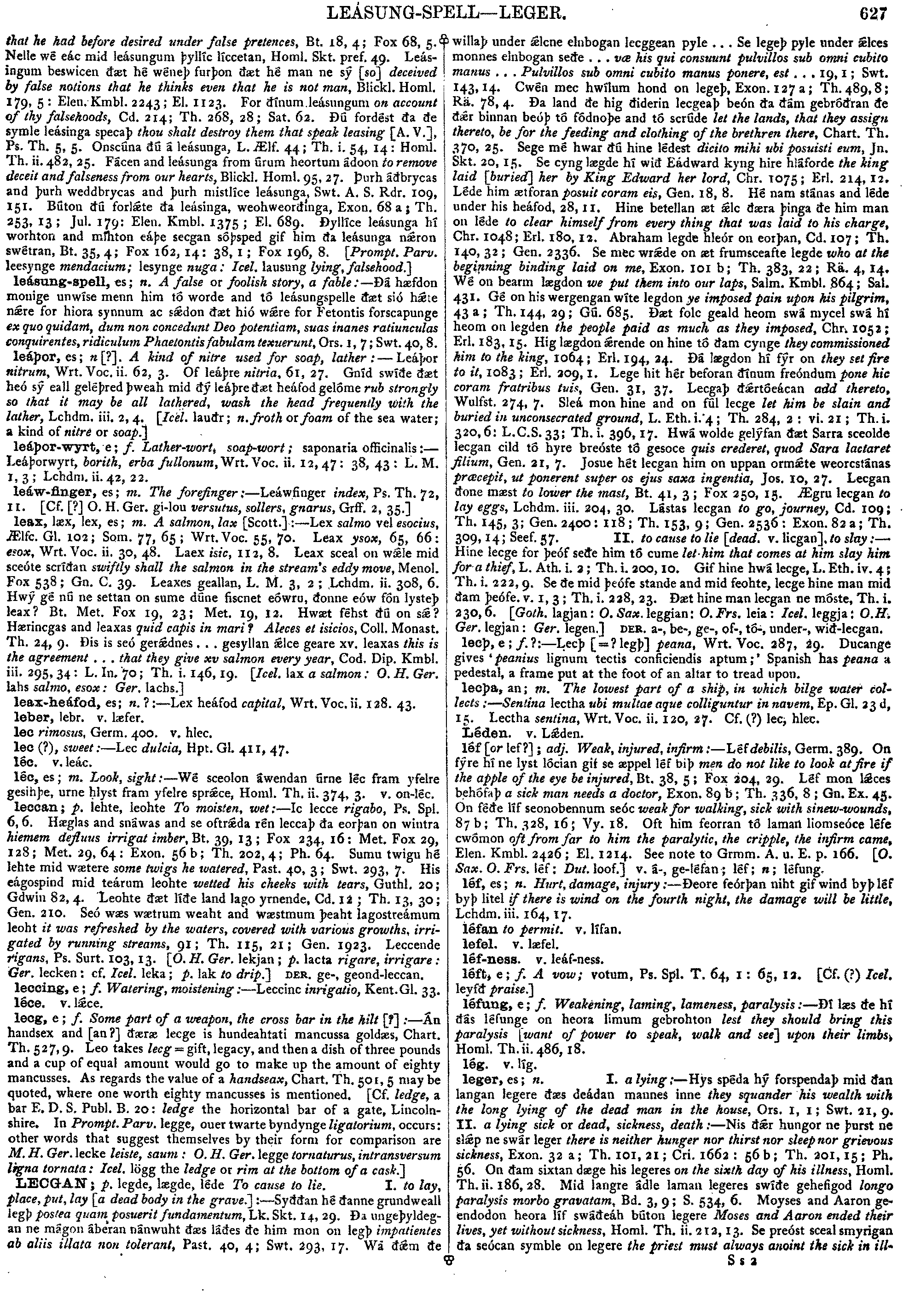
LECGAN;
p.
legde,
lægde,
léde
To
cause
to
lie.
I.
to
lay,
place,
put,
lay
[a
dead
body
in
the
grave.]
:--
Syððan
hé
ðanne
grundweall
legþ
postea
quam
posuerit
fundamentum,
Lk.
Skt.
14,
29.
Ða
ungeþyldegan
ne
mágon
áberan
nánwuht
ðæs
láðes
ðe
him
mon
on
legþ
impatientes
ab
aliis
illata
non
tolerant,
Past.
40,
4;
Swt.
293,
17.
Wá
ðm
ðe
willaþ
under
lcne
elnbogan
lecggean
pyle
...
Se
legeþ
pyle
under
lces
monnes
elnbogan
seðe
...
væ
his
qui
consuunt
pulvillos
sub
omni
cubito
manus
..
.
Pulvillos
sub
omni
cubito
manus
ponere,
est
...
19,
1;
Swt.
143,
14.
Cwén
mec
hwílum
hond
on
legeþ,
Exon.
127
a;
Th.
489,
8;
Rä.
78,
4.
Ða
land
ðe
hig
ðiderin
lecgeaþ
beón
ða
ðám
gebróðran
ðe
ðr
binnan
beóþ
tó
fódnoþe
and
tó
scrúde
let
the
lands,
that
they
assign
thereto,
be
for
the
feeding
and
clothing
of
the
brethren
there,
Chart.
Th.
370,
25.
Sege
mé
hwar
ðú
hine
lédest
diciio
mihi
ubi
posuisti
eum,
Jn.
Skt.
20,
15.
Se
cyng
lægde
hí
wið
Eádward
kyng
hire
hláforde
the
king
laid
[buried]
her
by
King
Edward
her
lord,
Chr.
1075;
Erl.
214,
12.
Léde
him
ætforan
posuit
coram
eis,
Gen.
18,
8.
Hé
nam
stánas
and
léde
under
his
heáfod,
28,
11.
Hine
betellan
æt
lc
ðæra
þinga
ðe
him
man
on
léde
to
clear
himself
from
every
thing
that
was
laid
to
his
charge,
Chr.
1048;
Erl.
180,
12.
Abraham
legde
hleór
on
eorþan,
Cd.
107;
Th.
140,
32;
Gen.
2336.
Se
mec
wrde
on
æt
frumsceafte
legde
who
at
the
beginning
binding
laid
on
me,
Exon.
101
b;
Th.
383,
22;
Rä.
4,
14.
Wé
on
bearm
lægdon
we
put
them
into
our
laps,
Salm.
Kmbl.
864;
Sal.
431.
Gé
on
his
wergengan
wíte
legdon
ye
imposed
pain
upon
his
pilgrim,
43
a;
Th.
144,
29;
Gú.
685.
Ðæt
folc
geald
heom
swá
mycel
swá
hí
heom
on
legden
the
people
paid
as
much
as
they
imposed,
Chr,
1052;
Erl.183,
15.
Hig
lægdon
rende
on
hine
tó
ðam
cynge
they
commissioned
him
to
the
king,
1064;
Erl.
194,
24.
Ðá
lægdon
hí
fýr
on
they
set
fire
to
it,
1083;
Erl.
209,
1.
Lege
hit
hér
beforan
ðínum
freóndum
pone
hic
coram
fratribus
tuis,
Gen.
31,
37.
Lecgaþ
ðrtóeácan
add
thereto,
Wulfst.
274,
7.
Sleá
mon
hine
and
on
fúl
lecge
let
him
be
slain
and
buried
in
unconsecrated
ground,
L.
Eth.
i.
4;
Th.
284,
2:
vi.
21;
Th.
i.
320,
6:
L.
C.
S.
33;
Th.
i.
396,
17.
Hwá
wolde
gelýfan
ðæt
Sarra
sceolde
lecgan
cild
tó
hyre
breóste
tó
gesoce
quis
crederet,
quod
Sara
lactaret
filium,
Gen.
21,
7.
Josue
hét
lecgan
him
on
uppan
ormte
weorcstánas
præcepit,
ut
ponerent
super
os
ejus
saxa
ingentia,
Jos.
10,
27.
Lecgan
ðone
mæst
to
lower
the
mast,
Bt.
41,
3;
Fox
250,
15.
Ægru
lecgan
to
lay
eggs,
Lchdm.
iii.
204,
30.
Lástas
lecgan
to
go,
journey,
Cd.
109;
Th.
145,
3;
Gen.
2400:
118;
Th.
153.
9;
Gen.
2536:
Exon.
82
a;
Th.
309,
14;
Seef.
57.
II.
to
cause
to
lie
[dead.
v.
licgan],
to
slay
:--
Hine
lecge
for
þeóf
seðe
him
tó
cume
let
him
that
comes
at
him
slay
him
for
a
thief,
L.
Ath.
i.
2;
Th.
i.
200,
10.
Gif
hine
hwá
lecge,
L.
Eth.
iv.
4;
Th.
i.
222,
9.
Se
ðe
mid
þeófe
stande
and
mid
feohte,
lecge
hine
man
mid
ðam
þeófe.
v.
1,
3;
Th.
i.
228,
23.
Ðæt
hine
man
lecgan
ne
móste,
Th.
i.
230,
6.
[Goth.
lagjan:
O.
Sax.
leggian:
O.
Frs.
leia:
Icel.
leggja:
O.
H.
Ger.
legjan:
Ger.
legen.]
DER.
a-,
be-,
ge-,
of-,
tó-,
under-,
wið-lecgan.
|
Source: Bosworth/Toller, page b0820, entry 3 View original page image as: [TIFF] [PNG] [View previous entry] [View next entry] |
[Comment on this entry] [View comments] |
The following entry has been hand-corrected once. |
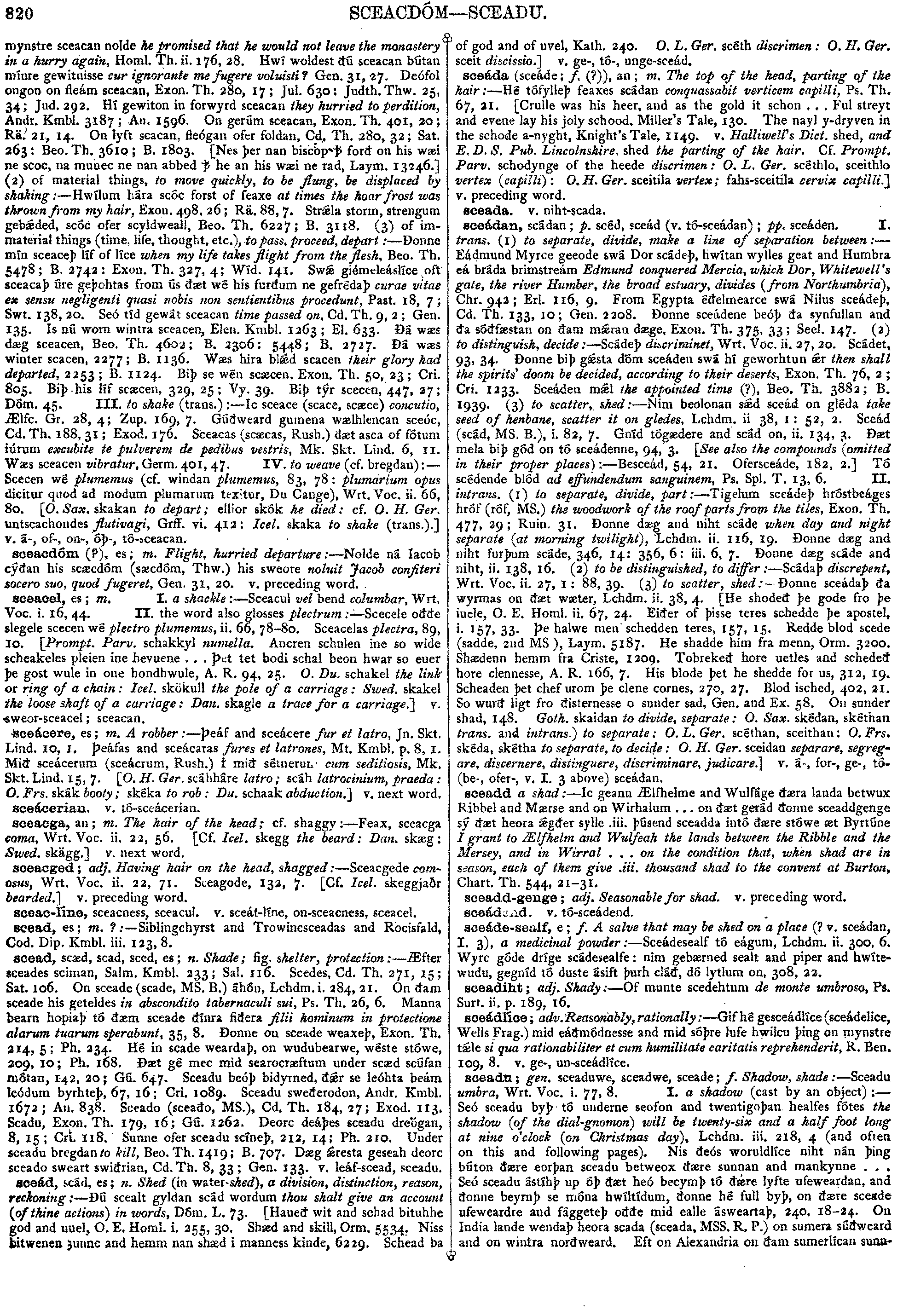
sceacel, es; m. I. a shackle :-- Sceacul vel bend columbar, Wrt. Voc. i. 16, 44. II. the word also glosses plectrum :-- Scecele oððe slegele scecen wé plectra plumemus, ii. 66, 78-80. Sceacelas plectra, 89, 10. [Prompt. Parv. schakkyl numella. Ancren schulen ine so wide scheakeles pleien ine hevuene . . . Þet tet bodi schal beon hwar so euer þe gost wule in one hondhwule, A. R. 94, 25. O. Du. schakel the link or ring of a chain: Icel. skökull the pole of a carriage: Swed. skakel the loose shaft of a carriage: Dan. skagle a trace for a carriage.] v. sweor-sceacel; sceacan.
|
Source: Bosworth/Toller, page b1018, entry 6 View original page image as: [TIFF] [PNG] [View previous entry] [View next entry] |
[Comment on this entry] [View comments] |
The following entry has been hand-corrected once. |
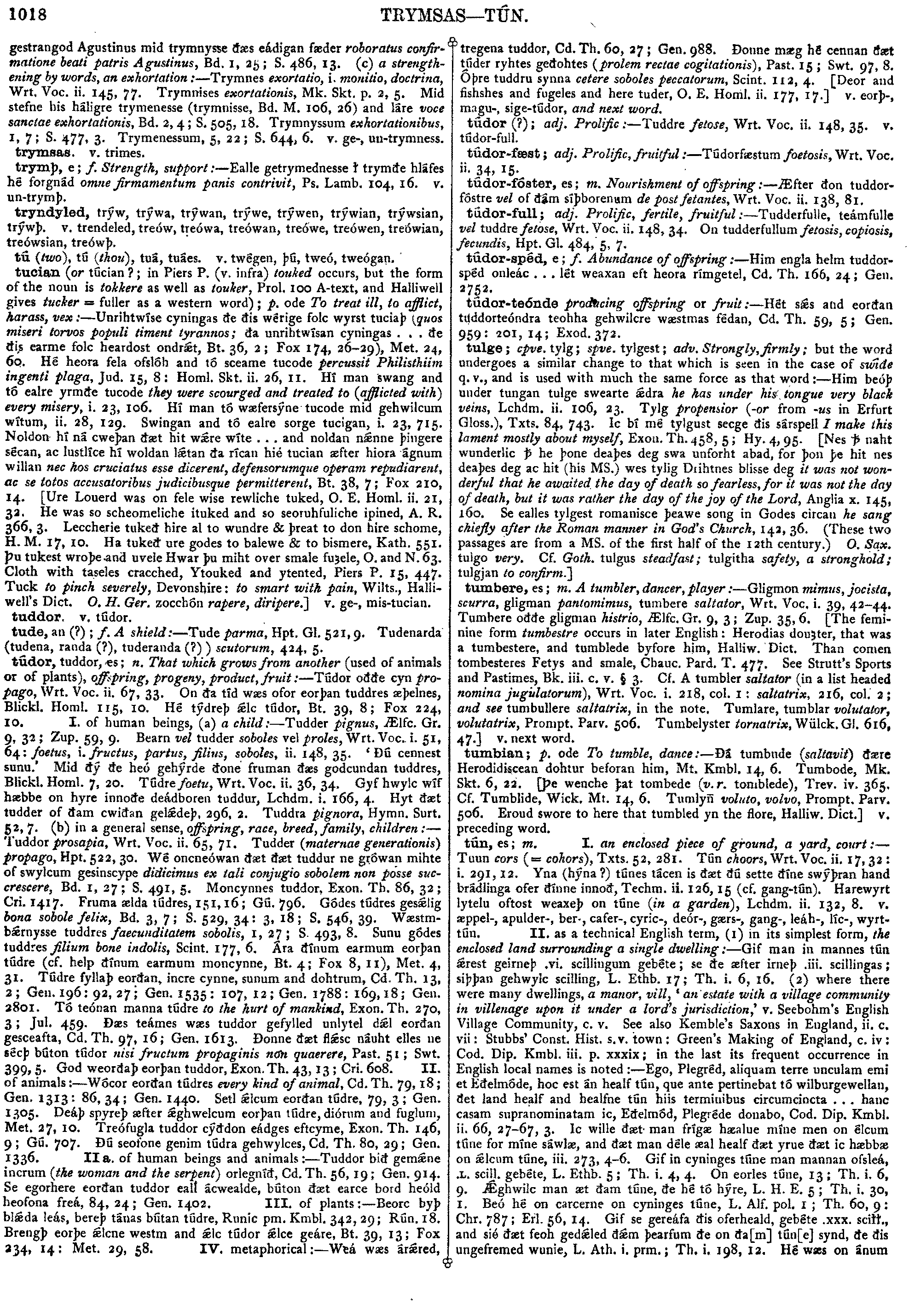
tucian
(or
túcian
?;
in
Piers
P.
(v.
infra)
touked
occurs,
but
the
form
of
the
noun
is
tokkere
as
well
as
touker,
Prol.
100
A-text,
and
Halliwell
gives
tucker
=
fuller
as
a
western
word);
p.
ode
To
treat
ill,
to
afflict,
harass,
vex
:--
Unrihtwíse
cyningas
ðe
ðis
wérige
folc
wyrst
tuciaþ
(quos
miseri
torvos
populi
timent
tyrannos;
ða
unrihtwísan
cyningas
.
.
.
ðe
ðis
earme
folc
heardost
ondrt,
Bt.
36,
2;
Fox
174,
26-29),
Met.
24,
60.
Hé
heora
fela
ofslóh
and
16
sceame
tucode
percussit
Philisthiim
ingenti
plaga,
Jud.
15,
8:
Homl.
Skt.
ii.
26,
11.
Hí
man
swang
and
tó
ealre
yrmðe
tucode
they
were
scourged
and
treated
to
(afflicted
with]
every
misery,
i.
23,
106.
Hí
man
tó
wæfersýne
tucode
mid
gehwilcum
witum,
ii.
28,
129.
Swingan
and
tó
ealre
sorge
tucigan,
i.
23,
715.
Noldon
hí
ná
cweþan
ðæt
hit
wre
wíte
.
.
.
and
noldan
nnne
þingere
sécan,
ac
lustlíce
hí
woldan
ltan
ða
rícan
hié
tucian
æfter
hiora
ágnum
willan
nec
hos
cruciatus
esse
dicerent,
defensorumque
operam
repudiarent,
ac
se
totos
accusatoribus
judicibusque
permitterent.
Bt.
38,
7;
Fox
210,
14.
[Ure
Lonerd
was
on
fele
wise
rewliche
tuked,
O.
E.
Homl.
ii.
21,
32.
He
was
so
scheomeliche
ituked
and
so
seoruhfuliche
ipined,
A.
R.
366,
3.
Leccherie
tukeð
ure
al
to
wundre
&
þreat
to
don
hire
schome,
H.
M.
17,
10.
Ha
tukeð
ure
godes
to
balewe
&
to
bismere,
Kath.
551.
þu
tukest
wroþe
and
uvele
Hwar
þu
miht
over
smale
fuzele,
O.
and
N.
63.
Cloth
with
taseles
cracched,
Ytouked
and
ytented,
Piers
P.
15,
447.
Tuck
to
pinch
severely,
Devonshire:
to
smart
with
pain,
Wilts.
,
Halliwell's
Dict.
O.
H.
Ger.
zocchón
rapere,
diripere.]
v.
ge-,
mis-tucian.
|
Source: Bosworth/Toller, page b1023, entry 6 View original page image as: [TIFF] [PNG] [View previous entry] [View next entry] |
[Comment on this entry] [View comments] |
The following entry has been hand-corrected once. |
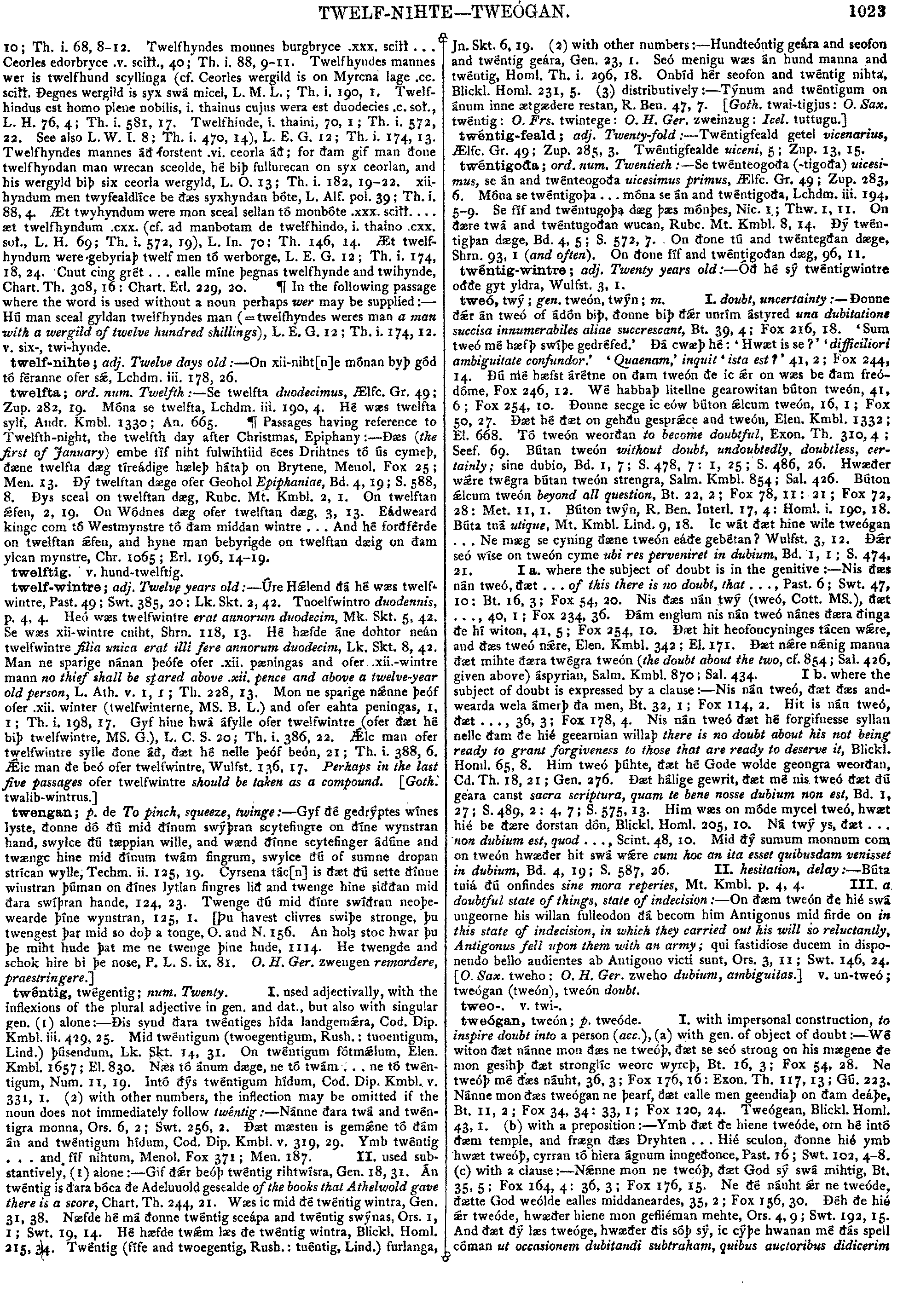
twengan;
p.
de
To
pinch,
squeeze,
twinge:--Gyf
ðé
gedrýptes
wínes
lyste,
ðonne
dó
ðú
mid
ðínum
swýþran
scytefingre
on
ðíne
wynstran
hand,
swylce
ðú
tæppian
wille,
and
wænd
ðínne
scytefinger
ádúne
and
twængc
hine
mid
ðínum
twám
fingrum,
swylce
ðú
of
sumne
dropan
strícan
wylle,
Techm.
ii.
125,
19.
Cyrsena
tác[n]
is
ðæt
ðú
sette
ðínne
winstran
þúman
on
ðínes
lytlan
fingres
lið
and
twenge
hine
siððan
mid
ðara
swíþran
hande,
124,
23.
Twenge
ðú
mid
ðínre
swíðran
neoþe wearde
þíne
wynstran,
125,
1.
[Þu
havest
clivres
swiþe
stronge,
þu
twengest
þar
mid
so
doþ
a
tonge,
O.
and
N.
156.
An
hol
wearde
þíne
wynstran,
125,
1.
[Þu
havest
clivres
swiþe
stronge,
þu
twengest
þar
mid
so
doþ
a
tonge,
O.
and
N.
156.
An
hol stoc
hwar
þu
þe
miht
hude
þat
me
ne
twenge
þine
hude,
1114.
He
twengde
and
schok
hire
bi
þe
nose,
P.
L.
S.
ix.
81.
O.
H.
Ger.
zwengen
remordere,
praestringere.]
stoc
hwar
þu
þe
miht
hude
þat
me
ne
twenge
þine
hude,
1114.
He
twengde
and
schok
hire
bi
þe
nose,
P.
L.
S.
ix.
81.
O.
H.
Ger.
zwengen
remordere,
praestringere.]
|
Source: Bosworth/Toller, page d0482, entry 13 View original page image as: [TIFF] [PNG] [View previous entry] [View next entry] |
[Comment on this entry] [View comments] |
The following entry has been hand-corrected once. |
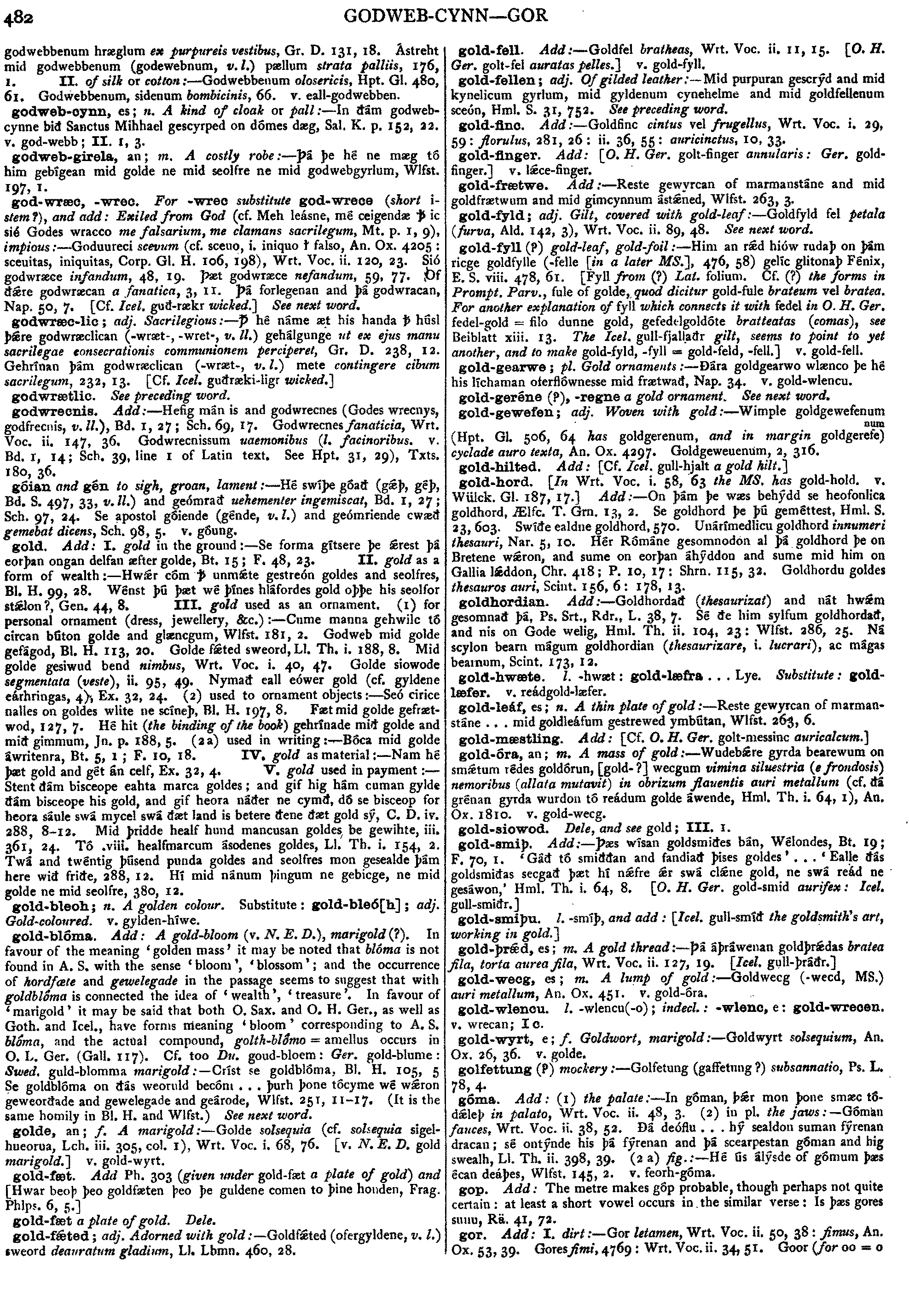
gold-fæt. Add Ph. 303 (given under gold-fæt a plate of gold) and [Hwar beoþ þeo goldfæten þeo þe guldene comen to þine honden, Frag. Phlps. 6, 5.]
|
Source: Cleasby/Vigfusson, page b0296, entry 8 View original page image as: [TIFF] [PNG] [View previous entry] [View next entry] |
[Comment on this entry] [View comments] |
The following entry has been hand-corrected once. |
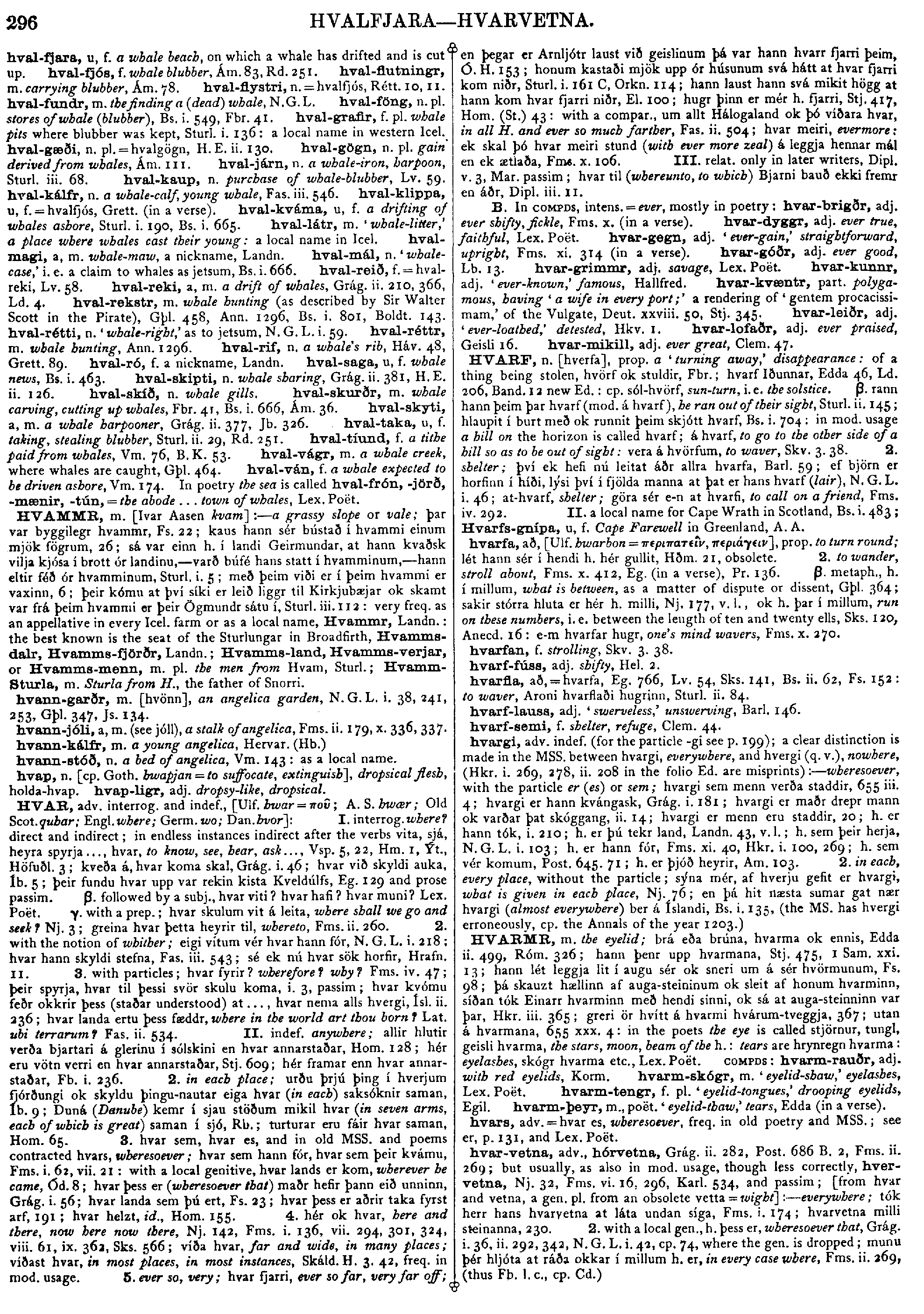
HVAR,
adv.
interrog.
and
indef.,
[Ulf.
hwar
=
GREEK
A.
S.
hwær;
Old
Scot.
qubar;
Engl.
where;
Germ,
wo;
Dan.
hvor]:
I.
interrog.
where?
direct
and
indirect;
in
endless
instances
indirect
after
the
verbs
vita,
sjá,
heyra
spyrja...,
hvar,
to
know,
see,
hear,
ask...,
Vsp.
5,
22,
Hm.
i,
Ýt.,
Höfuðl.
3;
kveða
á,
hvar
koma
skal,
Grág.
i.
46;
hvar
við
skyldi
auka,
Ib.
5;
þeir
fundu
hvar
upp
var
rekin
kista
Kveldúlfs,
Eg.
129
and
prose
passim.
 .
followed
by
a
subj.,
hvar
viti?
hvar
hafi?
hvar
muni?
Lex.
Poët.
.
followed
by
a
subj.,
hvar
viti?
hvar
hafi?
hvar
muni?
Lex.
Poët.
 .
with
a
prep.;
hvar
skulum
vit
á
leita,
where
shall
we
go
and
seek?
Nj.
3;
greina
hvar
þetta
heyrir
til,
whereto,
Fms.
ii.
260.
2.
with
the
notion
of
whither;
eigi
vitum
ver
hvar
hann
for,
N.
G.
L.
i.
218;
hvar
hann
skyldi
stefna,
Fas.
iii.
543;
sé
ek
nú
hvar
sök
horfir,
Hrafn.
II.
3.
with
particles;
hvar
fyrir?
wherefore?
why?
Fms.
iv.
47;
þeir
spyrja,
hvar
til
þessi
svör
skulu
koma,
i.
3,
passim;
hvar
kvómu
feðr
okkrir
þess
(staðar
understood)
at...,
hvar
nema
alls
hvergi,
Ísl.
ii.
236;
hvar
landa
ertu
þess
faeddr,
where
in
the
world
art
thou
born
?
Lat.
ubi
terrarum?
Fas.
ii.
534.
II.
indef.
anywhere;
allir
hlutir
verða
bjartari
á
glerinu
í
sólskini
en
hvar
annarstaðar,
Hom.
128;
hér
eru
vötn
verri
en
hvar
annarstadar,
Stj.
609;
hér
framar
enn
hvar
annar-
staðar,
Fb.
i.
236.
2.
in
each
place;
urðu
þrjú
þing
í
hverjum
fjórðungi
ok
skyldu
þingu-nautar
eiga
hvar
(in
each)
saksóknir
saman,
Íb.
9;
Duná
(Danube)
kemr
í
sjau
stöðum
mikil
hvar
(IB
seven
arms,
each
of
which
is
great)
saman
í
sjó,
Rb.;
turturar
eru
fair
hvar
saman,
Hom.
65.
3.
hvar
sem,
hvar
es,
and
in
old
MSS.
and
poems
contracted
hvars,
wheresoever;
hvar
sem
hann
for,
hvar
sem
þeir
kvámu,
Fms.
i.
62,
vii.
21:
with
a
local
genitive,
hvar
lands
er
kom,
wherever
he
came,
Ód.
8;
hvar
þess
er
(wheresoever
that)
maðr
hefir
þann
eið
unninn,
Grág.
i.
56;
hvar
landa
sem
þú
ert,
Fs.
23;
hvar
þess
er
aðrir
taka
fyrst
arf,
191;
hvar
helzt,
id.,
Hom.
155.
4.
hér
ok
hvar,
here
and
there,
now
here
now
there,
Nj.
142,
Fms.
i.
136,
vii.
294,
301,
324,
viii.
61,
ix.
362,
Sks.
566;
víða
hvar,
far
and
wide,
in
many
places;
víðast
hvar,
in
most
places,
in
most
instances,
Skald.
H.
3.
42,
freq.
in
mod.
usage.
5.
eve
r
so,
very;
hvar
fjarri,
ever
so
far,
very
far
off;
en
þegar
er
Arnljótr
laust
við
geislinum
þá
var
hann
hvarr
fjarri
þeim,
Ó.
H.
153;
honum
kastaði
mjök
upp
or
húsunum
svá
hátt
at
hvar
fjarri
kom
niðr,
Sturl.
i.
161
C,
Orkn.
114;
hann
laust
hann
svá
mikit
högg
at
hann
kom
hvar
fjarri
niðr,
El.
100;
hugr
þinn
er
mér
h.
fjarri,
Stj.
417,
Hom.
(St.)
43:
with
a
compar.,
um
allt
Hálogaland
ok
þó
víðara
hvar,
in
all
H.
and
ever
so
much
farther,
Fas.
ii.
504;
hvar
meiri,
evermore;
ek
skal
þó
hvar
meiri
stund
(with
ever
more
zeal)
á
leggja
hennar
mál
en
ek
ætlaða,
Fms.
x.
106.
III.
relat.
only
in
later
writers,
Dipl.
v.
3,
Mar.
passim;
hvar
til
(whereunto,
to
which)
Bjarni
bauð
ekki
fremr
en
áðr,
Dipl.
iii.
n.
B.
In
COMPDS,
intens.
=
ever,
mostly
in
poetry:
hvar-brigðr,
adj.
ever
shifty,
fickle,
Fms.
x.
(in
a
verse).
hvar-dyggr,
adj.
ever
true,
faithful,
Lex.
Poët.
hvar-gegn,
adj.
'ever-gain,'
straightforward,
upright,
Fms.
xi.
314
(in
a
verse).
hvar-góðr,
adj.
ever
good,
Lb.
13.
hvar-grimmr,
adj.
savage,
Lex.
Poët.
hvar-kunnr,
adj.
'
ever-known,'
famous,
Hallfred.
hvar-kvæntr,
part,
polyga-
mous,
having
'a
wife
in
every
port;'
a
rendering
of
'gentern
procacissi-
marn,'
of
the
Vulgate,
Deut.
xxviii.
50,
Stj.
345.
hvar-leiðr,
adj.
'ever-loathed,
'detested,
Hkv.
i.
hvar-lofaðr,
adj.
ever
praised,
Geisli
16.
hvar-mikill,
adj.
ever
great,
Clem.47.
.
with
a
prep.;
hvar
skulum
vit
á
leita,
where
shall
we
go
and
seek?
Nj.
3;
greina
hvar
þetta
heyrir
til,
whereto,
Fms.
ii.
260.
2.
with
the
notion
of
whither;
eigi
vitum
ver
hvar
hann
for,
N.
G.
L.
i.
218;
hvar
hann
skyldi
stefna,
Fas.
iii.
543;
sé
ek
nú
hvar
sök
horfir,
Hrafn.
II.
3.
with
particles;
hvar
fyrir?
wherefore?
why?
Fms.
iv.
47;
þeir
spyrja,
hvar
til
þessi
svör
skulu
koma,
i.
3,
passim;
hvar
kvómu
feðr
okkrir
þess
(staðar
understood)
at...,
hvar
nema
alls
hvergi,
Ísl.
ii.
236;
hvar
landa
ertu
þess
faeddr,
where
in
the
world
art
thou
born
?
Lat.
ubi
terrarum?
Fas.
ii.
534.
II.
indef.
anywhere;
allir
hlutir
verða
bjartari
á
glerinu
í
sólskini
en
hvar
annarstaðar,
Hom.
128;
hér
eru
vötn
verri
en
hvar
annarstadar,
Stj.
609;
hér
framar
enn
hvar
annar-
staðar,
Fb.
i.
236.
2.
in
each
place;
urðu
þrjú
þing
í
hverjum
fjórðungi
ok
skyldu
þingu-nautar
eiga
hvar
(in
each)
saksóknir
saman,
Íb.
9;
Duná
(Danube)
kemr
í
sjau
stöðum
mikil
hvar
(IB
seven
arms,
each
of
which
is
great)
saman
í
sjó,
Rb.;
turturar
eru
fair
hvar
saman,
Hom.
65.
3.
hvar
sem,
hvar
es,
and
in
old
MSS.
and
poems
contracted
hvars,
wheresoever;
hvar
sem
hann
for,
hvar
sem
þeir
kvámu,
Fms.
i.
62,
vii.
21:
with
a
local
genitive,
hvar
lands
er
kom,
wherever
he
came,
Ód.
8;
hvar
þess
er
(wheresoever
that)
maðr
hefir
þann
eið
unninn,
Grág.
i.
56;
hvar
landa
sem
þú
ert,
Fs.
23;
hvar
þess
er
aðrir
taka
fyrst
arf,
191;
hvar
helzt,
id.,
Hom.
155.
4.
hér
ok
hvar,
here
and
there,
now
here
now
there,
Nj.
142,
Fms.
i.
136,
vii.
294,
301,
324,
viii.
61,
ix.
362,
Sks.
566;
víða
hvar,
far
and
wide,
in
many
places;
víðast
hvar,
in
most
places,
in
most
instances,
Skald.
H.
3.
42,
freq.
in
mod.
usage.
5.
eve
r
so,
very;
hvar
fjarri,
ever
so
far,
very
far
off;
en
þegar
er
Arnljótr
laust
við
geislinum
þá
var
hann
hvarr
fjarri
þeim,
Ó.
H.
153;
honum
kastaði
mjök
upp
or
húsunum
svá
hátt
at
hvar
fjarri
kom
niðr,
Sturl.
i.
161
C,
Orkn.
114;
hann
laust
hann
svá
mikit
högg
at
hann
kom
hvar
fjarri
niðr,
El.
100;
hugr
þinn
er
mér
h.
fjarri,
Stj.
417,
Hom.
(St.)
43:
with
a
compar.,
um
allt
Hálogaland
ok
þó
víðara
hvar,
in
all
H.
and
ever
so
much
farther,
Fas.
ii.
504;
hvar
meiri,
evermore;
ek
skal
þó
hvar
meiri
stund
(with
ever
more
zeal)
á
leggja
hennar
mál
en
ek
ætlaða,
Fms.
x.
106.
III.
relat.
only
in
later
writers,
Dipl.
v.
3,
Mar.
passim;
hvar
til
(whereunto,
to
which)
Bjarni
bauð
ekki
fremr
en
áðr,
Dipl.
iii.
n.
B.
In
COMPDS,
intens.
=
ever,
mostly
in
poetry:
hvar-brigðr,
adj.
ever
shifty,
fickle,
Fms.
x.
(in
a
verse).
hvar-dyggr,
adj.
ever
true,
faithful,
Lex.
Poët.
hvar-gegn,
adj.
'ever-gain,'
straightforward,
upright,
Fms.
xi.
314
(in
a
verse).
hvar-góðr,
adj.
ever
good,
Lb.
13.
hvar-grimmr,
adj.
savage,
Lex.
Poët.
hvar-kunnr,
adj.
'
ever-known,'
famous,
Hallfred.
hvar-kvæntr,
part,
polyga-
mous,
having
'a
wife
in
every
port;'
a
rendering
of
'gentern
procacissi-
marn,'
of
the
Vulgate,
Deut.
xxviii.
50,
Stj.
345.
hvar-leiðr,
adj.
'ever-loathed,
'detested,
Hkv.
i.
hvar-lofaðr,
adj.
ever
praised,
Geisli
16.
hvar-mikill,
adj.
ever
great,
Clem.47.
|
Source: Gordon/Taylor, page b0166, entry 1 View original page image as: [TIFF][PNG] [View previous entry] [View next entry] |
[Comment on this entry] [View comments] |
The following entry has been hand-corrected once. |
Annæn
t mæ
took
han
snæ
mæ
took
han
snæ
 ghnæ
d
ghnæ
d ttær
ttær
 witændhes
oc
witændhes
oc
aflæthe
n
søn,
htæ
Rlf
Kragæ.
R
konung
irthæthæs
Læthræ.
Hælghe
drap
konung
af
Windæn
striith
oc
wan
15
Hodbrodæ
oc
fik
alt
Danmark.
Sithæn,
for
skam
skyld
at
han
haftæ
snæ
dttær,
th fl
fl thæ
han
til
thæ
han
til
 stærrike
oc
drap
stærrike
oc
drap
sek
thær
sæluær.
Th
sendæ
konung
Hkun
af
Swrke
et
køuærne
Danum
til
konung,
mæth
th
forrth
at
hwilkæn
thæt
først
sauthe
at
20
han
war
dthær,
han
skuldæ
mistæ
sit
liif.
&E-long;n
dag
sum
Rakkæ
sath
withær
brth,
oc
hunda
ruus
gulue,
th
sprng
han
frn
brth
oc
bland
hundanæ,
oc
th
rwo
honum
hæl;
oc
thæt
thrdæ
ængæn
sighæ
konung
Hkonæ.
Th
bath
Læ
iæten
L s
sin
hirthæ
Sni
faa
sek
konungædmæt
s
sin
hirthæ
Sni
faa
sek
konungædmæt
25
af
konung
Hkune.
Th
sprthe
Hkun
konung
Sni
vm
tthendæ.
Sni
suaræthæ:
'Bn
faræ
all
wrthæls
Danmark.'
Th
sauthæ
Hkon
konung:
'Hwar
laat
t
nt?'
Sni
swaræthæ
konungæn:
'Thær
sum
faaren
tæ
vluænæ.'
'Huræ
sw?'
'Forth
at
vluæn
szs
oc
gafs
30
faarum
at
drikkæ
for
lgædm.'
'Hwar
laat
th
andræ
nt?'
sathe
konungæn.
Sni
swarathe:
'Thær
sum
vluætæ
waghnæn,
oc
kæn
lp
bort.'
'Huræ
mttæ
thæt
waræ?'
'Forth
vluæ
tæ
biæuærthrlen,
thær
weth
haftæ
mællæn
sn
bn,
oc
th
biæfræ
sum
drgho,
th
lpæ
bort.'
'Hwar
35
laat
th
thrithiæ
nt?'
sathe
konungæn.
Sni
swarathe:
'Thær
sum
ms
tæ
yxenæ
oc
æi
skaftæt.'
'Hw
sw?'
'Forth
børn
giorthæ
yxæ
af
hwt
ost;
hennæ
tæ
ms,
oc
æi
stikken
ther
skaftæt
war
aff.'
Th
sprthæ
konung
æfter
tthændæ.
Sni
swaræthe:
'Bn
faræ
all
wrthæls.'
'Th
40
ær
Rakkæ
dthær!'
'Thæt
sigær
tho
oc
æi
iak',
sathe
Sni;
oc
sw
war
han
konung
Danmark,
wrngær
oc
ofhaarth
dmare
oc
grym
oc
fek
gzs
mæth
 skæll,
oc
megæt
skæll,
oc
megæt
thwingæthe
han
allæ
mæn.
&E-long;n
ht
Rth,
han
stth
hnum
gn.
Hnum
sændæ
konung
for
awnd
skyld
til
L
iætæn
45
at
spøriæ
sin
dth.
Th
sathæ
Rth
quæthiæ
konungæns
Germanic Lexicon Project (main page)
This search system was written by
Sean Crist
Please consider
volunteering
to correct the data in these online dictionaries.
No rights reserved. Feel free to use these data in any way you please.