|
|

Search for Hit again, using less strict matching (3450 results)
|
Source: Bosworth/Toller, page d0766, entry 47 View original page image as: [TIFF] [PNG] [View previous entry] [View next entry] |
[Comment on this entry] [View comments] |
The following entry has been hand-corrected once. |
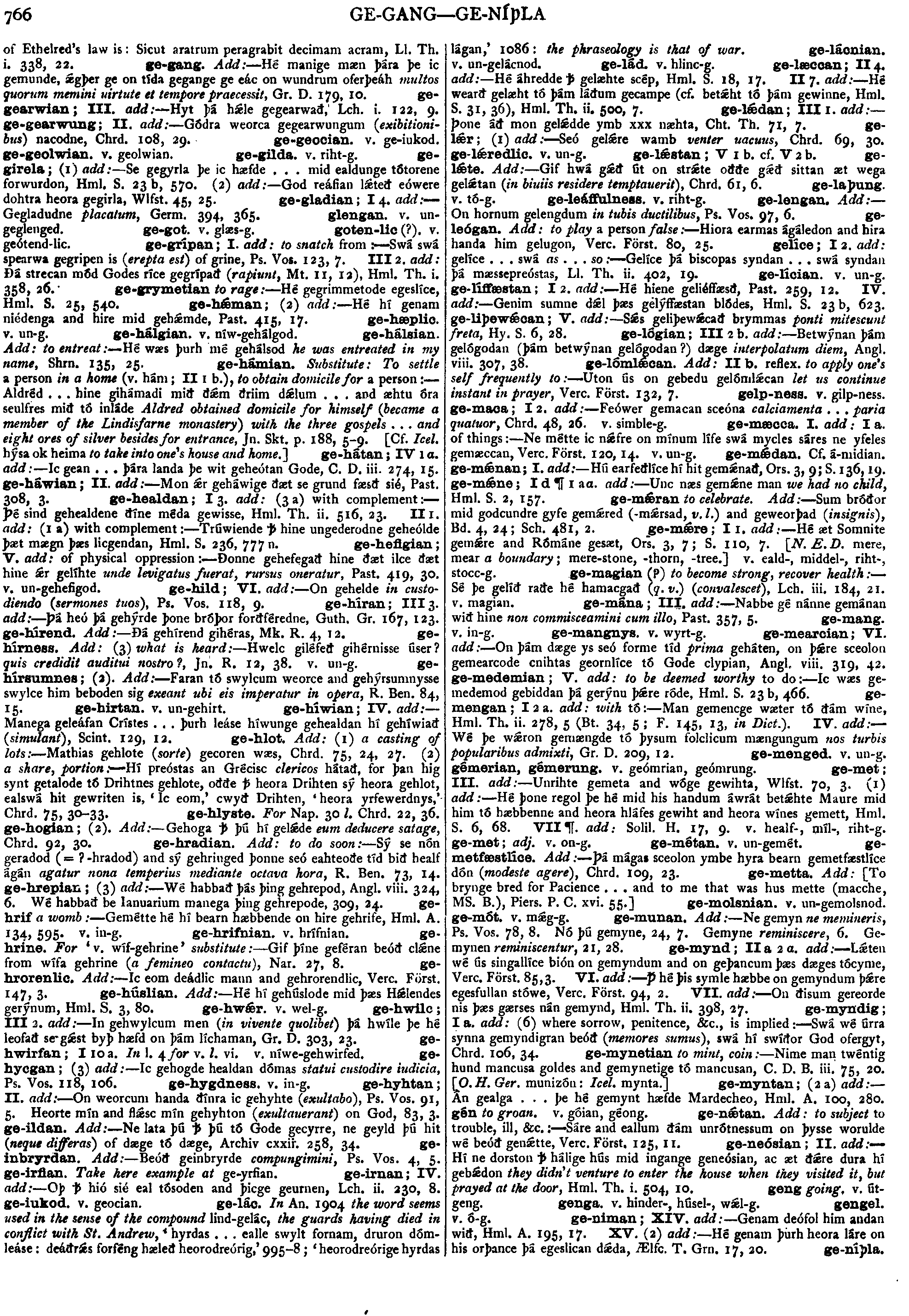
ge-ildan.
Add
:--
Ne
lata
þú
 þú
tó
Gode
gecyrre,
ne
geyld
þú
hit
(neque
differas)
of
dæge
tó
dæge,
Archiv
cxxii.
258,
34.
þú
tó
Gode
gecyrre,
ne
geyld
þú
hit
(neque
differas)
of
dæge
tó
dæge,
Archiv
cxxii.
258,
34.
|
Source: Bosworth/Toller, page d0766, entry 75 View original page image as: [TIFF] [PNG] [View previous entry] [View next entry] |
[Comment on this entry] [View comments] |
The following entry has been hand-corrected once. |
ge-m nan;
I.
add
:--
Hú
earfeðlíce
hí
hit
gemnað,
Ors.
3,
9;
S.
136,
19.
nan;
I.
add
:--
Hú
earfeðlíce
hí
hit
gemnað,
Ors.
3,
9;
S.
136,
19.
|
Source: Bosworth/Toller, page d0767, entry 46 View original page image as: [TIFF] [PNG] [View previous entry] [View next entry] |
[Comment on this entry] [View comments] |
The following entry has been hand-corrected once. |
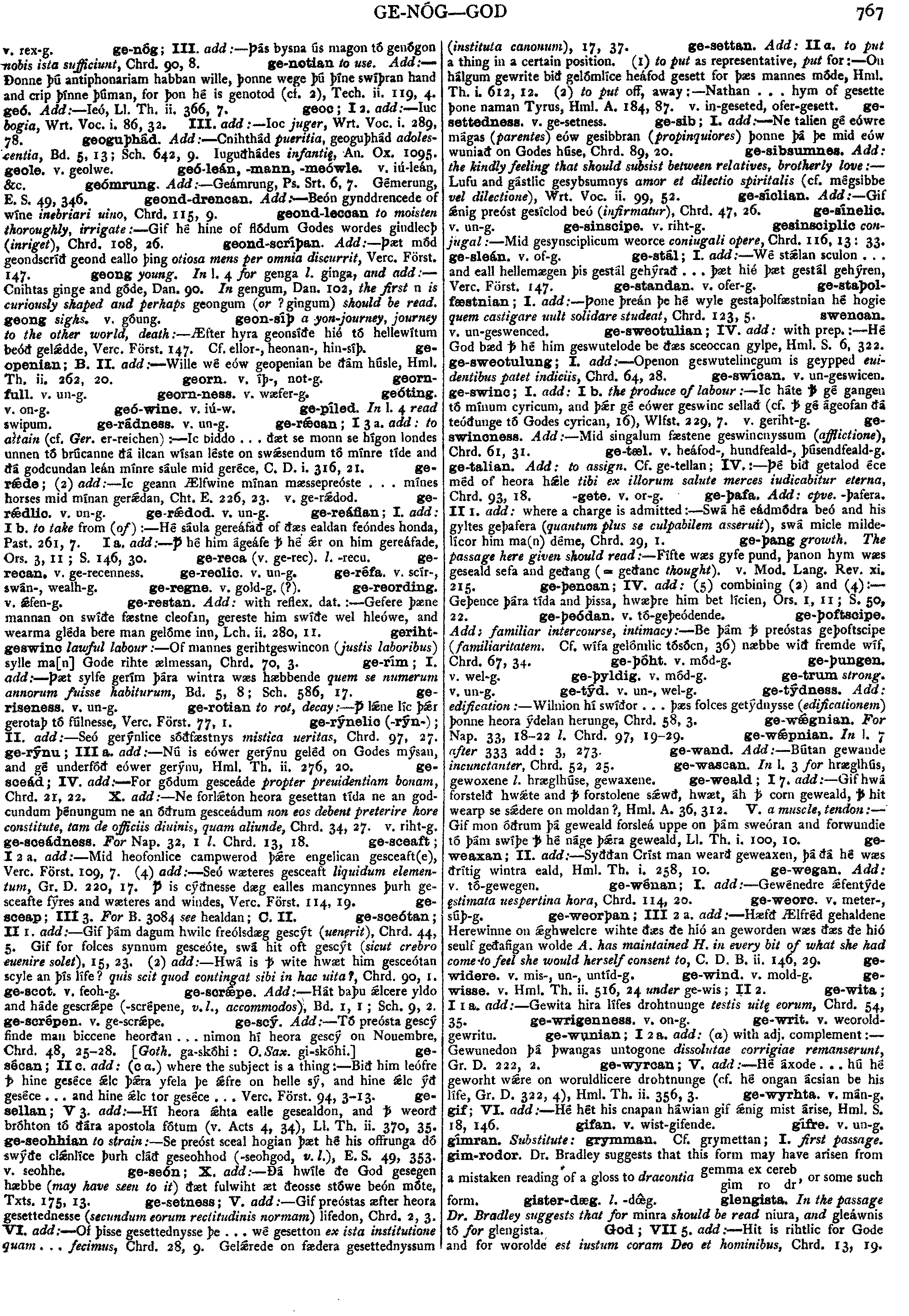
ge-sceótan;
II
1.
add
:--
Gif
þám
dagum
hwilc
freólsdæg
gescýt
(uenerit).
Chrd.
44,
5.
Gif
for
folces
synnum
gesceóte,
swá
hit
oft
gescýt
(sicut
crebro
euenire
solet),
15,
23.
(2)
add
:--
Hwá
is
wite
hwæt
him
gesceótan
scyle
an
þís
lífe?
quis
scit
quod
contingat
sibi
in
hac
uita?,
Chrd.
90,
1.
|
Source: Bosworth/Toller, page d0767, entry 92 View original page image as: [TIFF] [PNG] [View previous entry] [View next entry] |
[Comment on this entry] [View comments] |
The following entry has been hand-corrected once. |
ge-weald;
I
7.
add
:--
Gif
hwá
forstelð
hwte
and
forstolene
swð,
hwæt,
áh
corn
geweald,
hit
wearp
se
sdere
on
moldan?,
Hml.
A.
36,
312.
V.
a
muscle,
tendon
:--
Gif
mon
óðrum
þá
geweald
forsleá
uppe
on
þám
sweóran
and
forwundie
tó
þám
swíþe
hé
náge
þra
geweald,
Ll.
Th.
i.
100,
10.
|
Source: Bosworth/Toller, page d0767, entry 114 View original page image as: [TIFF] [PNG] [View previous entry] [View next entry] |
[Comment on this entry] [View comments] |
The following entry has been hand-corrected once. |
God; VII 5. add :-- Hit is rihtlic for Gode and for worolde est iustum coram Deo et hominibus, Chrd. 13, 19.
|
Source: Bosworth/Toller, page d0768, entry 61 View original page image as: [TIFF] [PNG] [View previous entry] [View next entry] |
[Comment on this entry] [View comments] |
The following entry has been hand-corrected once. |
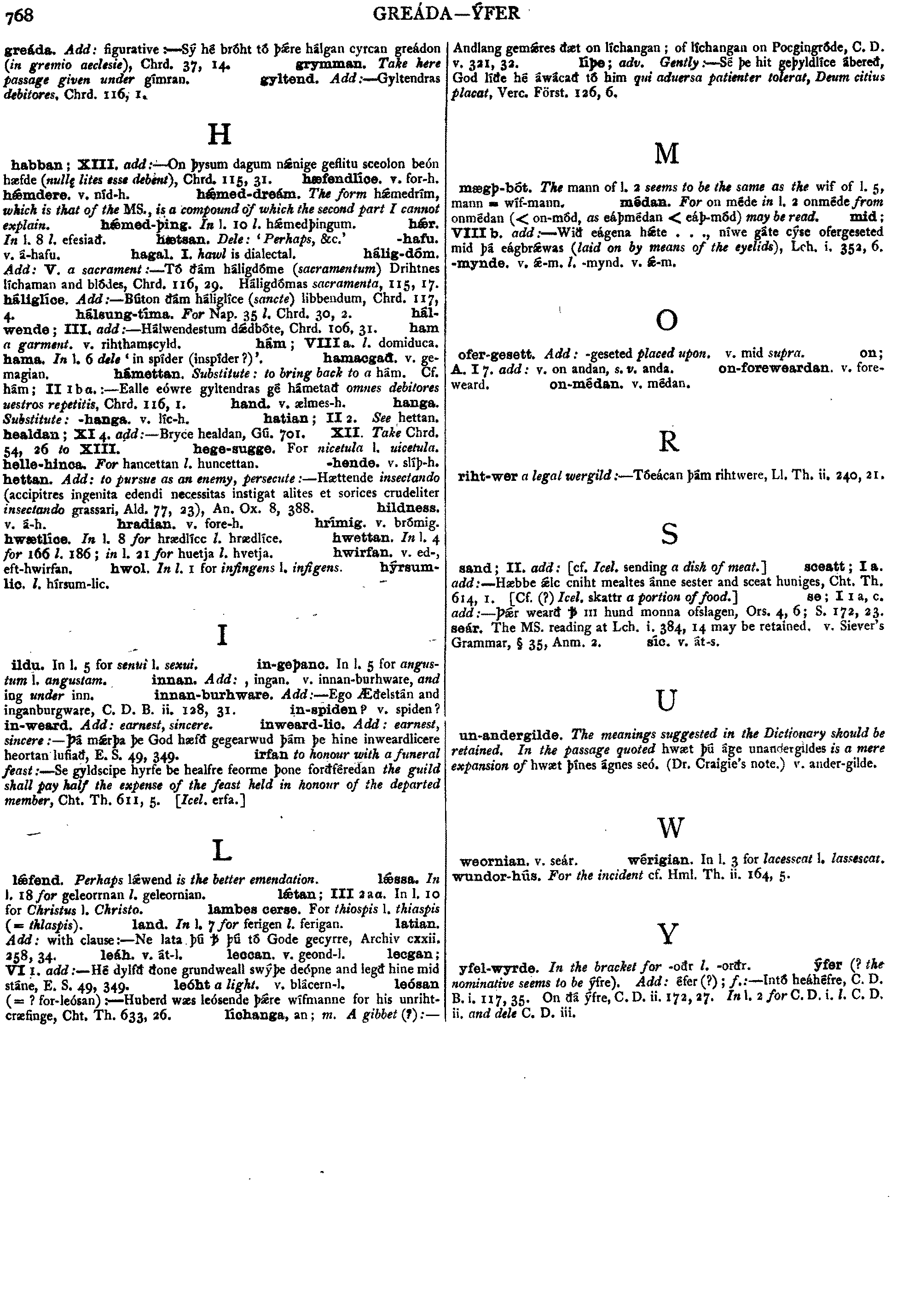
liþe; adv. Gently. :-- Sé þe hit geþyldlíce ábereð, God líðe hé áwácað tó him qui aduersa patienter tolerat, Deum citius placat, Verc. Först. 126, 6.
|
Source: Cleasby/Vigfusson, page b0030, entry 18 View original page image as: [TIFF] [PNG] [View previous entry] [View next entry] |
[Comment on this entry] [View comments] |
The following entry has been hand-corrected once. |
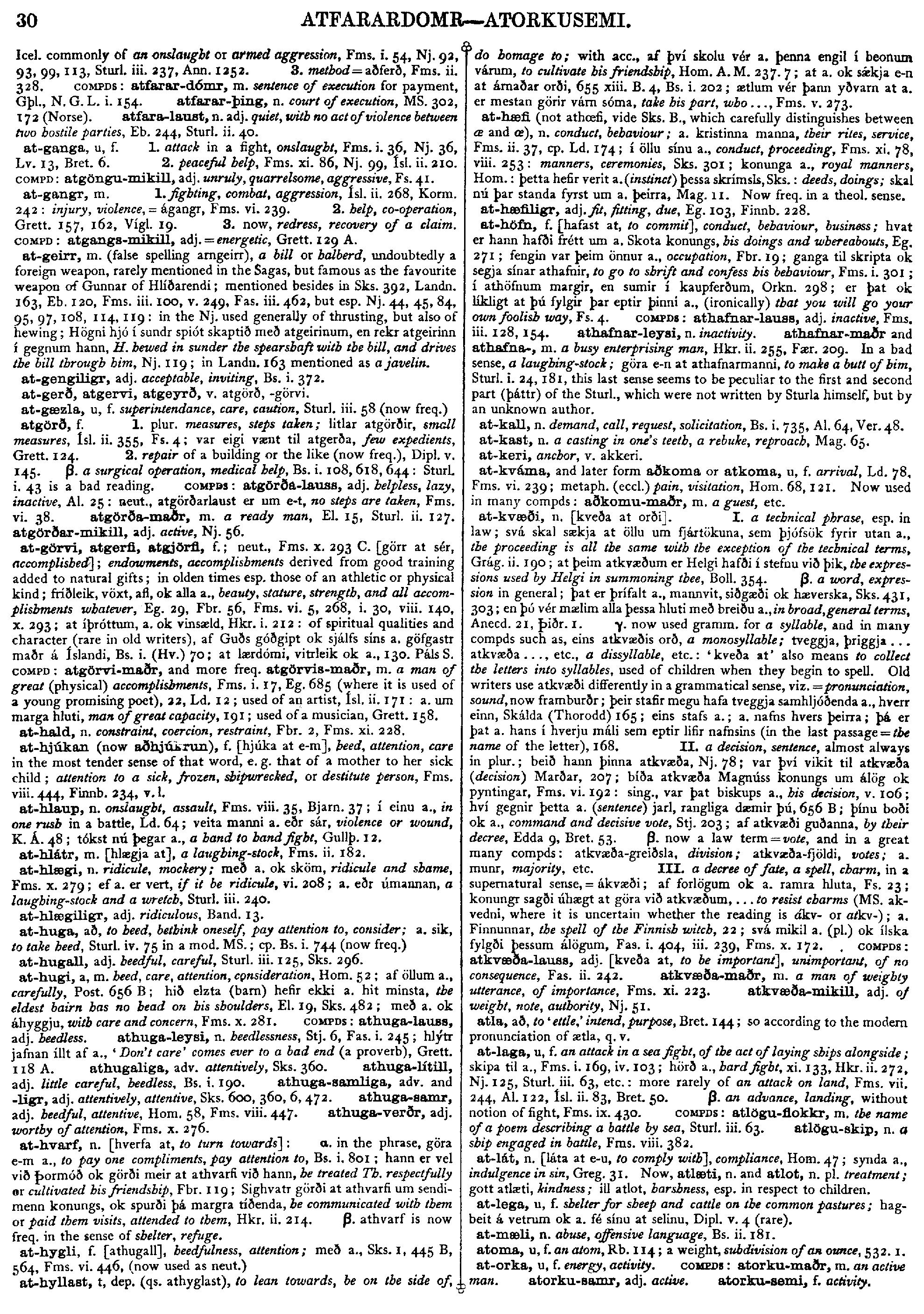
at-hugi, a, m. heed, care, attention, consideration, Hom. 5 2; af öllum a., carefully, Post. 656 B; hið elzta (barn) hefir ekki a. hit minsta, the eldest bairn has no head on his shoulders, El. 19, Sks. 482; með a. ok áhyggju, with care and concern, Fms. x. 281. COMPDS: athuga-lauss, adj. heedless. athuga-leysi, n. beedlessness, Stj. 6, Fas. i. 245; hlýtr jafnan íllt af a., ' Don't care' comes ever to a bad end (a proverb), Grett. 118 A. athugaliga, adv. attentively, Sks. 360. athuga-litill, adj. little careful, heedless, Bs. i. 190. athuga-sarnliga, adv. and -ligr, adj. attentively, attentive, Sks. 600, 360, 6, 472. athuga-samr, adj. heedful, attentive, Hom. 58, Fms. viii. 447. athuga-verðr, adj. worthy of attention, Fms. x. 276.
|
Source: Cleasby/Vigfusson, page b0041, entry 115 View original page image as: [TIFF] [PNG] [View previous entry] [View next entry] |
[Comment on this entry] [View comments] |
The following entry has been hand-corrected once. |
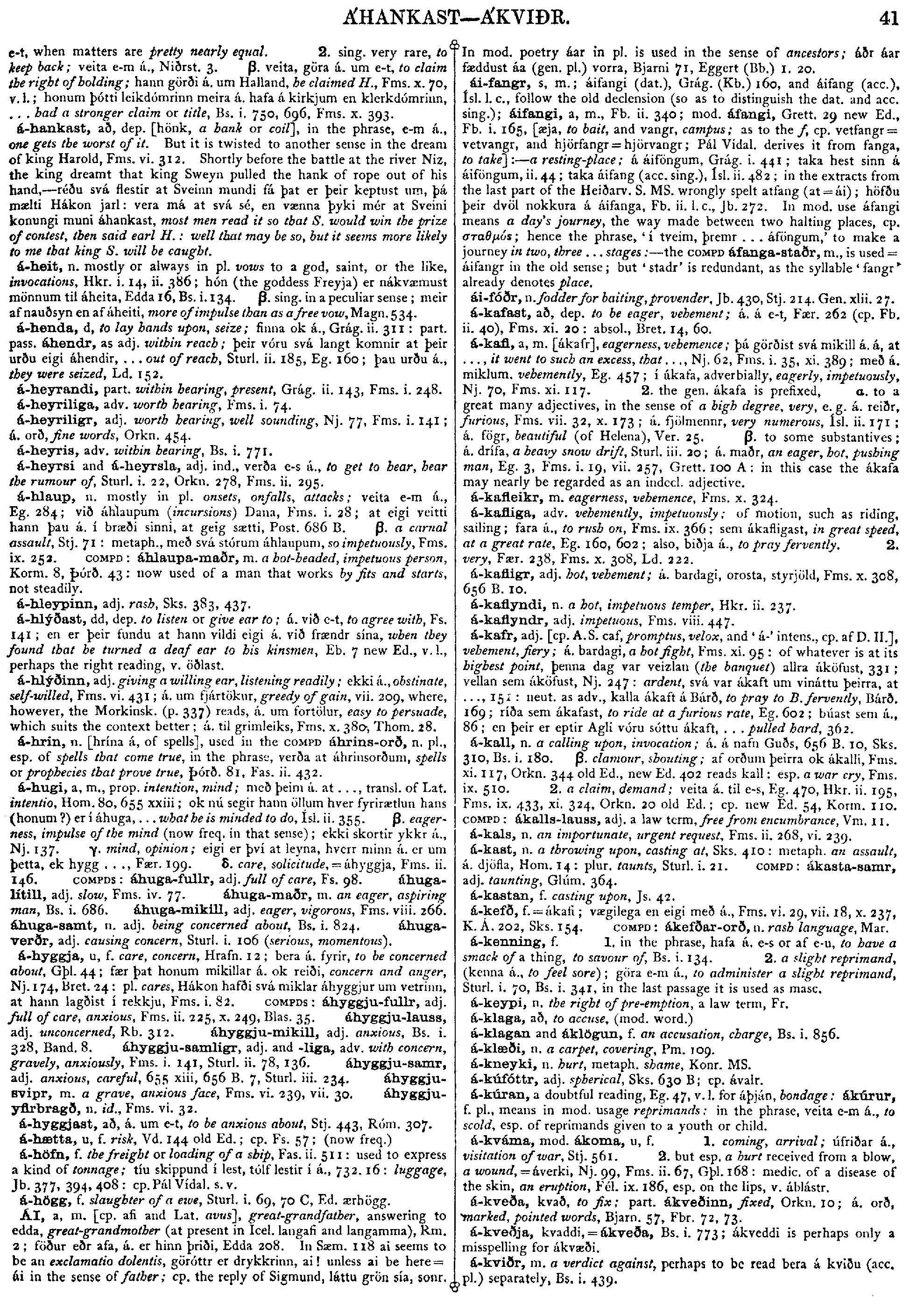
ÁN, prep. [Goth, inuh; Hel. and O. H. G. ano; Germ, ohne; Gr. GREEK] , without: the oldest form in MSS. is ón, Eluc. 25, Greg. Dial, (freq.), 655 xxvii. 2, Fms. xi. in, 153; aon, Hom. 19 sqq.; the common form is án; with gen. dat. and acc.; at present only with gen. I. with gen., þess máttu Gautar ilia án vera, Hkr. ii. 70. Ó. H. 49 has 'þat;' án manna valda, Fms. iii. 98; á. allra afarkosta, x. 7; mættim vér vel þess án vera, Ísl. ii. 339; in the proverb, án er ills gengis nema heiman hafi, Gísl. 63, but án er illt gengi (acc.), 149, Nj. 27, Ísl. ii. 142, l. c..; án allra klæða, Al. 171; án allrar vægðar, Sks. 229; ón lasta synda, Eluc. 25. II. with dat., esp. in translations or eccles. Writings, perh. in imitation of the Lat., and now quite out of use; esp. In the phrase, án e-s ráði, without (against) one's will, Nj. 38, Bjarn. 71, Korm. 142, Fms. xi. 153, 111; ón góðum verkum, Greg. 13; án úfláti, incessantly, Bs. i. 97; ón dómi, Eluc. 39; sannr ok on gildingi, 655 xxvii. 2. III. with acc., esp. freq. in the Grág., án er illt gengi, v. above; þá skal hann án vera liðit, Grág. i. 276; án ráð lögráðanda, 334; hann mun þik ekki þykjast mega án vera, Fms. vii. 26; án allan verma, Sks. 210; án alla flærð, 522 B; ón líkamligan breyskleik, ok on dóm, Eluc. 38; án leyfi, without leave, Fms. vii. 141. IV. ellipt. without case, or adverbially, hvatki es betra es at hafa en ón at vera (to be without), 677. 8; þau er mönnum þykir betr at hafa en án at vera, Gþl. 379; eiga vilja heldr en ón vera þat hit mjallhvíta man, Alvm. 7 : acc. with inf., án við löst at lifa, sine culpâ vivere, Hm. 68; used substantively, in the proverb, alls áni (omnium expers) verðr sá er einskis biðr, Sl. 38: Egilsson also, on Hdl. 23, suggests a form án, n.; but the passage (the poem is only left in the Fb.) is no doubt a corrupt one. Probably 'ani ómi' is a corruption from Arngrími (arngmi, the lower part of the g being blotted out: Arngrími | óru bornir | (öflgir ?) synir | ok Eyfuru, or the like).
|
Source: Cleasby/Vigfusson, page b0055, entry 21 View original page image as: [TIFF] [PNG] [View previous entry] [View next entry] |
[Comment on this entry] [View comments] |
The following entry has not been hand-corrected. However, the page is reserved and someone is correcting it. |
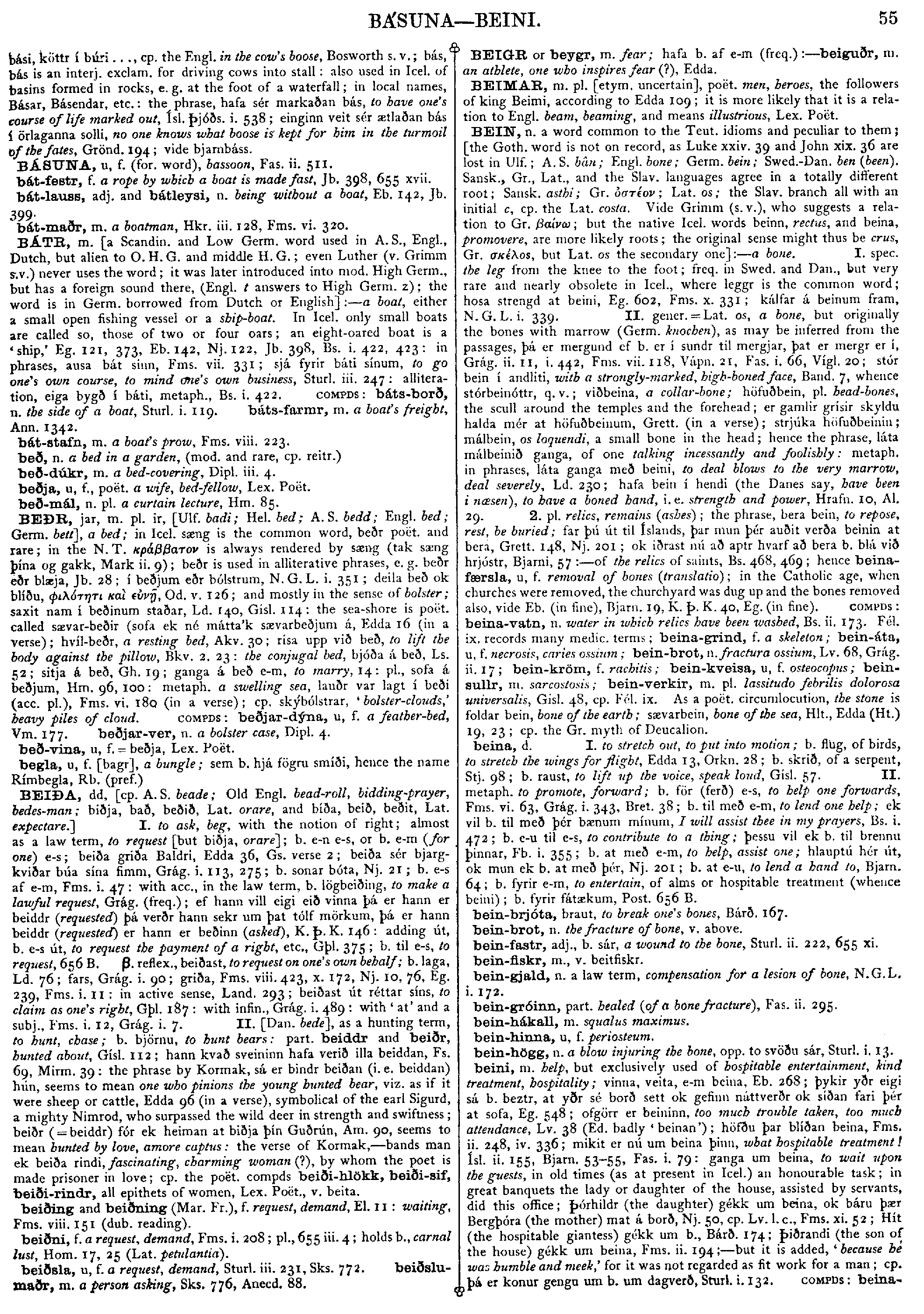
BEIN, n. a word common to the Teut. idioms and peculiar to them j [the Goth, word is not on record, as Luke xxiv. 39 and John xix. 36 are lost in Ulf.; A. S. ban; Engl. bone; Germ, bein; Swed. -Dan. ben (been). Sansk., Gr., Lat., and the Slav, languages agree in a totally different root; Sansk. asihi; Gr. oariov; Lat. os; the Slav, branch all with an initial c, cp. the Lat. cosia. Vide Grimm (s. v.), who suggests a rela- tion to Gr. jSeuVu;; but the native Icel. words beinn, rectus, and beina, promovere, are more likely roots; the original sense might thus be crus, Gr. er/ceAos, but Lat. os the secondary one] :-- a bone. I. spec. the le g" from the knee to the foot; freq. in Swed. and Dan., but very rare and nearly obsolete in Icel., where leggr is the common word; hosa strengd at beini, Eg. 602, Fms. x. 331; kálfar á beinum fram, N. G. L. i. 339. II. gener. = Lat. os, a bone, but originally the bones with marrow (Germ, knocben), as may be inferred from the passages, pa er mergund ef b. er í sundr til mergjar, þat er mergr er i, Grág. ii. II, i. 442, Fms. vii. 118, Vápn. 21, Fas. i. 66, Vígl. 20; stór bein í andliti, with a strongly-marked, high-boned face, Band. 7, whence stórbeinóttr, q. v.; viðbeina, a collar-bone; höfuðbein, pl. he a d- b on e s, the scull around the temples and the forehead; er gamlir grisir skyldu halda mér at höfuðbeinum, Grett. (in a verse); strjúka hó'fuðbeiniu; málbein, o s loquendi, a small bone in the head; hence the phrase, láta málbeinið ganga, of one talking incessantly and foolishly: metaph. in phrases, lata ganga með beini, to deal blows to the very marrow, deal severely, Ld. 230; hafa bein í hendi (the Danes say, have been i nœsen), to have a boned hand, i. e. strength and power, Hrafn. 10, Al. 29. 2. pl. relics, remains (ashes); the phrase, bera bein, to repose, rest, be buried; far þú út til islands, þar mun þér auðit verða beinin at bera, Grett. 148, Nj. 201; ok iðrast nú að aptr hvarf að bera b. blú við hrjóstr, Bjarni, 57 :-- of the reli cs of saints, Bs. 468, 469; hence beina- færsla, u, f. removal of bones (translatio); in the Catholic age, when churches were removed, the churchyard was dug up and the bones removed also, vide Eb. (in fine), Bjarn. 19, K. b. K. 40, Eg. (in fine). COMPDS: beina-vatn, n. water in which relics have been washed, Bs. ii. 173. Fél. ix. records many medic, terms; beina-griud, f. a skeleton; bein-áta, u, f. necrosis, caries ossiitm; bein-brot, \. fractura ossium, Lv. 68, Grág. ii. 17; bein-kröm, f. rachitis: bein-kveisa, u, f. osteocopus; bein- sullr, in. sarcostosis; bein-verkir, m. pl. lassitudo febrilis dolorosa universalis, Gísl. 48, cp. Fél. ix. As a poet, circumlocution, the s to ne is foldar bein, bone of the earth; sævarbein, bone of the sea, Hit., Edda (Ht.) 19, 23; cp. the Gr. myth of
|
Source: Cleasby/Vigfusson, page b0055, entry 32 View original page image as: [TIFF] [PNG] [View previous entry] [View next entry] |
[Comment on this entry] [View comments] |
The following entry has not been hand-corrected. However, the page is reserved and someone is correcting it. |
beini, m. help, but exclusively used of hospitable entertainment, kind treatment, hospitality; vinna, veita, e-m beina, Eb. 268; þykir yðr eigi sá b. beztr, at yðr sé borð sett ok gefinu náttverðr ok síðan fari þér at sofa, Eg. 548; ofgorr er beininn, t oo much trouble taken, too much attendance, Lv. 38 (Ed. badly 'beinan'); höfðu þar blíðan beina, Fms. ii. 248, iv. 336; mikit er mi um beina þinn, w hat hospitable treatment I ísl. ii. 155, Bjarn. 53 -- 55, Fas. i. 79: ganga um beina, to w a it upon the guests, in old times (as at present in Icel.) an honourable task; in great banquets the lady or daughter of the house, assisted by servants, did this office; bórhildr (the daughter) gékk um beina, ok báru þaer Bergþóra (the mother) mat á borð, Nj. 50, cp. Lv. 1. c., Fms. xi. 52; Hit (the hospitable giantess) gékk um b., Bárð. 174; þiðrandi (the son of the house) gékk um beina, Fms. ii. 194; -- but it is added, 'because he was humble and meek, ' for it was not regarded as fit work for a man; cp. þá er konur gengu um b. um dagverð, Sturl. i. 132. COMPDS: beina-
| Result Page: |  |
Previous | 322 323 324 325 326 327 328 329 330 331 332 333 334 335 336 337 338 339 340 | Next |  |
Germanic Lexicon Project (main page)
This search system was written by
Sean Crist
Please consider
volunteering
to correct the data in these online dictionaries.
No rights reserved. Feel free to use these data in any way you please.