|
|

Search for Hira again, using less strict matching (424 results)
|
Source: Bosworth/Toller, page b0393, entry 30 View original page image as: [TIFF] [PNG] [View previous entry] [View next entry] |
[Comment on this entry] [View comments] |
The following entry has been hand-corrected once. |
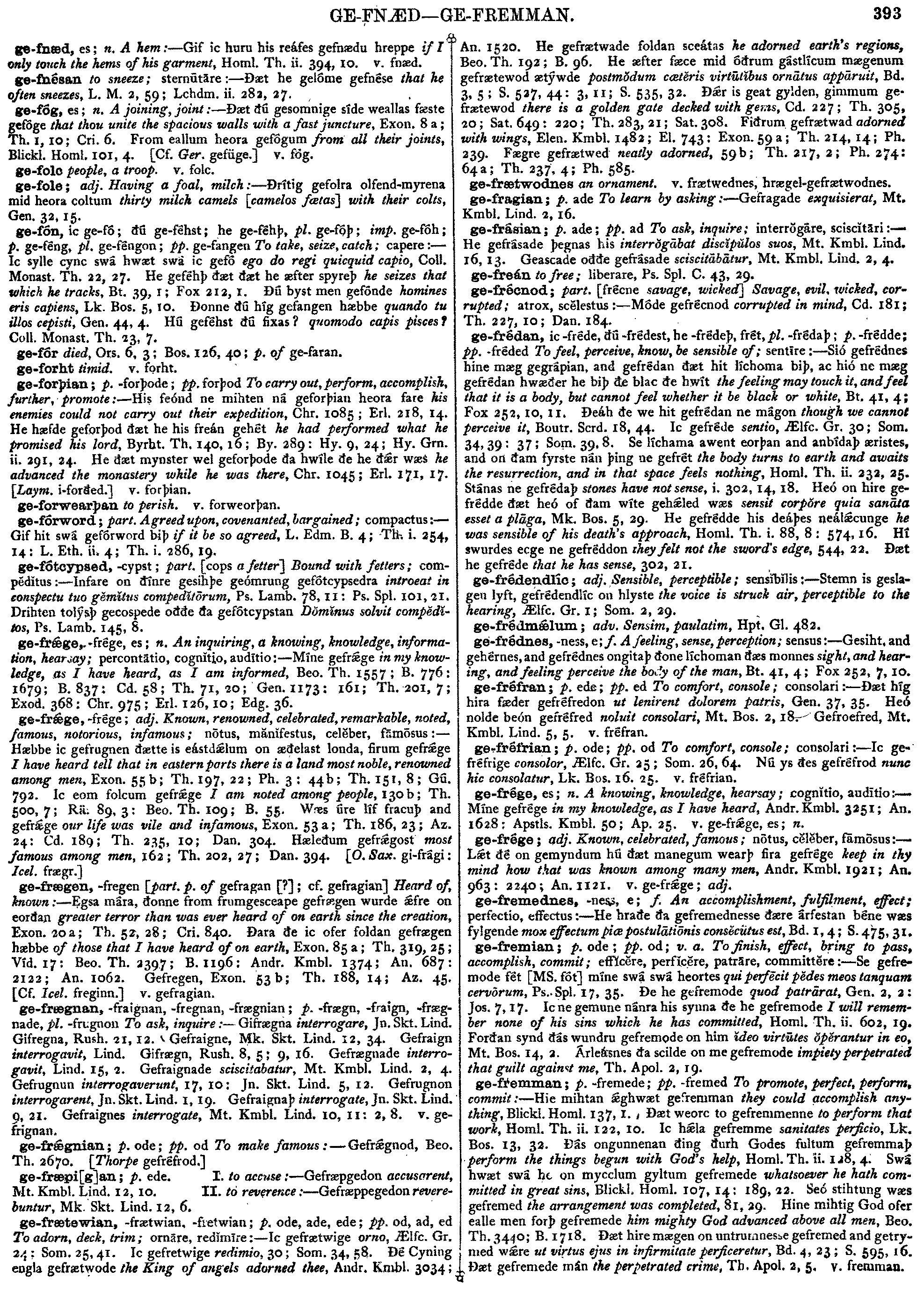
ge-fréfran; p. ede; pp. ed To comfort, console; consolari :-- Ðæt híg hira fæder gefréfredon ut lenirent dolorem patris, Gen. 37, 35. Heó nolde beón gefréfred noluit consolari, Mt. Bos. 2, 18. Gefroefred, Mt. Kmbl. Lind. 5, 5. v. fréfran.
|
Source: Bosworth/Toller, page b0398, entry 28 View original page image as: [TIFF] [PNG] [View previous entry] [View next entry] |
[Comment on this entry] [View comments] |
The following entry has been hand-corrected once. |
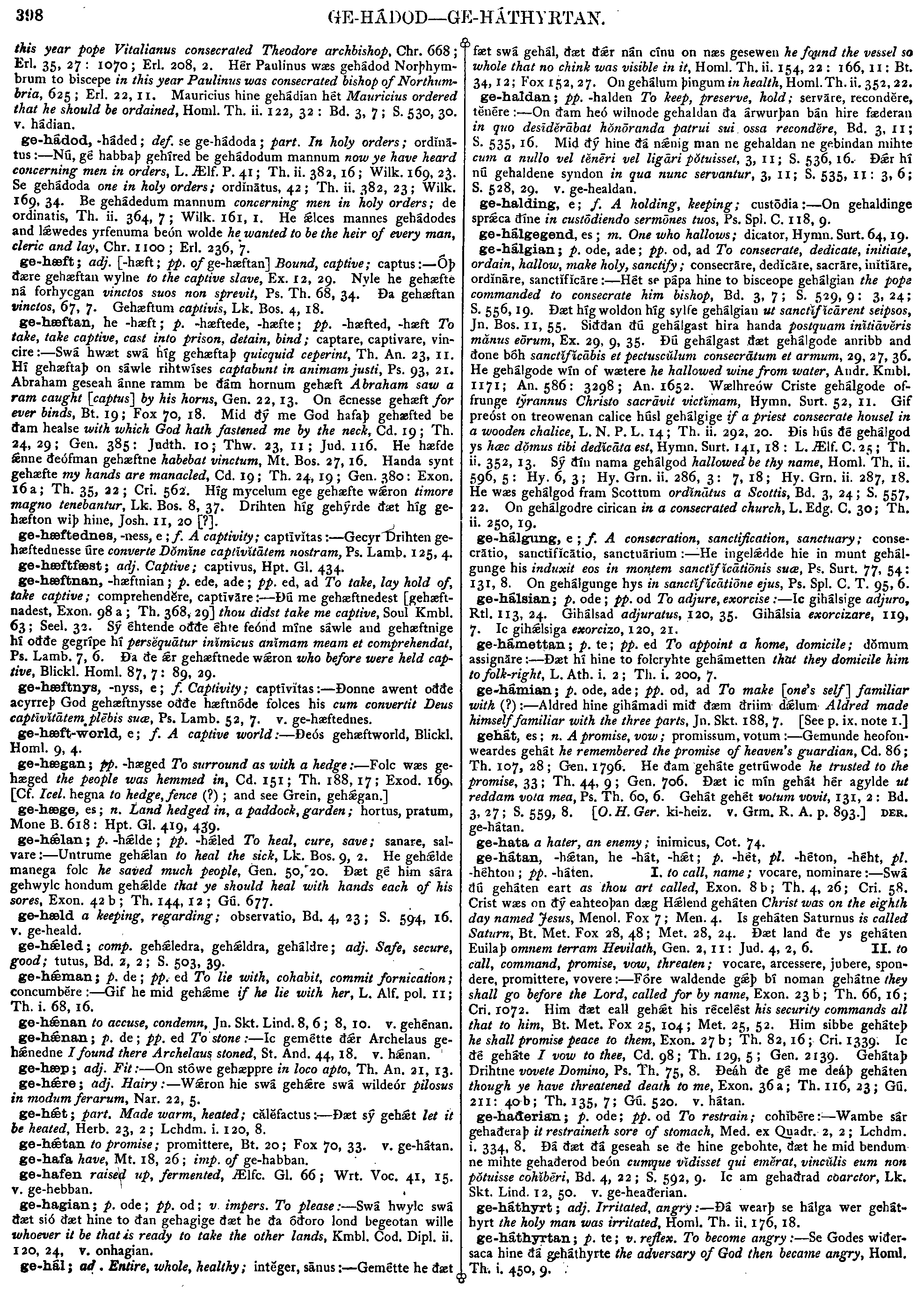
ge-hálgian;
p.
ode,
ade;
pp.
od,
ad
To
consecrate,
dedicate,
initiate,
ordain,
hallow,
make
holy,
sanctify;
consecr re,
ded
re,
ded cre,
sacrre,
intre,
ordnre,
sanctfcre
:--
Hét
se
pápa
hine
to
bisceope
gehálgian
the
pope
commanded
to
consecrate
him
bishop,
Bd.
3,
7;
S.
529,
9
:
3,
24;
S.
556,
19.
Ðæt
híg
woldon
híg
sylfe
gehálgian
ut
sanctfcrent
seipsos,
Jn.
Bos.
11,
55.
Siððan
ðú
gehálgast
hira
handa
postquam
intiv
cre,
sacrre,
intre,
ordnre,
sanctfcre
:--
Hét
se
pápa
hine
to
bisceope
gehálgian
the
pope
commanded
to
consecrate
him
bishop,
Bd.
3,
7;
S.
529,
9
:
3,
24;
S.
556,
19.
Ðæt
híg
woldon
híg
sylfe
gehálgian
ut
sanctfcrent
seipsos,
Jn.
Bos.
11,
55.
Siððan
ðú
gehálgast
hira
handa
postquam
intiv ris
m
ris
m nus
e
nus
e rum,
Ex.
29,
9,
35.
Ðú
gehálgast
ðæt
gehálgode
anribb
and
ðone
bóh
sanctfcbis
et
pectusc
rum,
Ex.
29,
9,
35.
Ðú
gehálgast
ðæt
gehálgode
anribb
and
ðone
bóh
sanctfcbis
et
pectusc lum
consecrtum
et
armum,
29,
27,
36.
He
gehálgode
wín
of
wætere
he
hallowed
wine
from
water,
Andr.
Kmbl.
1171;
An.
586
:
3298;
An.
1652.
Wælhreów
Criste
gehálgode
offrunge
tyrannus
Christo
sacrvit
victmam,
Hymn.
Surt.
52,
11.
Gif
preóst
on
treowenan
calice
húsl
gehálgige
if
a
priest
consecrate
housel
in
a
wooden
chalice,
L.
N.
P.
L.
14;
Th.
ii.
292,
20.
Ðis
hús
ðé
gehálgod
ys
hæc
d
lum
consecrtum
et
armum,
29,
27,
36.
He
gehálgode
wín
of
wætere
he
hallowed
wine
from
water,
Andr.
Kmbl.
1171;
An.
586
:
3298;
An.
1652.
Wælhreów
Criste
gehálgode
offrunge
tyrannus
Christo
sacrvit
victmam,
Hymn.
Surt.
52,
11.
Gif
preóst
on
treowenan
calice
húsl
gehálgige
if
a
priest
consecrate
housel
in
a
wooden
chalice,
L.
N.
P.
L.
14;
Th.
ii.
292,
20.
Ðis
hús
ðé
gehálgod
ys
hæc
d mus
tibi
dedcta
est,
Hymn.
Surt.
141,
18
:
L.
Ælf.
C.
25;
Th.
ii.
352,
13.
Sý
ðín
nama
gehálgod
hallowed
be
thy
name,
Homl.
Th.
ii.
596,
5
:
Hy.
6,
3;
Hy.
Grn.
ii.
286,
3
:
7,
18;
Hy.
Grn.
ii.
287,
18.
He
wæs
gehálgod
fram
Scottum
ordntus
a
Scottis,
Bd.
3,
24;
S.
557,
22.
On
gehálgodre
cirican
in
a
consecrated
church,
L.
Edg.
C.
30;
Th.
ii.
250,
19.
mus
tibi
dedcta
est,
Hymn.
Surt.
141,
18
:
L.
Ælf.
C.
25;
Th.
ii.
352,
13.
Sý
ðín
nama
gehálgod
hallowed
be
thy
name,
Homl.
Th.
ii.
596,
5
:
Hy.
6,
3;
Hy.
Grn.
ii.
286,
3
:
7,
18;
Hy.
Grn.
ii.
287,
18.
He
wæs
gehálgod
fram
Scottum
ordntus
a
Scottis,
Bd.
3,
24;
S.
557,
22.
On
gehálgodre
cirican
in
a
consecrated
church,
L.
Edg.
C.
30;
Th.
ii.
250,
19.
|
Source: Bosworth/Toller, page b0440, entry 6 View original page image as: [TIFF] [PNG] [View previous entry] [View next entry] |
[Comment on this entry] [View comments] |
The following entry has been hand-corrected once. |
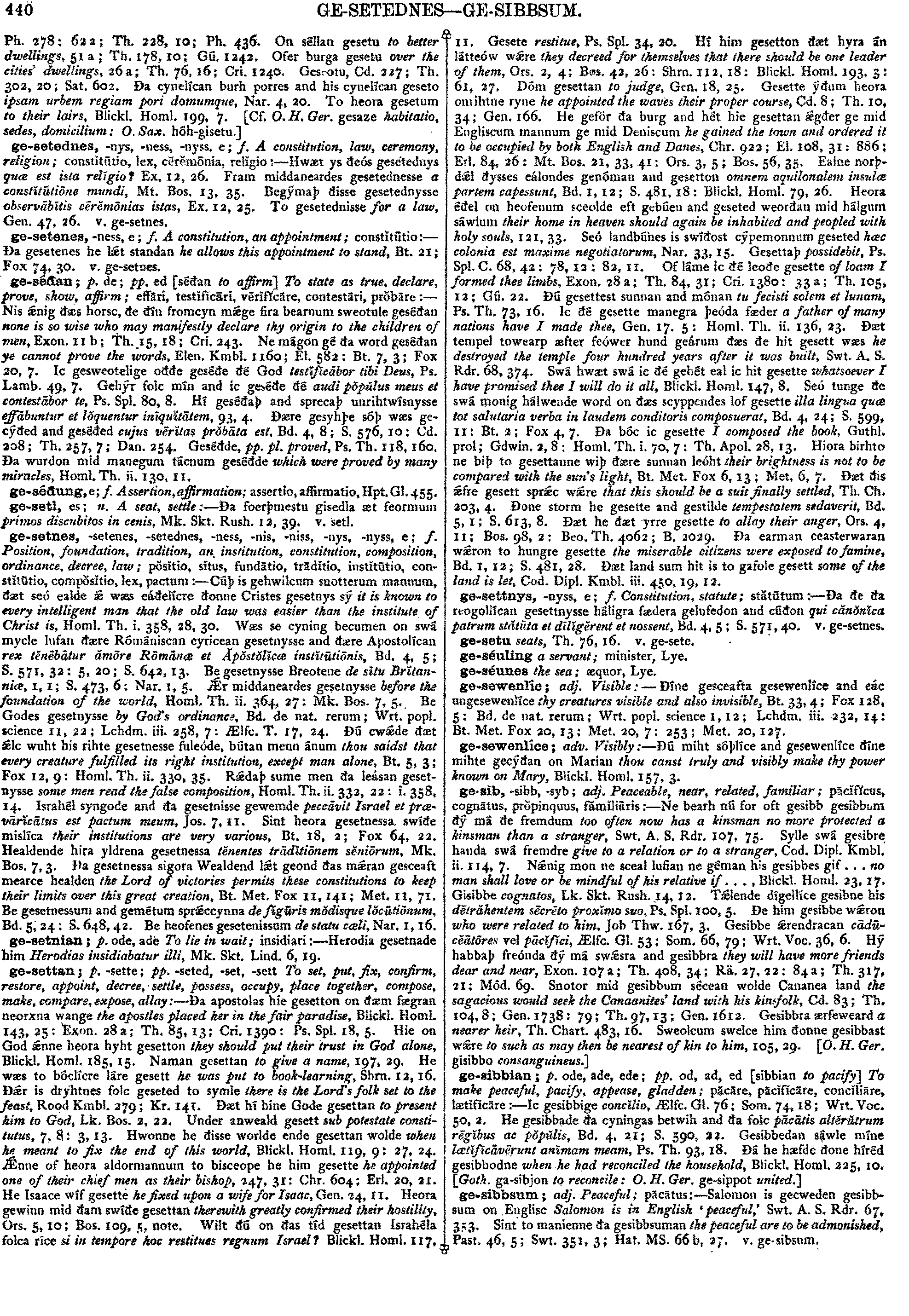
ge-setnes,
-setenes,
-setednes,
-ness,
-nis,
-niss,
-nys,
-nyss,
e;
f.
Position,
foundation,
tradition,
an
institution,
constitution,
composition,
ordinance,
decree,
law;
pstio,
stus,
fundtio,
trdtio,
instt tio,
constttio,
compstio,
lex,
pactum
:--
Cúþ
is
gehwilcum
snotterum
mannum,
ðæt
seó
ealde
tio,
constttio,
compstio,
lex,
pactum
:--
Cúþ
is
gehwilcum
snotterum
mannum,
ðæt
seó
ealde
 wæs
eáðelícre
ðonne
Cristes
gesetnys
sý
it
is
known
to
every
intelligent
man
that
the
old
law
was
easier
than
the
institute
of
Christ
is,
Homl.
Th.
i.
358,
28,
30.
Wæs
se
cyning
becumen
on
swá
mycle
lufan
ðære
Rómániscan
cyricean
gesetnysse
and
ðære
Apostolícan
rex
tn
wæs
eáðelícre
ðonne
Cristes
gesetnys
sý
it
is
known
to
every
intelligent
man
that
the
old
law
was
easier
than
the
institute
of
Christ
is,
Homl.
Th.
i.
358,
28,
30.
Wæs
se
cyning
becumen
on
swá
mycle
lufan
ðære
Rómániscan
cyricean
gesetnysse
and
ðære
Apostolícan
rex
tn btur
mre
Rmnæ
et
&A-short;pstlcæ
instttinis,
Bd.
4,
5;
S.
571,
32:
5,
20;
S.
642,
13.
Be
gesetnysse
Breotene
de
stu
Brtanniæ,
1,
1;
S.
473,
6:
Nar.
1,
5.
Æ-acute;r
middaneardes
gesetnysse
before
the
foundation
of
the
world,
Homl.
Th.
ii.
364,
27:
Mk.
Bos.
7,
5.
Be
Godes
gesetnysse
by
God's
ordinance,
Bd.
de
nat.
rerum;
Wrt.
popl.
science
11,
22;
Lchdm.
iii.
258,
7:
Ælfc.
T.
17,
24.
Ðú
cwde
ðæt
lc
wuht
his
rihte
gesetnesse
fuleóde,
bútan
menn
ánum
thou
saidst
that
every
creature
fulfilled
its
right
institution,
except
man
alone,
Bt.
5,
3;
Fox
12,
9:
Homl.
Th.
ii.
330,
35.
Rdaþ
sume
men
ða
leásan
gesetnysse
some
men
read
the
false
composition,
Homl.
Th.
ii.
332,
22:
i.
358,
14.
Israhél
syngode
and
ða
gesetnisse
gewemde
peccvit
Israel
et
prævrctus
est
pactum
meum,
Jos.
7,
11.
Sint
heora
gesetnessa
swíðe
mislíca
their
institutions
are
very
various,
Bt.
18,
2;
Fox
64,
22.
Healdende
hira
yldrena
gesetnessa
tnentes
trdtinem
snirum,
Mk.
Bos.
7,
3.
Ða
gesetnessa
sigora
Wealdend
lt
geond
ðas
mran
gesceaft
mearce
healden
the
Lord
of
victories
permits
these
constitutions
to
keep
their
limits
over
this
great
creation,
Bt.
Met.
Fox
11,
141;
Met.
l1,
75.
Be
gesetnessum
and
gemétum
sprccynna
de
fgris
mdisque
lctinum,
Bd.
5,
24:
S.
648,
42.
Be
heofenes
gesetenissum
de
statu
cæli,
Nar.
1,
16.
btur
mre
Rmnæ
et
&A-short;pstlcæ
instttinis,
Bd.
4,
5;
S.
571,
32:
5,
20;
S.
642,
13.
Be
gesetnysse
Breotene
de
stu
Brtanniæ,
1,
1;
S.
473,
6:
Nar.
1,
5.
Æ-acute;r
middaneardes
gesetnysse
before
the
foundation
of
the
world,
Homl.
Th.
ii.
364,
27:
Mk.
Bos.
7,
5.
Be
Godes
gesetnysse
by
God's
ordinance,
Bd.
de
nat.
rerum;
Wrt.
popl.
science
11,
22;
Lchdm.
iii.
258,
7:
Ælfc.
T.
17,
24.
Ðú
cwde
ðæt
lc
wuht
his
rihte
gesetnesse
fuleóde,
bútan
menn
ánum
thou
saidst
that
every
creature
fulfilled
its
right
institution,
except
man
alone,
Bt.
5,
3;
Fox
12,
9:
Homl.
Th.
ii.
330,
35.
Rdaþ
sume
men
ða
leásan
gesetnysse
some
men
read
the
false
composition,
Homl.
Th.
ii.
332,
22:
i.
358,
14.
Israhél
syngode
and
ða
gesetnisse
gewemde
peccvit
Israel
et
prævrctus
est
pactum
meum,
Jos.
7,
11.
Sint
heora
gesetnessa
swíðe
mislíca
their
institutions
are
very
various,
Bt.
18,
2;
Fox
64,
22.
Healdende
hira
yldrena
gesetnessa
tnentes
trdtinem
snirum,
Mk.
Bos.
7,
3.
Ða
gesetnessa
sigora
Wealdend
lt
geond
ðas
mran
gesceaft
mearce
healden
the
Lord
of
victories
permits
these
constitutions
to
keep
their
limits
over
this
great
creation,
Bt.
Met.
Fox
11,
141;
Met.
l1,
75.
Be
gesetnessum
and
gemétum
sprccynna
de
fgris
mdisque
lctinum,
Bd.
5,
24:
S.
648,
42.
Be
heofenes
gesetenissum
de
statu
cæli,
Nar.
1,
16.
|
Source: Bosworth/Toller, page b0443, entry 8 View original page image as: [TIFF] [PNG] [View previous entry] [View next entry] |
[Comment on this entry] [View comments] |
The following entry has been hand-corrected once. |
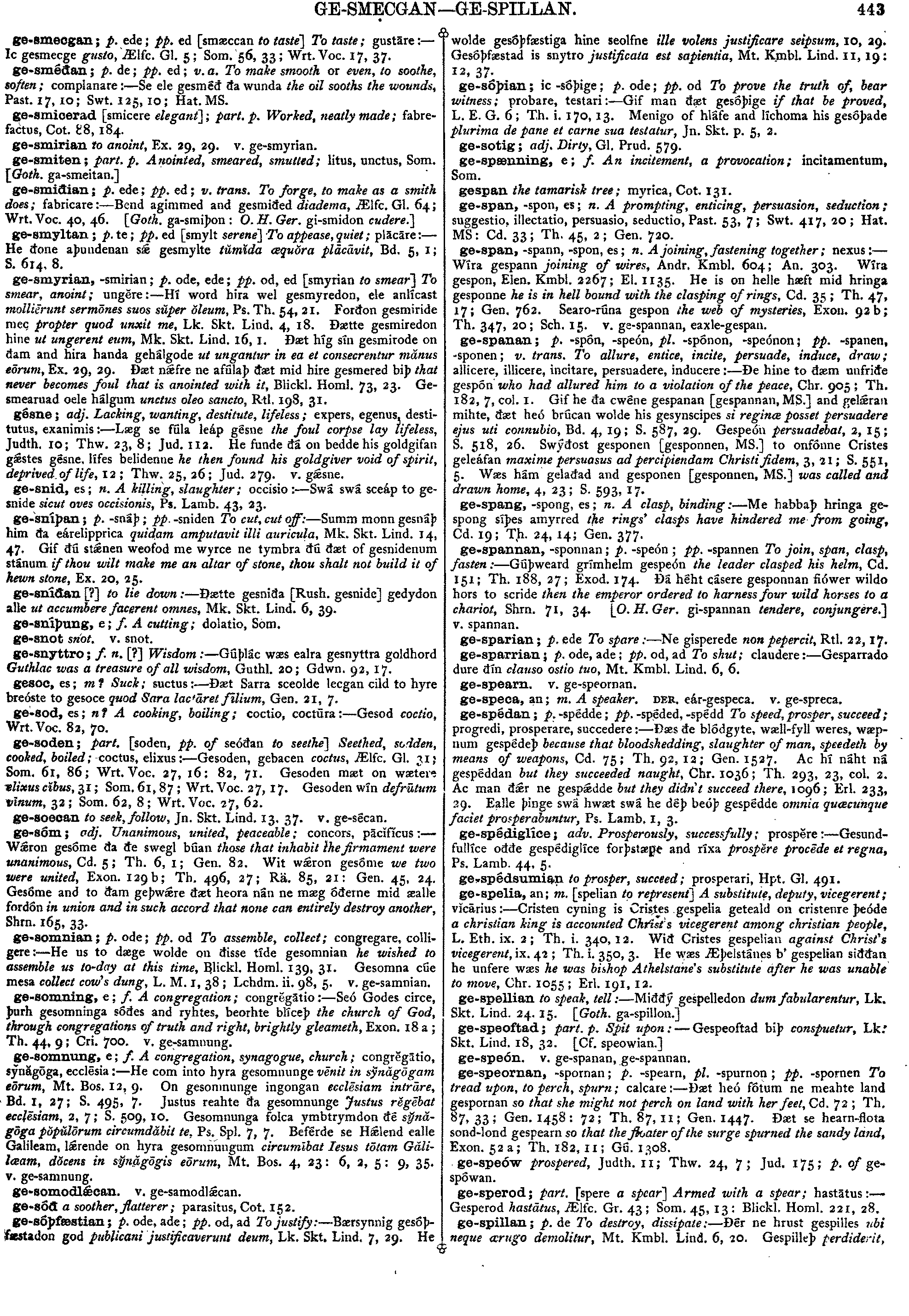
ge-smyrian,
-smirian;
p.
ode,
ede;
pp.
od,
ed
[smyrian
to
smear]
To
smear,
anoint;
ungre
:--
Hí
word
hira
wel
gesmyredon,
ele
anlícast
mollirunt
sermnes
suos
sper
leum,
Ps.
Th.
54,
21.
Forðon
gesmiride
mec
propter
quod
unxit
me,
Lk.
Skt.
Lind.
4,
18.
Ðætte
gesmiredon
hire
ut
ungerent
eum,
Mk.
Skt.
Lind.
16,
1.
Ðæt
híg
sín
gesmirode
on
ðam
and
hira
handa
gehálgode
ut
ungantur
in
ea
et
consecrentur
mnus
erum,
Ex.
29,
29.
Ðæt
nfre
ne
afúlaþ
ðæt
mid
hire
gesmered
biþ
that
never
becomes
foul
that
is
anointed
with
it,
Blickl.
Homl.
73,
23.
Ge-smearuad
oele
hálgum
unctus
oleo
sancto,
Rtl.
198,
31.
|
Source: Bosworth/Toller, page b0445, entry 26 View original page image as: [TIFF] [PNG] [View previous entry] [View next entry] |
[Comment on this entry] [View comments] |
The following entry has been hand-corrected once. |
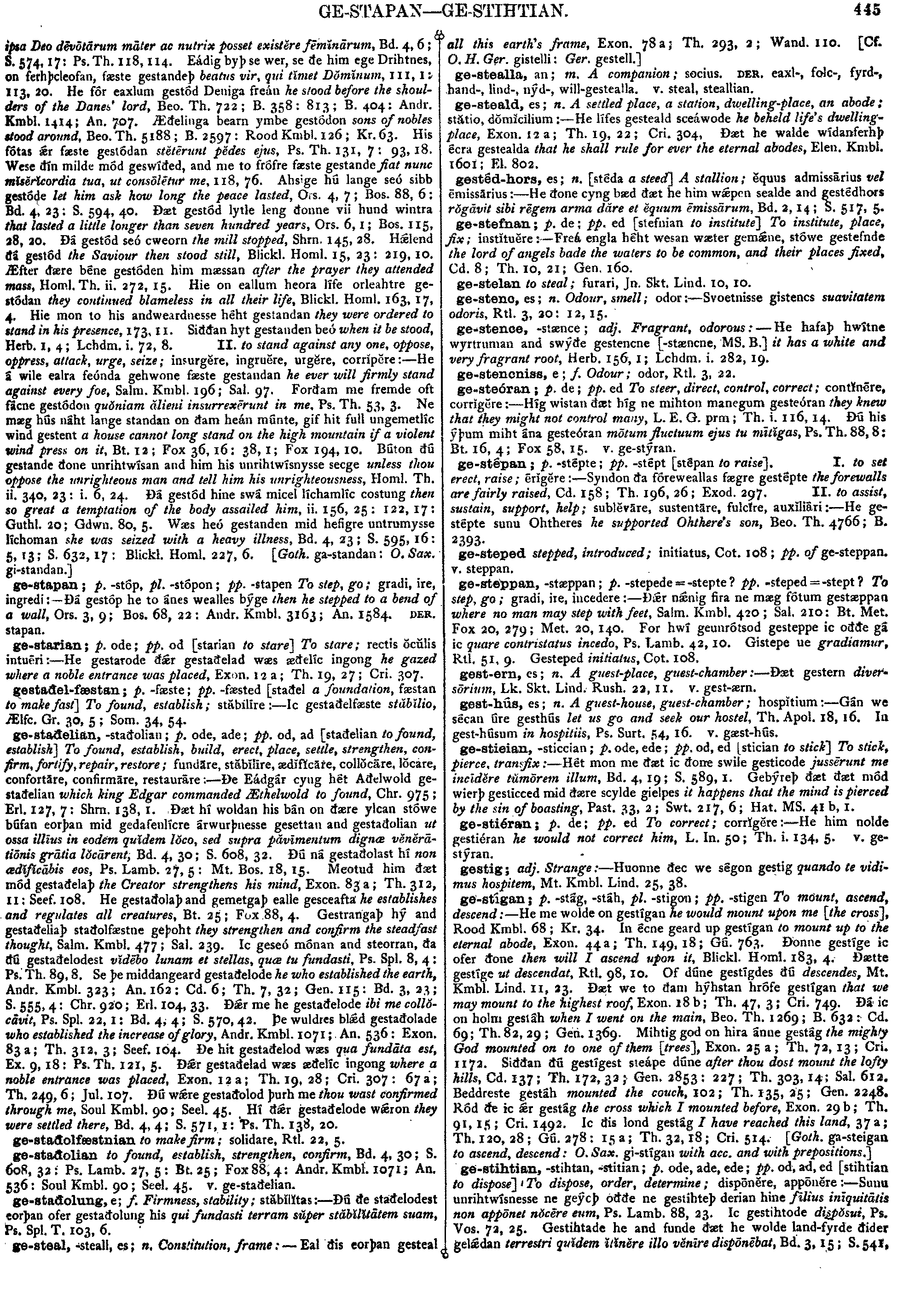
ge-stígan;
p.
-stág,
-stáh,
pl.
-stigon;
pp.
-stigen
To
mount,
ascend,
descend
:--
He
me
wolde
on
gestígan
he
would
mount
upon
me
[the
cross],
Rood
Kmbl.
68;
Kr.
34.
In
écne
geard
up
gestígan
to
mount
up
to
the
eternal
abode,
Exon.
44
a;
Th.
149,
18;
Gú.
763.
Ðonne
gestíge
ic
ofer
ðone
then
will
I
ascend
upon
it,
Blickl.
Homl.
183,
4.
Ðætte
gestíge
ut
descendat,
Rtl.
98,
10.
Of
dúne
gestígdes
ðú
descendes,
Mt.
Kmbl.
Lind.
11,
23.
Ðæt
we
to
ðam
hýhstan
hrófe
gestígan
that
we
may
mount
to
the
highest
roof,
Exon.
18
b;
Th.
47,
3;
Cri.
749.
Ðá
ic
on
holm
gestáh
when
I
went
on
the
main,
Beo.
Th.
1269;
B.
632:
Cd.
69;
Th.
82,
29;
Gen.
1369.
Mihtig
god
on
hira
ánne
gestág
the
mighty
God
mounted
on
to
one
of
them
[trees],
Exon.
25
a;
Th.
72,
13;
Cri.
1172.
Siððan
ðú
gestígest
steápe
dúne
after
thou
dost
mount
the
lofty
hills,
Cd.
137;
Th.
172,
32;
Gen.
2853:
227;
Th.
303,
14;
Sal.
612.
Beddreste
gestáh
mounted
the
couch,
102;
Th.
135,
25;
Gen.
2248.
Ród
ðe
ic
r
gestág
the
cross
which
I
mounted
before,
Exon.
29
b;
Th.
91,
15;
Cri.
1492.
Ic
ðis
lond
gestág
I
have
reached
this
land,
37
a;
Th.
120,
28;
Gú.
278:
15
a;
Th.
32,
18;
Cri.
514.
[Goth.
ga-steigan
to
ascend,
descend:
O.
Sax.
gi-stígan
with
acc.
and
with
prepositions.]
|
Source: Bosworth/Toller, page b0449, entry 2 View original page image as: [TIFF] [PNG] [View previous entry] [View next entry] |
[Comment on this entry] [View comments] |
The following entry has been hand-corrected once. |
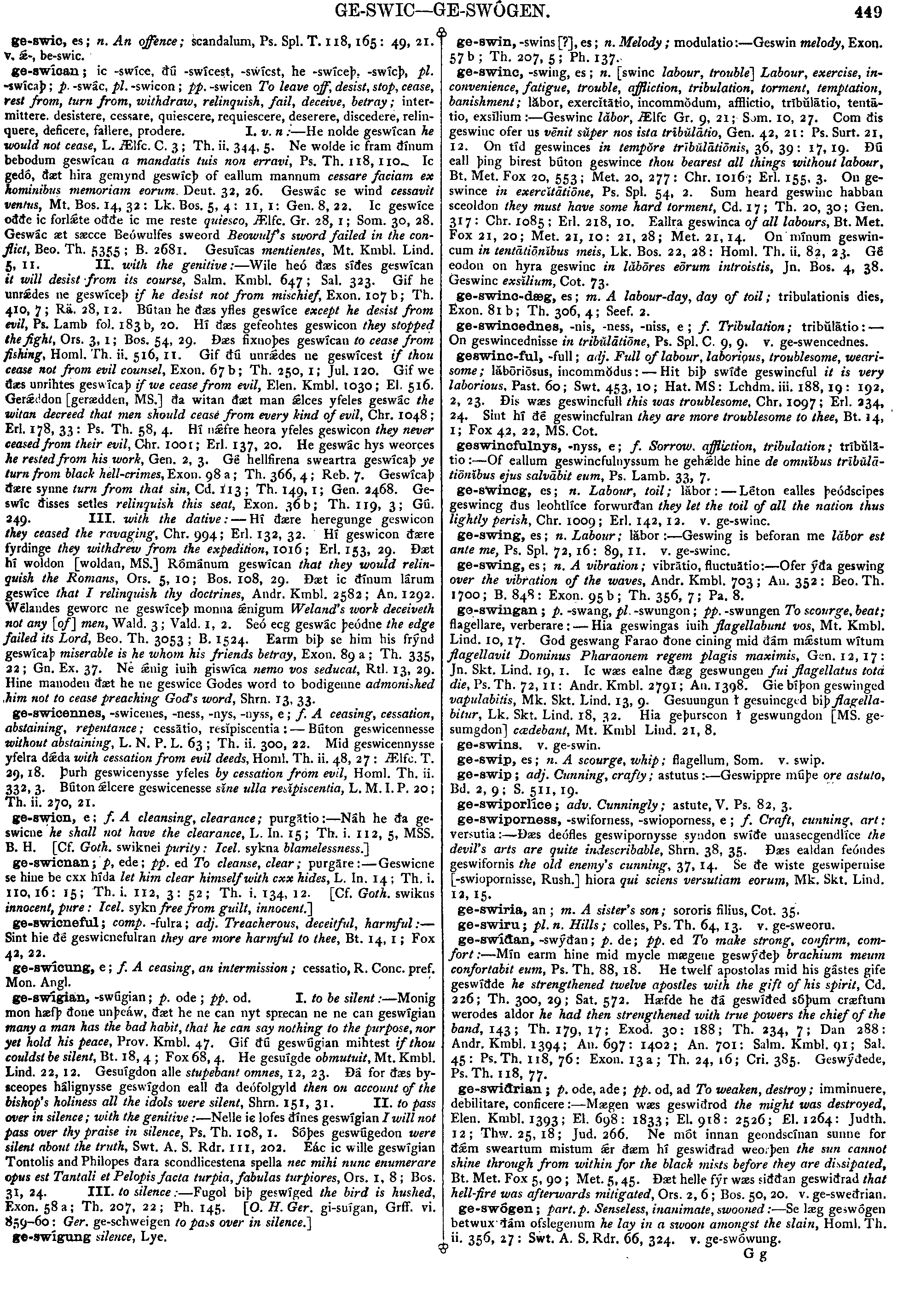
ge-swícan;
ic
-swíce,
ðú
-swícest,
-swícst,
he
-swíceþ.
-swícþ,
pl.
-swícaþ;
p.
-swác,
pl.
-swicon;
pp.
-swicen
To
leave
off,
desist,
stop,
cease,
rest
from,
turn
from,
withdraw,
relinquish,
fail,
deceive,
betray;
intermittere,
desistere,
cessare,
quiescere,
requiescere,
deserere,
discedere,
relinquere,
deficere,
fallere,
prodere.
I.
v.
n
:--
He
nolde
geswícan
he
would
not
cease,
L.
Ælfc.
C.
3;
Th.
ii.
344,
5.
Ne
wolde
ic
fram
ðínum
bebodum
geswícan
a
mandatis
tuis
non
erravi,
Ps.
Th.
118,
110.
Ic
gedó,
ðæt
hira
gemynd
geswícþ
of
eallum
mannum
cessare
faciam
ex
hominibus
memoriam
eorum.
Deut.
32,
26.
Geswác
se
wind
cessavit
ventus,
Mt.
Bos.
14,
32:
Lk.
Bos.
5,
4:
11,
1:
Gen.
8,
22.
Ic
geswíce
oððe
ic
forlte
oððe
ic
me
reste
quiesco,
Ælfc.
Gr.
28,
1;
Som.
30,
28.
Geswác
æt
sæcce
Beówulfes
sweord
Beowulf's
sword
failed
in
the
conflict,
Beo.
Th.
5355;
B.
2681.
Gesuícas
mentientes,
Mt.
Kmbl.
Lind.
5,
11.
II.
with
the
genitive
:--
Wile
heó
ðæs
síðes
geswícan
it
will
desist
from
its
course,
Salm.
Kmbl.
647;
Sal.
323.
Gif
he
unrdes
ne
geswíceþ
if
he
desist
not
from
mischief,
Exon.
107
b;
Th.
410,
7;
Rä.
28,
12.
Bútan
he
ðæs
yfles
geswíce
except
he
desist
from
evil,
Ps.
Lamb
fol.
183
b,
20.
Hí
ðæs
gefeohtes
geswicon
they
stopped
the
fight,
Ors.
3,
1;
Bos.
54,
29.
Ðæs
fixnoþes
geswícan
to
cease
from
fishing,
Homl.
Th.
ii.
516,
11.
Gif
ðú
unrdes
ne
geswícest
if
thou
cease
not
from
evil
counsel,
Exon.
67
b;
Th.
250,
1;
Jul.
120.
Gif
we
ðæs
unrihtes
geswícaþ
if
we
cease
from
evil,
Elen.
Kmbl.
1030;
El.
516.
Gerddon
[gerædden,
MS.]
ða
witan
ðæt
man
lces
yfeles
geswác
the
witan
decreed
that
men
should
cease
from
every
kind
of
evil,
Chr.
1048;
Erl.
178,
33:
Ps.
Th.
58,
4.
Hí
nfre
heora
yfeles
geswicon
they
never
ceased
from
their
evil,
Chr.
1001;
Erl.
137,
20.
He
geswác
hys
weorces
he
rested
from
his
work,
Gen.
2,
3.
Gé
hellfirena
sweartra
geswícaþ
ye
turn
from
black
hell-crimes.
Exon.
98
a;
Th.
366,
4;
Reb.
7.
Geswícaþ
ðære
synne
turn
from
that
sin,
Cd.
113;
Th.
149,
1;
Gen.
2468.
Geswíc
ðisses
setles
relinquish
this
seat,
Exon.
36
b;
Th.
119,
3;
Gú.
249.
III.
with
the
dative
:--
Hí
ðære
heregunge
geswicon
they
ceased
the
ravaging,
Chr.
994;
Erl.
132,
32.
Hí
geswicon
ðære
fyrdinge
they
withdrew
from
the
expedition,
1016;
Erl.
153,
29.
Ðæt
hí
woldon
[woldan,
MS.]
Rómánum
geswícan
that
they
would
relinquish
the
Romans,
Ors.
5,
10;
Bos.
108,
29.
Ðæt
ic
ðínum
lárum
geswíce
that
I
relinquish
thy
doctrines,
Andr.
Kmbl.
2582;
An.
1292.
Wélandes
geworc
ne
geswíceþ
monna
nigum
Weland's
work
deceiveth
not
any
[of]
men,
Wald.
3;
Vald.
1,
2.
Seó
ecg
geswác
þeódne
the
edge
failed
its
Lord,
Beo.
Th.
3053;
B.
1524.
Earm
biþ
se
him
his
frýnd
geswícaþ
miserable
is
he
whom
his
friends
betray,
Exon.
89
a;
Th.
335,
22;
Gn.
Ex.
37.
Ne
nig
iuih
giswíca
nemo
vos
seducat,
Rtl.
13,
29.
Hine
manoden
ðæt
he
ne
geswice
Godes
word
to
bodigenne
admonished
him
not
to
cease
preaching
God's
word,
Shrn.
13,
33.
|
Source: Bosworth/Toller, page b0482, entry 28 View original page image as: [TIFF] [PNG] [View previous entry] [View next entry] |
[Comment on this entry] [View comments] |
The following entry has been hand-corrected once. |
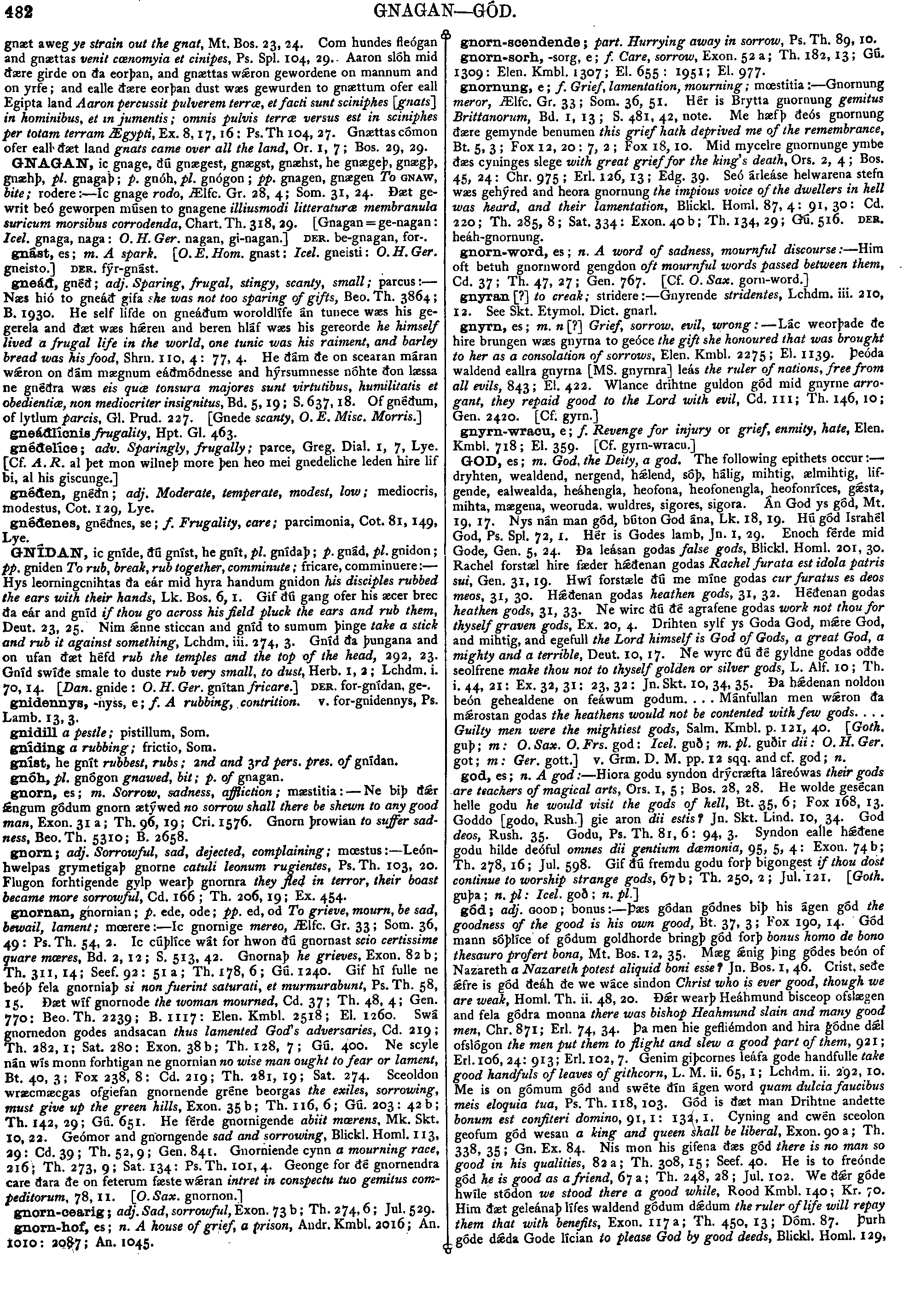
gód;
adj.
GOOD;
bonus
:--
Þæs
gódan
gódnes
biþ
his
ágen
gód
the
goodness
of
the
good
is
his
own
good,
Bt.
37,
3;
Fox
190,
14.
Gód
mann
sóþlíce
of
gódum
goldhorde
bringþ
gód
forþ
bonus
homo
de
bono
thesauro
profert
bona,
Mt.
Bos.
12,
35.
Mæg
nig
þing
gódes
beón
of
Nazareth
a
Nazareth
potest
aliquid
boni
esse?
Jn.
Bos.
1,
46.
Crist,
seðe
fre
is
gód
ðeáh
ðe
we
wáce
sindon
Christ
who
is
ever
good,
though
we
are
weak,
Homl.
Th.
ii.
48,
20.
Ðr
wearþ
Heáhmund
bisceop
ofslægen
and
fela
gódra
monna
there
was
bishop
Heahmund
slain
and
many
good
men,
Chr.
871;
Erl.
74,
34.
Þa
men
hie
gefliémdon
and
hira
gódne
dl
ofslógon
the
men
put
them
to
flight
and
slew
a
good
part
of
them,
921;
Erl.
106,
24:
913;
Erl.
102,
7.
Genim
giþcornes
leáfa
gode
handfulle
take
good
handfuls
of
leaves
of
githcorn,
L.
M.
ii.
65,
1;
Lchdm.
ii.
292,
10.
Me
is
on
gómum
gód
and
swéte
ðín
ágen
word
quam
dulcia
faucibus
meis
eloquia
tua,
Ps.
Th.
118,
103.
Gód
is
ðæt
man
Drihtne
andette
bonum
est
confiteri
domino,
91,
1:
134,
1.
Cyning
and
cwén
sceolon
geofum
gód
wesan
a
king
and
queen
shall
be
liberal,
Exon.
90
a;
Th.
338,
35;
Gn.
Ex.
84.
Nis
mon
his
gifena
ðæs
gód
there
is
no
man
so
good
in
his
qualities,
82
a;
Th.
308,
15;
Seef.
40.
He
is
to
freónde
gód
he
is
good
as
a
friend,
67
a;
Th.
248,
28;
Jul.
102.
We
ðr
góde
hwíle
stódon
we
stood
there
a
good
while,
Rood
Kmbl.
140;
Kr.
70.
Him
ðæt
geleánaþ
lífes
waldend
gódum
ddum
the
ruler
of
life
will
repay
them
that
with
benefits,
Exon.
117
a;
Th.
450,
13;
Dóm.
87.
Þurh
góde
dda
Gode
lícian
to
please
God
by
good
deeds,
Blickl.
Homl.
129,
34.
Ðám
ðe
gódes
willan
sýn
to
those
who
are
of
goodwill,
93,
10:
37,
27.
Gódes
lífes
bysene
onstellan
to
set
an
example
of
good
life,
81,
6.
Wæs
he
swíðe
æþelra
gebyrda
and
gódra
he
was
of
very
noble
and
good
birth,
211,
19.
Góde
sangeras
good
singers,
207,
31.
[Goth.
góds,
góþs:
O.
Sax.
O.
Frs.
gód:
O.
H.
Ger.
guot:
Ger.
gut:
Icel.
góðr.]
|
Source: Bosworth/Toller, page b0487, entry 28 View original page image as: [TIFF] [PNG] [View previous entry] [View next entry] |
[Comment on this entry] [View comments] |
The following entry has been hand-corrected once. |
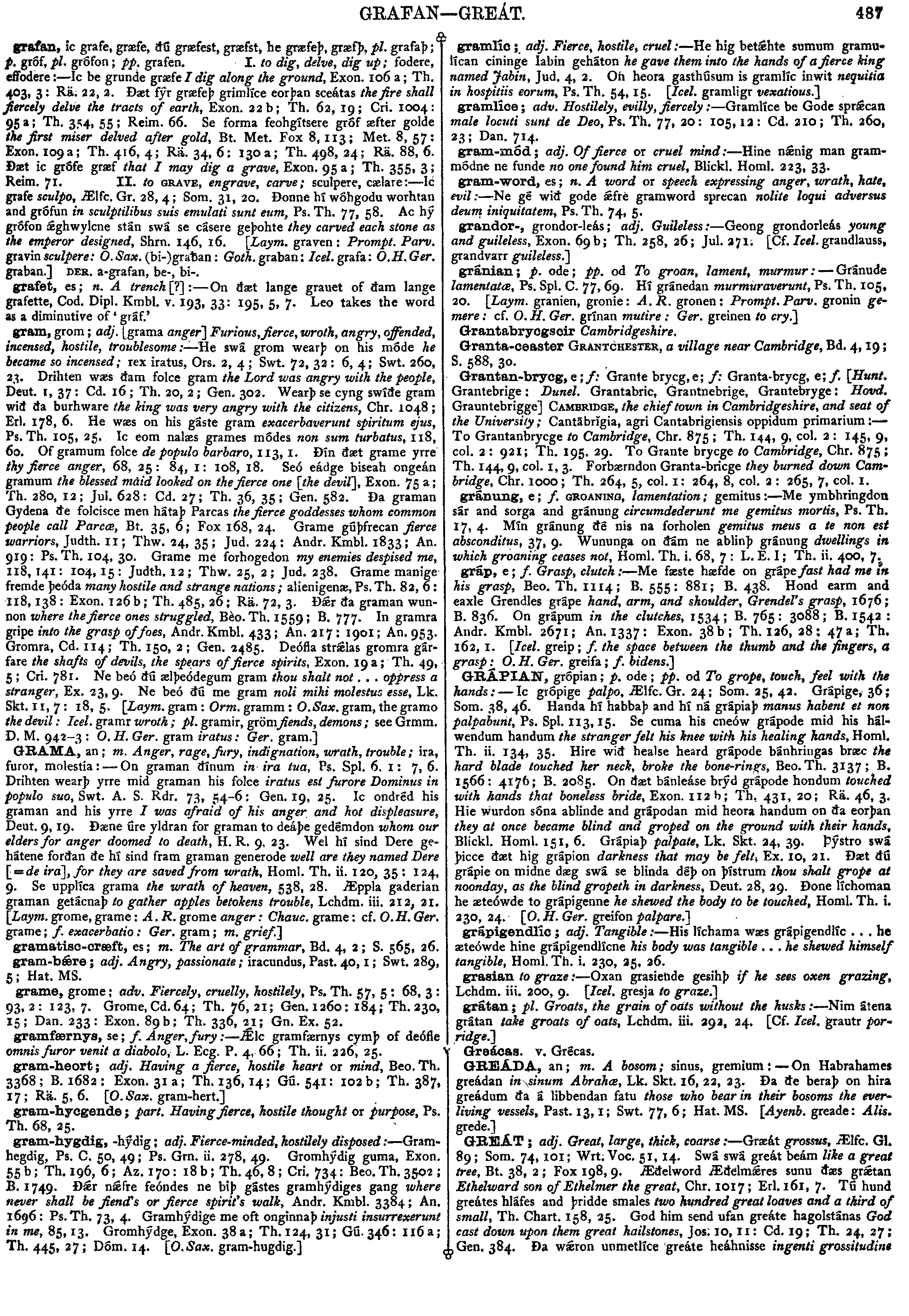
GREÁDA, an; m. A bosom; sinus, gremium :-- On Habrahames greádan in sinum Abrahæ, Lk. Skt. 16, 22, 23. Ða ðe beraþ on hira greádum ða á libbendan fatu those who bear in their bosoms the ever-living vessels, Past. 13, 1; Swt. 77, 6; Hat. MS. [Ayenb. greade: Alis. grede.]
|
Source: Bosworth/Toller, page b0494, entry 56 View original page image as: [TIFF] [PNG] [View previous entry] [View next entry] |
[Comment on this entry] [View comments (2)] |
The following entry has been hand-corrected once. |
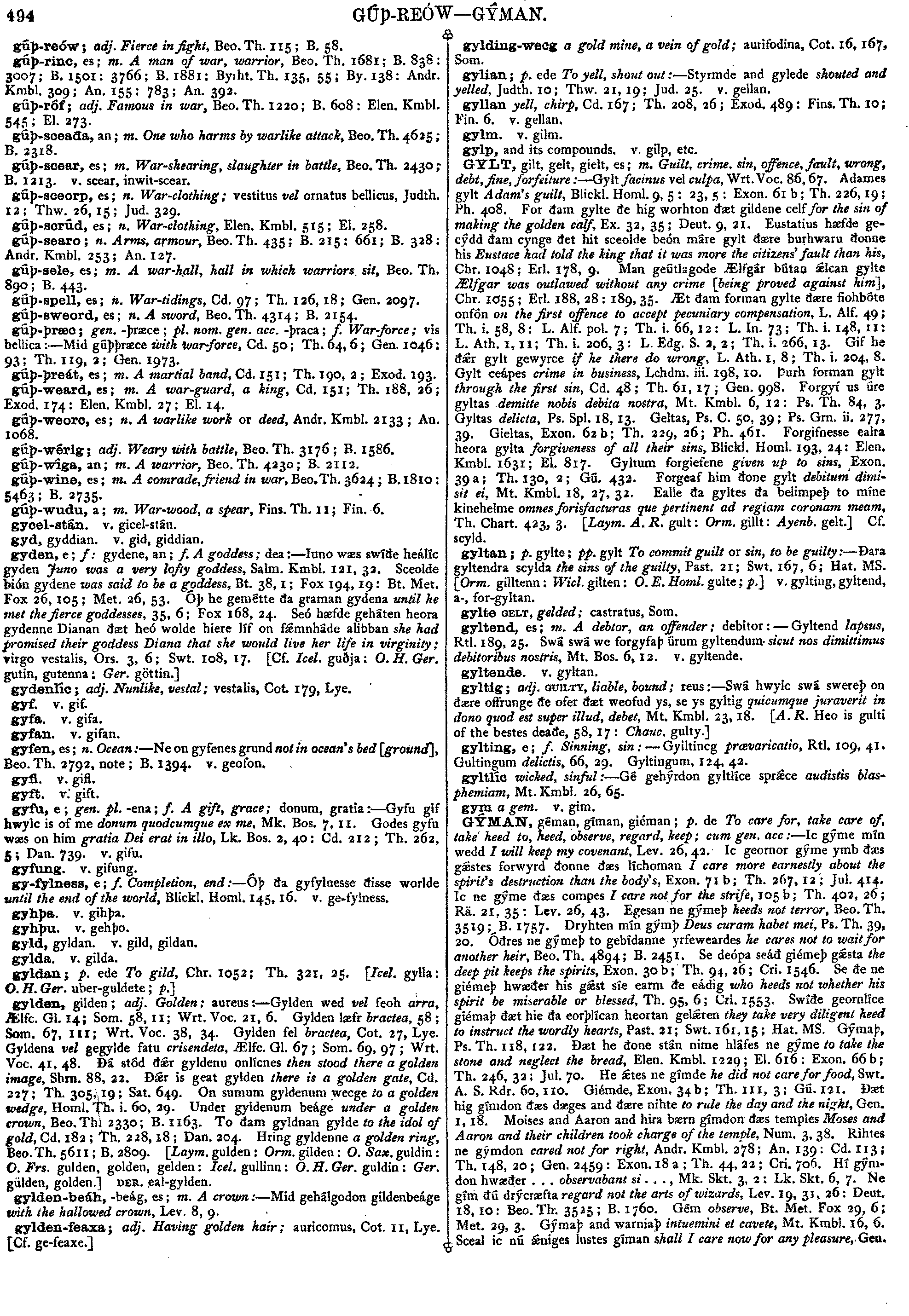
GÝMAN,
géman,
gíman,
giéman;
p.
de
To
care
for,
take
care
of,
take
heed
to,
heed,
observe,
regard,
keep;
cum
gen.
acc
:--
Ic
gýme
mín
wedd
I
will
keep
my
covenant,
Lev.
26,
42.
Ic
geornor
gýme
ymb
ðæs
gstes
forwyrd
ðonne
ðæs
líchoman
I
care
more
earnestly
about
the
spirit's
destruction
than
the
body's,
Exon.
71
b;
Th.
267,
12;
Jul.
414.
Ic
ne
gýme
ðæs
compes
I
care
not
for
the
strife,
105
b;
Th.
402,
26;
Rä.
21,
35:
Lev.
26,
43.
Egesan
ne
gýmeþ
heeds
not
terror,
Beo.
Th.
3519;
B.
1757.
Dryhten
mín
gýmþ
Deus
curam
habet
mei,
Ps.
Th.
39,
20.
Óðres
ne
gýmeþ
to
gebídanne
yrfeweardes
he
cares
not
to
wait
for
another
heir,
Beo.
Th.
4894;
B.
2451.
Se
deópa
seáð
giémeþ
gsta
the
deep
pit
keeps
the
spirits,
Exon.
30
b;
Th.
94,
26;
Cri.
1546.
Se
ðe
ne
giémeþ
hwæðer
his
gst
síe
earm
ðe
eádig
who
heeds
not
whether
his
spirit
be
miserable
or
blessed,
Th.
95,
6;
Cri.
1553.
Swíðe
geornlíce
giémaþ
ðæt
hie
ða
eorþlícan
heortan
gelren
they
take
very
diligent
heed
to
instruct
the
wordly
hearts,
Past.
21;
Swt.
161,
15;
Hat.
MS.
Gýmaþ,
Ps.
Th.
118,
122.
Ðæt
he
ðone
stán
nime
hláfes
ne
gýme
to
take
the
stone
and
neglect
the
bread,
Elen.
Kmbl.
1229;
El.
616:
Exon.
66
b;
Th.
246,
32;
Jul.
70.
He
tes
ne
gímde
he
did
not
care
for
food,
Swt.
A.
S.
Rdr.
60,
110.
Giémde,
Exon.
34
b;
Th.
111,
3;
Gú.
121.
Ðæt
hig
gímdon
ðæs
dæges
and
ðære
nihte
to
rule
the
day
and
the
night,
Gen.
1,
18.
Moises
and
Aaron
and
hira
bærn
gímdon
ðæs
temples
Moses
and
Aaron
and
their
children
took
charge
of
the
temple,
Num.
3,
38.
Rihtes
ne
gýmdon
cared
not
for
right,
Andr.
Kmbl.
278;
An.
139:
Cd.
113;
Th.
148,
20;
Gen.
2459:
Exon.
18
a;
Th.
44,
22;
Cri.
706.
Hí
gýmdon
hwæder
...
observabant
si...,
Mk.
Skt.
3,
2:
Lk.
Skt.
6,
7.
Ne
gím
ðú
drýcræfta
regard
not
the
arts
of
wizards,
Lev.
19,
31,
26:
Deut.
18,
10:
Beo.
Th.
3525;
B.
1760.
Gém
observe,
Bt.
Met.
Fox
29,
6;
Met.
29,
3.
Gýmaþ
and
warniaþ
intuemini
et
cavete,
Mt.
Kmbl.
16,
6.
Sceal
ic
nú
niges
lustes
gíman
shall
I
care
now
for
any
pleasure,
Gen.
18,
12.
Ða
ðe
bet
cunnon
sceolon
gýman
óðra
manna
those
who
know
better
are
to
take
care
of
other
men,
Homl.
Th.
ii.
282,
1:
Ps.
Th.
77,
10:
Exon.
31
a;
Th.
96,
5;
Cri.
1569.
Gif
his
ðé
géman
lyst
if
you
pleased
to
care
about
it,
Bt.
Met.
Fox
31,
2;
Met.
31,
1.
Gýman
ðæs
grundes
to
take
charge
of
the
abyss,
Cd.
18;
Th.
22,
31,
25;
Gen.
349,
346.
[Laym.
A.
R.
 emen:
Orm.
emenn:
Piers
P.
eme:
Goth.
gaumjan:
O.
Sax.
gómean:
Icel.
geyma:
Dan.
gjemme:
Swed.
gömma:
O.
H.
Ger.
goumon.]
DER.
for-,
ge-,
ofer-gýman.
v.
géman.
emen:
Orm.
emenn:
Piers
P.
eme:
Goth.
gaumjan:
O.
Sax.
gómean:
Icel.
geyma:
Dan.
gjemme:
Swed.
gömma:
O.
H.
Ger.
goumon.]
DER.
for-,
ge-,
ofer-gýman.
v.
géman.
|
Source: Bosworth/Toller, page b0496, entry 30 View original page image as: [TIFF] [PNG] [View previous entry] [View next entry] |
[Comment on this entry] [View comments] |
The following entry has been hand-corrected once. |
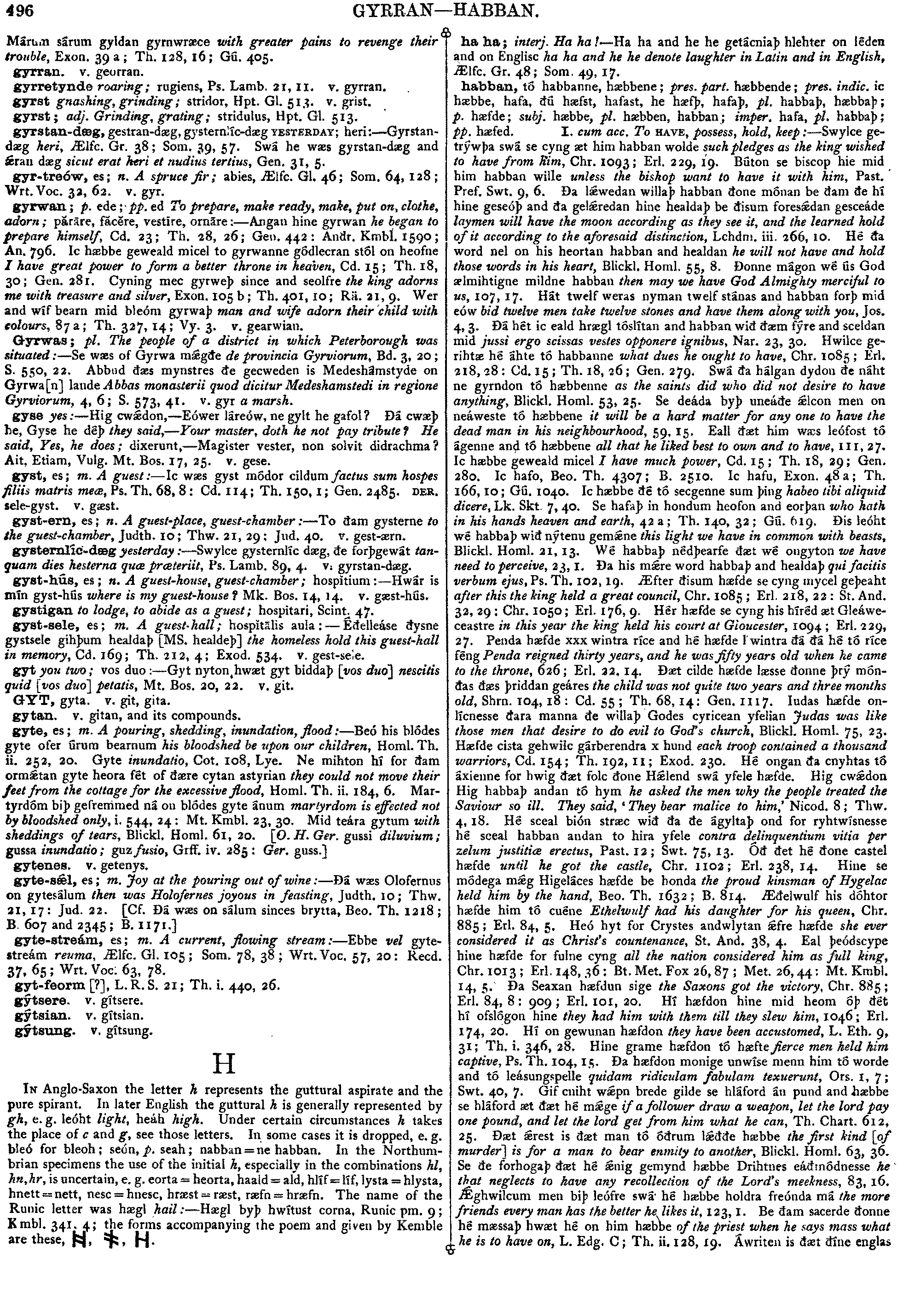
habban,
tó
habbanne,
hæbbene;
pres.
part.
hæbbende;
pres.
indic.
ic
hæbbe,
hafa,
ðú
hæfst,
hafast,
he
hæfþ,
hafaþ,
pl.
habbaþ,
hæbbaþ;
p.
hæfde;
subj.
hæbbe,
pl.
hæbben,
habban;
imper.
hafa,
pl.
habbaþ;
pp.
hæfed.
I.
cum
acc.
To
HAVE,
possess,
hold,
keep
:--
Swylce
getrýwþa
swá
se
cyng
æt
him
habban
wolde
such
pledges
as
the
king
wished
to
have
from
him,
Chr.
1093;
Erl.
229,
19.
Búton
se
biscop
hie
mid
him
habban
wille
unless
the
bishop
want
to
have
it
with
him,
Past.
Pref.
Swt.
9,
6.
Ða
lwedan
willaþ
habban
ðone
mónan
be
ðam
ðe
hí
hine
geseóþ
and
ða
gelredan
hine
healdaþ
be
ðisum
foresdan
gesceáde
laymen
will
have
the
moon
according
as
they
see
it,
and
the
learned
hold
of
it
according
to
the
aforesaid
distinction,
Lchdm.
iii.
266,
10.
Hé
ða
word
nel
on
his
heortan
habban
and
healdan
he
will
not
have
and
hold
those
words
in
his
heart,
Blickl.
Homl.
55,
8.
Ðonne
mágon
wé
ús
God
ælmihtigne
mildne
habban
then
may
we
have
God
Almighty
merciful
to
us,
107,
17.
Hát
twelf
weras
nyman
twelf
stánas
and
habban
forþ
mid
eów
bid
twelve
men
take
twelve
stones
and
have
them
along
with
you,
Jos.
4,
3.
Ðá
hét
ic
eald
hrægl
tóslítan
and
habban
wið
ðæm
fýre
and
sceldan
mid
jussi
ergo
scissas
vestes
opponere
ignibus,
Nar.
23,
30.
Hwilce
gerihtæ
hé
áhte
tó
habbanne
what
dues
he
ought
to
have,
Chr.
1085;
Erl.
218,
28
:
Cd.
15;
Th.
18,
26;
Gen.
279.
Swá
ða
hálgan
dydon
ðe
náht
ne
gyrndon
tó
hæbbenne
as
the
saints
did
who
did
not
desire
to
have
anything,
Blickl.
Homl.
53,
25.
Se
deáda
byþ
uneáðe
lcon
men
on
neáweste
tó
hæbbene
it
will
be
a
hard
matter
for
any
one
to
have
the
dead
man
in
his
neighbourhood,
59,
15.
Eall
ðæt
him
wæs
leófost
tó
ágenne
and
tó
hæbbene
all
that
he
liked
best
to
own
and
to
have,
111,
27.
Ic
hæbbe
geweald
micel
I
have
much
power,
Cd.
15;
Th.
18,
29;
Gen.
280.
Ic
hafo,
Beo.
Th.
4307;
B.
2510.
Ic
hafu,
Exon.
48
a;
Th.
166,
10;
Gú.
1040.
Ic
hæbbe
ðé
tó
secgenne
sum
þing
habeo
tibi
aliquid
dicere,
Lk.
Skt.
7,
40.
Se
hafaþ
in
hondum
heofon
and
eorþan
who
hath
in
his
hands
heaven
and
earth,
42
a;
Th.
140,
32;
Gú.
619.
Ðis
leóht
wé
habbaþ
wið
nýtenu
gemne
this
light
we
have
in
common
with
beasts,
Blickl.
Homl.
21,
13.
We
habbaþ
nédþearfe
ðæt
wé
ongyton
we
have
need
to
perceive,
23,
1.
Ða
his
mre
word
habbaþ
and
healdaþ
qui
facitis
verbum
ejus,
Ps.
Th.
102,
19.
Æfter
ðisum
hæfde
se
cyng
mycel
geþeaht
after
this
the
king
held
a
great
council,
Chr.
1085;
Erl.
218,
22
:
St.
And.
32,
29
:
Chr.
1050;
Erl.
176,
9.
Hér
hæfde
se
cyng
his
híréd
æt
Gleáweceastre
in
this
year
the
king
held
his
court
at
Gloucester,
1094;
Erl.
229,
27.
Penda
hæfde
xxx
wintra
ríce
and
hé
hæfde
l
wintra
ðá
dá
hé
tó
ríce
féng
Penda
reigned
thirty
years,
and
he
was
fifty
years
old
when
he
came
to
the
throne,
626;
Erl.
22,
14.
Ðæt
cilde
hæfde
læsse
ðonne
þrý
mónðas
ðæs
þriddan
geáres
the
child
was
not
quite
two
years
and
three
months
old,
Shrn.
104,
18
:
Cd.
55;
Th.
68,
14
:
Gen.
1117.
Iudas
hæfde
onlícnesse
ðara
manna
ðe
willaþ
Godes
cyricean
yfelian
Judas
was
like
those
men
that
desire
to
do
evil
to
God's
church,
Blickl.
Homl.
75,
23.
Hæfde
cista
gehwilc
gárberendra
x
hund
each
troop
contained
a
thousand
warriors,
Cd.
154;
Th.
192,
11;
Exod.
230.
Hé
ongan
ða
cnyhtas
tó
áxienne
for
hwig
ðæt
folc
ðone
Hlend
swá
yfele
hæfde.
Hig
cwdon
Hig
habbaþ
andan
tó
hym
he
asked
the
men
why
the
people
treated
the
Saviour
so
ill.
They
said,
'They
bear
malice
to
him,'
Nicod.
8;
Thw.
4,
18.
Hé
sceal
bión
stræc
wið
ða
ðe
ágyltaþ
and
for
ryhtwísnesse
hé
sceal
habban
andan
to
hira
yfele
contra
delinquentium
vitia
per
zelum
justitiæ
erectus,
Past.
12;
Swt.
75,
13.
Óð
ðet
hé
ðone
castel
hæfde
until
he
got
the
castle,
Chr.
1102;
Erl.
238,
14.
Hine
se
módega
mg
Higeláces
hæfde
be
honda
the
proud
kinsman
of
Hygelac
held
him
by
the
hand,
Beo.
Th.
1632;
B.
814.
Æðelwulf
his
dóhtor
hæfde
him
tó
cuéne
Ethelwulf
had
his
daughter
for
his
queen,
Chr.
885;
Erl.
84,
5.
Heó
hyt
for
Crystes
andwlytan
fre
hæfde
she
ever
considered
it
as
Christ's
countenance,
St.
And.
38,
4.
Eal
þeódscype
hine
hæfde
for
fulne
cyng
all
the
nation
considered
him
as
full
king,
Chr.
1013;
Erl.
148,
36
:
Bt.
Met.
Fox
26,
87;
Met.
26,
44
:
Mt.
Kmbl.
14,
5.
Ða
Seaxan
hæfdun
sige
the
Saxons
got
the
victory,
Chr.
885;
Erl.
84,
8
:
909;
Erl.
101,
20.
Hí
hæfdon
hine
mid
heom
óþ
ðét
hí
ofslógon
hine
they
had
him
with
them
till
they
slew
him,
1046;
Erl.
174,
20.
Hí
on
gewunan
hæfdon
they
have
been
accustomed,
L.
Eth.
9,
31;
Th.
i.
346,
28.
Hine
grame
hæfdon
tó
hæfte
fierce
men
held
him
captive,
Ps.
Th.
104,
15.
Ða
hæfdon
monige
unwíse
menn
him
tó
worde
and
tó
leásungspelle
quidam
ridiculam
fabulam
texuerunt,
Ors.
1,
7;
Swt.
40,
7.
Gif
cniht
wpn
brede
gilde
se
hláford
án
pund
and
hæbbe
se
hláford
æt
ðæt
hé
mge
if
a
follower
draw
a
weapon,
let
the
lord
pay
one
pound,
and
let
the
lord
get
from
him
what
he
can,
Th.
Chart.
612,
25.
Ðæt
rest
is
ðæt
man
tó
óðrum
lððe
hæbbe
the
first
kind
[of
murder]
is
for
a
man
to
bear
enmity
to
another,
Blickl.
Homl.
63,
36.
Se
ðe
forhogaþ
ðæt
hé
nig
gemynd
hæbbe
Drihtnes
eáðmódnesse
he
that
neglects
to
have
any
recollection
of
the
Lord's
meekness,
83,
16.
Æ-acute;ghwilcum
men
biþ
leófre
swá
hé
hæbbe
holdra
freónda
má
the
more
friends
every
man
has
the
better
he
likes
it,
123,
1.
Be
ðam
sacerde
ðonne
hé
mæssaþ
hwæt
hé
on
him
hæbbe
of
the
priest
when
he
says
mass
what
he
is
to
have
on,
L.
Edg.
C;
Th.
ii.
128,
19.
Áwriten
is
ðæt
ðíne
englas
ðé
on
hondum
habban
it
is
written
that
thine
angels
shall
take
thee
in
their
hands,
27,
14.
Ða
hwíle
ðe
wé
ðæt
líf
on
úrum
gewealde
habban
while
we
have
the
life
in
our
power,
101,
11.
Uton
geþencean
hwylc
handleán
wé
him
forþ
tó
berenne
habban
let
us
consider
what
recompense
we
have
to
produce
for
him,
91,
14.
Hafa
ðé
wunden
gold
take
for
thyself
the
twisted
gold,
Cd.
97;
Th.
128,
18;
Gen.
2128.
Gif
man
frigne
man
æt
hæbbendre
handa
gefó
if
a
freeman
be
taken
with
stolen
goods
upon
him,
L.
Wiht.
26;
Th.
i.
42,
15
:
L.
Ath.
1,
1;
Th.
i.
198,
16
:
4,
pref.
Th.
i.
220,
11.
Wé
beóþ
hæbbende
ðæs
ðe
wé
r
hopedon
we
shall
be
in
possession
of
that
which
before
we
hoped
for,
Homl.
Th.
i.
250,
34.
Is
seó
stów
on
micelre
árwurþnysse
hæfed
in
magna
veneratione
habetur
locus
ille,
Bd.
3,
2;
S.
524,
12.
Mid
ðý
hé
mid
ðone
gesíþ
hæfed
wæs
dum
apted
comitem
teneretur,
4,
22;
S.
591,
32.
Adam
and
Eva
on
bendum
wron
hæfde
Adam
and
Eve
were
held
in
bonds,
Blickl.
Homl.
87,
26.
II.
with
partitive
gen
:--
Hæbbe
ic
his
on
handa
I
have
some
of
it
in
my
hand,
Cd.
32;
Th.
42,
23;
Gen.
678.
Se
ðe
ðara
mihta
hæbbe
árre
cirican
he
who
has
the
means
let
him
erect
a
church,
L.
Pen.
14;
Th.
ii.
282,
5
:
L.
E.
I.
3;
Th.
ii.
404,
22.
Hé
ne
móste
ðæs
fyrstes
habban
ðe
hé
gewilnode
he
might
not
have
any
of
the
respite
that
he
desired,
Homl.
Th.
i.
414,
28.
III.
with
the
gerundial
infin.
to
express
the
future
:--
Ðone
calic
ðe
ic
tó
drincenne
hæbbe
calicem
quem
ego
bibiturus
sum,
Mt.
Kmbl.
20,
22
[cf.
the
formation
of
the
future
tense
in
the
Romance
languages].
IV.
with
an
uninflected
participle
:--
Ðú
mé
forlred
hæfst
thou
hast
seduced
me,
Cd.
38;
Th.
50,
34;
Gen.
818.
Ðæs
lífes
ðe
ðú
hafast
ofslegen
the
life
that
thou
hast
slain,
Exon.
29
b;
Th.
90,
25;
Cri.
1479
For
ðissum
ælþeódigum
ðe
wé
on
ðissum
carcerne
betýned
habbaþ
on
account
of
this
stranger
whom
we
shut
up
in
this
prison,
Blickl.
Homl.
245,
36.
Gé
habbaþ
ús
gedón
láðe
Pharaone
ye
have
made
us
hateful
to
Pharaoh,
Ex.
5,
21.
V.
with
an
inflected
participle,
sometimes
also
with
an
uninflected
participle
as
well
:--
Ic
mínes
þeódnes
hafa
hyldo
forworhte
I
have
forfeited
my
prince's
favour,
Cd.
39;
Th.
52,
1;
Gen.
836.
Ðú
hæfst
ðé
wið
dryhten
dýrne
geworhtne
thou
hast
made
thyself
dear
to
the
Lord,
25;
Th.
32,
22;
Gen.
507.
Ðú
hafast
helle
bereáfod
and
ðæs
deáþes
aldor
gebundenne
thou
hast
despoiled
hell,
and
bound
the
prince
of
death,
Blickl.
Homl.
87,
22.
Ðín
ágen
geleáfa
ðé
hæfþ
gehledne
thine
own
faith
hath
saved
thee,
15,
27
:
85,
23.
Ðás
þing
wé
habbaþ
be
him
gewritene
we
have
written
these
things
about
him,
Chr.
1086;
Erl.
222,
40.
Ðá
cwæþ
Iacob
Bearnleásne
gé
habbaþ
mé
gedónne
then
said
Jacob,
Ye
have
made
me
childless,
Gen.
42,
36.
Hie
hine
ofslægenne
hæfdon
they
had
slain
him,
Chr.
755;
Erl.
50,
1
:
867;
Erl.
72,
9.
[Laym.
habben,
han
:
Orm
:
habbenn,
hafenn
:
A.
R.
habben
:
Goth.
haban
:
O.
Sax.
hebbian
:
O.
Frs.
hebba,
habba
:
Icel.
hafa
:
O.
H.
Ger.
haben.]
DER.
á-,
æt-,
be-,
for-,
ge-,
of-,
on-,
wið-,
wiðer-,
ymb-habban
:
nabban
:
bord-,
daroþ-,
dreám-,
eard-,
lind-,
rand-,
searo-hæbbende.
| Result Page: |  |
Previous | 1 2 3 4 5 6 7 8 9 10 11 12 13 14 | Next |  |
Germanic Lexicon Project (main page)
This search system was written by
Sean Crist
Please consider
volunteering
to correct the data in these online dictionaries.
No rights reserved. Feel free to use these data in any way you please.