|
|

Search for Hie again, using less strict matching (2711 results)
|
Source: Bosworth/Toller, page b0174, entry 33 View original page image as: [TIFF] [PNG] [View previous entry] [View next entry] |
[Comment on this entry] [View comments] |
The following entry has been hand-corrected once. |
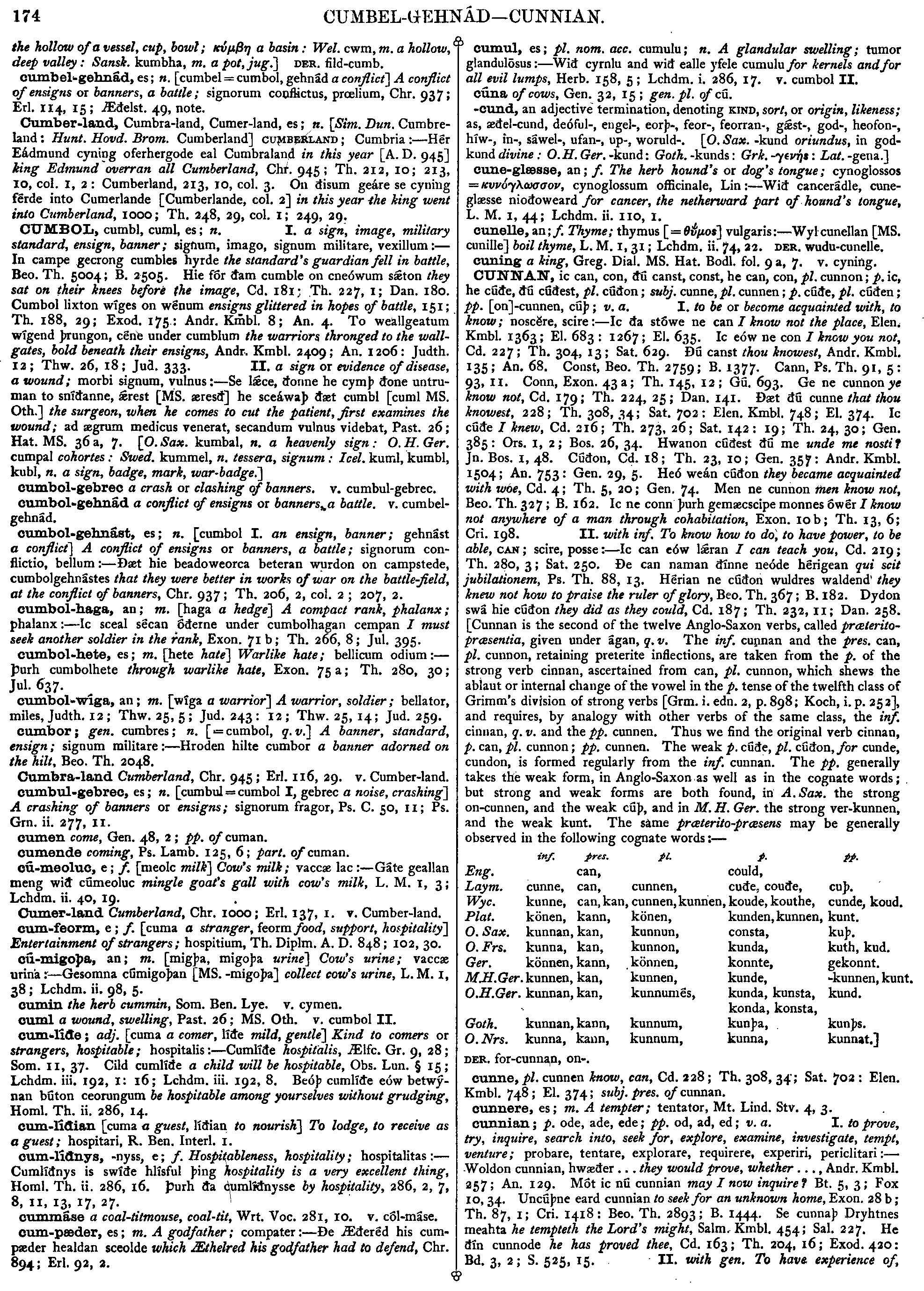
CUNNAN,
ic
can,
con,
ðú
canst,
const,
he
can,
con,
pl.
cunnon;
p.
ic,
he
cúðe,
ðú
cúðest,
pl.
cúðon;
subj.
cunne,
pl.
cunnen;
p.
cúðe,
pl.
cúðen;
pp.
[on]-cunnen,
cúþ;
v.
a.
I.
to
be
or
become
acquainted
with,
to
know;
nosc re,
scire
:--
Ic
ða
stówe
ne
can
I
know
not
the
place,
Elen.
Kmbl.
1363;
El.
683:
1267;
El.
635.
Ic
eów
ne
con
I
know
you
not,
Cd.
227;
Th.
304,
13;
Sat.
629.
ÐÚ
canst
thou
knowest,
Andr.
Kmbl.
135;
An.
68.
Const,
Beo.
Th.
2759;
B.
1377.
Cann,
Ps.
Th.
91,
5:
93,
11.
Conn,
Exon.
43a;
Th.
145,
12;
Gú.
693.
Ge
ne
cunnon
ye
know
not,
Cd.
179;
Th.
224,
25;
Dan.
141.
Ðæt
ðú
cunne
that
thow
knowest,
228;
Th.
308,
34;
Sae.
702:
Elen.
Kmbl.
748;
El.
374.
Ic
cúðe
I
knew,
Cd.
216;
Th.
273,
26;
Sat.
142:
19;
Th.
24,
30;
Gen.
385:
Ors.
1,
2;
Bos.
26,
34.
Hwanon
cúðest
ðú
me
unde
me
nosti?
Jn.
Bos.
1,
48.
Cúðon,
Cd.
18;
Th.
23,
10;
Gen.
357:
Andr.
Kmbl.
1504;
An.
753:
Gen.
29,
5.
Heó
weán
cúðon
they
became
acquainted
with
woe,
Cd.
4;
Th.
5,
20;
Gen.
74.
Men
ne
cunnon
men
know
not,
Beo.
Th.
327;
B.
162.
Ic
ne
conn
þurh
gemæcscipe
monnes
ówér
I
know
not
anywhere
of
a
man
through
cohabitation,
Exon.
10b;
Th.
13,
6;
Cri.
198.
II.
with
inf.
To
know
how
to
do,
to
have
power,
to
be
able,
CAN;
scire,
posse
:--
Ic
can
eów
l
re,
scire
:--
Ic
ða
stówe
ne
can
I
know
not
the
place,
Elen.
Kmbl.
1363;
El.
683:
1267;
El.
635.
Ic
eów
ne
con
I
know
you
not,
Cd.
227;
Th.
304,
13;
Sat.
629.
ÐÚ
canst
thou
knowest,
Andr.
Kmbl.
135;
An.
68.
Const,
Beo.
Th.
2759;
B.
1377.
Cann,
Ps.
Th.
91,
5:
93,
11.
Conn,
Exon.
43a;
Th.
145,
12;
Gú.
693.
Ge
ne
cunnon
ye
know
not,
Cd.
179;
Th.
224,
25;
Dan.
141.
Ðæt
ðú
cunne
that
thow
knowest,
228;
Th.
308,
34;
Sae.
702:
Elen.
Kmbl.
748;
El.
374.
Ic
cúðe
I
knew,
Cd.
216;
Th.
273,
26;
Sat.
142:
19;
Th.
24,
30;
Gen.
385:
Ors.
1,
2;
Bos.
26,
34.
Hwanon
cúðest
ðú
me
unde
me
nosti?
Jn.
Bos.
1,
48.
Cúðon,
Cd.
18;
Th.
23,
10;
Gen.
357:
Andr.
Kmbl.
1504;
An.
753:
Gen.
29,
5.
Heó
weán
cúðon
they
became
acquainted
with
woe,
Cd.
4;
Th.
5,
20;
Gen.
74.
Men
ne
cunnon
men
know
not,
Beo.
Th.
327;
B.
162.
Ic
ne
conn
þurh
gemæcscipe
monnes
ówér
I
know
not
anywhere
of
a
man
through
cohabitation,
Exon.
10b;
Th.
13,
6;
Cri.
198.
II.
with
inf.
To
know
how
to
do,
to
have
power,
to
be
able,
CAN;
scire,
posse
:--
Ic
can
eów
l ran
I
can
teach
you,
Cd.
219;
Th.
280,
3;
Sat.
250.
Ðe
can
naman
ðínne
neóde
hérigean
qui
scit
jubilationem,
Ps.
Th.
88,
13.
Hérian
ne
cúðon
wuldres
waldend
they
knew
not
how
to
praise
the
ruler
of
glory,
Beo.
Th.
367;
B.
182.
Dydon
swá
hie
cúðon
they
did
as
they
could,
Cd.
187;
Th.
232,
11;
Dan.
258.
[Cunnan
is
the
second
of
the
twelve
Anglo-Saxon
verbs,
called
præterito
ran
I
can
teach
you,
Cd.
219;
Th.
280,
3;
Sat.
250.
Ðe
can
naman
ðínne
neóde
hérigean
qui
scit
jubilationem,
Ps.
Th.
88,
13.
Hérian
ne
cúðon
wuldres
waldend
they
knew
not
how
to
praise
the
ruler
of
glory,
Beo.
Th.
367;
B.
182.
Dydon
swá
hie
cúðon
they
did
as
they
could,
Cd.
187;
Th.
232,
11;
Dan.
258.
[Cunnan
is
the
second
of
the
twelve
Anglo-Saxon
verbs,
called
præterito præsentia,
given
under
ágan,
q.
v.
The
inf.
cunnan
and
the
pres.
can,
pl.
cunnon,
retaining
preterite
inflections,
are
taken
from
the
p.
of
the
strong
verb
cinnan,
ascertained
from
can,
pl.
cunnon,
which
shews
the
ablaut
or
internal
change
of
the
vowel
in
the
p.
tense
of
the
twelfth
class
of
Grimm's
division
of
strong
verbs
[Grm.
i.
edn.
2,
p.
898;
Koch,
i.
p.
252],
and
requires,
by
analogy
with
other
verbs
of
the
same
class,
the
inf.
cinnan,
q.
v.
and
the
pp.
cunnen.
Thus
we
find
the
original
verb
cinnan,
p.
can,
pl.
cunnon;
pp.
cunnen.
The
weak
p.
cúðe,
pl.
cúðon,
for
cunde,
cundon,
is
formed
regularly
from
the
inf.
cunnan.
The
pp.
generally
takes
the
weak
form,
in
Anglo-Saxon
as
well
as
in
the
cognate
words;
but
strong
and
weak
forms
are
both
found,
in
A.
Sax.
the
strong
on-cunnen,
and
the
weak
cúþ,
and
in
M.
H.
Ger.
the
strong
ver-kunnen,
and
the
weak
kunt.
The
same
præterito-præsens
may
be
generally
observed
in
the
following
cognate
words
:--
præsentia,
given
under
ágan,
q.
v.
The
inf.
cunnan
and
the
pres.
can,
pl.
cunnon,
retaining
preterite
inflections,
are
taken
from
the
p.
of
the
strong
verb
cinnan,
ascertained
from
can,
pl.
cunnon,
which
shews
the
ablaut
or
internal
change
of
the
vowel
in
the
p.
tense
of
the
twelfth
class
of
Grimm's
division
of
strong
verbs
[Grm.
i.
edn.
2,
p.
898;
Koch,
i.
p.
252],
and
requires,
by
analogy
with
other
verbs
of
the
same
class,
the
inf.
cinnan,
q.
v.
and
the
pp.
cunnen.
Thus
we
find
the
original
verb
cinnan,
p.
can,
pl.
cunnon;
pp.
cunnen.
The
weak
p.
cúðe,
pl.
cúðon,
for
cunde,
cundon,
is
formed
regularly
from
the
inf.
cunnan.
The
pp.
generally
takes
the
weak
form,
in
Anglo-Saxon
as
well
as
in
the
cognate
words;
but
strong
and
weak
forms
are
both
found,
in
A.
Sax.
the
strong
on-cunnen,
and
the
weak
cúþ,
and
in
M.
H.
Ger.
the
strong
ver-kunnen,
and
the
weak
kunt.
The
same
præterito-præsens
may
be
generally
observed
in
the
following
cognate
words
:--
|
Source: Bosworth/Toller, page b0176, entry 20 View original page image as: [TIFF] [PNG] [View previous entry] [View next entry] |
[Comment on this entry] [View comments (1)] |
The following entry has been hand-corrected once. |
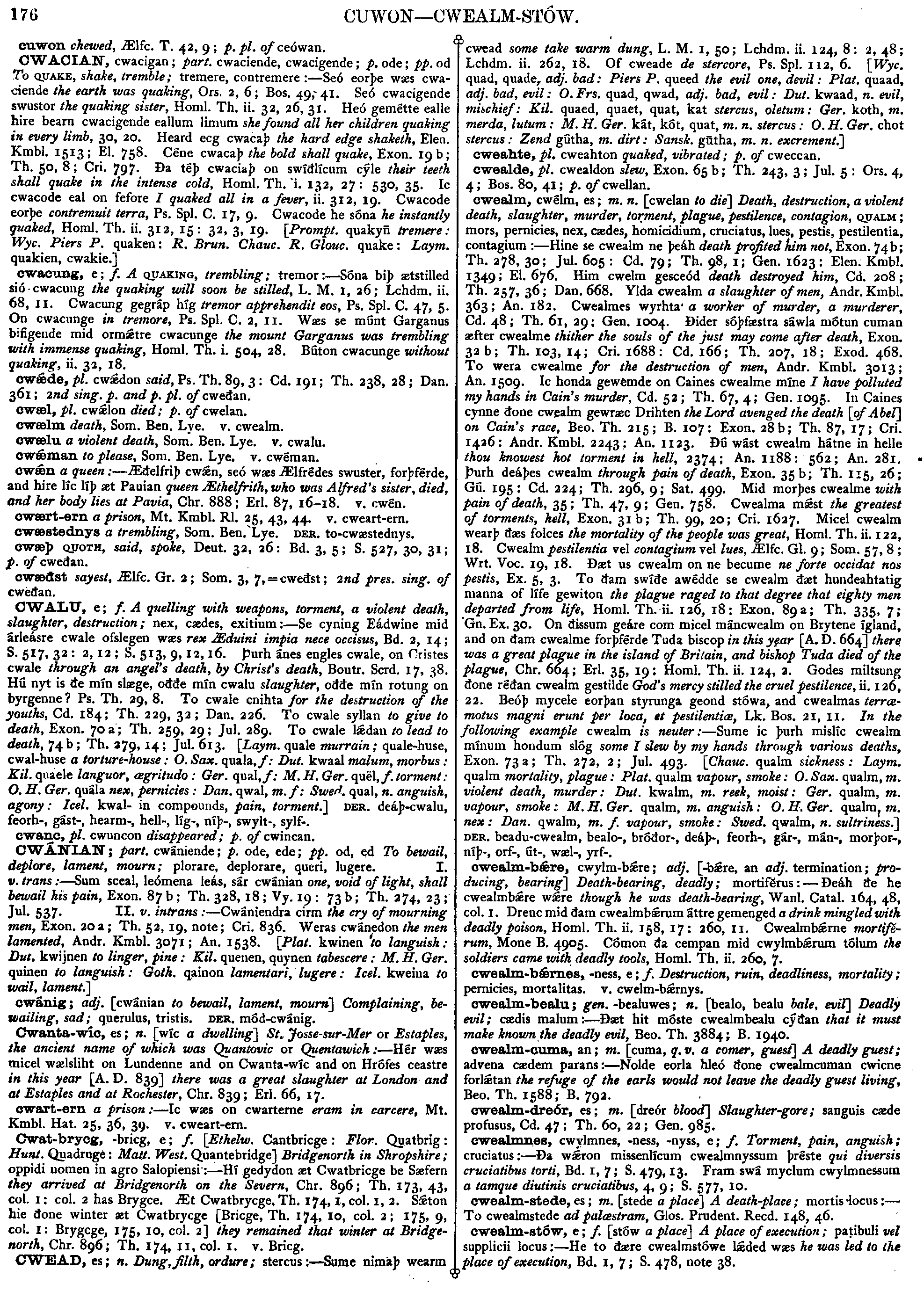
Cwat-brycg,
-bricg,
e;
f.
[Ethelw.
Cantbricge:
Flor.
Quatbrig:
Hunt.
Quadruge:
Matt.
West.
Quantebridge]
Bridgenorth
in
Shropshire;
oppidi
nomen
UNCERTAIN
in
agro
Salopiensi
:--
Hí
gedydon
æt
Cwatbricge
be
Sæfern
they
arrived
at
Bridgenorth
on
the
Severn,
Chr.
896;
Th.
173,
43,
col.
1:
col.
2
has
Brygce.
Æt
Cwatbrycge,
Th.
174,
1,
col.
1,
2.
Ston
hie
ðone
winter
æt
Cwatbrycge
[Bricge,
Th.
174,
10,
col.
2;
175,
9,
col.
1:
Brygcge,
175,
10,
col.
2]
they
remained
that
winter
at
Bridgenorth,
Chr.
896;
Th.
174,
11,
col.
1.
v.
Bricg.
|
Source: Bosworth/Toller, page b0177, entry 23 View original page image as: [TIFF] [PNG] [View previous entry] [View next entry] |
[Comment on this entry] [View comments] |
The following entry has been hand-corrected once. |
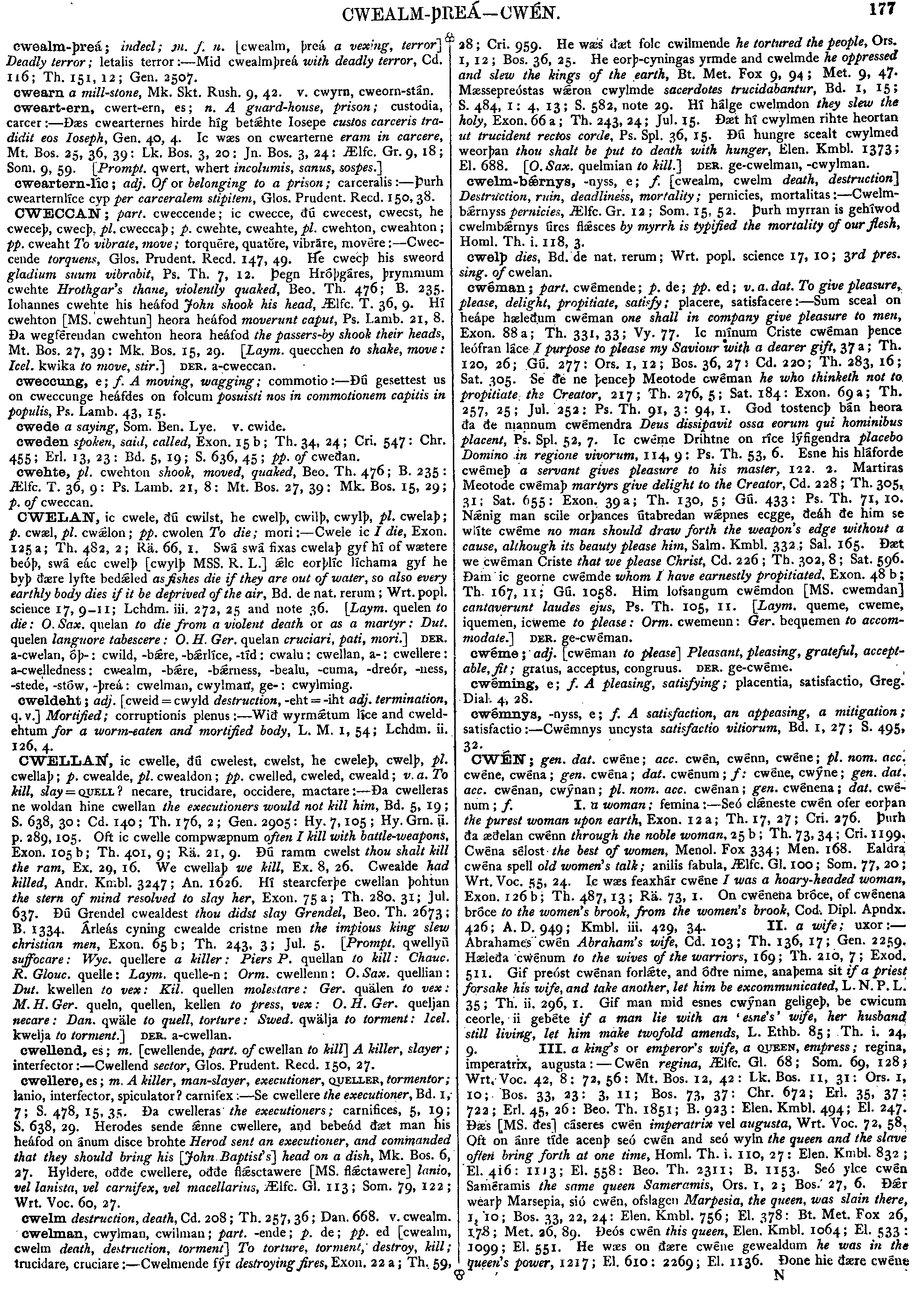
CWÉN;
gen.
dat.
cwéne;
acc.
cwén,
cwénn,
cwéne;
pl.
nom.
acc.
cwéne,
cwéna;
gen.
cwéna;
dat.
cwénum;
f:
cwéne,
cwýne;
gen.
dat.
acc.
cwénan,
cwýnan;
pl.
nom.
acc.
cwénan;
gen.
cwénena;
dat.
cwénum;
f.
I.
a
woman;
femina
:--
Seó
clneste
cwén
ofer
eorþan
the
purest
woman
upon
earth,
Exon.
12a;
Th.
17,
27;
Cri.
276.
Þurh
ða
æðelan
cwénn
through
the
noble
woman,
25b;
Th.
73,
34;
Cri.
1199.
Cwéna
sélost
the
best
of
women,
Menol.
Fox
334;
Men.
168.
Ealdra
cwéna
spell
old
women's
talk;
anilis
fabula,
Ælfc.
Gl.
100;
Som.
77,
20;
Wrt.
Voc.
55,
24.
Ic
wæs
feaxhár
cwéne
I
was
a
hoary-headed
woman,
Exon.
126b;
Th.
487,
13;
Rä.
73,
1.
On
cwénena
bróce,
of
cwénena
bróce
to
the
women's
brook,
from
the
women's
brook,
Cod.
Dipl.
Apndx.
426;
A.
D.
949;
Kmbl.
iii.
429,
34.
II.
a
wife;
uxor
:--
Abrahames
cwén
Abraham's
wife,
Cd.
103;
Th.
136,
17;
Gen.
2259.
Hæleða
cwénum
to
the
wives
of
the
warriors,
169;
Th.
210,
7;
Exod.
511.
Gif
preóst
cwénan
forlte,
and
óðre
nime,
anaþema
sit
if
a
priest
forsake
his
wife,
and
take
another,
let
him
be
excommunicated,
L.
N.
P.
L.
35;
Th.
ii.
296,
1.
Gif
man
mid
esnes
cwýnan
geligeþ,
be
cwicum
ceorle,
ii
gebéte
if
a
man
lie
with
an
'esne's'
wife,
her
husband,
still
living,
let
him
make
twofold
amends,
L.
Ethb.
85;
Th.
i.
24,
9.
III.
a
king's
or
emperor's
wife,
a
QUEEN,
empress;
regina,
imperatrix,
augusta
:--
Cwén
regina,
Ælfc.
Gl.
68;
Som.
69,
128;
Wrt.
Voc.
42,
8:
72,
56:
Mt.
Bos.
12,
42:
Lk.
Bos.
11,
31:
Ors.
1,
10;
Bos.
33,
23:
3,
11;
Bos.
73,
37:
Chr.
672;
Erl.
35,
37:
722;
Erl.
45,
26:
Beo.
Th.
1851;
B.
923:
Elen.
Kmbl.
494;
El.
247.
Ðæs
[MS.
ðes]
cáseres
cwén
imperatrix
vel
augusta,
Wrt.
Voc.
72,
58.
Oft
on
ánre
tíde
acenþ
seó
cwén
and
seó
wyln
the
queen
and
the
slave
often
bring
forth
at
one
time,
Homl.
Th.
i.
110,
27:
Elen.
Kmbl.
832;
El.
416:
1113;
El.
558:
Beo.
Th.
2311;
B.
1153.
Seó
ylce
cwén
Sarméramis
the
same
queen
Sameramis,
Ors.
1,
2;
Bos.
27,
6.
Ðær
wearþ
Marsepia,
sió
cwén,
ofslagen
Marpesia,
the
queen,
was
slain
there,
1,
10;
Bos.
33,
22,
24:
Elen.
Kmbl.
756;
El.
378:
Bt.
Met.
Fox
26,
178;
Met.
26,
89.
Ðeós
cwén
this
queen,
Elen.
Kmbl.
1064;
El.
533:
1099;
El.
551.
He
wæs
on
ðære
cwéne
gewealdum
he
was
in
the
queen's
power,
1217;
El.
610:
2269;
El.
1136.
Ðone
hie
ðære
cwéne
|
Source: Bosworth/Toller, page b0178, entry 20 View original page image as: [TIFF] [PNG] [View previous entry] [View next entry] |
[Comment on this entry] [View comments (1)] |
The following entry has been hand-corrected once. |
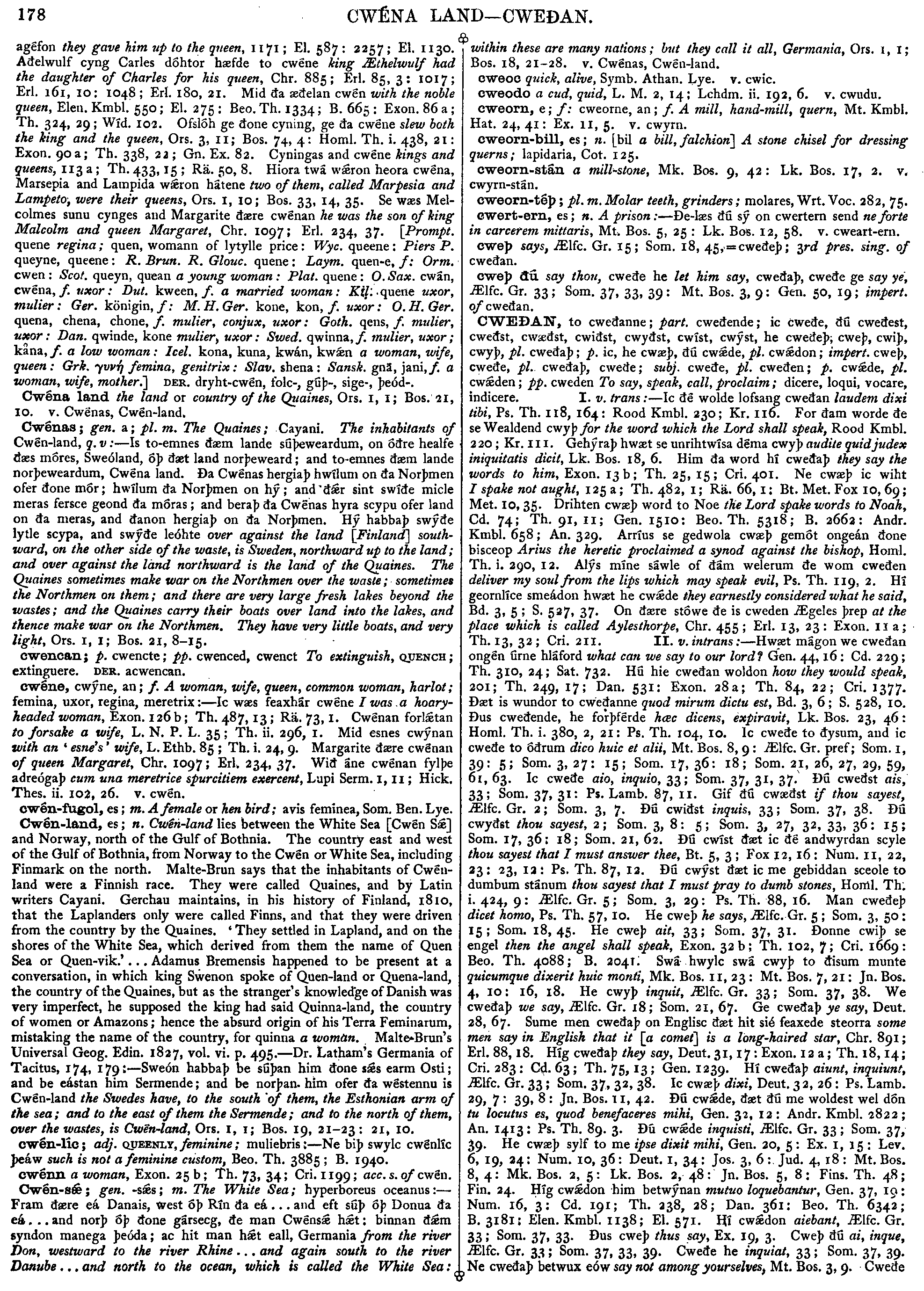
CWEÐAN,
to
cweðanne;
part.
cweðende;
ic
cweðe,
ðú
cweðest,
cweðst,
cwæðst,
cwiðst,
cwyðst,
cwíst,
cwýst,
he
cweðeþ;
cweþ,
cwiþ,
cwyþ,
pl.
cweðaþ;
p.
ic,
he
cwæþ,
ðú
cwde,
pl.
cwdon;
impert.
cweþ,
cweðe,
pl.
cweðaþ,
cweðe;
subj.
cweðe,
pl.
cweðen;
p.
cwde,
pl.
cwden;
pp.
cweden
To
say,
speak,
call,
proclaim;
dicere,
loqui,
vocare,
indicere.
I.
v.
trans
:--
Ic
ðé
wolde
lofsang
cweðan
laudem
dixi
tibi,
Ps.
Th.
118,
164:
Rood
Kmbl.
230;
Kr.
116.
For
ðam
worde
ðe
se
Wealdend
cwyþ
for
the
word
which
the
iord
shall
speak,
Rood
Kmbl.
220;
Kr.
111.
Gehýraþ
hwæt
se
unrihtwísa
déma
cwyþ
audite
quid
judex
iniquitatis
dicit,
Lk.
Bos.
18,
6.
Him
ða
word
hí
cweðaþ
they
say
the
words
to
him,
Exon.
13b;
Th.
25,
15;
Cri.
401.
Ne
cwæþ
ic
wiht
I
spake
not
aught,
125a;
Th.
482,
1;
Rä.
66,
1:
Bt.
Met.
Fox
10,
69;
Met.
10,
35.
Drihten
cwæþ
word
to
Noe
the
Lord
spake
words
to
Noah,
Cd.
74;
Th.
91,
11;
Gen.
1510:
Beo.
Th.
5318;
B.
2662:
Andr.
Kmbl.
658;
An.
329.
Arríus
se
gedwola
cwæþ
gemót
ongeán
ðone
bisceop
Arius
the
heretic
proclaimed
a
synod
against
the
bishop,
Homl.
Th.
i.
290,
12.
Alýs
míne
sáwle
of
ðám
welerum
ðe
wom
cweðen
deliver
my
soul
from
the
lips
which
may
speak
evil,
Ps.
Th.
119,
2.
Hí
geornlíce
smeádon
hwæt
he
cwde
they
earnestly
considered
what
he
said,
Bd.
3,
5;
S.
527,
37.
On
ðære
stówe
ðe
is
cweden
Ægeles
þrep
at
the
place
which
is
called
Aylesthorpe,
Chr.
455;
Erl.
13,
23:
Exon.
11a;
Th.
13,
32;
Cri.
211.
II.
v.
intrans
:--
Hwæt
mágon
we
cweðan
ongén
úrne
hláford
what
can
we
say
to
our
lord?
Gen.
44,
16:
Cd.
229;
Th.
310,
24;
Sae.
732.
Hú
hie
cweðan
woldon
how
they
would
speak,
201;
Th.
249,
17;
Dan.
531:
Exon.
28a;
Th.
84,
22;
Cri.
1377.
Ðæt
is
wundor
to
cweðanne
quod
mirum
dictu
est,
Bd.
3,
6;
S.
528,
10.
Ðus
cweðende,
he
forþférde
hæc
dicens,
expiravit,
Lk.
Bos.
23,
46:
Homl.
Th.
i.
380,
2,
21:
Ps.
Th.
104,
10.
Ic
cweðe
to
ðysum,
and
ic
cweðe
to
óðrum
dico
huic
et
alii,
Mt.
Bos.
8,
9:
Ælfc.
Gr.
pref;
Som.
1,
39:
5;
Som.
3,
27:
15;
Som.
17,
36:
18;
Som.
21,
26,
27,
29,
59,
61,
63.
Ic
cweðe
aio,
inquio,
33;
Som.
37,
31,
37.
Ðú
cweðst
ais,
33;
Som.
37,
31:
Ps.
Lamb.
87,
11.
Gif
ðú
cwæðst
if
thou
sayest,
Ælfc.
Gr.
2;
Som.
3,
7.
Ðú
cwiðst
inquis,
33;
Som.
37,
38.
Ðú
cwyðst
thou
sayest,
2;
Som.
3,
8:
5;
Som.
3,
27,
32,
33,
36:
15;
Som.
17,
36;
18;
Som.
21,
62.
Ðú
cwíst
ðæt
ic
ðé
andwyrdan
scyle
thou
sayest
that
I
must
answer
thee,
Bt.
5,
3;
Fox
12,
16:
Num.
11,
22,
23:
23,
12:
Ps.
Th.
87,
12.
Ðú
cwýst
ðæt
ic
me
gebiddan
sceole
to
dumbum
stánum
thow
sayest
that
I
must
pray
to
dumb
stones,
Homl.
Th;
i.
424,
9:
Ælfc.
Gr.
5;
Som.
3,
29:
Ps.
Th.
88,
16.
Man
cweðeþ
dicet
homo,
Ps.
Th.
57,
10.
He
cweþ
he
says,
Ælfc.
Gr.
5;
Som.
3,
50:
15;
Som.
18,
45.
He
cweþ
ait,
33;
Som.
37,
31.
Ðonne
cwiþ
se
engel
then
the
angel
shall
speak,
Exon.
32b;
Th.
102,
7;
Cri.
1669:
Beo.
Th.
4088;
B.
2041:
Swá
hwylc
swá
cwyþ
to
ðisum
munte
quicumque
dixerit
huic
monti,
Mk.
Bos.
11,
23:
Mt.
Bos.
7,
21:
Jn.
Bos.
4,
10:
16,
18.
He
cwyþ
inquit,
Ælfc.
Gr.
33;
Som.
37,
38.
We
cweðaþ
we
say,
Ælfc.
Gr.
18;
Som.
21,
67.
Ge
cweðaþ
ye
say,
Deut.
28.
67.
Sume
men
cweðaþ
on
Englisc
ðæt
hit
sié
feaxede
steorra
some
men
say
in
English
that
it
[a
comet]
is
a
long-haired
star,
Chr.
891;
Erl.
88,
18.
Híg
cweðaþ
they
say,
Deut.
31,
17:
Exon.
12a;
Th.
18,
14;
Cri.
283:
Cd.
63;
Th.
75,
13;
Gen.
1239.
Hí
cweðaþ
aiunt,
inquiunt,
Ælfc.
Gr.
33;
Som.
37,
32,
38.
Ic
cwæþ
dixi,
Deut.
32,
26:
Ps.
Lamb.
29.
7:
39,
8:
Jn.
Bos.
11,
42.
Ðú
cwde,
ðæt
ðú
me
woldest
wel
dón
tu
locutus
es,
quod
benefaceres
mihi,
Gen.
32,
12:
Andr.
Kmbl.
2822;
An.
1413:
Ps.
Th.
89,
3.
Ðú
cwde
inquisti,
Ælfc.
Gr.
33;
Som.
37,
39.
He
cwæþ
sylf
to
me
ipse
dixit
mihi,
Gen.
20,
5:
Ex.
1,
15:
Lev.
6,
19,
24:
Num.
10,
36:
Deut.
1,
34:
Jos.
3,
6:
Jud.
4,
18:
Mt.
Bos.
8,
4:
Mk.
Bos.
2,
5:
Lk.
Bos.
2,
48:
Jn.
Bos.
5,
8:
Fins.
Th.
48;
Fin.
24.
Híg
cwdon
him
betwýnan
mutuo
loquebantur,
Gen.
37,
19:
Num.
16,
3:
Cd.
191;
Th.
238,
28;
Dan.
361:
Beo.
Th.
6342;
B.
3181;
Elen.
Kmbl.
1138;
El.
571.
Hí
cwdon
aiebant,
Ælfc.
Gr.
33;
Som.
37,
33.
Ðus
cweþ
thus
say,
Ex.
19,
3.
Cweþ
ðú
ai,
inque,
Ælfc.
Gr.
33;
Som.
37,
33,
39.
Cweðe
he
inquiat,
33;
Som.
37,
39.
Ne
cweðaþ
betwux
eów
say
not
among
yourselves,
Mt.
Bos.
3,
9.
Cweðe
|
Source: Bosworth/Toller, page b0179, entry 4 View original page image as: [TIFF] [PNG] [View previous entry] [View next entry] |
[Comment on this entry] [View comments] |
The following entry has been hand-corrected once. |
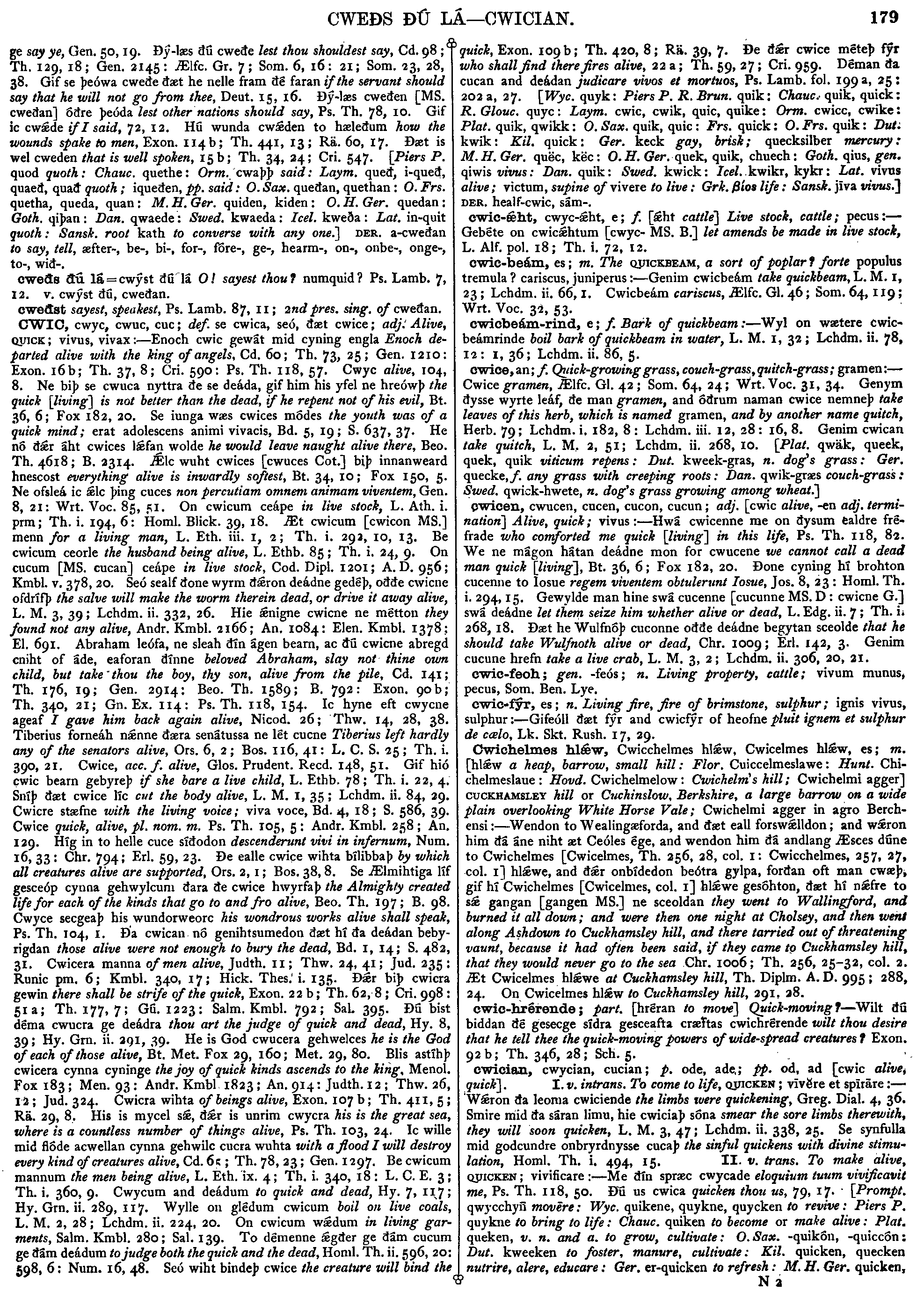
CWIC,
cwyc,
cwuc,
cuc;
def.
se
cwica,
seó,
ðæt
cwice;
adj.
Alive,
QUICK;
vivus,
vivax
:--
Enoch
cwic
gewát
mid
cyning
engla
Enoch
departed
alive
with
the
king
of
angels,
Cd.
60;
Th.
73,
25;
Gen.
1210:
Exon.
16b;
Th.
37,
8;
Cri.
590:
Ps.
Th.
118,
57.
Cwyc
alive,
104,
8.
Ne
biþ
se
cwuca
nyttra
ðe
se
deáda,
gif
him
his
yfel
ne
hreówþ
the
quick
[living]
is
not
better
than
the
dead,
if
he
repent
not
of
his
evil,
Bt.
36,
6;
Fox
182,
20.
Se
iunga
wæs
cwices
módes
the
youth
was
of
a
quick
mind;
erat
adolescens
animi
vivacis,
Bd.
5,
19;
S.
637,
37.
He
nó
ðr
áht
cwices
lfan
wolde
he
would
leave
naught
alive
there,
Beo.
Th.
4618;
B.
2314.
Æ-acute;lc
wuht
cwices
[cwuces
Cot.]
biþ
innanweard
hnescost
everything
alive
is
inwardly
softest,
Bt.
34,
10;
Fox
150,
5.
Ne
ofsleá
ic
lc
þing
cuces
non
percutiam
omnem
animam
viventem,
Gen.
8,
21:
Wrt.
Voc.
85,
51.
On
cwicum
ceápe
in
live
stock,
L.
Ath.
i.
prm;
Th.
i.
194,
6:
Homl.
Blick.
39,
18.
Æt
cwicum
[cwicon
MS.]
menn
for
a
living
man,
L.
Eth.
iii.
1,
2;
Th.
i.
292,
10,
13.
Be
cwicum
ceorle
the
husband
being
alive,
L.
Ethb.
85;
Th.
i.
24,
9.
On
cucum
[MS.
cucan]
ceápe
in
live
stock,
Cod.
Dipl.
1201;
A.
D.
956;
Kmbl.
v.
378,
20.
Seó
sealf
ðone
wyrm
ðron
deádne
gedéþ,
oððe
cwicne
ofdrífþ
the
salve
will
make
the
worm
therein
dead,
or
drive
it
away
alive,
L.
M.
3,
39;
Lchdm.
ii.
332,
26.
Hie
nigne
cwicne
ne
métton
they
found
not
any
alive,
Andr.
Kmbl.
2166;
An.
1084:
Elen.
Kmbl.
1378;
El.
691.
Abraham
leófa,
ne
sleah
ðín
ágen
bearn,
ac
ðú
cwicne
abregd
cniht
of
áde,
eaforan
ðínne
beloved
Abraham,
slay
not
thine
own
child,
but
take
thou
the
boy,
thy
son,
alive
from
the
pile,
Cd.
141;
Th.
176,
19;
Gen.
2914:
Beo.
Th.
1589;
B.
792:
Exon.
90b;
Th.
340,
21;
Gn.
Ex.
114:
Ps.
Th.
118,
154.
Ic
hyne
eft
cwycne
ageaf
I
gave
him
back
again
alive,
Nicod.
26;
Thw.
14,
28,
38.
Tiberius
forneáh
nnne
ðæra
senátussa
ne
lét
cucne
Tiberius
left
hardly
any
of
the
senators
alive,
Ors.
6,
2;
Bos.
116,
41:
L.
C.
S.
25;
Th.
i.
390,
21.
Cwice,
acc.
f.
alive,
Glos.
Prudent.
Recd.
148,
51.
Gif
hió
cwic
bearn
gebyreþ
if
she
bare
a
live
child,
L.
Ethb.
78;
Th.
i.
22,
4.
Sníþ
ðæt
cwice
líc
cut
the
body
alive,
L.
M.
1,
35;
Lchdm.
ii.
84,
29.
Cwicre
stæfne
with
the
living
voice;
viva
voce,
Bd.
4,
18;
S.
586,
39.
Cwice
quick,
alive,
pl.
nom.
m.
Ps.
Th.
105,
5:
Andr.
Kmbl.
258;
An.
129.
Híg
in
to
helle
cuce
síðodon
descenderunt
vivi
in
infernum,
Num.
16,
33:
Chr.
794;
Erl.
59,
23.
Ðe
ealle
cwice
wihta
bílibbaþ
by
which
all
creatures
alive
are
supported,
Ors.
2,
1;
Bos.
38,
8.
Se
Ælmihtiga
líf
gesceóp
cynna
gehwylcum
ðara
ðe
cwice
hwyrfaþ
the
Almighty
created
life
for
each
of
the
kinds
that
go
to
and
fro
alive,
Beo.
Th.
197;
B.
98.
Cwyce
secgeaþ
his
wundorweorc
his
wondrous
works
alive
shall
speak,
Ps.
Th.
104,
1.
Ða
cwican
nó
genihtsumedon
ðæt
hí
ða
deádan
bebyrigdan
those
alive
were
not
enough
to
bury
the
dead,
Bd.
1,
14;
S.
482,
31.
Cwicera
manna
of
men
alive,
Judth.
11;
Thw.
24,
41;
Jud.
235:
Runic
pm.
6;
Kmbl.
340,
17;
Hick.
Thes.
i.
135.
Ðr
biþ
cwicra
gewin
there
shall
be
strife
of
the
quick,
Exon.
22b;
Th.
62,
8;
Cri.
998:
51a;
Th.
177,
7;
Gú
1223:
Salm.
Kmbl.
792;
Sal.
395.
Ðú
bist
déma
cwucra
ge
deádra
thow
art
the
judge
of
quick
and
dead,
Hy.
8,
39;
Hy.
Grn.
ii.
291,
39.
He
is
God
cwucera
gehwelces
he
is
the
God
of
each
of
those
alive,
Bt.
Met.
Fox
29,
160;
Met.
29,
80.
Blis
astíhþ
cwicera
cynna
cyninge
the
joy
of
quick
kinds
ascends
to
the
king,
Menol.
Fox
183;
Men.
93:
Andr.
Kmbl
1823;
An.
914:
Judth.
12;
Thw.
26,
12;
Jud.
324.
Cwicra
wihta
of
beings
alive,
Exon.
107b;
Th.
411,
5;
Rä.
29,
8.
His
is
mycel
s,
ðr
is
unrim
cwycra
his
is
the
great
sea,
where
is
a
countless
number
of
things
alive,
Ps.
Th.
103,
24.
Ic
wille
mid
flóde
acwellan
cynna
gehwilc
cucra
wuhta
with
a
flood
I
will
destroy
every
kind
of
creatures
alive,
Cd.
65;
Th.
78,
23;
Gen.
1297.
Be
cwicum
mannum
the
men
being
alive,
L.
Eth.
ix.
4;
Th.
i.
340,
18:
L.
C.
E.
3;
Th.
i.
360,
9.
Cwycum
and
deádum
to
quick
and
dead,
Hy.
7,
117;
Hy.
Grn.
ii.
289,
117.
Wylle
on
glédum
cwicum
boil
on
live
coals,
L.
M.
2,
28;
Lchdm.
ii.
224,
20.
On
cwicum
wdum
in
living
garments,
Salm.
Kmbl.
280;
Sal.
139.
To
démenne
gðer
ge
ðám
cucum
ge
ðám
deádum
to
judge
both
the
quick
and
the
dead,
Homl.
Th.
ii.
596,
20:
598,
6:
Num.
16,
48.
Seó
wiht
bindeþ
cwice
the
creature
will
bind
the
quick,
Exon.
109b;
Th.
420,
8;
Rä.
39,
7.
Ðe
ðr
cwice
méteþ
fýr
who
shall
find
there
fires
alive,
22a;
Th.
59,
27;
Cri.
959.
Déman
ða
cucan
and
deádan
judicare
vivos
et
mortuos,
Ps.
Lamb.
fol.
199a.
25:
202a,
27.
[Wyc.
quyk:
Piers
P.
R.
Brun.
quik:
Chauc.
quik,
quick:
R.
Glouc.
quyc:
Laym.
cwic,
cwik,
quic,
quike:
Orm.
cwicc,
cwike:
Plat.
quik,
qwikk:
O.
Sax.
quik,
quic:
Frs.
quick:
O.
Frs.
quik:
Dut.
kwik:
Kil.
quick:
Ger.
keck
gay,
brisk;
quecksilber
mercury:
M.
H.
Ger.
quëc,
këc:
O.
H.
Ger.
quek,
quik,
chuech:
Goth.
qius,
gen.
qiwis
vivus:
Dan.
quik:
Swed.
kwick:
Icel.
kwikr,
kykr:
Lat.
vivus
alive;
victum,
supine
of
vivere
to
live:
Grk.


 life:
Sansk.
jiva
vivus.]
DER.
healf-cwic,
sám-.
life:
Sansk.
jiva
vivus.]
DER.
healf-cwic,
sám-.
|
Source: Bosworth/Toller, page b0179, entry 14 View original page image as: [TIFF] [PNG] [View previous entry] [View next entry] |
[Comment on this entry] [View comments] |
The following entry has been hand-corrected once. |
cwician,
cwycian,
cucian;
p.
ode,
ade;
pp.
od,
ad
[cwic
alive,
quick].
I.
v.
intrans.
To
come
to
life,
QUICKEN;
v vre
et
spr
vre
et
spr re
:--
Wron
ða
leoma
cwiciende
the
limbs
were
quickening,
Greg.
Dial.
4,
36.
Smire
mid
ða
sáran
limu,
hie
cwiciaþ
sóna
smear
the
sore
limbs
therewith,
they
will
soon
quicken,
L.
M.
3,
47;
Lchdm.
ii.
338,
25.
Se
synfulla
mid
godcundre
onbryrdnysse
cucaþ
the
sinful
quickens
with
divine
stimulation,
Homl.
Th.
i.
494,
15.
II.
v.
trans.
To
make
alive,
OUICKEN;
vivificare
:--
Me
ðín
spræc
cwycade
eloquium
tuum
vivificavit
me.
Ps.
Th.
118,
50.
Ðú
us
cwica
quicken
thou
us,
79,
17.
[Prompt.
qwycchy&n-long;
mov
re
:--
Wron
ða
leoma
cwiciende
the
limbs
were
quickening,
Greg.
Dial.
4,
36.
Smire
mid
ða
sáran
limu,
hie
cwiciaþ
sóna
smear
the
sore
limbs
therewith,
they
will
soon
quicken,
L.
M.
3,
47;
Lchdm.
ii.
338,
25.
Se
synfulla
mid
godcundre
onbryrdnysse
cucaþ
the
sinful
quickens
with
divine
stimulation,
Homl.
Th.
i.
494,
15.
II.
v.
trans.
To
make
alive,
OUICKEN;
vivificare
:--
Me
ðín
spræc
cwycade
eloquium
tuum
vivificavit
me.
Ps.
Th.
118,
50.
Ðú
us
cwica
quicken
thou
us,
79,
17.
[Prompt.
qwycchy&n-long;
mov re:
Wyc.
quikene,
quykne,
quycken
to
revive:
Piers
P.
quykne
to
bring
to
life:
Chauc.
quiken
to
become
or
make
alive:
Plat.
queken,
v.
n.
and
a.
to
grow,
cultivate:
O.
Sax.
-quikón,
-quiccón:
Dut.
kweeken
to
foster,
manure,
cultivate:
Kil.
quicken,
quecken
nutrire,
alere,
educare:
Ger.
er-quicken
to
refresh:
M.
H.
Ger.
quicken,
re:
Wyc.
quikene,
quykne,
quycken
to
revive:
Piers
P.
quykne
to
bring
to
life:
Chauc.
quiken
to
become
or
make
alive:
Plat.
queken,
v.
n.
and
a.
to
grow,
cultivate:
O.
Sax.
-quikón,
-quiccón:
Dut.
kweeken
to
foster,
manure,
cultivate:
Kil.
quicken,
quecken
nutrire,
alere,
educare:
Ger.
er-quicken
to
refresh:
M.
H.
Ger.
quicken,
|
Source: Bosworth/Toller, page b0183, entry 11 View original page image as: [TIFF] [PNG] [View previous entry] [View next entry] |
[Comment on this entry] [View comments] |
The following entry has been hand-corrected once. |
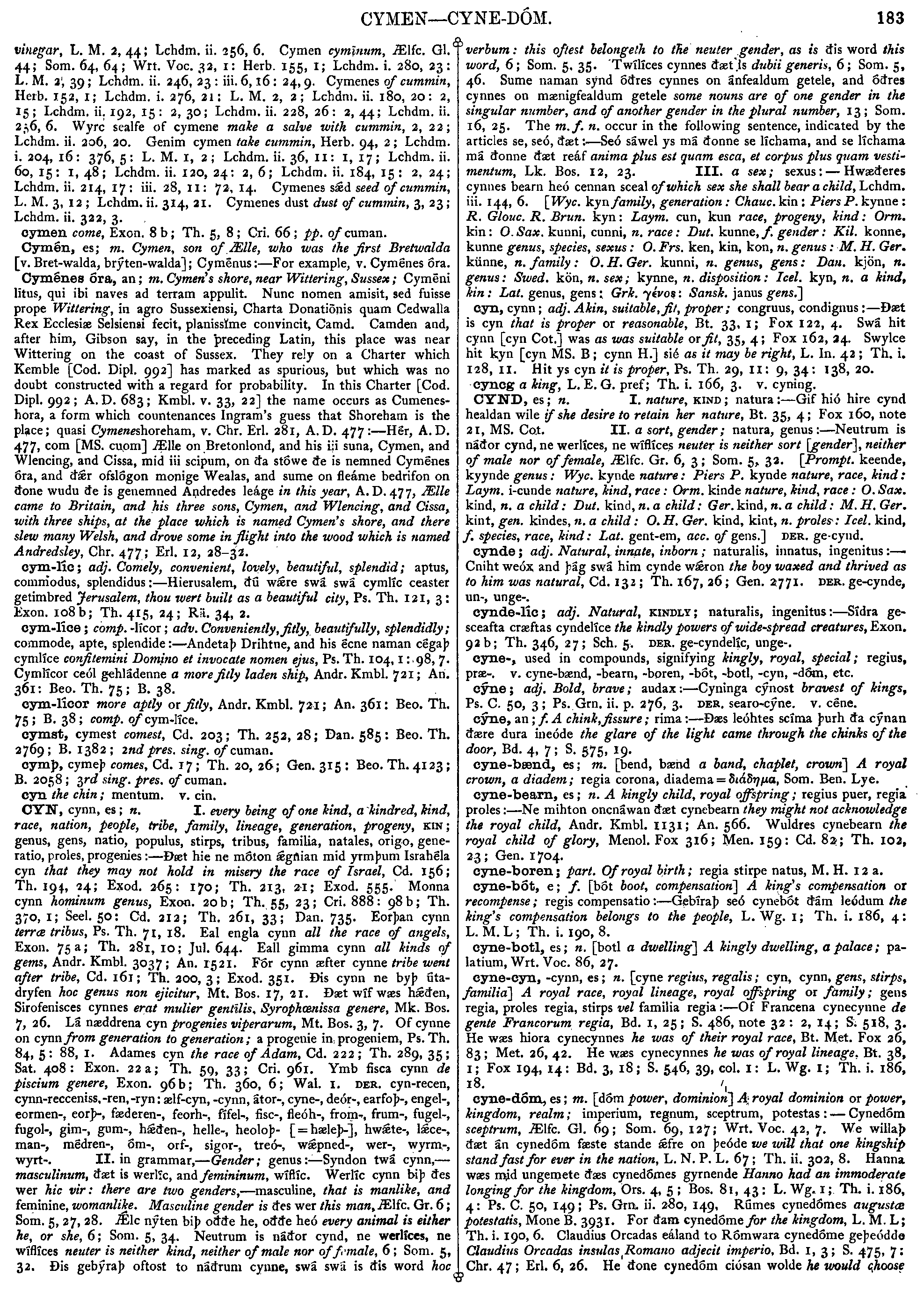
CYN,
cynn,
es;
n.
I.
every
being
of
one
kind,
a
kindred,
kind,
race,
nation,
people,
tribe,
family,
lineage,
generation,
progeny,
KIN;
genus,
gens,
natio,
populus,
stirps,
tribus,
familia,
natales,
origo,
generatio,
proles,
progenies
:--
Ðæt
hie
ne
móton
gnian
mid
yrmþum
Israhéla
cyn
that
they
may
not
hold
in
misery
the
race
of
Israel,
Cd.
156;
Th.
194,
24;
Exod.
265:
170;
Th.
213,
21;
Exod.
555.
Monna
cynn
hominum
genus,
Exon.
20b;
Th.
55,
23;
Cri.
888:
98b;
Th.
370,
1;
Seel.
50:
Cd.
212;
Th.
261,
33;
Dan.
735.
Eorþan
cynn
terræ
tribus,
Ps.
Th.
71,
18.
Eal
engla
cynn
all
the
race
of
angels,
Exon.
75a;
Th.
281,
10;
Jul.
644.
Eall
gimma
cynn
all
kinds
of
gems,
Andr.
Kmbl.
3037;
An.
1521.
Fór
cynn
æfter
cynne
tribe
went
after
tribe,
Cd.
161;
Th.
200,
3;
Exod.
351.
Ðis
cynn
ne
byþ
útadryfen
hoc
genus
non
ejicitur,
Mt.
Bos.
17,
21.
Ðæt
wíf
wæs
hðen,
Sirofenisces
cynnes
erat
mulier
gentlis,
Syrophœnissa
UNCERTAIN
genere,
Mk.
Bos.
7,
26.
Lá
næddrena
cyn
progenies
viperarum,
Mt.
Bos.
3,
7.
Of
cynne
on
cynn
from
generation
to
generation;
a
progenie
in,
progeniem,
Ps.
Th.
84,
5:
88,
1.
Adames
cyn
the
race
of
Adam,
Cd.
222;
Th.
289,
35;
Sat.
408:
Exon.
22a;
Th.
59,
33;
Cri.
961.
Ymb
fisca
cynn
de
piscium
genere,
Exon.
96b;
Th.
360,
6;
Wal.
1.
DER.
cyn-recen,
cynn-recceniss,
-ren,
-ryn:
ælf-cyn,
-cynn,
átor-,
cyne-,
deór-,
earfoþ-,
engel-,
eormen-,
eorþ-,
fæderen-,
feorh-,
fífel-,
fisc-,
fleóh-,
from-,
frum-,
fugel-,
fugol-,
gim-,
gum-,
hðen-,
helle-,
heoloþ-
[
=
hæleþ-],
hwte-,
lce-,
man-,
médren-,
óm-,
orf-,
sigor-,
treó-,
wpned-,
wer-,
wyrm-,
wyrt-.
II.
in
grammar,
--
Gender;
genus
:--
Syndon
twá
cynn,
--
masculinum,
ðæt
is
werlíc,
and
femininum,
wíflíc.
Werlíc
cynn
biþ
ðes
wer
hic
vir:
there
are
two
genders,
--
masculine,
that
is
manlike,
and
feminine,
womanlike.
Masculine
gender
is
ðes
wer
this
man,
Ælfc.
Gr.
6;
Som.
5,
27,
28.
Æ-acute;lc
nýten
biþ
oððe
he,
oððe
heó
every
animal
is
either
he,
or
she,
6;
Som.
5,
34.
Neutrum
is
náðor
cynd,
ne
werlíces,
ne
wíflíces
neuter
is
neither
kind,
neither
of
male
nor
of
female,
6;
Som.
5,
32.
Ðis
gebýraþ
oftost
to
náðrum
cynne,
swá
swá
is
ðis
word
hoc
verbum:
this
oftest
belongeth
to
the
neuter
gender,
as
is
ðis
word
this
word,
6;
Som.
5.
35.
Twílíces
cynnes
ðæt
Is
ILLEGIBLE
dubii
generis,
6;
Som.
5,
46.
Sume
naman
synd
óðres
cynnes
on
ánfealdum
getele,
and
óðres
cynnes
on
mænigfealdum
getele
some
nouns
are
of
one
gender
in
the
singular
number,
and
of
another
gender
in
the
plural
number,
13;
Som.
16,
25.
The
m.
f.
n.
occur
in
the
following
sentence,
indicated
by
the
articles
se,
seó,
ðæt
:--
Seó
sáwel
ys
má
ðonne
se
líchama,
and
se
líchama
má
ðonne
ðæt
reáf
anima
plus
est
guam
esca,
et
corpus
plus
quam
vestimentum,
Lk.
Bos.
12,
23.
III.
a
sex;
sexus
:--
Hwæðeres
cynnes
bearn
heó
cennan
sceal
of
which
sex
she
shall
bear
a
child,
Lchdm.
iii.
144,
6.
[Wyc.
kyn
family,
generation:
Chauc.
kin:
Piers
P.
kynne:
R.
Glouc.
R.
Brun.
kyn:
Laym.
cun,
kun
race,
progeny,
kind:
Orm.
kin:
O.
Sax.
kunni,
cunni,
n.
race:
Dut.
kunne,
f.
gender:
Kil.
konne,
kunne
genus,
species,
sexus:
O.
Frs.
ken,
kin,
kon,
n.
genus:
M.
H.
Ger.
künne,
n.
family:
O.
H.
Ger.
kunni,
n.
genus,
gens:
Dan.
kjön,
n.
genus:
Swed.
kön,
n.
sex;
kynne,
n.
disposition:
Icel.
kyn,
n.
a
kind,
kin:
Lat.
genus,
gens;
Grk.
GREEK
:
Sansk.
janus
gens.]
|
Source: Bosworth/Toller, page b0187, entry 2 View original page image as: [TIFF] [PNG] [View previous entry] [View next entry] |
[Comment on this entry] [View comments (1)] |
The following entry has been hand-corrected once. |
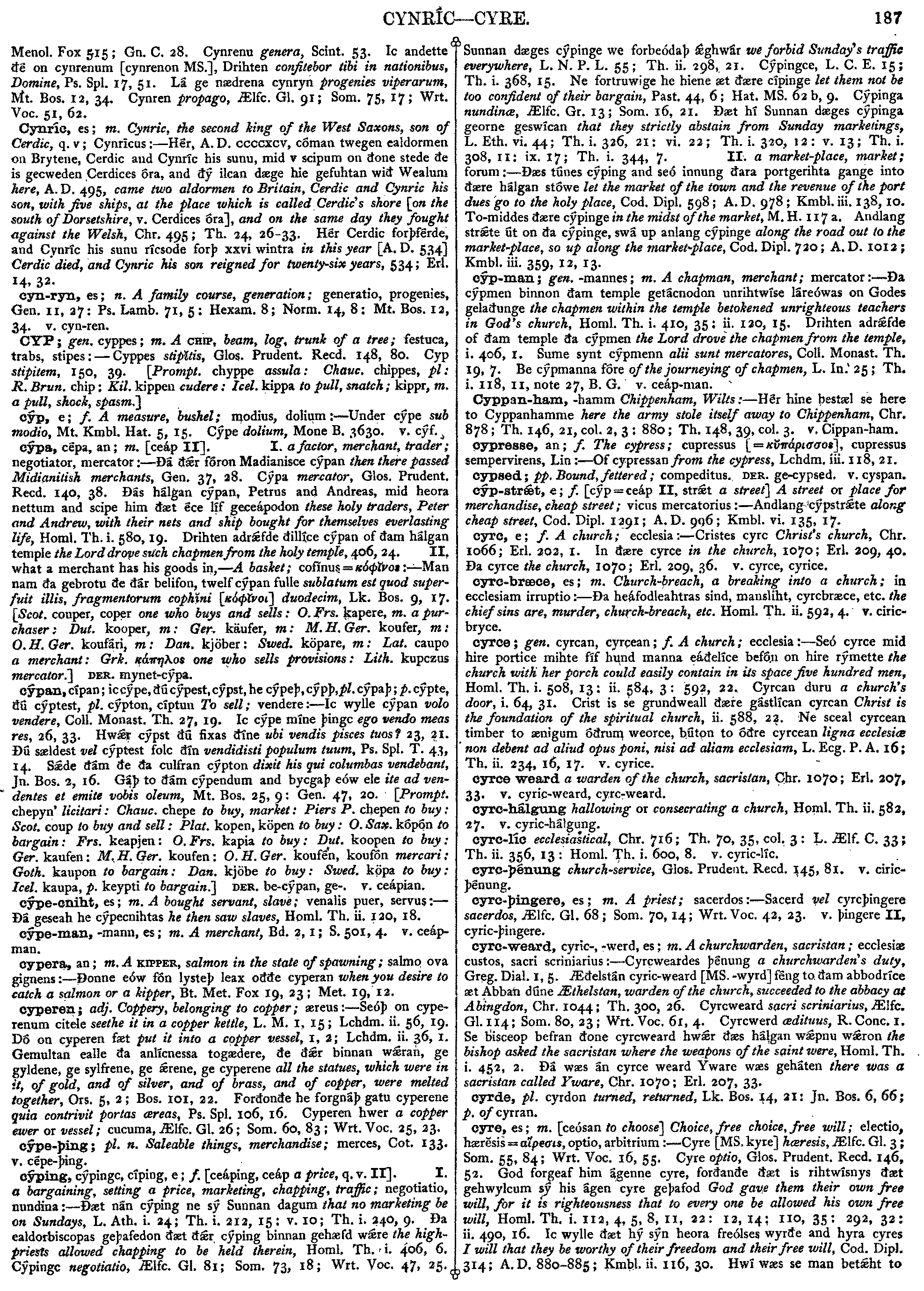
Cynríc,
es;
m.
Cynric,
the
second
king
of
the
West
Saxons,
son
of
Cerdic,
q.
v;
Cynrcus
:--
Hér,
A.
D.
ccccxcv,
cóman
twegen
ealdormen
on
Brytene,
Cerdic
and
Cynríc
his
sunu,
mid
v
scipum
on
ðone
stede
ðe
is
gecweden
Cerdices
óra,
and
ðý
ilcan
dæge
hie
gefuhtan
wið
Wealum
here,
A.
D.
495,
come
two
aldormen
to
Britain,
Cerdic
and
Cynric
his
son,
with
five
ships,
at
the
place
which
is
called
Cerdic's
shore
[on
the
south
of
Dorsetshire,
v.
Cerdices
óra],
and
on
the
same
day
they
fought
against
the
Welsh,
Chr.
495;
Th.
24,
26-33.
Hér
Cerdic
forþférde,
and
Cynríc
his
sunu
rícsode
forþ
xxvi
wintra
in
this
year
[A.
D.
534]
Cerdic
died,
and
Cynric
his
son
reigned
for
twenty-six
years,
534;
Erl.
14.
32.
|
Source: Bosworth/Toller, page b0189, entry 9 View original page image as: [TIFF] [PNG] [View previous entry] [View next entry] |
[Comment on this entry] [View comments] |
The following entry has been hand-corrected once. |
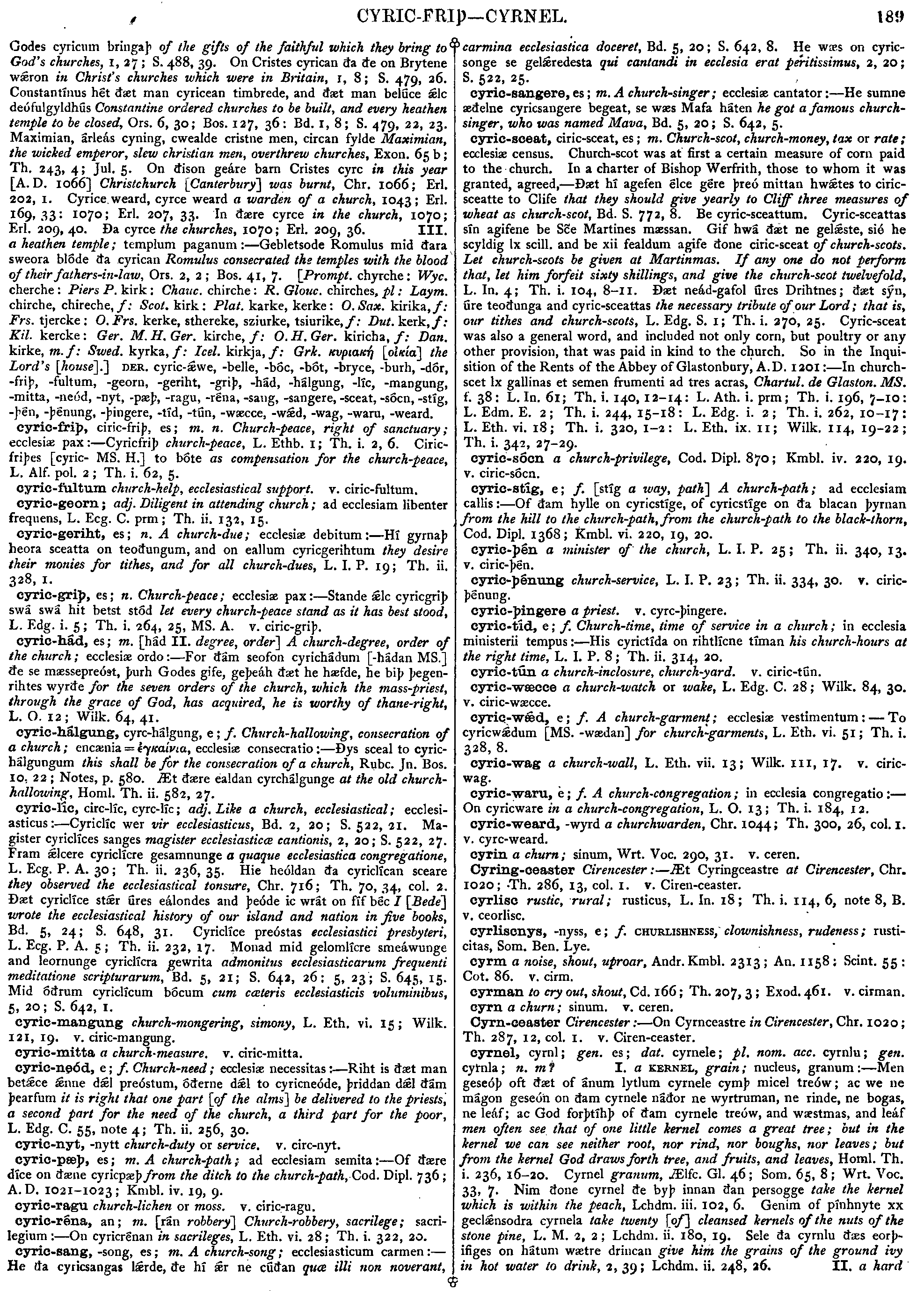
cyric-líc,
circ-líc,
cyrc-líc;
adj.
Like
a
church,
ecclesiastical;
ecclesiasticus
:--
Cyriclíc
wer
vir
ecclesiasticus,
Bd.
2,
20;
S.
522,
21.
Magister
cyriclíces
sanges
magister
ecclesiasticæ
cantionis,
2,
20;
S.
522,
27.
Fram
lcere
cyriclícre
gesamnunge
a
quaque
ecclesiastica
congregatione,
L.
Ecg.
P.
A.
30;
Th.
ii.
236,
35.
Hie
heóldan
ða
cyriclícan
sceare
they
observed
the
ecclesiastical
tonsure,
Chr.
716;
Th.
70,
34,
col.
2.
Ðæt
cyriclíce
str
úres
eálondes
and
þeóde
ic
wrát
on
fíf
béc
I
[Bede]
wrote
the
ecclesiastical
history
of
our
island
and
nation
in
five
books,
Bd.
5,
24;
S.
648,
31.
Cyriclíce
preóstas
ecclesiasíici
presbyteri,
L.
Ecg.
P.
A.
5;
Th.
ii.
232,
17.
Monad
mid
gelomlícre
smeáwunge
and
leornunge
cyriclícra
gewrita
admonitus
ecclesiasticarum
frequenti
meditatione
scripturarum,
Bd.
5,
21;
S.
642,
26:
5,
23;
S.
645,
15.
Mid
óðrum
cyriclícum
bócum
cum
cæteris
ecclesiasticis
voluminibus,
5,
20;
S.
642,
1.
|
Source: Bosworth/Toller, page b0190, entry 21 View original page image as: [TIFF] [PNG] [View previous entry] [View next entry] |
[Comment on this entry] [View comments] |
The following entry has been hand-corrected once. |
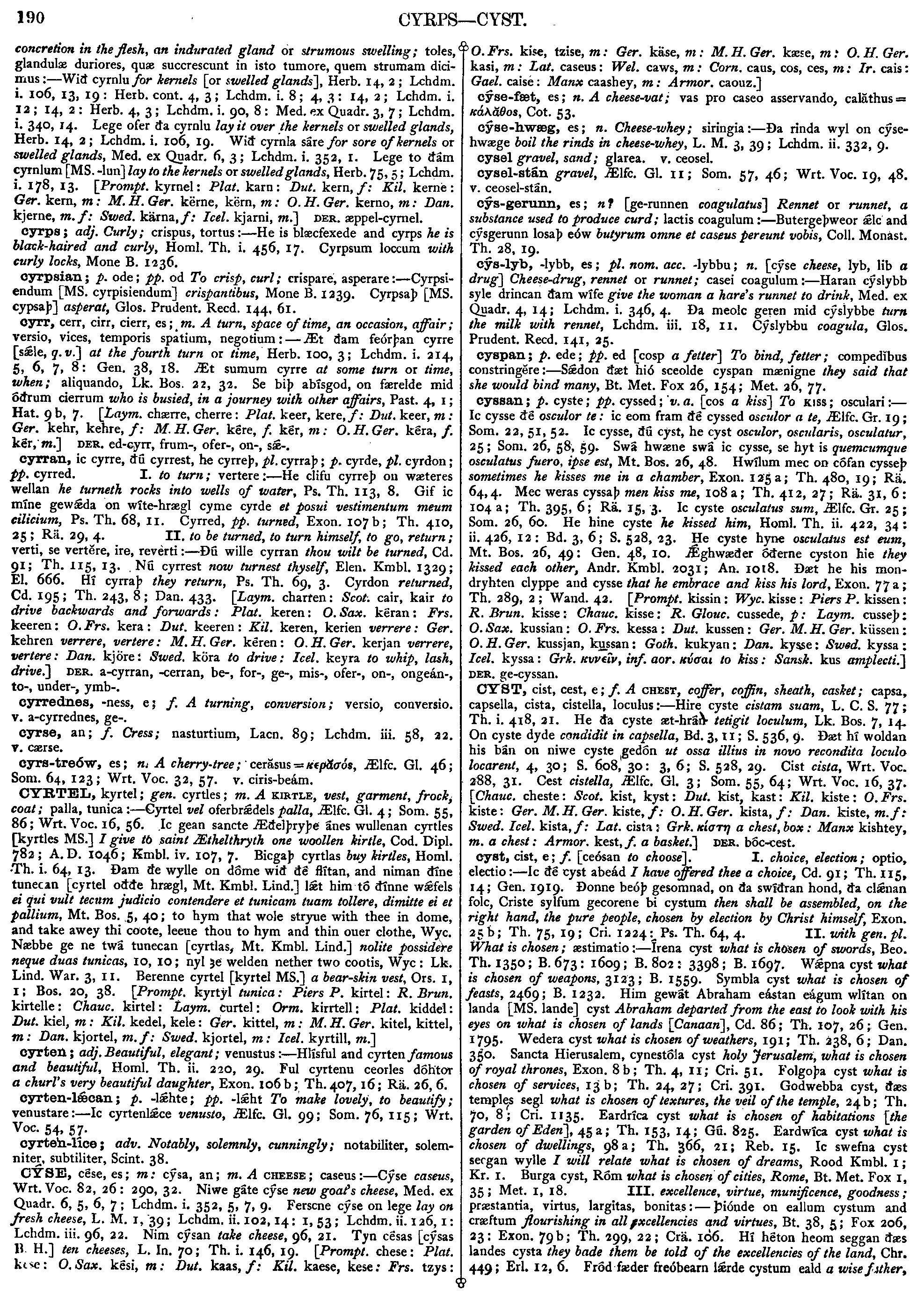
cyssan; p. cyste; pp. cyssed; v. a. [cos a kiss] To KISS; osculari :-- Ic cysse ðé oscular te: ic eom fram ðé cyssed oscular a te, Ælfc. Gr. 19; Som. 22, 51, 52, Ic cysse, ðú cyst, he cyst osculor, oscularis, osculatur, 25; Som. 26, 58, 59. Swá hwæne swá ic cysse, se hyt is quemcumque osculatus fuero, ipse est, Mt. Bos. 26, 48. Hwílum mec on cófan cysseþ sometimes he kisses me in a chamber, Exon. 125a; Th. 480, 19; Rä. 64, 4. Mec weras cyssaþ men kiss me, 108a; Th. 412, 27; Rä. 31, 6: 104a; Th. 395, 6; Rä. 15, 3. Ic cyste osculatus sum, Ælfc. Gr. 25; Som. 26, 60. He hire cyste he kissed him, Homl. Th. ii. 422, 34: ii. 426, 12: Bd. 3, 6; S. 528, 23. He cyste hyne osculatus est eum, Mt. Bos. 26, 49: Gen. 48, 10. Æ-acute;ghwæder óðerne cyston hie they kissed each other, Andr. Kmbl. 2031; An. 1018. Ðæt he his mondryhten clyppe and cysse that he embrace and kiss his lord, Exon. 77a; Th. 289, 2; Wand. 42. [Prompt. kissin: Wyc. kisse: Piers P. kissen: R. Brun. kisse: Chauc. kisse: R. Glouc. cussede, p: Laym. cusseþ: O. Sax. kussian: O. Frs. kessa: Dut. kussen: Ger. M. H. Ger. küssen: O. H. Ger. kussjan, kussan: Goth. kukyan: Dan. kysse: Swed. kyssa: Icel. kyssa: Grk. GREEK , inf. aor. GREEK to kiss: Sansk. kus amplecti.] DER. ge-cyssan.
| Result Page: |  |
Previous | 1 2 3 4 5 6 7 8 9 10 11 12 13 14 15 16 17 18 19 | Next |  |
Germanic Lexicon Project (main page)
This search system was written by
Sean Crist
Please consider
volunteering
to correct the data in these online dictionaries.
No rights reserved. Feel free to use these data in any way you please.