|
|

Search for Hat again, using less strict matching (530 results)
|
Source: Cleasby/Vigfusson, page b0105, entry 13 View original page image as: [TIFF] [PNG] [View previous entry] [View next entry] |
[Comment on this entry] [View comments] |
The following entry has not been hand-corrected. However, the page is reserved and someone is correcting it. |
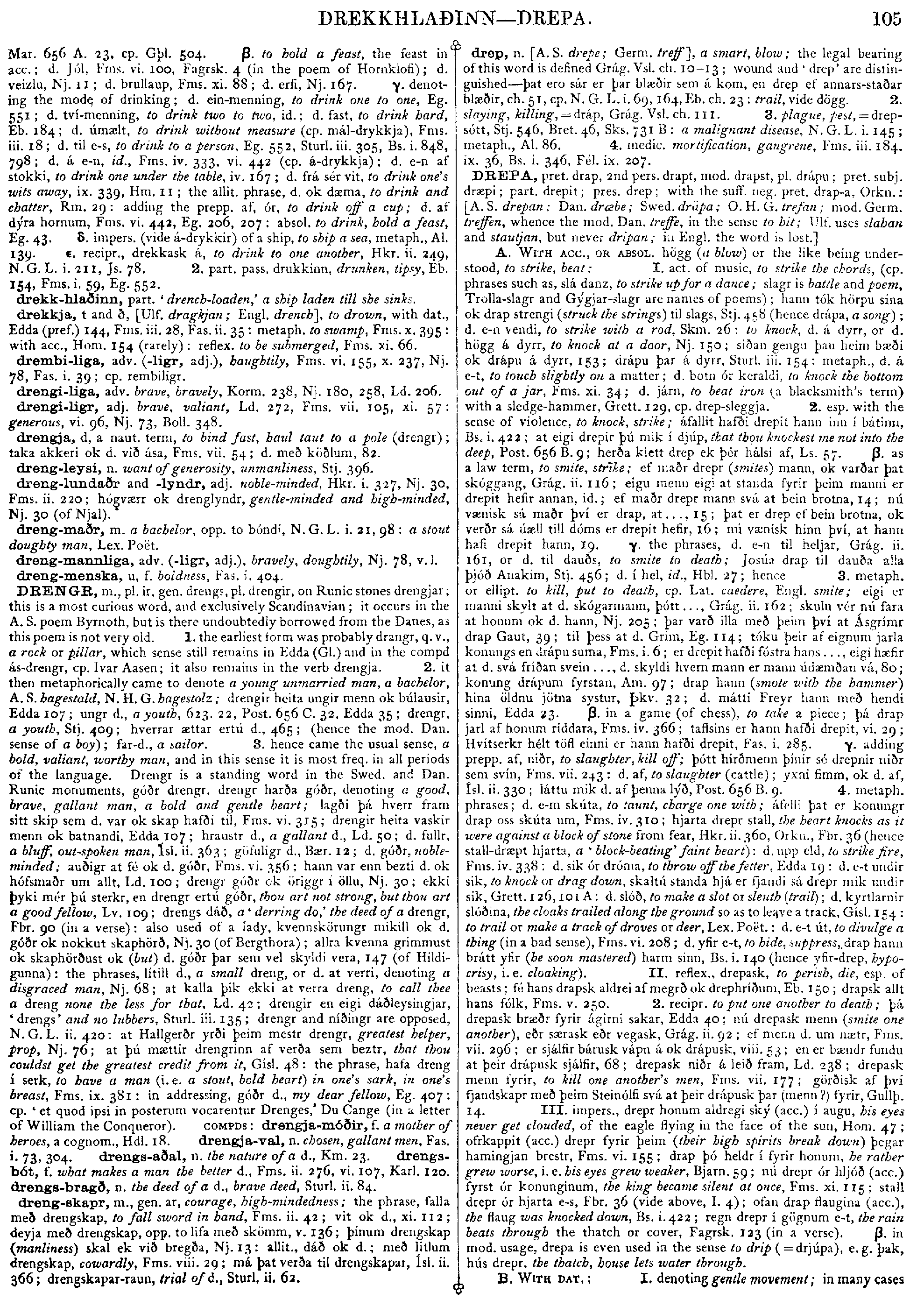
DRENGR, m., pl. ir, gen. drengs, pl. drengir, on Runic stones drengjar; this is a most curious word, and exclusively Scandinavian; it occurs in the A. S. poem Byrnoth, but is there undoubtedly borrowed from the Danes, as this poem is not very old. 1. the earliest form was probably drarigr, q. v., a rock or pjllar, which sense still remains in Edda (Gl.) and in the compd as-drengr, cp. Ivar Aasen; it also remains in the verb drengja. 2. it then metaphorically came to denote a young unmarried man, a bachelor, A. S. hagestald, N. H. G. hagestolz; drengir heita ungir menn ok búlausir, Edda 107; ungr d., a youth, 623. 22, Post. 656 C. 32, Edda 35; drengr, a youth, Stj. 409; hverrar ættar ertú d., 465; (hence the mod. Dan. sense of a boy); far-d., a sailor. 3. hence came the usual sense, a bold, valiant, worthy man, and in this sense it is most freq. in all periods of the language. Drengr is a standing word in the Swed. and Dan. Runic monuments, góðr drengr, drengr harða góðr, denoting c. good, brave, gallant man, a bold and gentle heart; lagði þá hverr fram sitt skip sem d. var ok skap hafði til, Fms. vi. 315; drengir heita vaskir menn ok batnandi, Edda 107; hraustr d., a gallant d., Ld. 50; d. fullr, a bluff, out-spoken man, Ísl. ii. 363; göfuligr d., Bær. 12; d. góðr, noble- minded; auðigr at fé ok d. góðr, Fms. vi. 356; hann var enn bezti d. ok hófsmaðr um allt, Ld. loo; drengr góðr ok öriggr í öllu, Nj. 30; ekki þyki mér þú sterkr, en drengr ertú góðr, thou art not strong, but tbou art a good fellow, Lv. 109; drengs dáð, a ' derring do, ' the deed of a drengr, Fbr. 90 (in a verse): also used of a lady, kvennskörungr mikill ok d. góðr ok nokkut skaphörð, Nj. 30 (of Bergthora); allra kvenna grimmust ok skaphörðust ok (but) d. góðr þar sem vel sk)'ldi vera, 147 (of Hildi- gunna): the phrases, litill d., a s mall dreng, or d. at verri, denoting a disgraced man, Nj. 68; at kalla þik ekki at verra dreng, to call thee a dreng none the le ss for that, Ld. 42; drengir en eigi dáðleysingjar, ' drengs' and no lubbers, Sturl. iii. 135; drengr and níðingr are opposed, N. G. L. ii. 420: at Hallgerðr yrði þeim mestr drengr, greatest helper, prop, Nj. 76; at þú mættir drengrinn af verða sem beztr, that thou couldst get the greatest credit from it, Gísl. 48: the phrase, hafa dreng i serk, to have a man (i. e. a stout, bold heart) in one's sark, in one's breast, Fms. ix. 381: in addressing, góðr d., my dear fellow, Eg. 407: cp. ' et quod ipsi in posterurn vocarentur Drenges, ' Du Cange (in a letter of William the Conqueror). COMPDS: drengja-móðir, f. a mother of heroes, a cognom., Hdl. 18. drengja-val, n. chosen, gallant men, Fas. i. 73, 304. drengs-aðal, n. the nature of a d., Km. 23. drengs- bót, f. w hat make s a man the better d., Fms. ii. 276, vi. 107, Karl. 120. drengs-bragð, n. the deed of a d., brave deed, Sturl. ii. 84.
|
Source: Cleasby/Vigfusson, page b0241, entry 3 View original page image as: [TIFF] [PNG] [View previous entry] [View next entry] |
[Comment on this entry] [View comments] |
The following entry has been hand-corrected once. |
hatr, n. [Ulf. hatis = GREEK; A. S. hete; Engl. hate; Germ. hass; Dan. had; Swed. hat] :-- hatred, spite, aversion, Hm. 154, Post. 645. 64, Magn. 470, Stj. 192, Fms. viii. 26, xi. 437, passim; mann-hatr, misanthropy; trúar-hatr, religious fanaticism; þjóð-hatr, (mod.) COMPDS: hatrs-fullr, adj. hateful, Skálda 199. hatrs-sök, f. cause of hatred, Stj. 192.
|
Source: Cleasby/Vigfusson, page b0241, entry 11 View original page image as: [TIFF] [PNG] [View previous entry] [View next entry] |
[Comment on this entry] [View comments] |
The following entry has been hand-corrected once. |
HATTR, m. a hat, Nj. 32, Fms. i. 74, Eg. 407; vide höttr.
|
Source: Cleasby/Vigfusson, page b0263, entry 2 View original page image as: [TIFF] [PNG] [View previous entry] [View next entry] |
[Comment on this entry] [View comments] |
The following entry has been hand-corrected once. |
B. When there was no adjective the article became a suffix to the noun (see Gramm. pp. xix, xx), a usage common even in early prose, but extremely rare in poetry; the reason is, not that the poems were composed before the suffixed article had come into use, but that the metres themselves in which all the old poems were composed are older than that usage, and are not well adapted to it, so that the absence of the article became traditional. The old poem Harbarðsljóð makes an exception, no doubt not from being later than all other poems, but from being composed in a peculiar metre, half verse and half prose; thus in that single poem alone there are nearly twenty instances, or about twice or thrice as many as in all the other poems together :-- váginn, Hbl. 2, 13, 15; sundit, 1, 3, 8, 13; verðinum, 4; eikjunni, 7; skipit, id.; stöðna, landit, id.; leiðina, 55; höfuðit, 15; bátinum, 53; veggsins, stokksins, steinsins, 56; matrinn, 3: other solitary instances are, goðin öll, Vsp. 27 (prob. somewhat corrupt); eiki-köstinn, Gh. 20; vömmin vár, Ls. 52. II. in prose, old and modern, the suffixed article occurs at every step; only one or two instances are worth noticing as peculiar to the Icelandic: 1. as vocative in addressing; konan, O woman! mjöðnannan, id., Sighvat (in a verse of A.D. 1018, and so in mod. usage); elskan! hjartað! heillin! ástin, my love! dear! heart! þursinn! Fas. i. 385; hundarnir! = GREEK, Od. xxii. 35: also with another word, barnið gott, good child! Þrúðnaþussinn, thou monster giant! Miðgarðs-ormrinn! Fas. i. 373. 2. esp. if with a possessive adjective following, as in Gr. GREEK, etc.; elskan mín, ástin mín, hjartað mitt, góðrinn minn! hér er nú ástin mín, here is my darling! Sturl. ii. 78, of a father presenting a darling child to a friend; and so in mod. usage: as abuse, hundrinn þinn, thou dog! Ísl. ii. 176; þjófrinn þinn! Fms. vii. 127; dyðrillinn þinn! ii. 279; hundinum þínum! vi. 323: this use is not confined to the vocative, e.g. konan mín biðr að heilsa, my wife (kona mín is never used); maðrinn minn, my husband; biddu foreldrana þína (ask thy parents) að lofa þér að fara; augun hans, his eyes, Pass. 24. 4; hugrinn vor og hjartað sé, our mind and heart (cp. Gr. GREEK), 43. 5; svo hjartað bæði og málið mitt | mikli samhuga nafnið þitt, 10. 7; gef þú að móður-málið mitt, 35. 9; bókin mín, my favourite book, my own book; as also, fáðu mér hattinn minn, vetlingana mína, skóna mína, give me my hat, gloves, shoes; tungan í þér, augun í þér, thy tongue, thy eyes; höfuðið á mér, fætrnir á mér, my head, my feet; hendrnar á þér ('á mér, á þér' are here equivalent to a possessive, see p. 37, C. IV), thy hands, cp. Homer, GREEK; hestana þína, Gr. GREEK: similar is the instance, vömmin vár, the sins of ours, Ls. 52; this may be a remnant of a time when the article was used separately, even with an indefinite adjective. 3. a double article, one suffixed to the noun and the other prefixed to the word in apposition; hirðin sú in Danska, Fms. vi. 323; þau in stóru skipin, viii. 384 and passim: again, when a noun is put in the genitive after another noun the former has no article; as the Engl. phrase 'the fish of the sea and the fowl of the air' is in Icel. 'fiskar sjávarins og fuglar loptsins:' but this belongs to the syntax; see also Grimm's D. G. iv. 432.
|
Source: Cleasby/Vigfusson, page b0302, entry 7 View original page image as: [TIFF] [PNG] [View previous entry] [View next entry] |
[Comment on this entry] [View comments] |
The following entry has been hand-corrected once. |
HVÍ, prop, a dat. of an old and partly obsolete pron. hvat, [see hvat and hverr] :-- Lat. cui, for what: I. interrog., þá var séð yfir hví stafrinn hafði búit, 655 iii. 2; kviðr berr hví hann orkar, of what it is capable, Grág. i. 252; at hví neyt sé, w hat it is good for, ii. 260; þá spurði Hallr hví þat sætti, H. asked what was the matter, Fms. ii. 193; hvi saetir hark þetta ok hlaup ? Ó. H. 109; fyrir hví, wherefore ? (in vulgar Engl. still, for why?), fyrir hví biðr þú eigi lækningar? 222; spurði hann fyrir hví þeir væri þar? Eg. 375, Eluc. 4: with compar., hví verri, how much the worse, quanta pejor; skulu búar telja hví hann var þá verri at hafa er hann var sjúkr en þá er hann tók vistina, Grág. i. 155, 475. II. indef. any; Guð mun við hví (= hverju) faðerni ganga, er hann játar oss í skirninni, 655 i. 2. B. Adverb interrog., prop, ellipt. [cp. Goth, du hwe = GREEK ; A. S. hwi; Engl. why; Germ, wie] :-- why ? (see fyrir hví above); hví freistið mín ? Vsp. 22; hví þú einn sitr ? Skm. 3; hví sitið ? Gk. 2; hví þá, why then? Vþm. 9, Ls. 47 is dubious; hví þykkir dóttur minni svá íllt vestr þar? Nj. 11; hví skal eigi þegar drepa hann? Eg. 414; eigi veit ek hví þú gengr með slíku máli, 523; mun ek ákveðit gera hví þannig er til skipt, Ísl. ii. 346: hvi-ligr, adj. (q. v.), Fms. x. 107: hví-likr, adj. = Lat. qualis, (q. v.) 2. with subj.; hví um segjak þér? Skm. 4; hvi þú vitir? Vþm. 42; hví sé drengr at feigri? Km. 22. 3. = hve, instrumental, Skm. 17, (q.v.).
|
Source: Cleasby/Vigfusson, page b0312, entry 19 View original page image as: [TIFF] [PNG] [View previous entry] [View next entry] |
[Comment on this entry] [View comments] |
The following entry has been hand-corrected once. |
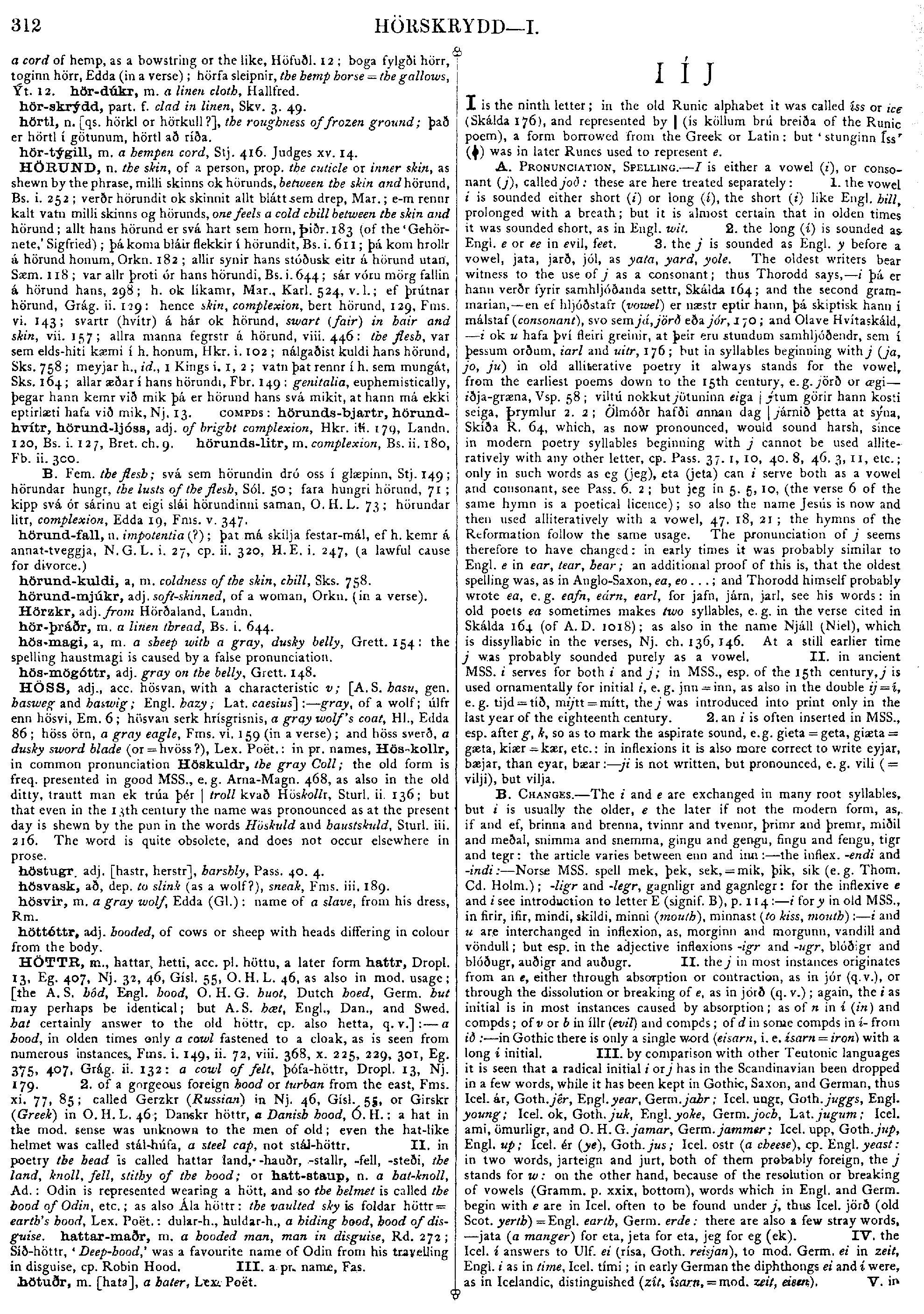
HÖTTR, m., hattar, hetti, acc. pl. höttu, a later form hattr, Dropl. 13, Eg. 407, Nj. 32, 46, Gísl. 55, O. H. L. 46, as also in mod. usage; [the A. S. hôd, Engl. hood, O. H. G. huot, Dutch hoed, Germ. hut may perhaps be identical; but A. S. hæt, Engl., Dan., and Swed. hat certainly answer to the old höttr, cp. also hetta, q.v.] :-- a hood, in olden times only a cowl fastened to a cloak, as is seen from numerous instances. Fms. i. 149, ii. 72, viii. 368, x. 225, 229, 301, Eg. 375, 407, Grág. ii. 132: a cowl of felt, þófa-höttr, Dropl. 13, Nj. 179. 2. of a gorgeous foreign hood or turban from the east, Fms. xi. 77, 85; called Gerzkr (Russian) in Nj. 46, Gísl. 55, or Girskr (Greek) in O. H. L. 46; Danskr höttr, a Danish hood, Ó. H.: a hat in the mod. sense was unknown to the men of old; even the hat-like helmet was called stál-húfa, a steel cap, not stál-höttr. II. in poetry the head is called hattar land, hauðr, -stallr, -fell, -steði, the land, knoll, fell, stithy of the hood; or hatt-staup, n. a hat-knoll, Ad.: Odin is represented wearing a hött, and so the helmet is called the hood of Odin, etc.; as also Ála höttr: the vaulted sky is foldar höttr = earth's hood, Lex. Poët.: dular-h., huldar-h., a hiding hood, hood of disguise. hattar-maðr, m. a hooded man, man in disguise, Rd. 272; Síð-höttr, 'Deep-hood,' was a favourite name of Odin from his travelling in disguise, cp. Robin Hood. III. a pr. name, Fas.
|
Source: Cleasby/Vigfusson, page b0325, entry 3 View original page image as: [TIFF] [PNG] [View previous entry] [View next entry] |
[Comment on this entry] [View comments] |
The following entry has been hand-corrected once. |
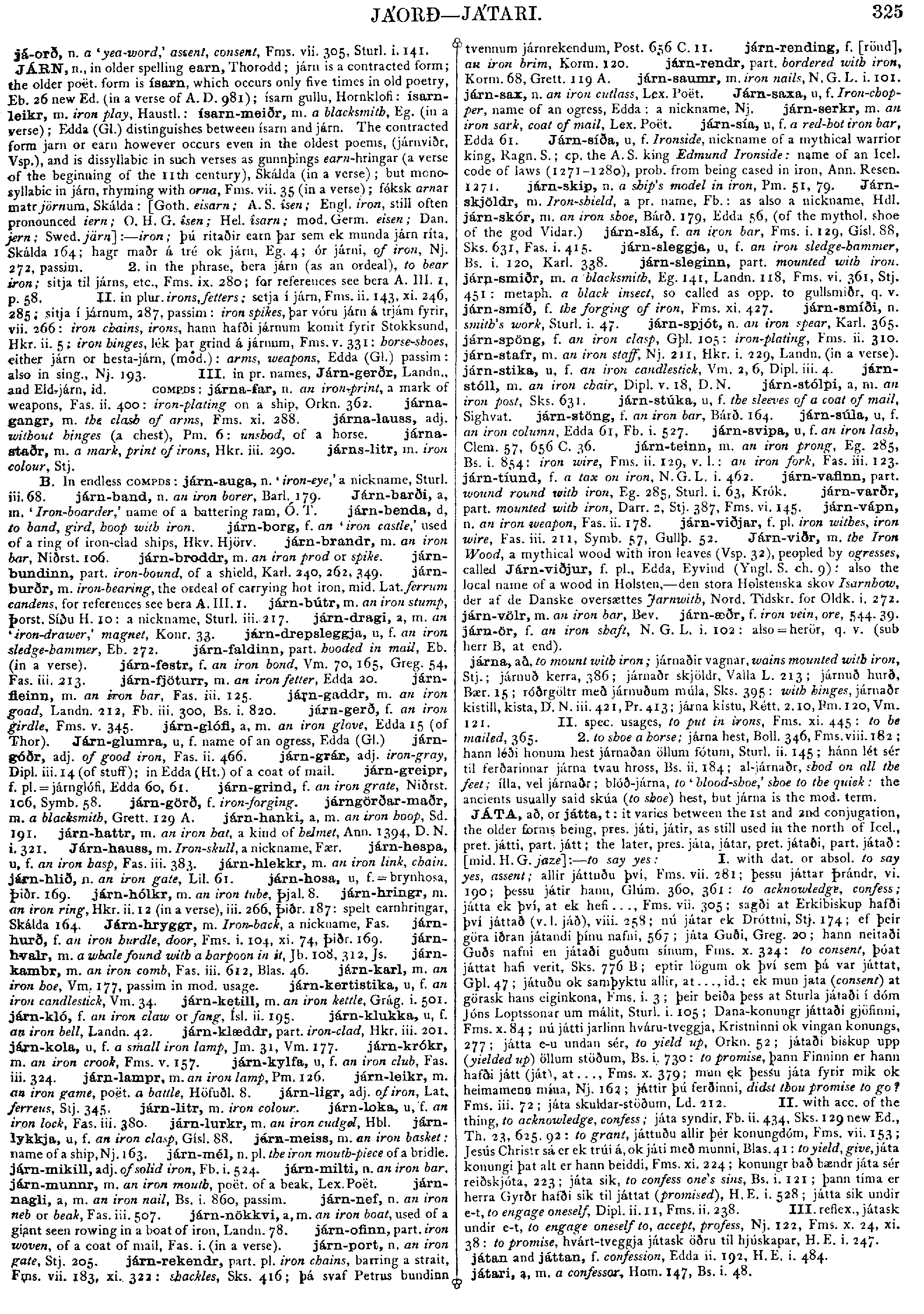
B. In endless COMPDS: járn-auga, n. 'iron-eye,' a nickname, Sturl. iii. 68. járn-band, n. an iron borer, Barl. 179. Járn-barði, a, m. 'Iron-boarder,' name of a battering ram, Ó. T. járn-benda, d, to band, gird, hoop with iron. járn-borg, f. an 'iron castle,' used of a ring of iron-clad ships, Hkv. Hjörv. járn-brandr, m. an iron bar, Niðrst. 106. járn-broddr, m. an iron prod or spike, járn-bundinn, part. iron-bound, of a shield, Karl. 240, 262, 349. járn-burðr, m. iron-bearing, the ordeal of carrying hot iron, mid. Lat. ferrum candens, for references see bera A. III. 1. járn-bútr, m. an iron stump, Þorst, Síðu H. 10: a nickname, Sturl. iii. 217. járn-dragi, a, m. an 'iron-drawer,' magnet, Konr. 33. járn-drepsleggja, u, f. an iron sledge-hammer, Eb. 272. járn-faldinn, part. hooded in mail, Eb. (in a verse). járn-festr, f. an iron bond, Vm. 70, 165, Greg. 54, Fas. iii. 213. járn-fjöturr, m. an iron fetter, Edda 20. járn-fleinn, m. an iron bar, Fas. iii. 125. járn-gaddr, m. an iron goad, Landn. 212, Fb. iii. 300, Bs. i. 820. járn-gerð, f. an iron girdle, Fms. v. 345. járn-glófi, a, m. an iron glove, Edda 15 (of Thor). Járn-glumra, u, f. name of an ogress, Edda (Gl.) járn-góðr, adj. of good iron, Fas. ii. 466. járn-grár, adj. iron-gray, Dipl. iii. 14 (of stuff); in Edda (Ht.) of a coat of mail. járn-greipr, f. pl. = járnglófi, Edda 60, 61. járn-grind, f. an iron grate, Niðrst. 106, Symb. 58. járn-görð, f. iron-forging. járngörðar-maðr, m. a blacksmith, Grett. 129 A. járn-hanki, a, m. an iron hoop, Sd. 191. járn-hattr, m. an iron hat, a kind of helmet, Ann. 1394, D. N. i. 321. Járn-hauss, m. Iron-skull, a nickname, Fær. járn-hespa, u, f. an iron hasp, Fas. iii. 383. járn-hlekkr, m. an iron link, chain. járn-hlið, n. an iron gate, Lil. 61. járn-hosa, u, f. = brynhosa, Þiðr. 169. járn-hólkr, m. an iron tube, Þjal. 8. járn-hringr, m. an iron ring, Hkr. ii. 12 (in a verse), iii. 266, Þiðr. 187: spelt earnhringar, Skálda 164. Járn-hryggr, m. Iron-back, a nickname, Fas. járn-hurð, f. an iron hurdle, door, Fms. i. 104, xi. 74, Þiðr. 169. járn-hvalr, m. a whale found with a harpoon in it, Jb. 108, 312, Js. járn-kambr, m. an iron comb, Fas. iii. 612, Blas. 46. járn-karl, m. an iron hoe, Vm. 177, passim in mod. usage. járn-kertistika, u, f. an iron candlestick, Vm. 34. járn-ketill, m. an iron kettle, Grág. i. 501. járn-kló, f. an iron claw or fang, Ísl. ii. 195. járn-klukka, u, f. an iron bell, Landn. 42. járn-klæddr, part. iron-clad, Hkr. iii. 201. járn-kola, u, f. a small iron lamp, Jm. 31, Vm. 177. járn-krókr, m. an iron crook, Fms. v. 157. járn-kylfa, u, f. an iron club, Fas. iii. 324. járn-lampr, m. an iron lamp, Pm. 126. járn-leikr, m. an iron game, poët. a battle, Höfuðl. 8. járn-ligr, adj. of iron, Lat. ferreus, Stj. 345. járn-litr, m. iron colour. járn-loka, u, f. an iron lock, Fas. iii. 380. járn-lurkr, m. an iron cudgel, Hbl. járn-lykkja, u, f. an iron clasp, Gísl. 88. járn-meiss, m. an iron basket: name of a ship. Nj. 163. járn-mél, n. pl. the iron mouth-piece of a bridle. járn-mikill, adj. of solid iron, Fb. i. 524. járn-milti, n. an iron bar. járn-munnr, m. an iron mouth, poët. of a beak, Lex. Poët. járn-nagli, a, m. an iron nail, Bs. i. 860, passim. járn-nef, n. an iron neb or beak, Fas. iii. 507. járn-nökkvi, a, m. an iron boat, used of a giant seen rowing in a boat of iron, Landn. 78. járn-ofinn, part. iron woven, of a coat of mail, Fas. i. (in a verse). járn-port, n. an iron gate, Stj. 205, járn-rekendr, part. pl. iron chains, barring a strait, Fms. vii. 183, xi. 322: shackles, Sks. 416; þá svaf Petrus bundinn tvennum járnrekendum, Post. 656 C. 11. járn-rending, f. [rönd], an iron brim, Korm. 120. járn-rendr, part. bordered with iron, Korm. 68, Grett. 119 A. járn-saumr, m. iron nails, N. G. L. i. 101. járn-sax, n. an iron cutlass, Lex. Poët. Járn-saxa, u, f. Iron-chopper, name of an ogress, Edda: a nickname, Nj. járn-serkr, m. an iron sark, coat of mail, Lex. Poët. járn-sía, u, f. a red-hot iron bar, Edda 61. Járn-síða, u, f. Ironside, nickname of a mythical warrior king, Ragn. S.; cp. the A. S. king Edmund Ironside: name of an Icel. code of laws (1271-1280), prob. from being cased in iron, Ann. Resen. 1271. járn-skip, n. a ship's model in iron, Pm. 51, 79. Járn-skjöldr, m. Iron-shield, a pr. name, Fb.: as also a nickname, Hdl. járn-skór, m. an iron shoe, Bárð. 179, Edda 56, (of the mythol. shoe of the god Vidar.) jára-slá, f. an iron bar, Fms. i. 129, Gísl. 88, Sks. 631, Fas. i. 415. járn-sleggja, u, f. an iron sledge-hammer, Bs. i. 120, Karl. 338. járn-sleginn, part. mounted with iron. járn-smiðr, m. a blacksmith, Eg. 141, Landn. 118, Fms. vi. 361, Stj. 451: metaph. a black insect, so called as opp. to gullsmiðr, q.v. járn-smíð, f. the forging of iron, Fms. xi. 427. járn-smíði, n. smith's work, Sturl. i. 47. járn-spjót, n. an iron spear, Karl. 365. járn-spöng, f. an iron clasp, Gþl. 105: iron-plating, Fms. ii. 310. járn-stafr, m. an iron staff, Nj. 211, Hkr. i. 229, Landn. (in a verse), járn-stika, u, f. an iron candlestick, Vm. 2, 6, Dipl. iii. 4. járn-stóll, m. an iron chair, Dipl. v. 18, D. N. járn-stólpi, a, m. an iron post, Sks. 631. járn-stúka, u, f. the sleeves of a coat of mail, Sighvat. járn-stöng, f. an iron bar, Bárð. 164. járn-súla, u, f. an iron column, Edda 61, Fb. i. 527. járn-svipa, u, f. an iron lash, Clem. 57, 656 C. 36. járn-teinn, m. an iron prong, Eg. 285, Bs. i. 854: iron wire, Fms. ii. 129, v.l.: an iron fork, Fas. iii. 123. járn-tíund, f. a tax on iron, N. G. L. i. 462. járn-vafinn, part. wound round with iron, Eg. 285, Sturl. i. 63, Krók. járn-varðr, part. mounted with iron, Darr. 2, Stj. 387, Fms. vi. 145. járn-vápn, n. an iron weapon, Fas. ii. 178. járn-viðjar, f. pl. iron withes, iron wire, Fas. iii. 211, Symb. 57, Gullþ. 52. Járn-viðr, m. the Iron Wood, a mythical wood with iron leaves (Vsp. 32), peopled by ogresses, called Járn-viðjur, f. pl., Edda, Eyvind (Yngl. S. ch. 9): also the local name of a wood in Holsten, -- den stora Holstenska skov Isarnhow, der af de Danske oversættes Jarnwith, Nord. Tidskr. for Oldk. i. 272. járn-völr, m. an iron bar, Bev. járn-æðr, f. iron vein, ore, 544. 39. járn-ör, f. an iron shaft, N. G. L. i. 102: also = herör, q.v. (sub herr B, at end).
|
Source: Cleasby/Vigfusson, page b0383, entry 17 View original page image as: [TIFF] [PNG] [View previous entry] [View next entry] |
[Comment on this entry] [View comments] |
The following entry has not been hand-corrected. However, the page is reserved and someone is correcting it. |
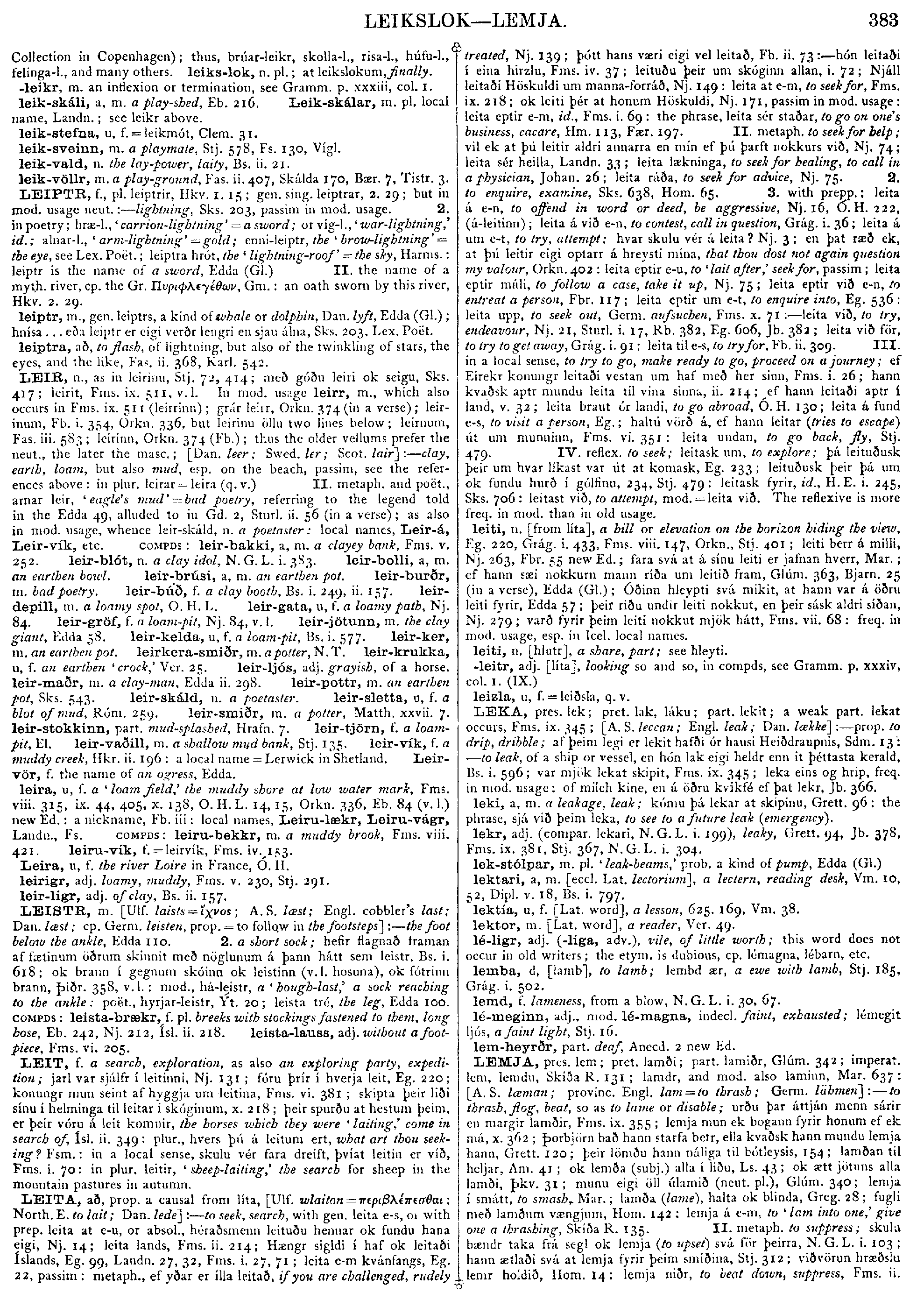
LEIT, f. a search, exploration, as also an exploring party, expedi- tion; jarl var sjálfr í leitinni, Nj. 131; fóru þrír í hverja leit, Eg. 220; konungr mun seint af hyggja um leitina, Fms. vi. 381; skipta þeir liði sínu í helminga til leitar í skóginum, x. 218; þeir spurðu at hestum þeim, er þeir vóru â leit komnir, the horses which they were ' laiting' come in search of, Ísl. ii. 349: plur., hvers þú á leitum ert, w hat art tbou seek- ing ? Fsm.: in a local sense, skulu vér fara dreift, þvíat leitin er víð, Fms. i. 70: in plur. leitir, ' sbeep-laiting, ' the search for sheep in the mountain pastures in autumn.
|
Source: Cleasby/Vigfusson, page b0589, entry 40 View original page image as: [TIFF] [PNG] [View previous entry] [View next entry] |
[Comment on this entry] [View comments] |
The following entry has been hand-corrected once. |
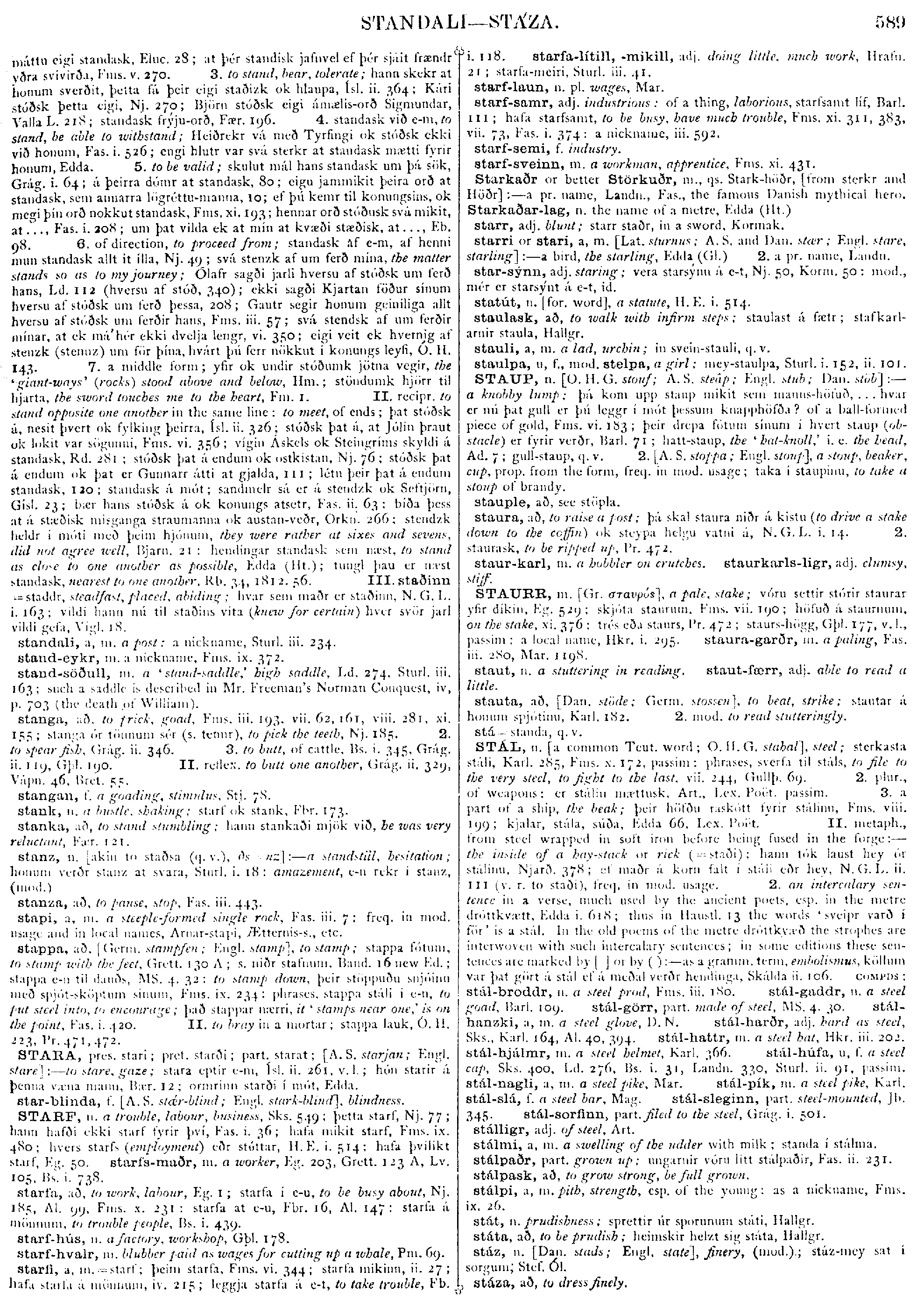
STÁL, n. [a common Teut. word; O.H.G. stahal], steel; sterkasta stáli, Karl. 285, Fms., x. 172, passim: phrases, sverfa til stáls, to file to the very steel, to fight to the last, vii. 244, Gullþ. 69. 2. plur., of weapons: er stálin mættusk. Art., Lex. Poët. passim. 3. a part of a ship, the beak; þeir höfðu raskótt fyrir stálinu, Fms. viii. 199; kjalar, stála, súða, Edda 66, Lex. Poët. II. metaph., from steel wrapped in soft iron before being fused in the forge :-- the inside of a hay-stack or rick (= staði); hann tók laust hey ór stálinu. Njarð. 378; ef maðr á korn falt í stáli eðr hey, N.G.L. ii. 111 (v.r. to staði), freq. in mod. usage. 2. an intercalary sentence in a verse, much used by the ancient poets, esp. in the metre dróttkvætt, Edda i. 618; thus in Haustl. 13 the words 'sveipr varð í för' is a stál. In the old poems of the metre dróttkvæð the strophes are interwoven with such intercalary sentences; in some editions these sentences are marked by [ ] or by ( ) :-- as a gramm. term, embolismus, köllum var þat gört á stál ef á meðal verðr hendinga, Skálda ii. 106. COMPDS: stál-broddr, n. a steel prod, Fms. iii. 180. stál-gaddr, n. a steel goad, Barl. 109. stál-görr, part. made of steel, MS. 4. 30. stál-hanzki, a, m. a steel glove, D.N. stál-harðr, adj. hard as steel, Sks., Karl. 164, Al. 40, 394. stál-hattr, m. a steel hat, Hkr. iii. 202. stál-hjálmr, m. a steel helmet, Karl. 366. stál-húfa, u, f. a steel cap, Sks. 400, Ld. 276, Bs. i. 31, Landn. 330, Sturl. ii. 91, passim. stál-nagli, a, m. a steel pike, Mar. stál-pík, m. a steel pike, Karl. stál-slá, f. a steel bar, Mag. stál-sleginn, part. steel-mounted, Jb. 345. stál-sorfinn, part. filed to the steel, Grág. i. 501.
|
Source: Cleasby/Vigfusson, page b0657, entry 41 View original page image as: [TIFF] [PNG] [View previous entry] [View next entry] |
[Comment on this entry] [View comments] |
The following entry has been hand-corrected once. |
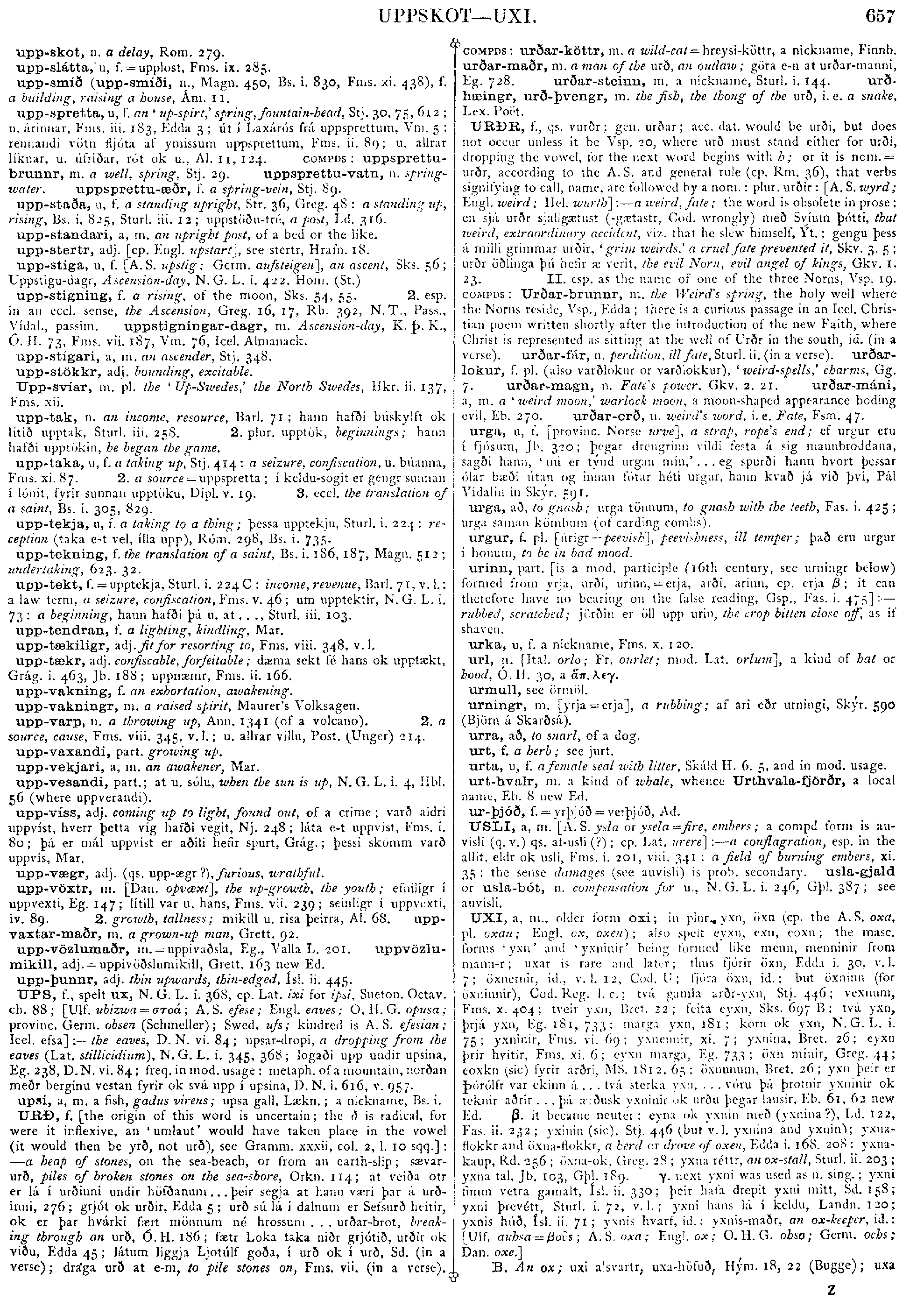
url, n. [Ital. orlo; Fr. ourlet; mod. Lat. orlum], a kind of hat or hood, Ó.H. 30, a GREEK.
| Result Page: |  |
Previous | 32 33 34 35 36 37 38 39 40 41 42 | Next |  |
Germanic Lexicon Project (main page)
This search system was written by
Sean Crist
Please consider
volunteering
to correct the data in these online dictionaries.
No rights reserved. Feel free to use these data in any way you please.