|
|

Tip: In the search results, you can click on any word or abbreviation for more information.
|
Source: Bosworth/Toller, page d0227, entry 34 View original page image as: [TIFF] [PNG] [View previous entry] [View next entry] |
[Comment on this entry] [View comments] |
The following entry has been hand-corrected once. |
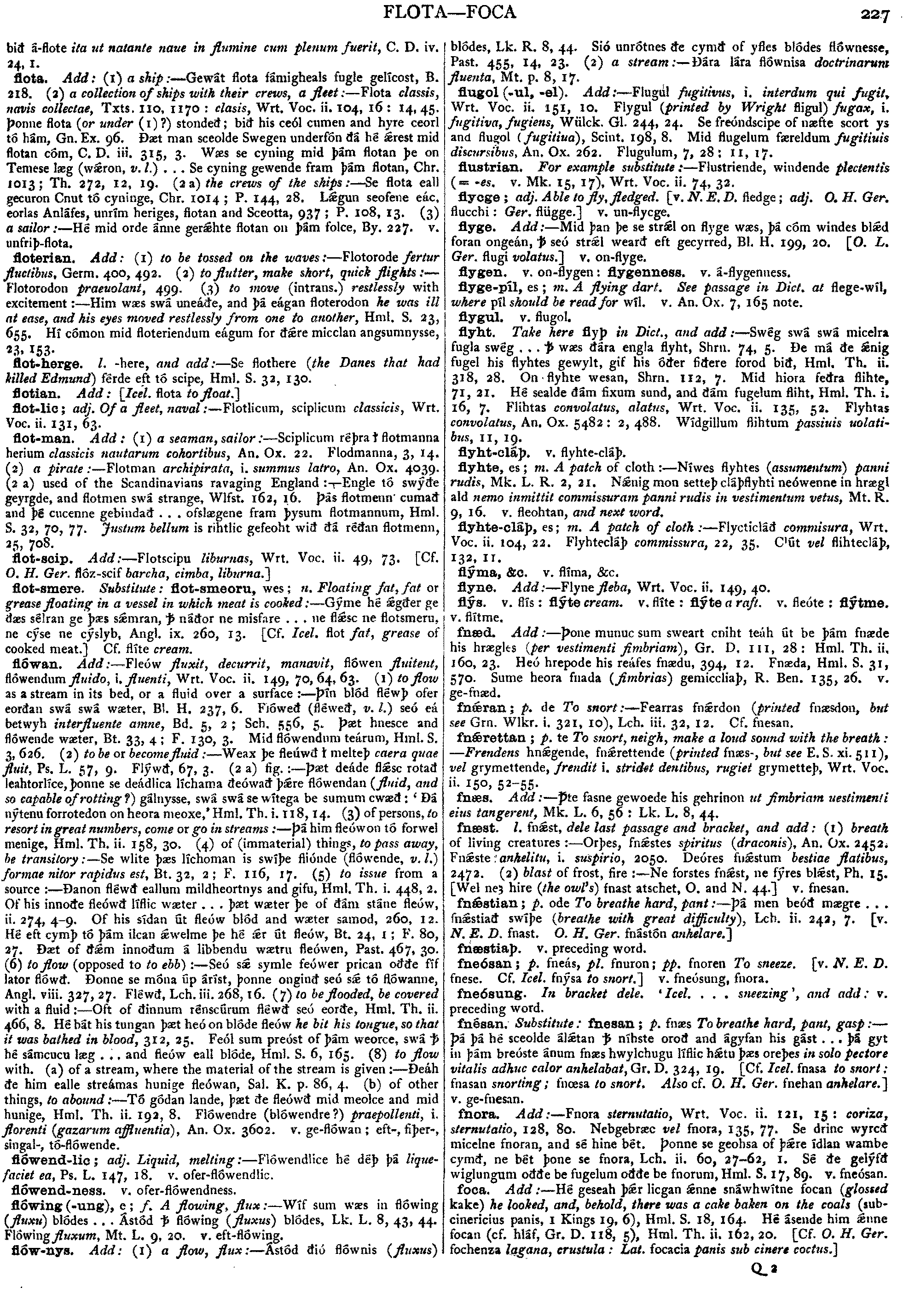
fn stian
;
p,
ode
To
breathe
hard,
pant
:--
Þá
men
beóð
mægre
.
.
.
fnstiað
swíþe
(breathe
with
great
difficulty),
Lch.
ii.
242,
7.
[v.
N.
E.
D.
fnast.
O.
H.
Ger.
fnástón
anhelare.]
stian
;
p,
ode
To
breathe
hard,
pant
:--
Þá
men
beóð
mægre
.
.
.
fnstiað
swíþe
(breathe
with
great
difficulty),
Lch.
ii.
242,
7.
[v.
N.
E.
D.
fnast.
O.
H.
Ger.
fnástón
anhelare.]
|
Source: Bosworth/Toller, page d0227, entry 38 View original page image as: [TIFF] [PNG] [View previous entry] [View next entry] |
[Comment on this entry] [View comments (2)] |
The following entry has been hand-corrected once. |
fnésan.
Substitute:
fnesan;
p.
fnæs
To
breathe
hard,
pant,
gasp
:--
Þá
þá
hé
sceolde
áltan
 níhste
oroð
and
ágyfan
his
gást
.
.
.
þá
gyt
in
þám
breóste
ánum
fnæs
hwylchugu
líflie
htu
þæs
oreþes
in
solo
pectore
vitalis
adhue
calor
anhelabat,
Gr.
D.
324,
19.
[Cf.
Icel.
fnasa
to
snort
:
fnasan
snorting;
fncesa
to
snort.
Also
cf.
O.
H.
Ger.
fnehan
anhelare.]
v.
ge-fnesan.
níhste
oroð
and
ágyfan
his
gást
.
.
.
þá
gyt
in
þám
breóste
ánum
fnæs
hwylchugu
líflie
htu
þæs
oreþes
in
solo
pectore
vitalis
adhue
calor
anhelabat,
Gr.
D.
324,
19.
[Cf.
Icel.
fnasa
to
snort
:
fnasan
snorting;
fncesa
to
snort.
Also
cf.
O.
H.
Ger.
fnehan
anhelare.]
v.
ge-fnesan.
|
Source: Bosworth/Toller, page d0235, entry 26 View original page image as: [TIFF] [PNG] [View previous entry] [View next entry] |
[Comment on this entry] [View comments] |
The following entry has been hand-corrected once. |
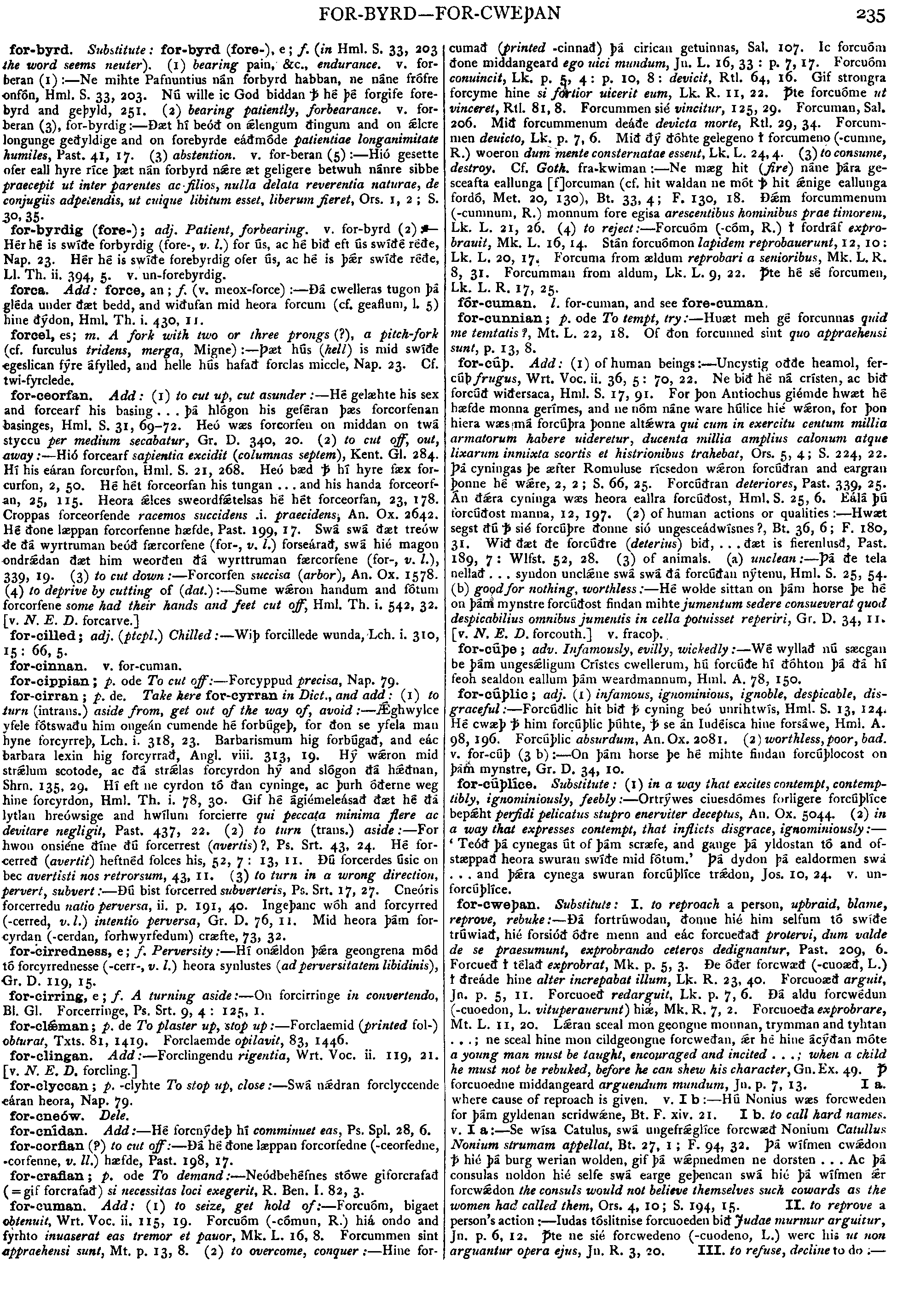
for-cweþan.
Substitute:
I.
to
reproach
a
person,
upbraid,
blame,
reprove,
rebuke
:--
Ðá
fortrúwodan,
ðonne
hié
him
selfum
tó
swíðe
trúwiað,
hié
forsióð
óðre
menn
and
eác
forcueðað
protervi,
dum
valde
de
se
praesumunt,
exprobrando
ceteros
dedignantur.
Past.
209,
6.
Forcueð
 télað
exprobrat,
Mk.
p.
5,
3.
Ðe
óðer
forcwæð
(-cuoæð,
L.)
ðreáde
hine
alter
increpabat
illum,
Lk.
R.
23,
40.
Forcuoæð
arguit,
Jn.
p.
5,
11.
Forcuoeð
redarguit,
Lk.
p.
7,
6.
Ðá
aldu
forcwédun
(-cuoedon,
L.
vituperauerunt)
hi,
Mk.
R.
7,
2.
Forcuoeða
exprobrare,
Mt.
L.
11,
20.
Lran
sceal
mon
geongne
monnan,
trymman
and
tyhtan
...;
ne
sceal
hine
mon
cildgeongne
forcweðan,
r
hé
hine
ácýðan
móte
a
young
man
must
be
taught,
encouraged
and
incited
...;
when
a
child
he
must
not
be
rebuked,
before
he
can
shew
his
character,
Gn.
Ex.
49.
Þ-bar;
forcuoedne
middangeard
arguendum
mundum,
Jn.
p.
7,
13.
I
a.
where
cause
of
reproach
is
given,
v.
I
b
:--
Hú
Nonius
wæs
forcweden
for
þám
gyldenan
scridwne,
Bt.
F.
xiv.
21.
I
b.
to
call
hard
names.
v.
I
a
:--
Se
wísa
Catulus,
swá
ungefrglíce
forcwæð
Nomum
Catullus
Nonium
strumam
appellat,
Bt.
27,
1;
F.
94,
32.
Þa
wífmen
cwdon
hié
þá
burg
werian
wolden,
gif
þá
wpnedmen
ne
dorsten
...
Ac
þá
consulas
noldon
hié
selfe
swá
earge
geþencan
swá
hié
þá
wífmen
r
forcwdon
the
consuls
would
not
believe
themselves
such
cowards
as
the
women
had
called
them.
Ors.
4,
10;
S.
194,
15.
II.
to
reprove
a
person's
action
:--
Iudas
tóslitnise
forcuoeden
bið
Judae
murmur
arguitur,
Jn.
p.
6,
12.
Þ-bar;te
ne
sié
forcwedeno
(-cuodeno,
L.)
werc
his
ut
non
arguantur
opera
ejus,
Jn.
R.
3,
20.
III.
to
refuse,
decline
to
do
:--
télað
exprobrat,
Mk.
p.
5,
3.
Ðe
óðer
forcwæð
(-cuoæð,
L.)
ðreáde
hine
alter
increpabat
illum,
Lk.
R.
23,
40.
Forcuoæð
arguit,
Jn.
p.
5,
11.
Forcuoeð
redarguit,
Lk.
p.
7,
6.
Ðá
aldu
forcwédun
(-cuoedon,
L.
vituperauerunt)
hi,
Mk.
R.
7,
2.
Forcuoeða
exprobrare,
Mt.
L.
11,
20.
Lran
sceal
mon
geongne
monnan,
trymman
and
tyhtan
...;
ne
sceal
hine
mon
cildgeongne
forcweðan,
r
hé
hine
ácýðan
móte
a
young
man
must
be
taught,
encouraged
and
incited
...;
when
a
child
he
must
not
be
rebuked,
before
he
can
shew
his
character,
Gn.
Ex.
49.
Þ-bar;
forcuoedne
middangeard
arguendum
mundum,
Jn.
p.
7,
13.
I
a.
where
cause
of
reproach
is
given,
v.
I
b
:--
Hú
Nonius
wæs
forcweden
for
þám
gyldenan
scridwne,
Bt.
F.
xiv.
21.
I
b.
to
call
hard
names.
v.
I
a
:--
Se
wísa
Catulus,
swá
ungefrglíce
forcwæð
Nomum
Catullus
Nonium
strumam
appellat,
Bt.
27,
1;
F.
94,
32.
Þa
wífmen
cwdon
hié
þá
burg
werian
wolden,
gif
þá
wpnedmen
ne
dorsten
...
Ac
þá
consulas
noldon
hié
selfe
swá
earge
geþencan
swá
hié
þá
wífmen
r
forcwdon
the
consuls
would
not
believe
themselves
such
cowards
as
the
women
had
called
them.
Ors.
4,
10;
S.
194,
15.
II.
to
reprove
a
person's
action
:--
Iudas
tóslitnise
forcuoeden
bið
Judae
murmur
arguitur,
Jn.
p.
6,
12.
Þ-bar;te
ne
sié
forcwedeno
(-cuodeno,
L.)
werc
his
ut
non
arguantur
opera
ejus,
Jn.
R.
3,
20.
III.
to
refuse,
decline
to
do
:--
|
Source: Bosworth/Toller, page d0242, entry 18 View original page image as: [TIFF] [PNG] [View previous entry] [View next entry] |
[Comment on this entry] [View comments] |
The following entry has been hand-corrected once. |
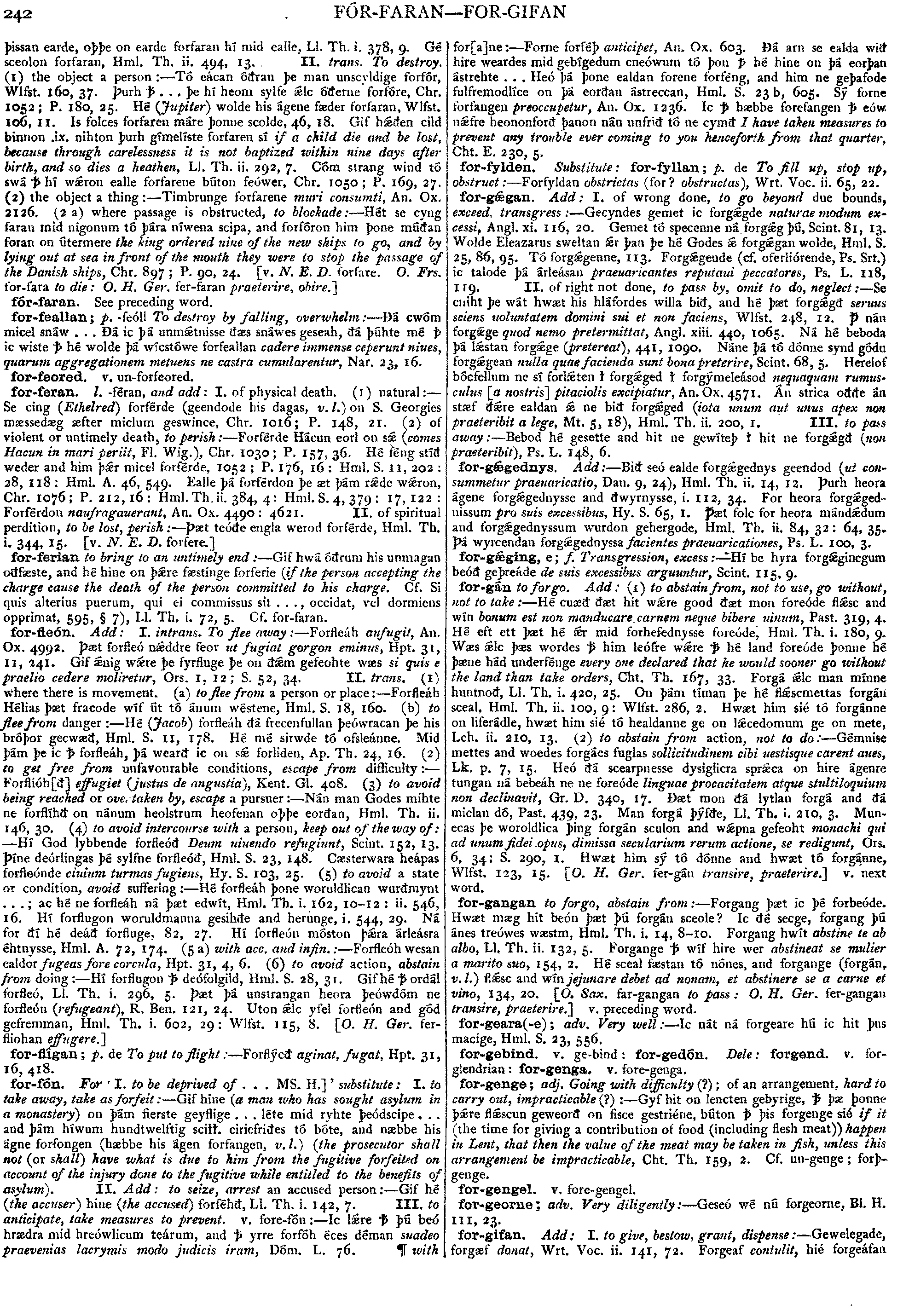
for-genge;
adj.
Going
with
difficulty(?);
of
an
arrangement,
hard
to
carry
out,
impracticable(?):--Gyf
hit
on
lencten
gebyrige,
þæ
þonne
þre
flscun
geweorð
on
fisce
gestriéne,
búton
þis
forgenge
sié
if
it
(the
time
for
giving
a
contribution
of
food
(including
flesh
meat))
happen
in
Lent,
that
then
the
value
of
the
meat
may
be
taken
in
fish,
unless
this
arrangement
be
impracticable,
Cht.
Th.
159,
2.
Cf.
un-genge;
forþ genge.
|
Source: Bosworth/Toller, page d0243, entry 3 View original page image as: [TIFF] [PNG] [View previous entry] [View next entry] |
[Comment on this entry] [View comments] |
The following entry has been hand-corrected once. |
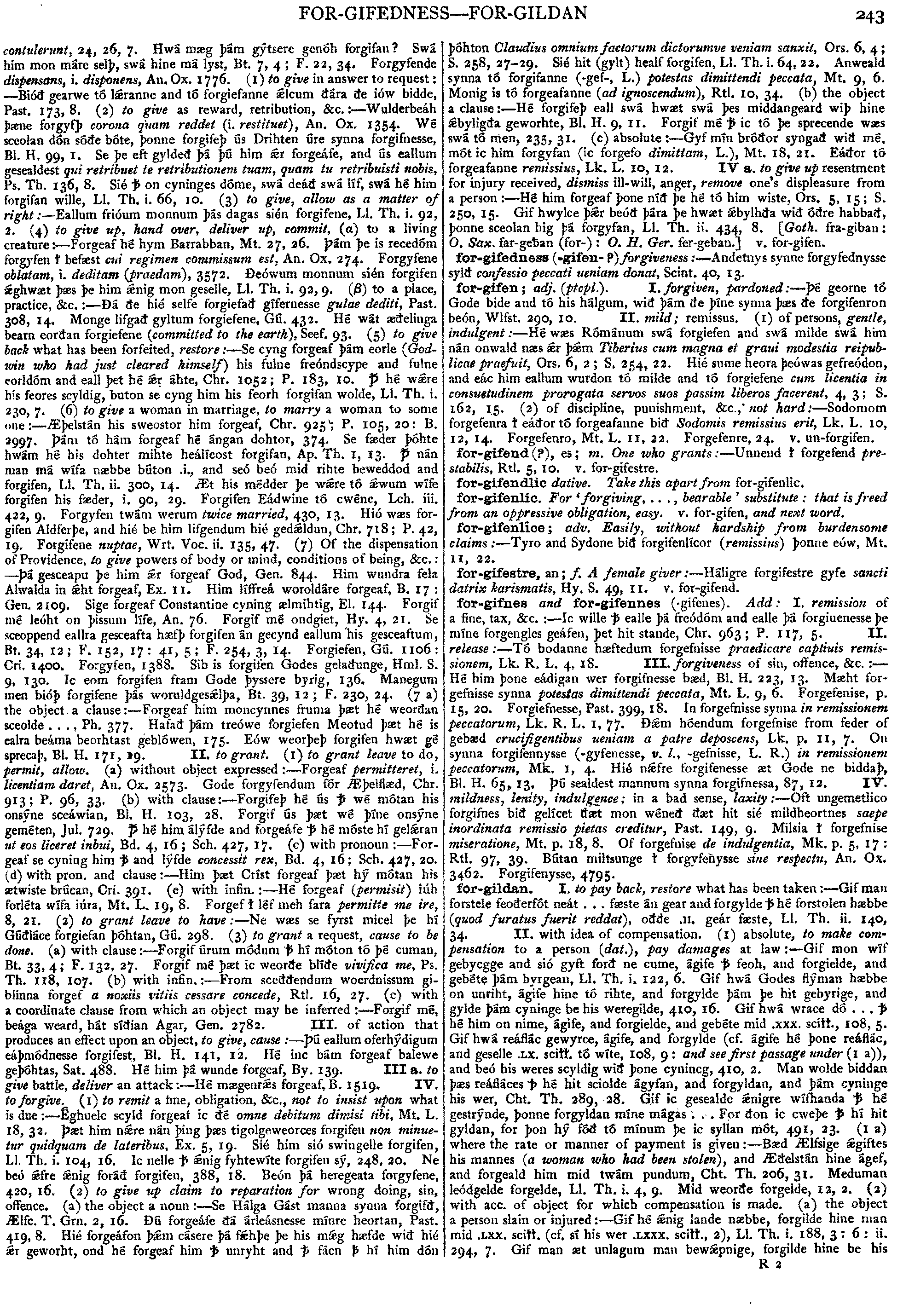
for-gifen;
adj.
(ptcpl.).
I.
forgiven,
pardoned:--Þé
georne
tó
Gode
bide
and
tó
his
hálgum,
wið
þám
ðe
þíne
synna
þæs
ðe
forgifenron
beón,
Wlfst.
290,
10.
II.
mild;
remissus.
(1)
of
persons,
gentle,
indulgent:--Hé
wæs
Rómánum
swá
forgiefen
and
swá
milde
swá
him
nán
onwald
næs
r
þm
Tiberius
cum
magna
et
graui
modestia
reipublicae
praefuit,
Ors.
6,
2;
S.
254,
22.
Hié
sume
heora
þeówas
gefreódon,
and
eác
him
eallum
wurdon
tó
milde
and
tó
forgiefene
cum
licentia
in
consuetudinem
prorogata
servos
suos
passim
liberos
facerent,
4,
3;
S.
162,
15.
(2)
of
discipline,
punishment,
&c.,
not
hard:--Sodomom
forgefenra
eáðor
tó
forgeafanne
bið
Sodomis
remissius
erit,
Lk.
L.
10,
12,
14.
Forgefenro,
Mt.
L.
11,
22.
Forgefenre,
24.
v.
un-forgifen.
|
Source: Bosworth/Toller, page d0245, entry 10 View original page image as: [TIFF] [PNG] [View previous entry] [View next entry] |
[Comment on this entry] [View comments] |
The following entry has been hand-corrected once. |
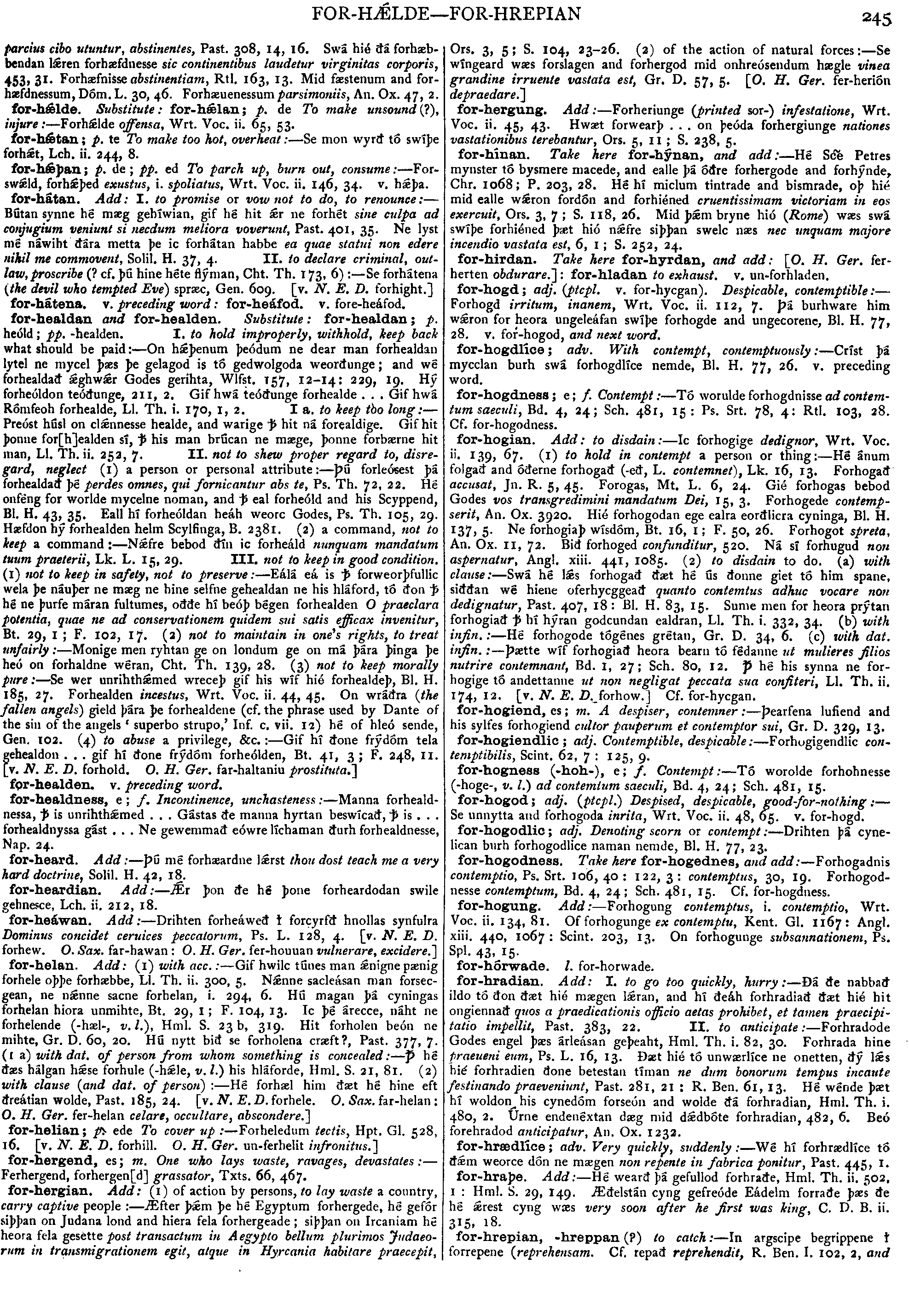
for-heard.
Add:--Þú
mé
forhæardne
lrst
thou
dost
teach
me
a
very
hard
doctrine,
Solil.
H.
42,
18.
|
Source: Bosworth/Toller, page d0312, entry 15 View original page image as: [TIFF] [PNG] [View previous entry] [View next entry] |
[Comment on this entry] [View comments] |
The following entry has been hand-corrected once. |
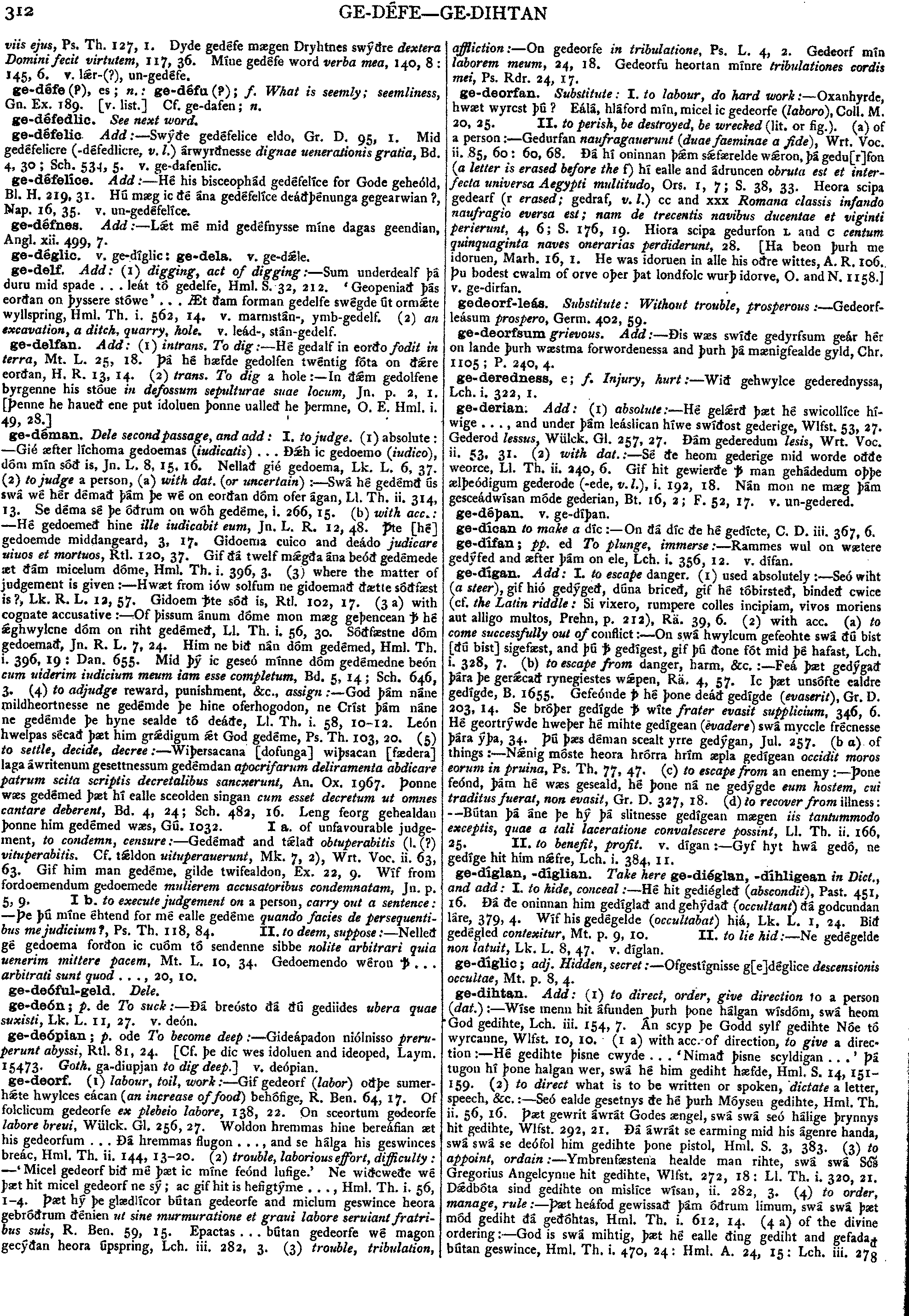
ge-deorfan.
Substitute:
I.
to
labour,
do
hard
work
:--
Oxanhyrde,
hwæt
wyrcst
þú
?
Eálá,
hláford
mín,
micel
ic
gedeorfe
(laboro),
Coll.
M.
20,
25.
II.
to
perish,
be
destroyed,
be
wrecked
(lit.
or
fig.),
(a)
of
a
person
:--
Gedurfan
naufragauerunt
(duae
faeminae
a
fide),
Wrt.
Voc.
ii.
85,
60:
60,
68.
Ðá
hí
oninnan
þm
sfærelde
wron,
þá
gedu[r]fon
(a
letter
is
erased
before
the
f)
hí
ealle
and
ádruncen
obruta
est
et
interfecta
universa
Aegypti
multitude,
Ors.
7;
S.
38,
33.
Heora
scipa
gedearf
(r
erased;
gedraf,
v.l.)
cc
and
xxx
Romana
classis
infando
nanfragio
eversa
est;
nom
de
trecentis
navibus
ducentae
et
viginti
perierunt,
4,
6;
S.
176,
19.
Hiora
scipa
gedurfon
L
and
C
centunt
quinquaginta
naves
onerarias
perdiderunt,
28.
[Ha
beon
þurh
me
idoruen,
Marh.
16,
He
was
idoruen
in
alle
his
oðre
wittes,
A.
R.
106.
Þu
bodest
cwalm
of
orve
oþer
þat
londfolc
wurþ
idorve,
O.
and
N.
1158.]
v.
ge-dirfan.
|
Source: Bosworth/Toller, page d0334, entry 22 View original page image as: [TIFF] [PNG] [View previous entry] [View next entry] |
[Comment on this entry] [View comments] |
The following entry has been hand-corrected once. |
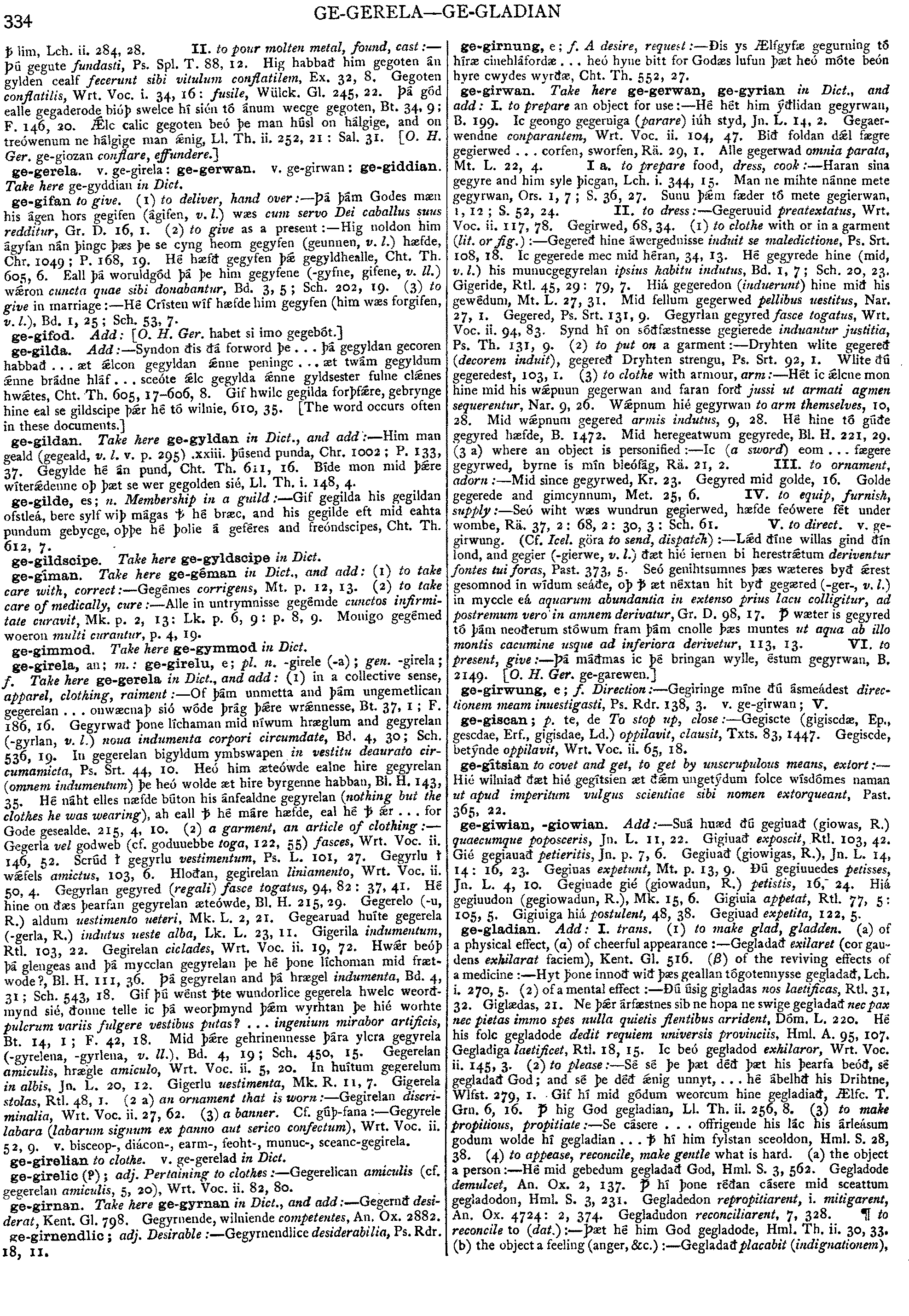
ge-gladian.
Add:
I.
trans.
(1)
to
make
glad,
gladden.
(a)
of
a
physical
effect,
( )
of
cheerful
appearance:--Gegladað
exilaret
(cor
gaudens
exhilarat
faciem),
Kent.
Gl.
516.
(
)
of
cheerful
appearance:--Gegladað
exilaret
(cor
gaudens
exhilarat
faciem),
Kent.
Gl.
516.
( )
of
the
reviving
effects
of
a
medicine:--Hyt
þone
innoð
wið
þæs
geallan
tógotennysse
gegladað,
Lch.
i.
270,
5.
(2)
of
a
mental
effect:--Ðú
úsig
gigladas
nos
laetificas,
Rtl.
31,
32.
Giglædas,
21.
Ne
þr
árfæstnes
sib
ne
hopa
ne
swige
gegladað
nec
pax
nec
pietas
immo
spes
nulla
quietis
flentibus
arrident,
Dóm.
L.
220.
Hé
his
folc
gegladode
dedit
requiem
universis
provinciis,
Hml.
A.
95,
107.
Gegladiga
laetificet,
Rtl.
18,
15.
Ic
beó
gegladod
exhilaror,
Wrt.
Voc.
ii.
145,
3.
(2)
to
please:--Sé
sé
þe
þæt
déð
þæt
his
þearfa
beóð,
sé
gegladað
God;
and
sé
þe
déð
nig
unnyt,
.
.
.
hé
ábelhð
his
Drihtne,
Wlfst.
279,
1.
Gif
hí
mid
gódum
weorcum
hine
gegladiað,
Ælfc.
T.
Grn.
6,
16.
Þ-bar;
hig
God
gegladian,
Ll.
Th.
ii.
256,
8.
(3)
to
make
propitious,
propitiate:--Se
cásere
.
.
.
offrigende
his
lác
his
árleásum
godum
wolde
hí
gegladian
.
.
.
hí
him
fylstan
sceoldon,
Hml.
S.
28,
38.
(4)
to
appease,
reconcile,
make
gentle
what
is
hard.
(a)
the
object
a
person:--Hé
mid
gebedum
gegladað
God,
Hml.
S.
3,
562.
Gegladode
demulcet,
An.
Ox.
2,
137.
Þ-bar;
hí
þone
réðan
cásere
mid
sceattum
gegladodon,
Hml.
S.
3,
231.
Gegladedon
repropitiarent,
i.
mitigarent,
An.
Ox.
4724:
2,
374.
Gegladudon
reconciliarent,
7,
328.

to
reconcile
to
(dat.):--Þæt
hé
him
God
gegladode,
Hml.
Th.
ii.
30,
33.
(b)
the
object
a
feeling
(anger,
&c.):--Gegladað
placabit
(indignationem),
)
of
the
reviving
effects
of
a
medicine:--Hyt
þone
innoð
wið
þæs
geallan
tógotennysse
gegladað,
Lch.
i.
270,
5.
(2)
of
a
mental
effect:--Ðú
úsig
gigladas
nos
laetificas,
Rtl.
31,
32.
Giglædas,
21.
Ne
þr
árfæstnes
sib
ne
hopa
ne
swige
gegladað
nec
pax
nec
pietas
immo
spes
nulla
quietis
flentibus
arrident,
Dóm.
L.
220.
Hé
his
folc
gegladode
dedit
requiem
universis
provinciis,
Hml.
A.
95,
107.
Gegladiga
laetificet,
Rtl.
18,
15.
Ic
beó
gegladod
exhilaror,
Wrt.
Voc.
ii.
145,
3.
(2)
to
please:--Sé
sé
þe
þæt
déð
þæt
his
þearfa
beóð,
sé
gegladað
God;
and
sé
þe
déð
nig
unnyt,
.
.
.
hé
ábelhð
his
Drihtne,
Wlfst.
279,
1.
Gif
hí
mid
gódum
weorcum
hine
gegladiað,
Ælfc.
T.
Grn.
6,
16.
Þ-bar;
hig
God
gegladian,
Ll.
Th.
ii.
256,
8.
(3)
to
make
propitious,
propitiate:--Se
cásere
.
.
.
offrigende
his
lác
his
árleásum
godum
wolde
hí
gegladian
.
.
.
hí
him
fylstan
sceoldon,
Hml.
S.
28,
38.
(4)
to
appease,
reconcile,
make
gentle
what
is
hard.
(a)
the
object
a
person:--Hé
mid
gebedum
gegladað
God,
Hml.
S.
3,
562.
Gegladode
demulcet,
An.
Ox.
2,
137.
Þ-bar;
hí
þone
réðan
cásere
mid
sceattum
gegladodon,
Hml.
S.
3,
231.
Gegladedon
repropitiarent,
i.
mitigarent,
An.
Ox.
4724:
2,
374.
Gegladudon
reconciliarent,
7,
328.

to
reconcile
to
(dat.):--Þæt
hé
him
God
gegladode,
Hml.
Th.
ii.
30,
33.
(b)
the
object
a
feeling
(anger,
&c.):--Gegladað
placabit
(indignationem),
|
Source: Bosworth/Toller, page d0336, entry 11 View original page image as: [TIFF] [PNG] [View previous entry] [View next entry] |
[Comment on this entry] [View comments] |
The following entry has been hand-corrected once. |
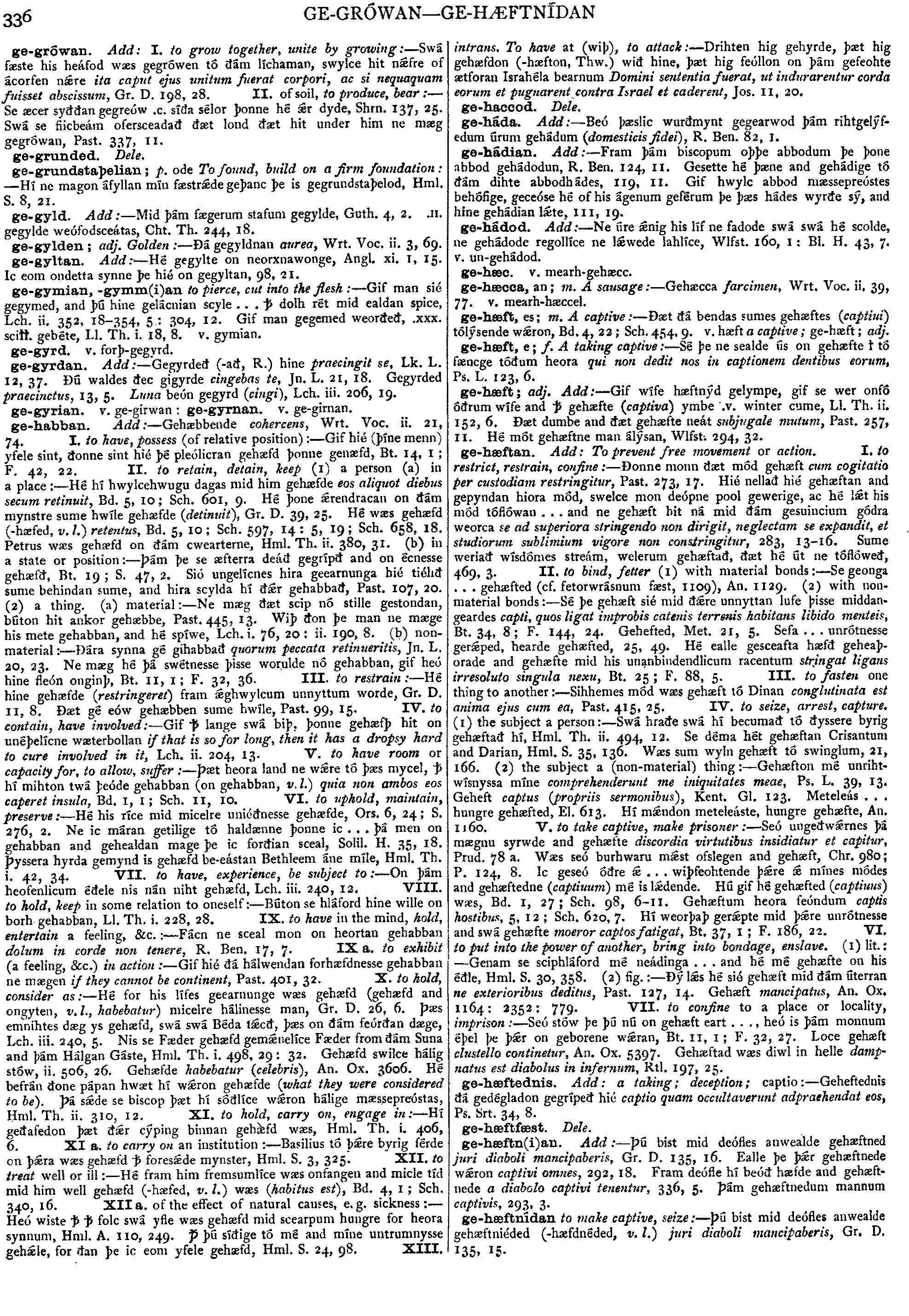
ge-habban.
Add:--Gehæbbende
cohercens,
Wrt.
Voc.
ii.
21,
74.
I.
to
have,
possess
(of
relative
position):--Gif
hié
(þíne
menn)
yfele
sint,
ðonne
sint
hié
þé
pleólicran
gehæfd
þonne
genæfd,
Bt.
14,
1;
F.
42,
22.
II.
to
retain,
detain,
keep
(1)
a
person
(a)
in
a
place:--Hé
hí
hwylcehwugu
dagas
mid
him
gehæfde
eos
aliquot
diebus
secum
retinuit,
Bd.
5,
10;
Sch.
601,
9.
Hé
þone
rendracan
on
ðám
mynstre
sume
hwíle
gehæfde
(detinuit),
Gr.
D.
39,
25.
Hé
wæs
gehæfd
(-hæfed,
v.
l.)
retentus,
Bd.
5,
10;
Sch.
597,
14:
5,
19;
Sch.
658,
18.
Petrus
wæs
gehæfd
on
ðám
cwearterne,
Hml.
Th.
ii.
380,
31.
(b)
in
a
state
or
position:--Þám
þe
se
æfterra
deáð
gegrípð
and
on
écnesse
gehæfð,
Bt.
19;
S.
47,
2.
Sió
ungelícnes
hira
geearnunga
hié
tiéhð
sume
behindan
sume,
and
hira
scylda
hí
ðr
gehabbað,
Past.
107,
20.
(2)
a
thing.
(a)
material:--Ne
mæg
ðæt
scip
nó
stille
gestondan,
búton
hit
ankor
gehæbbe,
Past.
445,
13.
Wiþ
ðon
þe
man
ne
mæge
his
mete
gehabban,
and
hé
spíwe,
Lch.
i.
76,
20:
ii.
190,
8.
(b)
non-material:--Ðára
synna
gé
gihabbað
quorum
peccata
retinueritis,
Jn.
L.
20,
23.
Ne
mæg
hé
þá
swétnesse
þisse
worulde
nó
gehabban,
gif
heó
hine
fleón
onginþ,
Bt.
11,
1;
F.
32,
36.
III.
to
restrain:--Hé
hine
gehæfde
(restringeret)
fram
ghwylcum
unnyttum
worde,
Gr.
D.
11,
8.
Ðæt
gé
eów
gehæbben
sume
hwíle,
Past.
99,
15.
IV.
to
contain,
have
involved:--Gif
lange
swá
biþ,
þonne
gehæfþ
hit
on
unéþelícne
wæterbollan
if
that
is
so
for
long,
then
it
has
a
dropsy
hard
to
cure
involved
in
it,
Lch.
ii.
204,
13.
V.
to
have
room
or
capacity
for,
to
allow,
suffer:--Þæt
heora
land
ne
wre
tó
þæs
mycel,
hí
mihton
twá
þeóde
gehabban
(on
gehabban,
v.
l.)
quia
non
ambos
eos
caperet
insula,
Bd.
1,
1;
Sch.
11,
10.
VI.
to
uphold,
maintain,
preserve:--Hé
his
ríce
mid
micelre
uniéðnesse
gehæfde,
Ors.
6,
24;
S.
276,
2.
Ne
ic
máran
getilige
tó
haldænne
þonne
ic
.
.
.
þá
men
on
gehabban
and
gehealdan
mage
þe
ic
forðian
sceal,
Solil.
H.
35,
18.
Þyssera
hyrda
gemynd
is
gehæfd
be-eástan
Bethleem
áne
míle,
Hml.
Th.
i.
42,
34.
VII.
to
have,
experience,
be
subject
to:--On
þám
heofenlicum
éðele
nis
nán
niht
gehæfd,
Lch.
iii.
240,
12.
VIII.
to
hold,
keep
in
some
relation
to
oneself:--Búton
se
hláford
hine
wille
on
borh
gehabban,
Ll.
Th.
i.
228,
28.
IX.
to
have
in
the
mind,
hold,
entertain
a
feeling,
&c.:--Fácn
ne
sceal
mon
on
heortan
gehabban
dolum
in
corde
non
tenere,
R.
Ben.
17,
7.
IX
a.
to
exhibit
(a
feeling,
&c.)
in
action:--Gif
hié
ðá
hálwendan
forhæfdnesse
gehabban
ne
mægen
if
they
cannot
be
continent,
Past.
401,
32.
X.
to
hold,
consider
as:--Hé
for
his
lífes
geearnunge
wæs
gehæfd
(gehæfd
and
ongyten,
v.
l.,
habebatur)
micelre
hálinesse
man,
Gr.
D.
26,
6.
Þæs
emnihtes
dæg
ys
gehæfd,
swá
swá
Béda
tcð,
þæs
on
ðám
feórðan
dæge,
Lch.
iii.
240,
5.
Nis
se
Fæder
gehæfd
gemnelíce
Fæder
from
ðám
Suna
and
þám
Hálgan
Gáste,
Hml.
Th.
i.
498,
29:
32.
Gehæfd
swilce
hálig
stów,
ii.
506,
26.
Gehæfde
habebatur
(celebris),
An.
Ox.
3606.
Hé
befrán
ðone
pápan
hwæt
hí
wron
gehæfde
(what
they
were
considered
to
be).
Þá
sde
se
biscop
þæt
hí
sóðlíce
wron
hálige
mæssepreóstas,
Hml.
Th.
ii.
310,
12.
XI.
to
hold,
carry
on,
engage
in:--Hí
geðafedon
þæt
ðr
cýping
binnan
gehæfd
wæs,
Hml.
Th.
i.
406,
6.
XI
a.
to
carry
on
an
institution:--Basilius
tó
þre
byrig
férde
on
þra
wæs
gehæfd
foresde
mynster,
Hml.
S.
3,
325.
XII.
to
treat
well
or
ill:--Hé
fram
him
fremsumlíce
wæs
onfangen
and
micle
tíd
mid
him
well
gehæfd
(-hæfed,
v.
l.)
wæs
(habitus
est),
Bd.
4,
1;
Sch.
340,
16.
XII
a.
of
the
effect
of
natural
causes,
e.
g.
sickness:--Heó
wiste
folc
swá
yfle
wæs
gehæfd
mid
scearpum
hungre
for
heora
synnum,
Hml.
A.
110,
249.
Þ-bar;
þú
síðige
tó
mé
and
míne
untrumnysse
gehle,
for
ðan
þe
ic
eom
yfele
gehæfd,
Hml.
S.
24,
98.
XIII.
intrans.
To
have
at
(wiþ),
to
attack:--Drihten
hig
gehyrde,
þæt
hig
gehæfdon
(-hæfton,
Thw.)
wið
hine,
þæt
hig
feóllon
on
þám
gefeohte
ætforan
Israhéla
bearnum
Domini
sententia
fuerat,
ut
indurarentur
corda
eorum
et
pugnarent
contra
Israel
et
caderent,
Jos.
11,
20.
|
Source: Bosworth/Toller, page d0345, entry 3 View original page image as: [TIFF] [PNG] [View previous entry] [View next entry] |
[Comment on this entry] [View comments] |
The following entry has been hand-corrected once. |
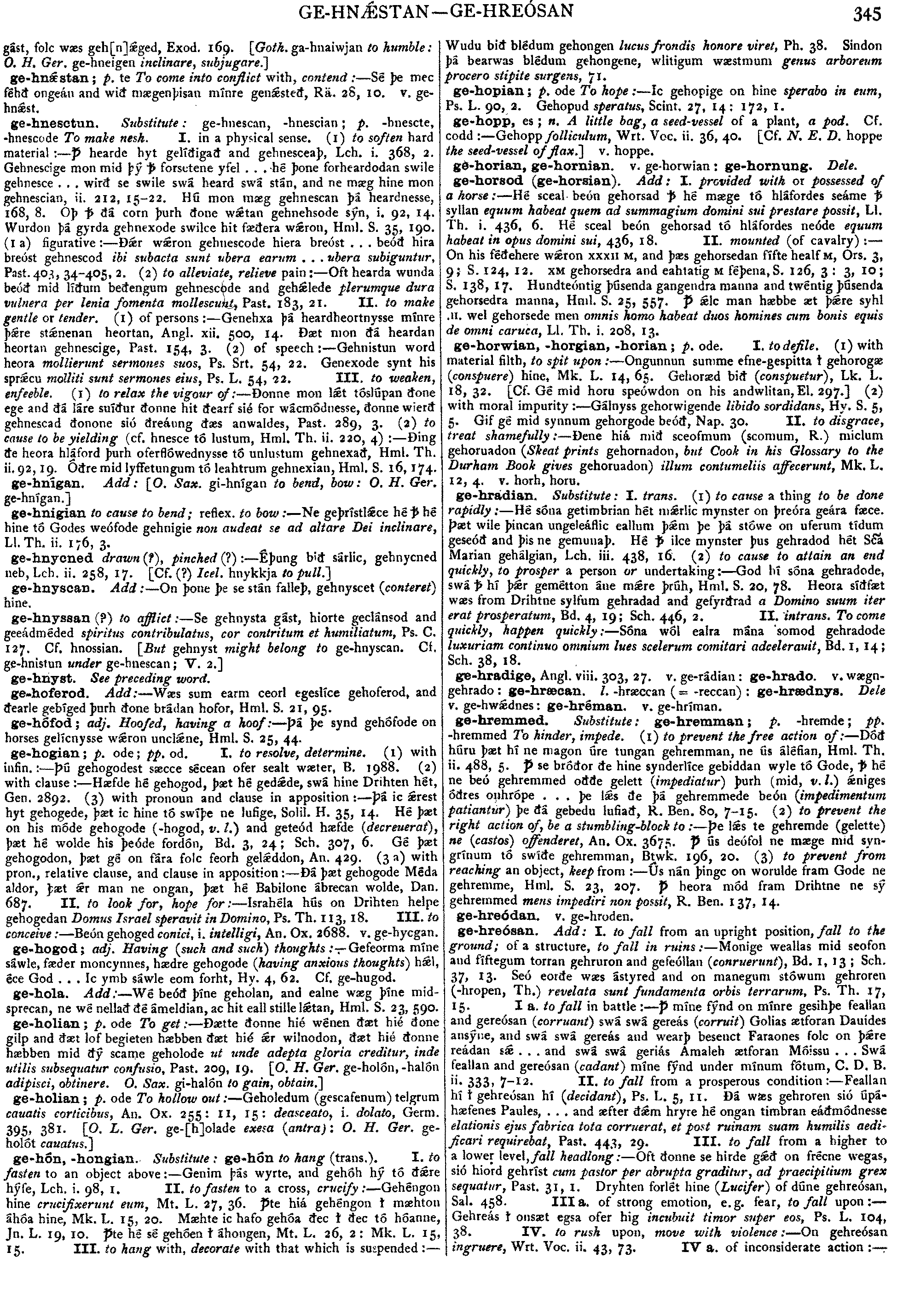
ge-hnesctun.
Substitute:
ge-hnescan,
-hnescian;
p.
-hnescte,
-hnescode
To
make
nesh.
I.
in
a
physical
sense.
(1)
to
soften
hard
material
:--
hearde
hyt
gel
 iga
and
gehnesceaþ.
Lch.
i.
368,
2.
Gehnescige
mon
mid
þ
iga
and
gehnesceaþ.
Lch.
i.
368,
2.
Gehnescige
mon
mid
þ forsetene
yfel
.
.
.
h
forsetene
yfel
.
.
.
h þone
forheardodan
swile
gehnesce
.
.
.
wir
se
swile
sw
þone
forheardodan
swile
gehnesce
.
.
.
wir
se
swile
sw heard
sw
stn,
and
ne
mæg
hine
mon
gehnescian,
ii.
212,
15-22.
H
heard
sw
stn,
and
ne
mæg
hine
mon
gehnescian,
ii.
212,
15-22.
H mon
mæg
gehnescan
þ
heardnesse,
168,
8.
Oþ
corn
þurh
one
w
mon
mæg
gehnescan
þ
heardnesse,
168,
8.
Oþ
corn
þurh
one
w tan
gehnehsode
sn,
i.
92,
14.
Wurdon
þ
gyrda
gehnexode
swilce
hit
fæera
wron,
Hml.
S.
35,
190.
(I
a)
figurative
:--
Ðr
wron
gehnescode
hiera
breóst
.
.
.
beó
hira
breóst
gehnescod
ibi
subacta
sunt
ubera
earum
.
.
.
ubera
subiguntur,
Past.
403,
34-405,
2.
(2)
to
alleviate,
relieve
pain
:--
Oft
hearda
wunda
beó
mid
lum
beengum
gehnescode
and
gehlede
plerumque
dura
vulnera
per
lenia
fomenta
mollescunt,
Past.
183,
21.
II.
to
make
gentle
or
tender.
(1)
of
persons
:--
Genehxa
þ
heardheortnysse
mnre
þre
stnenan
heortan,
Angl.
xii.
500,
14.
Ðæt
mon
heardan
heortan
gehnescige,
Past.
154,
3.
(2)
of
speech
:--
Gehnistun
word
heora
mollierunt
sermones
suos,
Ps.
Srt.
54,
22.
Genexode
synt
his
sprcu
molliti
sunt
sermones
eius,
Ps.
L.
54,
22.
III.
to
weaken,
enfeeble,
(i)
to
relax
the
vigour
of
:--
Ðonne
mon
lt
t
tan
gehnehsode
sn,
i.
92,
14.
Wurdon
þ
gyrda
gehnexode
swilce
hit
fæera
wron,
Hml.
S.
35,
190.
(I
a)
figurative
:--
Ðr
wron
gehnescode
hiera
breóst
.
.
.
beó
hira
breóst
gehnescod
ibi
subacta
sunt
ubera
earum
.
.
.
ubera
subiguntur,
Past.
403,
34-405,
2.
(2)
to
alleviate,
relieve
pain
:--
Oft
hearda
wunda
beó
mid
lum
beengum
gehnescode
and
gehlede
plerumque
dura
vulnera
per
lenia
fomenta
mollescunt,
Past.
183,
21.
II.
to
make
gentle
or
tender.
(1)
of
persons
:--
Genehxa
þ
heardheortnysse
mnre
þre
stnenan
heortan,
Angl.
xii.
500,
14.
Ðæt
mon
heardan
heortan
gehnescige,
Past.
154,
3.
(2)
of
speech
:--
Gehnistun
word
heora
mollierunt
sermones
suos,
Ps.
Srt.
54,
22.
Genexode
synt
his
sprcu
molliti
sunt
sermones
eius,
Ps.
L.
54,
22.
III.
to
weaken,
enfeeble,
(i)
to
relax
the
vigour
of
:--
Ðonne
mon
lt
t slpan
one
ege
and
lre
suur
onne
hit
earf
sié
for
wcmdnesse,
onne
wier
gehnescad
onone
sió
ðreánng
æs
anwaldes,
Past.
289,
3.
(a)
to
cause
to
be
yielding
(cf.
hnesce
t
lustum,
Hml.
Th.
ii.
220,
4)
:--
Ðing
e
heora
hlford
þurh
oferflwednysse
t
unlustum
gehnexa,
Hml.
Th.
ii.
92,
19.
Ore
mid
lyffetungum
t
leahtrum
gehnexian,
Hml.
S.
16,
174.
slpan
one
ege
and
lre
suur
onne
hit
earf
sié
for
wcmdnesse,
onne
wier
gehnescad
onone
sió
ðreánng
æs
anwaldes,
Past.
289,
3.
(a)
to
cause
to
be
yielding
(cf.
hnesce
t
lustum,
Hml.
Th.
ii.
220,
4)
:--
Ðing
e
heora
hlford
þurh
oferflwednysse
t
unlustum
gehnexa,
Hml.
Th.
ii.
92,
19.
Ore
mid
lyffetungum
t
leahtrum
gehnexian,
Hml.
S.
16,
174.
| Result Page: |  |
Previous | 9 10 11 12 13 14 15 16 17 18 19 20 21 22 23 24 25 26 27 | Next |  |
Germanic Lexicon Project (main page)
This search system was written by
Sean Crist
Please consider
volunteering
to correct the data in these online dictionaries.
No rights reserved. Feel free to use these data in any way you please.