|
|

Tip: In the search results, you can click on any word or abbreviation for more information.
|
Source: Bosworth/Toller, page b0195, entry 44 View original page image as: [TIFF] [PNG] [View previous entry] [View next entry] |
[Comment on this entry] [View comments] |
The following entry has been hand-corrected once. |
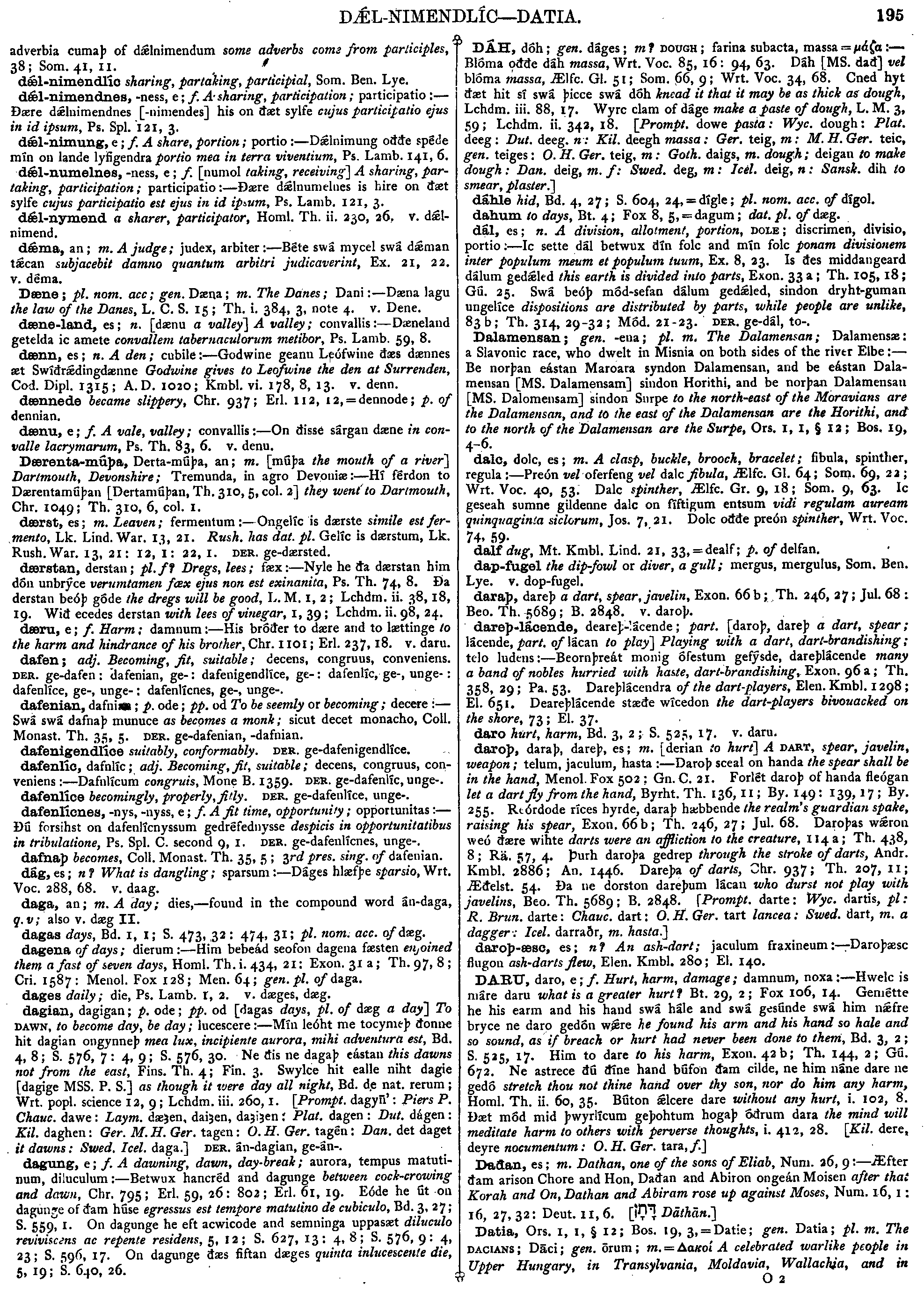
Daðan,
es;
m.
Dathan,
one
of
the
sons
of
Eliab,
Num.
26,
9
:--
Æfter
ðam
arison
Chore
and
Hon,
Daðan
and
Abiron
ongeán
Moisen
after
that
Korah
and
On,
Dathan
and
Abiram
rose
up
against
Moses,
Num.
16,
1:
16,
27,
32:
Deut.
11,
6.
[
HEBREW
D thn.]
thn.]
|
Source: Bosworth/Toller, page b0196, entry 1 View original page image as: [TIFF] [PNG] [View previous entry] [View next entry] |
[Comment on this entry] [View comments] |
The following entry has been hand-corrected once. |
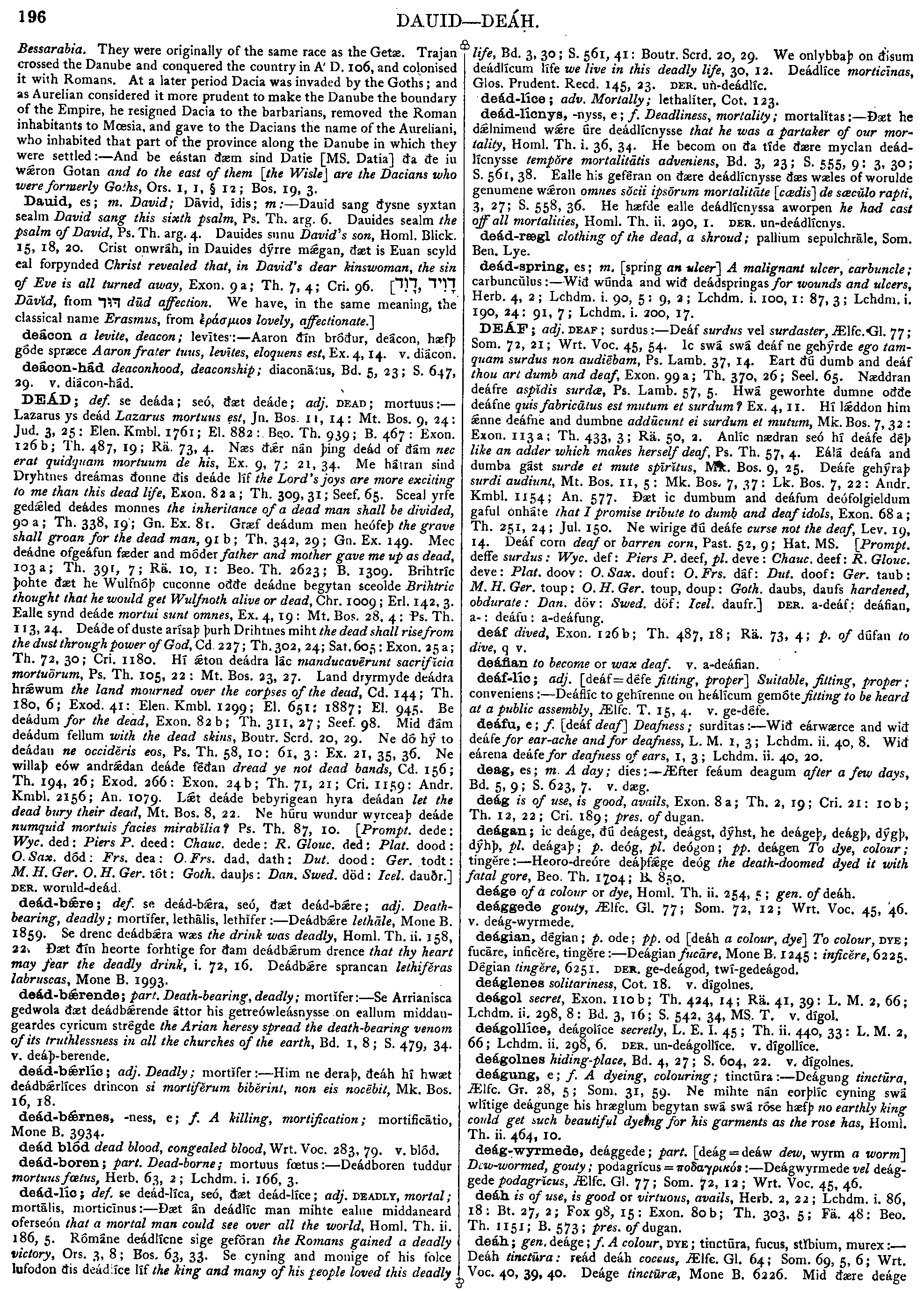
Dauid,
es;
m.
David;
Dvid,
 dis;
m
:--
Dauid
sang
ðysne
syxtan
sealm
David
sang
this
sixth
psalm,
Ps.
Th.
arg.
6.
Dauides
sealm
the
psalm
of
David,
Ps.
Th.
arg.
4.
Dauides
sunu
David's
son,
Homl.
Blick.
15,
18,
20.
Crist
onwráh,
in
Dauides
dýrre
m
dis;
m
:--
Dauid
sang
ðysne
syxtan
sealm
David
sang
this
sixth
psalm,
Ps.
Th.
arg.
6.
Dauides
sealm
the
psalm
of
David,
Ps.
Th.
arg.
4.
Dauides
sunu
David's
son,
Homl.
Blick.
15,
18,
20.
Crist
onwráh,
in
Dauides
dýrre
m gan,
ðæt
is
Euan
scyld
eal
forpynded
Christ
revealed
that,
in
David's
dear
kinswoman,
the
sin
of
Eve
is
all
turned
away,
Exon.
9
a;
Th.
7,
4;
Cri.
96.
[
HEBREW
Dv
gan,
ðæt
is
Euan
scyld
eal
forpynded
Christ
revealed
that,
in
David's
dear
kinswoman,
the
sin
of
Eve
is
all
turned
away,
Exon.
9
a;
Th.
7,
4;
Cri.
96.
[
HEBREW
Dv d,
from
HEBREW
d
d,
from
HEBREW
d d
affection.
We
have,
in
the
same
meaning,
the
classical
name
Erasmus,
from
&epsilon-tonos;
d
affection.
We
have,
in
the
same
meaning,
the
classical
name
Erasmus,
from
&epsilon-tonos; &alpha-tonos;

 os
lovely,
affectionate.]
os
lovely,
affectionate.]
|
Source: Bosworth/Toller, page b0200, entry 11 View original page image as: [TIFF] [PNG] [View previous entry] [View next entry] |
[Comment on this entry] [View comments] |
The following entry has been hand-corrected once. |
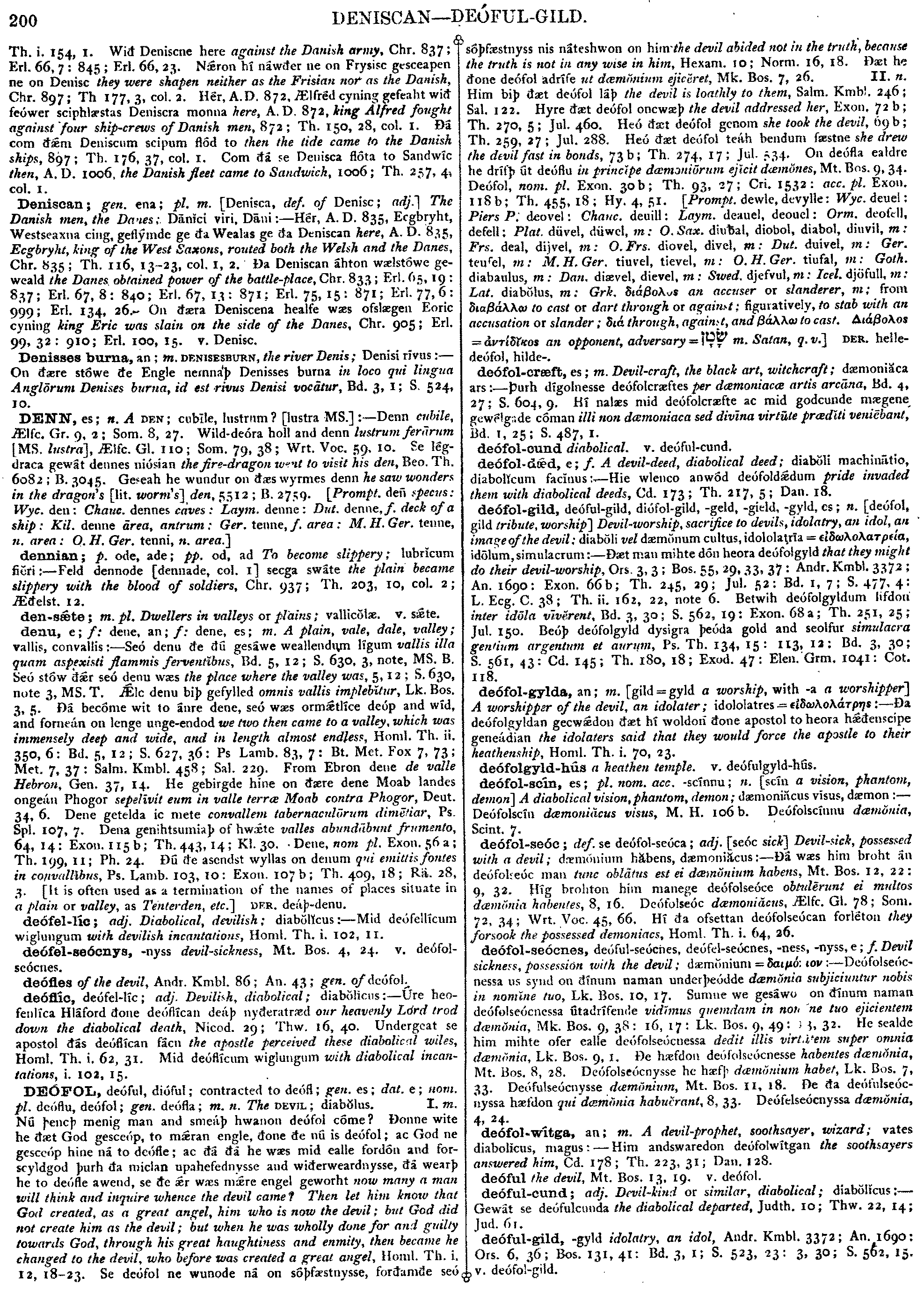
DEÓFOL,
deóful,
dióful;
contracted
to
deófl;
gen.
es;
dat.
e;
nom.
pl.
deóflu,
deófol;
gen.
deófla;
m.
n.
The
DEVIL;
diab lus.
I.
m.
Nú
þencþ
menig
man
and
smeáþ
hwanon
deófol
cóme?
Ðonne
wite
he
ðæt
God
gesceóp,
to
mran
engle,
ðone
ðe
nú
is
deófol;
ac
God
ne
gesceóp
hine
ná
to
deófle;
ac
ðá
ðá
he
wæs
mid
ealle
fordón
and
forscyldgod
þurh
ða
miclan
upahefednysse
and
wiðerweardnysse,
ðá
wearþ
he
to
deófle
awend,
se
ðe
r
wæs
mre
engel
geworht
now
many
a
man
will
think
and
inquire
whence
the
devil
came?
Then
let
him
know
that
God
created,
as
a
great
angel,
him
who
is
now
the
devil;
but
God
did
not
create
him
as
the
devil;
but
when
he
was
wholly
done
for
and
guilty
towards
God,
through
his
great
haughtiness
and
enmity,
then
became
he
changed
to
the
devil,
who
before
was
created
a
great
angel,
Homl.
Th.
i.
12,
18-23.
Se
deófol
ne
wunode
ná
on
sóþfæstnysse,
forðamðe
seó
soþfæstnyss
nis
náteshwon
on
him
the
devil
abided
not
in
the
truth,
because
the
truth
is
not
in
any
wise
in
him,
Hexam.
10;
Norm.
16,
18.
Ðæt
he
ðone
deófol
adrífe
ut
dæmnium
ejic
lus.
I.
m.
Nú
þencþ
menig
man
and
smeáþ
hwanon
deófol
cóme?
Ðonne
wite
he
ðæt
God
gesceóp,
to
mran
engle,
ðone
ðe
nú
is
deófol;
ac
God
ne
gesceóp
hine
ná
to
deófle;
ac
ðá
ðá
he
wæs
mid
ealle
fordón
and
forscyldgod
þurh
ða
miclan
upahefednysse
and
wiðerweardnysse,
ðá
wearþ
he
to
deófle
awend,
se
ðe
r
wæs
mre
engel
geworht
now
many
a
man
will
think
and
inquire
whence
the
devil
came?
Then
let
him
know
that
God
created,
as
a
great
angel,
him
who
is
now
the
devil;
but
God
did
not
create
him
as
the
devil;
but
when
he
was
wholly
done
for
and
guilty
towards
God,
through
his
great
haughtiness
and
enmity,
then
became
he
changed
to
the
devil,
who
before
was
created
a
great
angel,
Homl.
Th.
i.
12,
18-23.
Se
deófol
ne
wunode
ná
on
sóþfæstnysse,
forðamðe
seó
soþfæstnyss
nis
náteshwon
on
him
the
devil
abided
not
in
the
truth,
because
the
truth
is
not
in
any
wise
in
him,
Hexam.
10;
Norm.
16,
18.
Ðæt
he
ðone
deófol
adrífe
ut
dæmnium
ejic ret,
Mk.
Bos.
7,
26.
II.
n.
Him
biþ
ðæt
deófol
láþ
the
devil
is
loathly
to
them,
Salm.
Kmhl.
246;
Sal.
122.
Hyre
ðæt
deófol
oncwæþ
the
devil
addressed
her,
Exon.
72
b;
Th.
270,
5;
Jul.
460.
Heó
ðæt
deófol
genom
she
took
the
devil,
69
b;
Th.
259,
27;
Jul.
288.
Heó
ðæt
deófol
teáh
bendum
fæstne
she
drew
the
devil
fast
in
bonds,
73
b;
Th.
274,
17;
Jul.
534.
On
deófla
ealdre
he
drífþ
út
deóflu
in
princpe
dæmoni
ret,
Mk.
Bos.
7,
26.
II.
n.
Him
biþ
ðæt
deófol
láþ
the
devil
is
loathly
to
them,
Salm.
Kmhl.
246;
Sal.
122.
Hyre
ðæt
deófol
oncwæþ
the
devil
addressed
her,
Exon.
72
b;
Th.
270,
5;
Jul.
460.
Heó
ðæt
deófol
genom
she
took
the
devil,
69
b;
Th.
259,
27;
Jul.
288.
Heó
ðæt
deófol
teáh
bendum
fæstne
she
drew
the
devil
fast
in
bonds,
73
b;
Th.
274,
17;
Jul.
534.
On
deófla
ealdre
he
drífþ
út
deóflu
in
princpe
dæmoni rum
ejcit
dæmnes,
Mt.
Bos.
9,
34.
Deófol,
nom.
pl.
Exon.
30
b;
Th.
93,
27;
Cri.
1532
:
acc.
pl.
Exon.
118
b;
Th.
455.
18;
Hy.
4,
51.
[Prompt.
dewle,
devylle
:
Wyc.
deuel
:
Piers
P.
deovel
:
Chauc.
deuill
:
Laym.
deauel,
deouel
:
Orm.
deofell,
defell
:
Plat.
düvel,
düwel,
m
:
O.
Sax.
diu
rum
ejcit
dæmnes,
Mt.
Bos.
9,
34.
Deófol,
nom.
pl.
Exon.
30
b;
Th.
93,
27;
Cri.
1532
:
acc.
pl.
Exon.
118
b;
Th.
455.
18;
Hy.
4,
51.
[Prompt.
dewle,
devylle
:
Wyc.
deuel
:
Piers
P.
deovel
:
Chauc.
deuill
:
Laym.
deauel,
deouel
:
Orm.
deofell,
defell
:
Plat.
düvel,
düwel,
m
:
O.
Sax.
diu al,
diobol,
diabol,
diuvil,
m
:
Frs.
deal,
dijvel,
m
:
O.
Frs.
diovel,
divel,
m
:
Dut.
duivel,
m
:
Ger.
teufel,
m
:
M.
H.
Ger.
tiuvel,
tievel,
m
:
O.
H.
Ger.
tiufal,
m
:
Goth.
diabaulus,
m
:
Dan.
diævel,
dievel,
m
:
Swed.
djefvul,
m
:
Icel.
djöfull,
m
:
Lat.
diablus,
m
:
Grk.
al,
diobol,
diabol,
diuvil,
m
:
Frs.
deal,
dijvel,
m
:
O.
Frs.
diovel,
divel,
m
:
Dut.
duivel,
m
:
Ger.
teufel,
m
:
M.
H.
Ger.
tiuvel,
tievel,
m
:
O.
H.
Ger.
tiufal,
m
:
Goth.
diabaulus,
m
:
Dan.
diævel,
dievel,
m
:
Swed.
djefvul,
m
:
Icel.
djöfull,
m
:
Lat.
diablus,
m
:
Grk.
 &alpha-tonos;
 o
o
 s
an
accuser
or
slanderer,
m
:
from
s
an
accuser
or
slanderer,
m
:
from
 &alpha-tonos;
 to
cast
or
dart
through
or
against;
figuratively,
to
stab
with
an
accusation
or
slander;
&alpha-tonos;
through,
against,
and
&alpha-tonos;
to
cast.
Δ&alpha-tonos;oos
=
&alpha-tonos;
to
cast
or
dart
through
or
against;
figuratively,
to
stab
with
an
accusation
or
slander;
&alpha-tonos;
through,
against,
and
&alpha-tonos;
to
cast.
Δ&alpha-tonos;oos
=
&alpha-tonos;
 &iota-tonos;
 os
an
opponent,
adversary
=
HEBREW
m.
Satan,
q.
v.]
DER.
helle-deófol,
hilde-.
os
an
opponent,
adversary
=
HEBREW
m.
Satan,
q.
v.]
DER.
helle-deófol,
hilde-.
|
Source: Bosworth/Toller, page b0238, entry 4 View original page image as: [TIFF] [PNG] [View previous entry] [View next entry] |
[Comment on this entry] [View comments] |
The following entry has been hand-corrected once. |
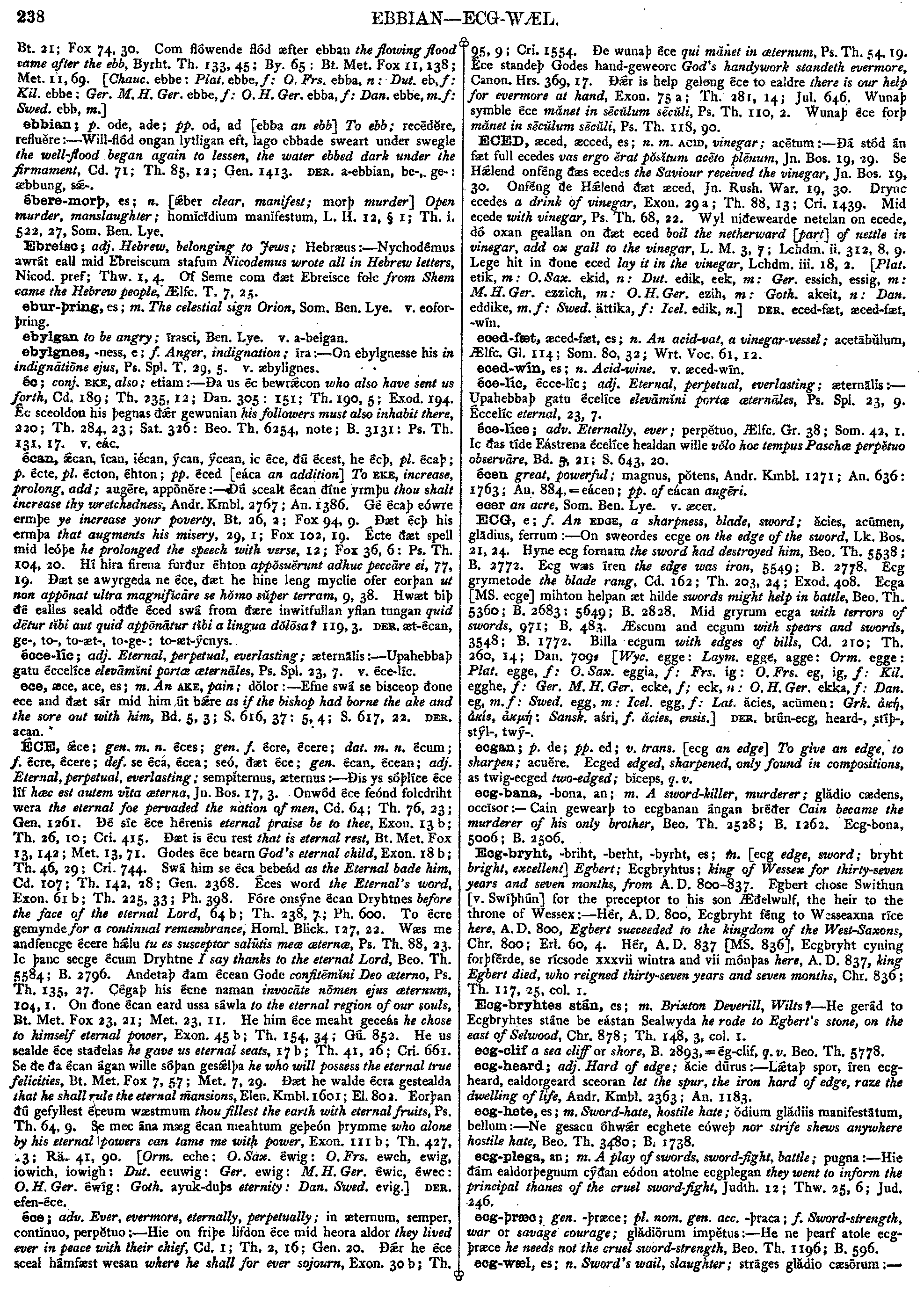
Ebreisc; adj. Hebrew, belonging to Jews; Hebræus :-- Nychodémus awrát eall mid Ebreiscum stafum Nicodemus wrote all in Hebrew letters, Nicod. pref; Thw. 1. 4. Of Seme com ðæt Ebreisce folc from Shem came the Hebrew people, Ælfc. T. 7, 25.
|
Source: Bosworth/Toller, page b0247, entry 35 View original page image as: [TIFF] [PNG] [View previous entry] [View next entry] |
[Comment on this entry] [View comments] |
The following entry has been hand-corrected once. |
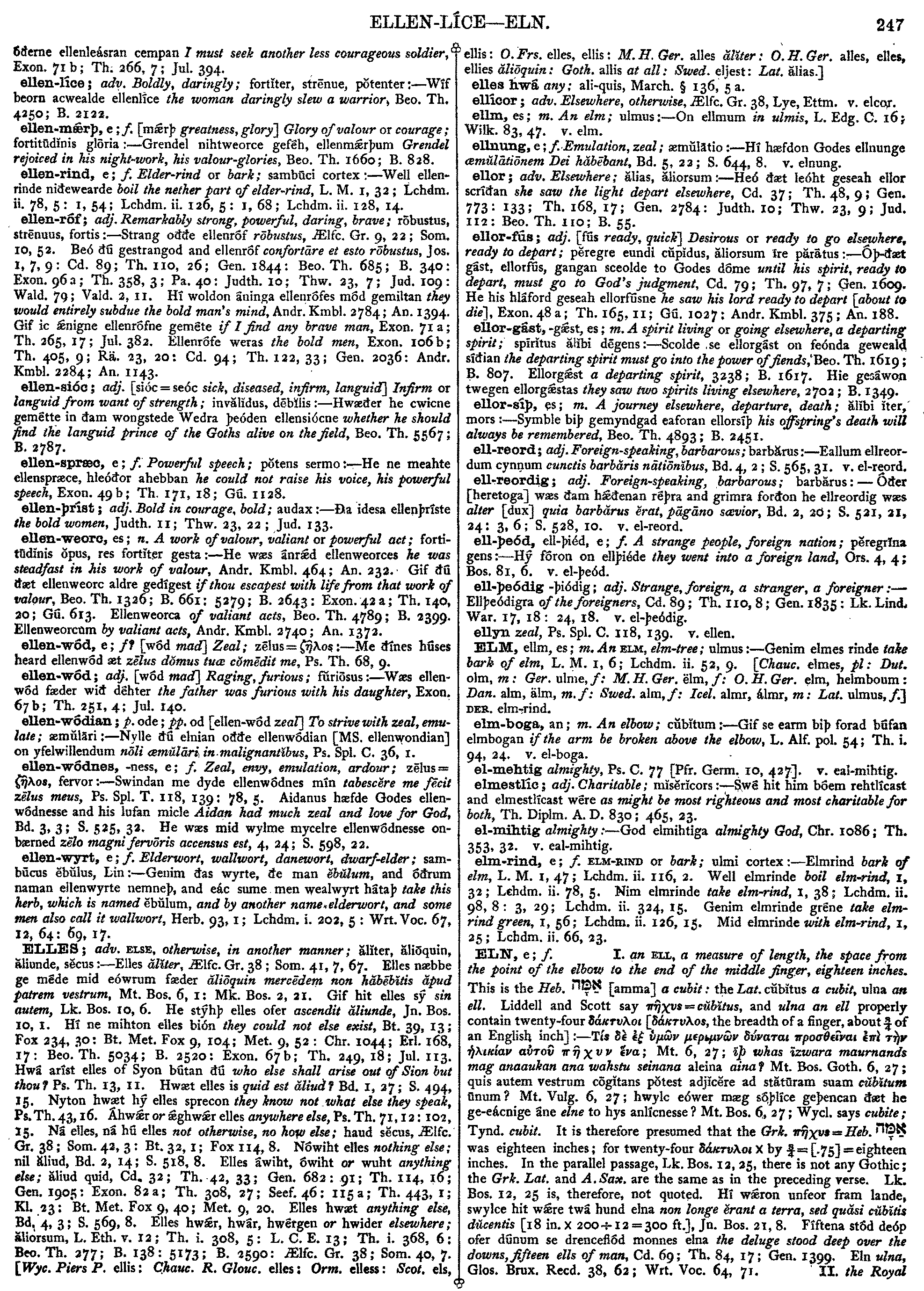
ELN,
e;
f.
I.
an
ELL,
a
measure
of
length,
the
space
from
the
point
of
the
elbow
to
the
end
of
the
middle
finger,
eighteen
inches.
This
is
the
Heb.
HEBREW
[amma]
a
cubit:
the
Lat.
c btus
a
cubit,
ulna
an
ell.
Liddell
and
Scott
say
GREEK
=
cbtus,
and
ulna
an
ell
properly
contain
twenty-four
GREEK
[GREEK
the
breadth
of
a
finger,
about
3/4
of
an
English
inch]
:--
GREEK;
Mt.
6,
27;
p
whas
zwara
maurnands
mag
anaaukan
ana
wahstu
seinana
aleina
aina?
Mt.
Bos.
Goth.
6,
27;
quis
autem
vestrum
cgtans
ptest
adjcre
ad
st
btus
a
cubit,
ulna
an
ell.
Liddell
and
Scott
say
GREEK
=
cbtus,
and
ulna
an
ell
properly
contain
twenty-four
GREEK
[GREEK
the
breadth
of
a
finger,
about
3/4
of
an
English
inch]
:--
GREEK;
Mt.
6,
27;
p
whas
zwara
maurnands
mag
anaaukan
ana
wahstu
seinana
aleina
aina?
Mt.
Bos.
Goth.
6,
27;
quis
autem
vestrum
cgtans
ptest
adjcre
ad
st tram
suam
cbtum
num?
Mt.
Vulg.
6,
27;
hwylc
eówer
mæg
sóþlíce
geþencan
ðæt
he
ge-eácnige
áne
elne
to
hys
anlícnesse?
Mt.
Bos.
6,
27;
Wycl.
says
cubite;
Tynd.
cubit.
It
is
therefore
presumed
that
the
Grk.
GREEK
=
Heb.
HEBREW
was
eighteen
inches;
for
twenty-four
GREEK
×
by
3/4
=
[.75]
=
eighteen
inches.
In
the
parallel
passage,
Lk.
Bos.
12,
25,
there
is
not
any
Gothic;
the
Grk.
Lat.
and
A.
Sax.
are
the
same
as
in
the
preceding
verse.
Lk.
Bos.
12,
25
is,
therefore,
not
quoted.
Hí
wron
unfeor
fram
lande,
swylce
hit
wre
twá
hund
elna
non
longe
rant
a
terra,
sed
qusi
cbtis
dcentis
[18
in.
×
200
÷
12
=
300
ft.],
Jn.
Bos.
21,
8.
Fíftena
stód
deóp
ofer
dúnum
se
drenceflód
monnes
elna
the
deluge
stood
deep
over
the
downs,
fifteen
ells
of
man,
Cd.
69;
Th.
84,
17;
Gen.
1399.
Eln
ulna,
Glos.
Brux.
Recd.
38,
62;
Wrt.
Voc.
64,
71.
II.
the
Royal
tram
suam
cbtum
num?
Mt.
Vulg.
6,
27;
hwylc
eówer
mæg
sóþlíce
geþencan
ðæt
he
ge-eácnige
áne
elne
to
hys
anlícnesse?
Mt.
Bos.
6,
27;
Wycl.
says
cubite;
Tynd.
cubit.
It
is
therefore
presumed
that
the
Grk.
GREEK
=
Heb.
HEBREW
was
eighteen
inches;
for
twenty-four
GREEK
×
by
3/4
=
[.75]
=
eighteen
inches.
In
the
parallel
passage,
Lk.
Bos.
12,
25,
there
is
not
any
Gothic;
the
Grk.
Lat.
and
A.
Sax.
are
the
same
as
in
the
preceding
verse.
Lk.
Bos.
12,
25
is,
therefore,
not
quoted.
Hí
wron
unfeor
fram
lande,
swylce
hit
wre
twá
hund
elna
non
longe
rant
a
terra,
sed
qusi
cbtis
dcentis
[18
in.
×
200
÷
12
=
300
ft.],
Jn.
Bos.
21,
8.
Fíftena
stód
deóp
ofer
dúnum
se
drenceflód
monnes
elna
the
deluge
stood
deep
over
the
downs,
fifteen
ells
of
man,
Cd.
69;
Th.
84,
17;
Gen.
1399.
Eln
ulna,
Glos.
Brux.
Recd.
38,
62;
Wrt.
Voc.
64,
71.
II.
the
Royal
|
Source: Bosworth/Toller, page b0254, entry 9 View original page image as: [TIFF] [PNG] [View previous entry] [View next entry] |
[Comment on this entry] [View comments] |
The following entry has been hand-corrected once. |
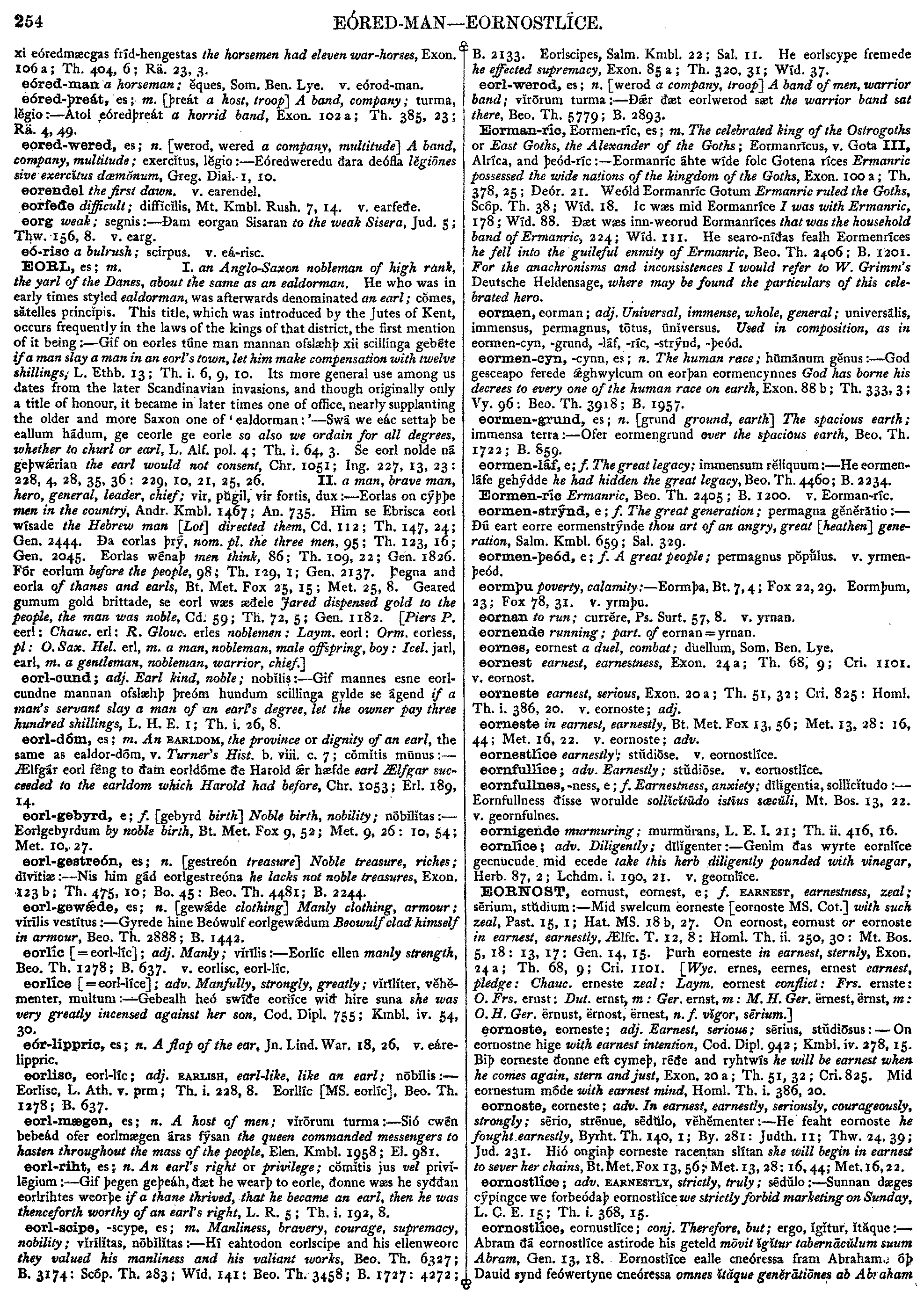
EORL.
es;
m.
I.
an
Anglo-Saxon
nobleman
of
high
rank,
the
yarl
of
the
Danes,
about
the
same
as
an
ealdorman.
He
who
was
in
early
times
styled
ealdorman,
was
afterwards
denominated
an
earl;
cmes,
stelles
princpis.
This
title,
which
was
introduced
by
the
Jutes
of
Kent,
occurs
frequently
in
the
laws
of
the
kings
of
that
district,
the
first
mention
of
it
being
:--
Gif
on
eorles
túne
man
mannan
ofslæhþ
xii
scillinga
gebéte
if
a
man
slay
a
man
in
an
earl's
town,
let
him
make
compensation
with
twelve
shillings,
L.
Ethb.
13;
Th.
i.
6,
9,
10.
Its
more
general
use
among
us
dates
from
the
later
Scandinavian
invasions,
and
though
originally
only
a
title
of
honour,
it
became
in
later
times
one
of
office,
nearly
supplanting
the
older
and
more
Saxon
one
of
'ealdorman:'
--
Swá
we
eác
settaþ
be
eallum
hádum,
ge
ceorle
ge
eorle
so
also
we
ordain
for
all
degrees,
whether
to
churl
or
earl,
L.
Alf.
pol.
4;
Th.
i.
64,
3.
Se
eorl
nolde
ná
géþwsrian
the
earl
would
not
consent,
Chr.
1051;
Ing.
227,
13,
23:
228,
4,
28,
35,
36:
229,
10,
21,
25,
26.
II.
a
man,
brave
man,
hero,
general,
leader,
chief;
vir,
pgil,
vir
fortis,
dux
:--
Eorlas
on
cýþþe
men
in
the
country.
Andr.
Kmbl.
1467;
An.
735.
Him
se
Ebrisca
eorl
wísade
the
Hebrew
man
[Lot]
directed
them.
Cd.
112;
Th.
147,
24;
Gen.
2444.
Ða
eorlas
þrý,
nom.
pl.
the
three
men,
95;
Th.
123,
16;
Gen.
2045.
Eorlas
wénaþ
men
think,
86;
Th.
109,
22;
Gen.
1826.
Fór
eorlum
before
the
people,
98;
Th.
129,
1;
Gen.
2137.
þegna
and
eorla
of
thanes
and
earls,
Bt.
Met.
Fox
25,
15
;
Met.
25,
8.
Geared
gumum
gold
brittade,
se
eorl
wæs
æðele
Jared
dispensed
gold
to
the
people,
the
man
was
noble.
Cd.
59;
Th.
72,
5;
Gen.
1182.
[Piers
P.
eerl:
Chauc.
erl:
R.
Glouc.
erles
noblemen:
Laym.
eorl:
Orm.
eorless,
pl:
O.
Sax.
Hel.
erl,
m.
a
man,
nobleman,
male
offspring,
boy:
Icel.
jarl,
earl,
m.
a
gentleman,
nobleman,
warrior,
chief.]
|
Source: Bosworth/Toller, page b0258, entry 31 View original page image as: [TIFF] [PNG] [View previous entry] [View next entry] |
[Comment on this entry] [View comments] |
The following entry has been hand-corrected once. |
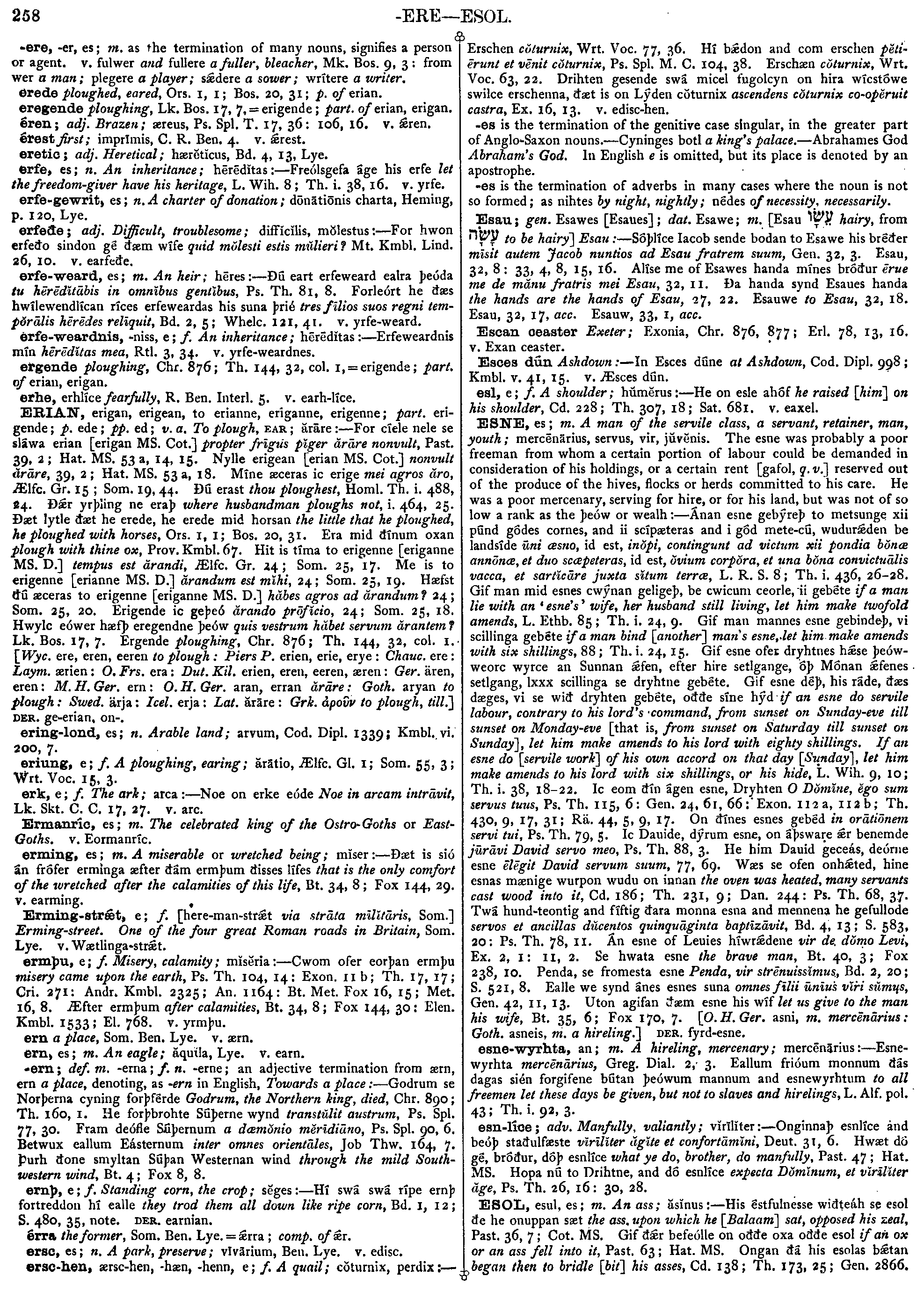
Esau;
gen.
Esawes
[Esaues];
dat.
Esawe;
m.
[Esau
HEBREW
hairy,
from
HEBREW
to
be
hairy]
Esau
:--
Sóþlíce
Iacob
sende
bodan
to
Esawe
his
bréðer
mst
autem
Jacob
nuntios
ad
Esau
fratrem
suum,
Gen.
32,
3.
Esau,
32,
8:
33,
4,
8,
15,
16.
Alse
me
of
Esawes
handa
mínes
bróður
 rue
me
de
mnu
fratris
mei
Esau,
32,
11.
Ða
handa
synd
Esaues
handa
the
hands
are
the
hands
of
Esau,
27,
22.
Esauwe
to
Esaa,
32,
18.
Esau,
32,
17,
acc.
Esauw,
33,
1,
acc.
rue
me
de
mnu
fratris
mei
Esau,
32,
11.
Ða
handa
synd
Esaues
handa
the
hands
are
the
hands
of
Esau,
27,
22.
Esauwe
to
Esaa,
32,
18.
Esau,
32,
17,
acc.
Esauw,
33,
1,
acc.
|
Source: Bosworth/Toller, page b0261, entry 27 View original page image as: [TIFF] [PNG] [View previous entry] [View next entry] |
[Comment on this entry] [View comments] |
The following entry has been hand-corrected once. |
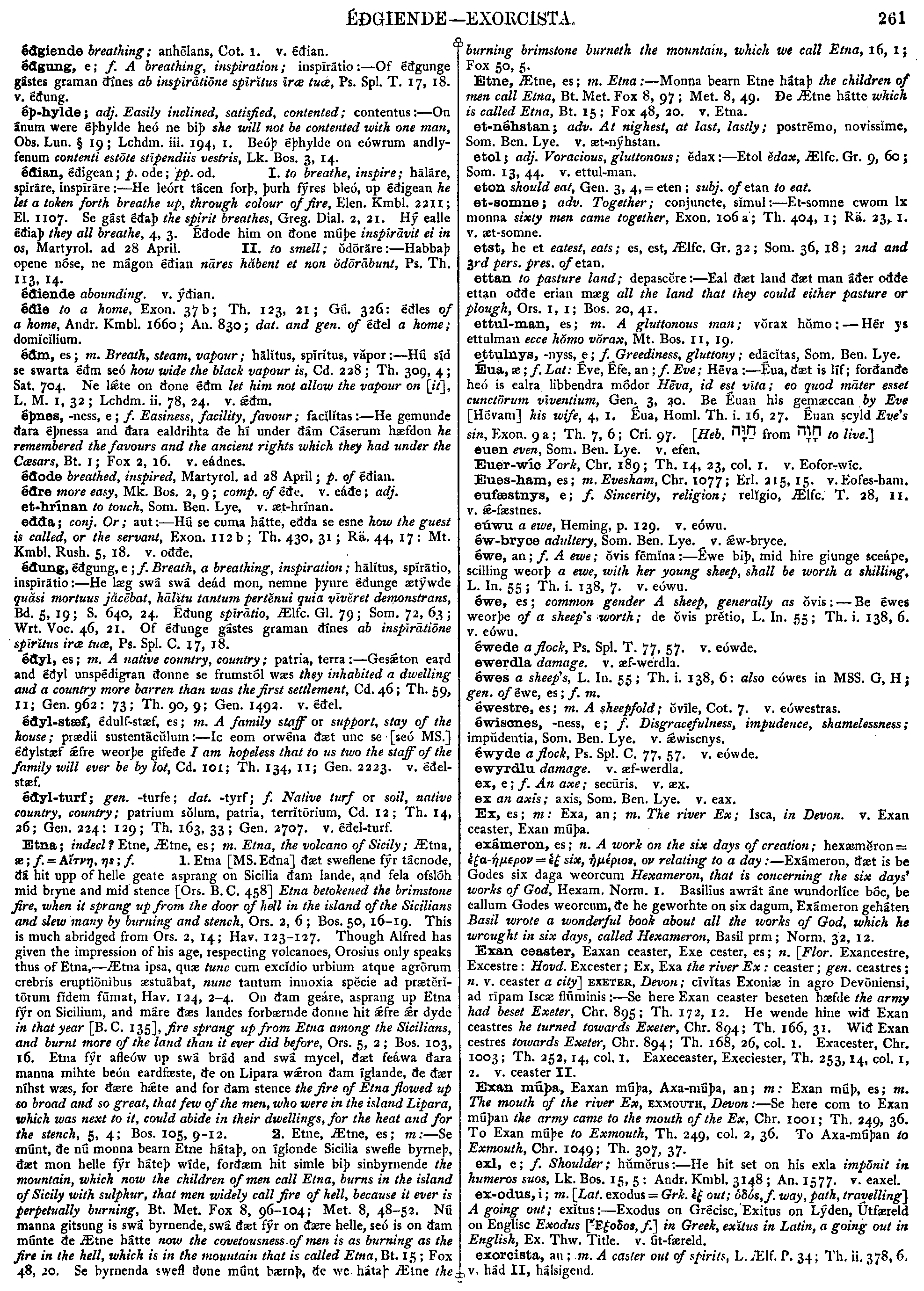
Éua,
æ;
f.
Lat:
Éve,
Éfe,
an;
f.
Eve;
Hva:--
Éua,
ðæt
is
lí;
forðanðe
heó
is
ealra
libbendra
módor
Hva,
id
est
vta;
eo
quod
mter
esset
cunctrum
vventium,
Gen.
3,
30.
Be
Éuan
his
gemæccan
by
Eve
[Hvam]
his
wife,
4,
1.
Éua,
Homl.
Th.
i.
16,
27.
Éuan
scyld
Eve's
sin,
Exon.
9
a;
Th.
7,
6;
Cri.
97.
[Heb.
HEBREW
from
HEBREW
to
live.]
|
Source: Bosworth/Toller, page b0281, entry 29 View original page image as: [TIFF] [PNG] [View previous entry] [View next entry] |
[Comment on this entry] [View comments (1)] |
The following entry has been hand-corrected once. |
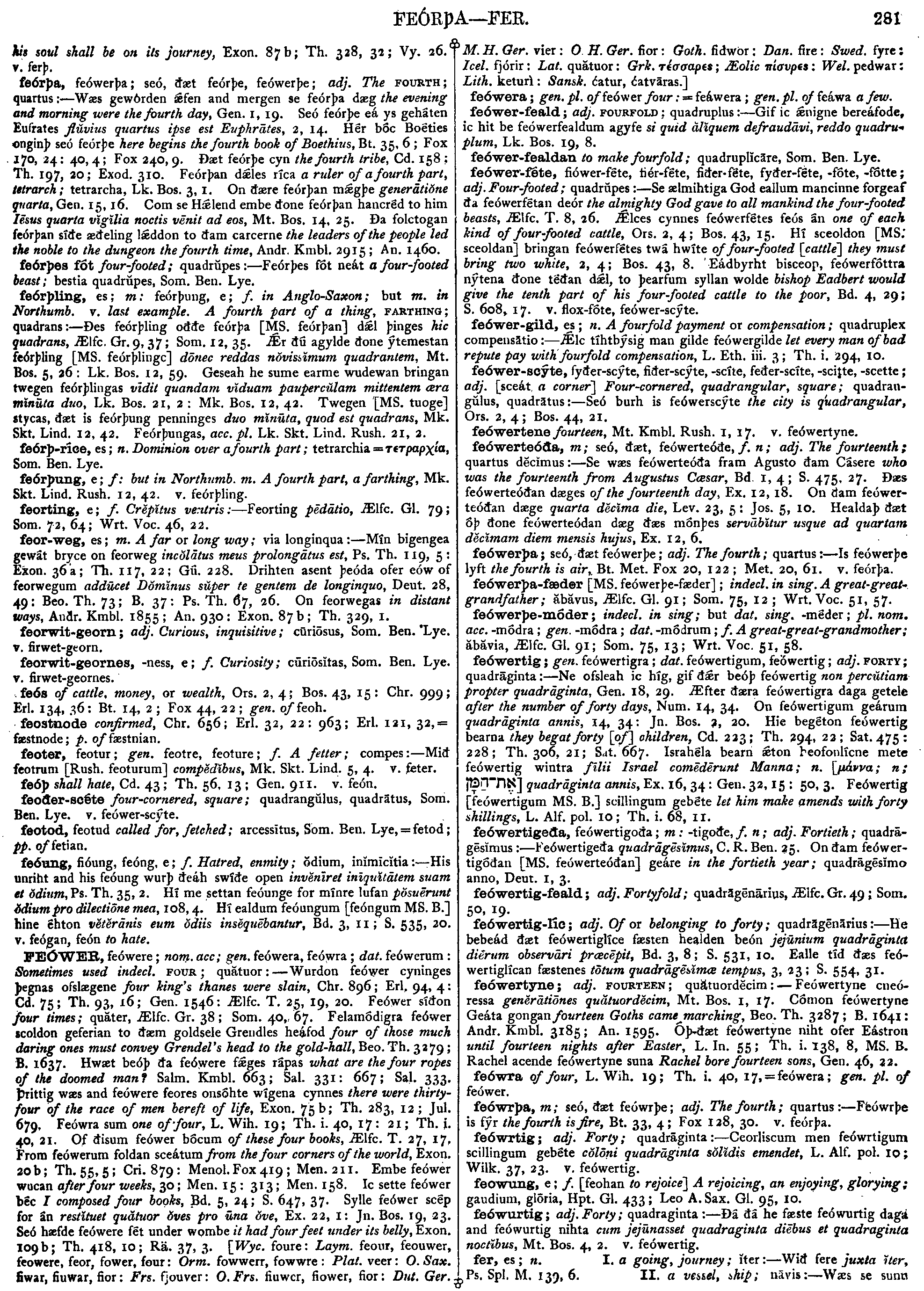
feówertig;
gen.
feówertigra;
dat.
feówertigum,
feówertig;
adj.
FORTY;
quadrginta
:--
Ne
ofsleah
ic
híg,
gif
ðr
beóþ
feówertig
non
perctiam
propter
quadrginta,
Gen.
18,
29.
Æfter
ðæra
feówertigra
daga
getele
after
the
number
of
forty
days,
Num.
14,
34.
On
feówertigum
geárum
quadrginta
annis,
14,
34:
Jn.
Bos.
2;
20.
Hie
begéton
feówertig
bearna
they
beat
forty
[of]
children,
Cd.
223;
Th.
294,
22;
Sat,
475:
228;
Th.
306,
21;
Sat.
667.
Israhéla
bearn
ton
beofonlícne
mete
feówertig
wintra
flii
Israel
comdrunt
Manna;
n.
[&alpha-tonos;;
n;
HEBREW
]
quadrginta
annis,
Ex.
16,
34:
Gen.
32,
15:
50,
3.
Feówertig
[feówertigum
MS.
B.]
scillingum
gebéte
let
him
make
amends
with
forty
shillings,
L.
Alf.
pol.
10;
Th.
i.
68,
11.
|
Source: Bosworth/Toller, page b0383, entry 8 View original page image as: [TIFF] [PNG] [View previous entry] [View next entry] |
[Comment on this entry] [View comments] |
The following entry has been hand-corrected once. |
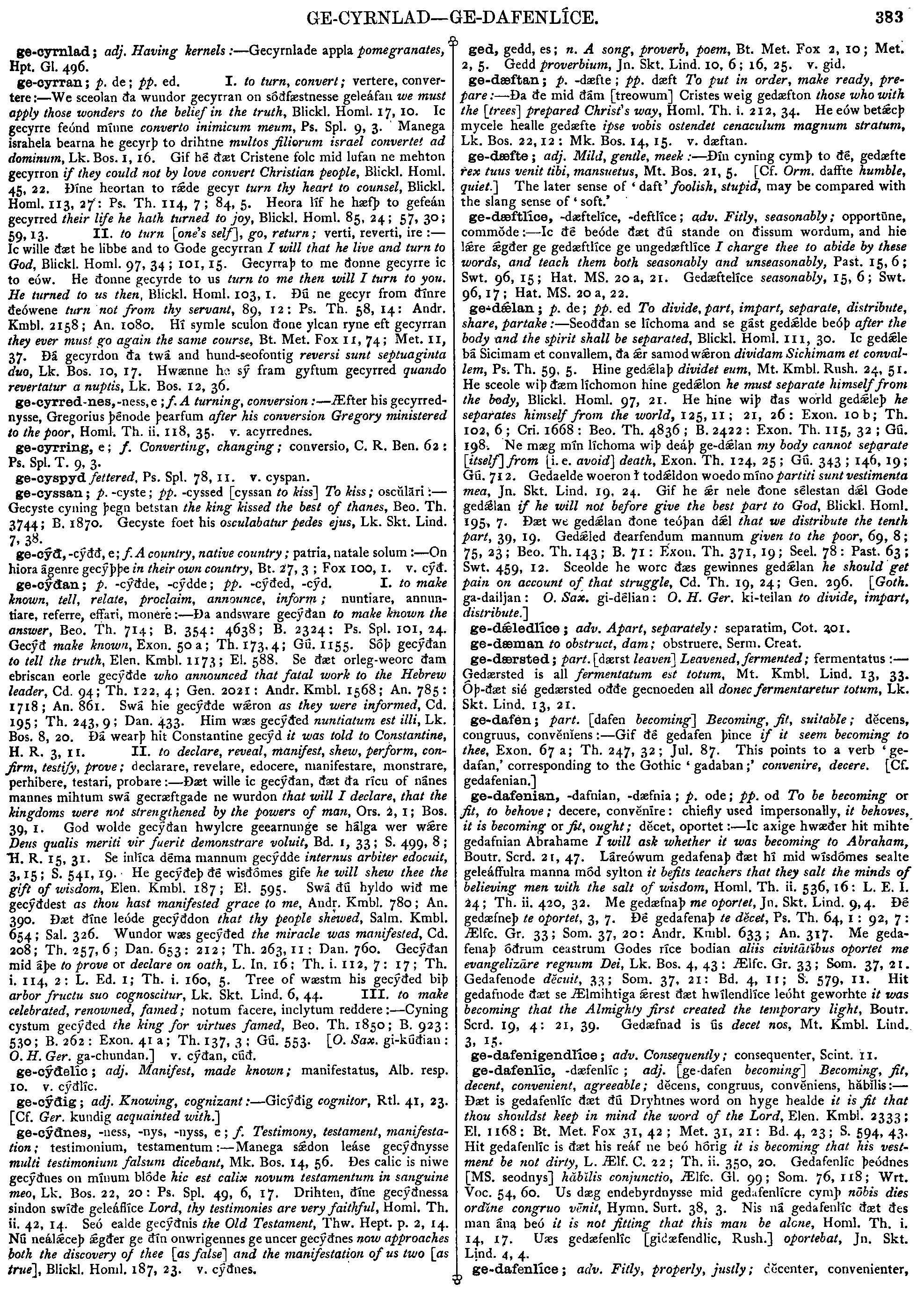
ge-cýðan;
p.
-cýðde,
-cýdde;
pp.
-cýðed,
-cýd.
I.
to
make
known,
tell,
relate,
proclaim,
announce,
inform;
nuntiare,
annuntiare,
referre,
effari,
monere
:--
Ða
andsware
gecýðan
to
make
known
the
answer,
Beo.
Th.
714;
B.
354
:
4638;
B.
2324
:
Ps.
Spl.
101,
24.
Gecýð
make
known,
Exon.
50
a;
Th.
173,
4;
Gú.
1155.
Sóþ
gecýðan
to
tell
the
truth,
Elen.
Kmbl.
1173;
El.
588.
Se
ðæt
orleg-weorc
ðam
ebriscan
eorle
gecýðde
who
announced
that
fatal
work
to
the
Hebrew
leader,
Cd.
94;
Th.
122,
4;
Gen.
2021
:
Andr.
Kmbl.
1568;
An.
785
:
1718;
An.
861.
Swá
hie
gecýðde
wron
as
they
were
informed,
Cd.
195;
Th.
243,
9;
Dan.
433.
Him
wæs
gecýðed
nuntiatum
est
illi,
Lk.
Bos.
8,
20.
Ðá
wearþ
hit
Constantine
gecýd
it
was
told
to
Constantine,
H.
R.
3,
11.
II.
to
declare,
reveal,
manifest,
shew,
perform,
confirm,
testify,
prove;
declarare,
revelare,
edocere,
manifestare,
monstrare,
perhibere,
testari,
probare
:--
Ðæt
wille
ic
gecýðan,
ðæt
ða
rícu
of
nánes
mannes
mihtum
swá
gecræftgade
ne
wurdon
that
will
I
declare,
that
the
kingdoms
were
not
strengthened
by
the
powers
of
man,
Ors.
2,
1;
Bos.
39,
1.
God
wolde
gecýðan
hwylcre
geearnunge
se
hálga
wer
wre
Deus
qualis
meriti
vir
fuerit
demonstrare
voluit,
Bd.
1,
33;
S.
499,
8;
H.
R.
15,
31.
Se
inlíca
déma
mannum
gecýdde
internus
arbiter
edocuit,
3,
15;
S.
541,
19.
He
gecýðeþ
ðé
wisðómes
gife
he
will
shew
thee
the
gift
of
wisdom,
Elen.
Kmbl.
187;
El.
595.
Swá
ðú
hyldo
wið
me
gecýðdest
as
thou
hast
manifested
grace
to
me,
Andr.
Kmbl.
780;
An.
390.
Ðæt
ðíne
leóde
gecýðdon
that
thy
people
shewed,
Salm.
Kmbl.
654;
Sal.
326.
Wundor
wæs
gecýðed
the
miracle
was
manifested,
Cd.
208;
Th.
257,
6;
Dan.
653
:
212;
Th.
263,
11;
Dan.
760.
Gecýðan
mid
áþe
to
prove
or
declare
on
oath,
L.
In.
16;
Th.
i.
112,
7
:
17;
Th.
i.
114,
2
:
L.
Ed.
1;
Th.
i.
160,
5.
Tree
of
wæstm
his
gecýðed
biþ
arbor
fructu
suo
cognoscitur,
Lk.
Skt.
Lind.
6,
44.
III.
to
make
celebrated,
renowned,
famed;
notum
facere,
inclytum
reddere
:--
Cyning
cystum
gecýðed
the
king
for
virtues
famed,
Beo.
Th.
1850;
B.
923
:
530;
B.
262
:
Exon.
41
a;
Th.
137,
3
:
Gú.
553.
[O.
Sax.
gi-kúðian
:
O.
H.
Ger.
ga-chundan.]
v.
cýðan,
cúð.
| Result Page: |  |
Previous | 1 2 3 4 | Next |  |
Germanic Lexicon Project (main page)
This search system was written by
Sean Crist
Please consider
volunteering
to correct the data in these online dictionaries.
No rights reserved. Feel free to use these data in any way you please.