|
|

|
Source: Cleasby/Vigfusson, page b0573, entry 3 View original page image as: [TIFF] [PNG] [View previous entry] [View next entry] |
[Comment on this entry] [View comments] |
The following entry has been hand-corrected once. |
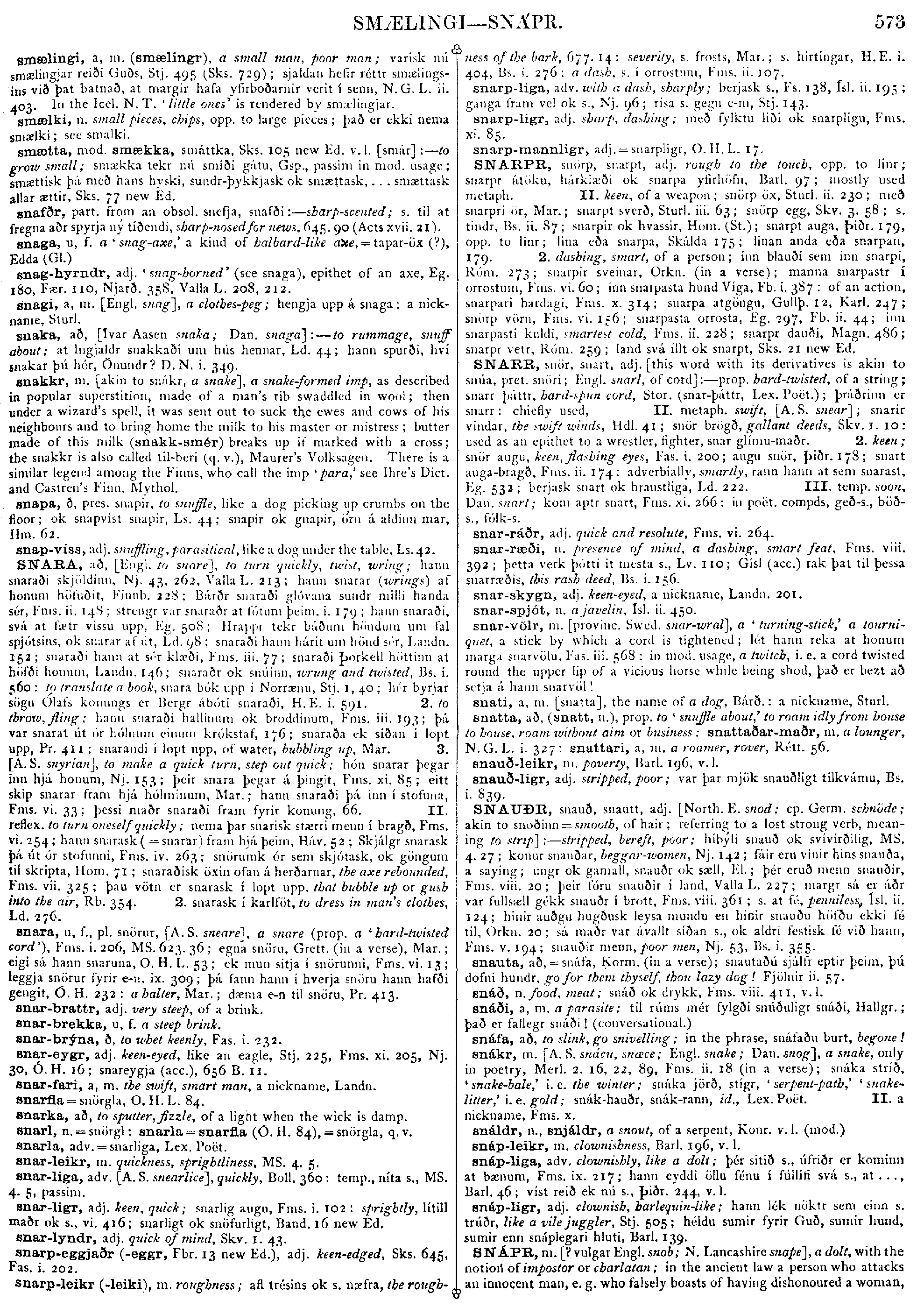
smætta, mod. smækka, smáttka, Sks. 105 new Ed. v.l. [smár] :-- to grow small; smækka tekr nú smíði gátu, Gsp., passim in mod. usage; smættisk þá með hans hyski, sundr-þykkjask ok smættask, ... smættask allar ættir, Sks. 77 new Ed.
|
Source: Cleasby/Vigfusson, page b0582, entry 26 View original page image as: [TIFF] [PNG] [View previous entry] [View next entry] |
[Comment on this entry] [View comments] |
The following entry has been hand-corrected once. |
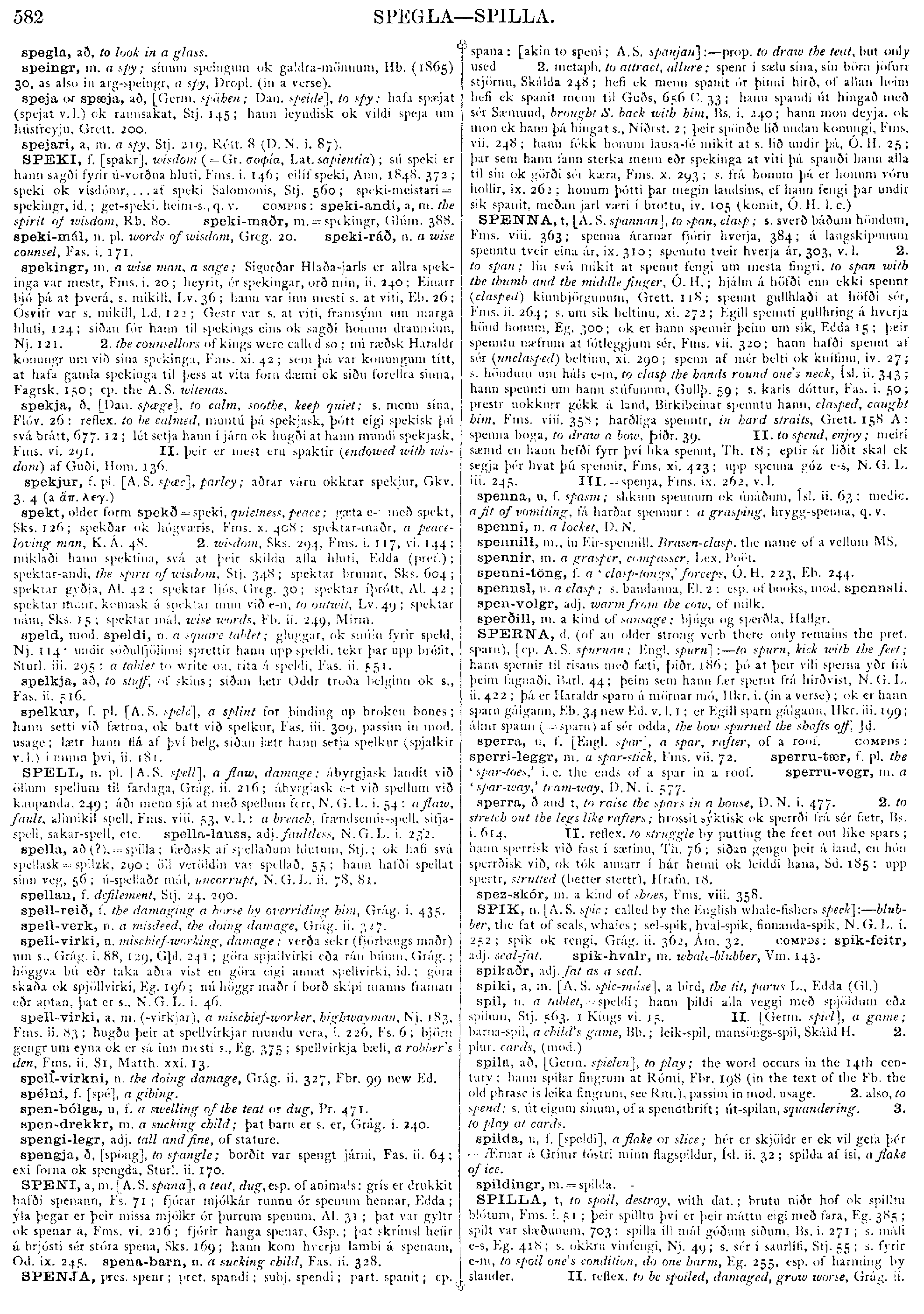
SPENI, a, m. [A.S. spana], a teat, dug, esp. of animals: grís er drukkit hafði spenann, Fs. 71; fjórar mjólkár runnu ór spenum hennar, Edda; ýla þegar er þeir missa mjólkr ór þurrum spenum, Al. 31; þat var gyltr ok spenar á, Fms. vi. 216; fjórir hanga spenar, Gsp.; þat skrímsl hefir á brjósti sér stóra spena, Sks. 169; hann kom hverju lambi á spenann, Od. ix. 245. spena-barn, n. a sucking child, Fas. ii. 328.
|
Source: Cleasby/Vigfusson, page b0601, entry 35 View original page image as: [TIFF] [PNG] [View previous entry] [View next entry] |
[Comment on this entry] [View comments] |
The following entry has been hand-corrected once. |
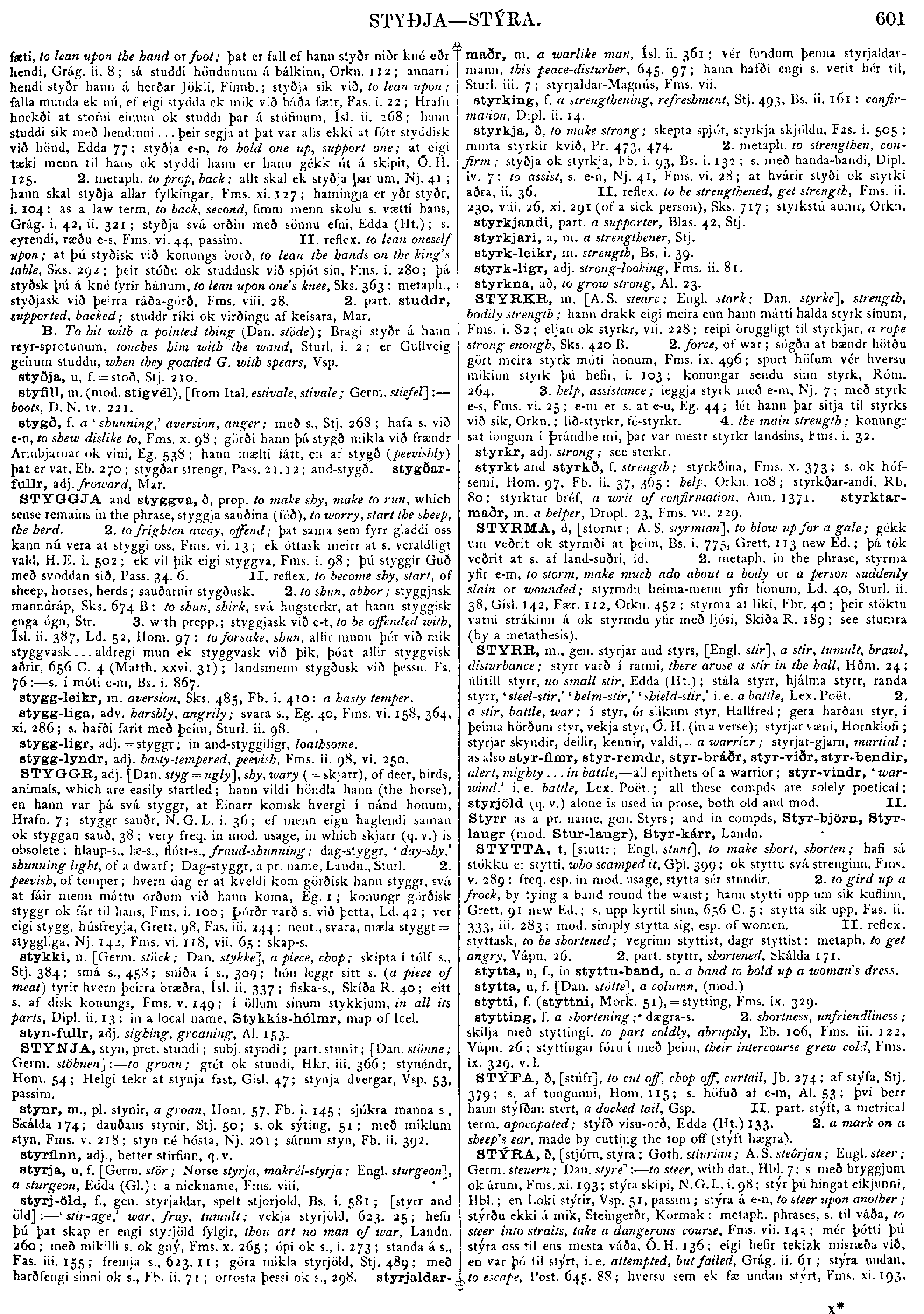
STÝFA, ð, [stúfr], to cut off, chop off, curtail, Jb. 274; af stýfa, Stj. 379; s. af tungunni, Hom. 115; s. höfuð af e-m, Al. 53; því berr hann stýfðan stert, a docked tail, Gsp. II. part. stýft, a metrical term, apocopated; stýfð vísu-orð, Edda (Ht.) 133. 2. a mark on a sheep's ear, made by cutting the top off (stýft hægra).
|
Source: Cleasby/Vigfusson, page b0627, entry 8 View original page image as: [TIFF] [PNG] [View previous entry] [View next entry] |
[Comment on this entry] [View comments] |
The following entry has been hand-corrected once. |
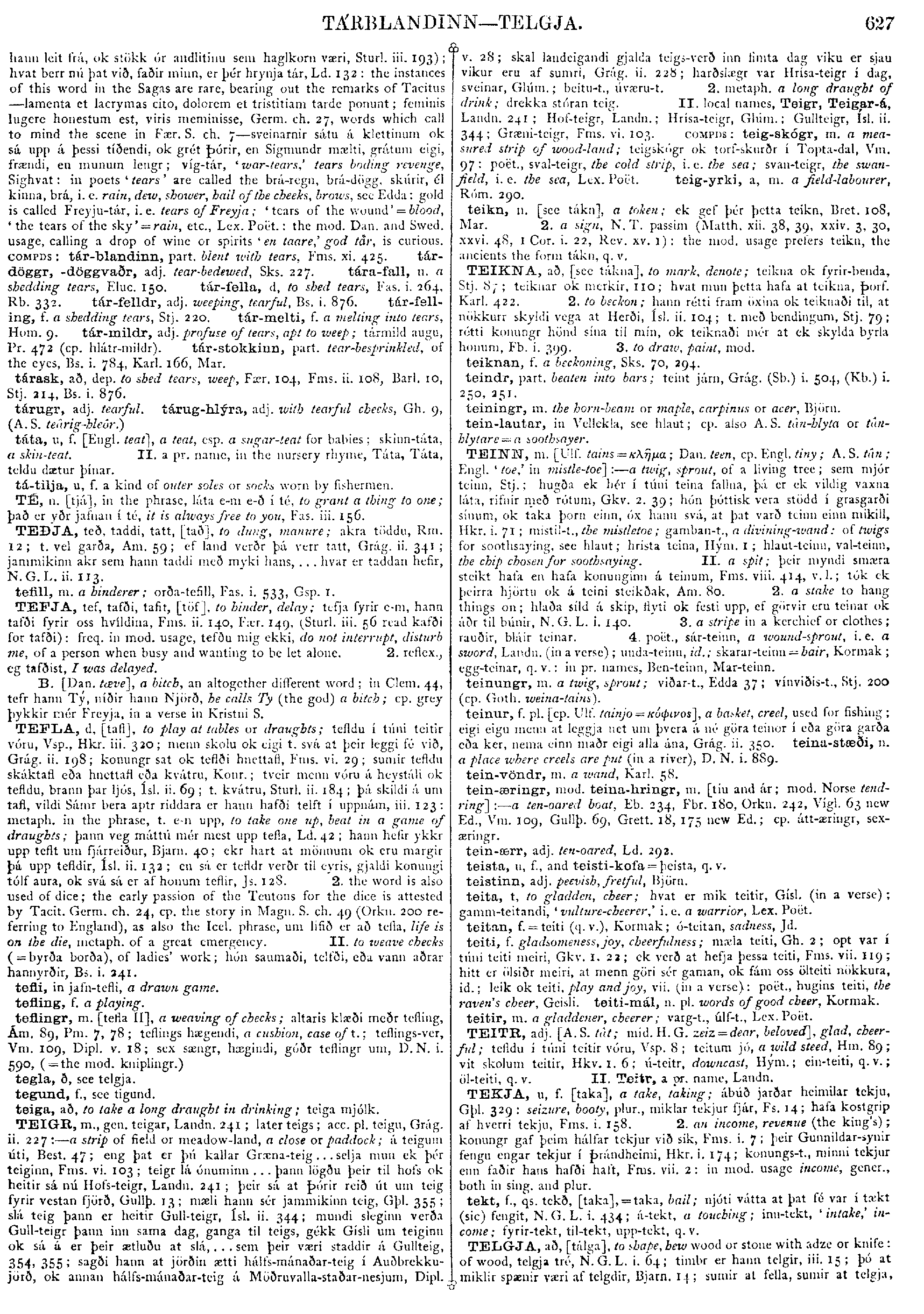
tefill, m. a hinderer; orða-tefill, Fas. i. 533, Gsp. 1.
|
Source: Cleasby/Vigfusson, page b0632, entry 63 View original page image as: [TIFF] [PNG] [View previous entry] [View next entry] |
[Comment on this entry] [View comments] |
The following entry has been hand-corrected once. |
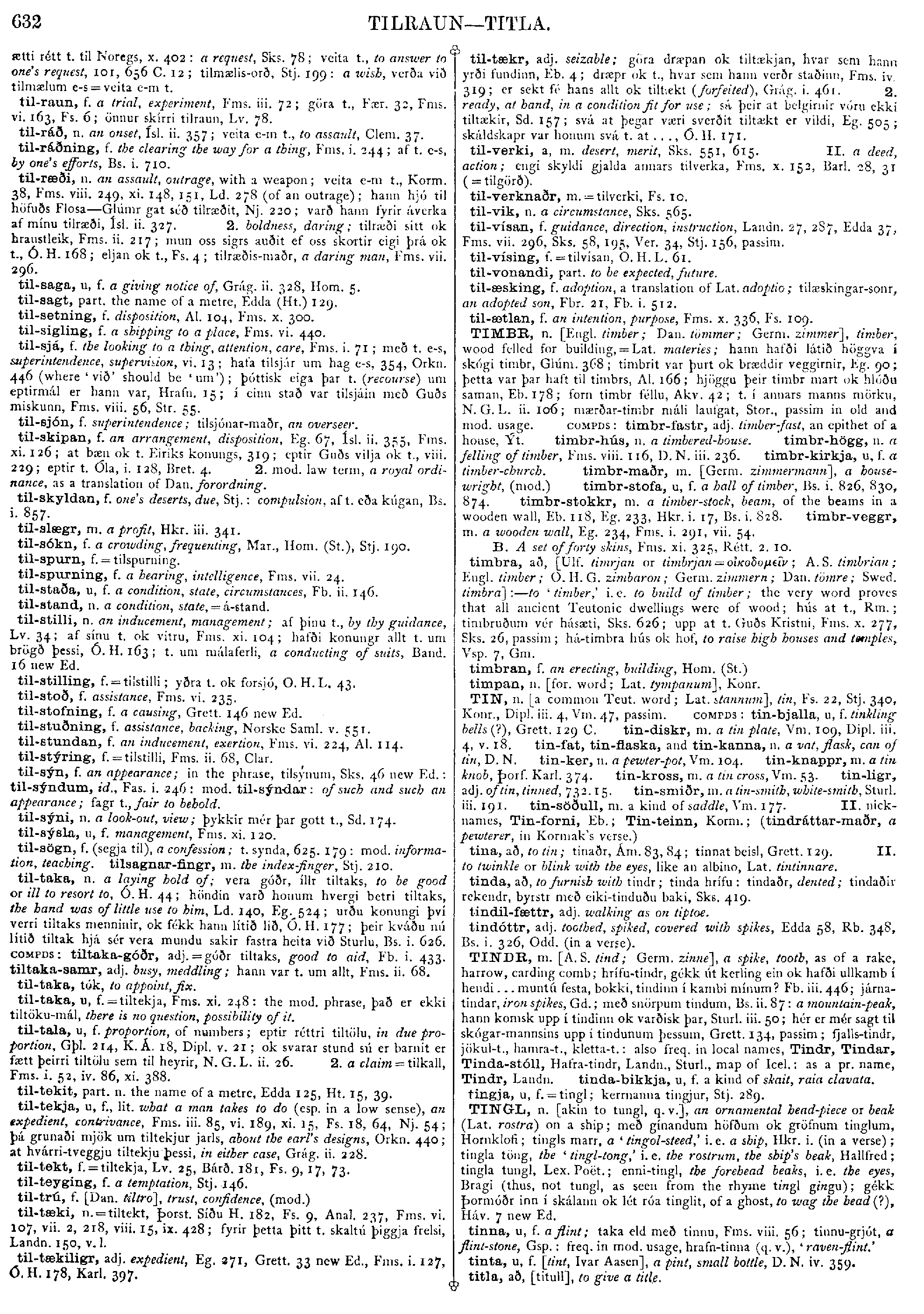
tinna, u, f. a flint; taka eld með tinnu, Fms. viii. 56; tiunu-grjót, a flint-stone, Gsp.: freq. in mod. usage, hrafn-tinna (q.v.), 'raven-flint,'
|
Source: Cleasby/Vigfusson, page b0636, entry 12 View original page image as: [TIFF] [PNG] [View previous entry] [View next entry] |
[Comment on this entry] [View comments] |
The following entry has been hand-corrected once. |
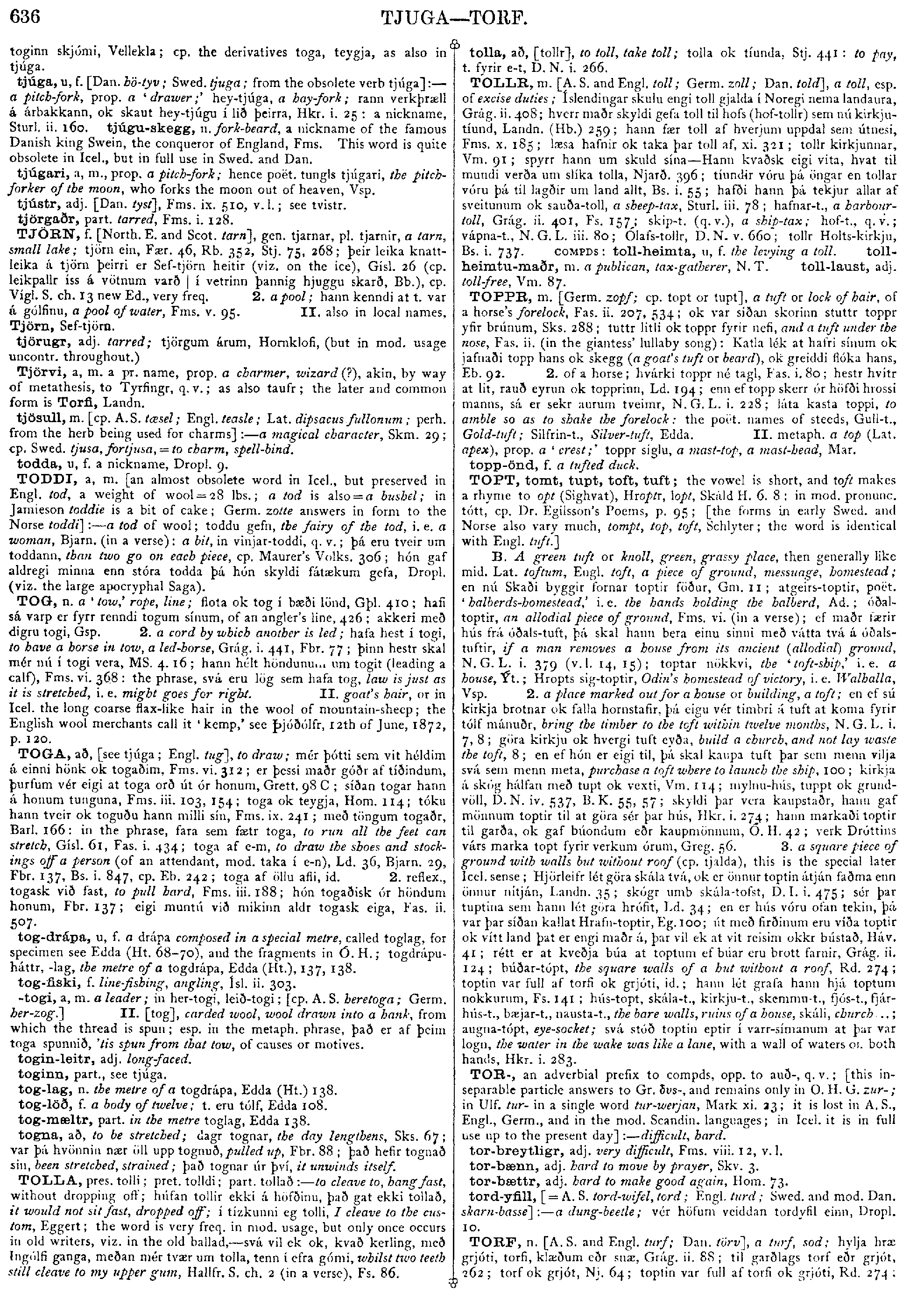
TOG, n. a 'tow,' rope, line; flota ok tog í bæði lönd, Gþl. 410; hafi sá varp er fyrr renndi togum sínum, of an angler's line, 426; akkeri með digru togi, Gsp. 2. a cord by which another is led; hafa hest í togi, to have a horse in tow, a led-horse, Grág. i. 441, Fbr. 77; þinn hestr skal mér nú í togi vera, MS. 4. 16; hann hélt höndunum um togit (leading a calf), Fms. vi. 368: the phrase, svá eru lög sem hafa tog, law is just as it is stretched, i.e. might goes for right. II. goat's hair, or in Icel. the long coarse flax-like hair in the wool of mountain-sheep; the English wool merchants call it 'kemp,' see Þjóðólfr, 12th of June, 1872, p. 120.
|
Source: Cleasby/Vigfusson, page b0656, entry 8 View original page image as: [TIFF] [PNG] [View previous entry] [View next entry] |
[Comment on this entry] [View comments] |
The following entry has been hand-corrected once. |
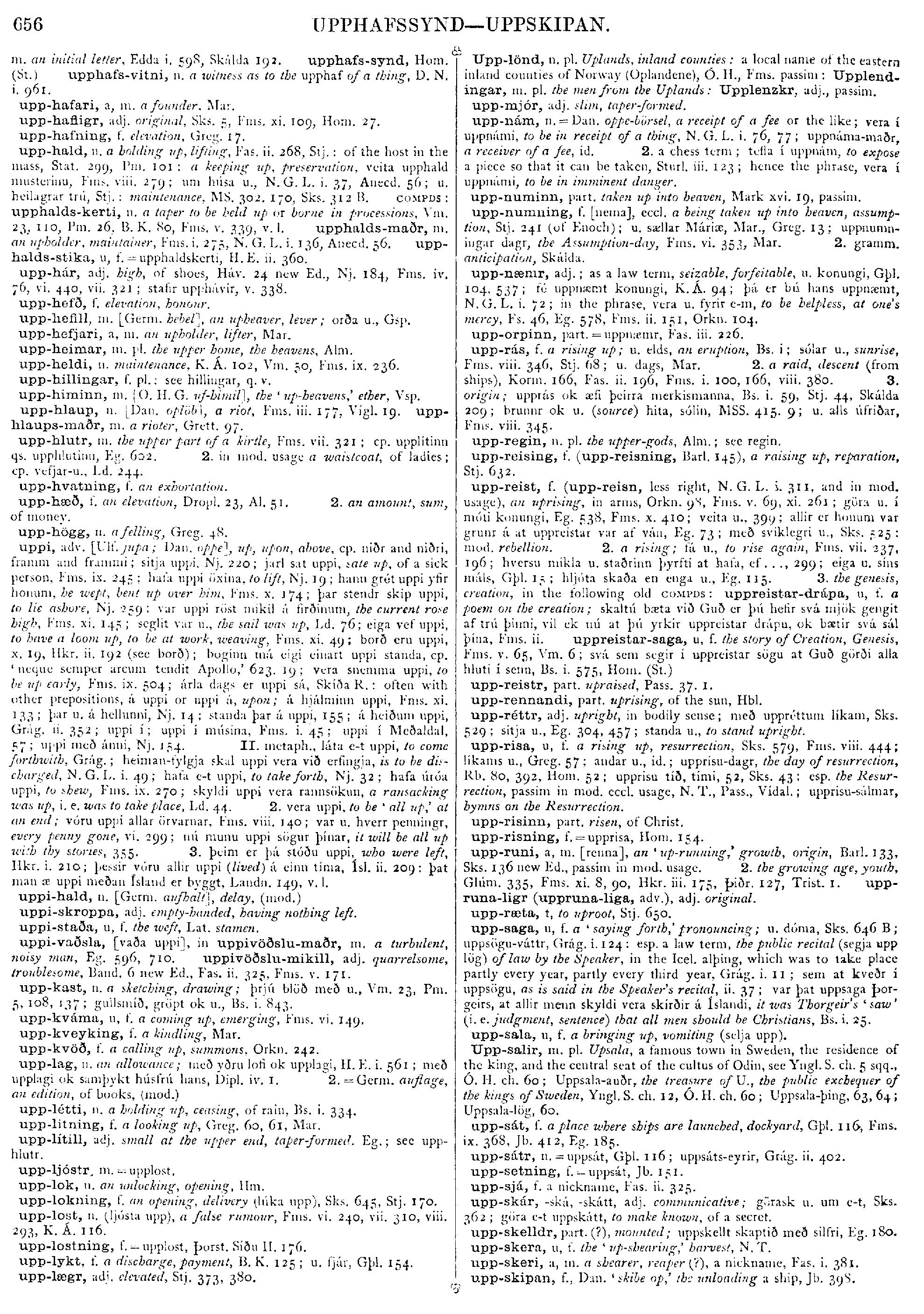
upp-hefill, m. [Germ. hebel], an upheaver, lever; orða u., Gsp.
|
Source: Cleasby/Vigfusson, page b0657, entry 39 View original page image as: [TIFF] [PNG] [View previous entry] [View next entry] |
[Comment on this entry] [View comments] |
The following entry has been hand-corrected once. |
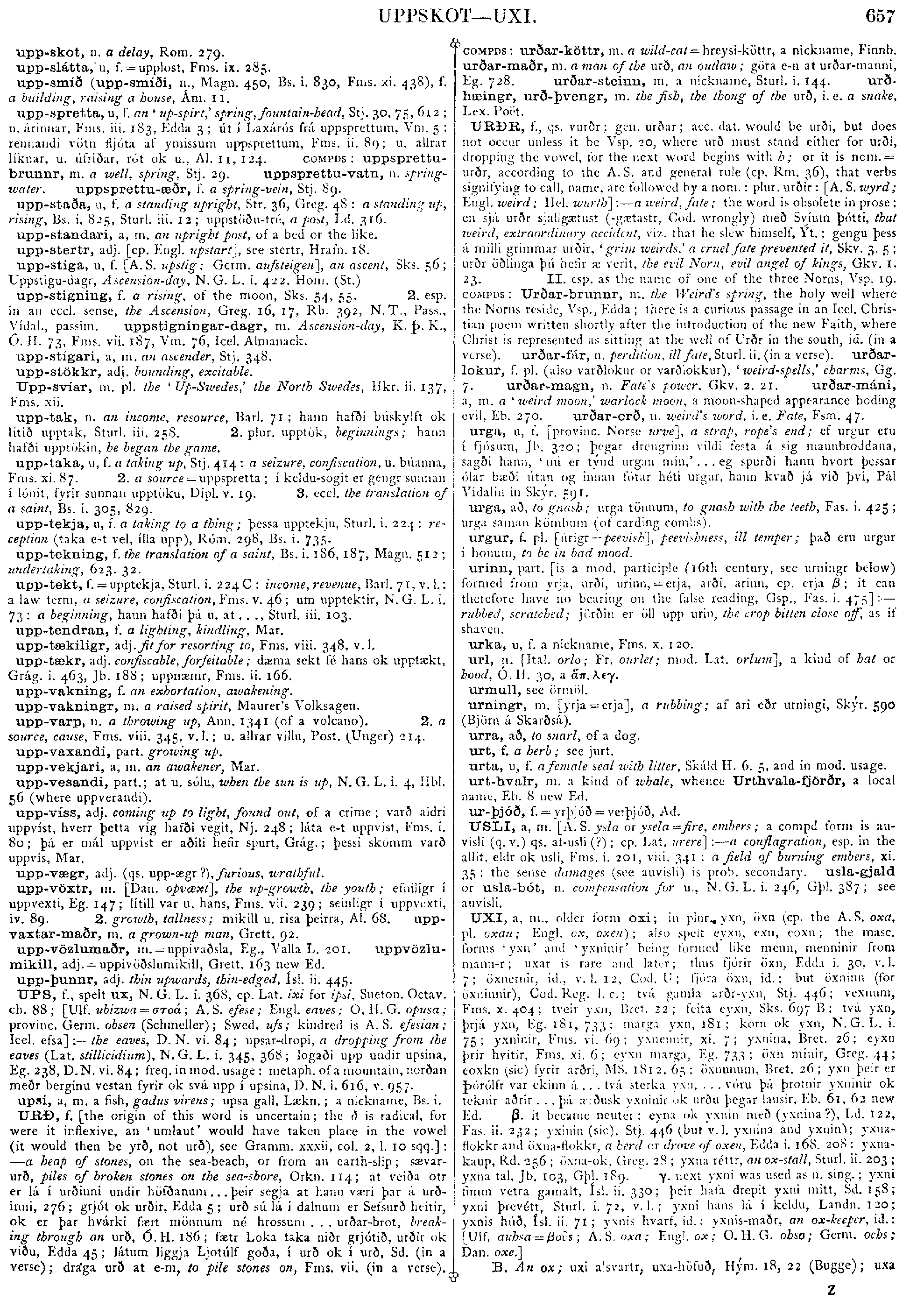
urinn,
part.
[is
a
mod.
participle
(16th
century,
see
urningr
below)
formed
from
yrja,
urði,
urinn,
=
erja,
arði,
arinn,
cp.
erja
 ;
it
can
therefore
have
no
bearing
on
the
false
reading,
Gsp.,
Fas.
i.
475]
:--
rubbed,
scratched;
jörðin
er
öll
upp
urin,
the
crop
bitten
close
off,
as
if
shaven.
;
it
can
therefore
have
no
bearing
on
the
false
reading,
Gsp.,
Fas.
i.
475]
:--
rubbed,
scratched;
jörðin
er
öll
upp
urin,
the
crop
bitten
close
off,
as
if
shaven.
|
Source: Cleasby/Vigfusson, page b0699, entry 1 View original page image as: [TIFF] [PNG] [View previous entry] [View next entry] |
[Comment on this entry] [View comments] |
The following entry has been hand-corrected once. |
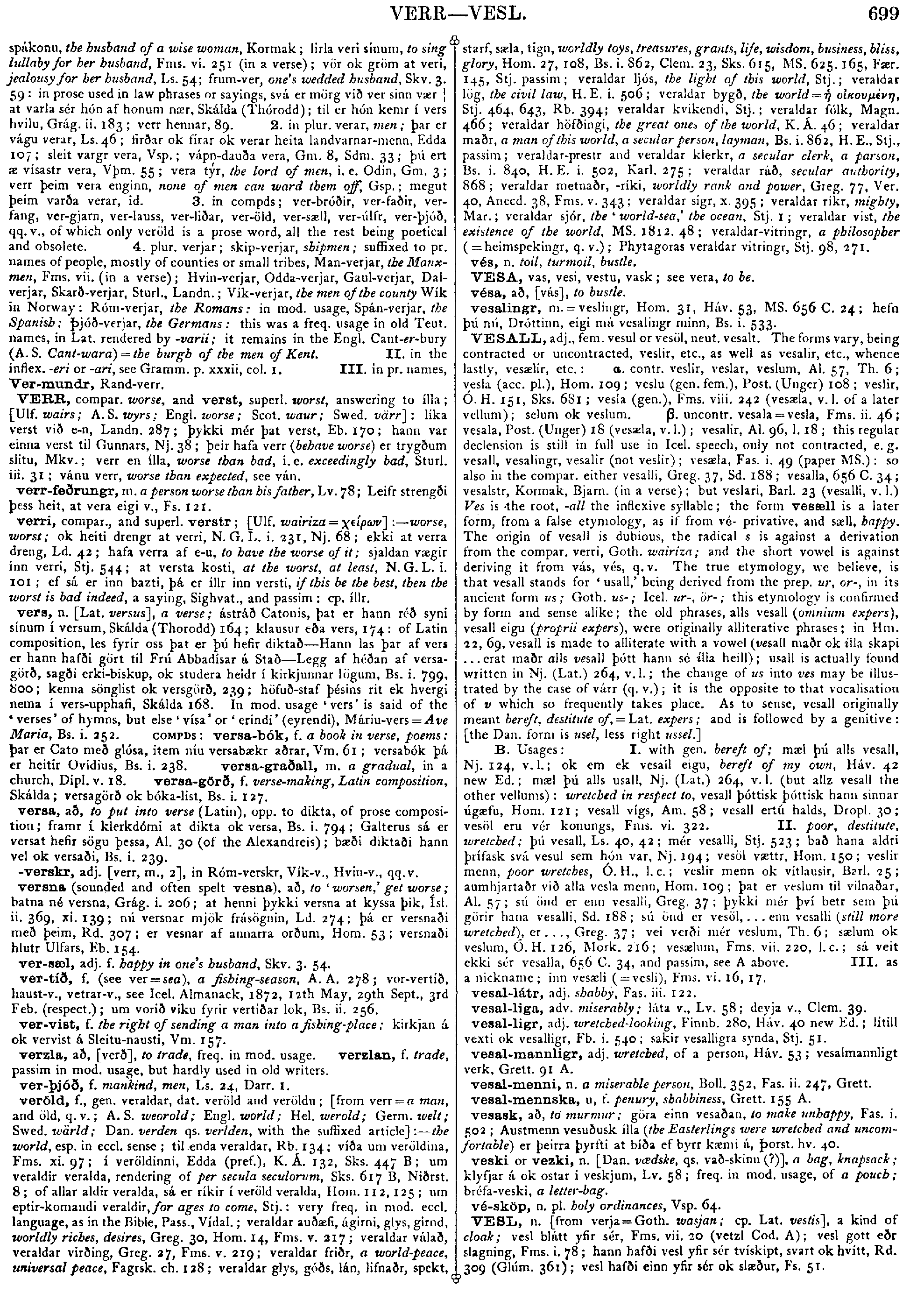
spákonu, the husband of a wise woman, Kormak; lirla veri sínum, to sing lullaby for her husband, Fms. vi. 251 (in a verse); vör ok gröm at veri, jealousy for her husband, Ls. 54; frum-ver, one's wedded husband, Skv. 3. 59: in prose used in law phrases or sayings, svá er mörg við ver sinn vær at varla sér hón af honum nær, Skálda (Thórodd); til er hón kemr í vers hvílu, Grág. ii. 183; verr hennar, 89. 2. in plur. verar, men; þar er vágu verar, Ls. 46; firðar ok fírar ok verar heita landvarnar-menn, Edda 107; sleit vargr vera, Vsp.; vápn-dauða vera, Gm. 8, Sdm. 33; þú ert æ vísastr vera, Vþm. 55; vera týr, the lord of men, i.e. Odin, Gm. 3; verr peim vera enginn, none of men can ward them off, Gsp.; megut þeim varða verar, id. 3. in compds; ver-bróðir, ver-faðir, ver-fang, ver-gjarn, ver-lauss, ver-liðar, ver-öld, ver-sæll, ver-úlfr, ver-þjóð, qq.v., of which only veröld is a prose word, all the rest being poetical and obsolete. 4. plur. verjar; skip-verjar, shipmen; suffixed to pr. names of people, mostly of counties or small tribes, Man-verjar, the Manx-men, Fms. vii. (in a verse); Hvin-verjar, Odda-verjar, Gaul-verjar, Dal-verjar, Skarð-verjar, Sturl., Landn.; Vík-verjar, the men of the county Wík in Norway: Róm-verjar, the Romans: in mod. usage, Spán-verjar, the Spanish; Þjóð-verjar, the Germans: this was a freq. usage in old Teut. names, in Lat. rendered by -varii; it remains in the Engl. Cant-er-bury (A.S. Cant-wara) = the burgh of the men of Kent. II. in the inflex. -eri or -ari, see Gramm. p. xxxii, col. i. III. in pr. names, Ver-mundr, Rand-verr.
|
Source: Cleasby/Vigfusson, page b0722, entry 10 View original page image as: [TIFF] [PNG] [View previous entry] [View next entry] |
[Comment on this entry] [View comments] |
The following entry has been hand-corrected once. |
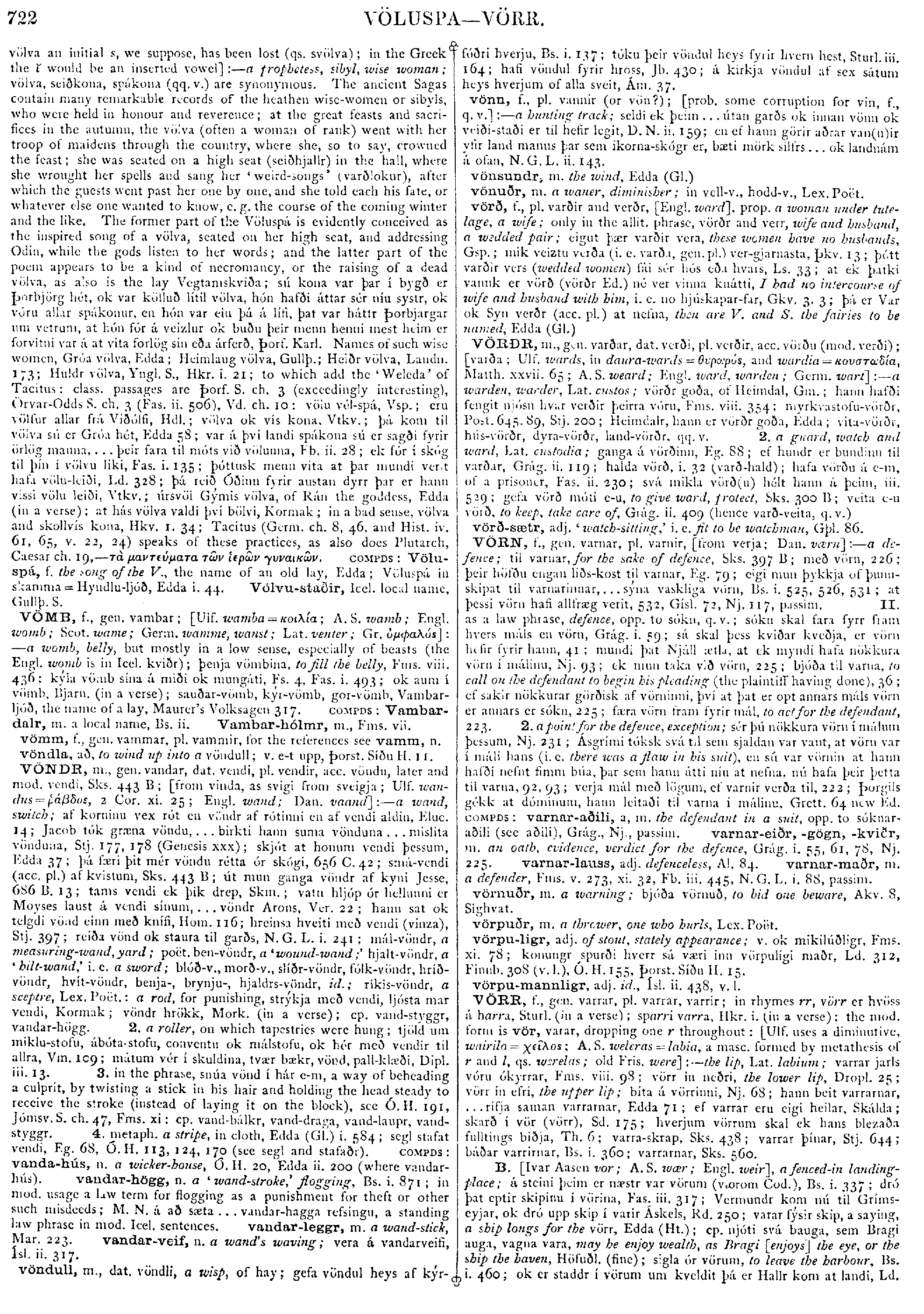
vörð, f., pl. varðir and verðr, [Engl. ward], prop. a woman under tutelage, a wife; only in the allit. phrase, vörðr and verr, wife and husband, a wedded pair; eigut þær varðir vera, these women have no husbands, Gsp.; mik veiztu verða (i.e. varða, gen. pl.) ver-gjarnasta, Þkv, 13; þótt varðir vers (wedded women) fái sér hós eða hvars, Ls. 33; at ek þatki vannk er vörð (vörðr Ed.) né ver vinna knátti, I had no intercourse of wife and husband with him, i.e. no hjúskapar-far, Gkv. 3. 3; þá er Var ok Syn verðr (acc. pl.) at nefna, then are V. and S. the fairies to be named, Edda (Gl.)
| Result Page: |  |
Previous | 1 2 3 4 | Next |  |
Germanic Lexicon Project (main page)
This search system was written by
Sean Crist
Please consider
volunteering
to correct the data in these online dictionaries.
No rights reserved. Feel free to use these data in any way you please.