|
|

Tip: In the search results, you can click on any word or abbreviation for more information.
|
Source: Cleasby/Vigfusson, page b0048, entry 26 View original page image as: [TIFF] [PNG] [View previous entry] [View next entry] |
[Comment on this entry] [View comments] |
The following entry has been hand-corrected once. |
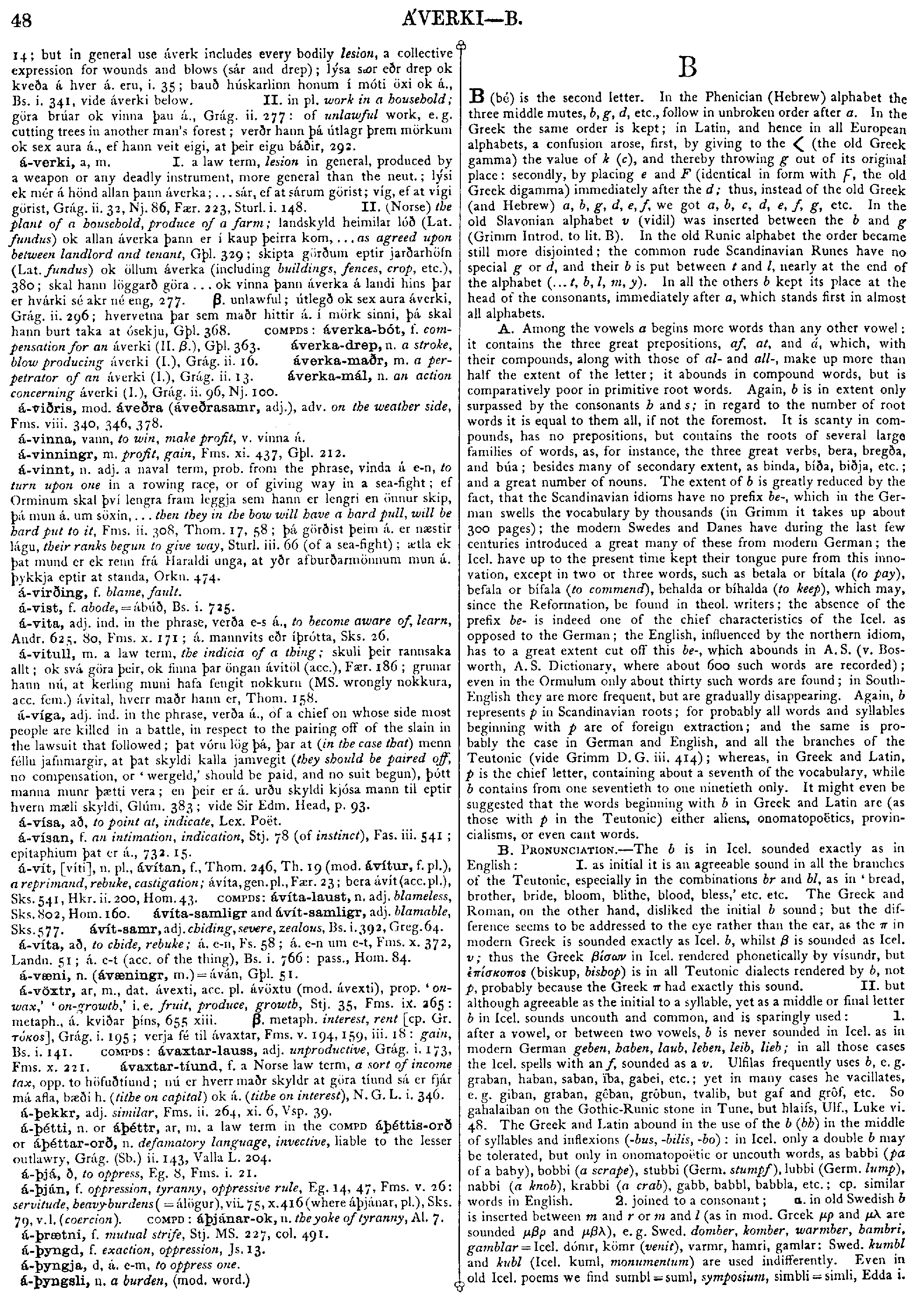
B (bé) is the second letter. In the Phenician (Hebrew) alphabet the three middle mutes, b, g, d, etc., follow in unbroken order after a. In the Greek the same order is kept; in Latin, and hence in all European alphabets, a confusion arose, first, by giving to the UNCERTAIN (the old Greek gamma) the value of k (c), and thereby throwing g out of its original place: secondly, by placing e and F (identical in form with UNCERTAIN, the old Greek digamma) immediately after the d; thus, instead of the old Greek (and Hebrew) a, b, g, d, e, f, we got a, b, c, d, e, f, g, etc. In the old Slavonian alphabet v (vidil) was inserted between the b and g (Grimm Introd. to lit. B). In the old Runic alphabet the order became still more disjointed; the common rude Scandinavian Runes have no special g or d, and their b is put between t and l, nearly at the end of the alphabet (... t, b, l, m, y). In all the others b kept its place at the head of the consonants, immediately after a, which stands first in almost all alphabets.
|
Source: Cleasby/Vigfusson, page b0048, entry 27 View original page image as: [TIFF] [PNG] [View previous entry] [View next entry] |
[Comment on this entry] [View comments] |
The following entry has been hand-corrected once. |
A. Among the vowels a begins more words than any other vowel: it contains the three great prepositions, af, at, and á, which, with their compounds, along with those of al- and all-, make up more than half the extent of the letter; it abounds in compound words, but is comparatively poor in primitive root words. Again, b is in extent only surpassed by the consonants h and s; in regard to the number of root words it is equal to them all, if not the foremost. It is scanty in compounds, has no prepositions, but contains the roots of several large families of words, as, for instance, the three great verbs, bera, bregða, and búa; besides many of secondary extent, as binda, bíða, biðja, etc.; and a great number of nouns. The extent of b is greatly reduced by the fact, that the Scandinavian idioms have no prefix be-, which in the German swells the vocabulary by thousands (in Grimm it takes up about 300 pages); the modern Swedes and Danes have during the last few centuries introduced a great many of these from modern German; the Icel. have up to the present time kept their tongue pure from this innovation, except in two or three words, such as betala or bítala (to pay), befala or bífala (to commend), behalda or bíhalda (to keep), which may, since the Reformation, be found in theol. writers; the absence of the prefix be- is indeed one of the chief characteristics of the Icel. as opposed to the German; the English, influenced by the northern idiom, has to a great extent cut off this be-, which abounds in A. S. (v. Bosworth, A. S. Dictionary, where about 600 such words are recorded); even in the Ormulum only about thirty such words are found; in South-English they are more frequent, but are gradually disappearing. Again, b represents p in Scandinavian roots; for probably all words and syllables beginning with p are of foreign extraction; and the same is probably the case in German and English, and all the branches of the Teutonic (vide Grimm D. G. iii. 414); whereas, in Greek and Latin, p is the chief letter, containing about a seventh of the vocabulary, while b contains from one seventieth to one ninetieth only. It might even be suggested that the words beginning with b in Greek and Latin are (as those with p in the Teutonic) either aliens, onomatopoëtics, provincialisms, or even cant words.
|
Source: Cleasby/Vigfusson, page b0049, entry 4 View original page image as: [TIFF] [PNG] [View previous entry] [View next entry] |
[Comment on this entry] [View comments] |
The following entry has been hand-corrected once. |
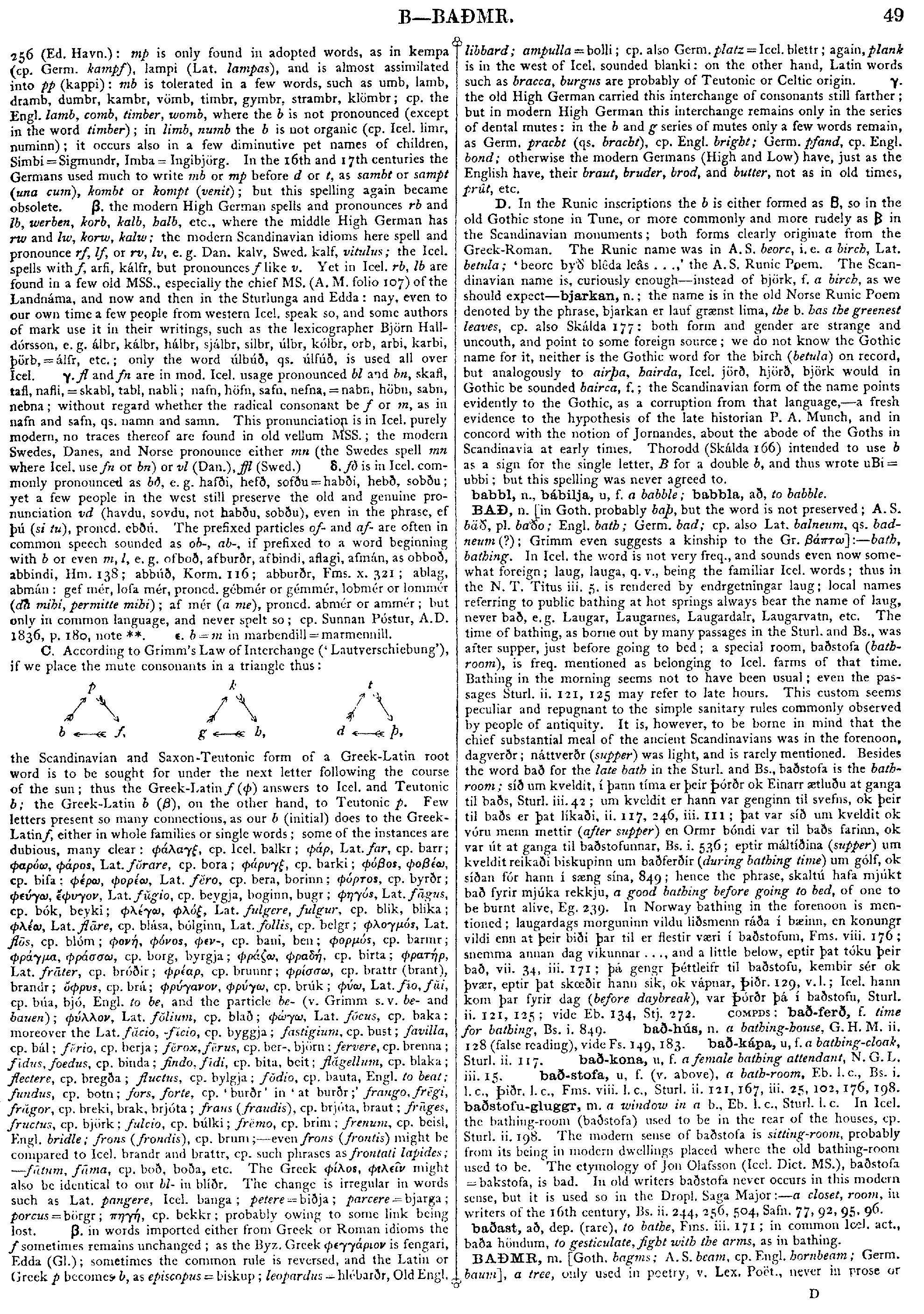
the
Scandinavian
and
Saxon-Teutonic
form
of
a
Greek-Latin
root
word
is
to
be
sought
for
under
the
next
letter
following
the
course
of
the
sun;
thus
the
Greek-Latin
f
( )
answers
to
Icel.
and
Teutonic
b;
the
Greek-Latin
b
(
)
answers
to
Icel.
and
Teutonic
b;
the
Greek-Latin
b
( ),
on
the
other
hand,
to
Teutonic
p.
Few
letters
present
so
many
connections,
as
our
b
(initial)
does
to
the
Greek-Latin
f,
either
in
whole
families
or
single
words;
some
of
the
instances
are
dubious,
many
clear:
GREEK,
cp.
Icel.
balkr;
GREEK,
Lat.
far,
cp.
barr;
GREEK,
GREEK,
Lat.
f
),
on
the
other
hand,
to
Teutonic
p.
Few
letters
present
so
many
connections,
as
our
b
(initial)
does
to
the
Greek-Latin
f,
either
in
whole
families
or
single
words;
some
of
the
instances
are
dubious,
many
clear:
GREEK,
cp.
Icel.
balkr;
GREEK,
Lat.
far,
cp.
barr;
GREEK,
GREEK,
Lat.
f rare,
cp.
bora;
GREEK,
cp.
barki;
GREEK,
GREEK,
cp.
bifa;
GREEK,
GREEK,
Lat.
f
rare,
cp.
bora;
GREEK,
cp.
barki;
GREEK,
GREEK,
cp.
bifa;
GREEK,
GREEK,
Lat.
f ro,
cp.
bera,
borinn;
GREEK,
cp.
byrðr;
GREEK,
GREEK,
Lat.
f
ro,
cp.
bera,
borinn;
GREEK,
cp.
byrðr;
GREEK,
GREEK,
Lat.
f gio,
cp.
beygja,
boginn,
bugr;
GREEK,
Lat.
f
gio,
cp.
beygja,
boginn,
bugr;
GREEK,
Lat.
f gus,
cp.
bók,
beyki;
GREEK,
GREEK,
Lat.
fulgere,
fulgur,
cp.
blik,
blika;
GREEK,
Lat.
flre,
cp.
blása,
bólginn,
Lat.
follis,
cp.
belgr;
GREEK,
Lat.
fl
gus,
cp.
bók,
beyki;
GREEK,
GREEK,
Lat.
fulgere,
fulgur,
cp.
blik,
blika;
GREEK,
Lat.
flre,
cp.
blása,
bólginn,
Lat.
follis,
cp.
belgr;
GREEK,
Lat.
fl s,
cp.
blóm;
GREEK,
GREEK,
GREEK,
cp.
bani,
ben;
GREEK,
cp.
barmr;
GREEK,
GREEK,
cp.
borg,
byrgja;
GREEK,
GREEK,
cp.
birta;
GREEK,
Lat.
frter,
cp.
bróðir;
GREEK,
cp.
brunnr;
GREEK,
cp.
brattr
(brant),
brandr;
GREEK,
cp.
brá;
GREEK,
GREEK,
cp.
brúk;
GREEK,
Lat.
f
s,
cp.
blóm;
GREEK,
GREEK,
GREEK,
cp.
bani,
ben;
GREEK,
cp.
barmr;
GREEK,
GREEK,
cp.
borg,
byrgja;
GREEK,
GREEK,
cp.
birta;
GREEK,
Lat.
frter,
cp.
bróðir;
GREEK,
cp.
brunnr;
GREEK,
cp.
brattr
(brant),
brandr;
GREEK,
cp.
brá;
GREEK,
GREEK,
cp.
brúk;
GREEK,
Lat.
f o,
fi,
cp.
búa,
bjó,
Engl.
to
be,
and
the
particle
be-
(v.
Grimm
s.v.
be-
and
bauen);
GREEK,
Lat.
flium,
cp.
blað;
GREEK,
Lat.
fcus,
cp.
baka:
moreover
the
Lat.
f
o,
fi,
cp.
búa,
bjó,
Engl.
to
be,
and
the
particle
be-
(v.
Grimm
s.v.
be-
and
bauen);
GREEK,
Lat.
flium,
cp.
blað;
GREEK,
Lat.
fcus,
cp.
baka:
moreover
the
Lat.
f cio,
-f
cio,
-f cio,
cp.
byggja;
fastigium,
cp.
bust;
favilla,
cp.
bál;
frio,
cp.
berja;
frox,
frus,
cp.
ber-,
björn;
fervere,
cp.
brenna;
fdus,
foedus,
cp.
binda;
findo,
fdi,
cp.
bíta,
beit;
flgellum,
cp.
blaka;
flectere,
cp.
bregða;
fluctus,
cp.
bylgja;
fdio,
cp.
bauta,
Engl.
to
beat;
fundus,
cp.
botn;
fors,
forte,
cp.
'burðr'
in
'at
burðr;'
frango,
fr
cio,
cp.
byggja;
fastigium,
cp.
bust;
favilla,
cp.
bál;
frio,
cp.
berja;
frox,
frus,
cp.
ber-,
björn;
fervere,
cp.
brenna;
fdus,
foedus,
cp.
binda;
findo,
fdi,
cp.
bíta,
beit;
flgellum,
cp.
blaka;
flectere,
cp.
bregða;
fluctus,
cp.
bylgja;
fdio,
cp.
bauta,
Engl.
to
beat;
fundus,
cp.
botn;
fors,
forte,
cp.
'burðr'
in
'at
burðr;'
frango,
fr gi,
frgor,
cp.
breki,
brak,
brjóta;
fraus
(fraudis),
cp.
brjóta,
braut;
fr
gi,
frgor,
cp.
breki,
brak,
brjóta;
fraus
(fraudis),
cp.
brjóta,
braut;
fr ges,
fructus,
cp.
björk;
fulcio,
cp.
búlki;
frmo,
cp.
brim;
frenum,
cp.
beisl,
Engl.
bridle;
frons
(frondis),
cp.
brum;
--
even
frons
(frontis)
might
be
compared
to
Icel.
brandr
and
brattr,
cp.
such
phrases
as
frontati
lapides;
--
ftum,
fma,
cp.
boð,
boða,
etc.
The
Greek
GREEK,
GREEK
might
also
be
identical
to
our
bl-
in
blíðr.
The
change
is
irregular
in
words
such
as
Lat.
pangere,
Icel.
banga;
petere
=
biðja;
parcere
=
bjarga;
porcus
=
börgr;
GREEK,
cp.
bekkr;
probably
owing
to
some
link
being
lost.
.
in
words
imported
either
from
Greek
or
Roman
idioms
the
f
sometimes
remains
unchanged;
as
the
Byz.
Greek
GREEK
is
fengari,
Edda
(Gl.);
sometimes
the
common
rule
is
reversed,
and
the
Latin
or
Greek
p
becomes
b,
as
episcopus
=
biskup;
leopardus
=
hlébarðr,
Old
Engl.
libbard;
ampulla
=
bolli;
cp.
also
Germ.
platz
=
Icel.
blettr;
again,
plank
is
in
the
west
of
Icel.
sounded
blanki:
on
the
other
hand,
Latin
words
such
as
bracca,
burgus
are
probably
of
Teutonic
or
Celtic
origin.
ges,
fructus,
cp.
björk;
fulcio,
cp.
búlki;
frmo,
cp.
brim;
frenum,
cp.
beisl,
Engl.
bridle;
frons
(frondis),
cp.
brum;
--
even
frons
(frontis)
might
be
compared
to
Icel.
brandr
and
brattr,
cp.
such
phrases
as
frontati
lapides;
--
ftum,
fma,
cp.
boð,
boða,
etc.
The
Greek
GREEK,
GREEK
might
also
be
identical
to
our
bl-
in
blíðr.
The
change
is
irregular
in
words
such
as
Lat.
pangere,
Icel.
banga;
petere
=
biðja;
parcere
=
bjarga;
porcus
=
börgr;
GREEK,
cp.
bekkr;
probably
owing
to
some
link
being
lost.
.
in
words
imported
either
from
Greek
or
Roman
idioms
the
f
sometimes
remains
unchanged;
as
the
Byz.
Greek
GREEK
is
fengari,
Edda
(Gl.);
sometimes
the
common
rule
is
reversed,
and
the
Latin
or
Greek
p
becomes
b,
as
episcopus
=
biskup;
leopardus
=
hlébarðr,
Old
Engl.
libbard;
ampulla
=
bolli;
cp.
also
Germ.
platz
=
Icel.
blettr;
again,
plank
is
in
the
west
of
Icel.
sounded
blanki:
on
the
other
hand,
Latin
words
such
as
bracca,
burgus
are
probably
of
Teutonic
or
Celtic
origin.
 .
the
old
High
German
carried
this
interchange
of
consonants
still
farther;
but
in
modern
High
German
this
interchange
remains
only
in
the
series
of
dental
mutes:
in
the
b
and
g
series
of
mutes
only
a
few
words
remain,
as
Germ.
pracht
(qs.
bracht),
cp.
Engl.
bright;
Germ.
pfand,
cp.
Engl.
bond;
otherwise
the
modern
Germans
(High
and
Low)
have,
just
as
the
English
have,
their
braut,
bruder,
brod,
and
butter,
not
as
in
old
times,
prût,
etc.
.
the
old
High
German
carried
this
interchange
of
consonants
still
farther;
but
in
modern
High
German
this
interchange
remains
only
in
the
series
of
dental
mutes:
in
the
b
and
g
series
of
mutes
only
a
few
words
remain,
as
Germ.
pracht
(qs.
bracht),
cp.
Engl.
bright;
Germ.
pfand,
cp.
Engl.
bond;
otherwise
the
modern
Germans
(High
and
Low)
have,
just
as
the
English
have,
their
braut,
bruder,
brod,
and
butter,
not
as
in
old
times,
prût,
etc.
|
Source: Cleasby/Vigfusson, page b0049, entry 7 View original page image as: [TIFF] [PNG] [View previous entry] [View next entry] |
[Comment on this entry] [View comments] |
The following entry has been hand-corrected once. |
BAÐ, n. [in Goth. probably baþ, but the word is not preserved; A. S. bäð, pl. baðo; Engl. bath; Germ. bad; cp. also Lat. balneum, qs. badneum (?); Grimm even suggests a kinship to the Gr. GREEK] :-- bath, bathing. In Icel. the word is not very freq., and sounds even now somewhat foreign; laug, lauga, q.v., being the familiar Icel. words; thus in the N. T. Titus iii. 5. is rendered by endrgetningar laug; local names referring to public bathing at hot springs always bear the name of laug, never bað, e.g. Laugar, Laugarnes, Laugardalr, Laugarvatn, etc. The time of bathing, as borne out by many passages in the Sturl. and Bs., was after supper, just before going to bed; a special room, baðstofa (bathroom), is freq. mentioned as belonging to Icel. farms of that time. Bathing in the morning seems not to have been usual; even the passages Sturl. ii. 121, 125 may refer to late hours. This custom seems peculiar and repugnant to the simple sanitary rules commonly observed by people of antiquity. It is, however, to be borne in mind that the chief substantial meal of the ancient Scandinavians was in the forenoon, dagverðr; náttverðr (supper) was light, and is rarely mentioned. Besides the word bað for the late bath in the Sturl. and Bs., baðstofa is the bathroom; síð um kveldit, í þann tíma er þeir Þórðr ok Einarr ætluðu at ganga til baðs, Sturl. iii. 42; um kveldit er hann var genginn til svefns, ok þeir til baðs er þat líkaði, ii. 117, 246, iii. 111; þat var síð um kveldit ok vóru menn mettir (after supper) en Ormr bóndi var til baðs farinn, ok var út at ganga til baðstofunnar, Bs. i. 536; eptir máltíðina (supper) um kveldit reikaði biskupinn um baðferðir (during bathing time) um gólf, ok síðan for hann í sæng sína, 849; hence the phrase, skaltú hafa mjúkt bað fyrir mjúka rekkju, a good bathing before going to bed, of one to be burnt alive, Eg. 239. In Norway bathing in the forenoon is mentioned; laugardags morguninn vildu liðsmenn ráða í bæinn, en konungr vildi enn at þeir biði þar til er flestir væri í baðstofum, Fms. viii. 176; snemma annan dag vikunnar ..., and a little below, eptir þat tóku þeir bað, vii. 34, iii. 171; þá gengr Þéttleifr til baðstofu, kembir sér ok þvær, eptir þat skœðir hanu sik, ok vápnar, Þiðr. 129, v.l.; Icel. hann kom þar fyrir dag (before daybreak), var Þórðr þá í baðstofu, Sturl. ii. 121, 125; vide Eb. 134, Stj. 272. COMPDS: bað-ferð, f. time for bathing, Bs. i. 849. bað-hús, n. a bathing-house, G. H. M. ii. 128 (false reading), vide Fs. 149, 183. bað-kápa, u, f. a bathing-cloak, Sturl. ii. 117. bað-kona, u, f. a female bathing attendant, N. G. L. iii. 15. bað-stofa, u, f. (v. above), a bath-room, Eb. l.c., Bs. i. l.c., Þiðr. l.c., Fms. viii. l.c., Sturl. ii. 121, 167, iii. 25, 102, 176, 198. baðstofu-gluggr, m. a window in a b., Eb. l.c., Sturl. l.c. In Icel. the bathing-room (baðstofa) used to be in the rear of the houses, cp. Sturl. ii. 198. The modern sense of baðstofa is sitting-room, probably from its being in modern dwellings placed where the old bathing-room used to be. The etymology of Jon Olafsson (Icel. Dict. MS.), baðstofa = bakstofa, is bad. In old writers baðstofa never occurs in this modern sense, but it is used so in the Dropl. Saga Major :-- a closet, room, in writers of the 16th century, Bs. ii. 244, 256, 504, Safn. 77, 92, 95, 96.
|
Source: Cleasby/Vigfusson, page b0051, entry 14 View original page image as: [TIFF] [PNG] [View previous entry] [View next entry] |
[Comment on this entry] [View comments] |
The following entry has been hand-corrected once. |
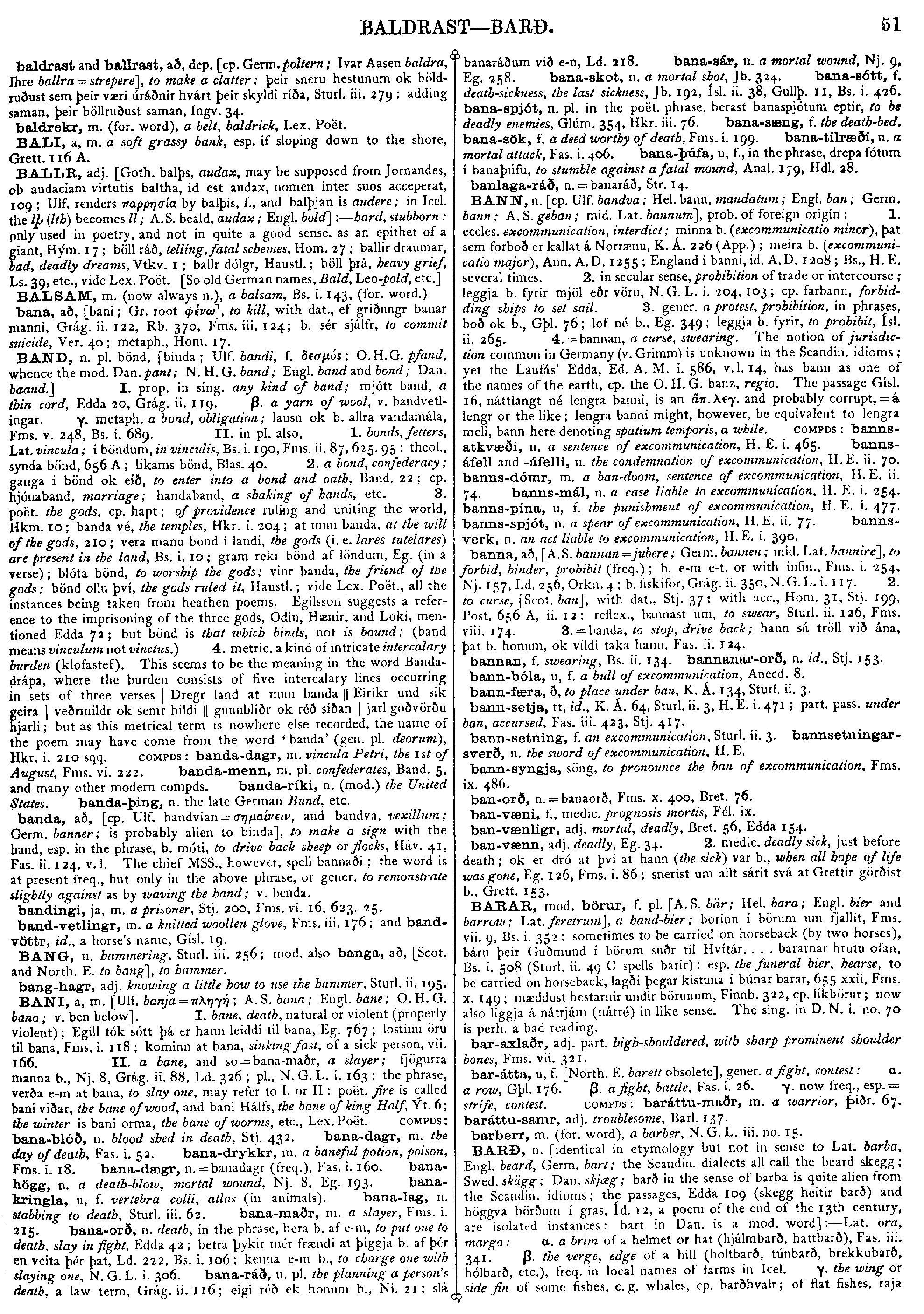
BANN, n. [cp. Ulf. bandva; Hel. bann, mandatum; Engl. ban; Germ. bann; A. S. geban; mid. Lat. bannum] , prob. of foreign origin: 1. eccles. excommunication, interdict; minna b. (excommunicatio minor), þat sem forboð er kallat á Norrænu, K. Á. 226 (App.); meira b. (excommuni- catio major), Ann. A. D. 1255; England í banni, id. A. D. 1208; Bs., H. E. several times. 2. in secular sense, prohibition of trade or intercourse; leggja b. fyrir mjöl eðr vöru, N. G. L. i. 204, 103; cp. farbann, forbid- ding ships to set sail. 3. gener. a protest, prohibition, in phrases, boð ok b., Gþl. 76; lof né b., Eg. 349; leggja b. fyrir, to prohibit, Ísl. ii. 265. 4. =bannan, a curse, swearing. The notion of jurisdic- tion common in Germany (v. Grimm) is unknown in the Scandin. idioms; yet the Laufás' Edda, Ed. A. M. i. 586, v.l. 14, has bann as one of the names of the earth, cp. the O. H. G. banz, regio. The passage Gísl. 16, náttlangt né lengra banni, is an GREEK and probably corrupt, = á lengr or the like; lengra banni might, however, be equivalent to lengra meli, bann here denoting spatium temporis, a while. COMPDS: banns- atkvæði, n. a sentence of excommunication, H. E. i. 465. banns- áfell and -áfelli, n. the condemnation of excommunication, H. E. ii. 70. banns-dómr, m. a ban-doom, sentence of excommunication, H. E. ii. 74. banns-mál, n. a case liable to excommunication, H.E. i. 254. banns-pína, u, f. the punishment of excommunication, H. E. i. 477. banns-spjót, n. a spear of excommunication, H. E. ii. 77. banns- verk, n. an act liable to excommunication, H. E. i. 390.
|
Source: Cleasby/Vigfusson, page b0052, entry 17 View original page image as: [TIFF] [PNG] [View previous entry] [View next entry] |
[Comment on this entry] [View comments] |
The following entry has not been hand-corrected. However, the page is reserved and someone is correcting it. |
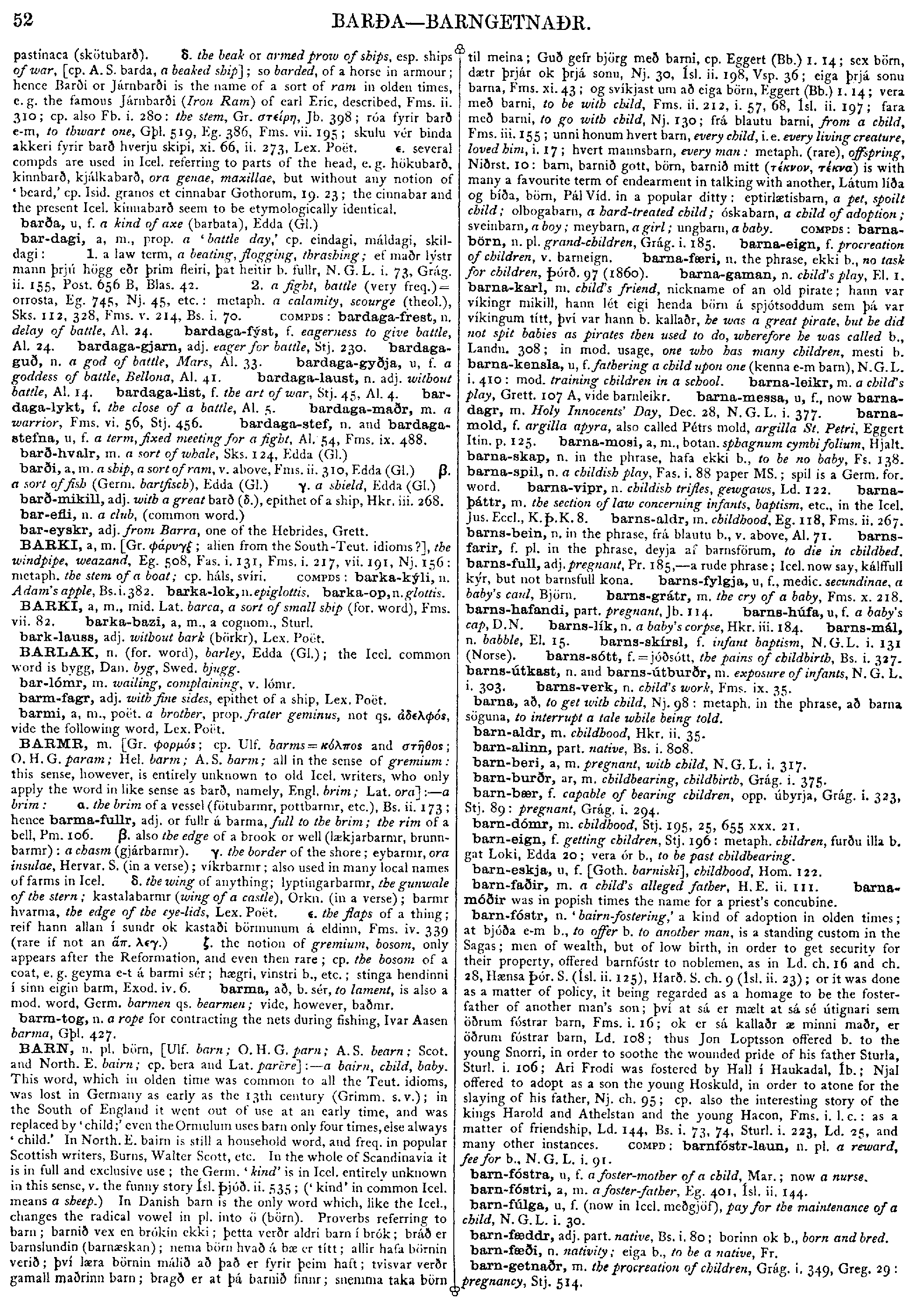
BARN, n. pl. born, [Ulf. barn; O. H. G. parn; A. S. beam; Scot, and North. E. bairn; cp. bera and Lat. parire] :-- a bairn, child, baby. This word, which in olden time was common to all the Teut. idioms, was lost in Germany as early as the 13th century (Grimm, s. v.); in the South of England it went out of use at an early time, and was replaced by ' child;' even the Ormulum uses barn only four times, else always ' child. ' In North. E. bairu is still a household word, and freq. in popular Scottish writers, Burns, Walter Scott, etc. In the whole of Scandinavia it is in full and exclusive use; the Germ. ' kind' is in Icel. entirely unknown in this sense, v. the funny story Ísl. jþjóð. ii. 535; (' kind' in common Icel. means a sheep.) In Danish barn is the only word which, like the Icel., changes the radical vowel in pl. into ö (born). Proverbs referring to barn; barnið vex en brókin ekki; þetta verðr aldri barn í brók; bráð er barnslundin (barnæskan); nema börn hvað ú bæ er titt; allir hafa börnin verið; því laera börnin málið að það er fyrir þeim hatt; tvisvar verðr gamall maðrinn barn; bragð er at þá barnið fmnr; snemnia taka börn til meina; Guð gefr björg með barni, cp. Eggert (Bb.) 1. 14; sex born, daetr þrjár ok þrjá sonu, Nj. 30, Ísl. ii. 198, Vsp. 36; eiga þrjá sonu barna, Fms. xi. 43; og svíkjast um að eiga börn, Eggert (Bb.) 1. 14; vera með barni, to be with child, Fms. ii. 212, i. 57, 68, Ísl. ii. 197; fara með barni, to gowith child, Nj. 130; frá blautu barni, from a child, Fms. iii. 155; unni honum hvert barn, every c hild, i. e. every living creature, loved him, i. 17; hvert mannsbarn, e very man: metaph. (rare), offspring, Niðrst. IO: barn, barnið gott, börn, barnið mitt (rticvov, TÍKVO) is with many a favourite term of endearment in talking with another, Látum líða og bíða, börn, Pal Vid. in a popular ditty: eptirlætisbarn, a pet, spoilt child; olbogabarn, a bard-treated child; oskabarn, a child of adoption; sveinbarn, a boy; meybarn, a girl; ungbarn, a baby. COMPDS: barna- börn, n. pl. grand-children, Grág. i. 185. bama-eign, f. procreation of children, v. barneign. barna-fœri, n. the phrase, ekki b., no task for children, fjórð. 97 (1860). barna-gaman, n. child's play, El. I. barna-karl, m. child's friend, nickname of an old pirate; hann var vikingr mikill, hann let eigi henda börn á spjótsoddum sem þá var víkingum títt, því var hann b. kallaðr, he was a great pirate, but he did not spit babies as pirates then used to do, wherefore he was called b., Landn. 308; in mod. usage, one who has many children, mesti b. barna-kensla, u, f. fathering a child upon one (kenna e-m barn), N. G. L. i. 410: mod. training children in a school. bama-leikr, m. a child's play, Grett. 107 A, vide barnleikr. barna-messa, u, f., now barna- dagr, m. Holy Innocents' Day, Dec. 28, N. G. L. i. 377. barna- mold, f. argilla apyra, also called Pétrs mold, argilla St. Petri, Eggert Itin. p. 125. barna-mosi, a, m., botan. sphagnum cymbifolium, Hjalt. barna-skap, n. in the phrase, hafa ekki b., to be nobab y, Fs. 138. barna-spil, n. a childish play, Fas. i. 88 paper MS.; spil is a Germ. for. word. barna-vipr, n. childish trifles, gewgaws, Ld. 122. barna- þattr, m. the section of law concerning infants, baptism, etc., in the Icel. Jus. Eccl., K. þ. K. 8. barns-aldr, m. childhood. Eg. 118, Fms. ii. 267. barns-bein, n. in the phrase, frá blautu b., v. above, Al. 71. barns- farir, f. pl. in the phrase, deyja af barnsförum, to die in childbed. barns-full, za] . pregnant, Pr. 185, -- a rude phrase; Icel. now say, kálffull kýr, but not barnsfull kona. barns-fylgja, u, f., medic, secundinae, a baby's caul, Björn. barns-gratr, m. the cry of a baby, Fms. x. 218. barns-hafandi, part, pregnant, Jb. 114. barn. 8-h. ufa, u, f. a baby's cap, D. N. barns-lik, n. a baby's corpse, Hkr. iii. 184. barns-mál, n. babble, El. 15. barns-skirsl, f. i/// awt baptism, N. G. L. i. 131 (Norse). barns-sótt, f. = jóðsótt, the pains of childbirth, Bs. i. 327. barns-útkast, n. and barns-útburðr, m. exposure of infants, N. G. L. i. 303. barns-verk, n. child's work, Fms. ix. 35.
|
Source: Cleasby/Vigfusson, page b0053, entry 34 View original page image as: [TIFF] [PNG] [View previous entry] [View next entry] |
[Comment on this entry] [View comments] |
The following entry has not been hand-corrected. However, the page is reserved and someone is correcting it. |
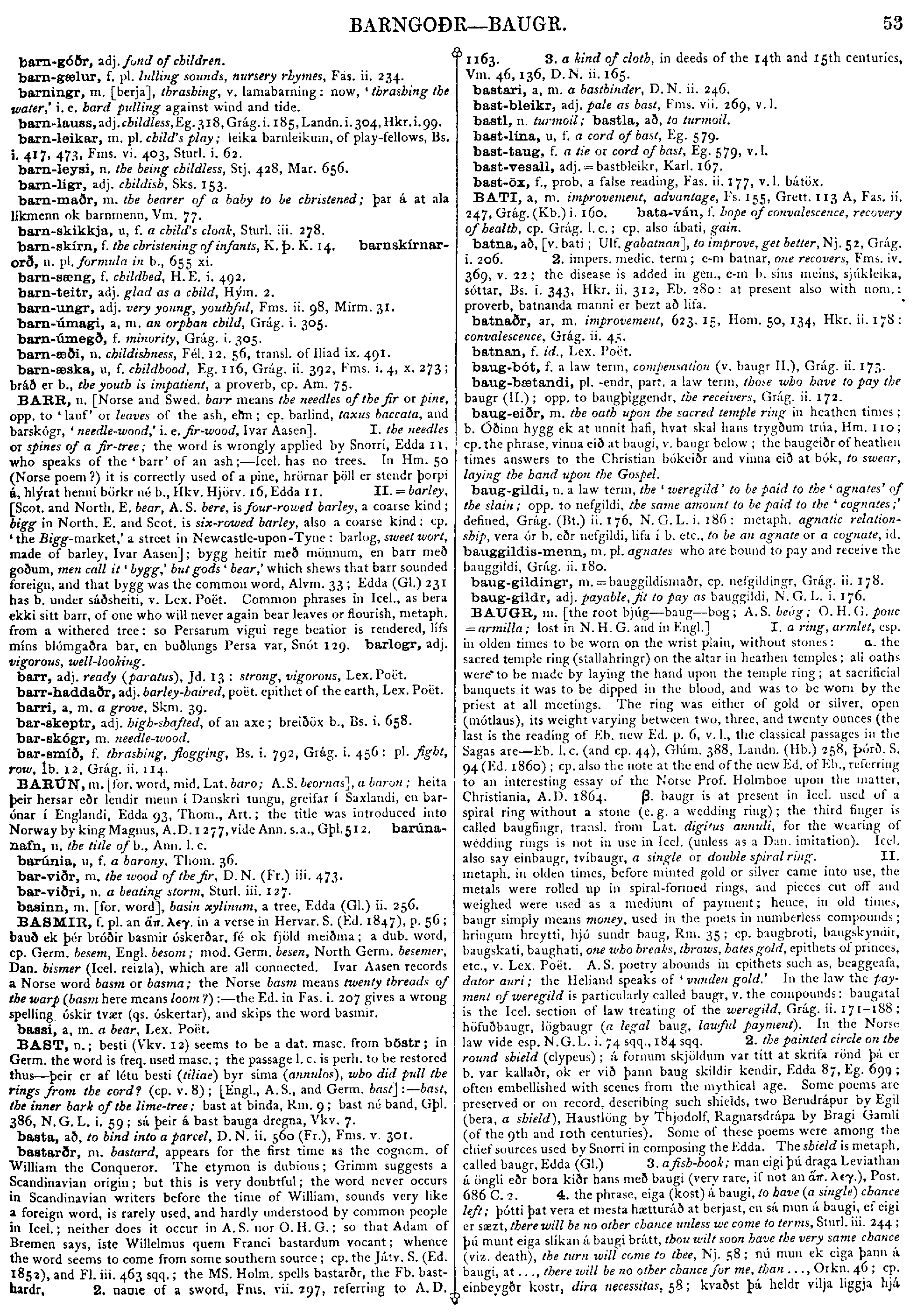
bastarðr, m. bastard, appears for the first time as the cognom. of William the Conqueror. The etymon is dubious; Grimm suggests a Scandinavian origin; but this is very doubtful; the word never occurs in Scandinavian writers before the time of William, sounds very like a foreign word, is rarely used, and hardly understood by common people in Icel.; neither does it occur in A. S. nor O. H. G.; so that Adam of Bremen says, iste Willelmus quem Franci bastardum vocant; whence the word seems to come from some southern source; cp. the Játv. S. (Ed. 1852), and Fl. iii. 463 sqq.; the MS. Holm, spells bastarðr, the Fb. bast- hardr. 2. name of a sword, Fms. vii. 297, referring to A. D. 1163. 3. a kind of cloth, in deeds of the I4th and 151:1 centuries, Vm. 46, 136, D. N. ii. 165.
|
Source: Cleasby/Vigfusson, page b0055, entry 6 View original page image as: [TIFF] [PNG] [View previous entry] [View next entry] |
[Comment on this entry] [View comments] |
The following entry has not been hand-corrected. However, the page is reserved and someone is correcting it. |
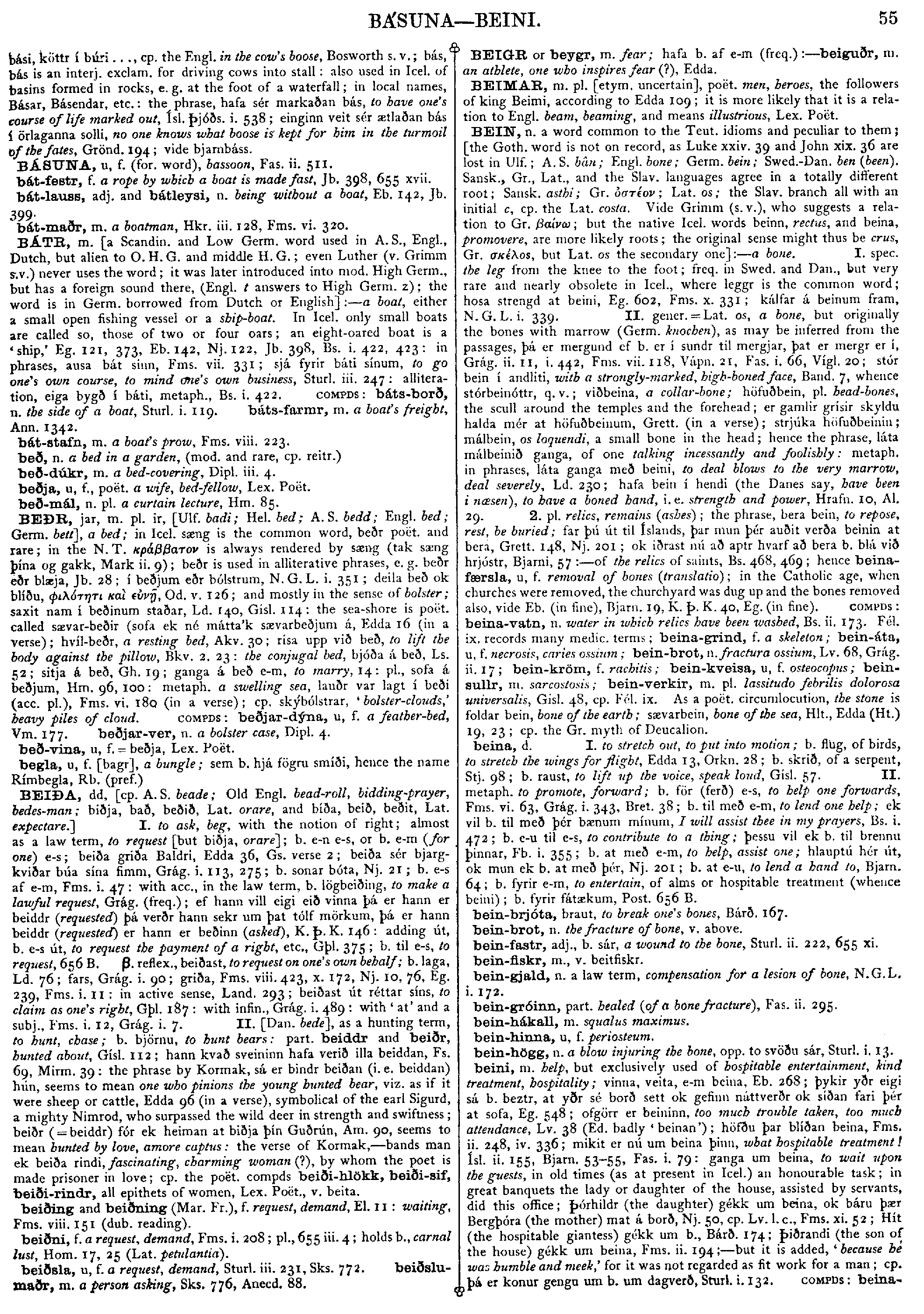
BÁTR,, m. [a Scandin. and Low Germ, word used in A. S., Engl., Dutch, but alien to O. H. G. and middle H. G.; even Luther (v. Grimm y. v.) never uses the word; it was later introduced into mod. High Germ., but has a foreign sound there, (Engl. t answers to High Germ, z); the word is in Germ, borrowed from Dutch or English] :-- a boat, either a small open fishing vessel or a shi p- boat. In Icel. only small boats are called so, those of two or four oars; an eight-oared boat is a 'ship, ' Eg. 121, 373, Eb. 142, Nj. 122, Jb. 398, Bs. 1. 422, 423: in phrases, ausa bat sinn, Fms. vii. 331; sjá fyrir báti sínum, to go one's own course, to mind erne's own business, Sturl. iii. 247: allitera- tion, eiga bygð í báti, metaph., Bs. i. 422. COMPDS: báts-borð, n. the s ide of a boat, Sturl. i. 119. báts-farmr, m. a boat's freight, Ann. 1342.
|
Source: Cleasby/Vigfusson, page b0055, entry 21 View original page image as: [TIFF] [PNG] [View previous entry] [View next entry] |
[Comment on this entry] [View comments] |
The following entry has not been hand-corrected. However, the page is reserved and someone is correcting it. |
BEIN, n. a word common to the Teut. idioms and peculiar to them j [the Goth, word is not on record, as Luke xxiv. 39 and John xix. 36 are lost in Ulf.; A. S. ban; Engl. bone; Germ, bein; Swed. -Dan. ben (been). Sansk., Gr., Lat., and the Slav, languages agree in a totally different root; Sansk. asihi; Gr. oariov; Lat. os; the Slav, branch all with an initial c, cp. the Lat. cosia. Vide Grimm (s. v.), who suggests a rela- tion to Gr. jSeuVu;; but the native Icel. words beinn, rectus, and beina, promovere, are more likely roots; the original sense might thus be crus, Gr. er/ceAos, but Lat. os the secondary one] :-- a bone. I. spec. the le g" from the knee to the foot; freq. in Swed. and Dan., but very rare and nearly obsolete in Icel., where leggr is the common word; hosa strengd at beini, Eg. 602, Fms. x. 331; kálfar á beinum fram, N. G. L. i. 339. II. gener. = Lat. os, a bone, but originally the bones with marrow (Germ, knocben), as may be inferred from the passages, pa er mergund ef b. er í sundr til mergjar, þat er mergr er i, Grág. ii. II, i. 442, Fms. vii. 118, Vápn. 21, Fas. i. 66, Vígl. 20; stór bein í andliti, with a strongly-marked, high-boned face, Band. 7, whence stórbeinóttr, q. v.; viðbeina, a collar-bone; höfuðbein, pl. he a d- b on e s, the scull around the temples and the forehead; er gamlir grisir skyldu halda mér at höfuðbeinum, Grett. (in a verse); strjúka hó'fuðbeiniu; málbein, o s loquendi, a small bone in the head; hence the phrase, láta málbeinið ganga, of one talking incessantly and foolishly: metaph. in phrases, lata ganga með beini, to deal blows to the very marrow, deal severely, Ld. 230; hafa bein í hendi (the Danes say, have been i nœsen), to have a boned hand, i. e. strength and power, Hrafn. 10, Al. 29. 2. pl. relics, remains (ashes); the phrase, bera bein, to repose, rest, be buried; far þú út til islands, þar mun þér auðit verða beinin at bera, Grett. 148, Nj. 201; ok iðrast nú að aptr hvarf að bera b. blú við hrjóstr, Bjarni, 57 :-- of the reli cs of saints, Bs. 468, 469; hence beina- færsla, u, f. removal of bones (translatio); in the Catholic age, when churches were removed, the churchyard was dug up and the bones removed also, vide Eb. (in fine), Bjarn. 19, K. b. K. 40, Eg. (in fine). COMPDS: beina-vatn, n. water in which relics have been washed, Bs. ii. 173. Fél. ix. records many medic, terms; beina-griud, f. a skeleton; bein-áta, u, f. necrosis, caries ossiitm; bein-brot, \. fractura ossium, Lv. 68, Grág. ii. 17; bein-kröm, f. rachitis: bein-kveisa, u, f. osteocopus; bein- sullr, in. sarcostosis; bein-verkir, m. pl. lassitudo febrilis dolorosa universalis, Gísl. 48, cp. Fél. ix. As a poet, circumlocution, the s to ne is foldar bein, bone of the earth; sævarbein, bone of the sea, Hit., Edda (Ht.) 19, 23; cp. the Gr. myth of
|
Source: Cleasby/Vigfusson, page b0057, entry 37 View original page image as: [TIFF] [PNG] [View previous entry] [View next entry] |
[Comment on this entry] [View comments] |
The following entry has been hand-corrected once. |
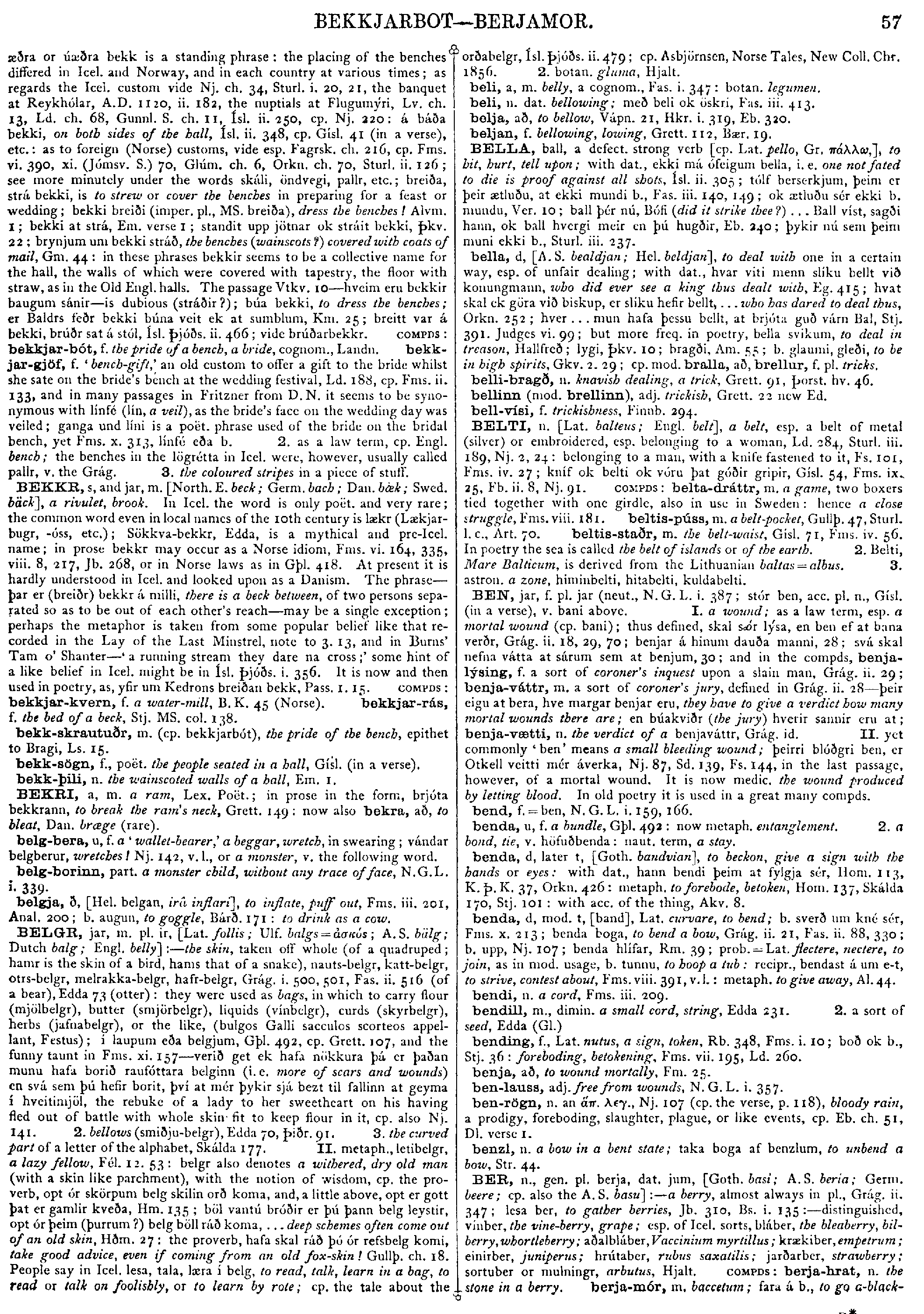
BERA,
bar,
báru,
borit,
pres.
berr,
--
poët,
forms
with
the
suffixed
negative;
3rd
pers.
sing.
pres.
Indic.
berrat,
Hm.
10;
3rd
pers.
sing.
pret.
barat,
Vellekla;
1st
pers.
sing.
barkak,
Eb.
62
(in
a
verse);
barkat
ek,
Hs.
8;
2nd
pers.
sing.
bartattu;
3rd
pers.
pl.
bárut,
etc.,
v.
Lex.
Poët.
[Gr.
GREEK
Lat.
ferre;
Ulf.
bairan;
A.
S.
beran;
Germ,
gebären;
Engl.
bear;
Swed.
bära;
Dan.
bære].
A.
Lat.
ferre,
portare:
I.
prop,
with
a
sense
of
motion,
to
bear,
carry,
by
means
of
the
body,
of
animals,
of
vehicles,
etc.,
with
acc.,
Egil
tók
mjöðdrekku
eina
mikla,
ok
bar
undir
hendi
sér,
Eg.
237;
bar
hann
heim
hrís,
Rm.
9;
konungr
lét
bera
inn
kistur
tvær,
báru
tveir
menn
hverja,
Eg.
310;
bera
farm
af
skipi,
to
unload
a
ship,
Ld.
32;
bera
(farm)
á
skip,
to
load
a
ship,
Nj.
182;
tóku
alla
ösku
ok
báru
á
á
(amnem)
út,
623,
36;
ok
bar
þat
(carried
it)
í
kerald,
43,
K.
Þ.
K.
92;
b.
mat
á
borð,
í
stofu,
to
put
the
meat
on
table,
in
the
oven;
b.
mat
af
borði,
to
take
it
off
table,
Eb.
36,
266,
Nj.
75,
Fms.
ix.
219,
etc.
2.
Lat.
gestare,
ferre,
denoting
to
wear
clothes,
to
carry
weapons;
skikkja
dýr
er
konungr
hafði
borit,
Eg.
318;
b.
kórónu,
to
wear
the
crown,
Fms.
x.
16;
atgeir,
Nj.
119;
vápn,
209:
metaph.,
b.
ægishjálm,
to
inspire
fear
and
awe;
b.
merki,
to
carry
the
flag
in
a
battle,
Nj.
274,
Orkn.
28,
30,
38,
Fms.
v.
64,
vi.
413;
bera
fram
merki,
to
advance,
move
in
a
battle,
vi.
406.
3.
b.
e-t
á
hesti
(áburðr),
to
carry
on
horseback;
Auðunn
bar
mat
á
hesti,
Grett.
107;
ok
bar
hrís
á
hesti,
76
new
Ed.;
þeir
báru
á
sjau
hestum,
98
new
Ed.
II.
without
a
sense
of
motion:
1.
to
give
birth
to;
[the
root
of
barn,
bairn;
byrja,
incipere;
burðr,
partus;
and
burr,
filius:
cp.
Lat.
parre;
also
Gr.
GREEK
Lat.
ferre,
of
child-bearing.]
In
Icel.
prose,
old
as
well
as
mod.,
'ala'
and
'fæða'
are
used
of
women;
but
'bera,'
of
cows
and
sheep;
hence
sauðburðr,
casting
of
lambs,
kýrburðr;
a
cow
is
snembær,
siðbær,
Jólabær,
calves
early,
late,
at
Yule
time,
etc.;
var
ekki
ván
at
hon
(the
cow)
mundi
b.
fyr
en
um
várit,
Bs.
i.
193,
194;
kýr
hafði
borit
kálf,
Bjarn.
32;
bar
hvárrtveggi
sauðrinn
sinn
burð,
Stj.
178:
the
participle
borinn
is
used
of
men
in
a
great
many
compds
in
a
general
sense,
aptrborinn,
árborinn,
endrborinn,
frjálsborinn,
goðborinn,
höldborinn,
hersborinn,
konungborinn,
óðalborinn,
samborinn,
sundrborinn,
velborinn,
úborinn,
þrælborinn,
etc.;
also
out
of
compds,
mun
ek
eigi
upp
gefa
þann
sóma,
sem
ek
em
til
borinn,
...
entitled
to
by
inheritance,
Ld.
102;
hann
hafði
blindr
verit
borinn,
born
blind,
Nj.
152,
Hdl.
34,
42,
Vsp.
2:
esp.
borinn
e-m,
born
of
one,
Rm.
39,
Hdl.
12,
23,
27,
Hðm.
2,
Gs.
9,
Vþm.
25,
Stor.
16,
Vkv.
15;
borinn
frá
e-m,
Hdl.
24:
the
other
tenses
are
in
theol.
Prose
used
of
Christ,
hans
blezaða
son
er
virðist
at
láta
berast
hingað
í
heim
af
sinni
blezaðri
móður,
Fms.
i.
281;
otherwise
only
in
poetry,
eina
dóttur
(acc.)
berr
álfröðull
(viz.
the
sun,
regarded
as
the
mother),
Vþm.
47;
hann
Gjálp
um
bar,
hann
Greip
um
bar
...,
Hdl.
36:
borit
(sup.),
Hkv.
1.
1.
.
of
trees,
flowers;
b.
ávöxt,
blóm
...,
to
bear
fruit,
flower
...
(freq.);
bar
aldinviðrinn
tvennan
blóma,
Fms.
ix.
265;
cp.
the
phrase,
bera
sitt
barr,
v.
barr.
2.
denoting
to
load,
with
acc.
of
the
person
and
dat.
of
the
thing:
 .
in
prop.
sense;
hann
hafði
borit
sik
mjök
vápnum,
he
had
loaded
himself
with
arms,
i.
e.
wore
heavy
armour,
Sturl.
iii.
250.
.
but
mostly
in
a
metaph.
sense;
b.
e-n
ofrafli,
ofrmagni,
ofrliði,
ofríki,
magni,
to
bear
one
down,
to
overcome,
oppress
one,
by
odds
or
superior
force,
Grág.
i.
101,
ii.
195,
Nj.
80,
Hkr.
ii.
371,
Gþl.
474,
Stj.
512,
Fms.
iii.
175
(in
the
last
passage
a
dat.
pers.
badly);
b.
e-n
ráðum,
to
overrule
one,
Nj.
198,
Ld.
296;
b.
e-n
málum,
to
bearhim
down
(wrongfully)
in
a
lawsuit,
Nj.
151;
b.
e-n
bjóri,
to
make
drunk,
Vkv.
26:
medic.,
borinn
verkjum,
sótt,
Bjarn.
68,
Og.
5;
bölvi,
Gg.
2:
borne
down,
feeling
heavy
pains;
þess
er
borin
ván,
no
hope,
all
hope
is
gone,
Ld.
250;
borinn
sök,
charged
with
a
cause,
Fms.
v.
324,
H.
E.
i.
561;
bráðum
borinn,
to
be
taken
by
surprise,
Fms.
iv.
111;
b.
fé,
gull
á
e-n,
to
bring
one
a
fee,
gold,
i.
e.
to
bribe
one,
Nj.
62;
borinn
baugum,
bribed,
Alvm.
5;
always
in
a
bad
sense,
cp.
the
law
phrase,
b.
fé
í
dóm,
to
bribe
a
court,
Grág.,
Nj.
240.
3.
to
bear,
support,
sustain,
Lat.
sustinere,
lolerare,
ferre:
.
properly,
of
a
ship,
horse,
vehicle,
to
bear,
be
capable
of
bearing;
þeir
hlóðu
bæði
skipin
sem
borð
báru,
all
that
they
could
carry,
Eb.
302;
--
a
ship
'berr'
(carries)
such
and
such
a
weight;
but
'tekr'
(takes)
denotes
a
measure
of
fluids.
.
metaph.
to
sustain,
support;
dreif
þannig
svá
mikill
mannfjöldi
at
landit
fékk
eigi
borit,
Hkr.
i.
56;
but
metaph.
to
bear
up
against,
endure,
support
grief,
sorrow,
etc.,
sýndist
öllum
at
Guð
hefði
nær
ætlað
hvat
hann
mundi
b.
mega,
Bs.
i.
139;
biðr
hann
friðar
ok
þykist
ekki
mega
b.
reiði
hans,
Fms.
iii.
80:
the
phrase,
b.
harm
sinn
í
hljóði,
to
suffer
silently;
b.
svívirðing,
x.
333:
absol.,
þótti
honum
mikit
víg
Kjartans,
en
þó
bar
hann
drengilega,
he
bore
it
manfully,
Ld.
226;
er
þat
úvizka,
at
b.
eigi
slíkt,
not
to
bear
or
put
up
with,
Glúm.
327;
b.
harm,
to
grieve,
Fms.
xi.
425:
in
the
phrases,
b.
sik,
b.
af
sér,
berask,
berask
vel
(illa,
lítt),
to
bear
oneself,
to
bear
up
against
misfortune;
Guðrúnu
þótti
mikit
fráfall
Þorkels,
en
þó
bar
hon
sköruliga
af
sér,
she
bore
her
bravely
up,
Ld.
326-328;
lézt
hafa
spurt
at
ekkjan
bæri
vel
af
sér
harmana,
Eb.
88;
berask
af;
hversu
bersk
Auðr
af
um
bróðurdauðann?
(how
does
she
bear
it?);
hón
bersk
af
lítt
(she
is
much
borne
down)
ok
þykir
mikit,
Gísl.
24;
niun
oss
vandara
gört
en
öðrum
at
vér
berim
oss
vel
(Lat.
fortiter
ferre),
Nj.
197;
engi
maðr
hefði
þar
jamvel
borit
sik,
none
bad
borne
himself
so
boldly,
Sturl.
iii.
132;
b.
sik
vel
upp,
to
bear
well
up
against,
bear
a
stout
heart,
Hrafn.
17;
b.
sik
beiskliga
(sorely),
Stj.
143;
b.
sik
lítt,
to
be
downcast,
Fms.
ii.
61;
b.
sik
at
göra
e-t,
to
do
one's
best,
try
a
thing.
III.
in
law
terms
or
modes
of
procedure:
1.
bera
járn,
the
ordeal
of
bearing
hot
iron
in
the
hand,
cp.
járnburðr,
skírsla.
This
custom
was
introduced
into
Scandinavia
together
with
Christianity
from
Germany
and
England,
and
superseded
the
old
heathen
ordeals
'hólmganga,'
and
'ganga
undir
jarðarmen,'
v.
this
word.
In
Norway,
during
the
civil
wars,
it
was
esp.
used
in
proof
of
paternity
of
the
various
pretenders
to
the
crown,
Fms.
vii.
164,
200,
ix.
Hák.
S.
ch.
14,
41-45,
viii.
(Sverr.
S.)
ch.
150,
xi.
(Jómsv.
S.)
ch.
11,
Grett.
ch.
41,
cp.
N.
G.
L.
i.
145,
389.
Trial
by
ordeal
was
abolished
in
Norway
A.
D.
1247.
In
Icel.
It
was
very
rarely
mentioned,
vide
however
Lv.
ch.
23
(paternity),
twice
or
thrice
in
the
Sturl.
i.
56,
65,
147,
and
Grág.
i.
341,
361;
it
seems
to
have
been
very
seldom
used
there,
(the
passage
in
Grett.
S.
l.
c.
refers
to
Norway.)
2.
bera
út
(hence
útburðr,
q.
v.),
to
expose
children;
on
this
heathen
custom,
vide
Grimm
R.
A.
In
heathen
Icel.,
as
in
other
parts
of
heathen
Scandinavia,
it
was
a
lawful
act,
but
seldom
exercised;
the
chief
passages
on
record
are,
Gunnl.
S.
ch.
3
(ok
þat
var
þá
siðvandi
nokkurr,
er
land
var
allt
alheiðit,
at
þeir
menn
er
félitlir
vórn,
en
stóð
ómegð
mjök
til
handa
létu
út
bera
börn
sín,
ok
þótti
þó
illa
gört
ávalt),
Fs.
Vd.
ch.
37,
Harð.
S.
ch.
8,
Rd.
ch.
7,
Landn.
v.
ch.
6,
Finnb.
ch.
2,
Þorst.
Uxaf.
ch.
4,
Hervar.
S.
ch.
4,
Fas.
i.
547
(a
romance);
cp.
Jómsv.
S.
ch.
1.
On
the
introduction
of
Christianity
into
Icel.
A.
D.
1000,
it
was
resolved
that,
in
regard
to
eating
of
horse-flesh
and
exposure
of
children,
the
old
laws
should
remain
in
force,
Íb.
ch.
9;
as
Grimm
remarks,
the
exposure
must
take
place
immediately
after
birth,
before
the
child
had
tasted
food
of
any
kind
whatever,
and
before
it
was
besprinkled
with
water
(ausa
vatni)
or
shown
to
the
father,
who
had
to
fix
its
name;
exposure,
after
any
of
these
acts,
was
murder,
cp.
the
story
of
Liafburga
told
by
Grimm
R.
A.);
v.
Also
a
Latin
essay
at
the
end
of
the
Gunnl.
S.
(Ed.
1775).
The
Christian
Jus
Eccl.
put
an
end
to
this
heathen
barbarism
by
stating
at
its
very
beginning,
ala
skal
barn
hvert
er
borit
verðr,
i.
e.
all
children,
if
not
of
monstrous
shape,
shall
be
brought
up,
N.
G.
L.
i.
339,
363.
.
b.
út
(now
more
usual,
hefja
út,
Am.
100),
to
carry
out
for
burial;
vera
erfðr
ok
tit
borinn,
Odd.
20;
var
hann
heygðr,
ok
út
borinn
at
fornum
sið,
Fb.
i.
123;
b.
á
bál,
to
place
(the
body
and
treasures)
upon
the
pile,
the
mode
of
burying
in
the
old
heathen
time,
Fas.
i.
487
(in
a
verse);
var
hon
borin
á
bálit
ok
slegit
í
eldi,
Edda
38.
B.
Various
and
metaph.
cases.
I.
denoting
motion:
1.
'bera'
is
in
the
Grág.
the
standing
law
term
for
delivery
of
a
verdict
by
a
jury
(búar),
either
'bera'
absol.
or
adding
kvið
(verdict);
bera
á
e-n,
or
b.
kvið
á
e-n,
to
give
a
verdict
against,
declare
guilty;
bera
af
e-m,
or
b.
af
e-m
kviðinn,
to
give
a
verdict
for;
or
generally,
bera,
or
b.
um
e-t,
to
give
a
verdict
in
a
case;
bera,
or
b.
vitni,
vætti,
also
simply
means
to
testify,
to
witness,
Nj.
111,
cp.
kviðburðr
(delivering
of
verdict),
vitnisburðr
(bearing
witness),
Grág.
ii.
28;
eigi
eigu
búar
(jurors)
enn
at
b.
um
þat
hvat
lög
eru
á
landi
hér,
the
jurors
have
not
to
give
verdict
in
(to
decide)
what
is
law
in
the
country,
cp.
the
Engl.
maxim,
that
jurors
have
only
to
decide
the
question
of
evidence,
not
of
law,
Grág.
(Kb.)
ch.
85;
eigi
eru
búar
skildir
at
b.
um
hvatvetna;
um
engi
mál
eigu
þeir
at
skilja,
þau
er
erlendis
(abroad)
hafa
görzt,
id.;
the
form
in
delivering
the
verdict
--
höfum
vér
(the
jurors),
orðit
á
eitt
sáttir,
berum
á
kviðburðinn,
berum
hann
sannan
at
sökinni,
Nj.
238,
Grág.
i.
49,
22,
138,
etc.;
í
annat
sinn
báru
þeir
á
Flosa
kviðinn,
id.;
b.
annattveggja
af
eðr
á;
b.
undan,
to
discharge,
Nj.
135;
b.
kvið
í
hag
(for),
Grág.
i.
55;
b.
lýsingar
vætti,
Nj.
87;
b.
vitni
ok
vætti,
28,
43,
44;
b.
ljúgvitni,
to
bear
false
witness,
Grág.
i.
28;
b.
orð,
to
bear
witness
to
a
speech,
43;
bera
frændsemi
sundr,
to
prove
that
they
are
not
relations,
N.
G.
L.
i.
147:
reflex.,
berask
ór
vætti,
to
prove
that
oneself
is
wrongly
summoned
to
bear
witness
or
to
give
a
verdict,
44:
berask
in
a
pass.
sense,
to
be
proved
by
evidence,
ef
vanefni
b.
þess
manns
er
á
hönd
var
lýst,
Grág.
i.
257;
nema
jafnmæli
berisk,
229;
þótt
þér
berisk
þat
faðerni
er
þú
segir,
Fms.
vii.
164;
hann
kvaðst
ætla,
at
honum
mundi
berask,
that
he
would
be
able
to
get
evidence
for,
Fs.
46.
.
gener.
and
not
as
a
law
term;
b.
á,
b.
á
hendr,
to
charge;
b.
e-n
undan,
to
discharge,
Fs.
95;
eigi
erum
vér
þessa
valdir
er
þú
berr
á
oss,
Nj.
238,
Ld.
206,
Fms.
iv.
380,
xi.
251,
Th.
78;
b.
e-m
á
brýnn,
to
throw
in
one's
face,
to
accuse,
Greg.
51;
b.
af
sér,
to
deny;
eigi
mun
ek
af
mér
b.,
at...
(non
diffitebor),
Nj.
271;
.
in
prop.
sense;
hann
hafði
borit
sik
mjök
vápnum,
he
had
loaded
himself
with
arms,
i.
e.
wore
heavy
armour,
Sturl.
iii.
250.
.
but
mostly
in
a
metaph.
sense;
b.
e-n
ofrafli,
ofrmagni,
ofrliði,
ofríki,
magni,
to
bear
one
down,
to
overcome,
oppress
one,
by
odds
or
superior
force,
Grág.
i.
101,
ii.
195,
Nj.
80,
Hkr.
ii.
371,
Gþl.
474,
Stj.
512,
Fms.
iii.
175
(in
the
last
passage
a
dat.
pers.
badly);
b.
e-n
ráðum,
to
overrule
one,
Nj.
198,
Ld.
296;
b.
e-n
málum,
to
bearhim
down
(wrongfully)
in
a
lawsuit,
Nj.
151;
b.
e-n
bjóri,
to
make
drunk,
Vkv.
26:
medic.,
borinn
verkjum,
sótt,
Bjarn.
68,
Og.
5;
bölvi,
Gg.
2:
borne
down,
feeling
heavy
pains;
þess
er
borin
ván,
no
hope,
all
hope
is
gone,
Ld.
250;
borinn
sök,
charged
with
a
cause,
Fms.
v.
324,
H.
E.
i.
561;
bráðum
borinn,
to
be
taken
by
surprise,
Fms.
iv.
111;
b.
fé,
gull
á
e-n,
to
bring
one
a
fee,
gold,
i.
e.
to
bribe
one,
Nj.
62;
borinn
baugum,
bribed,
Alvm.
5;
always
in
a
bad
sense,
cp.
the
law
phrase,
b.
fé
í
dóm,
to
bribe
a
court,
Grág.,
Nj.
240.
3.
to
bear,
support,
sustain,
Lat.
sustinere,
lolerare,
ferre:
.
properly,
of
a
ship,
horse,
vehicle,
to
bear,
be
capable
of
bearing;
þeir
hlóðu
bæði
skipin
sem
borð
báru,
all
that
they
could
carry,
Eb.
302;
--
a
ship
'berr'
(carries)
such
and
such
a
weight;
but
'tekr'
(takes)
denotes
a
measure
of
fluids.
.
metaph.
to
sustain,
support;
dreif
þannig
svá
mikill
mannfjöldi
at
landit
fékk
eigi
borit,
Hkr.
i.
56;
but
metaph.
to
bear
up
against,
endure,
support
grief,
sorrow,
etc.,
sýndist
öllum
at
Guð
hefði
nær
ætlað
hvat
hann
mundi
b.
mega,
Bs.
i.
139;
biðr
hann
friðar
ok
þykist
ekki
mega
b.
reiði
hans,
Fms.
iii.
80:
the
phrase,
b.
harm
sinn
í
hljóði,
to
suffer
silently;
b.
svívirðing,
x.
333:
absol.,
þótti
honum
mikit
víg
Kjartans,
en
þó
bar
hann
drengilega,
he
bore
it
manfully,
Ld.
226;
er
þat
úvizka,
at
b.
eigi
slíkt,
not
to
bear
or
put
up
with,
Glúm.
327;
b.
harm,
to
grieve,
Fms.
xi.
425:
in
the
phrases,
b.
sik,
b.
af
sér,
berask,
berask
vel
(illa,
lítt),
to
bear
oneself,
to
bear
up
against
misfortune;
Guðrúnu
þótti
mikit
fráfall
Þorkels,
en
þó
bar
hon
sköruliga
af
sér,
she
bore
her
bravely
up,
Ld.
326-328;
lézt
hafa
spurt
at
ekkjan
bæri
vel
af
sér
harmana,
Eb.
88;
berask
af;
hversu
bersk
Auðr
af
um
bróðurdauðann?
(how
does
she
bear
it?);
hón
bersk
af
lítt
(she
is
much
borne
down)
ok
þykir
mikit,
Gísl.
24;
niun
oss
vandara
gört
en
öðrum
at
vér
berim
oss
vel
(Lat.
fortiter
ferre),
Nj.
197;
engi
maðr
hefði
þar
jamvel
borit
sik,
none
bad
borne
himself
so
boldly,
Sturl.
iii.
132;
b.
sik
vel
upp,
to
bear
well
up
against,
bear
a
stout
heart,
Hrafn.
17;
b.
sik
beiskliga
(sorely),
Stj.
143;
b.
sik
lítt,
to
be
downcast,
Fms.
ii.
61;
b.
sik
at
göra
e-t,
to
do
one's
best,
try
a
thing.
III.
in
law
terms
or
modes
of
procedure:
1.
bera
járn,
the
ordeal
of
bearing
hot
iron
in
the
hand,
cp.
járnburðr,
skírsla.
This
custom
was
introduced
into
Scandinavia
together
with
Christianity
from
Germany
and
England,
and
superseded
the
old
heathen
ordeals
'hólmganga,'
and
'ganga
undir
jarðarmen,'
v.
this
word.
In
Norway,
during
the
civil
wars,
it
was
esp.
used
in
proof
of
paternity
of
the
various
pretenders
to
the
crown,
Fms.
vii.
164,
200,
ix.
Hák.
S.
ch.
14,
41-45,
viii.
(Sverr.
S.)
ch.
150,
xi.
(Jómsv.
S.)
ch.
11,
Grett.
ch.
41,
cp.
N.
G.
L.
i.
145,
389.
Trial
by
ordeal
was
abolished
in
Norway
A.
D.
1247.
In
Icel.
It
was
very
rarely
mentioned,
vide
however
Lv.
ch.
23
(paternity),
twice
or
thrice
in
the
Sturl.
i.
56,
65,
147,
and
Grág.
i.
341,
361;
it
seems
to
have
been
very
seldom
used
there,
(the
passage
in
Grett.
S.
l.
c.
refers
to
Norway.)
2.
bera
út
(hence
útburðr,
q.
v.),
to
expose
children;
on
this
heathen
custom,
vide
Grimm
R.
A.
In
heathen
Icel.,
as
in
other
parts
of
heathen
Scandinavia,
it
was
a
lawful
act,
but
seldom
exercised;
the
chief
passages
on
record
are,
Gunnl.
S.
ch.
3
(ok
þat
var
þá
siðvandi
nokkurr,
er
land
var
allt
alheiðit,
at
þeir
menn
er
félitlir
vórn,
en
stóð
ómegð
mjök
til
handa
létu
út
bera
börn
sín,
ok
þótti
þó
illa
gört
ávalt),
Fs.
Vd.
ch.
37,
Harð.
S.
ch.
8,
Rd.
ch.
7,
Landn.
v.
ch.
6,
Finnb.
ch.
2,
Þorst.
Uxaf.
ch.
4,
Hervar.
S.
ch.
4,
Fas.
i.
547
(a
romance);
cp.
Jómsv.
S.
ch.
1.
On
the
introduction
of
Christianity
into
Icel.
A.
D.
1000,
it
was
resolved
that,
in
regard
to
eating
of
horse-flesh
and
exposure
of
children,
the
old
laws
should
remain
in
force,
Íb.
ch.
9;
as
Grimm
remarks,
the
exposure
must
take
place
immediately
after
birth,
before
the
child
had
tasted
food
of
any
kind
whatever,
and
before
it
was
besprinkled
with
water
(ausa
vatni)
or
shown
to
the
father,
who
had
to
fix
its
name;
exposure,
after
any
of
these
acts,
was
murder,
cp.
the
story
of
Liafburga
told
by
Grimm
R.
A.);
v.
Also
a
Latin
essay
at
the
end
of
the
Gunnl.
S.
(Ed.
1775).
The
Christian
Jus
Eccl.
put
an
end
to
this
heathen
barbarism
by
stating
at
its
very
beginning,
ala
skal
barn
hvert
er
borit
verðr,
i.
e.
all
children,
if
not
of
monstrous
shape,
shall
be
brought
up,
N.
G.
L.
i.
339,
363.
.
b.
út
(now
more
usual,
hefja
út,
Am.
100),
to
carry
out
for
burial;
vera
erfðr
ok
tit
borinn,
Odd.
20;
var
hann
heygðr,
ok
út
borinn
at
fornum
sið,
Fb.
i.
123;
b.
á
bál,
to
place
(the
body
and
treasures)
upon
the
pile,
the
mode
of
burying
in
the
old
heathen
time,
Fas.
i.
487
(in
a
verse);
var
hon
borin
á
bálit
ok
slegit
í
eldi,
Edda
38.
B.
Various
and
metaph.
cases.
I.
denoting
motion:
1.
'bera'
is
in
the
Grág.
the
standing
law
term
for
delivery
of
a
verdict
by
a
jury
(búar),
either
'bera'
absol.
or
adding
kvið
(verdict);
bera
á
e-n,
or
b.
kvið
á
e-n,
to
give
a
verdict
against,
declare
guilty;
bera
af
e-m,
or
b.
af
e-m
kviðinn,
to
give
a
verdict
for;
or
generally,
bera,
or
b.
um
e-t,
to
give
a
verdict
in
a
case;
bera,
or
b.
vitni,
vætti,
also
simply
means
to
testify,
to
witness,
Nj.
111,
cp.
kviðburðr
(delivering
of
verdict),
vitnisburðr
(bearing
witness),
Grág.
ii.
28;
eigi
eigu
búar
(jurors)
enn
at
b.
um
þat
hvat
lög
eru
á
landi
hér,
the
jurors
have
not
to
give
verdict
in
(to
decide)
what
is
law
in
the
country,
cp.
the
Engl.
maxim,
that
jurors
have
only
to
decide
the
question
of
evidence,
not
of
law,
Grág.
(Kb.)
ch.
85;
eigi
eru
búar
skildir
at
b.
um
hvatvetna;
um
engi
mál
eigu
þeir
at
skilja,
þau
er
erlendis
(abroad)
hafa
görzt,
id.;
the
form
in
delivering
the
verdict
--
höfum
vér
(the
jurors),
orðit
á
eitt
sáttir,
berum
á
kviðburðinn,
berum
hann
sannan
at
sökinni,
Nj.
238,
Grág.
i.
49,
22,
138,
etc.;
í
annat
sinn
báru
þeir
á
Flosa
kviðinn,
id.;
b.
annattveggja
af
eðr
á;
b.
undan,
to
discharge,
Nj.
135;
b.
kvið
í
hag
(for),
Grág.
i.
55;
b.
lýsingar
vætti,
Nj.
87;
b.
vitni
ok
vætti,
28,
43,
44;
b.
ljúgvitni,
to
bear
false
witness,
Grág.
i.
28;
b.
orð,
to
bear
witness
to
a
speech,
43;
bera
frændsemi
sundr,
to
prove
that
they
are
not
relations,
N.
G.
L.
i.
147:
reflex.,
berask
ór
vætti,
to
prove
that
oneself
is
wrongly
summoned
to
bear
witness
or
to
give
a
verdict,
44:
berask
in
a
pass.
sense,
to
be
proved
by
evidence,
ef
vanefni
b.
þess
manns
er
á
hönd
var
lýst,
Grág.
i.
257;
nema
jafnmæli
berisk,
229;
þótt
þér
berisk
þat
faðerni
er
þú
segir,
Fms.
vii.
164;
hann
kvaðst
ætla,
at
honum
mundi
berask,
that
he
would
be
able
to
get
evidence
for,
Fs.
46.
.
gener.
and
not
as
a
law
term;
b.
á,
b.
á
hendr,
to
charge;
b.
e-n
undan,
to
discharge,
Fs.
95;
eigi
erum
vér
þessa
valdir
er
þú
berr
á
oss,
Nj.
238,
Ld.
206,
Fms.
iv.
380,
xi.
251,
Th.
78;
b.
e-m
á
brýnn,
to
throw
in
one's
face,
to
accuse,
Greg.
51;
b.
af
sér,
to
deny;
eigi
mun
ek
af
mér
b.,
at...
(non
diffitebor),
Nj.
271;
| Result Page: |  |
Previous | 1 2 3 4 5 6 7 8 9 10 11 | Next |  |
Germanic Lexicon Project (main page)
This search system was written by
Sean Crist
Please consider
volunteering
to correct the data in these online dictionaries.
No rights reserved. Feel free to use these data in any way you please.