|
|

Search for Glum again, using less strict matching (450 results)
|
Source: Cleasby/Vigfusson, page b0003, entry 1 View original page image as: [TIFF] [PNG] [View previous entry] [View next entry] |
[Comment on this entry] [View comments] |
The following entry has been hand-corrected once. |
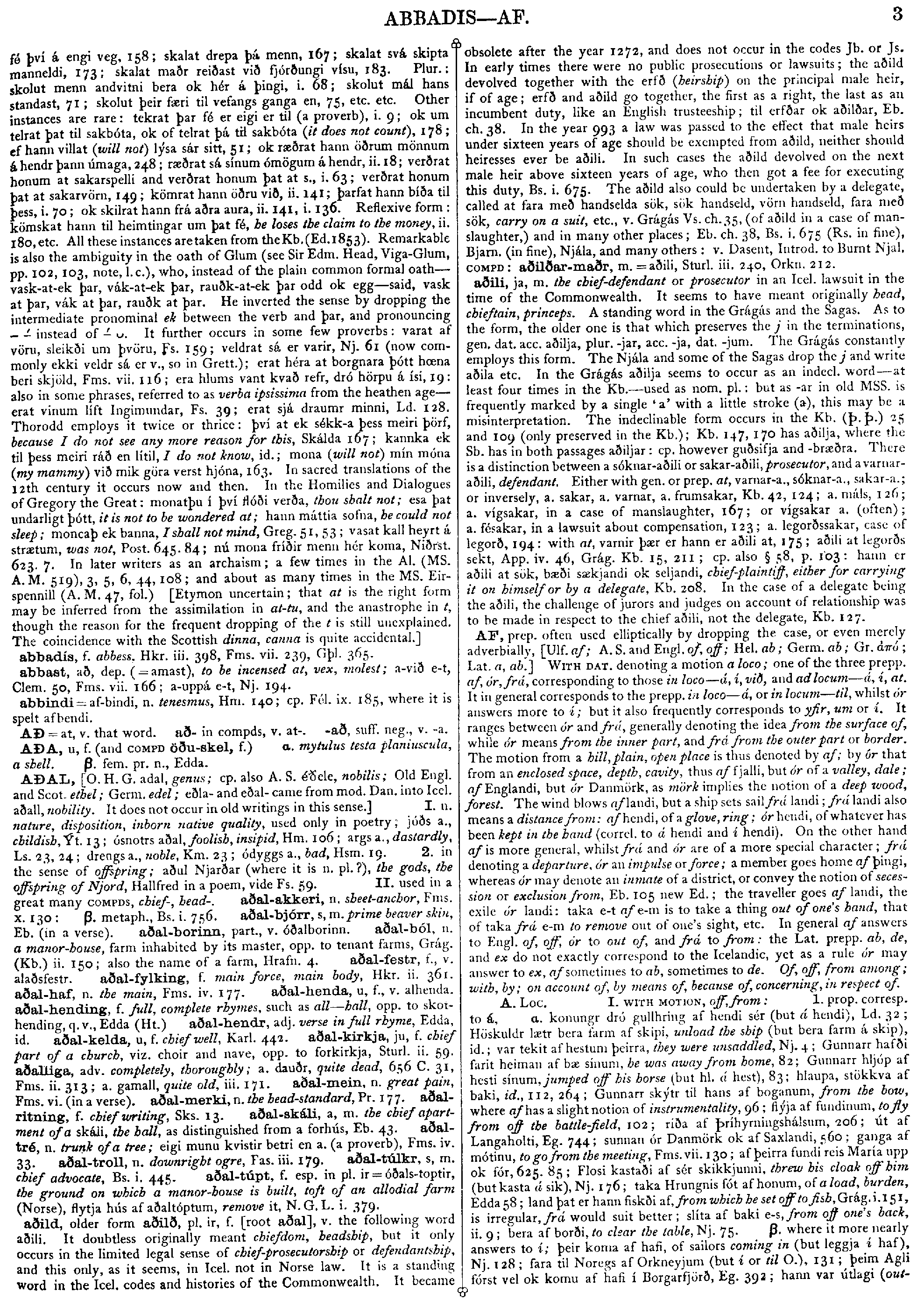
fé því á engi veg, 158; skalat drepa þá menn, 167; skalat svá skipta manneldi, 173; skalat maðr reiðast við fjórðungi vísu, 183. Plur.: skolut menn andvitni bera ok hér á þingi, i. 68; skolut mál hans standast, 71; skolut þeir færi til vefangs ganga en, 75, etc. etc. Other instances are rare: tekrat þar fé er eigi er til (a proverb), i. 9; ok um telrat þat til sakbóta, ok of telrat þá til sakbóta (it does not count), 178; ef hann villat (will not) lýsa sár sitt, 51; ok ræðrat hann öðrum mönnum á hendr þann úmaga, 248; ræðrat sá sínum ómögum á hendr, ii. 18; verðrat honum at sakarspelli and verðrat honum þat at s., i. 63; verðrat honum þat at sakarvörn, 149; kömrat hann öðru við, ii. 141; þarfat hann bíða til þess, i. 70; ok skilrat hann frá aðra aura, ii. 141, i. 136. Reflexive form: kömskat hann til heimtingar um þat fé, he loses the claim to the money, ii. 180, etc. All these instances are taken from the Kb. (Ed. 1853). Remarkable is also the ambiguity in the oath of Glum (see Sir Edm. Head, Viga-Glum, pp. 102, 103, note, I. c.), who, instead of the plain common formal oath -- vask-at-ek þar, vák-at-ek þar, rauðk-at-ek þar odd ok egg -- said, vask at þar, vák at þar, rauðk at þar. He inverted the sense by dropping the intermediate pronominal ek between the verb and þar, and pronouncing ??? instead of ???. It further occurs in some few proverbs: varat af vöru, sleikði um þvöru, Fs. 159; veldrat sá er varir, Nj. 61 (now com- monly ekki veldr sá er v., so in Grett.); erat héra at borgnara þótt hœna beri skjöld, Fms. vii. 116; era hlums vant kvað refr, dró hörpu á ísi, 19: also in some phrases, referred to as verba ipsissima from the heathen age -- erat vinum líft Ingimtmdar, Fs. 39; erat sjá draumr minni, Ld. 128. Thorodd employs it twice or thrice: því at ek sékk-a þess meiri þörf, because í do not see any more reason for this, Skálda 167; kannka ek til þess meiri ráð en lítil, I do not know, id.; mona (will not) mín móna (my mammy) við mik göra verst hjóna, 163. In sacred translations of the 12th century it occurs now and then. In the Homilies and Dialogues of Gregory the Great: monatþu í því flóði verða, thou shalt not; esa þat undarligt þótt, it is not to be wondered at; hann máttia sofna, he could not sleep; moncaþ ek banna, I shall not mind, Greg. 51, 53; vasal kall heyrt á strætum, was not, Post. 645. 84; nú mona fríðir menn hér koma, Niðrst. 623. 7. In later writers as an archaism; a few times in the Al. (MS. A. M. 519), 3, 5, 6, 44, 108; and about as many times in the MS. Eir- spennill (A. M. 47, fol.) [Etymon uncertain; that at is the right form may be inferred from the assimilation in at- t w, and the anastrophe in t, though the reason for the frequent dropping of the t is still unexplained. The coincidence with the Scottish dinna, canna is quite accidental.]
|
Source: Cleasby/Vigfusson, page b0046, entry 5 View original page image as: [TIFF] [PNG] [View previous entry] [View next entry] |
[Comment on this entry] [View comments (1)] |
The following entry has been hand-corrected once. |
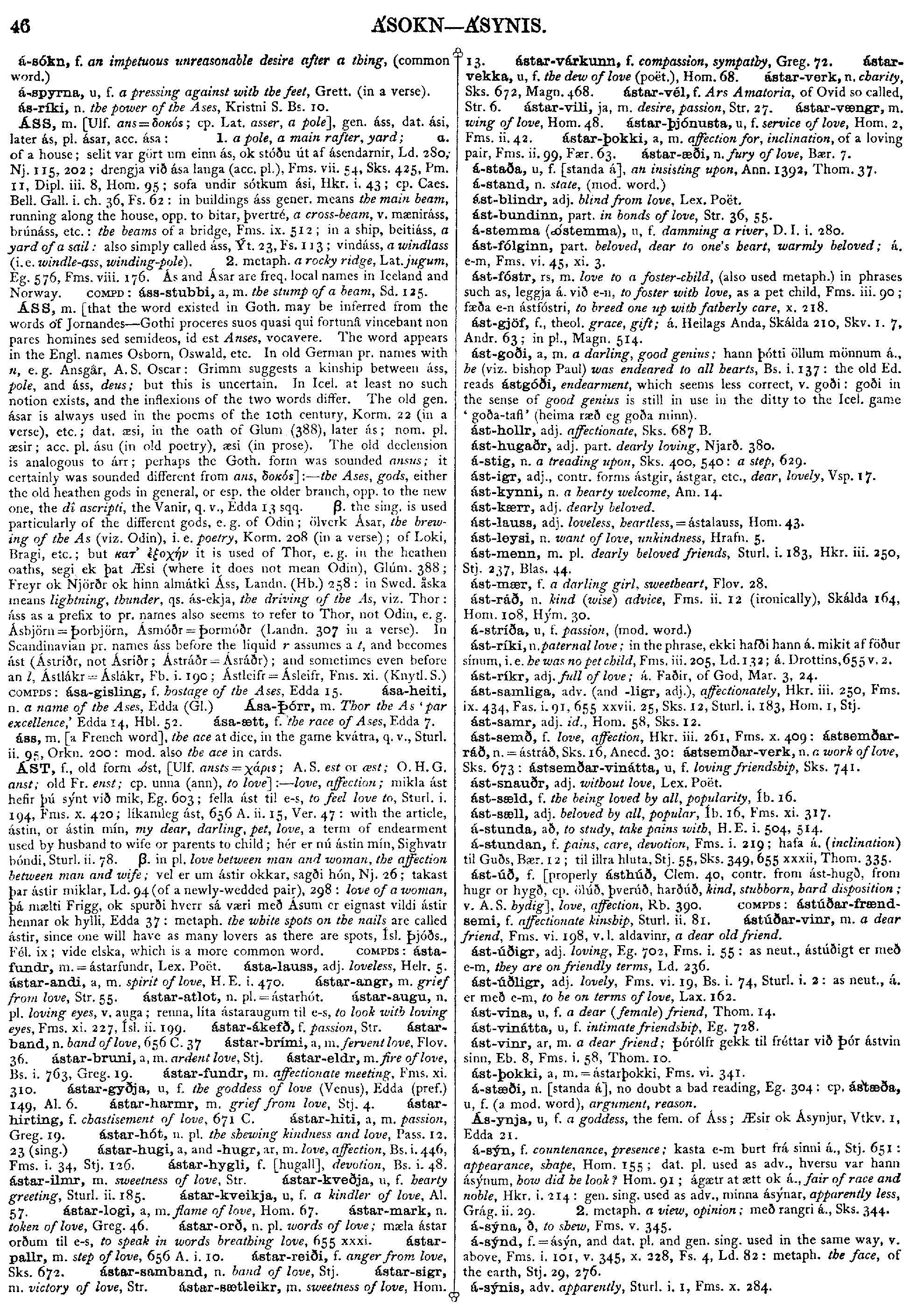
ÁSS,
m.
[that
the
word
existed
in
Goth,
may
be
inferred
from
the
words
of
Jornandes--Gothi
proceres
suos
quasi
qui
fortunâ
vincebant
non
pares
homines
sed
semideos,
id
est
Anses,
vocavere.
The
word
appears
in
the
Engl.
names
Osborn,
Oswald,
etc.
In
old
German
pr.
names
with
n,
e.
g.
Ansgâr,
A.
S.
Oscar:
Grimm
suggests
a
kinship
between
áss,
pole,
and
áss,
deus;
but
this
is
uncertain.
In
Icel.
at
least
no
such
notion
exists,
and
the
inflexions
of
the
two
words
differ.
The
old
gen.
asar
is
always
used
in
the
poems
of
the
10th
century,
Korm.
22
(in
a
verse),
etc.;
dat.
æsi,
in
the
oath
of
Glum
(388),
later
ás;
nom.
pl.
æsir;
acc.
pl.
ásu
(in
old
poetry),
æsi
(in
prose).
The
old
declension
is
analogous
to
árr;
perhaps
the
Goth,
form
was
sounded
ansus;
it
certainly
was
sounded
different
from
ans,
GREEK]:--the
Ases,
gods,
either
the
old
heathen
gods
in
general,
or
esp.
the
older
branch,
opp.
to
the
new
one,
the
dî
ascripti,
the
Vanir,
q.
v.,
Edda
13
sqq.
 .
the
sing,
is
used
particularly
of
the
different
gods,
e.
g.
of
Odin;
ölverk
Ásar,
the
brewing
of
the
As
(viz.
Odin),
i.
e.
poetry,
Korm.
208
(in
a
verse);
of
Loki,
Bragi,
etc.;
but
GREEK
it
is
used
of
Thor,
e.
g.
in
the
heathen
oaths,
segi
ek
þat
Æsi
(where
it
does
not
mean
Odin),
Glúm.
388;
Freyr
ok
Njörðr
ok
hinn
almátki
Áss,
Landn.
(Hb.)
258:
in
Swed.
åska
means
lightning,
thunder,
qs.
ás-ekja,
the
driving
of
the
As,
viz.
Thor:
áss
as
a
prefix
to
pr.
names
also
seems
to
refer
to
Thor,
not
Odin,
e.
g.
Ásbjörn
=
Þorbjörn,
Asmóðr
=
Þormóðr
(Landri.
307
in
a
verse).
In
Scandinavian
pr.
names
áss
before
the
liquid
r
assumes
a
t,
and
becomes
ást
(Ástríðr,
not
Ásríðr;
Ástráðr
=
Ásráðr);
and
sometimes
even
before
an
l,
Ástlákr
--
Áslákr,
Fb.
i.
190;
Ástleifr
--
Ásleifr,
Fms.
xi.
(Knytl.
S.)
COMPDS:
ása-gisling,
f.
hostage
of
the
Ases,
Edda
15.
ása-heiti,
n.
a
name
of
the
Ases,
Edda
(Gl.)
Ása-Þorr,
m.
Thor
the
As
'par
excellence,'
Edda
14,
Hbl.
52.
ása-ætt,
f.
the
race
of
Ases,
Edda
7.
.
the
sing,
is
used
particularly
of
the
different
gods,
e.
g.
of
Odin;
ölverk
Ásar,
the
brewing
of
the
As
(viz.
Odin),
i.
e.
poetry,
Korm.
208
(in
a
verse);
of
Loki,
Bragi,
etc.;
but
GREEK
it
is
used
of
Thor,
e.
g.
in
the
heathen
oaths,
segi
ek
þat
Æsi
(where
it
does
not
mean
Odin),
Glúm.
388;
Freyr
ok
Njörðr
ok
hinn
almátki
Áss,
Landn.
(Hb.)
258:
in
Swed.
åska
means
lightning,
thunder,
qs.
ás-ekja,
the
driving
of
the
As,
viz.
Thor:
áss
as
a
prefix
to
pr.
names
also
seems
to
refer
to
Thor,
not
Odin,
e.
g.
Ásbjörn
=
Þorbjörn,
Asmóðr
=
Þormóðr
(Landri.
307
in
a
verse).
In
Scandinavian
pr.
names
áss
before
the
liquid
r
assumes
a
t,
and
becomes
ást
(Ástríðr,
not
Ásríðr;
Ástráðr
=
Ásráðr);
and
sometimes
even
before
an
l,
Ástlákr
--
Áslákr,
Fb.
i.
190;
Ástleifr
--
Ásleifr,
Fms.
xi.
(Knytl.
S.)
COMPDS:
ása-gisling,
f.
hostage
of
the
Ases,
Edda
15.
ása-heiti,
n.
a
name
of
the
Ases,
Edda
(Gl.)
Ása-Þorr,
m.
Thor
the
As
'par
excellence,'
Edda
14,
Hbl.
52.
ása-ætt,
f.
the
race
of
Ases,
Edda
7.
|
Source: Cleasby/Vigfusson, page b0078, entry 2 View original page image as: [TIFF] [PNG] [View previous entry] [View next entry] |
[Comment on this entry] [View comments] |
The following entry has been hand-corrected once. |
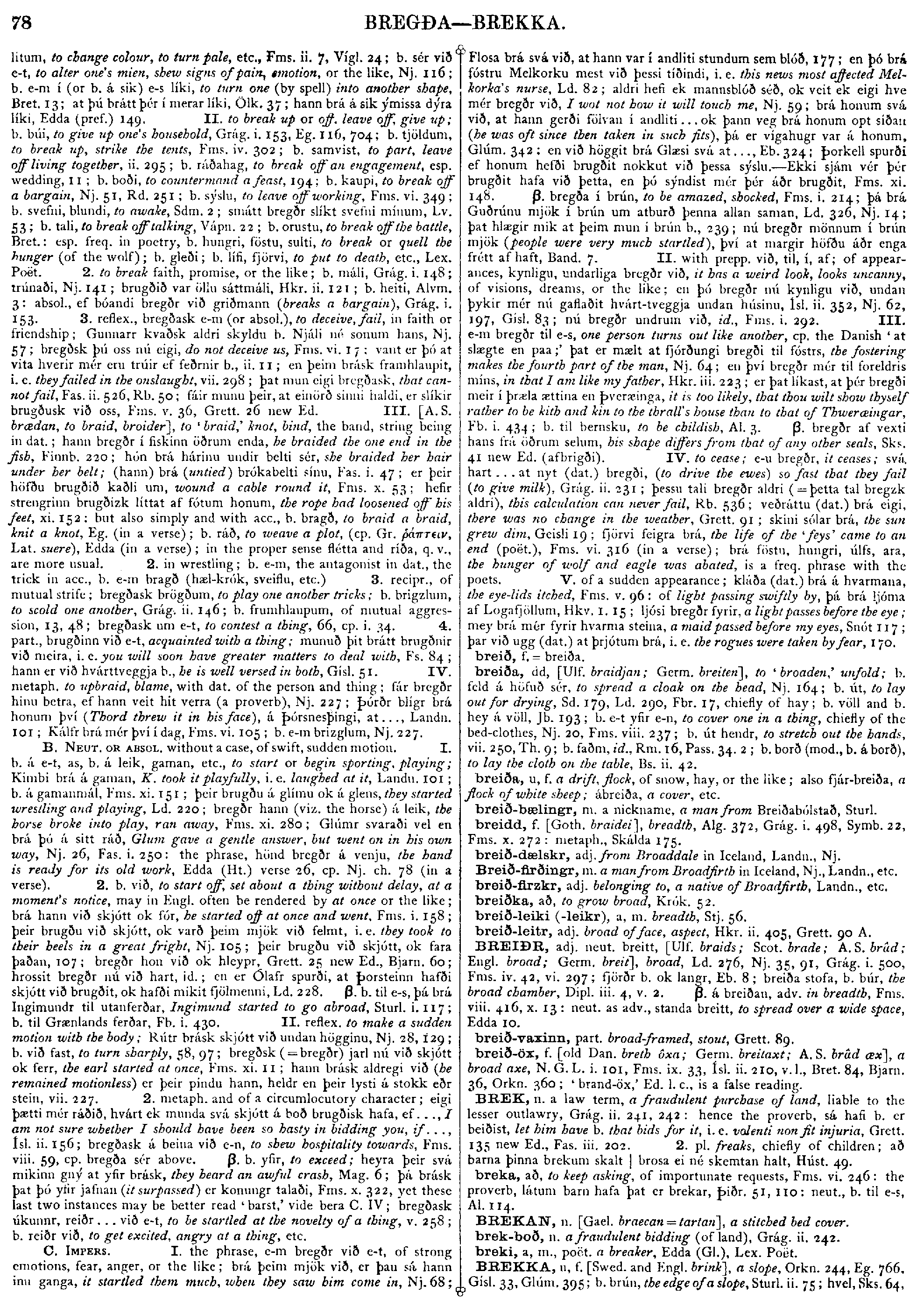
B.
NEUT.
OR
ABSOL.
without
a
case,
of
swift,
sudden
motion.
I.
b.
á
e-t,
as,
b.
á
leik,
gaman,
etc.,
to
start
or
begin
sporting,
playing;
Kimbi
brá
á
gaman,
K.
took
it
playfully,
i.e.
laughed
at
it,
Landn.
101;
b.
á
gamanmál,
Fms.
xi.
151;
þeir
brugðu
á
glímu
ok
á
glens,
they
started
wrestling
and
playing,
Ld.
220;
bregðr
hann
(viz.
the
horse)
á
leik,
the
horse
broke
into
play,
ran
away,
Fms.
xi.
280;
Glúmr
svaraði
vel
en
brá
þó
á
sitt
ráð,
Glum
gave
a
gentle
answer,
but
went
on
in
his
own
way,
Nj.
26,
Fas.
i.
250:
the
phrase,
hönd
bregðr
á
venju,
the
hand
is
ready
for
its
old
work,
Edda
(Ht.)
verse
26,
cp.
Nj.
ch.
78
(in
a
verse).
2.
b.
við,
to
start
off,
set
about
a
thing
without
delay,
at
a
moment's
notice,
may
in
Engl.
often
be
rendered
by
at
once
or
the
like;
brá
hann
við
skjótt
ok
fór,
he
started
off
at
once
and
went,
Fms.
i.
158;
þeir
brugðu
við
skjótt,
ok
varð
þeim
mjök
við
felmt,
i.e.
they
took
to
their
heels
in
a
great
fright,
Nj.
105;
þeir
brugðu
við
skjótt,
ok
fara
þaðan,
107;
bregðr
hon
við
ok
hleypr,
Grett.
25
new
Ed.,
Bjarn.
60;
hrossit
bregðr
nú
við
hart,
id.;
en
er
Ólafr
spurði,
at
Þorsteinn
hafði
skjótt
við
brugðit,
ok
hafði
mikit
fjölmenni,
Ld.
228.
.
b.
til
e-s,
þá
brá
Ingimundr
til
utanferðar,
Ingimund
started
to
go
abroad,
Sturl.
i.
117;
b.
til
Grænlands
ferðar,
Fb.
i.
430.
II.
reflex,
to
make
a
sudden
motion
with
the
body;
Rútr
brásk
skjótt
við
undan
högginu,
Nj.
28,
129;
b.
við
fast,
to
turn
sharply,
58,
97;
bregðsk
(=
bregðr)
jarl
nú
við
skjótt
ok
ferr,
the
earl
started
at
once,
Fms.
xi.
11;
hann
brásk
aldregi
við
(he
remained
motionless)
er
þeir
píndu
hann,
heldr
en
þeir
lysti
á
stokk
eðr
stein,
vii.
227.
2.
metaph.
and
of
a
circumlocutory
character;
eigi
þætti
mér
ráðið,
hvárt
ek
munda
svá
skjótt
á
boð
brugðisk
hafa,
ef
...,
I
am
not
sure
whether
I
should
have
been
so
hasty
in
bidding
you,
if
...,
Ísl.
ii.
156;
bregðask
á
beina
við
e-n,
to
shew
hospitality
towards,
Fms.
viii.
59,
cp.
bregða
sér
above.
.
b.
yfir,
to
exceed;
heyra
þeir
svá
mikinn
gný
at
yfir
brásk,
they
heard
an
awful
crash,
Mag.
6;
þá
brásk
þat
þó
yfir
jafnan
(it
surpassed)
er
konungr
talaði,
Fms.
x.
322,
yet
these
last
two
instances
may
be
better
read
'barst,'
vide
bera
C.
IV;
bregðask
úkunnr,
reiðr
...
við
e-t,
to
be
startled
at
the
novelty
of
a
thing,
v.
258;
b.
reiðr
við,
to
get
excited,
angry
at
a
thing,
etc.
|
Source: Cleasby/Vigfusson, page b0093, entry 28 View original page image as: [TIFF] [PNG] [View previous entry] [View next entry] |
[Comment on this entry] [View comments] |
The following entry has been hand-corrected once. |
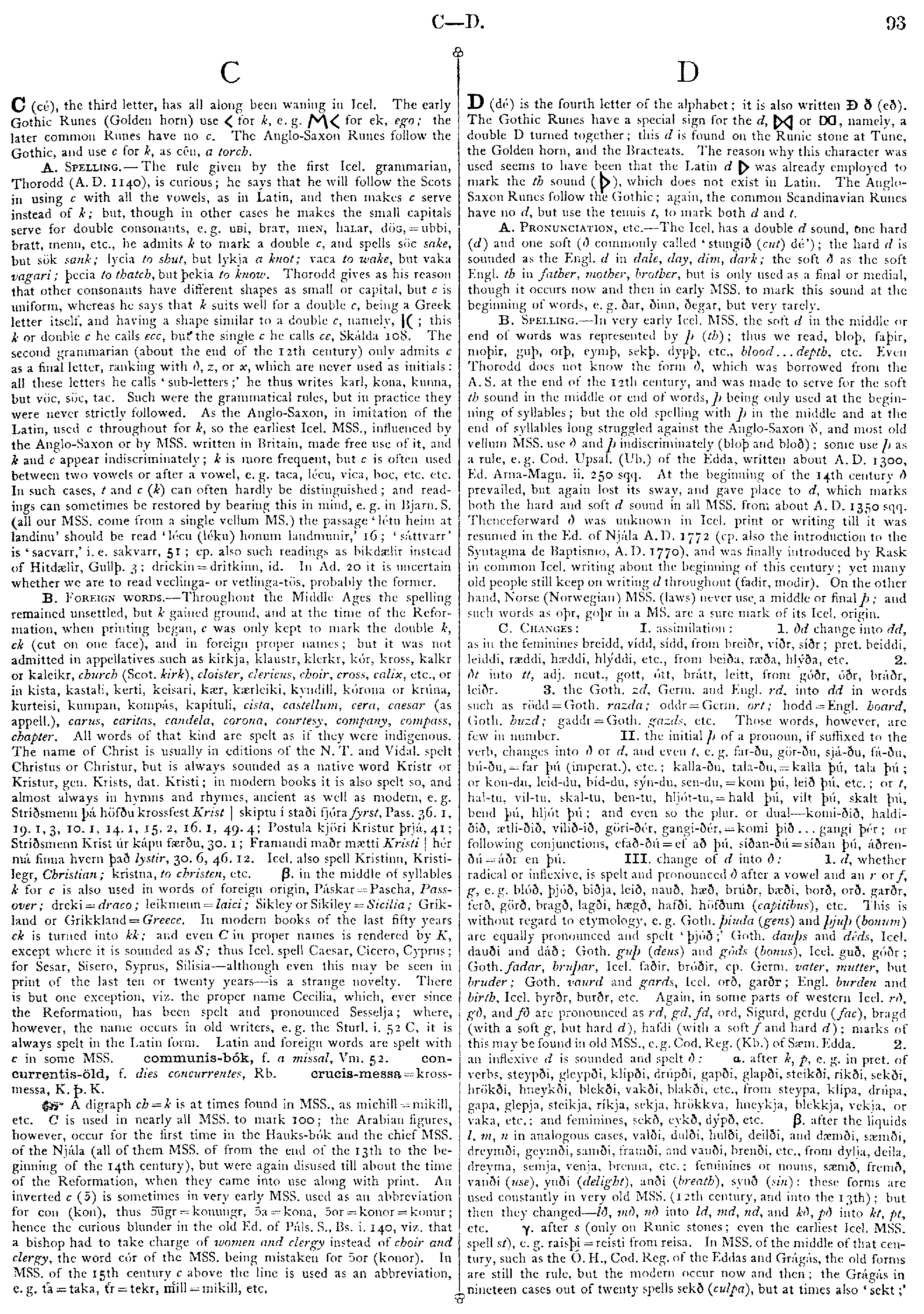
dag-mál, n. (vide dagr), prop. 'day-meal,' one of the divisions of the day, usually about 8 or 9 o'clock A. M.; the Lat. hora tertia is rendered by 'er vér köllum dagmál, 'which we call d., Hom. 142; cnn er ekki liðit af dagmálum, Hom. (St.) 10. Acts ii. 15; in Glúm. 342 we are told that the young Glum was very lazy, and lay in bed till day-meal every morning, cp. also 343; Hrafn. 28 and O.H.L. 18 -- á einum morni milli rismála ok dagmála -- where distinction is made between rismál (rising time) and dagmál, so as to make a separate dagsmark (q.v.) of each of them; and again, a distinction is made between 'midday' and dagmal, Ísl. ii. 334. The dagmal is thus midway between 'rising' and 'midday,' which accords well with the present use. The word is synonymous with dagverðarmál, breakfast-time, and denotes the hour when the ancient Icel. used to take their chief meal, opposed to náttmál, night-meal or supper-time, Fms. viii. 330; even the MSS. use dagmál and dagverðarmál indiscriminately; cp. also Sturl. iii. 4 C; Rb. 452 says that at full moon the ebb takes place 'at dagmálum.' To put the dagmál at 7.30 A.M., as Pál Vídalin does, seems neither to acccord with the present use nor the passage in Glum or the eccl. hora tertia, which was the nearest hour answering to the Icel, calculation of the day. In Fb. i. 539 it is said that the sun set at 'eykð' (i.e. half-past three o'clock), but rose at 'dagmál' which puts the dagmal at 8.30 A.M. COMPDS: dagmála- staðr, m. the place of d. in the horizon, Fb. I. dagmala-tið, f. morning terce, 625. 176.
|
Source: Cleasby/Vigfusson, page b0230, entry 4 View original page image as: [TIFF] [PNG] [View previous entry] [View next entry] |
[Comment on this entry] [View comments] |
The following entry has been hand-corrected once. |
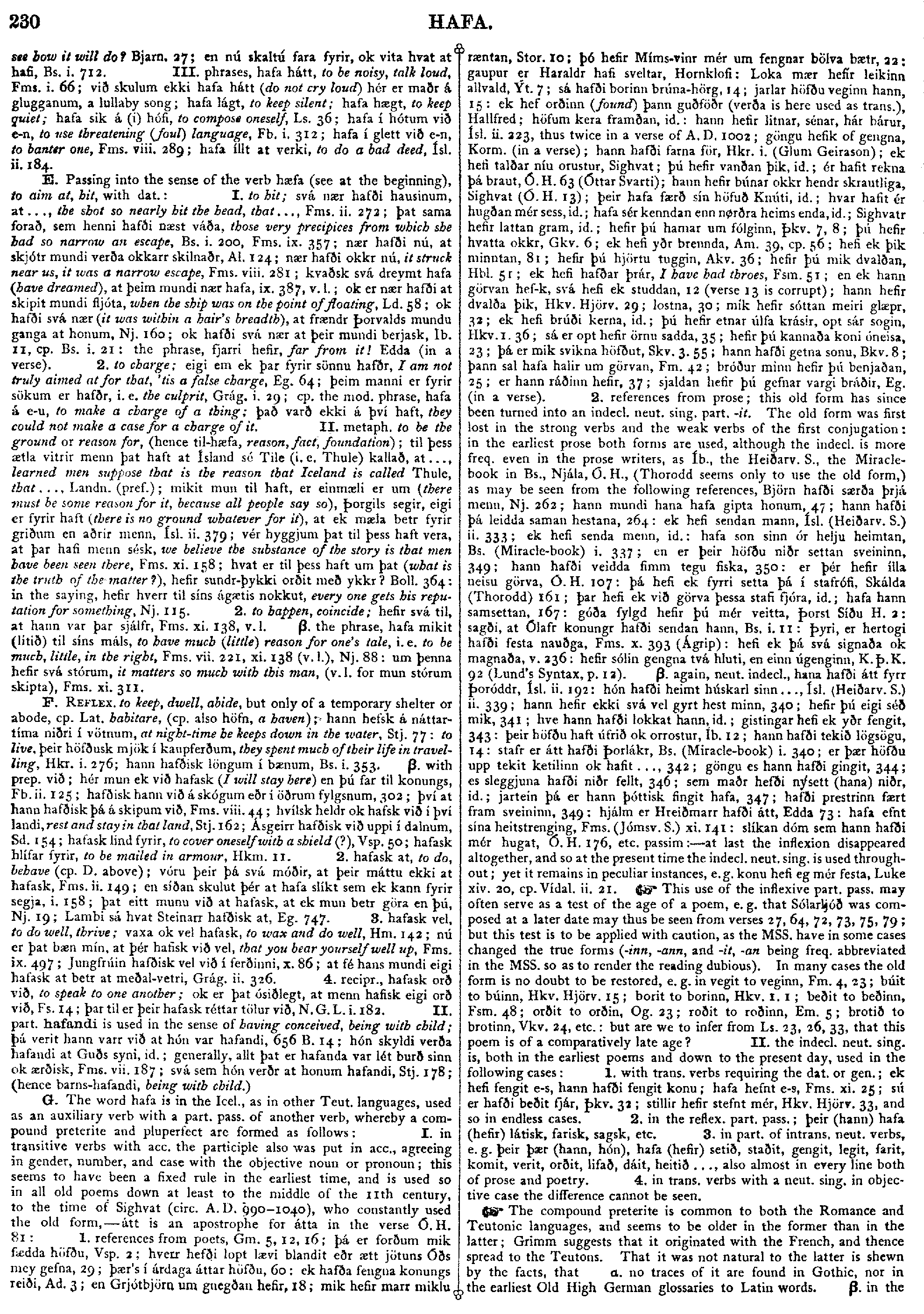
G.
The
word
hafa
is
in
the
Icel.,
as
in
other
Teut.
languages,
used
as
an
auxiliary
verb
with
a
part.
pass.
of
another
verb,
whereby
a
compound
preterite
and
pluperfect
are
formed
as
follows:
I.
in
transitive
verbs
with
acc.
the
participle
also
was
put
in
acc.,
agreeing
in
gender,
number,
and
case
with
the
objective
noun
or
pronoun;
this
seems
to
have
been
a
fixed
rule
in
the
earliest
time,
and
is
used
so
in
all
old
poems
down
at
least
to
the
middle
of
the
11th
century,
to
the
time
of
Sighvat
(circ.
A.D.
990-1040),
who
constantly
used
the
old
form,
--
átt
is
an
apostrophe
for
átta
in
the
verse
Ó.
H.
81:
1.
references
from
poets,
Gm.
5,
12,
16;
þá
er
forðum
mik
fædda
höfðu,
Vsp.
2;
hverr
hefði
lopt
lævi
blandit
eðr
ætt
jötuns
Óðs
mey
gefna,
29;
þær's
í
árdaga
áttar
höfðu,
60:
ek
hafða
fengna
konungs
reiði,
Ad.
3;
en
Grjótbjörn
um
gnegðan
hefir,
18;
mik
hefir
marr
miklu
ræntan,
Stor.
10;
þó
hefir
Míms-vinr
mér
um
fengnar
bölva
bætr,
22:
gaupur
er
Haraldr
hafi
sveltar,
Hornklofi:
Loka
mær
hefir
leikinn
allvald,
Ýt.
7;
sá
hafði
borinn
brúna-hörg,
14;
jarlar
höfðu
veginn
hann,
15:
ek
hef
orðinn
(found)
þann
guðföðr
(verða
is
here
used
as
trans.),
Hallfred;
höfum
kera
framðan,
id.:
hann
hefir
litnar,
sénar,
hár
bárur,
Ísl.
ii.
223,
thus
twice
in
a
verse
of
A.D.
1002;
göngu
hefik
of
gengna,
Korm.
(in
a
verse);
hann
hafði
farna
för,
Hkr.
i.
(Glum
Geirason);
ek
hefi
talðar
níu
orustur,
Sighvat;
þú
hefir
vanðan
þik,
id.;
ér
hafit
rekna
þá
braut,
Ó.
H.
63
(Óttar
Svarti);
hann
hefir
búnar
okkr
hendr
skrautliga,
Sighvat
(Ó.
H.
13);
þeir
hafa
færð
sín
höfuð
Knúti,
id.;
hvar
hafit
ér
hugðan
mér
sess,
id.;
hafa
sér
kenndan
enn
nørðra
heims
enda,
id.;
Sighvatr
hefir
lattan
gram,
id.;
hefir
þú
hamar
um
fólginn,
Þkv.
7,
8;
þú
hefir
hvatta
okkr,
Gkv.
6;
ek
hefi
yðr
brennda,
Am.
39,
cp.
56;
hefi
ek
þik
minntan,
81;
hefir
þú
hjörtu
tuggin,
Akv.
36;
hefir
þú
mik
dvalðan,
Hbl.
51;
ek
hefi
hafðar
þrár,
I
have
had
throes,
Fsm.
51;
en
ek
hann
görvan
hef-k,
svá
hefi
ek
studdan,
12
(verse
13
is
corrupt);
hann
hefir
dvalða
þik,
Hkv.
Hjörv.
29;
lostna,
30;
mik
hefir
sóttan
meiri
glæpr,
32;
ek
hefi
brúði
kerna,
id.;
þú
hefir
etnar
úlfa
krásir,
opt
sár
sogin,
Hkv.
1.
36;
sá
er
opt
hefir
örnu
sadda,
35;
hefir
þú
kannaða
koni
óneisa,
23;
þá
er
mik
svikna
höfðut,
Skv.
3.
55;
hann
hafði
getna
sonu,
Bkv.
8;
þann
sal
hafa
halir
um
görvan,
Fm.
42;
bróður
minn
hefir
þú
benjaðan,
25;
er
hann
ráðinn
hefir,
37;
sjaldan
hefir
þú
gefnar
vargi
bráðir,
Eg.
(in
a
verse).
2.
references
from
prose;
this
old
form
has
since
been
turned
into
an
indecl.
neut.
sing.
part.
-it.
The
old
form
was
first
lost
in
the
strong
verbs
and
the
weak
verbs
of
the
first
conjugation:
in
the
earliest
prose
both
forms
are
used,
although
the
indecl.
is
more
freq.
even
in
the
prose
writers,
as
Íb.,
the
Heiðarv.
S.,
the
Miracle-book
in
Bs.,
Njála,
Ó.
H.,
(Thorodd
seems
only
to
use
the
old
form,)
as
may
be
seen
from
the
following
references,
Björn
hafði
særða
þrjá
menn,
Nj.
262;
hann
mundi
hana
hafa
gipta
honum,
47;
hann
hafði
þá
leidda
saman
hestana,
264:
ek
hefi
sendan
mann,
Ísl.
(Heiðarv.
S.)
ii.
333;
ek
nefi
senda
menn,
id.:
hafa
son
sinn
ór
helju
heimtan,
Bs.
(Miracle-book)
i.
337;
en
er
þeir
höfðu
niðr
settan
sveininn,
349;
hann
hafði
veidda
fimm
tegu
fiska,
350:
er
þér
hefir
ílla
neisu
gorva,
Ó.
H.
107:
þá
hefi
ek
fyrri
setta
þá
í
stafrófi,
Skálda
(Thorodd)
161;
þar
hefi
ek
við
görva
þessa
stafi
fjóra,
id.;
hafa
hann
samsettan,
167:
góða
fylgd
hefir
þú
mér
veitta,
Þorst
Síðu
H.
2:
sagði,
at
Ólafr
konungr
hafði
sendan
hann,
Bs.
i.
11:
Þyri,
er
hertogi
hafði
festa
nauðga,
Fms.
x.
393
(Ágrip):
hefi
ek
þá
svá
signaða
ok
magnaða,
v.
236:
hefir
sólin
gengna
tvá
hluti,
en
einn
úgenginn,
K.
Þ.
K.
92
(Lund's
Syntax,
p.
12).
.
again,
neut.
indecl.,
hana
hafði
átt
fyrr
Þoróddr,
Ísl.
ii.
192:
hón
hafði
heimt
húskarl
sinn
...,
Ísl.
(Heiðarv.
S.)
ii.
339;
hann
hefir
ekki
svá
vel
gyrt
hest
minn,
340;
hefir
þú
eigi
séð
mik,
341;
hve
hann
hafði
lokkat
hann.
id.;
gistingar
hefi
ek
yðr
fengit,
343:
þeir
höfðu
haft
úfrið
ok
orrostur,
Íb.
12;
hann
hafði
tekið
lögsögu,
14:
stafr
er
átt
hafði
Þorlákr,
Bs.
(Miracle-book)
i.
340;
er
þær
höfðu
upp
tekit
ketilinn
ok
hafit
...,
342;
göngu
es
hann
hafði
gingit,
344;
es
sleggjuna
hafði
niðr
fellt,
346;
sem
maðr
hefði
nýsett
(hana)
niðr,
id.;
jartein
þá
er
hann
þóttisk
fingit
hafa,
347;
hafði
prestrinn
fært
fram
sveininn,
349:
hjálm
er
Hreiðmarr
hafði
átt,
Edda
73:
hafa
efnt
sína
heitstrenging,
Fms.
(Jómsv.
S.)
xi.
141:
slíkan
dóm
sem
hann
hafði
mér
hugat,
Ó.
H.
176,
etc.
passim
:--
at
last
the
inflexion
disappeared
altogether,
and
so
at
the
present
time
the
indecl.
neut.
sing,
is
used
throughout;
yet
it
remains
in
peculiar
instances,
e.g.
konu
hefi
eg
mér
festa,
Luke
xiv.
20,
cp.
Vídal.
ii.
21.
UNCERTAIN
This
use
of
the
inflexive
part.
pass.
may
often
serve
as
a
test
of
the
age
of
a
poem,
e.g.
that
Sólarljóð
was
composed
at
a
later
date
may
thus
be
seen
from
verses
27,
64,
72,
73,
75,
79;
but
this
test
is
to
be
applied
with
caution,
as
the
MSS.
have
in
some
cases
changed
the
true
forms
(-inn,
-ann,
and
-it,
-an
being
freq.
abbreviated
in
the
MSS.
so
as
to
render
the
reading
dubious).
In
many
cases
the
old
form
is
no
doubt
to
be
restored,
e.g.
in
vegit
to
veginn,
Fm.
4,
23;
búit
to
búinn,
Hkv.
Hjörv.
15;
borit
to
borinn,
Hkv.
1.
1;
beðit
to
beðinn,
Fsm.
48;
orðit
to
orðin,
Og.
23;
roðit
to
roðinn,
Em.
5;
brotið
to
brotinn,
Vkv.
24,
etc.:
but
are
we
to
infer
from
Ls.
23,
26,
33,
that
this
poem
is
of
a
comparatively
late
age?
II.
the
indecl.
neut.
sing.
is,
both
in
the
earliest
poems
and
down
to
the
present
day,
used
in
the
following
cases:
1.
with
trans.
verbs
requiring
the
dat.
or
gen.;
ek
hefi
fengit
e-s,
hann
hafði
fengit
konu;
hafa
hefnt
e-s,
Fms.
xi.
25;
sú
er
hafði
beðit
fjár,
Þkv.
32;
stillir
hefir
stefnt
mér,
Hkv.
Hjörv.
33,
and
so
in
endless
cases.
2.
in
the
reflex.
part.
pass.;
þeir
(hann)
hafa
(hefir)
látisk,
farisk,
sagsk,
etc.
3.
in
part.
of
intrans.
neut.
verbs,
e.g.
þeir
þær
(hann,
hón),
hafa
(hefir)
setið,
staðit,
gengit,
legit,
farit,
komit,
verit,
orðit,
lifað,
dáit,
heitið
...,
also
almost
in
every
line
both
of
prose
and
poetry.
4.
in
trans.
verbs
with
a
neut.
sing.
in
objective
case
the
difference
cannot
be
seen.
Germanic Lexicon Project (main page)
This search system was written by
Sean Crist
Please consider
volunteering
to correct the data in these online dictionaries.
No rights reserved. Feel free to use these data in any way you please.