|
|

Search for Given again, using less strict matching (867 results)
|
Source: Bosworth/Toller, page b1083, entry 5 View original page image as: [TIFF] [PNG] [View previous entry] [View next entry] |
[Comment on this entry] [View comments] |
The following entry has been hand-corrected once. |
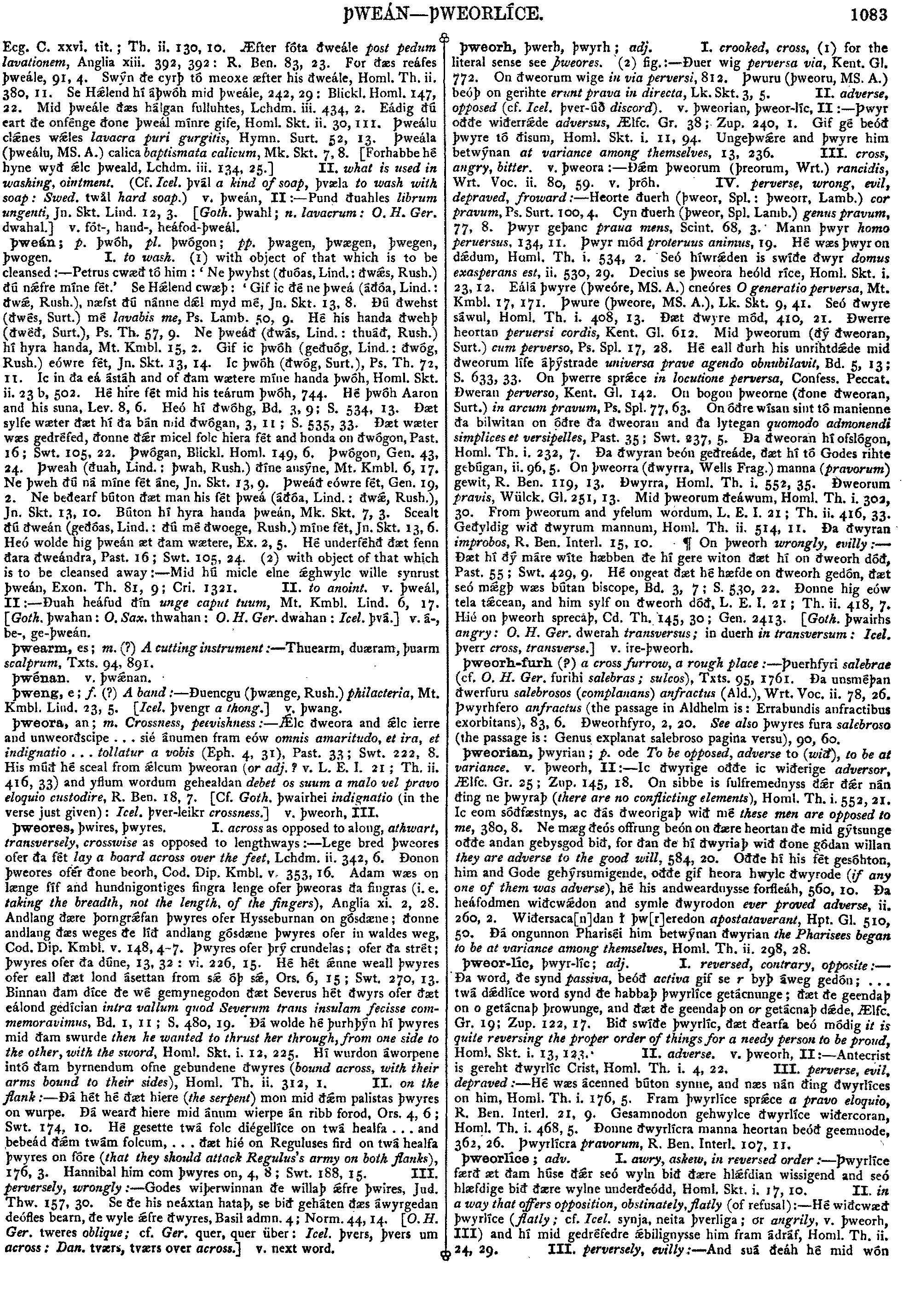
þweora,
an;
m.
Crossness,
peevishness
:--
Æ-acute;lc
ðweora
and
 lc
ierre
and
unweorðscipe
...
sié
ánumen
fram
eów
omnis
amaritudo,
et
ira,
et
indignatio
...
tollatur
a
vobis
(Eph.
4,
31),
Past.
33;
Swt.
222,
8.
His
múð
hé
sceal
from
lcum
þweoran
(or
adj.?
v.
L.
E.
I.
21;
Th.
ii.
416,
33)
and
yflum
wordum
gehealdan
debet
os
suum
a
malo
vel
pravo
eloquio
custodire,
R.
Ben.
18,
7.
[Cf.
Goth.
þwairhei
indignatio
(in
the
verse
just
given):
Icel.
þver-leikr
crossness.]
v.
þweorh,
III.
lc
ierre
and
unweorðscipe
...
sié
ánumen
fram
eów
omnis
amaritudo,
et
ira,
et
indignatio
...
tollatur
a
vobis
(Eph.
4,
31),
Past.
33;
Swt.
222,
8.
His
múð
hé
sceal
from
lcum
þweoran
(or
adj.?
v.
L.
E.
I.
21;
Th.
ii.
416,
33)
and
yflum
wordum
gehealdan
debet
os
suum
a
malo
vel
pravo
eloquio
custodire,
R.
Ben.
18,
7.
[Cf.
Goth.
þwairhei
indignatio
(in
the
verse
just
given):
Icel.
þver-leikr
crossness.]
v.
þweorh,
III.
|
Source: Bosworth/Toller, page b1084, entry 4 View original page image as: [TIFF] [PNG] [View previous entry] [View next entry] |
[Comment on this entry] [View comments] |
The following entry has been hand-corrected once. |
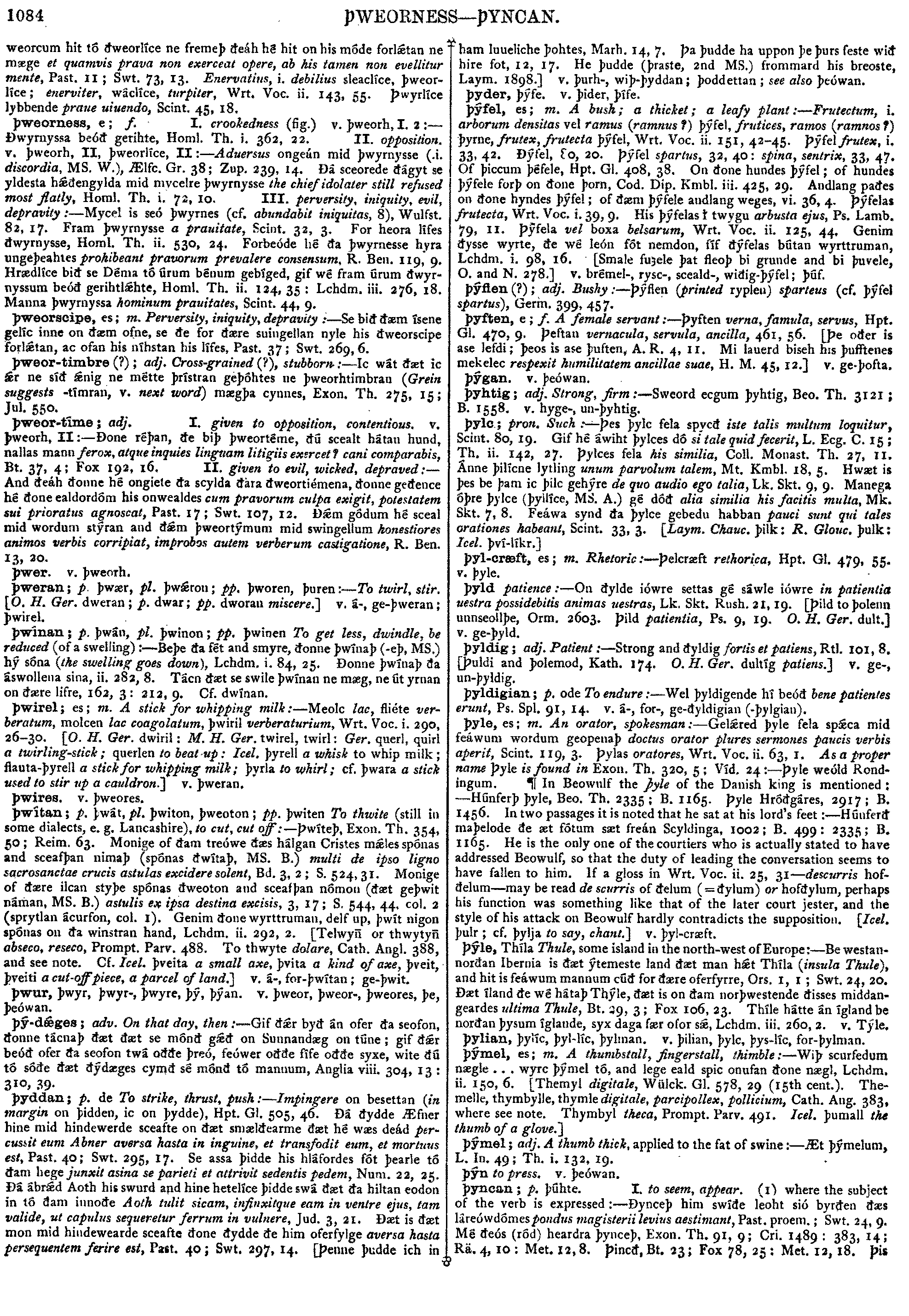
þweor-tíme;
adj.
I.
given
to
opposition,
contentious.
v.
þweorh,
II
:--
Ðone
réþan,
ðe
biþ
þweortéme,
ðú
scealt
hátan
hund,
nallas
mann
ferox,
atque
inquies
linguam
litigiis
exercet?
cani
comparabis,
Bt.
37,
4;
Fox
192,
16.
II.
given
to
evil,
wicked,
depraved
:--
And
ðeáh
ðonne
hé
ongiete
ða
scylda
ðara
ðweortiémena,
ðonne
geðence
hé
ðone
ealdordóm
his
onwealdes
cum
pravorum
culpa
exigit,
potestatem
sui
prioratus
agnoscat,
Past.
17;
Swt.
107,
12.
Ðm
gódum
hé
sceal
mid
wordum
stýran
and
ðm
þweortýmum
mid
swingellum
honestiores
animos
verbis
corripiat,
improbos
autem
verberum
castigatione,
R.
Ben.
13,
20.
|
Source: Bosworth/Toller, page b1089, entry 28 View original page image as: [TIFF] [PNG] [View previous entry] [View next entry] |
[Comment on this entry] [View comments] |
The following entry has been hand-corrected once. |
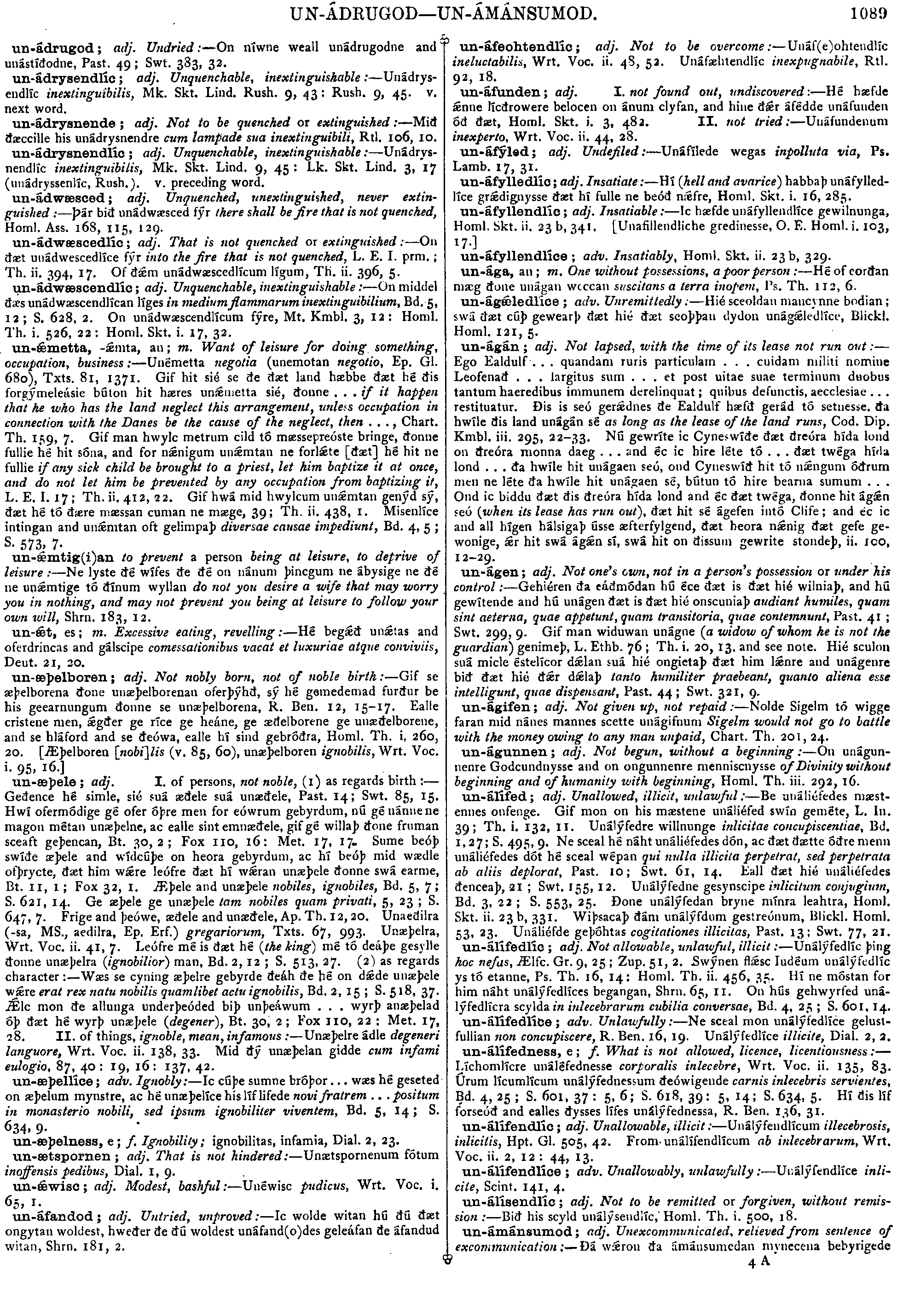
un-ágifen; adj. Not given up, not repaid :-- Nolde Sigelm tó wigge faran mid nánes mannes scette unágifnum Sigelm would not go to battle with the money owing to any man unpaid, Chart. Th. 201, 24.
|
Source: Bosworth/Toller, page b1094, entry 2 View original page image as: [TIFF] [PNG] [View previous entry] [View next entry] |
[Comment on this entry] [View comments] |
The following entry has been hand-corrected once. |
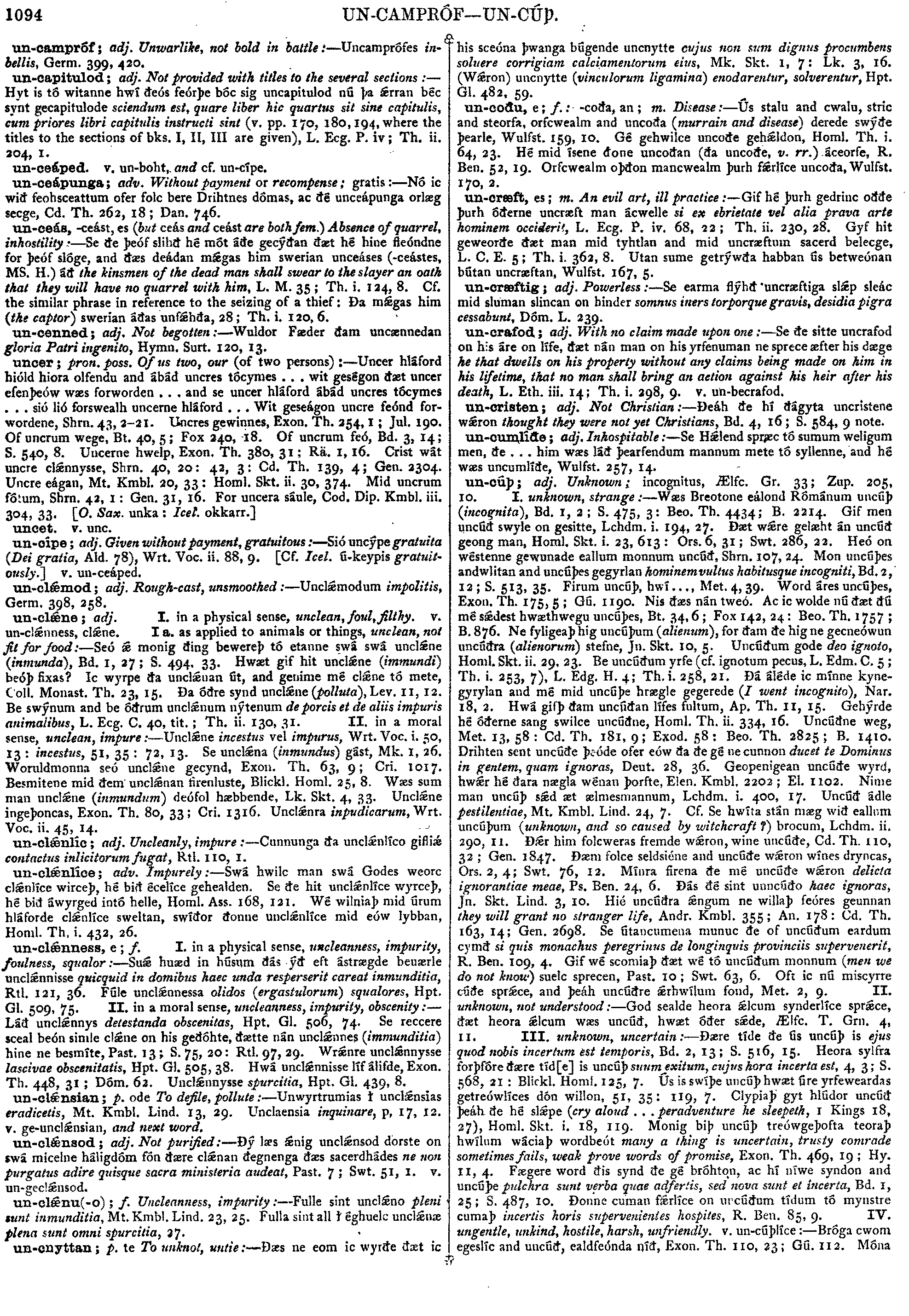
un-capitulod;
adj.
Not
provided
with
titles
to
the
several
sections
:--
Hyt
is
tó
witanne
hwí
ðeós
feórþe
bóc
sig
uncapitulod
nú
þa
rran
béc
synt
gecapitulode
sciendum
est,
quare
liber
hic
quartus
sit
sine
capitulis,
cum
priores
libri
capitulis
instructi
sint
(v.
pp.
170,
180,
194,
where
the
titles
to
the
sections
of
bks.
I,
II,
III
are
given),
L.
Ecg.
P.
iv;
Th.
ii.
204,
1.
|
Source: Bosworth/Toller, page b1094, entry 9 View original page image as: [TIFF] [PNG] [View previous entry] [View next entry] |
[Comment on this entry] [View comments] |
The following entry has been hand-corrected once. |
un-cípe; adj. Given without payment, gratuitous :-- Sió uncýpe gratuita (Dei gratia, Ald. 78), Wrt. Voc. ii. 88, 9. [Cf. Icel. ú-keypis gratuitously.] v. un-ceáped.
|
Source: Bosworth/Toller, page b1096, entry 8 View original page image as: [TIFF] [PNG] [View previous entry] [View next entry] |
[Comment on this entry] [View comments] |
The following entry has been hand-corrected once. |
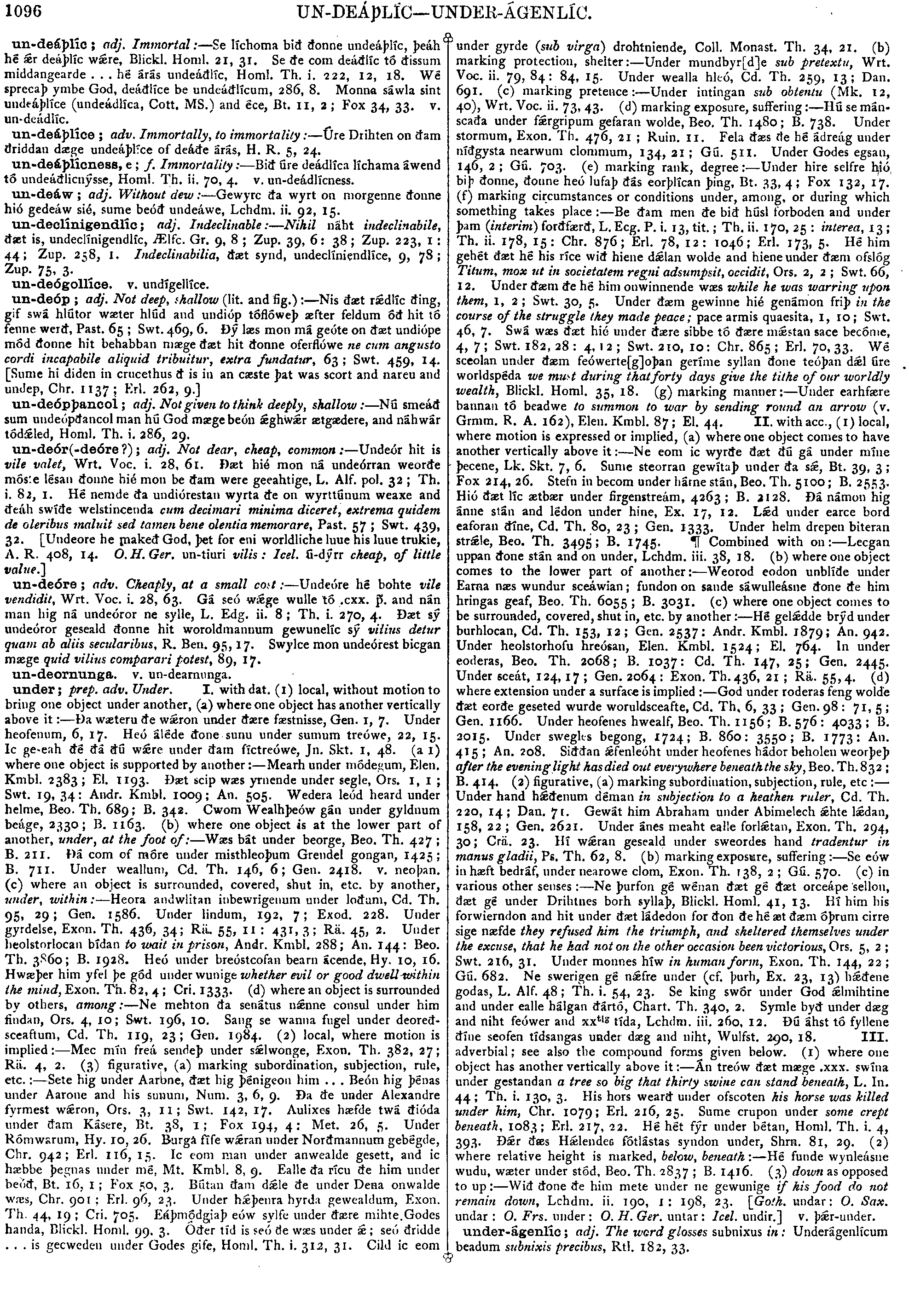
un-deópþancol;
adj.
Not
given
to
think
deeply,
shallow
:--
Nú
smeáð
sum
undeópðancol
man
hú
God
mæge
beón
ghwr
ætgædere,
and
náhwár
tódled,
Homl.
Th.
i.
286,
29.
|
Source: Bosworth/Toller, page b1096, entry 13 View original page image as: [TIFF] [PNG] [View previous entry] [View next entry] |
[Comment on this entry] [View comments] |
The following entry has been hand-corrected once. |
2015.
Under
swegles
begong,
1724;
B.
860:
3550;
B.
1773:
An.
415;
An.
208.
Siððan
fenleóht
under
heofenes
hádor
beholen
weorþeþ
after
the
evening
light
has
died
out
everywhere
beneath
the
sky,
Beo.
Th.
832;
B.
414.
(2)
figurative,
(a)
marking
subordination,
subjection,
rule,
etc
:--
Under
hand
hðenum
déman
in
subjection
to
a
heathen
ruler,
Cd.
Th.
220,
14;
Dan.
71.
Gewát
him
Abraham
under
Abimelech
hte
ldan,
158,
22;
Gen.
2621.
Under
ánes
meaht
ealle
forltan,
Exon.
Th.
294,
30;
Crä.
23.
Hí
wran
geseald
under
sweordes
hand
tradentur
in
manus
gladii,
Ps.
Th.
62,
8.
(b)
marking
exposure,
suffering
:--
Se
eów
in
hæft
bedráf,
under
nearowe
clom,
Exon.
Th.
138,
2;
Gú.
570.
(c)
in
various
other
senses
:--
Ne
þurfon
gé
wénan
ðæt
gé
ðæt
orceápe
sellon,
ðæt
gé
under
Drihtises
borh
syllaþ,
Blickl.
Homl.
41,
13.
Hí
him
his
forwierndon
and
hit
under
ðæt
ládedon
for
ðon
ðe
hé
æt
ðæm
óþrum
cirre
sige
næfde
they
refused
him
the
triumph,
and
sheltered
themselves
under
the
excuse,
that
he
had
not
on
the
other
occasion
been
victorious,
Ors.
5,
2;
Swt.
216,
31.
Under
monnes
híw
in
human
form,
Exon.
Th.
144,
22;
Gú.
682.
Ne
swerigen
gé
nfre
under
(cf.
þurh,
Ex.
23,
13)
hðene
godas,
L.
Alf.
48;
Th.
i.
54,
23.
Se
king
swór
under
God
lmihtine
and
under
ealle
hálgan
ðártó,
Chart.
Th.
340,
2.
Symle
byð
under
dæg
and
niht
feówer
and
xxtlg
UNCERTAIN
tída,
Lchdm,
iii.
260,
12.
Ðú
áhst
tó
fyllene
ðíne
seofen
tídsangas
under
dæg
and
niht,
Wulfst.
290,
18.
III.
adverbial;
see
also
the
compound
forms
given
below.
(1)
where
one
object
has
another
vertically
above
it
:--
Án
treów
ðæt
mæge
.xxx.
swína
under
gestandan
a
tree
so
big
that
thirty
swine
can
stand
beneath,
L.
In.
44;
Th.
i.
130,
3.
His
hors
wearð
under
ofscoten
his
horse
was
killed
under
him,
Chr.
1079;
Erl.
216,
25.
Sume
crupon
under
some
crept
beneath,
1083;
Erl.
217,
22.
Hé
hét
fýr
under
bétan,
Homl.
Th.
i.
4,
393.
Ðr
ðæs
Hlendes
fótlástas
syndon
under,
Shrn.
81,
29.
(2)
where
relative
height
is
marked,
below,
beneath
:--
Hé
funde
wynleásne
wudu,
wæter
under
stód,
Beo.
Th.
2837;
B.
1416.
(3)
down
as
opposed
to
up
:--
Wið
ðone
ðe
him
mete
under
ne
gewunige
if
his
food
do
not
remain
down,
Lchdm.
ii.
190,
1:
198,
23.
[Goth.
undar:
O.
Sax.
undar:
O.
Frs.
under:
O.
H.
Ger.
untar:
Icel.
undir.]
v.
þr-under.
|
Source: Bosworth/Toller, page b1097, entry 30 View original page image as: [TIFF] [PNG] [View previous entry] [View next entry] |
[Comment on this entry] [View comments (1)] |
The following entry has been hand-corrected once. |
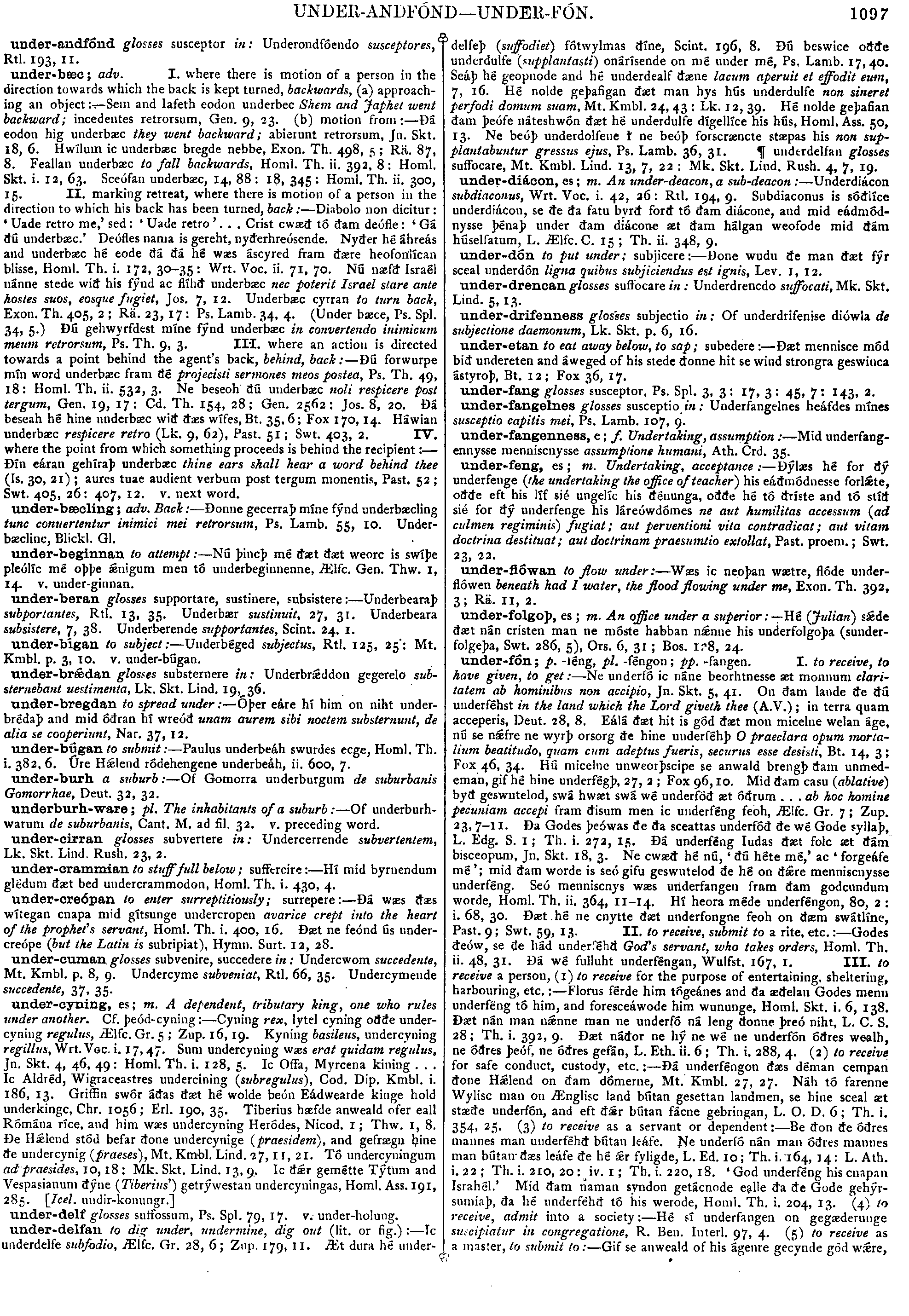
under-fón;
p.
-féng,
pl.
-féngon;
pp.
-fangen.
I.
to
receive,
to
have
given,
to
get
:--
Ne
underfó
ic
náne
beorhtnesse
æt
monnum
claritatem
ab
hominibus
non
accipio,
Jn.
Skt.
5,
41.
On
ðam
lande
ðe
ðú
underféhst
in
the
land
which
the
Lord
giveth
thee
(A.V.);
in
terra
quam
acceperis,
Deut.
28,
8.
Eálá
ðæt
hit
is
gód
ðæt
mon
micelne
welan
áge,
nú
se
nfre
ne
wyrþ
orsorg
ðe
hine
underféhþ
O
praeclara
opum
mortalium
beatitudo,
quam
cum
adeptus
fueris,
secures
esse
desisti,
Bt.
14,
3:
Fox
46,
34.
Hú
micelne
unweorþscipe
se
anwald
brengþ
ðam
unmedeman,
gif
hé
hine
underfégþ,
27,
2;
Fox
96,
10.
Mid
ðam
casu
(ablative)
byð
geswutelod,
swá
hwæt
swá
wé
underfóð
æt
óðrum
...
ab
hoc
homine
pecuniam
accepi
fram
ðisum
men
ic
underféng
feoh,
Ælfc.
Gr.
7;
Zup.
23,
7-11.
Ða
Godes
þeówas
ðe
ða
sceattas
underfóð
ðe
wé
Gode
syllaþ,
L.
Edg.
S.
1;
Th.
i.
272,
15.
Ðá
underféng
Iudas
ðæt
folc
æt
ðám
bisceopum,
Jn.
Skt.
18,
3.
Ne
cwæð
hé
nú,
'ðú
héte
mé,'
ac
'forgeáfe
mé';
mid
ðam
worde
is
seó
gifu
geswutelod
ðe
hé
on
ðre
menniscnysse
underféng.
Seó
menniscnys
wæs
underfangen
fram
ðam
godcundum
worde,
Homl.
Th.
ii.
364,
11-14.
Hí
heora
méde
underféngon,
80,
2:
i.
68,
30.
Ðæt
hé
ne
cnytte
ðæt
underfongne
feoh
on
ðæm
swátlíne,
Past.
9;
Swt.
59,
13.
II.
to
receive,
submit
to
a
rite,
etc.
:--
Godes
ðeów,
se
ðe
hád
underféhð
God's
servant,
who
takes
orders,
Homl.
Th.
ii.
48.
31.
Ðá
wé
fulluht
underféngan,
Wulfst.
167,
1.
III.
to
receive
a
person,
(1)
to
receive
for
the
purpose
of
entertaining,
sheltering,
harbouring,
etc.
:--
Florus
férde
him
tógeánes
and
ða
æðelan
Godes
menn
underféng
tó
him,
and
foresceáwode
him
wununge,
Homl.
Skt.
i.
6,
138.
Ðæt
nán
man
nnne
man
ne
underfó
ná
leng
ðonne
þreó
niht,
L.
C.
S.
28;
Th.
i.
392,
9.
Ðæt
náðor
ne
hý
ne
wé
ne
underfón
óðres
wealh,
ne
óðres
þeóf,
ne
óðres
gefán,
L.
Eth.
ii.
6;
Th.
i.
288,
4.
(2)
to
receive
for
safe
conduct,
custody,
etc.
:--
Ðá
underféngon
ðæs
déman
cempan
ðone
Hlend
on
ðam
dómerne,
Mt.
Kmbl.
27,
27.
Náh
tó
farenne
Wylisc
man
on
Ænglisc
land
bútan
gesettan
landmen,
se
hine
sceal
æt
stæðe
underfón,
and
eft
ðr
bútan
fácne
gebringan,
L.
O.
D.
6;
Th.
i.
354,
25.
(3)
to
receive
as
a
servant
or
dependent
:--
Be
ðon
ðe
óðres
mannes
man
underféhð
bútan
leáfe.
Ne
underfó
nán
man
óðres
mannes
man
bútan
ðæs
leáfe
ðe
hé
r
fyligde,
L.
Ed.
10;
Th.
i.
164,
14:
L.
Ath.
i.
22;
Th.
i.
210,
20:
iv.
1;
Th.
i.
220,
18.
'God
underféng
his
cnapan
Israhél.'
Mid
ðam
naman
syndon
getácnode
ealle
ða
ðe
Gode
gehýrsumiaþ,
ða
hé
underféhð
tó
his
werode,
Howl.
Th.
i.
204,
13.
(4)
to
receive,
admit
into
a
society
:--
Hé
sí
underfangen
on
gegæderunge
suscipiatur
in
congregatione,
R.
Ben.
Interl.
97,
4.
(5)
to
receive
as
a
master,
to
submit
to
:--
Gif
se
anweald
of
his
ágenre
gecynde
gód
wre,
ne
underfénge
hé
nfre
ða
yfelan
ac
ða
gódan,
Bt.
16,
3;
Fox
54,
23.
(6)
to
receive,
admit
the
claims
of
:--
Se
ðe
eów
underféhð,
hé
underféhð
mé,
and
se
ðe
mé
underféhð,
hé
underféhð
ðone
ðe
mé
sende,
Mt.
Kmbl.
10,
40.
Ic
com
on
mínes
Fæder
naman
and
gé
mé
ne
underféngon.
Gyf
óðer
cymþ
on
his
ágenum
naman,
hyne
gé
underfóð,
Jn.
Skt.
5,
43.
(6
a)
to
receive,
admit
the
force
of
a
person's
words,
accept
testimony
:--
Hé
cýð
ðæt
hé
geseah
and
gehýrde,
and
nán
man
ne
underféhþ
his
cýðnesse,
Jn.
Skt.
3,
32.
Se
ðe
míne
word
ne
underféhð,
hé
hæfþ
hwá
him
déme,
12,
48.
Ne
underfóð
ealle
menn
ðis
word,
Mt.
Kmbl.
19,
11.
IV.
to
receive
what
is
offered,
to
accept
:--
Drihten
gebed
mín
he
underféng
(-fang,
MS.)
Dominus
orationem
meam
suscepit,
Ps.
Spl.
6,
9.
Hé
nolde
náne
fréfrunge
underfón
noluit
consolationem
accipere,
Gen.
37,
35.
V.
of
things,
to
receive,
serve
as
a
receptacle
for
:--
Underfó
receptet
(the
passage
is:
Cadaver
nequaquam
sepulchri
sarcophagus
receptet,
Ald.
52),
Hpt.
Gl.
496,
11.
VI.
to
receive
or
accept
an
office,
a
duty,
etc.,
to
take
upon
one's
self,
to
undertake
a
labour,
task,
etc.,
(a)
where
the
object
of
the
verb
is
a
word
implying
action
or
effort
:--
Regulus
underféng
Cartaina
gewinn
Regulus,
bellum
Carthaginense
sortitus,
Ors.
4,
6;
Swt.
174,
1:
2,
2;
Swt.
66,
13.
Ðæt
ilce
(ða
ðegnunga
ðæs
láreówdómes)
ðæt
hé
untlwierðlíce
ondréd
tó
underfoonne,
Past.
7;
Swt.
48,
19.
Sió
giémen
ðæs
underfangenan
láreówdómes
suscepta
cura
regiminis,
4;
Swt.
37,
13.
Ðá
hié
gewin
hæfdon
underfongen
bella
suscepta,
Ors.
4,
9;
Swt.
192,
29.
Æ-acute;r
hé
hæbbe
godcunde
bóte
underfangen,
L.
Edm.
S.
4;
Th.
i.
248,
25.
Underfangenre
andwealhnysse
adeptae
integritatis,
Hpt.
Gl.
465,
70.
(b)
where
the
object
of
the
verb
denotes
that
in
respect
to
which
action
or
effort
is
needed
:--
Gif
wífman
híwrdene
underféhð
si
mulier
familiam
susceperit,
L.
Edg.
C.
25;
Th.
ii.
272,
7.
Ðonne
hié
monna
heortan
underfóð
tó
lronne,
Past.
21;
Swt.
161,
12.
Hig
underfóð
ðis
folc
mid
ðé
ut
sustentent
tecum
onus
populi,
Num,
11,
17.
On
ða
rícu
ðe
hé
underfangen
hæfde,
Bt.
proem.;
Fox
viii,
8.
VII.
to
receive
what
is
burdensome,
undergo,
bear
:--
Gé
underfóð
eówere
unrihtwísnissa
(ye
shall
bear
your
iniquities,
A.V.),
ðæt
gé
witon
míne
wrace
recipietis
iniquitates
vestras,
et
scietis
ultionem
meam,
Num.
14,
34.
VIII.
to
take
surreptitiously,
to
steal
:--
Gyf
feoh
sý
underfangen
(or?
under
fangen),Lchdm.
iii.
286,
4.
[O.
E.
Homl.
Laym.
Kath.
Gen.
and
Ex.
under-fon:
Orm.
unnderr-fon;
A.
R.
under-von:
Piers
P.
under-feng;
p.:
Ayenb.
onderving:
O.
H.
Ger.
untar-fáhan.]
v.
under-niman.
|
Source: Bosworth/Toller, page b1099, entry 5 View original page image as: [TIFF] [PNG] [View previous entry] [View next entry] |
[Comment on this entry] [View comments (1)] |
The following entry has been hand-corrected once. |
undern,
es;
m.
The
third
hour
of
the
day,
nine
in
the
morning;
in
later
English
(v.
infra)
it
is
used
of
the
sixth
hour,
a
use
it
seems
to
have
in
undern-rest,
q.v.
:--
Undern
tertia,
middæg
sexta,
Wrt.
Voc.
i.
53,
11.
Undem
is
dæges
þridde
tíd,
Btwk.
214,
33.
Ðæs
hírédes
ealdor
gehýrde
wyrhtan
on
rnemerigen,
eft
on
undern
...
Se
rmerigen
wæs
fram
Adam
óð
Noe,
se
undern
fram
Noe
óð
Abraham,
Homl.
Th.
ii.
74,
7-19.
Tó
undernes,
Lchdm.
ii.
194,
6.
Byð
seó
sceadu
tó
underne
and
tó
nóne
seofon
and
twéntigoþan
healfes
fótes
the
shadow
at
nine
and
at
three
is
twenty-six
and
a
half
feet
long,
iii.
218,
3,
and
often.
Æt
underne
...
r
underne,
Blickl.
Homl.
93,
22,
36.
Æ-acute;r
undern
...
ofer
undern
mane
...
vespere,
Lev.
6,
20.
On
ða
þriddan
tíd
dæges,
ðæt
is
on
undern,
Shrn.
79.
35.
Wé
étaþ
on
ðam
Sunnandagum
on
undern
and
on
fen,
Homl.
Skt.
i.
12,
3.
Sele
drincan
on
þreó
tída,
on
undern,
on
middæg,
on
nón,
Lchdm.
ii.
140,
1.
Fram
hancréde
óð
undern,
Homl.
Th.
i.
74,
21:
Chr.
538;
Erl.
16,
2.
Ofor
undern,
Blickl.
Homl.
93,
15.
Healfe
tíd
ofer
undern,
540;
Erl.
16,
4.
Óð
heáne
undern
usque
ad
tertiam
plenam,
R.
Ben,
74,
11.
[Abuten
undern
deies
...
abute
swucke
time
alse
me
singeð
messe
(from
prime
oðet
midmare en,
hwenne
preostes
singeð
heore
messen,
MS.
C.),
A.
R.
24,
11.
So
ha
dede
at
undren
and
and
at
midday
also
(Mt.
20,
3),
Misc.
33,
22.
At
þon
heye
undarne
(Acts
2,
15),
56,
657.
It
was
the
thridde
our
(that
men
clepen
undrun),
Wick.
Mk.
15,
25.
The
time
of
undern
of
the
same
day,
Ch.
Cl.
T.
260.
But
the
word
sometimes
denotes
a
later
hour
:--
Bi
þis
was
undren
(under,
undrin)
on
þe
dai
(the
sixth
hour,
Lk.
23.
44),
C.
M.
16741.
Undorne,
19830.
The
our
was
as
the
sixte
or
undurn,
Wick.
Jn.
4,
6.
An
orendron,
ornedrone
meredies,
Cath.
Angl.
261,
where
see
note.
See
also
the
later
English
forms
given
under
undern-ml,
-mete,
-tíd.
O.
Sax.
undorn
the
third
hour:
O.
Frs.
ond,
unden
(and
see
Richthofen
Wtbch.):
O.
H.
Ger.
untarn
midday:
Icel.
undorn
nine
o'clock
A.M.
or
three
o'clock
P.M.;
a
meal.
Cf.
Goth.
undaurni-mats
&alpha-tonos;
en,
hwenne
preostes
singeð
heore
messen,
MS.
C.),
A.
R.
24,
11.
So
ha
dede
at
undren
and
and
at
midday
also
(Mt.
20,
3),
Misc.
33,
22.
At
þon
heye
undarne
(Acts
2,
15),
56,
657.
It
was
the
thridde
our
(that
men
clepen
undrun),
Wick.
Mk.
15,
25.
The
time
of
undern
of
the
same
day,
Ch.
Cl.
T.
260.
But
the
word
sometimes
denotes
a
later
hour
:--
Bi
þis
was
undren
(under,
undrin)
on
þe
dai
(the
sixth
hour,
Lk.
23.
44),
C.
M.
16741.
Undorne,
19830.
The
our
was
as
the
sixte
or
undurn,
Wick.
Jn.
4,
6.
An
orendron,
ornedrone
meredies,
Cath.
Angl.
261,
where
see
note.
See
also
the
later
English
forms
given
under
undern-ml,
-mete,
-tíd.
O.
Sax.
undorn
the
third
hour:
O.
Frs.
ond,
unden
(and
see
Richthofen
Wtbch.):
O.
H.
Ger.
untarn
midday:
Icel.
undorn
nine
o'clock
A.M.
or
three
o'clock
P.M.;
a
meal.
Cf.
Goth.
undaurni-mats
&alpha-tonos;
 o
o o
o .
As
in
the
case
of
ml
=
meal,
the
word
seems
to
have
come
to
denote
the
eating
that
takes
place
at
the
time,
which
at
first
the
word
denoted.
v.
Halliwell's
Dict.
aandorn,
and
see
the
forms
in
other
dialects
in
Cl.
&
Vig.
Icel.
Dict.
s.v.
undorn.]
v.
compounds
with
undern-.
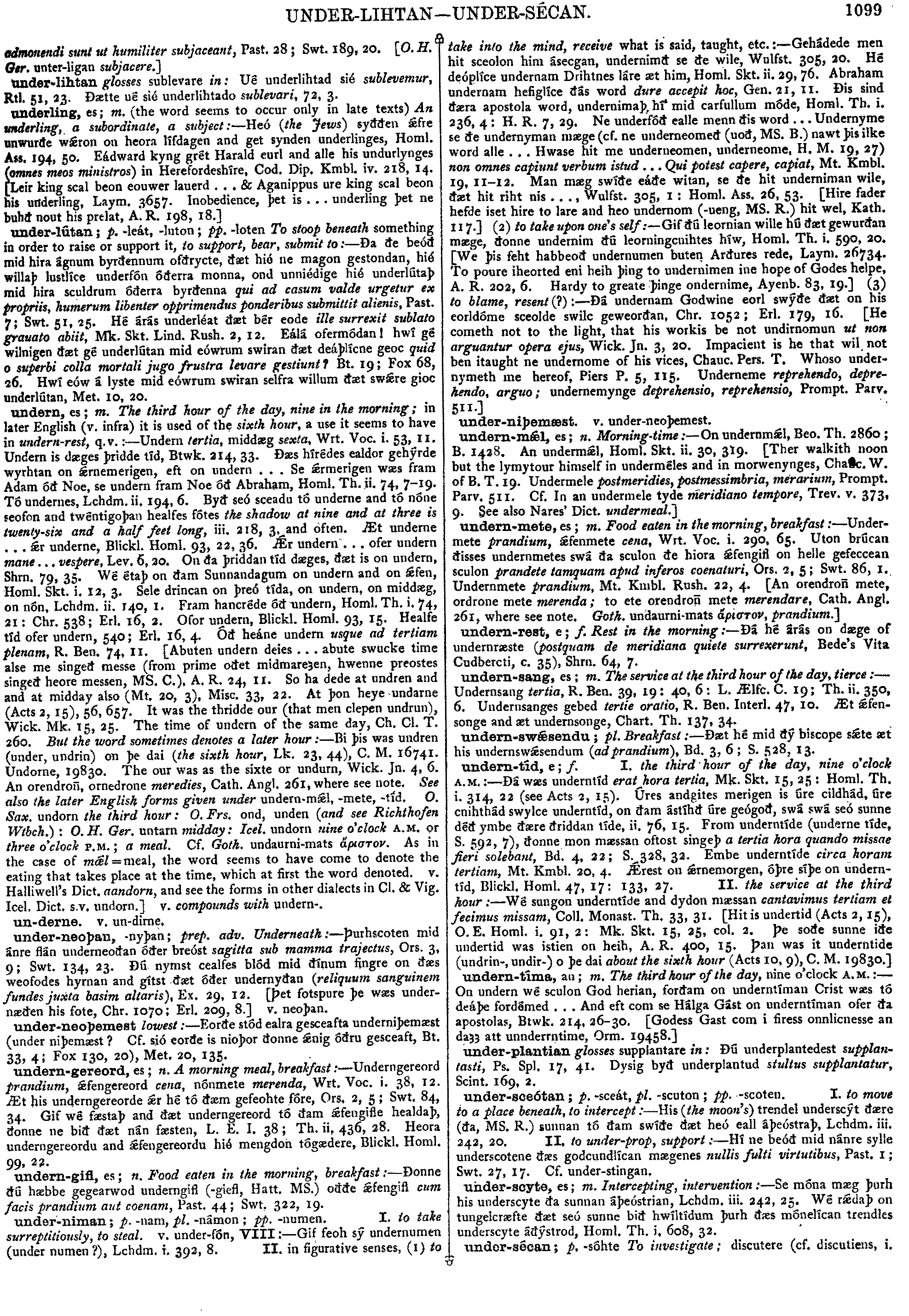
.
As
in
the
case
of
ml
=
meal,
the
word
seems
to
have
come
to
denote
the
eating
that
takes
place
at
the
time,
which
at
first
the
word
denoted.
v.
Halliwell's
Dict.
aandorn,
and
see
the
forms
in
other
dialects
in
Cl.
&
Vig.
Icel.
Dict.
s.v.
undorn.]
v.
compounds
with
undern-.
|
Source: Bosworth/Toller, page b1102, entry 17 View original page image as: [TIFF] [PNG] [View previous entry] [View next entry] |
[Comment on this entry] [View comments] |
The following entry has been hand-corrected once. |
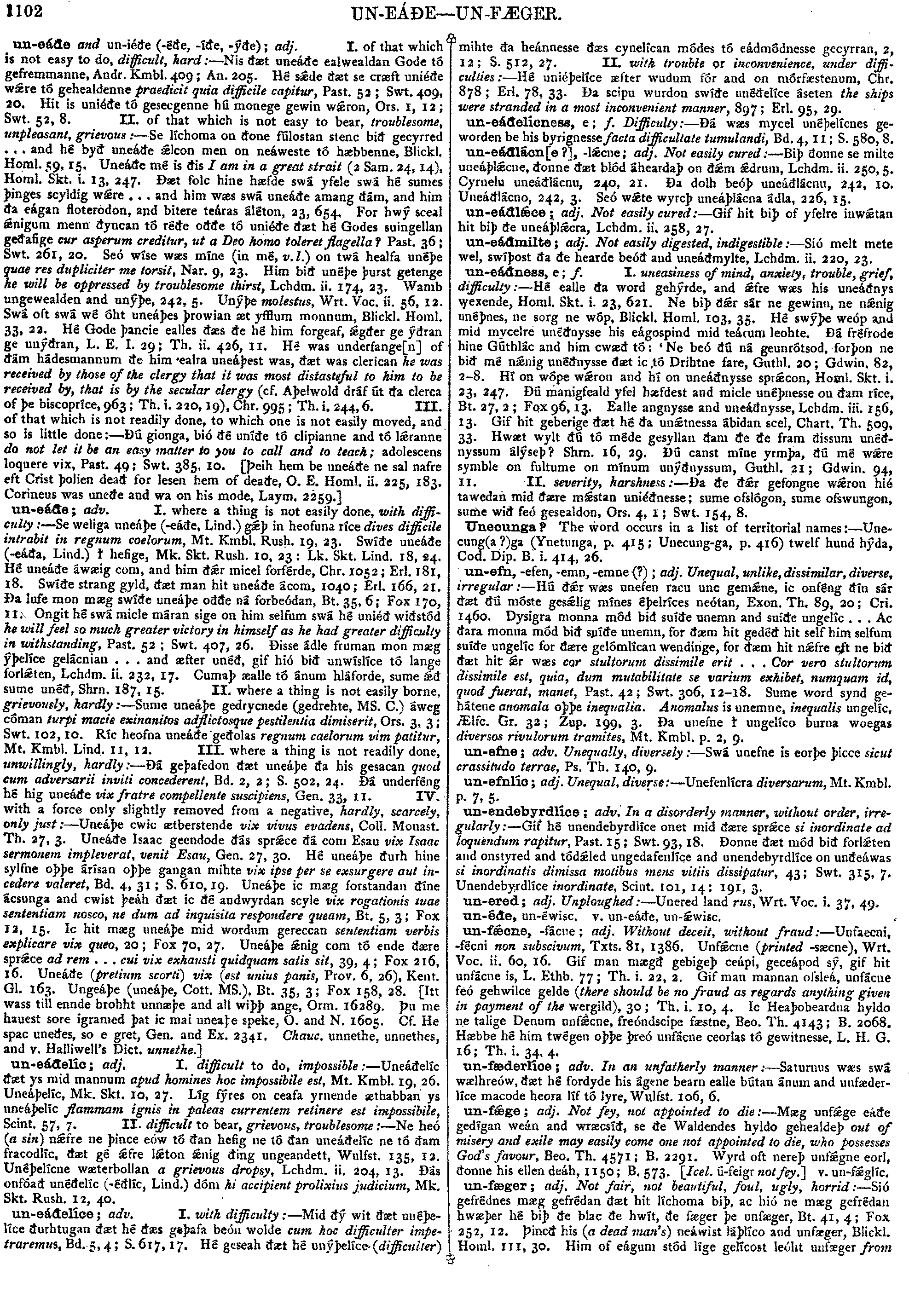
un-fcne,
-fácne;
adj.
Without
deceit,
without
fraud
:--
Unfaecni,
-fécni
non
subscivum,
Txts.
81,
1386.
Unfcne
(printed
-sæcne),
Wrt.
Voc.
ii.
60,
16.
Gif
man
mægð
gebigeþ
ceápi,
geceápod
sý,
gif
hit
unfácne
is,
L.
Ethb.
77;
Th.
i.
22,
2.
Gif
man
mannan
ofsleá,
unfácne
feó
gehwilce
gelde
(there
should
be
no
fraud
as
regards
anything
given
in
payment
of
the
wergild),
30;
Th.
i.
10,
4.
Ic
Heaþobeardna
hyldo
ne
talige
Denum
unfcne,
freóndscipe
fæstne,
Beo.
Th.
4143;
B.
2068.
Hæbbe
hé
him
twégen
oþþe
þreó
unfácne
ceorlas
tó
gewitnesse,
L.
H.
G.
16;
Th.
i.
34,
4.
| Result Page: |  |
Previous | 22 23 24 25 26 27 28 29 30 31 32 33 34 35 36 37 38 39 40 | Next |  |
Germanic Lexicon Project (main page)
This search system was written by
Sean Crist
Please consider
volunteering
to correct the data in these online dictionaries.
No rights reserved. Feel free to use these data in any way you please.