|
|

Tip: In the search results, you can click on any word or abbreviation for more information.
|
Source: Bosworth/Toller, page b1016, entry 15 View original page image as: [TIFF] [PNG] [View previous entry] [View next entry] |
[Comment on this entry] [View comments (1)] |
The following entry has been hand-corrected once. |
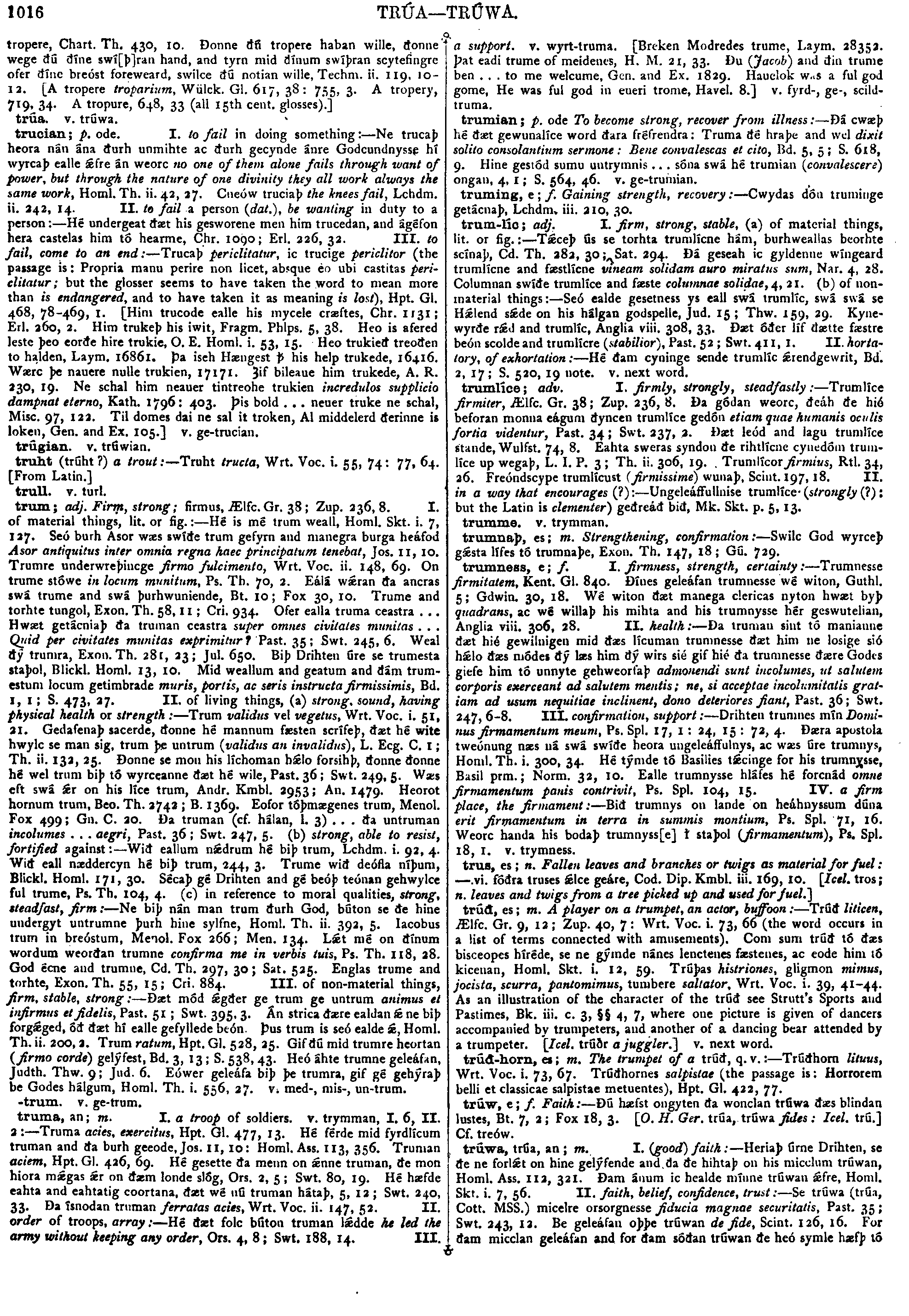
trumness,
e;
f.
I.
firmness,
strength,
certainty
:--
Trumnesse
firmitatem,
Kent.
Gl.
840.
Ðínes
geleáfan
trumnesse
wé
witon,
Guthl.
5;
Gdwin.
30,
18.
Wé
witon
ðæt
manega
clericas
nyton
hwæt
byþ
quadrans,
ac
wé
willaþ
his
mihta
and
his
trumnysse
hér
geswutelian,
Anglia
viii.
306,
28.
II.
health
:--
Ða
truman
sint
tó
manianne
ðæt
hié
gewilnigen
mid
ðæs
lícuman
trumnesse
ðæt
him
ne
losige
sió
h lo
ð
æs
módes
ðý
læs
him
ðý
wirs
sié
gif
hié
ða
trumnesse
ðære
Godes
giefe
him
tó
unnyte
gehweorfaþ
admonendi
sunt
incolumes,
ut
salutem
carports
exerceani
ad
salutem
mentis;
ne,
si
acceptae
incolumitatis
graí-iam
ad
usum
nequitiae
inclinent,
dono
deteriores
fiant,
Past.
36;
Swt.
247,
6-8.
III.
confirmation,
support
:--
Drihten
trumnes
mín
Dominus
firmamentum
meum,
Ps.
Spl.
17,
1:
24,
15
:
72,
4.
Ðæra
apostola
tweónung
næs
uá
swá
swíðe
heora
ungeleáffulnys,
ac
wæs
úre
trumnys,
Homl.
Th.
i.
300,
34.
Hé
týmde
tó
Basilies
tcinge
for
his
trumnysse,
Basil
prm.
;
Norm.
32,
10.
Ealle
trumnysse
hláfes
hé
forcnád
omne
firmamentum
panis
contrivit.
Ps.
Spl.
104,
15.
IV.
a
firm
place,
the
firmament
:--
Bið
trumnys
on
lande
on
hedhnyssum
dúna
erit
firmamentum
in
terra
in
summis
montium,
Ps.
Spl.
71,
16.
Weorc
handa
his
bodaþ
trumnyss[e]
lo
ð
æs
módes
ðý
læs
him
ðý
wirs
sié
gif
hié
ða
trumnesse
ðære
Godes
giefe
him
tó
unnyte
gehweorfaþ
admonendi
sunt
incolumes,
ut
salutem
carports
exerceani
ad
salutem
mentis;
ne,
si
acceptae
incolumitatis
graí-iam
ad
usum
nequitiae
inclinent,
dono
deteriores
fiant,
Past.
36;
Swt.
247,
6-8.
III.
confirmation,
support
:--
Drihten
trumnes
mín
Dominus
firmamentum
meum,
Ps.
Spl.
17,
1:
24,
15
:
72,
4.
Ðæra
apostola
tweónung
næs
uá
swá
swíðe
heora
ungeleáffulnys,
ac
wæs
úre
trumnys,
Homl.
Th.
i.
300,
34.
Hé
týmde
tó
Basilies
tcinge
for
his
trumnysse,
Basil
prm.
;
Norm.
32,
10.
Ealle
trumnysse
hláfes
hé
forcnád
omne
firmamentum
panis
contrivit.
Ps.
Spl.
104,
15.
IV.
a
firm
place,
the
firmament
:--
Bið
trumnys
on
lande
on
hedhnyssum
dúna
erit
firmamentum
in
terra
in
summis
montium,
Ps.
Spl.
71,
16.
Weorc
handa
his
bodaþ
trumnyss[e]
 staþol
(firmamentum),
Ps.
Spl.
18,
1.
v.trymness.
staþol
(firmamentum),
Ps.
Spl.
18,
1.
v.trymness.
|
Source: Bosworth/Toller, page b1021, entry 7 View original page image as: [TIFF] [PNG] [View previous entry] [View next entry] |
[Comment on this entry] [View comments] |
The following entry has been hand-corrected once. |
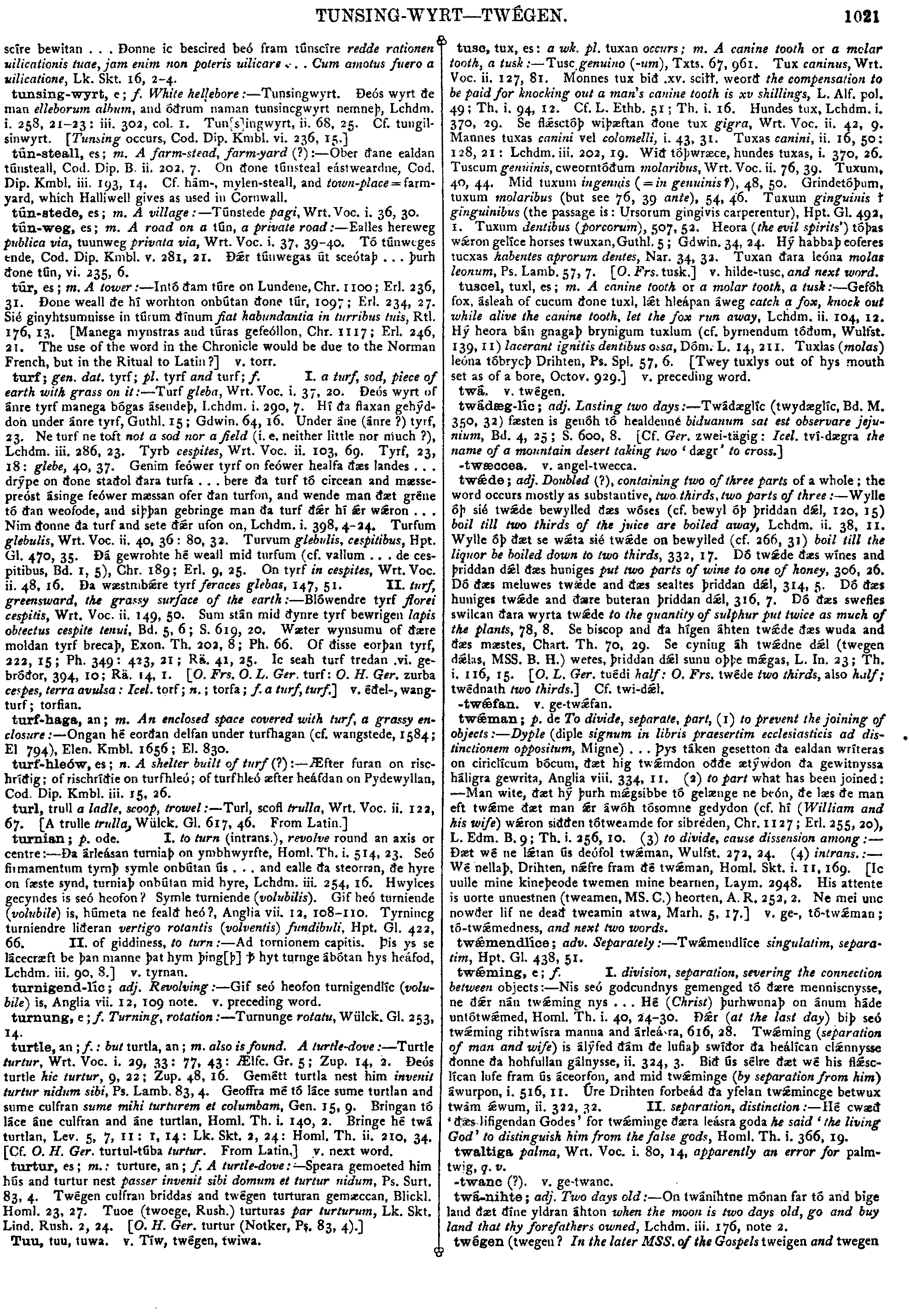
turf;
gen.
dat.
tyrf;
pl.
tyrf
and
turf;
f.
I.
a
turf,
sod,
piece
of
earth
with
grass
on
it:--Turf
gleba,
Wrt.
Voc.
i.
37,
20.
Ðeós
wyrt
of
ánre
tyrf
manega
bógas
ásendeþ,
Lchdm.
i.
290,
7.
Hí
ða
flaxan
gehýddon
under
ánre
tyrf,
Guthl.
15;
Gdwin.
64,
16.
Under
áne
(ánre?)
tyrf,
23.
Ne
turf
ne
toft
not
a
sod
nor
a
field
(i.
e.
neither
little
nor
much?),
Lchdm.
iii.
286,
23.
Tyrb
cespites,
Wrt.
Voc.
ii.
103,
69.
Tyrf,
23,
18:
glebe,
40,
37.
Genim
feówer
tyrf
on
feówer
healfa
ðæs
landes
.
.
.
drýpe
on
ðone
staðol
ðara
turfa
.
.
.
bere
ða
turf
tó
circean
and
maesse preóst
ásinge
feówer
mæssan
ofer
ðan
turfon,
and
wende
man
ðæt
gréne
tó
ðan
weofode,
and
siþþan
gebringe
man
ða
turf
ðr
hí
r
wron
.
.
.
Nim
ðonne
ða
turf
and
sete
ðr
ufon
on,
Lchdm.
i.
398,
4-24.
Turfum
glebulis,
Wrt.
Voc.
ii.
40,
36:
80,
32.
Turvum
glebulis,
cespitibus,
Hpt.
Gl.
470,
35.
Ðá
gewrohte
hé
weall
mid
turfum
(cf.
vallum
.
.
.
de
cespitibus,
Bd.
1,
5),
Chr.
189;
Erl.
9,
25.
On
tyrf
in
cespites,
Wrt.
Voc.
ii.
48,
16.
Ða
wæstmbre
tyrf
feraces
glebas,
147,
51.
II.
turf,
greensward,
the
grassy
surface
of
the
earth:--Blówendre
tyrf
florei
cespitis,
Wrt.
Voc.
ii.
149,
50.
Sum
stán
mid
ðynre
tyrf
bewrigen
lapis
obtectus
cespite
tenui,
Bd.
5,
6;
S.
619,
20.
Wæter
wynsumu
of
ðære
moldan
tyrf
brecaþ,
Exon.
Th.
202,
8;
Ph.
66.
Of
ðisse
eorþan
tyrf,
222,
15;
Ph.
349:
423,
21;
Rä.
41,
25.
Ic
seah
turf
tredan
.vi.
gebróðor,
394,
10;
Rä.
14,
1.
[O.
Frs.
O.
L.
Ger.
turf:
O.
H.
Ger.
zurba
cespes,
terra
avulsa:
Icel.
torf;
n.;
torfa;
f.
a
turf,
turf.]
v.
éðel-,
wang-turf;
torfian.
preóst
ásinge
feówer
mæssan
ofer
ðan
turfon,
and
wende
man
ðæt
gréne
tó
ðan
weofode,
and
siþþan
gebringe
man
ða
turf
ðr
hí
r
wron
.
.
.
Nim
ðonne
ða
turf
and
sete
ðr
ufon
on,
Lchdm.
i.
398,
4-24.
Turfum
glebulis,
Wrt.
Voc.
ii.
40,
36:
80,
32.
Turvum
glebulis,
cespitibus,
Hpt.
Gl.
470,
35.
Ðá
gewrohte
hé
weall
mid
turfum
(cf.
vallum
.
.
.
de
cespitibus,
Bd.
1,
5),
Chr.
189;
Erl.
9,
25.
On
tyrf
in
cespites,
Wrt.
Voc.
ii.
48,
16.
Ða
wæstmbre
tyrf
feraces
glebas,
147,
51.
II.
turf,
greensward,
the
grassy
surface
of
the
earth:--Blówendre
tyrf
florei
cespitis,
Wrt.
Voc.
ii.
149,
50.
Sum
stán
mid
ðynre
tyrf
bewrigen
lapis
obtectus
cespite
tenui,
Bd.
5,
6;
S.
619,
20.
Wæter
wynsumu
of
ðære
moldan
tyrf
brecaþ,
Exon.
Th.
202,
8;
Ph.
66.
Of
ðisse
eorþan
tyrf,
222,
15;
Ph.
349:
423,
21;
Rä.
41,
25.
Ic
seah
turf
tredan
.vi.
gebróðor,
394,
10;
Rä.
14,
1.
[O.
Frs.
O.
L.
Ger.
turf:
O.
H.
Ger.
zurba
cespes,
terra
avulsa:
Icel.
torf;
n.;
torfa;
f.
a
turf,
turf.]
v.
éðel-,
wang-turf;
torfian.
|
Source: Bosworth/Toller, page b1021, entry 17 View original page image as: [TIFF] [PNG] [View previous entry] [View next entry] |
[Comment on this entry] [View comments] |
The following entry has been hand-corrected once. |
tusc,
tux,
es:
a
wk.
pl.
tuxan
occurs;
m.
A
canine
tooth
or
a
molar
tooth,
a
tusk:--Tusc
genuino
(-um),
Txts.
67,
961.
Tux
caninus,
Wrt.
Voc.
ii.
127,
81.
Monnes
tux
bið
.xv.
sci.
weorð
the
compensation
to
be
paid
for
knocking
out
a
man's
canine
tooth
is
xv
shillings,
L.
Alf.
pol.
49;
Th.
i.
94,
12.
Cf.
L.
Ethb.
51;
Th.
i.
16.
Hundes
tux,
Lchdm.
i.
370,
29.
Se
flsctóþ
wiþæftan
ðone
tux
gigra,
Wrt.
Voc.
ii.
42,
9.
Mannes
tuxas
canini
vel
colomelli,
i.
43,
31.
Tuxas
canini,
ii.
16,
50:
128,
21:
Lchdm.
iii.
202,
19.
Wið
tóþwræce,
hundes
tuxas,
i.
370,
26.
Tuscum
genuinis,
cweorntóðum
molaribus,
Wrt.
Voc.
ii.
76,
39.
Tuxum,
40,
44,
Mid
tuxum
ingenuis
(
=
in
genuinis?),
48,
50.
Grindetóþum,
tuxum
molaribus
(but
see
76,
39
ante),
54,
46.
Tuxum
ginguinis
ginguinibus
(the
passage
is:
Ursorum
gingivis
carperentur),
Hpt.
Gl.
492,
1.
Tuxum
dentibus
(porcorum),
507,
52.
Heora
(the
evil
spirits')
tóþas
wron
gelíce
horses
twuxan,
Guthl.
5;
Gdwin.
34,
24.
Hý
habbaþ
eoferes
tucxas
habentes
aprorum
dentes,
Nar.
34,
32.
Tuxan
ðara
leóna
molas
leonum,
Ps.
Lamb.
57,
7.
[O.
Frs.
tusk.]
v.
hilde-tusc,
and
next
word.
|
Source: Bosworth/Toller, page b1024, entry 1 View original page image as: [TIFF] [PNG] [View previous entry] [View next entry] |
[Comment on this entry] [View comments] |
The following entry has been hand-corrected once. |
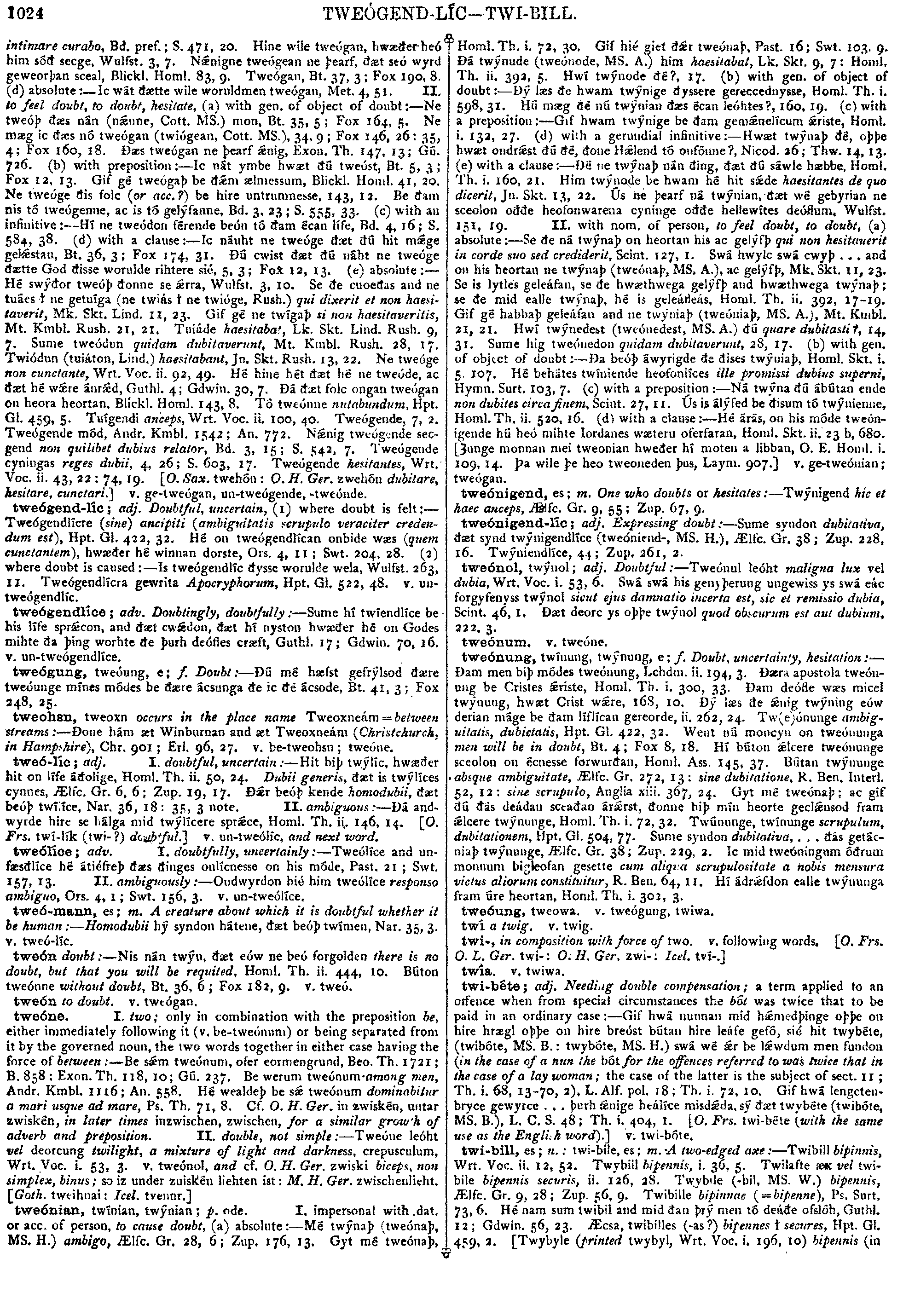
intimare
curabo,
Bd.
pref.;
S.
471,
20.
Hine
wile
tweógan,
hwæðer
heó
him
sóð
secge,
Wulfst.
3,
7.
Nnigne
tweógean
ne
þearf,
ðæt
seó
wyrd
geweorþan
sceal,
Blickl.
Homl.
83,
9.
Tweógan,
Bt.
37,
3;
Fox
190,
8.
(d)
absolute:--Ic
wát
ðætte
wile
woruldmen
tweógan,
Met.
4,
51.
II.
to
feel
doubt,
to
doubt,
hesitate,
(a)
with
gen.
of
object
of
doubt:--Ne
tweóþ
ðæs
nán
(nnne,
Cott.
MS.)
mon,
Bt.
35,
5;
Fox
164,
5.
Ne
mæg
ic
ðæs
nó
tweógan
(twiógean,
Cott.
MS.),
34,
9;
Fox
146,
26:
35,
4;
Fox
160,
18.
Ðæs
tweógan
ne
þearf
nig,
Exon.
Th.
147,
13;
Gú.
726.
(b)
with
preposition:--Ic
nát
ymbe
hwæt
ðú
tweóst,
Bt.
5,
3;
Fox
12,
13.
Gif
gé
tweógaþ
be
ðm
ælmessum,
Blickl.
Homl.
41,
20.
Ne
tweóge
ðis
folc
(or
acc.?)
be
hire
untrumnesse,
143,
12.
Be
ðam
nis
tó
tweógenne,
ac
is
tó
gelýfanne,
Bd.
3,
23;
S.
555,
33.
(c)
with
an
infinitive:--Hí
ne
tweódon
férende
beón
tó
ðam
écan
lífe,
Bd.
4,
16;
S.
584,
38.
(d)
with
a
clause:--Ic
náuht
ne
tweóge
ðæt
ðú
hit
mge
gelstan,
Bt.
36,
3;
Fox
174,
31.
Ðú
cwist
ðæt
ðú
náht
ne
tweóge
ðætte
God
ðisse
worulde
rihtere
sié,
5,
3;
Fox
12,
13.
(e)
absolute:--Hé
swýðor
tweóþ
ðonne
se
rra,
Wulfst.
3,
10.
Se
ðe
cuoeðas
and
ne
tuáes
ne
getuíga
(ne
twiás
ne
twióge,
Rush.)
qui
dixerit
et
non
haesitaverit,
Mk.
Skt.
Lind.
11,
23.
Gif
gé
ne
twígaþ
si
non
haesitaveritis,
Mt.
Kmbl.
Rush.
21,
21.
Tuiáde
haesitabat,
Lk.
Skt.
Lind.
Rush.
9,
7.
Sume
tweódun
quidam
dubitaverunt,
Mt.
Kmbl.
Rush.
28,
17.
Twiódun
(tuiáton,
Lind.)
haesitabant,
Jn.
Skt.
Rush.
13,
22.
Ne
tweóge
non
cunctante,
Wrt.
Voc.
ii.
92,
49.
Hé
hine
hét
ðæt
hé
ne
tweóde,
ac
ðæt
hé
wre
ánrd,
Guthl.
4;
Gdwin.
30,
7.
Ðá
ðæt
folc
ongan
tweógan
on
heora
heortan,
Blickl.
Homl.
143,
8.
Tó
tweónne
nutabundum,
Hpt.
Gl.
459,
5.
Tuígendi
anceps,
Wrt.
Voc.
ii.
100,
40.
Tweógende,
7,
2.
Tweógende
mód,
Andr.
Kmbl.
1542;
An.
772.
Nnig
tweógende
secgend
non
quilibet
dubius
relator,
Bd.
3,
15;
S.
542,
7.
Tweógende
cyningas
reges
dubii,
4,
26;
S.
603,
17.
Tweógende
hesitantes,
Wrt.
Voc.
ii.
43,
22:
74,
19.
[O.
Sax.
twehón:
O.
H.
Ger.
zwehón
dubitare,
hesitare,
cunctari.]
v.
ge-tweógan,
un-tweógende,
-tweónde.
|
Source: Bosworth/Toller, page b1024, entry 3 View original page image as: [TIFF] [PNG] [View previous entry] [View next entry] |
[Comment on this entry] [View comments] |
The following entry has been hand-corrected once. |
tweógendlíce;
adv.
Doubtingly,
doubtfully:--Sume
hí
twíendlíce
be
his
lífe
sprcon,
and
ðæt
cwdon,
ðæt
hí
nyston
hwæðer
hé
on
Godes
mihte
ða
þing
worhte
ðe
þurh
deófles
cræft,
Guthl.
17;
Gdwin.
70,
16.
v.
un-tweógendlíce.
|
Source: Bosworth/Toller, page b1024, entry 23 View original page image as: [TIFF] [PNG] [View previous entry] [View next entry] |
[Comment on this entry] [View comments] |
The following entry has been hand-corrected once. |
twi-bill,
es;
n.:
twi-bile,
es;
m.
A
two-edged
axe:--Twibill
bipinnis,
Wrt.
Voc.
ii.
12,
52.
Twybill
bipennis,
i.
36,
5.
Twilafte
æx
vel
twibile
bipennis
securis,
ii.
126,
28.
Twybile
(-bil,
MS.
W.)
bipennis,
Ælfc.
Gr.
9,
28;
Zup.
56,
9.
Twibille
bipinnae
(
=
bipenne),
Ps.
Surt.
73,
6.
Hé
nam
sum
twibil
and
mid
ðan
þrý
men
tó
deáðe
ofslóh,
Guthl.
12;
Gdwin.
56,
23.
Æcsa,
twibilles
(-as?)
bipennes
secures,
Hpt.
Gl.
459,
2.
[Twybyle
(printed
twybyl,
Wrt.
Voc.
i.
196,
10)
bipennis
(in
|
Source: Bosworth/Toller, page b1025, entry 20 View original page image as: [TIFF] [PNG] [View previous entry] [View next entry] |
[Comment on this entry] [View comments (1)] |
The following entry has been hand-corrected once. |
twi-feald;
adj.
Twofold,
double
:--
Twyfeald
duplex,
Ælfc.
Gr.
9,
61;
Zup.
70,
2
:
geminus,
Wrt.
Voc.
ii.
42,
l
:
44,
21:
41,
58.
I.
as
a
multiplicative,
twice
as
much,
of
twice
the
amount
:--
Gyt
synd
manega
getel
on
misl cum
get
cum
get cnungum
.
.
.
duplex
twyfeald,
Ælfc.
Gr.
49;
Zup.
287,
2.
Ic
dreáh
mycel
broc
mid
Petre;
n
cnungum
.
.
.
duplex
twyfeald,
Ælfc.
Gr.
49;
Zup.
287,
2.
Ic
dreáh
mycel
broc
mid
Petre;
n is
mn
yfel
twyfeald,
n
Paulus
is
mn
yfel
twyfeald,
n
Paulus
 æt
ilce
l
æt
ilce
l reþ,
Blickl.
Homl.
175,
13.
Twifealdum
gste
(Helisaeus
Helia)
duplo
(dilatuj)
spiritu,
Hpt.
Gl
440,
47.
Twi-fealdre
gife
bino
munere,
Wrt.
Voc.
ii.
126,
26:
Blickl.
Homl.
101,
23.
Be
twyfealdum
ic
forgylde
duplum,
Ælfc.
Gr.
49;
Zup.
286,
17
:
L.
Alf.
25
;
Th.
i.
50,
23
:
Homl.
Th.
ii.
562,
l.
H
reþ,
Blickl.
Homl.
175,
13.
Twifealdum
gste
(Helisaeus
Helia)
duplo
(dilatuj)
spiritu,
Hpt.
Gl
440,
47.
Twi-fealdre
gife
bino
munere,
Wrt.
Voc.
ii.
126,
26:
Blickl.
Homl.
101,
23.
Be
twyfealdum
ic
forgylde
duplum,
Ælfc.
Gr.
49;
Zup.
286,
17
:
L.
Alf.
25
;
Th.
i.
50,
23
:
Homl.
Th.
ii.
562,
l.
H him
sylþ
twifealdne
mete
(cibos
duplices),
Ex.
16,
29.
'Nymaþ
tw
sw
micel
fe
him
sylþ
twifealdne
mete
(cibos
duplices),
Ex.
16,
29.
'Nymaþ
tw
sw
micel
fe s
sw
g
er
hæfdon'.
.
.
Ð
nmon
hig
twigfeald
feoh
'pecuniam
duplicem
ferte'.
.
.
Tulerunt
ergo
pecuniam
duplicem,
Gen.
43,
12-15.
II.
consisting
of
two
items
:--
Twyfealdre
heolra
bilance,
Wrt.
Voc.
ii.
12,
i.
Næbbe
g
mid
eów
twyfeald
hrægl
(næbbe
g
tw
tunecan,
Mt.
Kmbl.
10,
10),
Blickl.
Homl.
233,
18.
II
a.
consisting
of
two
parts,
containing
two
elements
:--
Ðæt
twiefalde
(twyfealde,
Cott.
MSS.)
gesuinc.
.
.
æt
is
æt
hié
ondrdaþ
æt
h
mon
tlan
wille
.
.
.
;
s
sw
g
er
hæfdon'.
.
.
Ð
nmon
hig
twigfeald
feoh
'pecuniam
duplicem
ferte'.
.
.
Tulerunt
ergo
pecuniam
duplicem,
Gen.
43,
12-15.
II.
consisting
of
two
items
:--
Twyfealdre
heolra
bilance,
Wrt.
Voc.
ii.
12,
i.
Næbbe
g
mid
eów
twyfeald
hrægl
(næbbe
g
tw
tunecan,
Mt.
Kmbl.
10,
10),
Blickl.
Homl.
233,
18.
II
a.
consisting
of
two
parts,
containing
two
elements
:--
Ðæt
twiefalde
(twyfealde,
Cott.
MSS.)
gesuinc.
.
.
æt
is
æt
hié
ondrdaþ
æt
h
mon
tlan
wille
.
.
.
;
 er
is
ara
gesuinca
æt
h
sceaþ
endeleáse
ldunga.
Past.
35;
Swt.
239,
4-8.
Twufald
intinge
duplex
causa.
Mt.
Kmbl.
p.
I.
10.
IIb.
that
belongs
to
one
or
other
of
two
kinds
:--
Ege
is
twyfeald,
and
eówdm
is
twyfeald.
&A-long;n
ege
is
btan
lufe,
er
is
mid
lufe.
.
.
Sw
is
eác
er
eówt
neádunge
bton
lufe,
er
is
sylfwilles
mid
lufe,
Homl.
Th.
ii.
524,
3-6.
W
tweofealdne
deáþ
rowiaþ,
oþþe
sticode
beóþ,
oþþe
on
s
druncene
oriuntur
duo
genera
funerum,
aut
jugulamur,
aut
mergimur.
Bd.
l,
13;
8.
482,
l.
III.
doubtful,
irresolute:
v.
twifealdness,
II
:--
H
a
yfelan
and
a
twyfealdan
geþhtas
forlt
(cf.
h
hine
hider
and
þyder
gelmlce
on
his
mde
cyrde,
28,
8;
h
m
tweógendum
geþhtum
wistd,
18),
and
hine
SUNCERTAIN
Bartholomeus
frfrode,
and
hine
ht
æt
h
ne
tweóde,
ac
æt
h
wre
nrd,
Guthl.
4;
Gdwin.
30,
3-7.
IV.
double
(as
in
double
dealing),
not
straightforward,
deceitful,
v.
twifealdness,
III
:--
Dmes
dæg
rfaþ
æt
cliwen
ære
twifaldan
(twy-fealdan,
Cott.
MSS.)
heortan
corda
duplicitatibus
involuta
dissolvit,
Past.
35
;
Swt.
245,
22.
Se
e
mid
twyfealdum
geance
t
mynsterlcre
drohtnunge
gecyrþ,
and
sumne
dl
his
hta
dlþ,
sumne
him
sylfum
gehylt,
.
.
.
h
underfhþ
one
wyrgedan
cwyde
mid
Annanian
and
Saphiran,
e
swicedon
on
heora
genum
htum,
Homl.
Th.
i.
398,
28-33
:
ii.
410,
32.
Ðæt
is
syndrig
yfel
twiefealdra
(twy-,
Cott.
MSS.)
monna
est
speciale
duplicium
malum,
Past.
35
;
Swt.
243,
24.
Unclnu
and
twiefeald
md
impura
corda,
Swt.
245,
12.
V.
double
(as
in
bent
double),
placed
together
:--
Æ-long;lc
wg
biþ
gebiéged
twiefeald
on
æm
heale
duplex
semper
est
in
angulis
paries,
Past.
35;
Swt.
245,
13.
Ðæt
yfelwillende
md
gefielt
hit
self
twyfeald
oninnan
him
selfum,
and
sió
twyfealdnes
æs
yflan
willan
hiene
selfne
twyfealdne
gefielt
ouinnan
him
selfum
malitiosae
mentis
duplicitas
sese
infra
se
colligit,
242,
6-9.
[O.
Frs.
twi-fald
:
O.
L.
Ger.
twi-veld,
-fold:
O.
H.
Ger.
zwi-falt:
Icel.
tv-faldr.]
v.
un-twifeald.
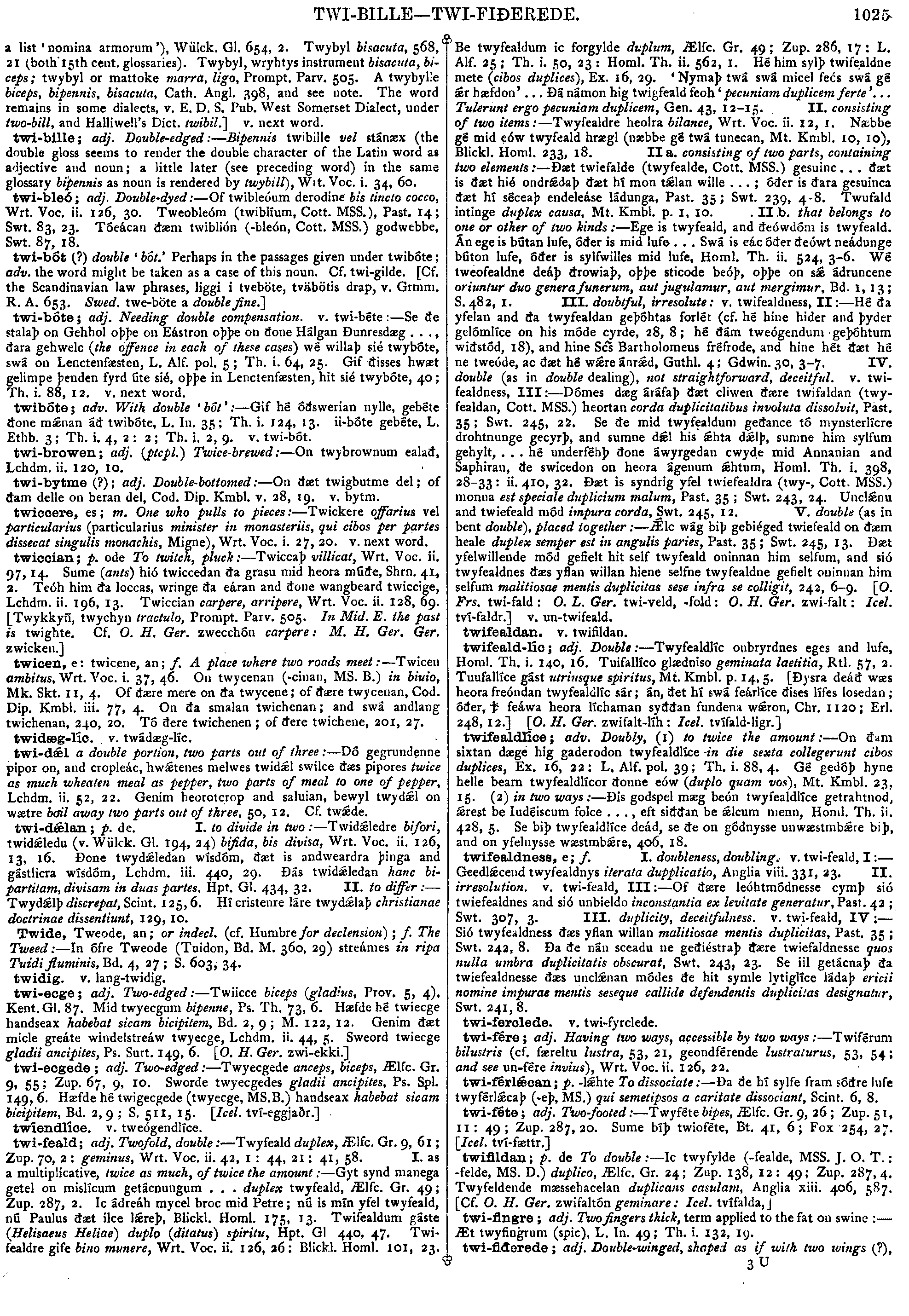
er
is
ara
gesuinca
æt
h
sceaþ
endeleáse
ldunga.
Past.
35;
Swt.
239,
4-8.
Twufald
intinge
duplex
causa.
Mt.
Kmbl.
p.
I.
10.
IIb.
that
belongs
to
one
or
other
of
two
kinds
:--
Ege
is
twyfeald,
and
eówdm
is
twyfeald.
&A-long;n
ege
is
btan
lufe,
er
is
mid
lufe.
.
.
Sw
is
eác
er
eówt
neádunge
bton
lufe,
er
is
sylfwilles
mid
lufe,
Homl.
Th.
ii.
524,
3-6.
W
tweofealdne
deáþ
rowiaþ,
oþþe
sticode
beóþ,
oþþe
on
s
druncene
oriuntur
duo
genera
funerum,
aut
jugulamur,
aut
mergimur.
Bd.
l,
13;
8.
482,
l.
III.
doubtful,
irresolute:
v.
twifealdness,
II
:--
H
a
yfelan
and
a
twyfealdan
geþhtas
forlt
(cf.
h
hine
hider
and
þyder
gelmlce
on
his
mde
cyrde,
28,
8;
h
m
tweógendum
geþhtum
wistd,
18),
and
hine
SUNCERTAIN
Bartholomeus
frfrode,
and
hine
ht
æt
h
ne
tweóde,
ac
æt
h
wre
nrd,
Guthl.
4;
Gdwin.
30,
3-7.
IV.
double
(as
in
double
dealing),
not
straightforward,
deceitful,
v.
twifealdness,
III
:--
Dmes
dæg
rfaþ
æt
cliwen
ære
twifaldan
(twy-fealdan,
Cott.
MSS.)
heortan
corda
duplicitatibus
involuta
dissolvit,
Past.
35
;
Swt.
245,
22.
Se
e
mid
twyfealdum
geance
t
mynsterlcre
drohtnunge
gecyrþ,
and
sumne
dl
his
hta
dlþ,
sumne
him
sylfum
gehylt,
.
.
.
h
underfhþ
one
wyrgedan
cwyde
mid
Annanian
and
Saphiran,
e
swicedon
on
heora
genum
htum,
Homl.
Th.
i.
398,
28-33
:
ii.
410,
32.
Ðæt
is
syndrig
yfel
twiefealdra
(twy-,
Cott.
MSS.)
monna
est
speciale
duplicium
malum,
Past.
35
;
Swt.
243,
24.
Unclnu
and
twiefeald
md
impura
corda,
Swt.
245,
12.
V.
double
(as
in
bent
double),
placed
together
:--
Æ-long;lc
wg
biþ
gebiéged
twiefeald
on
æm
heale
duplex
semper
est
in
angulis
paries,
Past.
35;
Swt.
245,
13.
Ðæt
yfelwillende
md
gefielt
hit
self
twyfeald
oninnan
him
selfum,
and
sió
twyfealdnes
æs
yflan
willan
hiene
selfne
twyfealdne
gefielt
ouinnan
him
selfum
malitiosae
mentis
duplicitas
sese
infra
se
colligit,
242,
6-9.
[O.
Frs.
twi-fald
:
O.
L.
Ger.
twi-veld,
-fold:
O.
H.
Ger.
zwi-falt:
Icel.
tv-faldr.]
v.
un-twifeald.
|
Source: Bosworth/Toller, page b1030, entry 16 View original page image as: [TIFF] [PNG] [View previous entry] [View next entry] |
[Comment on this entry] [View comments] |
The following entry has been hand-corrected once. |
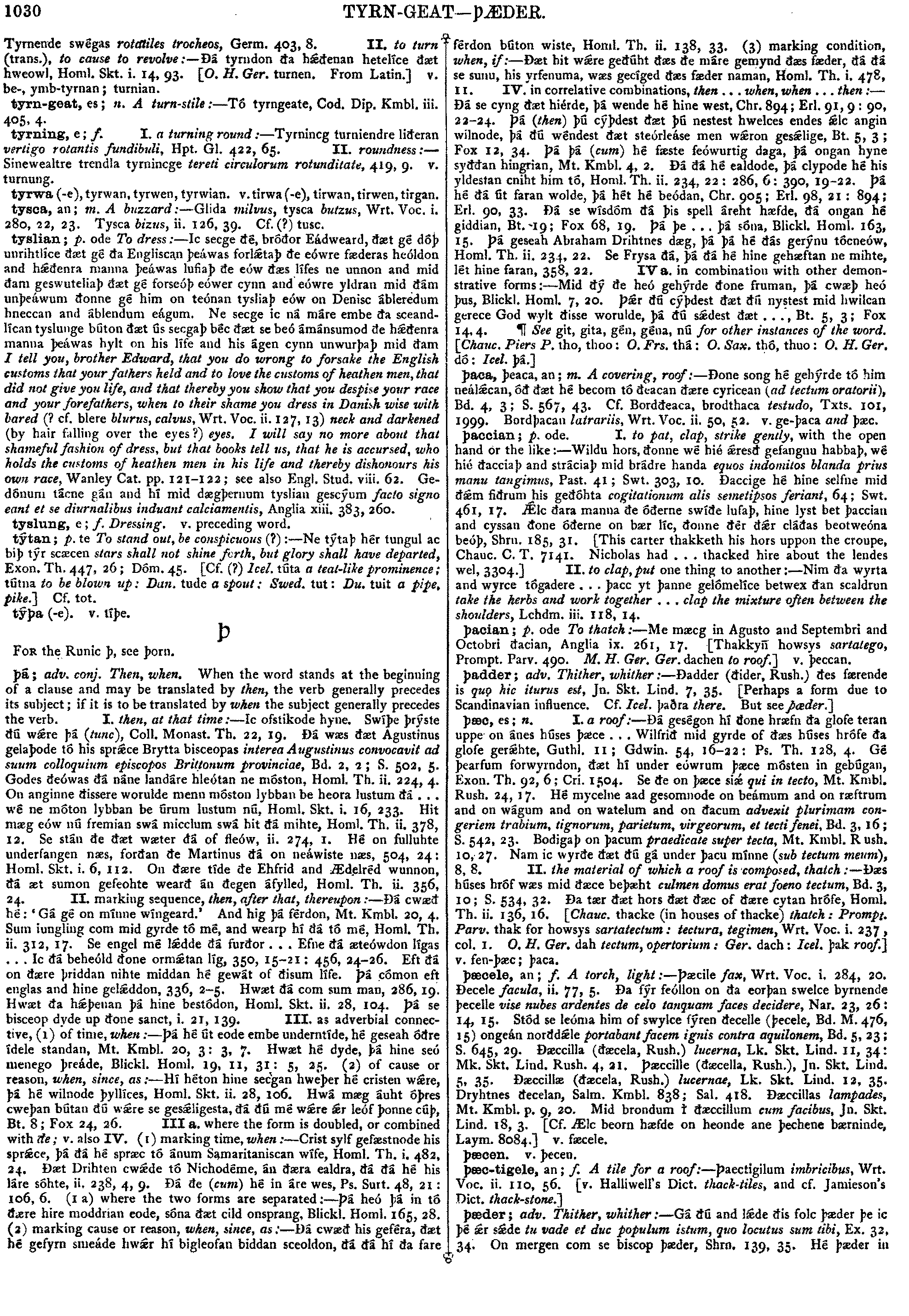
þæc,
es;
n.
I.
a
roof
:--
Ðá
geségon
hí
ðone
hræfn
ða
glofe
teran
uppe
on
ánes
húses
þæce
...
Wilfrið
mid
gyrde
of
ðæs
húses
hrófe
ða
glofe
gerhte,
Guthl.
11;
Gdwin.
54,
16-22
:
Ps.
Th.
128,
4.
Gé
þearfum
forwyrndon,
ðæt
hí
under
eówrum
þæce
mósten
in
gebúgan,
Exon.
Th.
92,
6;
Cri.
1504.
Se
ðe
on
þæce
si
qui
in
tecto,
Mt.
Kmbl.
Rush.
24,
17.
Hé
mycelne
aad
gesomnode
on
beámum
and
on
ræftrum
and
on
wágum
and
on
watelum
and
on
ðacum
advexit
plurimam
congeriem
trabium,
tignorum,
parietum,
virgeorum,
et
tecti
fenei,
Bd.
3,
16;
S.
542,
23.
Bodigaþ
on
þacum
praedicate
super
tecta,
Mt.
Kmbl.
Rush.
10,
27.
Nam
ic
wyrðe
ðæt
ðú
gá
under
þacu
mínne
(sub
tectum
meum),
8,
8.
II.
the
material
of
which
a
roof
is
composed,
thatch
:--
Ðæs
húses
hróf
wæs
mid
ðæce
beþæht
culmen
domus
erat
foeno
tectum,
Bd.
3,
10;
S.
534,
32.
Ða
tær
ðæt
hors
ðæt
ðæc
of
ðære
cytan
hrófe,
Homl.
Th.
ii.
136,
16.
[Chauc.
thacke
(in
houses
of
thacke)
thatch
:
Prompt.
Parv.
thak
for
howsys
sartatectum
:
tectura,
tegimen,
Wrt.
Voc.
i.
237,
col.
1.
O.
H.
Ger.
dah
tectum,
opertorium
:
Ger.
dach
:
Icel.
þak
roof.]
v.
fen-þæc;
þaca.
|
Source: Bosworth/Toller, page b1040, entry 1 View original page image as: [TIFF] [PNG] [View previous entry] [View next entry] |
[Comment on this entry] [View comments] |
The following entry has been hand-corrected once. |
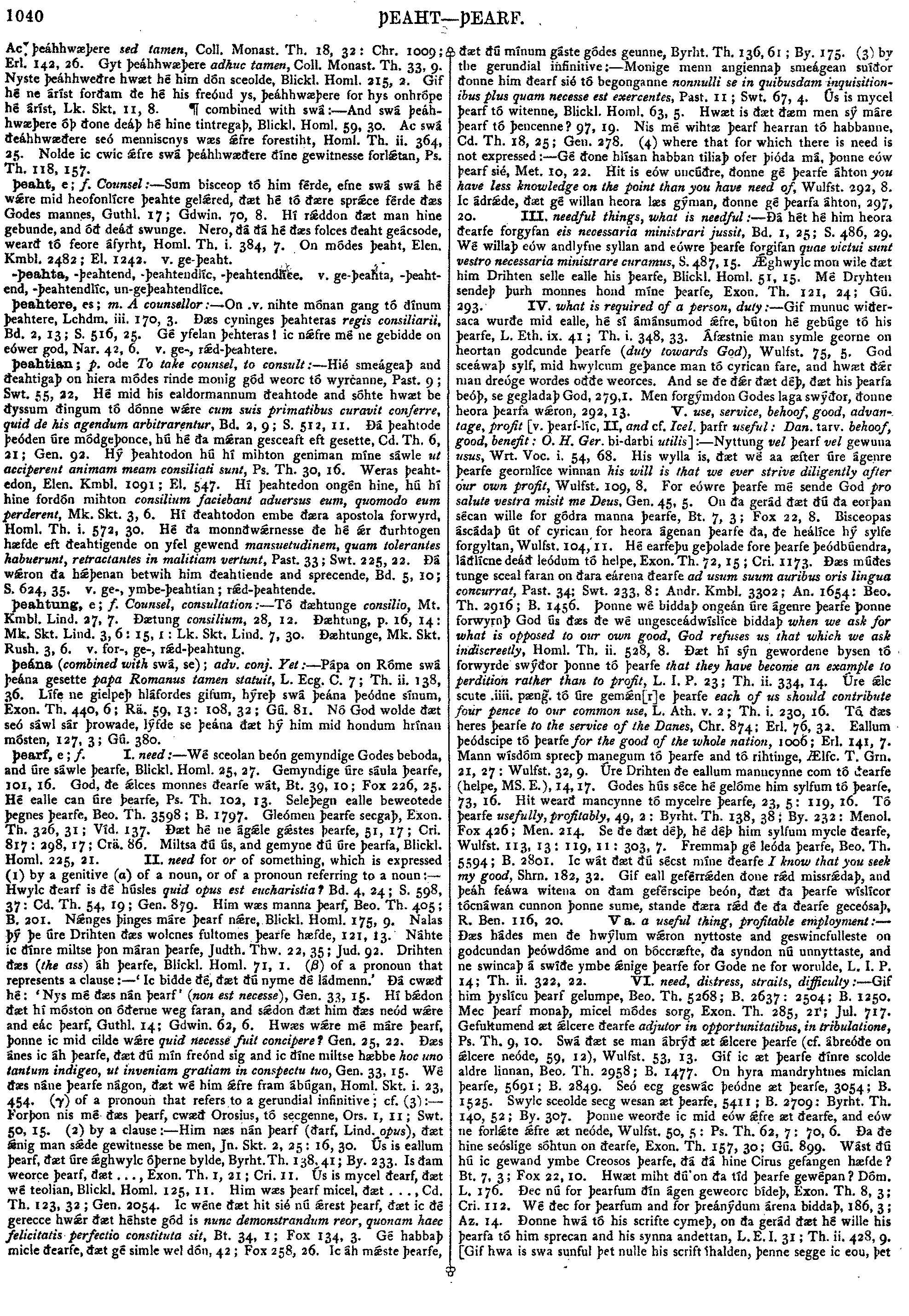
þeaht,
e;
f.
Counsel
:--
Sum
bisceop
tó
him
férde,
efne
swá
swá
hé
wre
mid
heofonlícre
þeahte
gelred,
ðæt
hé
tó
ðære
sprce
férde
ðæs
Godes
mannes,
Guthl.
17;
Gdwin.
70,
8.
Hí
rddon
ðæt
man
hine
gebunde,
and
óð
deáð
swunge.
Nero,
ðá
ðá
hé
ðæs
folces
ðeaht
geácsode,
wearð
tó
feore
áfyrht,
Homl.
Th.
i.
384,
7.
On
módes
þeaht,
Elen.
Kmbl.
2482;
El.
1242.
v.
ge-þeaht.
|
Source: Bosworth/Toller, page b1040, entry 7 View original page image as: [TIFF] [PNG] [View previous entry] [View next entry] |
[Comment on this entry] [View comments] |
The following entry has been hand-corrected once. |
þearf,
e;
f.
I.
need
:--
Wé
sceolan
beón
genyndige
Godes
beboda,
and
úre
sáwle
þearfe,
Blickl.
Homl.
25,
27.
Gemyndige
úre
sáula
þearfe,
101,
16.
God,
ðe
lces
monnes
ðearfe
wát,
Bt.
39,
10;
Fox
226,
25.
Hé
ealle
can
úre
þearfe,
Ps.
Th.
102,
13.
Seleþegn
ealle
beweotede
þegnes
þearfe,
Beo.
Th.
3598;
B.
1797.
Gleómen
þearfe
secgaþ,
Exon.
Th.
326,
31;
Víd.
137.
Ðæt
hé
ne
ágle
gstes
þearfe,
51,
17;
Cri.
817:
298,
17;
Crä.
86.
Miltsa
ðú
ús,
and
gemyne
ðú
úre
þearfa,
Blickl.
Homl.
225,
21.
II.
need
for
or
of
something,
which
is
expressed
(1)
by
a
genitive
( )
of
a
noun,
or
of
a
pronoun
referring
to
a
noun
:--
Hwylc
ðearf
is
ðé
húsles
quid
opus
est
eucharistia?
Bd.
4,
24;
S.
598,
37:
Cd.
Th.
54,
19;
Gen.
879.
Him
wæs
manna
þearf,
Beo.
Th.
405;
B.
201.
Nnges
þinges
máre
þearf
nre,
Blickl.
Homl.
175,
9.
Nalas
þý
þe
úre
Drihten
ðæs
wolcnes
fultomes
þearfe
hæfde,
121,
13.
Náhte
ic
ðínre
miltse
þon
máran
þearfe,
Judth.
Thw.
22,
35;
Jud.
92.
Drihten
ðæs
(the
ass)
áh
þearfe,
Blickl.
Homl.
71,
1.
(
)
of
a
noun,
or
of
a
pronoun
referring
to
a
noun
:--
Hwylc
ðearf
is
ðé
húsles
quid
opus
est
eucharistia?
Bd.
4,
24;
S.
598,
37:
Cd.
Th.
54,
19;
Gen.
879.
Him
wæs
manna
þearf,
Beo.
Th.
405;
B.
201.
Nnges
þinges
máre
þearf
nre,
Blickl.
Homl.
175,
9.
Nalas
þý
þe
úre
Drihten
ðæs
wolcnes
fultomes
þearfe
hæfde,
121,
13.
Náhte
ic
ðínre
miltse
þon
máran
þearfe,
Judth.
Thw.
22,
35;
Jud.
92.
Drihten
ðæs
(the
ass)
áh
þearfe,
Blickl.
Homl.
71,
1.
( )
of
a
pronoun
that
represents
a
clause
:--
'Ic
bidde
ðé,
ðæt
ðú
nyme
ðé
ládmenn.'
Ðá
cwæð
hé:
'Nys
mé
ðæs
nán
þearf'
(non
est
necesse),
Gen.
33,
15.
Hí
bdon
ðæt
hí
móston
on
óðerne
weg
faran,
and
sdon
ðæt
him
ðæs
neód
wre
and
eác
þearf,
Guthl.
14;
Gdwin.
62,
6.
Hwæs
wre
mé
máre
þearf,
þonne
ic
mid
cilde
wre
quid
necesse
fuit
concipere?
Gen.
25,
22.
Ðæs
ánes
ic
áh
þearfe,
ðæt
ðú
mín
freónd
sig
and
ic
ðíne
miltse
hæbbe
hoc
uno
tantum
indigeo,
ut
inveniam
gratiam
in
conspectu
tuo,
Gen.
33,
15.
Wé
ðæs
náne
þearfe
nágon,
ðæt
wé
him
fre
fram
ábúgan,
Homl.
Skt.
i.
23,
454.
(
)
of
a
pronoun
that
represents
a
clause
:--
'Ic
bidde
ðé,
ðæt
ðú
nyme
ðé
ládmenn.'
Ðá
cwæð
hé:
'Nys
mé
ðæs
nán
þearf'
(non
est
necesse),
Gen.
33,
15.
Hí
bdon
ðæt
hí
móston
on
óðerne
weg
faran,
and
sdon
ðæt
him
ðæs
neód
wre
and
eác
þearf,
Guthl.
14;
Gdwin.
62,
6.
Hwæs
wre
mé
máre
þearf,
þonne
ic
mid
cilde
wre
quid
necesse
fuit
concipere?
Gen.
25,
22.
Ðæs
ánes
ic
áh
þearfe,
ðæt
ðú
mín
freónd
sig
and
ic
ðíne
miltse
hæbbe
hoc
uno
tantum
indigeo,
ut
inveniam
gratiam
in
conspectu
tuo,
Gen.
33,
15.
Wé
ðæs
náne
þearfe
nágon,
ðæt
wé
him
fre
fram
ábúgan,
Homl.
Skt.
i.
23,
454.
( )
of
a
pronoun
that
refers
to
a
gerundial
infinitive;
cf.
(3)
:--
Forþon
nis
mé
ðæs
þearf,
cwæð
Orosius,
tó
secgenne,
Ors.
1,
11;
Swt.
50,
15.
(2)
by
a
clause
:--
Him
næs
nán
þearf
(ðarf,
Lind,
opus),
ðæt
nig
man
sde
gewitnesse
be
men,
Jn.
Skt.
2,
25:
16,
30.
Ús
is
eallum
þearf,
ðæt
úre
ghwylc
óþerne
bylde,
Byrht.Th.
138,
41;
By.
233.
Is
ðam
weorce
þearf,
ðæt...,
Exon.
Th.
1,
21;
Cri.
11.
Ús
is
mycel
ðearf,
ðæt
wé
teolian,
Blickl.
Homl.
125,
11.
Him
wæs
þearf
micel,
ðæt...,
Cd.
Th.
123,
32;
Gen.
2054.
Ic
wéne
ðæt
hit
sié
nú
rest
þearf,
ðæt
ic
ðé
gerecce
hwr
ðæt
héhste
gód
is
nunc
demonstrandum
reor,
quonam
haec
felicitatis
perfectio
constituta
sit,
Bt.
34,
1;
Fox
134,
3.
Gé
habbaþ
micle
ðearfe,
ðæt
gé
simle
wel
dón,
42;
Fox
258,
26.
Ic
áh
mste
þearfe,
ðæt
ðú
mínum
gáste
gódes
geunne,
Byrht.
Th.
136,
61;
By.
175.
(3)
by
)
of
a
pronoun
that
refers
to
a
gerundial
infinitive;
cf.
(3)
:--
Forþon
nis
mé
ðæs
þearf,
cwæð
Orosius,
tó
secgenne,
Ors.
1,
11;
Swt.
50,
15.
(2)
by
a
clause
:--
Him
næs
nán
þearf
(ðarf,
Lind,
opus),
ðæt
nig
man
sde
gewitnesse
be
men,
Jn.
Skt.
2,
25:
16,
30.
Ús
is
eallum
þearf,
ðæt
úre
ghwylc
óþerne
bylde,
Byrht.Th.
138,
41;
By.
233.
Is
ðam
weorce
þearf,
ðæt...,
Exon.
Th.
1,
21;
Cri.
11.
Ús
is
mycel
ðearf,
ðæt
wé
teolian,
Blickl.
Homl.
125,
11.
Him
wæs
þearf
micel,
ðæt...,
Cd.
Th.
123,
32;
Gen.
2054.
Ic
wéne
ðæt
hit
sié
nú
rest
þearf,
ðæt
ic
ðé
gerecce
hwr
ðæt
héhste
gód
is
nunc
demonstrandum
reor,
quonam
haec
felicitatis
perfectio
constituta
sit,
Bt.
34,
1;
Fox
134,
3.
Gé
habbaþ
micle
ðearfe,
ðæt
gé
simle
wel
dón,
42;
Fox
258,
26.
Ic
áh
mste
þearfe,
ðæt
ðú
mínum
gáste
gódes
geunne,
Byrht.
Th.
136,
61;
By.
175.
(3)
by
| Result Page: |  |
Previous | 9 10 11 12 13 14 15 16 17 18 19 20 21 22 23 24 25 | Next |  |
Germanic Lexicon Project (main page)
This search system was written by
Sean Crist
Please consider
volunteering
to correct the data in these online dictionaries.
No rights reserved. Feel free to use these data in any way you please.