|
|

Tip: In the search results, you can click on any word or abbreviation for more information.
|
Source: Cleasby/Vigfusson, page b0742, entry 2 View original page image as: [TIFF] [PNG] [View previous entry] [View next entry] |
[Comment on this entry] [View comments] |
The following entry has been hand-corrected once. |
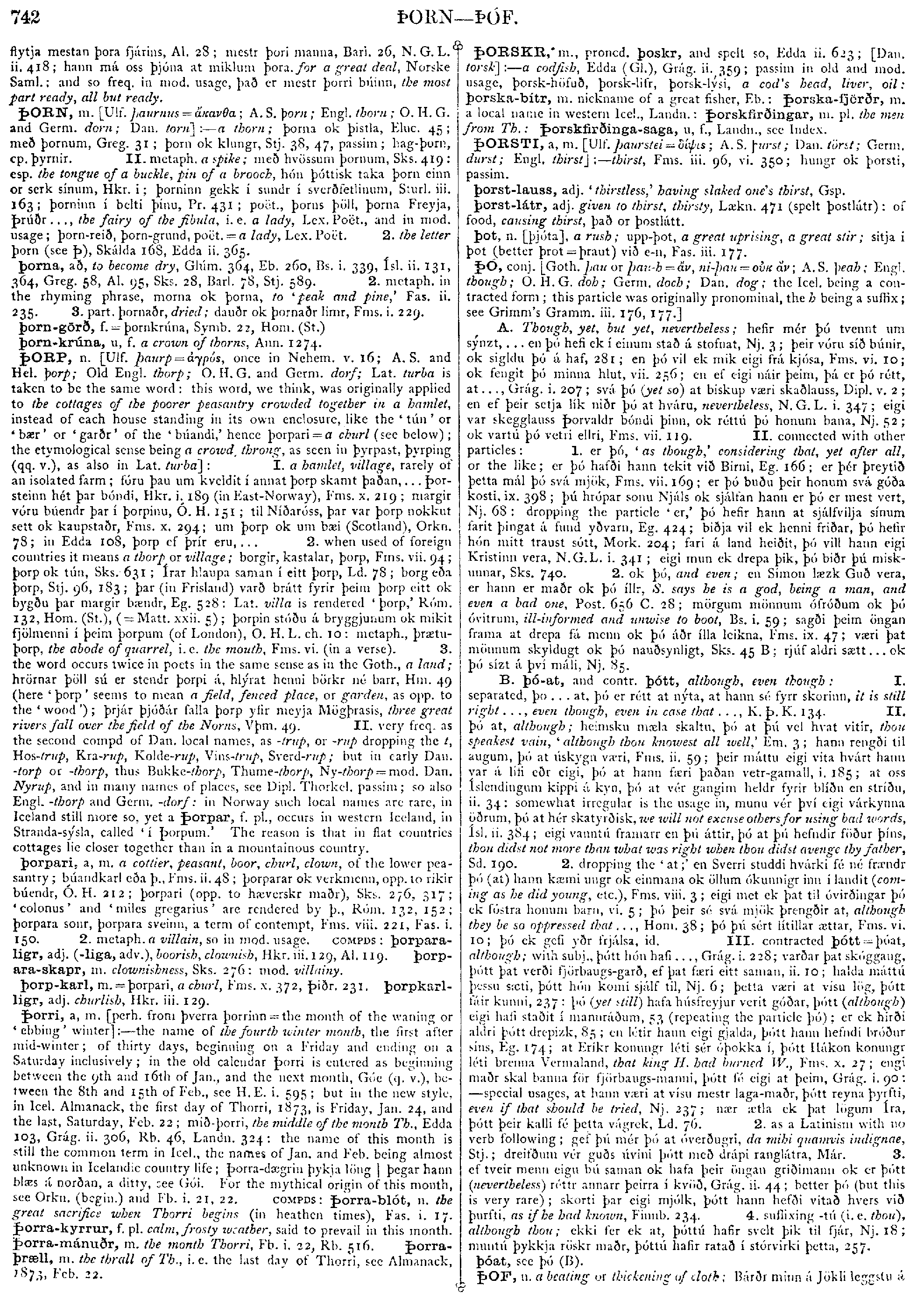
ÞORN, m. [Ulf. þaurnus = GREEK; A.S. þorn; Engl. thorn; O.H.G. and Germ. dorn; Dan. torn] :-- a thorn; þorna ok þistla, Eluc. 45; með þornum, Greg. 31; þorn ok klungr, Stj. 38, 47, passim; hag-þorn, cp. þyrnir. II. metaph. a spike; með hvössum þornum, Sks. 419: esp. the tongue of a buckle, pin of a brooch, hón þóttisk taka þorn einn or serk sínum, Hkr. i; þorninn gekk í sundr í sverðfetlinum, Sturl. iii. 163; þorninn í belti þiuu, Pr. 431; poët., þorns þöll, þorna Freyja, Þ;rúðr ..., the fairy of the fibula, i.e. a lady, Lex. Poët., and in mod. usage; þorn-reið, þorn-grund, poët, = a lady, Lex. Poët. 2. the letter þorn (see Þ), Skálda 168, Edda ii. 365.
|
Source: Cleasby/Vigfusson, page b0742, entry 6 View original page image as: [TIFF] [PNG] [View previous entry] [View next entry] |
[Comment on this entry] [View comments] |
The following entry has been hand-corrected once. |
ÞORP, n. [Ulf. þaurp = GREEK, once in Nehem. v. 16; A.S. and Hel. þorp; Old Engl. thorp; O.H.G. and Germ. dorf; Lat. turba is taken to be the same word: this word, we think, was originally applied to the cottages of the poorer peasantry crowded together in a hamlet, instead of each house standing in its own enclosure, like the 'tún' or 'bær' or 'garðr' of the 'búandi,' hence þorpari = a churl (see below); the etymological sense being a crowd, throng, as seen in þyrpast, þyrping (qq.v.), as also in Lat. turba]: I. a hamlet, village, rarely of an isolated farm; fóru þau um kveldit í annat þorp skamt þaðan, ... Þorsteinn hét þar bóndi, Hkr. i. 189 (in East-Norway), Fms. x. 219; margir vóru búendr þar í þorpinu, Ó.H. 151; til Níðaróss, þar var þorp nokkut sett ok kaupstaðr, Fms. x. 294; um þorp ok um bæi (Scotland), Orkn. 78; in Edda 108, þorp ef þrír eru, ... 2. when used of foreign countries it means a thorp or village; borgir, kastalar, þorp, Fms. vii. 94; þorp ok tún, Sks. 631; Írar hlaupa saman í eitt þorp, Ld. 78; borg eða þorp, Stj. 96, 183; þar (in Frisland) varð brátt fyrir þeim þorp eitt ok bygðu þar margir bændr, Eg. 528: Lat. villa is rendered 'þorp,' Róm. 132, Hom. (St.), (= Matt. xxii. 5); þorpin stóðu á bryggjunum ok mikit fjölmenni í þeim þorpum (of London), O.H.L. ch. 10: metaph., þrætu-þorp, the abode of quarrel, i.e. the mouth, Fms. vi. (in a verse). 3. the word occurs twice in poets in the same sense as in the Goth., a land; hrörnar þöll sú er stendr þorpi á, hlýrat henni börkr né barr, Hm. 49 (here 'þorp' seems to mean a field, fenced place, or garden, as opp. to the 'wood'); þrjár þjóðár falla þorp yfir meyja Mögþrasis, three great rivers fall over the field of the Norns, Vþm. 49. II. very freq. as the second compd of Dan. local names, as -trup, or -rup dropping the t, Hos-trup, Kra-rup, Kolde-rup, Vins-trup, Sverd-rup; but in early Dan. -torp or -thorp, thus Bukke-thorp, Thume-thorp, Ny-thorp = mod. Dan. Nyrup, and in many names of places, see Dipl. Thorkel. passim; so also Engl. -thorp and Germ. -dorf: in Norway such local names are rare, in Iceland still more so, yet a Þorpar, f. pl., occurs in western Iceland, in Stranda-sýsla, called 'í Þorpum.' The reason is that in flat countries cottages lie closer together than in a mountainous country.
|
Source: Cleasby/Vigfusson, page b0742, entry 11 View original page image as: [TIFF] [PNG] [View previous entry] [View next entry] |
[Comment on this entry] [View comments] |
The following entry has been hand-corrected once. |
ÞORSTI, a, m. [Ulf. þaurstei = GREEK; A.S. þurst; Dan. törst; Germ. durst; Engl. thirst] :-- thirst, Fms. iii. 96, vi. 350; hungr ok þorsti, passim.
|
Source: Cleasby/Vigfusson, page b0742, entry 15 View original page image as: [TIFF] [PNG] [View previous entry] [View next entry] |
[Comment on this entry] [View comments] |
The following entry has been hand-corrected once. |
ÞÓ, conj. [Goth. þau or þau-h = GREEK, ni-þau = GREEK; A.S. þeah; Engl. though; O.H.G. doh; Germ, doch; Dan. dog; the Icel. being a contracted form; this particle was originally pronominal, the h being a suffix; see Grimm's Gramm. iii. 176, 177.] A. Though, yet, but yet, nevertheless; hefir mér þó tvennt um sýnzt, ... en þó hefi ek í einum stað á stofnat, Nj. 3; þeir vóru síð búnir, ok sigldu þó á haf, 281; en þó vil ek mik eigi frá kjósa, Fms. vi. 10; ok fengit þó minna hlut, vii. 256; en ef eigi náir þeim, þá er þó rétt, at..., Grág. i. 207; svá þó (yet so) at biskup væri skaðlauss, Dipl. v. 2; en ef þeir setja lík niðr þó at hváru, nevertheless, N.G.L. i. 347; eigi var skegglauss Þorvaldr bóndi þinn, ok réttú þó honum bana, Nj. 52; ok vartú þó vetri ellri, Fms. vii. 119. II. connected with other particles: 1. er þó, 'as though,' considering that, yet after all, or the like; er þó hafði hann tekit við Birni, Eg. 166; er þér þreytið þetta mál þó svá mjök, Fms. vii. 169; er þó buðu þeir honum svá góða kosti, ix. 398; þú hrópar sonu Njáls ok sjálfan hann er þó er mest vert, Nj. 68: dropping the particle 'er,' þó hefir hann at sjálfvilja sínum farit þingat á fund yðvarn, Eg. 424; biðja vil ek henni friðar, þó hefir hón mitt traust sótt, Mork. 204; fari á land heiðit, þó vill hann eigi Kristinn vera, N.G.L. i. 341; eigi mun ek drepa þik, þó biðr þú miskunnar, Sks. 740. 2. ok þó, and even; en Símon læzk Guð vera, er hann er maðr ok þó íllr, S. says he is a god, being a man, and even a bad one. Post. 656 C. 28; mörgum mönnum ófróðum ok þó óvitrum, ill-informed and unwise to boot, Bs. i. 59; sagði þeim öngan frama at drepa fá menn ok þó áðr ílla leikna, Fms. ix. 47; væri þat mönnum skyldugt ok þó nauðsynligt, Sks. 45 B; rjúf aldri sætt ... ok þó sízt á þvi máíi, Nj. 85. B. þó-at, and contr. þótt, although, even though: I. separated, þo ... at, þó er rétt at nýta, at hann sé fyrr skorinn, it is still right ..., even though, even in case that ..., K.Þ.K. 134. II. þó at, although; heimsku mæla skaltu, þó at þú vel hvat vitir, thou speakest vain, 'although thou knowest all well,' Em. 3; hann rengði til augum, þó at úskygn væri, Fms. ii. 59; þeir máttu eigi vita hvárt hann var á lífi eðr eigi, þó at hann færi þaðan vetr-gamall, i. 185; at oss Íslendingum kippi á kyn, þó at vér gangim heldr fyrir blíðu en stríðu, ii. 34: somewhat irregular is the usage in, munu vér því eigi várkynna öðrum, þó at hér skatyrðisk, we will not excuse others for using bad words, Ísl. ii. 384; eigi vanntú framarr en þú áttir, þó at þú hefndir föður þíns, thou didst not more than what was right when thou didst avenge thy father, Sd. 190. 2. dropping the 'at;' en Sverri studdi hvárki fé né frændr þó (at) hann kæmi ungr ok einmana ok öllum ókunnigr inn í landit (coming as he did young, etc.), Fms. viii. 3; eigi met ek þat til óvirðingar þó ek fóstra honum barn, vi. 5; þó þeir sé svá miök þrengðir at, although they be so oppressed that ..., Hom. 38; þó þú sért lítillar ættar, Fms. vi. 10; þó ek gefi yðr frjálsa, id. III. contracted þótt = þóat, although; with subj., þótt hón hafi ..., Grág. i. 228; varðar þat skóggang, þótt þat verði fjörbaugs-garð, ef þat færi eitt saman, ii. 10; halda máttú þessu sæti, þótt hón komi sjálf til, Nj. 6; þetta væri at vísu lög, þótt fáir kunni, 237: þó (yet still) hafa húsfreyjur verit góðar, þótt (although) eigi hafi staðit í mannráðum, 53 (repeating the particle þó); er ek hirði aldri þótt drepizk, 85; en létir hann eigi gjalda, þótt hann hefndi bróður síns, Eg. 174; at Eríkr konungr léti sér óþokka í, þótt Hákon konungr léti brenna Vermaland, that king H. had burned W., Fms. x. 27; engi maðr skal banna för fjörbaugs-manni, þótt fé eigi at þeim, Grág. i. 90: -- special usages, at hann væri at vísu mestr laga-maðr, þótt reyna þyrfti, even if that should be tried, Nj. 237; nær ætla ek þat lögum Íra, þótt þeir kalli fé þetta vágrek, Ld. 76. 2. as a Latinism with no verb following; gef þú mér þó at óverðugri, da mihi quamvis indignae, Stj.; dreifðum vér guðs úvini þótt með drápi ranglátra, Már. 3. ef tveir menn eigu bú saman ok hafa þeir öngan griðimann ok er þótt (nevertheless) réttr annarr þeirra í kvöð, Grág. ii. 44; better þó (but this is very rare); skorti þar eigi mjólk, þótt hann hefði vitað hvers við þurfti, as if he had known, Finnb. 234. 4. suffixing -tú (i.e. thou), although thou; ekki fer ek at, þóttú hafir svelt þik til fjár, Nj. 18; muntú þykkja röskr maðr, þóttú hafir ratað í stórvirki þetta, 257.
|
Source: Cleasby/Vigfusson, page b0744, entry 34 View original page image as: [TIFF] [PNG] [View previous entry] [View next entry] |
[Comment on this entry] [View comments] |
The following entry has been hand-corrected once. |
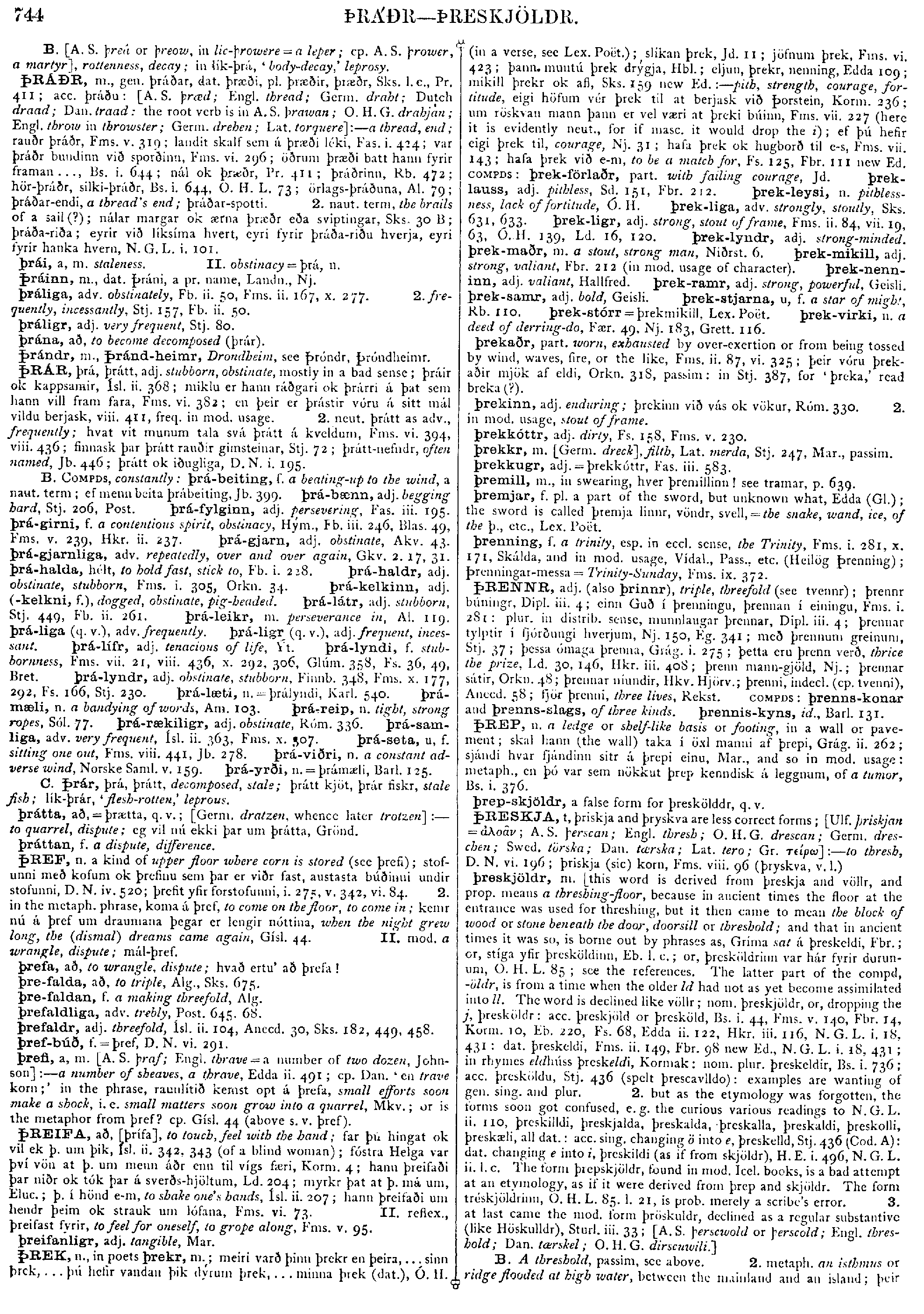
ÞRESKJA, t, þriskja and þryskva are less correct forms; [Ulf. þriskjan = GREEK; A.S. þerscan; Engl. thresh; O.H.G. drescan; Germ. dreschen; Swed. törska; Dan. tærska; Lat. tero; Gr. GREEK] :-- to thresh, D.N. vi. 196; þriskja (sic) korn, Fms. viii. 96 (þryskva, v.l.)
|
Source: Cleasby/Vigfusson, page b0745, entry 44 View original page image as: [TIFF] [PNG] [View previous entry] [View next entry] |
[Comment on this entry] [View comments] |
The following entry has been hand-corrected once. |
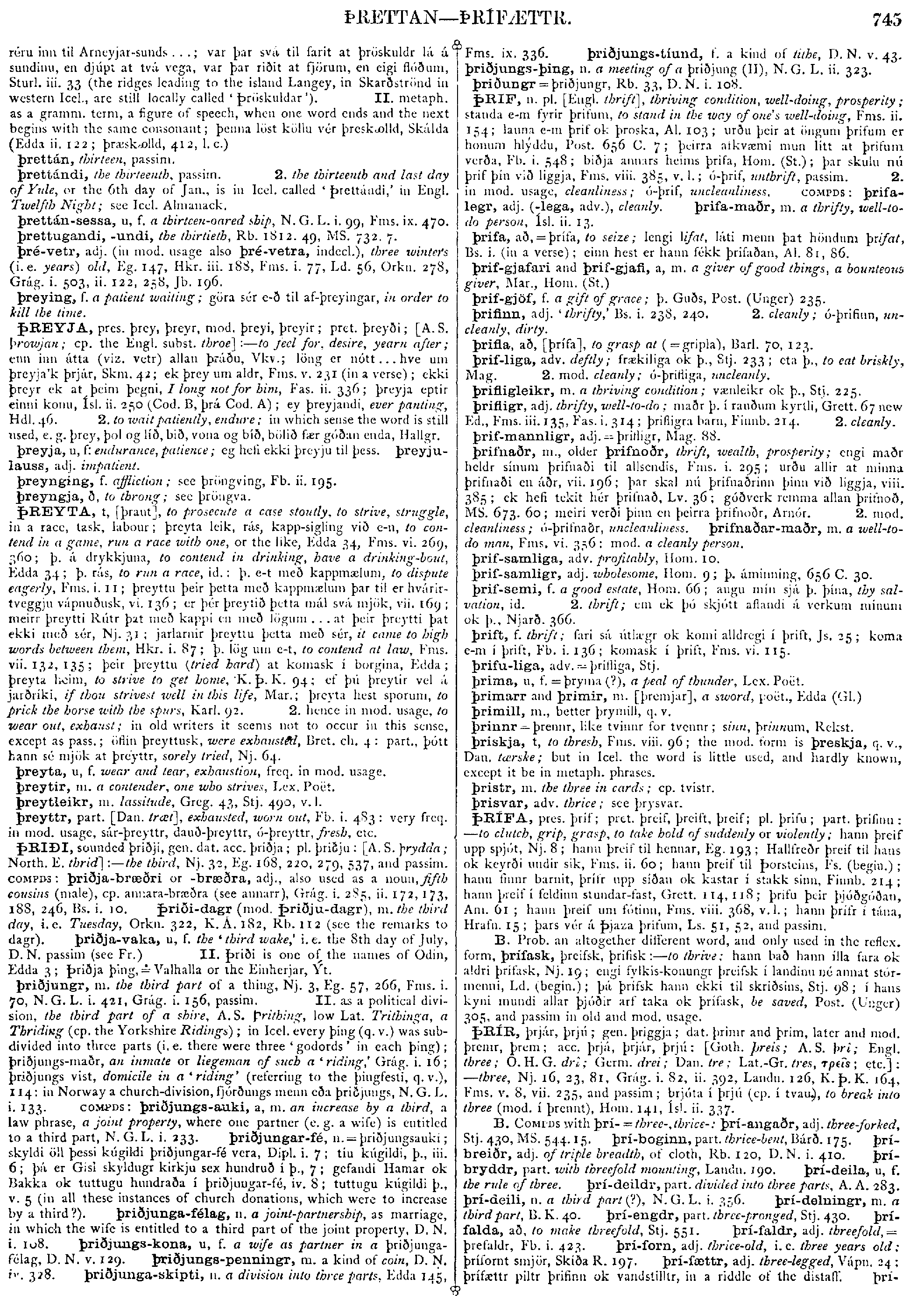
ÞRÍR, þrjár, þrjú; gen. þriggja; dat. þrimr and þrim, later and mod. þremr, þrem; acc. þrjá, þrjár, þrjú: [Goth. þreis; A.S. þrî; Engl. three; O.H.G. drî; Germ. drei; Dan. tre; Lat.-Gr. tres, GREEK; etc.] :-- three, Nj. 16, 23, 81, Grág. i. 82, ii. 392, Landn. 126, K.Þ.K. 164, Fms. v. 8, vii. 235, and passim; brjóta í þrjú (cp. í tvau), to break into three (mod. í þrennt), Hom. 141, Ísl. ii. 337. B. COMPDS with þrí- = three-, thrice-: þrí-angaðr, adj. three-forked, Stj. 430, MS. 544. 15. þrí-boginn, part. thrice-bent, Bárð. 175. þrí-breiðr, adj. of triple breadth, of cloth, Rb. 120, D.N. i. 410. þrí-bryddr, part. with threefold mounting, Landn. 190. þrí-deila, u, f. the rule of three. þrí-deildr, part. divided into three parts, A.A. 283. þrí-deili, n. a third part(?), N.G.L. i. 356. þrí-delningr, m. a third part, B.K. 40. þrí-engdr, part. three-pronged, Stj. 430. þri-falda, að, to make threefold, Stj. 551. þrí-faldr, adj. threefold, = þrefaldr, Fb. i. 423. þrí-forn, adj. thrice-old, i.e. three years old; þrífornt smjör, Skíða R. 197. þrí-fættr, adj. three-legged, Vápn. 24; þrífættr piltr þrifinn ok vandstilltr, in a riddle of the distaff. þrí-
|
Source: Cleasby/Vigfusson, page b0747, entry 27 View original page image as: [TIFF] [PNG] [View previous entry] [View next entry] |
[Comment on this entry] [View comments] |
The following entry has been hand-corrected once. |
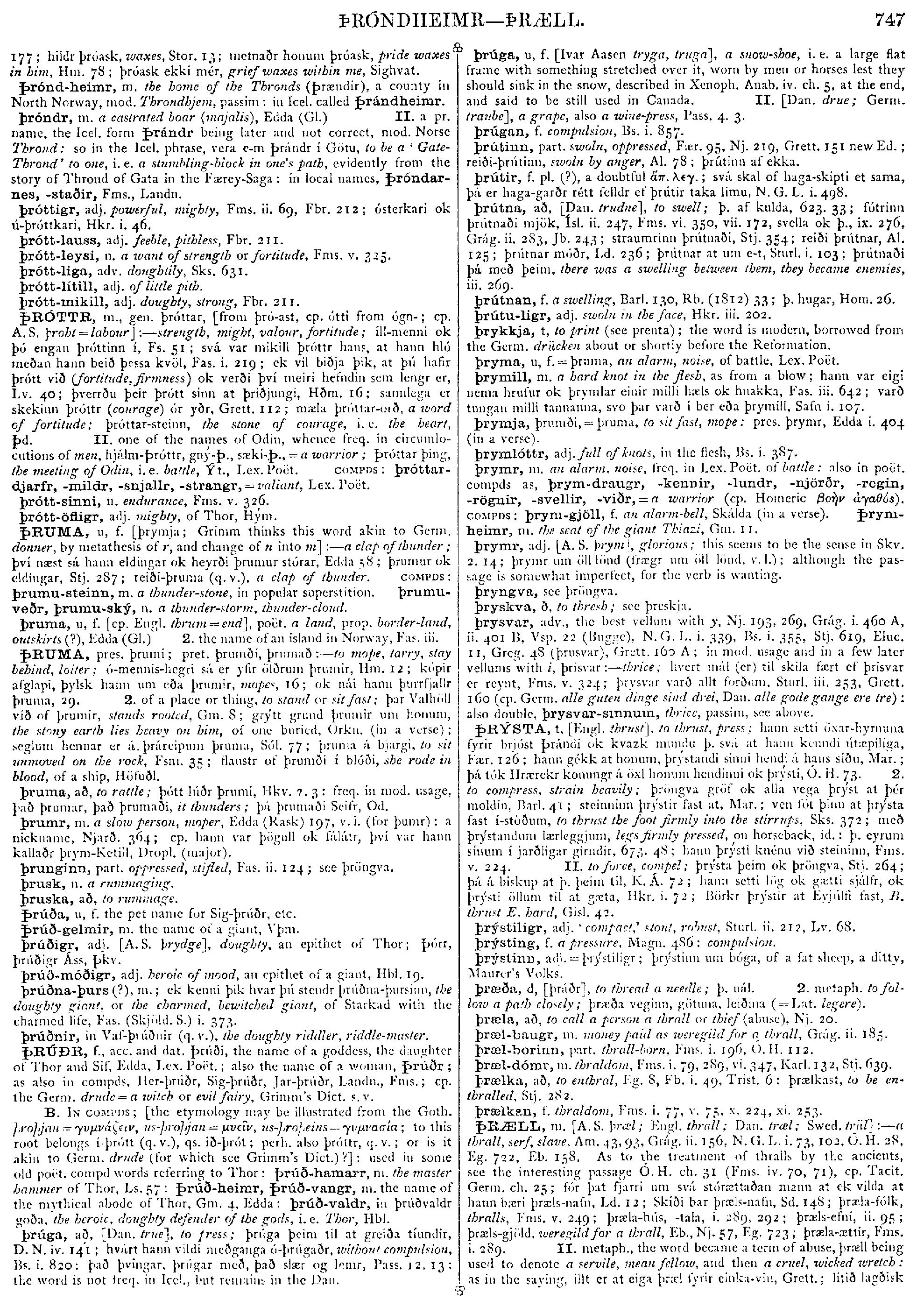
ÞRÚÐR, f., acc. and dat. Þrúði, the name of a goddess, the daughter of Thor and Sif, Edda, Lex. Poët.; also the name of a woman, Þrúðr; as also in compds, Her-þrúðr, Sig-þrúðr, Jar-þrúðr, Landn., Fms.; cp. the Germ. drude = a witch or evil fairy, Grimm's Dict. s.v. B. IN COMPDS; [the etymology may be illustrated from the Goth. þroþjan = GREEK, us-þroþjan = GREEK, us-þroþeins = GREEK; to this root belongs í-þrótt (q.v.), qs. ið-þrót; perh. also þróttr, q.v.; or is it akin to Germ. drude (for which see Grimm's Dict.)?]: used in some old poët. compd words referring to Thor: Þrúð-hamarr, m. the master hammer of Thor, Ls. 57: Þrúð-heimr, Þrúð-vangr, m. the name of the mythical abode of Thor, Gm. 4, Edda: þ;rúð-valdr, in þrúðvaldr goða, the heroic, doughty defender of the gods, i.e. Thor, Hbl.
|
Source: Cleasby/Vigfusson, page b0747, entry 32 View original page image as: [TIFF] [PNG] [View previous entry] [View next entry] |
[Comment on this entry] [View comments] |
The following entry has been hand-corrected once. |
þrútir, f. pl.(?), a doubtful GREEK; svá skal of haga-skipti et sama, þá er haga-garðr rétt felldr ef þrútir taka limu, N.G.L. i. 498.
|
Source: Cleasby/Vigfusson, page b0747, entry 41 View original page image as: [TIFF] [PNG] [View previous entry] [View next entry] |
[Comment on this entry] [View comments] |
The following entry has been hand-corrected once. |
þrymr, m. an alarm, noise, freq. in Lex. Poët, of battle: also in poët. compds as, þrym-draugr, -kennir, -lundr, -njörðr, -regin, -rögnir, -svellir, -viðr, = a warrior (cp. Homeric GREEK). COMPDS: þrym-gjöll, f. an alarm-bell, Skálda (in a verse). Þrym-heimr, m. the seat of the giant Thiazi, Gm. 11.
|
Source: Cleasby/Vigfusson, page b0748, entry 13 View original page image as: [TIFF] [PNG] [View previous entry] [View next entry] |
[Comment on this entry] [View comments] |
The following entry has been hand-corrected once. |
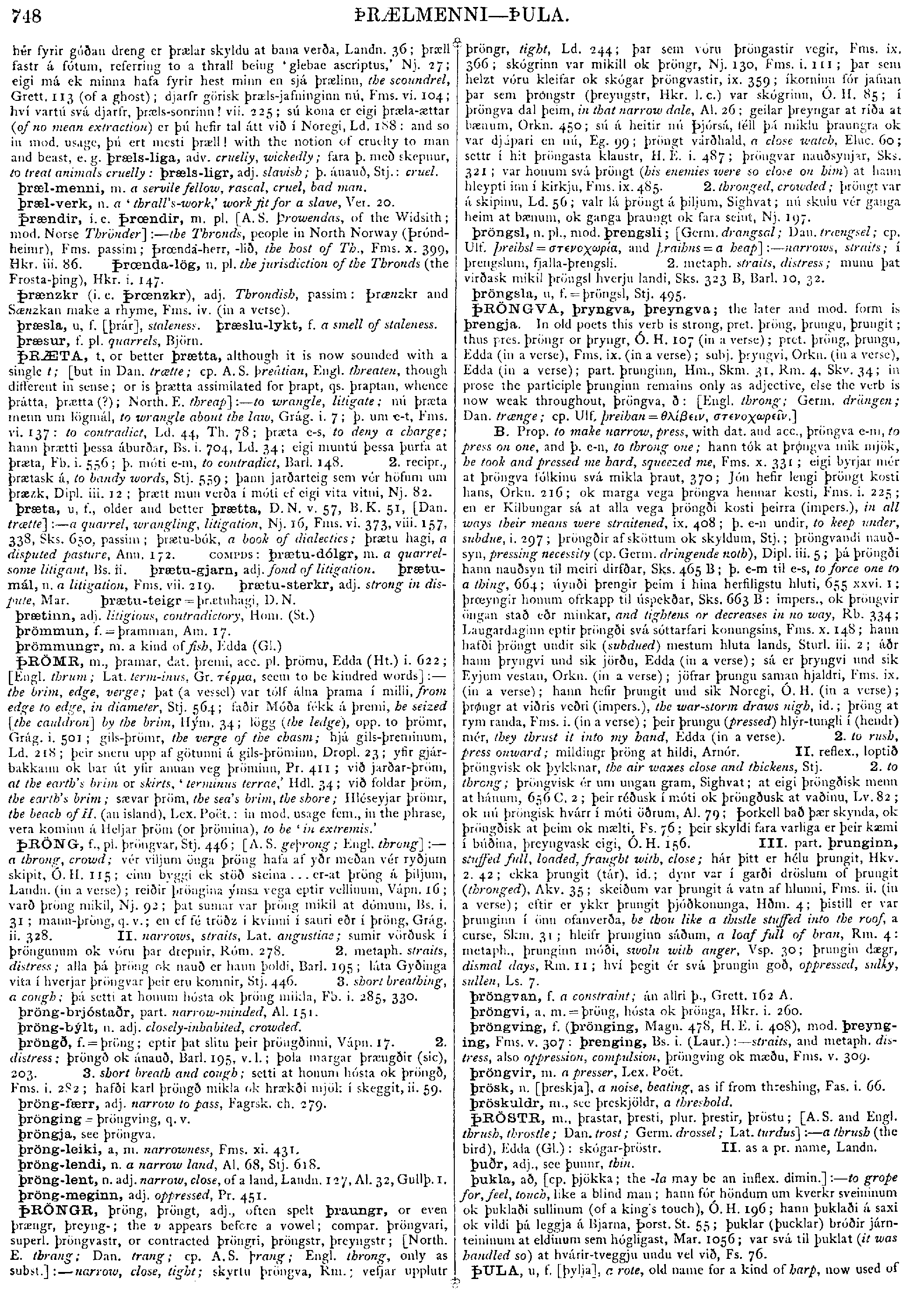
ÞRÖMR, m., þramar, dat. þremi, acc. pl. þrömu, Edda (Ht.) i. 622; [Engl. thrum; Lat. term-inus. Gr. GREEK, seem to be kindred words] :-- the brim, edge, verge; þat (a vessel) var tólf álna þrama í milli. from edge to edge, in diameter, Stj. 564; faðir Móða fékk á þremi, he seized [the cauldron] by the brim, Hým. 34; lögg (the ledge), opp. to þrömr, Grág. i. 501; gils-þrömr, the verge of the chasm; hjá gils-þreminum, Ld. 218; þeir sncru upp af götunni á gils-þröminn, Dropl. 23; yfir gjár-bakkann ok bar út yfir annan veg þröminn, Pr. 411; við jarðar-þröm, at the earth's brim or skirts, 'terminus terrae,' Hdl. 34; við foldar þröm, the earth's brim; sævar þröm, the sea's brim, the shore; Hléseyjar þrömr, the beach of H. (an island), Lex. Poët.: in mod. usage fem., in the phrase, vera kominn á Heljar þröm (or þrömina), to be 'in extremis.'
| Result Page: |  |
Previous | 142 143 144 145 146 147 148 149 150 151 152 153 154 155 156 | Next |  |
Germanic Lexicon Project (main page)
This search system was written by
Sean Crist
Please consider
volunteering
to correct the data in these online dictionaries.
No rights reserved. Feel free to use these data in any way you please.