|
|

|
Source: Bosworth/Toller, page b1032, entry 4 View original page image as: [TIFF] [PNG] [View previous entry] [View next entry] |
[Comment on this entry] [View comments] |
The following entry has been hand-corrected once. |
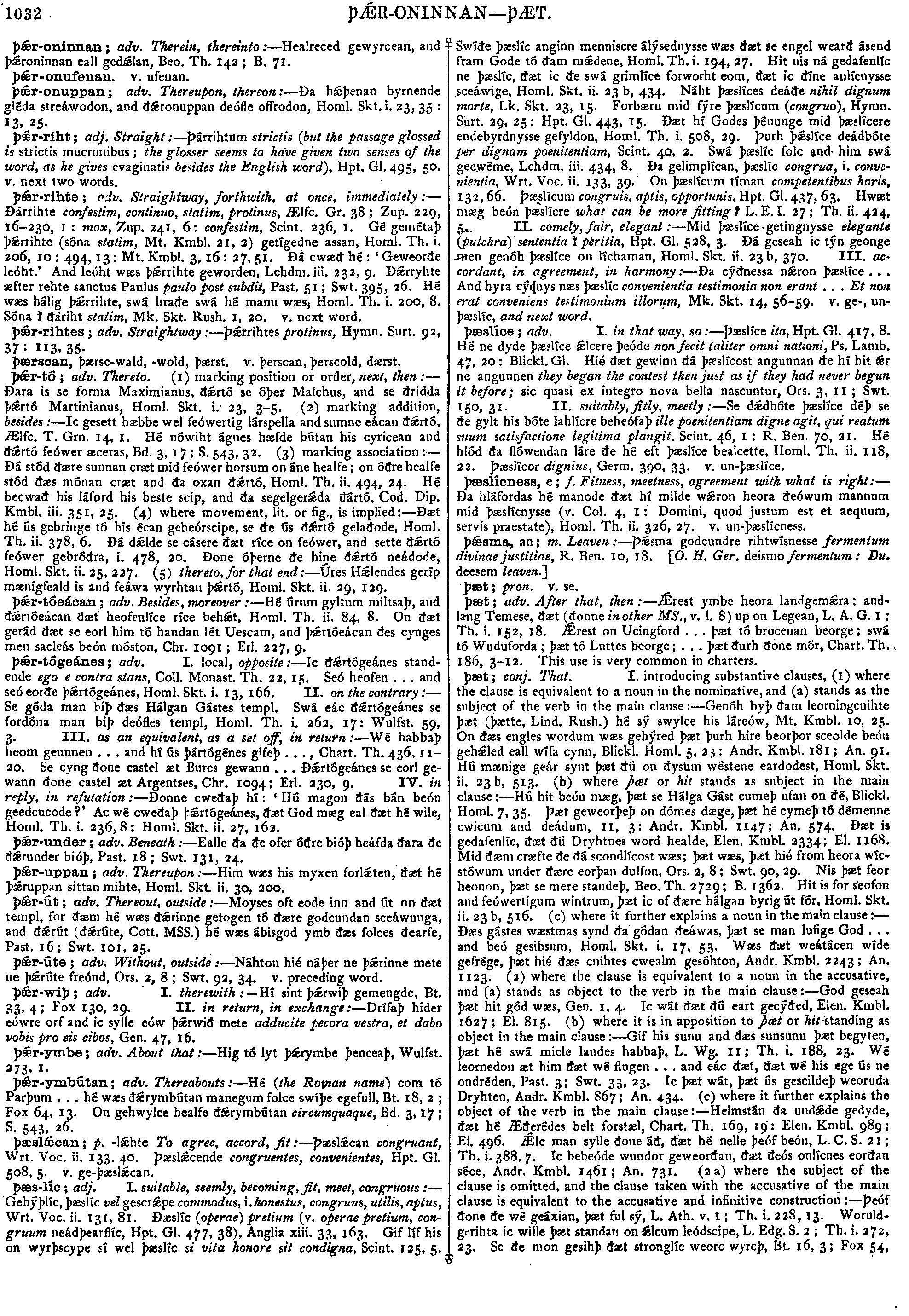
þ r-riht;
adj.
Straight
:--
Þárrihtum
strictis
(but
the
passage
glossed
is
strictis
mucronibus;
the
glosser
seems
to
have
given
two
senses
of
the
word,
as
he
gives
evaginatis
besides
the
English
word),
Hpt.
Gl.
495,
50.
v.
next
two
words.
r-riht;
adj.
Straight
:--
Þárrihtum
strictis
(but
the
passage
glossed
is
strictis
mucronibus;
the
glosser
seems
to
have
given
two
senses
of
the
word,
as
he
gives
evaginatis
besides
the
English
word),
Hpt.
Gl.
495,
50.
v.
next
two
words.
|
Source: Bosworth/Toller, page b1032, entry 18 View original page image as: [TIFF] [PNG] [View previous entry] [View next entry] |
[Comment on this entry] [View comments] |
The following entry has been hand-corrected once. |
þæslcan;
p.
-lhte
To
agree,
accord,
fit
:--
Þæslcan
congruant,
Wrt.
Voc.
ii.
133.
40.
Þæslcende
congruentes,
convenientes,
Hpt.
Gl.
508,
5.
v.
ge-þæslcan.
|
Source: Bosworth/Toller, page b1032, entry 19 View original page image as: [TIFF] [PNG] [View previous entry] [View next entry] |
[Comment on this entry] [View comments] |
The following entry has been hand-corrected once. |
þæs-líc;
adj.
I.
suitable,
seemly,
becoming,
fit,
meet,
congruous
:--
Gehýþlíc,
þæslíc
vel
gescrpe
commodus,
i.
honestus,
congruus,
utilis,
aptus,
Wrt.
Voc.
ii.
131,
81.
Ðæslíc
(operae)
pretium
(v.
operas
pretium,
congruum
neádþearflíc,
Hpt.
Gl.
477,
38),
Anglia
xiii.
33,
163.
Gif
líf
his
on
wyrþscype
sí
wel
þæslíc
si
vita
honore
sit
condigna,
Scint.
125,
5.
Swíde
þæslíc
anginn
menniscre
álýsednysse
wæs
ðæt
se
engel
wearð
ásend
fram
Gode
tó
ðam
mdene,
Homl.
Th.
i.
194,
27.
Hit
nis
ná
gedafenlíc
ne
þæslíc,
ðæt
ic
ðe
swá
grimlíce
forworht
eom,
ðæt
ic
ðíne
anlícnysse
sceáwige,
Homl.
Skt.
ii.
23
b,
434.
Náht
þæslíces
deáðe
nihil
dignum
morte,
Lk.
Skt.
23,
15.
Forbærn
mid
fýre
þæslícum
(congruo),
Hymn.
Surt.
29,
25
:
Hpt.
Gl.
443,
15.
Ðæt
hí
Godes
þénunge
mid
þæslícere
endebyrdnysse
gefyldon,
Homl.
Th.
i.
508,
29.
Þurh
þslíce
deádbóte
per
dignam
poenitentiam,
Scint.
40,
2.
Swá
þæslíc
folc
and
him
swá
gecwéme,
Lchdm.
iii.
434,
8.
Ða
gelimplícan,
þæslíc
congrua,
i.
convenientia,
Wrt.
Voc.
ii.
133,
39.
On
þæslícum
tíman
competentibus
horis,
132,
66.
Þæslícum
congruis,
aptis,
opportunis,
Hpt.
Gl.
437,
63.
Hwæt
mæg
beón
þæslícre
what
can
be
more
fitting?
L.
E.
I.
27;
Th.
ii.
424,
5.
II.
comely,
fair,
elegant
:--
Mid
þæslíce
getingnysse
elegante
(pulchra)
sententia
 peritia,
Hpt.
Gl.
528,
3.
Ðá
geseah
ic
týn
geonge
men
genóh
þæslíce
on
líchaman,
Homl.
Skt.
ii.
23
b,
370.
III.
accordant,
in
agreement,
in
harmony
:--
Ða
cýðnessa
nron
þæslíce
..
.
And
hyra
cýðnys
næs
þæslíc
convenientia
testimonia
non
erant
.
.
.
Et
non
erat
conveniens
testimonium
illorum,
Mk.
Skt.
14,
56-59.
v.
ge-,
unþæslíc,
and
next
word.
peritia,
Hpt.
Gl.
528,
3.
Ðá
geseah
ic
týn
geonge
men
genóh
þæslíce
on
líchaman,
Homl.
Skt.
ii.
23
b,
370.
III.
accordant,
in
agreement,
in
harmony
:--
Ða
cýðnessa
nron
þæslíce
..
.
And
hyra
cýðnys
næs
þæslíc
convenientia
testimonia
non
erant
.
.
.
Et
non
erat
conveniens
testimonium
illorum,
Mk.
Skt.
14,
56-59.
v.
ge-,
unþæslíc,
and
next
word.
|
Source: Bosworth/Toller, page b1032, entry 20 View original page image as: [TIFF] [PNG] [View previous entry] [View next entry] |
[Comment on this entry] [View comments] |
The following entry has been hand-corrected once. |
þæslíce;
adv.
I.
in
that
way,
so
:--
Þæslíce
ita,
Hpt.
Gl.
417,
8.
Hé
ne
dyde
þæslíce
lcere
þeóde
non
fecit
taliter
omni
nationi,
Ps.
Lamb.
47,
20
:
Blickl.
Gl.
Hié
ðæt
gewinn
ðá
þæslícost
angunnan
ðe
hí
hit
r
ne
angunnen
they
began
the
contest
then
just
as
if
they
had
never
begun
it
before;
sic
quasi
ex
integro
nova
bella
nascuntur,
Ors.
3,
11;
Swt.
150,
31.
II.
suitably,
fitly,
meetly
:--
Se
ddbóte
þæslíce
déþ
se
ðe
gylt
his
bóte
lahlícre
beheófaþ
ille
poenitentiam
digne
agit,
qui
reatum
suum
satisfactione
legitima
plangit.
Scint.
46,
1
:
R.
Ben.
70,
21.
Hé
hlód
ða
flówendan
láre
ðe
hé
eft
þæslíce
bealcette,
Homl.
Th.
ii.
118,
22.
Þæslícor
dignius,
Germ.
390,
33.
v.
un-þæslíce.
|
Source: Bosworth/Toller, page b1036, entry 4 View original page image as: [TIFF] [PNG] [View previous entry] [View next entry] |
[Comment on this entry] [View comments] |
The following entry has been hand-corrected once. |
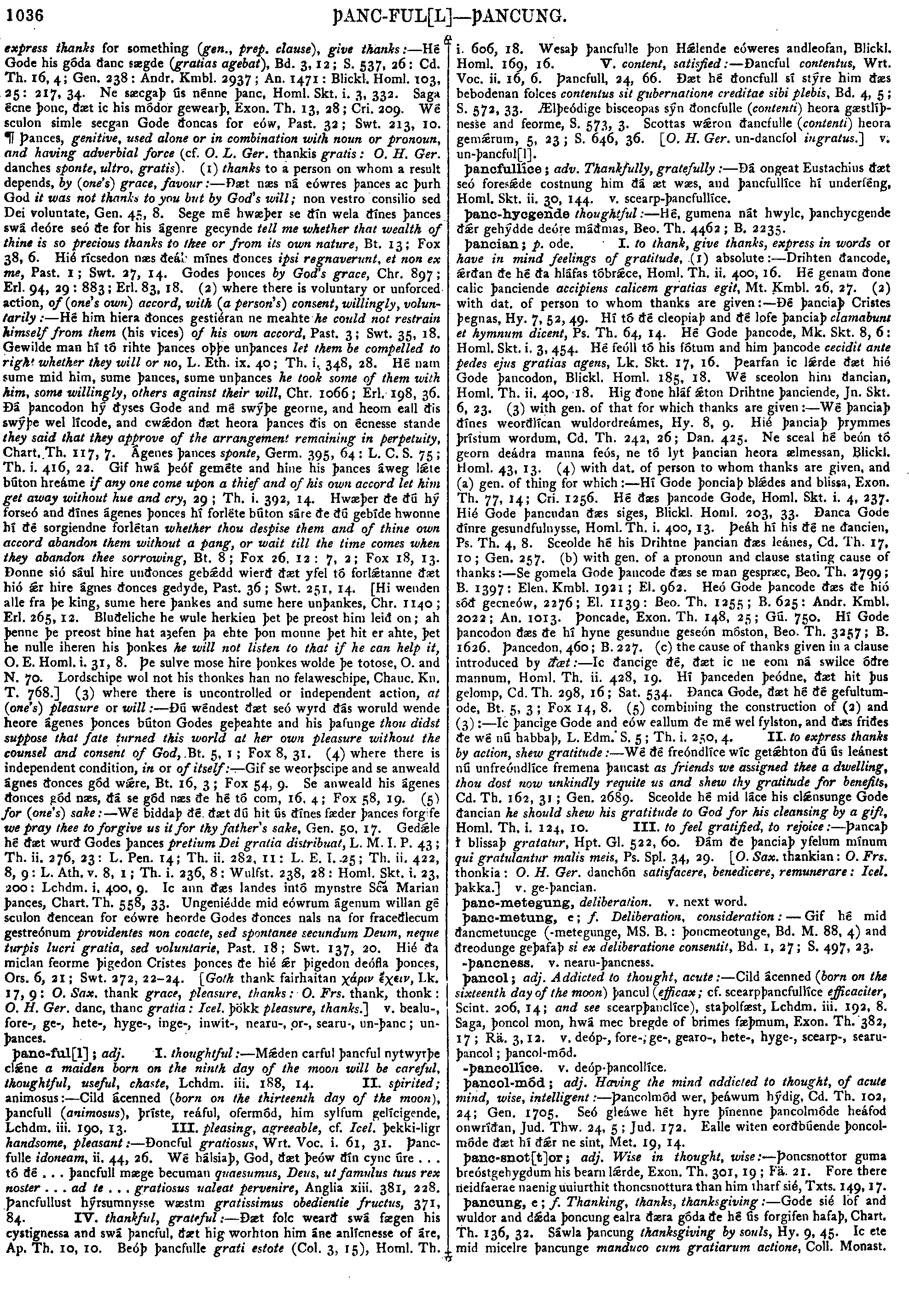
þancian;
p.
ode.
I.
to
thank,
give
thanks,
express
in
words
or
have
in
mind
feelings
of
gratitude,
(1)
absolute
:--
Drihten
ðancode,
rðan
ðe
hé
ða
hláfas
tóbrce,
Homl.
Th.
ii.
400,
16.
Hé
genam
ðone
calic
þanciende
accipiens
calicem
gratias
egit,
Mt.
Kmbl.
26,
27.
(2)
with
dat.
of
person
to
whom
thanks
are
given
:--
Ðé
þanciaþ
Cristes
þegnas,
Hy.
7,
52,
49.
Hí
tó
ðé
cleopiaþ
and
ðé
lofe
þanciaþ
clamabunt
et
hymnum
dicent,
Ps.
Th.
64,
14.
Hé
Gode
þancode,
Mk.
Skt.
8,
6:
Homl.
Skt.
i.
3,
454.
Hé
feóll
tó
his
fótum
and
him
þancode
cecidit
ante
pedes
ejus
gratias
agens,
Lk.
Skt.
17,
16.
Þearfan
ic
lrde
ðæt
hié
Gode
þancodon,
Blickl.
Homl.
185,
18.
Wé
sceolon
him
ðancian,
Homl.
Th.
ii.
400,
18.
Hig
ðone
hláf
ton
Drihtne
þanciende,
Jn.
Skt.
6,
23.
(3)
with
gen.
of
that
for
which
thanks
are
given
:--
Wé
þanciaþ
ðínes
weorðlícan
wuldordreámes,
Hy.
8,
9.
Hié
þanciaþ
þrymmes
þrístum
wordum,
Cd.
Th.
242,
26;
Dan.
425.
Ne
sceal
hé
beón
tó
georn
deádra
manna
feós,
ne
tó
lyt
þancian
heora
ælmessan,
Blickl.
Homl.
43,
13.
(4)
with
dat.
of
person
to
whom
thanks
are
given,
and
(a)
gen.
of
thing
for
which
:--
Hí
Gode
þonciaþ
bldes
and
blissa,
Exon.
Th.
77,
14;
Cri.
1256.
Hé
ðæs
þancode
Gode,
Homl.
Skt.
i.
4,
237.
Hié
Gode
þancudan
ðæs
siges,
Blickl.
Homl.
203,
33.
Ðanca
Gode
ðínre
gesundfulnysse,
Homl.
Th.
i.
400,
13.
Þeáh
hí
his
ðé
ne
ðancien,
Ps.
Th.
4,
8.
Sceolde
hé
his
Drihtne
þancian
ðæs
leánes,
Cd.
Th.
17,
10;
Gen.
257.
(b)
with
gen.
of
a
pronoun
and
clause
stating
cause
of
thanks
:--
Se
gomela
Gode
þancode
ðæs
se
man
gespræc,
Beo.
Th.
2799;
B.
1397:
Elen.
Kmbl.
1921;
El.
962.
Heó
Gode
þancode
ðæs
ðe
hió
sóð
gecneów,
2276;
El.
1139:
Beo.
Th.
1255;
B.
625:
Andr.
Kmbl.
2022;
An.
1013.
Þoncade,
Exon.
Th.
148,
25;
Gú.
750.
Hí
Gode
þancodon
ðæs
ðe
hí
hyne
gesundne
geseón
móston,
Beo.
Th.
3257;
B.
1626.
Þancedon,
460;
B.
227.
(c)
the
cause
of
thanks
given
in
a
clause
introduced
by
ðæt
:--
Ic
ðancige
ðé,
ðæt
ic
ne
eom
ná
swilce
óðre
magnum,
Homl.
Th.
ii.
428,
19.
Hí
þanceden
þeódne,
ðæt
hit
þus
gelomp,
Cd.
Th.
298,
16;
Sat.
534.
Ðanca
Gode,
ðæt
he
ðé
gefultumode,
Bt.
5,
3;
Fox
14,
8.
(5)
combining
the
construction
of
(2)
and
(3)
:--
Ic
þancige
Gode
and
eów
eallum
ðe
me
wel
fylston,
and
ðæs
friðes
ðe
wé
nú
habbaþ,
L.
Edm.
S.
5;
Th.
i.
250,
4.
II.
to
express
thanks
by
action,
shew
gratitude
:--
Wé
ðé
freóndlíce
wíc
gethton
ðú
ús
leánest
nú
unfreóndlíce
fremena
þancast
as
friends
we
assigned
thee
a
dwelling,
thou
dost
now
unkindly
requite
us
and
shew
thy
gratitude
for
benefits,
Cd.
Th.
162,
31;
Gen.
2689.
Sceolde
hé
mid
láce
his
clnsunge
Gode
ðancian
he
should
shew
his
gratitude
to
God
for
his
cleansing
by
a
gift,
Homl.
Th.
i.
124,
10.
III.
to
feel
gratified,
to
rejoice
:--
Þancaþ
blissaþ
gratatur,
Hpt.
Gl.
522,
60.
Ðám
ðe
þanciaþ
yfelum
mínum
qui
gratulantur
malis
meis,
Ps.
Spl.
34,
29.
[O.
Sax.
thankian:
O.
Frs.
thonkia:
O.
H.
Ger.
danchón
satisfacere,
benedicere,
remunerare:
Icel.
þakka.]
v.
ge-þancian.
|
Source: Bosworth/Toller, page b1037, entry 1 View original page image as: [TIFF] [PNG] [View previous entry] [View next entry] |
[Comment on this entry] [View comments (1)] |
The following entry has been hand-corrected once. |
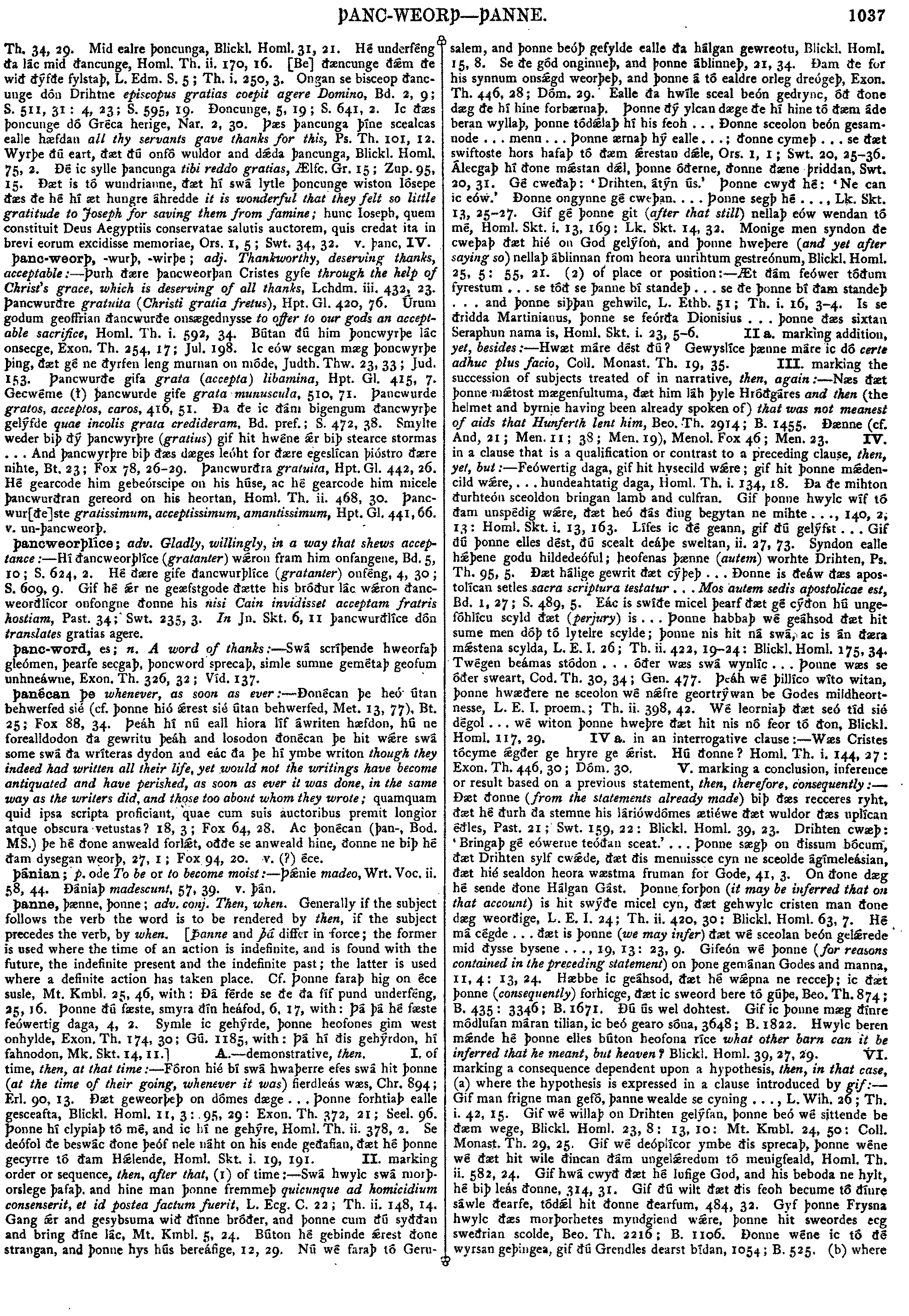
þanc-weorþ,
-wurþ,
-wirþe;
adj.
Thankworthy,
deserving
thanks,
acceptable
:--
Þurh
ðære
þancweorþan
Cristes
gyfe
through
the
help
of
Christ's
grace,
which
is
deserving
of
all
thanks,
Lchdm.
iii.
432,
23.
Þancwurðre
gratuita
(Christi
gratia
fretus),
Hpt.
Gl.
420,
76.
Úrum
godum
geoffrian
ðancwurðe
oatsægednysse
to
offer
to
our
gods
an
acceptable
sacrifice,
Homl.
Th.
i.
592,
34.
Bútan
ðú
him
þoncwyrþe
lác
onsecge,
Exon.
Th.
254,
17;
Jul.
198.
Ic
eów
secgan
mæg
þoncwyrþe
þing,
ðæt
gé
ne
ðyrfen
leng
murnan
on
móde,
Judth.
Thw.
23,
33;
Jud.
153.
Þancwurðe
gifa
grata
(accepta)
libamina,
Hpt.
Gl.
415,
7.
Gecwéme
()
þancwurde
gife
grata
munuscula,
510,
71.
Þancwurde
gratos,
acceptos,
caros,
416,
51.
Ða
ðe
ic
ðám
bigengum
ðancwyrþe
gelýfde
quae
incolis
grata
credideram,
Bd.
pref.;
S.
472,
38.
Smylte
weder
biþ
ðý
þancwyrþre
(gratius)
gif
hit
hwéne
r
biþ
stearce
stormas
...
And
þancwyrþre
biþ
ðæs
dæges
leóht
for
ðære
egeslícan
þióstro
ðære
nihte,
Bt.
23;
Fox
78,
26-29.
Þancwurðra
gratuita,
Hpt.
Gl.
442,
26.
Hé
gearcode
him
gebeótscipe
on
his
húse,
ac
hé
gearcode
him
micele
þancwurðran
gereord
on
his
heortan,
Homl.
Th.
ii.
468,
30.
Þancwur[ðe]ste
gratissimum,
acceptissimum,
amantissimum,
Hpt.
Gl.
441,
66.
v.
un-þancweorþ.
|
Source: Bosworth/Toller, page b1039, entry 3 View original page image as: [TIFF] [PNG] [View previous entry] [View next entry] |
[Comment on this entry] [View comments (1)] |
The following entry has been hand-corrected once. |
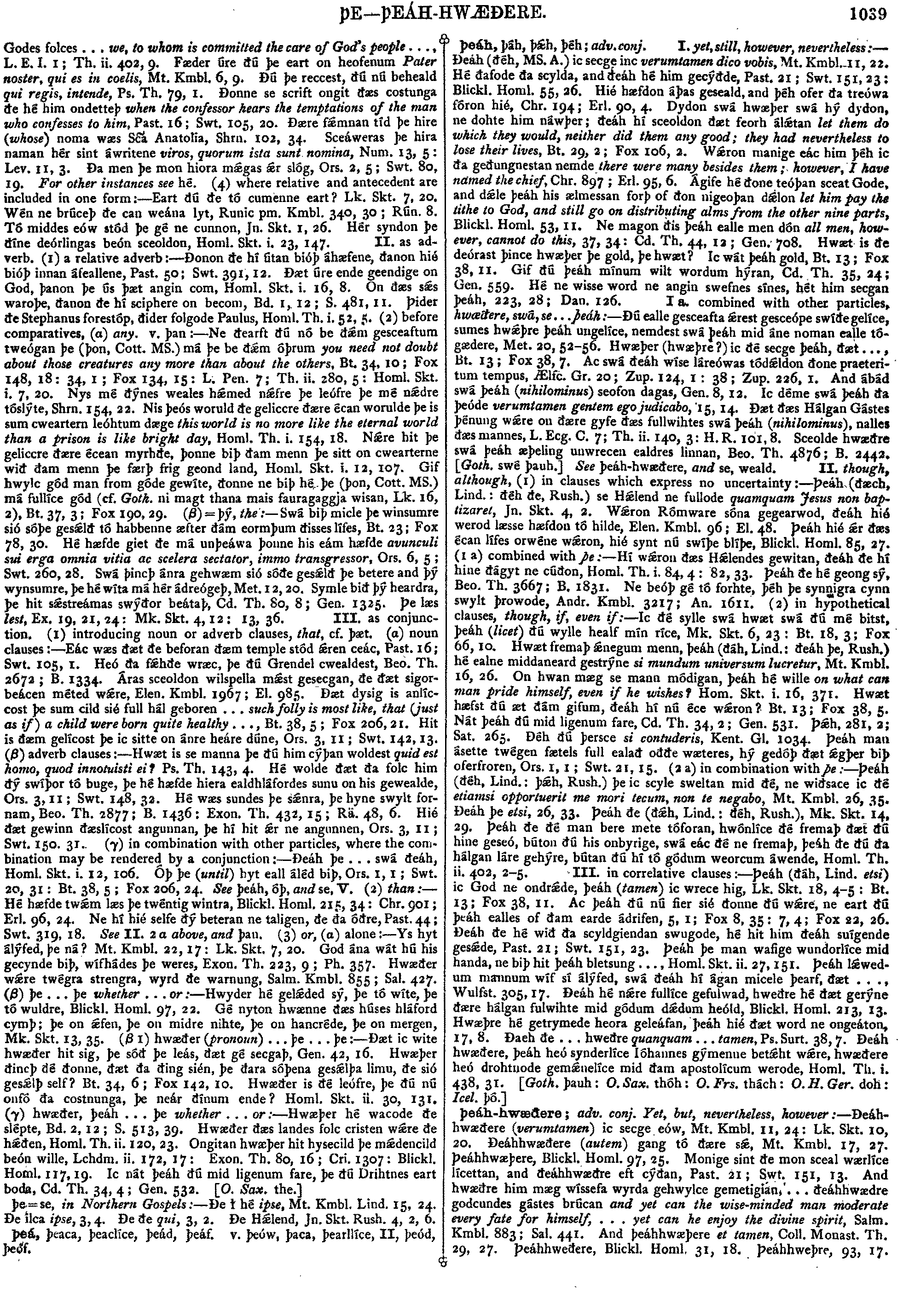
þeáh,
þáh,
þh,
þéh;
adv.conj.
I.
yet,
still,
however,
nevertheless
:--
Ðeáh
(ðéh,
MS.
A.)
ic
secge
inc
verumtamen
dico
vobis,
Mt.
Kmbl.
11,
22.
Hé
ðafode
ða
scylda,
and
ðeáh
hé
him
gecýðde,
Past.
21;
Swt.
151,
23:
Blickl.
Homl.
55,
26.
Hié
hæfdon
áþas
geseald,
and
þéh
ofer
ða
treówa
fóron
hié,
Chr.
194;
Erl.
90,
4.
Dydon
swá
hwæþer
swá
hý
dydon,
ne
dohte
him
náwþer;
ðeáh
hí
sceoldon
ðæt
feorh
áltan
let
them
do
which
they
would,
neither
did
them
any
good;
they
had
nevertheless
to
lose
their
lives,
Bt.
29,
2;
Fox
106,
2.
Wron
manige
eác
him
þéh
ic
ða
geðungnestan
nemde
there
were
many
besides
them;
however,
I
have
named
the
chief,
Chr.
897;
Erl.
95,
6.
Ágife
hé
ðone
teóþan
sceat
Gode,
and
dle
þeáh
his
ælmessan
forþ
of
ðon
nigeoþan
dlon
let
him
pay
the
tithe
to
God,
and
still
go
on
distributing
alms
from
the
other
nine
parts,
Blickl.
Homl.
53,
21.
Ne
magon
ðis
þeáh
ealle
men
dón
all
men,
however,
cannot
do
this,
37,
34:
Cd.
Th.
44,
12;
Gen.
708.
Hwæt
is
ðe
deórast
þince
hwæþer
þe
gold,
þe
hwæt?
Ic
wát
þeáh
gold,
Bt.
13;
Fox
38,
11.
Gif
ðú
þeáh
mínum
wilt
wordum
hýran,
Cd.
Th.
35,
24;
Gen.
559.
Hé
ne
wisse
word
ne
angin
swefnes
sínes,
hét
him
secgan
þeáh,
223,
28;
Dan.
126.
I
acombined
with
other
particles,
hwæðere,
swá,se
...
þeáh
:--
Ðú
ealle
gesceafta
rest
gesceópe
swíðe
gelíce,
sumes
hwþre
þeáh
ungelíce,
nemdest
swá
þeáh
mid
áne
noman
ealle
tógædere,
Met.
20,
52-56.
Hwæþer
(hwæþre?)
ic
ðé
secge
þeáh,
ðæt...,
Bt.
13;
Fox
38,
7.
Ac
swá
ðeáh
wíse
láreówas
tódldon
ðone
praeteritum
tempus,
Ælfc.
Gr.
20;
Zup.
124,
1:
38;
Zup.
226,
1.
And
ábád
swá
þeáh
(nihilominus)
seofon
dagas,
Gen.
8,
12.
Ic
déme
swá
þeáh
ða
þeóde
verumtamen
gentem
ego
judicabo,
15,
24.
Ðæt
ðæs
Hálgan
Gástes
þénung
wre
on
ðære
gyfe
ðæs
fullwihtes
swá
þeáh
(nihilominus),
nalles
ðæs
mannes,
L.
Ecg.
C.
7;
Th.
ii.
140,
3:
H.
R.
1010,
8.
Sceolde
hwæðre
swá
þeáh
æþeling
uuwrecen
ealdres
linnan,
Beo.
Th.
4876;
B.
2442.
[Goth.
swé
þauh.]
See
þeáh-hwæðere,
and
se,
weald.
II.
though,
although,
(1)
in
clauses
which
express
no
uncertainty
:--
Þeáh
(ðæch,
Lind.:
ðéh
ðe,
Rush.)
se
Hlend
ne
fullode
quamquam
Jesus
non
baptizaret,
Jn.
Skt.
4,
2.
Wron
Rómware
sóna
gegearwod,
ðeáh
hié
werod
læsse
hæfdon
tó
hilde,
Elen.
Kmbl.
96;
El.
48.
Þeáh
hié
r
ðæs
écan
lífes
orwéne
wron,
hié
synt
nú
swíþe
blíþe,
Blickl.
Homl.
85,
27.
(1
a)
combined
with
þe
:--
Hí
wron
ðæs
Hlendes
gewitan,
ðeáh
ðe
hí
hine
ðágyt
ne
cúðon,
Hornl.
Th.
i.
84,
4:
82,
33.
Þeáh
ðe
hé
geong
sý,
Beo.
Th.
3667;
B.
1831.
Ne
beóþ
gé
tó
forhte,
þéh
þe
synnnigra
cynn
swylt
þrowode,
Andr.
Kmbl.
3217;
An.
1611.
(2)
in
hypothetical
clauses,
though,
if,
even
if
:--
Ic
ðé
sylle
swá
hwæt
swá
ðú
mé
bitst,
þeáh
(licet)
ðú
wylle
healf
mín
ríce,
Mk.
Skt.
6,
23:
Bt.
18,
3;
Fox
66,
10.
Hwæt
fremaþ
negum
menn,
þeáh
(ðáh,
Lind.:
ðeáh
þe,
Rush.)
hé
ealne
middaneard
gestrýne
si
mundum
universum
lucretur,
Mt.
Kmbl.
16,
26.
On
hwan
mæg
se
mann
módigan,
þeáh
hé
wille
on
what
can
man
pride
himself,
even
if
he
wishes?
Hom.
Skt.
i.
16,
371.
Hwæt
hæfst
ðú
æt
ðám
gifum,
ðeáh
hí
nú
éce
wron?
Bt.
13;
Fox
38,
5.
Nát
þeáh
ðú
mid
ligenum
fare,
Cd.
Th.
34,
2;
Gen.
531.
Þh,
281,
2;
Sat.
265.
Ðéh
ðú
þersce
si
contuderis,
Kent.
Gl.
1034.
Þeáh
man
ásette
twégen
fætels
full
ealað
oððe
wæteres,
hý
gedóþ
ðæt
gþer
biþ
oferfroren,
Ors.
1,
1;
Swt.
21,
15.
(2
a)
in
combination
with
þe
:--
Þeáh
(ðéh,
Lind.:
þh,
Rush.)
þe
ic
scyle
sweltan
mid
ðé,
ne
wiðsace
ic
ðé
etiamsi
opportuerit
me
mori
tecum,
non
te
negabo,
Mt.
Kmbl.
26,
35.
Ðeáh
þe
etsi,
26,
33.
Þeáh
ðe
(ðh,
Lind.:
ðéh,
Rush.),
Mk.
Skt.
14,
29.
Þeáh
ðe
ðé
man
bere
mete
tóforan,
hwónlíce
ðé
fremaþ
ðæt
ðú
hine
geseó,
búton
ðú
his
onbyrige,
swá
eác
ðé
ne
fremaþ,
þeáh
ðe
ðú
ða
hálgan
láre
gehýre,
bútan
ðú
hí
tó
gódum
weorcum
áwende,
Homl.
Th.
ii.
402,
2-5.
III.
in
correlative
clauses
:--
Þeáh
(ðáh,
Lind.
etsi)
ic
God
ne
ondrde,
þeáh
(tamen)
ic
wrece
hig,
Lk.
Skt.
18,
4-5:
Bt.
13;
Fox
38,
11.
Ac
þeáh
ðú
nú
fier
sié
ðonne
ðú
wre,
ne
eart
ðú
þeáh
ealles
of
ðam
earde
ádrifen,
5,
1;
Fox
8,
35:
7,
4;
Fox
22,
26.
Ðeáh
ðe
hé
wið
ða
scyldgiendan
swugode,
hé
hit
him
ðeáh
suígende
gesde,
Past.
21;
Swt.
151,
23.
Þeáh
þe
man
wafige
wundorlíce
mid
handa,
ne
biþ
hit
þeáh
bletsung...,
Homl.
Skt.
ii.
27,
151.
Þeáh
lwedum
mannum
wíf
sí
álýfed,
swá
ðeáh
hí
ágan
micele
þearf,
ðæt...,
Wulfst.
305,
17.
Ðeáh
hé
nre
fullíce
gefulwad,
hweðre
hé
ðæt
gerýne
ðære
hálgan
fulwihte
mid
gódum
ddum
heóld,
Blickl.
Homl.
213,
13.
Hwæþre
hé
getrymede
heora
geleáfan,
þeáh
hié
ðæt
word
ne
ongeáton,
17,
8.
Ðaeh
ðe
...
hweðre
quanquam
...
tamen,
Ps.
Surt.
38,
7.
Ðeáh
hwæðere,
þeáh
heó
synderlíce
Ióhannes
gýmenne
betht
wre,
hwæðere
heó
drohtnode
gemnelíce
mid
ðam
apostolícum
werode,
Homl.
Th.
i.
438,
31.
[Goth.
þauh:
O.
Sax.
thóh:
O.
Frs.
thách:
O.
H.
Ger.
doh:
Icel.
þó.]
|
Source: Bosworth/Toller, page b1041, entry 2 View original page image as: [TIFF] [PNG] [View previous entry] [View next entry] |
[Comment on this entry] [View comments] |
The following entry has been hand-corrected once. |
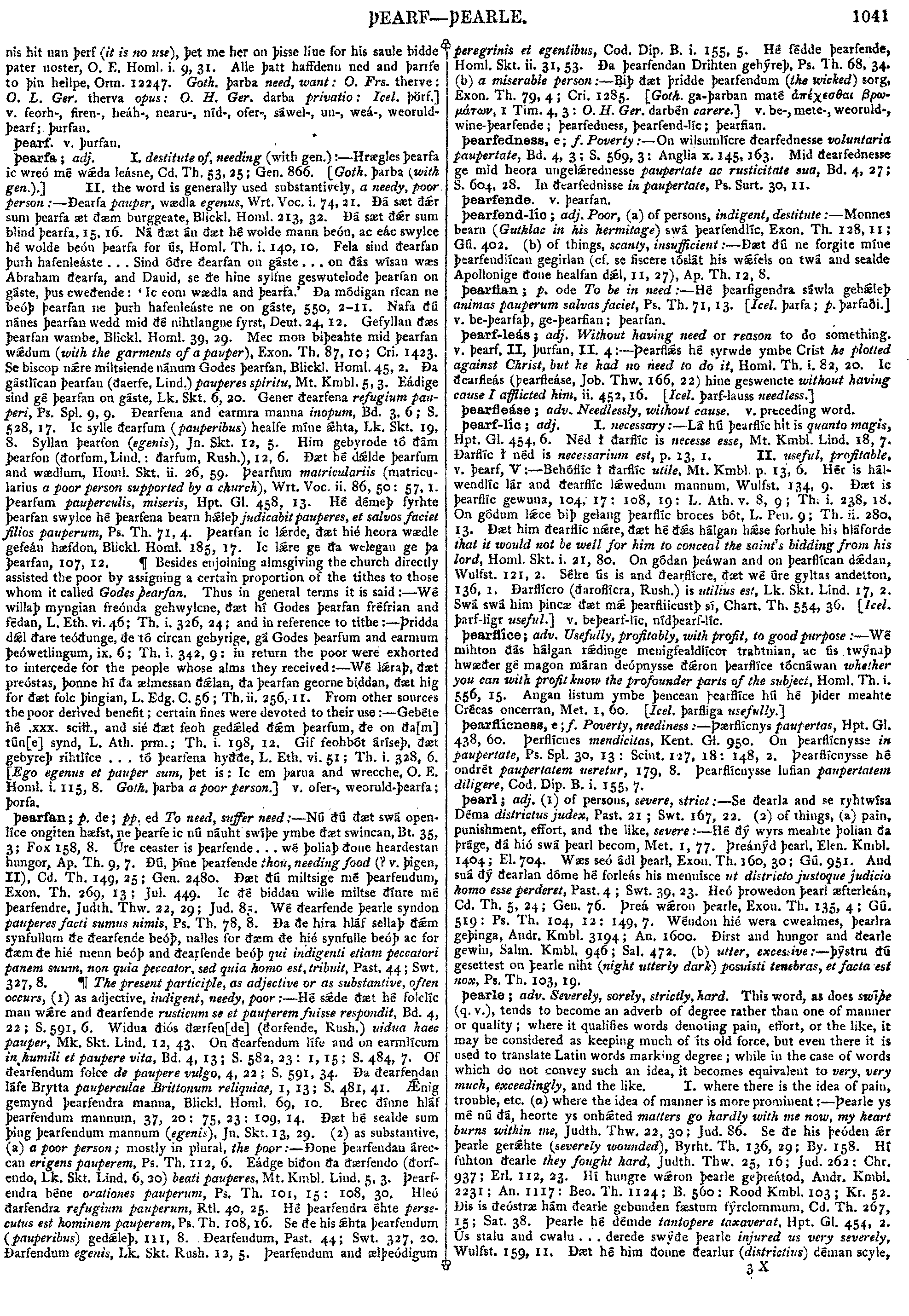
þearfa;
adj.
I.
destitute
of,
needing
(with
gen.)
:--
Hrægles
þearfa
ic
wreó
mé
wda
leásne,
Cd.
Th.
53,
25;
Gen.
866.
[Goth.
þarba
(with
gen.).]
II.
the
word
is
generally
used
substantively,
a
needy,
poor
person
:--
Ðearfa
pauper,
wædla
egenus,
Wrt.
Voc.
i.
74,
21.
Ðá
sæt
ðr
sum
þearfa
æt
ðæm
burggeate,
Blickl.
Homl.
213,
32.
Ðá
sæt
ðr
sum
blind
þearfa,
15,
16.
Ná
ðæt
án
ðæt
hé
wolde
mann
beón,
ac
eác
swylce
hé
wolde
beón
þearfa
for
ús,
Homl.
Th.
i.
140,
10.
Fela
sind
ðearfan
þurh
hafenleáste
...
Sind
óðre
ðearfan
on
gáste
...
on
ðás
wísan
wæs
Abraham
ðearfa,
and
Dauid,
se
ðe
hine
sylfne
geswutelode
þearfan
on
gáste,
þus
cweðende:
'Ic
eom
wædla
and
þearfa.'
Ða
módigan
rícan
ne
beóþ
þearfan
ne
þurh
hafenleáste
ne
on
gáste,
550,
2-11.
Nafa
ðú
nánes
þearfan
wedd
mid
ðé
nihtlangne
fyrst,
Deut.
24,
12.
Gefyllan
ðæs
þearfan
wambe,
Blickl.
Homl.
39,
29.
Mec
mon
biþeahte
mid
þearfan
wdum
(with
the
garments
of
a
pauper),
Exon.
Th.
87,
10;
Cri.
1423.
Se
biscop
nre
miltsiende
nánum
Godes
þearfan,
Blickl.
Homl.
45,
2.
Ða
gástlícan
þearfan
(ðaerfe,
Lind.)
pauperes
spiritu,
Mt.
Kmbl.
5,
3.
Eádige
sind
gé
þearfan
on
gáste,
Lk.
Skt.
6,
20.
Gener
ðearfena
refugium
pauperi,
Ps.
Spl.
9,
9.
Ðearfena
and
earmra
manna
inopum,
Bd.
3,
6;
S.
528,
17.
Ic
sylle
ðearfum
(pauperibus)
healfe
míne
hta,
Lk.
Skt.
19,
8.
Syllan
þearfon
(egenis),
Jn.
Skt.
12,
5.
Him
gebyrode
tó
ðám
þearfon
(ðorfum,
Lind.:
ðarfum,
Rush.),
12,
6.
Ðæt
hé
dlde
þearfum
and
wædlum,
Homl.
Skt.
ii.
26,
59.
Þearfum
matriculariis
(matricularius
a
poor
person
supported
by
a
church),
Wrt.
Voc.
ii.
86,
50:
57,
1.
Þearfum
pauperculis,
miseris,
Hpt.
Gl.
458,
13.
Hé
démeþ
fyrhte
þearfan
swylce
hé
þearfena
bearn
hleþ
judicabit
pauperes,
et
salvos
faciet
filios
pauperum,
Ps.
Th.
71,
4.
Þearfan
ic
lrde,
ðæt
hié
heora
wædle
gefeán
hæfdon,
Blickl.
Homl.
185,
17.
Ic
lre
ge
ða
welegan
ge
þa
þearfan,
107,
12.

Besides
enjoining
almsgiving
the
church
directly
assisted
the
poor
by
assigning
a
certain
proportion
of
the
tithes
to
those
whom
it
called
Godes
þearfan.
Thus
in
general
terms
it
is
said
:--
Wé
willaþ
myngian
freónda
gehwylcne,
ðæt
hí
Godes
þearfan
fréfrian
and
fédan,
L.
Eth.
vi.
46;
Th.
i.
326,
24;
and
in
reference
to
tithe
:--
Þridda
dl
ðare
teóðunge,
ðe
tó
circan
gebyrige,
gá
Godes
þearfum
and
earmum
þeówetlingum,
ix.
6;
Th.
i.
342,
9:
in
return
the
poor
were
exhorted
to
intercede
for
the
people
whose
alms
they
received
:--
Wé
lraþ,
ðæt
preóstas,
þonne
hí
ða
ælmessan
ðlan,
ða
þearfan
georne
biddan,
ðæt
hig
for
ðæt
folc
þingian,
L.
Edg.
C.
56;
Th.
ii.
256,
11.
From
other
sources
the
poor
derived
benefit;
certain
fines
were
devoted
to
their
use
:--
Gebéte
hé
.xxx.
sci.,
and
sié
ðæt
feoh
gedled
ðm
þearfum,
ðe
on
ða[m]
tún[e]
synd,
L.
Ath.
prm.;
Th.
i.
198,
12.
Gif
feohbót
áríseþ,
ðæt
gebyreþ
rihtlíce
...
tó
þearfena
hyððe,
L.
Eth.
vi.
51
;
Th.
i.
328,
6.
[Ego
egenus
et
pauper
sum,
þet
is:
Ic
em
þarna
and
wrecche,
O.
E.
Homl.
i.
115,
8.
Goth.
þarba
a
poor
person.]
v.
ofer-,
weoruld-þearfa;
þorfa.
|
Source: Bosworth/Toller, page b1041, entry 10 View original page image as: [TIFF] [PNG] [View previous entry] [View next entry] |
[Comment on this entry] [View comments] |
The following entry has been hand-corrected once. |
þearf-líc;
adj.
I.
necessary
:--
Lá
hú
þearflíc
hit
is
quanto
magis,
Hpt.
Gl.
454,
6.
Néd
ðarflíc
is
necesse
esse,
Mt.
Kmbl.
Lind.
18,
7.
Ðarflíc
néd
is
necessarium
est,
p.
13,
1.
II.
useful,
profitable,
v.
þearf,
V
:--
Behóflíc
ðarflíc
utile,
Mt.
Kmbl.
p.
13,
6.
Hér
is
hálwendlíc
lár
and
ðearflíc
lwedum
mannum,
Wulfst.
134,
9.
Ðæt
is
þearflíc
gewuna,
104;
17:
108,
19:
L.
Ath.
v.
8,
9;
Th.
i.
238,
18.
On
gódum
lce
biþ
gelang
þearflíc
broces
bót,
L.
Pen.
9;
Th.
ii.
280,
13.
Ðæt
him
ðearflíc
nre,
ðæt
hé
ðs
hálgan
hse
forhule
his
hláforde
that
it
would
not
be
well
for
him
to
conceal
the
saint's
bidding
from
his
lord,
Homl.
Skt.
i.
21,
80.
On
gódan
þeáwan
and
on
þearflícan
ddan,
Wulfst.
121,
2.
Sélre
ús
is
and
ðearflícre,
ðæt
wé
úre
gyltas
andetton,
136,
1.
Ðarflícro
(ðaroflícra,
Rush.)
is
utilius
est,
Lk.
Skt.
Lind.
17,
2.
Swá
swá
him
þincæ
ðæt
m
þearfliicustþ
sí,
Chart.
Th.
554,
36.
[Icel.
þarf-ligr
useful.]
v.
beþearf-líc,
nídþearf-líc.
|
Source: Bosworth/Toller, page b1041, entry 12 View original page image as: [TIFF] [PNG] [View previous entry] [View next entry] |
[Comment on this entry] [View comments] |
The following entry has been hand-corrected once. |
þearflícness, e; f. Poverty, neediness :-- Þærflícnys paupertas, Hpt. Gl. 438, 60. Þerflícnes mendicitas, Kent. Gl. 950. On þearflícnysse in paupertate, Ps. Spl. 30, 13: Scint. 127, 18: 148, 2. Þearflícnysse hé ondrét paupertatem ueretur, 179, 8. Þearflícnysse lufian paupertatem diligere, Cod. Dip. B. i. 155, 7.
| Result Page: |  |
Previous | 256 257 258 259 260 261 262 263 264 265 266 267 268 269 270 271 272 273 274 | Next |  |
Germanic Lexicon Project (main page)
This search system was written by
Sean Crist
Please consider
volunteering
to correct the data in these online dictionaries.
No rights reserved. Feel free to use these data in any way you please.