|
|

|
Source: Cleasby/Vigfusson, page b0396, entry 8 View original page image as: [TIFF] [PNG] [View previous entry] [View next entry] |
[Comment on this entry] [View comments] |
The following entry has been hand-corrected once. |
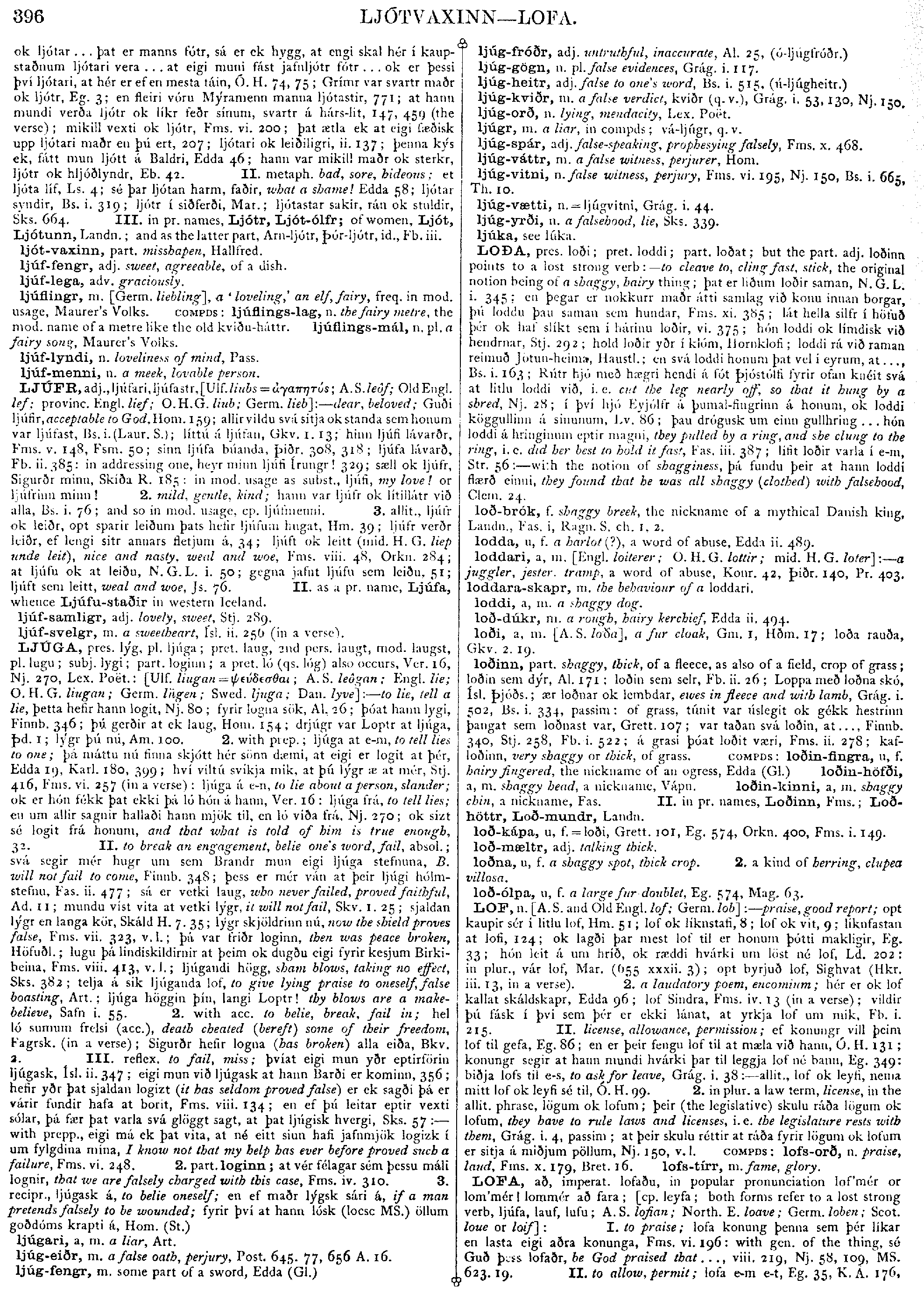
LJÚFR, adj., ljúíari, ljúfastr. [Ulf. liubs = GREEK; A.S. leôf; Old Engl. lef; provinc. Engl. lief; O.H.G. liub; Germ. lieb] :-- dear, beloved; Guði ljúfir, acceptable to God, Hom. 159; allir vildu svá sitja ok standa sem honum var ljúfast, Bs. i. (Laur. S.); líttú á ljúfan, Gkv. 1. 13; hinn ljúfi lávarðr, Fms. v. 148, Fsm. 50; sinn ljúfa búanda, Þiðr. 308, 318; ljúfa lávarð, Fb. ii. 385: in addressing one, heyr minn ljúfi Írungr! 329; sæll ok ljúfr, Sigurðr minn, Skíða R. 185: in mod. usage as subst., ljúfi, my love! or ljúfrinn minn! 2. mild, gentle, kind; hann var ljúfr ok lítillátr við alla, Bs. i. 76; and so in mod. usage, cp. ljúfmenni. 3. allit., ljúfr ok leiðr, opt sparir leiðum þats heftr ljúfum hugat, Hm. 39; ljúfr verðr leiðr, ef lengi sitr annars fletjum á, 34; ljúft ok leitt (mid.H.G. liep unde leit), nice and nasty, weal and woe, Fms. viii. 48, Orkn. 284; at ljúfu ok at leiðu, N.G.L. i. 50; gegna jafnt ljúfu sem leiðu, 51; ljúft sem leitt, weal and woe, Js. 76. II. as a pr. name, Ljúfa, whence Ljúfu-staðir in western Iceland.
|
Source: Cleasby/Vigfusson, page b0404, entry 14 View original page image as: [TIFF] [PNG] [View previous entry] [View next entry] |
[Comment on this entry] [View comments] |
The following entry has been hand-corrected once. |
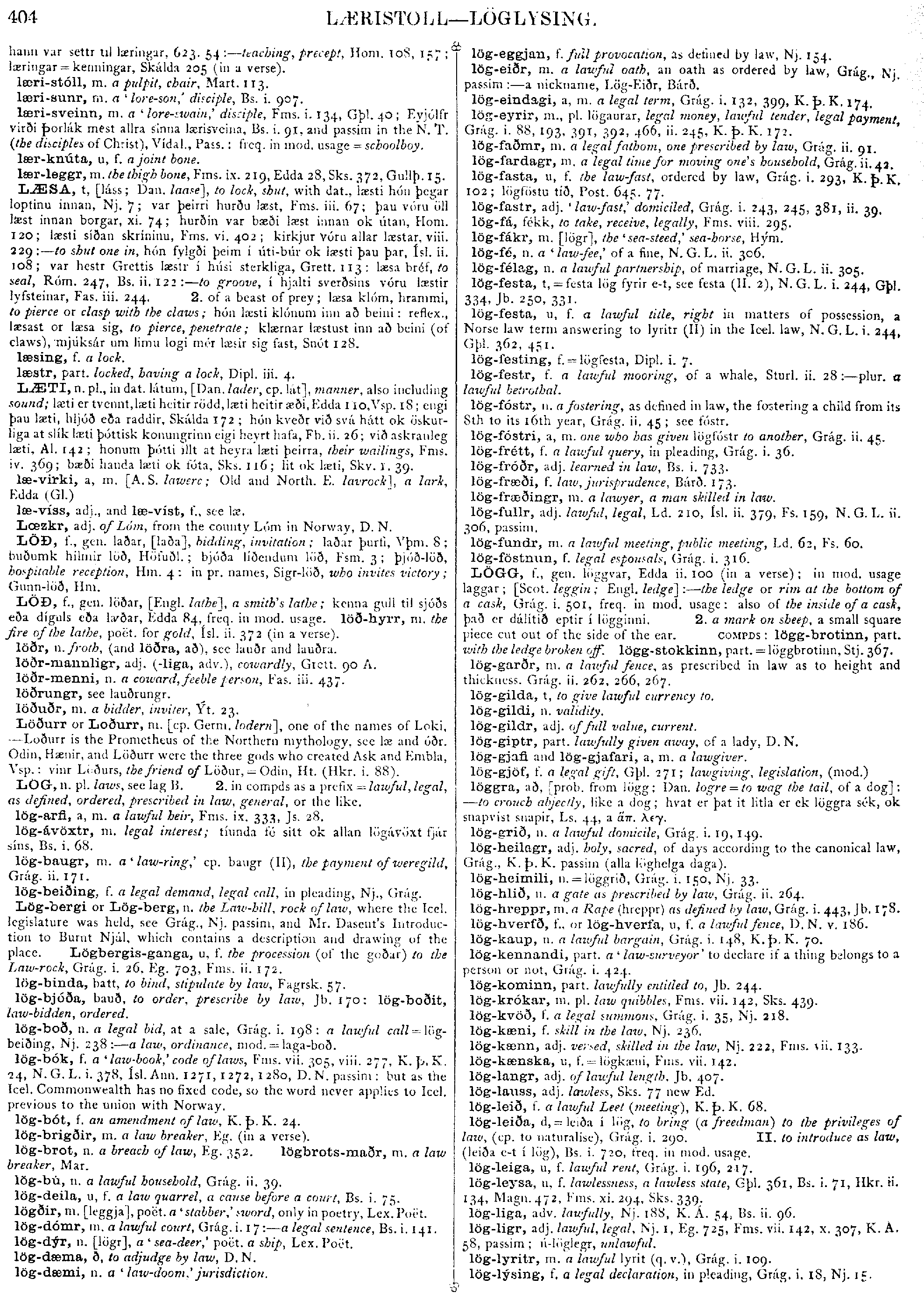
LÖÐ, f., gen. laðar, [laða], bidding, invitation; laðar þurfi, Vþm. 8; buðumk hilmir löð, Höfuðl.; bjóða líðendum löð, Fsm. 3; þjóð-löð, hospitable reception, Hm. 4: in pr. names, Sigr-löð, who invites victory; Gunn-löð, Hm.
|
Source: Cleasby/Vigfusson, page b0424, entry 5 View original page image as: [TIFF] [PNG] [View previous entry] [View next entry] |
[Comment on this entry] [View comments] |
The following entry has been hand-corrected once. |
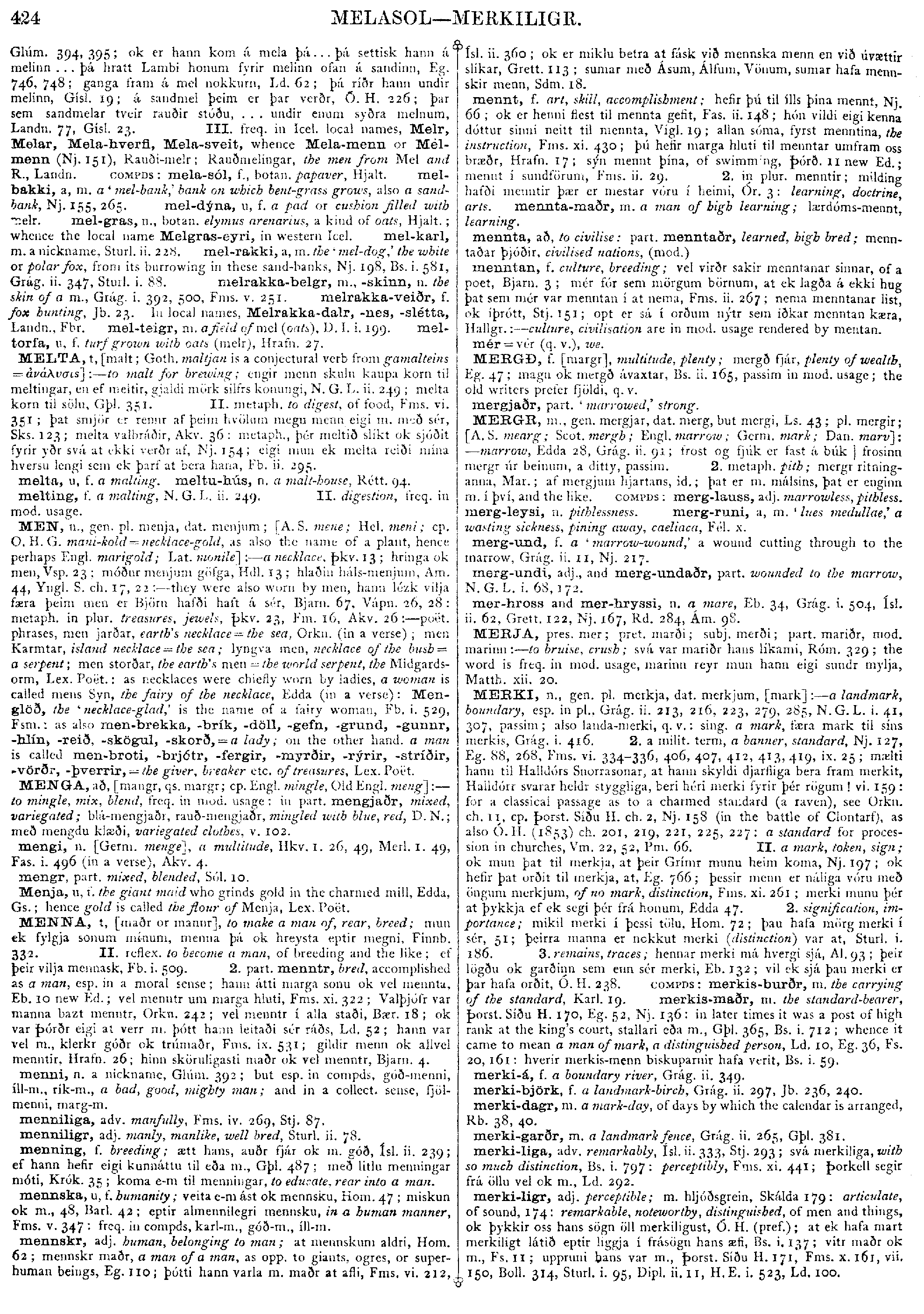
MEN, n., gen. pl. menja, dat. menjum; [A.S. mene; Hel. meni; cp. O.H.G. mani-kold = necklace-gold, as also the name of a plant, hence perhaps Engl. marigold; Lat. monile] :-- a necklace, Þkv. 13; hringa ok men, Vsp. 23; móður menjum göfga, Hdl. 13; hlaðin háls-menjum, Am. 44, Yngl. S. ch. 17, 22 :-- they were also worn by men, hann lézk vilja færa þeim men er Björn hafði haft á sér, Bjarn. 67, Vápn. 26, 28: metaph. in plur. treasures, jewels, Þkv. 23, Fm. 16, Akv. 26 :-- poët, phrases, men jarðar, earth's necklace = the sea, Orkn. (in a verse); men Karmtar, island necklace = the sea; lyngva men, necklace of the bush = a serpent; men storðar, the earth's men = the world serpent, the Miðgards-orm, Lex. Poët.: as necklaces were chiefly worn by ladies, a woman is called mens Syn, the fairy of the necklace, Edda (in a verse): Men-glöð, the 'necklace-glad,' is the name of a fairy woman, Fb. i. 529, Fsm.: as also men-brekka, -brík, -döll, -gefn, -grund, -gunnr, -hlín -reið, -skögul, -skorð, = a lady; on the other hand, a man is called men-broti, -brjótr, -fergir, -myrðir, -rýrir, -stríðir, -vörðr, -þverrir, = the giver, breaker etc. of treasures, Lex. Poët.
|
Source: Cleasby/Vigfusson, page b0432, entry 14 View original page image as: [TIFF] [PNG] [View previous entry] [View next entry] |
[Comment on this entry] [View comments] |
The following entry has been hand-corrected once. |
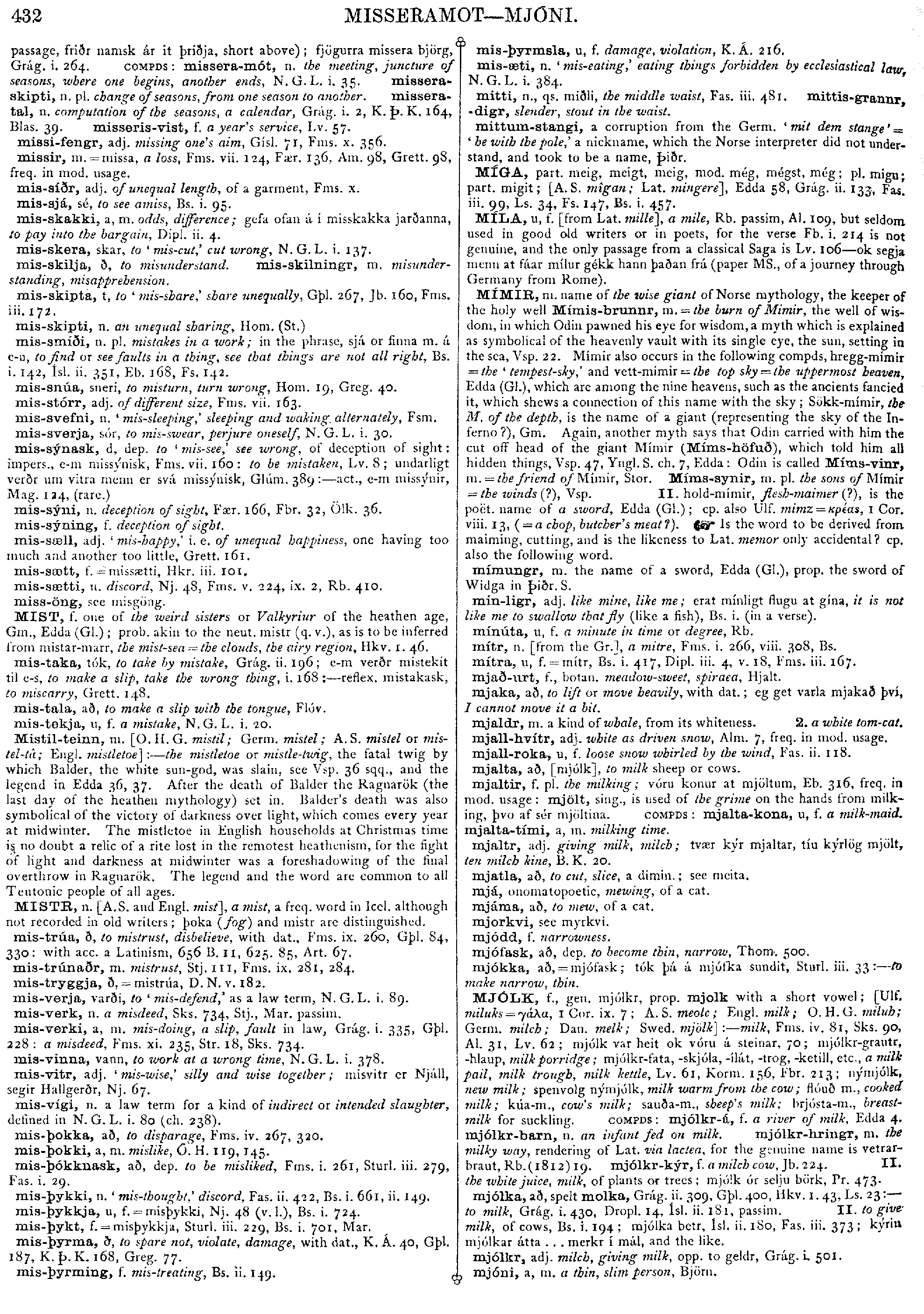
mis-svefni, n. 'mis-sleeping,' sleeping and waking, alternately, Fsm.
|
Source: Cleasby/Vigfusson, page b0434, entry 1 View original page image as: [TIFF] [PNG] [View previous entry] [View next entry] |
[Comment on this entry] [View comments] |
The following entry has been hand-corrected once. |
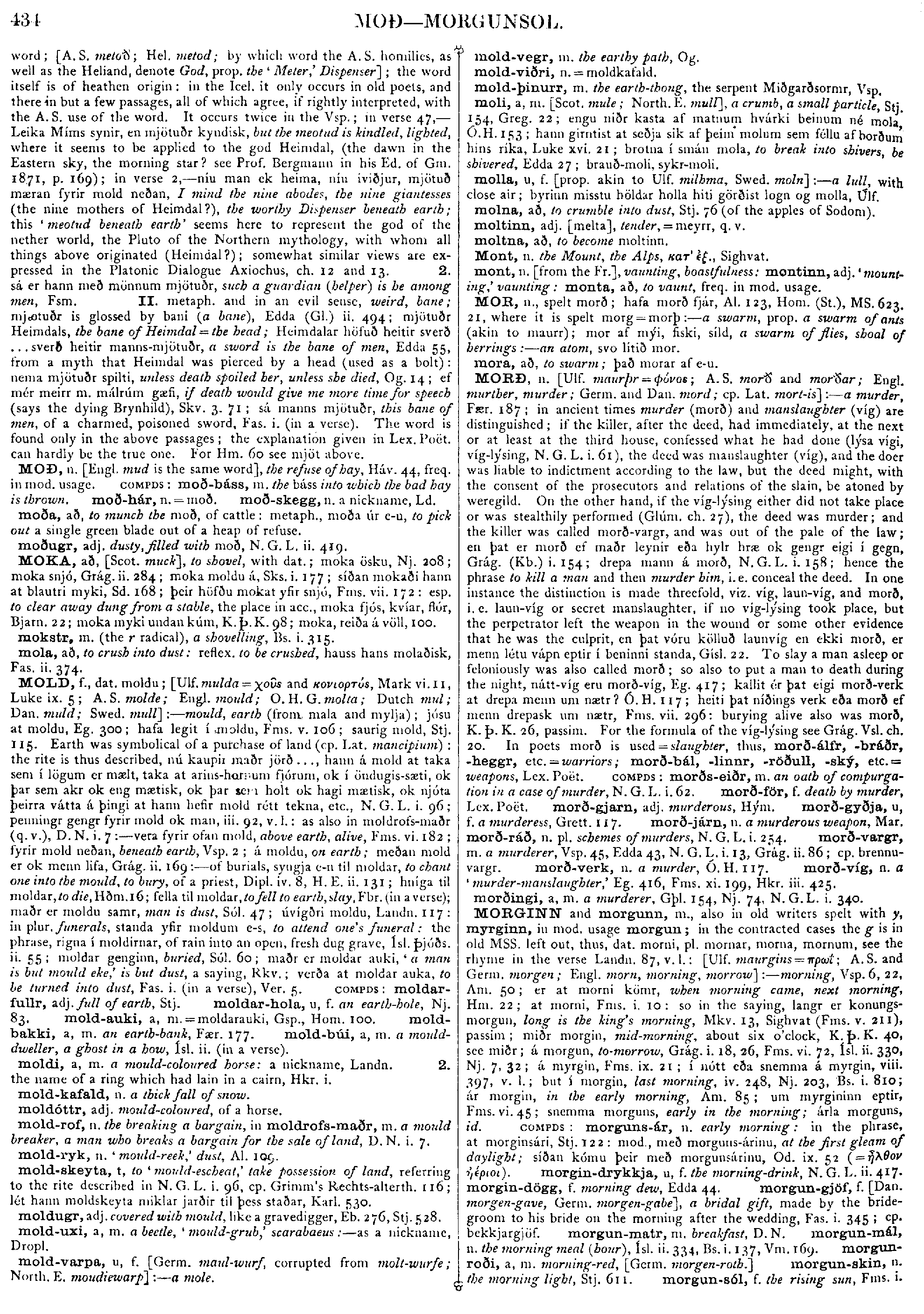
word;
[A.S.
metoð;
Hel.
metod;
by
which
word
the
A.S.
homilies,
as
well
as
the
Heliand,
denote
God,
prop.
the
'Meter,'
Dispenser];
the
word
itself
is
of
heathen
origin:
in
the
Icel.
it
only
occurs
in
old
poets,
and
there
in
but
a
few
passages,
all
of
which
agree,
if
rightly
interpreted,
with
the
A.S.
use
of
the
word.
It
occurs
twice
in
the
Vsp.;
in
verse
47,
--
Leika
Míms
synir,
en
mjötuðr
kyndisk,
but
the
meotud
is
kindled,
lighted,
where
it
seems
to
be
applied
to
the
god
Heimdal,
(the
dawn
in
the
Eastern
sky,
the
morning
star?
see
Prof.
Bergmann
in
his
Ed.
of
Gm.
1871,
p.
169);
in
verse
2,
--
níu
man
ek
heima,
níu
íviðjur,
mjötuð
mæran
fyrir
mold
neðan,
I
mind
the
nine
abodes,
the
nine
giantesses
(the
nine
mothers
of
Heimdal?),
the
worthy
Dispenser
beneath
earth;
this
'meotud
beneath
earth'
seems
here
to
represent
the
god
of
the
nether
world,
the
Pluto
of
the
Northern
mythology,
with
whom
all
things
above
originated
(Heimdal?);
somewhat
similar
views
are
expressed
in
the
Platonic
Dialogue
Axiochus,
ch.
12
and
13.
2.
sá
er
hann
með
mönnum
mjötuðr,
such
a
guardian
(helper)
is
he
among
men,
Fsm.
II.
metaph.
and
in
an
evil
sense,
weird,
bane;
mj tuðr
is
glossed
by
bani
(a
bane),
Edda
(Gl.)
ii.
494;
mjötuðr
Heimdals,
the
bane
of
Heimdal
=
the
head;
Heimdalar
höfuð
heitir
sverð
...
sverð
heitir
manns-mjötuðr,
a
sword
is
the
bane
of
men,
Edda
55,
from
a
myth
that
Heimdal
was
pierced
by
a
head
(used
as
a
bolt):
nema
mjötuðr
spilti,
unless
death
spoiled
her,
unless
she
died,
Og.
14;
ef
mér
meirr
m.
málrúm
gæfi,
if
death
would
give
me
more
time
for
speech
(says
the
dying
Brynhild),
Skv.
3.
71;
sá
manns
mjötuðr,
this
bane
of
men,
of
a
charmed,
poisoned
sword,
Fas.
i.
(in
a
verse).
The
word
is
found
only
in
the
above
passages;
the
explanation
given
in
Lex.
Poët,
can
hardly
be
the
true
one.
For
Hm.
60
see
mjöt
above.
tuðr
is
glossed
by
bani
(a
bane),
Edda
(Gl.)
ii.
494;
mjötuðr
Heimdals,
the
bane
of
Heimdal
=
the
head;
Heimdalar
höfuð
heitir
sverð
...
sverð
heitir
manns-mjötuðr,
a
sword
is
the
bane
of
men,
Edda
55,
from
a
myth
that
Heimdal
was
pierced
by
a
head
(used
as
a
bolt):
nema
mjötuðr
spilti,
unless
death
spoiled
her,
unless
she
died,
Og.
14;
ef
mér
meirr
m.
málrúm
gæfi,
if
death
would
give
me
more
time
for
speech
(says
the
dying
Brynhild),
Skv.
3.
71;
sá
manns
mjötuðr,
this
bane
of
men,
of
a
charmed,
poisoned
sword,
Fas.
i.
(in
a
verse).
The
word
is
found
only
in
the
above
passages;
the
explanation
given
in
Lex.
Poët,
can
hardly
be
the
true
one.
For
Hm.
60
see
mjöt
above.
|
Source: Cleasby/Vigfusson, page b0443, entry 15 View original page image as: [TIFF] [PNG] [View previous entry] [View next entry] |
[Comment on this entry] [View comments] |
The following entry has been hand-corrected once. |
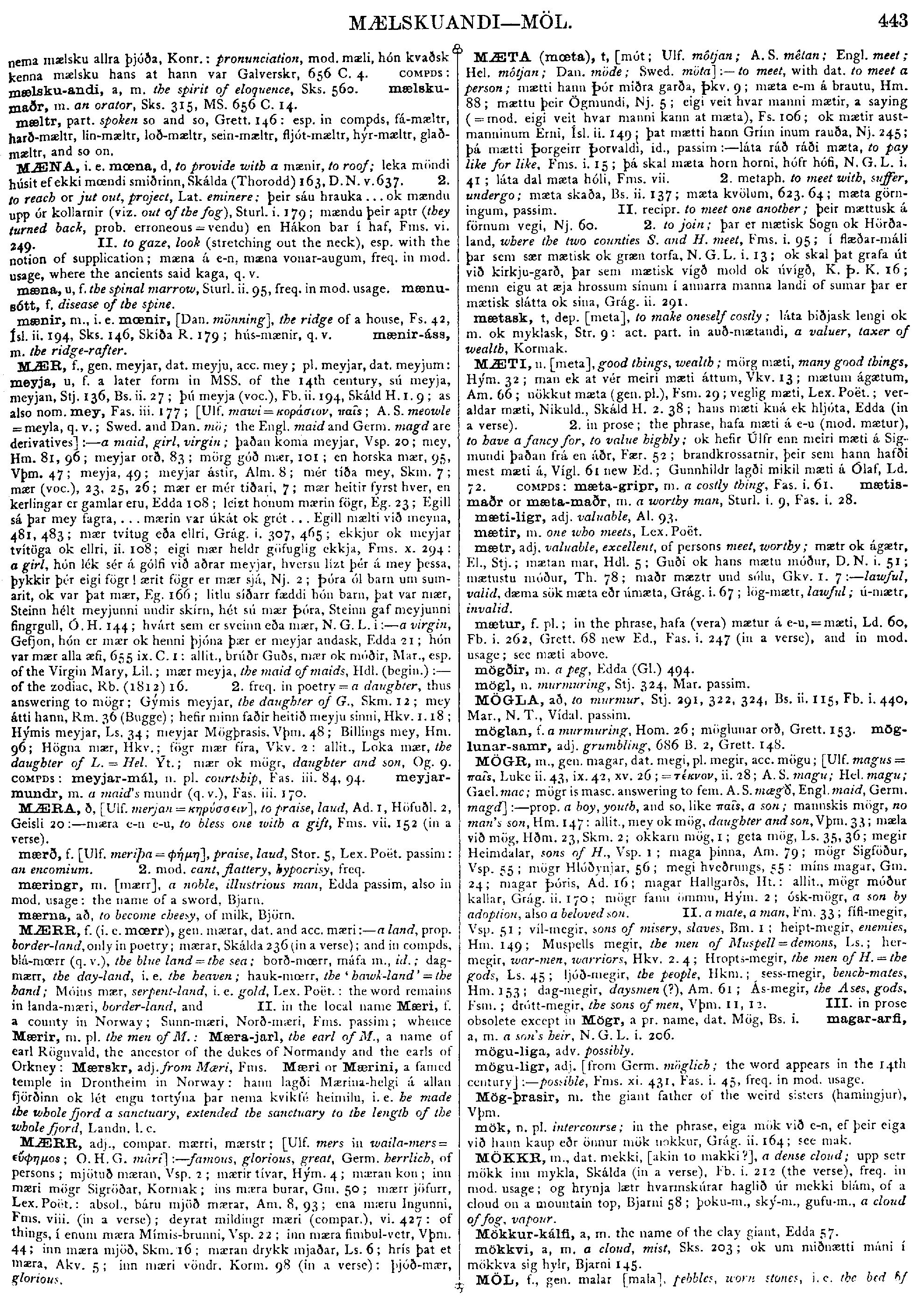
MÆTI, n. [meta], good things, wealth; mörg mæti, many good things, Hým. 32; man ek at vér meiri mæti áttum, Vkv. 13; mætum ágætum, Am. 66; nökkut mæta (gen. pl.), Fsm. 29; veglig mæti, Lex. Poët.; veraldar mæti, Nikuld., Skáld H. 2. 38; hans mæti kná ek hljóta, Edda (in a verse). 2. in prose; the phrase, hafa mæti á e-u (mod. mætur), to have a fancy for, to value highly; ok hefir Úlfr enn meiri mæti á Sigmundi þaðan frá en áðr, Fær. 52; brandkrossarnir, þeir sem hann hafði mest mæti á, Vígl. 61 new Ed.; Gunnhildr lagði mikil mæti á Ólaf, Ld. 72. COMPDS: mæta-gripr, m. a costly thing, Fas. i. 61. mætis-maðr or mæta-maðr, m. a worthy man, Sturl. i. 9, Fas. i. 28.
|
Source: Cleasby/Vigfusson, page b0443, entry 24 View original page image as: [TIFF] [PNG] [View previous entry] [View next entry] |
[Comment on this entry] [View comments] |
The following entry has been hand-corrected once. |
MÖGR, m., gen. magar, dat. megi, pl. megir, acc. mögu; [Ulf. magus = GREEK, Luke ii. 43, ix. 42, xv. 26; = GREEK, ii. 28; A.S. magu; Hel. magu; Gael. mac; mögr is masc. answering to fem. A.S. mægð, Engl. maid, Germ. magd] :-- prop. a boy, youth, and so, like GREEK a son; mannskis mögr, no man's son, Hm. 147: allit., mey ok mög, daughter and son, Vþm. 33; mæla við mög, Hðm. 23, Skm. 2; okkarn mög, 1; geta mög, Ls. 35, 36; megir Heimdalar, sons of H., Vsp. 1; maga þinna, Am. 79; mögr Sigföður, Vsp. 55; mögr Hlóðynjar, 56; megi hveðrungs, 55: míns magar, Gm. 24; magar Þóris, Ad. 16; magar Hallgarðs, Ht.: allit., mögr móður kallar, Grág. ii. 170; mögr fann ömmu, Hým. 2; ósk-mögr, a son by adoption, also a beloved son. II. a mate, a man, Fm. 33; fífl-megir, Vsp. 51; víl-megir, sons of misery, slaves, Bm. 1; heipt-megir, enemies, Hm. 149; Muspells megir, the men of Muspell = demons, Ls.; her-megir, war-men, warriors, Hkv. 2. 4; Hropts-megir, the men of H. = the gods, Ls. 45; ljóð-megir, the people, Hkm.; sess-megir, bench-mates, Hm. 153; dag-megir, daysmen(?), Am. 61; Ás-megir, the Ases, gods, Fsm.; drótt-megir, the sons of men, Vþm. 11, 12. III. in prose obsolete except in Mögr, a pr. name, dat. Mög, Bs. i. magar-arfi, a, m. a son's heir, N.G.L. i. 206.
|
Source: Cleasby/Vigfusson, page b0446, entry 14 View original page image as: [TIFF] [PNG] [View previous entry] [View next entry] |
[Comment on this entry] [View comments] |
The following entry has been hand-corrected once. |
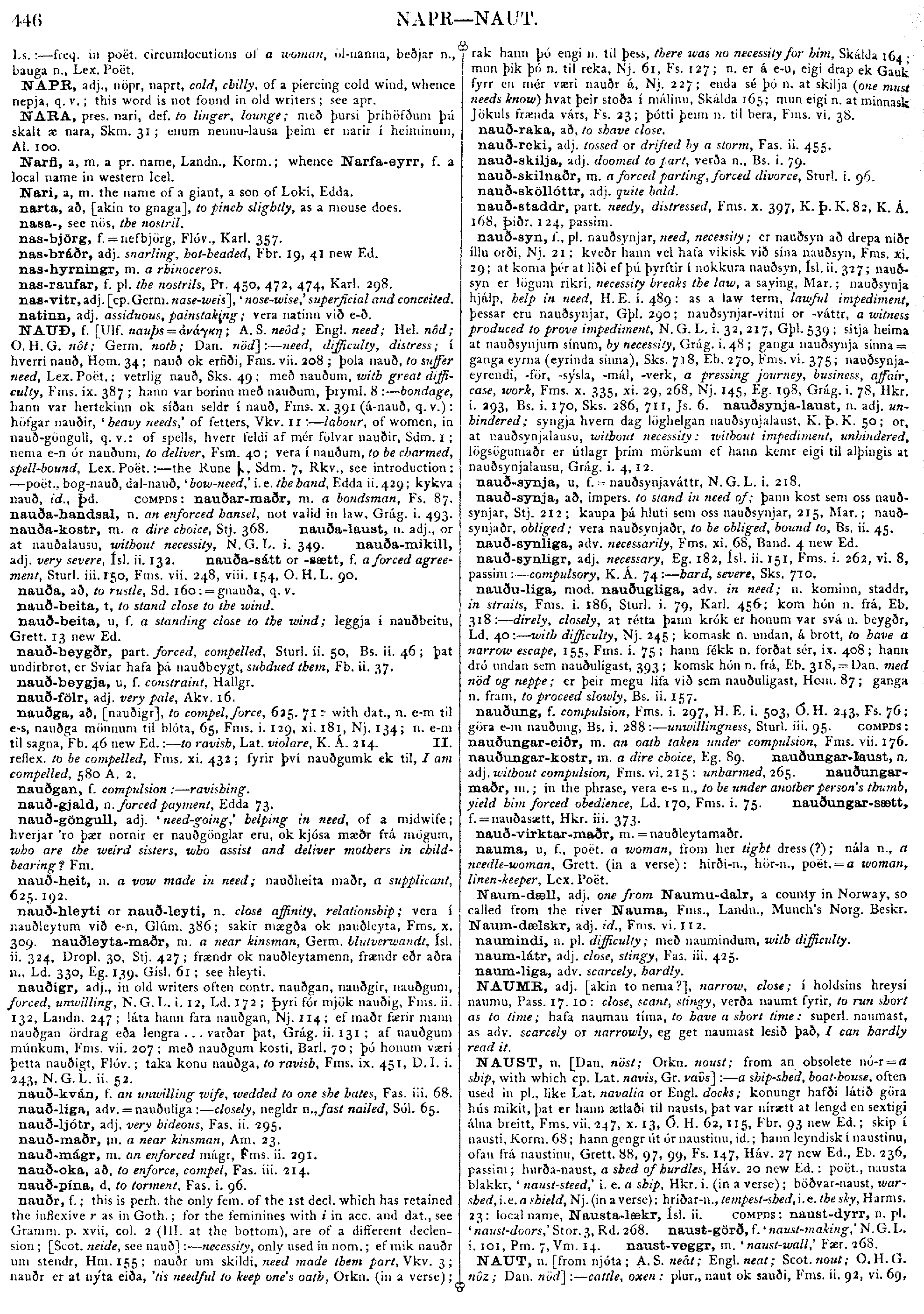
NAUÐ, f. [Ulf. nauþs = GREEK; A.S. neôd; Engl. need; Hel. nôd; O.H.G. nôt; Germ. noth; Dan. nöd] :-- need, difficulty, distress; í hverri nauð, Hom. 34; nauð ok erfiði, Fms. vii. 208; þola nauð, to suffer need, Lex. Poët.; vetrlig nauð, Sks. 49; með nauðum, with great difficulty, Fms. ix. 387; hann var borinn með nauðum, Þryml. 8 :-- bondage, hann var hertekinn ok síðan seldr í nauð, Fms. x. 391 (á-nauð, q.v.): höfgar nauðir, 'heavy needs,' of fetters, Vkv. 11 :-- labour, of women, in nauð-göngull, q.v.: of spells, hverr feldi af mér fölvar nauðir, Sdm. 1; nema e-n ór nauðum, to deliver, Fsm. 40; vera í nauðum, to be charmed, spell-bound, Lex. Poët. :-- the Rune RUNE, Sdm. 7, Rkv., see introduction :-- poët., bog-nauð, dal-nauð, 'bow-need,' i.e. the hand, Edda ii. 429; kykva nauð, id., Þd. COMPDS: nauðar-maðr, m. a bondsman, Fs. 87. nauða-handsal, n. an enforced hansel, not valid in law, Grág. i. 493. nauða-kostr, m. a dire choice, Stj. 368. nauða-laust, n. adj., or at nauðalausu, without necessity, N.G.L. i. 349. nauða-mikill, adj. very severe, Ísl. ii. 132. nauða-sátt or -sætt, f. a forced agreement, Sturl. iii. 150, Fms. vii. 248, viii. 154, O.H.L. 90.
|
Source: Cleasby/Vigfusson, page b0448, entry 27 View original page image as: [TIFF] [PNG] [View previous entry] [View next entry] |
[Comment on this entry] [View comments] |
The following entry has been hand-corrected once. |
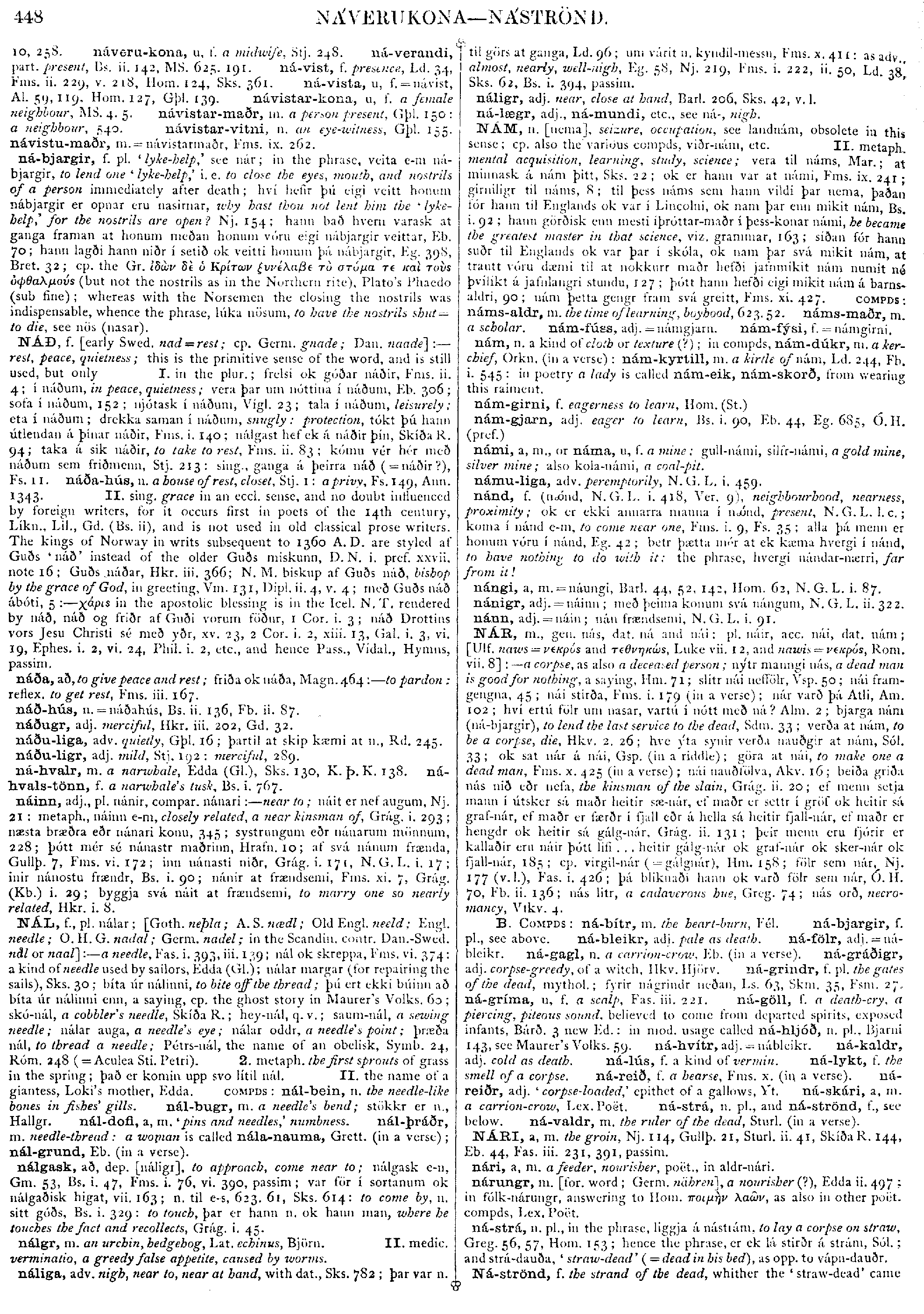
NÁR, m., gen. nás, dat. ná and nái: pl. náir, acc. nái, dat. nám; [Ulf. naws = GREEK and GREEK, Luke vii. 12, and nawis = GREEK, Rom. vii. 8] :-- a corpse, as also a deceased person; nýtr manngi nás, a dead man is good for nothing, a saying, Hm. 71; slítr nái neffölr, Vsp. 50; nái fram-gengna, 45; nái stirða, Fms. i. 179 (in a verse); nár varð þá Atli, Am. 102; hví ertú fölr um nasar, vartú í nótt með ná? Alm. 2; bjarga nám (ná-bjargir), to lend the last service to the dead, Sdm. 33: verða at nám, to be a corpse, die, Hkv. 2. 26; hve ýta synir verða nauðgir at nám, Sól. 33; ok sat nár á nái, Gsp. (in a riddle); göra at nái, to make one a dead man. Fms. x. 425 (in a verse); nái nauðfölva, Akv. 16; beiða griða nás nið eðr nefa, the kinsman of the slain, Grág. ii. 20; ef menn setja mann í útsker sá maðr heitir sæ-nár, ef maðr er settr í gröf ok heitir sá graf-nár, ef maðr er færðr í fjall eðr á hella sá heitir fjall-nár, ef maðr er hengdr ok heitir sá gálg-nár, Grág. ii. 131; þeir menn eru fjórir er kallaðir eru náir þótt lifi . . . heitir gálg-nár ok graf-nár ok sker-nár ok fjall-nár, 185; cp. virgil-nár ( = gálgnár), Hm. 158; fölr sem nár, Nj. 177 (v. l.), Fas. i. 426; þá bliknaði hann ok varð fölr sem nár, Ó. H. 70, Fb. ii. 136; nás litr, a cadaverous hue, Greg. 74; nás orð, necromancy, Vtkv. 4. B. COMPDS: ná-bítr, m. the heart-burn, Fél. ná-bjargir, f. pl., see above. ná-bleikr, adj. pale as death. ná-fölr, adj. = nábleikr. ná-gagl, n. a carrion-crow, Eb. (in a verse). ná-gráðigr, adj. corpse-greedy, of a witch, Hkv. Hjörv. ná-grindr, f. pl. the gates of the dead, mythol.; fyrir nágrindr neðan, Ls. 63, Skm. 35, Fsm. 27, ná-gríma, u, f. a scalp, Fas. iii. 221. ná-göll, f. a death-cry, a piercing, piteous sound, believed to come from departed spirits, exposed infants, Bárð. 3 new Ed.: in mod. usage called ná-hljóð, n. pl., Bjarni 143, see Maurer's Volks. 59. ná-hvítr, adj. = nábleikr. ná-kaldr, adj. cold as death. ná-lús, f. a kind of vermin. na-lykt, f. the smell of a corpse. ná-reið, f. a hearse, Fms. x. (in a verse). ná-reiðr, adj. 'corpse-loaded,' epithet of a gallows, Yt. ná-skári, a, m. a carrion-crow, Lex. Poët. ná-strá, n. pl., and ná-strönd, f., see below. ná-valdr, m. the ruler of the dead, Sturl. (in a verse).
|
Source: Cleasby/Vigfusson, page b0452, entry 4 View original page image as: [TIFF] [PNG] [View previous entry] [View next entry] |
[Comment on this entry] [View comments] |
The following entry has been hand-corrected once. |
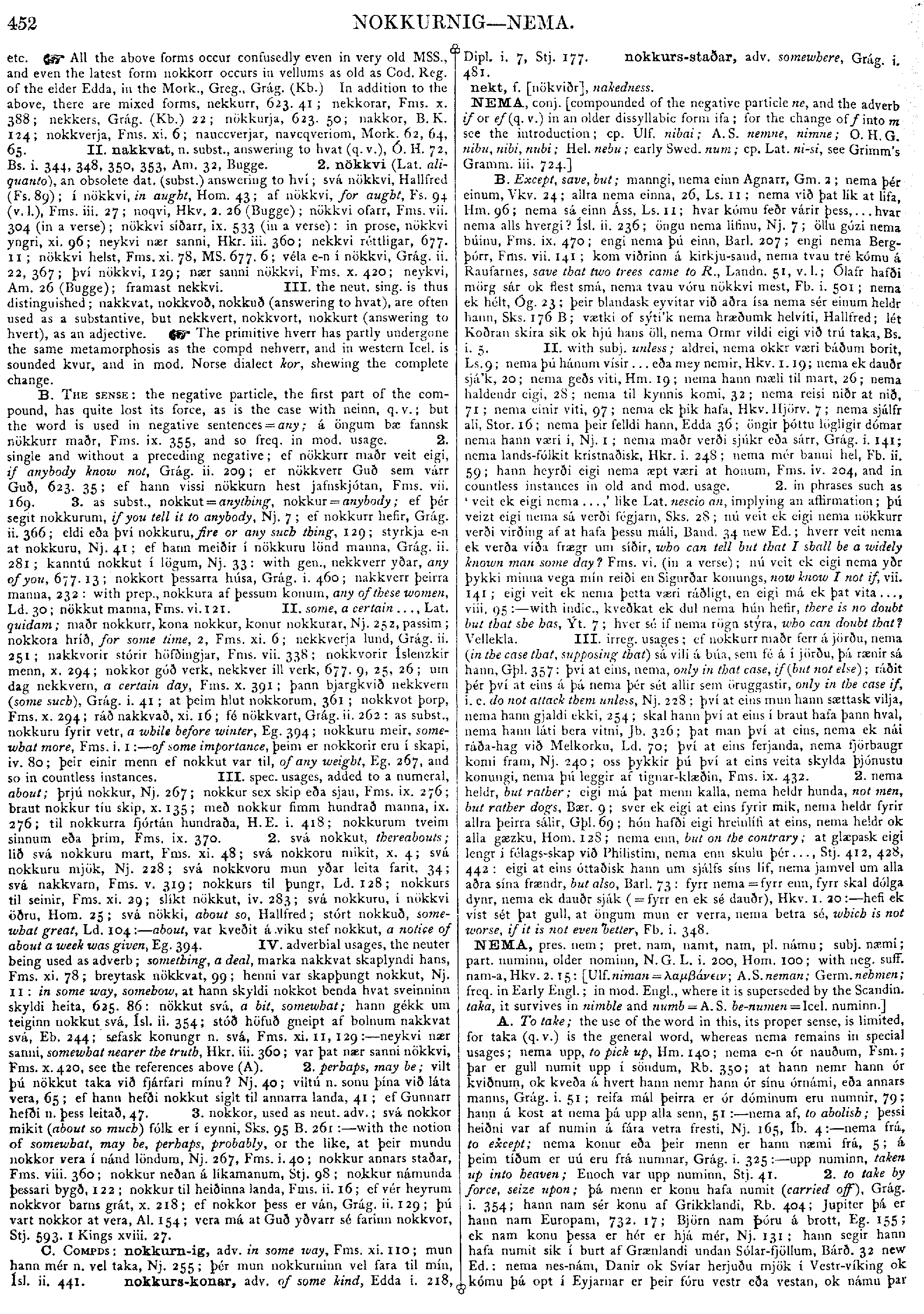
NEMA, pres. nem; pret. nam, namt, nam, pl. námu; subj. næmi; part. numinn, older nominn, N. G. L. i. 200, Hom. 100; with neg., suff. nam-a, Hkv. 2. 15: [Ulf. niman = GREEK; A. S. neman; Germ. nehmen; freq. in Early Engl.; in mod. Engl., where it is superseded by the Scandin. taka, it survives in nimble and numb = A. S. be-numen = lcel. numinn.] A. To take; the use of the word in this, its proper sense, is limited, for taka (q. v.) is the general word, whereas nema remains in special usages; nema upp, to pick up, Hm. 140; nema e-n ór nauðum, Fsm.; þar er gull numit upp í söndum, Rb. 350; at hann nemr hann ór kviðnum, ok kveða á hvert hann nemr hann ór sínu órnámi, eða annars manns, Grág. i. 51; reifa mál þeirra er ór dóminum eru numnir, 79; hann á kost at nema þá upp alla senn, 51 :-- nema af, to abolish; þessi heiðni var af numin á fára vetra fresti, Nj. 165, Íb. 4 :-- nema frá, to except; nema konur eða þeir menn er hann næmi frá, 5; á þeim tíðum er uú eru frá numnar, Grág. i. 325 :-- upp numinn, taken up into heaven; Enoch var upp numinn, Stj. 41. 2. to take by force, seize upon; þá menn er konu hafa numit (carried off), Grág. i. 354; hann nam sér konu af Grikklandi, Rb. 404; Jupiter þá er hann nam Europam, 732. 17; Björn nam Þóru á brott, Eg. 155; ek nam konu þessa er hér er hjá mér, Nj. 131; hann segir hann hafa numit sik í burt af Grænlandi undan Sólar-fjöllum, Bárð. 32 new Ed.: nema nes-nám, Danir ok Svíar herjuðu mjök í Vestr-víking ok kómu þá opt í Eyjarnar er þeir fóru vestr eða vestan, ok námu þar
| Result Page: |  |
Previous | 1 2 3 4 5 6 7 | Next |  |
Germanic Lexicon Project (main page)
This search system was written by
Sean Crist
Please consider
volunteering
to correct the data in these online dictionaries.
No rights reserved. Feel free to use these data in any way you please.