|
|

Search for Fram again, using less strict matching (2044 results)
|
Source: Bosworth/Toller, page d0291, entry 4 View original page image as: [TIFF] [PNG] [View previous entry] [View next entry] |
[Comment on this entry] [View comments] |
The following entry has been hand-corrected once. |
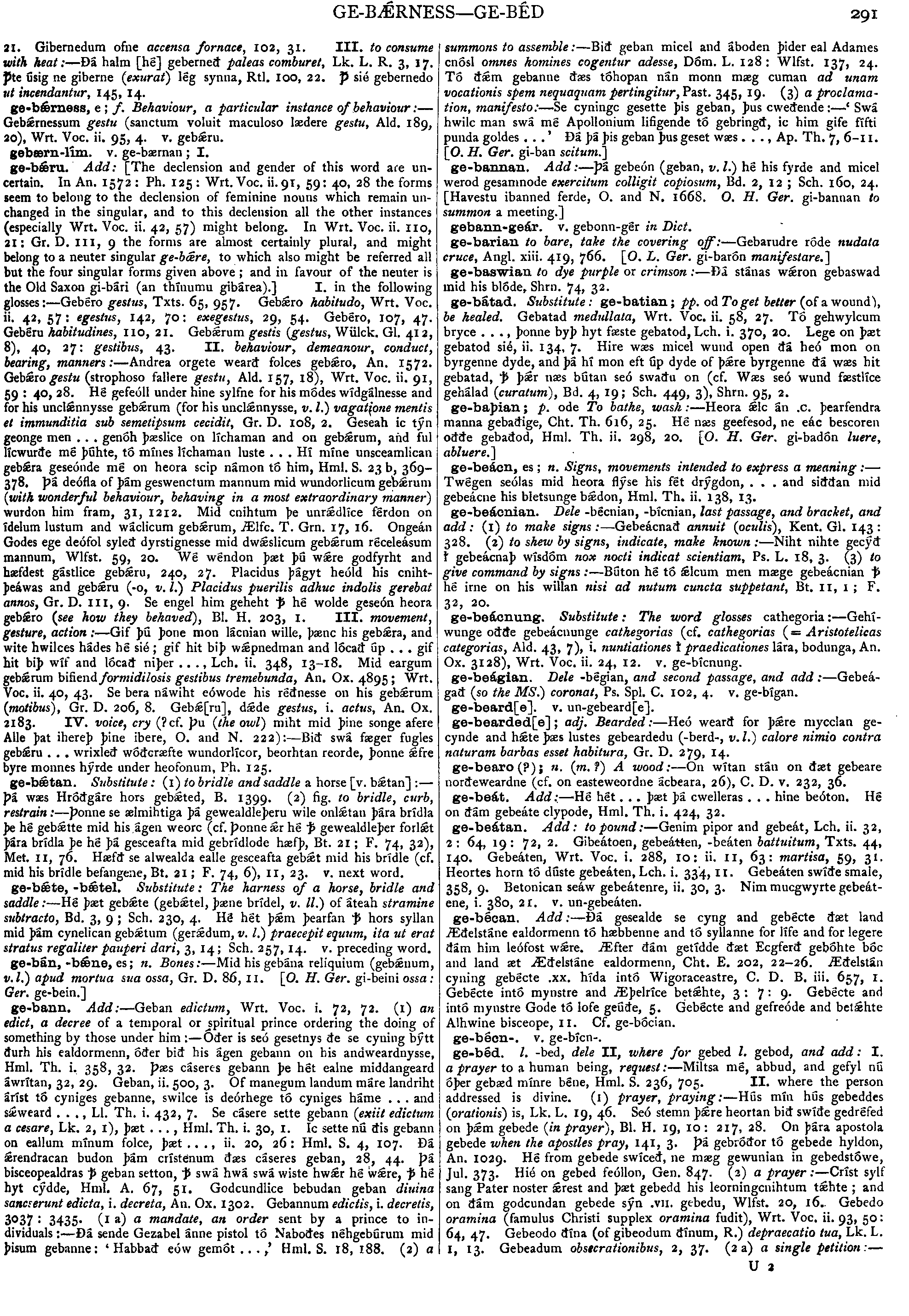
ge-b ru.
Add:
[The
declension
and
gender
of
this
word
are
uncertain.
In
An.
1572:
Ph.
125:
Wrt.
Voc.
ii.
91,
59:
40,
28
the
forms
seem
to
belong
to
the
declension
of
feminine
nouns
which
remain
unchanged
in
the
singular,
and
to
this
declension
all
the
other
instances
(especially
Wrt.
Voc.
ii.
42,
57)
might
belong.
In
Wrt.
Voc.
ii.
110,
21:
Gr.
D.
111,
9
the
forms
are
almost
certainly
plural,
and
might
belong
to
a
neuter
singular
ge-bre,
to
which
also
might
be
referred
all
but
the
four
singular
forms
given
above;
and
in
favour
of
the
neuter
is
the
Old
Saxon
gi-
ru.
Add:
[The
declension
and
gender
of
this
word
are
uncertain.
In
An.
1572:
Ph.
125:
Wrt.
Voc.
ii.
91,
59:
40,
28
the
forms
seem
to
belong
to
the
declension
of
feminine
nouns
which
remain
unchanged
in
the
singular,
and
to
this
declension
all
the
other
instances
(especially
Wrt.
Voc.
ii.
42,
57)
might
belong.
In
Wrt.
Voc.
ii.
110,
21:
Gr.
D.
111,
9
the
forms
are
almost
certainly
plural,
and
might
belong
to
a
neuter
singular
ge-bre,
to
which
also
might
be
referred
all
but
the
four
singular
forms
given
above;
and
in
favour
of
the
neuter
is
the
Old
Saxon
gi- ari
(an
thínumu
gibárea).]
I.
in
the
following
glosses
:--
Gebéro
gestus,
Txts.
65,
957.
Gebro
habitudo,
Wrt.
Voc.
ii.
42,
57:
egestus,
142,
70:
exegestus,
29,
54.
Gebéro,
107,
47.
Gebéru
habitudines,
110,
21.
Gebrum
gestis
(gestus,
Wülck.
Gl.
412,
8),
40,
27:
gestibus,
43.
II.
behaviour,
demeanour,
conduct,
bearing,
manners
:--
Andrea
orgete
wearð
folces
gebro,
An.
1572.
Gebro
gestu
(strophoso
fallere
gestu,
Ald.
157,
18),
Wrt.
Voc.
ii.
91,
59:
40,
28.
Hé
gefeóll
under
hine
sylfne
for
his
módes
wídgálnesse
and
for
his
unclnnysse
gebrum
(for
his
unclnnysse,
v.l.)
vagatione
mentis
et
immunditia
sub
semetipsum
cecidit,
Gr.
D.
108,
2.
Geseah
ic
týn
geonge
men
...
genóh
þæslice
on
líchaman
and
on
gebrum,
and
ful
lícwurðe
mé
þúhte,
tó
mínes
líchaman
luste
...
Hí
míne
unsceamlican
gebra
geseónde
mé
on
heora
scip
námon
tó
him,
Hml.
S.
23
b,
369-378.
Þá
deófla
of
þám
geswenctum
mannum
mid
wundorlicum
gebrum
(with
wonderful
behaviour,
behaving
in
a
most
extraordinary
manner)
wurdon
him
fram,
31,
1212.
Mid
cnihtum
þe
unrdlíce
férdon
on
ídelum
lustum
and
wáclicum
gebrum,
Ælfc.
T.
Grn.
17,
16.
Ongeán
Godes
ege
deófol
syleð
dyrstignesse
mid
dwslicum
gebrum
réceleásum
mannum,
Wlfst.
59,
20.
Wé
wéndon
þæt
þú
wre
godfyrht
and
hæfdest
gástlice
gebru,
240,
27.
Placidus
þágyt
heóld
his
cnihtþeáwas
and
gebru
(-o,
v.l.)
Placidus
puerilis
adhuc
indolis
gerebat
annos,
Gr.
D.
111,
9.
Se
engel
him
geheht
ari
(an
thínumu
gibárea).]
I.
in
the
following
glosses
:--
Gebéro
gestus,
Txts.
65,
957.
Gebro
habitudo,
Wrt.
Voc.
ii.
42,
57:
egestus,
142,
70:
exegestus,
29,
54.
Gebéro,
107,
47.
Gebéru
habitudines,
110,
21.
Gebrum
gestis
(gestus,
Wülck.
Gl.
412,
8),
40,
27:
gestibus,
43.
II.
behaviour,
demeanour,
conduct,
bearing,
manners
:--
Andrea
orgete
wearð
folces
gebro,
An.
1572.
Gebro
gestu
(strophoso
fallere
gestu,
Ald.
157,
18),
Wrt.
Voc.
ii.
91,
59:
40,
28.
Hé
gefeóll
under
hine
sylfne
for
his
módes
wídgálnesse
and
for
his
unclnnysse
gebrum
(for
his
unclnnysse,
v.l.)
vagatione
mentis
et
immunditia
sub
semetipsum
cecidit,
Gr.
D.
108,
2.
Geseah
ic
týn
geonge
men
...
genóh
þæslice
on
líchaman
and
on
gebrum,
and
ful
lícwurðe
mé
þúhte,
tó
mínes
líchaman
luste
...
Hí
míne
unsceamlican
gebra
geseónde
mé
on
heora
scip
námon
tó
him,
Hml.
S.
23
b,
369-378.
Þá
deófla
of
þám
geswenctum
mannum
mid
wundorlicum
gebrum
(with
wonderful
behaviour,
behaving
in
a
most
extraordinary
manner)
wurdon
him
fram,
31,
1212.
Mid
cnihtum
þe
unrdlíce
férdon
on
ídelum
lustum
and
wáclicum
gebrum,
Ælfc.
T.
Grn.
17,
16.
Ongeán
Godes
ege
deófol
syleð
dyrstignesse
mid
dwslicum
gebrum
réceleásum
mannum,
Wlfst.
59,
20.
Wé
wéndon
þæt
þú
wre
godfyrht
and
hæfdest
gástlice
gebru,
240,
27.
Placidus
þágyt
heóld
his
cnihtþeáwas
and
gebru
(-o,
v.l.)
Placidus
puerilis
adhuc
indolis
gerebat
annos,
Gr.
D.
111,
9.
Se
engel
him
geheht
 hé
wolde
geseón
heora
gebro
(see
how
they
behaved),
Bl.
H.
203,
1.
III.
movement,
gesture,
action
:--
Gif
þú
þone
mon
lácnian
wille,
þænc
his
gebra,
and
wite
hwilces
hádes
hé
sié;
gif
hit
biþ
wpnedman
and
lócað
úp
...
gif
hit
biþ
wíf
and
lócað
niþer
...,
Lch.
ii.
348,
13-18.
Mid
eargum
gebrum
bifiend
formidilosis
gestibus
tremebunda,
An.
Ox.
4895;
Wrt.
Voc.
ii.
40,
43.
Se
bera
náwiht
eówode
his
réðnesse
on
his
gebrum
(motibus),
Gr.
D.
206,
8.
Geb[ru],
dde
gestus,
i.
actus,
An.
Ox.
2183.
IV.
voice,
cry
(?cf.
Þu
(the
owl)
miht
mid
þine
songe
afere
Alle
þat
ihereþ
þine
ibere,
O.
and
N.
222)
:--
Bið
swá
fæger
fugles
gebru
...
wrixleð
wóðcræfte
wundorlícor,
beorhtan
reorde,
þonne
fre
byre
monnes
hýrde
under
heofonum,
Ph.
125.
hé
wolde
geseón
heora
gebro
(see
how
they
behaved),
Bl.
H.
203,
1.
III.
movement,
gesture,
action
:--
Gif
þú
þone
mon
lácnian
wille,
þænc
his
gebra,
and
wite
hwilces
hádes
hé
sié;
gif
hit
biþ
wpnedman
and
lócað
úp
...
gif
hit
biþ
wíf
and
lócað
niþer
...,
Lch.
ii.
348,
13-18.
Mid
eargum
gebrum
bifiend
formidilosis
gestibus
tremebunda,
An.
Ox.
4895;
Wrt.
Voc.
ii.
40,
43.
Se
bera
náwiht
eówode
his
réðnesse
on
his
gebrum
(motibus),
Gr.
D.
206,
8.
Geb[ru],
dde
gestus,
i.
actus,
An.
Ox.
2183.
IV.
voice,
cry
(?cf.
Þu
(the
owl)
miht
mid
þine
songe
afere
Alle
þat
ihereþ
þine
ibere,
O.
and
N.
222)
:--
Bið
swá
fæger
fugles
gebru
...
wrixleð
wóðcræfte
wundorlícor,
beorhtan
reorde,
þonne
fre
byre
monnes
hýrde
under
heofonum,
Ph.
125.
|
Source: Bosworth/Toller, page d0292, entry 14 View original page image as: [TIFF] [PNG] [View previous entry] [View next entry] |
[Comment on this entry] [View comments] |
The following entry has been hand-corrected once. |
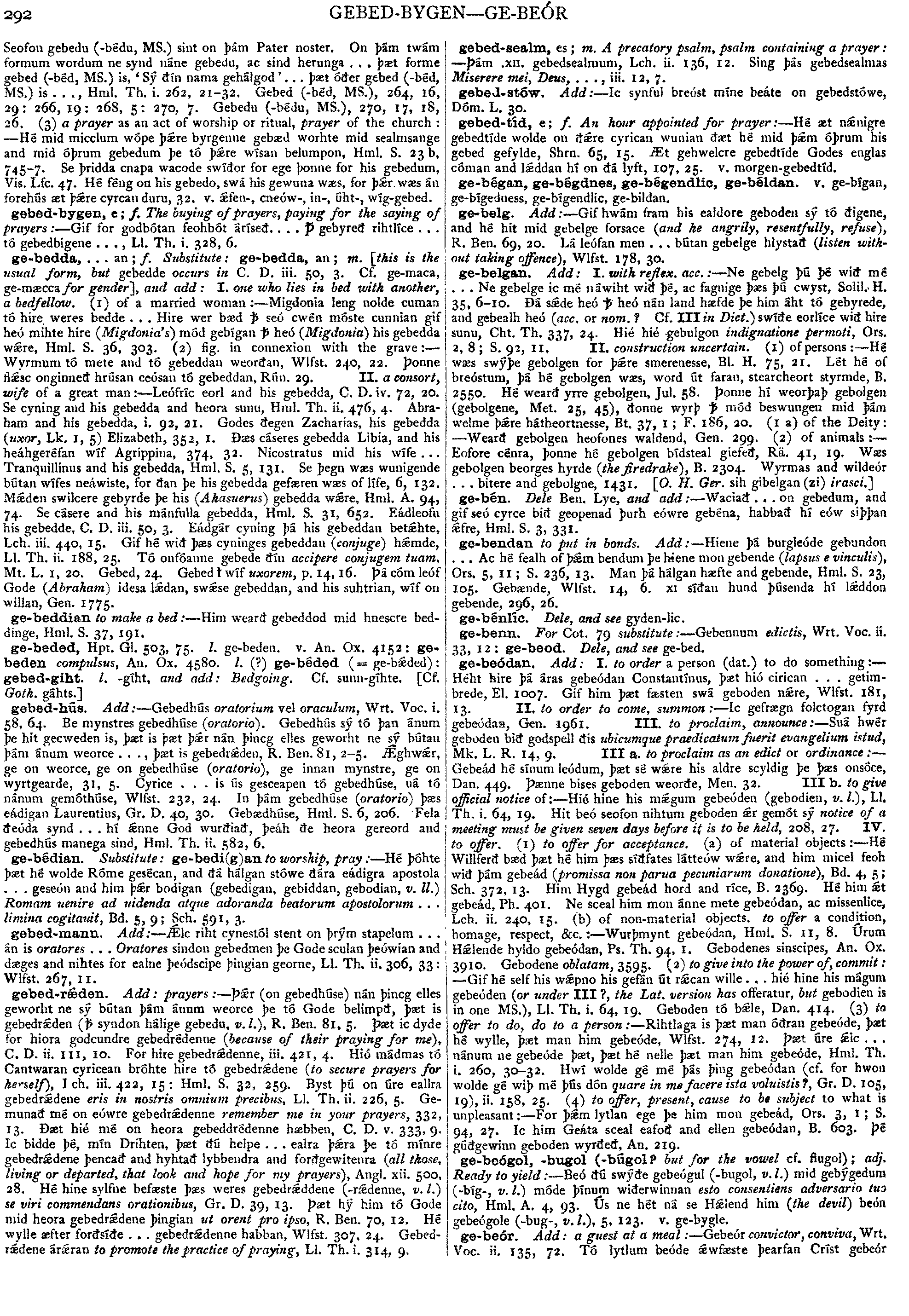
ge-belg. Add: -- Gif hwám fram his ealdore geboden sý to ðigene, and hé hit mid gebelge forsace (and he angrily, resentfully, refuse), R. Ben. 69, 20. Lá leófan men . . . bútan gebelge hlystað (listen without taking offence), Wlfst. 178, 30.
|
Source: Bosworth/Toller, page d0297, entry 23 View original page image as: [TIFF] [PNG] [View previous entry] [View next entry] |
[Comment on this entry] [View comments] |
The following entry has been hand-corrected once. |
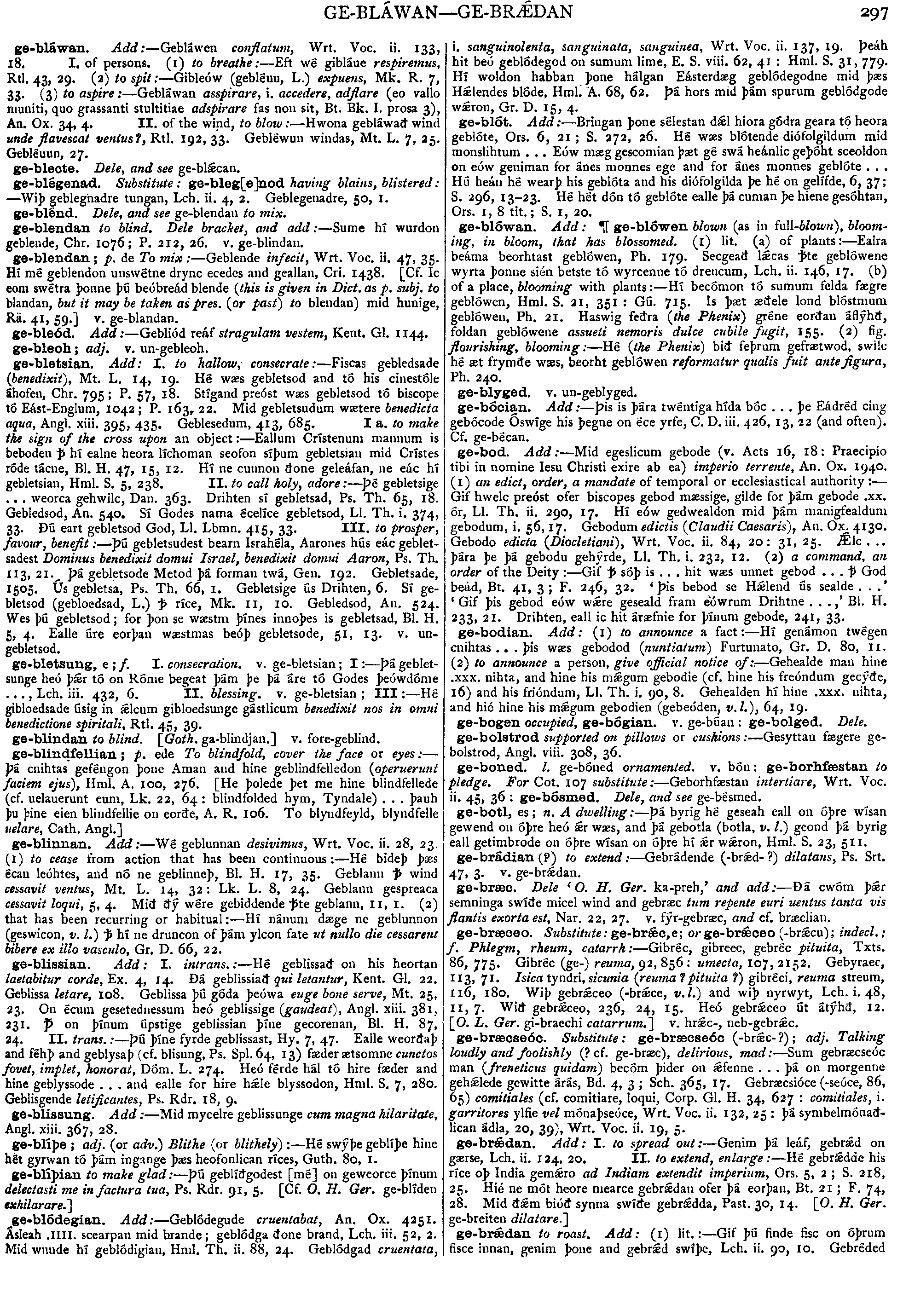
ge-bod.
Add
:--
Mid
egeslicum
gebode
(v.
Acts
16,
18:
Praecipio
tibi
in
nomine
Iesu
Christi
exire
ab
ea)
imperio
terrente,
An.
Ox.
1940.
(1)
an
edict,
order,
a
mandate
of
temporal
or
ecclesiastical
authority
:--
Gif
hwelc
preóst
ofer
biscopes
gebod
mæssige,
gilde
for
þám
gebode
.xx.
ór,
Ll.
Th.
ii.
290,
17.
Hí
eów
gedwealdon
mid
þám
manigfealdum
gebodum,
i.
56,
17.
Gebodum
edictis
(Claudii
Caesaris),
An.
Ox.
4130.
Gebodo
edicta
(Diocletiani),
Wrt.
Voc.
ii.
84,
20:
31,
25.
Æ-acute;lc
.
.
.
þára
þe
þá
gebodu
gehýrde,
Ll.
Th.
i.
232,
12.
(2)
a
command,
an
order
of
the
Deity
:--
Gif
sóþ
is
.
.
.
hit
wæs
unnet
gebod
.
.
.
God
beád.
Bt.
41,
3
;
F.
246,
32.
'þis
bebod
se
Hlend
ús
sealde
.
.
.
'
'Gif
þis
gebod
eów
wre
geseald
fram
eówrum
Drihtne
.
.
.
,'
Bl.
H.
233,
21.
Drihten,
eall
ic
hit
áræfnie
for
þínum
gebode,
241,
33.
|
Source: Bosworth/Toller, page d0299, entry 13 View original page image as: [TIFF] [PNG] [View previous entry] [View next entry] |
[Comment on this entry] [View comments] |
The following entry has been hand-corrected once. |
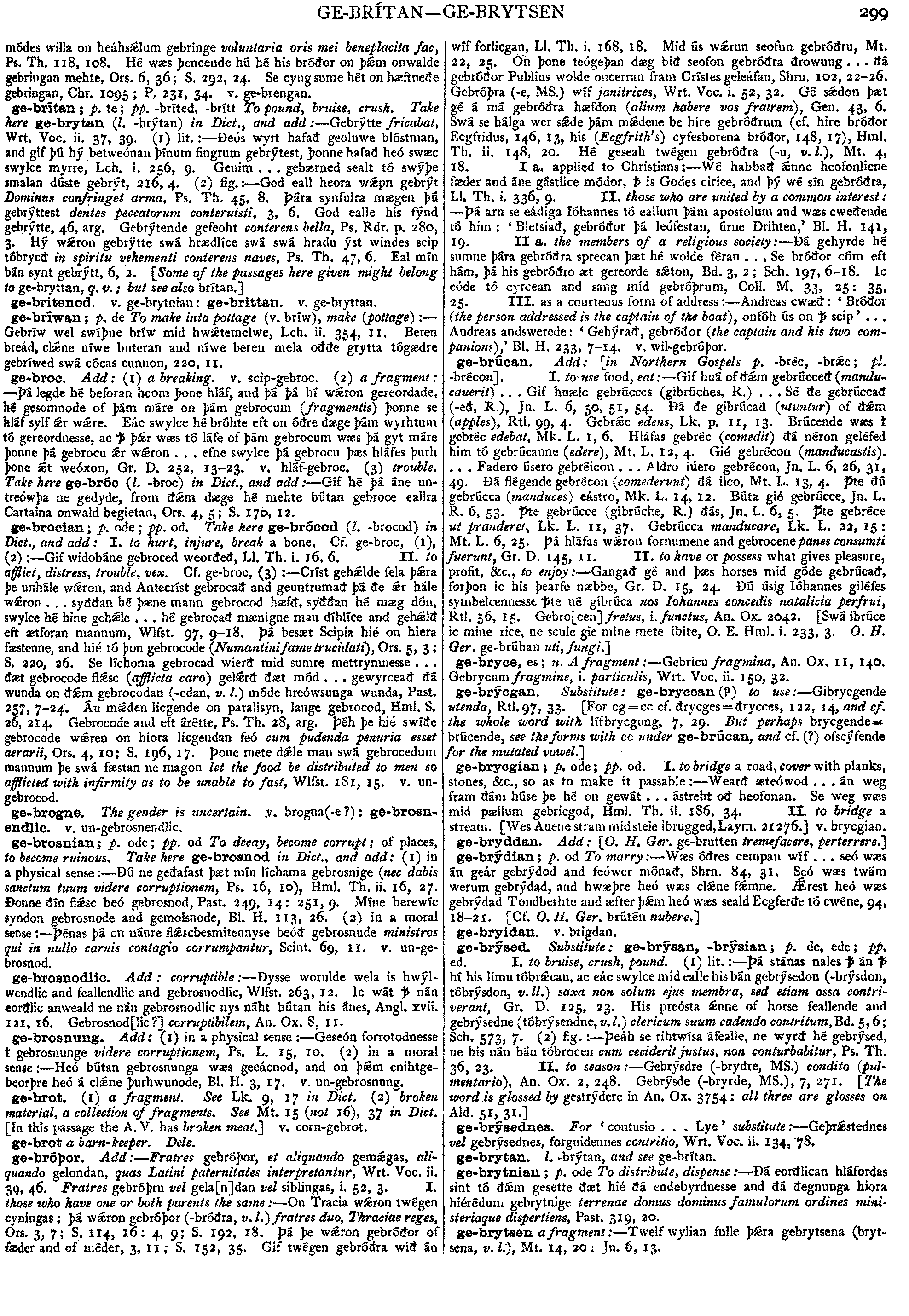
ge-bróþor.
Add
:--
Fratres
gebróþor,
et
aliquando
gemgas,
ali quando
gelondan,
quas
Latini
paternitates
interpretantur,
Wrt.
Voc.
ii.
39,
46.
Fratres
gebróþru
vel
gela[n]dan
vel
siblingas,
i.
52,
3.
I.
those
who
have
one
or
both
parents
the
same
:--
On
Tracia
wron
twégen
cyningas;
þá
wron
gebróþor
(-bróðra,
v.
l.)fratres
duo,
Thraciae
reges,
Ors.
3,
7;
S.
114,
16:
4,
9;
S.
192,
18.
þá
þe
wron
gebróðor
of
fæder
and
of
méder,
3,
11;
S.
152,
35.
Gif
twégen
gebróðra
wið
án
wíf
forlicgan,
Ll.
Th.
i.
168,
18.
Mid
ús
wrun
seofun
gebróðru,
Mt.
22,
25.
Ón
þone
teógeþan
dæg
bið
seofon
gebróðra
ðrowung
.
.
.
ðá
gebróðor
Publius
wolde
oncerran
fram
Crístes
geleáfan,
Shrn.
102,
22-26.
Gebróþra
(-e,
MS.)
wíf
janitrices,
Wrt.
Voc.
i.
52,
32.
Gé
sdon
þæt
gé
á
má
gebróðra
hæfdon
(alium
habere
vos
fratrem),
Gen.
43,
6.
Swá
se
hálga
wer
sde
þám
mdene
be
hire
gebróðrum
(cf.
hire
bróðor
Ecgfridus,
146,
13,
his
(Ecgfrith's)
cyfesborena
bródor,
148,
17),
Hml.
Th.
ii.
148,
20.
Hé
geseah
twégen
gebróðra
(-u,
v.
l.),
Mt.
4,
18.
I
a.
applied
to
Christians
:--
Wé
habbað
nne
heofonlicne
fæder
and
áne
gástlice
módor,
is
Godes
cirice,
and
þý
wé
sín
gebróðra,
Ll.
Th.
i.
336,
9.
II.
those
who
are
united
by
a
common
interest
:--
Þ
á
arn
se
eádiga
Ióhannes
to
eallum
þám
apostolum
and
wæs
cweðende
tó
him
:
'Bletsiað,
gebróðor
þá
leófestan,
úrne
Drihten,'
Bl.
H.
141,
19.
II
a.
the
members
of
a
religious
society
:--
Ðá
gehyrde
he
sumne
þára
gebróðra
sprecan
þæt
hé
wolde
féran
.
.
.
Se
bróðor
cóm
eft
hám,
þá
his
gebróðro
æt
gereorde
ston,
Bd.
3,
2
;
Sch.
197,
6-18.
Ic
eóde
to
cyrcean
and
sang
mid
gebróþrum,
Coll.
M.
33,
25:
35,
25.
III.
as
a
courteous
form
of
address
:--
Andreas
cwæð:
'Bróðor
(the
person
addressed
is
the
captain
of
the
boat),
onfóh
ús
on
scip'.
.
.
Andreas
andswerede:
'Gehýrað,
gebróðor
(the
captain
and
his
two
companions),'
Bl.
H.
233,
7-14.
v.
wil-gebróþor.
quando
gelondan,
quas
Latini
paternitates
interpretantur,
Wrt.
Voc.
ii.
39,
46.
Fratres
gebróþru
vel
gela[n]dan
vel
siblingas,
i.
52,
3.
I.
those
who
have
one
or
both
parents
the
same
:--
On
Tracia
wron
twégen
cyningas;
þá
wron
gebróþor
(-bróðra,
v.
l.)fratres
duo,
Thraciae
reges,
Ors.
3,
7;
S.
114,
16:
4,
9;
S.
192,
18.
þá
þe
wron
gebróðor
of
fæder
and
of
méder,
3,
11;
S.
152,
35.
Gif
twégen
gebróðra
wið
án
wíf
forlicgan,
Ll.
Th.
i.
168,
18.
Mid
ús
wrun
seofun
gebróðru,
Mt.
22,
25.
Ón
þone
teógeþan
dæg
bið
seofon
gebróðra
ðrowung
.
.
.
ðá
gebróðor
Publius
wolde
oncerran
fram
Crístes
geleáfan,
Shrn.
102,
22-26.
Gebróþra
(-e,
MS.)
wíf
janitrices,
Wrt.
Voc.
i.
52,
32.
Gé
sdon
þæt
gé
á
má
gebróðra
hæfdon
(alium
habere
vos
fratrem),
Gen.
43,
6.
Swá
se
hálga
wer
sde
þám
mdene
be
hire
gebróðrum
(cf.
hire
bróðor
Ecgfridus,
146,
13,
his
(Ecgfrith's)
cyfesborena
bródor,
148,
17),
Hml.
Th.
ii.
148,
20.
Hé
geseah
twégen
gebróðra
(-u,
v.
l.),
Mt.
4,
18.
I
a.
applied
to
Christians
:--
Wé
habbað
nne
heofonlicne
fæder
and
áne
gástlice
módor,
is
Godes
cirice,
and
þý
wé
sín
gebróðra,
Ll.
Th.
i.
336,
9.
II.
those
who
are
united
by
a
common
interest
:--
Þ
á
arn
se
eádiga
Ióhannes
to
eallum
þám
apostolum
and
wæs
cweðende
tó
him
:
'Bletsiað,
gebróðor
þá
leófestan,
úrne
Drihten,'
Bl.
H.
141,
19.
II
a.
the
members
of
a
religious
society
:--
Ðá
gehyrde
he
sumne
þára
gebróðra
sprecan
þæt
hé
wolde
féran
.
.
.
Se
bróðor
cóm
eft
hám,
þá
his
gebróðro
æt
gereorde
ston,
Bd.
3,
2
;
Sch.
197,
6-18.
Ic
eóde
to
cyrcean
and
sang
mid
gebróþrum,
Coll.
M.
33,
25:
35,
25.
III.
as
a
courteous
form
of
address
:--
Andreas
cwæð:
'Bróðor
(the
person
addressed
is
the
captain
of
the
boat),
onfóh
ús
on
scip'.
.
.
Andreas
andswerede:
'Gehýrað,
gebróðor
(the
captain
and
his
two
companions),'
Bl.
H.
233,
7-14.
v.
wil-gebróþor.
|
Source: Bosworth/Toller, page d0299, entry 17 View original page image as: [TIFF] [PNG] [View previous entry] [View next entry] |
[Comment on this entry] [View comments] |
The following entry has been hand-corrected once. |
ge-brycgian; p. ode; pp. od. I. to bridge a road, cover with planks, stones, &c. , so as to make it passable :-- Wearð æteówod . . . án weg fram ðám húse þe hé on gewát . . . ástreht oð heofonan. Se weg wæs mid pællum gebricgod, Hml. Th. ii. 186, 34. II. to bridge a stream. [Wes Auene stram mid stele ibrugged, Laym. 21276.] v. brycgian.
|
Source: Bosworth/Toller, page d0300, entry 5 View original page image as: [TIFF] [PNG] [View previous entry] [View next entry] |
[Comment on this entry] [View comments] |
The following entry has been hand-corrected once. |
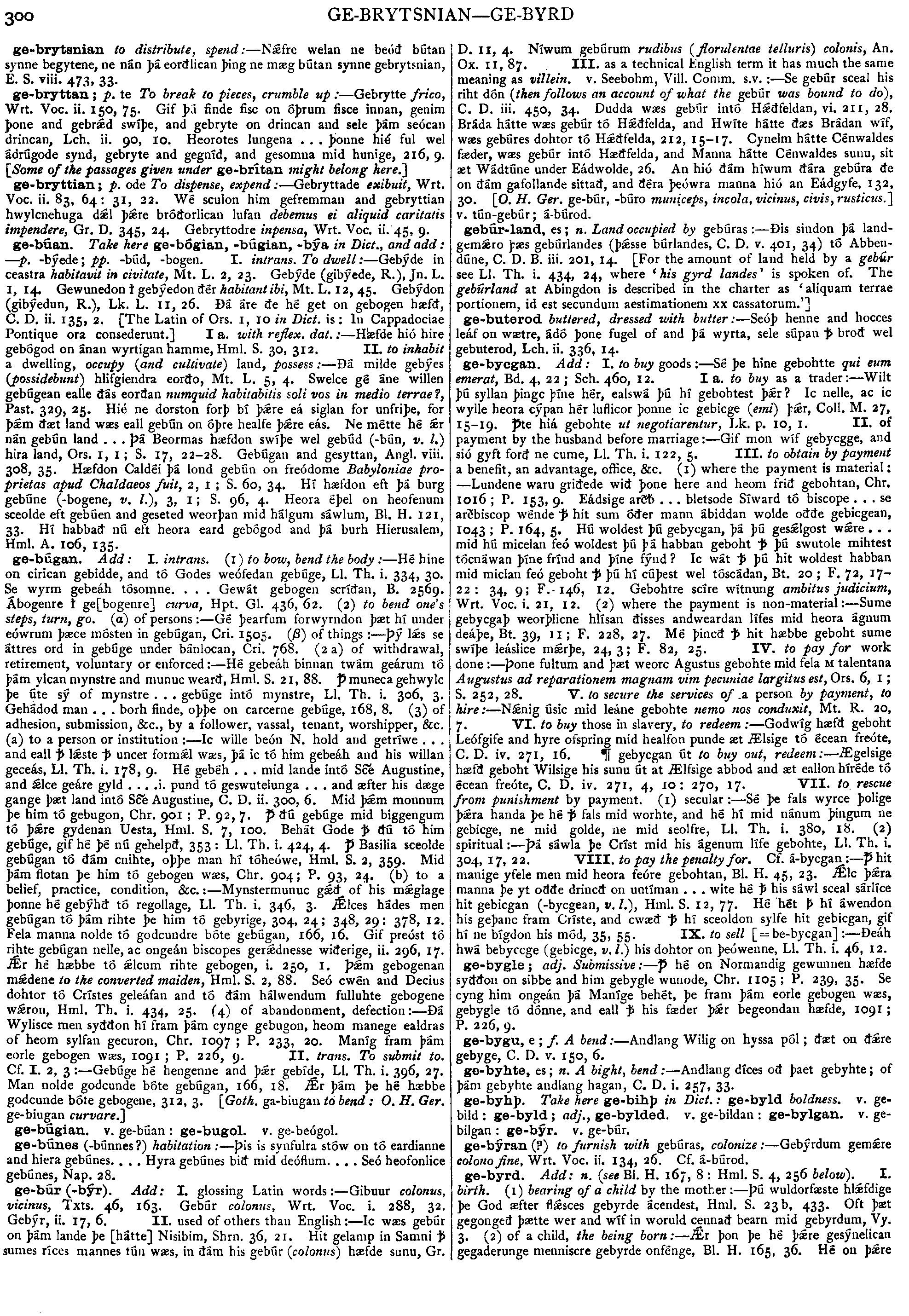
ge-búgan.
Add:
I.
intrans.
(1)
to
bow,
bend
the
body
:--
Hé
hine
on
cirican
gebidde,
and
tó
Godes
weófedan
gebúge,
Ll.
Th.
i.
334,
30.
Se
wyrm
gebeáh
tósomne.
...
Gewát
gebogen
scríðan,
B.
2569.
Ábogenre
 ge[bogenre]
curva,
Hpt.
Gl.
436,
62.
(2)
to
bend
one's
steps,
turn,
go.
(
ge[bogenre]
curva,
Hpt.
Gl.
436,
62.
(2)
to
bend
one's
steps,
turn,
go.
( )
of
persons
:--
Gé
þearfum
forwyrndon
þæt
hí
under
eówrum
þæce
mósten
in
gebúgan,
Cri.
1505.
(
)
of
persons
:--
Gé
þearfum
forwyrndon
þæt
hí
under
eówrum
þæce
mósten
in
gebúgan,
Cri.
1505.
( )
of
things
:--
Þý
ls
se
áttres
ord
in
gebúge
under
bánlocan,
Cri.
768.
(2
a)
of
withdrawal,
retirement,
voluntary
or
enforced
:--
Hé
gebeáh
binnan
twám
geárum
tó
þám
ylcan
mynstre
and
munuc
wearð.
Hml.
S.
21,
88.
muneca
gehwylc
þe
úte
sý
of
mynstre
...
gebúge
into
mynstre,
Ll.
Th.
i.
306,
3.
Gehádod
man
...
borh
finde,
oþþe
on
carcerne
gebúge,
168,
8.
(3)
of
adhesion,
submission,
&c.,
by
a
follower,
vassal,
tenant,
worshipper,
&c.
(a)
to
a
person
or
institution
:--
Ic
wille
beón
N.
hold
and
getríwe
...
and
eall
lste
uncer
forml
wæs,
þá
ic
tó
him
gebeáh
and
his
willan
geceás,
Ll.
Th.
i.
178,
9.
Hé
gebéh
...
mid
lande
intó
Sce
UNCERTAIN
Augustine,
and
lce
geáre
gyld
...
.i.
pund
tó
geswutelunga
...
and
æfter
his
dæge
gange
þæt
land
intó
Sce
UNCERTAIN
Augustine,
C.D.
ii.
300,
6.
Mid
þm
monnum
þe
him
tó
gebugon,
Chr.
901;
P.
92,
7.
ðú
gebúge
mid
biggengum
tó
þre
gydenan
Uesta,
Hml.
S.
7,
100.
Behát
Gode
ðú
tó
him
gebúge,
gif
hé
þé
nú
gehelpð,
353:
Ll.
Th.
i.
424,
4.
Basilia
sceolde
gebúgan
to
ðám
cnihte,
oþþe
man
hí
tóheówe.
Hml.
S.
2,
359.
Mid
þám
flotan
þe
him
tó
gebogen
wæs,
Chr.
904;
P.
93,
24.
(b)
to
a
belief,
practice,
condition,
&c.:--
Mynstermunuc
gð
of
his
mglage
þonne
hé
gebýhð
tó
regollage,
Ll.
Th.
i.
346,
3.
Æ-acute;lces
hádes
men
gebúgan
tó
þám
rihte
þe
him
tó
gebyrige,
304,
24;
348,
29:
378,
12.
Fela
manna
nolde
to
godcundre
bóte
gebúgan,
166,
16.
Gif
preóst
tó
rihte
gebúgan
nelle,
ac
ongeán
biscopes
gerdnesse
wiðerige,
ii.
296,
17.
Æ-acute;r
hé
hæbbe
tó
lcum
rihte
gebogen,
i.
250,
1.
Þm.
gebogenan
mdene
to
the
converted
maiden,
Hml.
S.
2,
88.
Seó
cwén
and
Decius
dohtor
to
Crístes
geleáfan
and
tó
ðám
hálwendum
fulluhte
gebogene
wron,
Hml.
Th.
i.
434,
25.
(4)
of
abandonment,
defection
:--
Ðá
Wylisce
men
syððon
hí
fram
þám
cynge
gebugon,
heom
manege
ealdras
of
heom
sylfan
gecuron.
Chr.
1097;
P.
233,
20.
Maníg
fram
þám
eorle
gebogen
wæs,
1091
;
P.
226,
9.
II.
trans.
To
submit
to.
Cf.
I.
2,
3
:--
Gebúge
hé
hengenne
and
þr
gebíde,
Ll.
Th.
i.
396,
27.
Man
nolde
godcunde
bóte
gebúgan,
166,
18.
Æ-acute;r
þám
þe
hé
hæbbe
godcunde
bóte
gebogene,
312,
3.
[Goth,
ga-biugan
to
bend:
O.H.
Ger.
ge-biugan
curvare.]
)
of
things
:--
Þý
ls
se
áttres
ord
in
gebúge
under
bánlocan,
Cri.
768.
(2
a)
of
withdrawal,
retirement,
voluntary
or
enforced
:--
Hé
gebeáh
binnan
twám
geárum
tó
þám
ylcan
mynstre
and
munuc
wearð.
Hml.
S.
21,
88.
muneca
gehwylc
þe
úte
sý
of
mynstre
...
gebúge
into
mynstre,
Ll.
Th.
i.
306,
3.
Gehádod
man
...
borh
finde,
oþþe
on
carcerne
gebúge,
168,
8.
(3)
of
adhesion,
submission,
&c.,
by
a
follower,
vassal,
tenant,
worshipper,
&c.
(a)
to
a
person
or
institution
:--
Ic
wille
beón
N.
hold
and
getríwe
...
and
eall
lste
uncer
forml
wæs,
þá
ic
tó
him
gebeáh
and
his
willan
geceás,
Ll.
Th.
i.
178,
9.
Hé
gebéh
...
mid
lande
intó
Sce
UNCERTAIN
Augustine,
and
lce
geáre
gyld
...
.i.
pund
tó
geswutelunga
...
and
æfter
his
dæge
gange
þæt
land
intó
Sce
UNCERTAIN
Augustine,
C.D.
ii.
300,
6.
Mid
þm
monnum
þe
him
tó
gebugon,
Chr.
901;
P.
92,
7.
ðú
gebúge
mid
biggengum
tó
þre
gydenan
Uesta,
Hml.
S.
7,
100.
Behát
Gode
ðú
tó
him
gebúge,
gif
hé
þé
nú
gehelpð,
353:
Ll.
Th.
i.
424,
4.
Basilia
sceolde
gebúgan
to
ðám
cnihte,
oþþe
man
hí
tóheówe.
Hml.
S.
2,
359.
Mid
þám
flotan
þe
him
tó
gebogen
wæs,
Chr.
904;
P.
93,
24.
(b)
to
a
belief,
practice,
condition,
&c.:--
Mynstermunuc
gð
of
his
mglage
þonne
hé
gebýhð
tó
regollage,
Ll.
Th.
i.
346,
3.
Æ-acute;lces
hádes
men
gebúgan
tó
þám
rihte
þe
him
tó
gebyrige,
304,
24;
348,
29:
378,
12.
Fela
manna
nolde
to
godcundre
bóte
gebúgan,
166,
16.
Gif
preóst
tó
rihte
gebúgan
nelle,
ac
ongeán
biscopes
gerdnesse
wiðerige,
ii.
296,
17.
Æ-acute;r
hé
hæbbe
tó
lcum
rihte
gebogen,
i.
250,
1.
Þm.
gebogenan
mdene
to
the
converted
maiden,
Hml.
S.
2,
88.
Seó
cwén
and
Decius
dohtor
to
Crístes
geleáfan
and
tó
ðám
hálwendum
fulluhte
gebogene
wron,
Hml.
Th.
i.
434,
25.
(4)
of
abandonment,
defection
:--
Ðá
Wylisce
men
syððon
hí
fram
þám
cynge
gebugon,
heom
manege
ealdras
of
heom
sylfan
gecuron.
Chr.
1097;
P.
233,
20.
Maníg
fram
þám
eorle
gebogen
wæs,
1091
;
P.
226,
9.
II.
trans.
To
submit
to.
Cf.
I.
2,
3
:--
Gebúge
hé
hengenne
and
þr
gebíde,
Ll.
Th.
i.
396,
27.
Man
nolde
godcunde
bóte
gebúgan,
166,
18.
Æ-acute;r
þám
þe
hé
hæbbe
godcunde
bóte
gebogene,
312,
3.
[Goth,
ga-biugan
to
bend:
O.H.
Ger.
ge-biugan
curvare.]
|
Source: Bosworth/Toller, page d0300, entry 11 View original page image as: [TIFF] [PNG] [View previous entry] [View next entry] |
[Comment on this entry] [View comments] |
The following entry has been hand-corrected once. |
ge-bycgan.
Add:
I.
to
buy
goods
:--
Sé
þe
hine
gebohtte
qui
eum
emerat,
Bd.
4,
22;
Sch.
460,
12.
1
a.
to
buy
as
a
trader
:--
Wilt
þú
syllan
þingc
þíne
hér,
ealswá
þú
hí
gebohtest
þr?
Ic
nelle,
ac
ic
wylle
heora
cýpan
hér
luflicor
þonne
ic
gebicge
(emi)
þr,
Coll.
M.
27,
15-19.
te
hiá
gebohte
ut
negotiarentur,
Lk.
p.
10,
1.
II.
of
payment
by
the
husband
before
marriage
:--
Gif
mon
wíf
gebycgge,
and
sió
gyft
forð
ne
cume,
Ll.
Th.
i.
122,
5.
III.
to
obtain
by
payment
a
benefit,
an
advantage,
office,
&c.
(1)
where
the
payment
is
material:--
Lundene
waru
griðede
wið
þone
here
and
heom
frið
gebohtan.
Chr.
1016;
P.
153,
9.
Eádsige
arcb
UNCERTAIN
...
bletsode
Síward
tó
biscope
...
se
arcbiscop
wénde
hit
sum
óðer
mann
ábiddan
wolde
oððe
gebicgean,
1043;
P.
164,
5.
Hú
woldest
þú
gebycgan,
þá
þú
geslgost
wre
...
mid
hú
micelan
feó
woldest
þú
þá
habban
geboht
þú
swutole
mihtest
tócnáwan
þíne
frínd
and
þine
fýnd?
Ic
wát
þú
hit
woldest
habban
mid
miclan
feó
geboht
þú
hí
cúþest
wel
tóscádan,
Bt.
20;
F.
72,
17-22:
34,
9;
F.
146,
12.
Gebohtre
scíre
wítnung
ambitus
judicium,
Wrt.
Voc.
i.
21,
12.
(2)
where
the
payment
is
non-material
:--
Sume
gebycgaþ
weorþlicne
hlísan
ðisses
andweardan
lífes
mid
heora
ágnum
deáþe,
Bt.
39
11;
F.
228,
27.
Mé
þincð
hit
hæbbe
geboht
sume
swíþe
leáslice
mrþe,
24,
3;
F.
82,
25.
IV.
to
pay
for
work
done
:--
Þone
fultum
and
þæt
weorc
Agustus
gebohte
mid
fela
M
talentana
Augustus
ad
reparationem
magnam
vim
pecuniae
largitus
est,
Ors.
6,
1;
S.
252,
28.
V.
to
secure
the
services
of
a
person
by
payment,
to
hire
:--
Nnig
úsic
mid
leáne
gebohte
nemo
nos
conduxit,
Mt.
R.
20,
7.
VI.
to
buy
those
in
slavery,
to
redeem
:--
Godwíg
hæfð
geboht
Leófgife
and
hyre
ofspring
mid
healfon
punde
æt
Ælsige
tó
écean
freóte,
C.D.
iv.
271,
16.

gebycgan
út
to
buy
out,
redeem
:--
Ægelsige
hæfð
geboht
Wilsige
his
sunu
út
at
Ælfsige
abbod
and
æt
eallon
híréde
tó
écean
freóte,
C.D.
iv.
271,
4,
10:
270,
17.
VII.
to
rescue
from
punishment
by
payment.
(1)
secular
:--
Sé
þe
fals
wyrce
þolige
þra
handa
þe
hé
fals
mid
worhte,
and
hé
hí
mid
nánum
þingum
ne
gebicge,
ne
mid
golde,
ne
mid
seolfre,
Ll.
Th.
i.
380,
18.
(2)
spiritual
:--
Þá
sáwla
þe
Críst
mid
his
ágenum
lífe
gebohte,
Ll.
Th.
i.
304,
17,
22.
VIII.
to
pay
the
penalty
for.
Cf.
á-bycgan
:--
hit
manige
yfele
men
mid
heora
feóre
gebohtan,
Bl.
H.
45,
23.
Æ-acute;lc
þra
manna
þe
yt
oððe
drincð
on
untíman
...
wite
hé
his
sáwl
sceal
sárlíce
hit
gebicgan
(-bycgean,
v.l.),
Hml.
S.
12,
77.
Hé
hét
hí
áwendon
his
geþanc
fram
Críste,
and
cwæð
hí
sceoldon
sylfe
hit
gebicgan,
gif
hí
ne
bígdon
his
mód,
35,
55.
IX.
to
sell
[=
be-bycgan]
:--
Ðeáh
hwá
bebyccge
(gebicge,
v.l.)
his
dohtor
on
þeówenne,
Ll.
Th.
i.
46,
12.
|
Source: Bosworth/Toller, page d0300, entry 12 View original page image as: [TIFF] [PNG] [View previous entry] [View next entry] |
[Comment on this entry] [View comments] |
The following entry has been hand-corrected once. |
ge-bygle;
adj.
Submissive
:--
hé
on
Normandig
gewunnen
hæfde
syððon
on
sibbe
and
him
gebygle
wunode,
Chr.
1105;
P.
239,
35.
Se
cyng
him
ongeán
þá
Maníge
behét,
þe
fram
þám
eorle
gebogen
wæs,
gebygle
tó
dónne,
and
eall
his
fæder
þr
begeondan
hæfde,
1091;
P.
226,
9.
|
Source: Bosworth/Toller, page d0301, entry 8 View original page image as: [TIFF] [PNG] [View previous entry] [View next entry] |
[Comment on this entry] [View comments] |
The following entry has been hand-corrected once. |
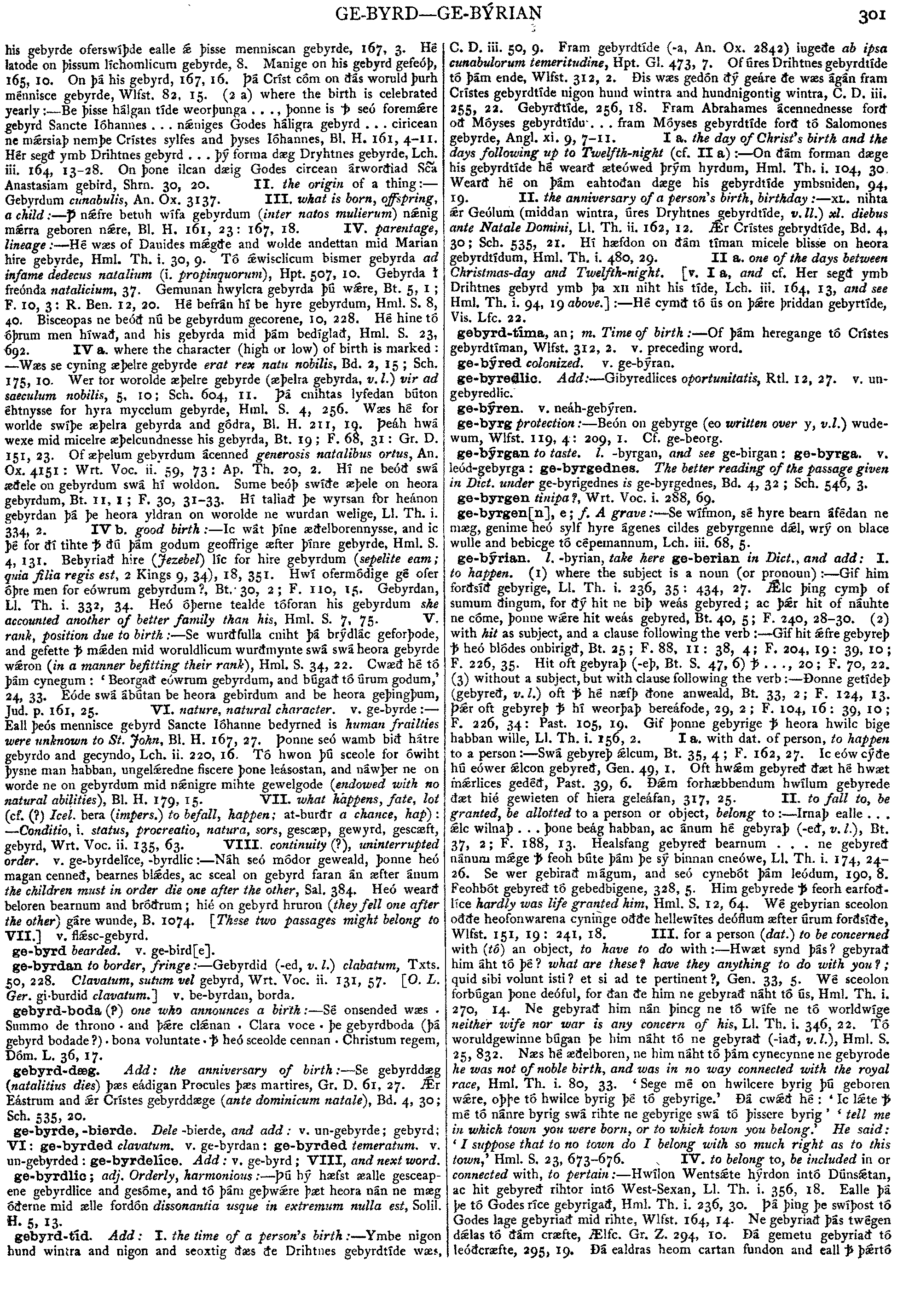
gebyrd-tíd.
Add:
I.
the
time
of
a
person's
birth
:--
Ymbe
nigon
hund
wintra
and
nigon
and
seoxtig
ðæs
ðe
Drihtnes
gebyrdtíde
wæs.
C.D.
iii.
50,
9.
Fram
gebyrdtíde
(-a,
An.
Ox.
2842)
iugeðe
ab
ipsa
cunabulorum
temeritudine,
Hpt.
Gl.
473,
7.
Of
úres
Drihtnes
gebyrdtíde
tó
þám
ende.
Wlfst.
312,
2.
Ðis
wæs
gedón
ðý
geáre
ðe
wæs
ágán
fram
Crístes
gebyrdtíde
nigon
hund
wintra
and
hundnigontig
wintra,
C.D.
iii.
255,
22.
Gebyrðtíde,
256,
18.
Fram
Abrahames
ácennednesse
forð
oð
Móyses
gebyrdtídu
...
fram
Móyses
gebyrdtíde
forð
tó
Salomones
gebyrde,
Angl.
xi.
9,
7-11.
I
a.
the
day
of
Christ's
birth
and
the
days
following
up
to
Twelfth-night
(cf.
II
a)
:--
On
ðám
forman
dæge
his
gebyrdtíde
hé
wearð
æteówed
þrým
hyrdum,
Hml.
Th.
i.
104,
30.
Wearð
hé
on
þám
eahtoðan
dæge
his
gebyrdtíde
ymbsniden,
94,
19.
II.
the
anniversary
of
a
person's
birth,
birthday
:--
xl.
nihta
r
Geólum
(middan
wintra,
úres
Dryhtnes
gebyrdtíde,
v.ll.)
xl.
diebus
ante
Natale
Domini,
Ll.
Th.
ii.
162,
12.
Æ-acute;r
Crístes
gebrydtíde,
Bd.
4,
30;
Sch.
535,
21.
Hí
hæfdon
on
ðám
tíman
micele
blisse
on
heora
gebyrdtídum,
Hml.
Th.
i.
480,
29.
II
a.
one
of
the
days
between
Christmas-day
and
Twelfth-night,
[v.
I
a.
and
cf.
Her
segð
ymb
Drihtnes
gebyrd
ymb
þa
xii
niht
his
tíde,
Lch.
iii.
164,
13,
and
see
Hml.
Th.
i.
94,
19
above.]
:--
Hé
cymð
tó
ús
on
þre
þriddan
gebyrtíde,
Vis.
Lfc.
22.
|
Source: Bosworth/Toller, page d0302, entry 9 View original page image as: [TIFF] [PNG] [View previous entry] [View next entry] |
[Comment on this entry] [View comments] |
The following entry has been hand-corrected once. |
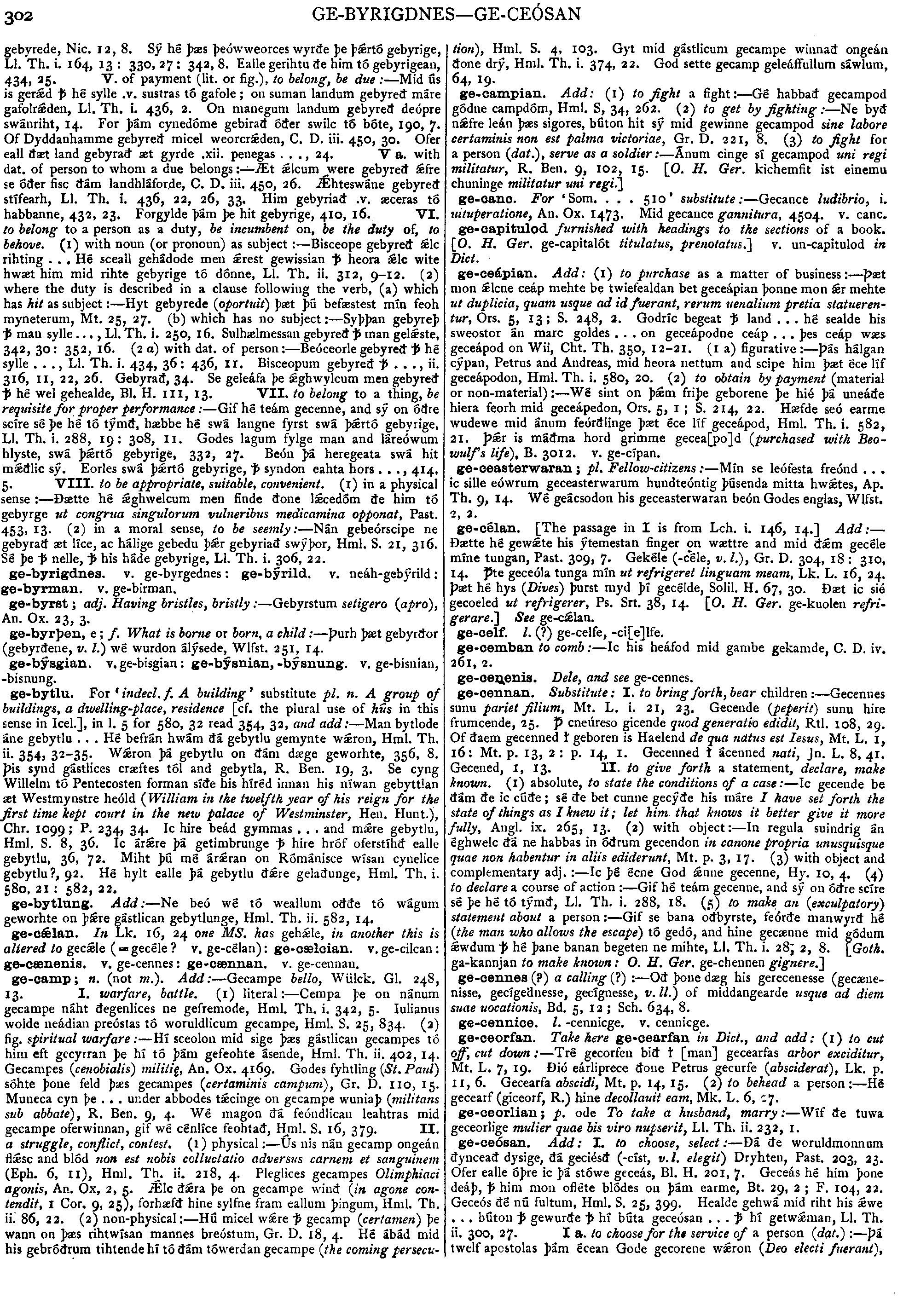
ge-camp;
n.
(not
m.).
Add
:--
Gecampe
bello,
Wülck.
Gl.
248,
13.
I.
warfare,
battle.
(1)
literal
:--
Cempa
þe
on
nánum
gecampe
náht
ðegenlices
ne
gefremode,
Hml.
Th.
i.
342,
5.
Iulianus
wolde
neádian
preóstas
tó
woruldlicum
gecampe,
Hml.
S.
25,
834.
(2)
fig.
spiritual
warfare
:--
Hí
sceolon
mid
sige
þæs
gástlican
gecampes
tó
him
eft
gecyrran
þe
hí
tó
þám
gefeohte
ásende,
Hml.
Th.
ii.
402,
14.
Gecampes
(cenobialis)
militie,
An.
Ox.
4169.
Godes
fyhtling
(St.
Paul)
sóhte
þone
feld
þæs
gecampes
(certaminis
campum),
Gr.
D.
110,
15.
Muneca
cyn
þe
...
under
abbodes
tcinge
on
gecampe
wuniaþ
(militans
sub
abbate),
R.
Ben.
9,
4.
Wé
magon
ðá
feóndlican
leahtras
mid
gecampe
oferwinnan,
gif
wé
cénlíce
feohtað,
Hml.
S.
16,
379.
II.
a
struggle,
conflict,
contest,
(1)
physical
:--
Ús
nis
nán
gecamp
ongeán
flsc
and
blód
non
est
nobis
colluctatio
adversus
carnem
et
sanguinem
(Eph.
6,
11),
Hml.
Th.
ii.
218,
4.
Pleglices
gecampes
Olimphiaci
agonis.
An.
Ox,
2,
5.
Æ-acute;lc
ðra
þe
on
gecampe
winð
(in
agone
contendit,
I
Cor.
9,
25),
forhæfð
hine
sylfne
fram
eallum
þingum,
Hml.
Th.
ii.
86,
22.
(2)
non-physical
:--
Hú
micel
wre
gecamp
(certamen)
þe
wann
on
þæs
rihtwísan
mannes
breóstum,
Gr.
D.
18,
4.
Hé
ábád
mid
his
gebróðrum
tihtende
hí
tó
ðám
tówerdan
gecampe
(the
coming
persecution),
Hml.
S.
4,
103.
Gyt
mid
gástlicum
gecampe
winnað
ongeán
ðone
drý,
Hml.
Th.
i.
374,
22.
God
sette
gecamp
geleáffullum
sáwlum,
64,
19.
| Result Page: |  |
Previous | 110 111 112 113 114 115 116 117 118 119 120 121 122 123 124 125 126 127 128 | Next |  |
Germanic Lexicon Project (main page)
This search system was written by
Sean Crist
Please consider
volunteering
to correct the data in these online dictionaries.
No rights reserved. Feel free to use these data in any way you please.