|
|

|
Source: Bosworth/Toller, page b0970, entry 11 View original page image as: [TIFF] [PNG] [View previous entry] [View next entry] |
[Comment on this entry] [View comments] |
The following entry has been hand-corrected once. |
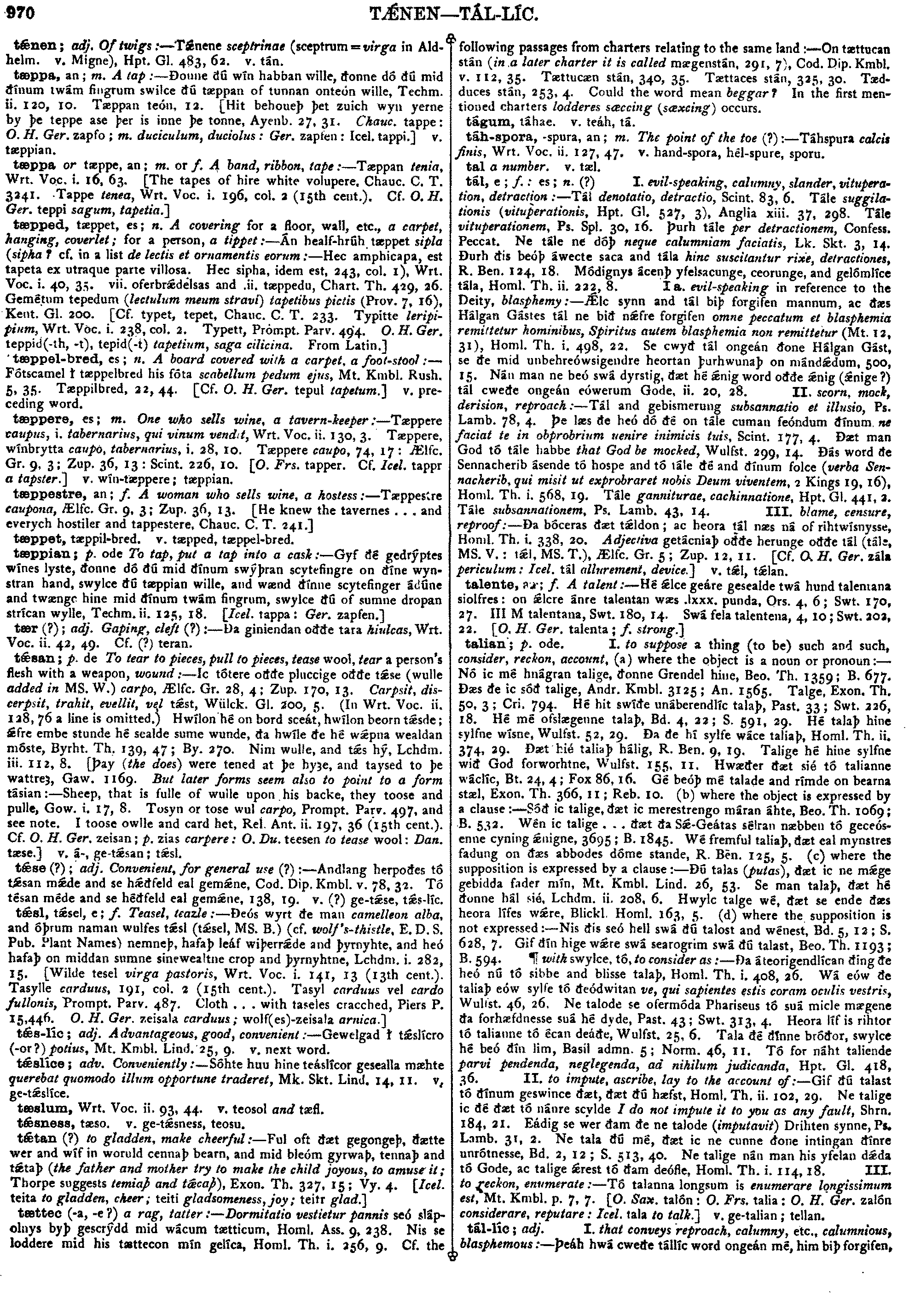
t san;
p.
de
To
tear
to
pieces,
pull
to
pieces,
tease
wool,
tear
a
person's
flesh
with
a
weapon,
wound
:--
Ic
tótere
oððe
pluccige
oððe
tse
(wulle
added
in
MS.
W.)
carpo,
Ælfc.
Gr.
28,
4;
Zup.
170,
13.
Carpsit,
discerpsit,
trahit,
evellit,
vel
tst,
Wülck.
Gl.
200,
5.
(In
Wrt.
Voc.
ii.
128,
76
a
line
is
omitted.)
Hwílon
hé
on
bord
sceát,
hwílon
beorn
tsde;
fre
embe
stunde
hé
sealde
sume
wunde,
ða
hwíle
ðe
hé
wpna
wealdan
móste,
Byrht.
Th.
139,
47;
By.
270.
Nint
wulle,
and
ts
hý,
Lchdm.
iii.
112,
8.
[Þay
(the
does)
were
tened
at
þe
hy
san;
p.
de
To
tear
to
pieces,
pull
to
pieces,
tease
wool,
tear
a
person's
flesh
with
a
weapon,
wound
:--
Ic
tótere
oððe
pluccige
oððe
tse
(wulle
added
in
MS.
W.)
carpo,
Ælfc.
Gr.
28,
4;
Zup.
170,
13.
Carpsit,
discerpsit,
trahit,
evellit,
vel
tst,
Wülck.
Gl.
200,
5.
(In
Wrt.
Voc.
ii.
128,
76
a
line
is
omitted.)
Hwílon
hé
on
bord
sceát,
hwílon
beorn
tsde;
fre
embe
stunde
hé
sealde
sume
wunde,
ða
hwíle
ðe
hé
wpna
wealdan
móste,
Byrht.
Th.
139,
47;
By.
270.
Nint
wulle,
and
ts
hý,
Lchdm.
iii.
112,
8.
[Þay
(the
does)
were
tened
at
þe
hy e,
and
taysed
to
þe
wattre,
Gaw.
1169.
But
later
forms
seem
also
to
point
to
a
form
tásian
:--
Sheep,
that
is
fulle
of
wulle
upon
his
backe,
they
toose
and
pulle,
Gow.
i.
17,
8.
Tosyn
or
tose
wul
carpo,
Prompt.
Parv.
497,
and
see
note.
I
toose
owlle
and
card
het,
Rel.
Ant.
ii.
197,
36
(15th
cent.).
Cf.
O.
H.
Ger.
zeisan;
p.
zias
carpere:
O.
Du.
teesen
to
tease
wool:
Dan.
tæse.]
v.
á-,
ge-tsan;
tsl.
e,
and
taysed
to
þe
wattre,
Gaw.
1169.
But
later
forms
seem
also
to
point
to
a
form
tásian
:--
Sheep,
that
is
fulle
of
wulle
upon
his
backe,
they
toose
and
pulle,
Gow.
i.
17,
8.
Tosyn
or
tose
wul
carpo,
Prompt.
Parv.
497,
and
see
note.
I
toose
owlle
and
card
het,
Rel.
Ant.
ii.
197,
36
(15th
cent.).
Cf.
O.
H.
Ger.
zeisan;
p.
zias
carpere:
O.
Du.
teesen
to
tease
wool:
Dan.
tæse.]
v.
á-,
ge-tsan;
tsl.
|
Source: Bosworth/Toller, page b0972, entry 14 View original page image as: [TIFF] [PNG] [View previous entry] [View next entry] |
[Comment on this entry] [View comments] |
The following entry has been hand-corrected once. |
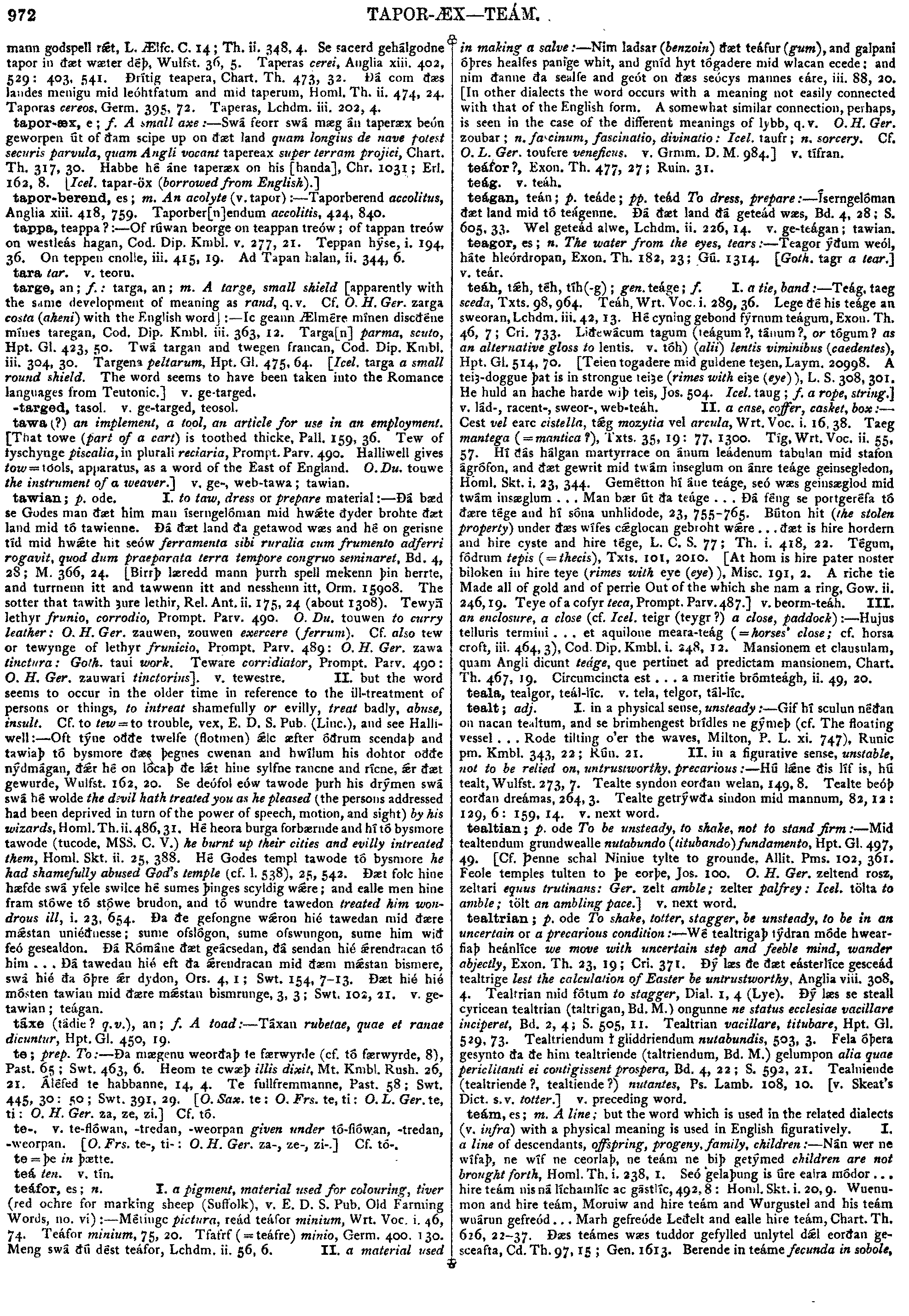
teáfor, es; n. I. a pigment, material used for colouring, tiver (red ochre for marking sheep (Suffolk), v. E. D. S. Pub. Old Farming Words, no. vi) :-- Métingc pictura, reád teáfor minium, Wrt. Voc. i. 46, 74. Teáfor minium, 75, 20. Tfafrf ( = teáfre) minio, Germ. 400, 130. Meng swá ðú dést teáfor, Lchdm. ii. 56, 6. II. a material used in making a salve :-- Nim ladsar (benzoin) ðæt teáfur (gum) and galpani óþres healfes panige whit, and gníd hyt tógadere mid wlacan ecede; and nim ðanne ða sealfe and geót on ðæs seócys mannes eáre, iii. 88, 20. [In other dialects the word occurs with a meaning not easily connected with that of the English form. A somewhat similar connection, perhaps, is seen in the case of the different meanings of lybb, q.v. O. H. Ger. zoubar; n. fascinum, fascinatio, divinatio: Icel. taufr; n. sorcery. Cf. O. L. Ger. toufere veneficus. v. Grmm. D. M. 984.] v. tífran.
|
Source: Bosworth/Toller, page b0972, entry 24 View original page image as: [TIFF] [PNG] [View previous entry] [View next entry] |
[Comment on this entry] [View comments] |
The following entry has been hand-corrected once. |
teám,
es;
m.
A
line;
but
the
word
which
is
used
in
the
related
dialects
(v.
infra)
with
a
physical
meaning
is
used
in
English
figuratively.
I.
a
line
of
descendants,
offspring,
progeny,
family,
children
:--
Nán
wen
ne
wífaþ,
ne
wíf
ne
ceorlaþ,
ne
teám
ne
biþ
getýmed
children
are
not
brought
forth,
Homl.
Th.
i.
238,
1.
Seó
gelaþung
is
úre
ealra
módor
...
hire
teám
nis
ná
líchamlíc
ac
gástlíc,
492,
8:
Homl.
Skt.
i.
20,
9.
Wuenumon
and
hire
teám,
Moruiw
and
hire
teám
and
Wurgustel
and
his
teám
wuárun
gefreód
...
Marh
gefreóde
Leðelt
and
ealle
hire
teám,
Chart.
Th.
626,
22-37.
Ðæs
teámes
wæs
tuddor
gefylled
unlytel
dl
eorðan
gesceafta,
Cd.
Th.
97,
15;
Gen.
1613.
Berende
in
teáme
fecunda
in
sobole,
Rtl.
110,
7.
Hé
Noe
bearh
and
his
wífe
and
his
teáme,
Gen.
5,
31
note:
Homl.
Skt.
i.
8,
18.
Caines
ofspring
forwearð
ádrenced
on
ðam
deópan
flóde
...
and
of
ðam
yfelan
teáme
ne
com
nán
þing
siððan,
Ælfc.
T.
Grn.
3,
27.
Séd
 teám
semen,
Mk.
Skt.
Lind.
12,
21,
22.
Ðæt
folc
týmde
micelne
teám
on
ðam
wéstene,
Homl.
Th.
ii.
212,
17.
Teám
gestrýnan,
324,
11.
Ðreó
wíteþeówe
men
mé
salde
bisceop
and
hire
teám,
Chart.
Th.
152,
22.
Fyllaþ
eówre
fromcynne
foldan
sceátas,
teámum
and
túdre,
Cd.
Th.
92,
27;
Gen.
1535.

of
animals
:--
Beón
týmaþ
heora
teám
mid
clnnysse,
Homl.
Th.
ii.
10,
17.
[Weóx
swa
Adames
team
her,
ne
mahte
hit
na
mon
tellen,
Jul.
61,
7.
Drauh
togedere
al
þene
team
under
þe
moder,
A.
R.
336,
15.
Wurrþenn
wiþþ
childe,
and
tæmenn
hire
tæm,
Orm.
2415.
Ys
foure
sones
...
Þys
was
a
stalwarde
tem,
R.
Glouc.
261,
4.]
I
a.
bringing
forth
children,
child-bearing
:--
Ðonne
wíf
byþ
teámes
ætealdod,
Homl.
Ass.
20,
159.
His
wíf
wearð
mid
Esau
and
Iacob,
and
heó
geswác
ðá
teámes,
38,
339.
[Weren
boðe
(John's
parents)
teames
ateald,
O.
E.
Homl.
ii.
133,
32.]
II.
a
line
of
animals
harnessed
together,
a
team
:--
Oxa
on
ðam
forman
teáme
(cf.
oxa
on
frumteáme
imus,
ii.
48,
36)
imus,
on
ðam
æfteran
teáme
binus
(bimus),
Wrt.
Voc.
i.
23,
47,
48.
On
ðæm
æftran
teáme
bimus,
ii.
12,
70.
v.
feoþer-tíme,
iuc-tíma,
ge-týme.
The
old
pictures
represent
the
plough
as
drawn
by
two
pairs
of
oxen
one
behind
the
other.
Cf.
My
plowman
...
a
teme
(teome,
MS.
C.)
shal
he
haue.
Grace
gaue
Piers
a
teme,
foure
gret
oxen,
Piers
P.
B.
19,
256.
III.
as
a
legal
term,
(1)
vouching
to
warranty.
The
word
denotes
one
step
in
the
proceedings
of
a
suit
for
the
recovery
of
property,
which
was
found
in
one
man's
possession
and
claimed
by
another,
who
alleged
that
it
had
been
stolen
or
had
strayed
from
him.
The
peculiar
character
of
the
process
to
which
it
refers
was
determined
by
the
formalities
insisted
upon
by
the
law
when
property
changed
hands.
At
such
a
transaction
the
presence
of
witnesses
was
necessary
(L.
Ed.
1;
Th.
i.
158,
11:
L.
Edg.
H.
4;
Th.
i.
258,
22:
L.
Edm.
C.
5;
Th.
i.
253,
8:
L.
C.
S.
23;
Th.
i.
388,
21:
24;
Th.
i.
390,
4),
and
one
responsible
person
(geteáma),
who
according
to
Ine's
laws
must
not
be
a
þeów
man
(L.
In.
47;
Th.
i.
132,
5),
was
to
be
fixed
upon
as
representing
the
party
that
made
the
sale
or
transfer,
and
to
him,
if
a
question
subsequently
arose
as
to
ownership,
the
new
owner
might
refer
(tíman)
in
support
of
his
right;
this
referring
the
property
to
the
party
who
had
sold
it
was
teám.
In
cases
of
undivided
ownership
the
geteáma
would
be
the
person
making
the
sale;
in
cases
of
joint
ownership
one
of
the
parties
would
be
taken.
The
proceedings
in
a
suit
in
which
teám
was
resorted
to
seem
to
have
been
somewhat
as
follows.
The
plaintiff,
who
made
claim
to
property
on
the
plea
that
it
had
been
stolen
from
him,
had
to
give
security
that
he
would
carry
on
his
case:
Warige
hine,
se
ðe
his
ágen
befóþ,
ðæt
hé
tó
lcan
teáme
hæbbe
getrýwne
borh,
L.
Eth.
ii.
9;
Th.
i.
290,
6:
Wil.
I.
21;
Th.
i.
477,
11;
the
defendant
had
to
declare
how
the
property
came
into
his
hands,
and
to
give
security
that
he
would
produce
his
geteáma
in
court:
Gif
hwá
befó
ðæt
him
losod
wæs,
cenne
se
ðe
hé
hit
æt
befó
hwanon
hit
him
cóme,
sylle
on
hand
and
sette
borh
(pledge
himself
and
find
security)
ðæt
hé
bringe
his
geteáman
in
ðr
hit
besprecen
biþ,
L.
Eth.
ii.
8;
Th.
i.
288,
15.
On
the
case
being
brought
into
court
(which
was
to
be
held
in
cynges
sele,
L.
H.
E.
7;
Th.
i.
30,
18:
16;
Th.
i.
34,
7,
or
kyninges
burh:
Æ-acute;lc
teám
beó
on
ðæs
kyninges
byrig;
L.
Eth.
iii.
6;
Th.
i.
296,
4),
the
plaintiff
made
oath,
that
he
prosecuted
his
suit
lawfully
and
fairly,
L.
O.
2;
Th.
i.
178,
10,
and
without
malice,
4;
Th.
i.
180,
8;
the
defendant
on
his
side
made
oath
that
he
had
had
no
part
in
the
alleged
robbery,
but
had
acquired
the
property
in
a
lawful
manner,
3;
Th.
i.
178,
16,
and
was
guiltless,
5;
Th.
i.
180,
14.
He
was
now
bound
to
produce
witnesses
of
the
transaction
which
resulted
in
his
acquiring
the
property
in
dispute,
or
teám
was
denied
him:
Búton
hé
ðara
óðer
(certain
witness)
hæbbe,
nele
him
mon
nnne
teám
geþafian,
L.
Edg.
H.
4;
Th.
i.
260,
2.
Ne
beó
nig
man
niges
teámes
wyrðe
búton
hé
getrýwe
gewitnysse
hæbbe,
L.
C.
S.
23;
Th.
i.
388,
20.
Ne
beó
ðr
nán
teám,
24;
Th.
i.
390,
6.
If
the
witness
was
forthcoming,
the
geteáma
had
to
be
produced,
and
witness
or
oath
again
was
called
for
to
prove
that
the
defendant's
proceedings
were
correct:
Wé
cwdon,
se
ðe
týman
scolde,
ðæt
hé
hæfde
ungeligene
gewitnesse
ðæs
ðæt
hé
hit
on
riht
týmde,
oþþe
ðone
áð
funde
ðe
se
gelýfan
mihte
ðe
on
sprece,
L.
Ed.
1;
Th.
i.
158,
16.
If
the
geteáma,
though
living,
were
not
brought,
according
to
one
regulation
the
defendant
lost
his
case,
and
had
to
resign
the
property,
L.
H.
E.
7;
Th.
i.
30,
9;
according
to
another,
if
he
could
bring
witness
to
prove
the
sale,
he
received
the
price
of
the
property
he
had
to
give
up,
16;
Th.
i.
34,
8.
If
the
geteáma
were
dead
other
formalities
were
prescribed,
L.
In.
53;
Th.
i.
134,
17:
L.
Eth.
ii.
9;
Th.
i.
290,
9.
If
all
the
requirements
had
been
satisfied
the
property
in
question
was
handed
over
to
the
geteáma:
Se
ðe
yrfe
bycge
on
gewitnesse,
and
hit
eft
týman
scyle,
ðonne
onfó
se
his
ðe
hé
hit
r
æt
bohte,
L.
Ath.
i.
24;
Th.
i.
212,
12.
Swá
ic
hit
týme
swá
hit
mé
se
sealde
ðe
ic
hit
nú
on
hand
sette,
L.
O.
3;
Th.
i.
180,
3:
L.
Eth.
ii.
8;
Th.
i.
288,
20;
and
the
defendant
thereupon
appealed
to
the
geteáma
to
corroborate
his
statement
of
the
case,
21.
If
the
latter
accepted
the
property,
the
former
was
cleared,
and
the
geteáma
himself
was
now
in
a
similar
position
to
that
in
which
the
defendant
had
stood,
22;
but
if
he
declined
to
receive
it,
and
declared
that
it
was
not
the
property
he
had
sold,
then
the
defendant
had
to
prove
that
it
was:
Gif
se
mon
(the
geteáma)
onfón
ne
wille,
and
sægþ
ðæt
hé
him
nfre
ðæt
(the
property)
ne
sealde,
ac
sealde
óðer,
ðonne
mót
se
gecýðan,
se
ðe
hit
tiémþ,
ðæt
hé
him
nán
óðer
ne
sealde
búton
ðæt
ilce,
L.
In.
75;
Th.
i.
150,
7:
cf.
35;
Th.
i.
124,
10.
If
however
the
case
were
not
stopped,
the
process,
in
earlier
times,
was
repeated
until
either
there
was
a
failure
to
produce
a
geteáma
(v.
teámbyrst),
or
the
property
was
traced
to
some
person
whose
right
to
its
possession
was
undoubted:
Gange
se
teám
forð
óþþæt
man
wire
hwr
hé
óðstande,
L.
Ed.
1;
Th.
i.
158,
15:
L.
Eth.
ii.
9;
Th.
i.
290,
3.
Betweox
teáme
gif
hwá
tó
féhþ,
and
ná
furðor
teám
ne
cenþ,
ac
ágnian
wile,
ne
mæg
mon
ðæs
wyrnan,
gif
getrýwe
gewitnes
him
tó
ágenunge
rýmþ,
290,
18.
Later
teám
was
necessary
only
three
times:
Týme
hit
man
þrywa,
æt
ðam
feórðan
cyrre
ágnige
hit,
oððe
ágyfe
ðam
ðe
hit
áge,
L.
C.
S.
24;
Th.
i.
390,
9.
At
one
time
also
a
change
was
made
in
the
place
where
teám
should
be
made:
Be
teámum.
Hwílon
stód
ðæt
man
sceolde
þrywa
týman
ðr
hit
rest
befangen
wre,
and
syþþan
fylgean
teáme
swá
hwr
swá
man
tó
cende.
Ðá
gerddan
witan,
ðæt
hit
betere
wre,
ðæt
man
ure
týmde
ðr
hit
rest
befangen
wre
...
ðý
læs
ðe
mon
unmihtigne
man
tó
feor
and
tó
lange
for
his
ágenan
swencte,
L.
Eth.
ii.
9;
Th.
i.
288,
28.
A
case
in
which
a
defendant
is
cleared
by
his
geteáma,
who,
however,
cannot
get
himself
cleared,
is
given
Chart.
Th.
206,
19
sqq.
A
woman
had
been
stolen,
and
was
found
in
the
possession
of
one
Wulfstan.
Ðá
týmde
Wulfstán
hine
(the
woman)
tó
Æðelstáne;
ðá
cende
hé
tém
and
lét
ðone
forberstan.
v.
teám-byrst.
Another
case
is
mentioned
where
a
bishop
was
not
allowed
teám:
Ne
móste
se
bisceop
beón
ðara
þreora
nánes
wyrðe
ðe
eallum
leódscipe
geseald
wæs
on
wedde,
tale,
ne
teámes,
ne
áhnunga,
266,
11.
(2)
The
word
also
occurs
often
in
charters
along
with
sac,
sóc,
toll,
etc.,
where
according
to
one
definition
it
refers
to
the
right
to
the
forfeitures
which
were
made
in
the
suits
where
teám
was
resorted
to:
Theam,
quod
si
aliquis
aliquid
interciebatur
super
aliquem,
et
ipse
non
poterat
warrantum
suum
habere,
erit
forisfactura,
et
justicia
sinuliter
de
calumpniatore,
si
deficiebat,
sua
erit,
L.
Ed.
C.
22;
Th.
i.
452,
1.
Donavi
abbati
...
consnetudinem
que
dicitur
teames,
Chart.
Th.
405,
1.
v.
teám-byrst.
A
different
meaning
is
given
elsewhere
to
the
word.
In
Cod.
Dip.
Kmbl.
iv.
202,
7
teám
occurs,
and
in
the
Latin
form
of
the
charter
is
rendered
by
'privilegium
habendi
totam
suorum
seruorum
propaginem,'
203,
6.
[O.
Frs.
tám
a
bridle;
a
line
of
descendants,
progeny,
family:
O.
L.
Ger.
tóm
frenum:
Du.
toom:
O.
H.
Ger.
zoum
funis,
habena;
Icel.
taumr
bridle,
rein,
cord.]
v.
bearn-,
frum-
(v.
II
above),
here-,
leger-teám;
tíman.
teám
semen,
Mk.
Skt.
Lind.
12,
21,
22.
Ðæt
folc
týmde
micelne
teám
on
ðam
wéstene,
Homl.
Th.
ii.
212,
17.
Teám
gestrýnan,
324,
11.
Ðreó
wíteþeówe
men
mé
salde
bisceop
and
hire
teám,
Chart.
Th.
152,
22.
Fyllaþ
eówre
fromcynne
foldan
sceátas,
teámum
and
túdre,
Cd.
Th.
92,
27;
Gen.
1535.

of
animals
:--
Beón
týmaþ
heora
teám
mid
clnnysse,
Homl.
Th.
ii.
10,
17.
[Weóx
swa
Adames
team
her,
ne
mahte
hit
na
mon
tellen,
Jul.
61,
7.
Drauh
togedere
al
þene
team
under
þe
moder,
A.
R.
336,
15.
Wurrþenn
wiþþ
childe,
and
tæmenn
hire
tæm,
Orm.
2415.
Ys
foure
sones
...
Þys
was
a
stalwarde
tem,
R.
Glouc.
261,
4.]
I
a.
bringing
forth
children,
child-bearing
:--
Ðonne
wíf
byþ
teámes
ætealdod,
Homl.
Ass.
20,
159.
His
wíf
wearð
mid
Esau
and
Iacob,
and
heó
geswác
ðá
teámes,
38,
339.
[Weren
boðe
(John's
parents)
teames
ateald,
O.
E.
Homl.
ii.
133,
32.]
II.
a
line
of
animals
harnessed
together,
a
team
:--
Oxa
on
ðam
forman
teáme
(cf.
oxa
on
frumteáme
imus,
ii.
48,
36)
imus,
on
ðam
æfteran
teáme
binus
(bimus),
Wrt.
Voc.
i.
23,
47,
48.
On
ðæm
æftran
teáme
bimus,
ii.
12,
70.
v.
feoþer-tíme,
iuc-tíma,
ge-týme.
The
old
pictures
represent
the
plough
as
drawn
by
two
pairs
of
oxen
one
behind
the
other.
Cf.
My
plowman
...
a
teme
(teome,
MS.
C.)
shal
he
haue.
Grace
gaue
Piers
a
teme,
foure
gret
oxen,
Piers
P.
B.
19,
256.
III.
as
a
legal
term,
(1)
vouching
to
warranty.
The
word
denotes
one
step
in
the
proceedings
of
a
suit
for
the
recovery
of
property,
which
was
found
in
one
man's
possession
and
claimed
by
another,
who
alleged
that
it
had
been
stolen
or
had
strayed
from
him.
The
peculiar
character
of
the
process
to
which
it
refers
was
determined
by
the
formalities
insisted
upon
by
the
law
when
property
changed
hands.
At
such
a
transaction
the
presence
of
witnesses
was
necessary
(L.
Ed.
1;
Th.
i.
158,
11:
L.
Edg.
H.
4;
Th.
i.
258,
22:
L.
Edm.
C.
5;
Th.
i.
253,
8:
L.
C.
S.
23;
Th.
i.
388,
21:
24;
Th.
i.
390,
4),
and
one
responsible
person
(geteáma),
who
according
to
Ine's
laws
must
not
be
a
þeów
man
(L.
In.
47;
Th.
i.
132,
5),
was
to
be
fixed
upon
as
representing
the
party
that
made
the
sale
or
transfer,
and
to
him,
if
a
question
subsequently
arose
as
to
ownership,
the
new
owner
might
refer
(tíman)
in
support
of
his
right;
this
referring
the
property
to
the
party
who
had
sold
it
was
teám.
In
cases
of
undivided
ownership
the
geteáma
would
be
the
person
making
the
sale;
in
cases
of
joint
ownership
one
of
the
parties
would
be
taken.
The
proceedings
in
a
suit
in
which
teám
was
resorted
to
seem
to
have
been
somewhat
as
follows.
The
plaintiff,
who
made
claim
to
property
on
the
plea
that
it
had
been
stolen
from
him,
had
to
give
security
that
he
would
carry
on
his
case:
Warige
hine,
se
ðe
his
ágen
befóþ,
ðæt
hé
tó
lcan
teáme
hæbbe
getrýwne
borh,
L.
Eth.
ii.
9;
Th.
i.
290,
6:
Wil.
I.
21;
Th.
i.
477,
11;
the
defendant
had
to
declare
how
the
property
came
into
his
hands,
and
to
give
security
that
he
would
produce
his
geteáma
in
court:
Gif
hwá
befó
ðæt
him
losod
wæs,
cenne
se
ðe
hé
hit
æt
befó
hwanon
hit
him
cóme,
sylle
on
hand
and
sette
borh
(pledge
himself
and
find
security)
ðæt
hé
bringe
his
geteáman
in
ðr
hit
besprecen
biþ,
L.
Eth.
ii.
8;
Th.
i.
288,
15.
On
the
case
being
brought
into
court
(which
was
to
be
held
in
cynges
sele,
L.
H.
E.
7;
Th.
i.
30,
18:
16;
Th.
i.
34,
7,
or
kyninges
burh:
Æ-acute;lc
teám
beó
on
ðæs
kyninges
byrig;
L.
Eth.
iii.
6;
Th.
i.
296,
4),
the
plaintiff
made
oath,
that
he
prosecuted
his
suit
lawfully
and
fairly,
L.
O.
2;
Th.
i.
178,
10,
and
without
malice,
4;
Th.
i.
180,
8;
the
defendant
on
his
side
made
oath
that
he
had
had
no
part
in
the
alleged
robbery,
but
had
acquired
the
property
in
a
lawful
manner,
3;
Th.
i.
178,
16,
and
was
guiltless,
5;
Th.
i.
180,
14.
He
was
now
bound
to
produce
witnesses
of
the
transaction
which
resulted
in
his
acquiring
the
property
in
dispute,
or
teám
was
denied
him:
Búton
hé
ðara
óðer
(certain
witness)
hæbbe,
nele
him
mon
nnne
teám
geþafian,
L.
Edg.
H.
4;
Th.
i.
260,
2.
Ne
beó
nig
man
niges
teámes
wyrðe
búton
hé
getrýwe
gewitnysse
hæbbe,
L.
C.
S.
23;
Th.
i.
388,
20.
Ne
beó
ðr
nán
teám,
24;
Th.
i.
390,
6.
If
the
witness
was
forthcoming,
the
geteáma
had
to
be
produced,
and
witness
or
oath
again
was
called
for
to
prove
that
the
defendant's
proceedings
were
correct:
Wé
cwdon,
se
ðe
týman
scolde,
ðæt
hé
hæfde
ungeligene
gewitnesse
ðæs
ðæt
hé
hit
on
riht
týmde,
oþþe
ðone
áð
funde
ðe
se
gelýfan
mihte
ðe
on
sprece,
L.
Ed.
1;
Th.
i.
158,
16.
If
the
geteáma,
though
living,
were
not
brought,
according
to
one
regulation
the
defendant
lost
his
case,
and
had
to
resign
the
property,
L.
H.
E.
7;
Th.
i.
30,
9;
according
to
another,
if
he
could
bring
witness
to
prove
the
sale,
he
received
the
price
of
the
property
he
had
to
give
up,
16;
Th.
i.
34,
8.
If
the
geteáma
were
dead
other
formalities
were
prescribed,
L.
In.
53;
Th.
i.
134,
17:
L.
Eth.
ii.
9;
Th.
i.
290,
9.
If
all
the
requirements
had
been
satisfied
the
property
in
question
was
handed
over
to
the
geteáma:
Se
ðe
yrfe
bycge
on
gewitnesse,
and
hit
eft
týman
scyle,
ðonne
onfó
se
his
ðe
hé
hit
r
æt
bohte,
L.
Ath.
i.
24;
Th.
i.
212,
12.
Swá
ic
hit
týme
swá
hit
mé
se
sealde
ðe
ic
hit
nú
on
hand
sette,
L.
O.
3;
Th.
i.
180,
3:
L.
Eth.
ii.
8;
Th.
i.
288,
20;
and
the
defendant
thereupon
appealed
to
the
geteáma
to
corroborate
his
statement
of
the
case,
21.
If
the
latter
accepted
the
property,
the
former
was
cleared,
and
the
geteáma
himself
was
now
in
a
similar
position
to
that
in
which
the
defendant
had
stood,
22;
but
if
he
declined
to
receive
it,
and
declared
that
it
was
not
the
property
he
had
sold,
then
the
defendant
had
to
prove
that
it
was:
Gif
se
mon
(the
geteáma)
onfón
ne
wille,
and
sægþ
ðæt
hé
him
nfre
ðæt
(the
property)
ne
sealde,
ac
sealde
óðer,
ðonne
mót
se
gecýðan,
se
ðe
hit
tiémþ,
ðæt
hé
him
nán
óðer
ne
sealde
búton
ðæt
ilce,
L.
In.
75;
Th.
i.
150,
7:
cf.
35;
Th.
i.
124,
10.
If
however
the
case
were
not
stopped,
the
process,
in
earlier
times,
was
repeated
until
either
there
was
a
failure
to
produce
a
geteáma
(v.
teámbyrst),
or
the
property
was
traced
to
some
person
whose
right
to
its
possession
was
undoubted:
Gange
se
teám
forð
óþþæt
man
wire
hwr
hé
óðstande,
L.
Ed.
1;
Th.
i.
158,
15:
L.
Eth.
ii.
9;
Th.
i.
290,
3.
Betweox
teáme
gif
hwá
tó
féhþ,
and
ná
furðor
teám
ne
cenþ,
ac
ágnian
wile,
ne
mæg
mon
ðæs
wyrnan,
gif
getrýwe
gewitnes
him
tó
ágenunge
rýmþ,
290,
18.
Later
teám
was
necessary
only
three
times:
Týme
hit
man
þrywa,
æt
ðam
feórðan
cyrre
ágnige
hit,
oððe
ágyfe
ðam
ðe
hit
áge,
L.
C.
S.
24;
Th.
i.
390,
9.
At
one
time
also
a
change
was
made
in
the
place
where
teám
should
be
made:
Be
teámum.
Hwílon
stód
ðæt
man
sceolde
þrywa
týman
ðr
hit
rest
befangen
wre,
and
syþþan
fylgean
teáme
swá
hwr
swá
man
tó
cende.
Ðá
gerddan
witan,
ðæt
hit
betere
wre,
ðæt
man
ure
týmde
ðr
hit
rest
befangen
wre
...
ðý
læs
ðe
mon
unmihtigne
man
tó
feor
and
tó
lange
for
his
ágenan
swencte,
L.
Eth.
ii.
9;
Th.
i.
288,
28.
A
case
in
which
a
defendant
is
cleared
by
his
geteáma,
who,
however,
cannot
get
himself
cleared,
is
given
Chart.
Th.
206,
19
sqq.
A
woman
had
been
stolen,
and
was
found
in
the
possession
of
one
Wulfstan.
Ðá
týmde
Wulfstán
hine
(the
woman)
tó
Æðelstáne;
ðá
cende
hé
tém
and
lét
ðone
forberstan.
v.
teám-byrst.
Another
case
is
mentioned
where
a
bishop
was
not
allowed
teám:
Ne
móste
se
bisceop
beón
ðara
þreora
nánes
wyrðe
ðe
eallum
leódscipe
geseald
wæs
on
wedde,
tale,
ne
teámes,
ne
áhnunga,
266,
11.
(2)
The
word
also
occurs
often
in
charters
along
with
sac,
sóc,
toll,
etc.,
where
according
to
one
definition
it
refers
to
the
right
to
the
forfeitures
which
were
made
in
the
suits
where
teám
was
resorted
to:
Theam,
quod
si
aliquis
aliquid
interciebatur
super
aliquem,
et
ipse
non
poterat
warrantum
suum
habere,
erit
forisfactura,
et
justicia
sinuliter
de
calumpniatore,
si
deficiebat,
sua
erit,
L.
Ed.
C.
22;
Th.
i.
452,
1.
Donavi
abbati
...
consnetudinem
que
dicitur
teames,
Chart.
Th.
405,
1.
v.
teám-byrst.
A
different
meaning
is
given
elsewhere
to
the
word.
In
Cod.
Dip.
Kmbl.
iv.
202,
7
teám
occurs,
and
in
the
Latin
form
of
the
charter
is
rendered
by
'privilegium
habendi
totam
suorum
seruorum
propaginem,'
203,
6.
[O.
Frs.
tám
a
bridle;
a
line
of
descendants,
progeny,
family:
O.
L.
Ger.
tóm
frenum:
Du.
toom:
O.
H.
Ger.
zoum
funis,
habena;
Icel.
taumr
bridle,
rein,
cord.]
v.
bearn-,
frum-
(v.
II
above),
here-,
leger-teám;
tíman.
|
Source: Bosworth/Toller, page b0976, entry 1 View original page image as: [TIFF] [PNG] [View previous entry] [View next entry] |
[Comment on this entry] [View comments] |
The following entry has been hand-corrected once. |
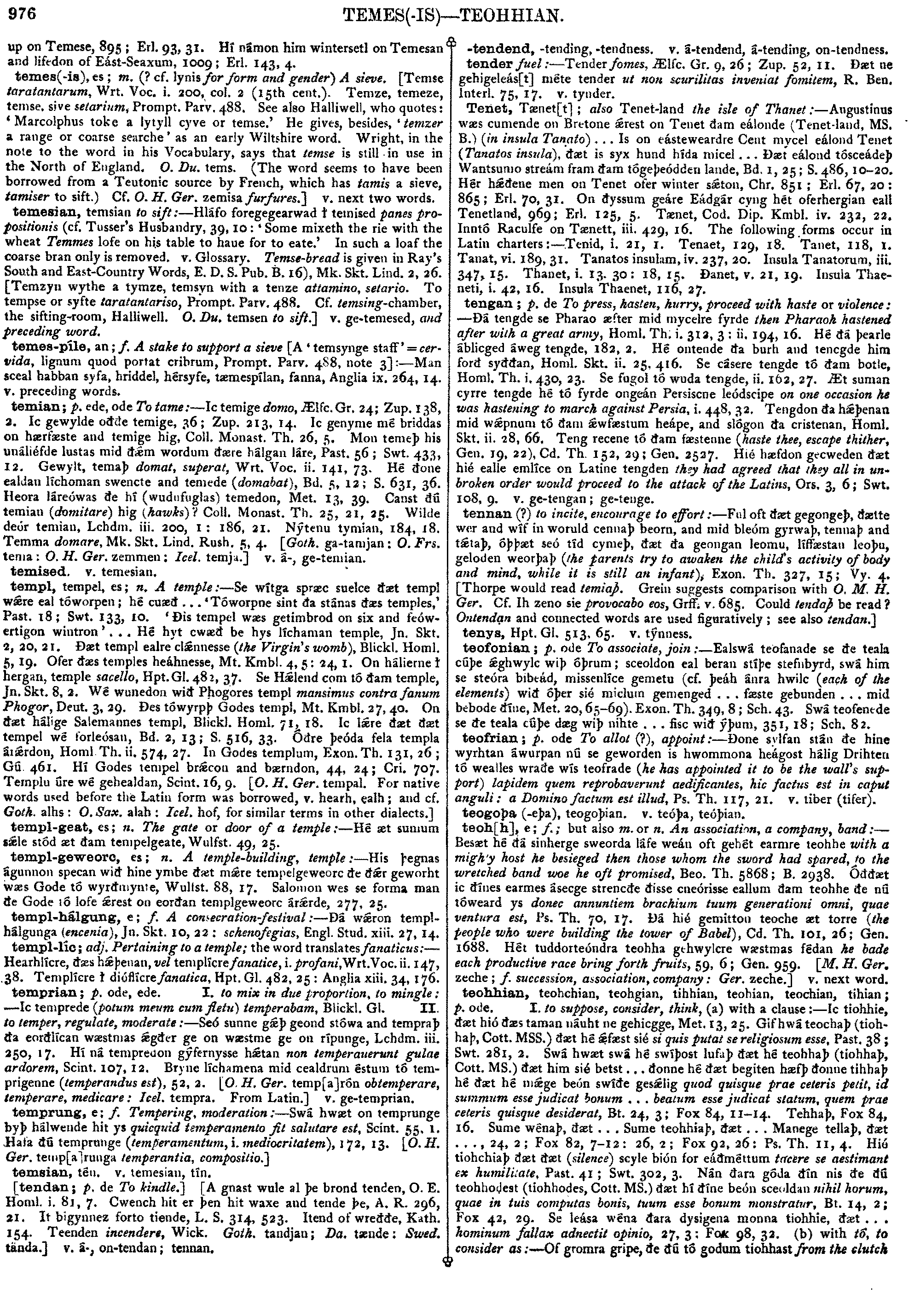
tames(-is), es; m. (? cf. lynis for form and gender) A sieve. [Temse taratantarum, Wrt. Voc. i. 200, col. 2 (15th cent.). Temze, temeze, temse, sive setarium, Prompt. Parv. 488. See also Halliwell, who quotes: 'Marcolphus toke a lytyll cyve or temse.' He gives, besides, 'temzer a range or coarse searche' as an early Wiltshire word. Wright, in the note to the word in his Vocabulary, says that temse is still in use in the North of England. O. Du. tems. (The word seems to have been borrowed from a Teutonic source by French, which has tamis a sieve, tamiser to sift.) Cf. O. H. Ger. zemisa furfures.] v. next two words.
|
Source: Bosworth/Toller, page b0976, entry 6 View original page image as: [TIFF] [PNG] [View previous entry] [View next entry] |
[Comment on this entry] [View comments (1)] |
The following entry has been hand-corrected once. |
templ,
tempel,
es;
n.
A
temple
:--
Se
wítga
spræc
suelce
ðæt
templ
wre
eal
tóworpen;
hé
cuæð
...
'Tóworpne
sint
ða
stánas
ðæs
temples,'
Past.
18;
Swt.
133,
10.
'Ðis
tenrpel
wæs
getimbrod
on
six
and
feówertigon
wintron'
...
Hé
hyt
cwæð
be
hys
líchaman
temple,
Jn.
Skt.
2,
20,
21.
Ðæt
templ
ealre
clnnesse
(the
Virgin's
womb),
Blickl.
Homl.
5,
19.
Ofer
ðæs
temples
heáhnesse,
Mt.
Kmbl.
4,
5:
24,
1.
On
hálierne
hergan,
temple
sacello,
Hpt.
GI.
482,
37.
Se
Hlend
com
tó
ðam
temple,
Jn.
Skt.
8,
2.
Wé
wunedon
wið
Phogores
templ
mansimus
contra
fanum
Phogor.
Deut.
3,
29.
Ðes
tówyrpþ
Godes
templ,
Mt.
Kmbl.
27,
40.
On
ðæt
hálige
Salemannes
templ,
Blickl.
Homl.
71,
18.
Ic
lre
ðæt
ðæt
tempel
wé
forleósan,
Bd.
2,
13;
S.
516,
33.
Óðre
þeóda
fela
templa
árrdon,
Homl.
Th.
ii.
574,
27.
In
Godes
templum,
Exon.
Th.
131,
26;
Gú.
461.
Hí
Godes
tempel
brcon
and
bærndon,
44,
24;
Cri.
707.
Templu
úre
we
gehealdan,
Scint.
16,
9.
[O.
H.
Ger.
tempal.
For
native
words
used
before
the
Latin
form
was
borrowed,
v.
hearh,
ealh;
and
cf.
Goth.
alhs:
O.
Sax.
alah:
Icel.
hof,
for
similar
terms
in
other
dialects.]
|
Source: Bosworth/Toller, page b0978, entry 2 View original page image as: [TIFF] [PNG] [View previous entry] [View next entry] |
[Comment on this entry] [View comments] |
The following entry has been hand-corrected once. |
teón
(from
tíhan;
but
the
verb
seems
to
have
almost
entirely
given
up
the
conjugation
to
which
this
form
would
belong
and
to
take
that
of
teón
from
teóhan);
p.
teáh,
pl.
tugon;
pp.
togen,
tygen
To
accuse
a
person
of
something
(acc.
of
person
and
gen.
of
charge,
or
charge
expressed
by
a
clause):--Ðú
mé
stale
týhst
furti
me
arguis,
Gen.
31,
32.
Hwí
tíhþ
úre
hláford
ús
swá
micles
falses?
44,
7.
Gif
gé
scyld
on
eów
witen
ðæs
ðe
eów
man
tíhþ,
Txts.
176,
10;
Rtl.
114,
23:
Exon.
Th.
345,
13;
Gn.
Ex.
187.
Týhþ,
Cd.
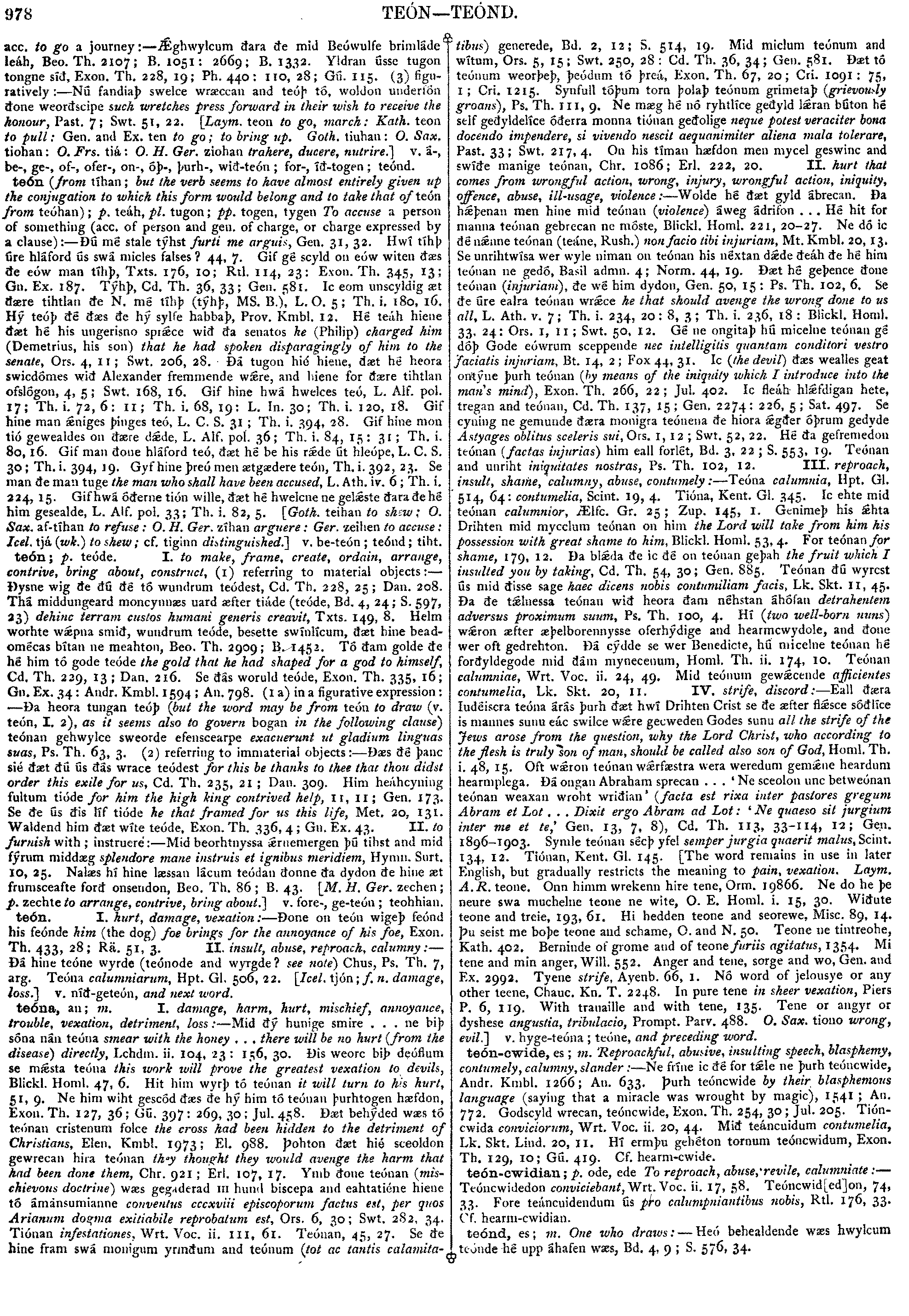
Th.
36,
33;
Gen.
581.
Ic
eom
unscyldig
æt
ðære
tihtlan
ðe
N.
mé
tíhþ
(týhþ,
MS.
B.),
L.
O.
5;
Th.
i.
180,
16.
Hý
teóþ
ðé
ðæs
ðe
hý
sylfe
habbaþ,
Prov.
Kmbl.
12.
Hé
teáh
hiene
ðæt
hé
his
ungerisno
sprce
wið
ða
senatos
he
(Philip)
charged
him
(Demetrius,
his
son)
that
he
had
spoken
disparagingly
of
him
to
the
senate,
Ors.
4,
11;
Swt.
206,
28.
Ðá
tugon
hié
hiene,
ðæt
hé
heora
swicdómes
wið
Alexander
fremmende
wre,
and
hiene
for
ðære
tihtlan
ofslógon,
4,
5;
Swt.
168,
16.
Gif
hine
hwá
hwelces
teó,
L.
Alf.
pol.
17;
Th.
i.
72,
6:
11;
Th.
i.
68,
19:
L.
In.
30;
Th.
i.
120,
18.
Gif
hine
man
niges
þinges
teó,
L.
C.
S.
31;
Th.
i.
394,
28.
Gif
hine
mon
tió
gewealdes
on
ðære
dde,
L.
Alf.
pol.
36;
Th.
i.
84,
15:
31;
Th.
i.
80,
16.
Gif
man
ðone
hláford
teó,
ðæt
hé
be
his
rde
út
hleópe,
L.
C.
S.
30;
Th.
i.
394,
19.
Gyf
hine
þreó
men
ætgædere
teón,
Th.
i.
392,
23.
Se
man
ðe
man
tuge
the
man
who
shall
have
been
accused,
L.
Ath.
iv.
6;
Th.
i.
224,
15.
Gif
hwá
óðerne
tión
wille,
ðæt
hé
hwelcne
ne
gelste
ðara
ðe
hé
him
gesealde,
L.
Alf.
pol.
33;
Th.
i.
82,
5.
[Goth.
teihan
to
show;
O.
Sax.
af-tíhan
to
refuse:
O.
H.
Ger.
zíhan
arguere:
Ger.
zeihen
to
accuse:
Icel.
tjá
(wk.)
to
shew;
cf.
tiginn
distinguished.]
v.
be-teón;
teónd;
tiht.
|
Source: Bosworth/Toller, page b0981, entry 3 View original page image as: [TIFF] [PNG] [View previous entry] [View next entry] |
[Comment on this entry] [View comments] |
The following entry has been hand-corrected once. |
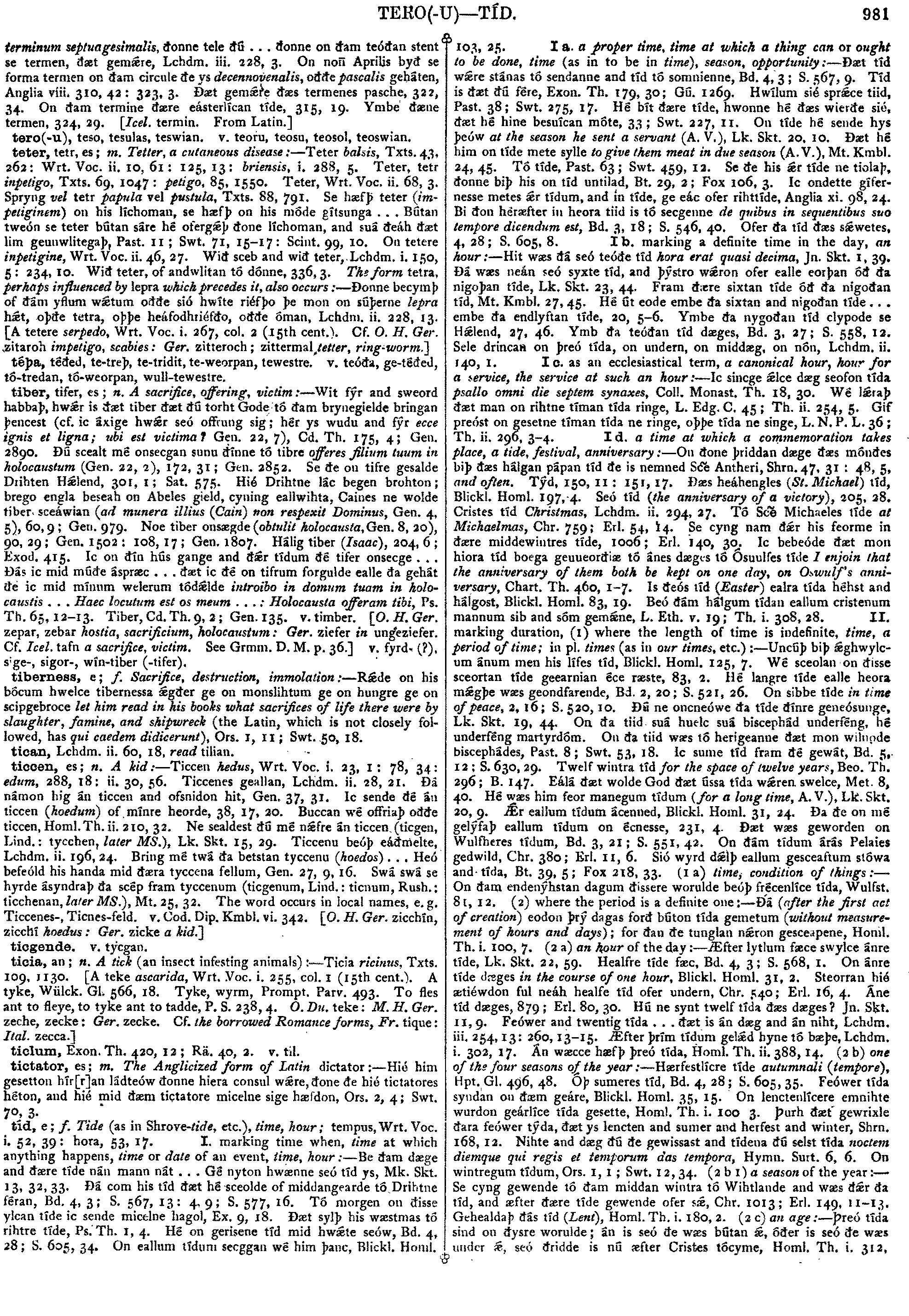
teter,
tetr,
es;
m.
Tetter,
a
cutaneous
disease:--Teter
balsis,
Txts.
43,
262:
Wrt.
Voc.
ii.
10,
61:
125,
13:
briensis,
i.
288,
5.
Teter,
tetr
inpetigo,
Txts.
69,
1047:
petigo,
85,
1550.
Teter,
Wrt.
Voc.
ii.
68,
3.
Spryng
vel
tetr
papula
vel
pustula,
Txts.
88,
791.
Se
hæfþ
teter
(impetiginem)
on
his
líchoman,
se
hæfþ
on
his
móde
gítsunga
.
.
.
Bútan
tweón
se
teter
bútan
sáre
hé
ofergþ
ðone
líchoman,
and
suá
ðeáh
ðæt
lim
geunwlitegaþ,
Past.
11;
Swt.
71,
15-17:
Scint.
99,
10,
On
tetere
inpetigine,
Wrt.
Voc.
ii.
46,
27.
Wið
sceb
and
wið
teter,
Lchdm.
i.
150,
5:
234,
10.
Wið
teter,
of
andwlitan
tó
dónne,
336,
3.
The
form
tetra,
perhaps
influenced
by
lepra
which
precedes
it,
also
occurs:--Ðonne
becymþ
of
ðám
yflum
wtum
oððe
sió
hwíte
riéfþo
þe
mon
on
súþerne
lepra
ht,
oþðe
tetra,
oþþe
heáfodhriéfðo,
oððe
óman,
Lchdm.
ii.
228,
13.
[A
tetere
serpedo,
Wrt.
Voc.
i.
267,
col.
2
(15th
cent.).
Cf.
O.
H.
Ger.
zitaroh
impetigo,
scabies:
Ger.
zitteroch;
zittermal
tetter,
ring-worm.]
|
Source: Bosworth/Toller, page b0981, entry 12 View original page image as: [TIFF] [PNG] [View previous entry] [View next entry] |
[Comment on this entry] [View comments] |
The following entry has been hand-corrected once. |
tictator,
es;
m.
The
Anglicized
form
of
Latin
dictator:--Hié
him
gesetton
hír[r]an
ládteów
ðonne
hiera
consul
wre,
ðone
ðe
hié
tictatores
héton,
and
hié
mid
ðæm
tictatore
micelne
sige
hæfdon,
Ors.
2,
4;
Swt.
70,
3.
|
Source: Bosworth/Toller, page b0983, entry 5 View original page image as: [TIFF] [PNG] [View previous entry] [View next entry] |
[Comment on this entry] [View comments] |
The following entry has been hand-corrected once. |
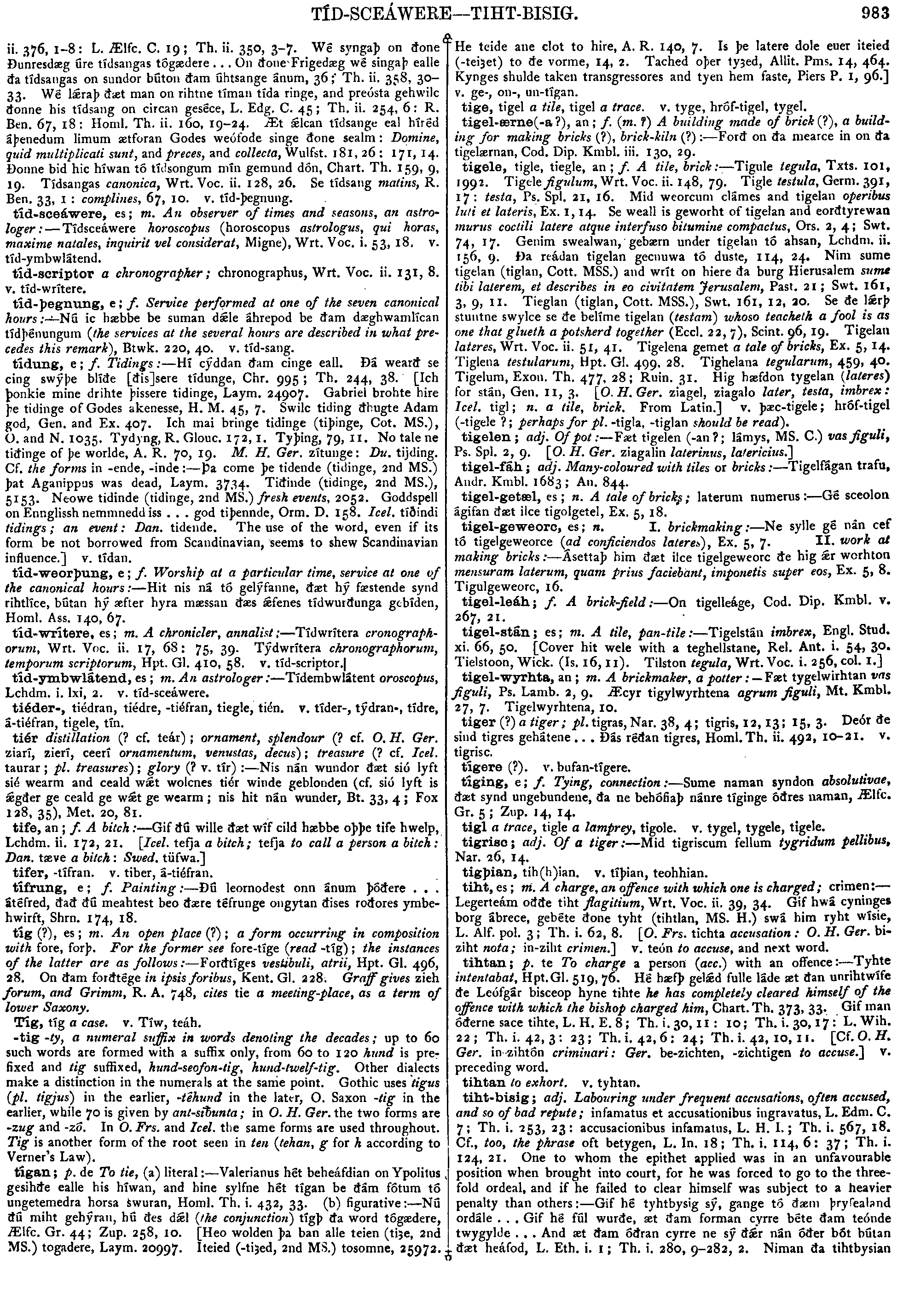
tídung, e; f. Tidings:--Hí cýddan ðam cinge eall. Ðá wearð se cing swýþe blíðe [ðis]sere tídunge, Chr. 995; Th. 244, 38. [Ich þonkie mine drihte þissere tidinge, Laym. 24907. Gabriel brohte hire þe tidinge of Godes akenesse, H. M. 45, 7. Swilc tiding ðhugte Adam god, Gen. and Ex. 407. Ich mai bringe tidinge (tiþinge, Cot. MS.), O. and N. 1035. Tydyng, R. Glouc. 172, 1. Tyþing, 79, 11. No tale ne tiðinge of þe worlde, A. R. 70, 19. M. H. Ger. zítunge: Du. tijding. Cf. the forms in -ende, -mde:--Þa come þe tidende (tidinge, 2nd MS.) þat Aganippus was dead, Laym. 3734. Tiðinde (tidinge, 2nd MS.), 5153. Neowe tidinde (tidinge, 2nd MS.) fresh events, 2052. Goddspell on Ennglissh nemmnedd iss . . . god tiþennde, Orm. D. 158. Icel. tíðindi tidings; an event: Dan. tidende. The use of the word, even if its form be not borrowed from Scandinavian, seems to shew Scandinavian influence.] v. tídan.
|
Source: Bosworth/Toller, page b0983, entry 14 View original page image as: [TIFF] [PNG] [View previous entry] [View next entry] |
[Comment on this entry] [View comments (1)] |
The following entry has been hand-corrected once. |
tíg (?), es; m. An open place (?); a form occurring in composition with fore, forþ. For the former see fore-tíge (read -tíg); the instances of the latter are as follows:--Forðtíges vestibuli, atrii, Hpt. Gl. 496, 28. On ðam forðtége in ipsis foribus, Kent. Gl. 228. Graff gives zieh forum, and Grimm, R. A. 748, cites tie a meeting-place, as a term of lower Saxony.
| Result Page: |  |
Previous | 17 18 19 20 21 22 23 24 25 26 27 28 29 30 31 32 33 34 35 | Next |  |
Germanic Lexicon Project (main page)
This search system was written by
Sean Crist
Please consider
volunteering
to correct the data in these online dictionaries.
No rights reserved. Feel free to use these data in any way you please.