|
|

Tip: In the search results, you can click on any word or abbreviation for more information.
|
Source: Cleasby/Vigfusson, page b0189, entry 1 View original page image as: [TIFF] [PNG] [View previous entry] [View next entry] |
[Comment on this entry] [View comments] |
The following entry has been hand-corrected once. |
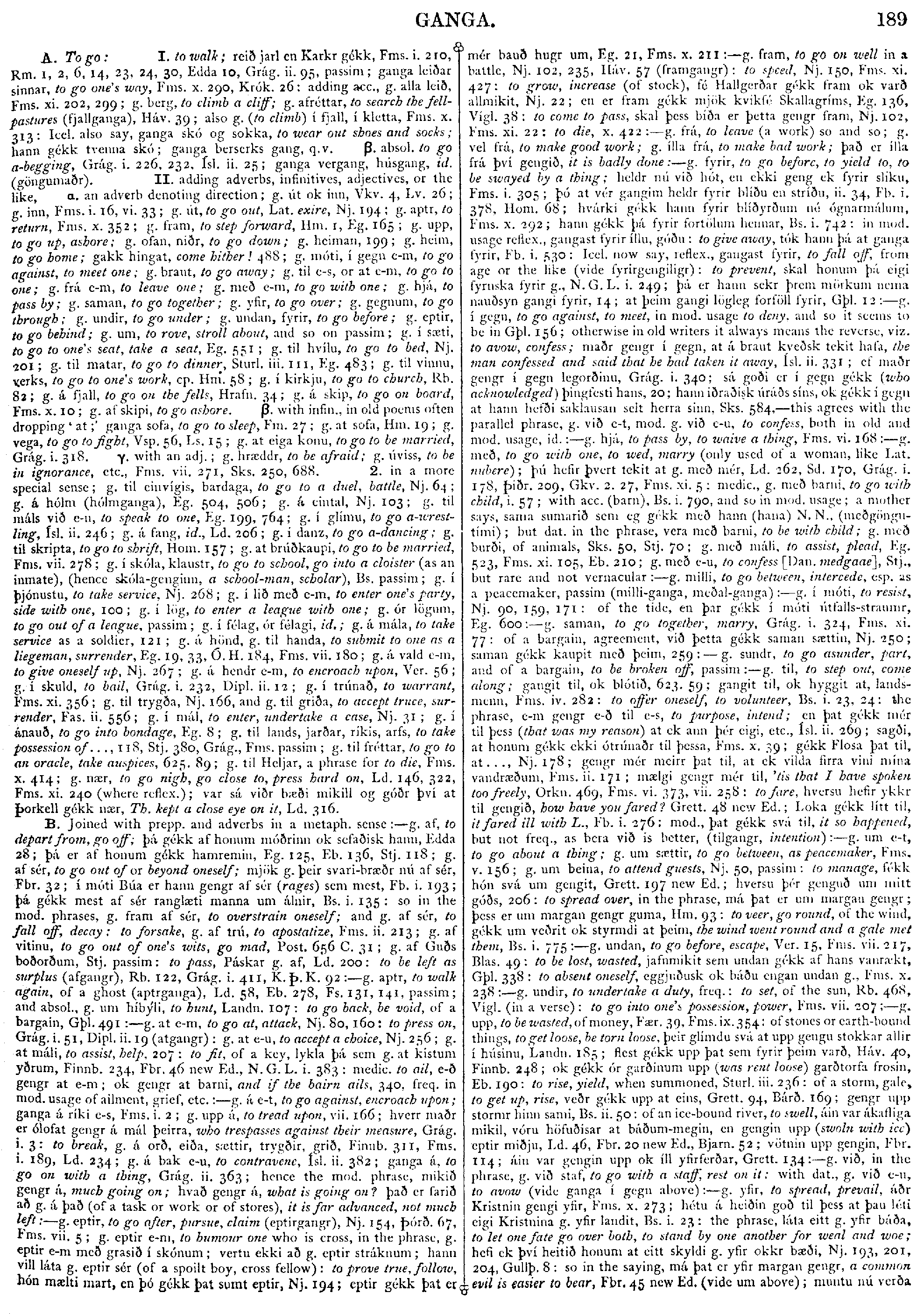
A.
To
go:
I.
to
walk;
reið
jarl
en
Karkr
gékk,
Fms.
i.
210,
Rm.
1,
2,
6,
14,
23,
24,
30,
Edda
10,
Grág.
ii.
95,
passim;
ganga
leiðar
sinnar,
to
go
one's
way,
Fms.
x.
290,
Krók.
26:
adding
acc.,
g.
alla
leið,
Fms.
xi.
202,
299;
g.
berg,
to
climb
a
cliff;
g.
afréttar,
to
search
the
fell-pastures
(fjallganga),
Háv.
39;
also
g.
(to
climb)
í
fjall,
í
kletta,
Fms.
x.
313:
Icel.
also
say,
ganga
skó
og
sokka,
to
wear
out
shoes
and
socks;
hann
gékk
tvenna
skó;
ganga
berserks
gang,
q.v.
 .
absol.
to
go
a-begging,
Grág.
i.
226,
232,
Ísl.
ii.
25;
ganga
vergang,
húsgang,
id.
(göngumaðr).
II.
adding
adverbs,
infinitives,
adjectives,
or
the
like,
.
absol.
to
go
a-begging,
Grág.
i.
226,
232,
Ísl.
ii.
25;
ganga
vergang,
húsgang,
id.
(göngumaðr).
II.
adding
adverbs,
infinitives,
adjectives,
or
the
like,
 .
an
adverb
denoting
direction;
g.
út
ok
inn,
Vkv.
4,
Lv.
26;
g.
inn,
Fms.
i.
16,
vi.
33;
g.
út,
to
go
out,
Lat.
exire,
Nj.
194;
g.
aptr,
to
return,
Fms.
x.
352;
g.
fram,
to
step
forward,
Hm.
1,
Eg.
165;
g.
upp,
to
go
up,
ashore;
g.
ofan,
niðr,
to
go
down;
g.
heiman,
199;
g.
heim,
to
go
home;
gakk
hingat,
come
hither!
488;
g.
móti,
í
gegn
e-m,
to
go
against,
to
meet
one;
g.
braut,
to
go
away;
g.
til
e-s,
or
at
e-m,
to
go
to
one;
g.
frá
e-m,
to
leave
one;
g.
með
e-m,
to
go
with
one;
g.
hjá,
to
pass
by;
g.
saman,
to
go
together;
g.
yfir,
to
go
over;
g.
gegnum,
to
go
through;
g.
undir,
to
go
under;
g.
undan,
fyrir,
to
go
before;
g.
eptir,
to
go
behind;
g.
um,
to
rove,
stroll
about,
and
so
on
passim;
g.
í
sæti,
to
go
to
one's
seat,
take
a
seat,
Eg.
551;
g.
til
hvílu,
to
go
to
bed,
Nj.
201;
g.
til
matar,
to
go
to
dinner,
Sturl.
iii.
111,
Eg.
483;
g.
til
vinnu,
verks,
to
go
to
one's
work,
cp.
Hm.
58;
g.
í
kirkju,
to
go
to
church,
Rb.
82;
g.
á
fjall,
to
go
on
the
fells,
Hrafn.
34;
g.
á
skip,
to
go
on
board,
Fms.
x.
10;
g.
af
skipi,
to
go
ashore.
.
with
infin.,
in
old
poems
often
dropping
'at;'
ganga
sofa,
to
go
to
sleep,
Fm.
27;
g.
at
sofa,
Hm.
19;
g.
vega,
to
go
to
fight,
Vsp.
56,
Ls.
15;
g.
at
eiga
konu,
to
go
to
be
married,
Grág.
i.
318.
.
an
adverb
denoting
direction;
g.
út
ok
inn,
Vkv.
4,
Lv.
26;
g.
inn,
Fms.
i.
16,
vi.
33;
g.
út,
to
go
out,
Lat.
exire,
Nj.
194;
g.
aptr,
to
return,
Fms.
x.
352;
g.
fram,
to
step
forward,
Hm.
1,
Eg.
165;
g.
upp,
to
go
up,
ashore;
g.
ofan,
niðr,
to
go
down;
g.
heiman,
199;
g.
heim,
to
go
home;
gakk
hingat,
come
hither!
488;
g.
móti,
í
gegn
e-m,
to
go
against,
to
meet
one;
g.
braut,
to
go
away;
g.
til
e-s,
or
at
e-m,
to
go
to
one;
g.
frá
e-m,
to
leave
one;
g.
með
e-m,
to
go
with
one;
g.
hjá,
to
pass
by;
g.
saman,
to
go
together;
g.
yfir,
to
go
over;
g.
gegnum,
to
go
through;
g.
undir,
to
go
under;
g.
undan,
fyrir,
to
go
before;
g.
eptir,
to
go
behind;
g.
um,
to
rove,
stroll
about,
and
so
on
passim;
g.
í
sæti,
to
go
to
one's
seat,
take
a
seat,
Eg.
551;
g.
til
hvílu,
to
go
to
bed,
Nj.
201;
g.
til
matar,
to
go
to
dinner,
Sturl.
iii.
111,
Eg.
483;
g.
til
vinnu,
verks,
to
go
to
one's
work,
cp.
Hm.
58;
g.
í
kirkju,
to
go
to
church,
Rb.
82;
g.
á
fjall,
to
go
on
the
fells,
Hrafn.
34;
g.
á
skip,
to
go
on
board,
Fms.
x.
10;
g.
af
skipi,
to
go
ashore.
.
with
infin.,
in
old
poems
often
dropping
'at;'
ganga
sofa,
to
go
to
sleep,
Fm.
27;
g.
at
sofa,
Hm.
19;
g.
vega,
to
go
to
fight,
Vsp.
56,
Ls.
15;
g.
at
eiga
konu,
to
go
to
be
married,
Grág.
i.
318.
 .
with
an
adj.;
g.
hræddr,
to
be
afraid;
g.
úviss,
to
be
in
ignorance,
etc.,
Fms.
vii.
271,
Sks.
250,
688.
2.
in
a
more
special
sense;
g.
til
einvígis,
bardaga,
to
go
to
a
duel,
battle,
Nj.
64;
g.
á
hólm
(hólmganga),
Eg.
504,
506;
g.
á
eintal,
Nj.
103;
g.
til
máls
við
e-n,
to
speak
to
one,
Eg.
199,
764;
g.
í
glímu,
to
go
a-wrestling,
Ísl.
ii.
246;
g.
á
fang,
id.,
Ld.
206;
g.
í
danz,
to
go
a-dancing;
g.
til
skripta,
to
go
to
shrift,
Hom.
157;
g.
at
brúðkaupi,
to
go
to
be
married,
Fms.
vii.
278;
g.
í
skóla,
klaustr,
to
go
to
school,
go
into
a
cloister
(as
an
inmate),
(hence
skóla-genginn,
a
school-man,
scholar),
Bs.
passim;
g.
í
þjónustu,
to
take
service,
Nj.
268;
g.
í
lið
með
e-m,
to
enter
one's
party,
side
with
one,
100;
g.
í
lög,
to
enter
a
league
with
one;
g.
ór
lögum,
to
go
out
of
a
league,
passim;
g.
í
félag,
ór
félagi,
id.;
g.
á
mala,
to
take
service
as
a
soldier,
121;
g.
á
hönd,
g.
til
handa,
to
submit
to
one
as
a
liegeman,
surrender,
Eg.
19,
33,
Ó.
H.
184,
Fms.
vii.
180;
g.
á
vald
e-m,
to
give
oneself
up,
Nj.
267;
g.
á
hendr
e-m,
to
encroach
upon,
Ver.
56;
g.
í
skuld,
to
bail,
Grág.
i.
232,
Dipl.
ii.
12;
g.
í
trúnað,
to
warrant,
Fms.
xi.
356;
g.
til
trygða,
Nj.
166,
and
g.
til
griða,
to
accept
truce,
surrender,
Fas.
ii.
556;
g.
í
mál,
to
enter,
undertake
a
case,
Nj.
31;
g.
í
ánauð,
to
go
into
bondage,
Eg.
8;
g.
til
lands,
jarðar,
ríkis,
arfs,
to
take
possession
of
...,
118,
Stj.
380,
Grág.,
Fms.
passim;
g.
til
fréttar,
to
go
to
an
oracle,
take
auspices,
625.
89;
g.
til
Heljar,
a
phrase
for
to
die,
Fms.
x.
414;
g.
nær,
to
go
nigh,
go
close
to,
press
hard
on,
Ld.
146,
322,
Fms.
xi.
240
(where
reflex.);
var
sá
viðr
bæði
mikill
og
góðr
því
at
Þorkell
gékk
nær,
Th.
kept
a
close
eye
on
it,
Ld.
316.
.
with
an
adj.;
g.
hræddr,
to
be
afraid;
g.
úviss,
to
be
in
ignorance,
etc.,
Fms.
vii.
271,
Sks.
250,
688.
2.
in
a
more
special
sense;
g.
til
einvígis,
bardaga,
to
go
to
a
duel,
battle,
Nj.
64;
g.
á
hólm
(hólmganga),
Eg.
504,
506;
g.
á
eintal,
Nj.
103;
g.
til
máls
við
e-n,
to
speak
to
one,
Eg.
199,
764;
g.
í
glímu,
to
go
a-wrestling,
Ísl.
ii.
246;
g.
á
fang,
id.,
Ld.
206;
g.
í
danz,
to
go
a-dancing;
g.
til
skripta,
to
go
to
shrift,
Hom.
157;
g.
at
brúðkaupi,
to
go
to
be
married,
Fms.
vii.
278;
g.
í
skóla,
klaustr,
to
go
to
school,
go
into
a
cloister
(as
an
inmate),
(hence
skóla-genginn,
a
school-man,
scholar),
Bs.
passim;
g.
í
þjónustu,
to
take
service,
Nj.
268;
g.
í
lið
með
e-m,
to
enter
one's
party,
side
with
one,
100;
g.
í
lög,
to
enter
a
league
with
one;
g.
ór
lögum,
to
go
out
of
a
league,
passim;
g.
í
félag,
ór
félagi,
id.;
g.
á
mala,
to
take
service
as
a
soldier,
121;
g.
á
hönd,
g.
til
handa,
to
submit
to
one
as
a
liegeman,
surrender,
Eg.
19,
33,
Ó.
H.
184,
Fms.
vii.
180;
g.
á
vald
e-m,
to
give
oneself
up,
Nj.
267;
g.
á
hendr
e-m,
to
encroach
upon,
Ver.
56;
g.
í
skuld,
to
bail,
Grág.
i.
232,
Dipl.
ii.
12;
g.
í
trúnað,
to
warrant,
Fms.
xi.
356;
g.
til
trygða,
Nj.
166,
and
g.
til
griða,
to
accept
truce,
surrender,
Fas.
ii.
556;
g.
í
mál,
to
enter,
undertake
a
case,
Nj.
31;
g.
í
ánauð,
to
go
into
bondage,
Eg.
8;
g.
til
lands,
jarðar,
ríkis,
arfs,
to
take
possession
of
...,
118,
Stj.
380,
Grág.,
Fms.
passim;
g.
til
fréttar,
to
go
to
an
oracle,
take
auspices,
625.
89;
g.
til
Heljar,
a
phrase
for
to
die,
Fms.
x.
414;
g.
nær,
to
go
nigh,
go
close
to,
press
hard
on,
Ld.
146,
322,
Fms.
xi.
240
(where
reflex.);
var
sá
viðr
bæði
mikill
og
góðr
því
at
Þorkell
gékk
nær,
Th.
kept
a
close
eye
on
it,
Ld.
316.
|
Source: Cleasby/Vigfusson, page b0193, entry 45 View original page image as: [TIFF] [PNG] [View previous entry] [View next entry] |
[Comment on this entry] [View comments] |
The following entry has been hand-corrected once. |
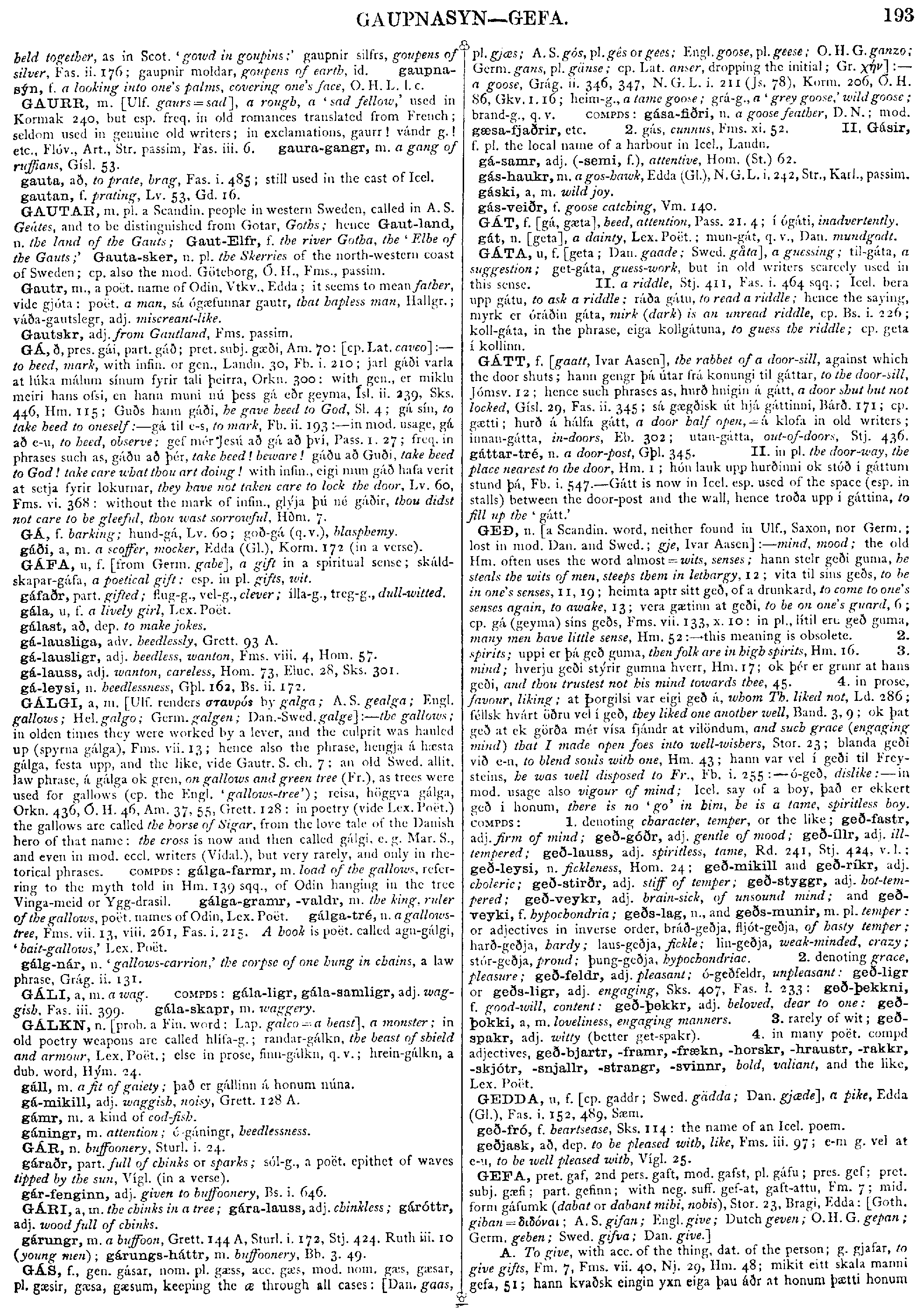
GEFA, pret. gaf, 2nd pers. gaft, mod. gafst, pl. gáfu; pres. gef; pret. subj. gæfi; part. gefinn; with neg. suff. gef-at, gaft-attu, Fm. 7; mid. form gáfumk (dabat or dabant mihi, nobis), Stor. 23, Bragi, Edda: [Goth. giban = GREEK; A. S. gifan; Engl. give; Dutch geven; O. H. G. gepan; Germ. geben; Swed. gifva; Dan. give.]
|
Source: Cleasby/Vigfusson, page b0193, entry 46 View original page image as: [TIFF] [PNG] [View previous entry] [View next entry] |
[Comment on this entry] [View comments] |
The following entry has been hand-corrected once. |
A. To give, with acc. of the thing, dat. of the person; g. gjafar, to give gifts, Fm. 7, Fms. vii. 40, Nj. 29, Hm. 48; mikit eitt skala manni gefa, 51; hann kvaðsk eingin yxn eiga þau áðr at honum þætti honum
|
Source: Cleasby/Vigfusson, page b0202, entry 2 View original page image as: [TIFF] [PNG] [View previous entry] [View next entry] |
[Comment on this entry] [View comments] |
The following entry has been hand-corrected once. |
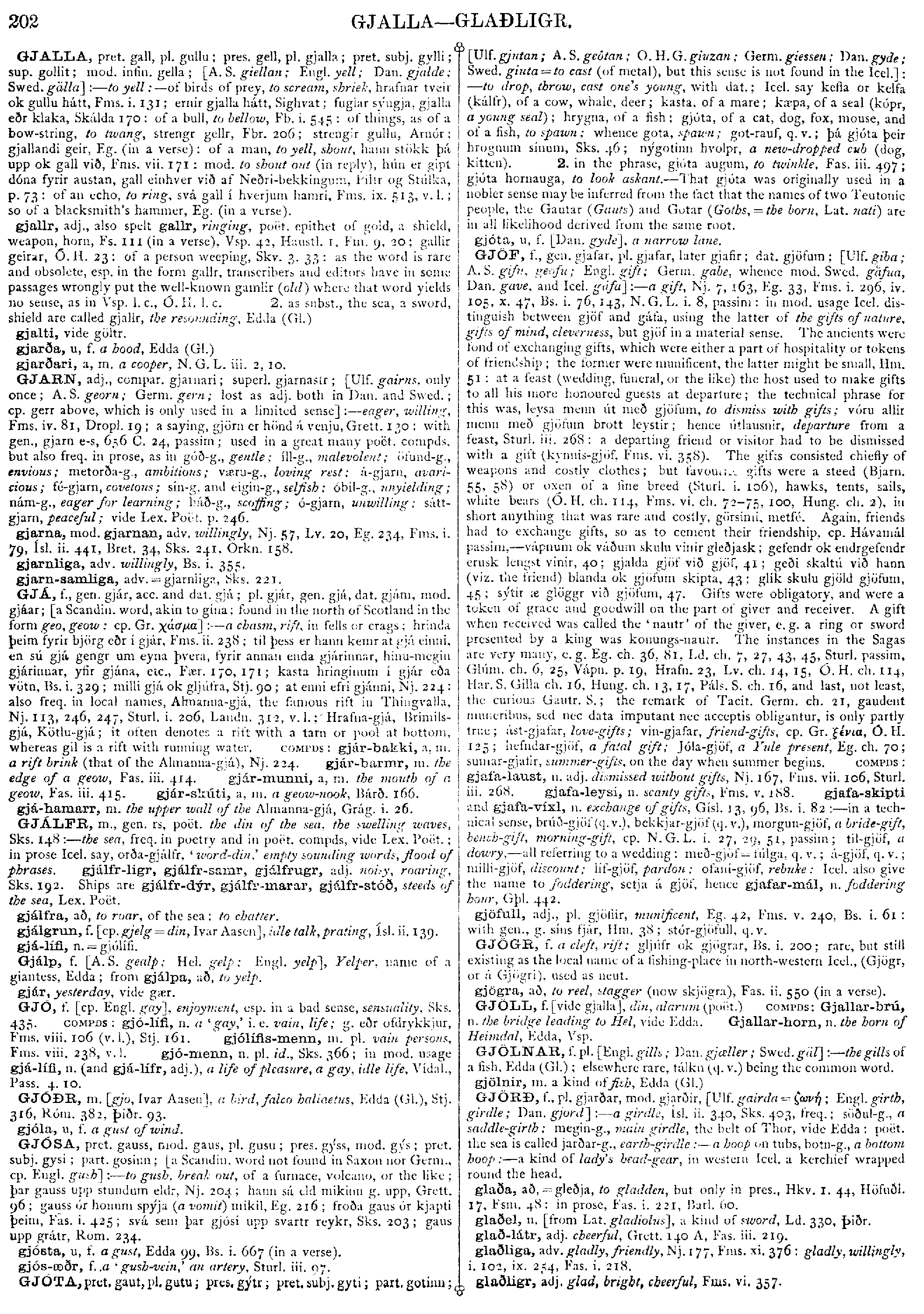
gjallr, adj., also spelt gallr, ringing, poët. epithet of gold, a shield, weapon, horn, Fs. 111 (in a verse), Vsp. 42, Haustl. 1, Fm. 9, 20; gallir geirar, Ó. H. 23: of a person weeping, Skv. 3. 33: as the word is rare and obsolete, esp. in the form gallr, transcribers and editors have in some passages wrongly put the well-known gamlir (old) where that word yields no sense, as in Vsp. l.c., Ó. H. l.c. 2. as subst., the sea, a sword, shield are called gjallr, the resounding, Edda (Gl.)
|
Source: Cleasby/Vigfusson, page b0205, entry 19 View original page image as: [TIFF] [PNG] [View previous entry] [View next entry] |
[Comment on this entry] [View comments] |
The following entry has been hand-corrected once. |
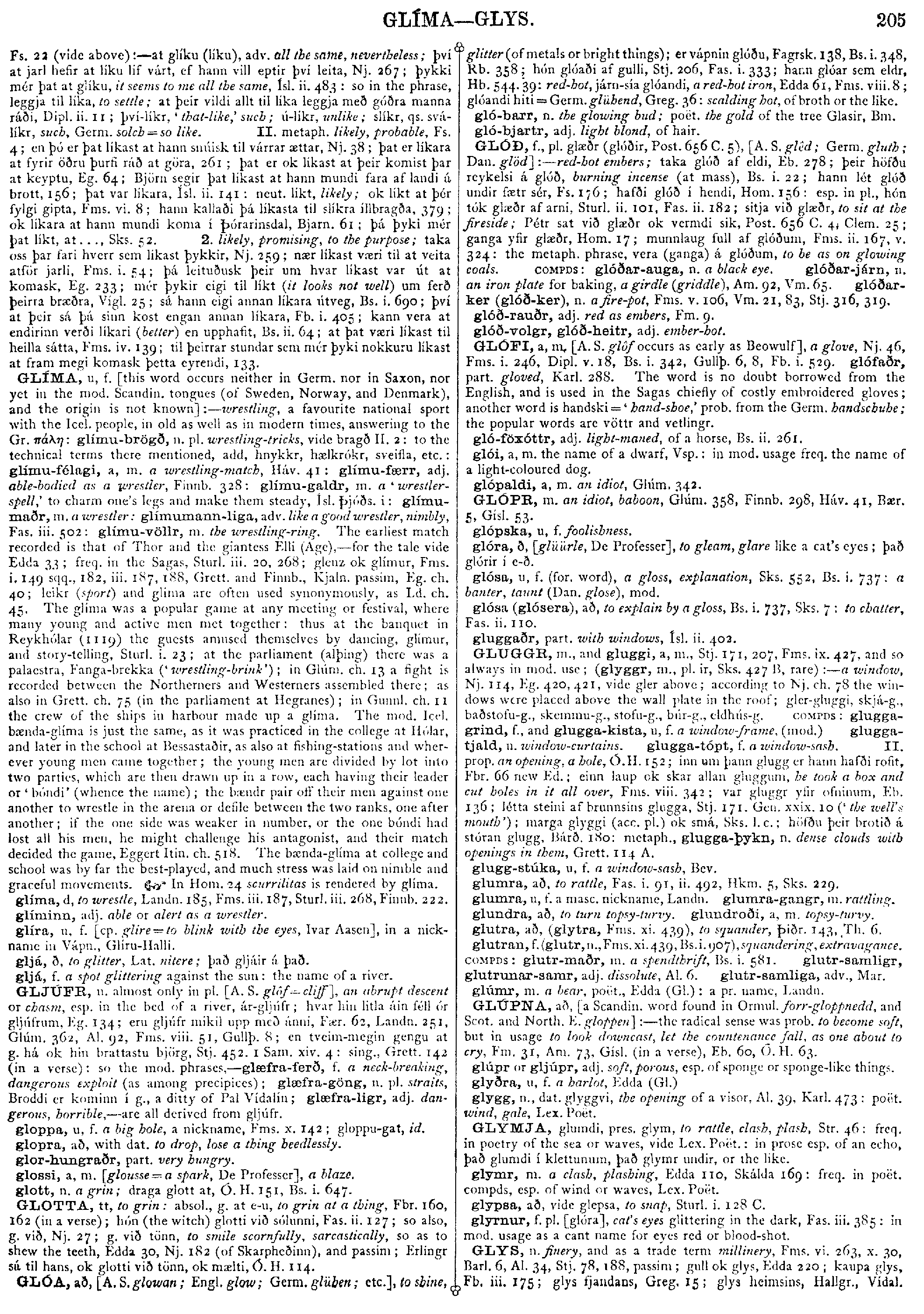
glóð-rauðr, adj. red as embers, Fm. 9.
|
Source: Cleasby/Vigfusson, page b0205, entry 39 View original page image as: [TIFF] [PNG] [View previous entry] [View next entry] |
[Comment on this entry] [View comments] |
The following entry has been hand-corrected once. |
GLÚPNA, að, [a Scandin. word found in Ormul. forr-gloppnedd, and Scot. and North. E. gloppen] :-- the radical sense was prob. to become soft, but in usage to look downcast, let the countenance fall, as one about to cry, Fm. 31, Am. 73, Gísl. (in a verse), Eb. 60, Ó. H. 63.
|
Source: Cleasby/Vigfusson, page b0211, entry 41 View original page image as: [TIFF] [PNG] [View previous entry] [View next entry] |
[Comment on this entry] [View comments] |
The following entry has been hand-corrected once. |
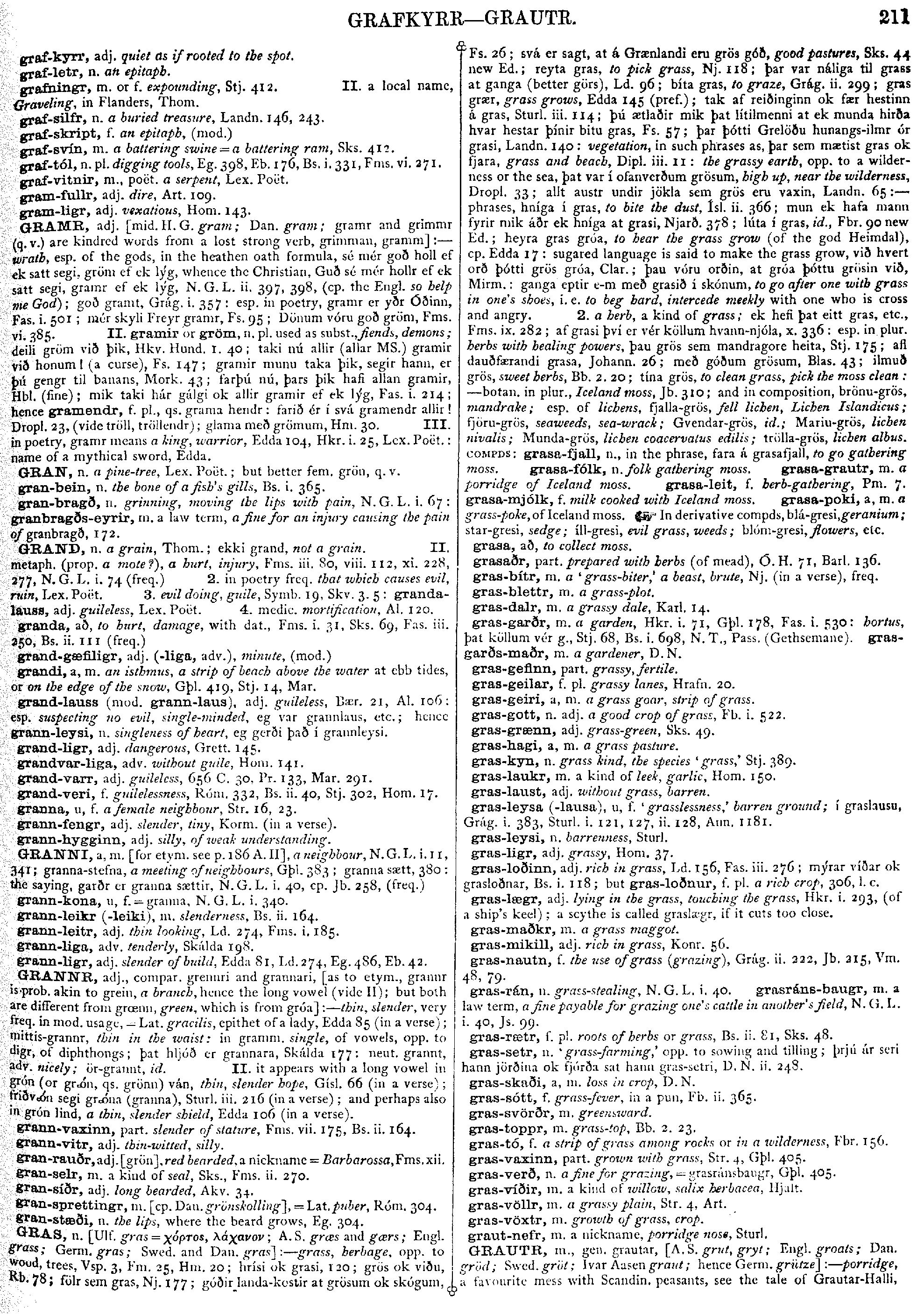
GRAS, n. [Ulf. gras = GREEK ; A.S. græ and gærs; Engl. grass; Germ, gras; Swed. and Dan. gras] :-- grass, herbage, opp. to wood, trees, Vsp. 3, Fm. 25, Hm. 20; hrísi ok grasi, 120; grös ok viðu, Rb. 78; fölr sem gras, Nj. 177; góðir landa-kostir at grösum ok skógum, Fs. 26; svá er sagt, at á Grænlandi eru grös góð, good pastures, Sks. 44 new Ed.; reyta gras, to pick grass, Nj. 118; þar var náliga til grass at ganga (better görs), Ld. 96; bíta gras, to graze, Grág. ii. 299; gras grær, grass grows, Edda 145 (pref.); tak af reiðinginn ok fær hestinn á gras, Sturl. iii. 114; þú ætlaðir mik þat lítilmenni at ek munda hirða hvar hestar þínir bitu gras, Fs. 57; þar þótti Grelöðu hunangs-ilmr ór grasi, Landn. 140 : vegetation, in such phrases as, þar sem mætist gras ok fjara, grass and beach, Dipl. iii. 11 : the grassy earth, opp. to a wilderness or the sea, þat var í ofanverðum grösum, high up, near the wilderness, Dropl. 33; allt austr undir jökla sem grös eru vaxin, Landn. 65 :-- phrases, hníga í gras, to bite the dust, Ísl. ii. 366; mun ek hafa mann fyrir mik áðr ek hníga at grasi, Njarð. 378; lúta í gras, id., Fbr. 90 new Ed.; heyra gras gróa, to hear the grass grow (of the god Heimdal), cp. Edda 17 : sugared language is said to make the grass grow, við hvert orð þótti grös gróa, Clar.; þau vóru orðin, at gróa þóttu grösin við, Mirm. : ganga eptir e-m með grasið í skónum, to go after one with grass in one's shoes, i.e. to beg hard, intercede meekly with one who is cross and angry. 2. a herb, a kind of grass; ek hefi þat eitt gras, etc., Fms. ix. 282; af grasi því er vér köllum hvann-njóla, x. 336 : esp. in plur. herbs with healing powers, þau grös sem mandragore heita, Stj. 175; afl dauðfærandi grasa, Johann. 26; með góðum grösum, Blas. 43; ilmuð grös, sweet herbs, Bb. 2. 20; tína grös, to clean grass, pick the moss clean : -- botan. in plur., Iceland moss, Jb. 310; and in composition, brönu-grös, mandrake; esp. of lichens, fjalla-grös, fell lichen, Lichen Islandicus; fjöru-grös, seaweeds, sea-wrack; Gvendar-grös, id.; Mariu-grös, lichen nivalis; Munda-grös, lichen coacervatus edilis; trölla-grös, lichen albus. COMPDS: grasa-fjall, n., in the phrase, fara á grasafjall, to go gathering moss. grasa-fó1k, n. folk gathering moss. grasa-grautr, m. a porridge of Iceland moss. grasa-leit, f. herb-gathering, Pm. 7. grasa-mjólk, f. milk cooked with Iceland moss. grasa-poki, a, m. a grass-poke, of Iceland moss. UNCERTAIN In derivative compds, blá-gresi, geranium; star-gresi, sedge; íll-gresi, evil grass, weeds; blóm-gresi, flowers, etc.
|
Source: Cleasby/Vigfusson, page b0220, entry 14 View original page image as: [TIFF] [PNG] [View previous entry] [View next entry] |
[Comment on this entry] [View comments] |
The following entry has been hand-corrected once. |
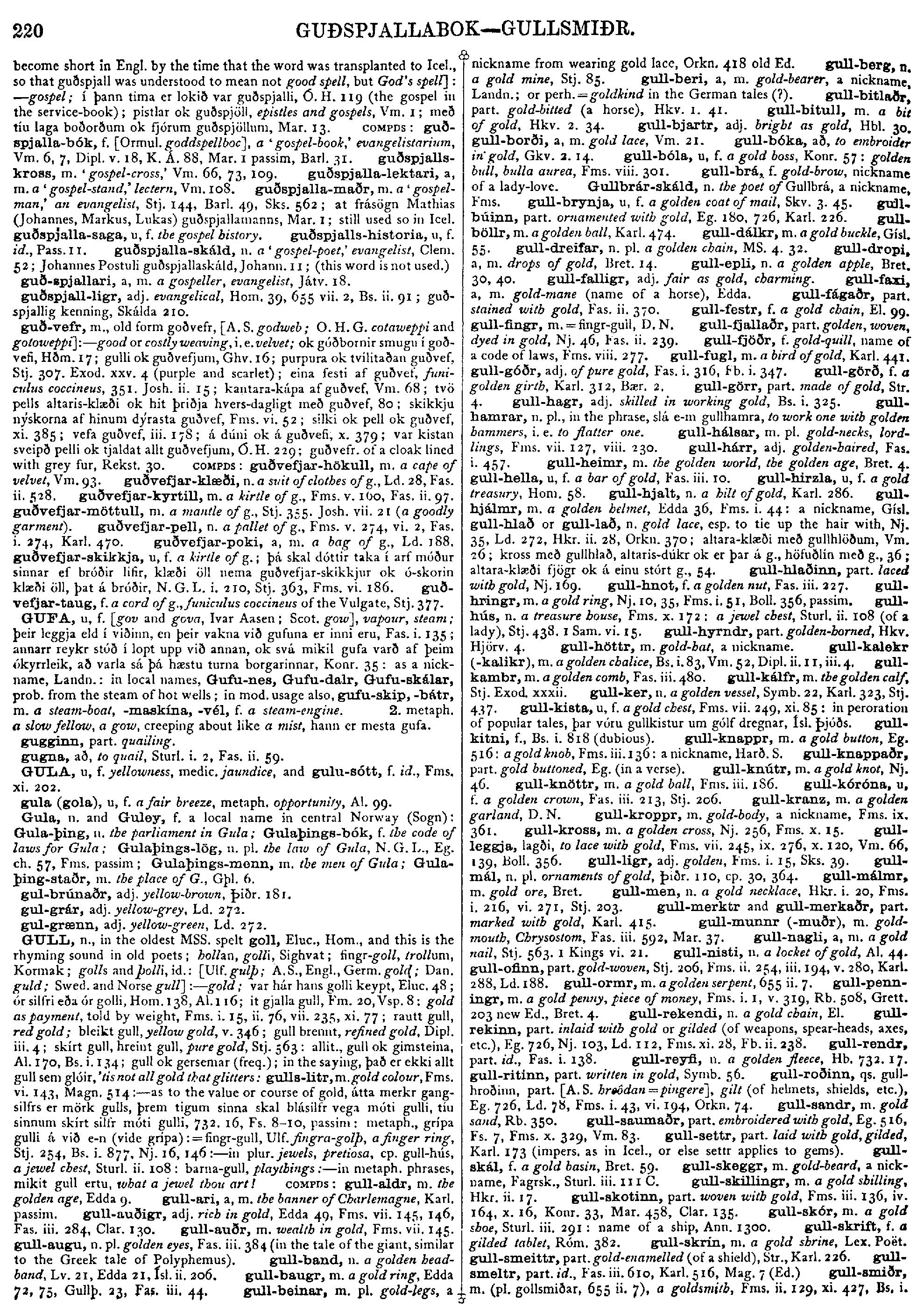
GULL, n., in the oldest MSS. spelt goll, Eluc., Hom., and this is the rhyming sound in old poets; hollan, golli, Sighvat; fingr-goll, trollum, Kormak; golls and þolli, id.: [Ulf. gulþ; A. S., Engl., Germ. gold; Dan. guld; Swed. and Norse gull] :-- gold; var hár hans golli keypt, Eluc. 48; ór silfri eða ór golli, Hom. 138, Al. 116; it gjalla gull, Fm. 20, Vsp. 8: gold as payment, told by weight, Fms. i. 15, ii. 76, vii. 235, xi. 77; rautt gull, red gold; bleikt gull, yellow gold, v. 346; gull brennt, refined gold, Dipl. iii. 4; skírt gull, hreint gull, pure gold, Stj. 563: allit., gull ok gimsteina, Al. 170, Bs. i. 134; gull ok gersemar (freq.); in the saying, það er ekki allt gull sem glóir, 'tis not all gold that glitters: gulls-litr, m. gold colour, Fms. vi. 143, Magn. 514 :-- as to the value or course of gold, átta merkr gangsilfrs er mörk gulls, þrem tigum sinna skal blásilfr vega móti gulli, tíu sinnum skírt silfr móti gulli, 732. 16, Fs. 8-10, passim: metaph., grípa gulli á við e-n (vide grípa) := fingr-gull, Ulf. fingra-golþ, a finger ring, Stj. 254, Bs. i. 877, Nj. 16, 146 :-- in plur. jewels, pretiosa, cp. gull-hús, a jewel chest, Sturl. ii. 108: barna-gull, playthings :-- in metaph. phrases, mikit gull ertu, what a jewel thou art! COMPDS: gull-aldr, m. the golden age, Edda 9. gull-ari, a, m. the banner of Charlemagne, Karl. passim. gull-auðigr, adj. rich in gold, Edda 49, Fms. vii. 145, 146, Fas. iii. 284, Clar. 130. gull-auðr, m. wealth in gold, Fms. vii. 145. gull-augu, n. pl. golden eyes, Fas. iii. 384 (in the tale of the giant, similar to the Greek tale of Polyphemus). gull-band, n. a golden head-band, Lv. 21, Edda 21, Ísl. ii. 206. gull-baugr, m. a gold ring, Edda 72, 75, Gullþ. 23, Fas. iii. 44. gull-beinar, m. pl. gold-legs, a nickname from wearing gold lace, Orkn. 418 old Ed. gull-berg, n. a gold mine, Stj. 85. gull-beri, a, m. gold-bearer, a nickname, Landn.; or perh. = goldkind in the German tales (?). gull-bitlaðr part. gold-bitted (a horse), Hkv. i. 41. gull-bitull, m. a bit of gold, Hkv. 2. 34. gull-bjartr, adj. bright as gold, Hbl. 30. gull-borði, a, m. gold lace, Vm. 21. gull-bóka, að, to embroider in gold, Gkv. 2. 14. gull-bóla, u, f. a gold boss, Konr. 57: golden bull, bulla aurea, Fms. viii. 301. gull-brá f. gold-brow, nickname of a lady-love. Gullbrár-skáld, n. the poet of Gullbrá, a nickname, Fms. gull-brynja, u, f. a golden coat of mail, Skv. 3. 45. gull-búinn, part. ornamented with gold, Eg. 180, 726, Karl. 226. gull-böllr, m. a golden ball, Karl. 474. gull-dálkr, m. a gold buckle, Gísl. 55. gull-dreifar, n. pl. a golden chain, MS. 4. 32. gull-dropi, a, m. drops of gold, Bret. 14. gull-epli, n. a golden apple, Bret. 30, 40. gull-falligr, adj. fair as gold, charming. gull-faxi, a, m. gold-mane (name of a horse), Edda. gull-fágaðr, part. stained with gold, Fas. ii. 370. gull-festr, f. a gold chain, El. 99. gull-fingr, m. = fingr-gull, D. N. gull-fjallaðr, part. golden, woven, dyed in gold, Nj. 46, Fas. ii. 239. gull-fjöðr, f. gold-quill, name of a code of laws, Fms. viii. 277. gull-fugl, m. a bird of gold, Karl. 441. gull-góðr, adj. of pure gold, Fas. i. 316, Fb. i. 347. gull-görð, f. a golden girth, Karl. 312, Bær. 2. gull-görr, part. made of gold, Str. 4. gull-hagr, adj. skilled in working gold, Bs. i. 325. gull-hamrar, n. pl., in the phrase, slá e-m gullhamra, to work one with golden hammers, i.e. to flatter one. gull-hálsar, m. pl. gold-necks, lordlings, Fms. vii. 127, viii. 230. gull-hárr, adj. golden-haired, Fas. i. 457. gull-heimr, m. the golden world, the golden age, Bret. 4. gull-hella, u, f. a bar of gold, Fas. iii. 10. gull-hirzla, u, f. a gold treasury, Hom. 58. gull-hjalt, n. a hilt of gold, Karl. 286. gull-hjálmr, m. a golden helmet, Edda 36, Fms. i. 44: a nickname, Gísl. gull-hlað or gull-lað, n. gold lace, esp. to tie up the hair with, Nj. 35, Ld. 272, Hkr. ii. 28, Orkn. 370; altara-klæði með gullhlöðum, Vm. 26; kross með gullhlað, altaris-dúkr ok er þar á g., höfuðlín með g., 36; altara-klæði fjögr ok á einu stórt g., 54. gull-hlaðinn, part. laced with gold, Nj. 169. gull-hnot, f. a golden nut, Fas. iii. 227. gull-hringr, m. a gold ring, Nj. 10, 35, Fms. i. 51, Boll. 356, passim. gull-hús, n. a treasure house, Fms. x. 172: a jewel chest, Sturl. ii. 108 (of a lady), Stj. 438. 1 Sam. vi. 15. gull-hyrndr, part. golden-horned, Hkv. Hjörv. 4. gull-höttr, m. gold-hat, a nickname. gull-kalekr (-kalikr), m. a golden chalice, Bs. i. 83, Vm. 52, Dipl. ii. 11, iii. 4. gull-kambr, m. a golden comb. Fas. iii. 480. gull-kálfr, m. the golden calf, Stj. Exod. xxxii. gull-ker, n. a golden vessel, Symb. 22, Karl. 323, Stj. 437. gull-kista, u, f. a gold chest, Fms. vii. 249, xi. 85: in peroration of popular tales, þar vóru gullkistur um gólf dregnar, Ísl. Þjóðs. gull-kitni, f., Bs. i. 818 (dubious). gull-knappr, m. a gold button, Eg. 516: a gold knob, Fms. iii. 136: a nickname, Harð. S. gull-knappaðr, part. gold buttoned, Eg. (in a verse). gull-knútr, m. a gold knot, Nj. 46. gull-knöttr, m. a gold ball, Fms. iii. 186. gull-kóróna, u, f. a golden crown, Fas. iii. 213, Stj. 206. gull-kranz, m. a golden garland, D. N. gull-kroppr, m. gold-body, a nickname, Fms. ix. 361. gull-kross, m. a golden cross, Nj. 256, Fms. x. 15. gull-leggja, lagði, to lace with gold, Fms. vii. 245, ix. 276, x. 120, Vm. 66, 139, Boll. 356. gull-ligr, adj. golden, Fms. i. 15, Sks. 39. gull-mál, n. pl. ornaments of gold, Þiðr. 110, cp. 30, 364. gull-málmr, m. gold ore, Bret. gull-men, n. a gold necklace, Hkr. i. 20, Fms. i. 216, vi. 271, Stj. 203. gull-merktr and gull-merkaðr, part. marked with gold, Karl. 415. gull-munnr (-muðr), m. gold-mouth, Chrysostom, Fas. iii. 592, Mar. 37. gull-nagli, a, m. a gold nail, Stj. 563. 1 Kings vi. 21. gull-nisti, n. a locket of gold, Al. 44. gull-ofinn, part. gold-woven, Stj. 206, Fms. ii. 254, iii. 194, v. 280, Karl. 288, Ld. 188. gull-ormr, m. a golden serpent, 655 ii. 7. gull-penningr, m. a gold penny, piece of money, Fms. i. 1, v. 319, Rb. 508, Grett. 203 new Ed., Bret. 4. gull-rekendi, n. a gold chain, El. gull-rekinn, part. inlaid with gold or gilded (of weapons, spear-heads, axes, etc.), Eg. 726, Nj. 103, Ld. 112, Fms. xi. 28, Fb. ii. 238. gull-rendr, part. id., Fas. i. 138. gull-reyfi, n. a golden fleece, Hb. 732. 17. gull-ritinn, part. written in gold, Symb. 56. gull-roðinn, qs. gull-hroðinn, part. [A. S. hreôdan = pingere], gilt (of helmets, shields, etc.), Eg. 726, Ld. 78, Fms. i. 43, vi. 194, Orkn. 74. gull-sandr, m. gold sand, Rb. 350. gull-saumaðr, part. embroidered with gold, Eg. 516, Fs. 7, Fms. x. 329, Vm. 83. gull-settr, part. laid with gold, gilded, Karl. 173 (impers. as in Icel., or else settr applies to gems). gull-skál, f. a gold basin, Bret. 59. gull-skeggr, m. gold-beard, a nickname, Fagrsk., Sturl. iii. 111 C. gull-skillingr, m. a gold shilling, Hkr. ii. 17. gull-skotinn, part. woven with gold, Fms. iii. 136, iv. 164, x. 16, Konr. 33, Mar. 458, Clar. 135. gull-skór, m. a gold shoe, Sturl. iii. 291: name of a ship, Ann. 1300. gull-skrift, f. a gilded tablet, Róm. 382. gull-skrín, m. a gold shrine, Lex. Poët, gull-smeittr, part. gold-enamelled (of a shield), Str., Karl. 226. gull-smeltr, part. id., Fas. iii. 610, Karl. 516, Mag. 7 (Ed.) gull-smiðr, m. (pl. gollsmiðar, 655 ii. 7), a goldsmith, Fms. ii. 129, xi. 427, Bs, i.
|
Source: Cleasby/Vigfusson, page b0230, entry 4 View original page image as: [TIFF] [PNG] [View previous entry] [View next entry] |
[Comment on this entry] [View comments] |
The following entry has been hand-corrected once. |
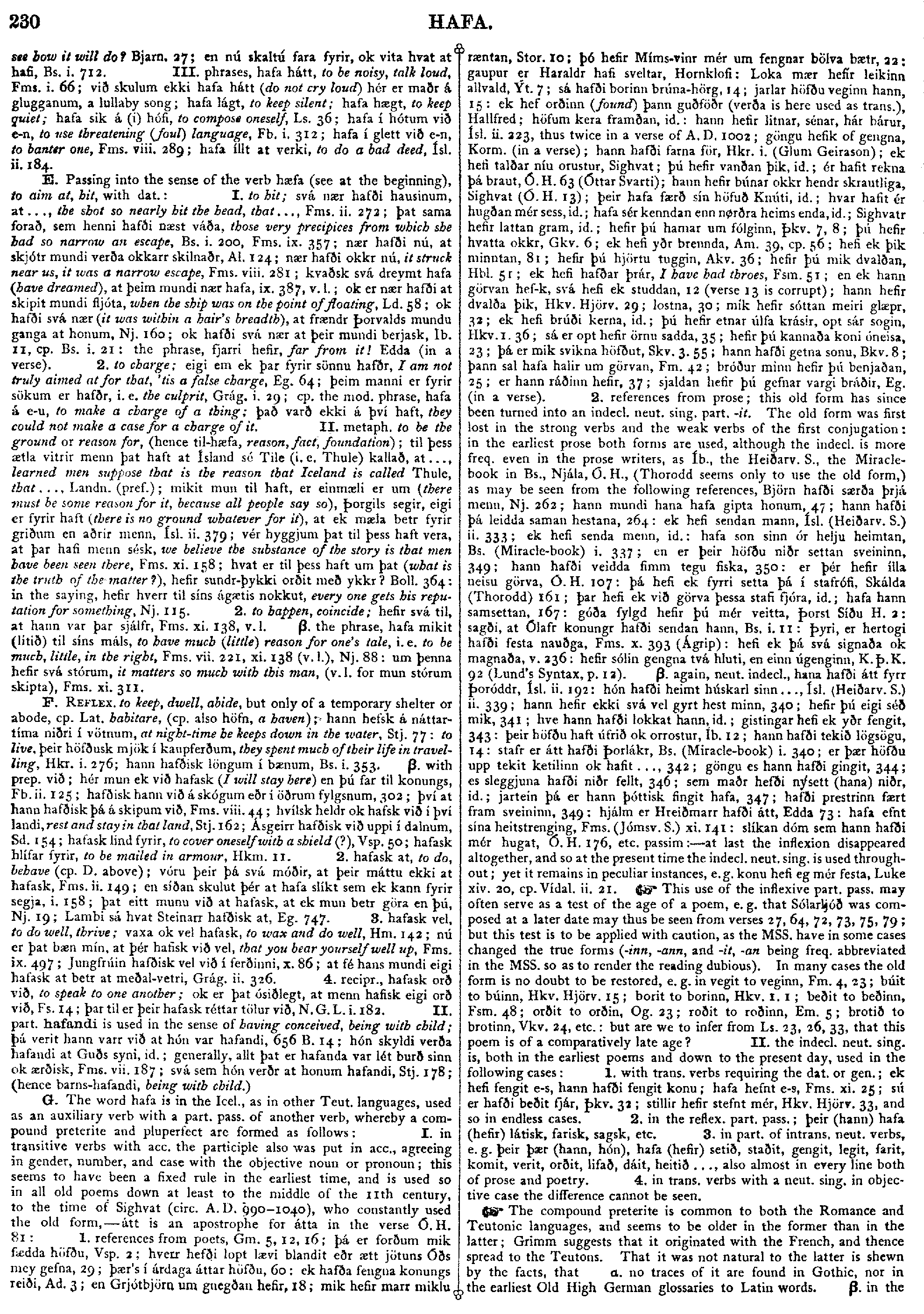
G.
The
word
hafa
is
in
the
Icel.,
as
in
other
Teut.
languages,
used
as
an
auxiliary
verb
with
a
part.
pass.
of
another
verb,
whereby
a
compound
preterite
and
pluperfect
are
formed
as
follows:
I.
in
transitive
verbs
with
acc.
the
participle
also
was
put
in
acc.,
agreeing
in
gender,
number,
and
case
with
the
objective
noun
or
pronoun;
this
seems
to
have
been
a
fixed
rule
in
the
earliest
time,
and
is
used
so
in
all
old
poems
down
at
least
to
the
middle
of
the
11th
century,
to
the
time
of
Sighvat
(circ.
A.D.
990-1040),
who
constantly
used
the
old
form,
--
átt
is
an
apostrophe
for
átta
in
the
verse
Ó.
H.
81:
1.
references
from
poets,
Gm.
5,
12,
16;
þá
er
forðum
mik
fædda
höfðu,
Vsp.
2;
hverr
hefði
lopt
lævi
blandit
eðr
ætt
jötuns
Óðs
mey
gefna,
29;
þær's
í
árdaga
áttar
höfðu,
60:
ek
hafða
fengna
konungs
reiði,
Ad.
3;
en
Grjótbjörn
um
gnegðan
hefir,
18;
mik
hefir
marr
miklu
ræntan,
Stor.
10;
þó
hefir
Míms-vinr
mér
um
fengnar
bölva
bætr,
22:
gaupur
er
Haraldr
hafi
sveltar,
Hornklofi:
Loka
mær
hefir
leikinn
allvald,
Ýt.
7;
sá
hafði
borinn
brúna-hörg,
14;
jarlar
höfðu
veginn
hann,
15:
ek
hef
orðinn
(found)
þann
guðföðr
(verða
is
here
used
as
trans.),
Hallfred;
höfum
kera
framðan,
id.:
hann
hefir
litnar,
sénar,
hár
bárur,
Ísl.
ii.
223,
thus
twice
in
a
verse
of
A.D.
1002;
göngu
hefik
of
gengna,
Korm.
(in
a
verse);
hann
hafði
farna
för,
Hkr.
i.
(Glum
Geirason);
ek
hefi
talðar
níu
orustur,
Sighvat;
þú
hefir
vanðan
þik,
id.;
ér
hafit
rekna
þá
braut,
Ó.
H.
63
(Óttar
Svarti);
hann
hefir
búnar
okkr
hendr
skrautliga,
Sighvat
(Ó.
H.
13);
þeir
hafa
færð
sín
höfuð
Knúti,
id.;
hvar
hafit
ér
hugðan
mér
sess,
id.;
hafa
sér
kenndan
enn
nørðra
heims
enda,
id.;
Sighvatr
hefir
lattan
gram,
id.;
hefir
þú
hamar
um
fólginn,
Þkv.
7,
8;
þú
hefir
hvatta
okkr,
Gkv.
6;
ek
hefi
yðr
brennda,
Am.
39,
cp.
56;
hefi
ek
þik
minntan,
81;
hefir
þú
hjörtu
tuggin,
Akv.
36;
hefir
þú
mik
dvalðan,
Hbl.
51;
ek
hefi
hafðar
þrár,
I
have
had
throes,
Fsm.
51;
en
ek
hann
görvan
hef-k,
svá
hefi
ek
studdan,
12
(verse
13
is
corrupt);
hann
hefir
dvalða
þik,
Hkv.
Hjörv.
29;
lostna,
30;
mik
hefir
sóttan
meiri
glæpr,
32;
ek
hefi
brúði
kerna,
id.;
þú
hefir
etnar
úlfa
krásir,
opt
sár
sogin,
Hkv.
1.
36;
sá
er
opt
hefir
örnu
sadda,
35;
hefir
þú
kannaða
koni
óneisa,
23;
þá
er
mik
svikna
höfðut,
Skv.
3.
55;
hann
hafði
getna
sonu,
Bkv.
8;
þann
sal
hafa
halir
um
görvan,
Fm.
42;
bróður
minn
hefir
þú
benjaðan,
25;
er
hann
ráðinn
hefir,
37;
sjaldan
hefir
þú
gefnar
vargi
bráðir,
Eg.
(in
a
verse).
2.
references
from
prose;
this
old
form
has
since
been
turned
into
an
indecl.
neut.
sing.
part.
-it.
The
old
form
was
first
lost
in
the
strong
verbs
and
the
weak
verbs
of
the
first
conjugation:
in
the
earliest
prose
both
forms
are
used,
although
the
indecl.
is
more
freq.
even
in
the
prose
writers,
as
Íb.,
the
Heiðarv.
S.,
the
Miracle-book
in
Bs.,
Njála,
Ó.
H.,
(Thorodd
seems
only
to
use
the
old
form,)
as
may
be
seen
from
the
following
references,
Björn
hafði
særða
þrjá
menn,
Nj.
262;
hann
mundi
hana
hafa
gipta
honum,
47;
hann
hafði
þá
leidda
saman
hestana,
264:
ek
hefi
sendan
mann,
Ísl.
(Heiðarv.
S.)
ii.
333;
ek
nefi
senda
menn,
id.:
hafa
son
sinn
ór
helju
heimtan,
Bs.
(Miracle-book)
i.
337;
en
er
þeir
höfðu
niðr
settan
sveininn,
349;
hann
hafði
veidda
fimm
tegu
fiska,
350:
er
þér
hefir
ílla
neisu
gorva,
Ó.
H.
107:
þá
hefi
ek
fyrri
setta
þá
í
stafrófi,
Skálda
(Thorodd)
161;
þar
hefi
ek
við
görva
þessa
stafi
fjóra,
id.;
hafa
hann
samsettan,
167:
góða
fylgd
hefir
þú
mér
veitta,
Þorst
Síðu
H.
2:
sagði,
at
Ólafr
konungr
hafði
sendan
hann,
Bs.
i.
11:
Þyri,
er
hertogi
hafði
festa
nauðga,
Fms.
x.
393
(Ágrip):
hefi
ek
þá
svá
signaða
ok
magnaða,
v.
236:
hefir
sólin
gengna
tvá
hluti,
en
einn
úgenginn,
K.
Þ.
K.
92
(Lund's
Syntax,
p.
12).
.
again,
neut.
indecl.,
hana
hafði
átt
fyrr
Þoróddr,
Ísl.
ii.
192:
hón
hafði
heimt
húskarl
sinn
...,
Ísl.
(Heiðarv.
S.)
ii.
339;
hann
hefir
ekki
svá
vel
gyrt
hest
minn,
340;
hefir
þú
eigi
séð
mik,
341;
hve
hann
hafði
lokkat
hann.
id.;
gistingar
hefi
ek
yðr
fengit,
343:
þeir
höfðu
haft
úfrið
ok
orrostur,
Íb.
12;
hann
hafði
tekið
lögsögu,
14:
stafr
er
átt
hafði
Þorlákr,
Bs.
(Miracle-book)
i.
340;
er
þær
höfðu
upp
tekit
ketilinn
ok
hafit
...,
342;
göngu
es
hann
hafði
gingit,
344;
es
sleggjuna
hafði
niðr
fellt,
346;
sem
maðr
hefði
nýsett
(hana)
niðr,
id.;
jartein
þá
er
hann
þóttisk
fingit
hafa,
347;
hafði
prestrinn
fært
fram
sveininn,
349:
hjálm
er
Hreiðmarr
hafði
átt,
Edda
73:
hafa
efnt
sína
heitstrenging,
Fms.
(Jómsv.
S.)
xi.
141:
slíkan
dóm
sem
hann
hafði
mér
hugat,
Ó.
H.
176,
etc.
passim
:--
at
last
the
inflexion
disappeared
altogether,
and
so
at
the
present
time
the
indecl.
neut.
sing,
is
used
throughout;
yet
it
remains
in
peculiar
instances,
e.g.
konu
hefi
eg
mér
festa,
Luke
xiv.
20,
cp.
Vídal.
ii.
21.
UNCERTAIN
This
use
of
the
inflexive
part.
pass.
may
often
serve
as
a
test
of
the
age
of
a
poem,
e.g.
that
Sólarljóð
was
composed
at
a
later
date
may
thus
be
seen
from
verses
27,
64,
72,
73,
75,
79;
but
this
test
is
to
be
applied
with
caution,
as
the
MSS.
have
in
some
cases
changed
the
true
forms
(-inn,
-ann,
and
-it,
-an
being
freq.
abbreviated
in
the
MSS.
so
as
to
render
the
reading
dubious).
In
many
cases
the
old
form
is
no
doubt
to
be
restored,
e.g.
in
vegit
to
veginn,
Fm.
4,
23;
búit
to
búinn,
Hkv.
Hjörv.
15;
borit
to
borinn,
Hkv.
1.
1;
beðit
to
beðinn,
Fsm.
48;
orðit
to
orðin,
Og.
23;
roðit
to
roðinn,
Em.
5;
brotið
to
brotinn,
Vkv.
24,
etc.:
but
are
we
to
infer
from
Ls.
23,
26,
33,
that
this
poem
is
of
a
comparatively
late
age?
II.
the
indecl.
neut.
sing.
is,
both
in
the
earliest
poems
and
down
to
the
present
day,
used
in
the
following
cases:
1.
with
trans.
verbs
requiring
the
dat.
or
gen.;
ek
hefi
fengit
e-s,
hann
hafði
fengit
konu;
hafa
hefnt
e-s,
Fms.
xi.
25;
sú
er
hafði
beðit
fjár,
Þkv.
32;
stillir
hefir
stefnt
mér,
Hkv.
Hjörv.
33,
and
so
in
endless
cases.
2.
in
the
reflex.
part.
pass.;
þeir
(hann)
hafa
(hefir)
látisk,
farisk,
sagsk,
etc.
3.
in
part.
of
intrans.
neut.
verbs,
e.g.
þeir
þær
(hann,
hón),
hafa
(hefir)
setið,
staðit,
gengit,
legit,
farit,
komit,
verit,
orðit,
lifað,
dáit,
heitið
...,
also
almost
in
every
line
both
of
prose
and
poetry.
4.
in
trans.
verbs
with
a
neut.
sing.
in
objective
case
the
difference
cannot
be
seen.
|
Source: Cleasby/Vigfusson, page b0231, entry 18 View original page image as: [TIFF] [PNG] [View previous entry] [View next entry] |
[Comment on this entry] [View comments] |
The following entry has been hand-corrected once. |
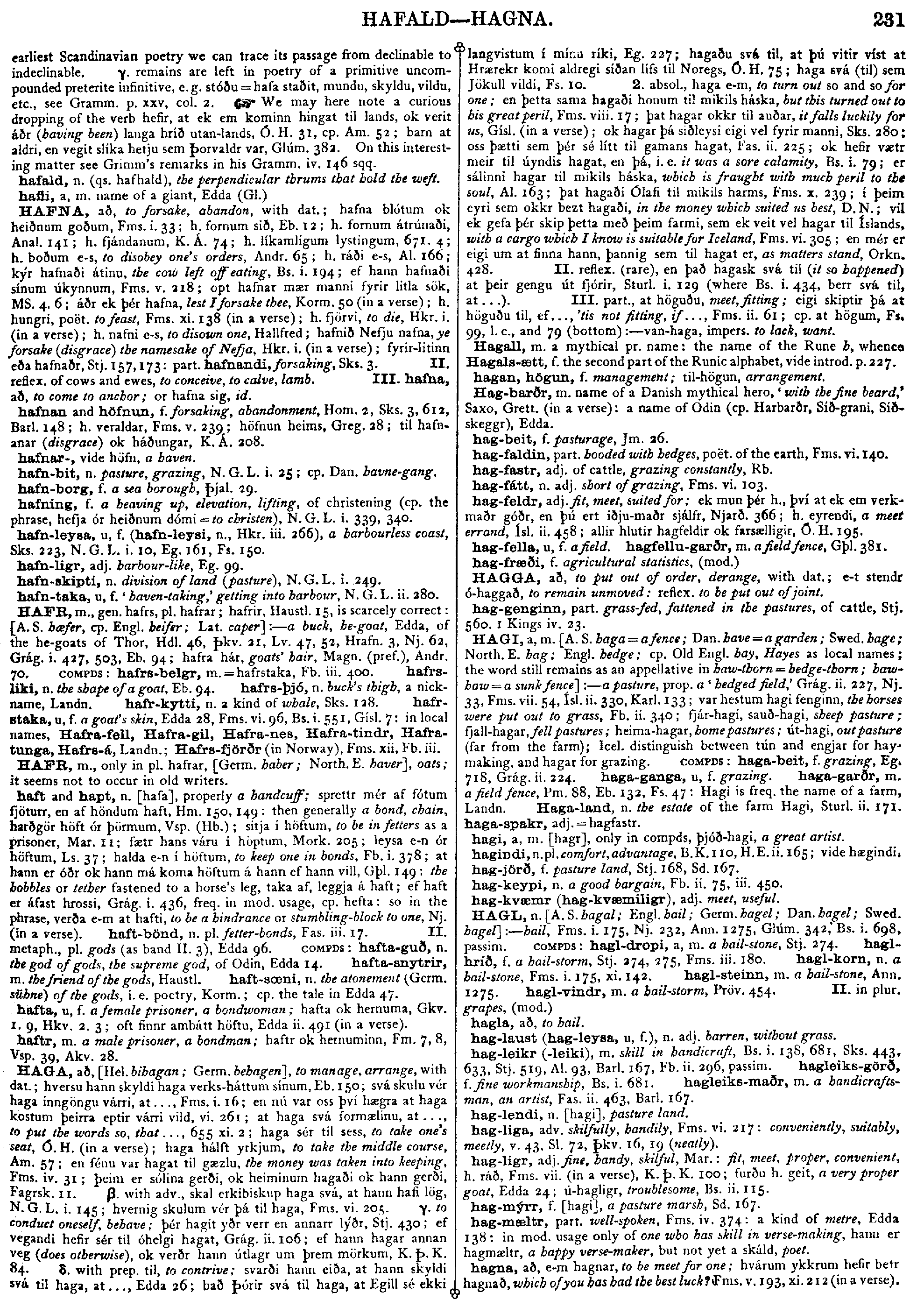
haftr, m. a male prisoner, a bondman; haftr ok hernuminn, Fm. 7, 8, Vsp. 39, Akv. 28.
| Result Page: |  |
Previous | 1 2 3 4 5 6 7 8 9 10 11 | Next |  |
Germanic Lexicon Project (main page)
This search system was written by
Sean Crist
Please consider
volunteering
to correct the data in these online dictionaries.
No rights reserved. Feel free to use these data in any way you please.