|
|

Tip: In the search results, you can click on any word or abbreviation for more information.
|
Source: Cleasby/Vigfusson, page b0407, entry 4 View original page image as: [TIFF] [PNG] [View previous entry] [View next entry] |
[Comment on this entry] [View comments] |
The following entry has not been hand-corrected. However, the page is reserved and someone is correcting it. |
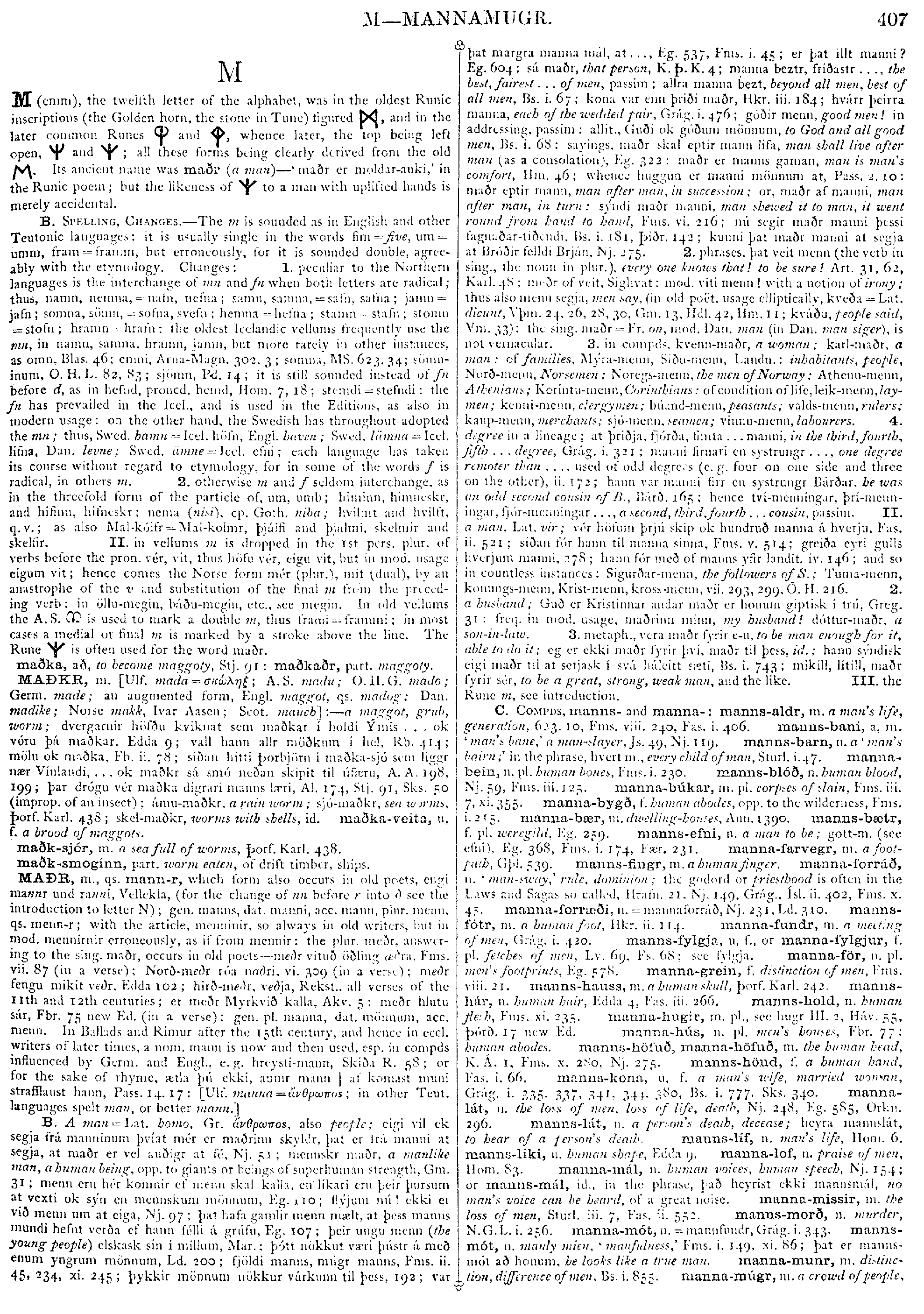
MAÐKR, in. [Ulf. mada -- aKw^ A. S. mr. ilu; O. II. G. 'inado; Germ, made; an augmented form, Engl. Maggot, qs. madog: Dan. madike; Norse makk, Ivar Aascn; Scot, mancb] :-- a maggot, grub, worm; dvergarnir hüfðu kviknat sem maðkar ï holdi Ymis ... ok vóru þá maðkar, Edda 9; vail haun allr niöðkum í he!, 1-111. 414; mölu ok maðka, Fb. ii. 78; síðan hitti borbjiïrn i maðka-sjó sem liggr user Vinlandi, ... ok niaðkr sá smó neðan skipit til úfæru, A. A. 198, 199; þar drógu vér maðka digrari nianns læri, Al. 174, Stj. 91, Sks. 50 (improp. of an insect); ámu-maðkr, a rain worm; sjó-maðkr, s ea worms, þorf. Karl. 438; skel-maðkr, worms with shells, id. maðka-veita, u, f. a brood of maggots.
|
Source: Cleasby/Vigfusson, page b0408, entry 1 View original page image as: [TIFF] [PNG] [View previous entry] [View next entry] |
[Comment on this entry] [View comments] |
The following entry has not been hand-corrected. However, the page is reserved and someone is correcting it. |
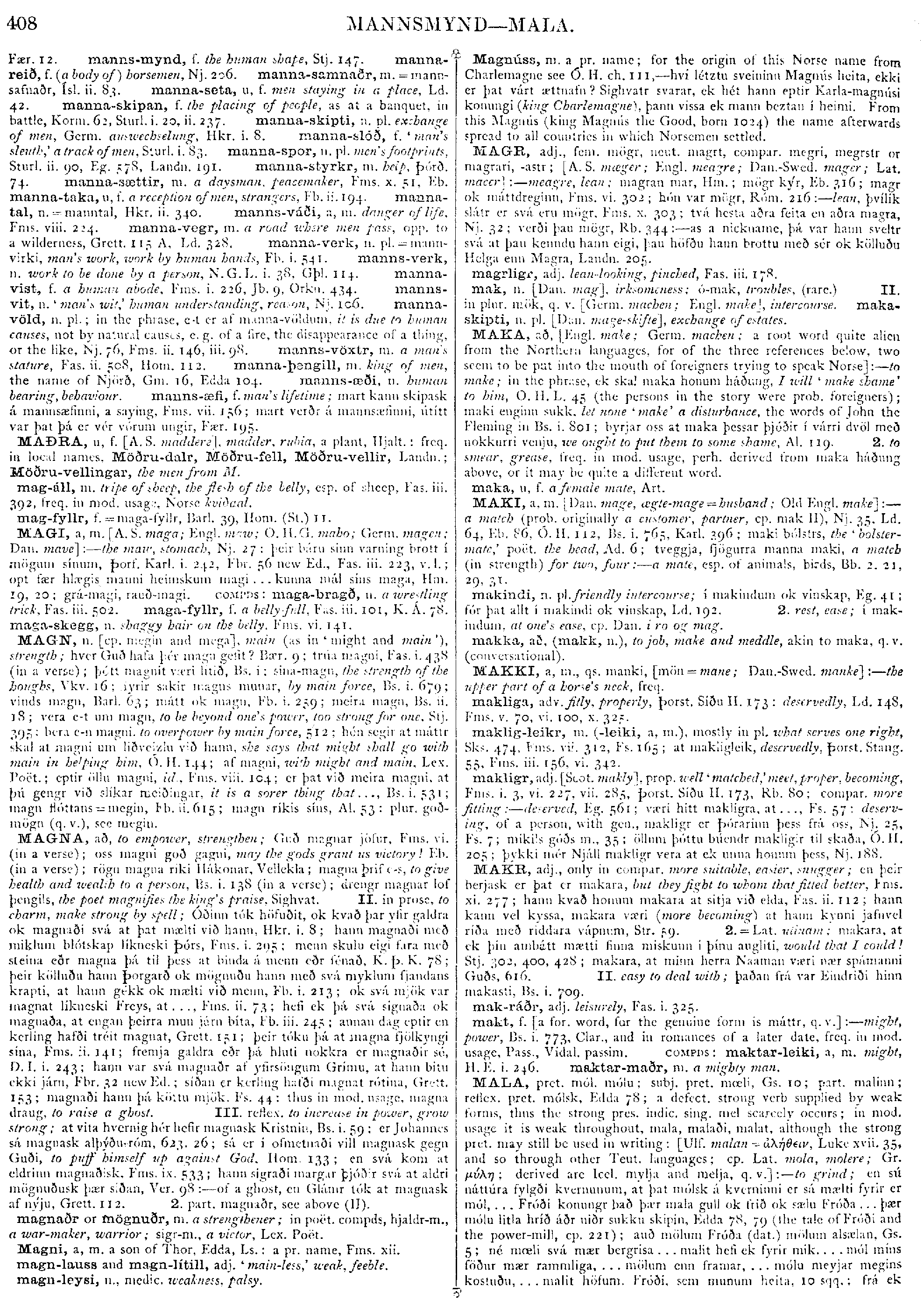
Fær. 12. manns-mynd, f. the human shape, Stj. 147. manna- reið, f. (a body of) horsemen, Nj. 206. manna-samnaðr, m. = inanr, - safnaðr, Ísl. ü. 83. manna-seta, u, f. msn staying in a place, Ld. 42. manna-skipan, f. the placing of people, as at a banquet, in battle, Korm. 62, Stud. i. 20, ii. 237. manna-skipti,:i. pl. exchange of men, Germ, attswechselting, Hkr. i. 8. manna-fjlóð, f. ' mart's sleuth, ' a track of men, Stud. i. 83. manna-spor, n. pl. men's footprints. Sturl. ii. 0, 0, Eg. 578, Landii. 191. manna-styrkr, in. beip, þórð. 74. manna-sættir, m. a daysman, peacemaker, Fms. x. 51, Kb. manna-taka, u, t". a reception of men, strangers, Fb. ii. 194. man na- tal, n. -- manntal, Hkr. ii. 340. manns-váði, a, in. danger of life, Fnis. viti. 2:4. marma-vegr, m. a road u'h-re men pass, opp. to a wilderncfs, Grett. 115 A, Ld. 328. manna-verk, n. pl. -- m:mn- virki, man's work, work by human bands, Fb. i. 541. manns-verk, n. U'ork to be done by a person, N. G. L. i., -, 8, Gþl. 114. manna- vist, f. a human abode. Fms. i. 226, Jb. 9, Orkn. 434. manns- vit, n. ' man's wit' human understanding, rea. -on, Nj. ic6. manna- void, n. pl.; in the phrase, e-l er at" in. inna-voldnin. i/ i s due to bitman causes, not by natural causes, e. g. of a fire, the disappearance of a thing, or the like, Nj. 76, Fms. ii. 146, iii. 98. maiins-voxtr, m. a man's stature, Fas. ii. 508, Hom. 112. manna-þsngill, m. king of men, the name of Njörð, Gm. 16, EdJa 104. manns-teði, n. human bearing, behaviour. manns-æfi, f. man's lifetime; mart kann skipask á maniisæíinni, a saying, Fms. vii. s 56; mart verðr á mannsætinni, útítt var þat þá er vér vórum ungir, Fær. 195.
|
Source: Cleasby/Vigfusson, page b0408, entry 6 View original page image as: [TIFF] [PNG] [View previous entry] [View next entry] |
[Comment on this entry] [View comments] |
The following entry has not been hand-corrected. However, the page is reserved and someone is correcting it. |
MAGN, n. [cp. mcgin and mega], main (as in 'might and main'), strength; hver Guð ha fa Jx'r inagu gefit? Birr. 9; tnia njagni, Fas. i-438 (in a verse); þett mas;nit VHTÍ litið, Bs. i; lina-magn, /be strength of the boughs, Vkv. 16; ivrir sakir ir. aims munar, by main force, Bs. i. 679; vinds inp. gn, Barl. 63; matt ok inagn, Fb. i. 25. 9; meira magn, Bs. ii. 18; vera e-t uni magn, to be beyond one's power, loo strong for one, Stj. 395: bi-ru e-n magni, to overpower by main force, 51 2; hen segir at mattr ska) at Jiiagni um liðvcivciu v^ð hann, she says that might shall go with main in he'ping him, O. II. 144; af maimi, wi'h might and main. Lex. Poët.; eptir öllu magni, id., Fms. viii. 104; er bat við ineira magni, at Jjú gengr við r-líkar ruciðingar, it i s a sorer thing that..., Bs. i. 531; magn tíóttans -- megin, frb. ii. 6i5; magn rikis sins, Al. 53: plur. goð- inögn (q. v.), see megin.
|
Source: Cleasby/Vigfusson, page b0408, entry 7 View original page image as: [TIFF] [PNG] [View previous entry] [View next entry] |
[Comment on this entry] [View comments] |
The following entry has not been hand-corrected. However, the page is reserved and someone is correcting it. |
MAGNA, að, to empower, strengthen; Gr. ð magnar jófur, Fms. vi. (in a verse); oss magni goð gagni, may the gods grant ns victory ! Kb. (in a verse); rogn magna riki llákonar, Vellekla; magua þrif e-s, to give health and wealth to a person, Ib. i. 138 (in a verse); tirengr magnar lof þengils, /he poet magnifies the king's praise, Sighvat. II. in prose, to charm, make strong by spell; O. ûinn tók höfuðit, ok kvað þar yiir galdra ok magnaði svá at þat mælti við hann, Hkr. i. 8; hann magnaði með mikhim blótskap líkncski jbórs, Fnis. i. 2(15; menu skulu eigi f. ira nieð steina eðr magna þá til þess at binda á menn eðr û'nað, K. þ. K. 78; þeir kölluðu hann þorgarð ok mögnuðu haim með svá niyklum fjaiulans krapti, at hann gt'-kk ok mælti við menu, Fb. i. 213; ok svá m;ök var magnat líkncski Freys, at..., Fms. ii. 73; hefi ek þá svá signaða ok magnaða, at engan þeirra mun iárn bíta, Fb. iii. 245; annan dag eptir en keriing hafði tr(''it inagnat, Grett. !=, !; þeir tóku þá at jnagna fjölkyngi sina, Fms. ii. 141; fremja galdra eðr þá hluti nokkra er magnaðir sé, D. I. i. 243; hann var svá m. ignaðr af yfirsiiugum Grírnu, at hann bitn ekki járn, Fbr. 32 newKi!.; síðan er kerling hafði magnat rótina, Gr-. -U. 1. ^3; magnaði harm þá köítu mjük. l''s. 44: thus in mod. usage, magna ilraug, to raise a ghost. III. reHex. to increase in power, grow strong; at vita hvernig her hefir magnask Kristnin, Bs. i. 59; er Johannes sá magnask alþyðurróm, 623. 26; sá er í ofmctnaði vill magnask gegn Guði, to puff himself up against God. Hom. 133; en svá kom at eldrinn inagnadisk, Fms. ix. 533; hann sigraði inarg. ir þjó5:r svá at aldri mögnuðusk þær síðan, Ver. 98 :-- of a ghost, cn Glánir lók at magnask af nyju, Grett. 112. 2. part, magiuðr, see above (II).
|
Source: Cleasby/Vigfusson, page b0409, entry 8 View original page image as: [TIFF] [PNG] [View previous entry] [View next entry] |
[Comment on this entry] [View comments] |
The following entry has not been hand-corrected. However, the page is reserved and someone is correcting it. |
MALR, m., dat. mal, Fb. iii. 446, [Fr. malle, Engl. ww il], a knap- sack, Grett. 93 A, þjal. Jóns. 7; hann tók hnióðliamar ór mal einum, Fb. iii. 446, freq. in mod. usage.
|
Source: Cleasby/Vigfusson, page b0409, entry 12 View original page image as: [TIFF] [PNG] [View previous entry] [View next entry] |
[Comment on this entry] [View comments] |
The following entry has not been hand-corrected. However, the page is reserved and someone is correcting it. |
MAN, n., does not occur in piur. unless it be in gen. pl. niana, Stor. 13 (ni in MS.); [man is an ancient word only used in old laws and poetry, it remains in the compd man-sal, and in the Icel. local name Man-heimar; 'man' (åvðpáiroSov'), being neuter and having but one;;, is prob. of different origin from maim (iii'Opcurros, avrjp), which is. masc. and has a double final n. The etymology of this word is lost in the remotest antiquity; it appears in the O. M. G. m a n a -b o ulnt -- -- -a bondman's bead, a 'serf's bead;' (Grimm in R. A. expresses a doubt as to the current ety- mology of Lat. man-cipium from mann-capere; peril, man and capnt"!). In early Swed. law the- word occurs twice or thrice, næmpna' man, naempnæ quicfic, Schlyter i. 134; in Cïutalagen -- kauper tu mans man i garth thin (i. e. mans-mann -- -- a bond/nan, cp. maus-manna and mans- inaðr, see Schly'. er's Glossary).] B. A bondman, prob. originally of prisoners of war who were sold as slaves (Irish in the west, Finns and Slaves in the east), see Ld. ch. 12, O. T. (Fms. i. ch. 92); svá ok ef hann vill i mani gjalda, tva aura fyrir einn, ok a hann lausn á maninu en i;æ. stn misseri ef haun heiir upp alit, Gr;i. g. i. 396; kaupa man ok gefa frelsi, N. G. L. i. 5, 6; ok þat ie skal liáift vera í gulli ok i silfri en hálit i mani herru'nu (n a tive bondmen) eigi cilia en fertogu, ne yngra en iimmtan vetra, SS; mans leiga, 224; ok heiiuta hann sein annan mans-mann, K. þ. K. 58; mani aiistrænu, eastern s lave s, Hornkloii; maukar nicyjar at mani hal'ðar, Gs. 1, 15; er |m man keyptir, 8; hálta aðra alin íyrir trjúlsgiafa, penning veginn fyrir man-manna, N. G. L. i, 347; næst kiikju-garði skal grata man-manna, 345; maðr manna, no doubt false for man-manna, 388; er hann réttlauss við hann ok hans konu ok man hans allt, 36, Am. 66; J-ar koin mart man fait, þar sá Loðinn konu nokkura er seld hafði verit mansali, Fms. i. 185: allit., mold ok man, N. G. L. iii. 92, v. 1. II. a girl, maid, as also in a worse sense, a mistress, for bondwomen often became their master's mistresses (see Ld. ch. 12), so that this sense grew out of the preceding one; liki ley fa ens Ijosa mans, Hm. 91; í myrkri skal við man spjalla, 81; et horska man, 101; et manunga man, 163; bat et unga man, þat et mjallhvita man, Aim. 6, 7; bjarthaddað man, Skv. I. 33; harðúðigt man, 27; tostr-man, a bondwoman mine, 3. 67; mans at kosta, Hbl. 16; live ek at andspilli komumk ens unga mans, Skm. 11; hve ek fyrir-banna manna glaum mani, manna nyt mani, bow I ban her from all concourse with men, 34; Ylfinga man, Hkv. 2. 3; Yggjar man, the beloved of Ygg (Odin) -- the Earth, Lex. l'oi-t.; HOðins man = Hilda, the beloved of lied in, Fms. ix. (in a verse); bjarnar man, a giantess, Stor. 13. It is probable that in some law phrases the obso- lete ' man' has been replaced by the common ' maim, ' e. g. in gefa manni frelsi (mani? cp. manfrelsi), N. G. L. i. 5: as also in mana-kaup in the Swed. law, see Schlyter's introd. to the loth vol. of Sver. (Manila Lag. ir. COMPDS: man-frelsi., n. a granting of freedom to a bondman, manu- mission (as a vow), Orkn. 198, 200, Gr;ig. i. 357, where it is wrongly spelt mannfrelsi. Man-heimar, in. pl. (thus pronounce;! on the spot, not Mann-heimar, as it is often spelt), the name of a farm in western Icel.; the local legend attributes the name to English captives kept there by lady Olo'f, for having slain her husband, during the Fnglish trade (1467). But at that time the word man had become quite obsolete, and so the name must be older, prob. dating from the time of the first settler Geirmund, who had been a freebooter in the British waters before he came to Icel.; he may have had his house- hold of bondmen at this farm, see Safn i. 353 (foot-note). man- kynni, n. pl.; gócî in., luck in love affairs, Hbl. 31. man-manna, n. (?) -- •- mansmaðr, N. G. L. i. 345, 347; see the references above. man-runar, f. pl. 'love-runes, ' love-spells, Eg. 587. man-sal, n. n 'man-sale. ' slave trade; selia e-n mansali, Fær. 117, Fms. i. 185, Fb. ii. 79. mansals-maðr, in. a bondman, Fms. i. 78, 22:. mans-maðr, m. [earh Swed. mam-man'', a bondman, (îrúg. i. 271. Eg. 89, K. p. K. 58. man-scmgr, m. a love song, Fig. 325. Bs. i. 165, Edda 16; esp. in the old law a kind of loi-f libel, liable to outlawry, Grug. ii. 150, Fb. ui. 242: in mod. usage the lyrical introduction to the epic rhap- sodies or ballads (rimur) is called manscingr, tor originally they were addressed to the poet's lady-love, Skald H. 6. i, SkíðaK. i, and in count- less instances, e. g. Ú If. I. H, 2. 8, 3. 8, 4, 8, 5. 7, 7. 9, 9. 11, cp. ii. 10. mansöngs-drápa, u, f., -kvœði, n., -visa, u, f. a love encomium, love song, lore di. 'ty. Eg. 5, Bs. i. 165, Fb. iii. 241, 242, Oik. 36, Fs. 60, 87.
|
Source: Cleasby/Vigfusson, page b0409, entry 22 View original page image as: [TIFF] [PNG] [View previous entry] [View next entry] |
[Comment on this entry] [View comments] |
The following entry has not been hand-corrected. However, the page is reserved and someone is correcting it. |
manna, að, prop, to make a ' man. ' 2. mod. to man a boat, manna skip. II. reflex, to become a man, to be brought up to man- hood; þórir var maðr ætt-smúr ok hafði mannask vel, Fms. iv. 255; att-smár ok mannaðr vel, it' ell bred, O. H. 113; var nióðir mín vel möp. nuð, of good family, Krandkr. 62; ef nu'r reynisk Jjórólfr tamvcl mannaðr (if í find Tb. as accomplished a man) sem hann er synuni full- tlrengiligr, Eg. 29; vii ek biðja dóttur þinnar til handa (jlúnii bróður mínum. skaltii þat vita, at hann er vel mannaðr, Nj. 23; synir þeirra vóru Ki'ilfr ok Grímr, mannaðir at lu'ifi, Â'. and G. îcere rather fine well- bred men, Fms. vi. 102; son þinn svá vel mannaðan, ii. 193; cngar eru bat ytirbælr at hann n;'ii at eiga dóttur þina, þvíat ekki er hann verr manuaðr en lion, Fb. i. 196; hann/i siau sonu ok alla vel mannaoa, Ísl. ii. 215; maðr af gi'iðri ætt er litt er mannaðr, Skálda 176. 2. manned, of a ship; vel (ilia) mannað, Jt-c/Z (badly) manned, of the crew; var þar ve! mannað, there was a good gathering of people, Grett. 78-
|
Source: Cleasby/Vigfusson, page b0410, entry 6 View original page image as: [TIFF] [PNG] [View previous entry] [View next entry] |
[Comment on this entry] [View comments] |
The following entry has been hand-corrected once. |
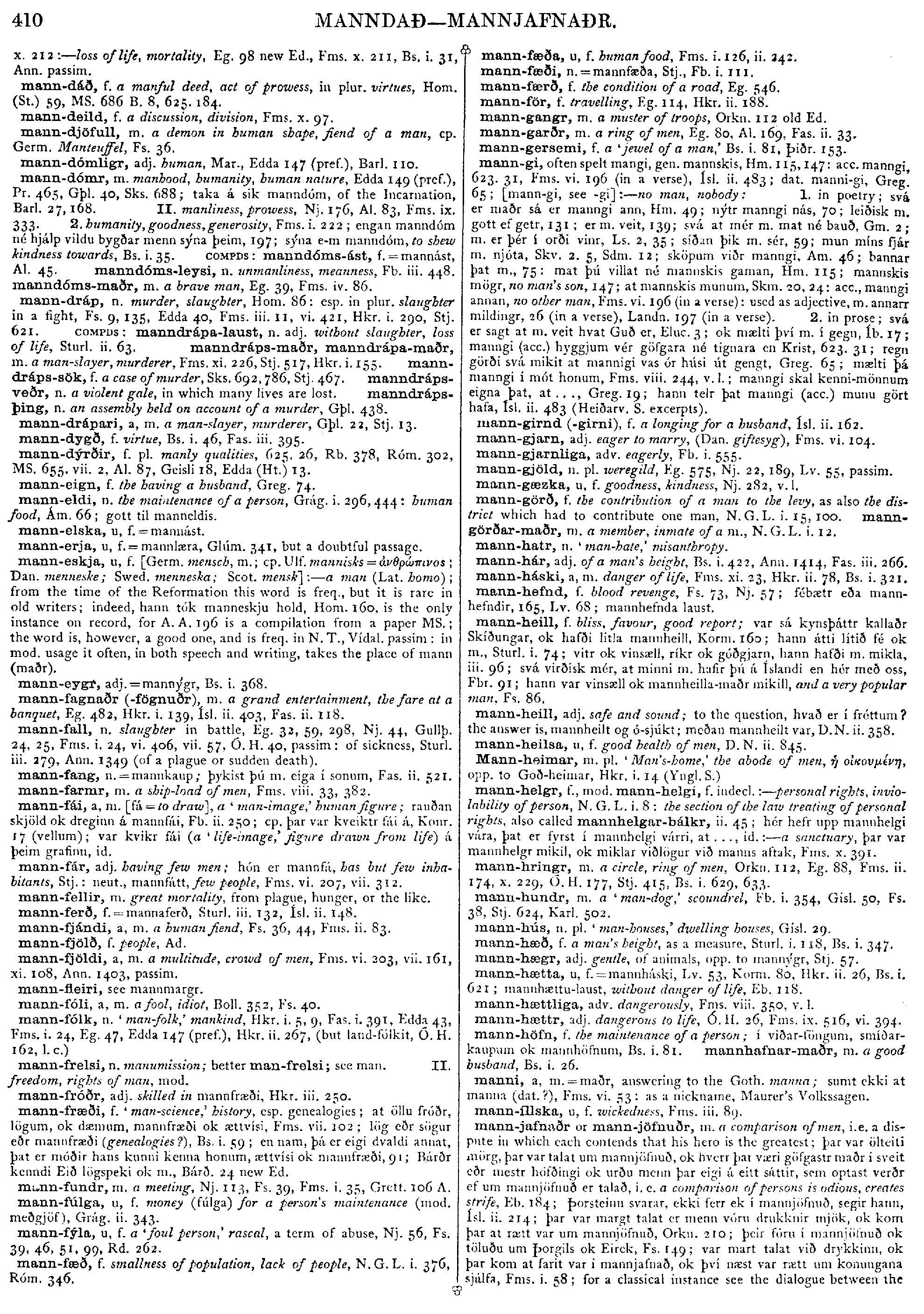
mann-dómr, m. manhood, humanity, human nature, Edda 149 (pref.), Pr. 465, Gþl. 40, Sks. 688; taka á sik manndóm, of the Incarnation, Barl. 27, 168. II. manliness, prowess, Nj. 176, Al. 83, Fms. ix. 333. 2. humanity, goodness, generosity, Fms. i. 222; engan manndóm né hjálp vildu bygðar menn sýna þeim, 197; sýna e-m manndóm, to shew kindness towards, Bs. i. 35. COMPDS: manndóms-ást, f. = mannást, Al. 45. manndóms-leysi, n. unmanliness, meanness, Fb. iii. 448. manndóms-maðr, m. a brave man, Eg. 39, Fms. iv. 86.
|
Source: Cleasby/Vigfusson, page b0410, entry 21 View original page image as: [TIFF] [PNG] [View previous entry] [View next entry] |
[Comment on this entry] [View comments] |
The following entry has been hand-corrected once. |
mann-fái, a, m. [fá = to draw], a 'man-image,' human figure; rauðan skjöld ok dreginn á mannfái, Fb. ii. 250; cp. þar var kveiktr fái á, Konr. 17 (vellum); var kvikr fái (a 'life-image,' figure drawn from life) á þeim grafinn, id.
|
Source: Cleasby/Vigfusson, page b0410, entry 39 View original page image as: [TIFF] [PNG] [View previous entry] [View next entry] |
[Comment on this entry] [View comments] |
The following entry has been hand-corrected once. |
mann-fæði, n. = mannfæða, Stj., Fb. i. 111.
| Result Page: |  |
Previous | 69 70 71 72 73 74 75 76 77 78 79 80 81 82 83 84 85 86 87 | Next |  |
Germanic Lexicon Project (main page)
This search system was written by
Sean Crist
Please consider
volunteering
to correct the data in these online dictionaries.
No rights reserved. Feel free to use these data in any way you please.