|
|

Search for Fas again, using less strict matching (2726 results)
|
Source: Cleasby/Vigfusson, page b0519, entry 10 View original page image as: [TIFF] [PNG] [View previous entry] [View next entry] |
[Comment on this entry] [View comments] |
The following entry has been hand-corrected once. |
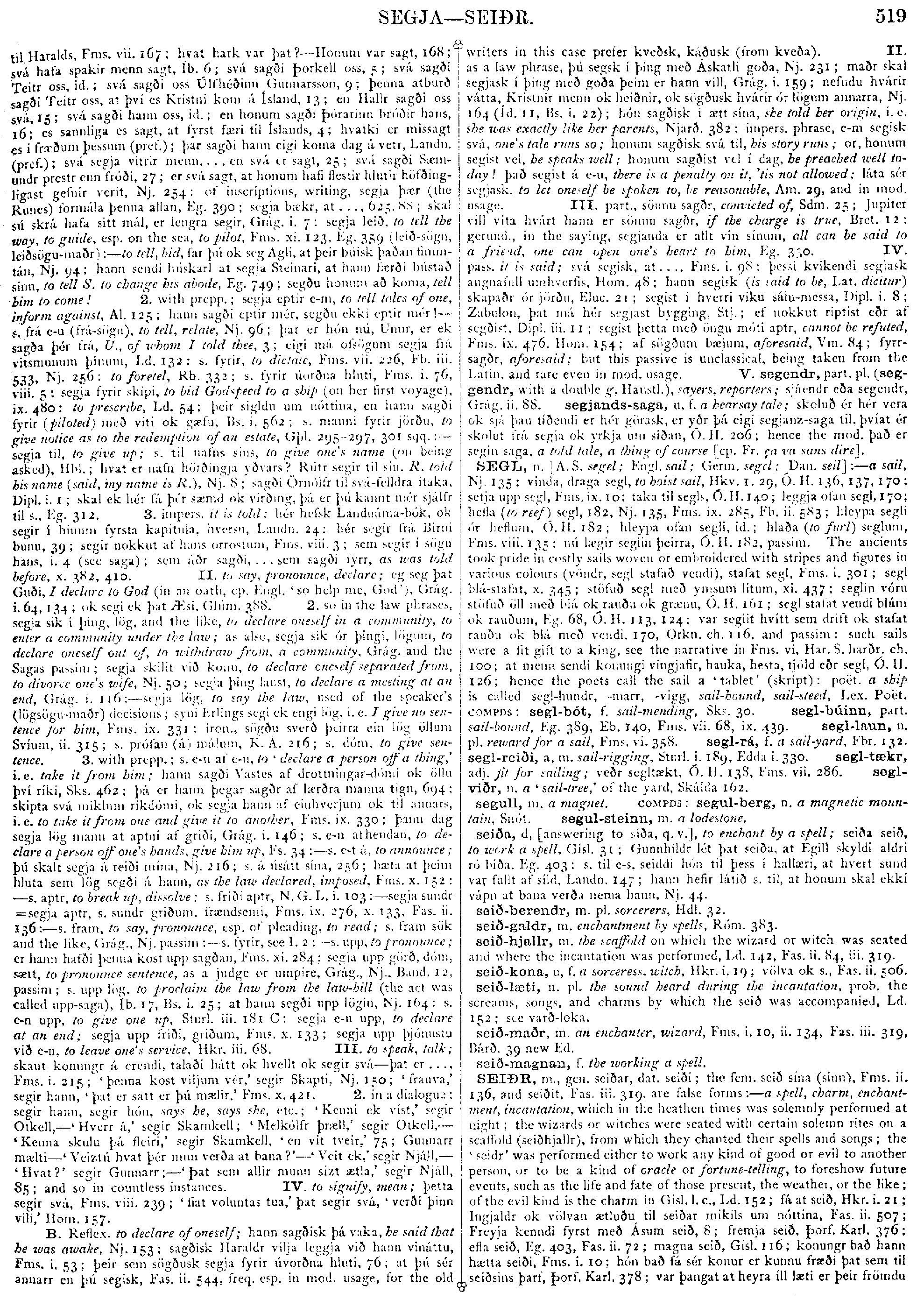
seið-maðr, m. an enchanter, wizard, Fms. i. 10, ii. 134, Fas. iii. 319, Bárð. 39 new Ed.
|
Source: Cleasby/Vigfusson, page b0519, entry 12 View original page image as: [TIFF] [PNG] [View previous entry] [View next entry] |
[Comment on this entry] [View comments] |
The following entry has been hand-corrected once. |
SEIÐR, m., gen. seiðar, dat. seiði; the fem, seið sina (sinn), Fms. ii. 136, and seiðit, Fas. iii. 319, are false forms :-- a spell, charm, enchantment, incantation, which in the heathen times was solemnly performed at night; the wizards or witches were seated with certain solemn rites on a scaffold (seiðhjallr), from which they chanted their spells and songs; the 'seidr' was performed either to work any kind of good or evil to another person, or to be a kind of oracle or fortune-telling, to foreshow future events, such as the life and fate of those present, the weather, or the like; of the evil kind is the charm in Gísl. l.c., Ld. 152; fá at seið, Hkr. i. 21; Ingjaldr ok völvan ætluðu til seiðar mikils um nóttina, Fas. ii. 507; Freyja kenndi fyrst með Ásum seið, 8; fremja seið, Þorf. Karl. 376; efla seið, Eg. 403, Fas. ii. 72; magna seið, Gísl. 116; konungr bað hann hætta seiði, Fms. i. 10: hón bað fá sér konur er kunnu fræði þat sem til seiðsins þarf, Þorf. Karl. 378; var þangat at heyra íll læti er þeir frömdu
|
Source: Cleasby/Vigfusson, page b0520, entry 1 View original page image as: [TIFF] [PNG] [View previous entry] [View next entry] |
[Comment on this entry] [View comments] |
The following entry has been hand-corrected once. |
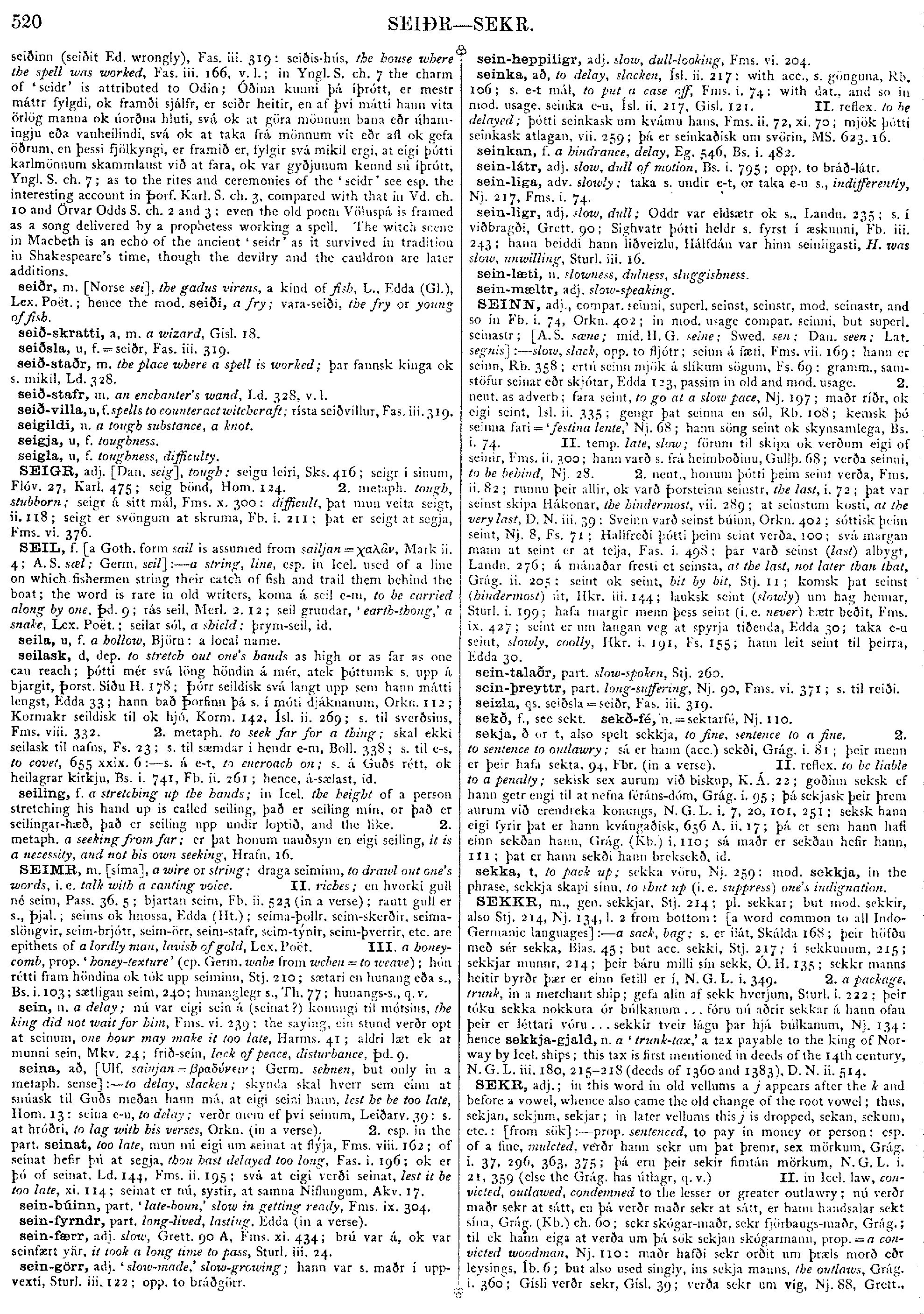
seiðinn (seiðit Ed. wrongly), Fas. iii. 319: seiðis-hús, the house where the spell was worked. Fas. iii. 166, v.l.; in Yngl. S. ch. 7 the charm of 'seidr' is attributed to Odin; Óðinn kunni þá íþrótt, er mestr máttr fylgdi, ok framði sjálfr, er seiðr heitir, en af því mátti hann vita örlög manna ok úorðna hluti, svá ok at göra mönnum bana eðr úhamingju eða vanheilindi, svá ok at taka frá mönnum vit eðr afl ok gefa öðrum, en þessi fjölkyngi, er framið er, fylgir svá mikil ergi, at eigi þótti karlmönnum skammlaust við at fara, ok var gyðjunum kennd sú íþrótt, Yngl. S. ch. 7; as to the rites and ceremonies of the 'seidr' see esp. the interesting account in Þorf. Karl. S. ch. 3, compared with that in Vd. ch. 10 and Örvar Odds S. ch. 2 and 3; even the old poem Völuspá is framed as a song delivered by a prophetess working a spell. The witch scene in Macbeth is an echo of the ancient 'seidr' as it survived in tradition in Shakespeare's time, though the devilry and the cauldron are later additions.
|
Source: Cleasby/Vigfusson, page b0520, entry 4 View original page image as: [TIFF] [PNG] [View previous entry] [View next entry] |
[Comment on this entry] [View comments] |
The following entry has been hand-corrected once. |
seiðsla, u, f. = seiðr, Fas. iii. 319.
|
Source: Cleasby/Vigfusson, page b0520, entry 7 View original page image as: [TIFF] [PNG] [View previous entry] [View next entry] |
[Comment on this entry] [View comments] |
The following entry has been hand-corrected once. |
seið-villa, u, f. spells to counteract witchcraft; rísta seiðvillur, Fas. iii. 319.
|
Source: Cleasby/Vigfusson, page b0520, entry 18 View original page image as: [TIFF] [PNG] [View previous entry] [View next entry] |
[Comment on this entry] [View comments] |
The following entry has been hand-corrected once. |
seina, að, [Ulf. sainjan = GREEK; Germ. sehnen, but only in a metaph. sense] :-- to delay, slacken; skynda skal hverr sem einn at snúask til Guðs meðan hann má, at eigi seini hann, lest he be too late, Hom. 13: seina e-u, to delay; verðr mein ef því seinum, Leiðarv. 39: s. at hróðri, to lag with his verses, Orkn. (in a verse). 2. esp. in the part. seinat, too late, mun nú eigi um seinat at flýja, Fms. viii. 162; of seinat hefir þú at segja, thou hast delayed too long. Fas. i. 196; ok er þó of seinat, Ld. 144, Fms. ii. 195; svá at eigi verði seinat, lest it be too late, xi. 114; seinat er nú, systir, at samna Niflungum, Akv. 17.
|
Source: Cleasby/Vigfusson, page b0520, entry 31 View original page image as: [TIFF] [PNG] [View previous entry] [View next entry] |
[Comment on this entry] [View comments] |
The following entry has been hand-corrected once. |
SEINN, adj., compar. seinni, superl. seinst, seinstr, mod. seinastr, and so in Fb. i. 74, Orkn. 402; in mod. usage compar. seinni, but superl. seinastr; [A.S. sæne; mid. H.G. seine; Swed. sen; Dan. seen; Lat. segnis] :-- slow, slack, opp. to fljótr; seinn á fæti, Fms. vii. 169; hann er seinn, Rb. 358; ertú seinn mjök á slíkum sögum, Fs. 69: gramm., samstöfur seinar eðr skjótar, Edda 123, passim in old and mod. usage. 2. neut. as adverb; fara seint, to go at a slow pace, Nj. 197; maðr ríðr, ok eigi seint, Ísl. ii. 335; gengr þat seinna en sól, Rb. 108; kemsk þó seinna fari = 'festina lente,' Nj. 68; hann söng seint ok skynsamlega, Bs. i. 74. II. temp. late, slow; förum til skipa ok verðum eigi of seinir, Fms. ii. 300; hann varð s. frá heimboðinu, Gullþ. 68; verða seinni, to be behind, Nj. 28. 2. neut., honum þótti þeim seint verða, Fms, ii. 82; runnu þeir allir, ok varð Þorsteinn seinstr, the last, i. 72; þat var seinst skipa Hákonar, the hindermost, vii. 289; at seinstum kosti, at the very last, D.N. iii. 39; Sveinn varð seinst búinn, Orkn. 402; sóttisk þeim seint, Nj. 8, Fs. 71; Hallfreði þótti þeim seint verða, 100; svá margan mann at seint er at telja, Fas. i. 498; þar varð seinst (last) albygt, Landn. 276; á máuaðar fresti et seinsta, at the last, not later than that, Grág. ii. 205: seint ok seint, bit by bit, Stj. 11; komsk þat seinst (hindermost) út, Hkr. iii. 144; lauksk seint (slowly) um hag hennar, Sturl. i. 199; hafa margir menn þess seint (i.e. never) bætr beðit, Fms. ix. 427; seint er um langan veg at spyrja tíðenda, Edda 30; taka e-u seint, slowly, coolly, Hkr. i. 191, Fs. 155; hann leit seint til þeirra, Edda 30.
|
Source: Cleasby/Vigfusson, page b0520, entry 34 View original page image as: [TIFF] [PNG] [View previous entry] [View next entry] |
[Comment on this entry] [View comments] |
The following entry has been hand-corrected once. |
seizla, qs. seiðsla = seiðr, Fas. iii. 319.
|
Source: Cleasby/Vigfusson, page b0522, entry 3 View original page image as: [TIFF] [PNG] [View previous entry] [View next entry] |
[Comment on this entry] [View comments] |
The following entry has been hand-corrected once. |
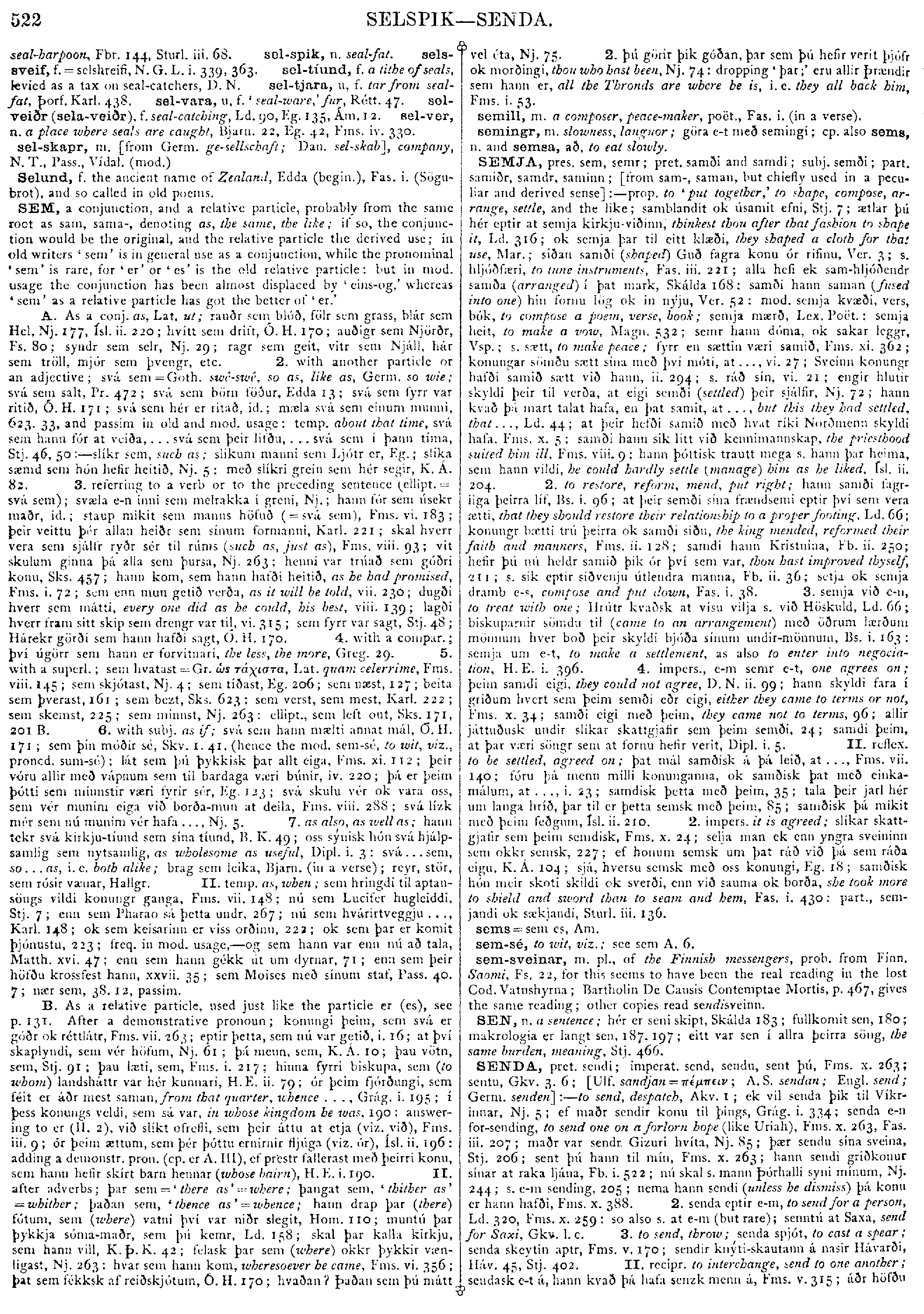
Selund, f. the ancient name of Zealand, Edda (begin.), Fas. i. (Sögubrot), and so called in old poems.
|
Source: Cleasby/Vigfusson, page b0522, entry 5 View original page image as: [TIFF] [PNG] [View previous entry] [View next entry] |
[Comment on this entry] [View comments] |
The following entry has been hand-corrected once. |
semill, m. a composer, peace-maker, poët., Fas. i. (in a verse).
| Result Page: |  |
Previous | 179 180 181 182 183 184 185 186 187 188 189 190 191 192 193 194 195 196 197 | Next |  |
Germanic Lexicon Project (main page)
This search system was written by
Sean Crist
Please consider
volunteering
to correct the data in these online dictionaries.
No rights reserved. Feel free to use these data in any way you please.