|
|

Search for Fas again, using less strict matching (2726 results)
|
Source: Cleasby/Vigfusson, page b0436, entry 51 View original page image as: [TIFF] [PNG] [View previous entry] [View next entry] |
[Comment on this entry] [View comments] |
The following entry has been hand-corrected once. |
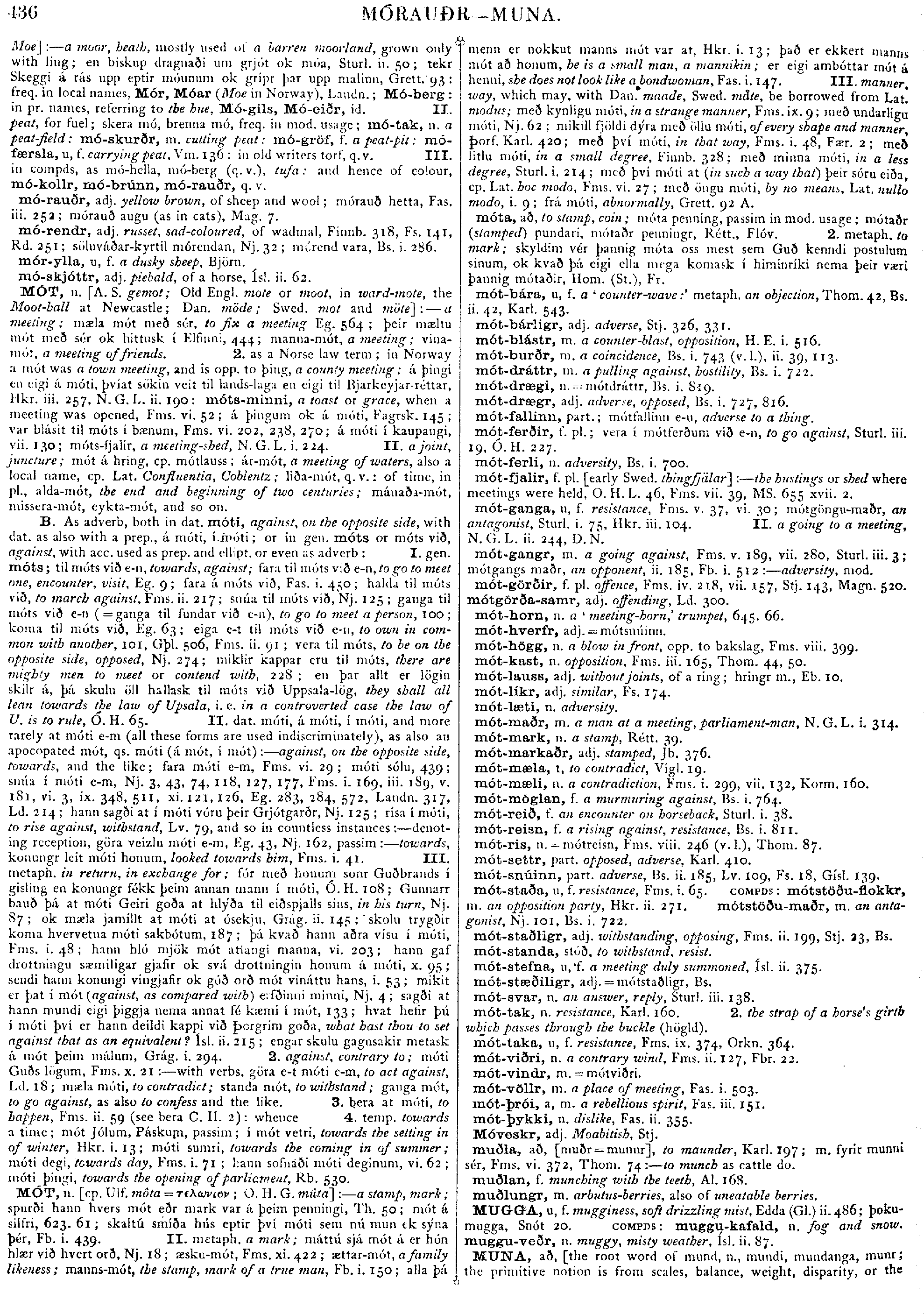
mót-völlr, m. a place of meeting, Fas. i. 503.
|
Source: Cleasby/Vigfusson, page b0436, entry 52 View original page image as: [TIFF] [PNG] [View previous entry] [View next entry] |
[Comment on this entry] [View comments] |
The following entry has been hand-corrected once. |
mót-þrói, a, m. a rebellious spirit, Fas. iii. 151.
|
Source: Cleasby/Vigfusson, page b0436, entry 53 View original page image as: [TIFF] [PNG] [View previous entry] [View next entry] |
[Comment on this entry] [View comments] |
The following entry has been hand-corrected once. |
mót-þykki, n. dislike, Fas. ii. 355.
|
Source: Cleasby/Vigfusson, page b0437, entry 2 View original page image as: [TIFF] [PNG] [View previous entry] [View next entry] |
[Comment on this entry] [View comments] |
The following entry has been hand-corrected once. |
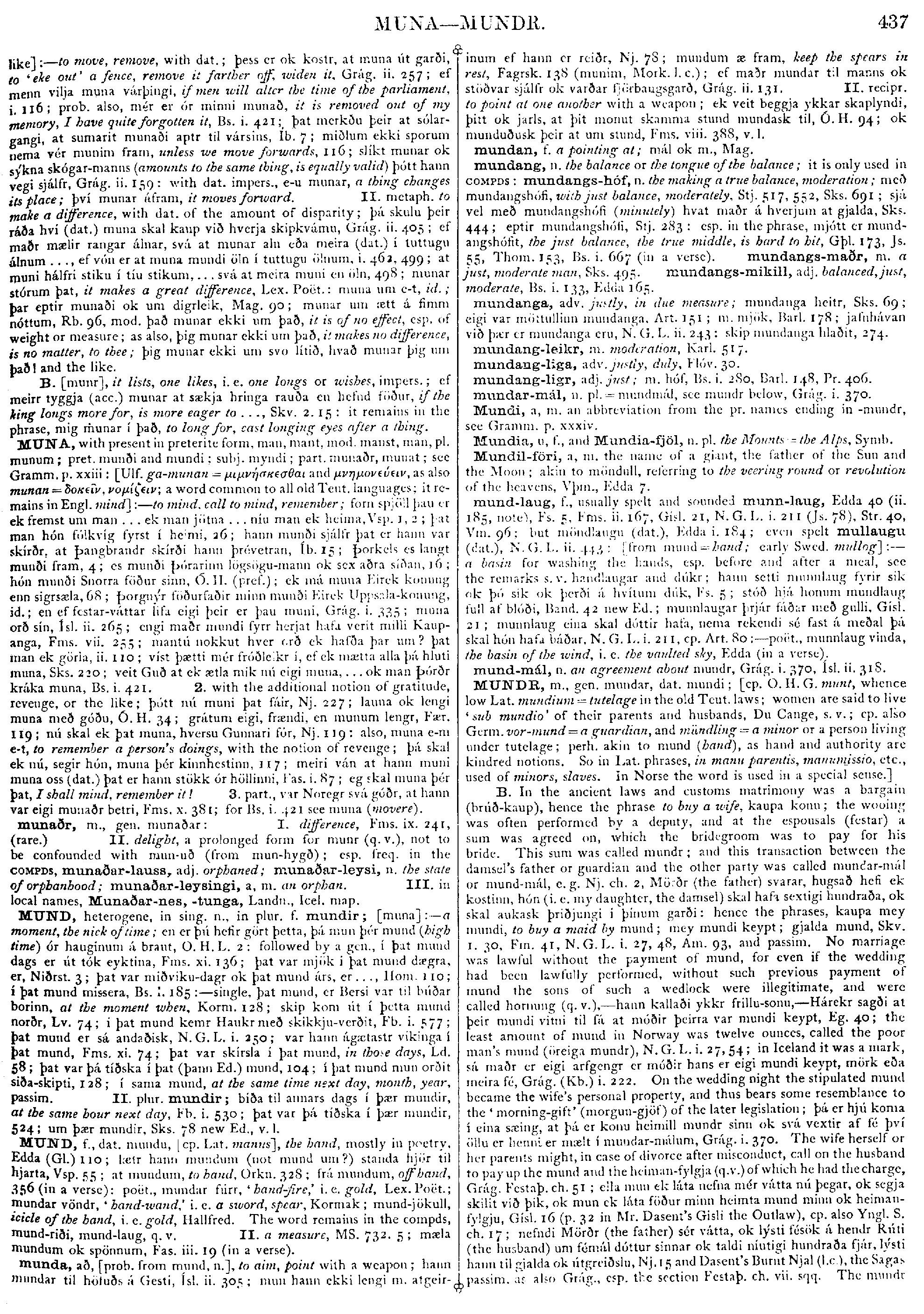
MUNA, with present in preterite form, man, mant, mod. manst, man, pl. munum; pret. munði and mundi: subj. myndi; part. munaðr, munat; see Gramm. p. xxiii: [Ulf. ga-munan = GREEK and GREEK, as also munan = GREEK; a word common to all old Teut. languages; it remains in Engl. mind] :-- to mind, call to mind, remember; forn spjöll þau er ek fremst um man ... ek man jötna ... níu man ek heima. Vsp. 1, 2; þat man hón fólkvíg fyrst í heimi, 26; hann munði sjálfr þat er hann var skírðr, at Þangbrandr skírði hann þrévetran, Íb. 15; Þorkek es langt munði fram, 4; es munði Þórarinn lögsögu-mann ok sex aðra síðan, 16; hón munði Snorra föður sinn, Ó.H. (pref.); ek má muna Eirek konung enn sigrsæla, 68; Þorgnýr föðurfaðir minn munði Eirek Uppsala-konung, id.; en ef fostar-váttar lífa eigi þeir er þau muni, Grág. i. 335; muna orð sín, Ísl. ii. 265; engi maðr mundi fyrr herjat hafa verit milli Kaupanga, Fms. vii. 255; mantú nokkut hver orð ek hafða þar um? þat man ek görla, ii. 110; víst þætti mér fróðleikr í, ef ek mætta alla þá hluti muna, Sks. 220; veit Guð at ek ætla mik nú eigi muna, ... ok man Þórðr kráka muna, Bs. i. 421. 2. with the additional notion of gratitude, revenge, or the like; þótt nú muni þat fáir, Nj. 227; launa ok lengi muna með góðu, Ó.H. 34; grátum eigi, frændi, en munum lengr, Fær. 119; nú skal ek þat muna, hversu Gunnari fór, Nj. 119: also, muna e-m e-t, to remember a person's doings, with the notion of revenge; þá skal ek nú, segir hón, muna þér kinnhestinn, 117; meiri ván at hann muni muna oss (dat.) þat er hann stökk ór höllinni, Fas. i. 87; eg skal muna þér þat, I shall mind, remember it! 3. part., vár Noregr svá góðr, at hann var eigi munaðr betri, Fms. x. 381; for Bs. i. 421 see muna (movere).
|
Source: Cleasby/Vigfusson, page b0437, entry 5 View original page image as: [TIFF] [PNG] [View previous entry] [View next entry] |
[Comment on this entry] [View comments] |
The following entry has been hand-corrected once. |
MUND, f., dat. mundu, [cp. Lat. manus], the hand, mostly in poetry, Edda (Gl.) 110; læfr hann mundum (not mund um?) standa hjör til hjarta, Vsp. 55; at mundum, to hand, Orkn. 328; frá mundum, off hand, 356 (in a verse): poët., mundar fúrr, 'hand-fire,' i.e. gold, Lex. Poët.; mundar vöndr, 'hand-wand' i.e. a sword, spear, Kormak; mund-jökull, icicle of the hand, i.e. gold, Hallfred. The word remains in the compds, mund-riði, mund-laug, q.v. II. a measure, MS. 732. 5; mæla mundum ok spönnum, Fas. iii. 19 (in a verse).
|
Source: Cleasby/Vigfusson, page b0438, entry 4 View original page image as: [TIFF] [PNG] [View previous entry] [View next entry] |
[Comment on this entry] [View comments] |
The following entry has been hand-corrected once. |
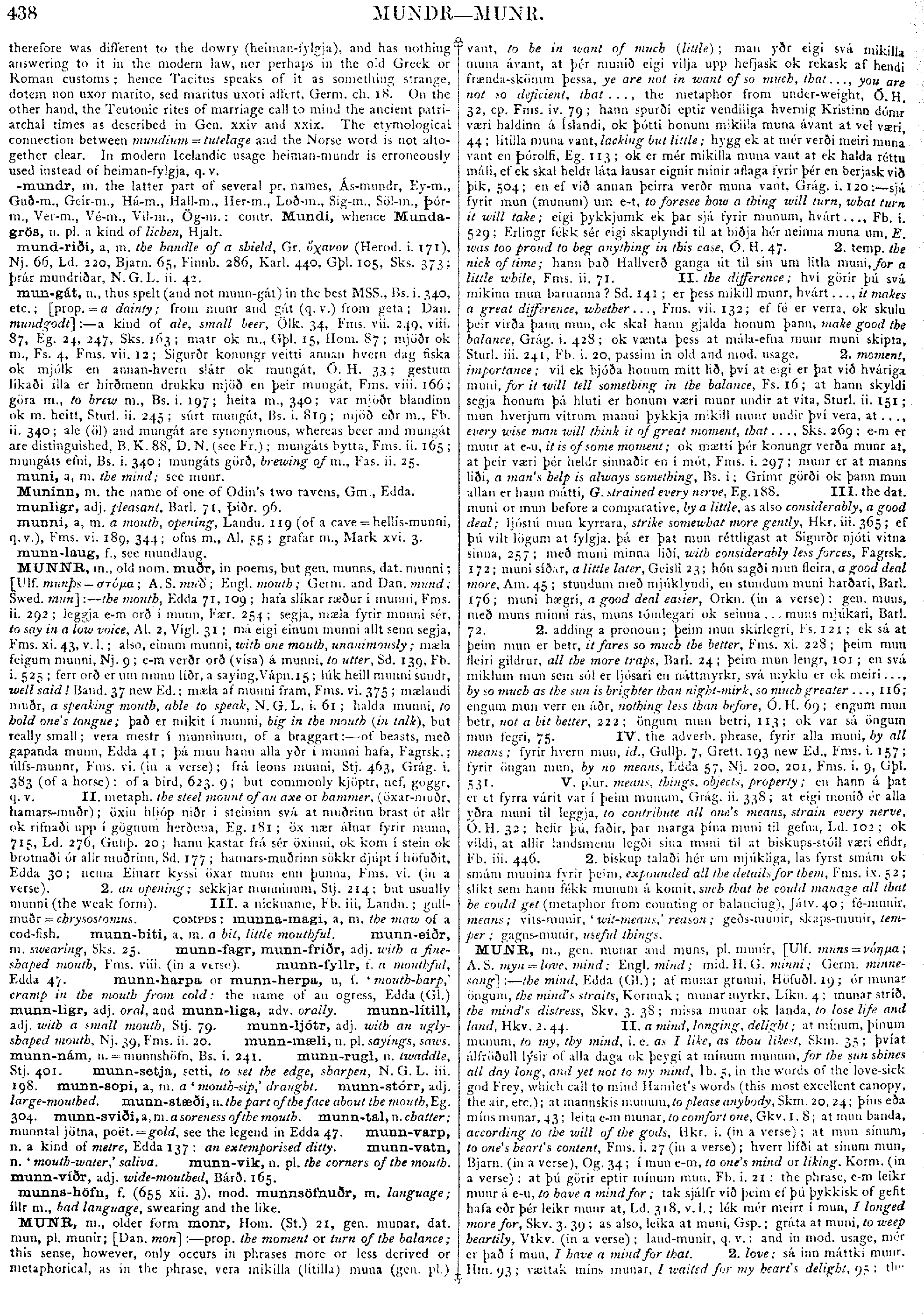
mun-gát, n., thus spelt (and not munn-gát) in the best MSS., Bs. i. 340, etc.; [prop. = a dainty; from munr and gát (q.v.) from geta; Dan. mundgodt] :-- a kind of ale, small beer, Ölk. 34, Fms. vii. 249, viii. 87, Eg. 24, 247, Sks. 163; matr ok m., Gþl. 15, Hom. 87; mjöðr ok m., Fs. 4, Fms. vii. 12; Sigurðr konungr veitti annan hvern dag fiska ok mjólk en annan-hvern slátr ok mungát, Ó.H. 33; gestum líkaði ílla er hirðmenn drukku mjöð en þeir mungát, Fms. viii. 166; göra m., to brew m., Bs. i. 197; heita m., 340; var mjöðr blandinn ok m. heitt, Sturl. ii. 245; súrt mungát, Bs. i. 819; mjöð eðr m., Fb. ii. 340; ale (öl) and mungát are synonymous, whereas beer and mungát are distinguished, B.K. 88, D.N. (see Fr.); mungáts bytta, Fms. ii. 165; mungáts efni, Bs. i. 340; mungáts görð, brewing of m., Fas. ii. 25.
|
Source: Cleasby/Vigfusson, page b0439, entry 1 View original page image as: [TIFF] [PNG] [View previous entry] [View next entry] |
[Comment on this entry] [View comments] |
The following entry has been hand-corrected once. |
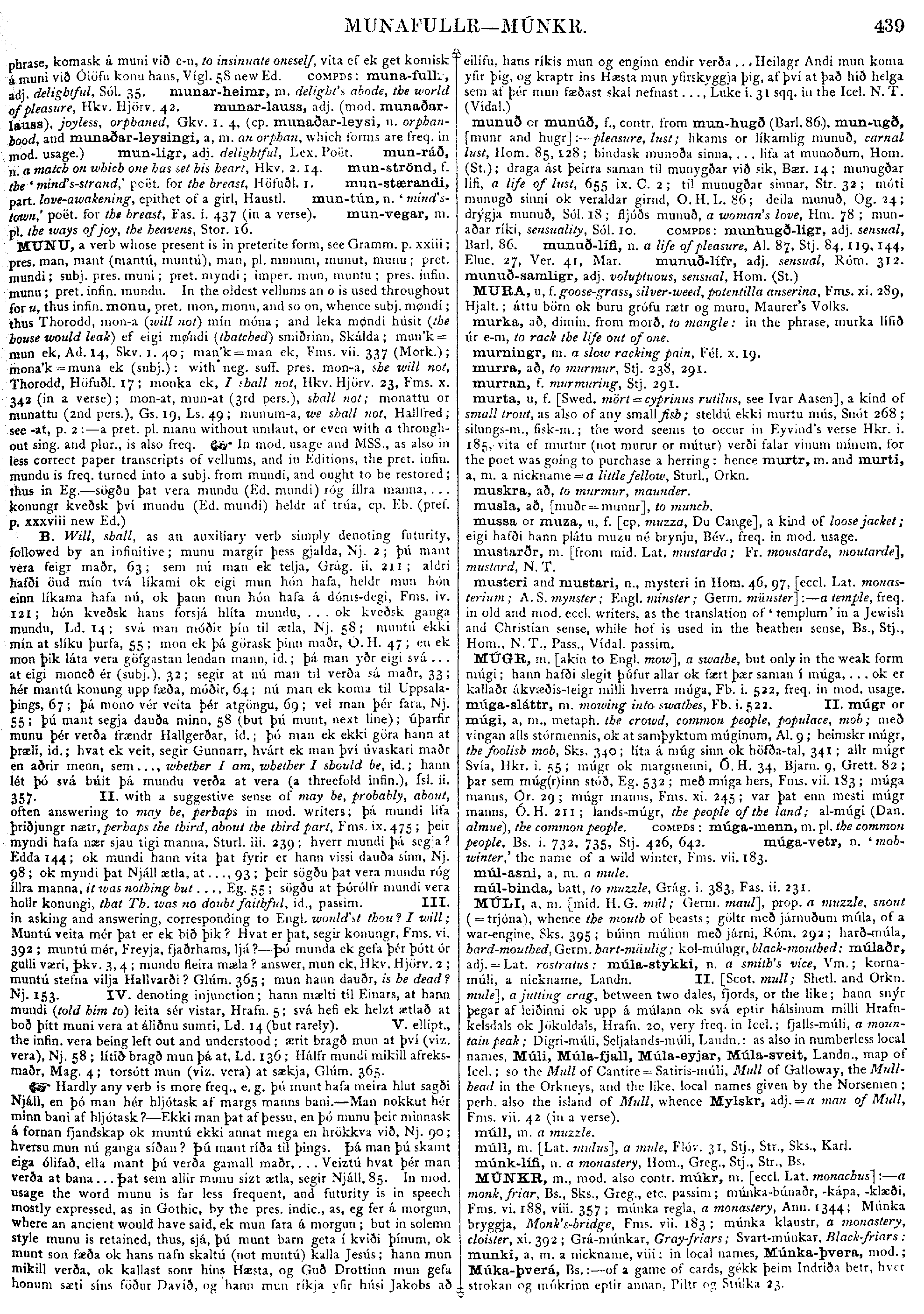
phrase, komask á muni við e-n, to insinuate oneself, vita ef ek get komisk á muni við Ólöfu konu hans, Vígl. 58 new Ed. COMPDS: muna-fullr, adj. delightful, Sól. 35. munar-heimr, m. delight's abode, the world, of pleasure, Hkv. Hjörv. 42. munar-lauss, adj. (mod. munaðar-lauss), joyless, orphaned, Gkv. 1. 4, (cp. munaðar-leysi, n. orphanhood, and munaðar-leysingi, a, m. an orphan, which forms are freq. in mod. usage.) mun-ligr, adj. delightful, Lex. Poët. mun-ráð, n. a match on which one has set his heart, Hkv. 2. 14. mun-strönd, f. the 'mind's-strand,' poët. for the breast, Höfuðl. 1. mun-stærandi, part. love-awakening, epithet of a girl, Haustl. mun-tún, n. 'mind's-town,' poët, for the breast, Fas. i. 437 (in a verse). mun-vegar, m. pl. the ways of joy, the heavens, Stor. 16.
|
Source: Cleasby/Vigfusson, page b0439, entry 17 View original page image as: [TIFF] [PNG] [View previous entry] [View next entry] |
[Comment on this entry] [View comments] |
The following entry has been hand-corrected once. |
múl-binda, batt, to muzzle, Grág. i. 383, Fas. ii. 231.
|
Source: Cleasby/Vigfusson, page b0440, entry 3 View original page image as: [TIFF] [PNG] [View previous entry] [View next entry] |
[Comment on this entry] [View comments] |
The following entry has been hand-corrected once. |
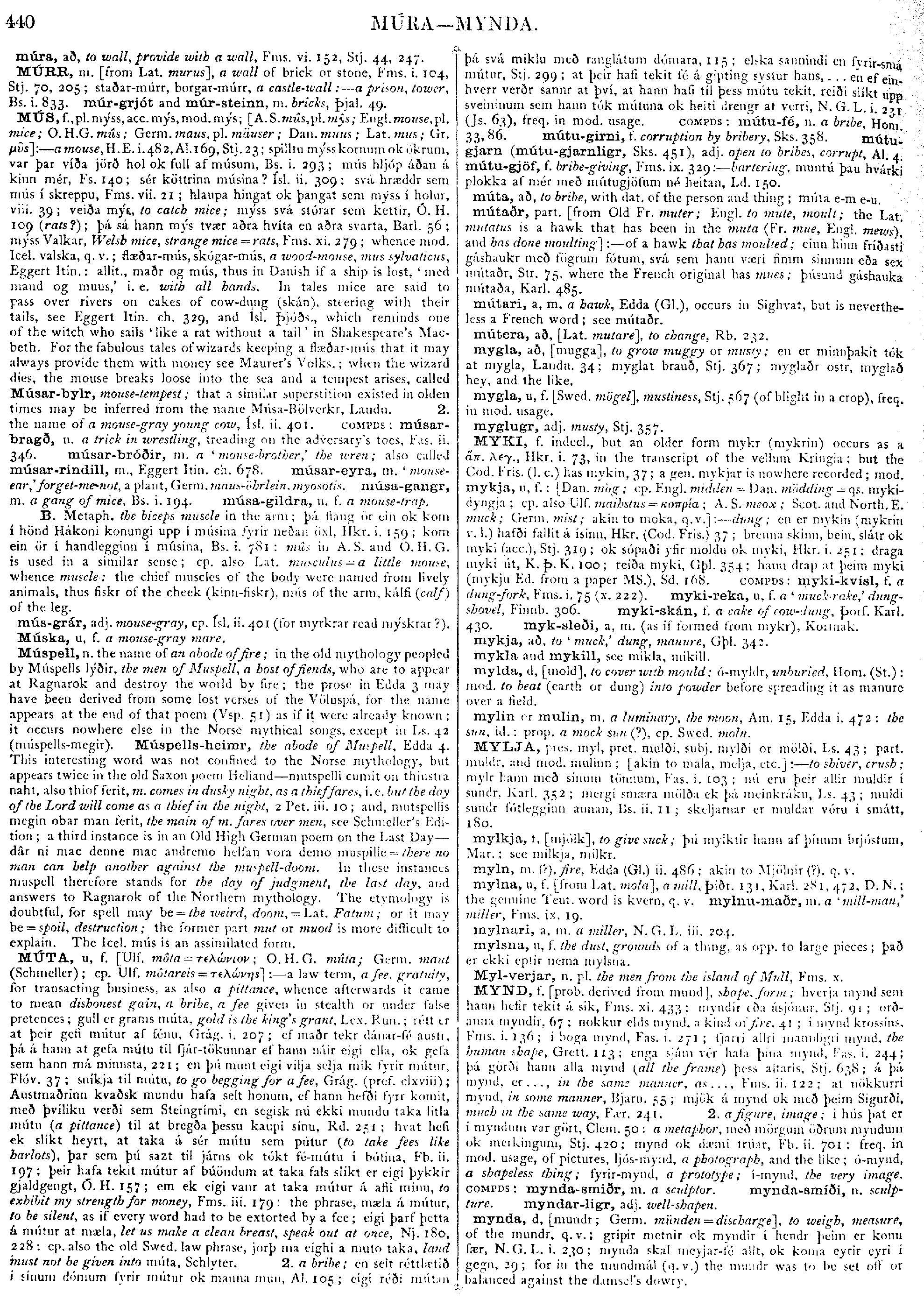
MÚS, f., pl. mýss, acc. mýs, mod. mýs; [A.S. mûs, pl. mýs; Engl. mouse, pl. mice; O.H.G. mûs; Germ. maus, pl. mäuser; Dan. muus; Lat. mus; Gr. GREEK] :-- a mouse, H.E. i. 482, Al. 169, Stj. 23; spilltu mýss kornum ok ökrum, var þar víða jörð hol ok full af músum, Bs. i. 293; mús hljóp áðan á kinn mér, Fs. 140; sér köttrinn músina? Ísl. ii. 309; svá hræddr sem mús í skreppu, Fms. vii. 21; hlaupa hingat ok þangat sem mýss í holur, viii. 39; veiða mýs, to catch mice; mýss svá stórar sem kettir, Ó.H. 109 (rats?); þá sá hann mýs tvær aðra hvíta en aðra svarta, Barl. 56; mýss Valkar, Welsh mice, strange mice = rats, Fms. xi. 279; whence mod. Icel. valska, q.v.; flæðar-mús, skógar-mús, a wood-mouse, mus sylvaticus, Eggert Itin.: allit., maðr og mús, thus in Danish if a ship is lost, 'med mand og muus,' i.e. with all hands. In tales mice are said to pass over rivers on cakes of cow-dung (skán), steering with their tails, see Eggert Itin. ch. 329, and Ísl. Þjóðs., which reminds one of the witch who sails 'like a rat without a tail' in Shakespeare's Macbeth. For the fabulous tales of wizards keeping a flæðar-mús that it may always provide them with money see Maurer's Volks.; when the wizard dies, the mouse breaks loose into the sea and a tempest arises, called Músar-bylr, mouse-tempest; that a similar superstition existed in olden times may be inferred from the name Músa-Bölverkr, Landn. 2. the name of a mouse-gray young cow, Ísl. ii. 401. COMPDS: músar-bragð, n. a trick in wrestling, treading on the adversary's toes, Fas. ii. 346. músar-bróðir, m. a 'mouse-brother,' the wren; also called músar-rindill, m., Eggert Itin. ch. 678. músar-eyra, m. 'mouse-ear,' forget-me-not, a plant, Germ. maus-öhrlein. myosotis. músa-gangr, m. a gang of mice, Bs. i. 194. músa-gildra, u. f. a mouse-trap. B. Metaph. the biceps muscle in the arm; þá flaug ör ein ok kom í hönd Hákoni konungi upp í músina fyrir neðan öxl, Hkr. i. 159; kom ein ör í handlegginn í músina, Bs. i. 781: mûs in A.S. and O.H.G. is used in a similar sense; cp. also Lat. musculus = a little mouse, whence muscle: the chief muscles of the body were named from lively animals, thus fiskr of the cheek (kinn-fiskr), mús of the arm, kálfi (calf) of the leg.
|
Source: Cleasby/Vigfusson, page b0440, entry 20 View original page image as: [TIFF] [PNG] [View previous entry] [View next entry] |
[Comment on this entry] [View comments] |
The following entry has been hand-corrected once. |
MYLJA, pres. myl, pret. mulði, subj. mylði or mölði, Ls. 43; part. muldr, and mod. mulinn; [akin to mala, melja, etc.] :-- to shiver, crush; mylr hann með sínum tönnum. Fas. i. 103; nú eru þeir allir muldir í sundr. Karl. 352; mergi smæra mölða ek þá meinkráku, Ls. 43; muldi sundr fótlegginn annan, Bs. ii. 11; skeljarnar er muldar vóru í smátt, 180.
| Result Page: |  |
Previous | 152 153 154 155 156 157 158 159 160 161 162 163 164 165 166 167 168 169 170 | Next |  |
Germanic Lexicon Project (main page)
This search system was written by
Sean Crist
Please consider
volunteering
to correct the data in these online dictionaries.
No rights reserved. Feel free to use these data in any way you please.