|
|

Search for Fas again, using less strict matching (2726 results)
|
Source: Cleasby/Vigfusson, page b0411, entry 22 View original page image as: [TIFF] [PNG] [View previous entry] [View next entry] |
[Comment on this entry] [View comments] |
The following entry has been hand-corrected once. |
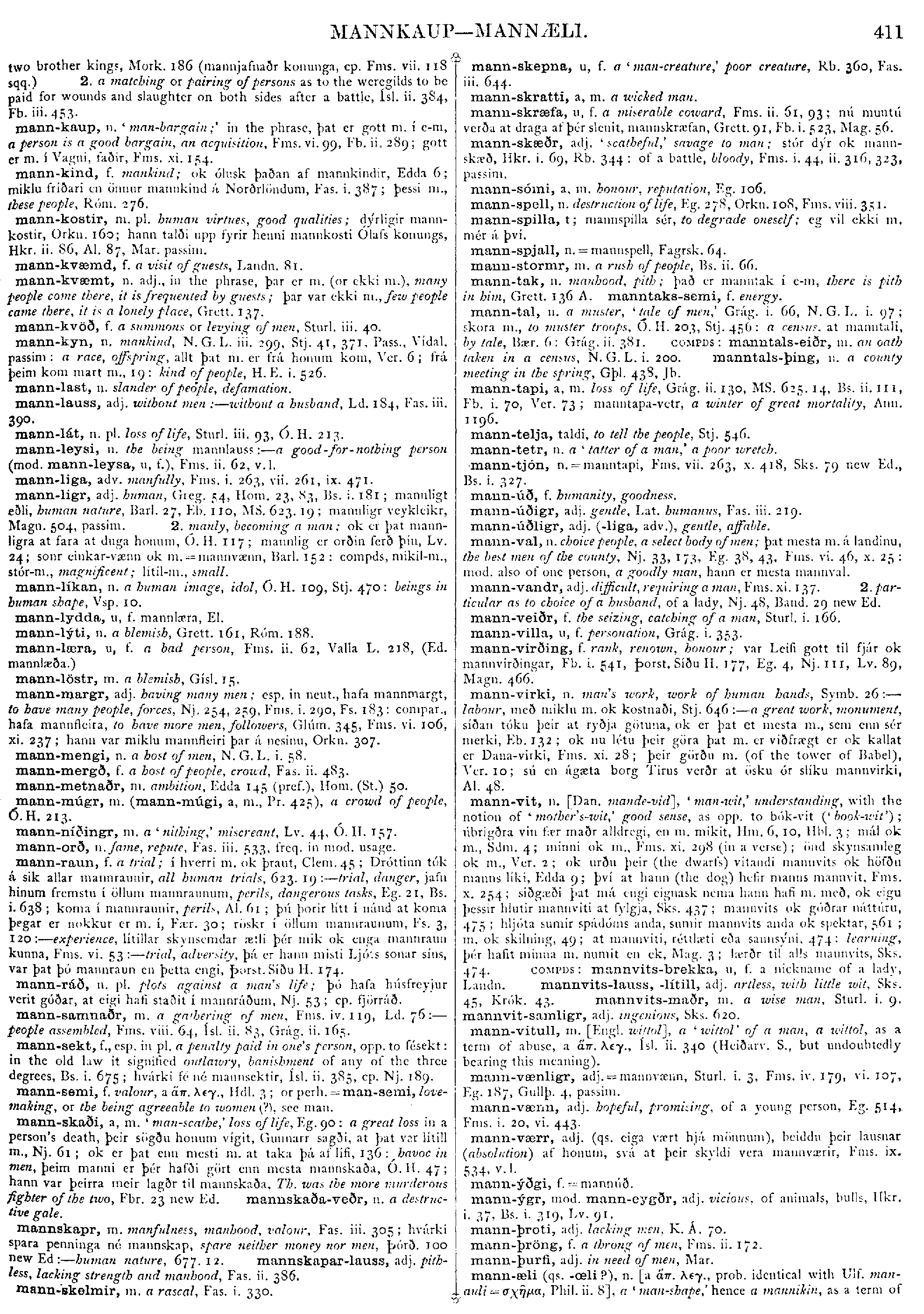
mann-mergð, f. a host of people, crowd, Fas. ii. 483.
|
Source: Cleasby/Vigfusson, page b0411, entry 26 View original page image as: [TIFF] [PNG] [View previous entry] [View next entry] |
[Comment on this entry] [View comments] |
The following entry has been hand-corrected once. |
mann-orð, n. fame, repute. Fas. iii. 533, freq. in mod. usage.
|
Source: Cleasby/Vigfusson, page b0411, entry 33 View original page image as: [TIFF] [PNG] [View previous entry] [View next entry] |
[Comment on this entry] [View comments] |
The following entry has been hand-corrected once. |
mannskapr, m. manfulness, manhood, valour, Fas. iii. 305; hvárki spara penninga né mannskap, spare neither money nor men, Þórð. 100 new Ed :-- human nature, 677. 12. mannskapar-lauss, adj. pithless, lacking strength and manhood, Fas. ii. 386.
|
Source: Cleasby/Vigfusson, page b0411, entry 34 View original page image as: [TIFF] [PNG] [View previous entry] [View next entry] |
[Comment on this entry] [View comments] |
The following entry has been hand-corrected once. |
mann-skelmir, m. a rascal, Fas. i. 330.
|
Source: Cleasby/Vigfusson, page b0411, entry 35 View original page image as: [TIFF] [PNG] [View previous entry] [View next entry] |
[Comment on this entry] [View comments] |
The following entry has been hand-corrected once. |
mann-skepna, u, f. a 'man-creature,' poor creature, Rb. 360, Fas. iii. 644.
|
Source: Cleasby/Vigfusson, page b0411, entry 51 View original page image as: [TIFF] [PNG] [View previous entry] [View next entry] |
[Comment on this entry] [View comments] |
The following entry has been hand-corrected once. |
mann-úðigr, adj. gentle, Lat. humanus, Fas. iii. 219.
|
Source: Cleasby/Vigfusson, page b0412, entry 2 View original page image as: [TIFF] [PNG] [View previous entry] [View next entry] |
[Comment on this entry] [View comments] |
The following entry has been hand-corrected once. |
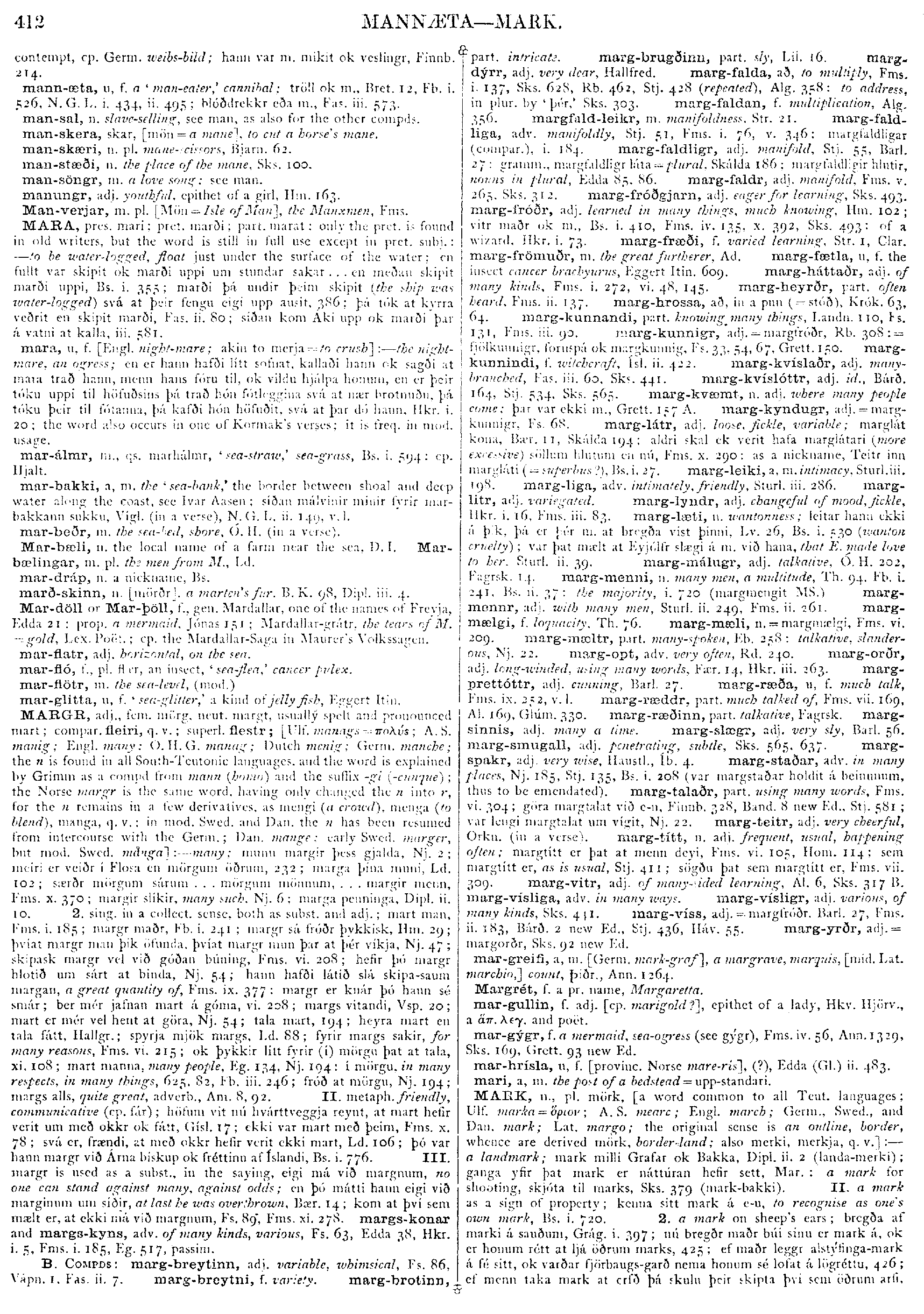
mann-æta, u, f. a 'man-eater' cannibal; tröll ok m. . Bret. 12, Fb. i. 526, N.G.L. i. 434, ii. 495; blóðdrekkr eða m., Fas. iii. 573.
|
Source: Cleasby/Vigfusson, page b0412, entry 10 View original page image as: [TIFF] [PNG] [View previous entry] [View next entry] |
[Comment on this entry] [View comments] |
The following entry has been hand-corrected once. |
MARA, pres. mari; pret. mardi; part. marat: only the pret. is found in old writers, but the word is still in full use except in pret. subj. :-- to be water-logged, float just under the surface of the water; en fullt var skipit ok marði uppi um stundar sakar ... en meðan skipit marði uppi, Bs. i. 355; marði þá undir þeim skipit (the ship was water-logged) svá at þeir fengu eigi upp ausit, 386: þá tók at kyrra veðrit en skipit marði, Fas. ii. 80; síðan kom Áki upp ok marði þar á vatni at kalla, iii. 581.
|
Source: Cleasby/Vigfusson, page b0412, entry 23 View original page image as: [TIFF] [PNG] [View previous entry] [View next entry] |
[Comment on this entry] [View comments] |
The following entry has been hand-corrected once. |
MARGR, adj., fem. mörg. neut. margt, usually spelt and pronounced mart; compar. fleiri, q.v.; superl. flestr; [Ulf. manags = GREEK; A.S. manig; Engl. many: O.H.G. manag; Dutch mennig; Germ. manche; the n is found in all South-Teutonic languages, and the word is explained by Grimm as a compd from mann (homo) and the suffix -gi (-cunque); the Norse margr is the same word, having only changed the n into r, for the n remains in a few derivatives, as mengi (a crowd), menga (to blend), manga, q.v.: in mod. Swed. and Dan. the n has been resumed from intercourse with the Germ.; Dan. mange; early Swed. marger, but mod. Swed. mânga] :-- -many; munu margir þess gjalda, Nj. 2; meiri er veiðr í Flosa en mörgum öðrum, 232; marga þína muni, Ld. 102; særðr mörgum sárum ... mörgum mönnum, ... margir menn, Fms. x. 370; margir slíkir, many such. Nj. 6; marga penninga, Dipl. ii. 10. 2. sing. in a collect. sense, both as subst. and adj.; mart man, Fms. i. 185; margr maðr, Fb. i. 241; margr sá fróðr þvkkisk, Hm. 29; þviat margr man þik öfunda, þvíat margr mun þar at þér víkja, Nj. 47; skipask margr vel við góðan búning, Fms. vi. 208; hefir þó margr hlotið um sárt at binda, Nj. 54; hann hafði látið slá skipa-saum margan, a great quantity of, Fms. ix. 377: margr er knár þó hann sé smár; ber mér jafnan mart á góma, vi. 208; margs vitandi, Vsp. 20; mart er mér vel hent at göra, Nj. 54; tala mart, 194; heyra mart en tala fátt, Hallgr.; spyrja mjök margs, Ld. 88; fyrir margs sakir, for many reasons, Fms. vi. 215; ok þykkir lítt fyrir (í) mörgu þat at tala, xi. 108; mart manna, many people, Eg. 134, Nj. 194: í mörgu, in many respects, in many things, 625. 82, Fb. iii. 246; fróð at mörgu, Nj. 194; margs alls, quite great, adverb., Am. 8, 92. II. metaph. friendly, communicative (cp. fár); höfum vit nú hvarttveggja reynt, at mart hefir verit um með okkr ok fátt, Gísl. 17; ekki var mart með þeim, Fms. x. 78; svá er, frændi, at með okkr hefir verit ekki mart, Ld. 106; þó var hann margr við Árna biskup ok fréttinn af Íslandi, Bs. i. 776. III. margr is used as a subst., in the saying, eigi má við margnum, no one can stand against many, against odds; en þó mátti hann eigi við marginum um síðir, at last he was overthrown, Bær. 14; kom at því sem mælt er, at ekki má við margnum, Fs. 89, Fms. xi. 278. margs-konar and margs-kyns, adv. of many kinds, various, Fs. 63, Edda 38, Hkr. i. 5, Fms. i. 185, Eg. 517, passim. B. COMPDS: marg-breytinn, adj. variable, whimsical, Fs. 86, Vápn. 1. Fas. ii. 7. marg-breytni, f. variety, marg-brotinn, part. intricate. marg-brugðinn, part. sly, Lil. 16. marg-dýrr, adj. very dear, Hallfred. marg-falda, að, to multiply, Fms. i. 137, Sks. 628, Rb. 462, Stj. 428 (repeated), Alg. 358: to address, in plur. by 'þér,' Sks. 303. marg-faldan, f. multiplication, Alg. 356. margfald-leikr, m. manifoldness. Str. 21. marg-faldliga, adv. manifoldly, Stj. 51, Fms. i. 76, v. 346: margfaldligar (compar.), i. 184. marg-faldligr, adj. manifold, Stj. 55, Barl. 27: gramm., margfaldligr láta = plural, Skálda 186; margfaldligar hlutir, nouns in plural, Edda 85. 86. marg-faldr; adj. manifold, Fms. v. 265. Sks. 312. marg-fróðgjarn, adj. eager for learning, Sks. 493. marg-fróðr, adj. learned in many things, much knowing, Hm. 102; vitr maðr ok m., Bs. i. 410, Fms. iv. 135, x. 392, Sks. 493: of a wizard, Hkr. i. 73. marg-fræði, f. varied learning, Str. 1, Clar. marg-frömuðr, m. the great furtherer. Ad. marg-fætla, u, f. the insect cancer brachyurus, Eggert Itin. 609. marg-háttaðr, adj. of many kinds, Fms. i. 272, vi. 48. 145. marg-heyrðr, part. often heard. Fms. ii. 137. marg-hrossa, að, in a pun (= stóð), Krók. 63, 64. marg-kunnandi, part. knowing many things, Landn. 110, Fs. 131, Fms. iii. 90. marg-kunnigr, adj. = margfróðr, Rb. 308: = fjölkunnigr, foruspá ok margkunnig, Fs. 33. 54, 67, Grett. 150. marg-kunnindi, f. witchcraft, Ísl. ii. 422. marg-kvíslaðr, adj. many-branched, Fas. iii. 60, Sks. 441. marg-kvíslóttr, adj. id., Bárð. 164, Stj. 534, Sks. 565. marg-kvæmt, n. adj. where many people come; þar var ekki m., Grett. 157 A. marg-kyndugr, adj. = margkunnigr, Fs. 68. marg-látr, adj. loose, fickle, variable; marglát kona, Bær. 11, Skálda 194; aldri skal ek verit hafa marglátari (more excessive) söllum hlutum en nú, Fms. x. 290: as a nickname, Teitr inn margláti (= superbus?), Bs. i. 27. marg-leiki, a. m. intimacy, Sturl. iii. 198. marg-liga, adv. intimately, friendly, Sturl. iii. 286. marg-litr, adj. variegated. marg-lyndr, adj. changeful of mood, fickle, Hkr. i. 16, Fms. iii. 83. marg-læti, n. wantonness; leitar hann ekki á þik, þá er þér m. at bregða vist þinni, Lv. 26, Bs. i. 530 (wanton cruelty); var þat mælt at Eyjólfr slægi á m. við hana, that E. made love to her. Sturl. ii. 39. marg-málugr, adj. talkative, Ó.H. 202, Fagrsk. 14. marg-menni, n. many men, a multitude, Th. 94, Fb. i. 241, Bs. ii. 37: the majority, i. 720 (margmengit MS.) marg-mennr, adj. with many men, Sturl. ii. 249, Fms. ii. 261. marg-mælgi, f. loquacity. Th. 76. marg-mæli, n. = margmælgi, Fms. vi. 209. marg-mæltr, part. many-spoken, Eb. 258: talkative, slanderous, Nj. 22. marg-opt, adv. very often, Rd. 240. marg-orðr, adj. long-winded, using many words. Fær. 14, Hkr. iii. 263. marg-prettóttr, adj. cunning, Barl. 27. marg-ræða, u, f.; much talk, Fms. ix. 252, v.l. marg-ræddr, part. much talked of, Fms. vii. 169, Al. 169, Glúm. 330. marg-ræðinn, part. talkative, Fagrsk. marg-sinnis, adj. many a time. marg-slægr, adj. very sly, Barl. 56. marg-smugall, adj. penetrating, subtle, Sks. 565. 637. marg-spakr, adj. very wise, Haustl., Íb. 4. marg-staðar, adv. in many places, Nj. 185, Stj. 135, Bs. i. 208 (var margstaðar holdit á beinunum, thus to be emendated). marg-talaðr, part. using many words, Fms. vi. 304; göra margtalat við e-n, Finnb. 328, Band. 8 new Ed., Stj. 581; var lengi margtalat um vígit, Nj. 22. marg-teitr, adj. very cheerful, Orkn. (in a verse). marg-títt, n. adj. frequent, usual, happening often; margtítt er þat at menn deyi, Fms. vi. 105, Hom. 114: sem margtítt er, as is usual, Stj. 411; sögðu þat sem margtítt er, Fms. vii. 309. marg-vitr, adj. of many-sided learning, Al. 6, Sks. 317 B. marg-vísliga, adv. in many ways. marg-vísligr, adj. various, of many kinds, Sks. 411. marg-víss, adj. = margfróðr. Barl. 27, Fms. ii. 183, Bárð. 2 new Ed., Stj. 436, Háv. 55. marg-yrðr, adj. = margorðr, Sks. 92 new Ed.
|
Source: Cleasby/Vigfusson, page b0413, entry 25 View original page image as: [TIFF] [PNG] [View previous entry] [View next entry] |
[Comment on this entry] [View comments] |
The following entry has been hand-corrected once. |
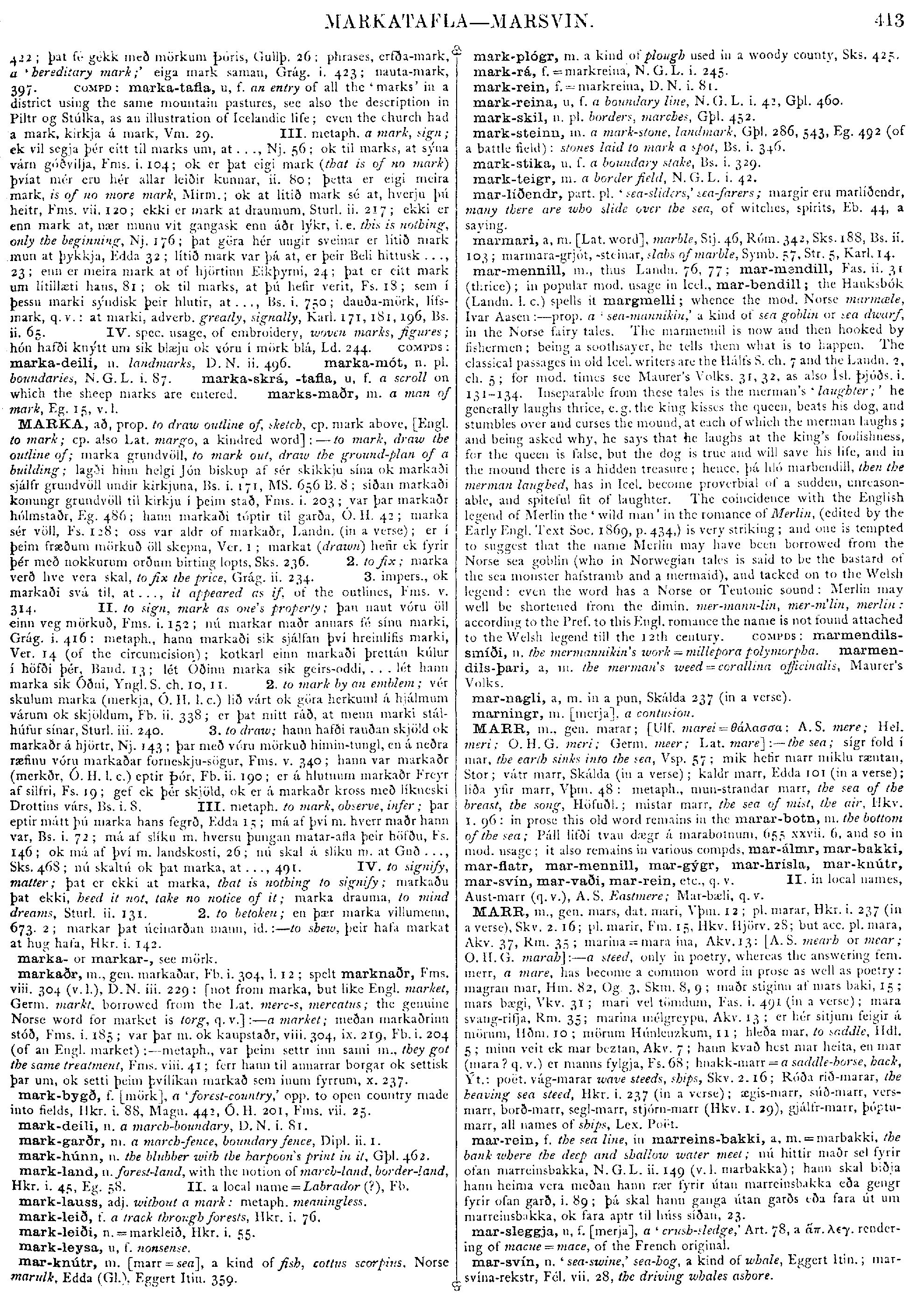
mar-mennill, m., thus Landn. 76, 77; mar-mandill, Fas. ii. 31 (thrice); in popular mod. usage in Icel., mar-bendill; the Hauksbok (Landn. l.c.) spells it margmelli; whence the mod. Norse marmæle, Ivar Aasen :-- prop. a 'sea-mannikin,' a kind ot sea goblin or sea dwarf, in the Norse fairy tales. The marmennil is now and then hooked by fishermen; being a soothsayer, he tells them what is to happen. The classical passages in oid Icel. writers are the Hálf's S. ch. 7 and the Landn. 2, ch. 5; for mod. times see Maurer's Volks. 31, 32, as also Ísl. Þjóðs. i. 131-134. Inseparable from these tales is the merman's 'laughter;' he generally laughs thrice, e.g. the king kisses the queen, beats his dog, and stumbles over and curses the mound, at each of which the merman laughs; and being asked why, he says that he laughs at the king's foolishness, for the queen is false, but the dog is true and will save his life, and in the mound there is a hidden treasure; hence, þá hló marbendill, then the merman laughed, has in Icel. become proverbial of a sudden, unreasonable, and spiteful fit of laughter. The coincidence with the English legend of Merlin the 'wild man' in the romance of Merlin, (edited by the Early Engl. Text Soc. 1869, p. 434,) is very striking; and one is tempted to suggest that the name Merlin may have been borrowed from the Norse sea goblin (who in Norwegian tales is said to be the bastard of the sea monster hafstramb and a mermaid), and tacked on to the Welsh legend: even the word has a Norse or Teutonic sound: Merlin may well be shortened from the dimin. mer-mann-lin, mer-m'lin, merlin: according to the Pref. to this Engl. romance the name is not found attached to the Welsh legend till the 12th century. COMPDS: marmendils-smíði, n. the mermannikins work = millepora polymorpha. marmendils-þari, a, m. the merman's weed = corallina officinalis, Maurer's Volks.
| Result Page: |  |
Previous | 143 144 145 146 147 148 149 150 151 152 153 154 155 156 157 158 159 160 161 | Next |  |
Germanic Lexicon Project (main page)
This search system was written by
Sean Crist
Please consider
volunteering
to correct the data in these online dictionaries.
No rights reserved. Feel free to use these data in any way you please.