|
|

|
Source: Bosworth/Toller, page b0203, entry 23 View original page image as: [TIFF] [PNG] [View previous entry] [View next entry] |
[Comment on this entry] [View comments] |
The following entry has been hand-corrected once. |
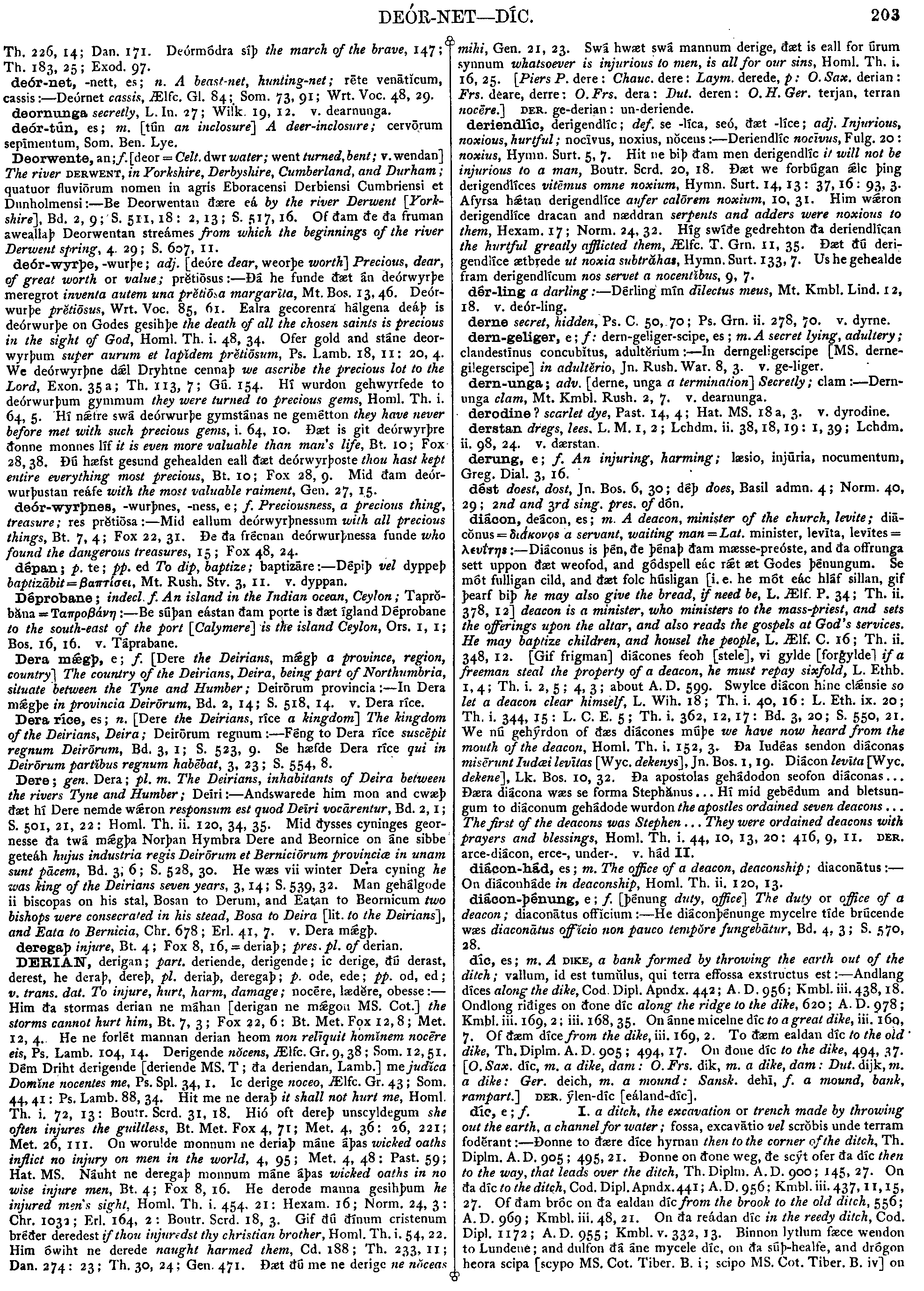
diácon,
deácon,
es;
m.
A
deacon,
minister
of
the
church,
levite;
di c
c nus
=
nus
=

 &alpha-tonos;
 o
o os
a
servant,
waiting
man
=
Lat.
minister,
lev
os
a
servant,
waiting
man
=
Lat.
minister,
lev ta,
levtes
=
ta,
levtes
=


 &iota-tonos;
 s
:--
Diáconus
is
þén,
ðe
þénaþ
ðam
mæsse-preóste,
and
ða
offrunga
sett
uppon
ðæt
weofod,
and
gódspell
eác
r
s
:--
Diáconus
is
þén,
ðe
þénaþ
ðam
mæsse-preóste,
and
ða
offrunga
sett
uppon
ðæt
weofod,
and
gódspell
eác
r t
æt
Godes
þénungum.
Se
mót
fulligan
cild,
and
ðæt
folc
húsligan
[i.e.
he
mót
eác
hláf
sillan,
gif
þearf
biþ
he
may
also
give
the
bread,
if
need
be,
L.
Ælf.
P.
34;
Th.
ii.
378,
12]
deacon
is
a
minister,
who
ministers
to
the
mass-priest,
and
sets
the
offerings
upon
the
altar,
and
also
reads
the
gospels
at
God's
services.
He
may
baptize
children,
and
housel
the
people,
L.
Ælf.
C.
16;
Th.
ii.
348,
12.
[Gif
frigman]
diácones
feoh
[stele],
vi
gylde
[forgylde]
if
a
freeman
steal
the
property
of
a
deacon,
he
must
repay
sixfold,
L.
Ethb.
1,
4
;
Th.
i.
2,
5;
4,
3;
about
A.
D.
599.
Swylce
diácon
hine
clnsie
so
let
a
deacon
clear
himself,
L.
Wih.
18;
Th.
i.
40,
16:
L.
Eth.
ix.
20;
Th.
i.
344,
15:
L.
C.
E.
5;
Th.
i.
362,
12,
17:
Bd.
3,
20;
S.
550,
21.
We
nú
gehýrdon
of
ðæs
diácones
múþe
we
have
now
heard
from
the
mouth
of
the
deacon,
Homl.
Th.
i.
152,
3.
Ða
Iudéas
sendon
diáconas
mis
t
æt
Godes
þénungum.
Se
mót
fulligan
cild,
and
ðæt
folc
húsligan
[i.e.
he
mót
eác
hláf
sillan,
gif
þearf
biþ
he
may
also
give
the
bread,
if
need
be,
L.
Ælf.
P.
34;
Th.
ii.
378,
12]
deacon
is
a
minister,
who
ministers
to
the
mass-priest,
and
sets
the
offerings
upon
the
altar,
and
also
reads
the
gospels
at
God's
services.
He
may
baptize
children,
and
housel
the
people,
L.
Ælf.
C.
16;
Th.
ii.
348,
12.
[Gif
frigman]
diácones
feoh
[stele],
vi
gylde
[forgylde]
if
a
freeman
steal
the
property
of
a
deacon,
he
must
repay
sixfold,
L.
Ethb.
1,
4
;
Th.
i.
2,
5;
4,
3;
about
A.
D.
599.
Swylce
diácon
hine
clnsie
so
let
a
deacon
clear
himself,
L.
Wih.
18;
Th.
i.
40,
16:
L.
Eth.
ix.
20;
Th.
i.
344,
15:
L.
C.
E.
5;
Th.
i.
362,
12,
17:
Bd.
3,
20;
S.
550,
21.
We
nú
gehýrdon
of
ðæs
diácones
múþe
we
have
now
heard
from
the
mouth
of
the
deacon,
Homl.
Th.
i.
152,
3.
Ða
Iudéas
sendon
diáconas
mis runt
Iudæi
levtas
[Wyc.
dekenys],
Jn.
Bos.
1,
19.
Diácon
levta
[Wyc.
dekene],
Lk.
Bos.
10,
32.
Ða
apostolas
gehádodon
seofon
diáconas
...
Ðæra
diácona
wæs
se
forma
Steph
runt
Iudæi
levtas
[Wyc.
dekenys],
Jn.
Bos.
1,
19.
Diácon
levta
[Wyc.
dekene],
Lk.
Bos.
10,
32.
Ða
apostolas
gehádodon
seofon
diáconas
...
Ðæra
diácona
wæs
se
forma
Steph nus
...
Hí
mid
gebédum
and
bletsungum
to
diáconum
gehádode
wurdon
the
apostles
ordained
seven
deacons
...
The
first
of
the
deacons
was
Stephen
...
They
were
ordained
deacons
with
prayers
and
blessings,
Homl.
Th.
i.
44,
10,
13,
20:
416,
9,
11.
DER.
arce-diácon,
erce-,
under-.
v.
hád
II.
nus
...
Hí
mid
gebédum
and
bletsungum
to
diáconum
gehádode
wurdon
the
apostles
ordained
seven
deacons
...
The
first
of
the
deacons
was
Stephen
...
They
were
ordained
deacons
with
prayers
and
blessings,
Homl.
Th.
i.
44,
10,
13,
20:
416,
9,
11.
DER.
arce-diácon,
erce-,
under-.
v.
hád
II.
|
Source: Bosworth/Toller, page b0207, entry 18 View original page image as: [TIFF] [PNG] [View previous entry] [View next entry] |
[Comment on this entry] [View comments] |
The following entry has been hand-corrected once. |
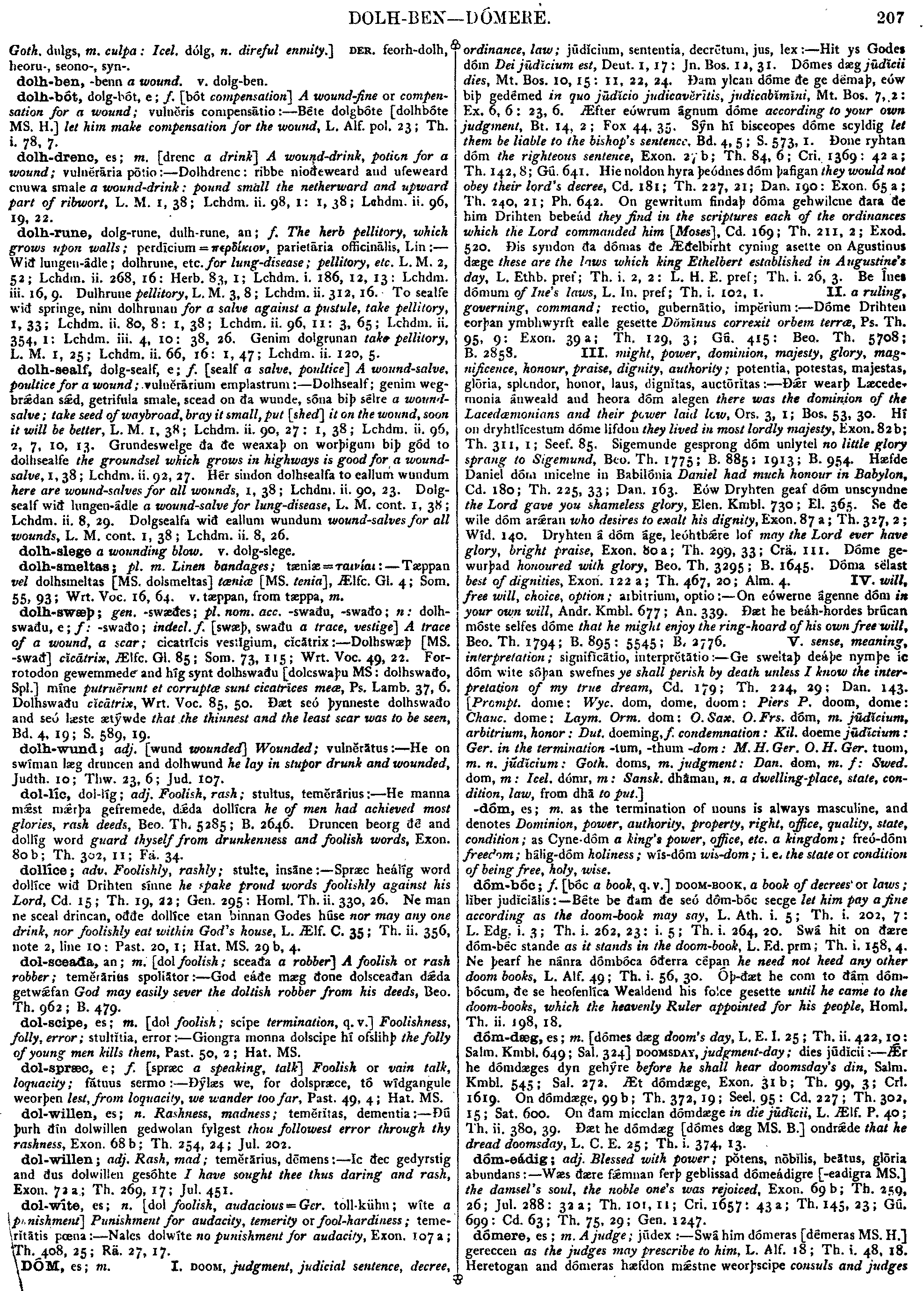
DÓM,
es;
m.
I.
Doom,
judgment,
judicial
sentence,
decree,
ordinance,
law;
j d
d cium,
sententia,
decrtum,
jus,
lex
:--
Hit
ys
Godes
dóm
Dei
jdcium
est,
Deut.
1,
17:
Jn.
Bos.
12,
31.
Dómes
dæ
jdcii
dies,
Mt.
Bos.
10,
15:
11,
22,
24.
Ðam
ylcan
dóme
ðe
ge
démaþ,
eów
biþ
gedémed
in
quo
jdcio
judicav
cium,
sententia,
decrtum,
jus,
lex
:--
Hit
ys
Godes
dóm
Dei
jdcium
est,
Deut.
1,
17:
Jn.
Bos.
12,
31.
Dómes
dæ
jdcii
dies,
Mt.
Bos.
10,
15:
11,
22,
24.
Ðam
ylcan
dóme
ðe
ge
démaþ,
eów
biþ
gedémed
in
quo
jdcio
judicav rtis,
judicabmni,
Mt.
Bos.
7,
2:
Ex.
6,
6:
23,
6.
Æfter
eówrum
ágnum
dóme
according
to
your
own
judgment,
Bt.
14,
2;
Fox
44,
35.
Sýn
hí
bisceopes
dóme
scyldig
let
them
be
liable
to
the
bishop's
sentence,
Bd.
4,
5;
S.
573,
1.
Ðone
ryhtan
dóm
the
righteous
sentence,
Exon.
27
b;
Th.
84,
6;
Cri.
1369:
42
a;
Th.
142,
8;
Gú.
641.
Hie
noldon
hyra
þeódnes
dóm
þafigan
they
would
not
obey
their
lord's
decree,
Cd.
181;
Th.
227,
21;
Dan.
190:
Exon.
65
a;
Th.
240,
21;
Ph.
642.
On
gewritum
findaþ
dóma
gehwilcne
ðara
ðe
him
Drihten
bebeád
they
find
in
the
scriptures
each
of
the
ordinances
which
the
Lord
commanded
him
[Moses],
Cd.
169;
Th.
211,
2;
Exod.
520.
Ðis
syndon
ða
dómas
ðe
Æðelbirht
cyniug
asette
on
Agustinus
dæge
these
are
the
laws
which
king
Ethelbert
established
in
Augustine's
day,
L.
Ethb.
pref;
Th.
i.
2,
2:
L.
H.
E.
pref;
Th.
i.
26,
3.
Be
Ínes
dómum
of
Ine's
laws,
L.
In.
pref;
Th.
i.
102,
1.
II.
a
ruling,
governing,
command;
rectio,
guberntio,
imprium
:--
Dóme
Drihten
eorþan
ymbhwyrft
ealle
gesette
D
rtis,
judicabmni,
Mt.
Bos.
7,
2:
Ex.
6,
6:
23,
6.
Æfter
eówrum
ágnum
dóme
according
to
your
own
judgment,
Bt.
14,
2;
Fox
44,
35.
Sýn
hí
bisceopes
dóme
scyldig
let
them
be
liable
to
the
bishop's
sentence,
Bd.
4,
5;
S.
573,
1.
Ðone
ryhtan
dóm
the
righteous
sentence,
Exon.
27
b;
Th.
84,
6;
Cri.
1369:
42
a;
Th.
142,
8;
Gú.
641.
Hie
noldon
hyra
þeódnes
dóm
þafigan
they
would
not
obey
their
lord's
decree,
Cd.
181;
Th.
227,
21;
Dan.
190:
Exon.
65
a;
Th.
240,
21;
Ph.
642.
On
gewritum
findaþ
dóma
gehwilcne
ðara
ðe
him
Drihten
bebeád
they
find
in
the
scriptures
each
of
the
ordinances
which
the
Lord
commanded
him
[Moses],
Cd.
169;
Th.
211,
2;
Exod.
520.
Ðis
syndon
ða
dómas
ðe
Æðelbirht
cyniug
asette
on
Agustinus
dæge
these
are
the
laws
which
king
Ethelbert
established
in
Augustine's
day,
L.
Ethb.
pref;
Th.
i.
2,
2:
L.
H.
E.
pref;
Th.
i.
26,
3.
Be
Ínes
dómum
of
Ine's
laws,
L.
In.
pref;
Th.
i.
102,
1.
II.
a
ruling,
governing,
command;
rectio,
guberntio,
imprium
:--
Dóme
Drihten
eorþan
ymbhwyrft
ealle
gesette
D mnus
correxit
orbem
terræ,
Ps.
Th.
95,
9:
Exon.
39
a;
Th.
129,
3;
Gú.
415:
Ben.
Th.
5708;
B.
2858.
III.
might,
power,
dominion,
majesty,
glory,
magnificence,
honour,
praise,
dignity,
authority;
potentia,
potestas,
majestas,
glria,
splendor,
honor,
laus,
digntas,
auctrtas
:--
Ðr
wearþ
Læcedemonia
ánweald
and
heora
dóm
alegen
there
was
the
dominion
of
the
Lacedæmonians
and
their
power
laid
low,
Ors.
3,
1;
Bos.
53,
30.
Hí
on
dryhtlícestum
dóme
lifdon
they
lived
in
most
lordly
majesty,
Exon.
82
b;
Th.
311,
1;
Seef.
85.
Sigemunde
gesprong
dóm
unlytel
no
little
glory
sprang
to
Sigemund,
Bo.
Th.
1775;
B.
885,
1913;
B.
954.
Hæfde
Daniel
dóm
micelne
in
Babilónia
Daniel
had
much
honour
in
Babylon,
Cd.
180;
Th.
225,
33;
Dan.
163.
Eów
Dryhten
geaf
dóm
unscyndne
the
Lord
gave
you
shameless
glory,
Elen.
Kmbl.
730;
El.
365.
Se
ðe
wile
dóm
arran
who
desires
to
exalt
his
dignity,
Exon.
87
a;
Th.
327,
2;
Wíd.
140.
Dryhten
á
dóm
áge,
leóhtbre
lof
may
the
Lord
ever
have
glory,
bright
praise,
Exon.
80
a;
Th.
299,
33;
Crä,
111.
Dóme
gewurþad
honoured
with
glory,
Beo.
Th.
3295;
B.
1645.
Dóma
selast
best
of
dignities,
Exon.
122
a;
Th.
467,
20;
Alm.
4.
IV.
will,
free
will,
choice,
option;
arbitrium,
optio
:--
On
eówerne
ágenne
dóm
in
your
own
will,
Andr.
Kmbl.
677;
An.
339.
Ðæt
he
beáh-hordes
brúcan
móste
selfes
dóme
that
he
might
enjoy
the
ring-hoard
of
his
own
free
will,
Beo.
Th.
1794;
B.
895:
5545;
B,
2776.
V.
sense,
meaning,
interpretation;
signifctio,
interprttio
:--
Ge
sweltaþ
deáþe
nymþe
ic
dóm
wite
sóþan
swefnes
ye
shall
perish
by
death
unless
I
know
the
interpretation
of
my
true
dream,
Cd.
179;
Th.
224,
29:
Dan.
143.
[Prompt.
dome:
Wyc.
dom,
dome,
doom:
Piers
P.
doom,
dome:
Chauc.
dome:
Laym.
Orm.
dom:
O.
Sax.
O.
Frs.
dóm,
m.
jdcium,
arbitrium,
honor:
Dut.
doeming,
f.
condemnation:
Kil.
doeme
jdcium:
Ger.
in
the
termination
-tum,
-thum
-dom:
M.
H.
Ger.
O.
H.
Ger.
tuom,
m.
n.
jdcium:
Goth.
doms,
m.
judgment:
Dan.
dom,
m.
f:
Swed.
dom,
m:
Icel.
dómr,
m:
Sansk.
dhaman,
n.
a
dwelling-place,
state,
condition,
law,
from
dh
to
put.]
mnus
correxit
orbem
terræ,
Ps.
Th.
95,
9:
Exon.
39
a;
Th.
129,
3;
Gú.
415:
Ben.
Th.
5708;
B.
2858.
III.
might,
power,
dominion,
majesty,
glory,
magnificence,
honour,
praise,
dignity,
authority;
potentia,
potestas,
majestas,
glria,
splendor,
honor,
laus,
digntas,
auctrtas
:--
Ðr
wearþ
Læcedemonia
ánweald
and
heora
dóm
alegen
there
was
the
dominion
of
the
Lacedæmonians
and
their
power
laid
low,
Ors.
3,
1;
Bos.
53,
30.
Hí
on
dryhtlícestum
dóme
lifdon
they
lived
in
most
lordly
majesty,
Exon.
82
b;
Th.
311,
1;
Seef.
85.
Sigemunde
gesprong
dóm
unlytel
no
little
glory
sprang
to
Sigemund,
Bo.
Th.
1775;
B.
885,
1913;
B.
954.
Hæfde
Daniel
dóm
micelne
in
Babilónia
Daniel
had
much
honour
in
Babylon,
Cd.
180;
Th.
225,
33;
Dan.
163.
Eów
Dryhten
geaf
dóm
unscyndne
the
Lord
gave
you
shameless
glory,
Elen.
Kmbl.
730;
El.
365.
Se
ðe
wile
dóm
arran
who
desires
to
exalt
his
dignity,
Exon.
87
a;
Th.
327,
2;
Wíd.
140.
Dryhten
á
dóm
áge,
leóhtbre
lof
may
the
Lord
ever
have
glory,
bright
praise,
Exon.
80
a;
Th.
299,
33;
Crä,
111.
Dóme
gewurþad
honoured
with
glory,
Beo.
Th.
3295;
B.
1645.
Dóma
selast
best
of
dignities,
Exon.
122
a;
Th.
467,
20;
Alm.
4.
IV.
will,
free
will,
choice,
option;
arbitrium,
optio
:--
On
eówerne
ágenne
dóm
in
your
own
will,
Andr.
Kmbl.
677;
An.
339.
Ðæt
he
beáh-hordes
brúcan
móste
selfes
dóme
that
he
might
enjoy
the
ring-hoard
of
his
own
free
will,
Beo.
Th.
1794;
B.
895:
5545;
B,
2776.
V.
sense,
meaning,
interpretation;
signifctio,
interprttio
:--
Ge
sweltaþ
deáþe
nymþe
ic
dóm
wite
sóþan
swefnes
ye
shall
perish
by
death
unless
I
know
the
interpretation
of
my
true
dream,
Cd.
179;
Th.
224,
29:
Dan.
143.
[Prompt.
dome:
Wyc.
dom,
dome,
doom:
Piers
P.
doom,
dome:
Chauc.
dome:
Laym.
Orm.
dom:
O.
Sax.
O.
Frs.
dóm,
m.
jdcium,
arbitrium,
honor:
Dut.
doeming,
f.
condemnation:
Kil.
doeme
jdcium:
Ger.
in
the
termination
-tum,
-thum
-dom:
M.
H.
Ger.
O.
H.
Ger.
tuom,
m.
n.
jdcium:
Goth.
doms,
m.
judgment:
Dan.
dom,
m.
f:
Swed.
dom,
m:
Icel.
dómr,
m:
Sansk.
dhaman,
n.
a
dwelling-place,
state,
condition,
law,
from
dh
to
put.]
|
Source: Bosworth/Toller, page b0213, entry 17 View original page image as: [TIFF] [PNG] [View previous entry] [View next entry] |
[Comment on this entry] [View comments] |
The following entry has been hand-corrected once. |
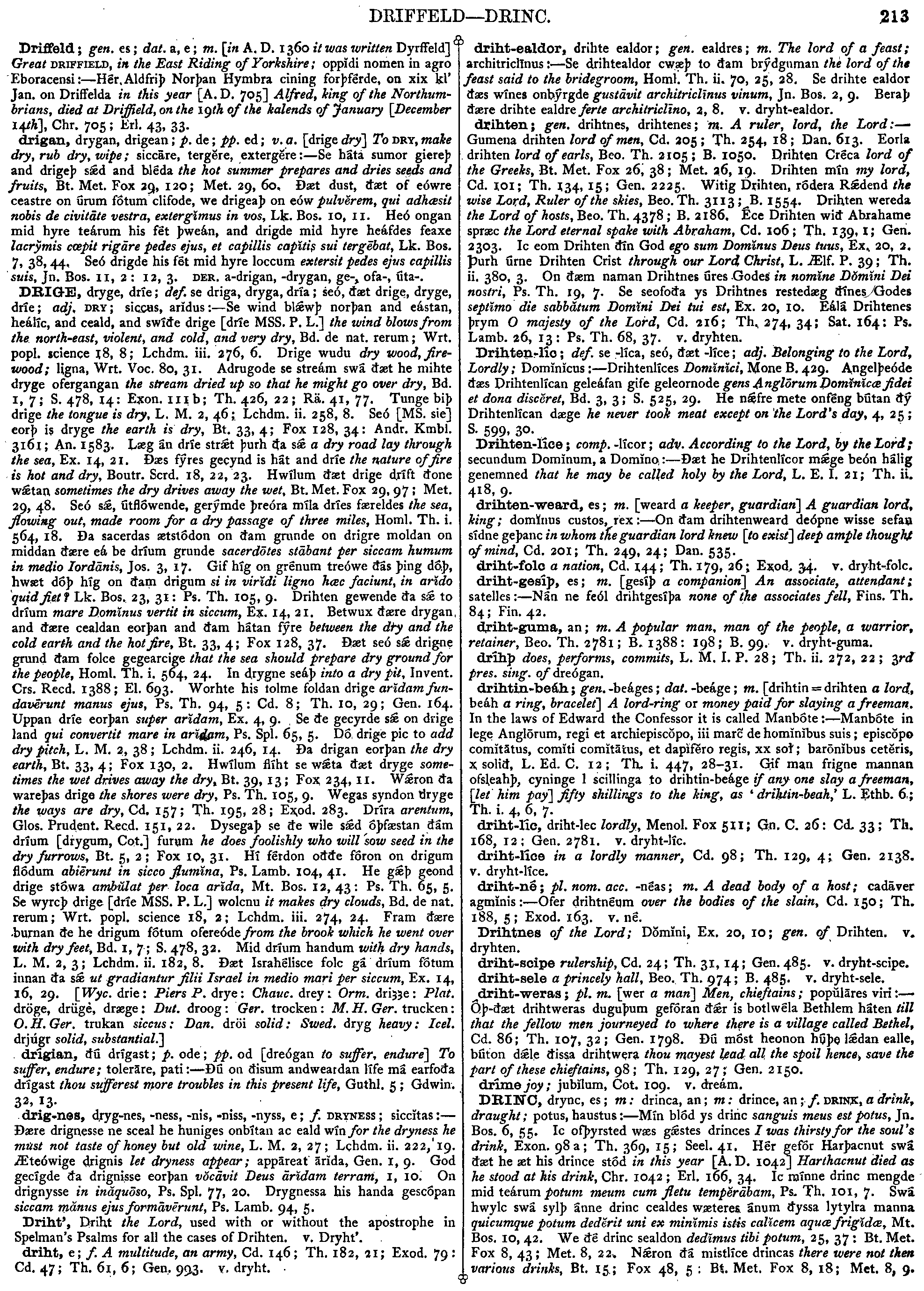
drihtin-beáh;
gen.
-beáges;
dat.
-beáge;
m.
[drihtin
=
drihten
a
lord,
beáh
a
ring,
bracelet]
A
lord-ring
or
money
paid
for
slaying
a
freeman.
In
the
laws
of
Edward
the
Confessor
it
is
called
Manbóte
:--
Manbóte
in
lege
Anglrum,
regi
et
archiepiscpo,
iii
marc
de
homnbus
suis;
episcpo
comttus,
comti
comttus,
et
dapfro
regis,
xx
so ;
barnbus
cetris,
x
solið,
L.
Ed.
C.
12;
Th.
i.
447,
28-31.
Gif
man
frigne
mannan
ofsteahþ,
cyninge
l
scillinga
to
drihtin-beáge
if
any
one
slay
a
freeman,
[let
him
pay]
fifty
shillings
to
the
king,
as
'drihtin-beah,'
L.
Ethb.
6;
Th.
i.
4,
6,
7.
;
barnbus
cetris,
x
solið,
L.
Ed.
C.
12;
Th.
i.
447,
28-31.
Gif
man
frigne
mannan
ofsteahþ,
cyninge
l
scillinga
to
drihtin-beáge
if
any
one
slay
a
freeman,
[let
him
pay]
fifty
shillings
to
the
king,
as
'drihtin-beah,'
L.
Ethb.
6;
Th.
i.
4,
6,
7.
|
Source: Bosworth/Toller, page b0221, entry 41 View original page image as: [TIFF] [PNG] [View previous entry] [View next entry] |
[Comment on this entry] [View comments] |
The following entry has been hand-corrected once. |
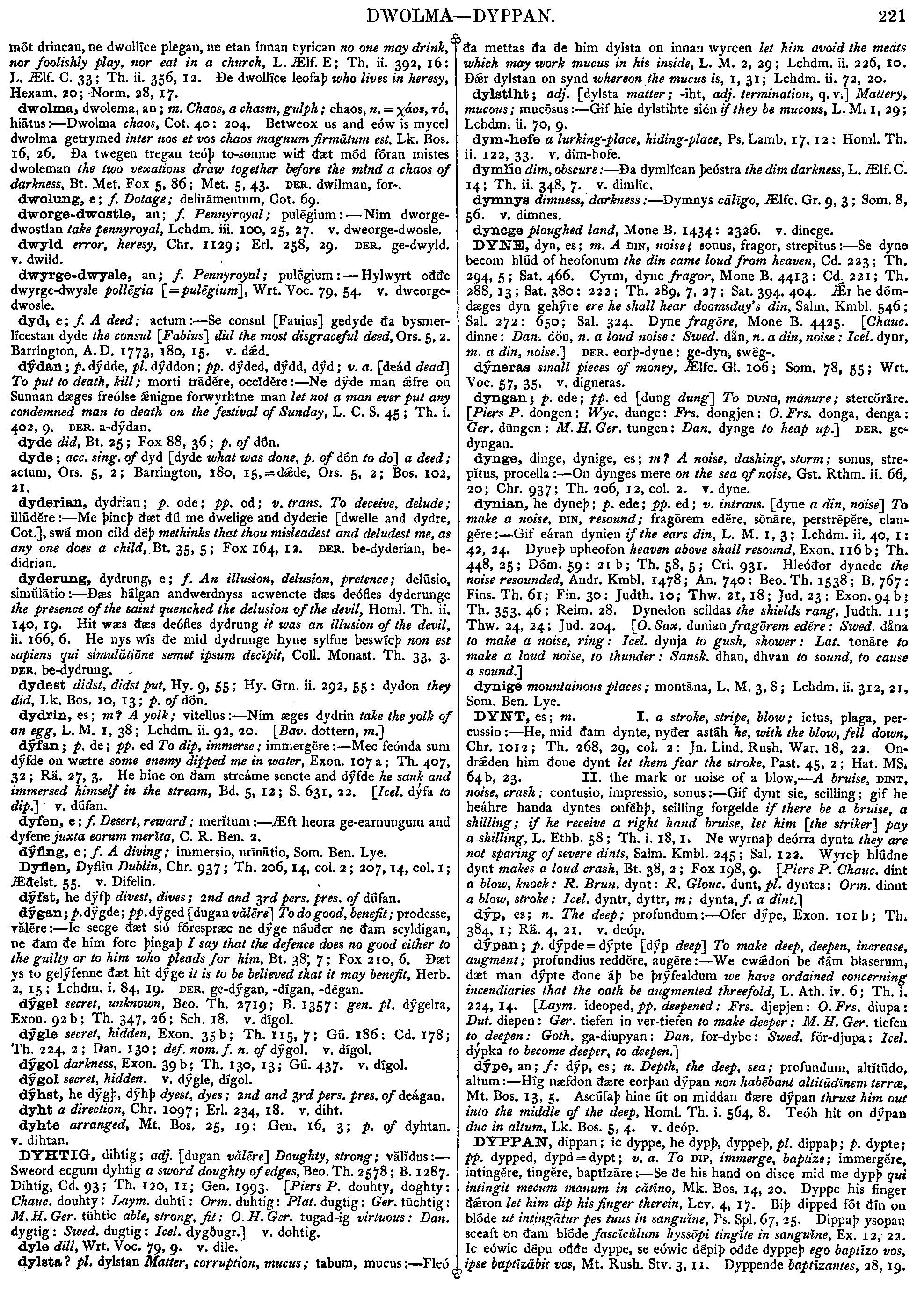
DYNT,
es;
m.
I.
a
stroke,
stripe,
blow;
ictus,
plaga,
percussio
:--
He,
mid
ðam
dynte,
nyðer
astáh
he,
with
the
blow,
fell
down,
Chr.
1012;
Th.
268,
29,
col.
2:
Jn.
Lind.
Rush.
War.
18,
22.
Ondrden
him
ðone
dynt
let
them
fear
the
stroke,
Past.
45,
2;
Hat.
MS.
64
b,
23.
II.
the
mark
or
noise
of
a
blow,-A
bruise,
DINT,
noise,
crash;
contusio,
impressio,
sonus
:--
Gif
dynt
sie,
scilling;
gif
he
heáhre
handa
dyntes
onféhþ,
scilling
forgelde
if
there
be
a
bruise,
a
shilling;
if
he
receive
a
right
hand
bruise,
let
him
[the
striker]
pay
a
shilling,
L.
Ethb.
58;
Th.
i.
18,
1.
Ne
wyrnaþ
deórra
dynta
they
are
not
sparing
of
severe
dints,
Salm.
Kmbl.
245;
Sal.
122.
Wyrcþ
hlúdne
dynt
makes
a
loud
crash,
Bt.
38,
2;
Fox
198,
9.
[Piers
P.
Chauc.
dint
a
blow,
knock:
R.
Brun.
dynt:
R.
Glouc.
dunt,
pl.
dyntes:
Orm.
dinnt
a
blow,
stroke:
Icel.
dyntr,
dyttr,
m;
dynta,
f.
a
dint.]
|
Source: Bosworth/Toller, page b0234, entry 1 View original page image as: [TIFF] [PNG] [View previous entry] [View next entry] |
[Comment on this entry] [View comments] |
The following entry has been hand-corrected once. |
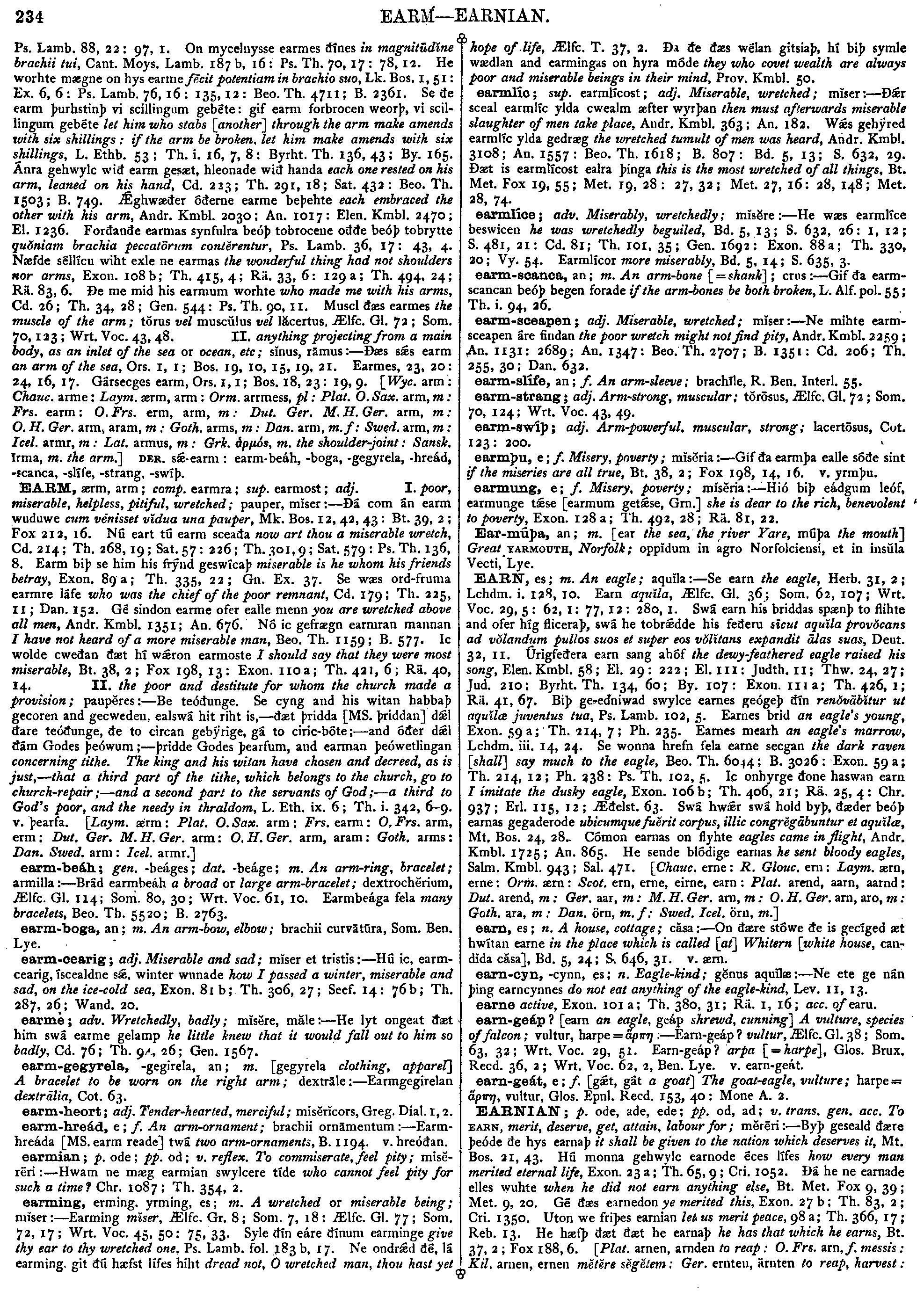
Ps.
Lamb.
88,
22:
97,
l.
On
mycelnysse
earmes
ðines
in
magnitdne
brachii
tui.
Cant.
Moys.
Lamb.
187
b,
16:
Ps.
Th.
70,
17:
78,
12.
He
worhte
mægne
on
hys
earme
fcit
potentiam
in
brachio
suo,
Lk.
Bos.
1,
51:
Ex.
6,
6:
Ps.
Lamb.
76,
16:
135,
12:
Beo.
Th.
4711;
B.
2361.
Se
ðe
earm
þurhstinþ
vi
scillingum
gebéte:
gif
earm
forbrocen
weorþ,
vi
scillingum
gebéte
let
him
who
stabs
[another]
through
the
arm
make
amends
with
six
shillings:
if
the
arm
be
broken,
let
him
make
amends
with
six
shillings,
L.
Ethb.
53;
Th.
i.
16,
7,
8:
Byrht.
Th.
136,
43;
By.
165.
Ánra
gehwylc
wið
earm
gesæt,
hleonade
wið
handa
each
one
rested
on
his
arm,
leaned
on
his
hand.
Cd.
223;
Th.
291,
18;
Sat.
432:
Beo.
Th.
1503;
B.
749.
Æ-acute;ghwæðer
óðerne
earme
beþehte
each
embraced
the
other
with
his
arm,
Andr.
Kmbl.
2030;
An.
1017:
Elen.
Kmbl.
2470;
El.
1236.
Forðanðe
earmas
synfulra
beóþ
tobrocene
oððe
beóþ
tobrytte
quniam
brachia
peccatrum
contrentur,
Ps.
Lamb.
36,
17:
43,
4.
Næfde
séllícu
wiht
exle
ne
earmas
the
wonderful
thing
had
not
shoulders
nor
arms,
Exon.
108
b;
Th.
415,
4;
Rä.
33,
6:
129
a;
Th.
494,
24;
Rä.
83,
6.
Ðe
me
mid
his
earmum
worhte
who
made
me
with
his
arms,
Cd.
26;
Th.
34,
28;
Gen.
544:
Ps.
Th.
90,
11.
Muscl
ðæs
earmes
the
muscle
of
the
arm;
trus
vel
musc lus
vel
lcertus,
Ælfc.
Gl.
72;
Som.
70,
123;
Wrt.
Voc.
43,
48.
II.
anything
projecting
from
a
main
body,
as
an
inlet
of
the
sea
or
ocean,
etc;
snus,
rmus
:--
Ðæs
ss
earm
an
arm
of
the
sea,
Ors.
1.
1;
Bos.
19,
10,
15,
19,
21.
Earmes,
23,
20:
24,
16,
17.
Gársecges
earm,
Ors.
1,
1;
Bos.
18,
23:
19,
9.
[Wyc.
arm:
Chauc.
arme:
Laym.
ærm,
arm:
Orm.
arrrness,
pl:
Plat.
O.
Sax.
arm,
m:
Frs.
earm:
O.
Frs.
erm,
arm,
m:
Dut.
Ger.
M.
H.
Ger.
arm,
m:
O.
H.
Ger.
arm,
aram,
m:
Goth.
arms,
m:
Dan.
arm,
m.
f:
Swed.
arm,
m:
Icel.
armr,
m:
Lat.
armus,
m
:
Grk.
GREEK,
m.
the
shoulder-joint:
Sansk.
rma,
m.
the
arm.]
DER.
s-earm:
earm-beáh,
-boga,
-gegyrela,
-hreád,
-scanca,
-slífe,
-strang,
-swíþ.
lus
vel
lcertus,
Ælfc.
Gl.
72;
Som.
70,
123;
Wrt.
Voc.
43,
48.
II.
anything
projecting
from
a
main
body,
as
an
inlet
of
the
sea
or
ocean,
etc;
snus,
rmus
:--
Ðæs
ss
earm
an
arm
of
the
sea,
Ors.
1.
1;
Bos.
19,
10,
15,
19,
21.
Earmes,
23,
20:
24,
16,
17.
Gársecges
earm,
Ors.
1,
1;
Bos.
18,
23:
19,
9.
[Wyc.
arm:
Chauc.
arme:
Laym.
ærm,
arm:
Orm.
arrrness,
pl:
Plat.
O.
Sax.
arm,
m:
Frs.
earm:
O.
Frs.
erm,
arm,
m:
Dut.
Ger.
M.
H.
Ger.
arm,
m:
O.
H.
Ger.
arm,
aram,
m:
Goth.
arms,
m:
Dan.
arm,
m.
f:
Swed.
arm,
m:
Icel.
armr,
m:
Lat.
armus,
m
:
Grk.
GREEK,
m.
the
shoulder-joint:
Sansk.
rma,
m.
the
arm.]
DER.
s-earm:
earm-beáh,
-boga,
-gegyrela,
-hreád,
-scanca,
-slífe,
-strang,
-swíþ.
|
Source: Bosworth/Toller, page b0237, entry 37 View original page image as: [TIFF] [PNG] [View previous entry] [View next entry] |
[Comment on this entry] [View comments] |
The following entry has been hand-corrected once. |
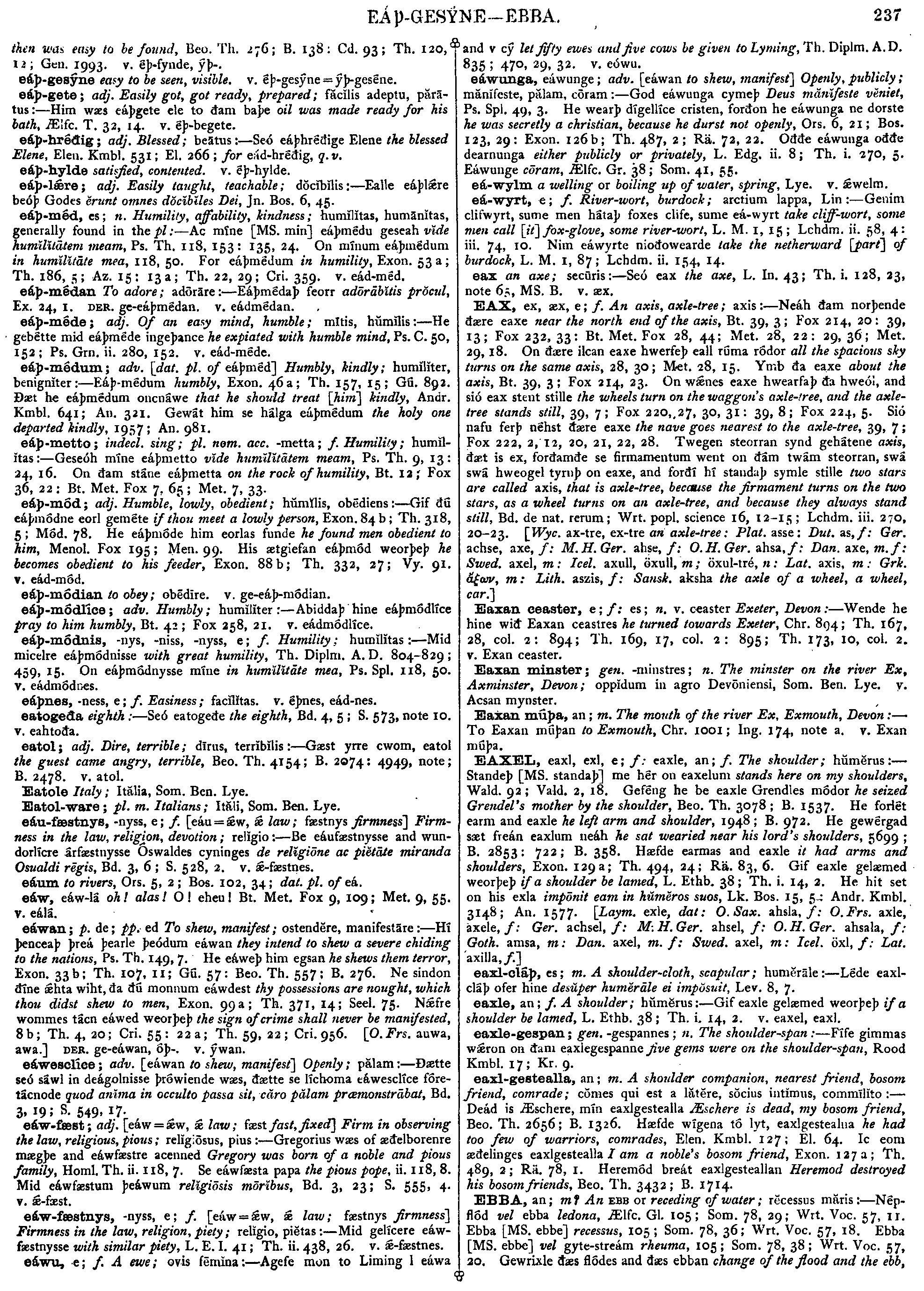
EAXEL,
eaxl,
exl,
e;
f:
eaxle,
an;
f.
The
shoulder;
hmrus
:--
Standeþ
[MS.
standaþ]
me
hér
on
eaxelum
stands
here
on
my
shoulders,
Wald.
92;
Vald.
2,
18.
Geféng
he
be
eaxle
Grendles
módor
he
seized
Grendel's
mother
by
the
shoulder,
Beo.
Th.
3078;
B.
1537.
He
forlét
earm
and
eaxle
he
left
arm
and
shoulder,
1948;
B.
972.
He
gewérgad
sæt
freán
eaxlum
neáh
he
sat
wearied
near
his
lord's
shoulders,
5699;
B.
2853:
722;
B.
358.
Hæfde
earmas
and
eaxle
it
had
arms
and
shoulders,
Exon.
129
a;
Th.
494,
24;
Rä.
83,
6.
Gif
eaxle
gelæmed
weorþeþ
if
a
shoulder
be
lamed,
L.
Ethb.
38;
Th.
i.
14,
2.
He
hit
set
on
his
exla
impnit
eam
in
hmros
suos,
Lk.
Bos.
15,
5:
Andr.
Kmbl.
3148;
An.
1577.
[Laym.
exle,
dat:
O.
Sax.
ahsla,
f:
O.
Frs.
axle,
axele,
f:
Ger.
achsel,
f:
M.
H.
Ger.
ahsel,
f:
O.
H.
Ger.
ahsala,
f:
Goth.
amsa,
m:
Dan.
axel,
m.
f:
Swed.
axel,
m:
Icel.
öxl,
f:
Lat.
axilla,
f.]
|
Source: Bosworth/Toller, page b0237, entry 39 View original page image as: [TIFF] [PNG] [View previous entry] [View next entry] |
[Comment on this entry] [View comments] |
The following entry has been hand-corrected once. |
eaxle,
an;
f.
A
shoulder;
hmrus
:--
Gif
eaxle
gelæmed
weorþeþ
if
a
shoulder
be
lamed,
L.
Ethb.
38;
Th.
i.
14,
2.
v.
eaxel,
eaxl.
|
Source: Bosworth/Toller, page b0239, entry 54 View original page image as: [TIFF] [PNG] [View previous entry] [View next entry] |
[Comment on this entry] [View comments] |
The following entry has been hand-corrected once. |
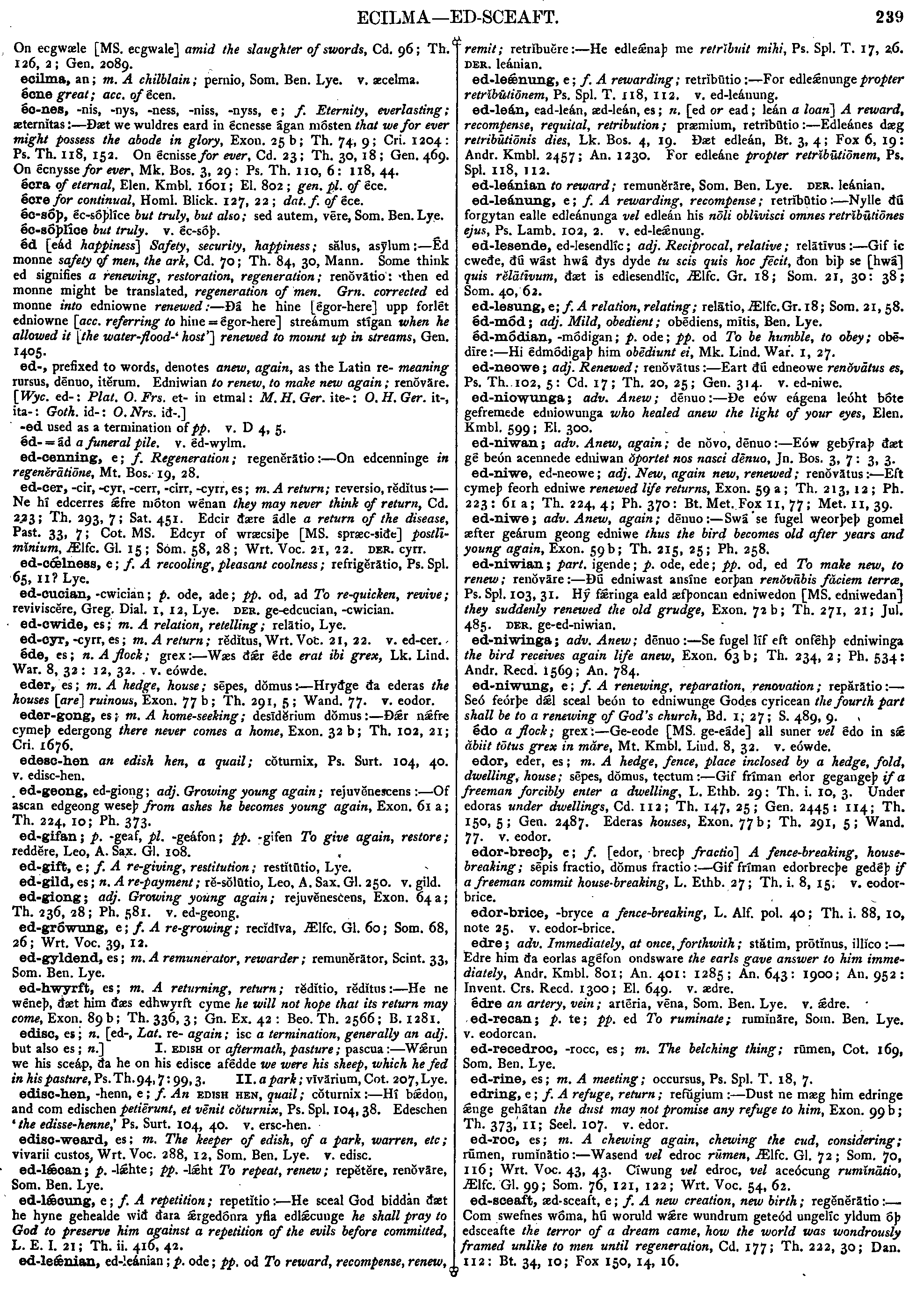
edor,
eder,
es;
m.
A
hedge,
fence,
place
inclosed
by
a
hedge,
fold,
dwelling,
house;
spes,
dmus,
tectum
:--
Gif
fríman
edor
gegangeþ
if
a
freeman
forcibly
enter
a
dwelling,
L.
Ethb.
29:
Th.
i.
10,
3.
Under
edoras
under
dwellings.
Cd.
112;
Th.
147,
25;
Gen.
2445:
114;
Th.
150,
5;
Gen.
2487.
Ederas
houses,
Exon.
77
b;
Th.
291,
5;
Wand.
77.
v.
eodor.
|
Source: Bosworth/Toller, page b0239, entry 55 View original page image as: [TIFF] [PNG] [View previous entry] [View next entry] |
[Comment on this entry] [View comments] |
The following entry has been hand-corrected once. |
edor-brecþ,
e;
f.
[edor,
brecþ
fractio]
A
fence-breaking,
house-breaking;
spis
fractio,
dmus
fractio
:--
Gif
fríman
edorbrecþe
gedéþ
if
a
freeman
commit
house-breaking,
L.
Ethb.
27;
Th.
i.
8,
15.
v.
eodor-brice.
|
Source: Bosworth/Toller, page b0254, entry 9 View original page image as: [TIFF] [PNG] [View previous entry] [View next entry] |
[Comment on this entry] [View comments] |
The following entry has been hand-corrected once. |
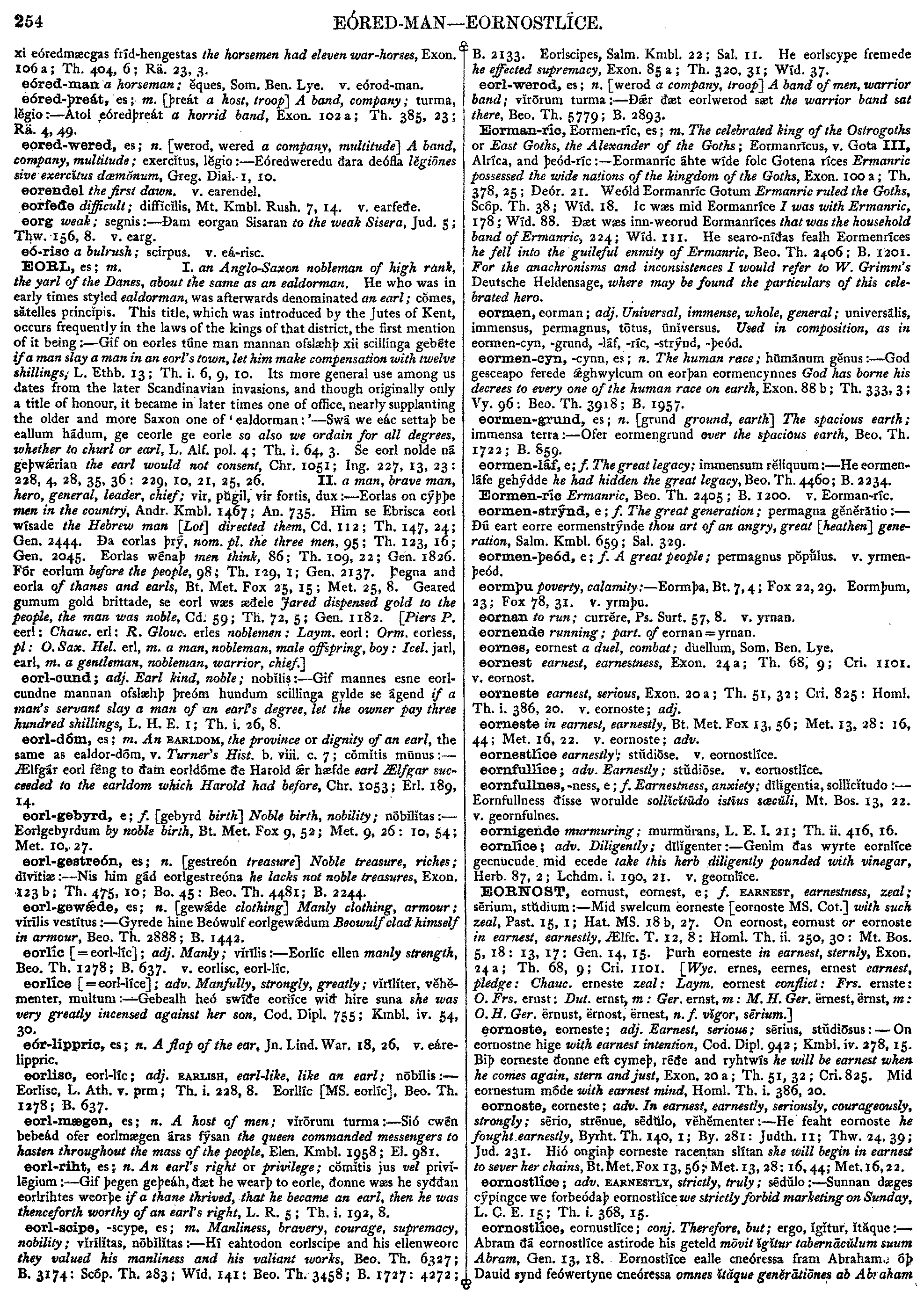
EORL.
es;
m.
I.
an
Anglo-Saxon
nobleman
of
high
rank,
the
yarl
of
the
Danes,
about
the
same
as
an
ealdorman.
He
who
was
in
early
times
styled
ealdorman,
was
afterwards
denominated
an
earl;
cmes,
stelles
princpis.
This
title,
which
was
introduced
by
the
Jutes
of
Kent,
occurs
frequently
in
the
laws
of
the
kings
of
that
district,
the
first
mention
of
it
being
:--
Gif
on
eorles
túne
man
mannan
ofslæhþ
xii
scillinga
gebéte
if
a
man
slay
a
man
in
an
earl's
town,
let
him
make
compensation
with
twelve
shillings,
L.
Ethb.
13;
Th.
i.
6,
9,
10.
Its
more
general
use
among
us
dates
from
the
later
Scandinavian
invasions,
and
though
originally
only
a
title
of
honour,
it
became
in
later
times
one
of
office,
nearly
supplanting
the
older
and
more
Saxon
one
of
'ealdorman:'
--
Swá
we
eác
settaþ
be
eallum
hádum,
ge
ceorle
ge
eorle
so
also
we
ordain
for
all
degrees,
whether
to
churl
or
earl,
L.
Alf.
pol.
4;
Th.
i.
64,
3.
Se
eorl
nolde
ná
géþwsrian
the
earl
would
not
consent,
Chr.
1051;
Ing.
227,
13,
23:
228,
4,
28,
35,
36:
229,
10,
21,
25,
26.
II.
a
man,
brave
man,
hero,
general,
leader,
chief;
vir,
pgil,
vir
fortis,
dux
:--
Eorlas
on
cýþþe
men
in
the
country.
Andr.
Kmbl.
1467;
An.
735.
Him
se
Ebrisca
eorl
wísade
the
Hebrew
man
[Lot]
directed
them.
Cd.
112;
Th.
147,
24;
Gen.
2444.
Ða
eorlas
þrý,
nom.
pl.
the
three
men,
95;
Th.
123,
16;
Gen.
2045.
Eorlas
wénaþ
men
think,
86;
Th.
109,
22;
Gen.
1826.
Fór
eorlum
before
the
people,
98;
Th.
129,
1;
Gen.
2137.
þegna
and
eorla
of
thanes
and
earls,
Bt.
Met.
Fox
25,
15
;
Met.
25,
8.
Geared
gumum
gold
brittade,
se
eorl
wæs
æðele
Jared
dispensed
gold
to
the
people,
the
man
was
noble.
Cd.
59;
Th.
72,
5;
Gen.
1182.
[Piers
P.
eerl:
Chauc.
erl:
R.
Glouc.
erles
noblemen:
Laym.
eorl:
Orm.
eorless,
pl:
O.
Sax.
Hel.
erl,
m.
a
man,
nobleman,
male
offspring,
boy:
Icel.
jarl,
earl,
m.
a
gentleman,
nobleman,
warrior,
chief.]
| Result Page: |  |
Previous | 1 2 3 4 5 6 7 8 9 10 11 12 | Next |  |
Germanic Lexicon Project (main page)
This search system was written by
Sean Crist
Please consider
volunteering
to correct the data in these online dictionaries.
No rights reserved. Feel free to use these data in any way you please.