|
|

|
Source: Bosworth/Toller, page b1085, entry 12 View original page image as: [TIFF] [PNG] [View previous entry] [View next entry] |
[Comment on this entry] [View comments] |
The following entry has been hand-corrected once. |
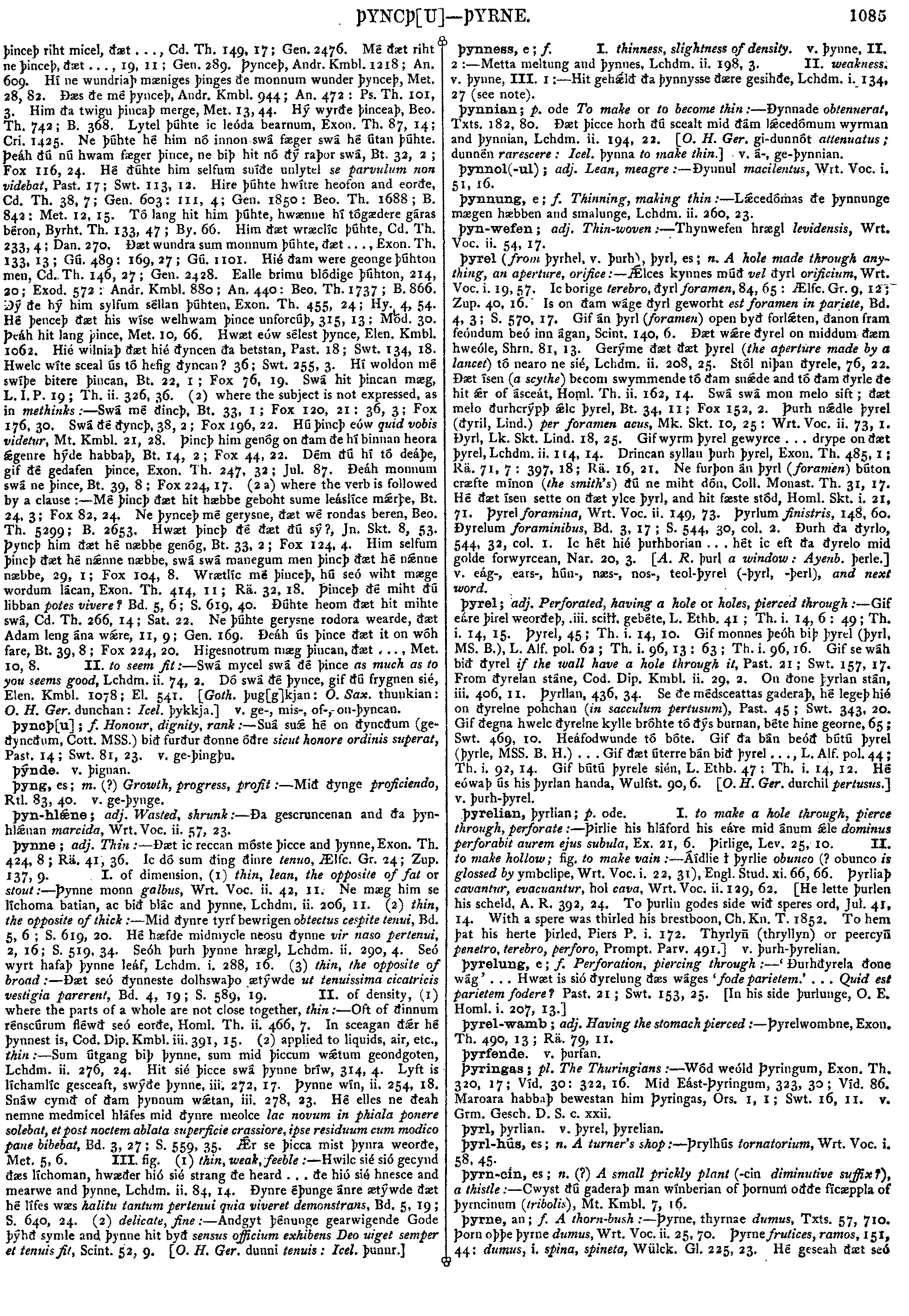
þyrel;
adj.
Perforated,
having
a
hole
or
holes,
pierced
through
:--
Gif
eáre
þirel
weorðeþ,
.iii.
sci .
gebéte,
L.
Ethb.
41;
Th.
i.
14,
6:
49;
Th.
i.
14,
15.
Þyrel,
45;
Th.
i.
14,
10.
Gif
monnes
þeóh
biþ
þyrel
(þyrl,
MS.
B.),
L.
Alf.
pol.
62;
Th.
i.
96,
13:
63;
Th.
i.
96,
16.
Gif
se
wáh
bið
ðyrel
if
the
wall
have
a
hole
through
it,
Past.
21;
Swt.
157,
17.
From
ðyrelan
stáne,
Cod.
Dip.
Kmbl.
ii.
29,
2.
On
ðone
þyrlan
stán,
iii.
406,
11.
Þyrlian,
436,
34.
Se
ðe
médsceattas
gaderaþ,
hé
legeþ
hié
on
ðyrelne
pohchan
(in
sacculum
pertusum),
Past.
45;
Swt.
343,
20.
Gif
ðegna
hwelc
ðyrelne
kylle
bróhte
tó
ðýs
burnan,
béte
hine
georne,
65;
Swt.
469,
10.
Heáfodwunde
tó
bóte.
Gif
ða
bán
beóð
bútú
þyrel
(þyrle,
MSS.
B.
H.)
...
Gif
ðæt
úterre
bán
bið
þyrel...,
L.
Alf.
pol.
44;
Th.
i.
92,
14.
Gif
bútú
þyrele
sién,
L.
Ethb.
47;
Th.
i.
14,
12.
Hé
eówaþ
ús
his
þyrlan
handa,
Wulfst.
90,
6.
[O.
H.
Ger.
durchil
pertusus.]
v.
þurh-þyrel.
.
gebéte,
L.
Ethb.
41;
Th.
i.
14,
6:
49;
Th.
i.
14,
15.
Þyrel,
45;
Th.
i.
14,
10.
Gif
monnes
þeóh
biþ
þyrel
(þyrl,
MS.
B.),
L.
Alf.
pol.
62;
Th.
i.
96,
13:
63;
Th.
i.
96,
16.
Gif
se
wáh
bið
ðyrel
if
the
wall
have
a
hole
through
it,
Past.
21;
Swt.
157,
17.
From
ðyrelan
stáne,
Cod.
Dip.
Kmbl.
ii.
29,
2.
On
ðone
þyrlan
stán,
iii.
406,
11.
Þyrlian,
436,
34.
Se
ðe
médsceattas
gaderaþ,
hé
legeþ
hié
on
ðyrelne
pohchan
(in
sacculum
pertusum),
Past.
45;
Swt.
343,
20.
Gif
ðegna
hwelc
ðyrelne
kylle
bróhte
tó
ðýs
burnan,
béte
hine
georne,
65;
Swt.
469,
10.
Heáfodwunde
tó
bóte.
Gif
ða
bán
beóð
bútú
þyrel
(þyrle,
MSS.
B.
H.)
...
Gif
ðæt
úterre
bán
bið
þyrel...,
L.
Alf.
pol.
44;
Th.
i.
92,
14.
Gif
bútú
þyrele
sién,
L.
Ethb.
47;
Th.
i.
14,
12.
Hé
eówaþ
ús
his
þyrlan
handa,
Wulfst.
90,
6.
[O.
H.
Ger.
durchil
pertusus.]
v.
þurh-þyrel.
|
Source: Bosworth/Toller, page b1089, entry 27 View original page image as: [TIFF] [PNG] [View previous entry] [View next entry] |
[Comment on this entry] [View comments] |
The following entry has been hand-corrected once. |
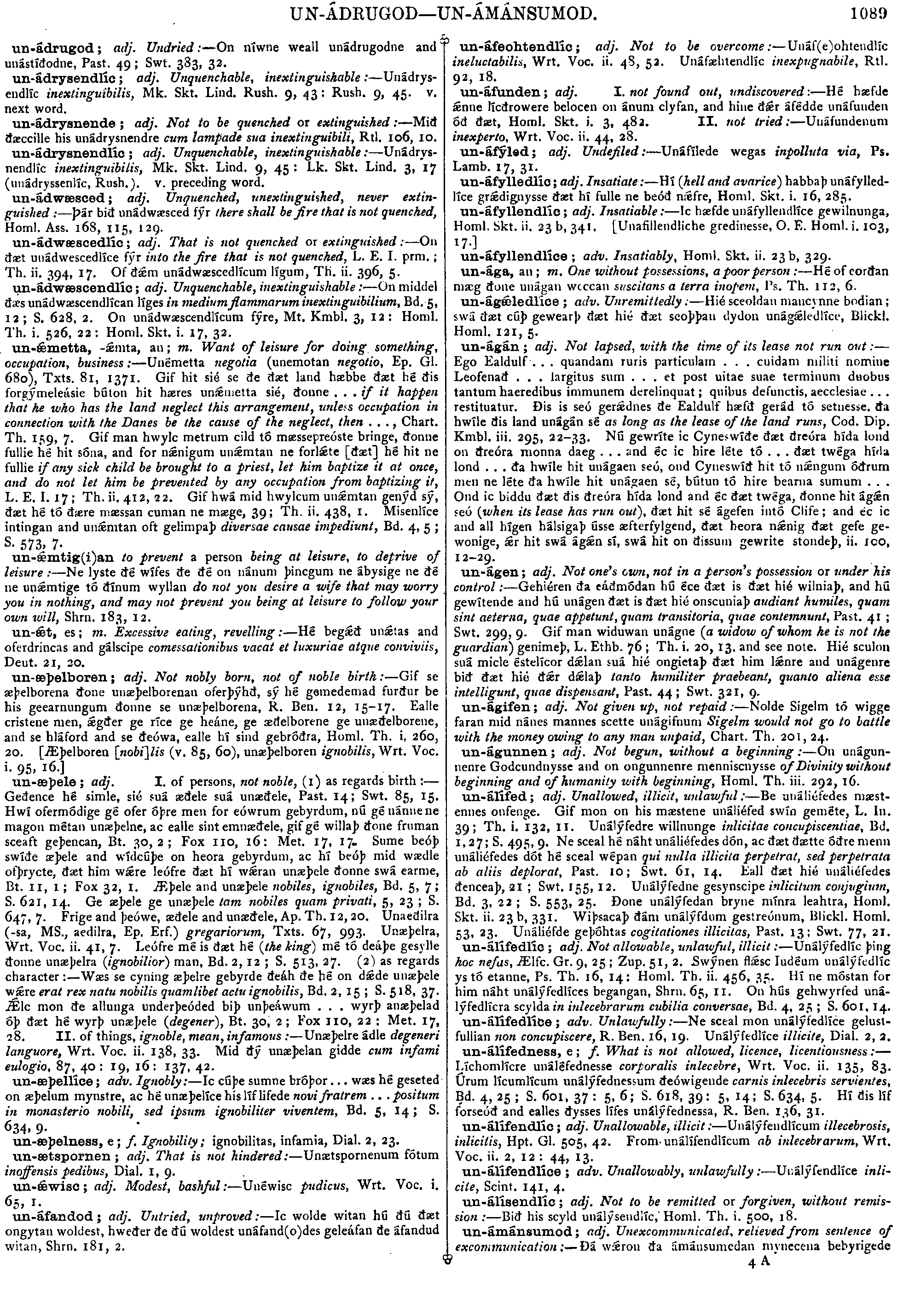
un-ágen;
adj.
Not
one's
own,
not
in
a
person's
possession
or
under
his
control
:--
Gehiéren
ða
eáðmódan
hú
éce
ðæt
is
ðæt
hié
wilniaþ,
and
hú
gewítende
and
hú
unágen
ðæt
is
ðæt
hié
onscuniaþ
audiant
humiles,
quam
sint
aeterna,
quae
appetunt,
quam
transitoria,
quae
contemnunt,
Past.
41;
Swt.
299,
9.
Gif
man
widuwan
unágne
(a
widow
of
whom
he
is
not
the
guardian)
genimeþ,
L.
Ethb.
76;
Th.
i.
20,
13.
and
see
note.
Hié
sculon
suá
micle
éstelícor
d lan
suá
hié
ongietaþ
ðæt
him
lnre
and
unágenre
bið
ðæt
hié
ðr
dlaþ
tanto
humiliter
praebeant,
quanto
aliena
esse
intelligunt,
quae
dispensant,
Past.
44;
Swt.
321,
9.
lan
suá
hié
ongietaþ
ðæt
him
lnre
and
unágenre
bið
ðæt
hié
ðr
dlaþ
tanto
humiliter
praebeant,
quanto
aliena
esse
intelligunt,
quae
dispensant,
Past.
44;
Swt.
321,
9.
|
Source: Bosworth/Toller, page b1102, entry 17 View original page image as: [TIFF] [PNG] [View previous entry] [View next entry] |
[Comment on this entry] [View comments] |
The following entry has been hand-corrected once. |
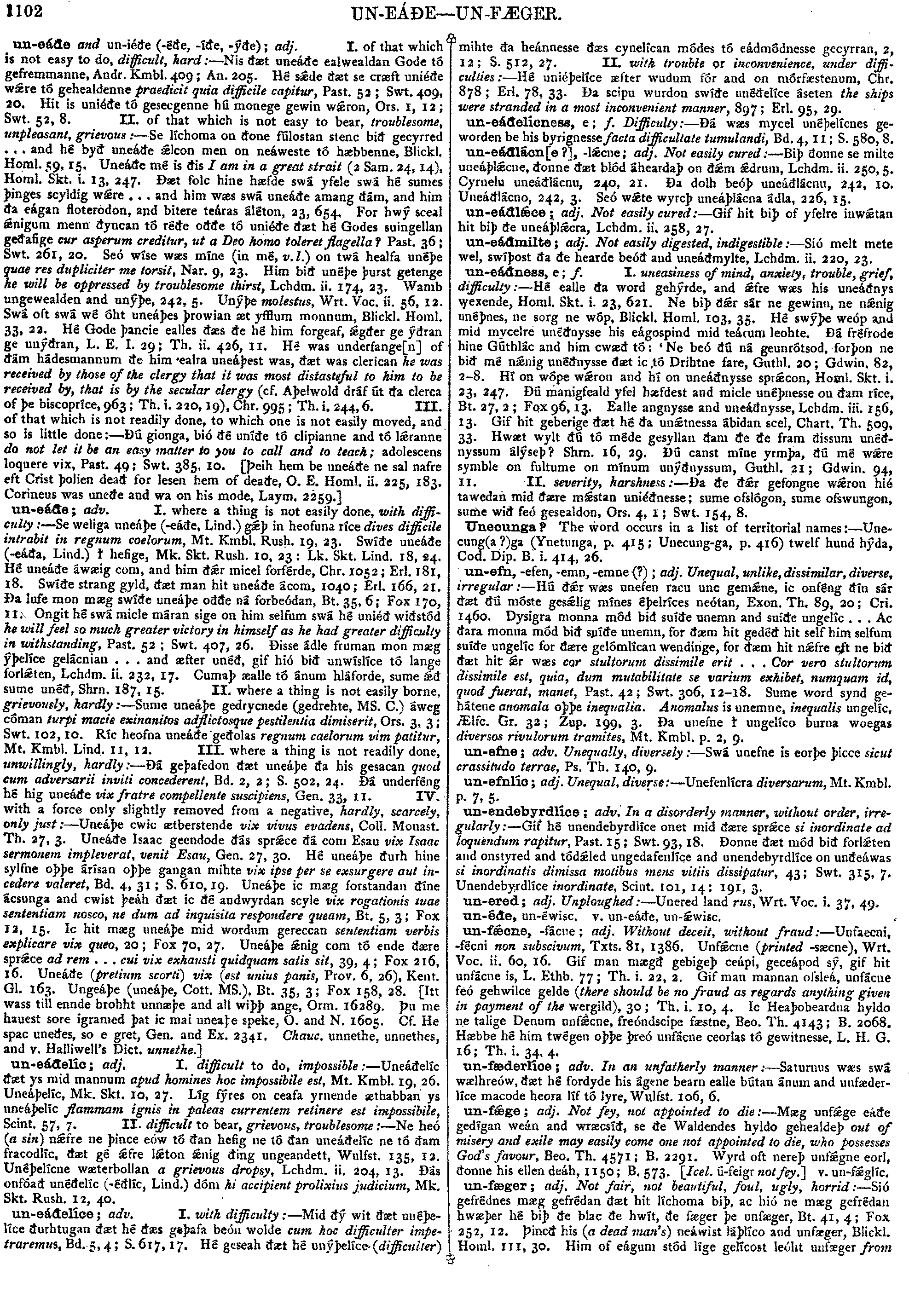
un-fcne,
-fácne;
adj.
Without
deceit,
without
fraud
:--
Unfaecni,
-fécni
non
subscivum,
Txts.
81,
1386.
Unfcne
(printed
-sæcne),
Wrt.
Voc.
ii.
60,
16.
Gif
man
mægð
gebigeþ
ceápi,
geceápod
sý,
gif
hit
unfácne
is,
L.
Ethb.
77;
Th.
i.
22,
2.
Gif
man
mannan
ofsleá,
unfácne
feó
gehwilce
gelde
(there
should
be
no
fraud
as
regards
anything
given
in
payment
of
the
wergild),
30;
Th.
i.
10,
4.
Ic
Heaþobeardna
hyldo
ne
talige
Denum
unfcne,
freóndscipe
fæstne,
Beo.
Th.
4143;
B.
2068.
Hæbbe
hé
him
twégen
oþþe
þreó
unfácne
ceorlas
tó
gewitnesse,
L.
H.
G.
16;
Th.
i.
34,
4.
|
Source: Bosworth/Toller, page b1131, entry 19 View original page image as: [TIFF] [PNG] [View previous entry] [View next entry] |
[Comment on this entry] [View comments] |
The following entry has been hand-corrected once. |
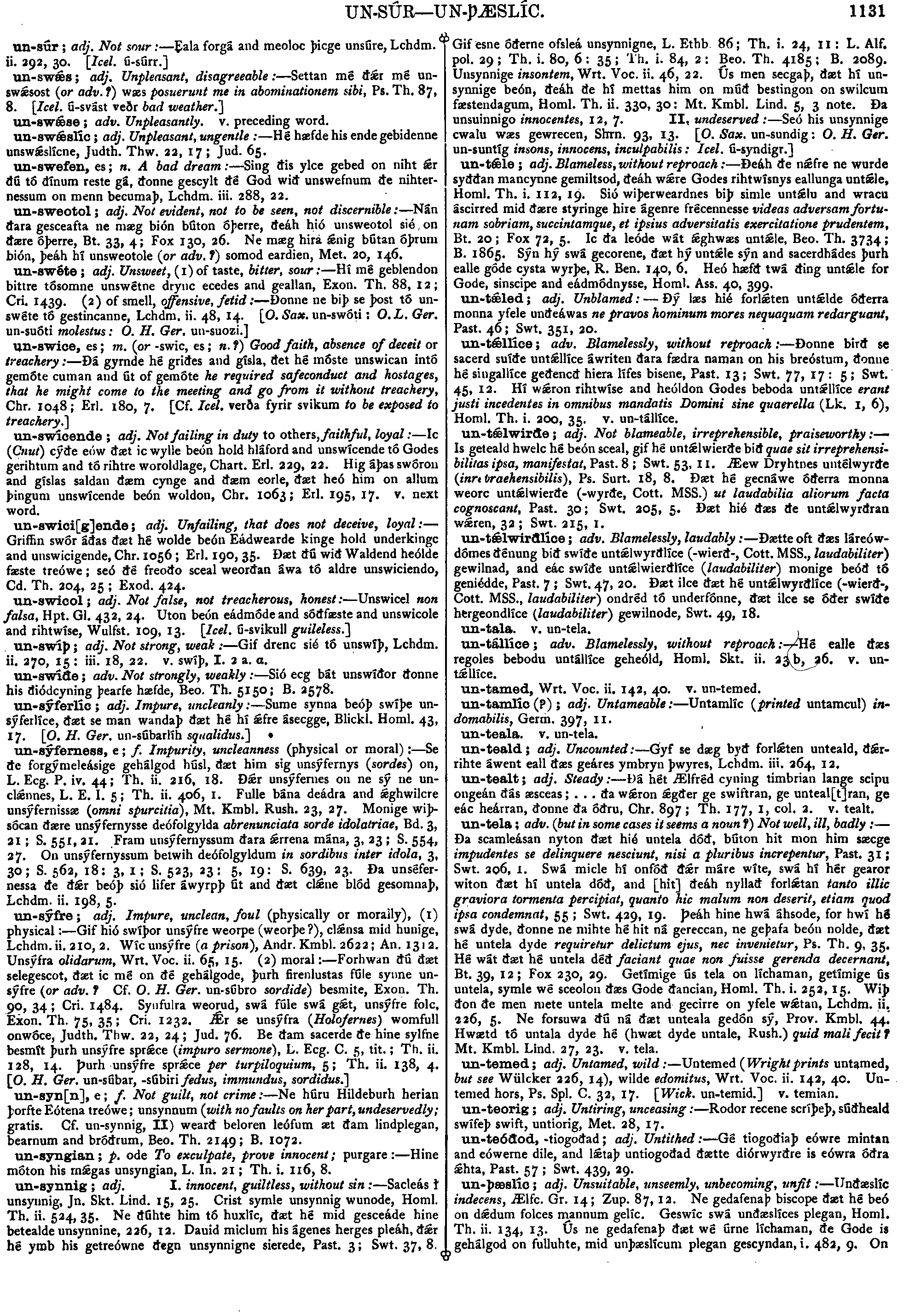
un-synnig;
adj.
I.
innocent,
guiltless,
without
sin
:--
Sacleás
unsynnig,
Jn.
Skt.
Lind.
15,
25.
Crist
symle
unsynnig
wunode,
Homl.
Th.
ii.
524,
35.
Ne
ðúhte
him
tó
huxlíc,
ðæt
hé
mid
gesceáde
hine
betealde
unsynnine,
226,
12.
Dauid
miclum
his
ágenes
herges
pleáh,
ðr
hé
ymb
his
getreówne
ðegn
unsynnigne
sierede,
Past.
3;
Swt.
37,
8.
Gif
esne
oðerne
ofsleá
unsynnigne,
L.
Ethb.
86;
Th.
i.
24,
11:
L.
Alf.
pol.
29;
Th.
i.
80,
6:
35;
Th.
i.
84,
2:
Beo.
Th.
4185,
B.
2089.
Unsynnige
insontem,
Wrt.
Voc.
11.
46,
22.
Ús
men
secgaþ,
ðæt
hí
unsynnige
beón,
ðeáh
ðe
hí
mettas
him
on
múð
bestingon
on
swilcum
fæstendagum,
Homl.
Th.
ii.
330,
30:
Mt.
Kmbl.
Lind.
5,
3
note.
Ða
unsuinnigo
innocentes,
12,
7.
II.
undeserved
:--
Seó
his
unsynnige
cwalu
wæs
gewrecen,
Shrn.
93,
13.
[O.
Sax.
un-sundig:
O.
H.
Ger.
un-suntíg
insons,
innocens,
inculpabilis:
Icel.
ú-syndigr.]
|
Source: Bosworth/Toller, page b1149, entry 17 View original page image as: [TIFF] [PNG] [View previous entry] [View next entry] |
[Comment on this entry] [View comments] |
The following entry has been hand-corrected once. |
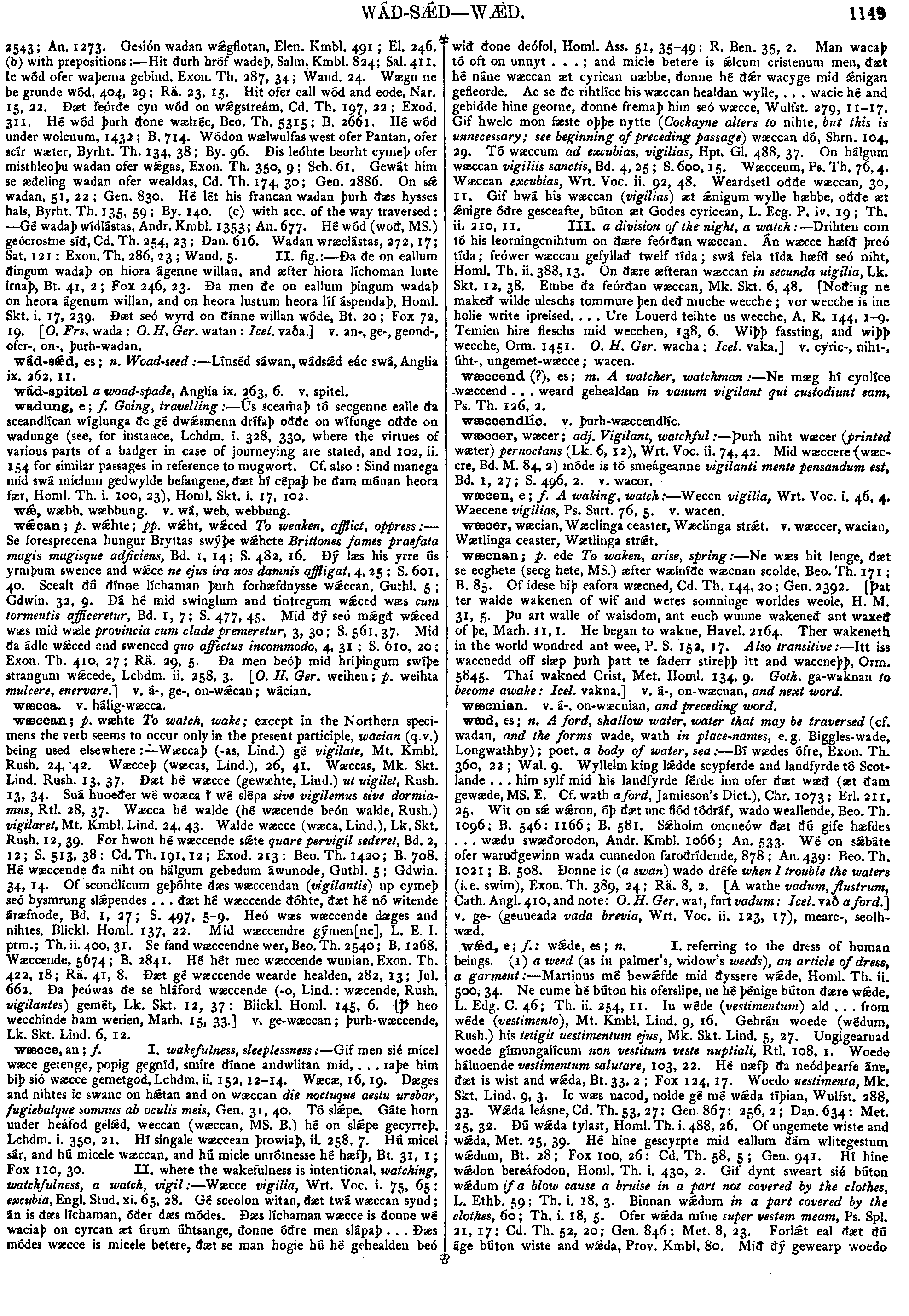
wd,
e;
f.:
wde,
es;
n.
I.
referring
to
the
dress
of
human
beings.
(1)
a
weed
(as
in
palmer's,
widow's
weeds),
an
article
of
dress,
a
garment
:--
Martinus
mé
bewfde
mid
ðyssere
wde,
Homl.
Th.
ii.
500,
34.
Ne
cume
hé
búton
his
oferslipe,
ne
hé
þénige
búton
ðære
wde,
L.
Edg.
C.
46;
Th.
ii.
254,
11.
In
wéde
(vestimentum)
ald
...
from
wéde
(vestimento),
Mt.
Kmbl.
Lind.
9,
16.
Gehrán
woede
(wédum,
Rush.)
his
tetigit
uestimentum
ejus,
Mk.
Skt.
Lind.
5,
27.
Ungigearuad
woede
gímungalícum
non
vestitum
veste
nuptiali,
Rtl.
108,
1.
Woede
háluoende
vestimentum
salutare,
103,
22.
Hé
næfþ
ða
neódþearfe
áne,
ðæt
is
wist
and
wda,
Bt.
33,
2;
Fox
124,
17.
Woedo
uestimenta,
Mk.
Skt.
Lind.
9,
3.
Ic
wæs
nacod,
nolde
gé
mé
wda
tíþian,
Wulfst.
288,
33.
Wda
leásne,
Cd.
Th.
53,
27;
Gen.
867:
256,
2;
Dan.
634:
Met.
25,
32.
Ðú
wda
tylast,
Homl.
Th.
i.
488,
26.
Of
ungemete
wiste
and
wda,
Met.
25,
39.
Hé
hine
gescyrpte
mid
eallum
ðám
wlitegestum
wdum,
Bt.
28;
Fox
100,
26:
Cd.
Th.
58,
5;
Gen.
941.
Hí
hine
wdon
bereáfodon,
Homl.
Th.
i.
430,
2.
Gif
dynt
sweart
sié
búton
wdum
if
a
blow
cause
a
bruise
in
a
part
not
covered
by
the
clothes,
L.
Ethb.
59;
Th.
i.
18,
3.
Binnan
wdum
in
a
part
covered
by
the
clothes,
60;
Th.
i.
18,
5.
Ofer
wda
míne
super
vestem
meam,
Ps.
Spl.
21,
17:
Cd.
Th.
52,
20;
Gen.
846:
Met.
8,
23.
Forlt
eal
ðæt
ðú
áge
búton
wiste
and
wda,
Prov.
Kmbl.
80.
Mið
ðý
gewearp
woedo
|
Source: Bosworth/Toller, page b1155, entry 5 View original page image as: [TIFF] [PNG] [View previous entry] [View next entry] |
[Comment on this entry] [View comments] |
The following entry has been hand-corrected once. |
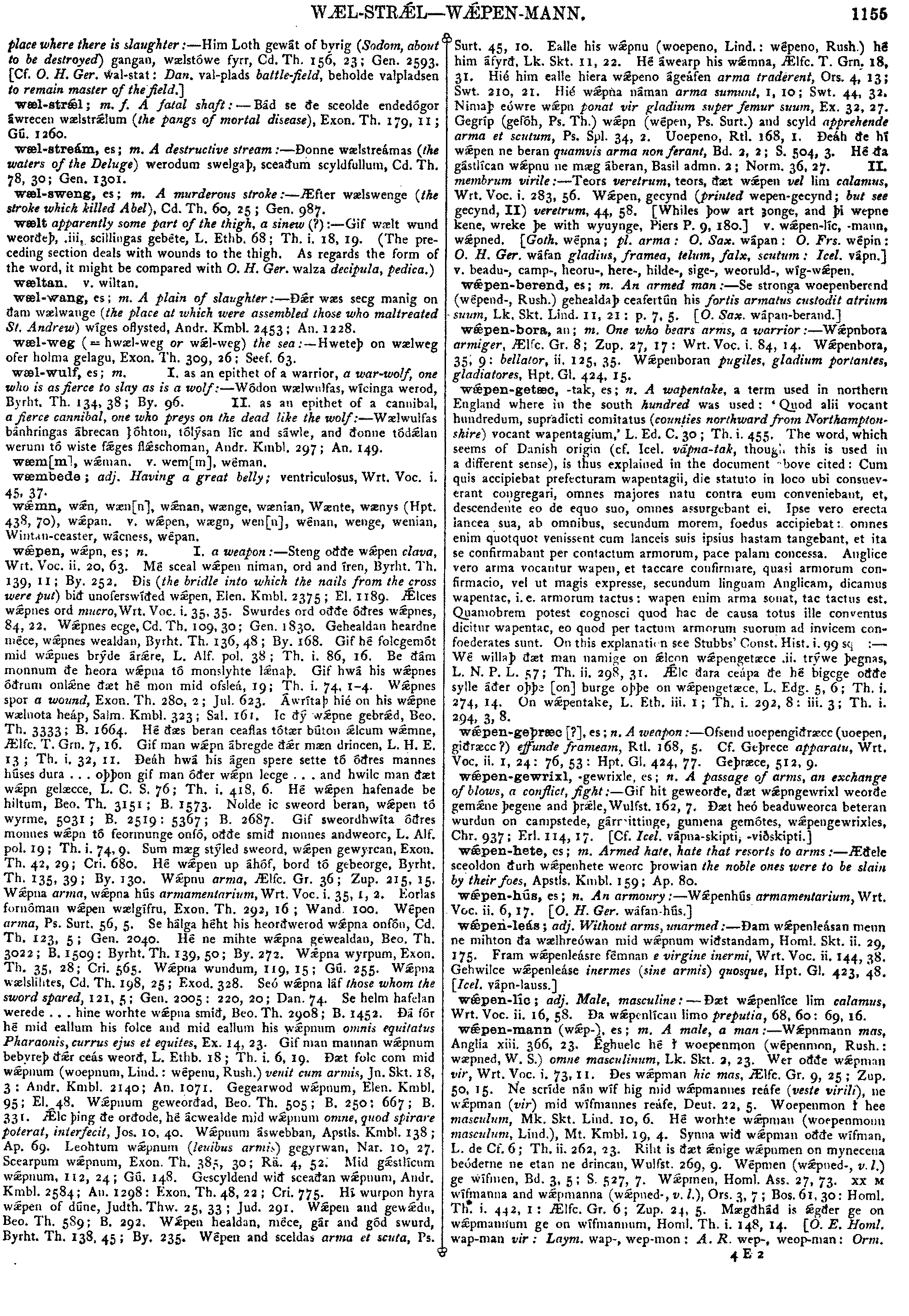
wælt apparently some part of the thigh, a sinew (?) :-- Gif wælt wund weorðeþ, .iii. scillingas gebéte, L. Ethb. 68; Th. i. 18, 19. (The preceding section deals with wounds to the thigh. As regards the form of the word, it might be compared with O.H. Ger. walza decipula, pedica.)
|
Source: Bosworth/Toller, page b1155, entry 13 View original page image as: [TIFF] [PNG] [View previous entry] [View next entry] |
[Comment on this entry] [View comments (1)] |
The following entry has been hand-corrected once. |
wepen,
wpn,
es;
n.
I.
a
weapon
:--
Steng
oððe
wpen
clava,
Wrt.
Voc.
ii.
20,
63.
Mé
sceal
wpen
niman,
ord
and
íren.
Byrht.
Th.
139,
11;
By.
252.
Ðis
(the
bridle
into
which
the
nails
from
the
cross
were
put)
bið
unoferswíðed
wpen,
Elen.
Kmbl.
2375;
El.
1189.
Æ-acute;lces
wpnes
ord
mucro,
Wrt.
Voc.
i.
35,
35.
Swurdes
ord
oððe
óðres
wpnes,
84,
22.
Wpnes
ecge.
Cd.
Th.
109,
30;
Gen.
1830.
Gehealdan
heardne
méce,
wpnes
wealdan,
Byrht.
Th.
136,
48;
By.
168.
Gif
hé
folcgemót
mid
wpnes
brýde
árre,
L.
Alf.
pol.
38;
Th.
i.
86,
16.
Be
ðám
monnum
ðe
heora
wpna
tó
monslyhte
lnaþ.
Gif
hwá
his
wpnes
óðrum
onlne
ðæt
hé
mon
mid
ofsleá,
19;
Th.
i.
74,
1-4.
Wpnes
spor
a
wound,
Exon.
Th.
280,
2;
Jul.
623.
Áwrítaþ
hié
on
his
wpne
wælnota
heáp,
Salm.
Kmbl.
323;
Sal.
161.
Ic
ðý
wpne
gebrd,
Beo.
Th.
3333;
B.
1664.
Hé
ðæs
beran
ceaflas
tótær
búton
lcum
wmne,
Ælfc.
T.
Grn.
7,
16.
Gif
man
wpn
ábregde
ðr
mæn
drincen,
L.H.E.
13;
Th.
i.
32,
11.
Ðeáh
hwá
his
ágen
spere
sette
tó
óðres
mannes
húses
dura
...
oþþon
gif
man
óðer
wpn
lecge
...
and
hwilc
man
ðæt
wpn
gelæcce,
L.C.S.
76;
Th.
i.
418,
6.
Hé
wpen
hafenade
be
hiltum,
Beo.
Th.
3151
;
B.
1573.
Nolde
ic
sweord
beran,
wpen
tó
wyrme,
5031;
B.
2519:
5367;
B.
2687.
Gif
sweordhwíta
óðres
monnes
wpn
tó
feormunge
onfó,
oððe
smið
monnes
andweorc,
L.
Alf.
pol.
19;
Th.
i.
74,
9.
Sum
mæg
stýled
sweord,
wpen
gewyrcan,
Exon.
Th.
42,
29;
Cri.
680.
Hé
wpen
up
áhóf,
bord
tó
gebeorge,
Byrht.
Th.
135.
39;
By.
130.
Wpnu
arma,
Ælfc.
Gr.
36;
Zup.
215,
15.
Wpna
arma,
wpna
hús
armamentarium,
Wrt.
Voc.
i.
35,
1,
2.
Eorlas
fornóman
wpen
wælgífru,
Exon.
Th.
292,
16;
Wand.
100.
Wépen
arma,
Ps.
Surt.
56,
5.
Se
hálga
héht
his
heorðwerod
wpna
onfón,
Cd.
Th.
123,
5;
Gen.
2040.
Hé
ne
mihte
wpna
gewealdan,
Beo.
Th.
3022;
6.
1509:
Byrht.
Th.
139,
50;
By.
272.
Wpna
wyrpum,
Exon.
Th.
35,
28;
Cri.
565.
Wpna
wundum,
119,
15;
Gú.
255.
Wpna
wælslihtes,
Cd.
Th.
198,
25;
Exod.
328.
Seó
wpna
láf
those
whom
the
sword
spared,
121,
5;
Gen.
2005:
220,
20;
Dan.
74.
Se
helm
hafelan
werede
...
hine
worhte
wpna
smið,
Beo.
Th.
2908;
B.
1452.
Ðá
fór
hé
mid
eallum
his
folce
and
mid
eallum
his
wpnum
omnis
equitatus
Pharaonis,
currus
ejus
et
equites.
Ex.
14,
23.
Gif
man
mannan
wpnum
bebyreþ
ðr
ceás
weorð,
L.
Ethb.
18;
Th.
i.
6,
19.
Ðæt
folc
com
mid
wpnum
(woepnum,
Lind.:
wépenu,
Rush.)
venit
cum
armis,
Jn.
Skt.
18,
3:
Andr.
Kmbl.
2140;
An.
1071.
Gegearwod
wpnum,
Elen.
Kmbl.
95;
El.
48.
Wpnum
geweorðad,
Beo.
Th.
505;
B.
250:
667;
B.
331.
Æ-acute;lc
þing
ðe
orðode,
hé
ácwealde
mid
wpnum
omne,
quod
spirare
poterat,
interfecit,
Jos.
10,
40.
Wpmun
áswebban,
Apstls.
Kmbl.
138;
Ap.
69.
Leohtum
wpnum
(leuibus
armis)
gegyrwan,
Nar.
10,
27.
Scearpum
wpnum,
Exon.
Th.
385,
30;
Rä.
4,
52.
Mid
gstlícum
wpnum,
112,
24;
Gú.
148.
Gescyldend
wið
sceaðan
wpnum.
Andr.
Kmbl.
2584;
An.
1298:
Exon.
Th.
48,
22;
Cri.
775.
Hí
wurpon
hyra
wpen
of
dúne,
Judth.
Thw.
25,
33;
Jud.
291.
Wpen
and
gewdu,
Beo.
Th.
589;
B.
292.
Wápen
healdan,
méce,
gár
and
gód
swurd,
Byrht.
Th.
138,
45;
By.
235.
Wépen
and
sceldas.
arma
et
scuta,
Ps.
Surt.
45,
10.
Ealle
his
wpnu
(woepeno,
Lind.:
wépeno,
Rush.)
hé
him
áfyrð,
Lk.
Skt.
ii.
22.
Hé
áwearp
his
wmna,
Ælfc.
T.
Grn.
18,
31.
Hié
him
ealle
hiera
wpeno
ágeáfen
arma
traderent,
Ors.
4,
13;
Swt.
210,
21.
Hié
wpna
náman
arma
sumunt,
1.
10;
Swt.
44,
32,
Nimaþ
eówre
wpn
ponat
vir
gladium
super
femur
suum,
Ex.
32,
27.
Gegríp
(gefóh,
Ps.
Th.)
wpn
(wépen,
Ps.
Surt.)
and
scyld
apprehende
arma
et
scutum,
Ps.
Spl.
34,
2.
Uoepeno,
Rtl.
168,
1.
Ðeáh
ðe
hí
wpen
ne
beran
quamvis
arma
non
ferant,
Bd.
2,
2;
S.
504,
3.
Hé
ða
gástlícan
wpnu
ne
mæg
áberan,
Basil
admn.
2;
Norm.
36,
27.
II.
membrum
virile
:--
Teors
veretrum,
teors,
ðæt
wpen
vel
lim
calamus,
Wrt.
Voc.
i.
283,
56.
Wpen,
gecynd
(printed
wepen-gecynd;
but
see
gecynd,
II)
veretrum,
44,
58.
[Whiles
þow
art
 onge,
and
þi
wepne
kene,
wreke
þe
with
wyuynge,
Piers
P.
9,
180.]
v.
wpen-líc,
-mann,
wpned.
[Goth.
wépna;
pl.
arma
:
O.
Sax.
wápan
:
O.
Frs.
wépin:
O.H.
Ger.
wáfan
gladius,
framea,
telum,
falx,
scutum:
Icel.
vápn.]
v.
beadu-,
camp-,
heoru-,
here-,
hilde-,
sige-,
weoruld-,
wíg-wpen.
onge,
and
þi
wepne
kene,
wreke
þe
with
wyuynge,
Piers
P.
9,
180.]
v.
wpen-líc,
-mann,
wpned.
[Goth.
wépna;
pl.
arma
:
O.
Sax.
wápan
:
O.
Frs.
wépin:
O.H.
Ger.
wáfan
gladius,
framea,
telum,
falx,
scutum:
Icel.
vápn.]
v.
beadu-,
camp-,
heoru-,
here-,
hilde-,
sige-,
weoruld-,
wíg-wpen.
|
Source: Bosworth/Toller, page b1184, entry 17 View original page image as: [TIFF] [PNG] [View previous entry] [View next entry] |
[Comment on this entry] [View comments] |
The following entry has been hand-corrected once. |
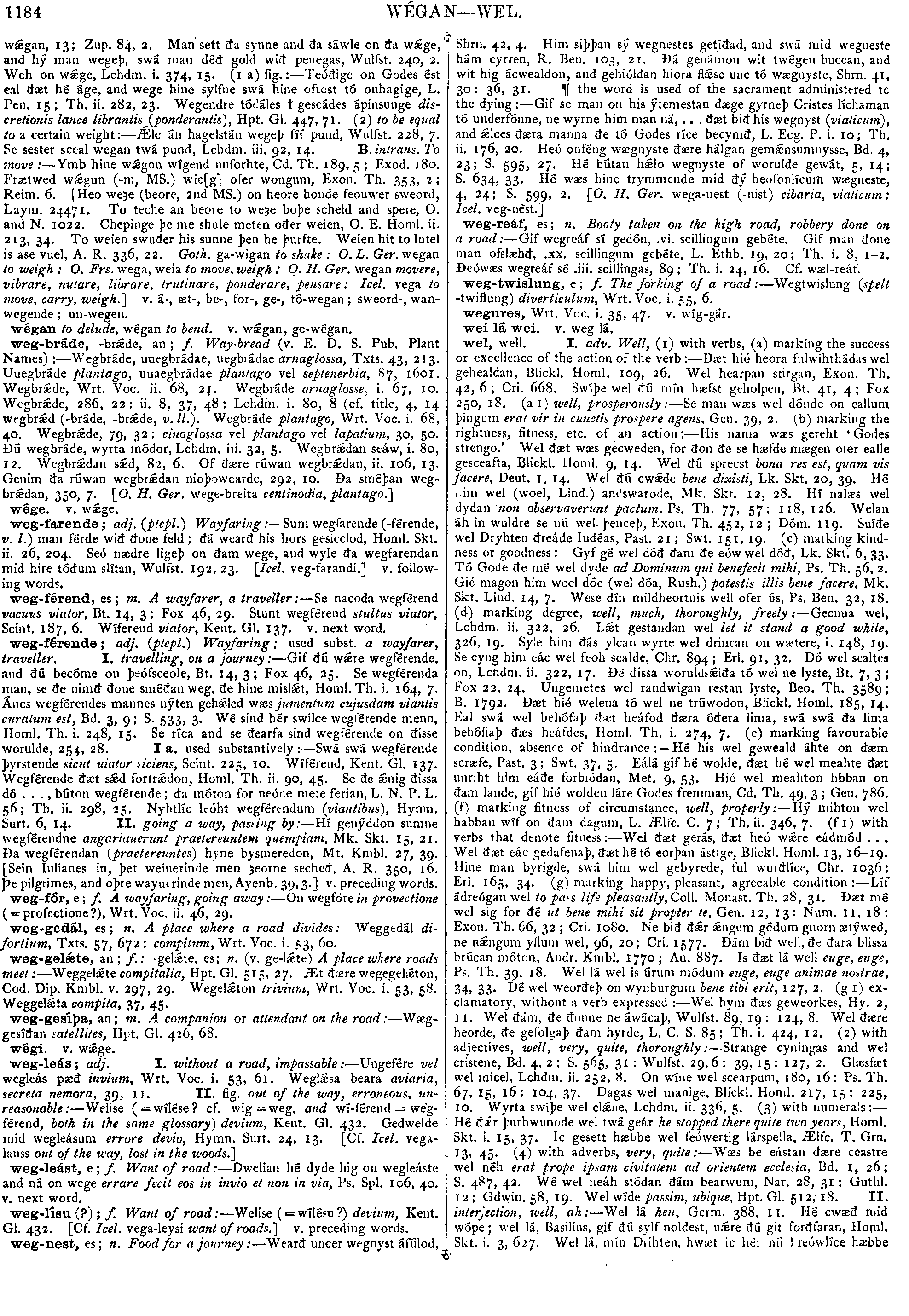
weg-reáf, es; n. Booty taken on the high road, robbery done on a road :-- Gif wegreáf sí gedón, .vi. scillingum gebéte. Gif man ðone man ofslæhð, .xx. scillingum gebéte, L. Ethb. 19, 20; Th. i. 8, 1-2. Ðeówæs wegreáf sé . iii. scillingas, 89; Th. i. 24, 16. Cf. wæl-reáf.
|
Source: Bosworth/Toller, page b1199, entry 7 View original page image as: [TIFF] [PNG] [View previous entry] [View next entry] |
[Comment on this entry] [View comments] |
The following entry has been hand-corrected once. |
weorþ,
weorþe,
worþ,
wurþ,
wyrþ,
es;
n.
I.
worth,
value,
(1)
of
things
:--
Underwed
ðæt
sý
ðæs
orfes
óðer
healf
weorð
a
security
that
is
half
as
much
again
as
the
value
of
the
cattle,
L.
O.
D.
1
;
Th.
i.
352,
9.
Be
ðæs
ceápes
weorðe
(wyrðe,
v.
l.),
L.
In.
49;
Th.
i.
132,
16.
Be
éwes
weorðe
(wyrðe,
v.
l.),
55
;
Th.
i.
138,
6.
Be
his
wlites
weorðe
.
.
.
swá
man
ðæt
weorð
up
árran
mihte,
L.
Ath.
v.
6,
2
;
Th.
i.
234,
6-10.
Gilde
ðæs
pyttes
hláford
ðæra
nýtena
wurð,
Ex.
21,
34.
(2)
of
persons,
worth,
worthiness:--
Ðæt
be
ðære
cennendra
gefyrhtum
ðæs
bearnes
weorþe
ongyten
wre,
Blickl.
Homl.
163,
27.
II.
price
of
anything
sold,
amount
paid
for
purchase
or
redemption
:--
Hig
cwdon
:
'Hyt
is
blódes
weorð'
(v.
l.
wurð,
worð,
Lind.
:
weorð,
Rush.,
praetium
sanguinis),
Mt.
Kmbl.
27,
6,
7,
9.
Noldon
hig
nánes
wurðes
onfón,
ac
forgeáfon
him
ða
birgene,
Gen.
23,
6.
Hí
sumne
dl
heora
landes
wurðes
æthæfdon,
Homl.
Th.
i.
316,
24.
Hire
innoþ
ðú
gefyldest
mid
ealles
middangeardes
weorþe
(cf.
Homl.
Skt.
ii.
27,
120
infra,
and
next
passage),
Blickl.
Homl.
89,
19.
Hé
áhongen
wæs
fore
moncynnes
mánforwyrhtum,
ðr
hé
lífes
ceápode
mid
ðý
weorðe,
Exon.
Th.
68,
3
;
Cri.
1098.
Hé
monige
mid
weorþe
álýsde
he
redeemed
many
by
purchase,
Bd.
3,
5
;
S.
527,
15.
Gebycge
hé
ða
lond
æt
hire
mid
halfe
weorðe
let
him
buy
the
lands
of
her
at
half
price,
Cod.
Dip.
Kmbl.
ii.
120,
28.
Giboht
worðe
miclum,
Rtl.
27,
1.
Ðú
becýptest
folc
ðín
búton
weorðe,
Ps.
Spl.
43,
14:
Ps.
Surt.
43,
13.
Geseald
tó
myclum
weorðe
(wurðe,
wyrðe,
v.
ll.).
Mt.
Kmbl.
26,
9,
'Ic
sille
eów
hundteóntig
þúsenda
mittan
hwtes
tó
ðam
wurðe
ðe
ic
hit
bebohte.'
.
.
.
Ðæt
wyrð
ðe
hé
mid
ðam
hwte
genam
hé
ágeaf
ágeán
tó
ðare
ceastre
bóte.
Th.
Ap.
10,
1-9.
Fæder
gesealde
bearn
wið
weorðe
(wurðe,
v.
l.),
Wulfst.
161,
7.
Mon
áceorfe
ða
tungan
of,
ðæt
hié
mon
ná
undeórran
weorðe
móste
lésan
ðonne
hié
mon
be
ðam
were
geeahtige,
L.
Alf.
pol.
32
;
Th.
i.
82,
2.
Syle
ðú
nig
wið
wurðe
and
bring
ðæt
wurð
tó
ðære
stówe,
and
bige
mid
ðam
ylcan
feó
swá
hwæt
swá
ðé
lícige.
Deut.
14,
25-26:
24,
7.
Ðæt
hé
ðæt
weorð
ágife
tó
álýsnesse
his
sáwle
pretium
redemtionis
animae
suae,
Ps.
Th.
48,
7:
Bd.
4,
22
;
S.
592,
14.
Álésan
wé
úre
sáule
ða
hwíle
ðe
wé
ðæt
weorþ
on
úrum
gewealde
habban,
Blickl.
Homl.
101,
10.
Tó
berenne
ealles
middaneardes
wurþ
(cf.
Blickl.
Homl.
89,
19
supra],
Homl.
Skt.
ii.
27,
120.
Forgelde
hé
ðæt
lond,
and
ðæt
wiorth
gedaele,
Cod.
Dip.
Kmbl.
i.
234,
33.
Wurð,
Ex.
21,
35:
Homl.
Th.
i.
62,
3
:
316,
11.
Him
man
his
weorð
ágefe
let
the
price
of
the
chattel
be
returned
to
him,
L.
H.
E.
16;
Th.
i.
34,
11.
Nán
man
nán
þing
ne
bycge
ofer
feówer
peninga
weorð
(that
costs
more
than
fourpence),
L.
C.
S.
24;
Th.
i.
390,
3.
Þéh
ðe
hé
hié
sume
wið
feó
gesealde,
hé
ðæt
weorð
nolde
ágan
ðæt
him
mon
wið
sealde,
Ors.
4,
10
;
Swt.
198,
17.
Ðæs
hwtes
wurð
ðe
hé
ðé,
sealde.
Gen.
44,
2.
Weorð,
Exon.
Th.
90,
23;
Cri.
1478.
III.
amount
to
be
paid
in
compensation
:--
Mid
weorðe
forgelde
man,
L.
Ethb.
32;
Th.
i.
12,
1.
Gif
esne
óðerne
ofsleá,
ealne
weorðe
forgelde,
86;
Th.
i.
24,
11.
Gif
esnes
eáge
and
fót
of
weorðeb
áslagen,
ealne
weorðe
hine
forgelde,
87;
Th.
i.
24,
14.
IV.
worth,
as
in
penny-worth,
amount
of
a
certain
value:--
Nabbaþ
hí
genóh
on
twégera
hundred
penega
weorðe
(wurþe,
v.
l.)
hláfes
ducentorum
denariorum
panes
non
sufficiunt
eis,
Jn.
Skt.
6,
7.
Sceóte
man
æt
ghwilcre
híde
pænig
oððe
pæniges
weorð,
Wulfst.
181,
5:
L.
O.
11;
Th.
i.
182,
10.
Ðæt
hyra
gðer
hæbbe
.lx.
penenga
wyrð
.
.
.
ðæt
sý
.xxx.
penega
wyrð,
Cod.
Dip.
Kmbl.
vi.
133,
23,
24.
[Goth.
wairþa
galaubamma
usbauhtai
pretio
empti:
O.
Sax.
O.
L.
Ger.
O.
Frs.
werð
;
n.
:
O.
H.
Ger.
werd
;
n.
pretium,
aestimatio:
Icel.
verð;
n.]
V.
mann-,
or-,
pening-weorþ
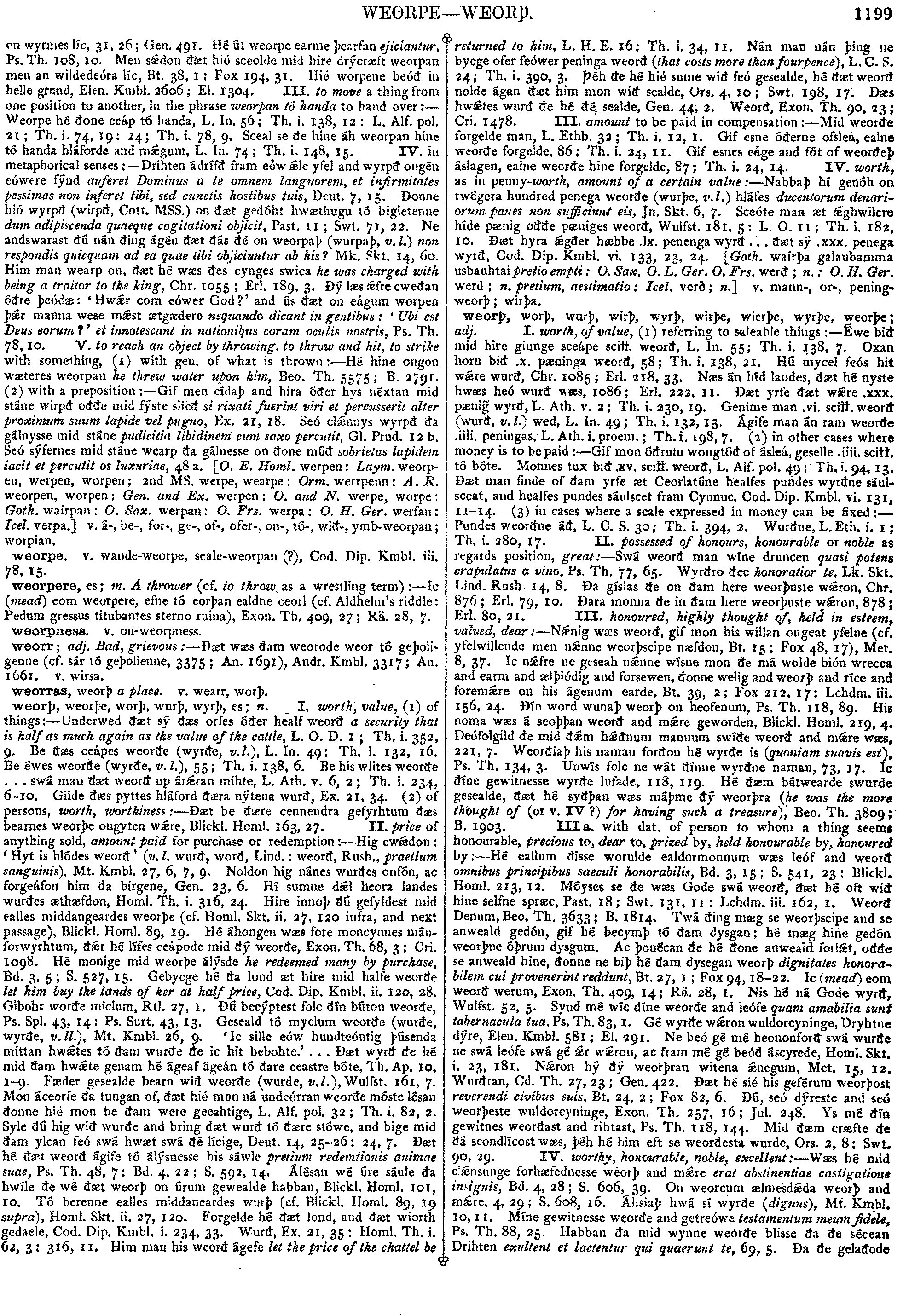
wirþa.
|
Source: Bosworth/Toller, page b1200, entry 2 View original page image as: [TIFF] [PNG] [View previous entry] [View next entry] |
[Comment on this entry] [View comments] |
The following entry has been hand-corrected once. |
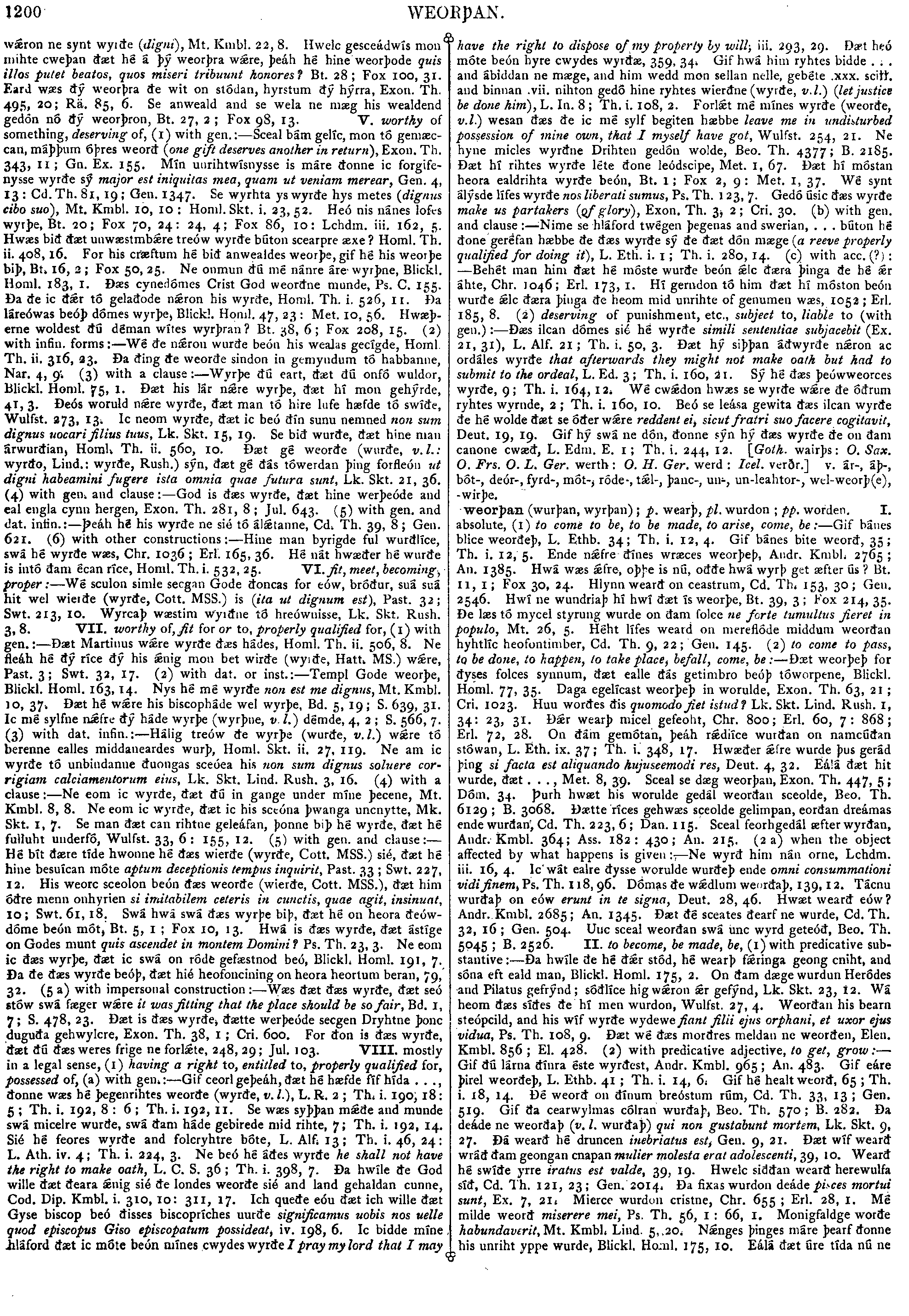
weorþan
(wurþan,
wyrþan);
p.
wearþ,
pl.
wurdon;
pp.
worden.
I.
absolute,
(1)
to
come
to
be,
to
be
made,
to
arise,
come,
be:--Gif
bánes
blice
weorðeþ,
L.
Ethb.
34;
Th.
i.
12,
4.
Gif
bánes
bite
weorð,
35;
Th.
i.
12,
5.
Ende
nfre
ðínes
wræces
weorþeþ,
Andr.
Kmbl.
2765;
An.
1385.
Hwá
wæs
fre,
oþþe
is
nú,
oððe
hwá
wyrþ
get
æfter
ús?
Bt.
11,
1;
Fox
30,
24.
Hlynn
wearð
on
ceastrum,
Cd.
Th.
153,
30;
Gen.
2546.
Hwí
ne
wundriaþ
hí
hwí
ðæt
ís
weorþe,
Bt.
39,
3;
Fox
214,
35.
Ðe
læs
tó
mycel
styrung
wurde
on
ðam
folce
ne
forte
tumultus
fieret
in
populo,
Mt.
26,
5.
Héht
lífes
weard
on
mereflóde
middum
weorðan
hyhtlíc
heofontimber,
Cd.
Th.
9,
22;
Gen.
145.
(2)
to
come
to
pass,
to
be
done,
to
happen,
to
take
place,
befall,
come,
be:--Ðæt
weorþeþ
for
ðyses
folces
synnum,
ðæt
ealle
ðás
getimbro
beóþ
tóworpene,
Blickl.
Homl.
77,
35.
Daga
egelícast
weorþeþ
in
worulde,
Exon.
Th.
63,
21;
Cri.
1023.
Huu
worðes
ðis
quomodo
fiet
istud?
Lk.
Skt.
Lind.
Rush.
1,
34:
23,
31.
Ðr
wearþ
micel
gefeoht,
Chr.
800;
Erl.
60,
7:
868;
Erl.
72,
28.
On
ðám
gemótan,
þeáh
rdlíce
wurðan
on
namcúðan
stówan,
L.
Eth.
ix.
37;
Th.
i.
348,
17.
Hwæðer
fre
wurde
þus
gerád
þing
si
facta
est
aliquando
hujuseemodi
res,
Deut.
4,
32.
Eálá
ðæt
hit
wurde,
ðæt
.
.
.,
Met.
8,
39.
Sceal
se
dæg
weorþan,
Exon.
Th.
447,
5;
Dóm.
34.
Þurh
hwæt
his
worulde
gedál
weorðan
sceolde,
Beo.
Th.
6129;
B.
3068.
Ðætte
ríces
gehwæs
sceolde
gelimpan,
eorðan
dreámas
ende
wurðan,
Cd.
Th.
223,
6;
Dan.
115.
Sceal
feorhgedál
æfter
wyrðan,
Andr.
Kmbl.
364;
Ass.
182:
430;
An.
215.
(2
a)
when
the
object
affected
by
what
happens
is
given:--Ne
wyrð
him
nán
orne,
Lchdm.
iii.
16,
4.
Ic
wát
ealre
ðysse
worulde
wurðeþ
ende
omni
consummationi
vidi
finem,
Ps.
Th.
118,
96.
Dómas
ðe
wdlum
weorðaþ,
139,
12.
Tácnu
wurðaþ
on
eów
erunt
in
te
signa,
Deut.
28,
46.
Hwæt
wearð
eów?
Andr.
Kmbl.
2685;
An.
1345.
Ðæt
ðé
sceates
ðearf
ne
wurde,
Cd.
Th.
32,
16;
Gen.
504.
Unc
sceal
weorðan
swá
unc
wyrd
geteóð,
Beo.
Th.
5045;
B.
2526.
II.
to
become,
be
made,
be,
(1)
with
predicative
substantive:--Ða
hwíle
ðe
hé
ðr
stód,
hé
wearþ
fringa
geong
cniht,
and
sóna
eft
eald
man,
Blickl.
Homl.
175,
2.
On
ðam
dæge
wurdun
Heródes
and
Pilatus
gefrýnd;
sóðlíce
hig
wron
r
gefýnd,
Lk.
Skt.
23,
12.
Wá
heom
ðæs
síðes
ðe
hí
men
wurdon,
Wulfst.
27,
4.
Weorðan
his
bearn
steópcild,
and
his
wíf
wyrðe
wydewe
fiant
filii
ejus
orphani,
et
uxor
ejas
vidua,
Ps.
Th.
108,
9.
Ðæt
wé
ðæs
morðres
meldan
ne
weorðen,
Elen.
Kmbl.
856;
El.
428.
(2)
with
predicative
adjective,
to
get,
grow:--Gif
ðú
lárna
ðínra
éste
wyrðest,
Andr.
Kmbl.
965;
An.
483.
Gif
eáre
þirel
weorðeþ,
L.
Ethb.
41;
Th.
i.
14,
6.
Gif
hé
healt
weorð,
65;
Th.
i.
18,
14.
Ðé
weorð
on
ðínum
breóstum
rúm,
Cd.
Th.
33,
13;
Gen.
519.
Gif
ða
cearwylmas
cólran
wurðaþ,
Beo.
Th.
570;
B.
282.
Ða
deáde
ne
weorðaþ
(v.
l.
wurðaþ)
qui
non
gustabunt
mortem,
Lk.
Skt.
9,
27.
Ðá
wearð
hé
druncen
inebriatus
est,
Gen.
9,
21.
Ðæt
wíf
wearð
wráð
ðam
geongan
cnapan
mulier
molesta
erat
adolescenti,
39,
10.
Wearð
hé
swíðe
yrre
iratus
est
valde,
39,
19.
Hwelc
siððan
wearð
herewulfa
síð,
Cd.
Th.
121,
23;
Gen.
2014.
Ða
fixas
wurdon
deáde
pisces
mortui
sunt,
Ex.
7,
21.
Mierce
wurdon
cristne,
Chr.
655;
Erl.
28,
1.
Mé
milde
weorð
miserere
mei,
Ps.
Th.
56,
1:
66,
1.
Monigfaldge
worðe
habundaverit,
Mt.
Kmbl.
Lind.
5,
20.
Nnges
þinges
máre
þearf
ðonne
his
unriht
yppe
wurde,
Blickl.
Homl.
175,
10.
Eálá
ðæt
úre
tída
nú
ne
| Result Page: |  |
Previous | 3 4 5 6 7 8 9 10 11 12 13 | Next |  |
Germanic Lexicon Project (main page)
This search system was written by
Sean Crist
Please consider
volunteering
to correct the data in these online dictionaries.
No rights reserved. Feel free to use these data in any way you please.