|
|

Tip: In the search results, you can click on any word or abbreviation for more information.
|
Source: Cleasby/Vigfusson, page b0352, entry 1 View original page image as: [TIFF] [PNG] [View previous entry] [View next entry] |
[Comment on this entry] [View comments] |
The following entry has been hand-corrected once. |
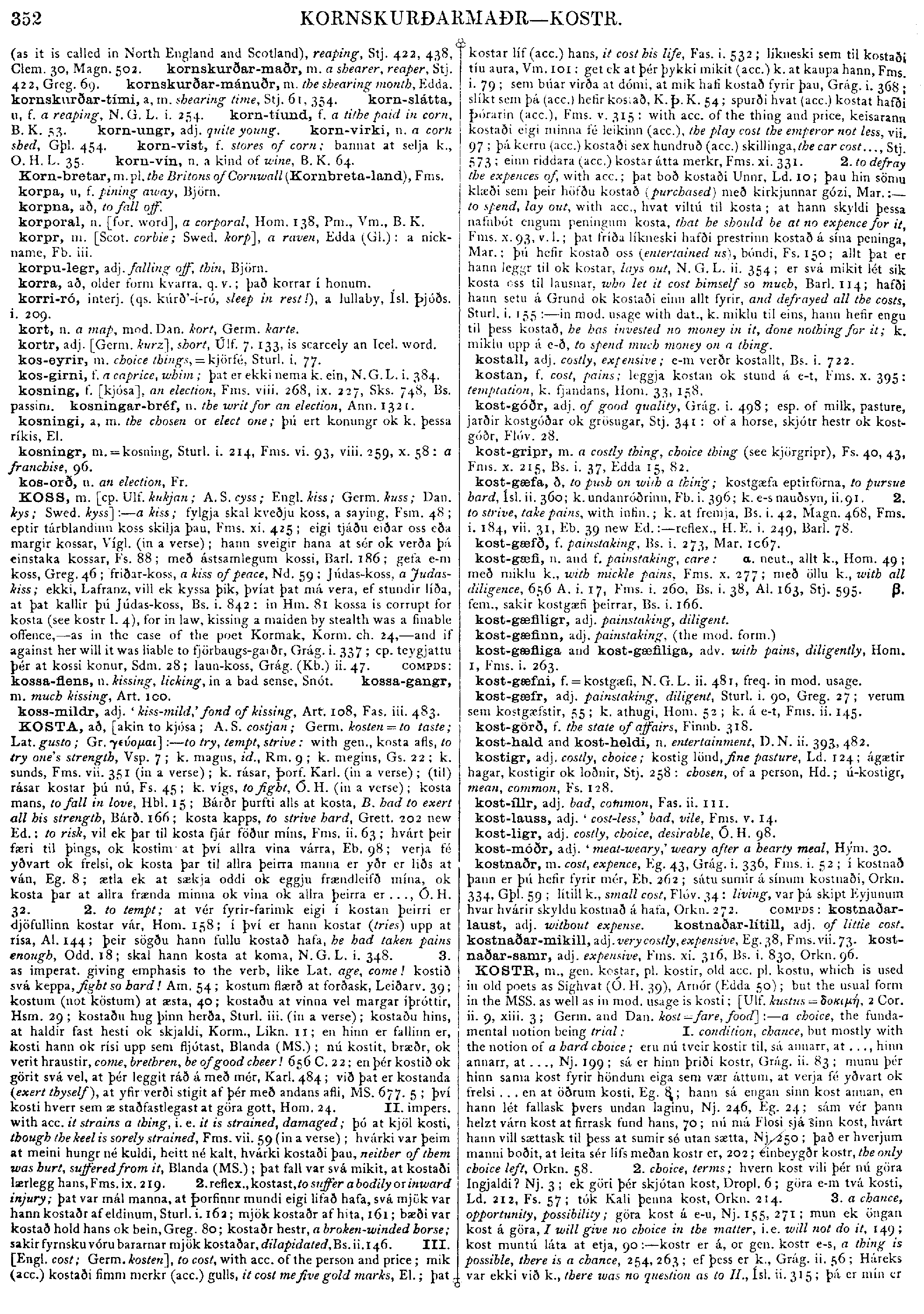
(as it is called in North England and Scotland), reaping, Stj. 422, 438, Clem. 30, Magn. 502. kornskurðar-maðr, m. a shearer, reaper, Stj. 422, Greg. 69. kornskurðar-mánuðr, m. the shearing month, Edda. kornskurðar-tími, a, m. shearing time, Stj. 61, 354. korn-slátta, u, f. a reaping, N. G. L. i. 254. korn-tíund, f. a tithe paid in corn, B. K. 53. korn-ungr, adj. quite young. korn-virki, n. a corn shed, Gþl. 454. korn-vist, f. stores of corn; bannat at selja k., O. H. L. 35. korn-vín, n. a kind of wine, B. K. 64.
|
Source: Cleasby/Vigfusson, page b0359, entry 37 View original page image as: [TIFF] [PNG] [View previous entry] [View next entry] |
[Comment on this entry] [View comments] |
The following entry has been hand-corrected once. |
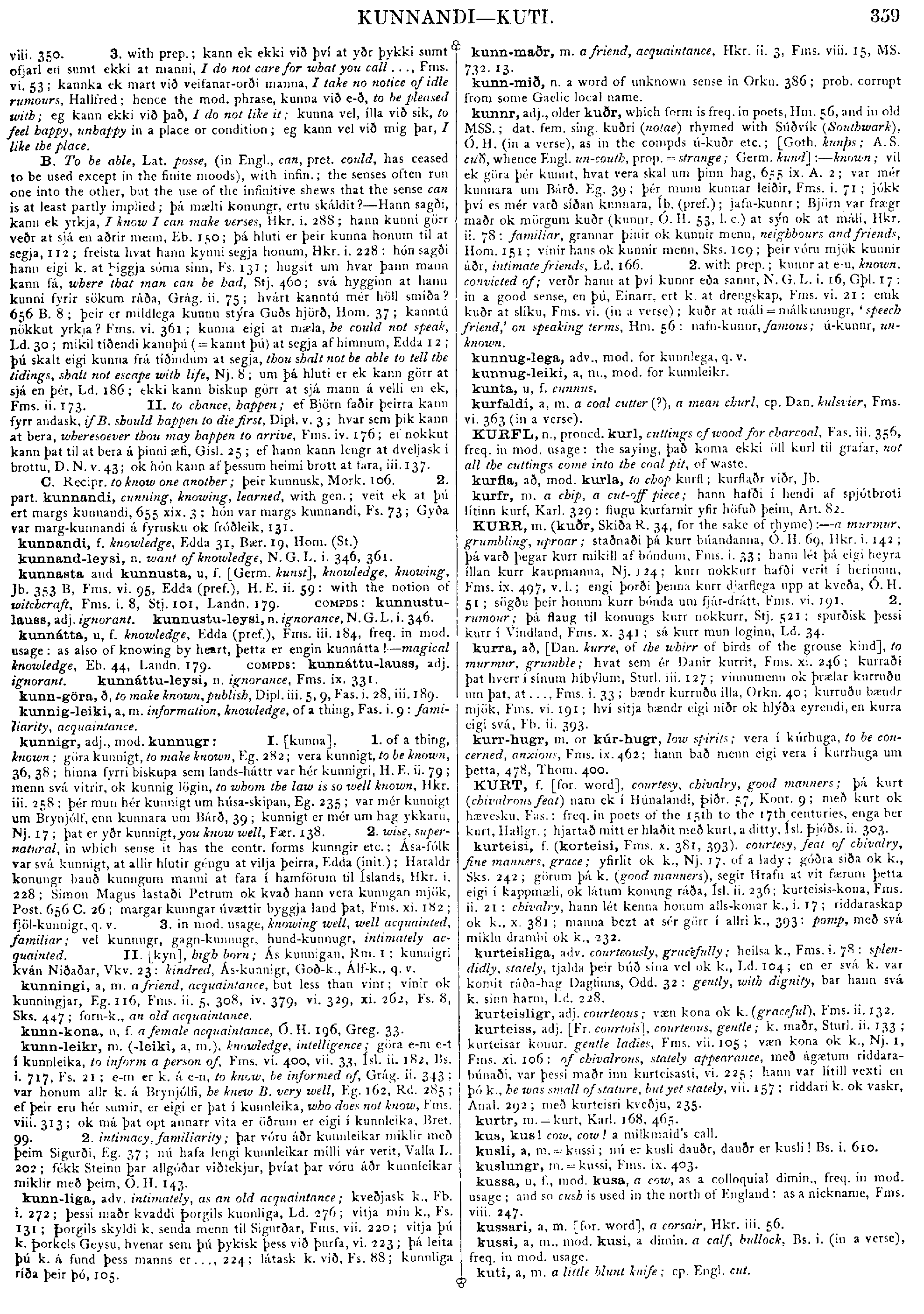
kussa, u, f., mod. kusa, a cow, as a colloquial dimin., freq. in mod. usage; and so cush is used in the north of England: as a nickname, Fms. viii. 247.
|
Source: Cleasby/Vigfusson, page b0364, entry 1 View original page image as: [TIFF] [PNG] [View previous entry] [View next entry] |
[Comment on this entry] [View comments] |
The following entry has been hand-corrected once. |
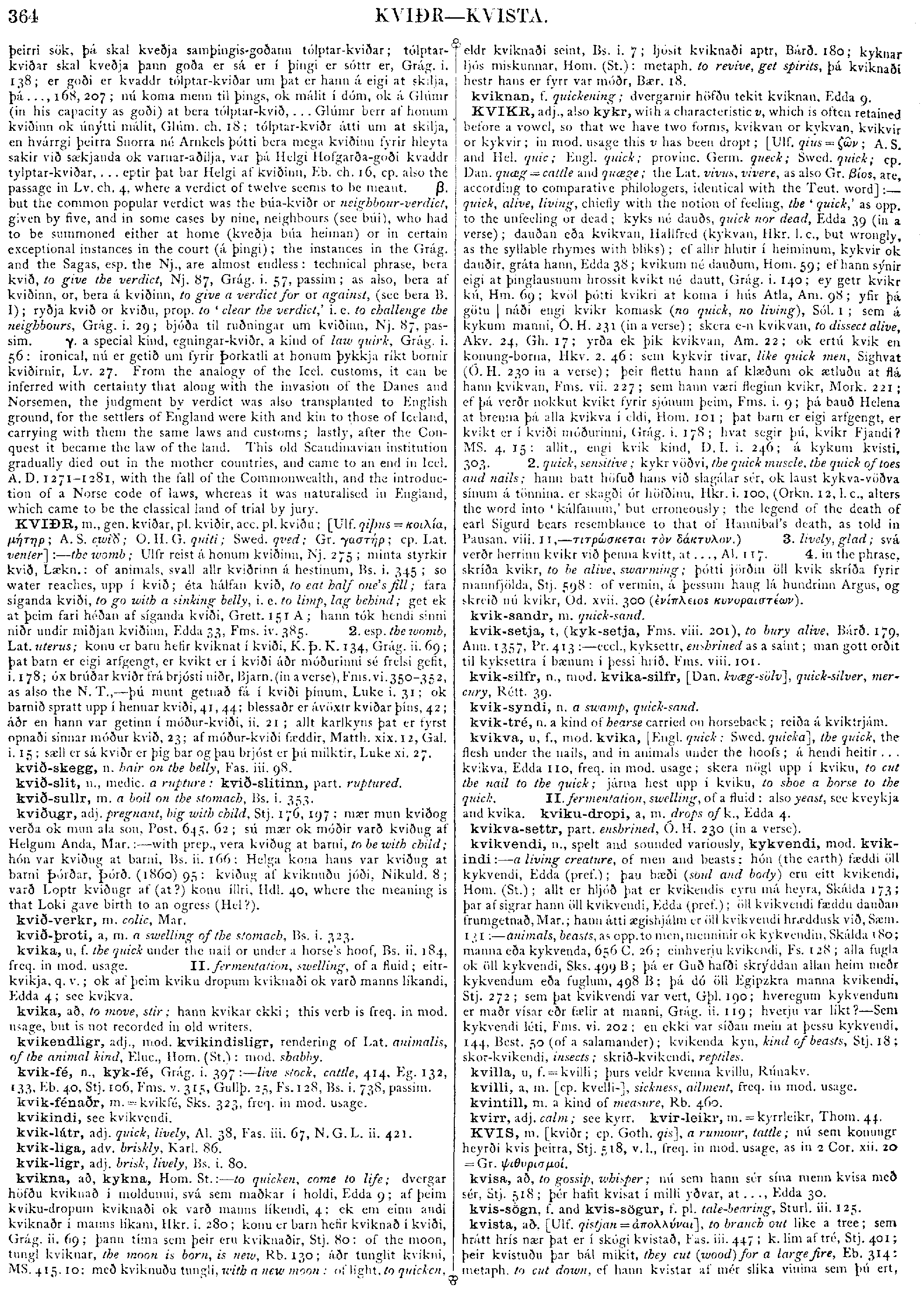
þeirri
sök,
þá
skal
kveðja
samþingis-goðann
tólptar-kviðar;
tólptar-kviðar
skal
kveðja
þann
goða
er
sá
er
í
þingi
er
sóttr
er,
Grág.
i.
138;
er
goði
er
kvaddr
tólptar-kviðar
um
þat
er
hann
á
eigi
at
skilja,
þá
...,
168,
207;
nú
koma
menn
til
þings,
ok
málit
í
dóm,
ok
á
Glúmr
(in
his
capacity
as
goði)
at
bera
tólptar-kvið,
...
Glúmr
berr
at
honum
kviðinn
ok
únýtti
málit,
Glúm.
ch.
18:
tólptar-kviðr
átti
um
at
skilja,
en
hvárrgi
þeirra
Snorra
né
Arnkels
þótti
bera
mega
kviðinn
fyrir
hleyta
sakir
við
sækjanda
ok
varnar-aðilja,
var
þá
Helgi
Hofgarða-goði
kvaddr
tylptar-kviðar,
...
eptir
þat
bar
Helgi
at
kviðinn,
Eb.
ch.
16,
cp.
also
the
passage
in
Lv.
ch.
4,
where
a
verdict
of
twelve
seems
to
be
meant.
 .
but
the
common
popular
verdict
was
the
búa-kviðr
or
neighbour-verdict,
given
by
five,
and
in
some
cases
by
nine,
neighbours
(see
búi),
who
had
to
be
summoned
either
at
home
(kveðja
búa
heiman)
or
in
certain
exceptional
instances
in
the
court
(á
þingi);
the
instances
in
the
Grág.
and
the
Sagas,
esp.
the
Nj.,
are
almost
endless:
technical
phrase,
bera
kvið,
to
give
the
verdict,
Nj.
87,
Grág.
i.
57,
passim;
as
also,
bera
af
kviðinn,
or,
bera
á
kviðinn,
to
give
a
verdict
for
or
against,
(see
bera
B.
I);
ryðja
kvið
or
kviðu,
prop.
to
'clear
the
verdict,'
i.e.
to
challenge
the
neighbours,
Grág.
i.
29;
bjóða
til
ruðningar
um
kviðinn,
Nj.
87,
passim.
.
but
the
common
popular
verdict
was
the
búa-kviðr
or
neighbour-verdict,
given
by
five,
and
in
some
cases
by
nine,
neighbours
(see
búi),
who
had
to
be
summoned
either
at
home
(kveðja
búa
heiman)
or
in
certain
exceptional
instances
in
the
court
(á
þingi);
the
instances
in
the
Grág.
and
the
Sagas,
esp.
the
Nj.,
are
almost
endless:
technical
phrase,
bera
kvið,
to
give
the
verdict,
Nj.
87,
Grág.
i.
57,
passim;
as
also,
bera
af
kviðinn,
or,
bera
á
kviðinn,
to
give
a
verdict
for
or
against,
(see
bera
B.
I);
ryðja
kvið
or
kviðu,
prop.
to
'clear
the
verdict,'
i.e.
to
challenge
the
neighbours,
Grág.
i.
29;
bjóða
til
ruðningar
um
kviðinn,
Nj.
87,
passim.
 .
a
special
kind,
egningar-kviðr,
a
kind
of
law
quirk,
Grág.
i.
56:
ironical,
nú
er
getið
um
fyrir
Þorkatli
at
honum
þykkja
ríkt
bornir
kviðirnir,
Lv.
27.
From
the
analogy
of
the
Icel.
customs,
it
can
be
inferred
with
certainty
that
along
with
the
invasion
of
the
Danes
and
Norsemen,
the
judgment
by
verdict
was
also
transplanted
to
English
ground,
for
the
settlers
of
England
were
kith
and
kin
to
those
of
Iceland,
carrying
with
them
the
same
laws
and
customs;
lastly,
after
the
Conquest
it
became
the
law
of
the
land.
This
old
Scandinavian
institution
gradually
died
out
in
the
mother
countries,
and
came
to
an
end
in
Icel.
A.D.
1271-1281,
with
the
fall
of
the
Commonwealth,
and
the
introduction
of
a
Norse
code
of
laws,
whereas
it
was
naturalised
in
England,
which
came
to
be
the
classical
land
of
trial
by
jury.
.
a
special
kind,
egningar-kviðr,
a
kind
of
law
quirk,
Grág.
i.
56:
ironical,
nú
er
getið
um
fyrir
Þorkatli
at
honum
þykkja
ríkt
bornir
kviðirnir,
Lv.
27.
From
the
analogy
of
the
Icel.
customs,
it
can
be
inferred
with
certainty
that
along
with
the
invasion
of
the
Danes
and
Norsemen,
the
judgment
by
verdict
was
also
transplanted
to
English
ground,
for
the
settlers
of
England
were
kith
and
kin
to
those
of
Iceland,
carrying
with
them
the
same
laws
and
customs;
lastly,
after
the
Conquest
it
became
the
law
of
the
land.
This
old
Scandinavian
institution
gradually
died
out
in
the
mother
countries,
and
came
to
an
end
in
Icel.
A.D.
1271-1281,
with
the
fall
of
the
Commonwealth,
and
the
introduction
of
a
Norse
code
of
laws,
whereas
it
was
naturalised
in
England,
which
came
to
be
the
classical
land
of
trial
by
jury.
|
Source: Cleasby/Vigfusson, page b0394, entry 10 View original page image as: [TIFF] [PNG] [View previous entry] [View next entry] |
[Comment on this entry] [View comments] |
The following entry has been hand-corrected once. |
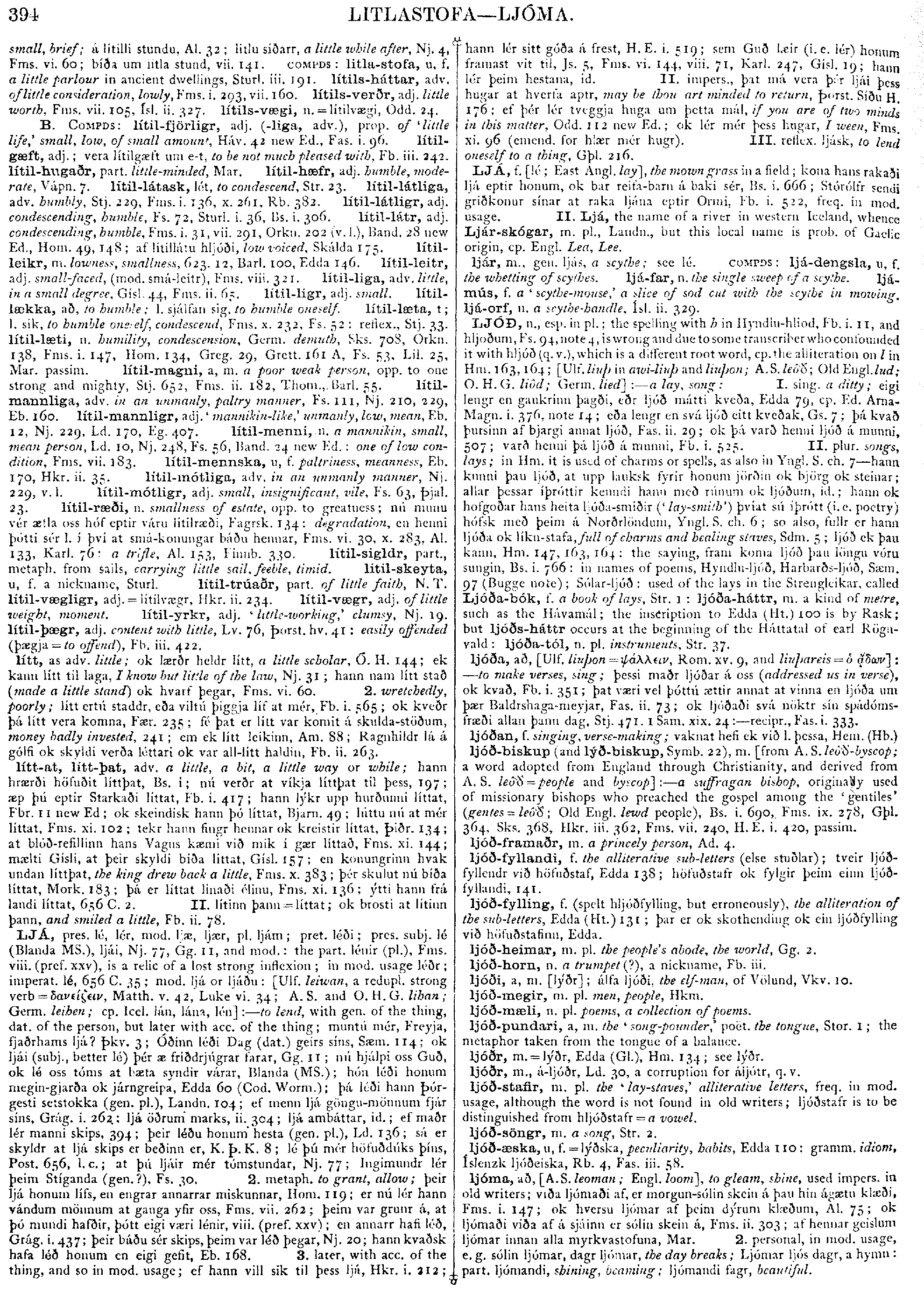
ljóð-biskup (and lýð-biskup, Symb. 22), m. [from A.S. leôð-byscop; a word adopted from England through Christianity, and derived from A.S. leôð = people and byscop] :-- a suffragan bishop, originally used of missionary bishops who preached the gospel among the 'gentiles' (gentes = leôð; Old Engl. lewd people), Bs. i. 690, Fms. ix. 278, Gþl. 364, Sks. 368, Hkr. iii. 362, Fms. vii. 240, H.E. i. 420, passim.
|
Source: Cleasby/Vigfusson, page b0398, entry 25 View original page image as: [TIFF] [PNG] [View previous entry] [View next entry] |
[Comment on this entry] [View comments] |
The following entry has not been hand-corrected. However, the page is reserved and someone is correcting it. |
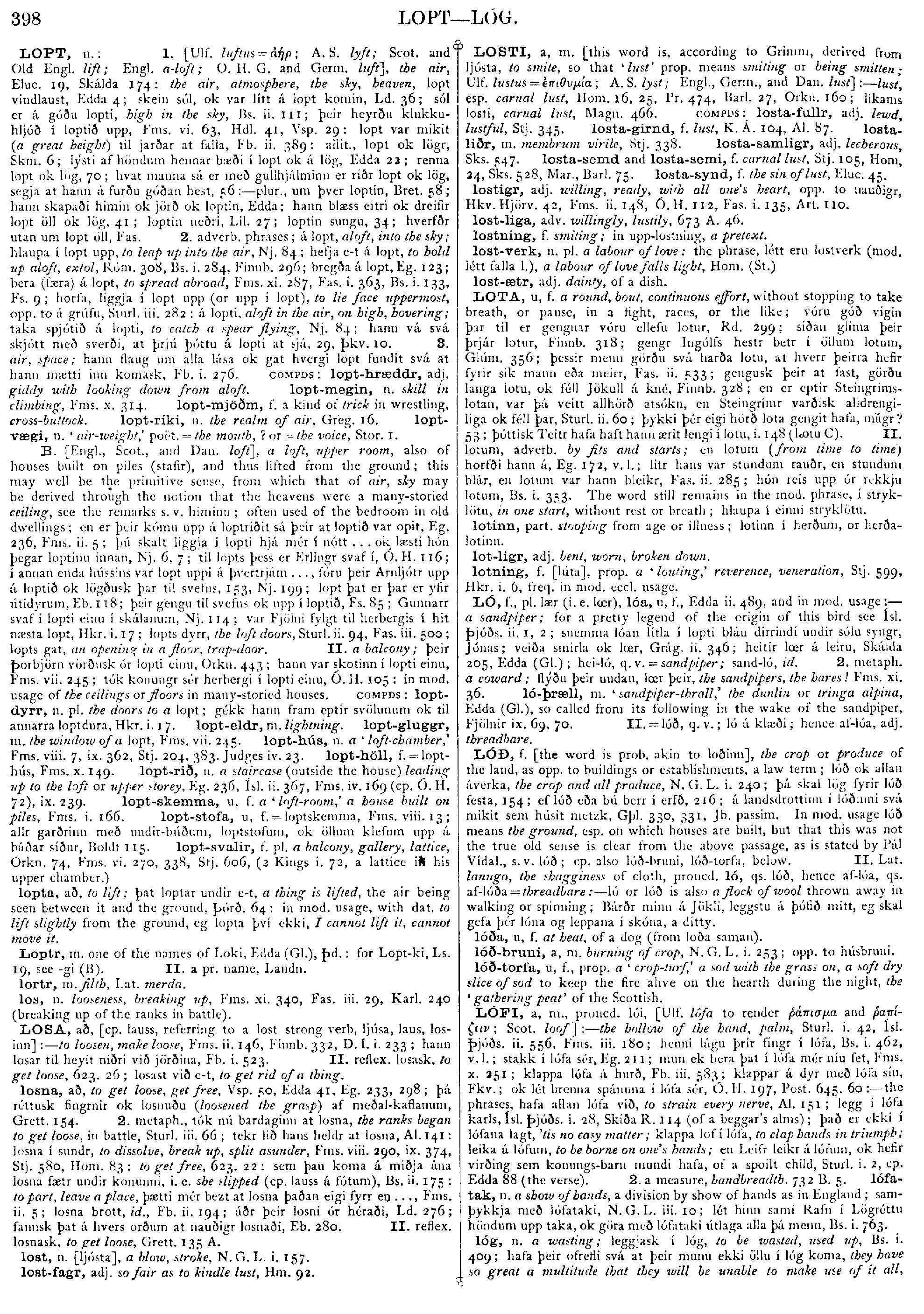
LÓFI, a, m., proncd. lói, [Ulf. lofa to render pa-nia^a. and pairi- &iv; Scot, l oo/] :-- the holl ow/ of the hand, palm, Sturl. i. 42, Ísl. Jjjóðs. ii. 556, Fms. iii. 180; henni lágu þrír fingr Í lofa, Bs. 1. 462, v. 1.; stakk í lófa ser, Eg. 211; mini ek bera þat í lófa mór níu fet, Fms. x. 251; klappa lofa;i hurð, Fb. iii. 583; klappar á dyr með lófa sin, Fkv.; ok let brenna spúnuna í lófa sér, Ó. H. 197, Post. 645. 60 :-- the phrases, hafa allan lota við, to strain every nerve, Al. 151; legg í lofa karls, Ísl. jþjóðs. i. 28, Skiða R. 114 (of a beggar's alms); það er ekki i lófana lagt, ' ti s noea s y matter; klappa lof í lofa, to clap hands in triumph; leika á lófum, to be borne on one's hands; en Leifr leikr á loiuin, ok hefir virðing sem konungs-barn mundi hafa, of a spoilt child, Sturl. i. 2, cp. Fldda 88 (the verse). 2. a measure, bandbreadtb, 732 B. 5. lófa- tak, n. a sh ow of hands, a division by show of hands as in England; sam- þykkja með lófataki, N. G. L. iii. io; lot hinn sami Rafn í Lögróttu höndum upp taka, ok giira með lófataki litlaga alla þá menu, Bs. i. 763.
|
Source: Cleasby/Vigfusson, page b0399, entry 24 View original page image as: [TIFF] [PNG] [View previous entry] [View next entry] |
[Comment on this entry] [View comments] |
The following entry has not been hand-corrected. However, the page is reserved and someone is correcting it. |
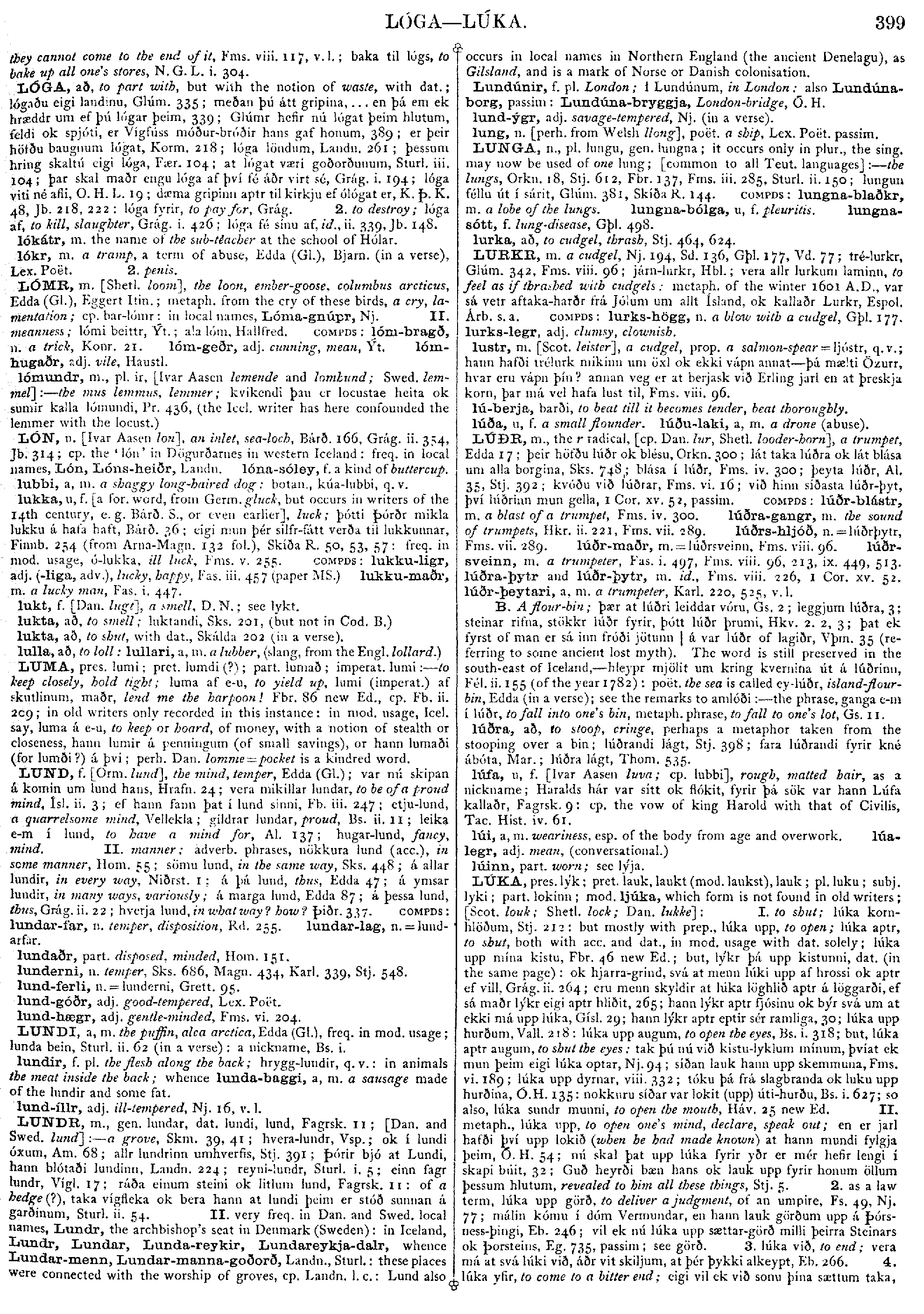
LUNDR, m., gen. lundar, dat. lundi, lund, Fagrsk. Ii; [Dan. and Swed. lund'] :-- a grove, Skin. 39, 41; hvera-lundr, Vsp.; ok í lundi óxum, Am. 68; allr lundrinn umhverfis, Stj. 391; fxmr bjó at Lundi, hann blótaði lundinn, Landn. 224; reyni-!undr, Sturl. i. 5; einn fagr lundr, Vígl. 17; rúða einum steini ok litlum lund, Fagrsk. 11: of a hedge (?), taka vigfleka ok bera hann at lundi þeim er stóð sunnan á garðinum, Sturl. ii. 54. II. very freq. in Dan. and Swed. local names, Lundr, the archbishop's seat in Denmark (Sweden): in Iceland, Lundr, Lundar, Lunda-reykir, Lundareykja-dalr, whence Lundar-menn, Lundar-manna-goðorð, Landn., Sturl.: these places were connected with the worship of groves, cp. Landn. I. e.: Lund also(occurs in local names in Northern England (the ancient Denelagu), as Gilsland, and is a mark of Norse or Danish colonisation.
|
Source: Cleasby/Vigfusson, page b0404, entry 100 View original page image as: [TIFF] [PNG] [View previous entry] [View next entry] |
[Comment on this entry] [View comments] |
The following entry has been hand-corrected once. |
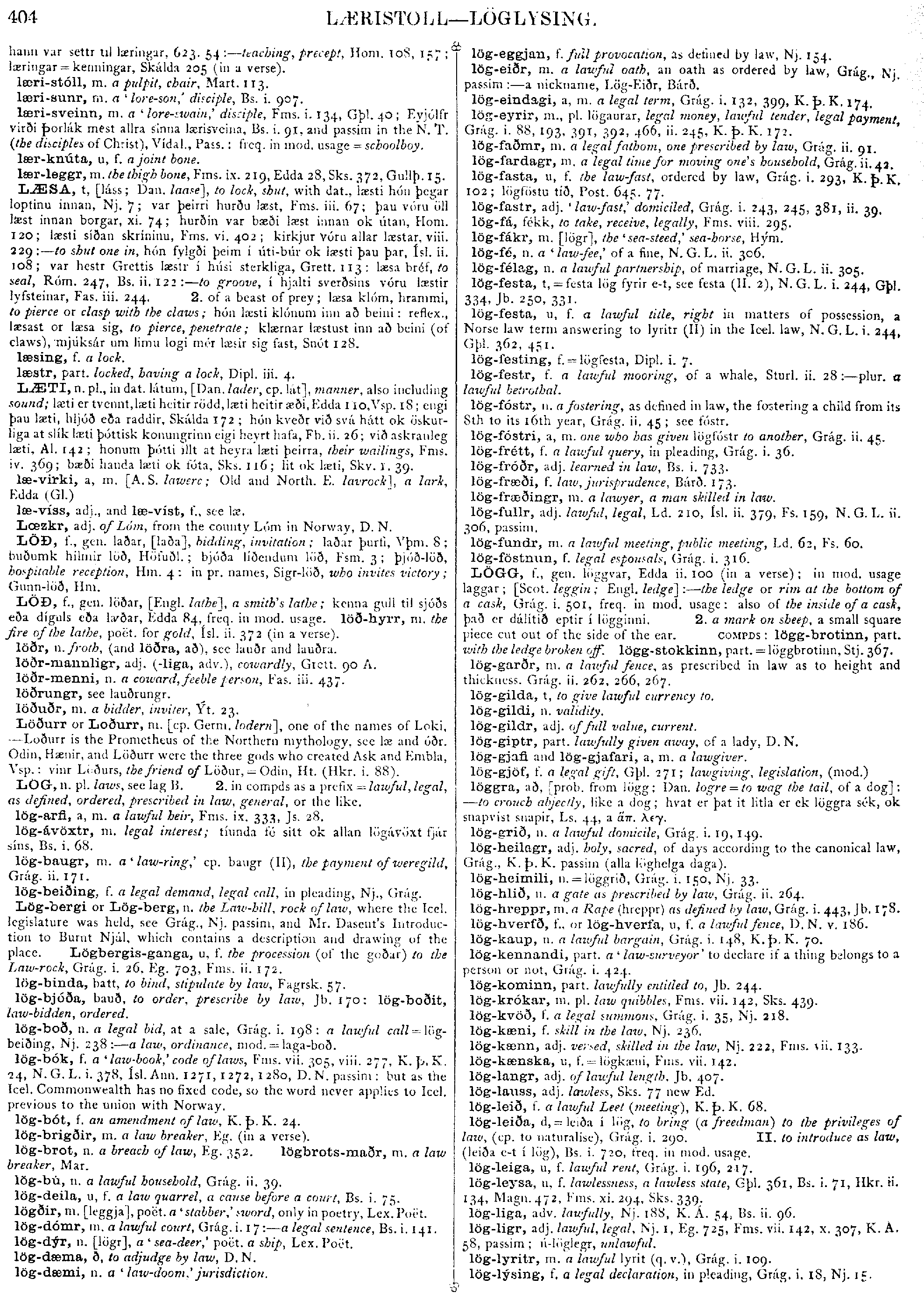
lög-maðr, m. [old Swed. lagman; the president of the supreme court formerly held in Orkney was called the lagman] :-- ' law-man. ' In the ancient Scandinavian kingdoms each legal community or state (log) had its own laws, its own parliament (lögþing), and its own 'law-man' (lagh- mann, logmaðr); the lagman was the first commoner and the spokesman of the people against the king and court at public assemblies or else- where; he was also the guardian of the law, and the president of the legis- lative body and of the law courts. As in the heathen time laws were not written, the lagman had to sry what was the law of the laud in any case of doubt; in the general assemblies, at least in Iceland, he had to ' say the law (from memory) to the assembled people from the Law-hill (LogbergiJ; hence in the Icelandic Commonwealth he was called lög-sögu- jnaðr (q. v.), the ' law-speaker, ' ' law-sayer, ' ' speaker of the law, ' and his office log-saga or lög-sögn =' law-speaking:' 1. Sweden and Gothland in olden times were the classical lands of lagmen, for the whole kingdom was a confederation of commonwealths, each with its parliament, law- speaker, and laws, who were all of them united under one king; see the Various records in the old Swedish laws, Sveriges Gamla Lagar, as edited by Schlyter, as also the classical account given of lagman Thorgny in O. H. ch. 60 sqq. -- í hverri þessi deild landsins er sitt lögþing, ok sin log, yfir hverjum lögum er lögmaðr, ... þat skulu log vera sem hann réð upp at kveða; en ef konungr, eða jarl, eða byskupar fara yfir land ok eigu þing við búendr, þá svarar lögmaðr af hendi búenda ...; aðrir lögmenn allir skulu vera undir-menn þess lögmanns er á Tíunda-landi er, Ö. H. 65. 2. in Norway the political institutions of the old patriarchal ages were greatly disturbed through the wars and conquest of Harald Fairhair; the ancient laws of Norway too have been preserved in a much more fragmentary state than those of Sweden; of some of the most interest- ing laws only the eccl. section has been preserved, often in Icelandic transcripts or abridged. The most interesting records of the lagmen are therefore not to be found in the Norse laws, but in the Sagas, e. g. the debates in the Hák. S. Gamla, ch. 71-80, 85-97 (in the Flatey book), as also in the þinga-þáttr in Fms. vii. 123-150, and in stray passages in the Icelandic Sagas, in such phrases as lögmenn ok konungr, logmenn ok dómendr, lenda menn ok logmenn ok alla aiþyðu, Eg. 352. 3. in the later Middle Age in Norway, and in Icel. after 1280, the lagman was a justice, who presided in the court lögrétta, at the lögþing (II), cp. jb. passim. 4. in the Icelandic Commonwealth, the officer whose duties have been described above was specially called lögsögu- maðr, and lögmaðr is only used = lagamaðr = a lawyer, -- þat er ok, at lögsögumaðí skal svá görla þáttu alla upp segja, at engi viti einna miclogi görr, en ef honum vinsk eigi fróðleikr til þess, þá skal hann eiga stefnu via fimm logmenn (lawyers, men skilled in law), en næstu dægr áðr, eðr fleiri, Grág. i. 2, 3; þat skal allt hafa er finnsk á skrdO þeirri er Hafiiði lét göra ... en þat eitt af annarra lögmajma fyrirsögn (of other lawyers) er eigi mæli því í gegn, 7; Njáll var lögmaðr svá mikill (so ^ reat a lawyer), at eingi fannsk hans jafningi, Nj. 30. At the union with Nor- way (A. D. 1272) the lögsögu-maðr of the Commonwealth was replaced by two lagmen of the Norse kind, so that in the Sagas composed after that date (e. g. the Grettla) or in Sagas preserved in later transcripts, the terms were now and then confounded, and 'lögmaðr' was, by way of anachronism, used of the lögsögu-maðr of the old Commonwealth, cp. Grett. 64, 115, 173, 191 new Ed., Nj. 24, 164, 237 (v. 1.), Eg. 597, Ísl. (Gunnl. S.) ii. 208, 238, 256, Bs. i. (Hungrv.) 62, Fms. iv. 115, 176, where the 0. H. edition has the true reading, being made from a vel- lum of the Commonwealth time. P. two instances are recorded referring to the loth century in Iceland, where a lögmaðr occurs as a kind of county- sheriff" or officer, viz. in the Háv. S. (begin.) and the Svarfdæla S. ch. 10; but both records seem to be spurious and adapted to the state of things in Norway, for neither Saga is preserved in its pure original state, but remoulded after the union; see Maurqr's Entstehung des Ísl. Staates, Beitrage, 136 sqq. In Scandinavia during the Middle Ages, as the power of the king increased, so that of the old lagman sank, and at last died away. In England it is preserved in the Speaker of the House of Commons, whose very name recalls to mind the law- speaker of the old Scandinavian communities. II. a pr. name, Lög-maðr, Orkn. COMPDS: lögmanns-dæmi, n. the jurisdiction of a lagman, Fms. v. 266. lögmanns-eiðr, m. an oath of homage to the king, Gþl. 66. logmarms-lauss, adj. without a lagman, Ann. I39O- lögmanns-úrskurðr, m. a logman's decree, Jb. 170.
|
Source: Cleasby/Vigfusson, page b0470, entry 3 View original page image as: [TIFF] [PNG] [View previous entry] [View next entry] |
[Comment on this entry] [View comments] |
The following entry has been hand-corrected once. |
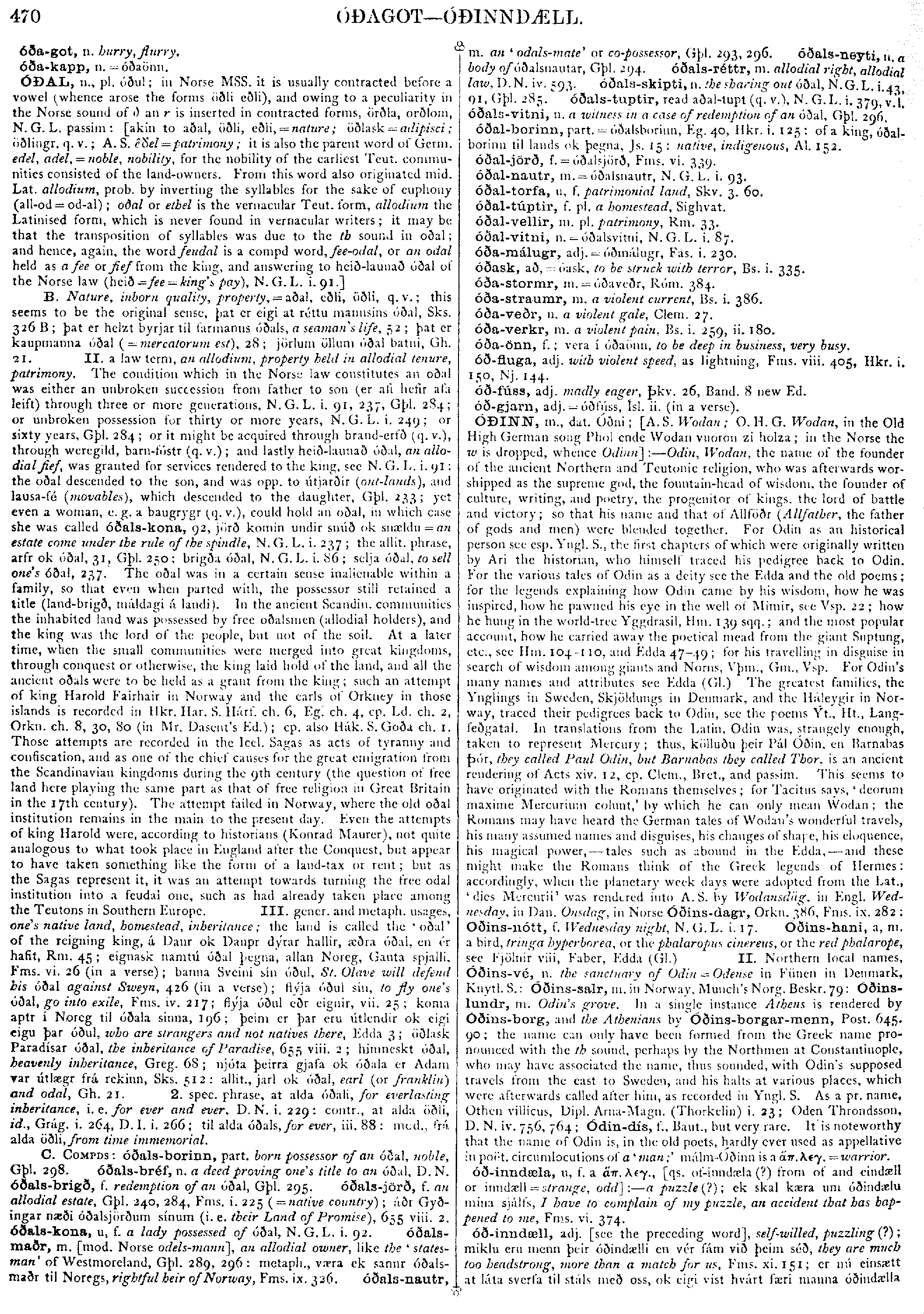
ÓÐAL, n., pl. óðul; in Norse MSS. it is usually contracted before a vowel (whence arose the forms öðli eðli), and owing to a peculiarity in the Norse sound of ð an r is inserted in contracted forms, örðla, orðlom, N.G.L. passim: [akin to aðal, öðli, eðli, = nature; öðlask = adipisci; oðlingr, q.v.; A.S. êðel = patrimony; it is also the parent word of Germ. edel, adel, = noble, nobility, for the nobility of the earliest Teut. communities consisted of the land-owners. From this word also originated mid. Lat. allodium, prob. by inverting the syllables for the sake of euphony (all-od = od-al); oðal or ethel is the vernacular Teut. form, allodium the Latinised form, which is never found in vernacular writers; it may be that the transposition of syllables was due to the th sound in oðal; and hence, again, the word feudal is a compd word, fee-odal, or an odal held as a fee or feif from the king, and answering to heið-launað óðal of the Norse law (heið = fee = king's pay), N.G.L. i. 91.] B. Nature, inborn quality, property, = aðal, eðli, öðli, q.v.; this seems to be the original sense, þat er eigi at réttu mannsins óðal, Sks. 326 B; þat er helzt byrjar til farmanns óðals, a seaman's life, 52; þat er kaupmanna óðal ( = mercatorum est), 28; jörlum öllum óðal batni, Gh. 21. II. a law term, an allodium, property held in allodial tenure, patrimony. The condition which in the Norse law constitutes an oðal was either an unbroken succession from father to son (er afi hefir afa leift) through three or more generations, N.G.L. i. 91, 237, Gþl. 284; or unbroken possession for thirty or more years, N.G.L. i. 249; or sixty years, Gþl. 284; or it might be acquired through brand-erfð (q.v.), through weregild, barn-fóstr (q.v.); and lastly heið-launað óðal, an allodial fief, was granted for services rendered to the king, see N.G.L. i. 91: the oðal descended to the son, and was opp. to útjarðir (out-lands), and lausa-fé (movables), which descended to the daughter, Gþl. 233; yet even a woman, e.g. a baugrygr (q.v.), could hold an oðal, in which case she was called óðals-kona, 92, jörð komin undir snúð ok snældu = an estate come under the rule of the spindle, N.G.L. i. 237; the allit. phrase, arfr ok óðal, 31, Gþl. 250: brigða óðal, N.G.L. i. 86; selja óðal, to sell one's óðal, 237. The oðal was in a certain sense inalienable within a family, so that even when parted with, the possessor still retained a title (land-brigð, máldagi á landi). In the ancient Scandin. communities the inhabited land was possessed by free oðalsmen (allodial holders), and the king was the lord of the people, but not of the soil. At a later time, when the small communities were merged into great kingdoms, through conquest or otherwise, the king laid hold of the land, and all the ancient oðals were to be held as a grant from the king; such an attempt of king Harold Fairhair in Norway and the earls of Orkney in those islands is recorded in Hkr. Har. S. Hárf. ch. 6, Eg. ch. 4, cp. Ld. ch. 2, Orkn. ch. 8, 30, 80 (in Mr. Dasent's Ed.); cp. also Hák. S. Goða ch. 1. Those attempts are recorded in the Icel. Sagas as acts of tyranny and confiscation, and as one of the chief causes for the great emigration from the Scandinavian kingdoms during the 9th century (the question of free land here playing the same part as that of free religion in Great Britain in the 17th century). The attempt failed in Norway, where the old oðal institution remains in the main to the present day. Even the attempts of king Harold were, according to historians (Konrad Maurer), not quite analogous to what took place in England after the Conquest, but appear to have taken something like the form of a land-tax or rent; but as the Sagas represent it, it was an attempt towards turning the free odal institution into a feudal one, such as had already taken place among the Teutons in Southern Europe. III. gener. and metaph. usages, one's native land, homestead, inheritance; the land is called the 'oðal' of the reigning king, á Danr ok Danpr dýrar hallir, æðra óðal, en ér hafit, Rm. 45; eignask namtú óðal þegna, allan Noreg, Gauta spjalli, Fms. vi. 26 (in a verse); banna Sveini sín óðul, St. Olave will defend his óðal against Sweyn, 426 (in a verse); flýja óðul sín, to fly one's óðal, go into exile, Fms. iv. 217; flýja óðul eðr eignir, vii. 25; koma aptr í Noreg til óðala sinna, 196; þeim er þar eru útlendir ok eigi eigu þar óðul, who are strangers and not natives there, Edda 3; öðlask Paradísar óðal, the inheritance of Paradise, 655 viii. 2; himneskt óðal, heavenly inheritance, Greg. 68; njóta þeirra gjafa ok óðala er Adam var útlægr frá rekinn, Sks. 512: allit., jarl ok óðal, earl (or franklin) and odal, Gh. 21. 2. spec. phrase, at alda óðali, for everlasting inheritance, i.e. for ever and ever, D.N. i. 229: contr., at alda öðli, id., Grág. i. 264, D.I. i. 266; til alda óðals, for ever, iii. 88: mod., frá, alda öðli, from time immemorial. C. COMPDS: óðals-borinn, part. born possessor of an óðal, noble, Gþl. 298. óðals-bréf, n. a deed proving one's title to an óðal, D.N. óðals-brigð, f. redemption of an óðal, Gþl. 295. óðals-jörð, f. an allodial estate, Gþl. 240, 284, Fms. i. 225 (= native country); áðr Gyðingar næði óðalsjörðum sínum (i.e. their Land of Promise), 655 viii. 2. óðals-kona, u, f. a lady possessed of óðal, N.G.L. i. 92. óðals-maðr, m. [mod. Norse odels-mann], an allodial owner, like the 'statesman' of Westmorland, Gþl. 289, 296: metaph., væra ek sannr óðalsmaðr til Noregs, rightful heir of Norway, Fms. ix. 326. óðals-nautr, m. an 'odals-mate' or co-possessor, Gþl. 293, 296. óðals-neyti, u. a body of óðalsnautar, Gþl. 294. óðals-réttr, m. allodial right, allodial law, D.N. iv. 593. óðals-skipti, n. the sharing out óðal, N.G.L. i. 43, 91, Gþl. 285. óðals-tuptir, read aðal-tupt (q.v.), N.G.L. i. 379, v.l. óðals-vitni, n. a witness in a case of redemption of an óðal, Gþl. 296.
|
Source: Cleasby/Vigfusson, page b0474, entry 17 View original page image as: [TIFF] [PNG] [View previous entry] [View next entry] |
[Comment on this entry] [View comments] |
The following entry has been hand-corrected once. |
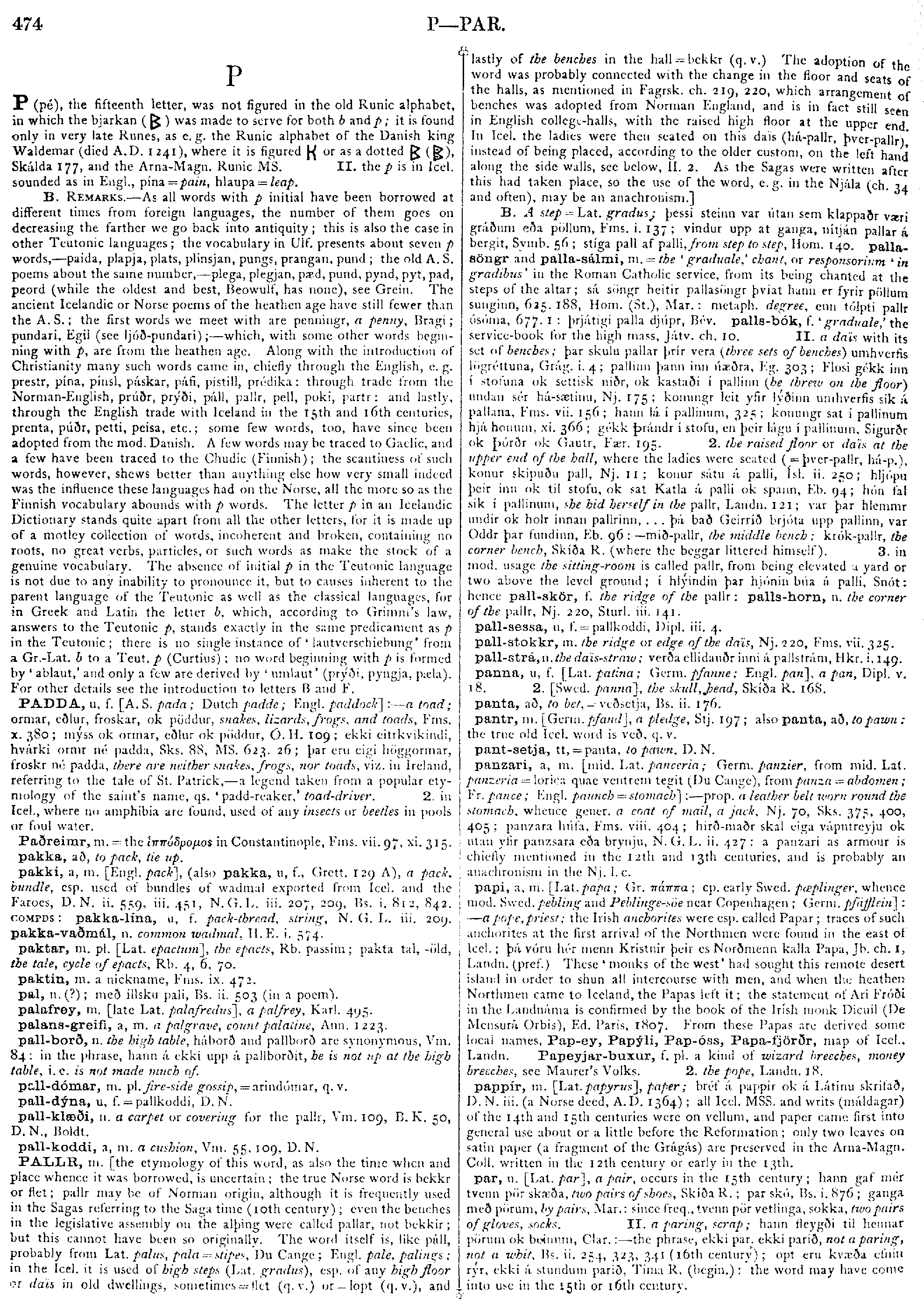
PALLR, m. [the etymology of this word, as also the time when and place whence it was borrowed, is uncertain; the true Norse word is bekkr or flet; pallr may be of Norman origin, although it is frequently used in the Sagas referring to the Saga time (10th century); even the benches in the legislative assembly on the alþing were called pallar, not bekkir; but this cannot have been so originally. The word itself is, like páll, probably from Lat. palus, pala = stipes, Du Cange; Engl. pale, palings; in the Icel. it is used of high steps (Lat. gradus), esp. of any high floor or daïs in old dwellings, sometimes = flet (q.v.) or -lopt (q.v.), and lastly of the benches in the hall = bekkr (q.v.) The adoption of the word was probably connected with the change in the floor and seats of the halls, as mentioned in Fagrsk. ch. 219, 220, which arrangement of benches was adopted from Norman England, and is in fact still seen in English college-halls, with the raised high floor at the upper end. In Icel. the ladies were then seated on this daïs (há-pallr, þver-pallr), instead of being placed, according to the older custom, on the left hand along the side walls, see below, II. 2. As the Sagas were written after this had taken place, so the use of the word, e.g. in the Njála (ch. 34 and often), may be an anachronism.] B. A step = Lat. gradus; þessi steinn var útan sem klappaðr væri gráðum eða pöllum, Fms. i. 137; vindur upp at ganga, nítján pallar á bergit, Symb. 56; stíga pall af palli, from step to step, Hom. 140. palla-söngr and palla-sálmi, m. = the 'graduale,' chant, or responsorium 'in gradibus' in the Roman Catholic service, from its being chanted at the steps of the altar; sá söngr heitir pallasöngr þviat hann er fyrir pöllum sunginn, 625. 188, Hom. (St.), Mar.: metaph. degree, enn tólpti pallr ósóma, 677. 1: þrjátigi palla djúpr, Bév. palls-bók, f. 'graduale,' the service-book for the high mass, Játv. ch. 10. II. a daïs with its set of benches; þar skulu pallar þrír vera (three sets of benches) umhverfis lögréttuna, Grág. i. 4; pallinn þann inn úæðra, Eg. 303; Flosi gékk inn í stofuna ok settisk niðr, ok kastaði í pallinn (he threw on the floor) undan sér há-sætinu, Nj. 175; konungr leit yfir lýðinn umhverfis sik á pallana, Fms. vii. 156; hann lá í pallinum, 325; konungr sat í pallinum hjá honum, xi. 366; gékk Þrándr í stofu, en þeir lágu í pallinum, Sigurðr ok Þórðr ok Gautr, Fær. 195. 2. the raised floor or daïs at the upper end of the hall, where the ladies were seated (= þver-pallr, há-p.), konur skipuðu pall, Nj. 11; konur sátu á palli, Ísl. ii. 250; hljópu þeir inn ok til stofu, ok sat Katla á palli ok spann, Eb. 94; hón fal sik í pallinum, she hid herself in the pallr, Landn. 121; var þar hlemmr undir ok holr innan pallrinn, ... þá bað Geirríð brjóta upp pallinn, var Oddr þar fundinn, Eb. 96 :-- mið-pallr, the middle bench; krók-pallr, the corner bench, Skíða R. (where the beggar littered himself). 3. in mod. usage the sitting-room is called pallr, from being elevated a yard or two above the level ground; í hlýindin þar hjónin búa á palli. Snót: hence pall-skör, f. the ridge of the pallr: palls-horn, n. the corner of the pallr, Nj. 220, Sturl. iii. 141.
|
Source: Cleasby/Vigfusson, page b0479, entry 11 View original page image as: [TIFF] [PNG] [View previous entry] [View next entry] |
[Comment on this entry] [View comments] |
The following entry has been hand-corrected once. |
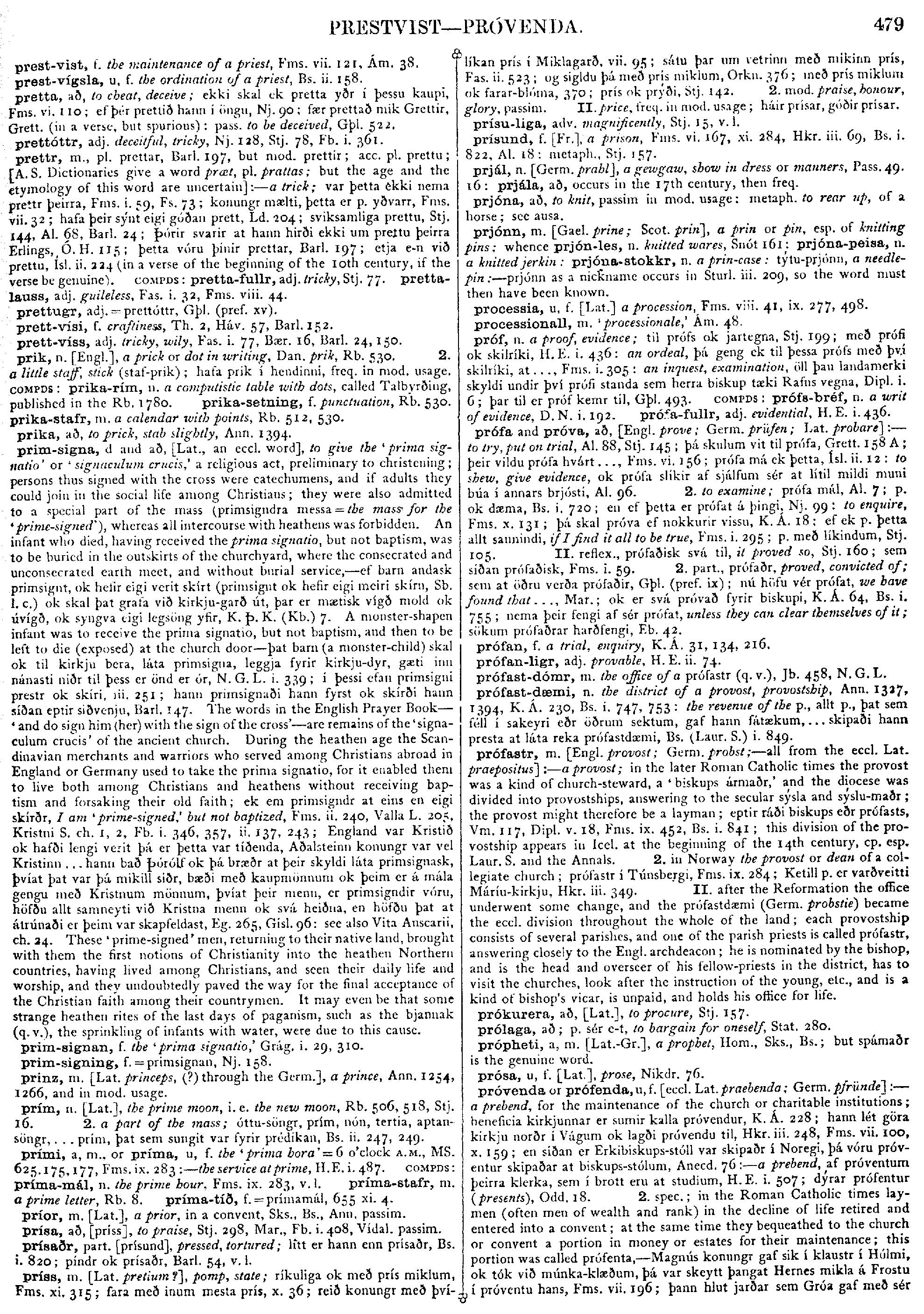
prim-signa, d and að, [Lat., an eccl. word], to give the 'prima signatio' or 'signaculum crucis' a religious act, preliminary to christening; persons thus signed with the cross were catechumens, and if adults they could join in the social life among Christians; they were also admitted to a special part of the mass (primsigndra messa = the mass for the 'prime-signed'), whereas all intercourse with heathens was forbidden. An infant who died, having received the prima signatio, but not baptism, was to be buried in the outskirts of the churchyard, where the consecrated and unconsecrated earth meet, and without burial service, -- ef barn andask primsignt, ok hefir eigi verit skírt (primsignt ok hefir eigi meiri skírn, Sb. l.c.) ok skal þat grafa við kirkju-garð út, þar er mætisk vígð mold ok úvígð, ok syngva eigi legsöng yfir, K.Þ.K. (Kb.) 7. A monster-shapen infant was to receive the prima signatio, but not baptism, and then to be left to die (exposed) at the church door -- þat barn (a monster-child) skal ok til kirkju bera, láta primsigna, leggja fyrir kirkju-dyr, gæti inn nánasti niðr til þess er önd er ór, N.G.L. i. 339; í þessi efan primsigni prestr ok skíri, iii. 251; hann primsignaði hann fyrst ok skírði hann síðan eptir siðvenju, Barl. 147. The words in the English Prayer Book -- 'and do sign him (her) with the sign of the cross' -- are remains of the 'signaculum crucis' of the ancient church. During the heathen age the Scandinavian merchants and warriors who served among Christians abroad in England or Germany used to take the prima signatio, for it enabled them to live both among Christians and heathens without receiving baptism and forsaking their old faith; ek em primsigndr at eins en eigi skírðr, I am 'prime-signed,' but not baptized, Fms. ii. 240, Valla L. 205, Kristni S. ch. 1, 2, Fb. i. 346, 357, ii. 137, 243; England var Kristið ok hafði lengi verit þá er þetta var tíðenda, Aðalsteinn konungr var vel Kristinn ... hann bað Þórólf ok þá bræðr at þeir skyldi láta primsignask, þvíat þat var þá mikill siðr, bæði með kaupmönnum ok þeim er á mála gengu með Kristnum mönnum, þvíat þeir menn, er primsigndir vóru, höfðu allt samneyti við Kristna menn ok svá heiðna, en höfðu þat at átrúnaði er þeim var skapfeldast, Eg. 265, Gísl. 96: see also Vita Anscarii, ch. 24. These 'prime-signed' men, returning to their native land, brought with them the first notions of Christianity into the heathen Northern countries, having lived among Christians, and seen their daily life and worship, and they undoubtedly paved the way for the final acceptance of the Christian faith among their countrymen. It may even be that some strange heathen rites of the last days of paganism, such as the bjannak (q.v.), the sprinkling of infants with water, were due to this cause.
| Result Page: |  |
Previous | 15 16 17 18 19 20 21 22 23 24 25 26 27 28 | Next |  |
Germanic Lexicon Project (main page)
This search system was written by
Sean Crist
Please consider
volunteering
to correct the data in these online dictionaries.
No rights reserved. Feel free to use these data in any way you please.