|
|

Tip: In the search results, you can click on any word or abbreviation for more information.
|
Source: Cleasby/Vigfusson, page b0586, entry 16 View original page image as: [TIFF] [PNG] [View previous entry] [View next entry] |
[Comment on this entry] [View comments] |
The following entry has been hand-corrected once. |
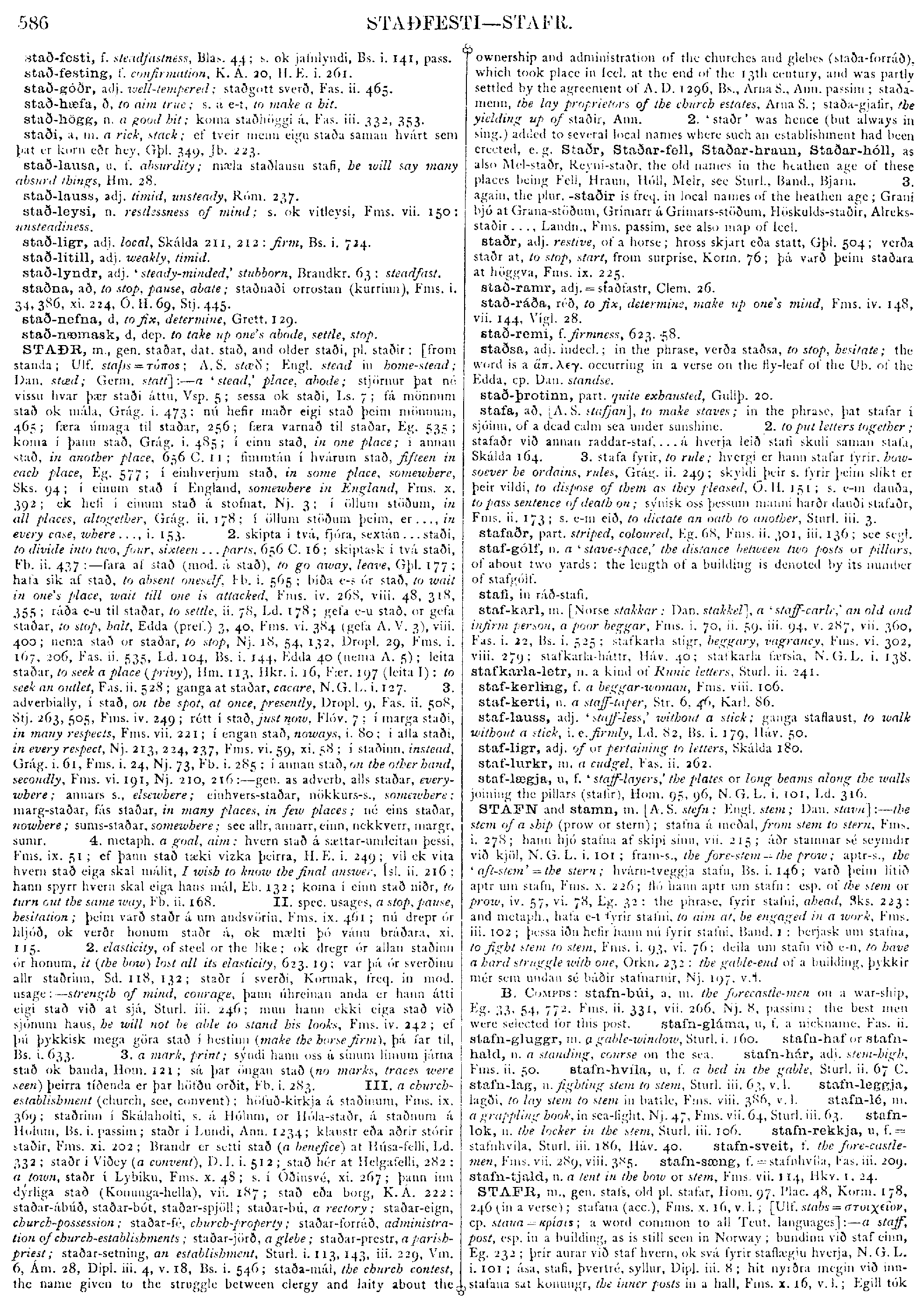
STAÐR, m., gen. staðar, dat. stað, and older staði, pl. staðir: [from standa; Ulf. staþs = GREEK; A.S. stæð; Engl. stead in home-stead; Dan. stæd; Germ. statt] :-- a 'stead,' place, abode; stjörnur þat né vissu hvar þær staði áttu, Vsp. 5; sessa ok staði, Ls. 7; fá mönnum stað ok mála, Grág. i. 473; nú hefir maðr eigi stað þeim mönnum, 465; færa úmaga til staðar, 256; færa varnað til staðar, Eg. 535; koma í þann stað, Grág. i. 485; í einn stað, in one place; í annan stað, in another place, 656 C. 11; fimmtán í hvárum stað, fifteen in each place, Eg. 577; í einhverjum stað, in some place, somewhere, Sks. 94; í einum stað í England, somewhere in England, Fms. x. 392; ek hefi í einum stað á stofnat, Nj. 3; í öllum stöðum, in all places, altogether, Grág. ii. 178; í öllum stöðum þeim, er..., in every case, where ..., i. 153. 2. skipta í tvá, fjóra, sextán ... staði, to divide into two, four, sixteen ... parts, 656 C. 16; skiptask í tvá staði, Fb. ii. 437 :-- fara af stað (mod. á stað), to go away, leave, Gþl. 177; hafa sik af stað, to absent oneself, Fb. i. 565; bíða e-s ór stað, to wait in one's place, wait till one is attacked, Fms. iv. 268, viii. 48, 318, 355; ráða e-u til staðar, to settle, ii. 78, Ld. 178; gefa e-u stað, or gefa staðar, to stop, halt, Edda (pref.) 3, 40, Fms. vi. 384 (gefa A.V. 3), viii. 400; nema stað or staðar, to stop, Nj. 18, 54, 132, Dropl, 29, Fms. i. 167, 206, Fas. ii. 535, Ld. 104, Bs. i. 144, Edda 40 (nema A. 5); leita staðar, to seek a place (privy), Hm. 113. Hkr. i. 16, Fær. 197 (leita I): to seek an outlet, Fas. ii. 528; ganga at staðar, cacare, N.G.L. i. 127. 3. adverbially, í stað, on the spot, at once, presently, Dropl. 9, Fas. ii. 508, Stj. 263, 505, Fms. iv. 249; rétt í stað, just now, Flóv. 7; í marga staði, in many respects, Fms. vii. 221; í engan stað, noways, i. 80; í alla staði, in every respect, Nj. 213, 224, 237, Fms. vi. 59, xi. 58; í staðinn. instead, Grág. i. 61, Fms. i. 24, Nj. 73, Fb. i. 285; í annan stað, on the other hand, secondly. Fms. vi. 191, Nj. 210, 216 :-- gen. as adverb, alls staðar, everywhere; annars s., elsewhere; einhvers-staðar, nökkurs-s., somewhere; marg-staðar, fás staðar, in many places, in few places; né eins staðar, nowhere; sums-staðar, somewhere; see allr, annarr, einn, nekkverr, margr, sumr. 4. metaph. a goal, aim; hvern stað á sættar-umleitan þessi, Fms. ix. 51; ef þann stað tæki vizka þeirra, H.E. i. 249; vil ek vita hvern stað eiga skal málit, I wish to know the final answer, Ísl. ii. 216: hann spyrr hvern skal eiga hans mál, Eb. 132; koma í einn stað niðr, to turn out the same way, Fb. ii. 168. II. spec. usages, a stop, pause, hesitation; þeim varð staðr á um andsvörin. Fms. ix. 461; nú drepr ór hljóð, ok verðr honum staðr á, ok mælti þó vánu bráðara, xi. 115. 2. elasticity, of steel or the like; ok dregr ór allan staðinn ór honum, it (the bow) lost all its elasticity, 623. 19; var þá ór sverðinu allr staðrinn, Sd. 118, 132; staðr í sverði, Kormak, freq. in mod. usage :-- strength of mind, courage, þann úhreinan anda er hann átti eigi stað við at sjá, Sturl. iii. 246; mun hann ekki eiga stað við sjónum haus, he will not be able to stand his looks, Fms. iv. 242; ef þú þykkisk mega göra stað í hestinn (make the horse firm), þá far til, Bs. i. 633. 3. a mark, print; sýndi hann oss á sínum limum járna stað ok banda, Hom. 121; sá þar öngan stað (no marks, traces were seen) þeirra tíðenda er þar hofðu orðit, Fb. i. 283. III. a church-establishment (church, see, convent); höfuð-kirkja á staðinum, Fms. ix. 369; staðrinn í Skálaholti, s. á Hólum, or Hóla-staðr, á staðnum á Hólum, Bs. i. passim; staðr í Lundi, Ann. 1234; klaustr eða aðrir stórir staðir, Fms. xi. 202; Brandr er setti stað (a benefice) at Húsa-felli, Ld. 332; staðr í Viðey (a convent), D.I. i. 512 stað hér at Helgafelli, 282: a town, staðr í Lybiku, Fms. x. 48; s. í Óðinsvé, xi. 267; þann inn dýrliga stað (Konunga-hella), vii. 187; stað eða borg, K.Á. 222: staðar-ábúð, staðar-bót, staðar-spjöll; staðar-bú, a rectory; staðar-eign, church-possession; staðar-fé, church-property; staðar-forráð, administration of church-establishments; staðar-jörð, a glebe; staðar-prestr, a parish-priest; staðar-setning, an establishment, Sturl. i. 113, 143, iii. 229, Vm. 6, Ám. 28, Dipl. iii. 4, v. 18, Bs. i. 546; staða-mál, the church contest, the name given to the struggle between clergy and laity about the ownership and administration of the churches and glebes (staða-forráð), which took place in Icel. at the end of the 13th century, and was partly settled by the agreement of A.D. 1296, Bs., Arna S., Ann. passim; staða-menn, the lay proprietors of the church estates, Arna S.; staða-gjafir, the yielding up of staðir, Ann. 2. 'staðr' was hence (but always in sing.) added to several local names where such an establishment had been erected, e.g. Staðr, Staðar-fell, Staðar-hraun, Staðar-hóll, as also Mel-staðr, Reyni-staðr, the old names in the heathen age of these places being Fell, Hraun, Hóll, Melr, see Sturl., Band., Bjarn. 3. again, the plur. -staðir is freq. in local names of the heathen age; Grani bjó at Grana-stöðum, Grímarr á Grímars-stöðum, Höskulds-staðir, Alreks-staðir ..., Landn., Fms. passim, see also map of lcel.
|
Source: Cleasby/Vigfusson, page b0668, entry 9 View original page image as: [TIFF] [PNG] [View previous entry] [View next entry] |
[Comment on this entry] [View comments] |
The following entry has been hand-corrected once. |
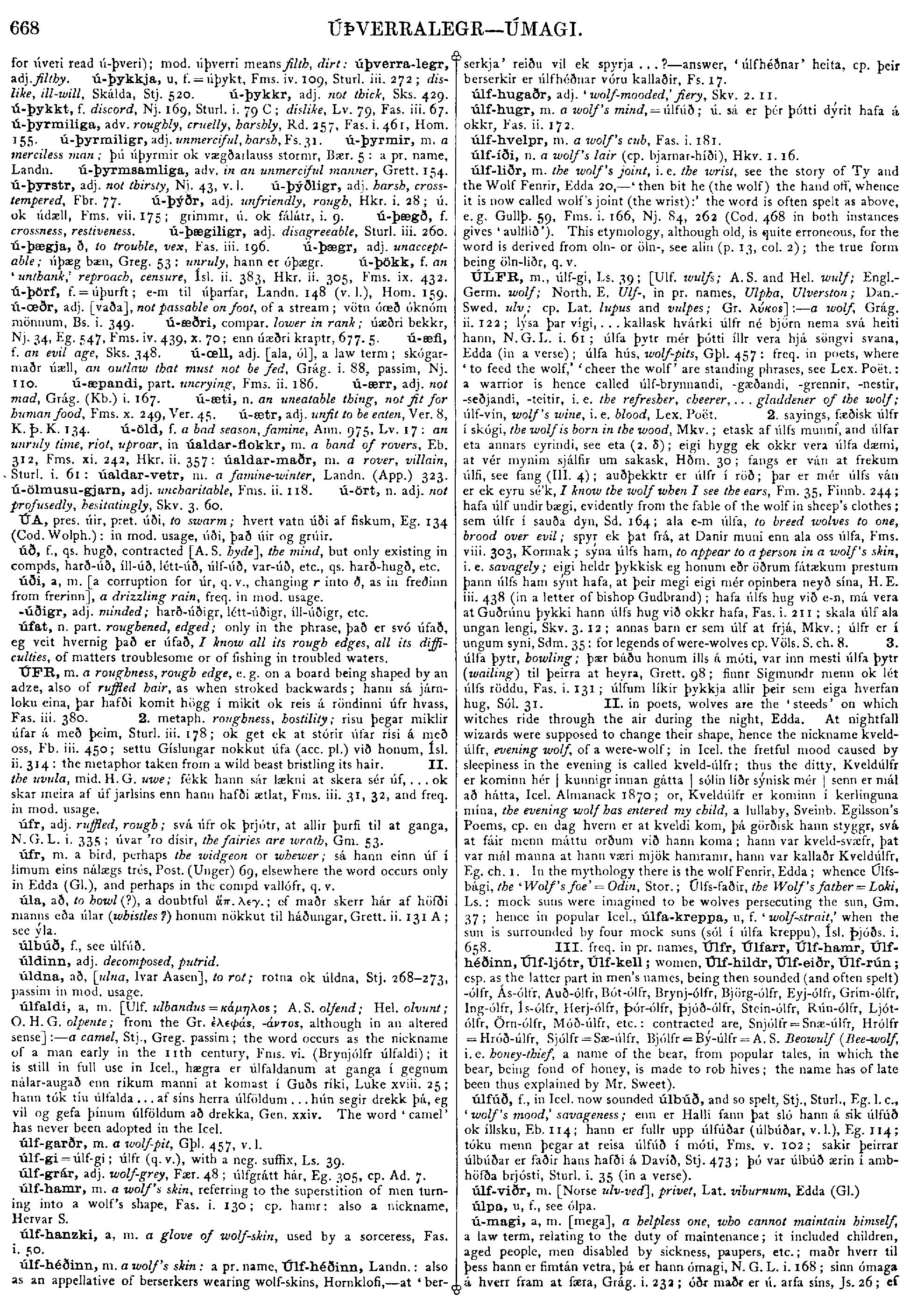
úfr, m. a bird, perhaps the widgeon or whewer; sá hann einn úf í limum eins nálægs trés, Post. (Unger) 69, elsewhere the word occurs only in Edda (Gl.), and perhaps in the compd vallófr, q.v.
|
Source: Cleasby/Vigfusson, page b0704, entry 47 View original page image as: [TIFF] [PNG] [View previous entry] [View next entry] |
[Comment on this entry] [View comments] |
The following entry has been hand-corrected once. |
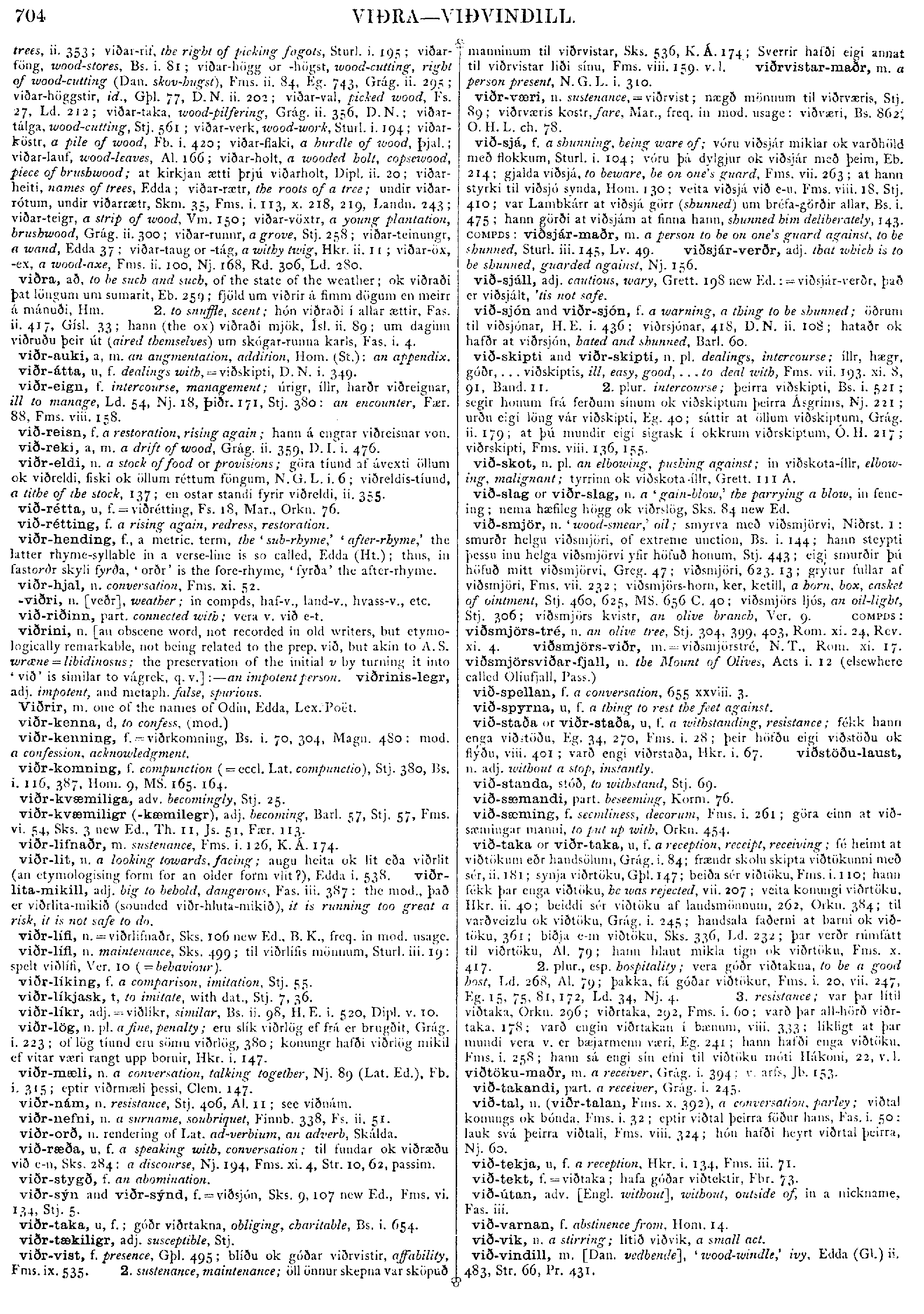
við-smjör, n. 'wood-smear,' oil; smyrva með viðsmjörvi, Niðrst. 1: smurðr helgu viðsmjöri, of extreme unction, Bs. i. 144; hann steypti þessu inu helga viðsmjörvi yfir höfuð honum, Stj. 443; eigi smurðir þú höfuð mitt viðsmjörvi, Greg. 47; viðsmjöri, 623. 13; grýtur fullar af viðsmjöri, Fms. vii. 232; viðsmjörs-horn, ker, ketill, a horn, box, casket of ointment, Stj. 460, 625, MS. 656 C. 40; viðsmjörs ljós, an oil-light, Stj. 306; viðsmjörs kvistr, an olive branch, Ver. 9. COMPDS: viðsmjörs-tré, n. an olive tree, Stj. 304, 399, 403, Rom. xi. 24, Rev. xi. 4. viðsmjörs-viðr, m. = viðsmjörstré, N.T., Rom. xi. 17. viðsmjörsviðar-fjall, n. the Mount of olives, Acts i. 12 (elsewhere called Olíufjall, Pass.)
|
Source: Cleasby/Vigfusson, page b0743, entry 11 View original page image as: [TIFF] [PNG] [View previous entry] [View next entry] |
[Comment on this entry] [View comments] |
The following entry has been hand-corrected once. |
ÞÓRR,
m.,
gen.
Þórs,
dat.
and
acc.
Þór,
but
Þóri
dat.,
Bragi;
in
Runic
inscriptions
spelt
Þur;
[A.S.
þunor;
Engl.
thunder;
North.
E.
thunner;
Dutch
donder;
O.H.G.
donar;
Germ.
donner;
Hel.
thunar;
Dan.
Tor,
in
tor-den;
cp.
Lat.
t no
and
tonitrus;
the
word
Þór-r
is
therefore
formed
by
absorption
of
the
middle
n,
and
contraction
of
an
older
dissyllabic
Þonor
into
one
syllable,
and
is
a
purely
Scandinavian
form;
hence
in
A.S.
charters
or
diplomas
it
is
a
sure
sign
of
forgery
when
names
compd
with
þur-
appear
in
deeds
pretending
to
be
of
a
time
earlier
than
the
Danish
invasion
in
the
9th
century;
although
in
later
times
they
abound;
the
Engl.
Thurs-day
is
a
later
form,
in
which
the
phonetic
rule
of
the
Scandin.
tongue
has
been
followed;
perh.
it
is
a
North.
E.
form.
There
is
a
short
essay
by
Jacob
Grimm
on
the
etymology
of
this
word.]
A.
The
god
Thor,
the
god
of
thunder,
keeper
of
the
hammer,
the
ever-fighting
slayer
of
trolls
and
destroyer
of
evil
spirits,
the
friend
of
mankind,
the
defender
of
the
earth,
the
heavens,
and
the
gods,
for
without
Thor
and
his
hammer
the
earth
would
become
the
helpless
prey
of
the
giants.
He
was
the
consecrator,
the
hammer
being
the
cross
or
holy
sign
of
the
ancient
heathen,
hence
the
expressive
phrase
on
a
heathen
Danish
Runic
stone,
Þurr
vigi
þassi
runar,
'Thor,
consecrate
these
Runes!'
Rafn
193.
Thor
was
the
son
of
mother
Earth;
blunt,
hot-tempered,
without
fraud
or
guile,
of
few
words
and
ready
stroke,
--
such
was
Thor,
the
favourite
deity
of
the
ancients.
The
finest
legends
of
the
Edda,
-
and
the
best
lays
(the
lays
of
Hymir,
Thrym,
and
Harbard)
refer
to
Thor,
see
the
Edda
passim,
Eb.
the
first
chapters
--
hann
varðveitti
þar
í
eyinni
Þórs-hof,
ok
var
mikill
vin
Þórs,
...
hann
gékk
til
fréttar
við
Þór
ástvin
sinn
...,
Eb.;
Helgi
var
blandinn
í
trú,
hann
trúði
á
Krist,
en
hét
á
Þór
til
sjófara
ok
harðræða,
Landn.
206.
For
a
head
of
Thor
carved
on
the
high-seat
pillars,
see
Eb.,
Fbr.:
or
on
a
talisman,
Fs.
97.
B.
COMPDS
OF
PROPER
NAMES.
--
The
name
of
Thor
has
always
been
thought
to
sound
well,
and
is
much
used
in
pr.
names;
(hann
átti)
son
er
Steinn
hét,
þann
svein
gaf
Þórólfr
Þór
vin
símim
ok
kallaði
Þorstein,
Eb.;
uncompd
only
in
the
form
Þórir
of
a
man,
Þóra
of
a
woman,
but
common
in
compds,
where
in
mod.
usage
the
vowel
is
sounded
long
before
a
vowel,
and
before
b
and
d,
elsewhere
short,
but
in
old
times
it
was
no
doubt
ó
throughout;
--
thus,
as
a
prefix,
Þór-álfr,
Þórólfr,
Þórarr,
Þór-arinn,
Þór-oddr,
Þór-haddr,
Þór-halli,
Þór-hallr;
but
Þor-bergr,
Þor-björn,
Þor-brandr,
Þor-finnr,
Þor-gautr,
Þor-geirr,
Þor-gestr
(Þórgestlingar,
the
family
of
Th.,
Eb.),
Þor-grímr,
Þor-gils,
Þor-gnýr,
Þor-kell
(qs.
Þorketill),
Þor-lákr
(sounded
Þollákr,
Bs.
i.
356,
l.
18,
and
so
in
mod.
usage),
Þor-leifr,
Þor-leikr,
Þor-ljótr,
Þor-móðr,
Þor-mundr
(Dan.
Runic
stone),
Þor-steinn
(sounded
Þosteinn,
and
often,
spelt
so
in
later
vellums),
Þor-valdr,
Þor-varðr,
Þór-viðr;
of
women,
Þór-ey,
Þór-arna,
Þor-finna,
Þor-gríma,
Þor-gunna,
Þór-halla,
Þór-hildr,
Þór-unn,
Þór-dís,
Þor-gerðr,
Þor-björg,
Þor-katla,
Þór-ný,
Þor-veig,
Þór-vör.
2.
as
a
suffix.
-Þórr,
-Þóra,
-dórr,
-dóra;
Arn-órr,
qs.
Arn-þórr
and
Arn-óra,
Stein-dórr,
Hall-dórr
and
Hall-dóra,
Berg-þórr
and
Berg-þóra,
Ey-þórr
and
Ey-þóra,
Haf-þórr.
Of
all
these
names,
three
demand
special
mention,
viz.
Þórðr,
being
a
contr.
qs.
Þór-røðr
(as
Bárðr
=
Bár-röðr),
the
old
uncontr.
form
occurs
in
poems
of
the
10th
century,
e.g.
Þórröðr
vinon
óra,
Korm.
132;
so
Sighvat
calls
his
own
father
Þórröðr
(dissyll.).
yet
he
makes
it
rhyme
as
if
contracted
(Þorröðr
er
var
forðum),
so
Þorðr
skor
Bjarn.
(in
a
verse):
the
other
name
is
Þuríðr,
a
fem.
name,
a
weakened
form
for
Þóríðr,
Íb.
363
(qs.
Þór-ríðr,
like
Sig-ríðr);
thirdly,
Þyri,
a
fem.
name,
weakened
from
Þór-vé,
or
still
older
Þór-veig,
mod.
Dan.
Thyra,
see
Landn.
309;
Þurvi
(Þiurvi),
gen.
Þurviar,
on
Runic
stones.
II.
in
local
names,
Þórs-mörk,
Þórs-nes,
Þórs-á,
Landn.,
Eb.;
whence
Þórs-nes-ingar,
the
men
from
Th.,
Landn.;
and
Þórs-ness-lönd,
-þing,
Eb.,
Landn.,
Korm.:
Þórsnesinga-goðord,
Landn.,
Eb.
.
Sturl.:
Þórs-engi,
n.,
i.e.
Þórs-vengi,
=
Thaasinge
in
Fünen,
Denmark.
C.
COMPDS:
Þórs-dagr,
m.
[A.S.
Þunresdæg;
O.H.G.
Donares-tac,
Toniris-tag;
mid.
Germ.
Donres-tac;
mod.
Germ.
Donners-tag;
Dutch
Donder-dag;
Swed.-Dan.
Tors-dag;
in
Engl.
also
contr.
Thursday]
:--
Thursday,
dies
Jovis,
N.G.L.
ii.
347,
Rb.
572,
Fms.
ix.
317,
passim;
Helgi-Þórsdagr,
Holy
Thursday,
Ascension
Day,
Js.
11,
Fms.
ix.
526,
D.N.;
Skíri-Þórsdagr,
Dan.
Skjertorsdag,
Thursday
in
Passion-week,
passim.
Þórs-hani,
a,
m.
a
bird,
cp.
Óðins-hani.
Þórs-hof,
n.
the
temple
of
Jove,
Clem.,
Al.
no
and
tonitrus;
the
word
Þór-r
is
therefore
formed
by
absorption
of
the
middle
n,
and
contraction
of
an
older
dissyllabic
Þonor
into
one
syllable,
and
is
a
purely
Scandinavian
form;
hence
in
A.S.
charters
or
diplomas
it
is
a
sure
sign
of
forgery
when
names
compd
with
þur-
appear
in
deeds
pretending
to
be
of
a
time
earlier
than
the
Danish
invasion
in
the
9th
century;
although
in
later
times
they
abound;
the
Engl.
Thurs-day
is
a
later
form,
in
which
the
phonetic
rule
of
the
Scandin.
tongue
has
been
followed;
perh.
it
is
a
North.
E.
form.
There
is
a
short
essay
by
Jacob
Grimm
on
the
etymology
of
this
word.]
A.
The
god
Thor,
the
god
of
thunder,
keeper
of
the
hammer,
the
ever-fighting
slayer
of
trolls
and
destroyer
of
evil
spirits,
the
friend
of
mankind,
the
defender
of
the
earth,
the
heavens,
and
the
gods,
for
without
Thor
and
his
hammer
the
earth
would
become
the
helpless
prey
of
the
giants.
He
was
the
consecrator,
the
hammer
being
the
cross
or
holy
sign
of
the
ancient
heathen,
hence
the
expressive
phrase
on
a
heathen
Danish
Runic
stone,
Þurr
vigi
þassi
runar,
'Thor,
consecrate
these
Runes!'
Rafn
193.
Thor
was
the
son
of
mother
Earth;
blunt,
hot-tempered,
without
fraud
or
guile,
of
few
words
and
ready
stroke,
--
such
was
Thor,
the
favourite
deity
of
the
ancients.
The
finest
legends
of
the
Edda,
-
and
the
best
lays
(the
lays
of
Hymir,
Thrym,
and
Harbard)
refer
to
Thor,
see
the
Edda
passim,
Eb.
the
first
chapters
--
hann
varðveitti
þar
í
eyinni
Þórs-hof,
ok
var
mikill
vin
Þórs,
...
hann
gékk
til
fréttar
við
Þór
ástvin
sinn
...,
Eb.;
Helgi
var
blandinn
í
trú,
hann
trúði
á
Krist,
en
hét
á
Þór
til
sjófara
ok
harðræða,
Landn.
206.
For
a
head
of
Thor
carved
on
the
high-seat
pillars,
see
Eb.,
Fbr.:
or
on
a
talisman,
Fs.
97.
B.
COMPDS
OF
PROPER
NAMES.
--
The
name
of
Thor
has
always
been
thought
to
sound
well,
and
is
much
used
in
pr.
names;
(hann
átti)
son
er
Steinn
hét,
þann
svein
gaf
Þórólfr
Þór
vin
símim
ok
kallaði
Þorstein,
Eb.;
uncompd
only
in
the
form
Þórir
of
a
man,
Þóra
of
a
woman,
but
common
in
compds,
where
in
mod.
usage
the
vowel
is
sounded
long
before
a
vowel,
and
before
b
and
d,
elsewhere
short,
but
in
old
times
it
was
no
doubt
ó
throughout;
--
thus,
as
a
prefix,
Þór-álfr,
Þórólfr,
Þórarr,
Þór-arinn,
Þór-oddr,
Þór-haddr,
Þór-halli,
Þór-hallr;
but
Þor-bergr,
Þor-björn,
Þor-brandr,
Þor-finnr,
Þor-gautr,
Þor-geirr,
Þor-gestr
(Þórgestlingar,
the
family
of
Th.,
Eb.),
Þor-grímr,
Þor-gils,
Þor-gnýr,
Þor-kell
(qs.
Þorketill),
Þor-lákr
(sounded
Þollákr,
Bs.
i.
356,
l.
18,
and
so
in
mod.
usage),
Þor-leifr,
Þor-leikr,
Þor-ljótr,
Þor-móðr,
Þor-mundr
(Dan.
Runic
stone),
Þor-steinn
(sounded
Þosteinn,
and
often,
spelt
so
in
later
vellums),
Þor-valdr,
Þor-varðr,
Þór-viðr;
of
women,
Þór-ey,
Þór-arna,
Þor-finna,
Þor-gríma,
Þor-gunna,
Þór-halla,
Þór-hildr,
Þór-unn,
Þór-dís,
Þor-gerðr,
Þor-björg,
Þor-katla,
Þór-ný,
Þor-veig,
Þór-vör.
2.
as
a
suffix.
-Þórr,
-Þóra,
-dórr,
-dóra;
Arn-órr,
qs.
Arn-þórr
and
Arn-óra,
Stein-dórr,
Hall-dórr
and
Hall-dóra,
Berg-þórr
and
Berg-þóra,
Ey-þórr
and
Ey-þóra,
Haf-þórr.
Of
all
these
names,
three
demand
special
mention,
viz.
Þórðr,
being
a
contr.
qs.
Þór-røðr
(as
Bárðr
=
Bár-röðr),
the
old
uncontr.
form
occurs
in
poems
of
the
10th
century,
e.g.
Þórröðr
vinon
óra,
Korm.
132;
so
Sighvat
calls
his
own
father
Þórröðr
(dissyll.).
yet
he
makes
it
rhyme
as
if
contracted
(Þorröðr
er
var
forðum),
so
Þorðr
skor
Bjarn.
(in
a
verse):
the
other
name
is
Þuríðr,
a
fem.
name,
a
weakened
form
for
Þóríðr,
Íb.
363
(qs.
Þór-ríðr,
like
Sig-ríðr);
thirdly,
Þyri,
a
fem.
name,
weakened
from
Þór-vé,
or
still
older
Þór-veig,
mod.
Dan.
Thyra,
see
Landn.
309;
Þurvi
(Þiurvi),
gen.
Þurviar,
on
Runic
stones.
II.
in
local
names,
Þórs-mörk,
Þórs-nes,
Þórs-á,
Landn.,
Eb.;
whence
Þórs-nes-ingar,
the
men
from
Th.,
Landn.;
and
Þórs-ness-lönd,
-þing,
Eb.,
Landn.,
Korm.:
Þórsnesinga-goðord,
Landn.,
Eb.
.
Sturl.:
Þórs-engi,
n.,
i.e.
Þórs-vengi,
=
Thaasinge
in
Fünen,
Denmark.
C.
COMPDS:
Þórs-dagr,
m.
[A.S.
Þunresdæg;
O.H.G.
Donares-tac,
Toniris-tag;
mid.
Germ.
Donres-tac;
mod.
Germ.
Donners-tag;
Dutch
Donder-dag;
Swed.-Dan.
Tors-dag;
in
Engl.
also
contr.
Thursday]
:--
Thursday,
dies
Jovis,
N.G.L.
ii.
347,
Rb.
572,
Fms.
ix.
317,
passim;
Helgi-Þórsdagr,
Holy
Thursday,
Ascension
Day,
Js.
11,
Fms.
ix.
526,
D.N.;
Skíri-Þórsdagr,
Dan.
Skjertorsdag,
Thursday
in
Passion-week,
passim.
Þórs-hani,
a,
m.
a
bird,
cp.
Óðins-hani.
Þórs-hof,
n.
the
temple
of
Jove,
Clem.,
Al.
|
Source: Cleasby/Vigfusson, page b0774, entry 38 View original page image as: [TIFF] [PNG] [View previous entry] [View next entry] |
[Comment on this entry] [View comments] |
The following entry has been hand-corrected once. |
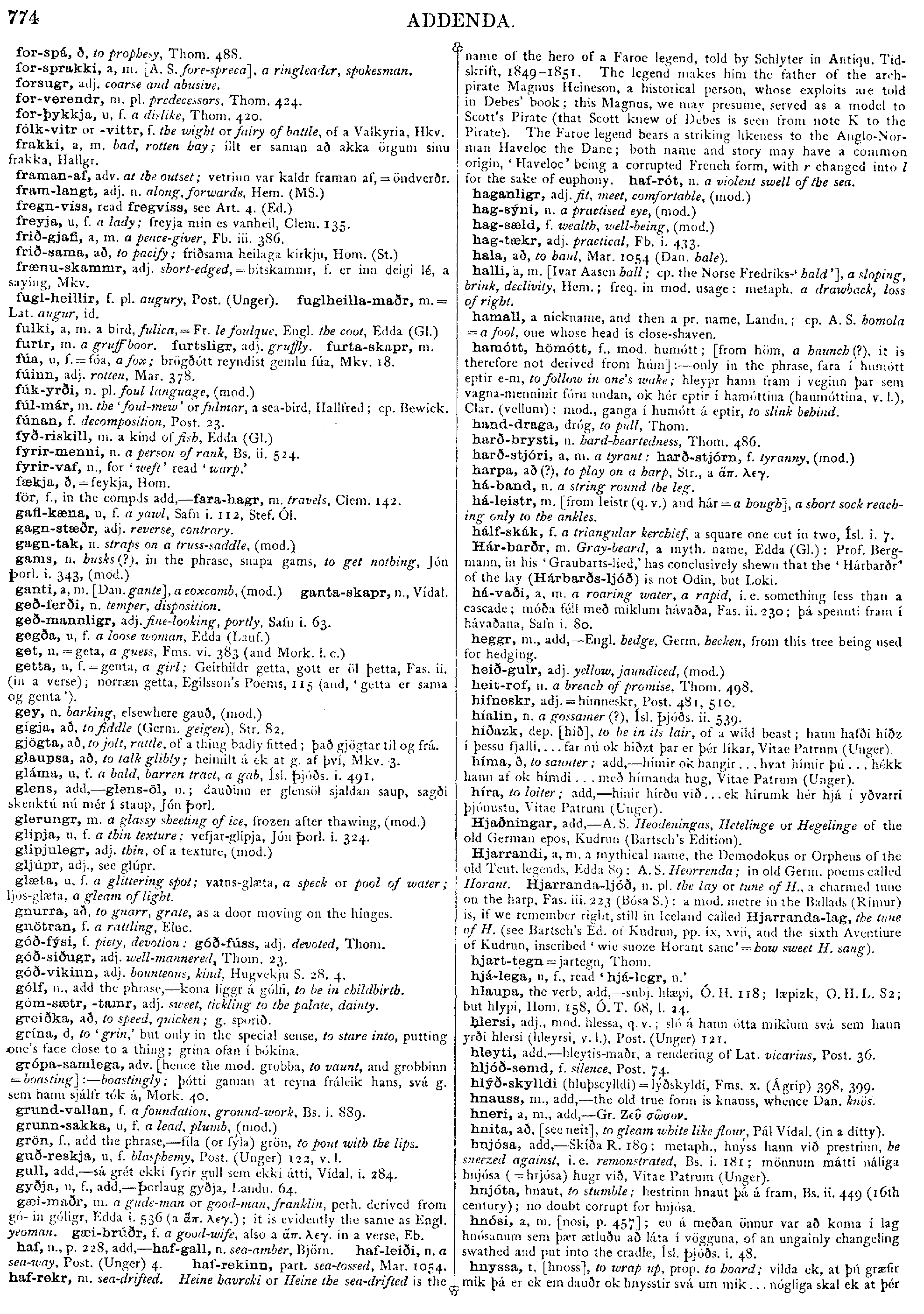
gey, n. barking, elsewhere gauð, (mod.)
| Result Page: |  |
Previous | 1 2 3 4 5 6 7 8 |
Germanic Lexicon Project (main page)
This search system was written by
Sean Crist
Please consider
volunteering
to correct the data in these online dictionaries.
No rights reserved. Feel free to use these data in any way you please.