|
|

|
Source: Bosworth/Toller, page b0562, entry 39 View original page image as: [TIFF] [PNG] [View previous entry] [View next entry] |
[Comment on this entry] [View comments] |
The following entry has been hand-corrected once. |
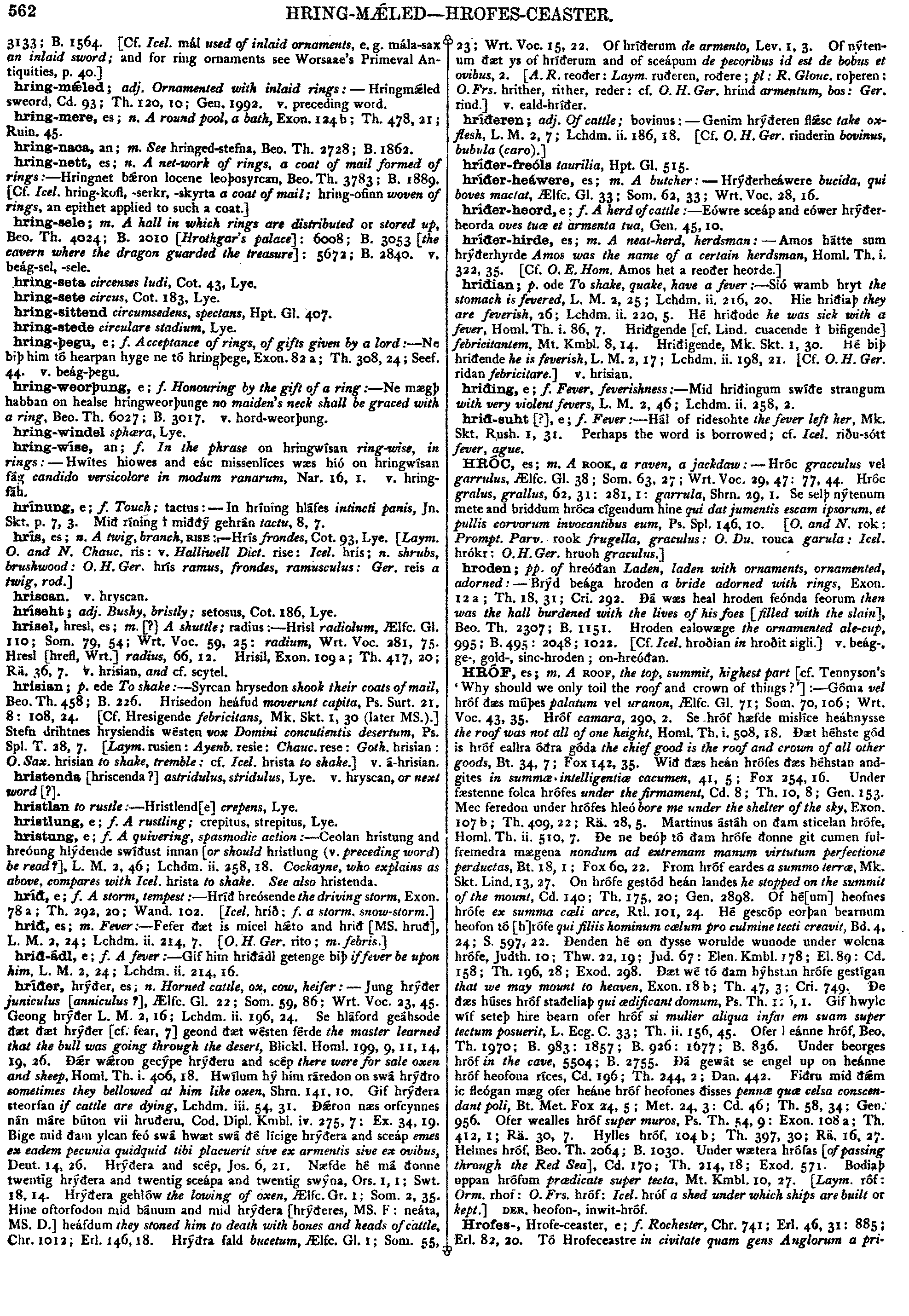
HRÓF,
es;
m.
A
ROOF,
the
top,
summit,
highest
part
[cf.
Tennyson's
'Why
should
we
only
toil
the
roof
and
crown
of
things?']
:--
Góma
vel
hróf
ðæs
múþes
palatum
vel
uranon,
Ælfc.
Gl.
71;
Som.
70,
106;
Wrt.
Voc.
43,
35.
Hróf
camara,
290,
2.
Se
hróf
hæfde
mislíce
heáhnysse
the
roof
was
not
all
of
one
height,
Homl.
Th.
i.
508,
18.
Ðæt
héhste
gód
is
hróf
eallra
óðra
góda
the
chief
good
is
the
roof
and
crown
of
all
other
goods,
Bt.
34,
7;
Fox
142,
35.
Wið
ðæs
heán
hrófes
ðæs
héhstan
andgites
in
summæ
intelligentiæ
cacumen,
41,
5;
Fox
254,
16.
Under
fæstenne
folca
hrófes
under
the
firmament,
Cd.
8;
Th.
10,
8;
Gen.
153.
Mec
feredon
under
hrófes
hleó
bore
me
under
the
shelter
of
the
sky,
Exon.
107
b;
Th.
409,
22;
Rä.
28,
5.
Martinus
ástáh
on
ðam
sticelan
hrófe,
Homl.
Th.
ii.
510,
7.
Ðe
ne
beóþ
tó
ðam
hrófe
ðonne
git
cumen
fulfremedra
mægena
nondum
ad
extremam
manum
virtutum
perfectione
perductas,
Bt.
18,
1;
Fox
60,
22.
From
hróf
eardes
a
summo
terræ,
Mk.
Skt.
Lind.
13,
27.
On
hrófe
gestód
heán
landes
he
stopped
on
the
summit
of
the
mount,
Cd.
140;
Th.
175,
20;
Gen.
2898.
Of
hé[um]
heofnes
hrófe
ex
summa
cæli
arce,
Rtl.
101,
24.
Hé
gescóp
eorþan
bearnum
heofon
tó
[h]rófe
qui
filiis
hominum
cælum
pro
culmine
tecti
creavit,
Bd.
4,
24;
S.
597,
22.
Ðenden
hé
on
ðysse
worulde
wunode
under
wolcna
hrófe,
Judth.
10;
Thw.
22,
19;
Jud.
67:
Elen.
Kmbl.
178;
El.
89:
Cd.
158;
Th.
196,
28;
Exod.
298.
Ðæt
wé
to
ðam
hýhstan
hrófe
gestígan
that
we
may
mount
to
heaven,
Exon.
18
b;
Th.
47,
3;
Cri.
749.
Ðe
ðæs
húses
hróf
staðeliaþ
qui
ædificant
domum,
Ps.
Th.
126,
1.
Gif
hwylc
wíf
seteþ
hire
bearn
ofer
hróf
si
mulier
aliqua
infantem
suam
super
tectum
posuerit,
L.
Ecg.
C.
33;
Th.
ii.
156,
45.
Ofer
heánne
hróf,
Beo.
Th.
1970;
B.
983:
1857;
B.
926:
1677;
B.
836.
Under
beorges
hróf
in
the
cave,
5504;
B.
2755.
Ðá
gewát
se
engel
up
on
heánne
hróf
heofona
ríces,
Cd.
196;
Th.
244,
2;
Dan.
442.
Fiðru
mid
ð m
ic
fleógan
mæg
ofer
heáne
hróf
heofones
ðisses
pennæ
quæ
celsa
conscendant
poli,
Bt.
Met.
Fox
24,
5;
Met.
24,
3:
Cd.
46;
Th.
58,
34;
Gen.
956.
Ofer
wealles
hróf
super
muros,
Ps.
Th.
54,
9:
Exon.
108
a;
Th.
412,
1;
Rä.
30,
7.
Hylles
hróf,
104
b;
Th.
397,
30;
Rä.
16,
27.
Helmes
hróf,
Beo.
Th.
2064;
B.
1030.
Under
wætera
hrófas
[of
passing
through
the
Red
Sea],
Cd.
170;
Th.
214,
18;
Exod.
571.
Bodiaþ
uppan
hrófum
prædicate
super
tecta,
Mt.
Kmbl.
10,
27.
[Laym.
róf:
Orm.
rhof:
O.
Frs.
hróf:
Icel.
hróf
a
shed
under
which
ships
are
built
or
kept.]
DER.
heofon-,
inwit-hróf.
m
ic
fleógan
mæg
ofer
heáne
hróf
heofones
ðisses
pennæ
quæ
celsa
conscendant
poli,
Bt.
Met.
Fox
24,
5;
Met.
24,
3:
Cd.
46;
Th.
58,
34;
Gen.
956.
Ofer
wealles
hróf
super
muros,
Ps.
Th.
54,
9:
Exon.
108
a;
Th.
412,
1;
Rä.
30,
7.
Hylles
hróf,
104
b;
Th.
397,
30;
Rä.
16,
27.
Helmes
hróf,
Beo.
Th.
2064;
B.
1030.
Under
wætera
hrófas
[of
passing
through
the
Red
Sea],
Cd.
170;
Th.
214,
18;
Exod.
571.
Bodiaþ
uppan
hrófum
prædicate
super
tecta,
Mt.
Kmbl.
10,
27.
[Laym.
róf:
Orm.
rhof:
O.
Frs.
hróf:
Icel.
hróf
a
shed
under
which
ships
are
built
or
kept.]
DER.
heofon-,
inwit-hróf.
|
Source: Bosworth/Toller, page b0563, entry 12 View original page image as: [TIFF] [PNG] [View previous entry] [View next entry] |
[Comment on this entry] [View comments] |
The following entry has been hand-corrected once. |
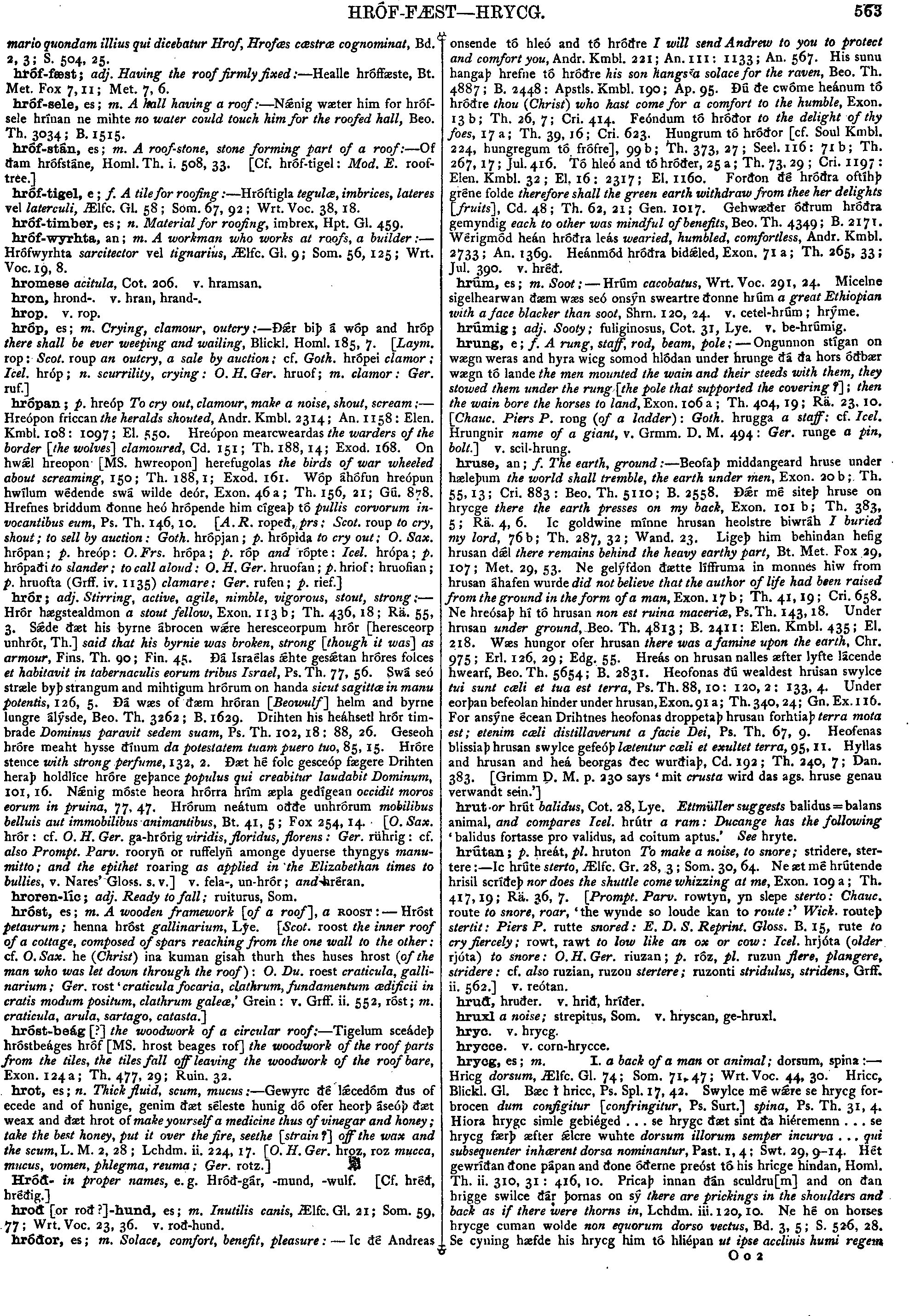
hrópan;
p.
hreóp
To
cry
out,
clamour,
make
a
noise,
shout,
scream
:--
Hreópon
friccan
the
heralds
shouted,
Andr.
Kmbl.
2314;
An.
1158:
Elen.
Kmbl.
108:
1097;
El.
550.
Hreópon
mearcweardas
the
warders
of
the
border
[the
wolves]
clamoured,
Cd.
151;
Th.
188,
14;
Exod.
168.
On
hwl
hreopon
[MS.
hwreopon]
herefugolas
the
birds
of
war
wheeled
about
screaming,
150;
Th.
188,
1;
Exod.
161.
Wóp
áhófun
hreópun
hwílum
wédende
swá
wilde
deór.
Exon.
46
a;
Th.
156,
21;
Gú.
878.
Hrefnes
briddum
ðonne
heó
hrópende
him
cígeaþ
tó
pullis
corvorum
invocantibus
eum,
Ps.
Th.
146,
10.
[A.
R.
ropeð,
prs:
Scot.
roup
to
cry,
shout;
to
sell
by
auction:
Goth.
hrópjan;
p.
hrópida
to
cry
out:
O.
Sax.
hrópan;
p.
hreóp:
O.
Frs.
hrópa;
p.
róp
and
rópte:
Icel.
hrópa;
p.
hrópaði
to
slander;
to
call
aloud:
O.
H.
Ger.
hruofan;
p.
hriof:
hruofian;
p.
hruofta
(Grff.
iv.
1135)
clamare;
Ger.
rufen;
p.
rief.]
|
Source: Bosworth/Toller, page b0563, entry 20 View original page image as: [TIFF] [PNG] [View previous entry] [View next entry] |
[Comment on this entry] [View comments] |
The following entry has been hand-corrected once. |
hróðor,
es;
m.
Solace,
comfort,
benefit,
pleasure
:--
Ic
ðé
Andreas
onsende
tó
hleó
and
tó
hróðre
I
will
send
Andrew
to
you
to
protect
and
comfort
you,
Andr.
Kmbl.
221;
An.
111:
1133;
An.
567.
His
sunu
hangaþ
hrefne
tó
hróðre
his
son
hangs
a
solace
for
the
raven,
Beo.
Th.
4887;
B.
2448:
Apstls.
Kmbl.
190;
Ap.
95.
Ðú
ðe
cwóme
heánum
tó
hróðre
thou
(Christ)
who
hast
come
for
a
comfort
to
the
humble,
Exon.
13
b;
Th.
26,
7;
Cri.
414.
Feóndum
tó
hróðor
to
the
delight
of
thy
foes,
17
a;
Th.
39,
16;
Cri.
623.
Hungrum
tó
hróðor
[cf.
Soul
Kmbl.
224,
hungregum
tó
frófre],
99
b;
Th.
373,
27;
Seel.
116:
71
b;
Th.
267,
17;
Jul.
416.
Tó
hleó
and
tó
hróðer,
25
a;
Th.
73,
29;
Cri.
1197:
Elen.
Kmbl.
32;
El.
16:
2317;
El.
1160.
Forðon
ðé
hróðra
oftíhþ
gréne
folde
therefore
shall
the
green
earth
withdraw
from
thee
her
delights
[fruits],
Cd.
48;
Th.
62,
21;
Gen.
1017.
Gehwæðer
óðrum
hróðra
gemyndig
each
to
other
was
mindful
of
benefits,
Beo.
Th.
4349;
B.
2171.
Wérigmód
heán
hróðra
leás
wearied,
humbled,
comfortless,
Andr.
Kmbl.
2733;
An.
1369.
Heánmód
hróðra
bidled,
Exon.
71
a;
Th.
265,
33;
Jul.
390.
v.
hréð.
|
Source: Bosworth/Toller, page b0563, entry 24 View original page image as: [TIFF] [PNG] [View previous entry] [View next entry] |
[Comment on this entry] [View comments] |
The following entry has been hand-corrected once. |
hruse,
an;
f.
The
earth,
ground
:--
Beofaþ
middangeard
hruse
under
hæleþum
the
world
shall
tremble,
the
earth
under
men,
Exon.
20
b;
Th.
55,
13;
Cri.
883:
Beo.
Th.
5110;
B.
2558.
Ðr
mé
siteþ
hruse
on
hrycge
there
the
earth
presses
on
my
back,
Exon.
101
b;
Th.
383,
5;
Rä.
4,
6.
Ic
goldwine
mínne
hrusan
heolstre
biwráh
I
buried
my
lord,
76
b;
Th.
287,
32;
Wand.
23.
Ligeþ
him
behindan
hefig
hrusan
dl
there
remains
behind
the
heavy
earthy
part,
Bt.
Met.
Fox
29,
107;
Met.
29,
53.
Ne
gelýfdon
ðætte
líffruma
in
monnes
hiw
from
hrusan
áhafen
wurde
did
not
believe
that
the
author
of
life
had
been
raised
from
the
ground
in
the
form
of
a
man,
Exon.
17
b;
Th.
41,
19;
Cri.
658.
Ne
hreósaþ
hí
tó
hrusan
non
est
ruina
maceriæ,
Ps.
Th.
143,
18.
Under
hrusan
under
ground,
Beo.
Th.
4813;
B.
2411:
Elen.
Kmbl.
435;
El.
218.
Wæs
hungor
ofer
hrusan
there
was
a
famine
upon
the
earth,
Chr.
975;
Erl.
126,
29;
Edg.
55.
Hreás
on
hrusan
nalles
æfter
lyfte
lácende
hwearf,
Beo.
Th.
5654;
B.
2831.
Heofonas
ðú
wealdest
hrusan
swylce
tui
sunt
cæli
et
tua
est
terra,
Ps.
Th.
88,
10:
120,
2:
133,
4.
Under
eorþan
befeolan
hinder
under
hrusan,
Exon.
9l
a;
Th.
340,
24;
Gn.
Ex.
116.
For
ansýne
écean
Drihtnes
heofonas
droppetaþ
hrusan
forhtiaþ
terra
motu
est;
etenim
cæli
distillaverunt
a
facie
Dei,
Ps.
Th.
67,
9.
Heofenas
blissiaþ
hrusan
swylce
gefeóþ
lætentur
cæli
et
exultet
terra,
95,
11.
Hyllas
and
hrusan
and
heá
beorgas
ðec
wurðiaþ.
Cd.
192;
Th.
240,
7;
Dan.
383.
[Grimm
D.
M.
p.
230
says
'mit
crusta
wird
das
ags.
hruse
genau
verwandt
sein.']
|
Source: Bosworth/Toller, page b0565, entry 22 View original page image as: [TIFF] [PNG] [View previous entry] [View next entry] |
[Comment on this entry] [View comments] |
The following entry has been hand-corrected once. |
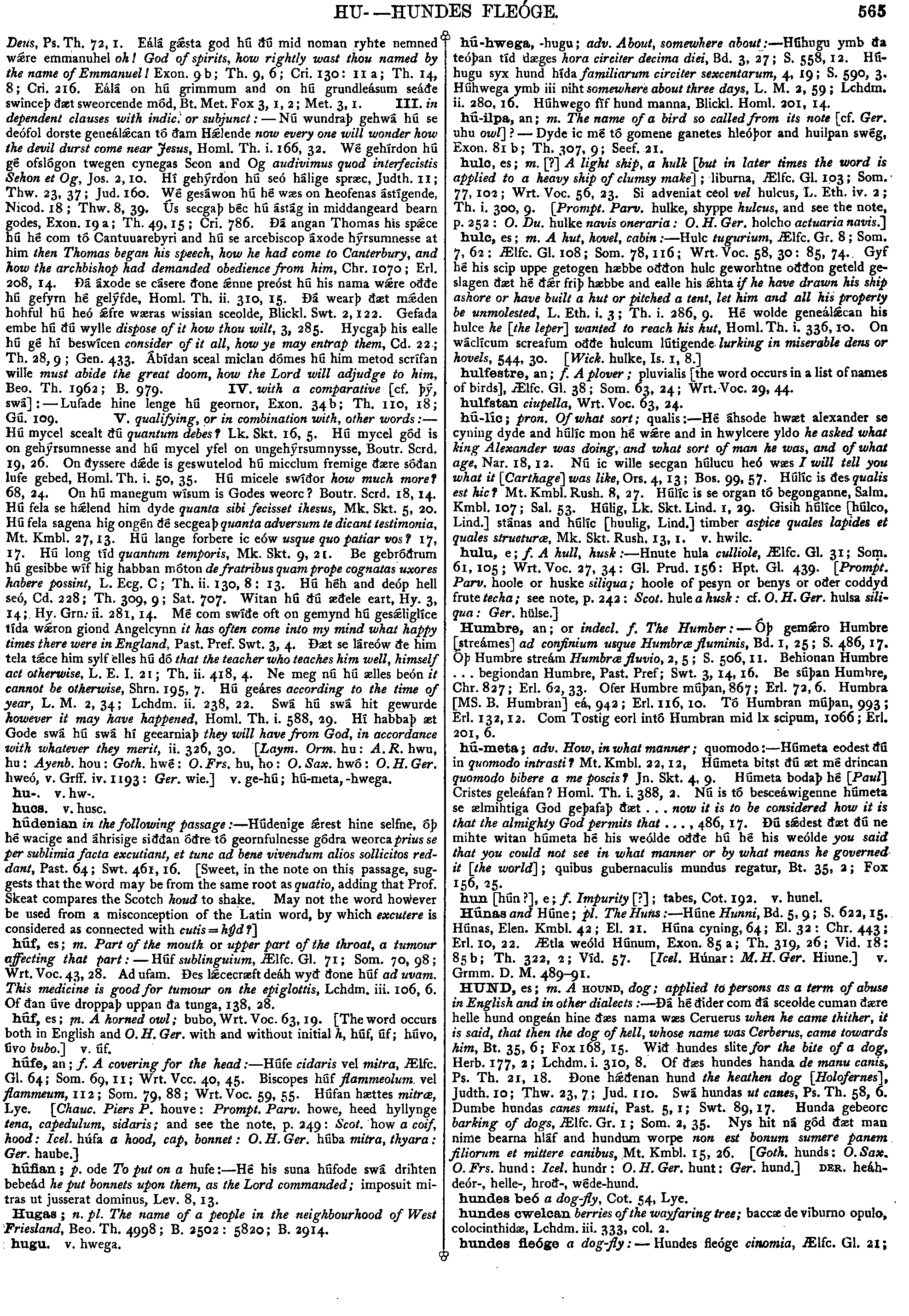
Húnas and Húne; pl. The Huns :-- Húne Hunni, Bd. 5, 9; S. 622, 15. Húnas, Elen. Kmbl. 42; El. 21. Húna cyning, 64; El. 32: Chr. 443; Erl. 10, 22. Ætla weóld Húnum, Exon. 85 a; Th. 319, 26; Vid. 18: 85 b; Th. 322, 2; Víd. 57. [Icel. Húnar: M. H. Ger. Hiune.] v. Grmm. D. M. 489-91.
|
Source: Bosworth/Toller, page b0568, entry 11 View original page image as: [TIFF] [PNG] [View previous entry] [View next entry] |
[Comment on this entry] [View comments] |
The following entry has been hand-corrected once. |
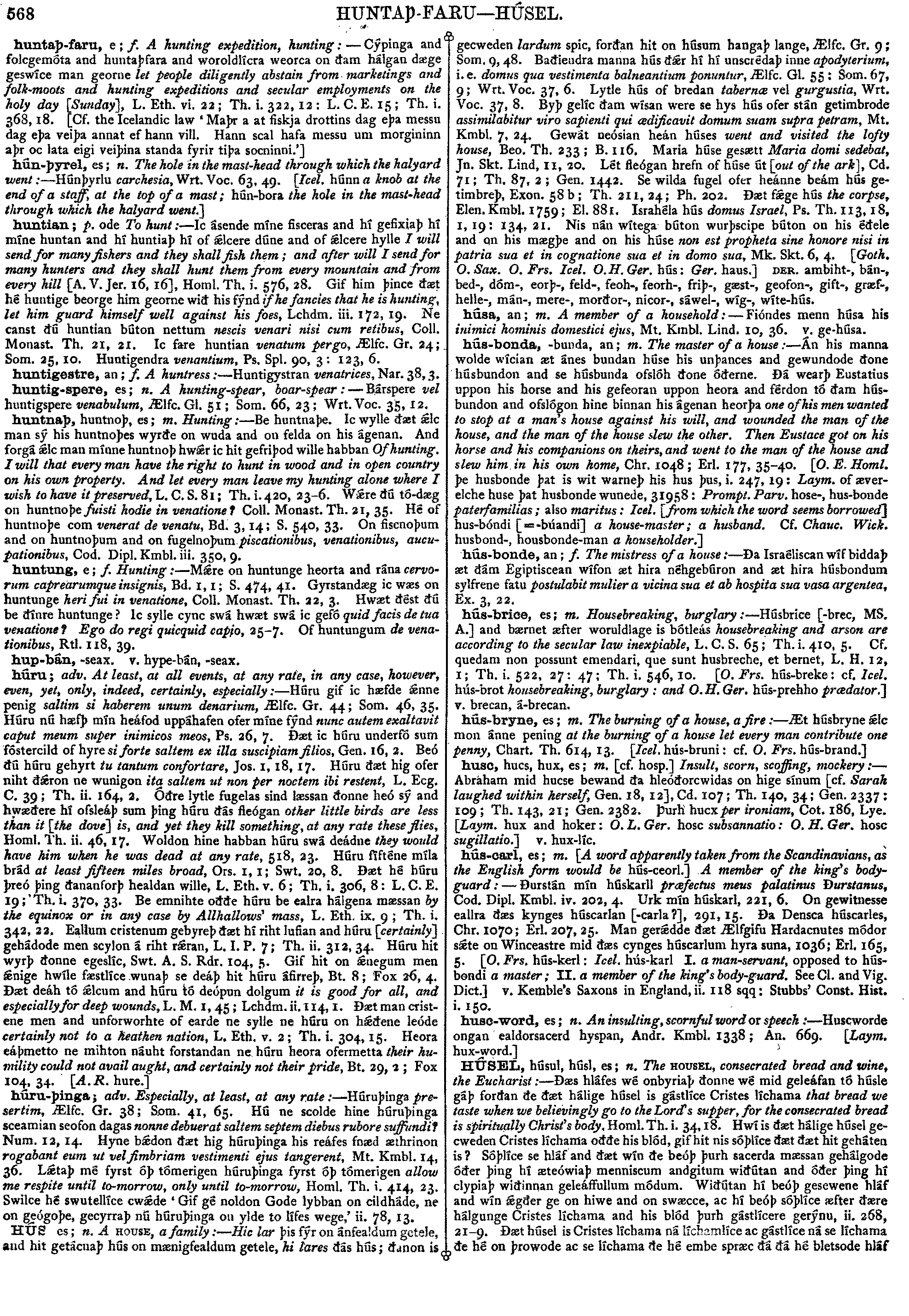
HÚS
es;
n.
A
HOUSE,
a
family
:--
Hic
lar
þis
fýr
on
ánfealdum
getele,
and
hit
getácnaþ
hús
on
mænigfealdum
getele,
hi
lares
ðás
hús;
ðanon
is
gecweden
lardum
spic,
forðan
hit
on
húsum
hangaþ
lange,
Ælfc.
Gr.
9;
Som.
9,
48.
Baðiendra
manna
hús
ðr
hí
hí
unscrédaþ
inne
apodyterium,
i.
e.
domus
qua
vestimenta
balneantium
ponuntur,
Ælfc.
Gl.
55
:
Som.
67,
9;
Wrt.
Voc.
37,
6.
Lytle
hús
of
bredan
tabernæ
vel
gurgustia,
Wrt.
Voc.
37,
8.
Byþ
gelíc
ðam
wísan
were
se
hys
hús
ofer
stán
getimbrode
assimilabitur
viro
sapienti
qui
ædificavit
domum
suam
supra
petram,
Mt.
Kmbl.
7,
24.
Gewát
neósian
heán
húses
went
and
visited
the
lofty
house,
Beo.
Th.
233;
B.
116.
Maria
húse
gesætt
Maria
domi
sedebat,
Jn.
Skt.
Lind,
11,
20.
Lét
fleógan
hrefn
of
húse
út
[out
of
the
ark],
Cd.
71;
Th.
87,
2;
Gen.
1442.
Se
wilda
fugel
ofer
heánne
beám
hús
getimbreþ,
Exon.
58
b;
Th.
211,
24;
Ph.
202.
Ðæt
fge
hús
the
corpse,
Elen.
Kmbl.
1759;
EI.
881.
Israhéla
hús
domus
Israel,
Ps.
Th.
113,
18,
1,
19
:
134,
21.
Nis
nán
wítega
búton
wurþscipe
búton
on
his
éðele
and
on
his
mægþe
and
on
his
húse
non
est
propheta
sine
honore
nisi
in
patria
sua
et
in
cognatione
sua
et
in
domo
sua,
Mk.
Skt.
6,
4.
[Goth.
O.
Sax.
O.
Frs.
Icel.
O.
H.
Ger.
hús
:
Ger.
haus.]
DER.
ambiht-,
bán-,
bed-,
dóm-,
eorþ-,
feld-,
feoh-,
feorh-,
friþ-,
gæst-,
geofon-,
gift-,
græf-,
helle-,
mán-,
mere-,
morðor-,
nicor-,
sáwel-,
wíg-,
wíte-hús.
|
Source: Bosworth/Toller, page b0569, entry 24 View original page image as: [TIFF] [PNG] [View previous entry] [View next entry] |
[Comment on this entry] [View comments] |
The following entry has been hand-corrected once. |
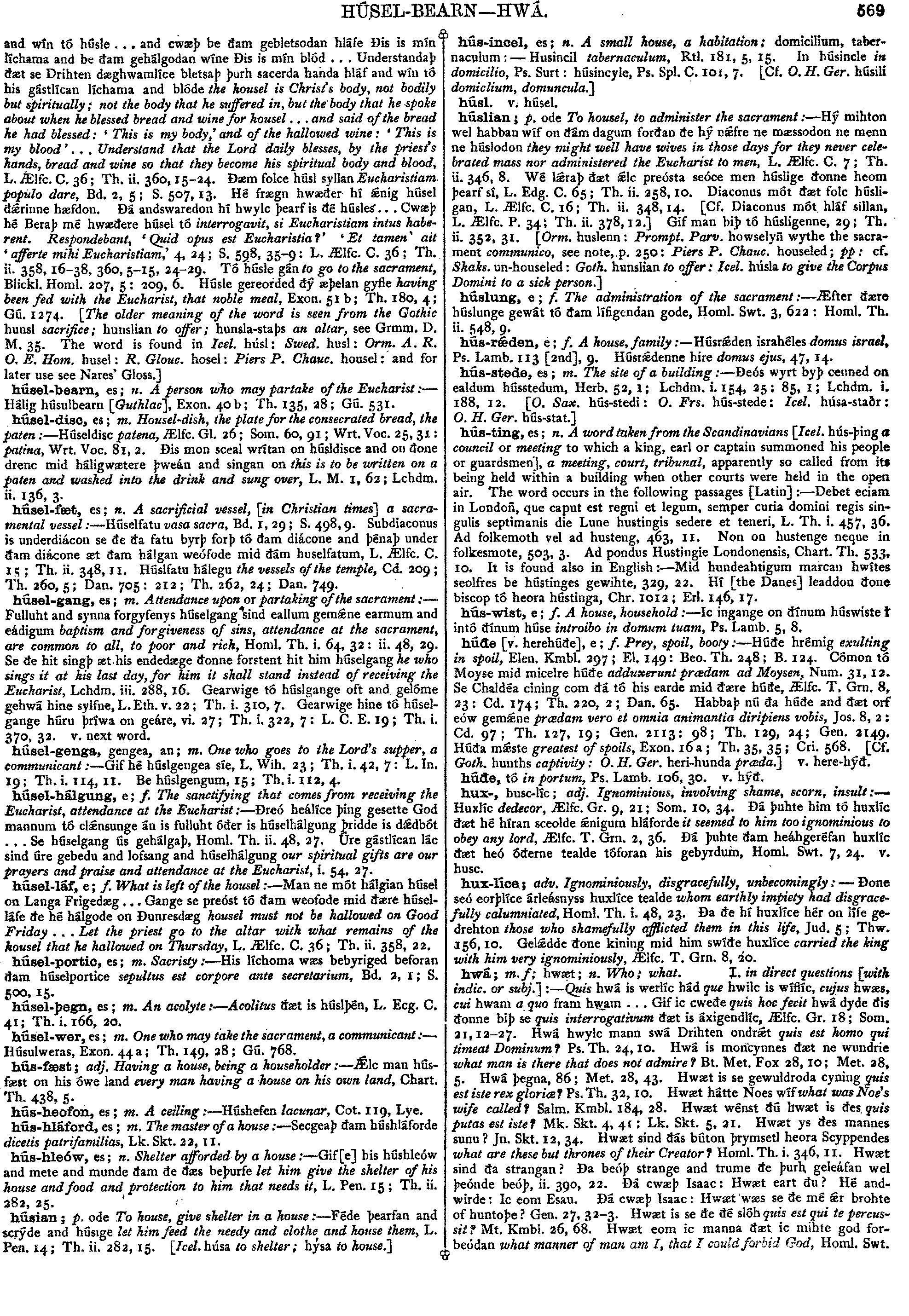
húðe
[v.
herehúðe],
e;
f.
Prey,
spoil,
booty
:--
Húðe
hremig
exulting
in
spoil,
Elen.
Kmbl.
297;
El.
149:
Beo.
Th.
248;
B.
124.
Cómon
tó
Moyse
mid
micelre
húðe
adduxerunt
prædam
ad
Moysen,
Num.
31,
12.
Se
Chaldéa
cining
com
ðá
tó
his
earde
mid
ðære
húðe,
Ælfc.
T.
Grn.
8,
23:
Cd.
174;
Th.
220,
2;
Dan.
65.
Habbaþ
nú
ða
húðe
and
ðæt
orf
eów
gemne
prædam
vero
et
omnia
animantia
diripiens
vobis,
Jos.
8,
2:
Cd.
97;
Th.
127,
19;
Gen.
2113:
98;
Th.
129,
24;
Gen.
2149.
Húða
mste
greatest
of
spoils,
Exon.
16
a;
Th.
35,
35;
Cri.
568.
[Cf.
Goth.
hunths
captivity:
O.
H.
Ger.
heri-hunda
præda.]
v.
here-hýð.
|
Source: Bosworth/Toller, page b0570, entry 1 View original page image as: [TIFF] [PNG] [View previous entry] [View next entry] |
[Comment on this entry] [View comments (3)] |
The following entry has been hand-corrected once. |
10,
191:
Elen.
Kmbl.
1802;
El.
903:
Beo.
Th.
479;
B.
237.
Hwæt
is
þinga
ðe
bitere
síe
what
thing
is
there
that
is
bitterer?
Past.
21;
Swt.
164,
1.
Hwæt
næddercynna
sí
on
eorþan
how
many
kinds
of
snakes
are
there
on
the
earth?
Salm.
Kmbl.
204,
7.
Hwæt
suna
hæfde
Adam
what
sons
had
Adam?
184,
31.
Hwæt
synt
ðínum
esne
ealra
dagena
quot
sunt
dies
servi
tui?
Ps.
Th.
118,
84.
Hwæt
gódes
dó
ic
quid
boni
faciam?
Mt.
Kmbl.
19,
16.
Hwæt
þincþ
eów
be
Criste
hwæs
sunu
ys
hé
quid
vobis
videtur
de
Christo?
cujus
est
filius?
22,
42.
Hunta
ic
eom.
Hwæs?
venator
sum.
Cujus?
Coll.
Monast.
Th.
21,
7.
Hwæs
wénaþ
se
ðe
nyle
gemunan
what
does
he
expect
that
will
not
remember?
Exon.
25
b;
Th.
74,
1;
Cri.
1200.
Tó
hwam
gá
wé
ad
quem
ibimus?
Jn.
Skt.
6,
68.
Bí
hwon
scealt
ðú
lifgan
by
what
art
thou
to
live?
Exon.
36
b;
Th.
118,
23;
Gú.
244.
For
hwan
nron
eorþwelan
gedled
gelíce
why
have
not
earth's
treasures
been
equally
divided?
Salm.
Kmbl.
685,
693,
703;
Sal.
342,
346,
351.
For
hwan
gst
ðú
swá
búton
wæstme
ðínes
gewinnes?
St.
And.
24,
15:
Ps.
Th.
73,
11:
113,
5.
For
hwon
sécest
ðú
sceade?
Cd.
42;
Th.
54,
7,
12;
Gen.
873,
876.
On
hwam
mæg
man
geseón
mannes
deáþ
by
what
can
one
foresee
a
man's
death?
Salm.
Kmbl.
206,
10.
On
hwan
in
quo?
Ps.
Th.
118,
9.
Tó
hwæm
willaþ
gé
þider
faran
why
will
ye
go
thither?
St.
And.
6,
18.
Tó
hwam,
Salm.
Kmbl.
894;
Sal.
446.
Tó
hwan,
Soul
Kmbl.
39;
Seel.
17.
Hwæne
séce
gé
quem
quæritis?
Jn.
Skt.
18,
7.
For
hwí
quare?
Ps.
Th.
113,
5:
Coll.
Monast.
Th.
24,
19.
For
hwí
swá
cur
sic?
27.
Tó
hwi
stande
gé
ídele
why
stand
ye
idle,
Homl.
Th.
ii.
74,
35.
Hwý
biþ
his
anwald
áuhte
ðý
mára
gif
hé
náh
his
selfes
geweald
in
what
way
will
his
power
be
at
all
the
greater
if
he
has
not
command
over
himself?
Bt.
Met.
Fox
16,
39;
Met.
16,
20.
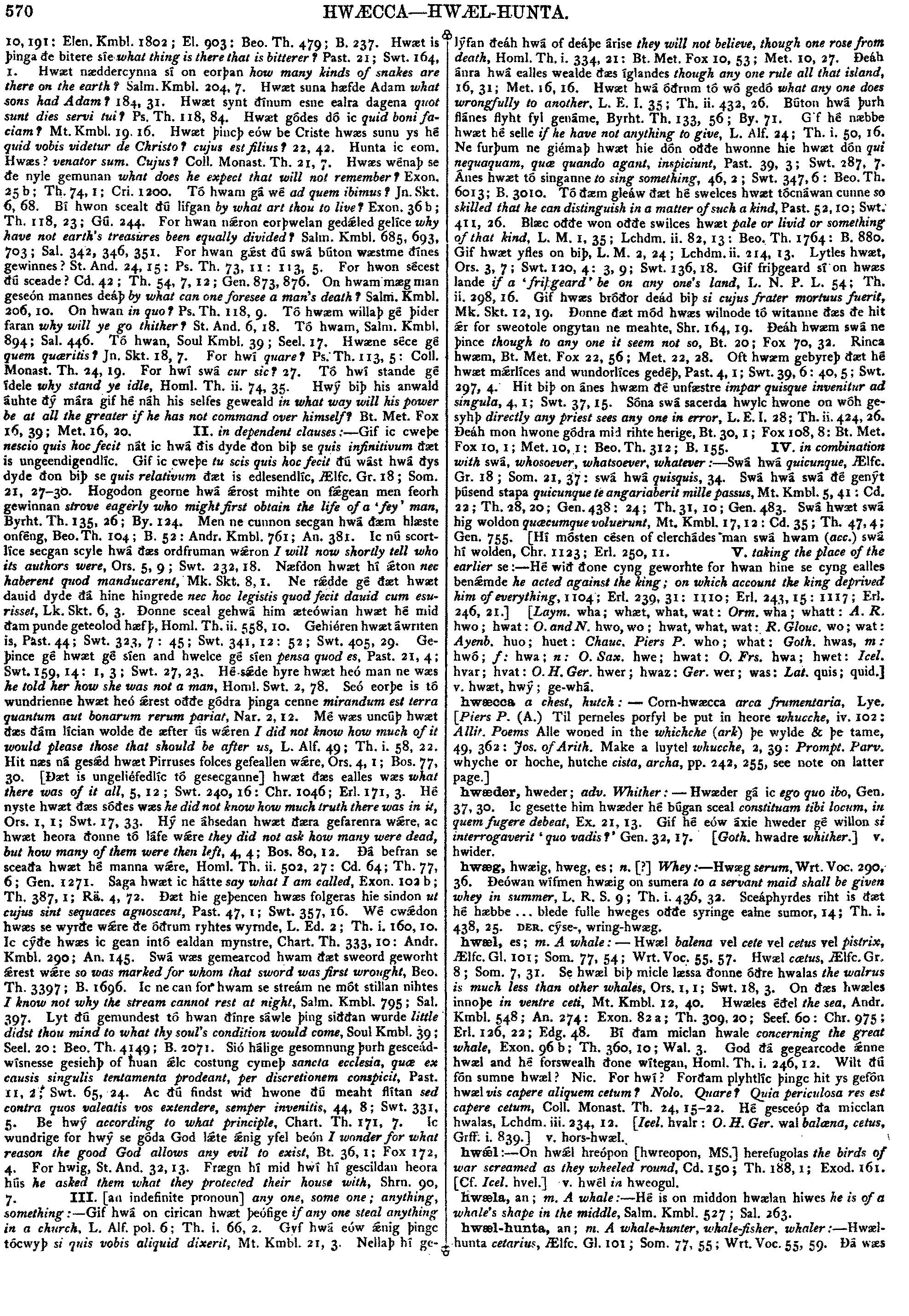
II.
in
dependent
clauses
:--
Gif
ic
cweþe
nescio
quis
hoc
fecit
nát
ic
hwá
ðis
dyde
ðon
biþ
se
quis
infinitivum
ðæt
is
ungeendigendlíc.
Gif
ic
cweþe
tu
scis
quis
hoc
fecit
ðú
wást
hwá
ðys
dyde
ðon
biþ
se
quis
relativum
ðæt
is
edlesendlíc,
Ælfc.
Gr.
18;
Som.
21,
27-30.
Hogodon
georne
hwá
rost
mihte
on
fgean
men
feorh
gewinnan
strove
eagerly
who
might
first
obtain
the
life
of
a
'fey'
man,
Byrht.
Th.
135,
26;
By.
124.
Men
ne
cunnon
secgan
hwá
dæm
hlæste
onféng,
Beo.
Th.
104;
B.
52:
Andr.
Kmbl.
761;
An.
381.
Ic
nú
scortlíce
secgan
scyle
hwá
ðæs
ordfruman
wron
I
will
now
shortly
tell
who
its
authors
were,
Ors.
5,
9;
Swt.
232,
18.
Næfdon
hwæt
hí
ton
nec
haberent
quod
manducarent,
Mk.
Skt.
8,
1.
Ne
rdde
gé
ðæt
hwæt
dauid
dyde
ðá
hine
hingrede
nec
hoc
legistis
quod
fecit
dauid
cum
esurisset,
Lk.
Skt.
6,
3.
Ðonne
sceal
gehwá
him
æteówian
hwæt
hé
mid
ðam
punde
geteolod
hæfþ,
Homl.
Th.
ii.
558,
10.
Gehiéren
hwæt
áwriten
is,
Past.
44;
Swt.
323,
7:
45;
Swt.
341,
12:
52;
Swt.
405,
29.
Geþince
gé
hwæt
gé
síen
and
hwelce
gé
síen
pensa
quod
es,
Past.
21,
4;
Swt.
159,
14:
1,
3;
Swt.
27,
23.
Hé
sde
hyre
hwæt
heó
man
ne
wæs
he
told
her
how
she
was
not
a
man,
Homl.
Swt.
2,
78.
Seó
eorþe
is
tó
wundrienne
hwæt
heó
rest
oððe
gódra
þinga
cenne
mirandum
est
terra
quantum
aut
bonarum
rerum
pariat,
Nar.
2,
12.
Mé
wæs
uncúþ
hwæt
ðæs
ðám
lícian
wolde
ðe
æfter
ús
wren
I
did
not
know
how
much
of
it
would
please
those
that
should
be
after
us,
L.
Alf.
49;
Th.
i.
58,
22.
Hit
næs
ná
gesd
hwæt
Pirruses
folces
gefeallen
wre,
Ors.
4,
1;
Bos.
77,
30.
[Ðæt
is
ungeliéfedlíc
tó
gesecganne]
hwæt
ðæs
ealles
wæs
what
there
was
of
it
all,
5,
12;
Swt.
240,
16:
Chr.
1046;
Erl.
171,
3.
Hé
nyste
hwæt
ðæs
sóðes
wæs
he
did
not
know
how
much
truth
there
was
in
it,
Ors.
1,
1;
Swt.
17,
33.
Hý
ne
áhsedan
hwæt
ðæra
gefarenra
wre,
ac
hwæt
heora
ðonne
tó
láfe
wre
they
did
not
ask
how
many
were
dead,
but
how
many
of
them
were
then
left,
4,
4;
Bos.
80,
12.
Ðá
befran
se
sceaða
hwæt
hé
manna
wre.
Homl.
Th.
ii.
502,
27:
Cd.
64;
Th.
77,
6;
Gen.
1271.
Saga
hwæt
ic
hátte
say
what
I
am
called,
Exon.
102
b;
Th.
387,
1;
Rä.
4,
72,
Ðæt
hie
geþencen
hwæs
folgeras
hie
sindon
ut
cujus
sint
sequaces
agnoscant,
Past.
47,
1;
Swt.
357,
16.
Wé
cwdon
hwæs
se
wyrðe
wre
ðe
óðrum
ryhtes
wyrnde,
L.
Ed.
2;
Th.
i.
160,
10.
Ic
cýðe
hwæs
ic
gean
intó
ealdan
mynstre,
Chart.
Th.
333,
10:
Andr.
Kmbl.
290;
An.
145.
Swá
wæs
gemearcod
hwam
ðæt
sweord
geworht
rest
wre
so
was
marked
for
whom
that
sword
was
first
wrought,
Beo.
Th.
3397;
B.
1696.
Ic
ne
can
for
hwam
se
streám
ne
mót
stillan
nihtes
I
know
not
why
the
stream
cannot
rest
at
night,
Salm.
Kmbl.
795;
Sal.
397.
Lyt
ðú
gemundest
tó
hwan
ðínre
sáwle
þing
siððan
wurde
little
didst
thou
mind
to
what
thy
soul's
condition
would
come,
Soul
Kmbl.
39;
Seel.
20:
Beo.
Th.
4149;
B.
2071.
Sió
hálige
gesomnung
þurh
gesceádwísnesse
gesiehþ
of
huan
lc
costung
cymeþ
sancta
ecclesia,
quæ
ex
causis
singulis
tentamenta
prodeant,
per
discretionem
conspicit,
Past.
11,
2;
Swt.
65,
24.
Ac
ðú
findst
wið
hwone
ðú
meaht
flítan
sed
contra
quos
valeatis
vos
extendere,
semper
invenitis,
44,
8;
Swt.
331,
5.
Be
hwý
according
to
what
principle,
Chart.
Th.
171,
7.
Ic
wundrige
for
hwý
se
góda
God
lte
nig
yfel
beón
I
wonder
for
what
reason
the
good
God
allows
any
evil
to
exist,
Bt.
36,
1;
Fox
172,
4.
For
hwig,
St.
And.
32,
13.
Frægn
hí
mid
hwí
hí
gescildan
heora
hús
he
asked
them
what
they
protected
their
house
with,
Shrn.
90,
7.
III.
[an
indefinite
pronoun]
any
one,
some
one;
anything,
something
:--
Gif
hwá
on
cirican
hwæt
þeófige
if
any
one
steal
anything
in
a
church,
L.
Alf.
pol.
6;
Th.
i.
66,
2.
Gyf
hwá
eów
nig
þingc
tócwyþ
si
quis
vobis
aliquid
dixerit,
Mt.
Kmbl.
21,
3.
Nellaþ
hí
gelýfan
ðeáh
hwá
of
deáþe
árise
they
will
not
believe,
though
one
rose
from
death,
Homl.
Th.
i.
334,
21:
Bt.
Met.
Fox
10,
53;
Met.
10,
27.
Ðeáh
ánra
hwá
ealles
wealde
ðæs
íglandes
though
any
one
rule
all
that
island,
16,
31;
Met.
16,
16.
Hwæt
hwá
óðrum
tó
wó
gedó
what
any
one
does
wrongfully
to
another,
L.
E.
I.
35;
Th.
ii.
432,
26.
Búton
hwá
þurh
flánes
flyht
fyl
genáme,
Byrht.
Th.
133,
56;
By.
71.
Gif
hé
næbbe
hwæt
hé
selle
if
he
have
not
anything
to
give,
L.
Alf.
24;
Th.
i.
50,
16.
Ne
furþum
ne
giémaþ
hwæt
hie
dón
oððe
hwonne
hie
hwæt
dón
qui
nequaquam,
quæ
quando
agant,
inspiciunt,
Past.
39,
3;
Swt.
287,
7.
Ánes
hwæt
tó
singanne
to
sing
something,
46,
2;
Swt.
347,
6:
Beo.
Th.
6013;
B.
3010.
Tó
ðæm
gleáw
ðæt
hé
swelces
hwæt
tócnáwan
cunne
so
skilled
that
he
can
distinguish
in
a
matter
of
such
a
kind,
Past.
52,
10;
Swt.
411,
26.
Blæc
oððe
won
oððe
swilces
hwæt
pale
or
livid
or
something
of
that
kind,
L.
M.
1,
35;
Lchdm.
ii.
82,
13:
Beo.
Th.
1764:
B.
880.
Gif
hwæt
yfles
on
biþ,
L.
M.
2,
24;
Lchdm.
ii.
214,
13.
Lytles
hwæt,
Ors.
3,
7;
Swt.
120,
4:
3,
9;
Swt.
136,
18.
Gif
friþgeard
sí
on
hwæs
lande
if
a
'friþgeard'
be
on
any
one's
land,
L.
N.
P.
L.
54;
Th.
ii.
298,
16.
Gif
hwæs
bróðor
deád
biþ
si
cujus
frater
mortuus
fuerit,
Mk.
Skt.
12,
19.
Ðonne
ðæt
mód
hwæs
wilnode
tó
witanne
ðæs
ðe
hit
r
for
sweotole
ongytan
ne
meahte,
Shr.
164,
19.
Ðeáh
hwæm
swá
ne
þince
though
to
any
one
it
seem
not
so,
Bt.
20;
Fox
70,
32.
Rinca
hwæm,
Bt.
Met.
Fox
22,
56;
Met.
22,
28.
Oft
hwæm
gebyreþ
ðæt
hé
hwæt
mrlíces
and
wundorlíces
gedéþ,
Past.
4,
1;
Swt.
39,
6:
40,
5;
Swt.
297,
4.
Hit
biþ
on
ánes
hwæm
ðé
unfæstre
impar
quisque
invenitur
ad
singula,
4,
1;
Swt.
37,
15.
Sóna
swá
sacerda
hwylc
hwone
on
wóh
gesyhþ
directly
any
priest
sees
any
one
in
error,
L.
E.
I.
28;
Th.
ii.
424,
26.
Ðeáh
mon
hwone
gódra
mid
rihte
herige,
Bt.
30,
1;
Fox
108,
8:
Bt.
Met.
Fox
10,
1;
Met.
10,
1:
Beo.
Th.
312;
B.
155.
IV.
in
combination
with
swá,
whosoever,
whatsoever,
whatever
:--
Swá
hwá
quicunque,
Ælfc.
Gr.
18;
Som.
21,
37:
swá
hwá
quisquis,
34.
Swá
hwá
swá
ðé
genýt
þúsend
stapa
quicunque
té
angariaberit
mille
passus,
Mt.
Kmbl.
5,
41:
Cd.
22;
Th.
28,
20;
Gen.
438:
24;
Th.
31,
10;
Gen.
483.
Swá
hwæt
swá
hig
woldon
quæcumque
voluerunt,
Mt.
Kmbl.
17,
12:
Cd.
35;
Th.
47,
4;
Gen.
755.
[Hí
mósten
césen
of
clerchádes
man
swá
hwam
(acc.)
swá
hí
wolden,
Chr.
1123;
Erl.
250,
ii.
V.
taking
the
place
of
the
earlier
se
:--
Hé
wið
ðone
cyng
geworhte
for
hwan
hine
se
cyng
ealles
benmde
he
acted
against
the
king;
on
which
account
the
king
deprived
him
of
everything,
1104;
Erl.
239,
31:
1110;
Erl.
243,
15:
1117;
Erl.
246,
21.]
[Laym.
wha;
whæt,
what,
wat:
Orm.
wha;
whatt:
A.
R.
hwo;
hwat:
O.
and
N.
hwo,
wo;
hwat,
what,
wat:
R.
Glouc.
wo;
wat:
Ayenb.
huo;
huet:
Chauc.
Piers
P.
who;
what:
Goth.
hwas,
m:
hwó;
f:
hwa;
n:
O.
Sax.
hwe;
hwat:
O.
Frs.
hwa;
hwet:
Icel.
hvar;
hvat:
O.
H.
Ger.
hwer;
hwaz:
Ger.
wer;
was:
Lat.
quis;
quid.]
v.
hwæt,
hwý;
ge-whá.
|
Source: Bosworth/Toller, page b0571, entry 13 View original page image as: [TIFF] [PNG] [View previous entry] [View next entry] |
[Comment on this entry] [View comments] |
The following entry has been hand-corrected once. |
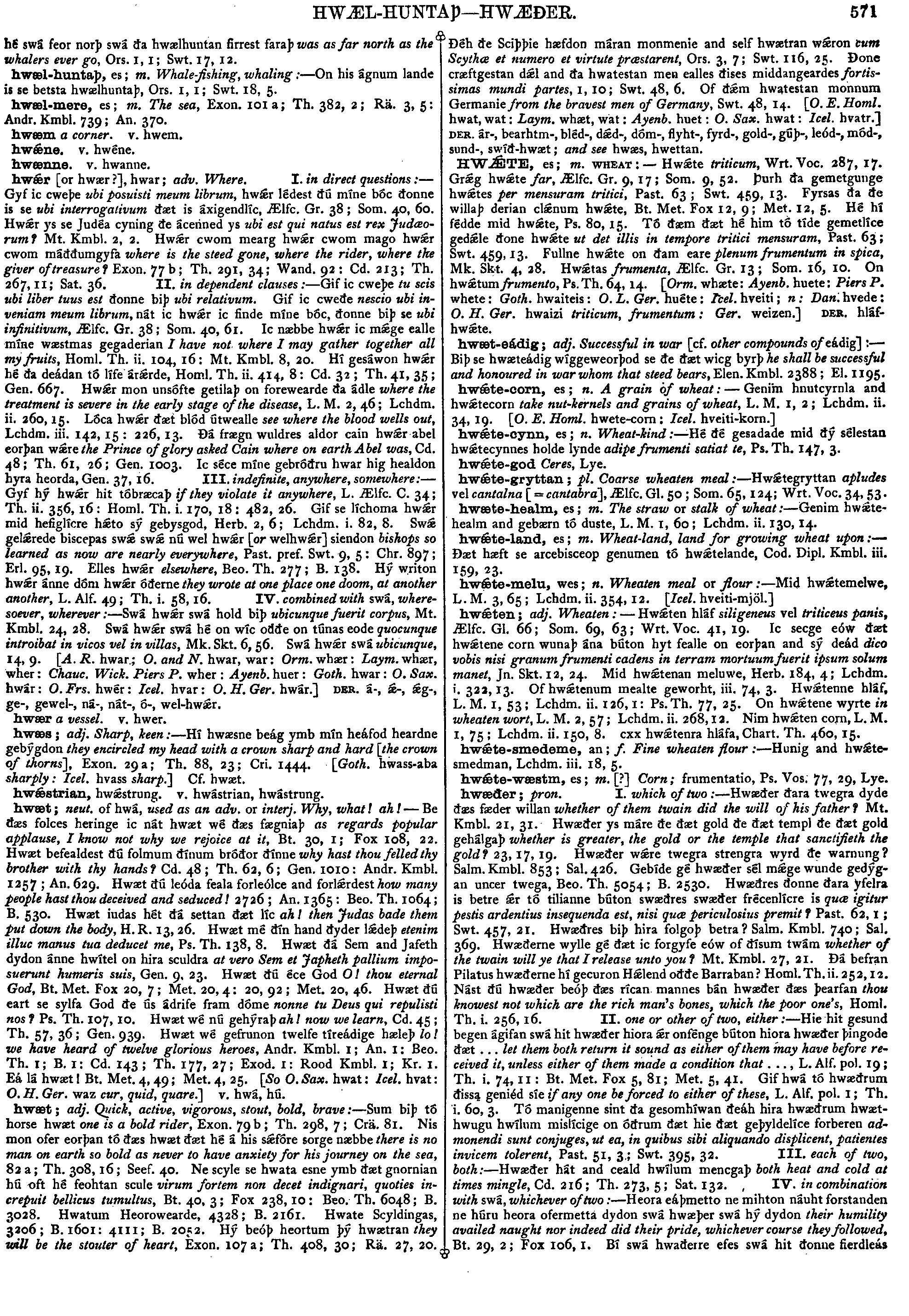
hwæt-eádig; adj. Successful in war [cf. other compounds of eádig] :-- Biþ se hwæteádig wíggeweorþod se ðe ðæt wicg byrþ he shall be successful and honoured in war whom that steed bears, Elen. Kmbl. 2388; El. 1195.
|
Source: Bosworth/Toller, page b0572, entry 8 View original page image as: [TIFF] [PNG] [View previous entry] [View next entry] |
[Comment on this entry] [View comments] |
The following entry has been hand-corrected once. |
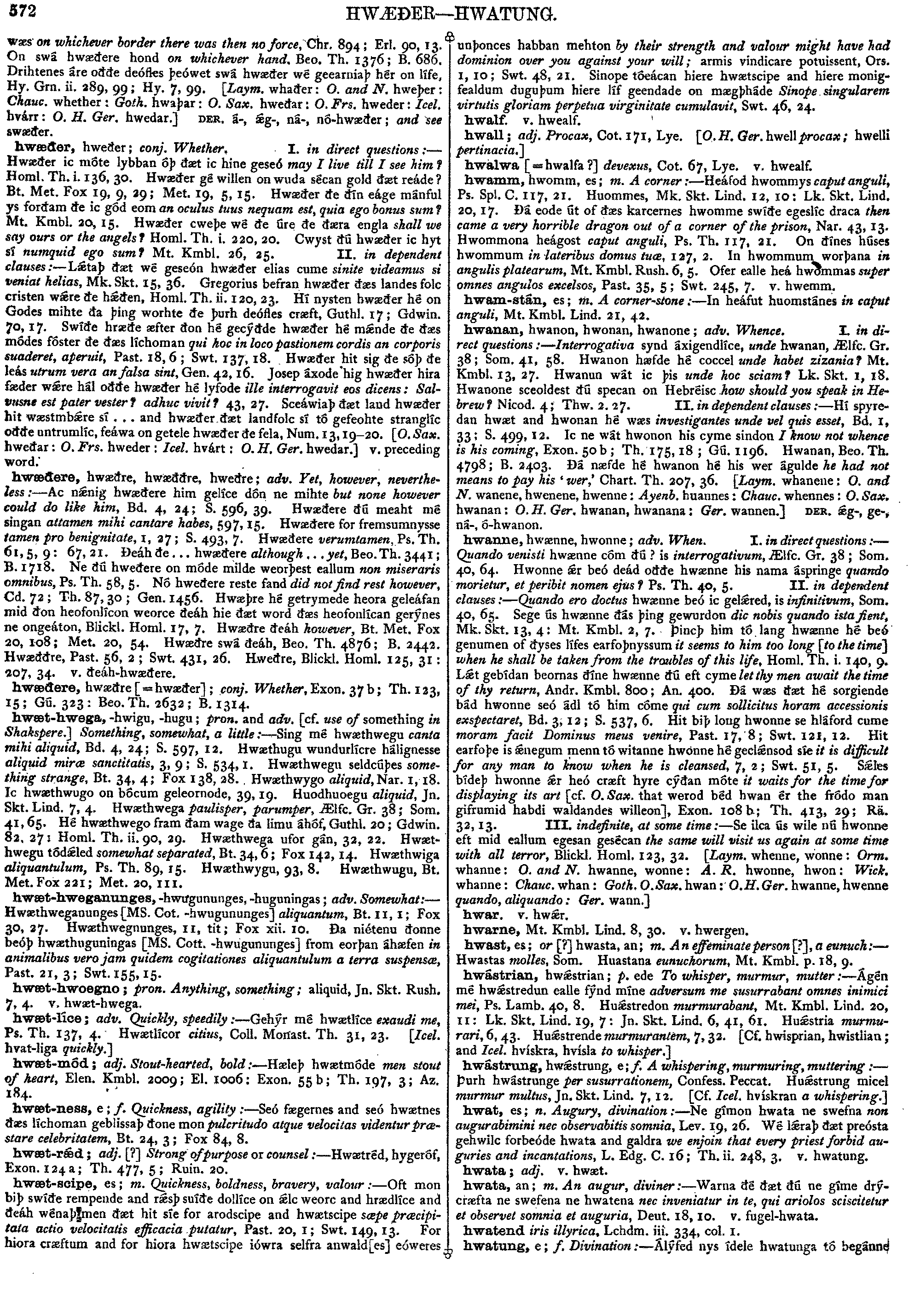
hwæt-mód; adj. Stout-hearted, bold :-- Hæleþ hwætmóde men stout of heart, Elen. Kmbl. 2009; El. 1006: Exon. 55 b; Th. 197, 3; Az. 184.
| Result Page: |  |
Previous | 59 60 61 62 63 64 65 66 67 68 69 70 71 72 73 74 75 76 77 | Next |  |
Germanic Lexicon Project (main page)
This search system was written by
Sean Crist
Please consider
volunteering
to correct the data in these online dictionaries.
No rights reserved. Feel free to use these data in any way you please.