|
|

Search for Ek again, using less strict matching (1468 results)
|
Source: Cleasby/Vigfusson, page b0081, entry 14 View original page image as: [TIFF] [PNG] [View previous entry] [View next entry] |
[Comment on this entry] [View comments] |
The following entry has been hand-corrected once. |
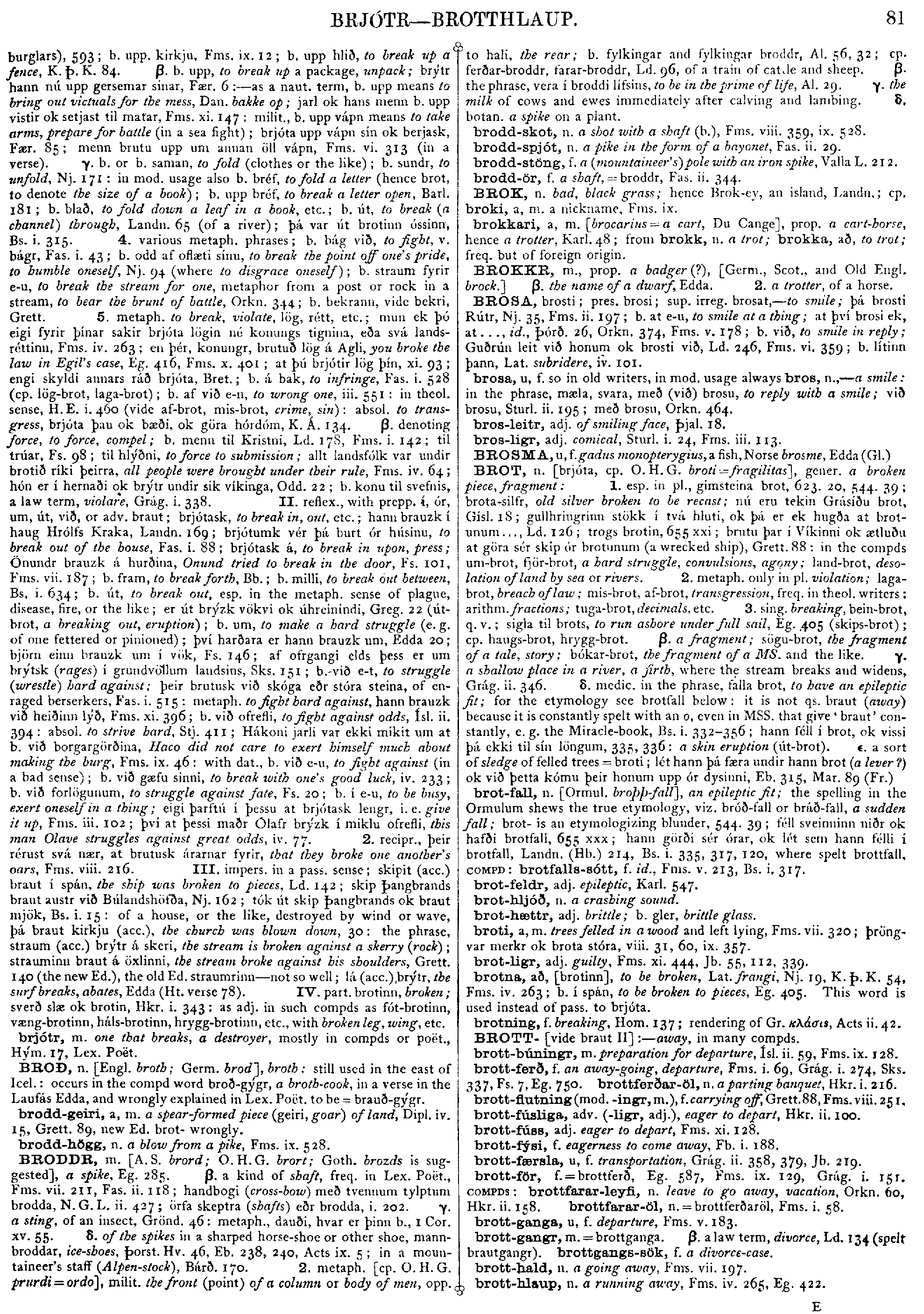
BROSA, brosti; pres. brosi; sup. irreg. brosat, -- to smile; þá brosti Rútr, Nj. 35, Fms. ii. 197; b. at e-u, to smile at a thing; at því brosi ek, at ..., id., Þórð. 26, Orkn. 374, Fms. v. 178; b. við, to smile in reply; Guðrún leit við honum ok brosti við, Ld. 246, Fms. vi. 359; b. lítinn þann, Lat. subridere, iv. 101.
|
Source: Cleasby/Vigfusson, page b0081, entry 19 View original page image as: [TIFF] [PNG] [View previous entry] [View next entry] |
[Comment on this entry] [View comments] |
The following entry has been hand-corrected once. |
BROT,
n.
[brjóta,
cp.
O.
H.
G.
broti
=
fragilitas],
gener.
a
broken
piece,
fragment:
1.
esp.
in
pl.,
gimsteina
brot,
623.
20,
544.
39;
brota-silfr,
old
silver
broken
to
be
recast;
nú
eru
tekin
Grásíðu
brot,
Gísl.
18;
gullhringrinn
stökk
í
tvá
hluti,
ok
þá
er
ek
hugða
at
brotunum
...,
Ld.
126;
trogs
brotin,
655
xxi;
brutu
bar
í
Víkinni
ok
ætluðu
at
göra
sér
skip
ór
brotunum
(a
wrecked
ship),
Grett.
88:
in
the
compds
um-brot,
fjör-brot,
a
hard
struggle,
convulsions,
agony;
land-brot,
desolation
of
land
by
sea
or
rivers.
2.
metaph.
only
in
pl.
violation;
lagabrot,
breach
of
law;
mis-brot,
af-brot,
transgression,
freq.
in
theol.
writers:
arithm.
fractions;
tuga-brot,
decimals,
etc.
3.
sing.
breaking,
bein-brot,
q.v.;
sigla
til
brots,
to
run
ashore
under
full
sail,
Eg.
405
(skips-brot);
cp.
haugs-brot,
hrygg-brot.
 .
a
fragment;
sögu-brot,
the
fragment
of
a
tale,
story;
bókar-brot,
the
fragment
of
a
MS.
and
the
like.
.
a
fragment;
sögu-brot,
the
fragment
of
a
tale,
story;
bókar-brot,
the
fragment
of
a
MS.
and
the
like.
 .
a
shallow
place
in
a
river,
a
firth,
where
the
stream
breaks
and
widens,
Grág.
ii.
346.
.
a
shallow
place
in
a
river,
a
firth,
where
the
stream
breaks
and
widens,
Grág.
ii.
346.
 .
medic.
in
the
phrase,
falla
brot,
to
have
an
epileptic
fit;
for
the
etymology
see
brotfall
below:
it
is
not
qs.
braut
(away)
because
it
is
constantly
spelt
with
an
o,
even
in
MSS.
that
give
'braut'
constantly,
e.g.
the
Miracle-book,
Bs.
i.
332-356;
hann
féll
í
brot,
ok
vissi
þá
ekki
til
sín
löngum,
335,
336:
a
skin
eruption
(út-brot).
.
medic.
in
the
phrase,
falla
brot,
to
have
an
epileptic
fit;
for
the
etymology
see
brotfall
below:
it
is
not
qs.
braut
(away)
because
it
is
constantly
spelt
with
an
o,
even
in
MSS.
that
give
'braut'
constantly,
e.g.
the
Miracle-book,
Bs.
i.
332-356;
hann
féll
í
brot,
ok
vissi
þá
ekki
til
sín
löngum,
335,
336:
a
skin
eruption
(út-brot).
 .
a
sort
of
sledge
of
felled
trees
=
broti;
lét
hann
þá
færa
undir
hann
brot
(a
lever?)
ok
við
þetta
kómu
þeir
honum
upp
ór
dysinni,
Eb.
315,
Mar.
89
(Fr.)
.
a
sort
of
sledge
of
felled
trees
=
broti;
lét
hann
þá
færa
undir
hann
brot
(a
lever?)
ok
við
þetta
kómu
þeir
honum
upp
ór
dysinni,
Eb.
315,
Mar.
89
(Fr.)
|
Source: Cleasby/Vigfusson, page b0084, entry 5 View original page image as: [TIFF] [PNG] [View previous entry] [View next entry] |
[Comment on this entry] [View comments] |
The following entry has been hand-corrected once. |
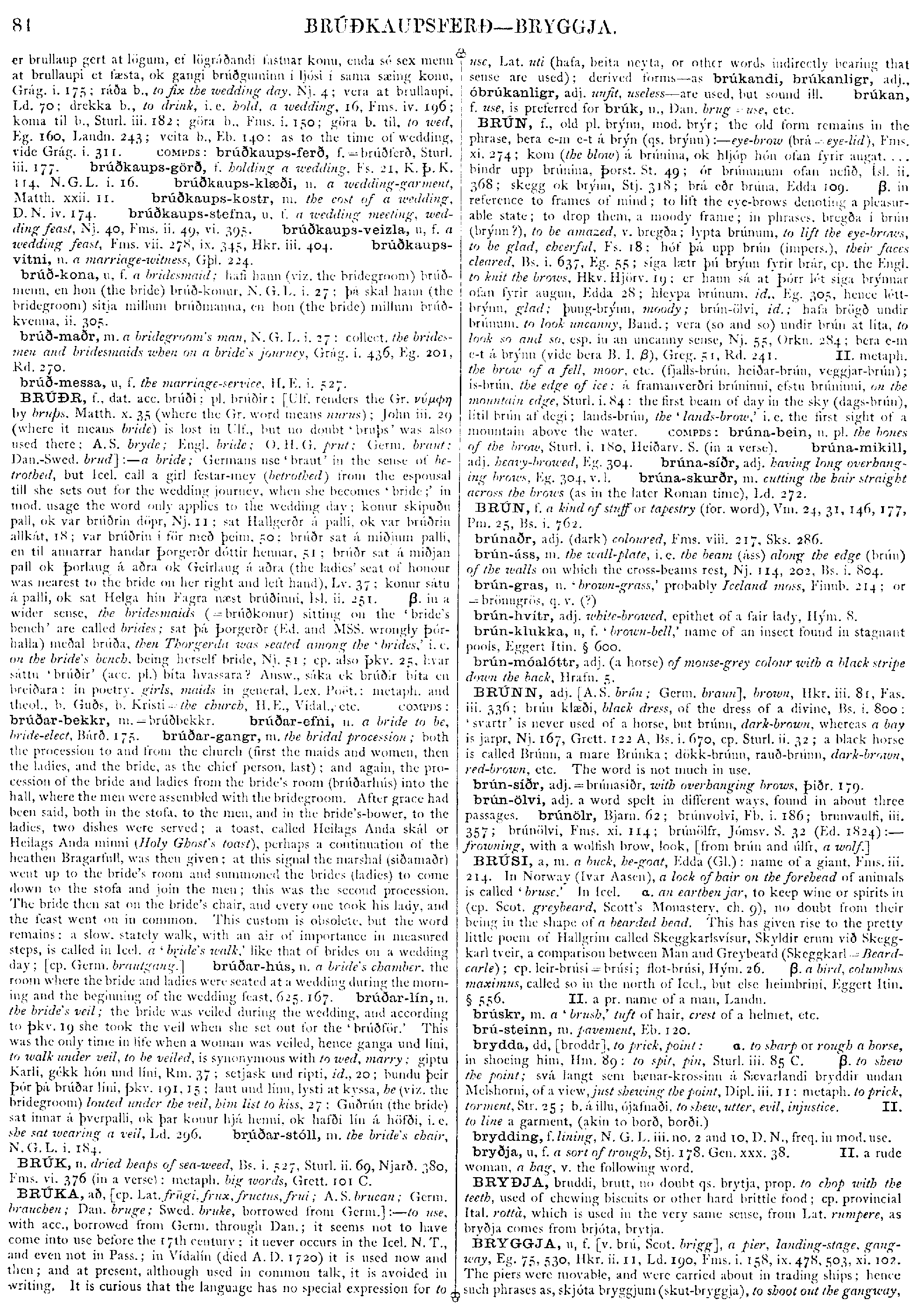
BRÚÐR,
f.,
dat.
acc.
brúði;
pl.
brúðir:
[Ulf.
renders
the
Gr.
GREEK
by
bruþs,
Matth.
x.
35
(where
the
Gr.
word
means
nurus);
John
iii.
29
(where
it
means
bride)
is
lost
in
UIf.,
but
no
doubt
'bruþs'
was
also
used
there:
A.
S.
bryde;
Engl.
bride;
O.
H.
G.
prut;
Germ,
braut;
Dan.-Swed.
Brud]
:--
a
bride;
Germans
use
'braut'
in
the
sense
of
betrothed,
but
Icel.
call
a
girl
festar-mey
(betrothed)
from
the
espousal
till
she
sets
out
for
the
wedding
journey,
when
she
becomes
'bride';
in
mod.
usage
the
word
only
applies
to
the
wedding
day;
konur
skipuðu
pall,
ok
var
brúðrin
döpr,
Nj.
11;
sat
Hallgerðr
á
palli,
ok
var
brúðrin
allkát,
18;
var
brúðrin
í
för
með
þeim,
50;
brúðr
sat
á
miðjum
palli,
en
til
annarrar
handar
Þorgerðr
dóttir
hennar,
51;
brúðr
sat
á
midjan
pall
ok
Þorlaug
á
aðra
ok
Geirlaug
á
aðra
(the
ladies'
seat
of
honour
was
nearest
to
the
bride
on
her
right
and
left
hand),
Lv.
37;
konur
sátu
á
palli,
ok
sat
Helga
hin
Fagra
næst
brúðinni,
Ísl..
ii.
251.
.
in
a
wider
sense,
the
bridesmaids
(
=
brúðkonur)
sitting
on
the
'bride's
bench'
are
called
brides;
sat
þá
Þorgerðr
(Ed.
and
MSS.
wrongly
Þórhalla)
meðal
brúða,
then
Thorgerda
was
seated
among
the
'brides,'
i.
e.
on
the
bride's
bench,
being
herself
bride,
Ni.
51;
cp.
also
Þkv.
25,
hvar
sattu
'brúðir'
(acc.
pl.)
bíta
hvassara?
Answ.,
sáka
ek
brúðir
bíta
en
breiðara:
in
poetry,
girls,
maids
in
general.
Lex.
Poët.:
metaph.
and
theol.,
b.
Guðs,
b.
Kristi
=
the
church,
H.
E.,
Vidal.,
etc.
COMPDS:
brúðar-bekkr,
m.
=
brúðbekkr.
brúðar-efni,
n.
a
bride
to
be,
bride-elect,
Bárð.
175.
brúðar-gangr,
m.
the
bridal
procession;
both
the
procession
to
and
from
the
church
(first
the
maids
and
women,
then
the
ladies,
and
the
bride,
as
the
chief
person,
last);
and
again,
the
procession
of
the
bride
and
ladies
from
the
bride's
room
(brúðarhús)
into
the
hall,
where
the
men
were
assembled
with
the
bridegroom.
After
grace
had
been
said,
both
in
the
stofa,
to
the
men,
and
in
the
bride's-bower,
to
the
ladies,
two
dishes
were
served;
a
toast,
called
Heilags
Anda
skál
or
Heilags
Anda
minni
(Holy
Ghost's
toast),
perhaps
a
continuation
of
the
heathen
Bragarfull,
was
then
given;
at
this
signal
the
marshal
(siðamaðr)
went
up
to
the
bride's
room
and
summoned
the
brides
(ladies)
to
come
down
to
the
stofa
and
join
the
men;
this
was
the
second
procession.
The
bride
then
sat
on
the
bride's
chair,
and
every
one
took
his
lady,
and
the
feast
went
on
in
common.
This
custom
is
obsolete,
but
the
word
remains:
a
slow,
stately
walk,
with
an
air
of
importance
in
measured
steps,
is
called
in
Icel.
a
'bride's
walk,'
like
that
of
brides
on
a
wedding
day;
[cp.
Germ.
brautgang.]
brúðar-hús,
n.
a
bride's
chamber,
the
room
where
the
bride
and
ladies
were
seated
at
a
wedding
during
the
morning
and
the
beginning
of
the
wedding
feast,
625.
167.
brúðar-lín,
n.
the
bride's
veil;
the
bride
was
veiled
during
the
wedding,
and
according
to
Þkv.
19
she
took
the
veil
when
she
set
out
for
the
'brúðför.'
This
was
the
only
time
in
life
when
a
woman
was
veiled,
hence
ganga
und
líni,
to
walk
under
veil,
to
be
veiled,
is
synonymous
with
to
wed,
marry;
giptu
Karli,
gékk
hón
und
líni,
Rm.
37;
setjask
und
ripti,
id.,
20;
bundu
þeir
Þór
þá
brúðar
líni,
Þkv.
191,
15;
laut
und
línn,
lysti
at
kyssa,
he
(viz.
the
bridegroom)
louted
under
the
veil,
him
list
to
kiss,
27;
Guðrún
(the
bride)
sat
innar
á
þverpalli,
ok
þar
konur
hja
henni,
ok
hafði
lín
á
höfði,
i.
e.
she
sat
wearing
a
veil,
Ld.
296.
brúðar-stóll,
m.
the
bride's
chair,
N.
G.
L.
i.
184.
|
Source: Cleasby/Vigfusson, page b0084, entry 50 View original page image as: [TIFF] [PNG] [View previous entry] [View next entry] |
[Comment on this entry] [View comments] |
The following entry has been hand-corrected once. |
brýning, f. a whetting, sharpening, esp. metaph. egging on, sharpening; ek veit görst um yðr sonu mína, þurfi þér brýningina, Ld. 240; segir, at þá hefði þeir tekið brýningunni, Hkr. ii. 239.
|
Source: Cleasby/Vigfusson, page b0084, entry 53 View original page image as: [TIFF] [PNG] [View previous entry] [View next entry] |
[Comment on this entry] [View comments] |
The following entry has been hand-corrected once. |
bræða, dd, [bráð], to melt, Sks. 145; b. jökul, snjó, ís, Fms. iii. 180, ix. 355, K. Á. 6; b. lýsi, to make oil. 2. metaph. to hurry; nú seinkaða ek, en þú bræddir heldr, I tarried, but you hurried, Dropl. 25. 3. [bráð, n.], to tar, pitch; b. hús, skip, timbr, kirkju, etc., Fms. i. 291, v. 331, Vm. 62, Eg. 90, N. G. L. ii. 247, Gþl. 81.
|
Source: Cleasby/Vigfusson, page b0084, entry 92 View original page image as: [TIFF] [PNG] [View previous entry] [View next entry] |
[Comment on this entry] [View comments] |
The following entry has been hand-corrected once. |
BURÐR,
ar,
m.
pl.
ir,
[Engl.
birth;
Hel.
giburd;
Germ.
geburt;
cp.
bera
A.
II]
:--
birth,
esp.
of
the
birth
of
Christ;
frá
Guðs,
Drottins,
Krists
burði,
Bs.
i.
112,
145,
158,
173;
frá
hingað-burði
Christi,
id.,
64,
75,
79,
85;
til
burðar
Christi,
Rb.
84:
of
men,
sótt
burðar
=
jóðsótt,
labours,
K.
Á.
104.
2.
of
domestic
animals,
calving,
lambing,
hence
sauð-burðr,
the
lambing-time;
þeim
kúm
er
bezt
búast
til
burðar,
Bs.
i.
194.
3.
birth,
the
thing
born,
an
embryo;
Fíllinn
gengr
tvö
ár
með
burðinum,
Stj.
70;
at
þær
(viz.
the
ewes)
skyldi
sinn
burð
geta,
178;
fæða
sinn
burð,
97;
með
konum
leysisk
burðr
(abort),
Bs.
i.
798.
4.
in
pl.
birth,
extraction;
heiðinn
at
burðum
(MS.
sing.),
heathen
by
birth,
Ver.
40;
burðir
ok
ætt,
kith
and
kin,
Fms.
i.
83;
er
ekki
er
til
Noregs
kominn
fyrir
burða
sakir,
ix.
389;
Hákon
jarl
hafði
burði
til
þess,
at
halda
foðurleifð
sinni,
ok
hafa
jarlsnafn,
i.
223;
þykkjumk
ek
hafa
til
þess
burði
ok
frænda
styrk,
Eg.
474;
hence
in
mod.
usage
burðir
means
one's
'physique,'
strength;
burðamaðr
mikill,
a
mighty
strong
man;
hafa
litla
burði,
to
have
little
strength;
yfir-burðir,
superior
strength
(cp.
bera
yfir),
and
afburðir,
q.v.
II.
the
bearing
of
limbs,
body;
lima-burðr,
fóta-burðr,
höfuð-burðr.
III.
[bera
C],
the
compds
at-burðr,
við-burðr,
til-burðr,
hop,
accident;
fyrir-burðr,
vision.
IV.
answering
to
bera
A.
I,
vide
byrðr,
and
compds
like
á-burðr.
.
saman-burðr,
comparison.
COMPDS:
burða-munr,
m.
distance
of
birth,
Fs.
125.
burðar-dagr,
m.
a
birthday,
Hom.
106;
b.
Maríu,
the
nativity
of
the
Virgin
Mary,
Rb.
8.
burðar-maðr,
m.
a
bearer,
Fms.
i.
271.
burðar-sveinn,
m.
an
errand-boy,
Fms.
vii.
222.
burðar-tími,
a,
m.
birth-time,
Stj.
97;
natal
hour,
101.
|
Source: Cleasby/Vigfusson, page b0087, entry 1 View original page image as: [TIFF] [PNG] [View previous entry] [View next entry] |
[Comment on this entry] [View comments] |
The following entry has been hand-corrected once. |
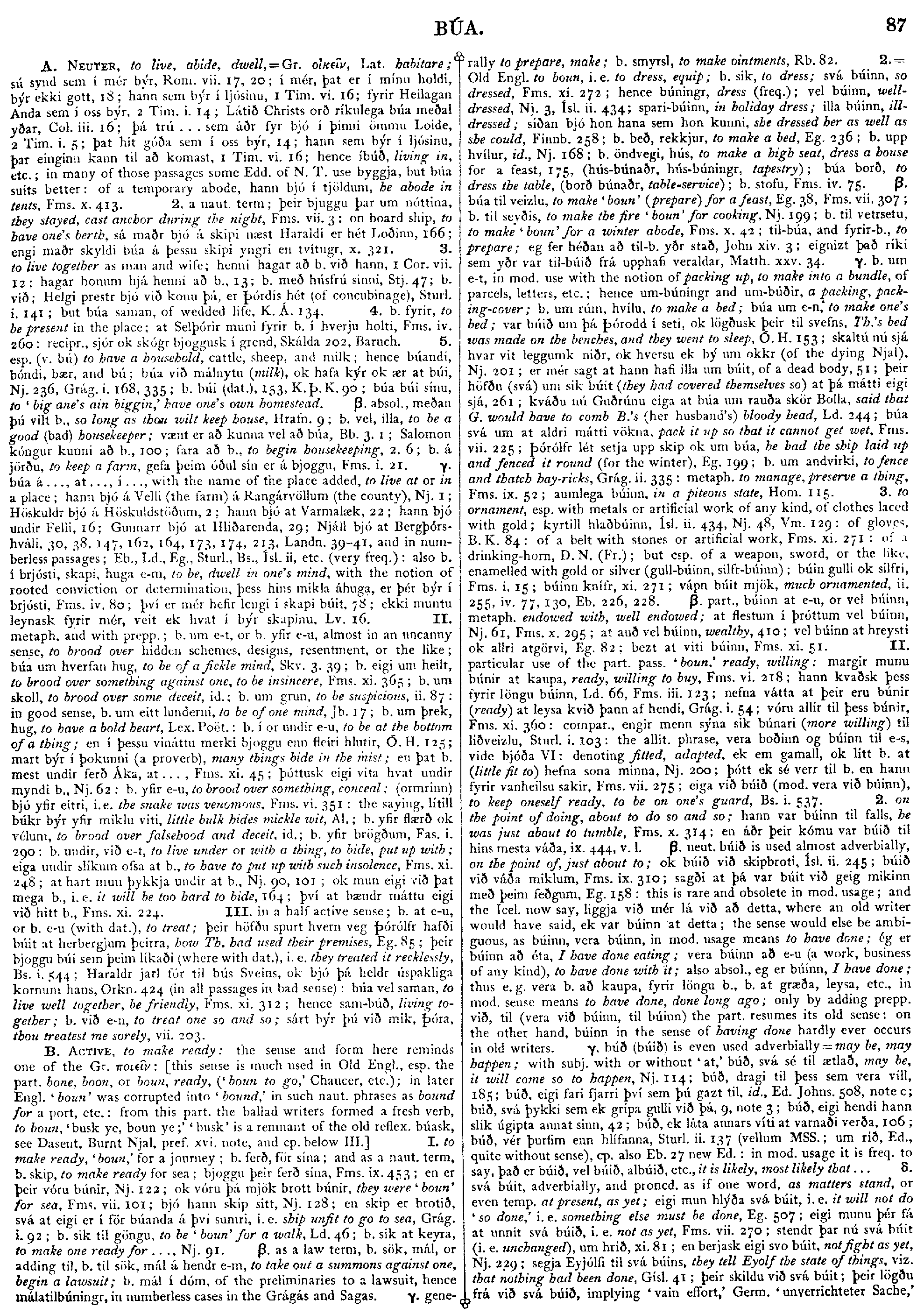
A.
NEUTER,
to
live,
abide,
dwell,
=
Gr.
GREEK,
Lat.
habitare;
sú
synd
sem
í
mér
býr,
Rom.
vii.
17,
20;
í
mér,
þat
er
í
mínu
holdi,
býr
ekki
gott,
18;
hann
sem
býr
í
ljósinu,
1
Tim.
vi.
16;
fyrir
Heilagan
Anda
sem
í
oss
býr,
2
Tim.
i.
14;
Látið
Christs
orð
ríkulega
búa
meðal
yðar,
Col.
iii.
16;
þá
trú
...
sem
áðr
fyr
bjó
í
þinni
ömmu
Loide,
2
Tim.
i.
5;
þat
hit
góða
sem
í
oss
býr,
14;
hann
sem
býr
í
ljósinu,
þar
einginn
kann
til
að
komast,
1
Tim.
vi.
16;
hence
íbúð,
living
in,
etc.;
in
many
of
those
passages
some
Edd.
of
N.
T.
use
byggja,
but
búa
suits
better:
of
a
temporary
abode,
hann
bjó
í
tjöldum,
he
abode
in
tents,
Fms.
x.
413.
2.
a
naut.
term;
þeir
bjuggu
þar
um
nóttina,
they
stayed,
cast
anchor
during
the
night,
Fms.
vii.
3:
on
board
ship,
to
have
one's
berth,
sá
maðr
bjó
á
skipi
næst
Haraldi
er
hét
Loðinn,
166;
engi
maðr
skyldi
búa
á
þessu
skipi
yngri
en
tvítugr,
x.
321.
3.
to
live
together
as
man
and
wife;
henni
hagar
að
b.
við
hann,
1
Cor.
vii.
12;
hagar
honum
hjá
henni
að
b.,
13;
b.
með
húsfrú
sinni,
Stj.
47;
b.
við;
Helgi
prestr
bjó
við
konu
þá,
er
Þórdís
hét
(of
concubinage),
Sturl.
i.
141;
but
búa
saman,
of
wedded
life,
K.
Á.
134.
4.
b.
fyrir,
to
be
present
in
the
place:
at
Selþórir
muni
fyrir
b.
í
hverju
holti,
Fms.
iv.
260:
recipr.,
sjór
ok
skúgr
bjoggusk
í
grend,
Skálda
202,
Baruch.
5.
esp.
(v.
bú)
to
have
a
household,
cattle,
sheep,
and
milk;
hence
búandi,
bóndi,
bær,
and
bú;
búa
við
málnytu
(milk),
ok
hafa
kýr
ok
ær
at
búi,
Nj.
236,
Grág.
i.
168,
335;
b.
búi
(dat.),
153,
K.
Þ.
K.
90;
búa
búi
sínu,
to
'big
ane's
ain
biggin,'
have
one's
own
homestead.
.
absol.,
meðan
þú
vilt
b.,
so
long
as
thou
wilt
keep
bouse,
Hrafn.
9;
b.
vel,
illa,
to
be
a
good
(bad)
housekeeper;
vænt
er
að
kunna
vel
að
búa,
Bb.
3.
1;
Salomon
kóngur
kunni
að
b.,
100;
fara
að
b.,
to
begin
housekeeping,
2.
6;
b.
á
jörðu,
to
keep
a
farm,
gefa
þeim
óðul
sín
er
á
bjoggu,
Fms.
i.
21.
.
búa
á
...,
at
...,
i
...,
with
the
name
of
the
place
added,
to
live
at
or
in
a
place;
hann
bjó
á
Velli
(the
farm)
á
Rangárvöllum
(the
county),
Nj.
1;
Höskuldr
bjó
á
Höskuldstöðum,
2:
hann
bjó
at
Varmalæk,
22;
hann
bjó
undir
Felli,
16;
Gunnarr
bjó
at
Hlíðarenda,
29;
Njáll
bjó
at
Bergþórshváli,
30,
38,
147,
162,
164,
173,
174,
213,
Landn.
39-41,
and
in
numberless
passages;
Eb.,
Ld.,
Eg.,
Sturl.,
Bs.,
Ísl.
ii,
etc.
(very
freq.):
also
b.
í
brjósti,
skapi,
huga
e-m,
to
be,
dwell
in
one's
mind,
with
the
notion
of
rooted
conviction
or
determination,
þess
hins
mikla
áhuga,
er
þér
býr
í
brjósti,
Fms.
iv.
80;
því
er
mér
hefir
lengi
í
skapi
búit,
78;
ekki
muntu
leynask
fyrir
mér,
veit
ek
hvat
í
býr
skapinu,
Lv.
16.
II.
metaph.
and
with
prepp.;
b.
um
e-t,
or
b.
yfir
e-u,
almost
in
an
uncanny
sense,
to
brood
over
hidden
schemes,
designs,
resentment,
or
the
like;
búa
um
hverfan
hug,
to
be
of
a
fickle
mind,
Skv.
3.
39;
b.
eigi
um
heilt,
to
brood
over
something
against
one,
to
be
insincere,
Fms.
xi.
365;
b.
um
skoll,
to
brood
over
some
deceit,
id.;
b.
um
grun,
to
be
suspicious,
ii.
87:
in
good
sense,
b.
um
eitt
lunderni,
to
be
of
one
mind,
Jb.
17;
b.
um
þrek,
hug,
to
have
a
bold
heart,
Lex.
Poët.:
b.
í
or
undir
e-u,
to
be
at
the
bottom
of
a
thing;
en
í
þessu
vináttu
merki
bjoggu
enn
fleiri
hlutir,
Ó.
H.
125;
mart
býr
í
þokunni
(a
proverb),
many
things
bide
in
the
mist;
en
þat
b.
mest
undir
ferð
Áka,
at
...,
Fms.
xi.
45;
þóttusk
eigi
vita
hvat
undir
myndi
b.,
Nj.
62:
b.
yfir
e-u,
to
brood
over
something,
conceal;
(ormrinn)
bjó
yfir
eitri,
i.e.
the
snake
was
venomous,
Fms.
vi.
351:
the
saying,
lítill
búkr
býr
yfir
miklu
viti,
little
bulk
hides
mickle
wit,
Al.;
b.
yfir
flærð
ok
vélum,
to
brood
over
falsehood
and
deceit,
id.;
b.
yfir
brögðum,
Fas.
i.
290:
b.
undir,
við
e-t,
to
live
under
or
with
a
thing,
to
bide,
put
up
with;
eiga
undir
slíkum
ofsa
at
b.,
to
have
to
put
up
with
such
insolence,
Fms.
xi.
248;
at
hart
mun
þykkja
undir
at
b.,
Nj.
90,
101;
ok
mun
eigi
við
þat
mega
b.,
i.e.
it
will
be
too
hard
to
bide,
164;
því
at
bændr
máttu
eigi
við
hitt
b.,
Fms.
xi.
224.
III.
in
a
half
active
sense;
b.
at
e-u,
or
b.
e-u
(with
dat.),
to
treat;
þeir
höfðu
spurt
hvern
veg
Þórólfr
hafði
búit
at
herbergjum
þeirra,
how
Th.
had
used
their
premises,
Eg.
85;
þeir
bjoggu
búi
sem
þeim
líkaði
(where
with
dat.),
i.e.
they
treated
it
recklessly,
Bs.
i.
544;
Haraldr
jarl
fór
til
bús
Sveins,
ok
bjó
þá
heldr
úspakliga
kornum
hans,
Orkn.
424
(in
all
passages
in
bad
sense):
búa
vel
saman,
to
live
well
together,
be
friendly,
Fms.
xi.
312;
hence
sam-búð,
living
together;
b.
við
e-n,
to
treat
one
so
and
so;
sárt
býr
þú
við
mik,
Þóra,
thou
treatest
me
sorely,
vii.
203.
|
Source: Cleasby/Vigfusson, page b0087, entry 2 View original page image as: [TIFF] [PNG] [View previous entry] [View next entry] |
[Comment on this entry] [View comments] |
The following entry has been hand-corrected once. |
B.
ACTIVE,
to
make
ready:
the
sense
and
form
here
reminds
one
of
the
Gr.
GREEK:
[this
sense
is
much
used
in
Old
Engl.,
esp.
the
part.
bone,
boon,
or
boun,
ready,
('boun
to
go,'
Chaucer,
etc.);
in
later
Engl.
'boun'
was
corrupted
into
'bound,'
in
such
naut.
phrases
as
bound
for
a
port,
etc.:
from
this
part,
the
ballad
writers
formed
a
fresh
verb,
to
boun,
'busk
ye,
boun
ye;'
'busk'
is
a
remnant
of
the
old
reflex,
búask,
see
Dasent,
Burnt
Njal,
pref.
xvi.
note,
and
cp.
below
III.]
I.
to
make
ready,
'boun,'
for
a
journey;
b.
ferð,
för
sína;
and
as
a
naut.
term,
b.
skip,
to
make
ready
for
sea;
bjoggu
þeir
ferð
sína,
Fms.
ix.
453;
en
er
þeir
vóru
búnir,
Nj.
122;
ok
vóru
þá
mjök
brott
búnir,
they
were
'boun'
for
sea,
Fms.
vii.
101;
bjó
hann
skip
sitt,
Nj.
128;
en
skip
er
brotið,
svá
at
eigi
er
í
för
búanda
á
því
sumri,
i.e.
ship
unfit
to
go
to
sea,
Grág.
i.
92;
b.
sik
til
göngu,
to
be
'boun'
for
a
walk,
Ld.
46;
b.
sik
at
keyra,
to
make
one
ready
for
...,
Nj.
91.
.
as
a
law
term,
b.
sök,
mál,
or
adding
til,
b.
til
sök,
mál
á
hendr
e-m,
to
take
out
a
summons
against
one,
begin
a
lawsuit;
b.
mál
í
dóm,
of
the
preliminaries
to
a
lawsuit,
hence
málatilbúningr,
in
numberless
cases
in
the
Grágás
and
Sagas.
.
generally
to
prepare,
make;
b.
smyrsl,
to
make
ointments,
Rb.
82.
2.
=
Old
Engl.
to
boun,
i.e.
to
dress,
equip;
b.
sik,
to
dress;
svá
búinn,
so
dressed,
Fms.
xi.
272;
hence
búningr,
dress
(freq.);
vel
búinn,
well-dressed,
Nj.
3,
Ísl.
ii.
434;
spari-búinn,
in
holiday
dress;
illa
búinn,
ill-dressed;
síðan
bjó
hon
hana
sem
hon
kunni,
she
dressed
her
as
well
as
she
could,
Finnb.
258;
b.
beð,
rekkjur,
to
make
a
bed,
Eg.
236;
b.
upp
hvílur,
id.,
Nj.
168;
b.
öndvegi,
hús,
to
make
a
high
seat,
dress
a
house
for
a
feast,
175,
(hús-búnaðr,
hús-búningr,
tapestry);
búa
borð,
to
dress
the
table,
(borð
búnaðr,
table-service);
b.
stofu,
Fms.
iv.
75.
.
búa
til
veizlu,
to
make
'boun'
(prepare)
for
a
feast,
Eg.
38,
Fms.
vii.
307;
b.
til
seyðis,
to
make
the
fire
'boun'
for
cooking,
Nj.
199;
b.
til
vetrsetu,
to
make
'boun'
for
a
winter
abode,
Fms.
x.
42;
til-búa,
and
fyrir-b.,
to
prepare;
eg
fer
héðan
að
til-b.
yðr
stað,
John
xiv.
3;
eignizt
það
ríki
sem
yðr
var
til-búið
frá
upphafi
veraldar,
Matth.
xxv.
34.
.
b.
um
e-t,
in
mod.
use
with
the
notion
of
packing
up,
to
make
into
a
bundle,
of
parcels,
letters,
etc.;
hence
um-búningr
and
um-búðir,
a
packing,
packing-cover;
b.
um
rúm,
hvílu,
to
make
a
bed;
búa
um
e-n,
to
make
one's
bed;
var
búið
um
þá
Þórodd
í
seti,
ok
lögðusk
þeir
til
svefns,
Th.'s
bed
was
made
on
the
benches,
and
they
went
to
sleep,
Ó.
H.
153;
skaltú
nú
sjá
hvar
vit
leggumk
niðr,
ok
hversu
ek
bý
um
okkr
(of
the
dying
Njal),
Nj.
701;
er
mér
sagt
at
hann
hafi
illa
um
búit,
of
a
dead
body,
51;
þeir
höfðu
(svá)
um
sik
búit
(they
had
covered
themselves
so)
at
þá
mátti
eigi
sjá,
261;
kváðu
nú
Guðrúnu
eiga
at
búa
um
rauða
skör
Bolla,
said
that
G.
would
have
to
comb
B.'s
(her
husband's)
bloody
head,
Ld.
244;
búa
svá
um
at
aldri
mátti
vökna,
pack
it
up
so
that
it
cannot
get
wet,
Fms.
vii.
225;
Þórólfr
lét
setja
upp
skip
ok
um
búa,
he
had
the
ship
laid
up
and
fenced
it
round
(for
the
winter),
Eg.
199;
b.
um
andvirki,
to
fence
and
thatch
bay-ricks,
Grág.
ii.
335:
metaph.
to
manage,
preserve
a
thing,
Fms.
ix.
52;
aumlega
búinn,
in
a
piteous
state,
Hom.
115.
3.
to
ornament,
esp.
with
metals
or
artificial
work
of
any
kind,
of
clothes
laced
with
gold;
kyrtill
hlaðbúinn,
Ísl.
ii.
434,
Nj.
48,
Vm.
129:
of
gloves,
B.
K.
84:
of
a
belt
with
stones
or
artificial
work,
Fms.
xi.
271:
of
a
drinking-horn,
D.
N.
(Fr.);
but
esp.
of
a
weapon,
sword,
or
the
like,
enamelled
with
gold
or
silver
(gull-búinn,
silfr-búinn);
búin
gulli
ok
silfri,
Fms.
i.
15;
búinn
knífr,
xi.
271;
vápn
búit
mjök,
much
ornamented,
ii.
255,
iv.
77,
130,
Eb.
226,
228.
.
part.,
búinn
at
e-u,
or
vel
búinn,
metaph.
endowed
with,
well
endowed;
at
flestum
í
þróttum
vel
búinn,
Nj.
61,
Fms.
x.
295;
at
auð
vel
búinn,
wealthy,
410;
vel
búinn
at
hreysti
ok
allri
atgörvi,
Eg.
82;
bezt
at
viti
búinn,
Fms.
xi.
51.
II.
particular
use
of
the
part.
pass,
'boun,'
ready,
willing;
margir
munu
búnir
at
kaupa,
ready,
willing
to
buy,
Fms.
vi.
218;
hann
kvaðsk
þess
fyrir
löngu
búinn,
Ld.
66,
Fms.
iii.
123;
nefna
vátta
at
þeir
eru
búnir
(ready)
at
leysa
kvið
þann
af
hendi,
Grág.
i.
54;
vóru
allir
til
þess
búnir,
Fms.
xi.
360:
compar.,
engir
menn
sýna
sik
búnari
(more
willing)
til
liðveizlu,
Sturl.
i.
103:
the
allit.
phrase,
vera
boðinn
og
búinn
til
e-s,
vide
bjóða
VI:
denoting
fitted,
adapted,
ek
em
gamall,
ok
lítt
b.
at
(little
fit
to)
hefna
sona
minna,
Nj.
200;
þótt
ek
sé
verr
til
b.
en
hann
fyrir
vanheilsu
sakir,
Fms.
vii.
275;
eiga
við
búið
(mod.
vera
við
búinn),
to
keep
oneself
ready,
to
be
on
one's
guard,
Bs.
i.
537.
2.
on
the
point
of
doing,
about
to
do
so
and
so;
hann
var
búinn
til
falls,
he
was
just
about
to
tumble,
Fms.
x.
314;
en
áðr
þeir
kómu
var
búið
til
hins
mesta
váða,
ix.
444,
v.l.
.
neut.
búið
is
used
almost
adverbially,
on
the
point
of,
just
about
to;
ok
búið
við
skipbroti,
Ísl.
ii.
245;
búið
við
váða
miklum,
Fms.
ix.
310;
sagði
at
þá
var
búit
við
geig
mikinn
með
þeim
feðgum,
Eg.
158:
this
is
rare
and
obsolete
in
mod.
usage;
and
the
Icel.
now
say,
liggja
við
mér
lá
við
að
detta,
where
an
old
writer
would
have
said,
ek
var
búinn
at
detta;
the
sense
would
else
be
ambiguous,
as
búinn,
vera
búinn,
in
mod.
usage
means
to
have
done;
ég
er
búinn
að
eta,
I
have
done
eating;
vera
búinn
að
e-u
(a
work,
business
of
any
kind),
to
have
done
with
it;
also
absol.,
eg
er
búinn,
I
have
done;
thus
e.g.
vera
b.
að
kaupa,
fyrir
löngu
b.,
b.
at
græða,
leysa,
etc.,
in
mod.
sense
means
to
have
done,
done
long
ago;
only
by
adding
prepp.
við,
til
(vera
við
búinn,
til
búinn)
the
part.
resumes
its
old
sense:
on
the
other
hand,
búinn
in
the
sense
of
having
done
hardly
ever
occurs
in
old
writers.
.
búð
(búið)
is
even
used
adverbially
=
may
be,
may
happen;
with
subj.
with
or
without
'at,'
búð,
svá
sé
til
ætlað,
may
be,
it
will
come
so
to
happen,
Nj.
114;
búð,
dragi
til
þess
sem
vera
vill,
185;
búð,
eigi
fari
fjarri
því
sem
þú
gazt
til,
id.,
Ed.
Johns.
508,
note
c;
búð,
svá
þykki
sem
ek
grípa
gulli
við
þá,
9,
note
3;
búð,
eigi
hendi
hann
slík
úgipta
annat
sinn,
42;
búð,
ek
láta
annars
víti
at
varnaði
verða,
106;
búð,
vér
þurfim
enn
hlífanna,
Sturl.
ii.
137
(vellum
MSS.;
um
ríð,
Ed.,
quite
without
sense),
cp.
also
Eb.
27
new
Ed.:
in
mod.
usage
it
is
freq.
to
say,
það
er
búið,
vel
búið,
albúið,
etc.,
it
is
likely,
most
likely
that
...
.
svá
búit,
adverbially,
and
proncd.
as
if
one
word,
as
matters
stand,
or
even
temp.
at
present,
as
yet;
eigi
mun
hlýða
svá
búit,
i.e.
it
will
not
do
'so
done,'
i.e.
something
else
must
be
done,
Eg.
507;
eigi
munu
þér
fá
at
unnit
svá
búið,
i.e.
not
as
yet,
Fms.
vii.
270;
stendr
þar
nú
svá
búit
(i.e.
unchanged),
um
hríð,
xi.
81;
en
berjask
eigi
svo
búit,
not
fight
as
yet,
Nj.
229;
segja
Eyjólfi
til
svá
búins,
they
tell
Eyolf
the
state
of
things,
viz.
that
nothing
had
been
done,
Gísl.
41;
þeir
skildu
við
svá
búit;
þeir
lögðu
frá
við
svá
búið,
implying
'vain
effort,'
Germ.
'unverrichteter
Sache,'
|
Source: Cleasby/Vigfusson, page b0088, entry 6 View original page image as: [TIFF] [PNG] [View previous entry] [View next entry] |
[Comment on this entry] [View comments] |
The following entry has been hand-corrected once. |
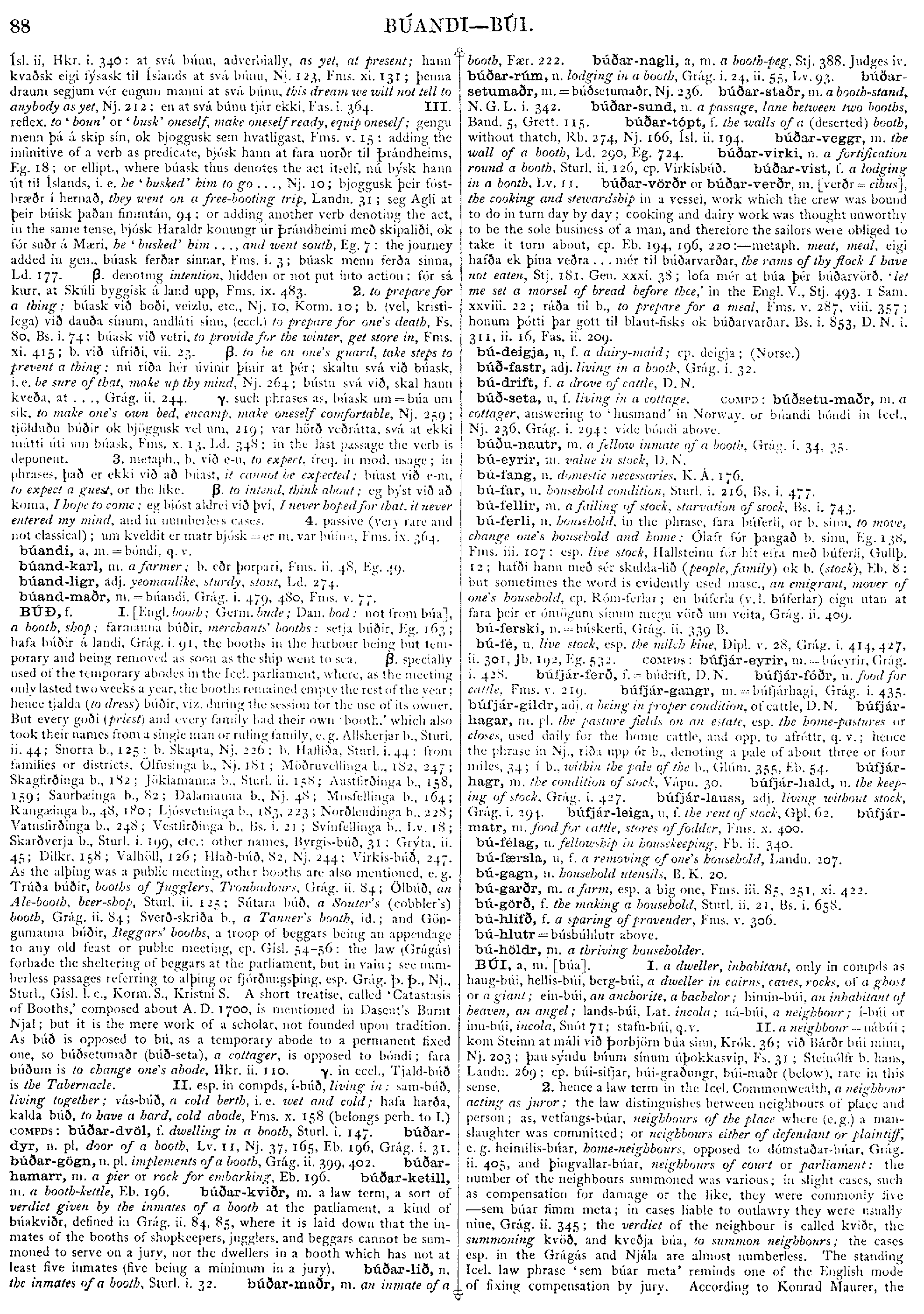
BÚÐ,
f.
I.
[Engl.
booth;
Germ.
bude;
Dan.
bod:
not
from
búa],
a
booth,
shop;
farmanna
búðir,
merchants'
booths:
setja
búðir,
Eg.
163;
hafa
búðir
á
landi,
Grág.
i.
91,
the
booths
in
the
harbour
being
but
temporary
and
being
removed
as
soon
as
the
ship
went
to
sea.
.
specially
used
of
the
temporary
abodes
in
the
Icel.
parliament,
where,
as
the
meeting
only
lasted
two
weeks
a
year,
the
booths
remained
empty
the
rest
of
the
year;
hence
tjalda
(to
dress)
búðir,
viz.
during
the
session
for
the
use
of
its
owner.
But
every
goði
(priest)
and
every
family
had
their
own
'booth,'
which
also
took
their
names
from
a
single
man
or
ruling
family,
e.g.
Allsherjar
b.,
Sturl.
ii.
44;
Snorra
b.,
125;
b.
Skapta,
Nj.
220;
b.
Hafliða,
Sturl.
i.
44:
from
families
or
districts,
Ölfusinga
b.,
Nj.
181;
Möðruvellinga
b.,
182,
247;
Skagfirðinga
b.,
182;
Jöklamanna
b.,
Sturl.
ii.
158;
Austfirðinga
b.,
158,
159;
Saurbæinga
b.,
82;
Dalamanna
b.,
Nj.
48;
Mosfellinga
b.,
164;
Rangæinga
b.,
48,
180;
Ljósvetninga
b.,
183,
223;
Norðlendinga
b.,
228;
Vatnsfirðinga
b.,
248;
Vestfirðingu
b.,
Bs.
i.
21;
Svínfellinga
b.,
Lv.
18;
Skarðverja
b.,
Sturl.
i.
199,
etc.:
other
names,
Byrgis-búð,
31;
Grýta,
ii.
45;
Dilkr,
158;
Valhöll,
126;
Hlað-búð,
82,
Nj.
244;
Virkis-búð,
247.
As
the
alþing
was
a
public
meeting,
other
booths
are
also
mentioned,
e.g.
Trúða
búðir,
booths
of
Jugglers,
Troubadours,
Grág.
ii.
84;
Ölbúð,
an
Ale-booth,
beer-shop,
Sturl.
ii.
125;
Sútara
búð,
a
Souter's
(cobbler's)
booth,
Grág.
ii.
84;
Sverð-skriða
b.,
a
Tanner's
booth,
id.;
and
Göngumanna
búðir,
Beggars'
booths,
a
troop
of
beggars
being
an
appendage
to
any
old
feast
or
public
meeting,
cp.
Gísl.
54-56:
the
law
(Grágás)
forbade
the
sheltering
of
beggars
at
the
parliament,
but
in
vain;
see
numberless
passages
referring
to
alþing
or
fjórðungsþing,
esp.
Grág.
Þ.
Þ.,
Nj.,
Sturl.,
Gísl.
l.c.,
Korm.
S.,
Kristni
S.
A
short
treatise,
called
'Catastasis
of
Booths,'
composed
about
A.D.
1700,
is
mentioned
in
Dasent's
Burnt
Njal;
but
it
is
the
mere
work
of
a
scholar,
not
founded
upon
tradition.
As
búð
is
opposed
to
bú,
as
a
temporary
abode
to
a
permanent
fixed
one,
so
búðsetumaðr
(búð-seta),
a
cottager,
is
opposed
to
bóndi;
fara
búðum
is
to
change
one's
abode,
Hkr.
ii.
110.
.
in
eccl.,
Tjald-búð
is
the
Tabernacle.
II.
esp.
in
compds,
í-búð,
living
in;
sam-búð,
living
together;
vás-búð,
a
cold
berth,
i.e.
wet
and
cold;
hafa
harða,
kalda
búð,
to
have
a
hard,
cold
abode,
Fms.
x.
158
(belongs
perh.
to
I.)
COMPDS:
búðar-dvöl,
f.
dwelling
in
a
booth,
Sturl.
i.
147.
búðar-dyr,
n.
pl.
door
of
a
booth,
Lv.
11,
Nj.
37,
165,
Eb.
196,
Grág.
i.
31.
búðar-gögn,
n.
pl.
implements
of
a
booth,
Grág.
ii.
399,
402.
búðar-hamarr,
m.
a
pier
or
rock
for
embarking,
Eb.
196.
búðar-ketill,
m.
a
booth-kettle,
Eb.
196.
búðar-kviðr,
m.
a
law
term,
a
sort
of
verdict
given
by
the
inmates
of
a
booth
at
the
parliament,
a
kind
of
búakviðr,
defined
in
Grág.
ii.
84,
85,
where
it
is
laid
down
that
the
inmates
of
the
booths
of
shopkeepers,
jugglers,
and
beggars
cannot
be
summoned
to
serve
on
a
jury,
nor
the
dwellers
in
a
booth
which
has
not
at
least
five
inmates
(five
being
a
minimum
in
a
jury).
búðar-lið,
n.
the
inmates
of
a
booth,
Sturl.
i.
32.
búðar-maðr,
m.
an
inmate
of
a
booth,
Fær.
222.
búðar-nagli,
a,
m.
a
booth-peg,
Stj.
388.
Judges
iv.
búðar-rúm,
n.
lodging
in
a
booth,
Grág.
i.
24,
ii.
55,
Lv.
93.
búðar-setumaðr,
m.
=
búðsetumaðr,
Nj.
236.
búðar-staðr,
m.
a
booth-stand,
N.
G.
L.
i.
342.
búðar-sund,
n.
a
passage,
lane
between
two
booths,
Band.
5,
Grett.
115.
búðar-tópt,
f.
the
walls
of
a
(deserted)
booth,
without
thatch,
Rb.
274,
Nj.
166,
Ísl.
ii.
194.
búðar-veggr,
m.
the
wall
of
a
booth,
Ld.
290,
Eg.
724.
búðar-virki,
n.
a
fortification
round
a
booth,
Sturl.
ii.
126,
cp.
Virkisbúð.
búðar-vist,
f.
a
lodging
in
a
booth,
Lv.
11.
búðar-vörðr
or
búðar-verðr,
m.
[verðr
=
cibus],
the
cooking
and
stewardship
in
a
vessel,
work
which
the
crew
was
bound
to
do
in
turn
day
by
day;
cooking
and
dairy
work
was
thought
unworthy
to
be
the
sole
business
of
a
man,
and
therefore
the
sailors
were
obliged
to
take
it
turn
about,
cp.
Eb.
194,
196,
220
:--
metaph.
meat,
meal,
eigi
hafða
ek
þina
veðra
...
mér
til
búðarvarðar,
the
rams
of
thy
flock
I
have
not
eaten,
Stj.
181.
Gen.
xxxi.
38;
lofa
mér
at
búa
þér
búðarvörð,
'let
me
set
a
morsel
of
bread
before
thee,'
in
the
Engl.
V.,
Stj.
493.
1
Sam.
xxviii.
22;
ráða
til
b.,
to
prepare
for
a
meal,
Fms.
v.
287,
viii.
357;
honum
þótti
þar
gott
til
blaut-fisks
ok
búðarvarðar,
Bs.
i.
853,
D.
N.
i.
311,
ii.
16,
Fas.
ii.
209.
|
Source: Cleasby/Vigfusson, page b0089, entry 21 View original page image as: [TIFF] [PNG] [View previous entry] [View next entry] |
[Comment on this entry] [View comments] |
The following entry has been hand-corrected once. |
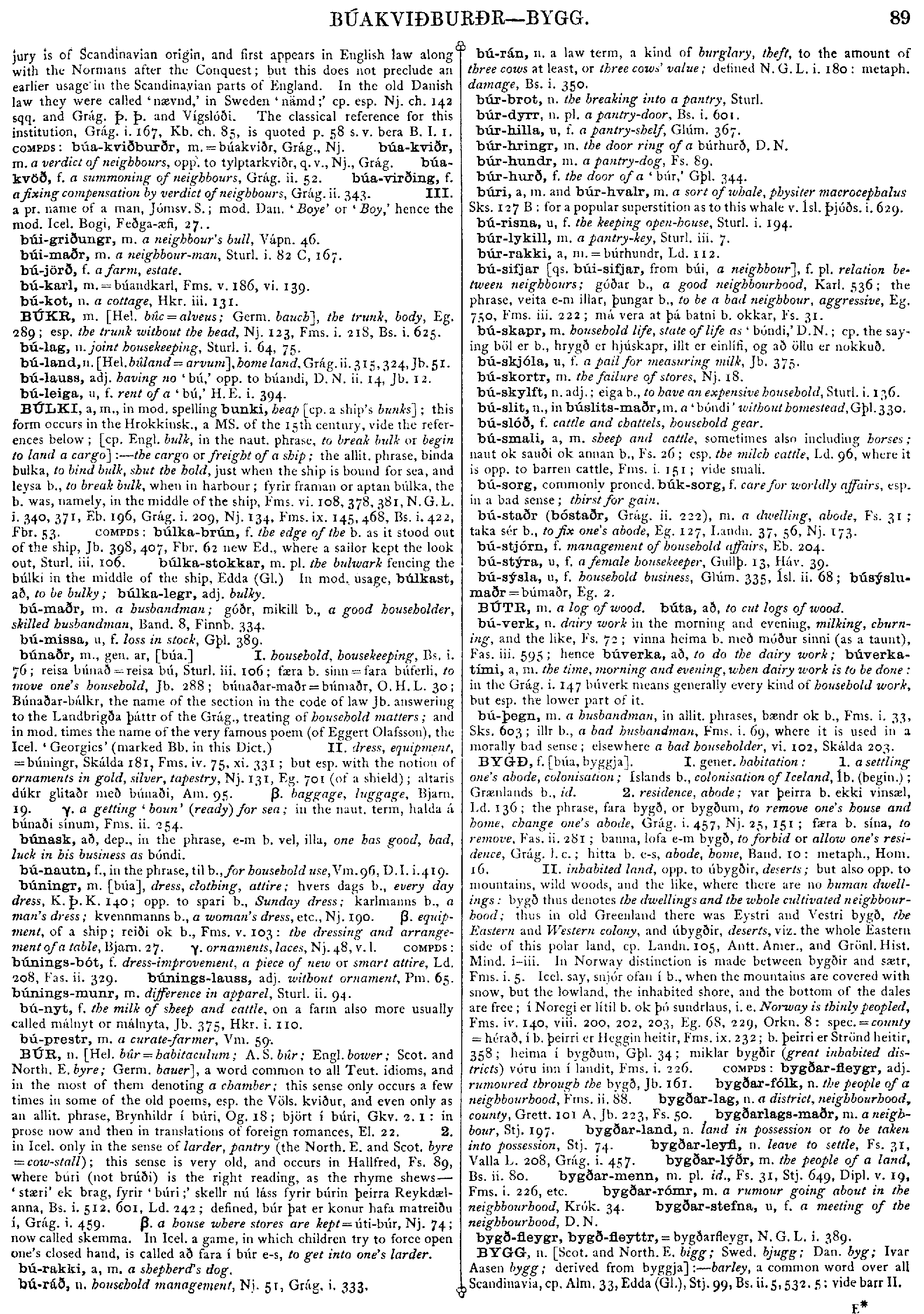
BÚR,
n.
[Hel.
bûr
=
habitaculum;
A.
S.
bûr;
Engl.
bower;
Scot.
and
North.
E.
byre;
Germ.
bauer],
a
word
common
to
all
Teut.
idioms,
and
in
the
most
of
them
denoting
a
chamber;
this
sense
only
occurs
a
few
times
in
some
of
the
old
poems,
esp.
the
Völs.
kviður,
and
even
only
as
an
allit.
phrase,
Brynhildr
í
búri,
Og.
18;
björt
í
búri,
Gkv.
2.
1:
in
prose
now
and
then
in
translations
of
foreign
romances,
El.
22.
2.
in
Icel.
only
in
the
sense
of
larder,
pantry
(the
North.
E.
and
Scot.
byre
=
cow-stall);
this
sense
is
very
old,
and
occurs
in
Hallfred,
Fs.
89,
where
búri
(not
brúði)
is
the
right
reading,
as
the
rhyme
shews--'stæri'
ek
brag,
fyrir
'búri;'
skellr
nú
lass
fyrir
búrin
þeirra
Reykdælanna,
Bs.
i.
512.
601,
Ld.
242;
defined,
búr
þat
er
konur
hafa
matreiðu
í,
Grág.
i.
459.
.
a
house
where
stores
are
kept
=
úti-búr,
Nj.
74;
now
called
skemma.
In
Icel.
a
game,
in
which
children
try
to
force
open
one's
closed
hand,
is
called
að
fara
í
búr
e-s,
to
get
into
one's
larder.
| Result Page: |  |
Previous | 4 5 6 7 8 9 10 11 12 13 14 15 16 17 18 19 20 21 22 | Next |  |
Germanic Lexicon Project (main page)
This search system was written by
Sean Crist
Please consider
volunteering
to correct the data in these online dictionaries.
No rights reserved. Feel free to use these data in any way you please.