|
|

Search for Ed again, using less strict matching (2154 results)
|
Source: Bosworth/Toller, page d0417, entry 20 View original page image as: [TIFF] [PNG] [View previous entry] [View next entry] |
[Comment on this entry] [View comments] |
The following entry has been hand-corrected once. |
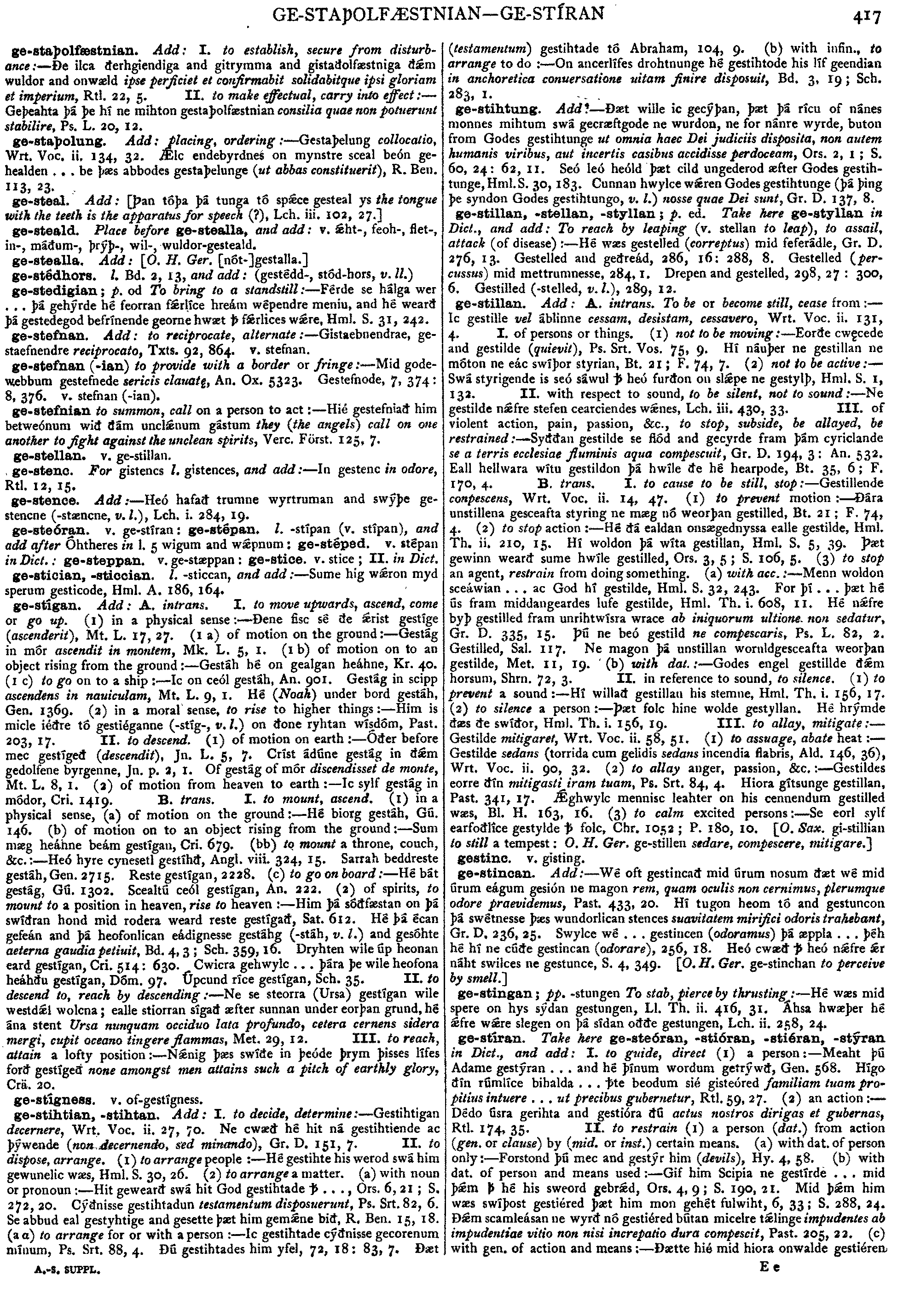
ge-stillan, -stellan, -styllan; p. ed. Take here ge-styllan in Dict., and add: To reach by leaping (v. stellan to leap), to assail, attack (of disease) :-- Hé wæs gestelled (correptus) mid feferádle, Gr. D. 276, 13. Gestelled and geðreád, 286, 16: 288, 8. Gestelled (per-cussus) mid mettrumnesse, 284, l, Drepen and gestelled, 298, 27 : 300, 6. Gestilled (-stelled, v.l.), 289, 12.
|
Source: Bosworth/Toller, page d0437, entry 11 View original page image as: [TIFF] [PNG] [View previous entry] [View next entry] |
[Comment on this entry] [View comments] |
The following entry has been hand-corrected once. |
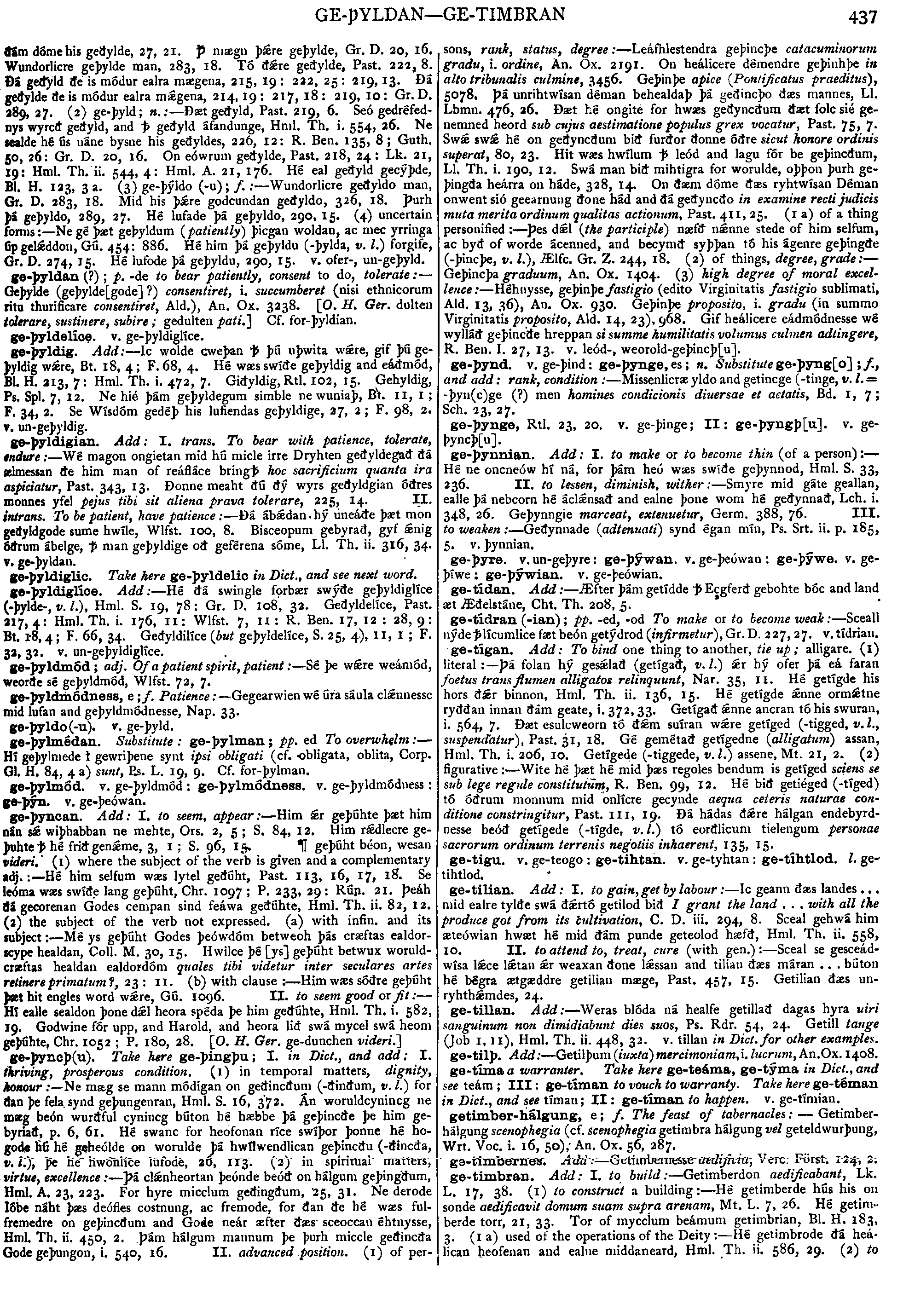
ge-þylmédan.
Substitute:
ge-þylman;
pp.
ed
To
overwhelm
:--
Hí
geþylmede
 gewriþene
synt
ipsi
obligati
(cf.
obligata,
oblita,
Corp.
Gl.
H.
84,
4
a)
sunt,
Ps.
L.
19,
9.
Cf.
for-þylman.
gewriþene
synt
ipsi
obligati
(cf.
obligata,
oblita,
Corp.
Gl.
H.
84,
4
a)
sunt,
Ps.
L.
19,
9.
Cf.
for-þylman.
|
Source: Bosworth/Toller, page d0438, entry 8 View original page image as: [TIFF] [PNG] [View previous entry] [View next entry] |
[Comment on this entry] [View comments] |
The following entry has been hand-corrected once. |
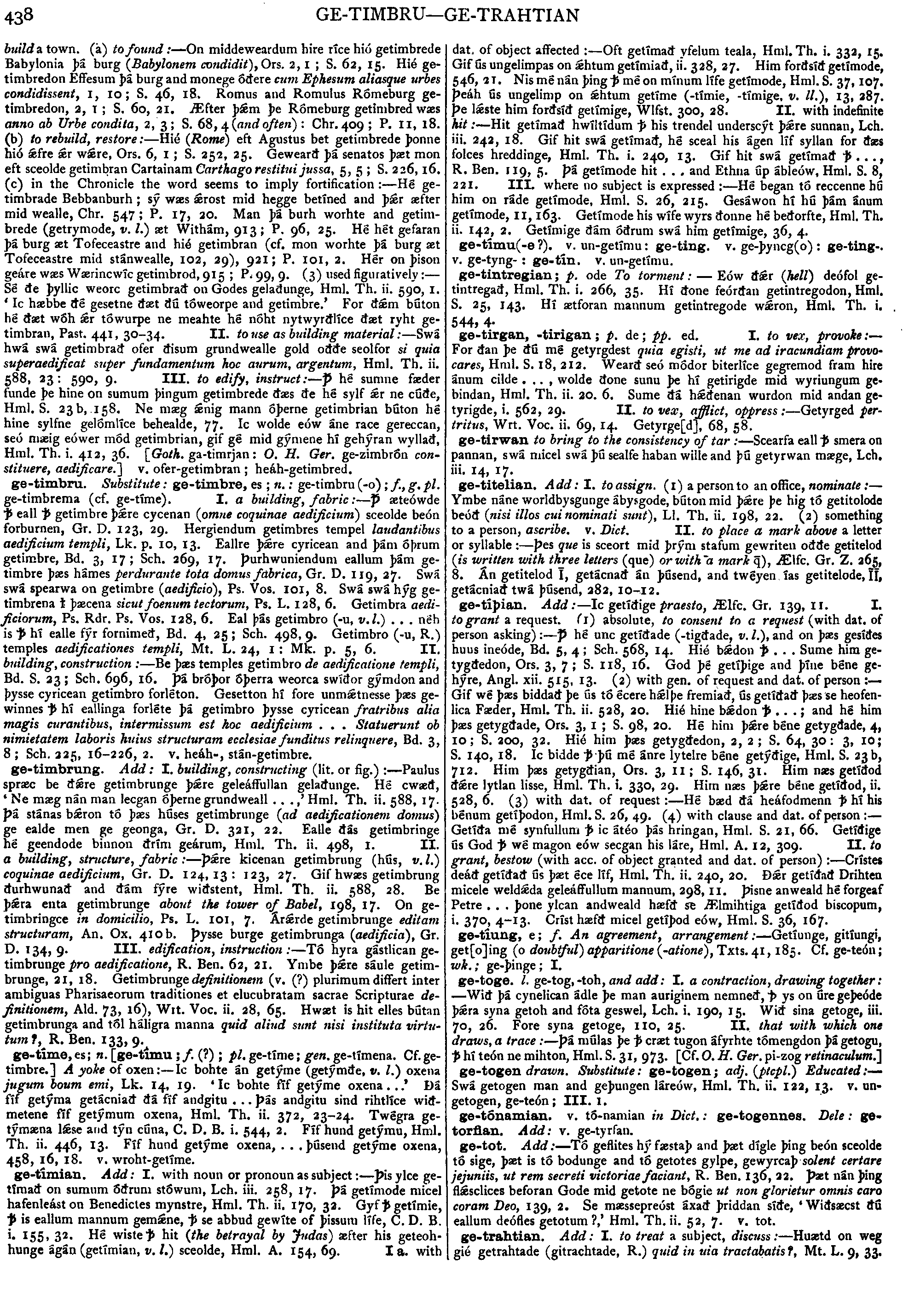
ge-tirgan,
-tirigan;
p.
de;
pp.
ed.
I.
to
vex,
provoke
:--
For
ðan
þe
ðú
mé
getyrgdest
quia
egisti,
ut
me
ad
iracundiam
provocares,
Hml.
S.
18,
212.
Wearð
seó
módor
biterlíce
gegremod
fram
hire
ánum
cilde
...
wolde
ðone
sunu
þe
hí
getirigde
mid
wyriungum
gebindan,
Hml.
Th.
ii.
20.
6.
Sume
ðá
h ðenan
wurdon
mid
andan
getyrigde,
i.
562,
29.
II.
to
vex,
afflict,
oppress
:--
Getyrged
pertritus,
Wrt.
Voc.
ii.
69,
14.
Getyrge[d],
68,
58.
ðenan
wurdon
mid
andan
getyrigde,
i.
562,
29.
II.
to
vex,
afflict,
oppress
:--
Getyrged
pertritus,
Wrt.
Voc.
ii.
69,
14.
Getyrge[d],
68,
58.
|
Source: Bosworth/Toller, page d0449, entry 19 View original page image as: [TIFF] [PNG] [View previous entry] [View next entry] |
[Comment on this entry] [View comments] |
The following entry has been hand-corrected once. |
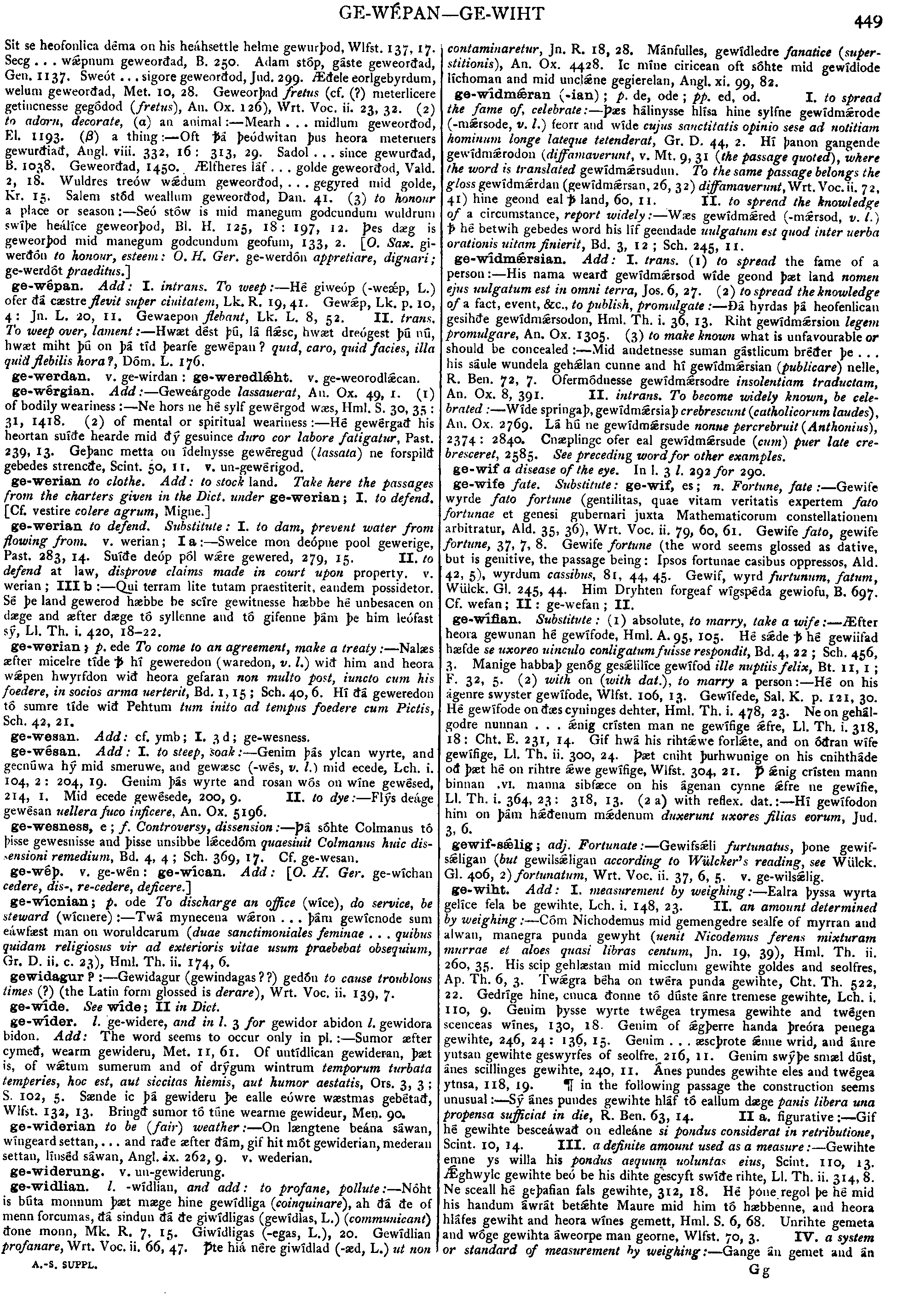
ge-wídmran
(-ian)
;
p.
de,
ode
;
pp.
ed.
od.
I.
to
spread
the
fame
of,
celebrate
:--
Þæs
hálinysse
hlísa
hine
sylfne
gewídmrode
(-mrsode,
v.
l.)
feorr
and
wíde
cujus
sanctitatis
opinio
sese
ad
notitiam
hominum
longe
lateque
tetenderat,
Gr.
D.
44,
2.
Hí
þanon
gangende
gewídmrodon
(diffamaverunt,
v.
Mt.
9,
31
(the
passage
quoted),
where
the
word
is
translated
gewídmrsudim.
To
the
same
passage
belongs
the
gloss
gewídmrdan
(gewídmrsan,
26,
32)
difamavenmt,
Wrt.
Voc.
ii.
72,
41)
hine
geond
eal
 land,
60,
ll.
II.
to
spread
the
knowledge
of
a
circumstance,
report
widely
:--
Wæs
gewídmred
(-mrsod,
v.
l.)
hé
betwih
gebedes
word
his
líf
geendade
uulgatum
est
quod
inter
uerba
orationis
uitam
finierit,
Bd.
3,
12
;
Sch.
245,
11.
land,
60,
ll.
II.
to
spread
the
knowledge
of
a
circumstance,
report
widely
:--
Wæs
gewídmred
(-mrsod,
v.
l.)
hé
betwih
gebedes
word
his
líf
geendade
uulgatum
est
quod
inter
uerba
orationis
uitam
finierit,
Bd.
3,
12
;
Sch.
245,
11.
|
Source: Bosworth/Toller, page d0497, entry 17 View original page image as: [TIFF] [PNG] [View previous entry] [View next entry] |
[Comment on this entry] [View comments] |
The following entry has been hand-corrected once. |
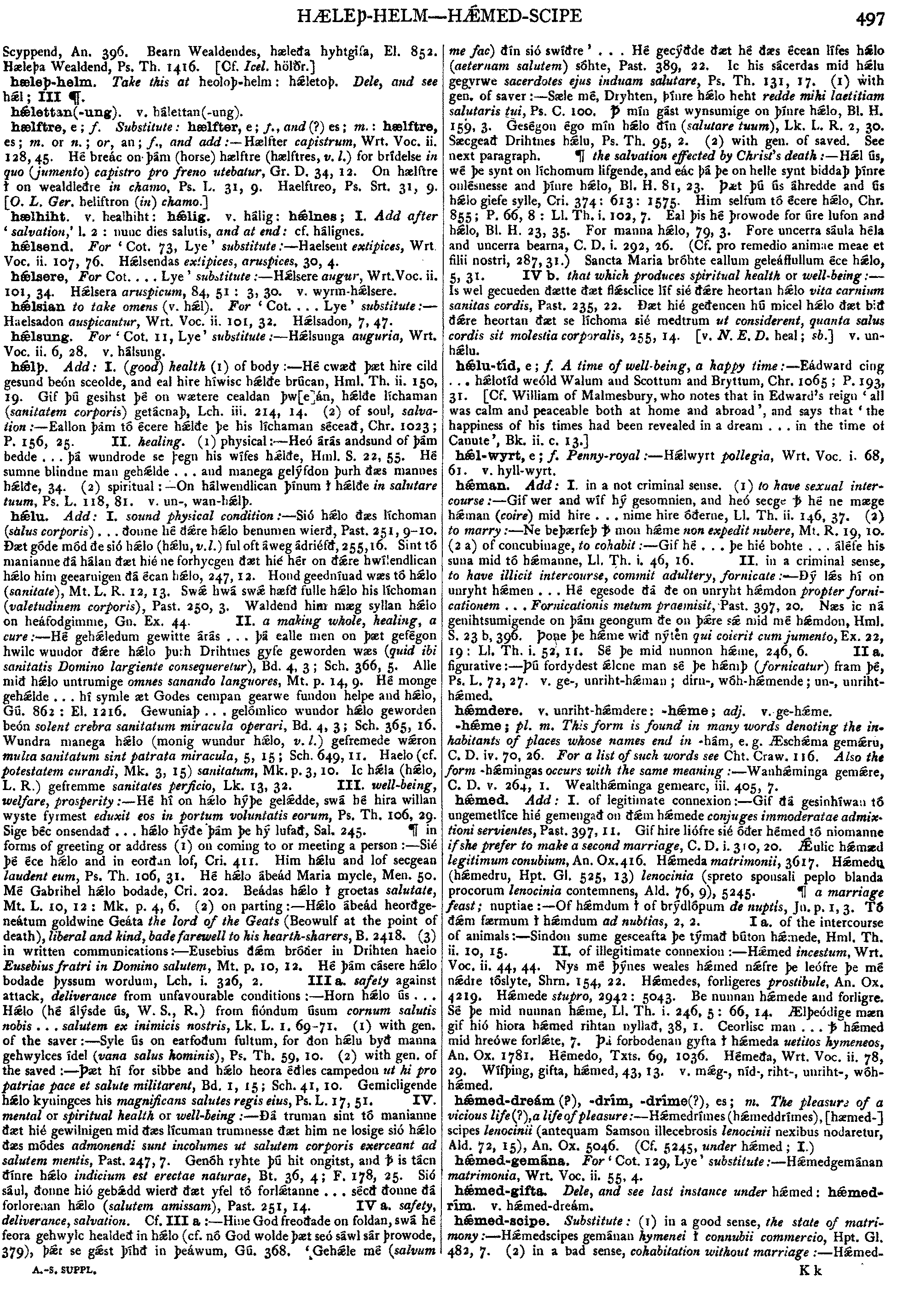
hmed.
.
Add:
I.
of
legitimate
connexion
:--
Gif
ðá
gesinhíwan
tó
ungemetlíce
hié
gemengað
on
ðm
hmede
conjuges
immoderatae
admixtioni
servientes,
Past.
397,
11.
Gif
hire
liófre
sié
óðer
hémed
tó
niomanne
if
sie
prefer
to
make
a
second
marriage,
C.
D.
i.
310,
20.
Æ-acute;ulic
hin.
.
ed
legitimum
conubium,
An.
Ox.
416.
Hmeda
matrimonii,
3617.
Hrnedu
(hmedru,
Hpt.
Gl.
525,
13)
lenocinia
(spreto
spousali
peplo
blanda
procorurn
lenocinia
conternnens,
Ald.
76,
9),
5245.

a
marriage
feast;
nuptiae
:--
Of
hmdum
of
brýdlðpurn
de
nuptis,
Jn.
p.
i.
3.
Tó
ðrn
færmum
hmdum
ad
nubtias,
2,
2.
I
a.
of
the
intercourse
of
animals
:--
Sindon
sume
gesceafta
þe
týmað
búton
hmede,
Hml.
Th.
ii.
10,
15.
II.
of
illegitimate
connexion
:--
Hmed
incestum,
Wrt.
Voc.
ii.
44,
44.
Nys
mé
þýnes
weales
hmed
nfre
þe
leófre
þe
mé
ndre
tóslyte,
Shrn.
154,
22.
Hmedes,
forligeres
prostibule,
An.
Ox.
4219.
Hmede
stupro,
2942
:
5043.
Be
nunnan
hmede
and
forligre.
Sé
þe
mid
nunnan
hme,
Ll.
Th.
i.
346,
5
:
66,
14.
Ælþeódige
mæn
gif
hió
hiora
hmed
rihtan
nyllað,
38,
Ceorlisc
man..
.
hmed
mid
hreówe
forlte,
7.
Þá
forbodenan
gyfta
hmeda
uetitos
hymeneos,
An.
Ox.
1781.
Hémedo,
Txts.
69,
1036.
Hémeða,
Wrt.
Voc.
ii.
78,
29.
Wífþing,
gifta,
hmed,
43,
13.
v.
mg-,
níd-,
riht-,
unriht-,
wÓh-hmed.
|
Source: Bosworth/Toller, page d0508, entry 3 View original page image as: [TIFF] [PNG] [View previous entry] [View next entry] |
[Comment on this entry] [View comments] |
The following entry has been hand-corrected once. |
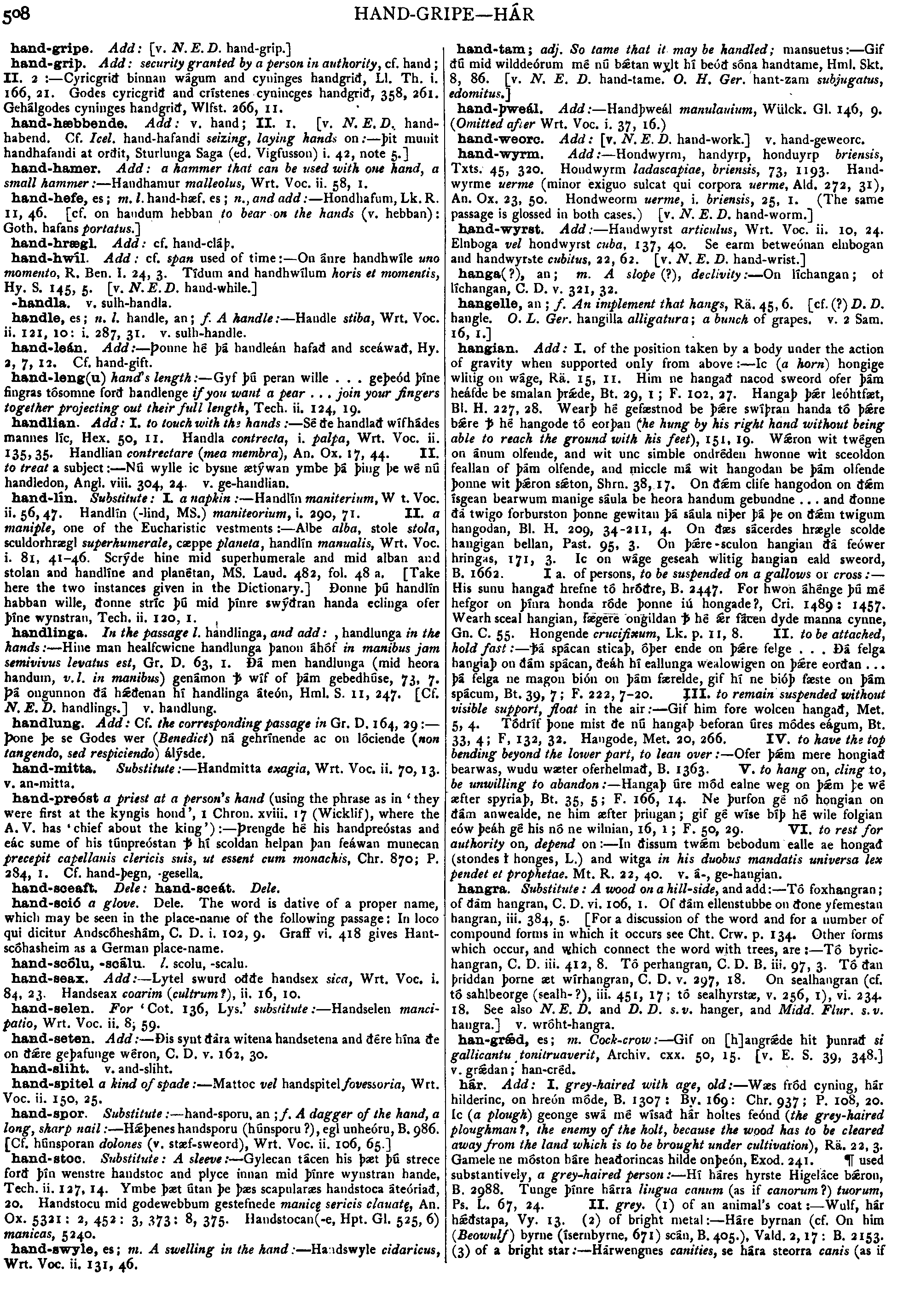
hand-hæbbende. Add: v. hand; II. 1. [v. N. E. D. hand-habend. Cf. Icel. hand-hafandi seizing, laying hands on: -- þit munit handhafandi at orðit, Sturlunga Saga (ed. Vigfusson) i. 42, note 5.]
|
Source: Bosworth/Toller, page d0566, entry 24 View original page image as: [TIFF] [PNG] [View previous entry] [View next entry] |
[Comment on this entry] [View comments] |
The following entry has been hand-corrected once. |
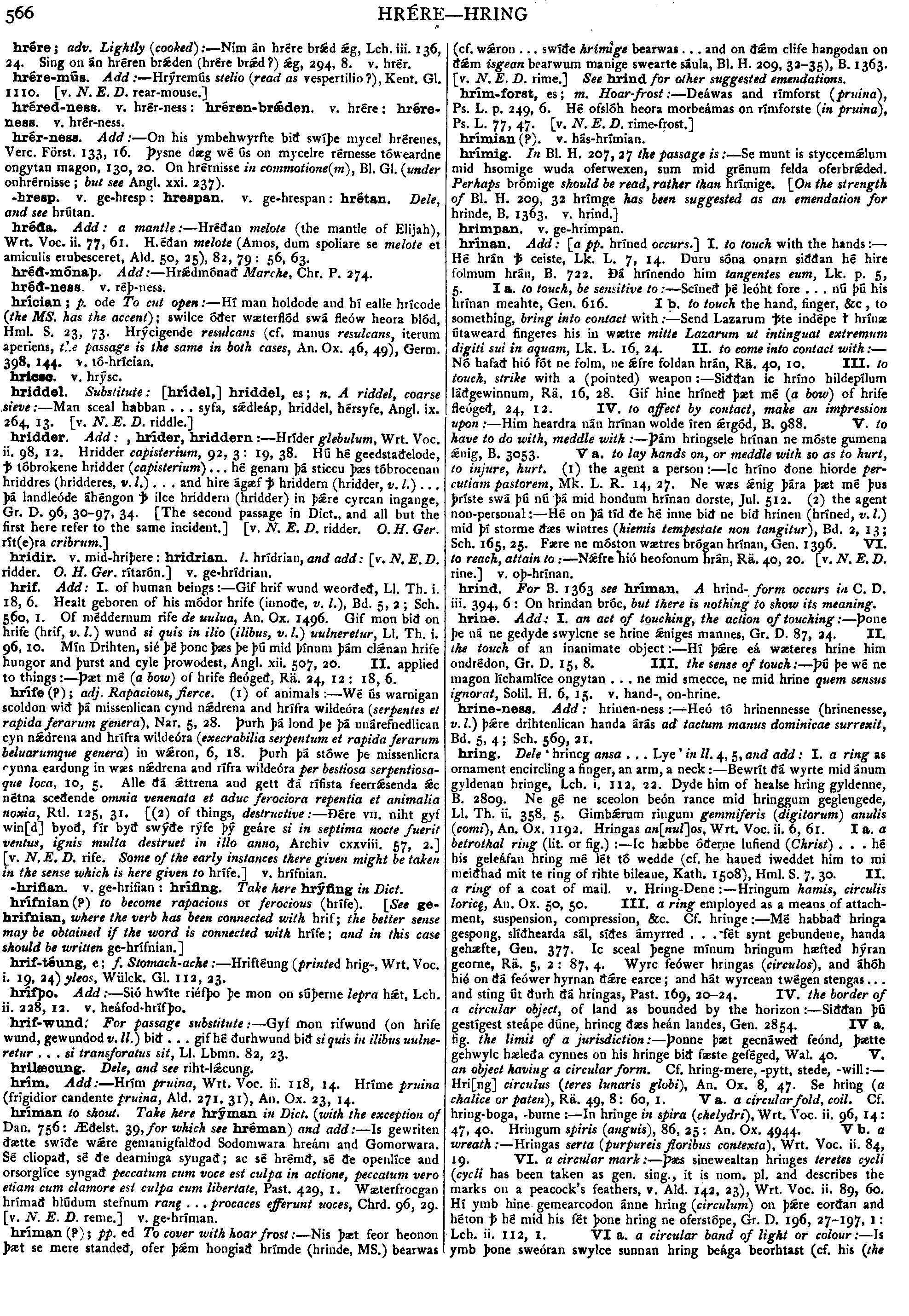
hríman
(?);
pp.
ed
To
cover
with
hoar
frost:--Nis
þæt
feor
heonon
þæt
se
mere
standeð,
ofer
þm
hongiað
hrímde
(hrinde,
MS.)
bearwas
(cf.
wron
.
.
.
swíðe
hrímige
bearwas
.
.
.
and
on
ðm
clife
hangodan
on
ðm
isgean
bearwum
manige
swearte
sáula,
Bl.
H.
209,
32-35),
B.
1363.
[v.
N.
E.
D.
rime.]
See
hrind
for
other
suggested
emendations.
|
Source: Bosworth/Toller, page d0730, entry 13 View original page image as: [TIFF] [PNG] [View previous entry] [View next entry] |
[Comment on this entry] [View comments] |
The following entry has been hand-corrected once. |
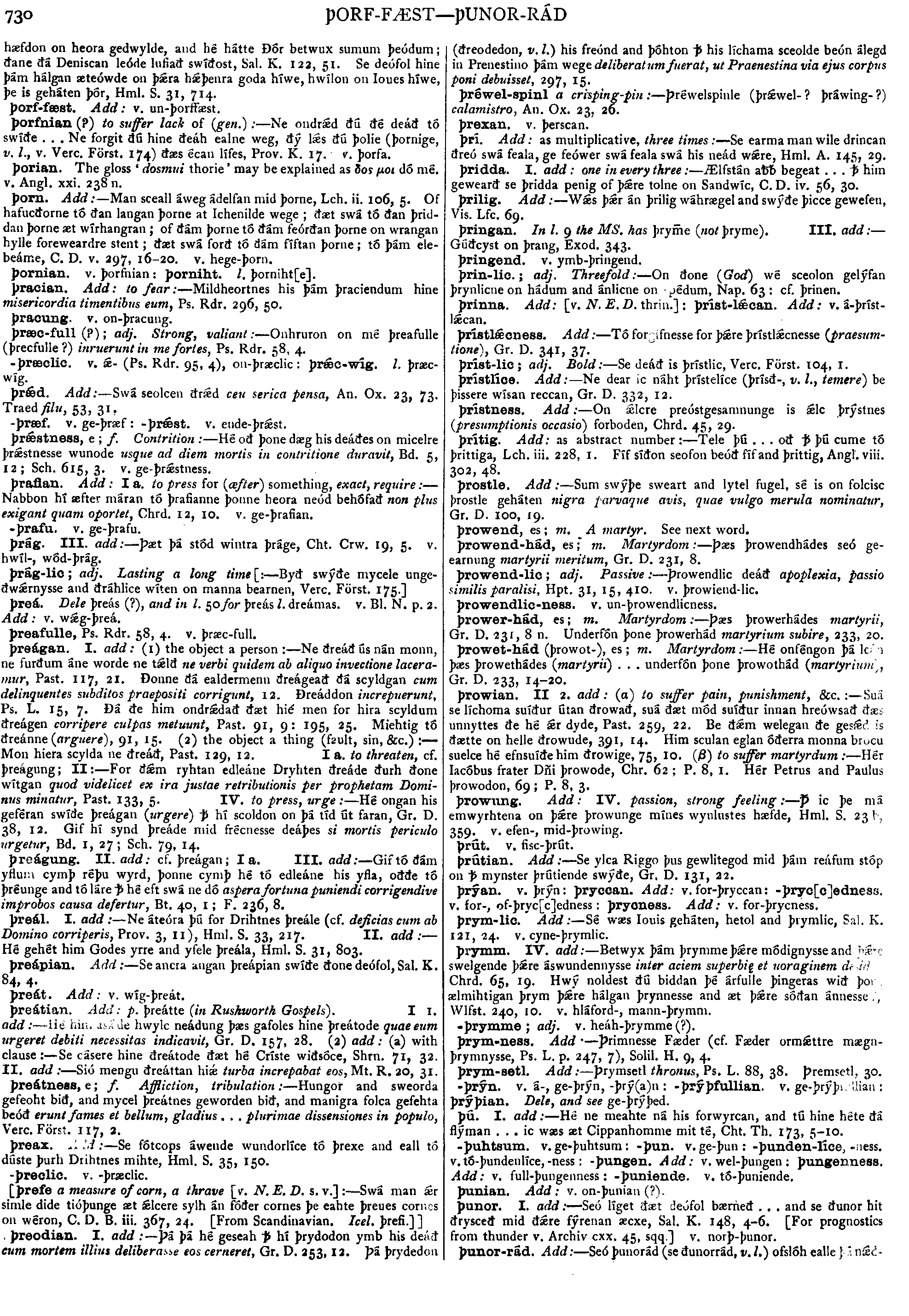
þrstness,
e
;
f.
Contrition
:--
Hé
oð
þone
dæg
his
deáðes
on
micelre
þrstnesse
wunode
usque
ad
diem
mortis
in
conlritione
duravit,
Ed.
5,
12
;
Sch.
615,
3,
v.
ge-þrstness.
|
Source: Cleasby/Vigfusson, page b0001, entry 1 View original page image as: [TIFF] [PNG] [View previous entry] [View next entry] |
[Comment on this entry] [View comments] |
The following entry has been hand-corrected once. |
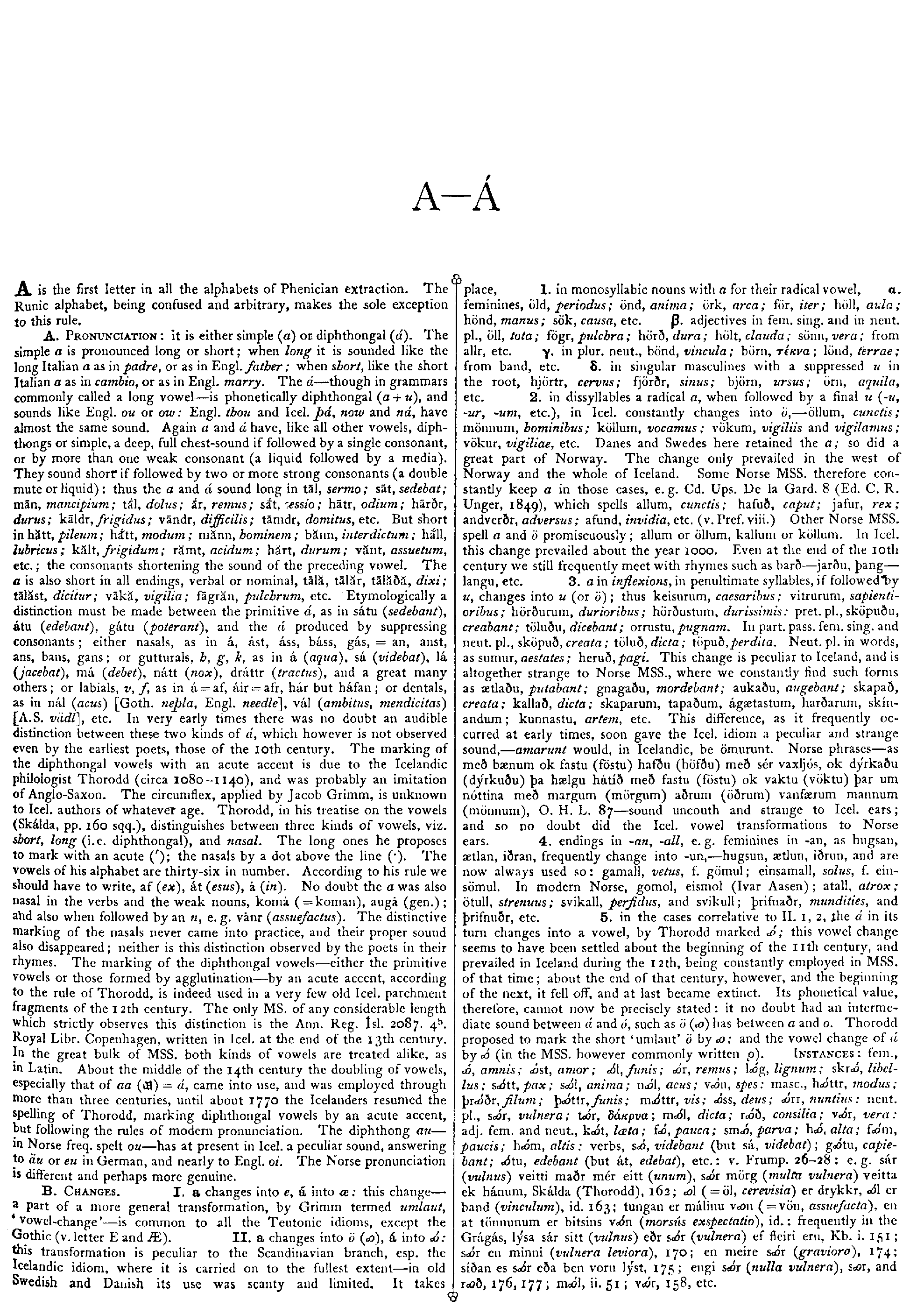
A.
is
the
first
letter
in
all
the
alphabets
of
Phenician
extraction.
The
Runic
alphabet,
being
confused
and
arbitrary,
makes
the
sole
exception
to
this
rule.
A.
PRONUNCIATION:
it
is
either
simple
(a)
or
diphthongal
(á).
The
simple
a
is
pronounced
long
or
short;
when
long
it
is
sounded
like
the
long
Italian
a
as
in
padre,
or
as
in
Engl.
father;
when
short,
like
the
short
Italian
a
as
in
cambio,
or
as
in
Engl.
marry.
The
á
--
though
in
grammars
commonly
called
a
long
vowel
--
is
phonetically
diphthongal
(a
+
u),
and
sounds
like
Engl.
ou
or
ow:
Engl.
thou
and
Icel.
þá,
now
and
ná,
have
almost
the
same
sound.
Again
a
and
á
have,
like
all
other
vowels,
diph-
thongs
or
simple,
a
deep,
full
chest-sound
if
followed
by
a
single
consonant,
or
by
more
than
one
weak
consonant
(a
liquid
followed
by
a
media).
They
sound
short
if
followed
by
two
or
more
strong
consonants
(a
double
mute
or
liquid):
thus
the
a
and
á
sound
long
in
tál,
sermo;
sát,
sedebat;
mán,
mancipium;
tál,
dolus;
ár,
remits;
sát,
sessio,
hátr,
odium;
hárðr,
durus;
káldr,
frigidus;
vándr,
difficilis;
támdr,
domitus,
etc.
But
short
in
hátt,
pileum;
hátt,
modum;
mánn,
bominem;
bánn,
interdictum;
háll,
lubricus;
kált,
frigidum;
rámt,
acidum;
hárt,
durum;
vánt,
assuetum,
etc.;
the
consonants
shortening
the
sound
of
the
preceding
vowel.
The
a
is
also
short
in
all
endings,
verbal
or
nominal,
tala,
talar,
talaða,
dixi;
talast,
dicitur;
vaka,
vigilia;
fagran,
pulchrum,
etc.
Etymologically
a
distinction
must
be
made
between
the
primitive
á,
as
in
sátu
(sedebant),
átu
(edebant),
gátu
(poterant),
and
the
á
produced
by
suppressing
consonants;
either
nasals,
as
in
á,
ást,
áss,
báss,
gás,
=
an,
anst,
ans,
bans,
gans;
or
gutturals,
h,
g,
k,
as
in
á
(aqua),
sá
(videbat),
lá
(jacebat),
má
(debet),
nátt
(nox),
dráttr
(tractus),
and
a
great
many
others;
or
labials,
v,
f,
as
in
á
=
af,
áir
=
afr,
hár
but
háfan;
or
dentals,
as
in
nál
(acus)
[Goth.
nepla,
Engl.
needle],
vál
(ambitus,
mendicitas)
[A.
S.
vädl],
etc.
In
very
early
times
there
was
no
doubt
an
audible
distinction
between
these
two
kinds
of
á,
which
however
is
not
observed
even
by
the
earliest
poets,
those
of
the
10th
century.
The
marking
of
the
diphthongal
vowels
with
an
acute
accent
is
due
to
the
Icelandic
philologist
Thorodd
(circa
1080-1140),
and
was
probably
an
imitation
of
Anglo-Saxon.
The
circumflex,
applied
by
Jacob
Grimm,
is
unknown
to
Icel.
authors
of
whatever
age.
Thorodd,
in
his
treatise
on
the
vowels
(Skálda,
pp.
160
sqq.),
distinguishes
between
three
kinds
of
vowels,
viz.
short,
long
(i.
e.
diphthongal),
and
nasal.
The
long
ones
he
proposes
to
mark
with
an
acute
( );
the
nasals
by
a
dot
above
the
line
(•).
The
vowels
of
his
alphabet
are
thirty-six
in
number.
According
to
his
rule
we
should
have
to
write,
af
(ex),
át
(esus),
ä
(in).
No
doubt
the
a
was
also
nasal
in
the
verbs
and
the
weak
nouns,
komå
(=
koman),
augä
(gen.);
and
also
when
followed
by
an
n,
e.
g.
vänr
(assuefactus).
The
distinctive
marking
of
the
nasals
never
came
into
practice,
and
their
proper
sound
also
disappeared;
neither
is
this
distinction
observed
by
the
poets
in
their
rhymes.
The
marking
of
the
diphthongal
vowels
--
either
the
primitive
vowels
or
those
formed
by
agglutination
--
by
an
acute
accent,
according
to
the
rule
of
Thorodd,
is
indeed
used
in
a
very
few
old
Icel.
parchment
fragments
of
the
12th
century.
The
only
MS.
of
any
considerable
length
which
strictly
observes
this
distinction
is
the
Ann.
Reg.
Ísl.
2087.
4b.
Royal
Libr.
Copenhagen,
written
in
Icel.
at
the
end
of
the
13th
century.
In
the
great
bulk
of
MSS.
both
kinds
of
vowels
are
treated
alike,
as
in
Latin.
About
the
middle
of
the
14th
century
the
doubling
of
vowels,
especially
that
of
aa
()
=
á,
came
into
use,
and
was
employed
through
more
than
three
centuries,
until
about
1770
the
Icelanders
resumed
the
spelling
of
Thorodd,
marking
diphthongal
vowels
by
an
acute
accent,
but
following
the
rules
of
modern
pronunciation.
The
diphthong
au
--
in
Norse
freq.
spelt
ou
--
has
at
present
in
Icel.
a
peculiar
sound,
answering
to
äu
or
eu
in
German,
and
nearly
to
Engl.
oi.
The
Norse
pronunciation
is
different
and
perhaps
more
genuine.
B.
CHANGES.
I.
a
changes
into
æ,
á
into
Æ:
this
change
--
a
part
of
a
more
general
transformation,
by
Grimm
termed
umlaut,
'vowel-change'
--
is
common
to
all
the
Teutonic
idioms,
except
the
Gothic
(v.
letter
E
and
Æ).
II.
a
changes
into
ö
(),
á
into
:
this
transformation
is
peculiar
to
the
Scandinavian
branch,
esp.
the
Icelandic
idiom,
where
it
is
carried
on
to
the
fullest
extent
--
in
old
Swedish
and
Danish
its
use
was
scanty
and
limited.
It
takes
place,
1.
in
monosyllabic
nouns
with
a
for
their
radical
vowel,
);
the
nasals
by
a
dot
above
the
line
(•).
The
vowels
of
his
alphabet
are
thirty-six
in
number.
According
to
his
rule
we
should
have
to
write,
af
(ex),
át
(esus),
ä
(in).
No
doubt
the
a
was
also
nasal
in
the
verbs
and
the
weak
nouns,
komå
(=
koman),
augä
(gen.);
and
also
when
followed
by
an
n,
e.
g.
vänr
(assuefactus).
The
distinctive
marking
of
the
nasals
never
came
into
practice,
and
their
proper
sound
also
disappeared;
neither
is
this
distinction
observed
by
the
poets
in
their
rhymes.
The
marking
of
the
diphthongal
vowels
--
either
the
primitive
vowels
or
those
formed
by
agglutination
--
by
an
acute
accent,
according
to
the
rule
of
Thorodd,
is
indeed
used
in
a
very
few
old
Icel.
parchment
fragments
of
the
12th
century.
The
only
MS.
of
any
considerable
length
which
strictly
observes
this
distinction
is
the
Ann.
Reg.
Ísl.
2087.
4b.
Royal
Libr.
Copenhagen,
written
in
Icel.
at
the
end
of
the
13th
century.
In
the
great
bulk
of
MSS.
both
kinds
of
vowels
are
treated
alike,
as
in
Latin.
About
the
middle
of
the
14th
century
the
doubling
of
vowels,
especially
that
of
aa
()
=
á,
came
into
use,
and
was
employed
through
more
than
three
centuries,
until
about
1770
the
Icelanders
resumed
the
spelling
of
Thorodd,
marking
diphthongal
vowels
by
an
acute
accent,
but
following
the
rules
of
modern
pronunciation.
The
diphthong
au
--
in
Norse
freq.
spelt
ou
--
has
at
present
in
Icel.
a
peculiar
sound,
answering
to
äu
or
eu
in
German,
and
nearly
to
Engl.
oi.
The
Norse
pronunciation
is
different
and
perhaps
more
genuine.
B.
CHANGES.
I.
a
changes
into
æ,
á
into
Æ:
this
change
--
a
part
of
a
more
general
transformation,
by
Grimm
termed
umlaut,
'vowel-change'
--
is
common
to
all
the
Teutonic
idioms,
except
the
Gothic
(v.
letter
E
and
Æ).
II.
a
changes
into
ö
(),
á
into
:
this
transformation
is
peculiar
to
the
Scandinavian
branch,
esp.
the
Icelandic
idiom,
where
it
is
carried
on
to
the
fullest
extent
--
in
old
Swedish
and
Danish
its
use
was
scanty
and
limited.
It
takes
place,
1.
in
monosyllabic
nouns
with
a
for
their
radical
vowel,
 .
feminines,
öld,
periodus;
önd,
anima;
örk,
arca;
för,
iter;
höll,
aula;
hönd,
manus;
sök,
causa,
etc.
.
feminines,
öld,
periodus;
önd,
anima;
örk,
arca;
för,
iter;
höll,
aula;
hönd,
manus;
sök,
causa,
etc.
 .
adjectives
in
fem.
sing,
and
in
neut.
pl.,
öll,
tota;
fögr,
pulchra;
hörð,
dura;
hölt,
clauda;
sönn,
vera;
from
allr,
etc.
.
adjectives
in
fem.
sing,
and
in
neut.
pl.,
öll,
tota;
fögr,
pulchra;
hörð,
dura;
hölt,
clauda;
sönn,
vera;
from
allr,
etc.
 .
in
plur.
neut.,
bönd,
vincula;
börn,
GREEK;
lönd,
terrae;
from
band,
etc.
.
in
plur.
neut.,
bönd,
vincula;
börn,
GREEK;
lönd,
terrae;
from
band,
etc.
 .
in
singular
masculines
with
a
suppressed
u
in
the
root,
hjörtr,
cervus;
fjörðr,
sinus;
björn,
ursus;
örn,
aquila,
etc.
2.
in
dissyllables
a
radical
a,
when
followed
by
a
final
u
(-u,
-ur,
-um,
etc.),
in
Icel.
constantly
changes
into
ö,
--
öllum,
cunctis;
mönnum,
hominibus;
köllum,
vocamus;
vökum,
vigiliis
and
vigilamus;
vökur,
vigiliae,
etc.
Danes
and
Swedes
here
retained
the
a;
so
did
a
great
part
of
Norway.
The
change
only
prevailed
in
the
west
of
Norway
and
the
whole
of
Iceland.
Some
Norse
MSS.
therefore
con-
stantly
keep
a
in
those
cases,
e.
g.
Cd.
Ups.
De
la
Gard.
8
(Ed.
C.
R.
Unger,
1849),
which
spells
allum,
cunctis;
hafuð,
caput;
jafur,
rex;
andverðr,
adversus;
afund,
invidia,
etc.
(v.
Pref.
viii.)
Other
Norse
MSS.
spell
a
and
ö
promiscuously;
allum
or
öllum,
kallum
or
köllum.
In
Icel.
this
change
prevailed
about
the
year
1000.
Even
at
the
end
of
the
loth
century
we
still
frequently
meet
with
rhymes
such
as
barð
--
jarðu,
þang
--
langu,
etc.
3.
a
in
inflexions,
in
penultimate
syllables,
if
followed
by
u,
changes
into
u
(or
ö);
thus
keisurum,
caesaribus;
vitrurum,
sapienti-
oribus;
hörðurum,
durioribus;
hörðustum,
durissimis:
pret.
pl.,
sköpuðu,
creabant;
töluðu,
dicebant;
orrustu,
pugnam.
In
part.
pass.
fem.
sing,
and
neut.
pl.,
sköpuð,
creata;
töluð,
dicta;
töpuð,
perdi/
a.
Neut.
pl.
in
words,
as
sumur,
aestates;
heruð,
pagi.
This
change
is
peculiar
to
Iceland,
and
is
altogether
strange
to
Norse
MSS.,
where
we
constantly
find
such
forms
as
ætlaðu,
putabant;
gnagaðu,
mordebant;
aukaðu,
augebant;
skapað,
creata;
kallað,
dicta;
skaparum,
tapaðum,
ágætastum,
harðarum,
skín-
andum;
kunnastu,
artem,
etc.
This
difference,
as
it
frequently
oc-
curred
at
early
times,
soon
gave
the
Icel.
idiom
a
peculiar
and
strange
sound,
--
amarunt
would,
in
Icelandic,
be
ömurunt.
Norse
phrases
--
as
með
bænum
ok
fastu
(fostu)
hafðu
(höfðu)
með
sér
vaxljós,
ok
dýrkaðu
(dýrkuðu)
þa
hælgu
hátíð
með
fastu
(föstu)
ok
vaktu
(vöktu)
þar
um
nóttina
með
margum
(mörgum)
aðrum
(öðrum)
vanfærum
mannum
(monnum),
O.
H.
L.
87
--
sound
uncouth
and
strange
to
Icel.
ears;
and
so
no
doubt
did
the
Icel.
vowel
transformations
to
Norse
ears.
4.
endings
in
-an,
-all,
e.
g.
feminines
in
-an,
as
hugsan,
ætlan,
iðran,
frequently
change
into
-un,
--
hugsun,
ætlun,
iðrun,
and
are
now
always
used
so:
gamall,
vetus,
f.
gömul;
einsamall,
solus,
f.
ein-
sömul.
In
modern
Norse,
gomol,
eismol
(Ivar
Aasen);
atall,
atrox;
ötull,
strenuus;
svikall,
perfidus,
and
svikull;
þrifnaðr,
mundities,
and
þrifnuðr,
etc.
5.
in
the
cases
correlative
to
II.
1,
2,
the
á
in
its
turn
changes
into
a
vowel,
by
Thorodd
marked
;
this
vowel
change
seems
to
have
been
settled
about
the
beginning
of
the
11th
century,
and
prevailed
in
Iceland
during
the
12th,
being
constantly
employed
in
MSS.
of
that
time;
about
the
end
of
that
century,
however,
and
the
beginning
of
the
next,
it
fell
off,
and
at
last
became
extinct.
Its
phonetical
value,
therefore,
cannot
now
be
precisely
stated:
it
no
doubt
had
an
interme-
diate
sound
between
á
and
ó,
such
as
ö
(oo)
has
between
a
and
o.
Thorodd
proposed
to
mark
the
short
'umlaut'
ö
by
;
and
the
vowel
change
of
á
by
(in
the
MSS.
however
commonly
written
).
INSTANCES:
fcm.,
,
amnis;
st,
amor;
l,
funis;
r,
remits;
lg,
lignum;
skr,
libel-
lus;
stt,
pax;
sl,
anima;
nl,
acus;
vn,
spes:
masc.,
httr,
modus;
þrðr,
fîlum;
þttr,
funis;
mttr,
vis;
ss,
deus;
rr,
nuntius:
neut.
pl.,
sr,
vulnera;
tr,
GREEK;
ml,
dicta;
rð,
consilia;
vr,
vera:
adj.
fem,
and
neut.,
koát,
læta;
f,
pauca;
sm,
parva;
h,
alta;
fm,
paucis;
hm,
altis:
verbs,
s,
videbant
(but
sá,
videbat);
gtu,
capie-
bant;
tu,
edebant
(but
at,
edebat),
etc.:
v.
Frump.
26-28:
e.
g.
sár
(vulnus)
veitti
maðr
mer
eitt
(unum),
sr
mörg
(multa
vulnera)
veitta
ek
hánum,
Skálda
(Thorodd),
162;
l
(=
öl,
cerevisia)
er
drykkr,
l
er
band
(vinculum),
id.
163;
tungan
er
málinu
vn
(=
vön,
assuefacta),
en
at
tönnunum
er
bitsins
vn
(morsils
exspectatio),
id.:
frequently
in
the
Grágás,
lýsa
sár
sitt
(vulnus)
eðr
sr
(vulnera)
ef
fleiri
eru,
Kb.
i.
151;
sr
en
minni
(vulnera
leviora),
170;
en
meire
sr
(graviora),
174;
síðan
es
sr
eða
ben
voru
lýst,
175;
engi
sr
(nulla
vulnera),
sr,
and
rð,
176,
177;
ml,
ii.
51;
vr,
158,
.
in
singular
masculines
with
a
suppressed
u
in
the
root,
hjörtr,
cervus;
fjörðr,
sinus;
björn,
ursus;
örn,
aquila,
etc.
2.
in
dissyllables
a
radical
a,
when
followed
by
a
final
u
(-u,
-ur,
-um,
etc.),
in
Icel.
constantly
changes
into
ö,
--
öllum,
cunctis;
mönnum,
hominibus;
köllum,
vocamus;
vökum,
vigiliis
and
vigilamus;
vökur,
vigiliae,
etc.
Danes
and
Swedes
here
retained
the
a;
so
did
a
great
part
of
Norway.
The
change
only
prevailed
in
the
west
of
Norway
and
the
whole
of
Iceland.
Some
Norse
MSS.
therefore
con-
stantly
keep
a
in
those
cases,
e.
g.
Cd.
Ups.
De
la
Gard.
8
(Ed.
C.
R.
Unger,
1849),
which
spells
allum,
cunctis;
hafuð,
caput;
jafur,
rex;
andverðr,
adversus;
afund,
invidia,
etc.
(v.
Pref.
viii.)
Other
Norse
MSS.
spell
a
and
ö
promiscuously;
allum
or
öllum,
kallum
or
köllum.
In
Icel.
this
change
prevailed
about
the
year
1000.
Even
at
the
end
of
the
loth
century
we
still
frequently
meet
with
rhymes
such
as
barð
--
jarðu,
þang
--
langu,
etc.
3.
a
in
inflexions,
in
penultimate
syllables,
if
followed
by
u,
changes
into
u
(or
ö);
thus
keisurum,
caesaribus;
vitrurum,
sapienti-
oribus;
hörðurum,
durioribus;
hörðustum,
durissimis:
pret.
pl.,
sköpuðu,
creabant;
töluðu,
dicebant;
orrustu,
pugnam.
In
part.
pass.
fem.
sing,
and
neut.
pl.,
sköpuð,
creata;
töluð,
dicta;
töpuð,
perdi/
a.
Neut.
pl.
in
words,
as
sumur,
aestates;
heruð,
pagi.
This
change
is
peculiar
to
Iceland,
and
is
altogether
strange
to
Norse
MSS.,
where
we
constantly
find
such
forms
as
ætlaðu,
putabant;
gnagaðu,
mordebant;
aukaðu,
augebant;
skapað,
creata;
kallað,
dicta;
skaparum,
tapaðum,
ágætastum,
harðarum,
skín-
andum;
kunnastu,
artem,
etc.
This
difference,
as
it
frequently
oc-
curred
at
early
times,
soon
gave
the
Icel.
idiom
a
peculiar
and
strange
sound,
--
amarunt
would,
in
Icelandic,
be
ömurunt.
Norse
phrases
--
as
með
bænum
ok
fastu
(fostu)
hafðu
(höfðu)
með
sér
vaxljós,
ok
dýrkaðu
(dýrkuðu)
þa
hælgu
hátíð
með
fastu
(föstu)
ok
vaktu
(vöktu)
þar
um
nóttina
með
margum
(mörgum)
aðrum
(öðrum)
vanfærum
mannum
(monnum),
O.
H.
L.
87
--
sound
uncouth
and
strange
to
Icel.
ears;
and
so
no
doubt
did
the
Icel.
vowel
transformations
to
Norse
ears.
4.
endings
in
-an,
-all,
e.
g.
feminines
in
-an,
as
hugsan,
ætlan,
iðran,
frequently
change
into
-un,
--
hugsun,
ætlun,
iðrun,
and
are
now
always
used
so:
gamall,
vetus,
f.
gömul;
einsamall,
solus,
f.
ein-
sömul.
In
modern
Norse,
gomol,
eismol
(Ivar
Aasen);
atall,
atrox;
ötull,
strenuus;
svikall,
perfidus,
and
svikull;
þrifnaðr,
mundities,
and
þrifnuðr,
etc.
5.
in
the
cases
correlative
to
II.
1,
2,
the
á
in
its
turn
changes
into
a
vowel,
by
Thorodd
marked
;
this
vowel
change
seems
to
have
been
settled
about
the
beginning
of
the
11th
century,
and
prevailed
in
Iceland
during
the
12th,
being
constantly
employed
in
MSS.
of
that
time;
about
the
end
of
that
century,
however,
and
the
beginning
of
the
next,
it
fell
off,
and
at
last
became
extinct.
Its
phonetical
value,
therefore,
cannot
now
be
precisely
stated:
it
no
doubt
had
an
interme-
diate
sound
between
á
and
ó,
such
as
ö
(oo)
has
between
a
and
o.
Thorodd
proposed
to
mark
the
short
'umlaut'
ö
by
;
and
the
vowel
change
of
á
by
(in
the
MSS.
however
commonly
written
).
INSTANCES:
fcm.,
,
amnis;
st,
amor;
l,
funis;
r,
remits;
lg,
lignum;
skr,
libel-
lus;
stt,
pax;
sl,
anima;
nl,
acus;
vn,
spes:
masc.,
httr,
modus;
þrðr,
fîlum;
þttr,
funis;
mttr,
vis;
ss,
deus;
rr,
nuntius:
neut.
pl.,
sr,
vulnera;
tr,
GREEK;
ml,
dicta;
rð,
consilia;
vr,
vera:
adj.
fem,
and
neut.,
koát,
læta;
f,
pauca;
sm,
parva;
h,
alta;
fm,
paucis;
hm,
altis:
verbs,
s,
videbant
(but
sá,
videbat);
gtu,
capie-
bant;
tu,
edebant
(but
at,
edebat),
etc.:
v.
Frump.
26-28:
e.
g.
sár
(vulnus)
veitti
maðr
mer
eitt
(unum),
sr
mörg
(multa
vulnera)
veitta
ek
hánum,
Skálda
(Thorodd),
162;
l
(=
öl,
cerevisia)
er
drykkr,
l
er
band
(vinculum),
id.
163;
tungan
er
málinu
vn
(=
vön,
assuefacta),
en
at
tönnunum
er
bitsins
vn
(morsils
exspectatio),
id.:
frequently
in
the
Grágás,
lýsa
sár
sitt
(vulnus)
eðr
sr
(vulnera)
ef
fleiri
eru,
Kb.
i.
151;
sr
en
minni
(vulnera
leviora),
170;
en
meire
sr
(graviora),
174;
síðan
es
sr
eða
ben
voru
lýst,
175;
engi
sr
(nulla
vulnera),
sr,
and
rð,
176,
177;
ml,
ii.
51;
vr,
158,
|
Source: Cleasby/Vigfusson, page b0002, entry 1 View original page image as: [TIFF] [PNG] [View previous entry] [View next entry] |
[Comment on this entry] [View comments] |
The following entry has been hand-corrected once. |
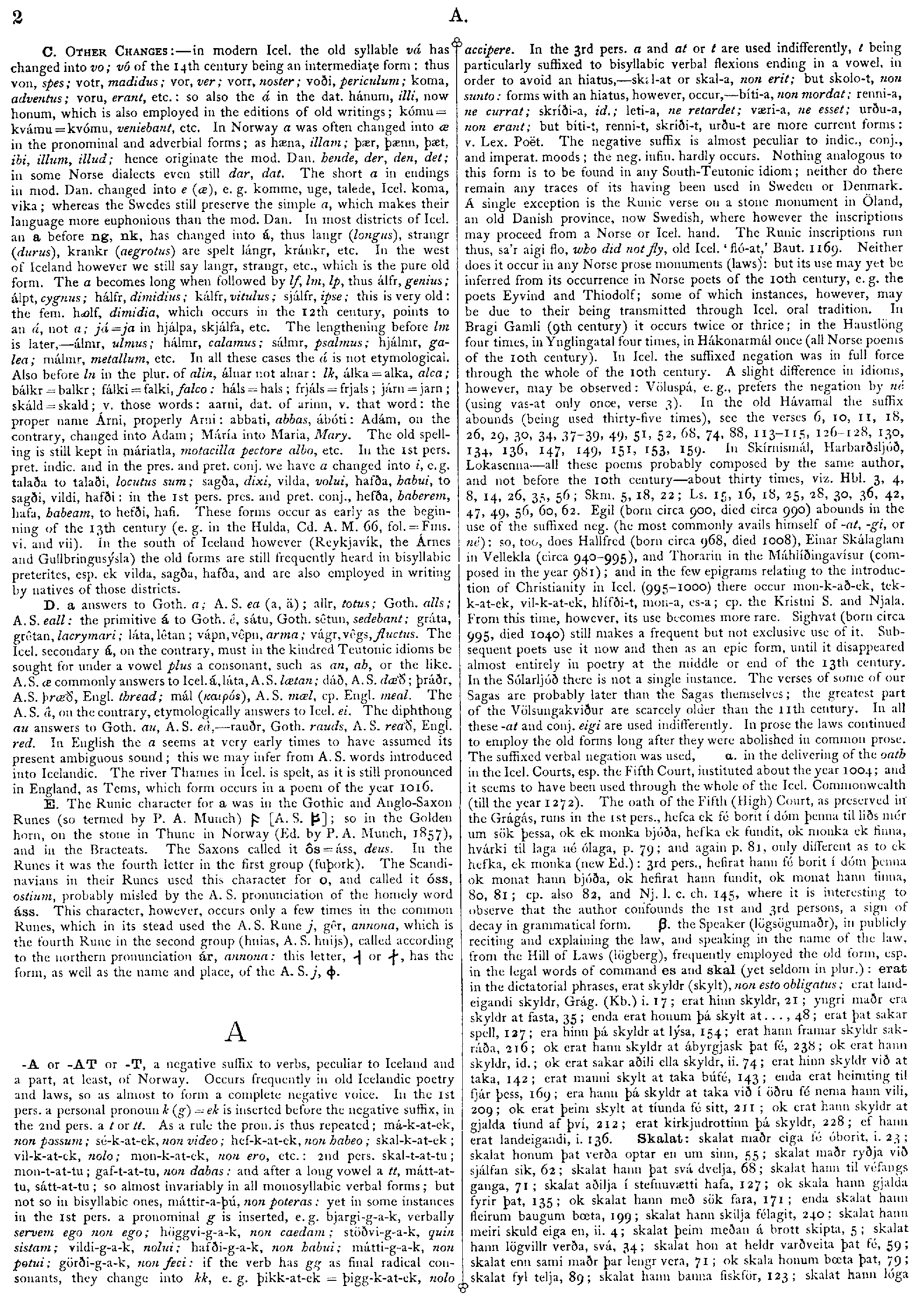
C.
OTHER
CHANGES
:--
in
modern
Icel.
the
old
syllable
va
has
changed
into
vo;
vó
of
the
14th
century
being
an
intermediate
form:
thus
von,
spes;
votr,
madidus;
vor,
ver;
vorr,
noster;
voði,
periculum;
koma,
adventus;
voru,
erant,
etc.:
so
also
the
á
in
the
dat.
hánum,
illi,
now
honum,
which
is
also
employed
in
the
editions
of
old
writings;
kómu
=
kvámu
=
kvómu,
veniebant,
etc.
In
Norway
a
was
often
changed
into
æ
in
the
pronominal
and
adverbial
forms;
as
hæna,
illam;
þær,
þænn,
þæt,
ibi,
ilium,
illud;
hence
originate
the
mod.
Dan.
hende,
der,
den,
det;
in
some
Norse
dialects
even
still
dar,
dat.
The
short
a
in
endings
in
mod.
Dan.
changed
into
e
(æ),
e.
g.
komme,
uge,
talede,
Icel.
koma,
vika;
whereas
the
Swedes
still
preserve
the
simple
a,
which
makes
their
language
more
euphonious
than
the
mod.
Dan.
In
most
districts
of
Icel.
an
a
before
ng,
nk,
has
changed
into
á,
thus
langr
(longus),
strangr
(durus),
krankr
(aegrotus)
are
spelt
lángr,
kránkr,
etc.
In
the
west
of
Iceland
however
we
still
say
langr,
strangr,
etc.,
which
is
the
pure
old
form.
The
a
becomes
long
when
followed
by
lf,
lm,
lp,
thus
álfr,
genius;
álpt,
cygnus;
hálfr,
dimidius;
kálfr,
vitulus;
sjálfr,
ipse;
this
is
very
old:
the
fem.
hlf,
dimidia,
which
occurs
in
the
12th
century,
points
to
an
á,
not
a;
já
=
ja
in
hjálpa,
skjálfa,
etc.
The
lengthening
before
lm
is
later,
--
álmr,
ulmus;
hálmr,
calamus;
sálmr,
psalmus;
hjálmr,
ga-
lea;
málmr,
metallum,
etc.
In
all
these
cases
the
á
is
not
etymological.
Also
before
ln
in
the
plur.
of
alin,
álnar
not
alnar:
lk,
alka
=
alka,
alca;
bálkr
=
balkr;
fálki
=
falki,
falco:
háls
=
hals;
frjáls
=
frjals;
járn
=
jarn;
skáld
=
skald;
v.
those
words:
aarni,
dat.
of
arinn,
v.
that
word:
the
proper
name
Árni,
properly
Arni:
abbati,
abbas,
ábóti:
Adám,
on
the
contrary,
changed
into
Adam;
Máría
into
Maria,
Mary.
The
old
spell-
ing
is
still
kept
in
máriatla,
motacilla
pectore
albo,
etc.
In
the
1st
pers.
pret.
indic.,
and
in
the
pres.
and
pret.
conj.
we
have
a
changed
into
i,
e.
g.
talaða
to
talaði,
locutus
sum;
sagða,
dixi,
vilda,
volui,
hafða,
habui,
to
sagði,
vildi,
hafði:
in
the
1st
pers.
pres.
and
pret.
conj.,
hefða,
haberem,
hafa,
habeam,
to
hefði,
hafi.
These
forms
occur
as
early
as
the
begin-
ning
of
the
13th
century
(e.
g.
in
the
Hulda,
Cd.
A.
M.
66,
fol.
=
Fms.
vi.
and
vii).
In
the
south
of
Iceland
however
(Reykjavik,
the
Árnes
and
Gullbringusýsla)
the
old
forms
are
still
frequently
heard
in
bisyllabic
preterites,
esp.
ek
vilda,
sagða,
hafða,
and
are
also
employed
in
writing
by
natives
of
those
districts.
D.
a
answers
to
Goth,
a;
A.
S.
ea
(a,
ä);
allr,
totus;
Goth,
alls;
A.
S.
eall:
the
primitive
á
to
Goth,
ê,
sátu,
Goth,
sêtun,
sedebant;
gráta,
grétun,
lacrymari;
láta,
lêtan;
vápn,
vêpn,
arma;
vagr,
vêgs,
fluctus.
The
Icel.
secondary
á,
on
the
contrary,
must
in
the
kindred
Teutonic
idioms
be
sought
for
under
a
vowel
plus
a
consonant,
such
as
an,
ah,
or
the
like.
A.
S.
æ
commonly
answers
to
Icel.
á,
láta,
A.
S.
lætan;
dáð,
A.
S.
dæð;
þráðr,
A.
S.
þræð,
Engl.
thread;
mál
(GREEK),
A.
S.
mœl,
cp.
Engl.
meal.
The
A.
S.
(1,
on
the
contrary,
etyrnologically
answers
to
Icel.
ei.
The
diphthong
au
answers
to
Goth.
au,
A.
S.
eá,
--
rauðr,
Goth.
rauds,
A.
S.
reað,
Engl.
red.
In
English
the
a
seems
at
very
early
times
to
have
assumed
its
present
ambiguous
sound;
this
we
may
infer
from
A.
S.
words
introduced
into
Icelandic.
The
river
Thames
in
Icel.
is
spelt,
as
it
is
still
pronounced
in
England,
as
Tems,
which
form
occurs
in
a
poem
of
the
year
1016.
E.
The
Runic
character
for
a
was
in
the
Gothic
and
Anglo-Saxon
Runes
(so
termed
by
P.
A.
Munch)
RUNE
[A.
S.
RUNE];
so
in
the
Golden
horn,
on
the
stone
in
Thune
in
Norway
(Ed.
by
P.
A.
Munch,
1857),
and
in
the
Bracteats.
The
Saxons
called
it
os
=
áss,
deus.
In
the
Runes
it
was
the
fourth
letter
in
the
first
group
(fuþork).
The
Scandi-
navians
in
their
Runes
used
this
character
for
o,
and
called
it
óss,
ostium,
probably
misled
by
the
A.
S.
pronunciation
of
the
homely
word
áss.
This
character,
however,
occurs
only
a
few
times
in
the
common
Runes,
which
in
its
stead
used
the
A.
S.
Rune
RUNE,
gér,
annona,
which
is
the
fourth
Rune
in
the
second
group
(hnias,
A.
S.
hnijs),
called
according
to
the
northern
pronunciation
ár,
annona:
this
letter,
RUNE
or
RUNE
has
the
form,
as
well
as
the
name
and
place,
of
the
A.
S.
RUNE,
RUNE.
| Result Page: |  |
Previous | 90 91 92 93 94 95 96 97 98 99 100 101 102 103 104 105 106 107 108 | Next |  |
Germanic Lexicon Project (main page)
This search system was written by
Sean Crist
Please consider
volunteering
to correct the data in these online dictionaries.
No rights reserved. Feel free to use these data in any way you please.