|
|

Search for Easter again, using less strict matching (57 results)
|
Source: Cleasby/Vigfusson, page b0111, entry 2 View original page image as: [TIFF] [PNG] [View previous entry] [View next entry] |
[Comment on this entry] [View comments] |
The following entry has been hand-corrected once. |
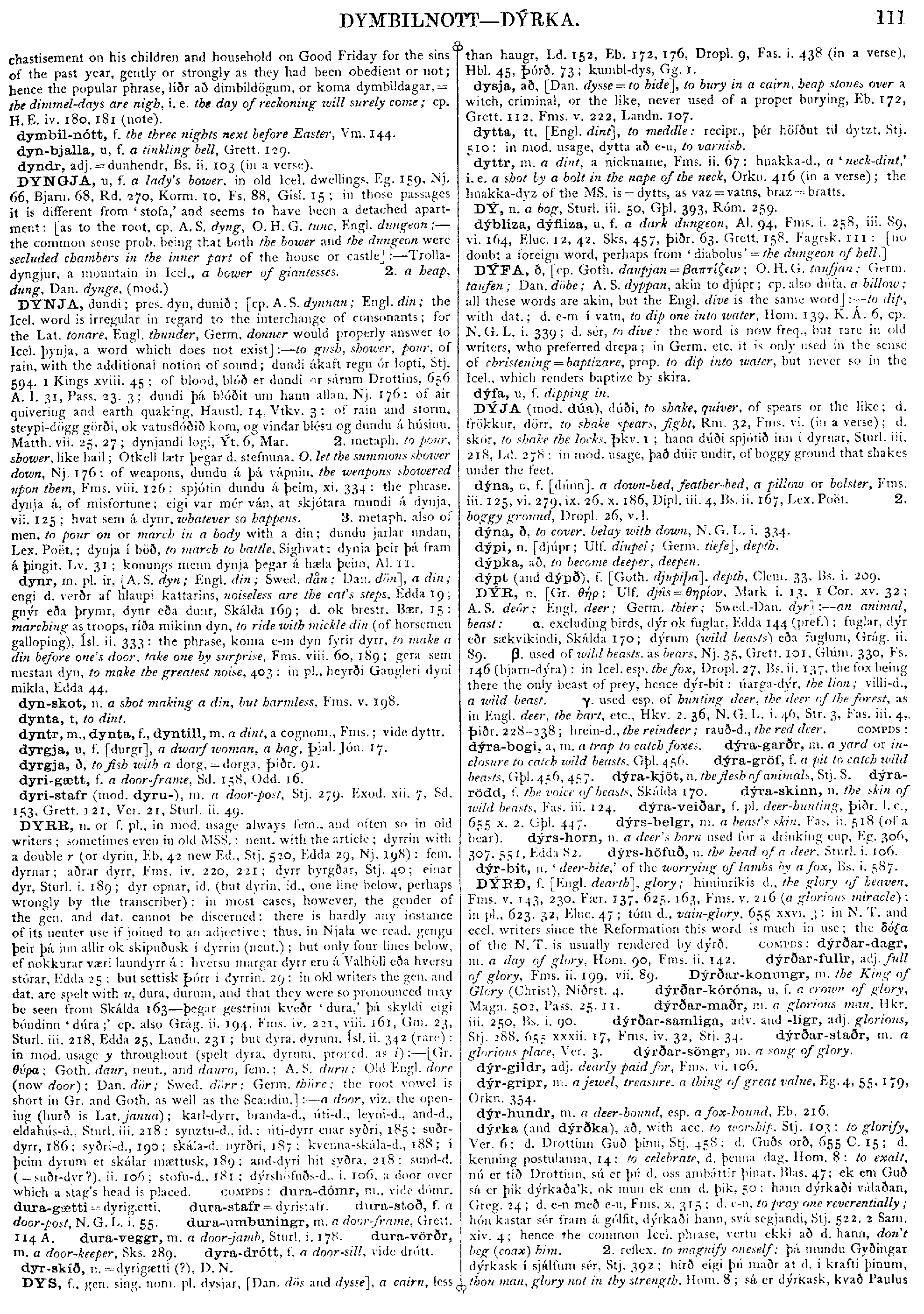
dymbil-nótt, f. the three nights next before Easter, Vm. 144.
|
Source: Cleasby/Vigfusson, page b0116, entry 13 View original page image as: [TIFF] [PNG] [View previous entry] [View next entry] |
[Comment on this entry] [View comments] |
The following entry has been hand-corrected once. |
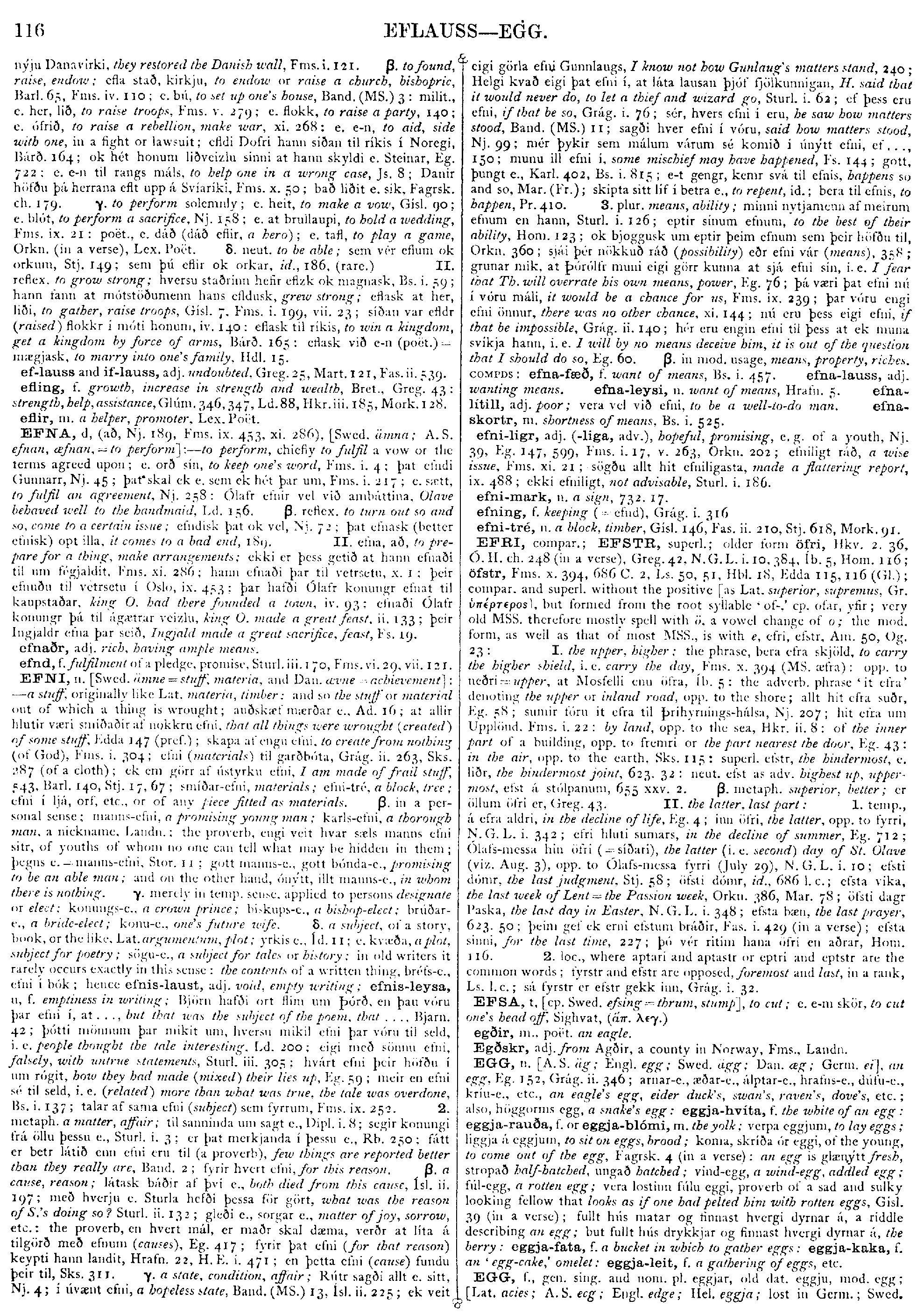
EFRI,
compar.;
EFSTR,
superl.;
older
form
öfri,
Hkv.
2.
36,
Ó.
H.
ch.
248
(in
a
verse),
Greg.
42,
N.
G.
L.
i.
10,
384,
Íb.
5,
Hom.
116;
öfstr,
Fms.
x.
394,
686
C.
2,
Ls.
50,
51,
Hbl.
18,
Edda
115,
116
(Gl.);
compar.
and
superl.
without
the
positive
[as
Lat.
superior,
supremus.
Gr.
GREEK,
but
formed
from
the
root
syllable
'of-,'
cp.
ofar,
yfir;
very
old
MSS.
therefore
mostly
spell
with
ö,
a
vowel
change
of
o;
the
mod.
form,
as
well
as
that
of
most
MSS.,
is
with
e,
efri,
efstr,
Am.
50,
Og.
23:
I.
the
upper,
higher;
the
phrase,
bera
efra
skjöld,
to
carry
the
higher
shield,
i.e.
carry
the
day,
Fms.
x.
394
(MS.
æfra):
opp.
to
neðri
=
upper,
at
Mosfelli
enu
öfra,
Íb.
5:
the
adverb,
phrase
'it
efra'
denoting
the
upper
or
inland
road,
opp.
to
the
shore;
allt
hit
efra
suðr,
Eg.
58;
sumir
fóru
it
efra
til
Þríhyrnings-hálsa,
Nj.
207;
hit
efra
um
Upplönd,
Fms.
i.
22:
by
land,
opp.
to
the
sea,
Hkr.
ii.
8:
of
the
inner
part
of
a
building,
opp.
to
fremri
or
the
part
nearest
the
door,
Eg.
43:
in
the
air,
opp.
to
the
earth,
Sks.
115:
superl.
efstr,
the
hindermost,
e.
liðr,
the
hindermost
joint,
623.
32:
neut.
efst
as
adv.
highest
up,
uppermost,
efst
á
stólpanum,
655
xxv.
2.
 .
metaph.
superior,
better;
er
öllum
öfri
er,
Greg.
43.
II.
the
latter,
last
part:
1.
temp.,
á
efra
aldri,
in
the
decline
of
life,
Eg.
4;
inn
öfri,
the
latter,
opp.
to
fyrri,
N.
G.
L.
i.
342;
efri
hluti
sumars,
in
the
decline
of
summer,
Eg.
712;
Ólafs-messa
hin
öfri
(
=
síðari),
the
latter
(i.e.
second)
day
of
St.
Olave
(viz.
Aug.
3),
opp.
to
Ólafs-messa
fyrri
(July
29),
N.
G.
L.
i.
10;
efsti
dómr,
the
last
judgment,
Stj.
58;
öfsti
dómr,
id.,
686
l.c.;
efsta
vika,
the
last
week
of
Lent
=
the
Passion
week,
Orkn.
386,
Mar.
78;
öfsti
dagr
Paska,
the
last
day
in
Easter,
N.
G.
L.
i.
348;
efsta
bæn,
the
last
prayer,
623.
50;
þeim
gef
ek
erni
efstum
bráðir,
Fas.
i.
429
(in
a
verse);
efsta
sinni,
for
the
last
time,
227;
þó
vér
ritim
hana
öfri
en
aðrar,
Hom.
116.
2.
loc.,
where
aptari
and
aptastr
or
eptri
and
eptstr
are
the
common
words;
fyrstr
and
efstr
are
opposed,
foremost
and
last,
in
a
rank,
Ls.
l.c.;
sá
fyrstr
er
efstr
gekk
inn,
Grág.
i.
32.
.
metaph.
superior,
better;
er
öllum
öfri
er,
Greg.
43.
II.
the
latter,
last
part:
1.
temp.,
á
efra
aldri,
in
the
decline
of
life,
Eg.
4;
inn
öfri,
the
latter,
opp.
to
fyrri,
N.
G.
L.
i.
342;
efri
hluti
sumars,
in
the
decline
of
summer,
Eg.
712;
Ólafs-messa
hin
öfri
(
=
síðari),
the
latter
(i.e.
second)
day
of
St.
Olave
(viz.
Aug.
3),
opp.
to
Ólafs-messa
fyrri
(July
29),
N.
G.
L.
i.
10;
efsti
dómr,
the
last
judgment,
Stj.
58;
öfsti
dómr,
id.,
686
l.c.;
efsta
vika,
the
last
week
of
Lent
=
the
Passion
week,
Orkn.
386,
Mar.
78;
öfsti
dagr
Paska,
the
last
day
in
Easter,
N.
G.
L.
i.
348;
efsta
bæn,
the
last
prayer,
623.
50;
þeim
gef
ek
erni
efstum
bráðir,
Fas.
i.
429
(in
a
verse);
efsta
sinni,
for
the
last
time,
227;
þó
vér
ritim
hana
öfri
en
aðrar,
Hom.
116.
2.
loc.,
where
aptari
and
aptastr
or
eptri
and
eptstr
are
the
common
words;
fyrstr
and
efstr
are
opposed,
foremost
and
last,
in
a
rank,
Ls.
l.c.;
sá
fyrstr
er
efstr
gekk
inn,
Grág.
i.
32.
|
Source: Cleasby/Vigfusson, page b0122, entry 12 View original page image as: [TIFF] [PNG] [View previous entry] [View next entry] |
[Comment on this entry] [View comments] |
The following entry has been hand-corrected once. |
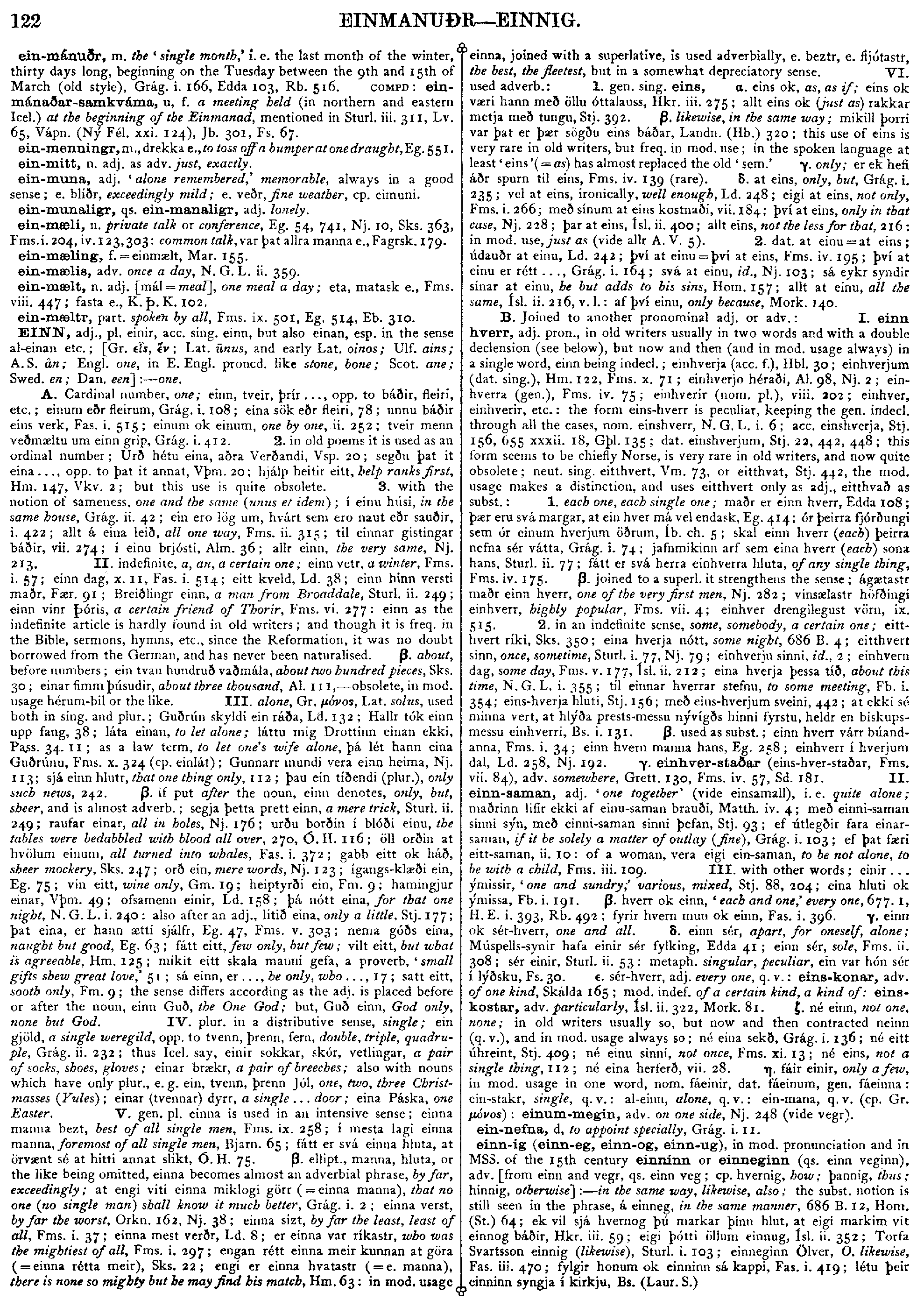
A.
Cardinal
number,
one;
einn,
tveir,
þrír
...,
opp.
to
báðir,
fleiri,
etc.;
einum
eðr
fleirum,
Grág.
i.
108;
eina
sök
eðr
fleiri,
78;
unnu
báðir
eins
verk,
Fas.
i.
515;
einum
ok
einum,
one
by
one,
ii.
252;
tveir
menn
veðmæltu
um
einn
grip,
Grág.
i.
412.
2.
in
old
poems
it
is
used
as
an
ordinal
number;
Urð
hétu
eina,
aðra
Verðandi,
Vsp.
20;
segðu
þat
it
eina
...,
opp.
to
þat
it
annat,
Vþm.
20;
hjálp
heitir
eitt,
help
ranks
first,
Hm.
147,
Vkv.
2;
but
this
use
is
quite
obsolete.
3.
with
the
notion
of
sameness,
one
and
the
same
(unus
et
idem;)
í
einu
húsi,
in
the
same
house,
Grág.
ii.
42;
ein
ero
lög
um,
hvárt
sem
ero
naut
eðr
sauðir,
i.
422;
allt
á
eina
leið,
all
one
way,
Fms.
ii.
315;
til
einnar
gistingar
báðir,
vii.
274;
í
einu
brjósti,
Alm.
36;
allr
einn,
the
very
same,
Nj.
213.
II.
indefinite,
a,
an,
a
certain
one;
einn
vetr,
a
winter,
Fms.
i.
57;
einn
dag,
x.
11,
Fas.
i.
514;
eitt
kveld,
Ld.
38;
einn
hinn
versti
maðr,
Fær.
91;
Breiðlingr
einn,
a
man
from
Broaddale,
Sturl.
ii.
249;
einn
vinr
Þóris,
a
certain
friend
of
Thorir,
Fms.
vi.
277:
einn
as
the
indefinite
article
is
hardly
found
in
old
writers;
and
though
it
is
freq.
in
the
Bible,
sermons,
hymns,
etc.,
since
the
Reformation,
it
was
no
doubt
borrowed
from
the
German,
and
has
never
been
naturalised.
.
about,
before
numbers;
ein
tvau
hundruð
vaðmála,
about
two
hundred
pieces,
Sks.
30;
einar
fimm
þúsudir,
about
three
thousand,
Al.
111,--obsolete,
in
mod.
usage
hérum-bil
or
the
like.
III.
alone,
Gr.
GREEK,
Lat.
solus,
used
both
in
sing.
and
plur.;
Guðrún
skyldi
ein
ráða,
Ld.
132;
Hallr
tók
einn
upp
fang,
38;
láta
einan,
to
let
alone;
láttu
mig
Drottinn
einan
ekki,
Pass.
34.
11;
as
a
law
term,
to
let
one's
wife
alone,
þá
lét
hann
eina
Guðrúnu,
Fms.
x.
324
(cp.
einlát);
Gunnarr
mundi
vera
einn
heima,
Nj.
113;
sjá
einn
hlutr,
that
one
thing
only,
112;
þau
ein
tíðendi
(plur.),
only
such
news,
242.
.
if
put
after
the
noun,
einn
denotes,
only,
but,
sheer,
and
is
almost
adverb.;
segja
þetta
prett
einn,
a
mere
trick,
Sturl.
ii.
249;
raufar
einar,
all
in
holes,
Nj.
176;
urðu
borðin
í
blóði
einu,
the
tables
were
bedabbled
with
blood
all
over,
270,
Ó.
H.
116;
öll
orðin
at
hvölum
einum,
all
turned
into
whales,
Fas.
i.
372;
gabb
eitt
ok
háð,
sheer
mockery,
Sks.
247;
orð
ein,
mere
words,
Nj.
123;
ígangs-klæði
ein,
Eg.
75;
vin
eitt,
wine
only,
Gm.
19;
heiptyrði
ein,
Fm.
9;
hamingjur
einar,
Vþm.
49;
ofsamenn
einir,
Ld.
158;
þá
nótt
eina,
for
that
one
night,
N.
G.
L.
i.
240:
also
after
an
adj.,
lítið
eina,
only
a
little,
Stj.
177;
þat
eina,
er
hann
ætti
sjálfr,
Eg.
47,
Fms.
v.
303;
nema
góðs
eina,
naught
but
good,
Eg.
63;
fátt
eitt,
few
only,
but
few;
vilt
eitt,
but
what
is
agreeable,
Hm.
125;
mikit
eitt
skala
manni
gefa,
a
proverb,
'small
gifts
shew
great
love,'
51;
sá
einn,
er
...,
he
only,
who
...,
17;
satt
eitt,
sooth
only,
Fm.
9;
the
sense
differs
according
as
the
adj.
is
placed
before
or
after
the
noun,
einn
Guð,
the
one
God;
but,
Guð
einn,
God
only,
none
but
God.
IV.
plur.
in
a
distributive
sense,
single;
ein
gjöld,
a
single
weregild,
opp.
to
tvenn,
þrenn,
fern,
double,
triple,
quadruple,
Grág.
ii.
232;
thus
Icel.
say,
einir
sokkar,
skór,
vetlingar,
a
pair
of
socks,
shoes,
gloves;
einar
brækr,
a
pair
of
breeches;
also
with
nouns
which
have
only
plur.,
e.g.
ein,
tvenn,
þrenn
Jól,
one,
two,
three
Christmasses
(Yules);
einar
(tvennar)
dyrr,
a
single
...
door;
eina
Páska,
one
Easter.
V.
gen.
pl.
einna
is
used
in
an
intensive
sense;
einna
manna
bezt,
best
of
all
single
men,
Fms.
ix.
258;
í
mesta
lagi
einna
manna,
foremost
of
all
single
men,
Bjarn.
65;
fátt
er
svá
einna
hluta,
at
örvænt
sé
at
hitti
annat
slíkt,
Ó.
H.
75.
.
ellipt.,
manna,
hluta,
or
the
like
being
omitted,
einna
becomes
almost
an
adverbial
phrase,
by
far,
exceedingly;
at
engi
viti
einna
miklogi
görr
(=
einna
manna),
that
no
one
(no
single
man)
shall
know
it
much
better,
Grág.
i.
2;
einna
verst,
by
far
the
worst,
Orkn.
162,
Nj.
38;
einna
sizt,
by
far
the
least,
least
of
all,
Fms.
i.
37;
einna
mest
verðr,
Ld.
8;
er
einna
var
ríkastr,
who
was
the
mightiest
of
all,
Fms.
i.
297;
engan
rétt
einna
meir
kunnan
at
göra
(=
einna
rétta
meir),
Sks.
22;
engi
er
einna
hvatastr
(=
e.
manna),
there
is
none
so
mighty
but
be
may
find
his
match,
Hm.
63:
in
mod.
usage
einna,
joined
with
a
superlative,
is
used
adverbially,
e.
beztr,
e.
fljótastr,
the
best,
the
fleetest,
but
in
a
somewhat
depreciatory
sense.
VI.
used
adverb.:
1.
gen.
sing,
eins,
 .
eins
ok,
as,
as
if;
eins
ok
væri
hann
með
öllu
óttalauss,
Hkr.
iii.
275;
allt
eins
ok
(just
as)
rakkar
metja
með
tungu,
Stj.
392.
.
likewise,
in
the
same
way;
mikill
þorri
var
þat
er
þær
sögðu
eins
báðar,
Landn.
(Hb.)
320;
this
use
of
eins
is
very
rare
in
old
writers,
but
freq.
in
mod.
use;
in
the
spoken
language
at
least
'eins'
(=
as)
has
almost
replaced
the
old
'sem.'
.
eins
ok,
as,
as
if;
eins
ok
væri
hann
með
öllu
óttalauss,
Hkr.
iii.
275;
allt
eins
ok
(just
as)
rakkar
metja
með
tungu,
Stj.
392.
.
likewise,
in
the
same
way;
mikill
þorri
var
þat
er
þær
sögðu
eins
báðar,
Landn.
(Hb.)
320;
this
use
of
eins
is
very
rare
in
old
writers,
but
freq.
in
mod.
use;
in
the
spoken
language
at
least
'eins'
(=
as)
has
almost
replaced
the
old
'sem.'
 .
only;
er
ek
hefi
áðr
spurn
til
eins,
Fms.
iv.
139
(rare).
.
only;
er
ek
hefi
áðr
spurn
til
eins,
Fms.
iv.
139
(rare).
 .
at
eins,
only,
but,
Grág.
i.
235;
vel
at
eins,
ironically,
well
enough,
Ld.
248;
eigi
at
eins,
not
only,
Fms.
i.
266;
með
sínum
at
eins
kostnaði,
vii.
184;
því
at
eins,
only
in
that
case,
Nj.
228;
þar
at
eins,
Ísl.
ii.
400;
allt
eins,
not
the
less
for
that,
216:
in
mod.
use,
just
as
(vide
allr
A.
V.
5).
2.
dat.
at
einu
=
at
eins;
údauðr
at
einu,
Ld.
242;
því
at
einu
=
því
at
eins,
Fms.
iv.
195;
því
at
einu
er
rétt
...,
Grág.
i.
164;
svá
at
einu,
id.,
Nj.
103;
sá
evkr
syndir
sínar
at
einu,
he
but
adds
to
his
sins,
Hom.
157;
allt
at
einu,
all
the
same,
Ísl.
ii.
216,
v.l.:
af
því
einu,
only
because,
Mork.
140.
.
at
eins,
only,
but,
Grág.
i.
235;
vel
at
eins,
ironically,
well
enough,
Ld.
248;
eigi
at
eins,
not
only,
Fms.
i.
266;
með
sínum
at
eins
kostnaði,
vii.
184;
því
at
eins,
only
in
that
case,
Nj.
228;
þar
at
eins,
Ísl.
ii.
400;
allt
eins,
not
the
less
for
that,
216:
in
mod.
use,
just
as
(vide
allr
A.
V.
5).
2.
dat.
at
einu
=
at
eins;
údauðr
at
einu,
Ld.
242;
því
at
einu
=
því
at
eins,
Fms.
iv.
195;
því
at
einu
er
rétt
...,
Grág.
i.
164;
svá
at
einu,
id.,
Nj.
103;
sá
evkr
syndir
sínar
at
einu,
he
but
adds
to
his
sins,
Hom.
157;
allt
at
einu,
all
the
same,
Ísl.
ii.
216,
v.l.:
af
því
einu,
only
because,
Mork.
140.
|
Source: Cleasby/Vigfusson, page b0144, entry 52 View original page image as: [TIFF] [PNG] [View previous entry] [View next entry] |
[Comment on this entry] [View comments] |
The following entry has been hand-corrected once. |
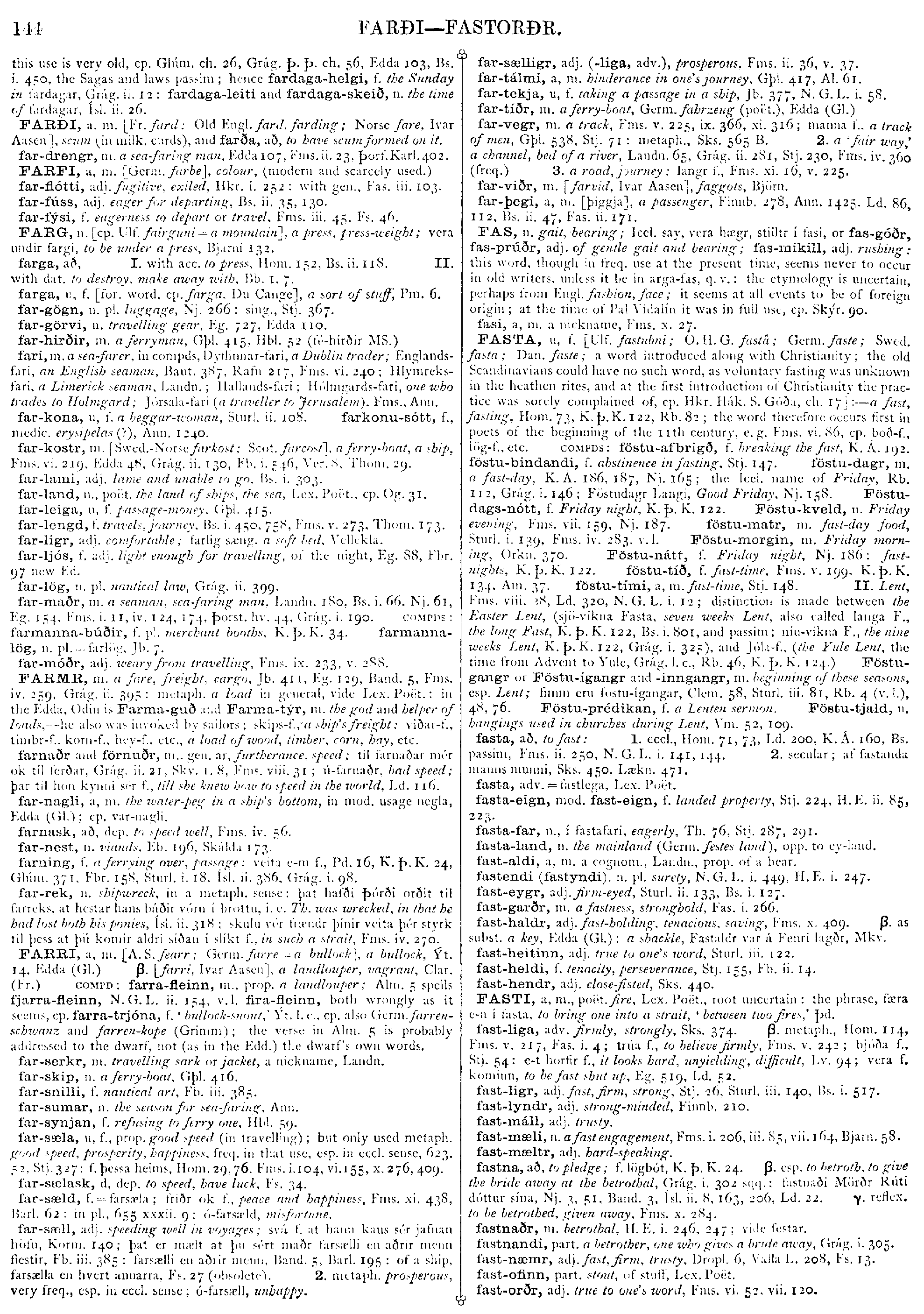
FASTA, u, f. [Ulf. fastubni; O. H. G. fastá; Germ. faste; Swed. fasta; Dan. faste; a word introduced along with Christianity; the old Scandinavians could have no such word, as voluntary fasting was unknown in the heathen rites, and at the first introduction of Christianity the practice was sorely complained of, cp. Hkr. Hák. S. Góða, ch. 17] :-- a fast, fasting, Hom. 73, K. Þ. K. 122, Rb. 82; the word therefore occurs first in poets of the beginning of the 11th century, e.g. Fms. vi. 86, cp. boð-f., lög-f., etc. COMPDS: föstu-afbrigð, f. breaking the fast, K. Á. 192. föstu-bindandi, f. abstinence in fasting, Stj. 147. föstu-dagr, m. a fast-day, K. Á. 186, 187, Nj. 165; the Icel. name of Friday, Rb. 112, Grág. i. 146; Föstudagr Langi, Good Friday, Nj. 158. Föstudags-nótt, f. Friday night, K. Þ. K. 122. Föstu-kveld, n. Friday evening, Fms. vii. 159, Nj. 187. föstu-matr, m. fast-day food, Sturl. i. 139, Fms. iv. 283, v.l. Föstu-morgin, m. Friday morning, Orkn. 370. Föstu-nátt, f. Friday night, Nj. 186: fast-nights, K. Þ. K. 122. föstu-tíð, f. fast-time, Fms. v. 199, K. Þ. K. 134, Am. 37. föstu-tími, a, m. fast-time, Stj. 148. II. Lent, Fms. viii. 28, Ld. 320, N. G. L. i. 12; distinction is made between the Easter Lent, (sjö-vikna Fasta, seven weeks Lent, also called langa F., the long Fast, K. Þ. K. 122, Bs. i. 801, and passim; níu-vikna F., the nine weeks Lent, K. Þ. K. 122, Grág. i. 325), and Jóla-f., (the Yule Lent, the time from Advent to Yule, Grág. l.c., Rb. 46, K. Þ. K. 124.) Föstu-gangr or Föstu-ígangr and -inngangr, m. beginning of these seasons, esp. Lent; fimm eru föstu-ígangar, Clem. 58, Sturl. iii. 81, Rb. 4 (v.l.), 48, 76. Föstu-prédikan, f. a Lenten sermon. Föstu-tjald, n. hangings used in churches during Lent, Vm. 52, 109.
|
Source: Cleasby/Vigfusson, page b0173, entry 43 View original page image as: [TIFF] [PNG] [View previous entry] [View next entry] |
[Comment on this entry] [View comments] |
The following entry has been hand-corrected once. |
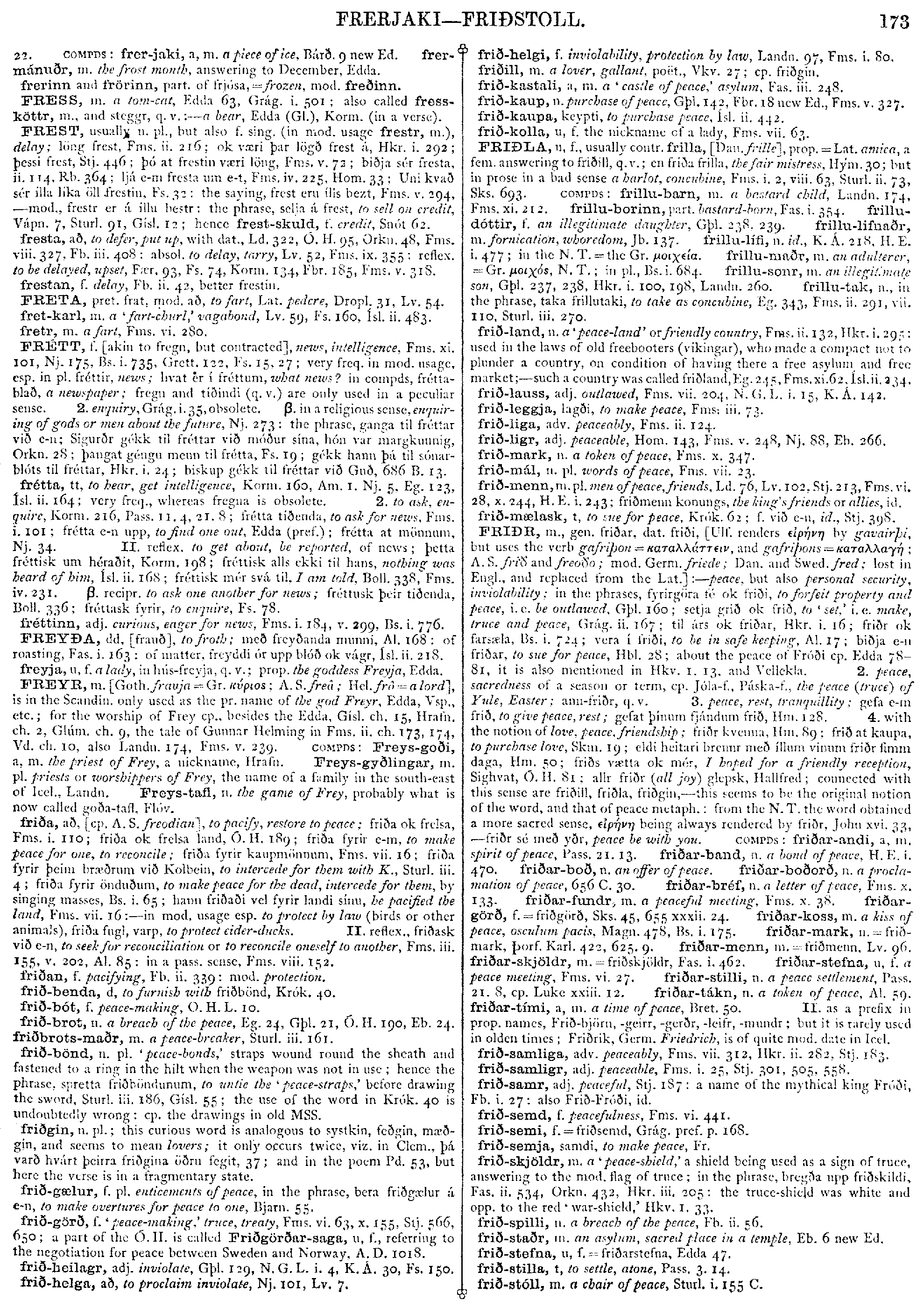
FRIÐR, m., gen. friðar, dat. friði, [Ulf. renders GREEK by gavairþi, but uses the verb gafriþon = GREEK, and gafriþons = GREEK; A. S. frið and freoðo; mod. Germ. friede; Dan. and Swed. fred; lost in Engl., and replaced from the Lat.] :-- peace, but also personal security, inviolability: in the phrases, fyrirgöra fé ok friði, to forfeit property and peace, i.e. be outlawed, Gþl. 160; setja grið ok frið, to 'set,' i.e. make, truce and peace, Grág. ii. 167: til árs ok friðar, Hkr. i. 16; friðr ok farsæla, Bs. i. 724; vera í friði, to be in safe keeping, Al. 17; biðja e-n friðar, to sue for peace, Hbl. 28; about the peace of Fróði cp. Edda 78-81, it is also mentioned in Hkv. 1. 13, and Vellekla. 2. peace, sacredness of a season or term, cp. Jóla-f., Páska-f., the peace (truce) of Yule, Easter; ann-friðr, q.v. 3. peace, rest, tranquillity; gefa e-m frið, to give peace, rest; gefat þínum fjándum frið, Hm. 128. 4. with the notion of love, peace, friendship; friðr kvenna, Hm. 89; frið at kaupa, to purchase love, Skm. 19; eldi heitari brennr með íllum vinum friðr fimm daga, Hm. 50; friðs vætla ok mér, I hoped for a friendly reception, Sighvat, Ó. H. 81; allr friðr (all joy) glepsk, Hallfred; connected with this sense are friðiil, friðla, friðgin, -- this seems to he the original notion of the word, and that of peace metaph.: from the N. T. the word obtained a more sacred sense, GREEK being always rendered by friðr, John xvi. 33, -- friðr sé með yðr, peace be with you. COMPDS: friðar-andi, a, m. spirit of peace, Pass. 21. 13. friðar-band, n. a bond of peace, H. E. i. 470. friðar-boð, n. an offer of peace. friðar-boðorð, n. a proclamation of peace, 656 C. 30. friðar-bréf, n. a letter of peace, Fms. x. 133. friðar-fundr, m. a peaceful meeting, Fms. x. 38. friðar-görð, f. = friðgörð, Sks. 45, 655 xxxii. 24. friðar-koss, m. a kiss of peace, osculum pacis, Magn. 478, Bs. i. 175. friðar-mark, n. = friðmark, Þorf. Karl. 422, 625. 9. friðar-menn, m. = friðmenn, Lv. 96. friðar-skjöldr, m. = friðskjöldr, Fas. i. 462. friðar-stefna, u, f. a peace meeting, Fms. vi. 27. friðar-stilli, n. a peace settlement, Pass. 21. 8, cp. Luke xxiii. 12. friðar-tákn, n. a token of peace, Al. 59. friðar-tími, a, m. a time of peace, Bret. 50. II. as a prefix in prop. names, Frið-björn, -geirr, -gerðr, -leifr, -mundr; but it is rarely used in olden times; Friðrik, Germ. Friedrich, is of quite mod. date in Icel.
|
Source: Cleasby/Vigfusson, page b0303, entry 1 View original page image as: [TIFF] [PNG] [View previous entry] [View next entry] |
[Comment on this entry] [View comments] |
The following entry has been hand-corrected once. |
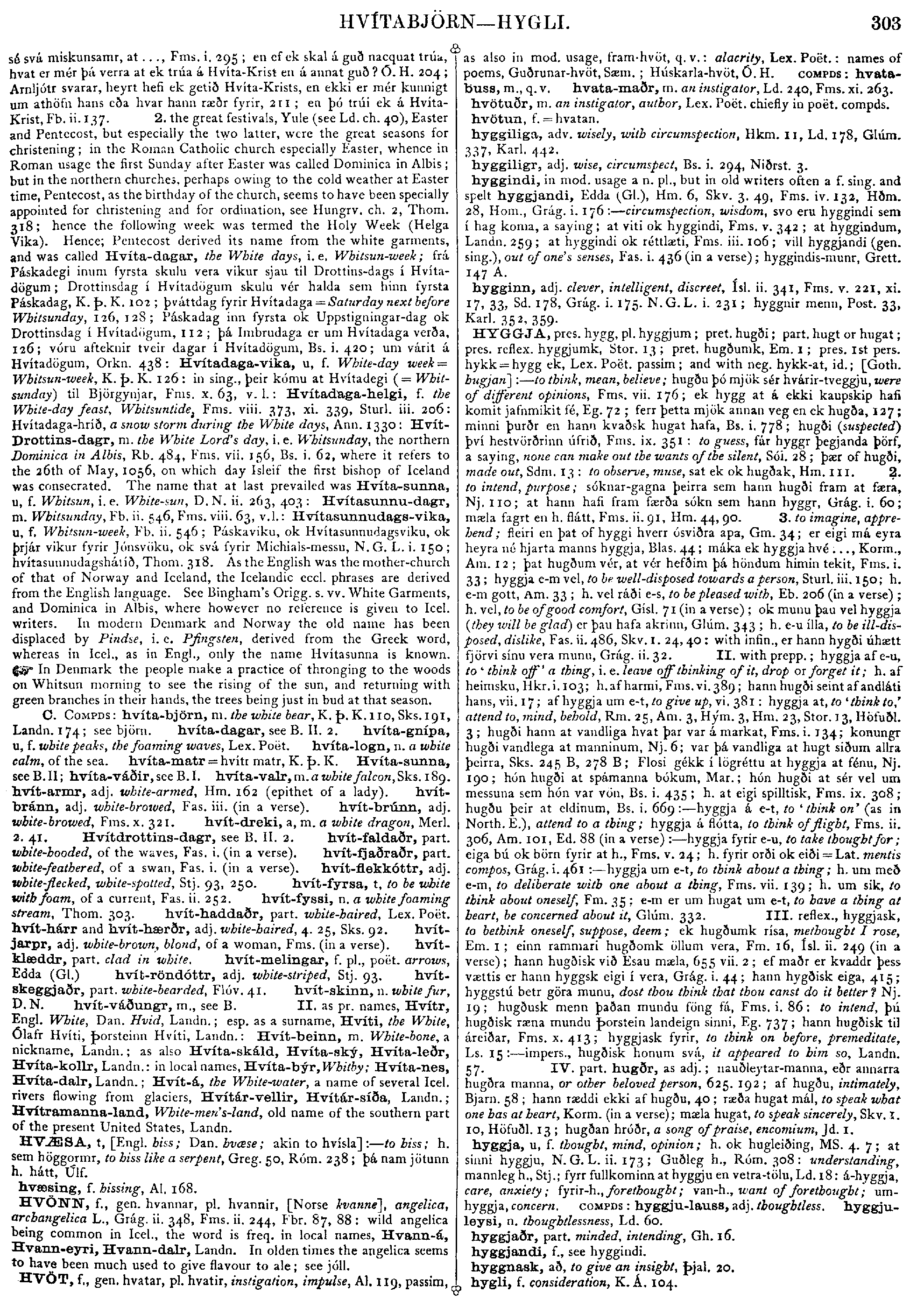
sé svá miskunsamr, at..., Fms. i. 295; en ef ek skal á guð nacquat trúa, hvat er mér þá verra at ek trúa á Hvita-Krist en á annat guð ? Ó. H. 204; Arnljótr svarar, heyrt hefi ek getið Hvíta-Krists, en ekki er mér kunnigt um athöfn hans eða hvar hann ræðr fyrir, 211; en þó trúi ek á Hviíta- Krist, Fb. ii. 137. 2. the great festivals, Yule (see Ld. ch. 40), Easter and Pentecost, but especially the two latter, were the great seasons for christening; in the Roman Catholic church especially Easter, whence in Roman usage the first Sunday after Easter was called Dominica in Albis; but in the northern churches, perhaps owing to the cold weather at Easter time, Pentecost, as the birthday of the church, seems to have been specially appointed for christening and for ordination, see Hungrv. ch. 2, Thom. 318; hence the following week was termed the Holy Week (Helga Vika). Hence; Pentecost derived its name from the white garments, and was called Hvíta-dagar, the White days, i. e. Whitsun-week; frá Páskadegi inum fýrsta skulu vera vikur sjau til Drottins-dags í Hvíta- dögum; Drottinsdag í Hvítadögum skulu vér halda sem hinn fyrsta Páskadag, K. Þ. K. 102; þváttdag fyrir Hvítadaga = Saturday next before Whitsunday, 126, 128; Páskadag inn fyrsta ok Uppstigningar-dag ok Drottinsdag í Hvítadögum, 112; þá Imbrudaga er um Hvítadaga verða, 120; vóru afteknir tveir dagar í Hvítadögum, Bs. i. 420; um várit á Hvítadögum, Orkn. 438: Hvítadaga-vika, u, f. White-day week = Whitsun-week, K. Þ. K. 126: in sing., þeir kómu at Hvítadegi (= Whit- sunday) til Björgynjar, Fms. x. 63, v. 1.: Hvíitadaga-helgi, f. the White-day feast, Whitsuntide, Fms. viii. 373, xi. 339, Sturl. iii. 206: Hvítadaga-hríð, a snow storm during the White days, Ann. 1330: Hvit- Drottins-dagr, m. the White Lord's day, i. e. Whitsunday, the northern Dominica in Albis, Rb. 484, Ems. vii. 156, Bs. i. 62, where it refers to the 20th of May, 1056, on which day Isleif the first bishop of Iceland was consecrated. The name that at last prevailed was Hvíta-sunna, u, f. Whitsun, i. e. White-sun, D. N. ii. 263, 403: Hvítasunni-dagr, m. Whitsuday, Fb. ii. 546, Ems. viii. 63, v. l.: Hvítasunnudags-vika, u, f. Whitsun-week, Fb. ii. 546; Páskaviku, ok Hvítasunnudags-viku, ok þrjár vikur fyrir Jónsvöku, ok svá fyrir Michials-messu, N. G. L. i. 150; hvítasunnudagshátíð, Thom. 318. As the English was the mother-church of that of Norway and Iceland, the Icelandic eccl. phrases are derived from the English language. See Bingham's Origg. s. vv. White Garments, and Dominica in Albis, where however no reference is given to Icel. writers. In modern Denmark and Norway the old name has been displaced by Pindse, i. e. Pfingsten, derived from the Greek word, whereas in Icel., as in Engl., only the name Hvitasunna is known, UNCERTAIN In Denmark the people make a practice of thronging to the woods on Whitsun morning to see the rising of the sun, and returning with green branches in their hands, the trees being just in bud at that season. C. COMPDS: hvíta-björn, m. the white bear, K. Þ. K. 110, Sks. 191, Landn. 174; see björn. hvíta-dagar, see B. II. 2. hvíta-gnípa, u, f. white peaks, the foaming waves, Lex. Poët. hvíta-logn, n. a white calm, of the sea. hvíta-matr = hvítr matr, K. Þ. K. Hvíta-sunna, see B. II; hvíta-váðir, see B. I. hvíta-valr, m. a white/ al co n, Sks. 189. hvít-armr, adj. white-armed, Hm. 162 (epithet of a lady). hvít- bránn, adj. white-browed, Fas. iii. (in a verse). hvít-brúnn, adj. white-browed, Ems. x. 321. hvít-dreki, a, m. a white dragon, Merl. 2. 41. Hvítdrottins-dagr, see B. II. 2. hvít-faldaðr, part. white-hooded, of the waves, Fas. i. (in a verse). hvít-fjaðraðr, part. white-feathered, of a swan, Fas. i. (in a verse). hvít-flekkóttr, adj. white-decked, white-spotted, Stj. 93, 250. hvít-fyrsa, t, to be white with foam, of a current, Fas. ii. 252. hvít-fyssi, n. a white foaming stream, Thom. 303. hvít-haddaðr, part, white-haired, Lex. Poët. hvít-hárr and lavít-hærðr, adj. white-haired, 4. 25, Sks. 92. hvít- jarpr, adj. white-brown, blond, of a woman, Fms. (in a verse). hvít- klæddr, part. clad in white. hvít-melingar, f. pl., poët, arrows, Edda (Gl.) hvít-röndóttr, adj. white-striped, Stj. 93. hvít- skeggjaðr, part. white-bearded, Flóv. 41. hvít-skinn, n. white fur, D. N. hvít-váðungr, m., see B. II. as pr. names, Hvítr, Engl. White, Dan. Hvid, Landn.; esp. as a surname, Hvíti, the White, Óláfr Hvíti, Þorsteinn Hvíti, Landn.: Hvít-beinn, m. White-hone, a nickname, Landn.; as also Hvíta-skáld, Hvíta-ský, Hvíta-leðr, Hvíta-kollr, Landn.: in local names, Hvíta-býr, Whitby; Hvíta-nes, Hvíta-dalr, Landn.; Hvít-á, the White-water, a name of several Icel. rivers flowing from glaciers, Hvítár-vellir, Hvítár-síða, Landn.; Hvítramanna-land, White-men's-land, old name of the southern part of the present United States, Landn.
|
Source: Cleasby/Vigfusson, page b0420, entry 1 View original page image as: [TIFF] [PNG] [View previous entry] [View next entry] |
[Comment on this entry] [View comments] |
The following entry has been hand-corrected once. |
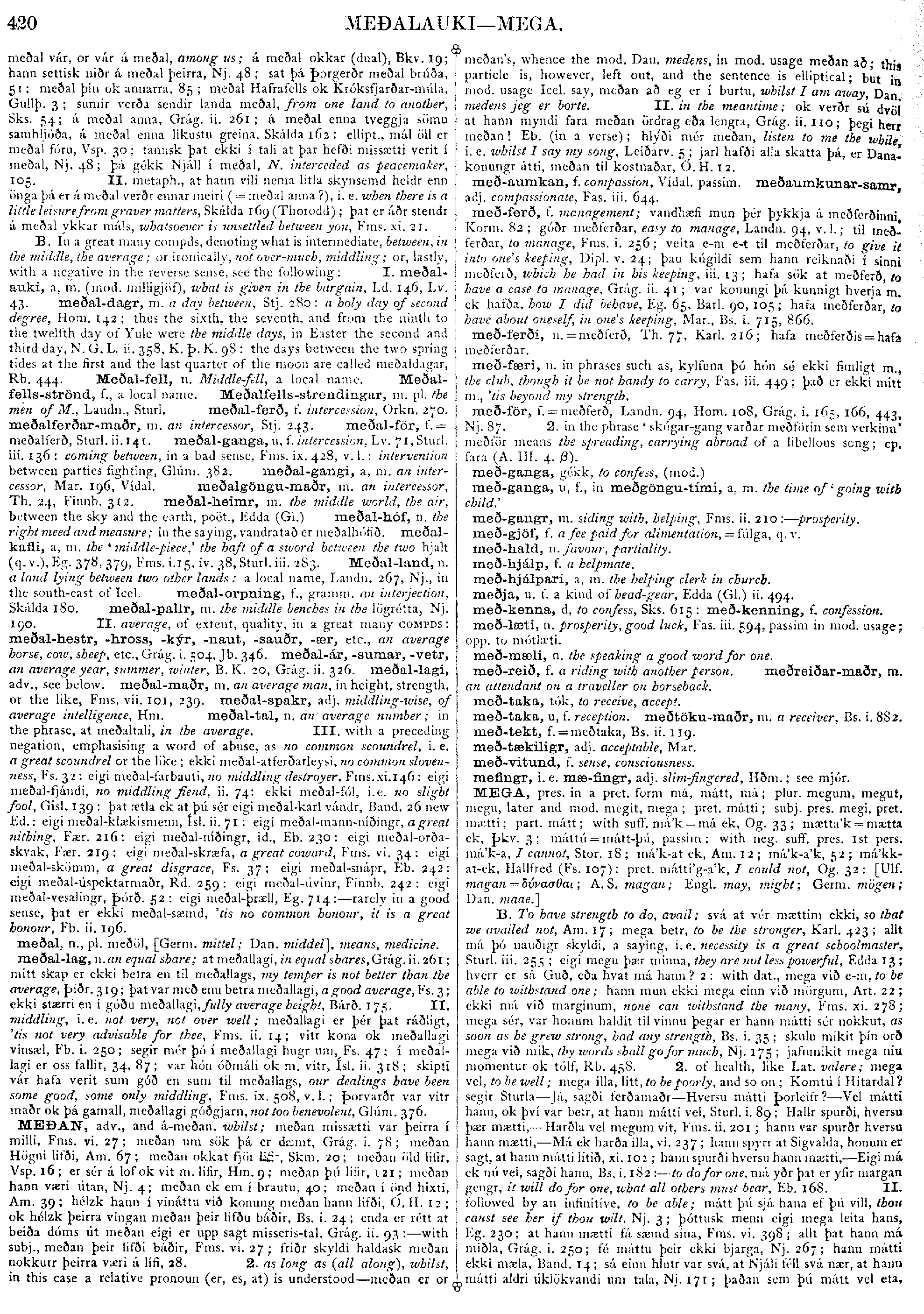
meðal vár, or vár á meðal, among us; á meðal okkar (dual), Bkv. 19; hann settisk niðr á meðal þeirra, Nj. 48; sat þá Þorgerðr meðal brúða, 51; meðal þín ok annarra, 85; meðal Hafrafells ok Króksfjarðar-múla, Gullþ. 3; sumir verða sendir landa meðal, from one land to another, Sks. 54; á meðal anna, Grág. ii. 261; á meðal enna tveggja sömu samhljóða, á meðal enna líkustu greina, Skálda 162: ellipt., mál öll er meðal fóru, Vsp. 30; fannsk þat ekki í tali at þar hefði missætti verit í meðal, Nj. 48; þá gékk Njáll í meðal, N. interceded as peacemaker, 105. II. metaph., at hann vili nema litla skynsemd heldr enn önga þá er á meðal verðr ennar meiri (= meðal anna?), i.e. when there is a little leisure from graver matters, Skálda 169 (Thorodd); þat er áðr stendr á meðal ykkar má!s, whatsoever is unsettled between you, Fms. xi. 21. B. In a great many compds, denoting what is intermediate, between, in the middle, the average; or ironically, not over-much, middling; or, lastly, with a negative in the reverse sense, see the following: I. meðal-auki, a, m. (mod. milligjöf), what is given in the bargain, Ld. 146, Lv. 43. meðal-dagr, m. a day between, Stj. 280: a holy day of second degree, Hom. 142; thus the sixth, the seventh, and from the ninth to the twelfth day of Yule were the middle days, in Easter the second and third day, N.G.L. ii, 358, K.Þ.K. 98: the days between the two spring tides at the first and the last quarter of the moon are called meðaldagar, Rb. 444. Meðal-fell, n. Middle-fell, a local name. Meðal-fells-strönd, f., a local name. Meðalfells-strendingar, m. pl. the men of M., Landn., Sturl. meðal-ferð, f. intercession, Orkn. 270. meðalferðar-maðr, m. an intercessor, Stj. 243. meðal-för, f. = meðalferð, Sturl. ii. 141. meðal-ganga, u, f. intercession, Lv. 71, Sturl. iii. 136: coming between, in a bad sense. Fms. ix. 428, v.l.: intervention between parties fighting, Glúm. 382. meðal-gangi, a, m. an intercessor, Mar. 196, Vídal. meðalgöngu-maðr, m. an intercessor, Th. 24, Finnb. 312. meðal-heimr, m. the middle world, the air, between the sky and the earth, poët., Edda (Gl.) meðal-hóf, n. the right meed and measure; in the saying, vandratað er meðalhófið. meðal-kafli, a, m. the 'middle-piece, ' the haft of a sword between the two hjalt (q.v.), Eg. 378, 379, Fms. i. 15, iv. 38, Sturl. iii. 283. Meðal-land, n. a land lying between two other lands: a local name, Landn. 267, Nj., in the south-east of Icel. meðal-orpning, f., gramm. an interjection, Skálda 180. meðal-pallr, m. the middle benches in the lögrétta, Nj. 190. II. average, of extent, quality, in a great many COMPDS: meðal-hestr, -hross, -kýr, -naut, -sauðr, -ær, etc., an average horse, cow, sheep, etc., Grág. i. 504, Jb. 346. meðal-ár, -sumar, -vetr, an average year, summer, winter, B.K. 20, Grág. ii. 326. meðal-lagi, adv., see below, meðal-maðr, m. an average man, in height, strength, or the like, Fms. vii. 101, 239. meðal-spakr, adj. middling-wise, of average intelligence, Hm. meðal-tal, n. an average number; in the phrase, at meðaltali, in the average. III. with a preceding negation, emphasising a word of abuse, as no common scoundrel, i.e. a great scoundrel or the like; ekki meðal-atferðarleysi, no common slovenness, Fs. 32: eigi meðal-farbauti, no middling destroyer, Fms. xi. 146: eigi meðal-fjándi, no middling fiend, ii. 74: ekki meðal-fól, i.e. no slight fool, Gísl. 139: þat ætla ek at þú sér eigi meðal-karl vándr, Band. 26 new Ed.: eigi meðal-klækismenn, Ísl. ii. 71: eigi meðal-mann-níðingr, a great nithing, Fær. 216: eigi meðal-níðingr, id., Eb. 230: eigi meðal-orðaskvak, Fæ 219: eigi meðal-skræfa, a great coward, Fms. vi. 34: eigi meðal-skömm, a great disgrace, Fs. 37: eigi meðal-snápr, Eb. 242: eigi meðal-úspektarmaðr, Rd. 259: eigi meðal-úvinr, Finnb. 242: eigi meðal-vesalingr, Þórð. 52: eigi meðal-þræli, Eg. 714 :-- rarely in a good sense, þat er ekki meðal-sæmd, 'tis no common honour, it is a great honour, Fb. ii. 196.
|
Source: Cleasby/Vigfusson, page b0475, entry 51 View original page image as: [TIFF] [PNG] [View previous entry] [View next entry] |
[Comment on this entry] [View comments] |
The following entry has been hand-corrected once. |
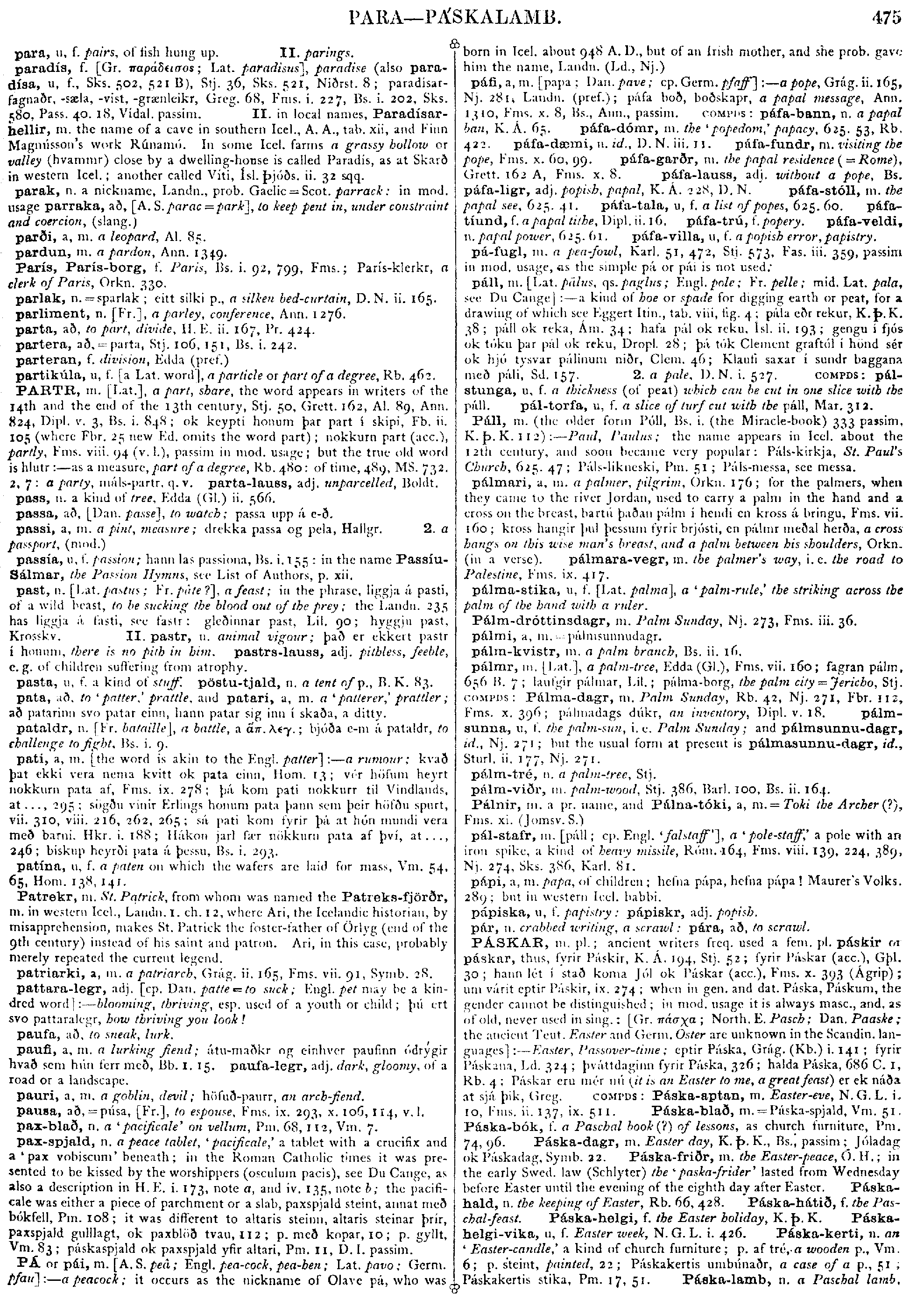
PÁSKAR, m. pl.; ancient writers freq. used a fem. pl. páskir or páskar, thus, fyrir Páskir, K.Á. 194, Stj. 52; fyrir Páskar (acc.), Gþl. 30; hann lét í stað koma Jól ok Páskar (acc.), Fms. x. 393 (Ágrip); um várit eptir Páskir, ix. 274; when in gen. and dat. Páska, Páskum, the gender cannot be distinguished; in mod. usage it is always masc., and, as of old, never used in sing.: [Gr. GREEK; North. E. Pasch; Dan. Paaske; the ancient Teut. Easter and Germ. Oster are unknown in the Scandin. languages] :-- Easter, Passover-time; eptir Páska, Grág. (Kb.) i. 141; fyrir Páskana, Ld. 324; þváttdaginn fyrir Páska, 326; halda Páska, 686 C. 1, Rb. 4; Páskar eru mér nú (it is an Easter to me, a great feast) er ek náða at sjá þik, Greg. COMPDS: Páska-aptan, m. Easter-eve, N.G.L. i, 10, Fms. ii. 137, ix. 511. Páska-blað, m. = Páska-spjald, Vm. 51. Páska-bók, f. a Paschal book(?) of lessons, as church furniture, Pm. 74, 96. Páska-dagr, m. Easter day, K.Þ.K., Bs., passim; Jóladag ok Páskadag, Symb. 22. Páska-friðr, m. the Easter-peace, Ó.H.; in the early Swed. law (Schlyter) the 'paska-frider' lasted from Wednesday before Easter until the evening of the eighth day after Easter. Páska-hald, n. the keeping of Easter, Rb. 66, 428. Páska-hátið, f. the Paschal-feast. Páska-helgi, f. the Easter holiday, K.Þ.K. Páskahelgi-vika, u, f. Easter week, N.G.L. i. 426. Páska-kerti, n. an 'Easter-candle,' a kind of church furniture; p. af tré a wooden p., Vm. 6; p. steint, painted, 22; Páskakertis umbúnaðr, a case of a p., 51; Páskakertis stika, Pm. 17, 51. Páska-lamb, n. a Paschal lamb.
|
Source: Cleasby/Vigfusson, page b0476, entry 1 View original page image as: [TIFF] [PNG] [View previous entry] [View next entry] |
[Comment on this entry] [View comments] |
The following entry has been hand-corrected once. |
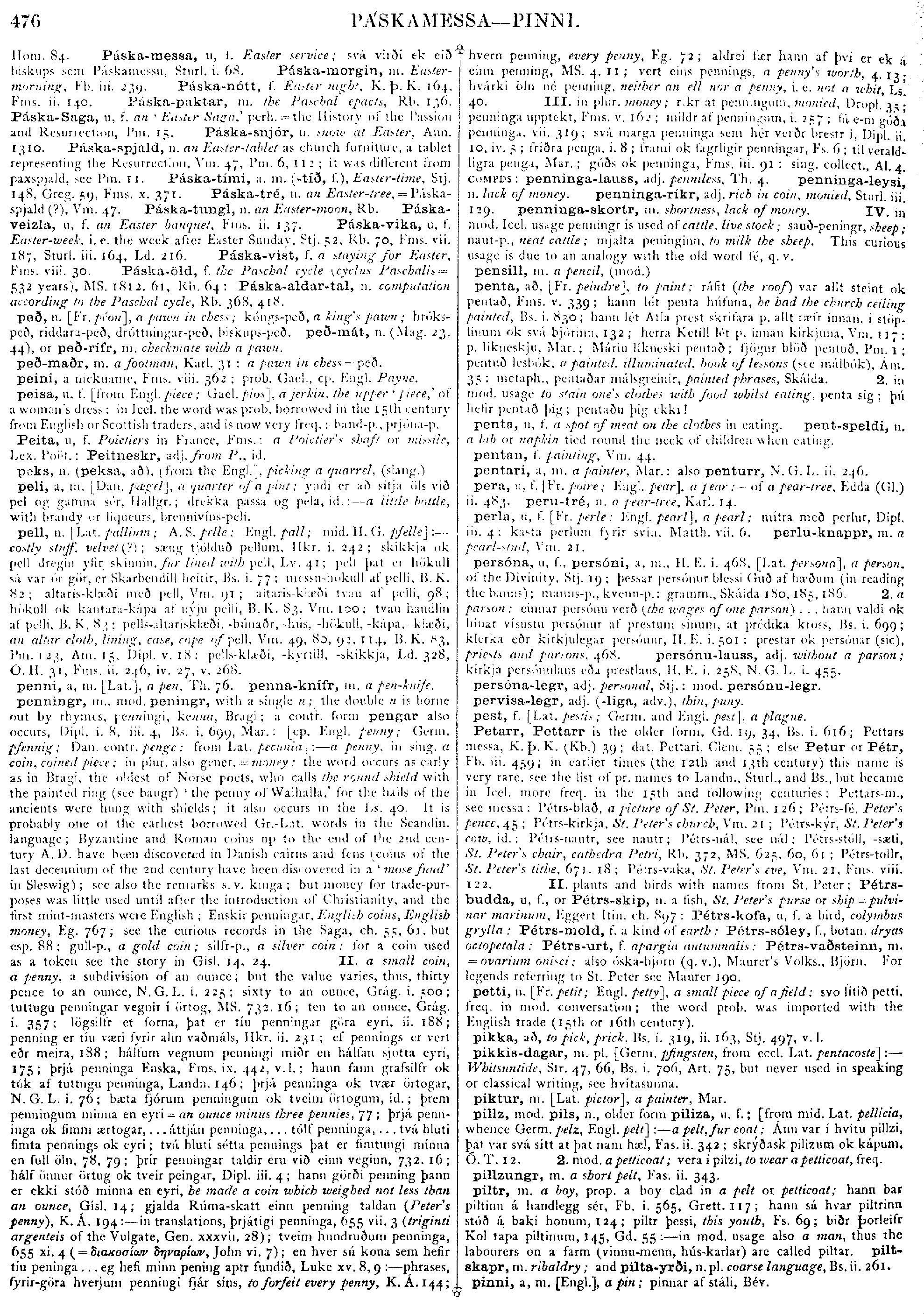
Hom. 84. Páska-messa, u, f. Easter service; svá virði ek eið biskups sem Páskamessu, Sturl. i. 68. Páska-morgin, m. Easter-morning, Fb. iii. 239. Páska-nótt, f. Easter night, K.Þ.K. 164, Fms. ii. 140. Páska-paktar, m. the Paschal epacts, Rb. 136. Páska-Saga, u, f. an 'Easter Saga,' perh. = the History of the Passion and Resurrection, Pm. 15. Páska-snjór, n. snow at Easter, Ann. 1310. Páska-spjald, n. an Easter-tablet as church furniture, a tablet representing the Resurrection, Vm. 47, Pm. 6, 112; it was different from paxspjald, see Pm. 11. Páska-tími, a, m. (-tíð, f.), Easter-time, Stj. 148, Greg. 59, Fms. x. 371. Páska-tré, n. an Easier-tree, = Páskaspjald(?), Vm. 47. Páska-tungl, n. an Easter-moon, Rb. Páska-veizla, u, f. an Easter banquet, Fms. ii. 137. Páska-vika, u, f. Easter-week, i.e. the week after Easter Sunday, Stj. 52, Rb. 70, Fms. vii. 187, Sturl. iii. 164, Ld. 216. Páska-vist, f. a staying for Easter, Fms. viii. 30. Páska-öld, f. the Paschal cycle (cyclus Paschalis = 532 years), MS. 1812. 61, Rb. 64: Páska-aldar-tal, n. computation according to the Paschal cycle, Rb. 368, 418.
|
Source: Cleasby/Vigfusson, page b0604, entry 1 View original page image as: [TIFF] [PNG] [View previous entry] [View next entry] |
[Comment on this entry] [View comments] |
The following entry has been hand-corrected once. |
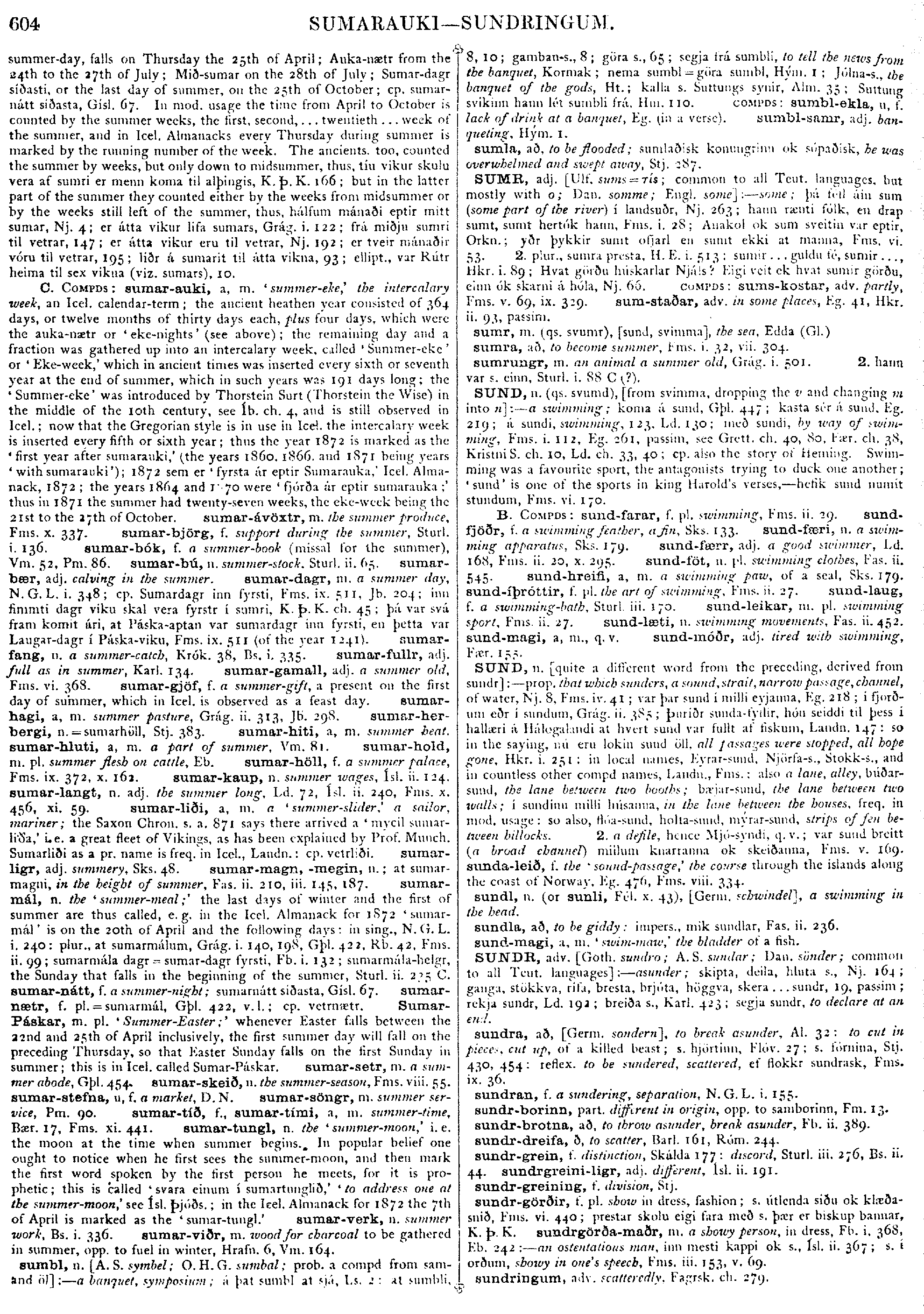
summer-day, falls on Thursday the 25th of April; Auka-nætr from the 24th to the 27th of July; Mið-sumar on the 28th of July; Sumar-dagr síðasti, or the last day of summer, on the 25th of October; cp. sumar-nátt siðasta, Gísl. 67. In mod. usage the time from April to October is counted by the summer weeks, the first, second, ... twentieth ... week of the summer, and in Icel. Almanacks every Thursday during summer is marked by the running number of the week. The ancients, too, counted the summer by weeks, but only down to midsummer, thus, tíu vikur skulu vera af sumri er menn koma til alþingis, K.Þ.K. 166; but in the latter part of the summer they counted either by the weeks from midsummer or by the weeks still left of the summer, thus, hálfum mánaði eptir mitt sumar, Nj. 4; er átta vikur lifa sumars, Grág. i. 122; frá miðju sumri til vetrar, 147; er átta vikur eru til vetrar, Nj. 192; er tveir mánaðir vóru til vetrar, 195; líðr á sumarit til átta vikna, 93; ellipt., var Rútr heima til sex vikna (viz. sumars), 10. C. COMPDS: sumar-auki, a, m. 'summer-eke,' the intercalary week, an Icel. calendar-term; the ancient heathen year consisted of 364 days, or twelve months of thirty days each, plus four days, which were the auka-nætr or 'eke-nights' (see above); the remaining day and a fraction was gathered up into an intercalary week, called 'Summer-eke' or 'Eke-week,' which in ancient times was inserted every sixth or seventh year at the end of summer, which in such years was 191 days long; the 'Summer-eke' was introduced by Thorstein Surt (Thorstein the Wise) in the middle of the 10th century, see Íb. ch. 4, and is still observed in Icel.; now that the Gregorian style is in use in Icel. the intercalary week is inserted every fifth or sixth year; thus the year 1872 is marked as the 'first year after sumarauki,' (the years 1860, 1866, and 1871 being years 'with sumarauki'); 1872 sem er 'fyrsta ár eptir Sumarauka,' Icel. Almanack, 1872; the years 1864 and 187O were 'fjórða ár eptir sumarauka;' thus in 1871 the summer had twenty-seven weeks, the eke-week being the 21st to the 27th of October. sumar-ávöxtr, m. the summer produce, Fms. x. 337. sumar-björg, f. support during the summer, Sturl. i. 136. sumar-bók, f. a summer-book (missal for the summer), Vm. 52, Pm. 86. sumar-bú, n. summer-stock, Sturl. ii. 65. sumar-bær, adj. calving in the summer. sumar-dagr, m. a summer day, N.G.L. i. 348; cp. Sumardagr inn fyrsti, Fms. ix. 511, Jb. 204; inn fimmti dagr viku skal vera fyrstr í sumri, K.Þ.K. ch. 45; þá var svá fram komit ári, at Páska-aptan var sumardagr inn fyrsti, en þetta var Laugar-dagr í Páska-viku, Fms. ix. 511 (of the year 1241). sumar-fang, n. a summer-catch, Krók. 38, Bs. i. 335. sumar-fullr, adj. full as in summer, Karl. 134. sumar-gamall, adj. a summer old, Fms. vi. 368. sumar-gjöf, f. a summer-gift, a present on the first day of summer, which in Icel. is observed as a feast day. sumar-hagi, a, m. summer pasture, Grág. ii. 313, Jb. 298. sumar-herbergi, n. = sumarhöll, Stj. 383. sumar-hiti, a, m. summer heat. sumar-hluti, a, m. a part of summer, Vm. 81. sumar-hold, m. pl. summer flesh on cattle, Eb. sumar-höll, f. a summer palace, Fms. ix. 372, x. 162. sumar-kaup, n. summer wages, Ísl. ii. 124. sumar-langt,? n. adj. the summer long, Ld. 72, Ísl. ii. 240, Fms. x. 456, xi. 59, sumar-liði, a, m. a 'summer-slider,' a sailor, mariner; the Saxon Chron. s. a. 871 says there arrived a 'mycil sumar-liða,' i.e. a great fleet of Vikings, as has been explained by Prof. Munch. Sumarliði as a pr. name is freq. in Icel., Landn.: cp. vetrliði. sumar-ligr, adj. summery, Sks. 48. sumar-magn, -megin, n.; at sumar-magni, in the height of summer. Fas. ii. 210, iii. 145, 187. sumar-mál, n. the 'summer-meal;' the last days of winter and the first of summer are thus called, e.g. in the Icel. Almanack for 1872 'sumar-mál' is on the 20th of April and the following days: in sing., N.G.L. i. 240: plur., at sumarmálum, Grág. i. 140, 198, Gþl. 422, Rb. 42, Fms. ii. 99; sumarmála dagr = sumar-dagr fyrsti, Fb. i. 132; sumarmála-helgr, the Sunday that falls in the beginning of the summer, Sturl. ii. 235 C. sumar-nátt, f. a summer-night; sumarnátt siðasta, Gísl. 67. sumar-nætr, f. pl. = sumarmál, Gþl. 422, v.l.; cp. vetrnætr. Sumar-Páskar, m. pl. 'Summer-Easter;' whenever Easter falls between the 22nd and 25th of April inclusively, the first summer day will fall on the preceding Thursday, so that Easter Sunday falls on the first Sunday in summer; this is in Icel. called Sumar-Páskar. sumar-setr, m. a summer abode, Gþl. 454. sumar-skeið, n. the summer-season, Fms. viii. 55. sumar-stefna, u, f. a market, D.N. sumar-söngr, m. summer service, Pm. 90. sumar-tíð, f., sumar-tími, a, m. summer-time, Bær. 17, Fms. xi. 441. sumar-tungl, n. the 'summer-moon,' i.e. the moon at the time when summer begins. In popular belief one ought to notice when he first sees the summer-moon, and then mark the first word spoken by the first person he meets, for it is prophetic; this is called 'svara einum í sumartunglið,' 'to address one at the summer-moon,' see Ísl. Þjóðs.; in the Icel. Almanack for 1872 the 7th of April is marked as the 'sumar-tungl.' sumar-verk, n. summer-work, Bs. i. 336. sumar-viðr, m. wood for charcoal to be gathered in summer, opp. to fuel in winter, Hrafn. 6, Vm. 164.
| Result Page: |  |
Previous | 1 2 3 4 5 6 | Next |  |
Germanic Lexicon Project (main page)
This search system was written by
Sean Crist
Please consider
volunteering
to correct the data in these online dictionaries.
No rights reserved. Feel free to use these data in any way you please.