|
|

|
Source: Cleasby/Vigfusson, page b0743, entry 19 View original page image as: [TIFF] [PNG] [View previous entry] [View next entry] |
[Comment on this entry] [View comments] |
The following entry has been hand-corrected once. |
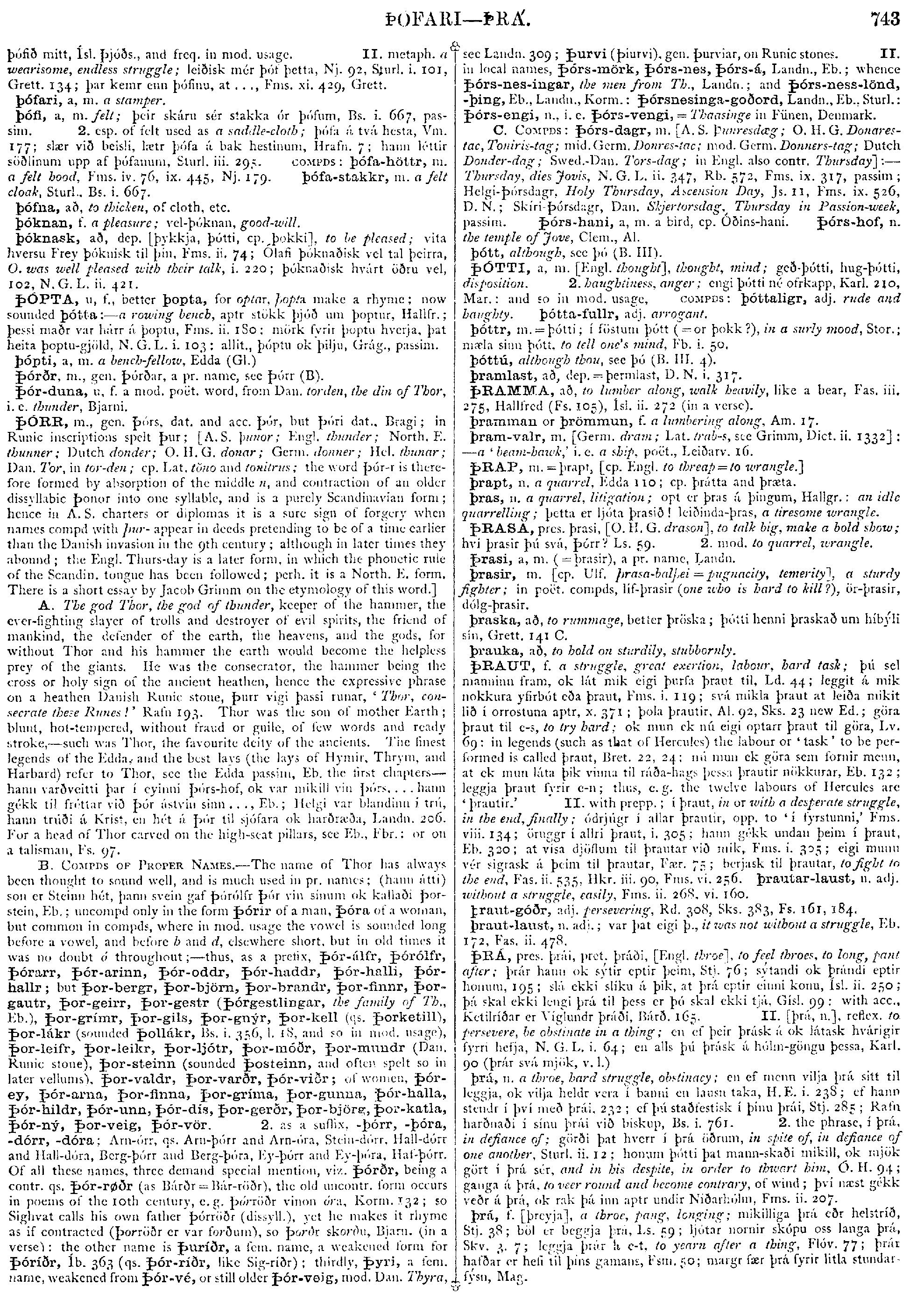
þram-valr, m. [Germ. dram; Lat. trab-s, see Grimm, Dict. ii. 1332] :-- a 'beam-hawk,' i.e. a ship, poët., Leiðarv. 16.
|
Source: Cleasby/Vigfusson, page b0747, entry 27 View original page image as: [TIFF] [PNG] [View previous entry] [View next entry] |
[Comment on this entry] [View comments] |
The following entry has been hand-corrected once. |
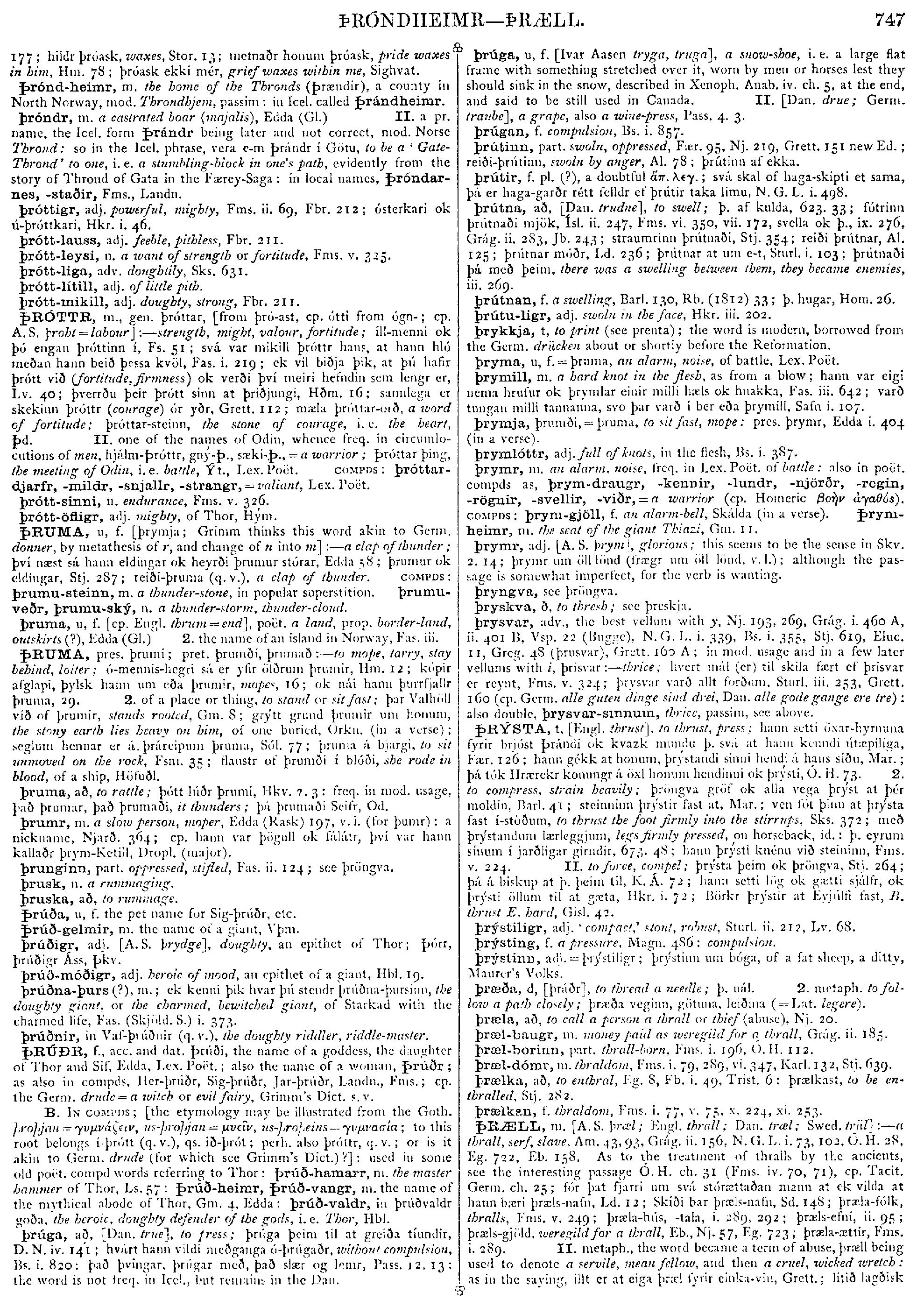
ÞRÚÐR, f., acc. and dat. Þrúði, the name of a goddess, the daughter of Thor and Sif, Edda, Lex. Poët.; also the name of a woman, Þrúðr; as also in compds, Her-þrúðr, Sig-þrúðr, Jar-þrúðr, Landn., Fms.; cp. the Germ. drude = a witch or evil fairy, Grimm's Dict. s.v. B. IN COMPDS; [the etymology may be illustrated from the Goth. þroþjan = GREEK, us-þroþjan = GREEK, us-þroþeins = GREEK; to this root belongs í-þrótt (q.v.), qs. ið-þrót; perh. also þróttr, q.v.; or is it akin to Germ. drude (for which see Grimm's Dict.)?]: used in some old poët. compd words referring to Thor: Þrúð-hamarr, m. the master hammer of Thor, Ls. 57: Þrúð-heimr, Þrúð-vangr, m. the name of the mythical abode of Thor, Gm. 4, Edda: þ;rúð-valdr, in þrúðvaldr goða, the heroic, doughty defender of the gods, i.e. Thor, Hbl.
|
Source: Cleasby/Vigfusson, page b0756, entry 4 View original page image as: [TIFF] [PNG] [View previous entry] [View next entry] |
[Comment on this entry] [View comments] |
The following entry has been hand-corrected once. |
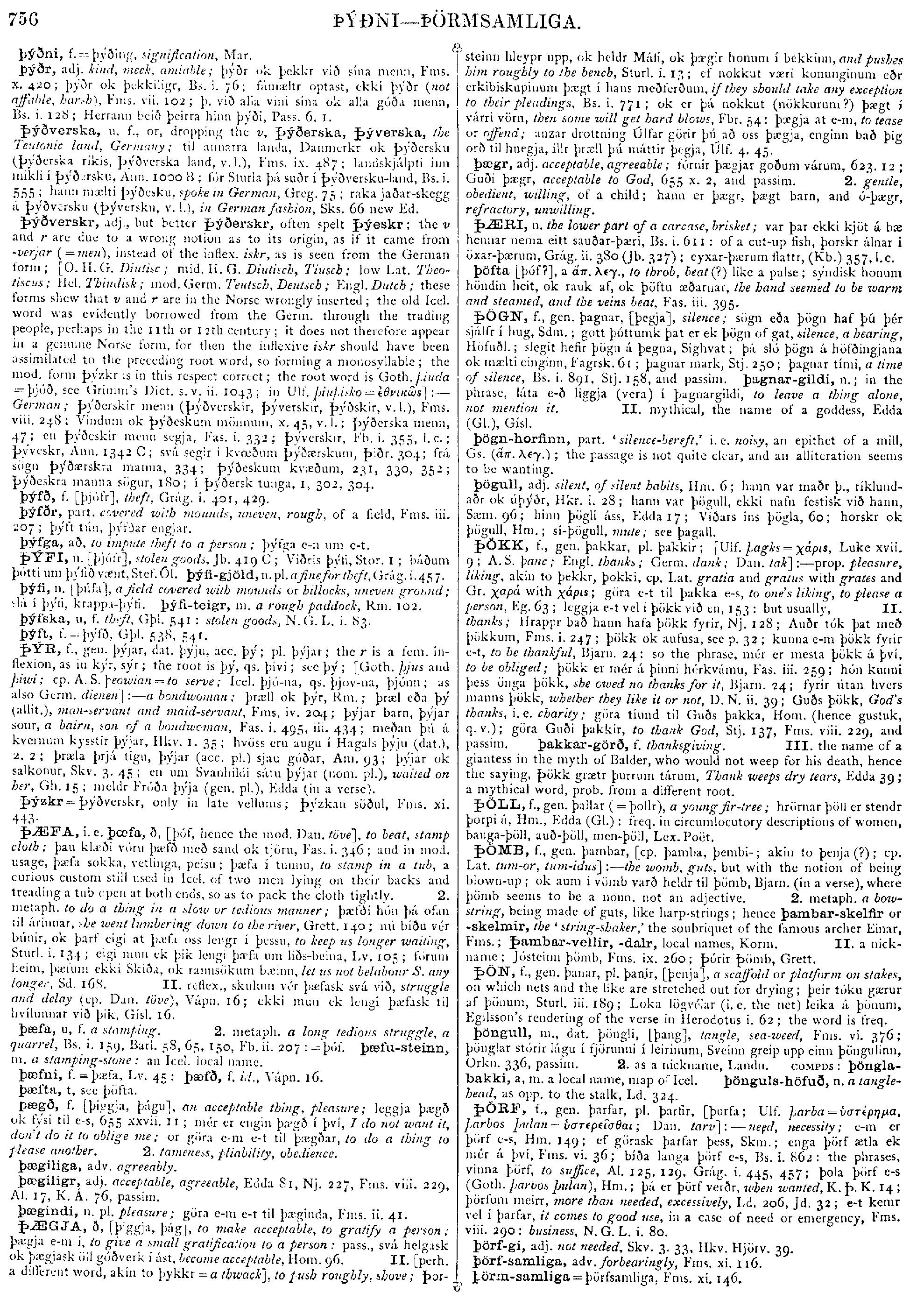
Þýðverskr, adj., but better Þýðerskr, often spelt Þyeskr; the v and r are due to a wrong notion as to its origin, as if it came from -verjar (= men) instead of the inflex. iskr, as is seen from the German form; [0.H.G. Diutisc; mid.H.G. Diutisch, Tiusch; low Lat. Theotiscus;; Hel. Thiudisk; mod. Germ. Teutsch, Deutsch; Engl. Dutch; these forms shew that v and r are in the Norse wrongly inserted; the old Icel. word was evidently borrowed from the Germ. through the trading people, perhaps in the 11th or 12th century; it does not therefore appear in a genuine Norse form, for then the inflexive iskr should have been assimilated to the preceding root word, so forming a monosyllable; the mod. form Þýzkr is in this respect correct; the root word is Goth. þiuda = þjóð, see Grimm's Dict. s.v. ii. 1043; in Ulf. þiuþisko = GREEK] :-- German; Þýðerskir menn (Þýðverskir, Þýverskir, Þýðskir, v.l.), Fms. viii. 248; Vindum ok Þýðeskum mönnum, x. 45, v.l.; Þýðerska menn, 47; en Þýðeskir menn segja, Fas. i. 332; Þýverskir, Fb. i. 355. l.c.; Þýveskr, Ann. 1342 C; svá segir í kvœðum Þýðærskum, Þiðr. 304; frá sögn Þýðærskra manna, 334; Þýðeskum kvæðum, 231, 330, 352; Þýðeskra manna sögur, 180; í Þýðersk tunga, 1, 302, 304.
|
Source: Cleasby/Vigfusson, page b0757, entry 4 View original page image as: [TIFF] [PNG] [View previous entry] [View next entry] |
[Comment on this entry] [View comments] |
The following entry has been hand-corrected once. |
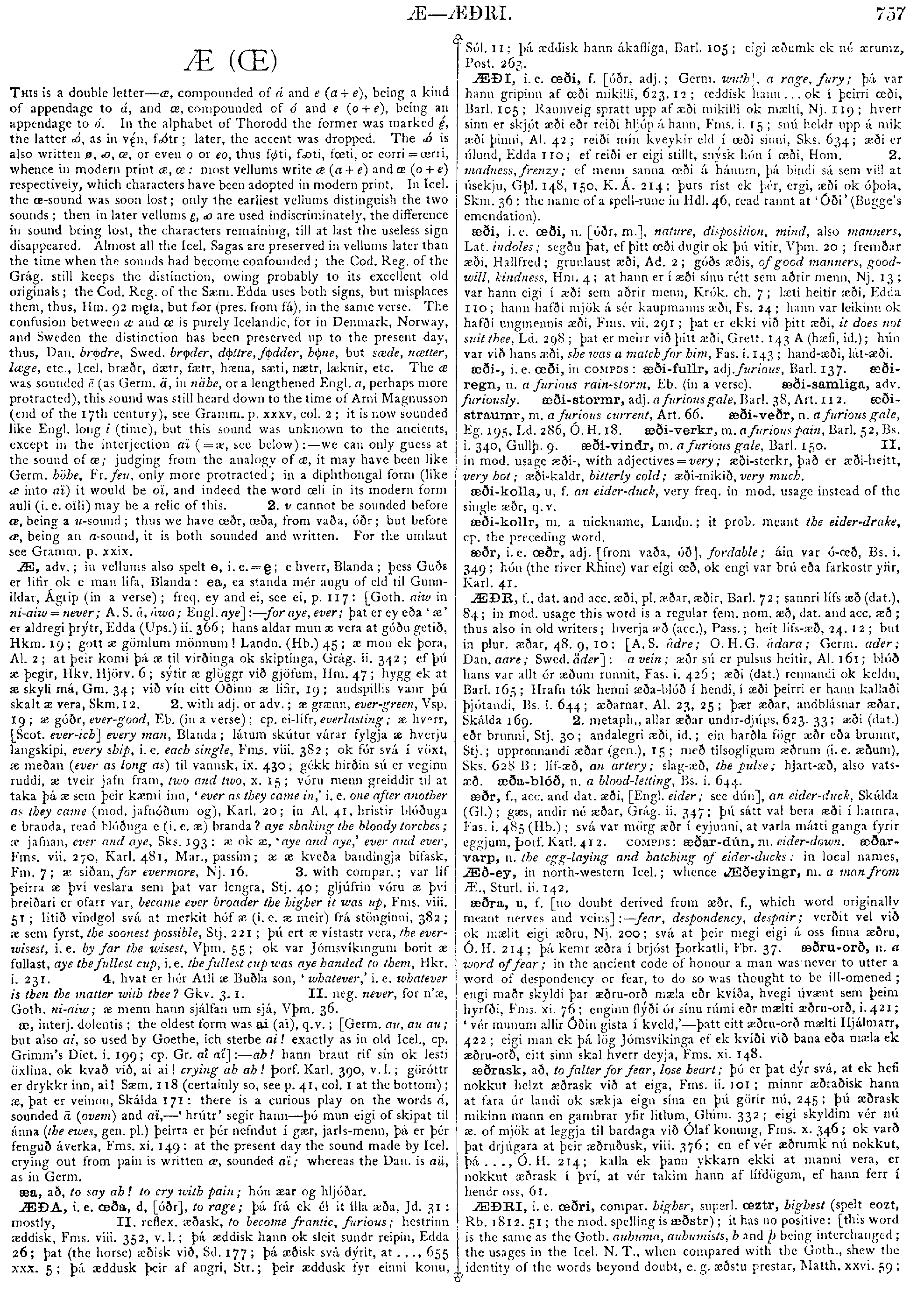
æ,
interj.
dolentis;
the
oldest
form
was
ai
(aï),
q.v.;
[Germ.
au,
au
au;
but
also
ai,
so
used
by
Goethe,
ich
sterbe
ai!
exactly
as
in
old
Icel.,
cp.
Grimm's
Dict.
i.
199;
cp.
Gr.
GREEK]
:--
ah!
hann
braut
rif
sín
ok
lesti
öxlina,
ok
kvað
við,
ai
ai!
crying
ah
ah!
Þorf.
Karl.
390,
v.l.;
göróttr
er
drykkr
inn,
ai!
Sæm.
118
(certainly
so,
see
p.
41,
col.
1
at
the
bottom);
æ
þat
er
veinon,
Skálda
171:
there
is
a
curious
play
on
the
words
á,
sounded
 (ovem)
and
aï,
--
'hrútr'
segir
hann
--
þó
mun
eigi
of
skipat
til
ánna
(the
ewes,
gen.
pl.)
þeirra
er
þer
nefndut
í
gær,
jarls-menn,
þá
er
þér
fenguð
áverka,
Fms.
xi.
149:
at
the
present
day
the
sound
made
by
Icel.
crying
out
from
pain
is
written
æ,
sounded
aï;
whereas
the
Dan.
is
aü,
as
in
Germ.
(ovem)
and
aï,
--
'hrútr'
segir
hann
--
þó
mun
eigi
of
skipat
til
ánna
(the
ewes,
gen.
pl.)
þeirra
er
þer
nefndut
í
gær,
jarls-menn,
þá
er
þér
fenguð
áverka,
Fms.
xi.
149:
at
the
present
day
the
sound
made
by
Icel.
crying
out
from
pain
is
written
æ,
sounded
aï;
whereas
the
Dan.
is
aü,
as
in
Germ.
|
Source: Cleasby/Vigfusson, page b0769, entry 8 View original page image as: [TIFF] [PNG] [View previous entry] [View next entry] |
[Comment on this entry] [View comments] |
The following entry has been hand-corrected once. |
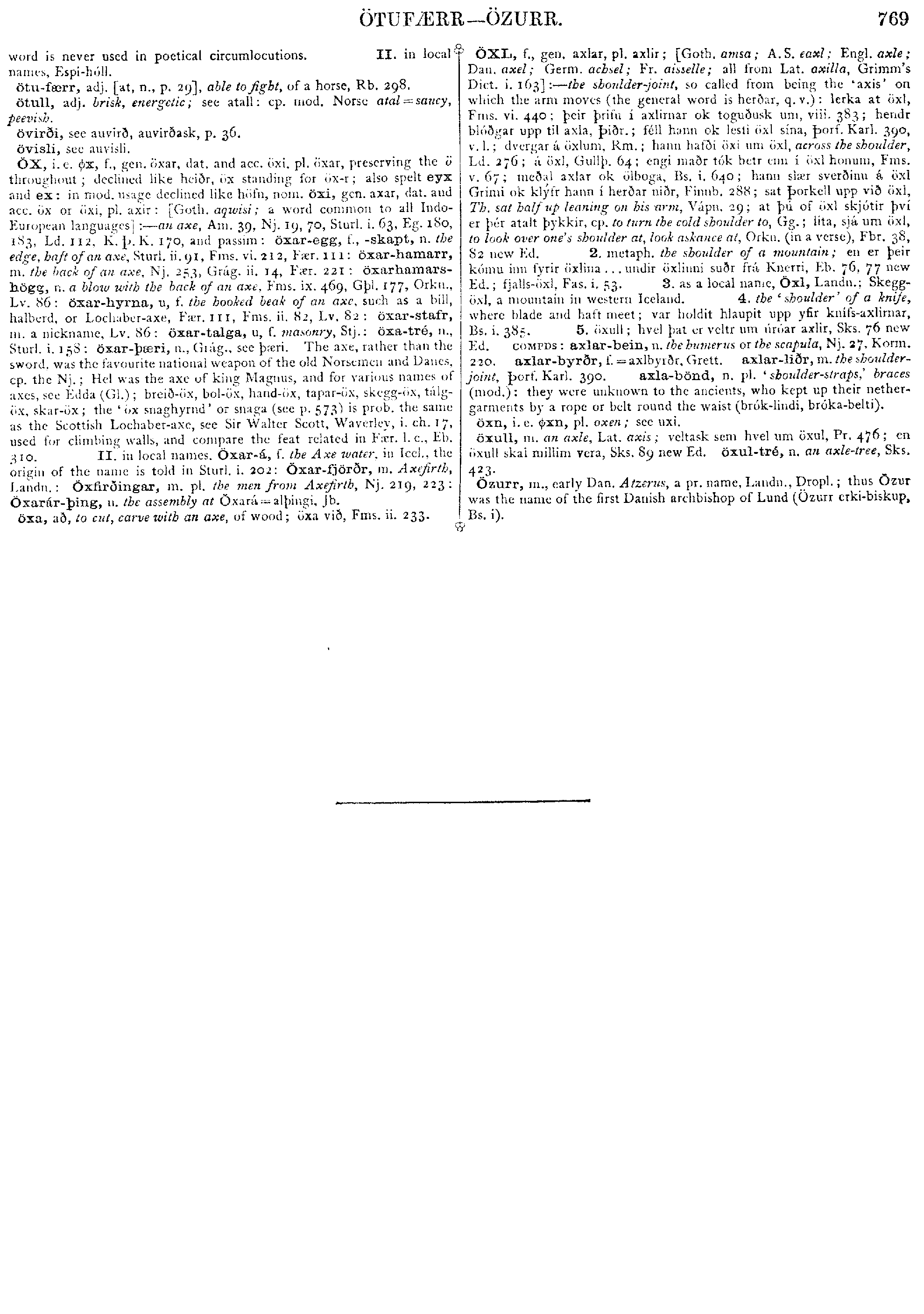
ÖXL, f., gen. axlar, pl. axlir; [Goth. amsa; A.S. eaxl; Engl. axle; Dan. axel; Germ. achsel; Fr. aisselle; all from Lat. axilla, Grimm's Dict. i. 163] :-- the shoulder-joint, so called from being the 'axis' on which the arm moves (the general word is herðar, q.v.): lerka at öxl, Fms. vi. 440; þeir þrifu í axlirnar ok toguðusk um, viii. 383; hendr blóðgar upp til axla, Þiðr.; féll hann ok lesti öxl sína, Þorf. Karl. 390, v.l.; dvergar á öxlum, Rm.; hann hafði öxi um öxl, across the shoulder, Ld. 276; á öxl, Gullþ. 64; engi maðr tók betr enn í öxl honum, Fms. v. 67; meðal axlar ok ölboga, Bs. i. 640; hann slær sverðinu á öxl Grimi ok klýfr hann í herðar niðr, Finnb. 288; sat Þorkell upp við öxl, Tb. sat half up leaning on his -arm, Vápn. 29; at þú of öxl skjótir því er per atalt þykkir, cp. to turn the cold shoulder to, Gg.; lita, sja um oxl, to look over one's shoulder at, look askance at, Orkn. (in a verse), Fbr. 38, 82 new Ed. 2. metaph. the shoulder of a mountain; en er þeir kómu inn fyrir öxlina ... undir öxlinni suðr frá Knerri, Eb. 76, 77 new Ed.; fjalls-öxl, Fas. i, 53. 3. as a local name, Öxl, Landn.: Skegg-öxl, a mountain in western Iceland. 4. the 'shoulder' of a knife, where blade and haft meet; var holdit hlaupit upp yfir knífs-axlirnar, Bs. i. 385. 5. öxull; hvel þat er veltr um úróar axlir, Sks. 76 new Ed. COMPDS: axlar-bein, n. the humerus or the scapula, Nj. 27, Korm. 220. axlar-byrðr, f. = axlbyrðr, Grett. axlar-liðr, m. the shoulder-joint, Þorf. Karl. 390. axla-bönd, n. pl. 'shoulder-straps,' braces (mod.): they were unknown to the ancients, who kept up their nether-garments by a rope or belt round the waist (brók-lindi, bróka-belti).
|
Source: Cleasby/Vigfusson, page b0777, entry 27 View original page image as: [TIFF] [PNG] [View previous entry] [View next entry] |
[Comment on this entry] [View comments] |
The following entry has been hand-corrected once. |
njótr, m., add, -- njóts-minni, n. [still in Norway called njös-minne, Ivar Aasen, in the new Edition of his Dict., of a cup drunk by customers after striking a bargain] :-- a kind of 'earnest-cup;' sendi hann honum eina skál fulla mjaðar, ok bað hann drekka njótsminni (mótsminni is an error), hér með, segir konungr, vil ek gefa þér, Sveinn, jarlsnafn, etc., Fms. vi. 52: the suggestion at the end of the article is therefore true.
|
Source: Cleasby/Vigfusson, page b0778, entry 49 View original page image as: [TIFF] [PNG] [View previous entry] [View next entry] |
[Comment on this entry] [View comments] |
The following entry has been hand-corrected once. |
skin, n., -- in provinc. Germ. the moon is called schein, Grimm's Dict.
| Result Page: |  |
Previous | 124 125 126 127 128 129 130 131 132 133 |
Germanic Lexicon Project (main page)
This search system was written by
Sean Crist
Please consider
volunteering
to correct the data in these online dictionaries.
No rights reserved. Feel free to use these data in any way you please.