|
|

|
Source: Cleasby/Vigfusson, page b0332, entry 46 View original page image as: [TIFF] [PNG] [View previous entry] [View next entry] |
[Comment on this entry] [View comments] |
The following entry has been hand-corrected once. |
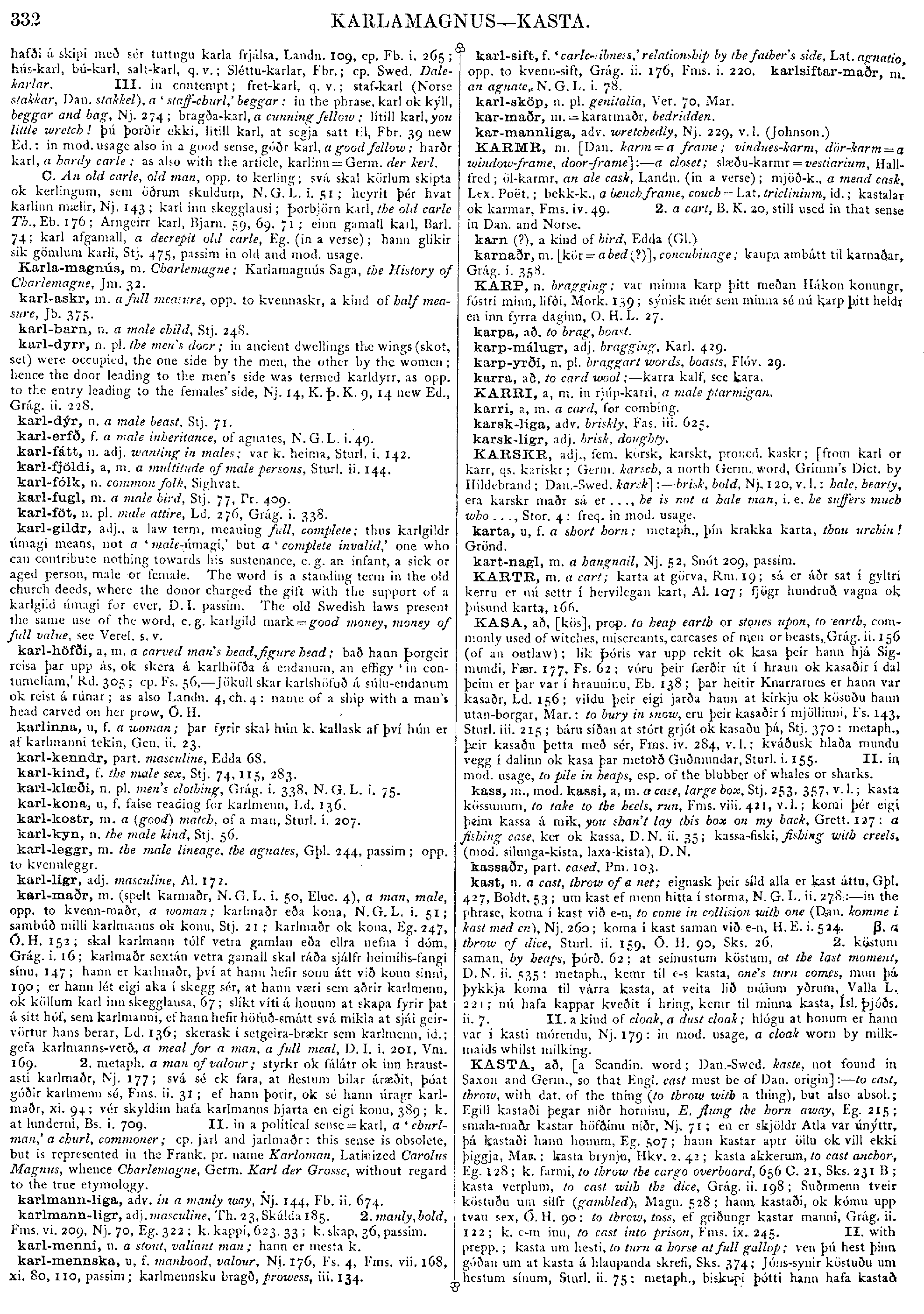
KARSKR, adj., fem. körsk, karskt, proncd. kaskr; [from karl or karr, qs. kariskr; Germ. karsch, a north Germ., word, Grimm's Dict. by Hildebrand; Dan.-Swed. karsk] :-- brisk, bold, Nj, 120, v.l.: hale, hearty, era karskr maðr sá er ..., he is not a hale man, i.e. he suffers much who ..., Stor. 4: freq. in mod. usage.
|
Source: Cleasby/Vigfusson, page b0333, entry 15 View original page image as: [TIFF] [PNG] [View previous entry] [View next entry] |
[Comment on this entry] [View comments] |
The following entry has been hand-corrected once. |
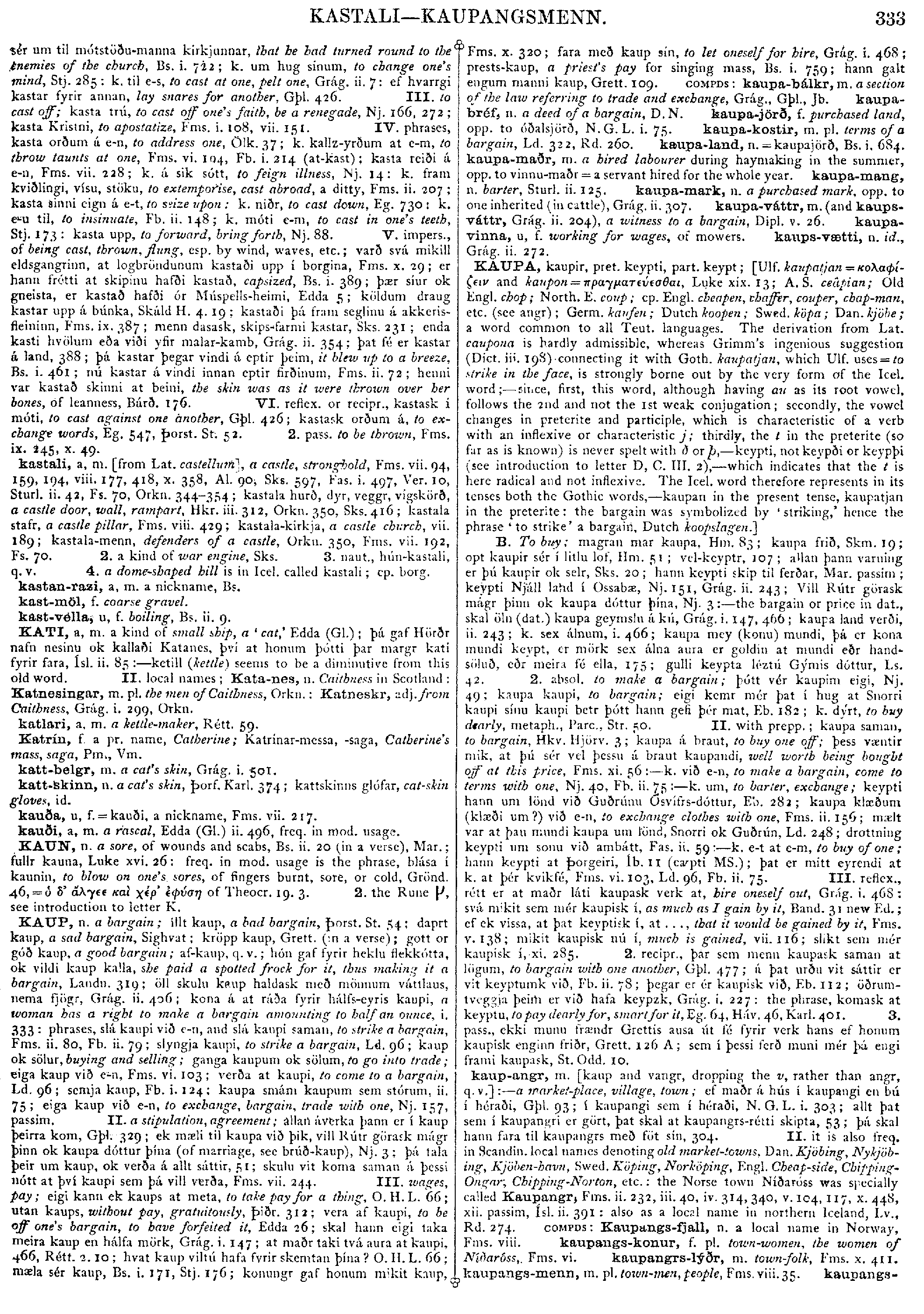
KAUPA, kaupir, pret. keypti, part. keypt; [Ulf. kaupatjan = GREEK and kaupon = GREEK, Luke xix. 13; A. S. ceâpian; Old Engl. chop; North. E. coup; cp. Engl. cheapen, chaffer, couper, chap-man, etc. (see angr); Germ. kaufen; Dutch koopen; Swed. köpa; Dan. kjöbe; a word common to all Teut. languages. The derivation from Lat. caupona is hardly admissible, whereas Grimm's ingenious suggestion (Dict. iii. 198) connecting it with Goth. kaupatjan, which Ulf. uses = to strike in the face, is strongly borne out by the very form of the Icel. word; -- since, first, this word, although having au as its root vowel, follows the 2nd and not the 1st weak conjugation; secondly, the vowel changes in preterite and participle, which is characteristic of a verb with an inflexive or characteristic j; thirdly, the t in the preterite (so far as is known) is never spelt with ð or þ, -- keypti, not keypði or keypþi (see introduction to letter D, C. III. 2), -- which indicates that the t is here radical and not inflexive. The Icel. word therefore represents in its tenses both the Gothic words, -- kaupan in the present tense, kaupatjan in the preterite: the bargain was symbolized by 'striking,' hence the phrase 'to strike' a bargain, Dutch koopslagen.]
|
Source: Cleasby/Vigfusson, page b0462, entry 13 View original page image as: [TIFF] [PNG] [View previous entry] [View next entry] |
[Comment on this entry] [View comments] |
The following entry has been hand-corrected once. |
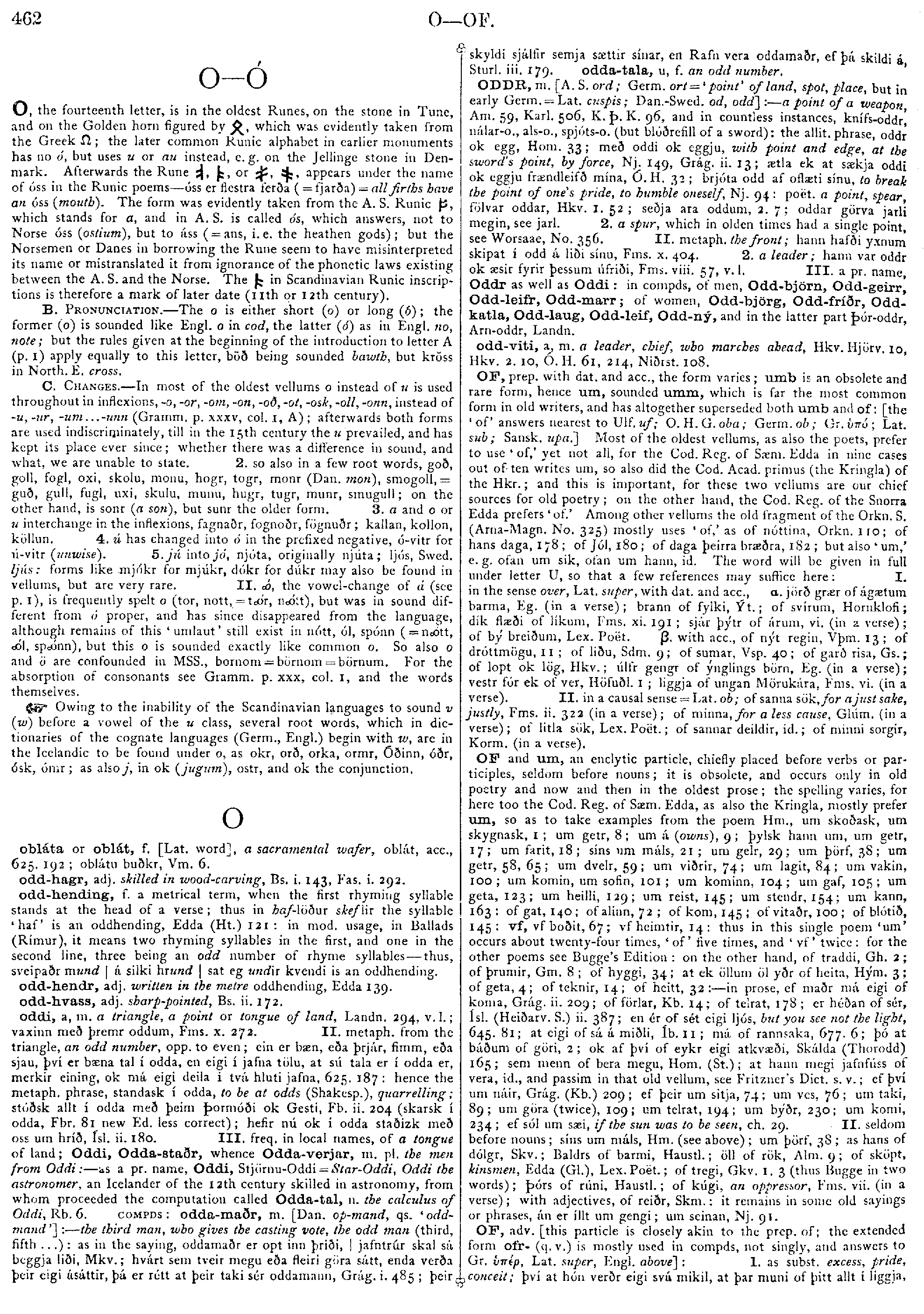
OF and um, an enclytic particle, chiefly placed before verbs or participles, seldom before nouns; it is obsolete, and occurs only in old poetry and now and then in the oldest prose; the spelling varies, for here too the Cod. Reg. of Sæm. Edda, as also the Kringla, mostly prefer um, so as to take examples from the poem Hm., um skoðask, um skygnask, 1; um getr, 8; um á (owns), 9; þylsk hann um, um getr, 17; um farit, 18; síns um máls, 21; um gelr, 29; um þörf, 38; um getr, 58, 65; um dvelr, 59; um viðrir, 74; um lagit, 84; um vakin, 100; um komin, um sofin, 101; um kominn, 104; um gaf, 105; um geta, 123; um heilli, 129; um reist, 145; um stendr, 154; um kann, 163: of gat, 140; of alinn, 72; of kom, 145; of vitaðr, 100; of blótið, 145: vf, vf boðit, 67; vf heimtir, 14: thus in this single poem 'um' occurs about twenty-four times, 'of' five times, and 'vf' twice: for the other poems see Bugge's Edition: on the other hand, of traddi, Gh. 2; of þrumir, Gm. 8; of hyggi, 34; at ek öllum öl yðr of heita, Hým. 3; of geta, 4; of teknir, 14; of heitt, 32 :-- in prose, ef maðr má eigi of koma, Grág. ii. 209; of förlar, Kb. 14; of telrat, 178; er héðan of sér, Ísl. (Heiðarv. S.) ii. 387; en ér of sét eigi ljós, but you see not the light, 645. 81; at eigi of sá á miðli, Íb. 11; má of rannsaka, 677. 6; þó at báðum of göri, 2; ok af því of eykr eigi atkvæði, Skálda (Thorodd) 165; sem menn of bera megu, Hom. (St.); at hann megi jafnfúss of vera, id., and passim in that old vellum, see Fritzner's Dict. s.v.; ef því um náir, Grág. (Kb.) 209; ef þeir um sitja, 74; um ves, 76; um taki, 89; um göra (twice), 109; um telrat, 194; urn býðr, 230; um komi, 234; ef sól um sæi, if the sun was to be seen, ch. 29. II. seldom before nouns; síns um máls, Hm. (see above); um þörf, 38; as hans of dólgr, Skv.; Baldrs of barmi, Haustl.; öll of rök, Alm. 9; of sköpt, kinsmen, Edda (Gl.), Lex. Poët.; of tregi, Gkv. 1. 3 (thus Bugge in two words); Þórs of rúni, Haustl.; of kúgi, an oppressor, Fms. vii. (in a verse); with adjectives, of reiðr, Skm.: it remains in some old sayings or phrases, án er íllt um gengi; um seinan, Nj. 91.
|
Source: Cleasby/Vigfusson, page b0469, entry 7 View original page image as: [TIFF] [PNG] [View previous entry] [View next entry] |
[Comment on this entry] [View comments] |
The following entry has been hand-corrected once. |
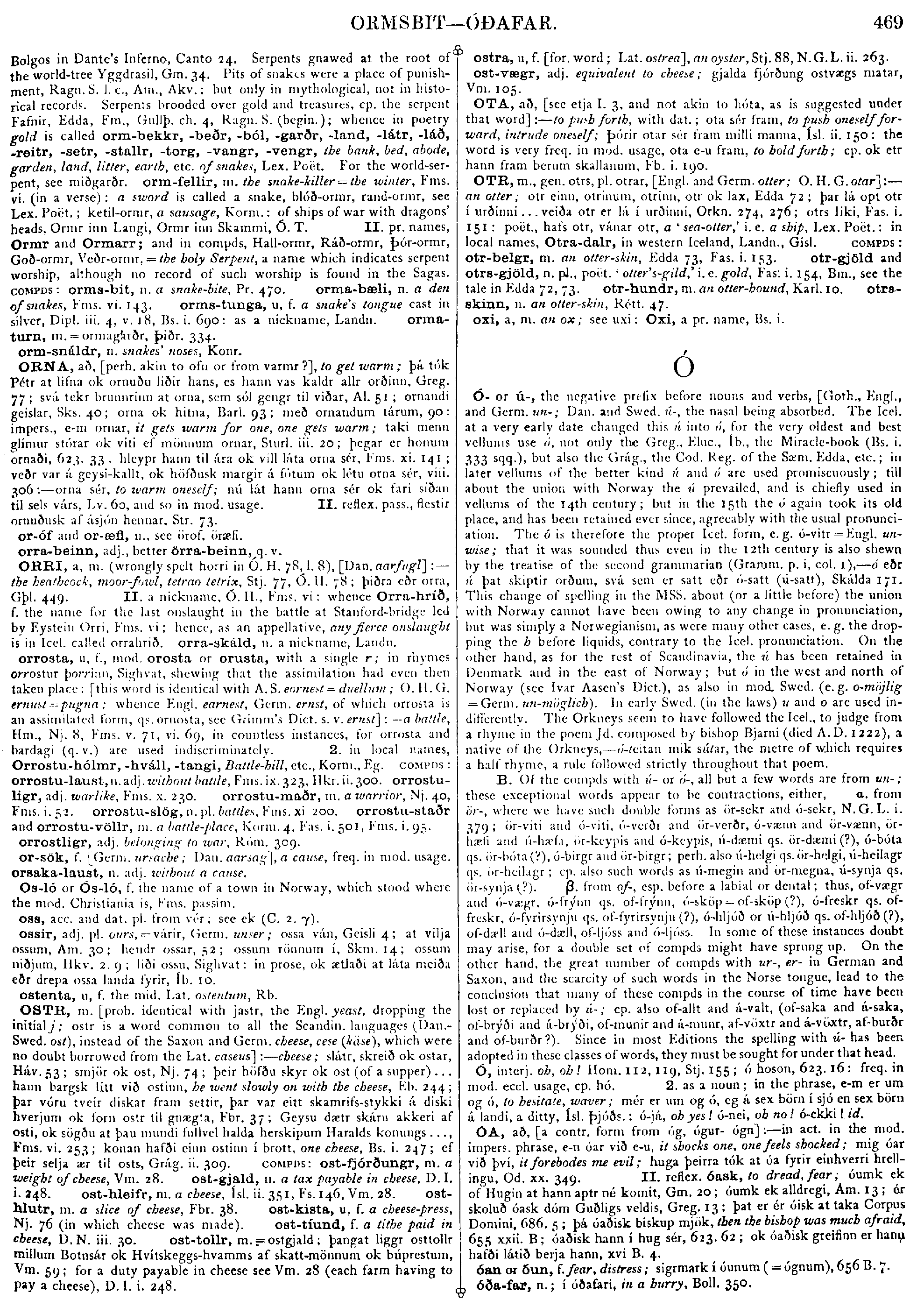
orrosta, u, f., mod. orosta or orusta, with a single r; in rhymes orrostur þorrinn, Sighvat, shewing that the assimilation had even then taken place: [this word is identical with A.S. eornest = duellum; O.H.G. ernust = pugna: whence Fngl. earnest. Germ. ernst, of which orrosta is an assimilated form, qs. ornosta, see Grimm's Dict. s.v. ernst] :-- a battle, Hm., Nj. 8, Fms. v. 71, vi. 69, in countless instances, for orrosta and bardagi (q.v.) are used indiscriminately. 2. in local names, Orrostu-hólmr, -hváll, -tangi, Battle-hill, etc., Korm., Eg. COMPDS: orrostu-laust, n. adj. without battle, Fms. ix. 323, Hkr. ii. 300. orrostu-ligr, adj. warlike, Fms. x. 230. orrostu-maðr, m. a warrior, Nj. 40, Fms. i. 52. orrostu-slög, n. pl. battles, Fms. xi 200. orrostu-staðr and orrostu-völlr, m. a battle-place, Korm. 4, Fas. i. 501, Fms. i. 95.
|
Source: Cleasby/Vigfusson, page b0469, entry 21 View original page image as: [TIFF] [PNG] [View previous entry] [View next entry] |
[Comment on this entry] [View comments] |
The following entry has been hand-corrected once. |
Ó-
or
ú-,
the
negative
prefix
before
nouns
and
verbs,
[Goth.,
Engl.,
and
Germ.
un-;
Dan.
and
Swed.
û-,
the
nasal
being
absorbed.
The
Icel.
at
a
very
early
date
changed
this
ú
into
ó,
for
the
very
oldest
and
best
vellums
use
ó,
not
only
the
Greg.,
Eluc.,
Íb.,
the
Miracle-book
(Bs.
i.
333
sqq.),
but
also
the
Grág.,
the
Cod.
Reg.
of
the
Sæm.
Edda,
etc.;
in
later
vellums
of
the
better
kind
ú
and
ó
are
used
promiscuously;
till
about
the
union
with
Norway
the
ú
prevailed,
and
is
chiefly
used
in
vellums
of
the
14th
century;
but
in
the
15th
the
ó
again
took
its
old
place,
and
has
been
retained
ever
since,
agreeably
with
the
usual
pronunciation.
The
ó
is
therefore
the
proper
Icel.
form,
e.g.
ó-vitr
=
Engl.
un-wise;
that
it
was
sounded
thus
even
in
the
12th
century
is
also
shewn
by
the
treatise
of
the
second
grammarian
(Gramm.
p.
i,
col.
1),
--
ó
eðr
ú
þat
skiptir
orðum,
svá
sem
er
satt
eðr
ó-satt
(ú-satt),
Skálda
171.
This
change
of
spelling
in
the
MSS.
about
(or
a
little
before)
the
union
with
Norway
cannot
have
been
owing
to
any
change
in
pronunciation,
but
was
simply
a
Norwegianism,
as
were
many
other
cases,
e.g.
the
dropping
the
h
before
liquids,
contrary
to
the
Icel.
pronunciation.
On
the
other
hand,
as
for
the
rest
of
Scandinavia,
the
ú
has
been
retained
in
Denmark
and
in
the
east
of
Norway;
but
ó
in
the
west
and
north
of
Norway
(see
Ivar
Aasen's
Dict.),
as
also
in
mod,
Swed.
(e.g.
o-möjlig
=
Germ.
un-möglich).
In
early
Swed.
(in
the
laws)
u
and
o
are
used
indifferently.
The
Orkneys
seem
to
have
followed
the
Icel.,
to
judge
from
a
rhyme
in
the
poem
Jd.
composed
by
bishop
Bjarni
(died
A.D.
1222),
a
native
of
the
Orkneys,
--
ó-teitan
mik
sútar,
the
metre
of
which
requires
a
half
rhyme,
a
rule
followed
strictly
throughout
that
poem.
B.
Of
the
compds
with
ú-
or
ó-,
all
but
a
few
words
are
from
un-;
these
exceptional
words
appear
to
be
contractions,
either,
 .
from
ör-,
where
we
have
such
double
forms
as
ör-sekr
and
ó-sekr,
N.G.L.
i.
379;
ör-viti
and
ó-viti,
ó-verðr
and
ör-verðr,
ó-vænn
and
ör-vænn,
ör-hæfi
and
ú-hæfa,
ör-keypis
and
ó-keypis,
ú-dæmi
qs.
ör-dæmi(?),
ó-bóta
qs.
ör-bóta(?),
ó-birgr
and
ör-birgr;
perh.
also
ú-helgi
qs.
ör-helgi,
ú-heilagr
qs.
ör-heilagr;
cp.
also
such
words
as
ú-megin
and
ör-megna,
ú-synja
qs.
ör-synja(?).
.
from
ör-,
where
we
have
such
double
forms
as
ör-sekr
and
ó-sekr,
N.G.L.
i.
379;
ör-viti
and
ó-viti,
ó-verðr
and
ör-verðr,
ó-vænn
and
ör-vænn,
ör-hæfi
and
ú-hæfa,
ör-keypis
and
ó-keypis,
ú-dæmi
qs.
ör-dæmi(?),
ó-bóta
qs.
ör-bóta(?),
ó-birgr
and
ör-birgr;
perh.
also
ú-helgi
qs.
ör-helgi,
ú-heilagr
qs.
ör-heilagr;
cp.
also
such
words
as
ú-megin
and
ör-megna,
ú-synja
qs.
ör-synja(?).
 .
from
of-,
esp.
before
a
labial
or
dental;
thus,
of-vægr
and
ó-vægr,
ó-frýnn
qs.
of-frýnn,
ó-skö;p
=
of-sköp(?),
ó-freskr
qs.
of-freskr,
ó-fyrirsynju
qs.
of-fyrirsynju(?),
ó-hljóð
or
ú-hljóð
qs.
of-hljóð(?),
of-dæll
and
ó-dæll,
of-ljóss
and
ó-ljóss.
In
some
of
these
instances
doubt
may
arise,
for
a
double
set
of
compds
might
have
sprung
up.
On
the
other
hand,
the
great
number
of
compds
with
ur-,
er-
in
German
and
Saxon,
and
the
scarcity
of
such
words
in
the
Norse
tongue,
lead
to
the
conclusion
that
many
of
these
compds
in
the
course
of
time
have
been
lost
or
replaced
by
ú-;
cp.
also
of-allt
and
á-valt,
(of-saka
and
á-saka,
of-brýði
and
á-brýði,
of-munir
and
á-munr,
af-vöxtr
and
á-vöxtr,
af-burðr
and
of-burðr?).
Since
in
most
Editions
the
spelling
with
ú-
has
been
adopted
in
these
classes
of
words,
they
must
be
sought
for
under
that
head.
.
from
of-,
esp.
before
a
labial
or
dental;
thus,
of-vægr
and
ó-vægr,
ó-frýnn
qs.
of-frýnn,
ó-skö;p
=
of-sköp(?),
ó-freskr
qs.
of-freskr,
ó-fyrirsynju
qs.
of-fyrirsynju(?),
ó-hljóð
or
ú-hljóð
qs.
of-hljóð(?),
of-dæll
and
ó-dæll,
of-ljóss
and
ó-ljóss.
In
some
of
these
instances
doubt
may
arise,
for
a
double
set
of
compds
might
have
sprung
up.
On
the
other
hand,
the
great
number
of
compds
with
ur-,
er-
in
German
and
Saxon,
and
the
scarcity
of
such
words
in
the
Norse
tongue,
lead
to
the
conclusion
that
many
of
these
compds
in
the
course
of
time
have
been
lost
or
replaced
by
ú-;
cp.
also
of-allt
and
á-valt,
(of-saka
and
á-saka,
of-brýði
and
á-brýði,
of-munir
and
á-munr,
af-vöxtr
and
á-vöxtr,
af-burðr
and
of-burðr?).
Since
in
most
Editions
the
spelling
with
ú-
has
been
adopted
in
these
classes
of
words,
they
must
be
sought
for
under
that
head.
|
Source: Cleasby/Vigfusson, page b0472, entry 16 View original page image as: [TIFF] [PNG] [View previous entry] [View next entry] |
[Comment on this entry] [View comments] |
The following entry has been hand-corrected once. |
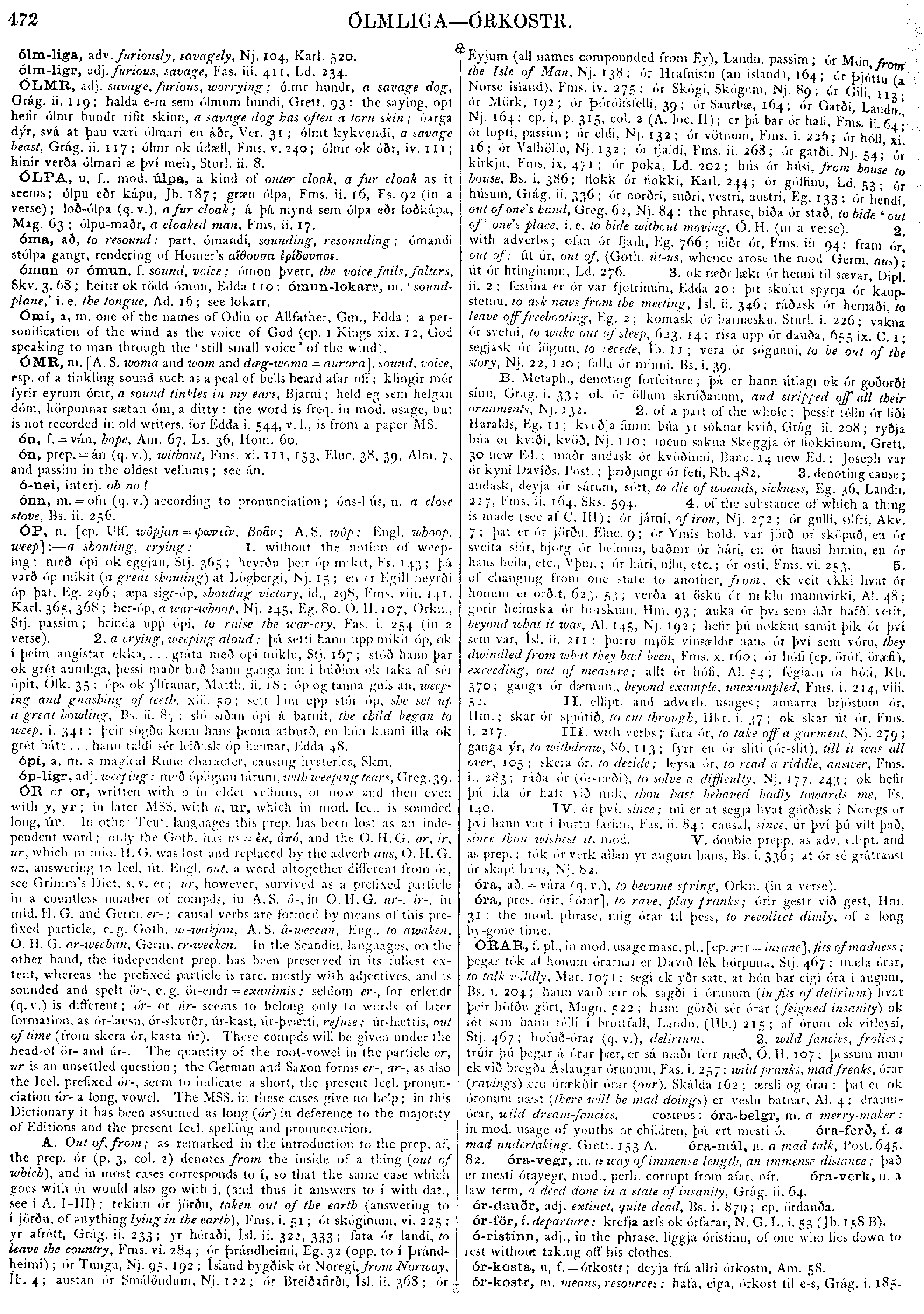
ÓR or or, written with o in older vellums, or now and then even with y, yr; in later MSS. with u, ur, which in mod. Icel. is sounded long, úr. In other Teut. languages this prep. has been lost as an independent word; only the Goth. has us = GREEK, and the O.H.G. ar, ir, ur, which in mid. H.G. was lost and replaced by the adverb aus, O.H.G. uz, answering to Icel. út. Engl. out, a word altogether different from ór, see Grimm's Dict. s.v. er; ur, however, survived as a prefixed particle in a countless number of compds, in A.S. â-, in O.H.G. ar-, ir-, in mid. H.G. and Germ. er-; causal verbs are formed by means of this prefixed particle, e.g. Goth. us-wakjan, A.S. â-weccan, Engl. to awaken, O.H.G. ar-wechan, Germ. er-wecken. In the Scandin. languages, on the other hand, the independent prep. has been preserved in its fullest extent, whereas the prefixed particle is rare, mostly wiih adjectives, and is sounded and spelt ör-, e.g. ör-endr = exanimis; seldom er-, for erlendr (q.v.) is different; ór- or úr- seems to belong only to words of later formation, as ór-lausn, ór-skurðr, úr-kast, úr-þvætti, refuse; úr-hættis, out of time (from skera ór, kasta úr). These compds will be given under the head of ör- and úr-. The quantity of the root-vowel in the particle or, ur is an unsettled question; the German and Saxon forms er-, ar-, as also the Icel. prefixed ör-, seem to indicate a short, the present Icel. pronunciation úr- a long, vowel. The MSS. in these cases give no help; in this Dictionary it has been assumed as long (ór) in deference to the majority of Editions and the present Icel. spelling and pronunciation. A. Out of, from; as remarked in the introduction to the prep. af, the prep. ór (p. 3, col. 2) denotes from the inside of a thing (out of which), and in most cases corresponds to í, so that the same case which goes with ór would also go with í, (and thus it answers to í with dat., see í A. I-III); tekinn ór jörðu, taken out of the earth (answering to í jörðu, of anything lying in the earth), Fms. i. 51; ór skóginum, vi. 225; yr afrétt, Grág. ii. 233; yr héraði, Ísl. ii. 322, 333; fara ór landi, to leave the country, Fms. vi. 284; ór Þrándheimi, Eg. 32 (opp. to í Þrándheimi); ór Tungu, Nj. 95, 192; Ísland bygðisk ór Noregi. from Norway, Íb. 4; austan ór Smálöndum, Nj. 122; ór Breiðafirði, Ísl. ii. 368; ór Eyjum (all names compounded from Ey), Landn. passim; ór Mön, from the Isle of Man, Nj. 138; ór Hrafnistu (an island), 164; ór Þjóttu (a Norse island), Fms. iv. 275; ór Skógi, Skógum, Nj. 89; ór Gili, 113; ór Mörk, 192; ór Þórólfsfelli, 39; ór Saurbæ, 164; ór Garði, Landn., Nj. 164; cp. i, p. 315, col. 2 (A. loc. II); er þá bar ór hafi, Fms. ii. 64; ór lopti, passim; úr eldi, Nj. 132; ór vötnum, Fms. i. 226; ór höll, xi. 16; ór Valhöllu, Nj. 132; ór tjaldi, Fms. ii. 268; ór garði, Nj. 54; ór kirkju, Fms. ix. 471; ór poka, Ld. 202; hús ór húsi, from house to house, Bs. i. 386; flokk ór flokki, Karl. 244; ór gólfinu, Ld. 53; ór húsum, Grág. ii. 336; ór norðri, suðri, vestri, austri, Eg. 133: ór hendi, out of one's hand, Greg. 62, Nj. 84: the phrase, bíða ór stað, to bide 'out of' one's place, i.e. to bide without moving, Ó.H. (in a verse). 2. with adverbs; ofan ór fjalli, Eg. 766: niðr ór, Fms. iii 94; fram ór, out of; út úr, out of, (Goth. ût-;us, whence arose the mod Germ. aus); út ór hringinum, Ld. 276. 3. ok ræðr lækr ór henni til sævar, Dipl. ii. 2; festina er ór var fjötrinum, Edda 20; þit skulut spyrja ór kaupstefnu, to ask news from the meeting, Ísl. ii. 346; ráðask ór hernaði, to leave off freebooting, Eg. 2; komask ór barnæsku, Sturl. i. 226; vakna ór svefni, to wake out of sleep, 623. 14; rísa upp ór dauða, 655 ix. C. 1; segjask ór lögum, to secede, Íb. 11; vera ór sögunni, to be out of the story, Nj. 22, 120; falla ór minni, Bs. i. 39. B. Metaph., denoting forfeiture; þá er hann útlagr ok ór goðorði sínu, Grág. i. 33; ok ór öllum skrúðanum, and stripped off all their ornaments, Nj. 132. 2. of a part of the whole; þessir téllu ór liði Haralds, Eg. 11; kveðja fimm búa yr sóknar kvið, Grág ii. 208; ryðja búa ór kviði, kvöð, Nj. 110; menn sakna Skeggja ór flokkinum, Grett. 30 new Ed.; maðr andask ór kvöðinni, Band. 14 new Ed.; Joseph var ór kyni Davíðs, Post.; þriðjungr ór feti, Rb. 482. 3. denoting cause; andask, deyja ór sárum, sótt, to die of wounds, sickness. Eg. 36, Landn. 217, Fms. ii. 164, Sks. 594. 4. of the substance of which a thing is made (see af C. III); ór járni, of iron, Nj. 272; ór gulli, silfri, Akv. 7; þat er ór jörðu, Eluc. 9; ór Ymis holdi var jörð of sköpuð, en ór sveita siár, björg or beinum, baðinr ór hari, en or hausi himin, en or hans heila, etc., Vþm.; úr hári, ullu, etc.; ór osti, Fms. vi. 253. 5. of changing from one state to another, from; ek veil ekki hvat ór honum er orðit, 623. 53; verða at ösku ór miklu mannvirki, Al. 48; görir heimska ór herskum, Hm. 93; auka ór því sem áðr hafði verit, beyond what it was, Al. 145, Nj. 192; hefir þú nokkut samit þik ór því sem var, Ísl. ii. 211: þurru mjök vinsældir hans ór því sem vóru, they dwindled from what they had been, Fms. x. 160; ór hófi (cp. öróf, öræfi), exceeding, out of measure; allt ór hófi, Al. 54; fégjarn ór hófi, Rb. 370; ganga ór dæmum, beyond example, unexampled. Fms. i. 214, viii. 52. II. ellipt. and adverb. usages; annarra brjóstum ór, Hm.; skar ór spjótið, to cut through, Hkr. i. 37; ok skar út ór, Fms. i. 217. III. with verbs; fara ór, to take off a garment, Nj. 279; ganga ýr, to withdraw, 86, 113; fyrr en ór sliti (ór-slit), till it was all over, 105; skera ór, to decide; leysa ór, to read a riddle, answer, Fms. ii. 283; ráða ór (ór-ræði), to solve a difficulty, Nj. 177, 243; ok hefir þú ílla ór haft við mik, thou hast behaved badly towards me, Fs. 140. IV. ór því, since; nú er at segja hvat görðisk í Noregs ór því hann var í burtu farinn, Fas. ii. 84: causal, since, úr því þú vilt það, since thou wishest it, mod. V. double prepp. as adv. ellipt. and as prep.; tók ór verk allan yr augum hans, Bs. i. 336; at ór sé grátraust ór skapi hans, Nj. 82.
|
Source: Cleasby/Vigfusson, page b0480, entry 61 View original page image as: [TIFF] [PNG] [View previous entry] [View next entry] |
[Comment on this entry] [View comments] |
The following entry has been hand-corrected once. |
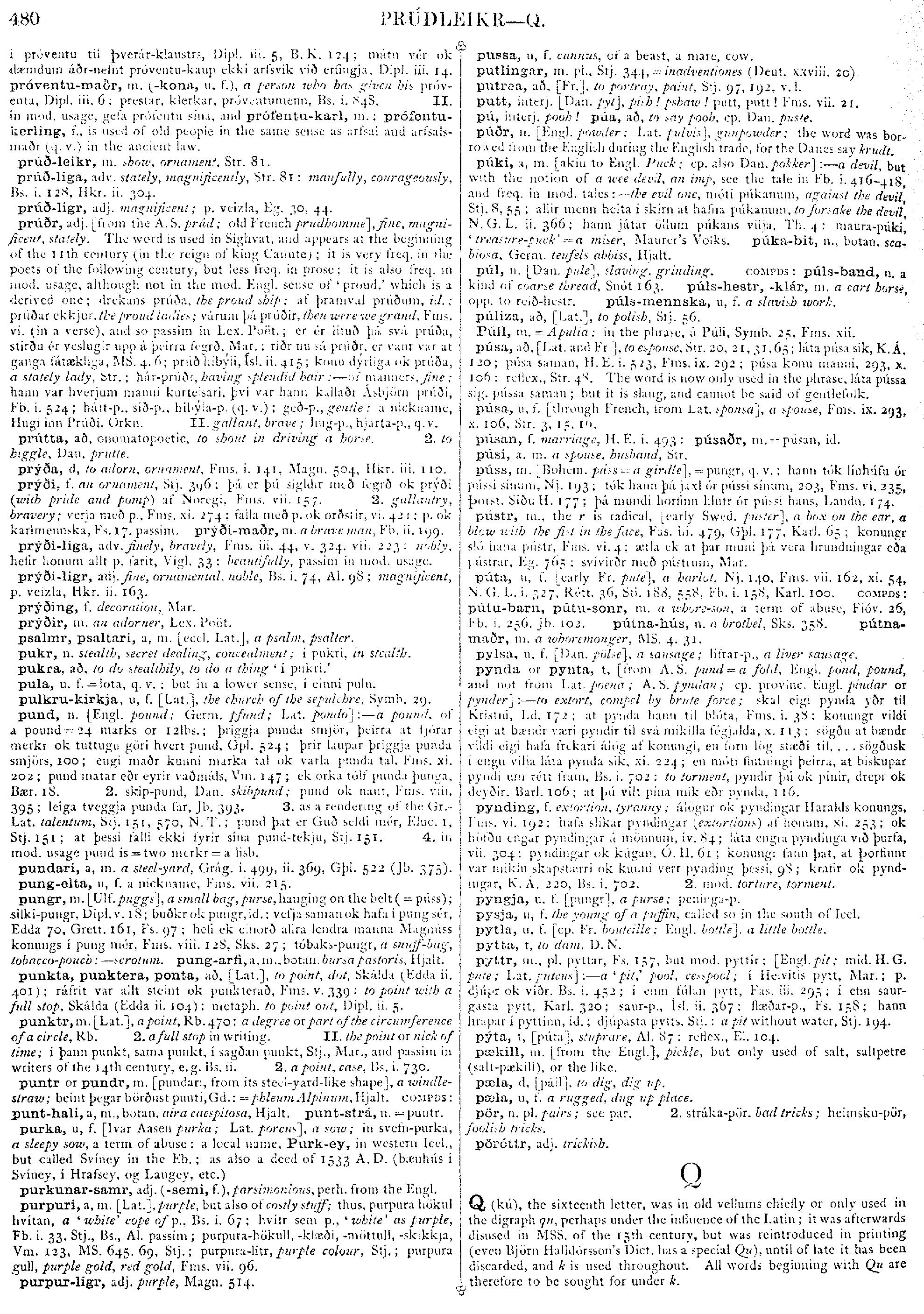
Q (kú), the sixteenth letter, was in old vellums chiefly or only used in the digraph qu, perhaps under the influence of the Latin; it was afterwards disused in MSS. of the 15th century, but was reintroduced in printing (even Björn Halldórsson's Dict. has a special Qu), until of late it has been discarded, and k is used throughout. All words beginning with Qu are therefore to be sought for under k.
|
Source: Cleasby/Vigfusson, page b0731, entry 18 View original page image as: [TIFF] [PNG] [View previous entry] [View next entry] |
[Comment on this entry] [View comments] |
The following entry has been hand-corrected once. |
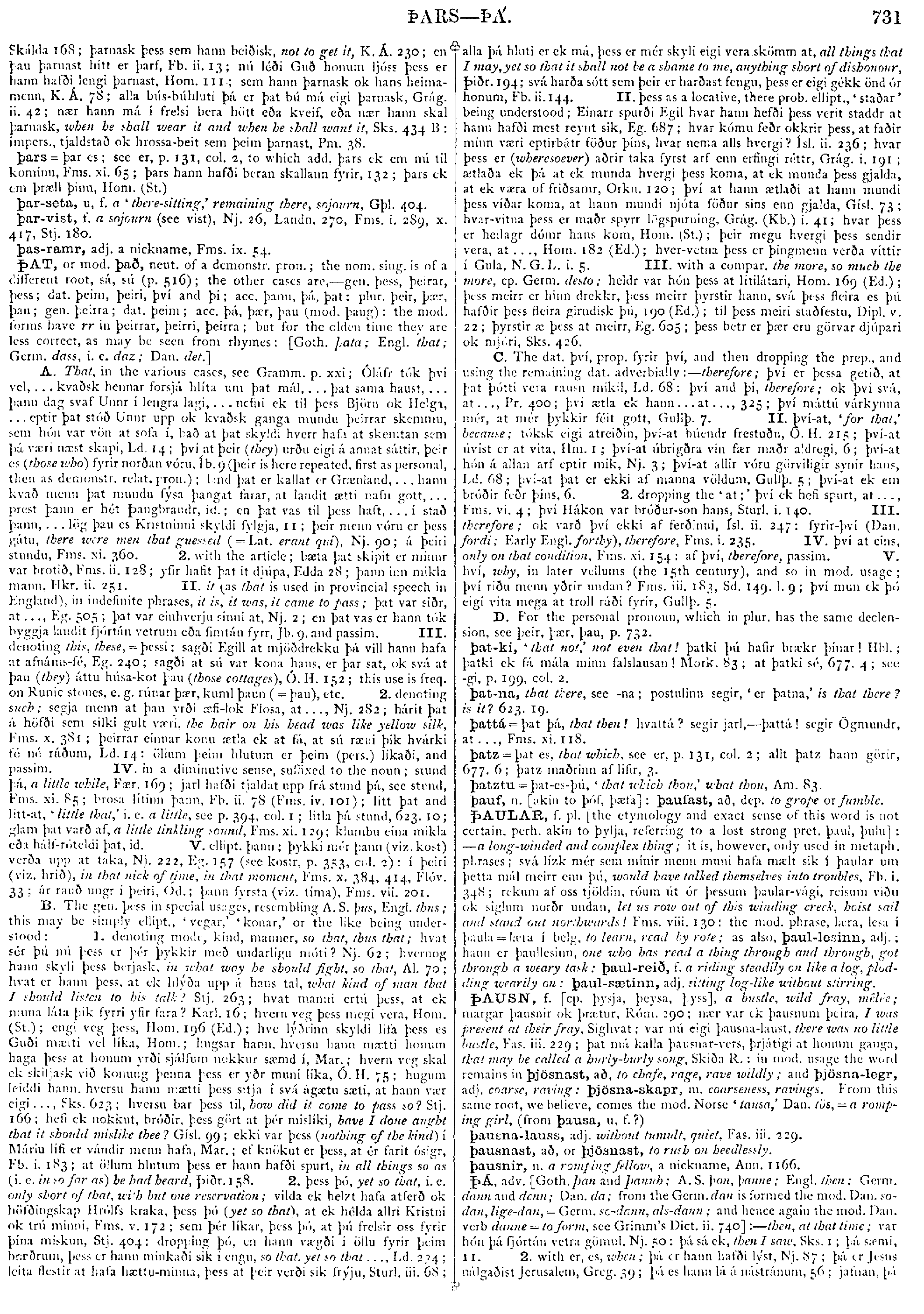
ÞÁ, adv. [Goth. þan and þanuh; A.S. þon, þanne; Engl. then; Germ. dann and denn; Dan. da; from the Germ. dan is formed the mod. Dan. so-dan, lige-dan, -- Germ. so-dann, als-dann; and hence again the mod. Dan. verb danne = to form, see Grimm's Dict. ii. 740] :-- then, at that time; var hón þá fjórtán vetra gömul, Nj. 50: þá sá ek, then I saw, Sks. 1; þá sæmi, 11. 2. with er, es, when; þá er hann hafði lýst, Nj. 87; þá er Jesus nálgaðist Jerusalem, Greg. 39; þá es hann lá á nástránum, 56; jafnan, þá
|
Source: Cleasby/Vigfusson, page b0732, entry 27 View original page image as: [TIFF] [PNG] [View previous entry] [View next entry] |
[Comment on this entry] [View comments] |
The following entry has been hand-corrected once. |
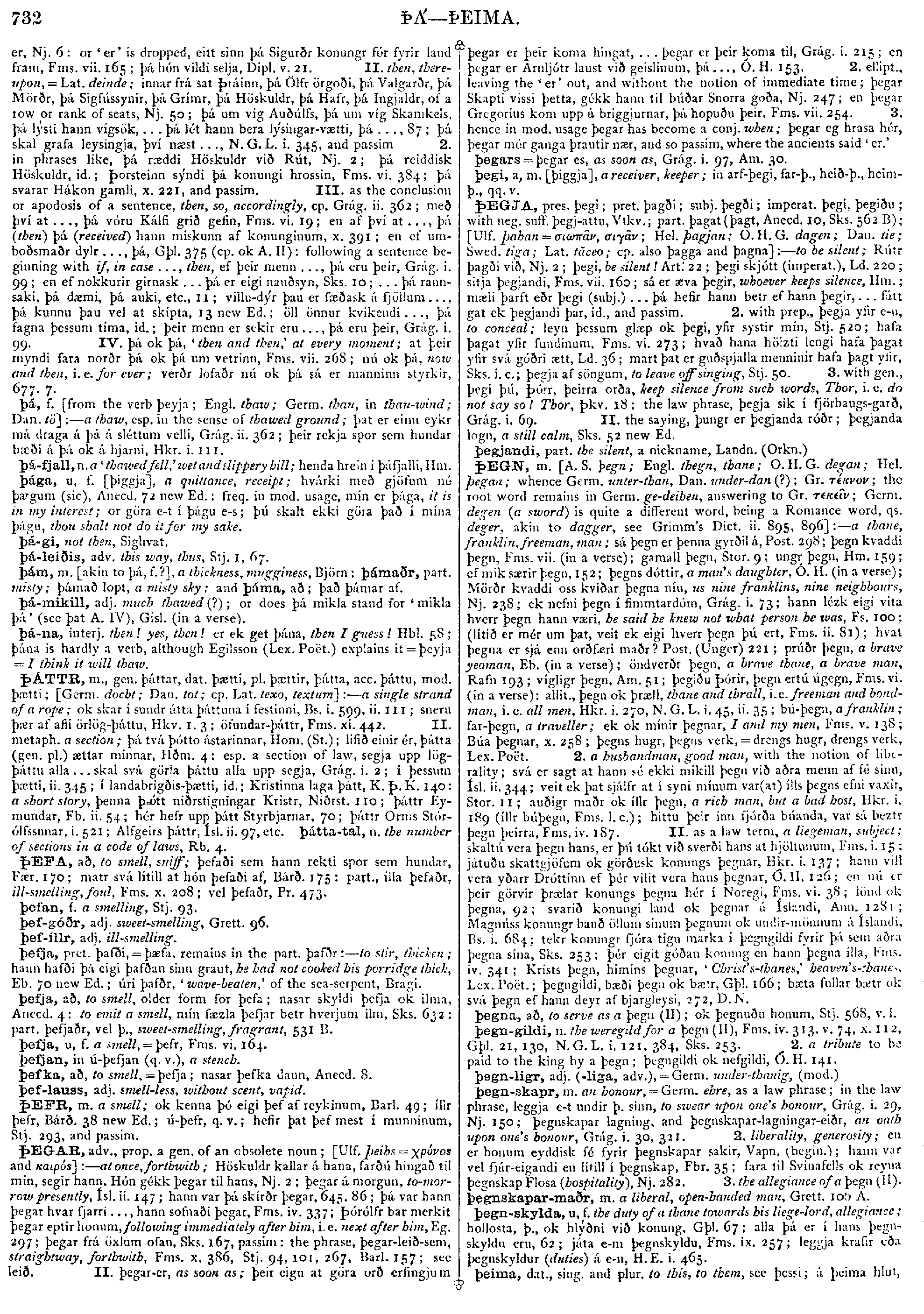
ÞEGN, m. [A.S. þegn; Engl. thegn, thane; O.H.G. degan; Hel. þegan; whence Germ. unter-than, Dan. under-dan(?); Gr. GREEK; the root word remains in Germ. ge-deiben, answering to Gr. GREEK; Germ. degen (a sword) is quite a different word, being a Romance word, qs. deger, akin to dagger, see Grimm's Dict. ii. 895, 896] :-- a thane, franklin, freeman, man; sá þegn er þenna gyrðil á, Post. 298; þegn kvaddi þegn, Fms. vii. (in a verse); gamall þegn, Stor. 9; ungr þegn, Hm. 159; ef mik særir þegn, 152; þegns dóttir, a man's daughter, Ó.H. (in a verse); Mörðr kvaddi oss kviðar þegna níu, us nine franklins, nine neighbours, Nj. 238; ek nefni þegn í fimmtardóm, Grág. i. 73; hann lézk eigi vita hverr þegn hann væri, he said he knew not what person he was, Fs. 100: (lítið er mér um þat, veit ek eigi hverr þegn þú ert, Fms. ii. 81); hvat þegna er sjá enn orðfæri maðr? Post. (Unger) 221; prúðr þegn, a brave yeoman, Eb. (in a verse); öndverðr þegn, a brave thane, a brave man, Rafn 193; vígligr þegn, Am. 51; þegiðu Þórir, þegn ertú úgegn, Fms. vi. (in a verse): allit., þegn ok þræll, thane and thrall, i.e. freeman and bondman, i.e. all men, Hkr. i. 270, N.G.L. i. 45, ii. 35; bú-þegn, a franklin; far-þegn, a traveller; ek ok mínir þegnar, I and my men, Fms. v. 138; Búa þegnar, x. 258; þegns hugr, þegns verk, = drengs hugr, drengs verk, Lex. Poët. 2. a husbandman, good man, with the notion of liberality; svá er sagt at hann sé ekki mikill þegu við adra menn af fé sínu, Ísl. ii. 344; veit ek þat sjálfr at í syni mínum var(at) ílls þegns efni vaxit, Stor. 11; auðigr maðr ok íllr þegn, a rich man, but a bad host, Hkr. i. 189 (íllr búþegu, Fms. l.c.); hittu þeir inn fjórða búanda, var sá beztr þegn þeirra, Fms. iv. 187. II. as a law term, a liegeman, subject; skaltú vera þegn hans, er þú tókt við sverði hans at hjöltunum, Fms. i. 15; játuðu skattgjöfum ok görðusk konungs þegnar, Hkr. i. 137; hann vill vera yðarr Dróttinn ef þér vilit vera hans þegnar, Ó.H. 126; en nú er þeir görvir þrælar konungs þegna hér í Noregi, Fms. vi. 38; lönd ok þegna, 92; svarið konungi land ok þegnar á Íslandi, Ann. 1281; Magnúss konungr bauð öllum sínum þegnum ok undir-mönnum á Íslandi, Bs. i. 684: tekr konungr fjóra tigu marka í þegngildi fyrir þá sem aðra þegna sína, Sks. 253; þér eigit góðan konung en hann þegna ílla, Fms. iv. 341; Krists þegn, himins þegnar, 'Christ's-thanes,' heaven's-thanes, Lex. Poët.; þegngildi, bæði þegn ok bætr, Gþl. 166; bæta fullar bætr ok svá þegn ef hann deyr af bjargleysi, 272, D.N.
|
Source: Cleasby/Vigfusson, page b0739, entry 1 View original page image as: [TIFF] [PNG] [View previous entry] [View next entry] |
[Comment on this entry] [View comments] |
The following entry has been hand-corrected once. |
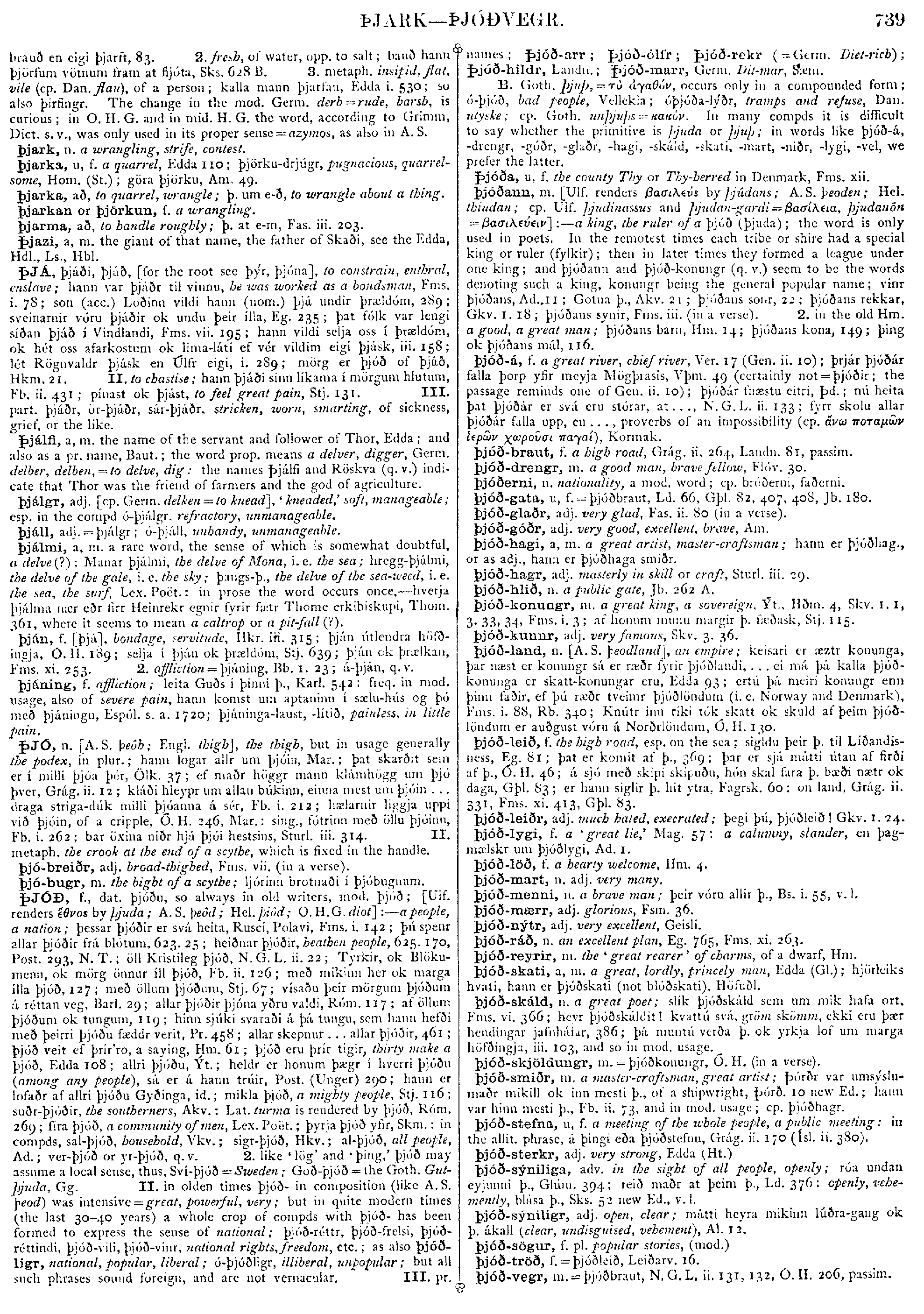
brauð en eigi þjarft, 83. 2. fresh, of water, opp. to salt; bauð hann þjörfum vötnum fram at fljóta, Sks. 628 B. 3. metaph. insipid, flat, vile (cp. Dan. flau), of a person; kalla mann þjarfan, Edda i. 530; so also þirfingr. The change in the mod. Germ. derb = rude, harsh, is curious; in O.H.G. and in mid. H.G. the word, according to Grimm, Dict. s.v., was only used in its proper sense = azymos, as also in A.S.
| Result Page: |  |
Previous | 123 124 125 126 127 128 129 130 131 132 133 | Next |  |
Germanic Lexicon Project (main page)
This search system was written by
Sean Crist
Please consider
volunteering
to correct the data in these online dictionaries.
No rights reserved. Feel free to use these data in any way you please.