|
|

Search for Dan again, using less strict matching (3745 results)
|
Source: Bosworth/Toller, page b0877, entry 5 View original page image as: [TIFF] [PNG] [View previous entry] [View next entry] |
[Comment on this entry] [View comments] |
The following entry has been hand-corrected once. |
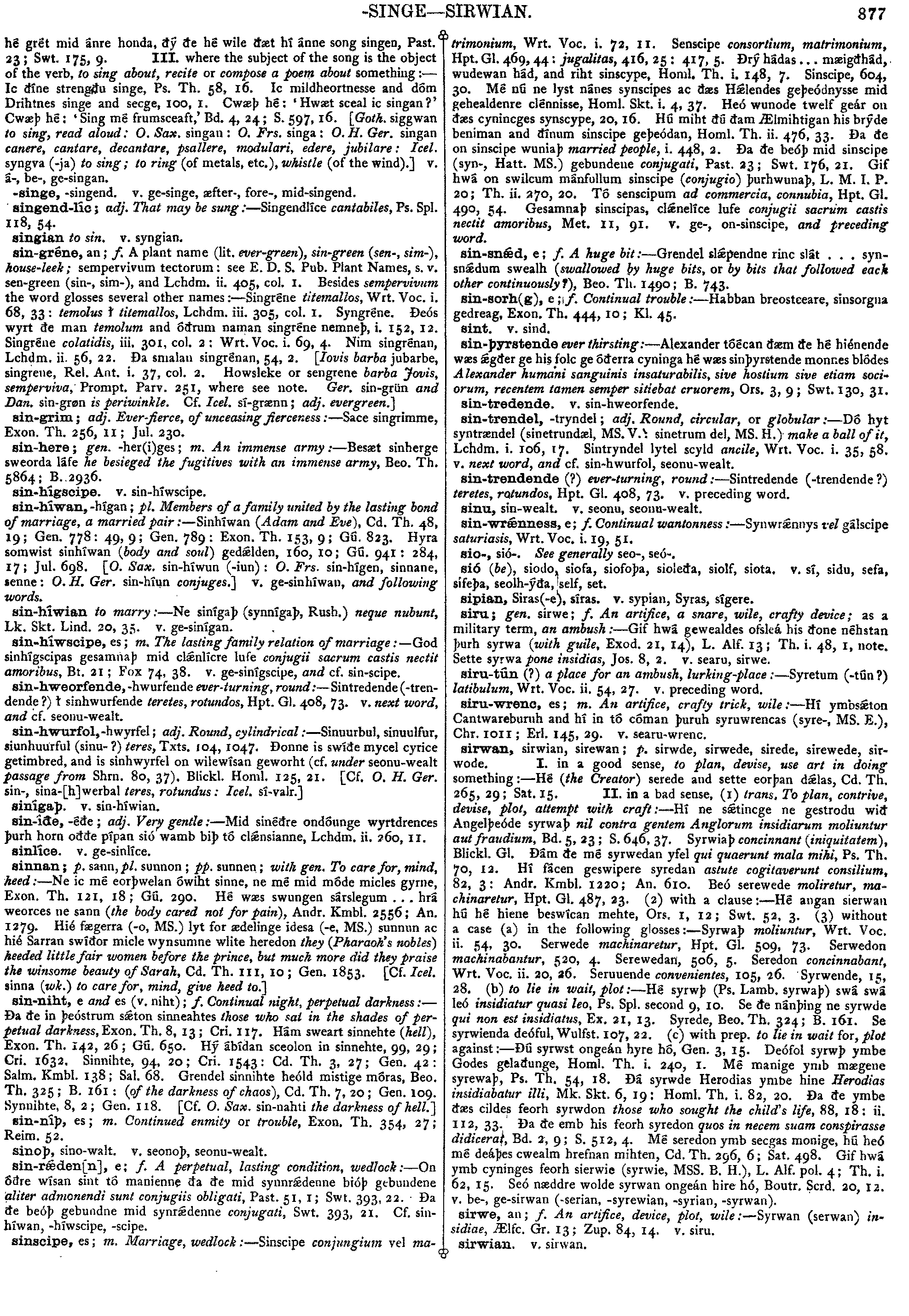
sin-gréne,
an
;
f.
A
plant
name
(lit.
ever-green),
sin-green
(sen-,
sim-),
house-leek
;
sempervivum
tectorum
:
see
E.
D.
S.
Pub.
Plant
Names,
s.
v.
sen-green
(sin-,
sim-),
and
Lchdm.
ii.
405,
col.
1.
Besides
sempervivum
the
word
glosses
several
other
names
:--Singréne
titemallos,
Wrt.
Voc.
i.
68,
33
:
temolus
 titemallos,
Lchdm.
iii.
305,
col.
1.
Syngréne.
Ðeós
wyrt
ðe
man
temolum
and
óðrum
naman
singréne
nemneþ,
i.
152,
12.
Singréne
colatidis,
iii.
301,
col.
2
:
Wrt.
Voc.
i.
69,
4.
Nim
singrénan,
Lchdm.
ii.
56,
22.
Ða
smalan
singrénan,
54,
2.
[Iovis
barba
jubarbe,
singrene.
Rel.
Ant.
i.
37,
col.
2.
Howsleke
or
sengrene
barba
Jovis,
semperviva,
Prompt.
Parv.
251,
where
see
note.
Ger.
sin-grün
and
Dan.
sin-grøn
is
periwinkle.
Cf.
Icel.
sí-grænn
;
adj.
evergreen.]
titemallos,
Lchdm.
iii.
305,
col.
1.
Syngréne.
Ðeós
wyrt
ðe
man
temolum
and
óðrum
naman
singréne
nemneþ,
i.
152,
12.
Singréne
colatidis,
iii.
301,
col.
2
:
Wrt.
Voc.
i.
69,
4.
Nim
singrénan,
Lchdm.
ii.
56,
22.
Ða
smalan
singrénan,
54,
2.
[Iovis
barba
jubarbe,
singrene.
Rel.
Ant.
i.
37,
col.
2.
Howsleke
or
sengrene
barba
Jovis,
semperviva,
Prompt.
Parv.
251,
where
see
note.
Ger.
sin-grün
and
Dan.
sin-grøn
is
periwinkle.
Cf.
Icel.
sí-grænn
;
adj.
evergreen.]
|
Source: Bosworth/Toller, page b0878, entry 3 View original page image as: [TIFF] [PNG] [View previous entry] [View next entry] |
[Comment on this entry] [View comments] |
The following entry has been hand-corrected once. |
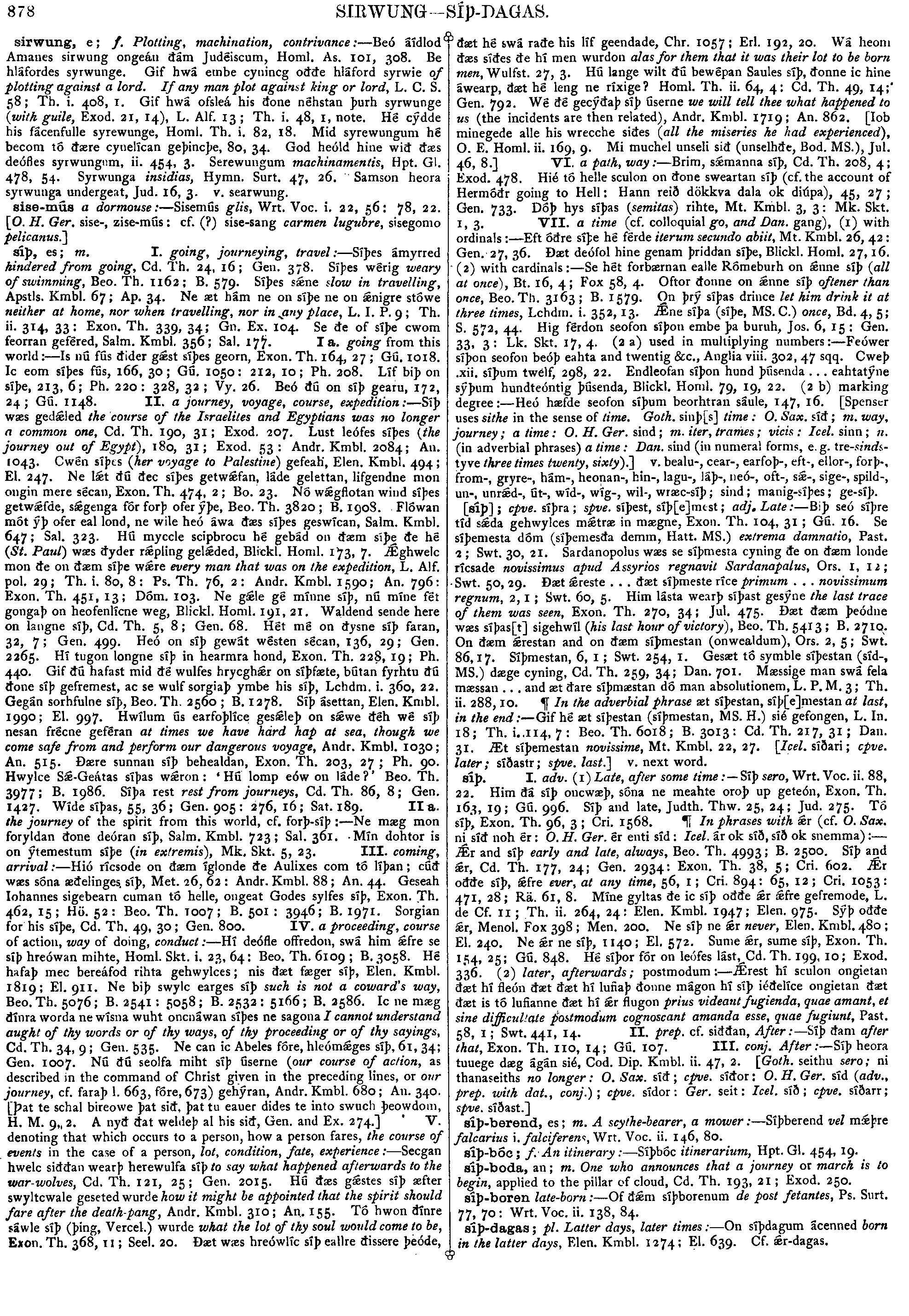
síþ,
es
;
m.
I.
going,
journeying,
travel
:--Síþes
ámyrred
hindered
from
going,
Cd.
Th.
24,
16
;
Gen.
378.
Síþes
wérig
weary
of
swimming,
Beo.
Th.
1162
;
B.
579.
Síþes
s ne
slow
in
travelling,
Apstls.
Kmbl.
67
;
Ap.
34.
Ne
æt
hám
ne
on
síþe
ne
on
nigre
stówe
neither
at
home,
nor
when
travelling,
nor
in
any
place,
L.
I.
P.
9
;
Th.
ii.
314,
33
:
Exon.
Th.
339,
34
;
Gn.
Ex.
104.
Se
ðe
of
síþe
cwom
feorran
geféred,
Salm.
Kmbl.
356
;
Sal.
177.
Ia.
going
from
this
world
:--Is
nú
fús
ðider
gst
síþes
georn,
Exon.
Th.
164,
27
;
Gú.
1018.
Ic
eom
síþes
fús,
166,
30
;
Gú.
1050
:
212,
10
;
Ph.
208.
Líf
biþ
on
síþe,
213,
6
;
Ph.
220
:
328,
32
;
Vy.
26.
Beó
ðú
on
síþ
gearu,
172,
24
;
Gú.
1148.
II.
a
journey,
voyage,
course,
expedition
:--Síþ
wæs
gedled
the
course
of
the
Israelites
and
Egyptians
was
no
longer
a
common
one,
Cd.
Th.
190,
31
;
Exod.
207.
Lust
leófes
síþes
(the
journey
out
of
Egypt),
180,
31
;
Exod.
53
:
Andr.
Kmbl.
2084
;
An.
1043.
Cwén
siþes
(her
voyage
to
Palestine)
gefeah,
Elen.
Kmbl.
494
;
El.
247.
Ne
lt
ðú
ðec
síþes
getwfan,
láde
gelettan,
lifgendne
mon
ongin
mere
sécan,
Exon.
Th.
474,
2
;
Bo.
23.
Nó
wgflotan
wind
síþes
getwfde,
sgenga
fór
forþ
ofer
ýþe,
Beo.
Th.
3820
;
B.
1908.
Flówan
mót
ýþ
ofer
eal
lond,
ne
wile
heó
áwa
ðæs
síþes
geswícan,
Salm.
Kmbl.
647
;
Sal.
323.
Hú
myccle
scipbrocu
hé
gebád
on
ðæm
síþe
ðe
hé
(St.
Paul)
wæs
ðyder
rpling
gelded,
Blickl.
Homl.
173,
7.
Æ-acute;ghwelc
mon
ðe
on
ðæm
síþe
wre
every
man
that
was
on
the
expedition,
L.
Alf.
pol.
29
;
Th.
i.
80,
8
:
Ps.
Th.
76,
2
:
Andr.
Kmbl.
1590
;
An.
796
:
Exon.
Th.
451,
13
;
Dóm.
103.
Ne
gle
gé
mínne
síþ,
nú
míne
fét
gongaþ
on
heofenlícne
weg,
Blickl.
Homl.
191,
21.
Waldend
sende
here
on
langne
síþ,
Cd.
Th.
5,
8
;
Gen.
68.
Hét
mé
on
ðysne
síþ
faran,
32,
7
;
Gen.
499.
Heó
on
síþ
gewát
wésten
sécan,
136,
29
;
Gen.
2265.
Hí
tugon
longne
síþ
in
hearmra
hond,
Exon.
Th.
228,
19
;
Ph.
440.
Gif
ðú
hafast
mid
ðé
wulfes
hrycghr
on
síþfæte,
bútan
fyrhtu
ðú
ðone
síþ
gefremest,
ac
se
wulf
sorgiaþ
ymbe
his
síþ,
Lchdm.
i.
360,
22.
Gegán
sorhfulne
síþ,
Beo.
Th.
2560
;
B.
1278.
Síþ
ásettan,
Elen.
Kmbl.
1990
;
El.
997.
Hwílum
ús
earfoþlíce
gesleþ
on
swe
ðéh
wé
síþ
nesan
frécne
geféran
at
times
we
have
hard
hap
at
sea,
though
we
come
safe
from
and
perform
our
dangerous
voyage,
Andr.
Kmbl.
1030
;
An.
515.
Ðære
sunnan
síþ
behealdan,
Exon.
Th.
203,
27
;
Ph.
90.
Hwylce
S-Geátas
síþas
wron
:
'Hú
lomp
eów
on
láde
?'
Beo.
Th.
3977
;
B.
1986.
Síþa
rest
rest
from
journeys,
Cd.
Th.
86,
8
;
Gen.
1427.
Wíde
síþas,
55,
36
;
Gen.
905
:
276,
16
;
Sat.
189.
IIa.
the
journey
of
the
spirit
from
this
world,
cf.
forþ-síþ
:--Ne
mæg
mon
foryldan
ðone
deóran
síþ,
Salm.
Kmbl.
723
;
Sal.
361.
Mín
dohtor
is
on
ýtemestum
síþe
(in
extremis),
Mk.
Skt.
5,
23.
III.
coming,
arrival
:--Hió
rícsode
on
ðæm
íglonde
ðe
Aulixes
com
tó
líþan
;
cúð
wæs
sóna
æðelinges
síþ,
Met.
26,
62
:
Andr.
Kmbl.
88
;
An.
44.
Geseah
Iohannes
sigebearn
cuman
tó
helle,
ongeat
Godes
sylfes
síþ,
Exon.
Th.
462,
15
;
Hö.
52
:
Beo.
Th.
1007
;
B.
501
:
3946
;
B.
1971.
Sorgian
for
his
síþe,
Cd.
Th.
49,
30
;
Gen.
800.
IV.
a
proceeding,
course
of
action,
way
of
doing,
conduct
:--Hí
deófle
offredon,
swá
him
fre
se
síþ
hreówan
mihte,
Homl.
Skt.
i.
23,
64
:
Beo.
Th.
6109
;
B.
3058.
Hé
hafaþ
mec
bereáfod
rihta
gehwylces
;
nis
ðæt
fæger
síþ,
Elen.
Kmbl.
1819
;
El.
911.
Ne
biþ
swylc
earges
síþ
such
is
not
a
coward's
way,
Beo.
Th.
5076
;
B.
2541
:
5058
;
B.
2532
:
5166
;
B.
2586.
Ic
ne
mæg
ðínra
worda
ne
wísna
wuht
oncnáwan
síþes
ne
sagona
I
cannot
understand
aught
of
thy
words
or
of
thy
ways,
of
thy
proceeding
or
of
thy
sayings,
Cd.
Th.
34,
9
;
Gen.
535.
Ne
can
ic
Abeles
fóre,
hleómges
síþ,
61,
34
;
Gen.
1007.
Nú
ðú
seolfa
miht
síþ
úserne
(our
course
of
action,
as
described
in
the
command
of
Christ
given
in
the
preceding
lines,
or
our
journey,
cf.
faraþ
l.
663,
fóre,
673)
gehýran,
Andr.
Kmbl.
680
;
An.
340.
[Þat
te
schal
bireowe
þat
sið,
þat
tu
eauer
dides
te
into
swuch
þeowdom,
H.
M.
9,
2.
A
nyð
ðat
weldeþ
al
his
sið,
Gen.
and
Ex.
274.]
V.
denoting
that
which
occurs
to
a
person,
how
a
person
fares,
the
course
of
events
in
the
case
of
a
person,
lot,
condition,
fate,
experience
:--Secgan
hwelc
siððan
wearþ
herewulfa
síþ
to
say
what
happened
afterwards
to
the
war-wolves,
Cd.
Th.
121,
25
;
Gen.
2015.
Hú
ðæs
gstes
síþ
æfter
swyltcwale
geseted
wurde
how
it
might
be
appointed
that
the
spirit
should
fare
after
the
death-pang,
Andr.
Kmbl.
310
;
An.
155.
Tó
hwon
ðínre
sáwle
síþ
(þing,
Vercel.)
wurde
what
the
lot
of
thy
soul
would
come
to
be,
Exon.
Th.
368,
11
;
Seel.
20.
Ðæt
wæs
hreówlíc
síþ
eallre
ðissere
þeóde,
ðæt
hé
swá
raðe
his
líf
geendade,
Chr.
1057
;
Erl.
192,
20.
Wá
heom
ðæs
síðes
ðe
hí
men
wurdon
alas
for
them
that
it
was
their
lot
to
be
born
men,
Wulfst.
27,
3.
Hú
lange
wilt
ðú
bewépan
Saules
síþ,
ðonne
ic
hine
áwearp,
ðæt
hé
leng
ne
ríxige
?
Homl.
Th.
ii.
64,
4
:
Cd.
Th.
49,
14
;
Gen.
792.
Wé
ðé
gecýðaþ
síþ
úserne
we
will
tell
thee
what
happened
to
us
(the
incidents
are
then
related),
Andr.
Kmbl.
1719
;
An.
862.
[Iob
minegede
alle
his
wrecche
siðes
(all
the
miseries
he
had
experienced),
O.
E.
Homl.
ii.
169,
9.
Mi
muchel
unseli
sið
(unselhðe,
Bod.
MS.),
Jul.
46,
8.]
VI.
a
path,
way
:--Brim,
smanna
síþ,
Cd.
Th.
208,
4
;
Exod.
478.
Hié
tó
helle
sculon
on
ðone
sweartan
síþ
(cf.
the
account
of
Hermóðr
going
to
Hell
:
Hann
reið
dökkva
dala
ok
diúpa),
45,
27
;
Gen.
733.
Dóþ
hys
síþas
(semitas)
rihte,
Mt.
Kmbl.
3,
3
:
Mk.
Skt.
I.
3.
VII.
a
time
(cf.
colloquial
go,
and
Dan.
gang),
(1)
with
ordinals
:--Eft
óðre
síþe
hé
férde
iterum
secundo
abiit,
Mt.
Kmbl.
26,
42
:
Gen.
27,
36.
Ðæt
deófol
hine
genam
þriddan
síþe,
Blickl.
Homl.
27,
16.
(2)
with
cardinals
:--Se
hét
forbærnan
ealle
Rómeburh
on
nne
síþ
(all
at
once),
Bt.
16,
4
;
Fox
58,
4.
Oftor
ðonne
on
nne
síþ
oftener
than
once,
Beo.
Th.
3163
;
B.
1579.
On
þrý
síþas
drince
let
him
drink
it
at
three
times,
Lchdm.
i.
352,
13.
Æ-acute;ne
síþa
(síþe,
MS.
C.)
once,
Bd.
4,
5
;
S.
572,
44.
Hig
férdon
seofon
síþon
embe
þa
buruh,
Jos.
6,
15
:
Gen.
33,
3
:
Lk.
Skt.
17,
4.
(2
a)
used
in
multiplying
numbers
:--Feówer
síþon
seofon
beóþ
eahta
and
twentig
&c.,
Anglia
viii.
302,
47
sqq.
Cweþ
.xii.
síþum
twélf,
298,
22.
Endleofan
síþon
hund
þúsenda
.
.
.
eahtatýne
sýþum
hundteóntig
þúsenda,
Blickl.
Homl.
79,
19,
22.
(2
b)
marking
degree
:--Heó
hæfde
seofon
síþum
beorhtran
sáule,
147,
16.
[Spenser
uses
sithe
in
the
sense
of
time.
Goth.
sinþ[s]
time
:
O.
Sax.
síð
;
m.
way,
journey
;
a
time
:
O.
H.
Ger.
sind
;
m.
iter,
trames
;
vicis
:
Icel.
sinn
;
n.
(in
adverbial
phrases)
a
time
;
Dan.
sind
(in
numeral
forms,
e.
g.
tre-sinds-tyve
three
times
twenty,
sixty).]
v.
bealu-,
cear-,
earfoþ-,
eft-,
ellor-,
forþ-,
from-,
gryre-,
hám-,
heonan-,
hin-,
lagu-,
láþ-,
neó-,
oft-,
s-,
sige-,
spild-,
un-,
unrd-,
út-,
wíd-,
wíg-,
wil-,
wræc-síþ
;
sind
;
manig-síþes
;
ge-síþ.
ne
slow
in
travelling,
Apstls.
Kmbl.
67
;
Ap.
34.
Ne
æt
hám
ne
on
síþe
ne
on
nigre
stówe
neither
at
home,
nor
when
travelling,
nor
in
any
place,
L.
I.
P.
9
;
Th.
ii.
314,
33
:
Exon.
Th.
339,
34
;
Gn.
Ex.
104.
Se
ðe
of
síþe
cwom
feorran
geféred,
Salm.
Kmbl.
356
;
Sal.
177.
Ia.
going
from
this
world
:--Is
nú
fús
ðider
gst
síþes
georn,
Exon.
Th.
164,
27
;
Gú.
1018.
Ic
eom
síþes
fús,
166,
30
;
Gú.
1050
:
212,
10
;
Ph.
208.
Líf
biþ
on
síþe,
213,
6
;
Ph.
220
:
328,
32
;
Vy.
26.
Beó
ðú
on
síþ
gearu,
172,
24
;
Gú.
1148.
II.
a
journey,
voyage,
course,
expedition
:--Síþ
wæs
gedled
the
course
of
the
Israelites
and
Egyptians
was
no
longer
a
common
one,
Cd.
Th.
190,
31
;
Exod.
207.
Lust
leófes
síþes
(the
journey
out
of
Egypt),
180,
31
;
Exod.
53
:
Andr.
Kmbl.
2084
;
An.
1043.
Cwén
siþes
(her
voyage
to
Palestine)
gefeah,
Elen.
Kmbl.
494
;
El.
247.
Ne
lt
ðú
ðec
síþes
getwfan,
láde
gelettan,
lifgendne
mon
ongin
mere
sécan,
Exon.
Th.
474,
2
;
Bo.
23.
Nó
wgflotan
wind
síþes
getwfde,
sgenga
fór
forþ
ofer
ýþe,
Beo.
Th.
3820
;
B.
1908.
Flówan
mót
ýþ
ofer
eal
lond,
ne
wile
heó
áwa
ðæs
síþes
geswícan,
Salm.
Kmbl.
647
;
Sal.
323.
Hú
myccle
scipbrocu
hé
gebád
on
ðæm
síþe
ðe
hé
(St.
Paul)
wæs
ðyder
rpling
gelded,
Blickl.
Homl.
173,
7.
Æ-acute;ghwelc
mon
ðe
on
ðæm
síþe
wre
every
man
that
was
on
the
expedition,
L.
Alf.
pol.
29
;
Th.
i.
80,
8
:
Ps.
Th.
76,
2
:
Andr.
Kmbl.
1590
;
An.
796
:
Exon.
Th.
451,
13
;
Dóm.
103.
Ne
gle
gé
mínne
síþ,
nú
míne
fét
gongaþ
on
heofenlícne
weg,
Blickl.
Homl.
191,
21.
Waldend
sende
here
on
langne
síþ,
Cd.
Th.
5,
8
;
Gen.
68.
Hét
mé
on
ðysne
síþ
faran,
32,
7
;
Gen.
499.
Heó
on
síþ
gewát
wésten
sécan,
136,
29
;
Gen.
2265.
Hí
tugon
longne
síþ
in
hearmra
hond,
Exon.
Th.
228,
19
;
Ph.
440.
Gif
ðú
hafast
mid
ðé
wulfes
hrycghr
on
síþfæte,
bútan
fyrhtu
ðú
ðone
síþ
gefremest,
ac
se
wulf
sorgiaþ
ymbe
his
síþ,
Lchdm.
i.
360,
22.
Gegán
sorhfulne
síþ,
Beo.
Th.
2560
;
B.
1278.
Síþ
ásettan,
Elen.
Kmbl.
1990
;
El.
997.
Hwílum
ús
earfoþlíce
gesleþ
on
swe
ðéh
wé
síþ
nesan
frécne
geféran
at
times
we
have
hard
hap
at
sea,
though
we
come
safe
from
and
perform
our
dangerous
voyage,
Andr.
Kmbl.
1030
;
An.
515.
Ðære
sunnan
síþ
behealdan,
Exon.
Th.
203,
27
;
Ph.
90.
Hwylce
S-Geátas
síþas
wron
:
'Hú
lomp
eów
on
láde
?'
Beo.
Th.
3977
;
B.
1986.
Síþa
rest
rest
from
journeys,
Cd.
Th.
86,
8
;
Gen.
1427.
Wíde
síþas,
55,
36
;
Gen.
905
:
276,
16
;
Sat.
189.
IIa.
the
journey
of
the
spirit
from
this
world,
cf.
forþ-síþ
:--Ne
mæg
mon
foryldan
ðone
deóran
síþ,
Salm.
Kmbl.
723
;
Sal.
361.
Mín
dohtor
is
on
ýtemestum
síþe
(in
extremis),
Mk.
Skt.
5,
23.
III.
coming,
arrival
:--Hió
rícsode
on
ðæm
íglonde
ðe
Aulixes
com
tó
líþan
;
cúð
wæs
sóna
æðelinges
síþ,
Met.
26,
62
:
Andr.
Kmbl.
88
;
An.
44.
Geseah
Iohannes
sigebearn
cuman
tó
helle,
ongeat
Godes
sylfes
síþ,
Exon.
Th.
462,
15
;
Hö.
52
:
Beo.
Th.
1007
;
B.
501
:
3946
;
B.
1971.
Sorgian
for
his
síþe,
Cd.
Th.
49,
30
;
Gen.
800.
IV.
a
proceeding,
course
of
action,
way
of
doing,
conduct
:--Hí
deófle
offredon,
swá
him
fre
se
síþ
hreówan
mihte,
Homl.
Skt.
i.
23,
64
:
Beo.
Th.
6109
;
B.
3058.
Hé
hafaþ
mec
bereáfod
rihta
gehwylces
;
nis
ðæt
fæger
síþ,
Elen.
Kmbl.
1819
;
El.
911.
Ne
biþ
swylc
earges
síþ
such
is
not
a
coward's
way,
Beo.
Th.
5076
;
B.
2541
:
5058
;
B.
2532
:
5166
;
B.
2586.
Ic
ne
mæg
ðínra
worda
ne
wísna
wuht
oncnáwan
síþes
ne
sagona
I
cannot
understand
aught
of
thy
words
or
of
thy
ways,
of
thy
proceeding
or
of
thy
sayings,
Cd.
Th.
34,
9
;
Gen.
535.
Ne
can
ic
Abeles
fóre,
hleómges
síþ,
61,
34
;
Gen.
1007.
Nú
ðú
seolfa
miht
síþ
úserne
(our
course
of
action,
as
described
in
the
command
of
Christ
given
in
the
preceding
lines,
or
our
journey,
cf.
faraþ
l.
663,
fóre,
673)
gehýran,
Andr.
Kmbl.
680
;
An.
340.
[Þat
te
schal
bireowe
þat
sið,
þat
tu
eauer
dides
te
into
swuch
þeowdom,
H.
M.
9,
2.
A
nyð
ðat
weldeþ
al
his
sið,
Gen.
and
Ex.
274.]
V.
denoting
that
which
occurs
to
a
person,
how
a
person
fares,
the
course
of
events
in
the
case
of
a
person,
lot,
condition,
fate,
experience
:--Secgan
hwelc
siððan
wearþ
herewulfa
síþ
to
say
what
happened
afterwards
to
the
war-wolves,
Cd.
Th.
121,
25
;
Gen.
2015.
Hú
ðæs
gstes
síþ
æfter
swyltcwale
geseted
wurde
how
it
might
be
appointed
that
the
spirit
should
fare
after
the
death-pang,
Andr.
Kmbl.
310
;
An.
155.
Tó
hwon
ðínre
sáwle
síþ
(þing,
Vercel.)
wurde
what
the
lot
of
thy
soul
would
come
to
be,
Exon.
Th.
368,
11
;
Seel.
20.
Ðæt
wæs
hreówlíc
síþ
eallre
ðissere
þeóde,
ðæt
hé
swá
raðe
his
líf
geendade,
Chr.
1057
;
Erl.
192,
20.
Wá
heom
ðæs
síðes
ðe
hí
men
wurdon
alas
for
them
that
it
was
their
lot
to
be
born
men,
Wulfst.
27,
3.
Hú
lange
wilt
ðú
bewépan
Saules
síþ,
ðonne
ic
hine
áwearp,
ðæt
hé
leng
ne
ríxige
?
Homl.
Th.
ii.
64,
4
:
Cd.
Th.
49,
14
;
Gen.
792.
Wé
ðé
gecýðaþ
síþ
úserne
we
will
tell
thee
what
happened
to
us
(the
incidents
are
then
related),
Andr.
Kmbl.
1719
;
An.
862.
[Iob
minegede
alle
his
wrecche
siðes
(all
the
miseries
he
had
experienced),
O.
E.
Homl.
ii.
169,
9.
Mi
muchel
unseli
sið
(unselhðe,
Bod.
MS.),
Jul.
46,
8.]
VI.
a
path,
way
:--Brim,
smanna
síþ,
Cd.
Th.
208,
4
;
Exod.
478.
Hié
tó
helle
sculon
on
ðone
sweartan
síþ
(cf.
the
account
of
Hermóðr
going
to
Hell
:
Hann
reið
dökkva
dala
ok
diúpa),
45,
27
;
Gen.
733.
Dóþ
hys
síþas
(semitas)
rihte,
Mt.
Kmbl.
3,
3
:
Mk.
Skt.
I.
3.
VII.
a
time
(cf.
colloquial
go,
and
Dan.
gang),
(1)
with
ordinals
:--Eft
óðre
síþe
hé
férde
iterum
secundo
abiit,
Mt.
Kmbl.
26,
42
:
Gen.
27,
36.
Ðæt
deófol
hine
genam
þriddan
síþe,
Blickl.
Homl.
27,
16.
(2)
with
cardinals
:--Se
hét
forbærnan
ealle
Rómeburh
on
nne
síþ
(all
at
once),
Bt.
16,
4
;
Fox
58,
4.
Oftor
ðonne
on
nne
síþ
oftener
than
once,
Beo.
Th.
3163
;
B.
1579.
On
þrý
síþas
drince
let
him
drink
it
at
three
times,
Lchdm.
i.
352,
13.
Æ-acute;ne
síþa
(síþe,
MS.
C.)
once,
Bd.
4,
5
;
S.
572,
44.
Hig
férdon
seofon
síþon
embe
þa
buruh,
Jos.
6,
15
:
Gen.
33,
3
:
Lk.
Skt.
17,
4.
(2
a)
used
in
multiplying
numbers
:--Feówer
síþon
seofon
beóþ
eahta
and
twentig
&c.,
Anglia
viii.
302,
47
sqq.
Cweþ
.xii.
síþum
twélf,
298,
22.
Endleofan
síþon
hund
þúsenda
.
.
.
eahtatýne
sýþum
hundteóntig
þúsenda,
Blickl.
Homl.
79,
19,
22.
(2
b)
marking
degree
:--Heó
hæfde
seofon
síþum
beorhtran
sáule,
147,
16.
[Spenser
uses
sithe
in
the
sense
of
time.
Goth.
sinþ[s]
time
:
O.
Sax.
síð
;
m.
way,
journey
;
a
time
:
O.
H.
Ger.
sind
;
m.
iter,
trames
;
vicis
:
Icel.
sinn
;
n.
(in
adverbial
phrases)
a
time
;
Dan.
sind
(in
numeral
forms,
e.
g.
tre-sinds-tyve
three
times
twenty,
sixty).]
v.
bealu-,
cear-,
earfoþ-,
eft-,
ellor-,
forþ-,
from-,
gryre-,
hám-,
heonan-,
hin-,
lagu-,
láþ-,
neó-,
oft-,
s-,
sige-,
spild-,
un-,
unrd-,
út-,
wíd-,
wíg-,
wil-,
wræc-síþ
;
sind
;
manig-síþes
;
ge-síþ.
|
Source: Bosworth/Toller, page b0878, entry 4 View original page image as: [TIFF] [PNG] [View previous entry] [View next entry] |
[Comment on this entry] [View comments] |
The following entry has been hand-corrected once. |
[síþ]
;
cpve.
síþra
;
spve.
síþest,
síþ[e]mest
;
adj.
Late
:--Biþ
seó
síþre
tíd
sda
gehwylces
mtræ
in
mægne,
Exon.
Th.
104,
31
;
Gú.
16.
Se
síþemesta
dóm
(síþemesða
demm,
Hatt.
MS.)
extrema
damnatio,
Past.
2
;
Swt.
30,
21.
Sardanopolus
wæs
se
síþmesta
cyning
ðe
on
ðæm
londe
rícsade
novissimus
apud
Assyrios
regnavit
Sardanapalus,
Ors.
1,
12
;
Swt.
50,
29.
Ðæt
reste
.
.
.
ðæt
síþmeste
ríce
primum
.
.
.
novissimum
regnum,
2,
1
;
Swt.
60,
5.
Him
lásta
wearþ
síþast
gesýne
the
last
trace
of
them
was
seen,
Exon.
Th.
270,
34
;
Jul.
475.
Ðæt
ðæm
þeódne
wæs
síþas[t]
sigehwíl
(his
last
hour
of
victory),
Beo.
Th.
5413
;
B.
2710.
On
ðæm
restan
and
on
ðæm
síþmestan
(onwealdum),
Ors.
2,
5
;
Swt.
86,
17.
Síþmestan,
6,
1
;
Swt.
254,
1.
Gesæt
tó
symble
síþestan
(síd-,
MS.)
dæge
cyning,
Cd.
Th.
259,
34
;
Dan.
701.
Mæssige
man
swá
fela
mæssan
.
.
.
and
æt
ðare
síþmæstan
dó
man
absolutionem,
L.
P.
M.
3
;
Th.
ii.
288,
10.

In
the
adverbial
phrase
æt
síþestan,
síþ[e]mestan
at
last,
in
the
end
:--Gif
hé
æt
síþestan
(síþmestan,
MS.
H.)
sié
gefongen,
L.
In.
18
;
Th.
i.
114,
7
;
Beo.
Th.
6018
;
B.
3013
;
Cd.
Th.
217,
31
;
Dan.
31.
Æt
síþemestan
novissime,
Mt.
Kmbl.
22,
27.
[Icel.
síðari
;
cpve.
later
;
síðastr;
spve.
last.]
v.
next
word.
|
Source: Bosworth/Toller, page b0879, entry 4 View original page image as: [TIFF] [PNG] [View previous entry] [View next entry] |
[Comment on this entry] [View comments] |
The following entry has been hand-corrected once. |
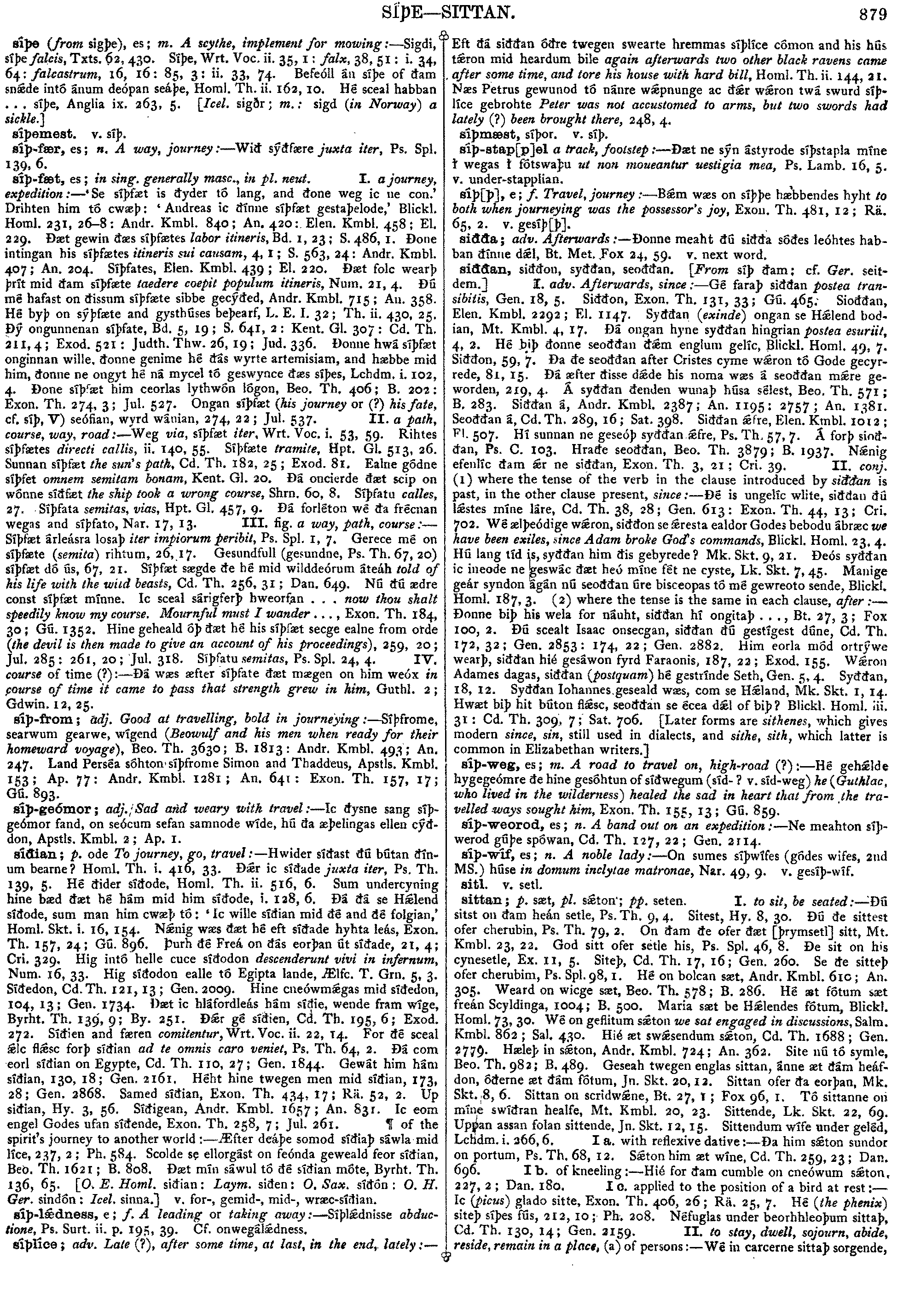
síþ-fæt, es ; in sing. generally masc., in pl. neut. I. a journey, expedition :--'Se síþfæt is ðyder tó lang, and ðone weg ic ne con.' Drihten him tó cwæþ : 'Andreas ic ðínne síþfæt gestaþelode,' Blickl. Homl. 231, 26-8 : Andr. Kmbl. 840 ; An. 420 : Elen. Kmbl. 458 ; El. 229. Ðæt gewin ðæs síþfætes labor itineris, Bd. 1, 23 ; S. 486, 1. Ðone intingan his síþfætes itineris sui causam, 4, 1 ; S. 563, 24 : Andr. Kmbl. 407 ; An. 204. Síþfates, Elen. Kmbl. 439 ; El. 220. Ðæt folc wearþ þrít mid ðam síþfæte taedere coepit populum itineris, Num. 21, 4. Ðú mé hafast on ðissum síþfæte sibbe gecýðed, Andr. Kmbl. 715 ; An. 358. Hé byþ on sýþfæte and gysthúses beþearf, L. E. I. 32 ; Th. ii. 430, 25. Ðý ongunnenan síþfate, Bd. 5, 19 ; S. 641, 2 : Kent. Gl. 307 : Cd. Th. 211, 4 ; Exod. 521 : Judth. Thw. 26, 19 ; Jud. 336. Ðonne hwá síþfæt onginnan wille, ðonne genime hé ðás wyrte artemisiam, and hæbbe mid him, ðonne ne ongyt hé ná mycel tó geswynce ðæs síþes, Lchdm. i. 102, 4. Ðone síþfæt him ceorlas lythwón lógon, Beo. Th. 406 ; B. 202 : Exon. Th. 274, 3 ; Jul. 527. Ongan síþfæt (his journey or (?) his fate, cf. síþ, V) seófian, wyrd wánian, 274, 22 ; Jul. 537. II. a path, course, way, road :--Weg via, síþfæt iter, Wrt. Voc. i. 53, 59. Rihtes síþfætes directi callis, ii. 140, 55. Síþfæte tramite, Hpt. Gl. 513, 26. Sunnan síþfæt the sun's path, Cd. Th. 182, 25 ; Exod. 81. Ealne gódne síþfet omnem semitam bonam, Kent. Gl. 20. Ðá oncierde ðæt scip on wónne síðfæt the ship took a wrong course, Shrn. 60, 8. Síþfatu calles, 27. Síþfata semitas, vias, Hpt. Gl. 457, 9. Ðá forléton wé ða frécnan wegas and síþfato, Nar. 17, 13. III. fig. a way, path, course :--Síþfæt árleásra losaþ iter impiorum peribit, Ps. Spl. 1, 7. Gerece mé on síþfæte (semita) rihtum, 26, 17. Gesundfull (gesundne, Ps. Th. 67, 20) síþfæt dó ús, 67, 21. Síþfæt sægde ðe hé mid wilddeórum áteáh told of his life with the wild beasts, Cd. Th. 256, 31 ; Dan. 649. Nú ðú ædre const síþfæt mínne. Ic sceal sárigferþ hweorfan . . . now thou shalt speedily know my course. Mournful must I wander . . . , Exon. Th. 184, 30 ; Gú. 1352. Hine geheald óþ ðæt hé his síþfæt secge ealne from orde (the devil is then made to give an account of his proceedings), 259, 20 ; Jul. 285 : 261, 20 ; Jul. 318. Síþfatu semitas, Ps. Spl. 24, 4. IV. course of time (?) :--Ðá wæs æfter síþfate ðæt mægen on him weóx in course of time it came to pass that strength grew in him, Guthl. 2 ; Gdwin. 12, 25.
|
Source: Bosworth/Toller, page b0879, entry 19 View original page image as: [TIFF] [PNG] [View previous entry] [View next entry] |
[Comment on this entry] [View comments] |
The following entry has been hand-corrected once. |
sittan
;
p.
sæt,
pl.
ston
;
pp.
seten.
I.
to
sit,
be
seated
:--Ðú
sitst
on
ðam
heán
setle,
Ps.
Th.
9,
4.
Sitest,
Hy.
8,
30.
Ðú
ðe
sittest
ofer
cherubin,
Ps.
Th.
79,
2.
On
ðam
ðe
ofer
ðæt
[þrymsetl]
sitt.
Mt.
Kmbl.
23,
22.
God
sitt
ofer
setle
his,
Ps.
Spl.
46,
8.
Ðe
sit
on
his
cynesetle,
Ex.
11,
5.
Siteþ,
Cd.
Th.
17,
16
;
Gen.
260.
Se
ðe
sitteþ
ofer
cherubim,
Ps.
Spl.
98,
1.
Hé
on
bolcan
sæt,
Andr.
Kmbl.
610
;
An.
305.
Weard
on
wicge
sæt,
Beo.
Th.
578
;
B.
286.
Hé
æt
fótum
sæt
freán
Scyldinga,
1004
;
B.
500.
Maria
sæt
be
Hlendes
fótum,
Blickl.
Homl.
73,
30.
Wé
on
geflitum
ston
we
sat
engaged
in
discussions,
Salm.
Kmbl.
862
;
Sal.
430.
Hié
æt
swsendum
ston,
Cd.
Th.
1688
;
Gen.
2779.
Hæleþ
in
ston,
Andr.
Kmbl.
724
;
An.
362.
Site
nú
tó
symle,
Beo.
Th.
982
;
B.
489.
Geseah
twegen
englas
sittan,
ánne
æt
ðam
heáf don,
óðerne
æt
ðam
fótum,
Jn.
Skt.
20,
12.
Sittan
ofer
ða
eorþan,
Mk.
Skt.
8,
6.
Sittan
on
scridwne,
Bt.
27,
1
;
Fox
96,
1.
Tó
sittanne
on
míne
swíðran
healfe,
Mt.
Kmbl.
20,
23.
Sittende,
Lk.
Skt.
22,
69.
Uppan
assan
folan
sittende,
Jn.
Skt.
12,
15.
Sittendum
wífe
under
geléd,
Lchdm.
i.
266,
6.
Ia.
with
reflexive
dative
:--Ða
him
ston
sundor
on
portum,
Ps.
Th.
68,
12.
Ston
him
æt
wíne,
Cd.
Th.
259,
23
;
Dan.
696.
Ib.
of
kneeling
:--Hié
for
ðam
cumble
on
cneówum
ston,
227,
2
;
Dan.
180.
Ic.
applied
to
the
position
of
a
bird
at
rest
:--Ic
(picus)
glado
sitte,
Exon.
Th.
406,
26
;
Rä.
25,
7.
Hé
(the
phenix)
siteþ
síþes
fús,
212,
10
;
Ph.
208.
Néfuglas
under
beorhhleoþum
sittaþ,
Cd.
Th.
130,
14
;
Gen.
2159.
II.
to
stay,
dwell,
sojourn,
abide,
reside,
remain
in
a
place,
(a)
of
persons
:--Wé
in
carcerne
sittaþ
sorgende,
don,
óðerne
æt
ðam
fótum,
Jn.
Skt.
20,
12.
Sittan
ofer
ða
eorþan,
Mk.
Skt.
8,
6.
Sittan
on
scridwne,
Bt.
27,
1
;
Fox
96,
1.
Tó
sittanne
on
míne
swíðran
healfe,
Mt.
Kmbl.
20,
23.
Sittende,
Lk.
Skt.
22,
69.
Uppan
assan
folan
sittende,
Jn.
Skt.
12,
15.
Sittendum
wífe
under
geléd,
Lchdm.
i.
266,
6.
Ia.
with
reflexive
dative
:--Ða
him
ston
sundor
on
portum,
Ps.
Th.
68,
12.
Ston
him
æt
wíne,
Cd.
Th.
259,
23
;
Dan.
696.
Ib.
of
kneeling
:--Hié
for
ðam
cumble
on
cneówum
ston,
227,
2
;
Dan.
180.
Ic.
applied
to
the
position
of
a
bird
at
rest
:--Ic
(picus)
glado
sitte,
Exon.
Th.
406,
26
;
Rä.
25,
7.
Hé
(the
phenix)
siteþ
síþes
fús,
212,
10
;
Ph.
208.
Néfuglas
under
beorhhleoþum
sittaþ,
Cd.
Th.
130,
14
;
Gen.
2159.
II.
to
stay,
dwell,
sojourn,
abide,
reside,
remain
in
a
place,
(a)
of
persons
:--Wé
in
carcerne
sittaþ
sorgende,
|
Source: Bosworth/Toller, page b0880, entry 24 View original page image as: [TIFF] [PNG] [View previous entry] [View next entry] |
[Comment on this entry] [View comments] |
The following entry has been hand-corrected once. |
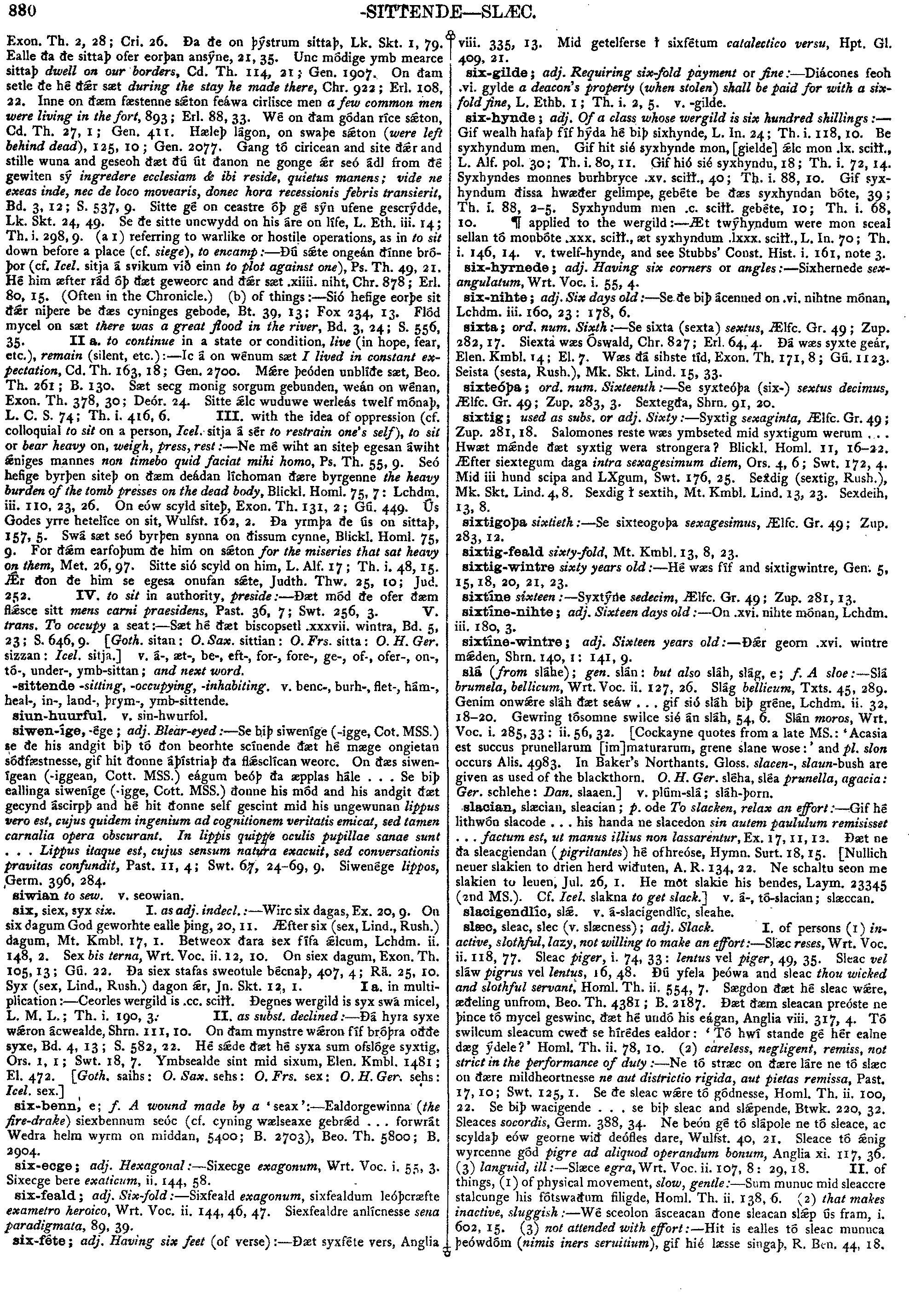
slá
(from
sláhe);
gen.
slán:
but
also
sláh,
slág,
e;
f.
A
sloe:
--
Slá
brumela,
bellicum.
Wrt.
Voc.
ii.
127,
26.
Slág
bellicum,
Txts.
45,
289.
Genim
onwre
sláh
ðæt
seáw
.
.
.
gif
sió
sláh
biþ
gréne,
Lchdm.
ii.
32,
18
-
20.
Gewring
tósomne
swilce
sié
án
sláh,
54,
6.
Slán
moros.
Wrt.
Voc.
i.
285,
33
:
ii.
56,
32.
[Cockayne
quotes
from
a
late
MS.
:
Acasia
est
succus
prunellarum
[im]maturarum,
grene
slane
wose:
and
pl.
slon
occurs
Alis.
4983.
In
Baker's
Northants.
Gloss.
slacen-,
slaun-bush
are
given
as
used
of
the
blackthorn.
O.
H.
Ger.
sléha,
sléa
prunella,
agacia:
Ger.
schlehe:
Dan.
slaaen.
v.
plúm-slá;
sláh-þorn.
|
Source: Bosworth/Toller, page b0881, entry 13 View original page image as: [TIFF] [PNG] [View previous entry] [View next entry] |
[Comment on this entry] [View comments] |
The following entry has been hand-corrected once. |
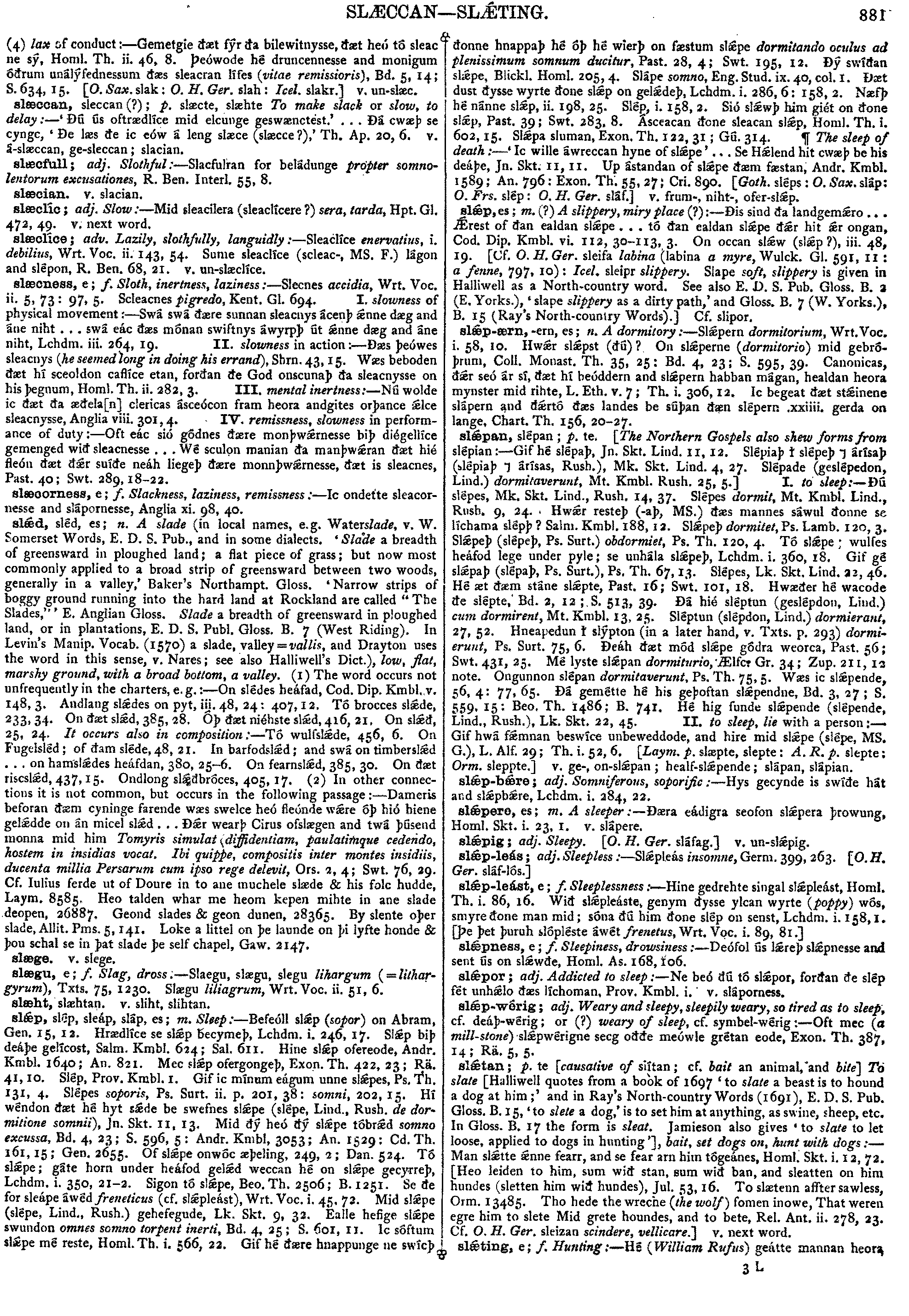
slp,
slép,
sleáp,
sláp,
es;
m.
Sleep
:--
Befeóll
slp
(sopor)
on
Abram,
Gen.
15,
12.
Hrædlíce
se
slp
becymeþ,
Lchdm.
i.
246,
17.
Slp
biþ
deáþe
gelícost,
Salm.
Kmbl.
624;
Sal.
611.
Hine
slp
ofereode.
Andr.
Kmbl.
1640;
An.
821.
Mec
slp
ofergongeþ.
Exon.
Th.
422,
23;
Ra.
41,
10.
Slép,
Prov.
Kmbl.
1.
Gif
ic
mínum
eágum
unne
slpes,
Ps.
Th.
131,
4.
Slépes
soporis,
Ps.
Surt.
ii.
p.
201,
38:
somni,
202,
15.
Hí
wéndon
ðæt
hé
hyt
sde
be
swefnes
slpe
(slépe,
Lind.
,
Rush.
de
dormitione
somnii),
Jn.
Skt.
11.
13.
Mid
ðý
heó
ðý
slpe
tðbrd
somno
excussa,
Bd.
4,
23;
S.
596,
5:
Andr.
Kmbl.
3053;
An.
1529:
Cd.
Th.
161,
15;
Gen.
2655.
Of
slpe
onwóc
æþeling,
249,
2;
Dan.
524.
Tó
slpe;
;
gáte
horn
under
heáfod
geld
weccan
hé
on
slpe
gecyrreþ,
Lchdm.
I.
350,
21-2.
Sigon
tó
slpe,
Beo.
Th.
2506;
B.1251.
Se
ðe
for
sleápe
áwéd
frenticus
(cf.
slpleást),
Wrt.
Voc.
I.
45,
72.
Mid
slpe
swundon
omnes
somno
torpent
inerti,
Bd.
4,
25;
S.
601,
11.
Ic
sóftum
alpe
mé
reste,
Homl.
Th.
I.
566,
22.
Gif
hé
ð
ære
hnappunge
ne
swícþ
ðonne
hnappaþ
hé
óþ
hé
wierþ
on
fæstum
slpe
dormitando
oculus
ad
plenissimum
somnum
ducitur,
Past.
28,
4;
Swt.
195,
12.
Ðý
swíðan
slpe,
Blickl.
Homl.
205,
4.
Slápe
somno,
Eng.
Stud.
ix.
40,
col.
1.
Ðæt
dust
ðysse
wyrte
ðone
slp
on
geldeþ,
Lchdm.
i.
286,
6:
158,
2.
Næfþ
hénánne
slp,
ii.
198,
25.
Slép,
i.
158,
2.
Sió
slwþ
him
giét
on
ðone
slp,
Past.
39;
Swt.
283.
8.
Ásceacan
ðone
sleacan
slp.
Homl.
Th.
i.
602,
15.
Slpa
sluman.
Exon.
Th.
122,
31;
Gú.
314.
The
sleep
of
death
:--
'
Ic
wille
áwreccan
hyne
of
slpe'.
.
.
Se
Hlend
hit
cwæþ
be
his
deáþe.
Jn.
Skt.
11.
11.
Up
ástandan
of
slpe
ðæm
fæstan,
Andr.
Kmbl.
1589;
An.
796:
Exon.
Th.
55,
27;
Cri.
890.
[Goth.
sléps:
O.
Sax.
sláp:
O.
Frs.
slép:
O.
H.
Ger.
sláf.]
v.
frum-,
niht-,
ofer-slp.
|
Source: Bosworth/Toller, page b0882, entry 8 View original page image as: [TIFF] [PNG] [View previous entry] [View next entry] |
[Comment on this entry] [View comments] |
The following entry has been hand-corrected once. |
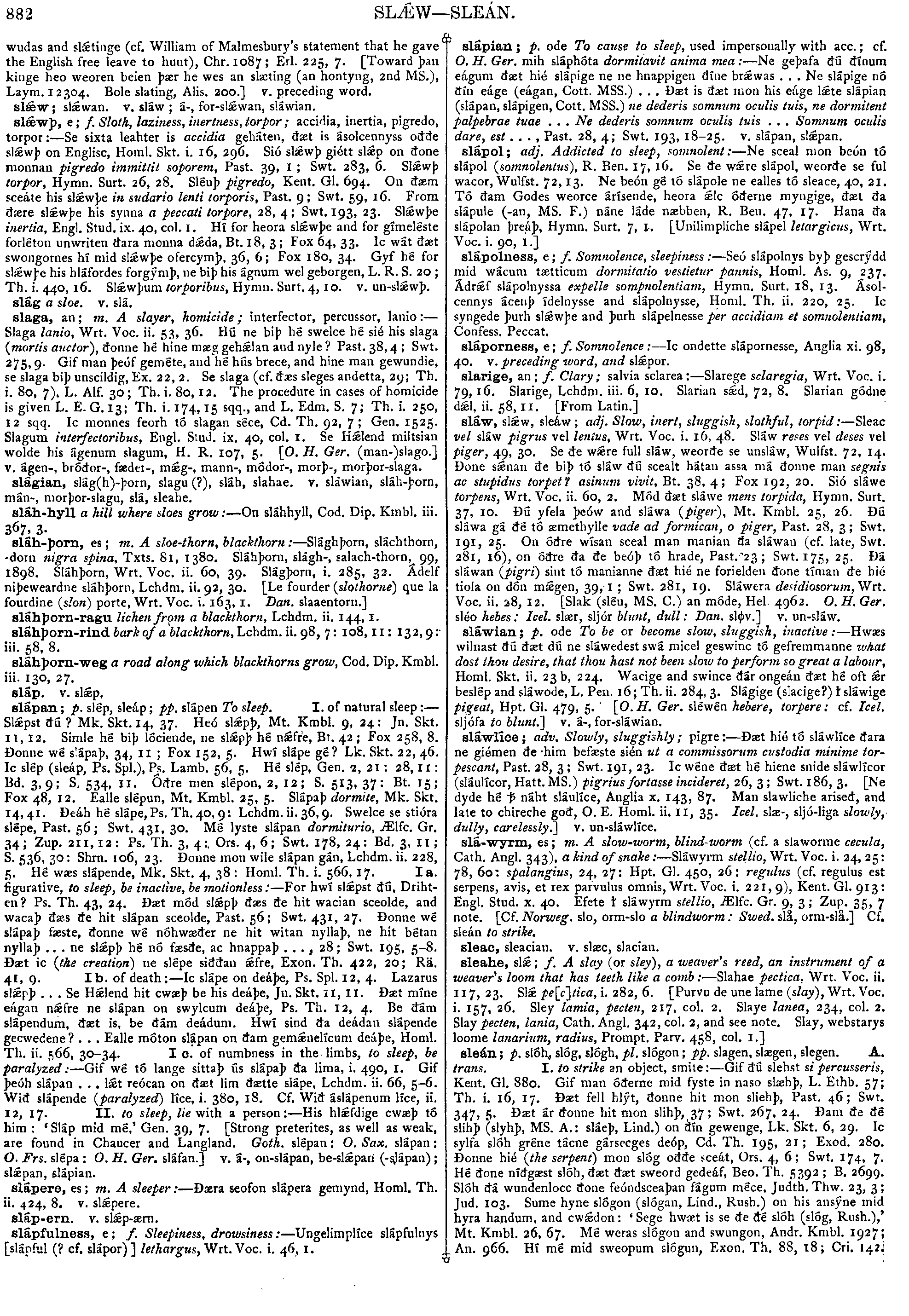
sláh-þorn, es ; m. A sloe-thorn, blackthorn :-- Slághþorn, sláchthorn, -dorn nigra spina, Txts. 81, 1380. Sláhþorn, slágh-, salach-thorn, 99, 1898. Sláhþorn, Wrt. Voc. ii. 60, 39. Slágþorn, i. 285, 32. Ádelf niþeweardne sláhþorn, Lchdm. ii. 92, 30. [Le fourder (slothorne) que la fourdine (slon) porte, Wrt. Voc. i. 163, 1. Dan. slaaentorn.]
|
Source: Bosworth/Toller, page b0882, entry 22 View original page image as: [TIFF] [PNG] [View previous entry] [View next entry] |
[Comment on this entry] [View comments] |
The following entry has been hand-corrected once. |
sláw,
slw,
sleáw;
adj.
Slow,
inert,
sluggish,
slothful,
torpid
:--
Sleac
vel
sláw
pigrus
vel
lentus,
Wrt.
Voc.
i.
16,
48.
Sláw
reses
vel
deses
vel
piger,
49,
30.
Se
ðe
wre
full
sláw,
weorðe
se
unsláw,
Wulfst.
72,
14.
Ðone
snan
ðe
biþ
tó
sláw
ðú
scealt
hátan
assa
má
ðonne
man
segnis
ac
stupidus
torpet?
asinum
vivit,
Bt.
38,
4;
Fox
192,
20.
Sió
sláwe
torpens,
Wrt.
Voc.
ii.
60,
2.
Mód
ðæt
sláwe
mens
torpida,
Hymn.
Surt.
37,
10.
Ðú
yfela
þeów
and
sláwa
(piger).
Mt.
Kmbl.
25,
26.
Ðú
sláwa
gá
ðé
tó
æmethylle
vade
ad
fortnican,
o
piger,
Past.
28,
3;
Swt.
191,
25.
On
óðre
wísan
sceal
man
manian
ða
sláwan
(cf.
late,
Swt.
281,
16),
on
óðre
ða
ðe
beóþ
tó
hrade,
Past.
"23;
Swt.
175,
25.
Ðá
sláwan
(pigri)
sint
to
manianne
ðæt
hié
ne
forielden
ðone
tíman
ðe
hié
tiola
on
dón
mgen,
39,
l
;
Swt.
281,
19.
Sláwera
desidiosorum,
Wtr.
Voc.
ii.
28,
12.
[Slak
(sléu,
MS.
C.
)
an
móde,
Hel.
4962.
O.
H.
Ger.
sléo
hebes:
Icel.
slær,
sljór
blunt,
dull;
Dan.
slostals;v.]
v.
un-sláw.
|
Source: Bosworth/Toller, page b0883, entry 1 View original page image as: [TIFF] [PNG] [View previous entry] [View next entry] |
[Comment on this entry] [View comments] |
The following entry has been hand-corrected once. |
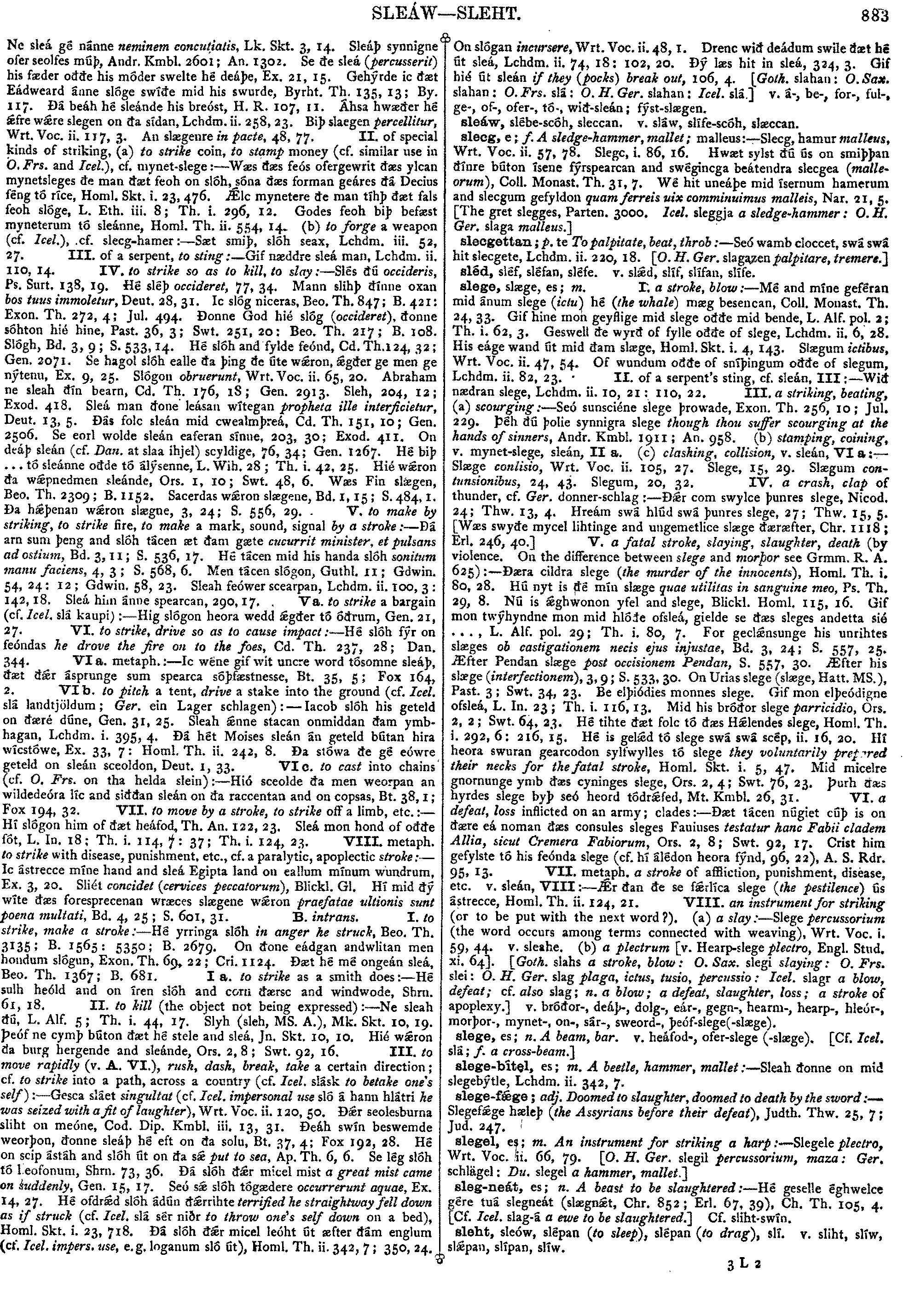
Ne
sleá
gé
nánne
neminem
concutiatis,
Lk.
Skt.
3,
14.
Sleáþ
synnigne
ofer
seolfes
múþ,
Andr.
Kmbl.
2601;
An.
1302.
Se
ðe
sleá
(percusserit)
his
fæder
oððe
his
móder
swelte
hé
deáþe,
Ex.
21,
15.
Gehýrde
ic
ðæt
Eádweard
ánne
slóge
swíðe
mid
his
swurde,
Byrht.
Th.
135,
13;
By.
117.
Ðá
beáh
hé
sleánde
his
breóst,
H.
R.
107,
11.
Áhsa
hwæðer
hé
fre
wre
slegen
on
ða
sídan.
Lchdm.
ii.
258,
23.
Biþ
slaegen
percellitur,
Wrt.
Voc.
ii.
117,
3.
An
slægenre
in
pacte,
48,
77.
II.
of
special
kinds
of
striking,
(a)
to
strike
coin,
to
stamp
money
(cf.
similar
use
in
O.
Frs.
and
Icel.
),
cf.
mynet-slege
:--
Wæs
ðæs
feós
ofergewrit
ðæs
ylcan
mynetsleges
ðe
man
ðæt
feoh
on
slóh,
sóna
ðæs
forman
geáres
ðá
Decius
féng
tó
ríce.
Homl.
Skt.
i.
23,
476.
Ælc
mynetere
ðe
man
tíhþ
ðæt
fals
feoh
slóge.
L.
Eth.
iii.
8;
Th.
i.
296,
12.
Godes
feoh
biþ
befæst
myneterum
tó
sleánne,
Homl.
Th.
ii.
554,
14.
(b)
to
forge
a
weapon
(cf.
Icel.
),
.
cf.
slecg-hamer
:--
Sæt
smiþ,
slóh
seax.
Lchdm.
iii.
52,
27.
III.
of
a
serpent,
to
sting
:--
Gif
næddre
sleá
man,
Lchdm.
ii.
no,
14.
IV.
to
strike
so
as
to
kill,
to
slay
:--
Slés
ðú
occideris,
Ps.
Surt.
138,
19.
Hé
sléþ
occideret,
77,
34.
Mann
slihþ
ðínne
oxan
bos
tuus
immoletur.
Deut.
28,
31.
Ic
slóg
niceras,
Beo.
Th.
847;
6.
421:
Exon.
Th.
272,
4;
Jul.
494.
Ðonne
God
hié
slóg
(occideret),
ðonne
sóhton
hié
hine,
Past.
36,
3;
Swt.
251,
20:
Beo.
Th.
217;
B.
108.
Slógh,
Bd.
3,
9
;
S.
533,
14.
Hé
slóh
and
fylde
feond,
Cd.
Th.
124,
32;
Gen.
2071.
Se
hagol
slóh
ealle
ða
þing
ðe
úte
wron,
gðer
ge
men
ge
nýtenu.
Ex.
9,
25.
Slógon
obruerunt,
Wrt.
Voc.
ii.
65,
20.
Abraham
ne
sleah
ðín
bearn,
Cd.
Th.
176,
18;
Gen.
2913.
Sleh,
204,
12;
Exod.
418.
Sleá
man
ðone
leásan
wítegan
propheta
Hie
interficietur,
Deut.
13,
5.
Ðás
folc
sleán
mid
cwealmþreá,
Cd.
Th.
151,
10;
Gen.
2506.
Se
eorl
wolde
sleán
eaferan
sínne,
203,
30;
Exod.
411.
On
deáþ
sleán
(cf.
Dan.
at
slaa
ihjel)
scyldige,
76,
34;
Gen.
1267.
Hé
biþ
.
.
.
tó
sleánne
oðde
tó
álýsenne,
L.
Wih.
28
;
Th.
i.
42,
25.
Hié
wron
ða
wpnedmen
sleánde,
Ors.
l,
10;
Swt.
48,
6.
Wæs
Fin
slægen,
Beo.
Th.
2309;
B.
1152.
Sacerdas
wron
slægene,
Bd.
1,
15;
S.
484,
1.
Ða
hþenan
wron
slægne,
3,
24;
S.
556,
29.
.
V.
to
make
by
striking,
to
strike
fire,
to
make
a
mark,
sound,
signal
by
a
stroke
:--
Ðá
arn
sum
þeng
and
slóh
tácen
æt
ðam
gæte
cucurrit
minister,
et
pulsans
ad
ostium,
Bd.
3,
11;
S.
536,
17.
Hé
tácen
mid
his
handa
slóh
sonitum
manu
faciens,
4,
3
;
S.
568,
6.
Men
tácen
slógon,
Guthl.
11;
Gdwin.
54,
24:
12
;
Gdwin.
58,
23.
Sleah
feówer
scearpan,
Lchdm.
ii.
100,
3
:
142,
18.
Sleá
him
ánne
spearcan,
290,
17.
.
V
a.
to
strike
a
bargain
(cf.
Icel.
slá
kaupi)
:--
Hig
slógon
heora
wedd
gðer
tó
óðrum,
Gen.
21,
27.
VI.
to
strike,
drive
so
as
to
cause
impact
:--
Hé
slóh
fýr
on
feóndas
he
drove
the
fire
on
to
the
foes,
Cd.
Th.
237,
28;
Dan.
344.
VIa.
metaph.
:--
Ic
wéne
gif
wit
uncre
word
tósomne
sleáþ,
ðæt
ðr
ásprunge
sum
spearca
sóþfæstnesse,
Bt.
35,
5;
Fox
164,
2.
VI
b.
to
pitch
a
tent,
drive
a
stake
into
the
ground
(cf.
Icel.
slá
landtjoldum;
Ger.
ein
Lager
schlagen)
:--
Iacob
slóh
his
geteld
on
ðæré
dúne,
Gen.
31,
25.
Sleah
nne
stacan
onmiddan
ðam
ymb-hagan,
Lchdm.
i.
395,
4.
Ða
hét
Moises
sleán
án
geteld
bútan
hira
wícstówe,
Ex.
33,
7:
Homl.
Th.
ii.
242,
8.
Ða
stówa
ðe
gé
eówre
geteld
on
sleán
sceoldon,
Deut.
i.
33.
VIc.
to
cast
into
chains
(cf.
O.
Frs.
on
tha
helda
slein)
:--
Hió
sceolde
ða
men
weorpan
an
wildedeóra
líc
and
siððan
sleán
on
ða
raccentan
and
on
copsas.
Bt.
38,
1;
Fox
194,
32.
VII.
to
move
by
a
stroke,
to
strike
off
a
limb,
etc.
:--
Hí
slógon
him
of
ðæt
heáfod,
Th.
An.
122,
23.
Sleá
mon
hond
of
oððe
fót,
L.
In.
18;
Th.
i.
114,
7:
37;
Th.
i.
124,
23.
VIII.
metaph.
to
strike
with
disease,
punishment,
etc.
,
cf.
a
paralytic,
apoplectic
stroke
:--
Ic
ástrecce
mine
hand
and
sleá
Egipta
land
on
eallum
minum
wundrum.
Ex.
3,
20.
Sliét
concidet
(cervices
peccatorum),
Blickl.
Gl.
Hí
mid
ðý
wíte
ðæs
foresprecenan
wræces
slægene
wron
praefatae
ultionis
sunt
poena
multati,
Bd.
4,
25
;
S.
601,
31.
B.
intrans.
I.
to
strike,
make
a
stroke
:--
Hé
yrringa
slóh
in
anger
he
struck,
Beo.
Th.
3135;
B.
1565:
5350;
B.
2679.
On
ðone
eádgan
andwlitan
men
hondum
slógun,
Exon.
Th.
69,
22;
Cri.
1124.
Ðæt
hé
mé
ongeán
sleá,
Beo.
Th.
1367;
B.
681.
Ia.
to
strike
as
a
smith
does
:--
Hé
sulh
heóld
and
on
íren
slóh
and
corn
ðærsc
and
windwode.
Shrn.
61,
18.
II.
to
kill
(the
object
not
being
expressed)
:--
Ne
sleah
ð
ú,
L.
Alf.
5;
Th.
i.
44,
17.
Slyh
(sleh,
MS.
A.
),
Mk.
Skt.
10,
19.
þeóf
ne
cymþ
búton
ðæt
hé
stele
and
sleá,
Jn.
Skt.
10,
10.
Hié
wron
ða
burg
hergende
and
sleánde,
Ors.
2,
8
;
Swt.
92,
16.
III.
to
move
rapidly
(v.
A.
VI.
),
rush,
dash,
break,
take
a
certain
direction;
cf.
to
strike
into
a
path,
across
a
country
(cf.
Icel.
slásk
to
betake
ones
self]
:--
Gesca
sláet
singultat
(cf.
Icel.
impersonal
use
sló
á
hann
hlátri
he
was
seized
with
a
fit
of
laughter).
Wrt.
Voc.
ii.
120,
50.
Ðr
seolesburna
sliht
on
meóne.
Cod.
Dip.
Kmbl.
iii.
13,
31.
Ðeáh
swín
beswemde
weorþon,
ðonne
sleáþ
hé
eft
on
ða
solu.
Bt.
37,
4;
Fox
192,
28.
Hé
on
scip
ástáh
and
slóh
út
on
ða
sput
to
sea,
Ap.
Th.
6,
6.
Se
lég
slóh
tó
leofonum,
Shrn.
73,
36.
Ðá
slóh
ðr
micel
mist
a
great
mist
came
on
suddenly.
Gen.
15,
17.
Seó
s
slóh
tógædere
occurrerunt
aquae,
Ex.
14,
27.
Hé
ofdrd
slóh
ádún
ðrrihte
terrified
he
straightway
fell
down
as
if
struck
(cf.
Icel.
slá
sér
niðr
to
throw
one's
self
down
on
a
bed),
Homl.
Skt.
i.
23,
718.
Ðá
slóh
ðr
micel
leóht
fit
æfter
ðam
englum
(cf.
Icel.
impers.
use,
e.
g.
loganum
sló
út),
Homl.
Th.
ii.
342,
7;
350,
24.
On
slógan
incursere,
Wrt.
Voc.
ii.
48,
1.
Drenc
wið
deádum
swile
ðæt
hé
út
sleá,
Lchdm.
ii.
74,
18:
102,
20.
Ðý
læs
hit
in
sleá,
324,
3.
Gif
hié
út
sleán
if
they
(pocks)
break
out,
106,
4.
[Goth.
slahan:
O.
Sax.
slahan:
O.
Frs.
slá:
O.
H.
Ger.
slahan:
Icel.
slá.]
v.
á-,
be-,
for-,
ful-,
ge-,
of-,
ofer-,
tó-,
wið-sleán;
fýst-slægen.
| Result Page: |  |
Previous | 101 102 103 104 105 106 107 108 109 110 111 112 113 114 115 116 117 118 119 | Next |  |
Germanic Lexicon Project (main page)
This search system was written by
Sean Crist
Please consider
volunteering
to correct the data in these online dictionaries.
No rights reserved. Feel free to use these data in any way you please.