|
|

Tip: In the search results, you can click on any word or abbreviation for more information.
|
Source: Cleasby/Vigfusson, page b0635, entry 1 View original page image as: [TIFF] [PNG] [View previous entry] [View next entry] |
[Comment on this entry] [View comments] |
The following entry has been hand-corrected once. |
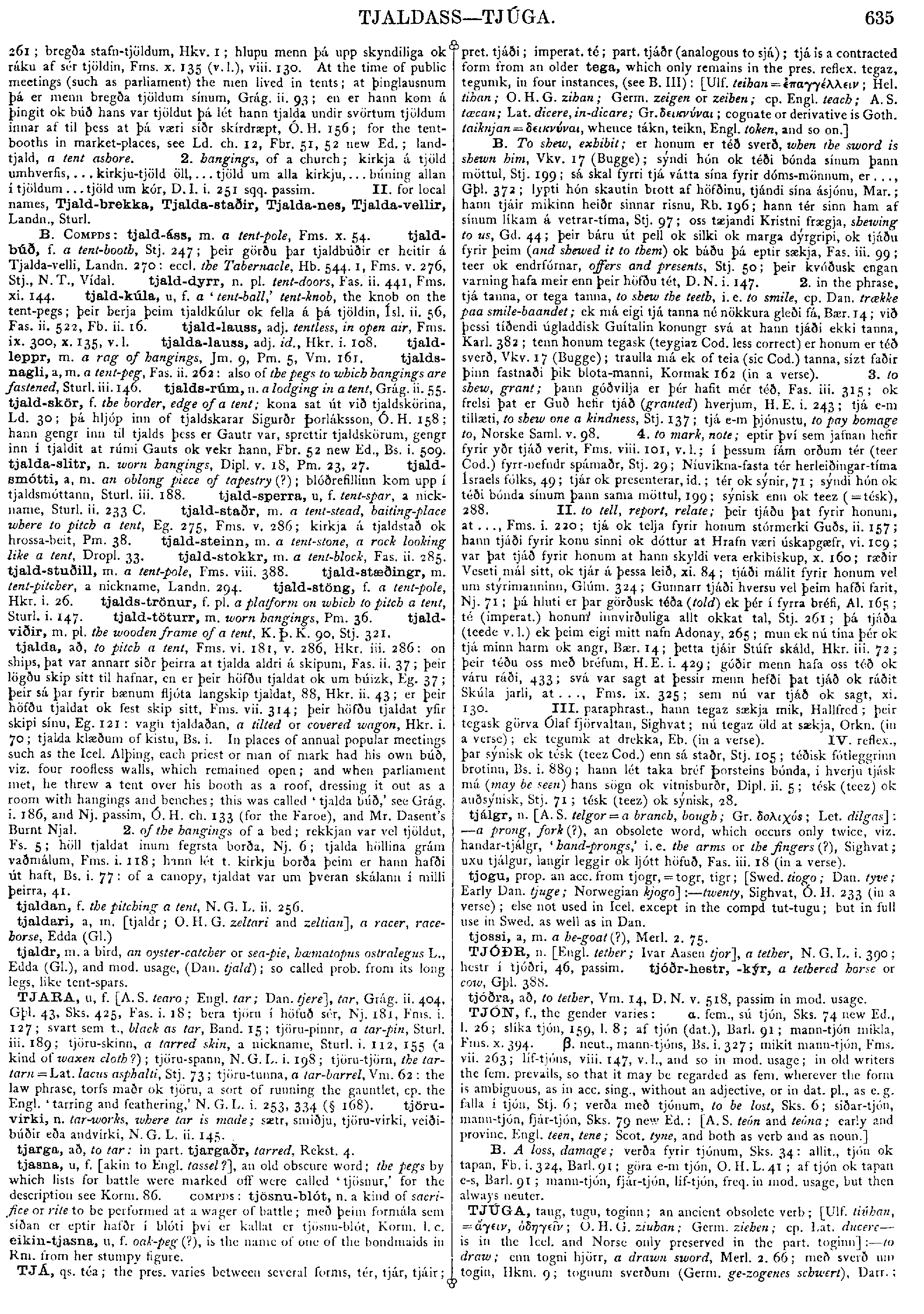
261; bregða stafn-tjöldum, Hkv. 1; hlupu menn þá upp skyndiliga ok ráku af sér tjöldin, Fms. x. 135 (v.l.), viii. 130. At the time of public meetings (such as parliament) the men lived in tents; at þinglausnum þá er menn bregða tjöldum sínum, Grág. ii. 93; en er hann kom á þingit ok búð hans var tjöldut þá lét hann tjalda undir svörtum tjöldum innar af til þess at þá væri síðr skírdræpt, Ó.H. 156; for the tent-booths in market-places, see Ld. ch. 12, Fbr. 51, 52 new Ed.; land-tjald, a tent ashore. 2. hangings, of a church; kirkja á tjöld umhverfis, ... kirkju-tjöld öll, ... tjöld um alla kirkju, ... búning allan í tjöldum ... tjöld um kór, D.I. i. 251 sqq. passim. II. for local names, Tjald-brekka, Tjalda-staðir, Tjalda-nes, Tjalda-vellir, Landn., Sturl. B. COMPDS: tjald-áss, m. a tent-pole, Fms. x. 54. tjald-búð, f. a tent-booth, Stj. 247; þeir görðu þar tjaldbúðir er heitir á Tjalda-velli, Landn. 270: eccl. the Tabernacle, Hb. 544. 1, Fms. v. 276, Stj., N.T., Vídal. tjald-dyrr, n. pl. tent-doors, Fas. ii. 441, Fms. xi. 144. tjald-kúla, u, f. a 'tent-ball,' tent-knob, the knob on the tent-pegs; þeir berja þeim tjaldkúlur ok fella á þá tjöldin, Ísl. ii. 56, Fas. ii. 522, Fb. ii. 16. tjald-lauss, adj. tentless, in open air, Fms. ix. 300, x. 135, v.l. tjalda-lauss, adj. id., Hkr. i. 108. tjald-leppr, m. a rag of hangings, Jm. 9, Pm. 5, Vm. 161. tjalds-nagli, a, m. a tent-peg, Fas. ii. 262: also of the pegs to which hangings are fastened, Sturl. iii. 146. tjalds-rúm, n. a lodging in a tent, Grág. ii. 55. tjald-skör, f. the border, edge of a tent; kona sat út við tjaldskörina, Ld. 30; þá hljóp inn of tjaldskarar Sigurðr Þorláksson, Ó.H. 158; hann gengr inn til tjalds þess er Gautr var, sprettir tjaldskörum, gengr inn í tjaldit at rúmi Gauts ok vekr hann, Fbr. 52 new Ed., Bs. i. 509. tjalda-slitr, n. worn hangings, Dipl. v. 18, Pm. 23, 27. tjald-smótti, a, m. an oblong piece of tapestry(?); blóðrefillinn kom upp í tjaldsmóttann, Sturl. iii. 188. tjald-sperra, u, f. tent-spar, a nickname, Sturl. ii. 233 C. tjald-staðr, m. a tent-stead, baiting-place where to pitch a tent, Eg. 275, Fms. v. 286; kirkja á tjaldstað ok hrossa-beit, Pm. 38. tjald-steinn, m. a tent-stone, a rock looking like a tent, Dropl. 33. tjald-stokkr, m. a tent-block, Fas. ii. 285. tjald-stuðill, m. a tent-pole, Fms. viii. 388. tjald-stæðingr, m. tent-pitcher, a nickname, Landn. 294. tjald-stöng, f. a tent-pole, Hkr. i. 26. tjalds-trönur, f. pl. a platform on which to pitch a tent, Sturl. i. 147. tjald-töturr, m. worn hangings, Pm. 36. tjald-viðir, m. pl. the wooden frame of a tent, K.Þ.K. 90, Stj. 321.
|
Source: Cleasby/Vigfusson, page b0635, entry 2 View original page image as: [TIFF] [PNG] [View previous entry] [View next entry] |
[Comment on this entry] [View comments] |
The following entry has been hand-corrected once. |
tjalda, að, to pitch a tent, Fms. vi. 181, v. 286, Hkr. iii. 286: on ships, þat var annarr siðr þeirra at tjalda aldri á skipum, Fas. ii. 37; þeir lögðu skip sitt til hafnar, en er þeir höfðu tjaldat ok um búizk, Eg. 37; þeir sá þar fyrir bænum fljóta langskip tjaldat, 88, Hkr. ii. 43; er þeir höfðu tjaldat ok fest skip sitt, Fms. vii. 314; þeir höfðu tjaldat yfir skipi sínu, Eg. 121: vagn tjaldaðan, a tilted or covered wagon, Hkr. i. 70; tjalda klæðum of kistu, Bs. i. In places of annual popular meetings such as the Icel. Alþing, each priest or man of mark had his own búð, viz. four roofless walls, which remained open; and when parliament met, he threw a tent over his booth as a roof, dressing it out as a room with hangings and benches; this was called 'tjalda búð,' see Grág. i. 186, and Nj. passim, Ó.H. ch. 133 (for the Faroe), and Mr. Dasent's Burnt Njal. 2. of the hangings of a bed; rekkjan var vel tjöldut, Fs. 5; höll tjaldat inum fegrsta borða, Nj. 6; tjalda höllina grám vaðmálum, Fms. i. 118; hann lét t. kirkju borða þeim er hann hafði út haft, Bs. i. 77: of a canopy, tjaldat var um þveran skálann í milli þeirra, 41.
|
Source: Cleasby/Vigfusson, page b0636, entry 6 View original page image as: [TIFF] [PNG] [View previous entry] [View next entry] |
[Comment on this entry] [View comments] |
The following entry has been hand-corrected once. |
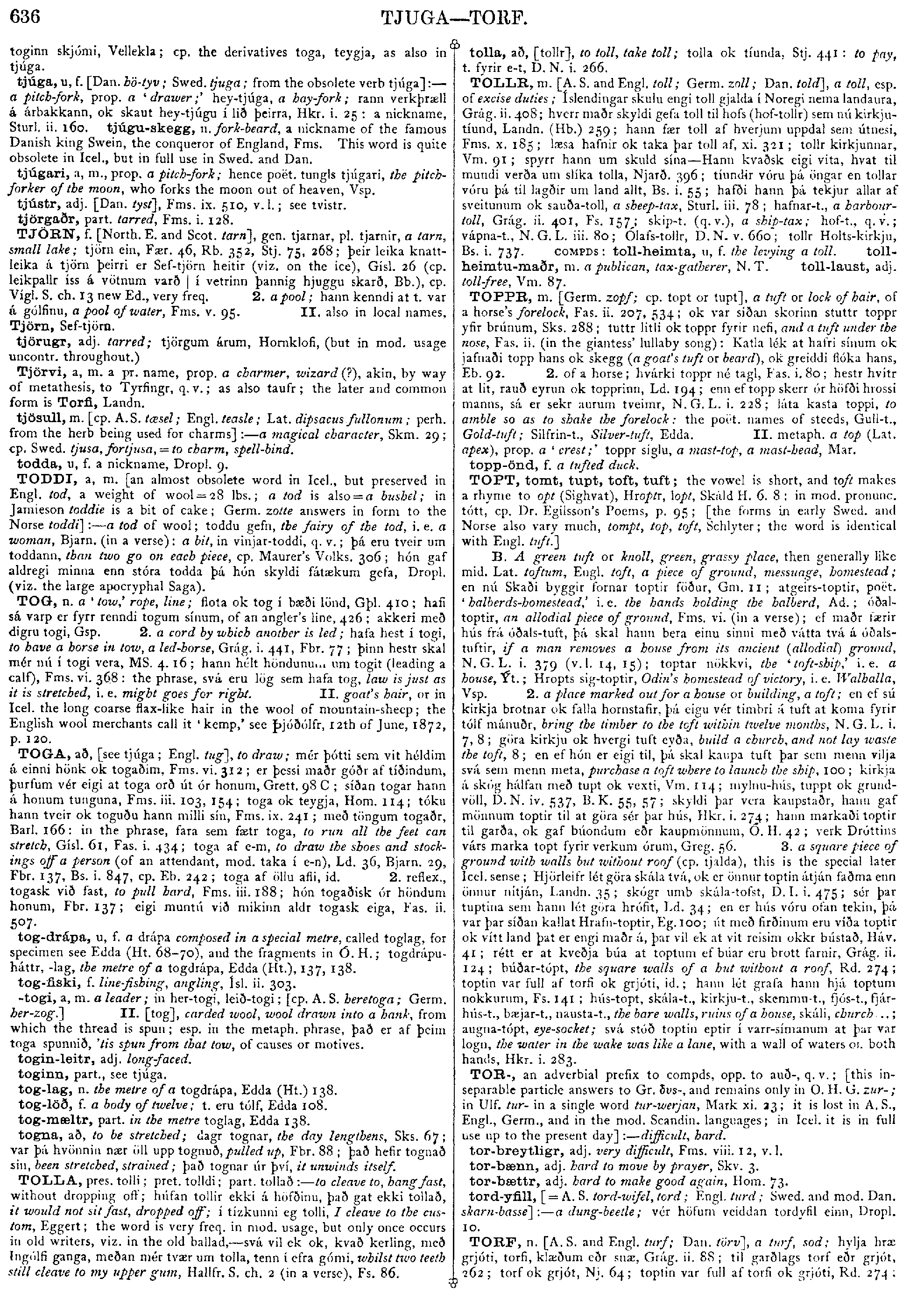
TJÖRN, f. [North. E. and Scot. tarn], gen. tjarnar, pl. tjarnir, a tarn, small lake; tjörn ein, Fær. 46, Rb. 352, Stj. 75, 268; þeir leika knatt-leika á tjörn þeirri er Sef-tjörn heitir (viz. on the ice), Gísl. 26 (cp. leikpallr íss á vötnum varð | í vetrinn þannig hjuggu skarð, Bb.), cp. Vígl. S. ch. 13 new Ed., very freq. 2. a pool; hann kenndi at t. var á gólfinu, a pool of water, Fms. v. 95. II. also in local names, Tjörn, Sef-tjörn.
|
Source: Cleasby/Vigfusson, page b0636, entry 23 View original page image as: [TIFF] [PNG] [View previous entry] [View next entry] |
[Comment on this entry] [View comments] |
The following entry has been hand-corrected once. |
TOLLA, pres. tolli; pret. tolldi; part. tollað :-- to cleave to, hang fast, without dropping off; húfan tollir ekki á höfðinu, það gat ekki tollað, it would not sit fast, dropped off; í tízkunni eg tolli, I cleave to the custom, Eggert; the word is very freq. in mod. usage, but only once occurs in old writers, viz. in the old ballad, -- svá vil ek ok, kvað kerling, með Ingólfi ganga, meðan mér tvær um tolla, tenn í efra gómi, whilst two teeth still cleave to my upper gum, Hallfr. S. ch. 2 (in a verse), Fs. 86.
|
Source: Cleasby/Vigfusson, page b0637, entry 1 View original page image as: [TIFF] [PNG] [View previous entry] [View next entry] |
[Comment on this entry] [View comments] |
The following entry has been hand-corrected once. |
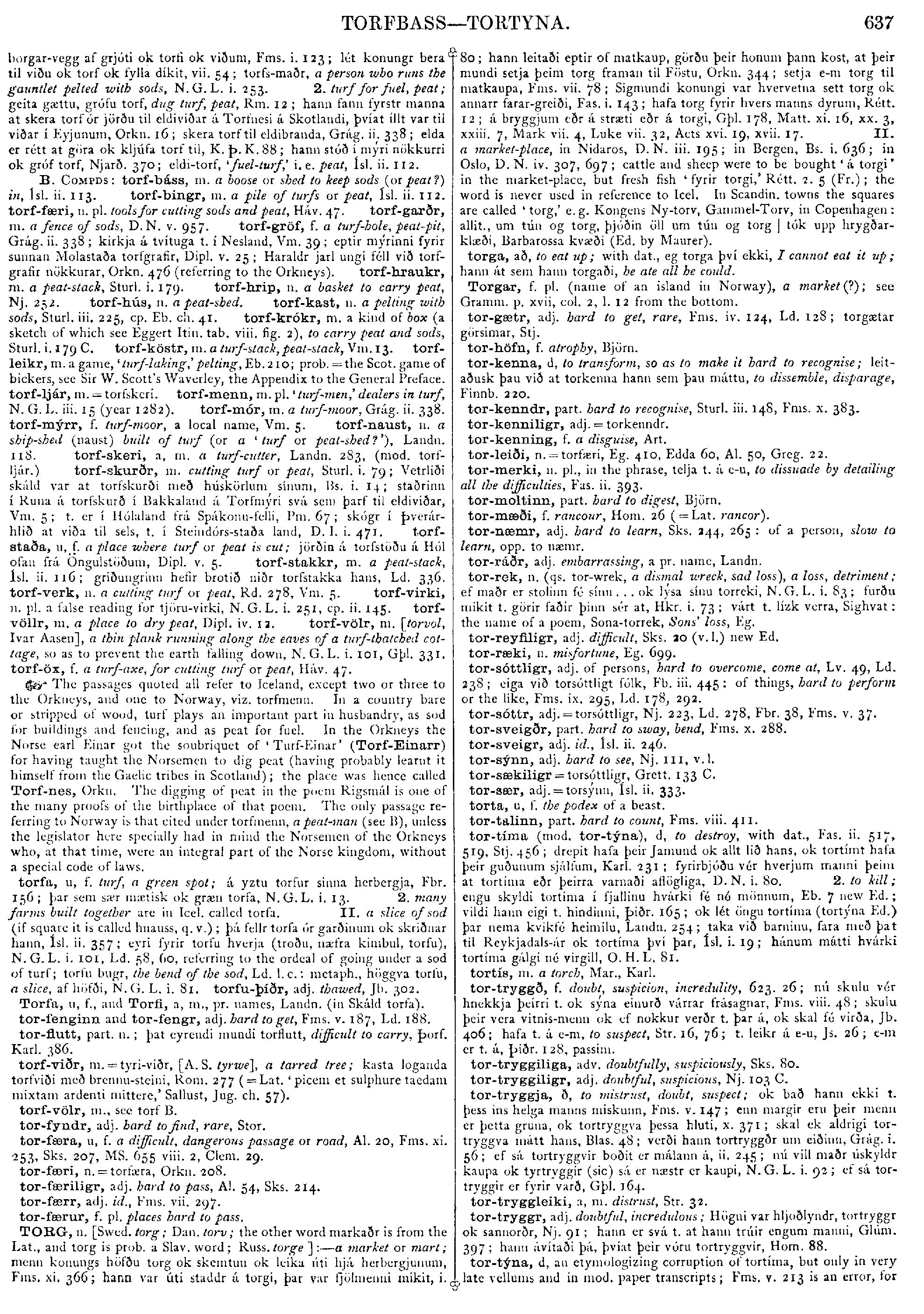
borgar-vegg af grjóti ok torfi ok viðum, Fms. i. 123; lét konungr bera til viðu ok torf ok fylla díkit, vii. 54; torfs-maðr, a person who runs the gauntlet pelted with sods, N.G.L. i. 253. 2. turf for fuel, peat; geita gættu, grófu torf, dug turf, peat, Rm. 12; hann fann fyrstr manna at skera torf ór jörðu til eldiviðar á Torfnesi á Skotlandi, þvíat íllt var til viðar í Eyjunum, Orkn. 16; skera torf til eldibranda, Grág. ii. 338; elda er rétt at göra ok kljúfa torf til, K.Þ.K. 88; hann stóð í mýri nökkurri ok gróf torf, Njarð. 370; eldi-torf, 'fuel-turf,' i.e. peat, Ísl. ii. 112. B. COMPDS: torf-báss, m. a boose or shed to keep sods (or peat?) in, Ísl. ii. 113. torf-bingr, m. a pile of turfs or peat, Ísl. ii. 112. torf-færi, n. pl. tools for cutting sods and peat, Háv. 47. torf-garðr, m. a fence of sods, D.N. v. 957. torf-gröf, f. a turf-hole, peat-pit, Grág. ii. 338; kirkja á tvítuga t. í Nesland, Vm. 39; eptir mýrinni fyrir sunnan Molastaða torfgrafir, Dipl. v. 25; Haraldr jarl ungi féll við torf-grafir nökkurar, Orkn. 476 (referring to the Orkneys). torf-hraukr, m. a peat-stack, Sturl. i. 179. torf-hrip, n. a basket to carry peat, Nj. 252. torf-hús, n. a peat-shed. torf-kast, n. a pelting with sods, Sturl. iii. 225, cp. Eb. ch. 41. torf-krókr, m. a kind of box (a sketch of which see Eggert Itin. tab. viii. fig. 2), to carry peat and sods, Sturl. i. 179 C. torf-köstr, m. a turf-stack, peat-stack, Vm. 13. torf-leikr, m. a game, 'turf-laking,' pelting, Eb. 210; prob. = the Scot. game of bickers, see Sir W. Scott's Waverley, the Appendix to the General Preface. torf-ljár, m. = torfskeri. torf-menn, m. pl. 'turf-men,' dealers in turf, N.G.L. iii. 15 (year 1282). torf-mór, m. a turf-moor, Grág. ii. 338. torf-mýrr, f. turf-moor, a local name, Vm. 5. torf-naust, n. a ship-shed (naust) built of turf (or a 'turf or peat-shed?'), Landn. 118. torf-skeri, a, m. a turf-cutter, Landn. 283, (mod. torf-ljár.) torf-skurðr, m. cutting turf or peat, Sturl. i. 79; Vetrliði skáld var at torfskurði með húskörlum sínum, Bs. i. 14; staðrinn í Runa á torfskurð í Bakkaland á Torfmýri svá sem þarf til eldiviðar, Vm. 5; t. er í Hólalaud frá Spákonu-felli, Pm. 67; skógr í Þverárhlíð at viða til sels, t. í Steindórs-staða land, D.I. i. 471. torf-staða, u, f. a place where turf or peat is cut; jörðin á torfstöðu á Hól ofan frá Öngulstöðum, Dipl. v. 5. torf-stakkr, m. a peat-stack, Ísl. ii. 116; griðungrinn hefir brotið niðr torfstakka hans, Ld. 336. torf-verk, n. a cutting turf or peat, Rd. 278, Vm. 5. torf-virki, n. pl. a false reading for tjöru-virki, N.G.L. i. 251, cp. ii. 145. torf-völlr, m. a place to dry peat, Dipl. iv. 12. torf-völr, m. [torvol, Ivar Aasen], a thin plank running along the eaves of a turf-thatched cottage, so as to prevent the earth falling down, N.G.L. i. 101, Gþl. 331. torf-öx, f. a turf-axe, for cutting turf or peat, Háv. 47. &FINGER; The passages quoted all refer to Iceland, except two or three to the Orkneys, and one to Norway, viz. torfmenn. In a country bare or stripped of wood, turf plays an important part in husbandry, as sod for buildings and fencing, and as peat for fuel. In the Orkneys the Norse earl Einar got the soubriquet of 'Turf-Einar' (Torf-Einarr) for having taught the Norsemen to dig peat (having probably learnt it himself from the Gaelic tribes in Scotland); the place was hence called Torf-nes, Orkn. The digging of peat in the poem Rigsmál is one of the many proofs of the birthplace of that poem. The only passage referring to Norway is that cited under torfmenn, a peat-man (see B), unless the legislator here specially had in mind the Norsemen of the Orkneys who, at that time, were an integral part of the Norse kingdom, without a special code of laws.
|
Source: Cleasby/Vigfusson, page b0637, entry 6 View original page image as: [TIFF] [PNG] [View previous entry] [View next entry] |
[Comment on this entry] [View comments] |
The following entry has been hand-corrected once. |
torf-viðr, m. = tyri-viðr, [A.S. tyrwe], a tarred tree; kasta loganda torfviði með brennu-steini, Róm. 277 (= Lat. 'picem et sulphure taedam mixtam ardenti mittere,' Sallust, Jug. ch. 57).
|
Source: Cleasby/Vigfusson, page b0638, entry 2 View original page image as: [TIFF] [PNG] [View previous entry] [View next entry] |
[Comment on this entry] [View comments] |
The following entry has been hand-corrected once. |
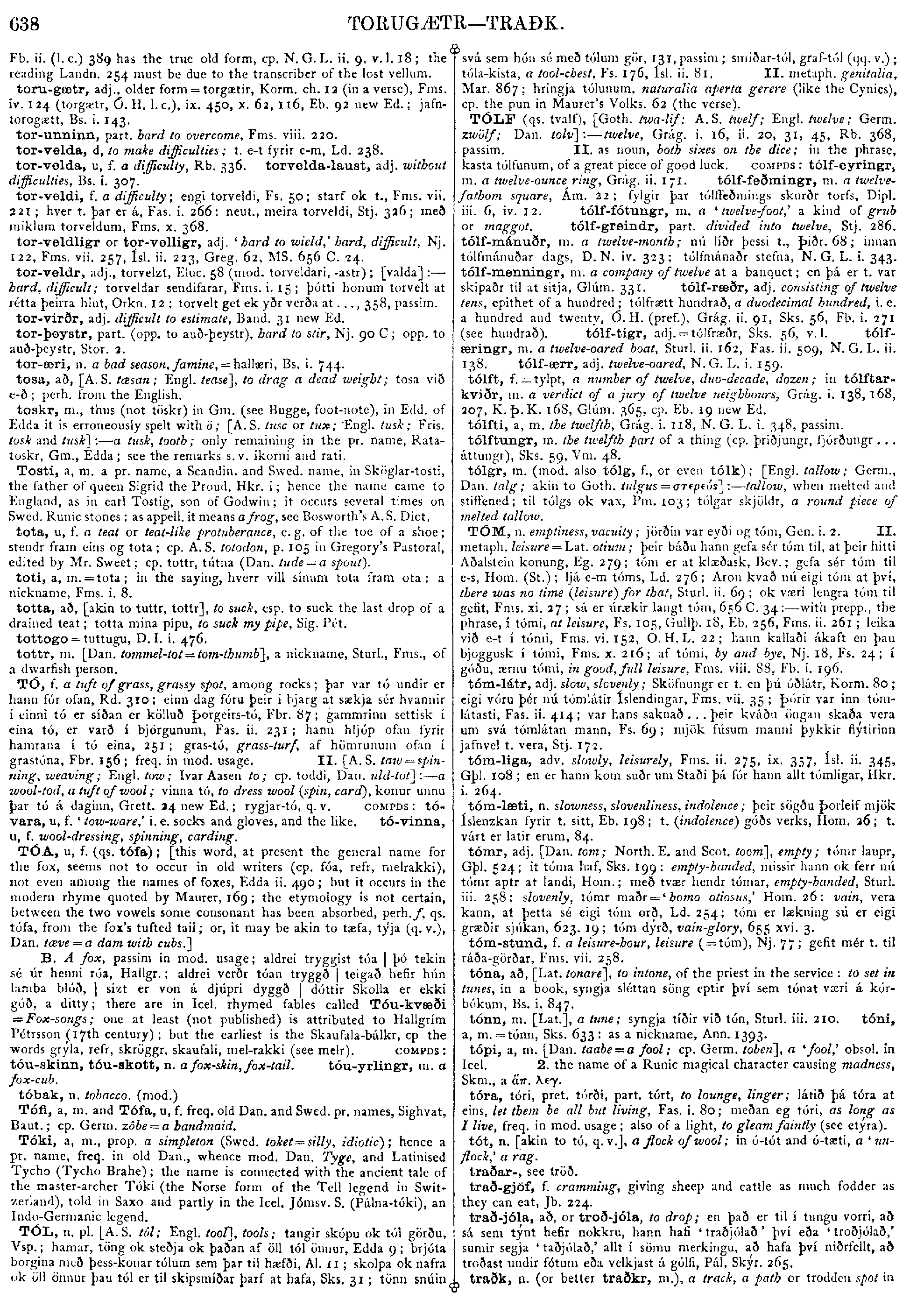
toru-gætr, adj., older form = torgætir, Korm. ch. 12 (in a verse), Fms. iv. 124 (torgætr, Ó.H. l.c.), ix. 450, x. 62, 116, Eb. 92 new Ed.; jafn-torogætt, Bs. i. 143.
|
Source: Cleasby/Vigfusson, page b0639, entry 14 View original page image as: [TIFF] [PNG] [View previous entry] [View next entry] |
[Comment on this entry] [View comments] |
The following entry has been hand-corrected once. |
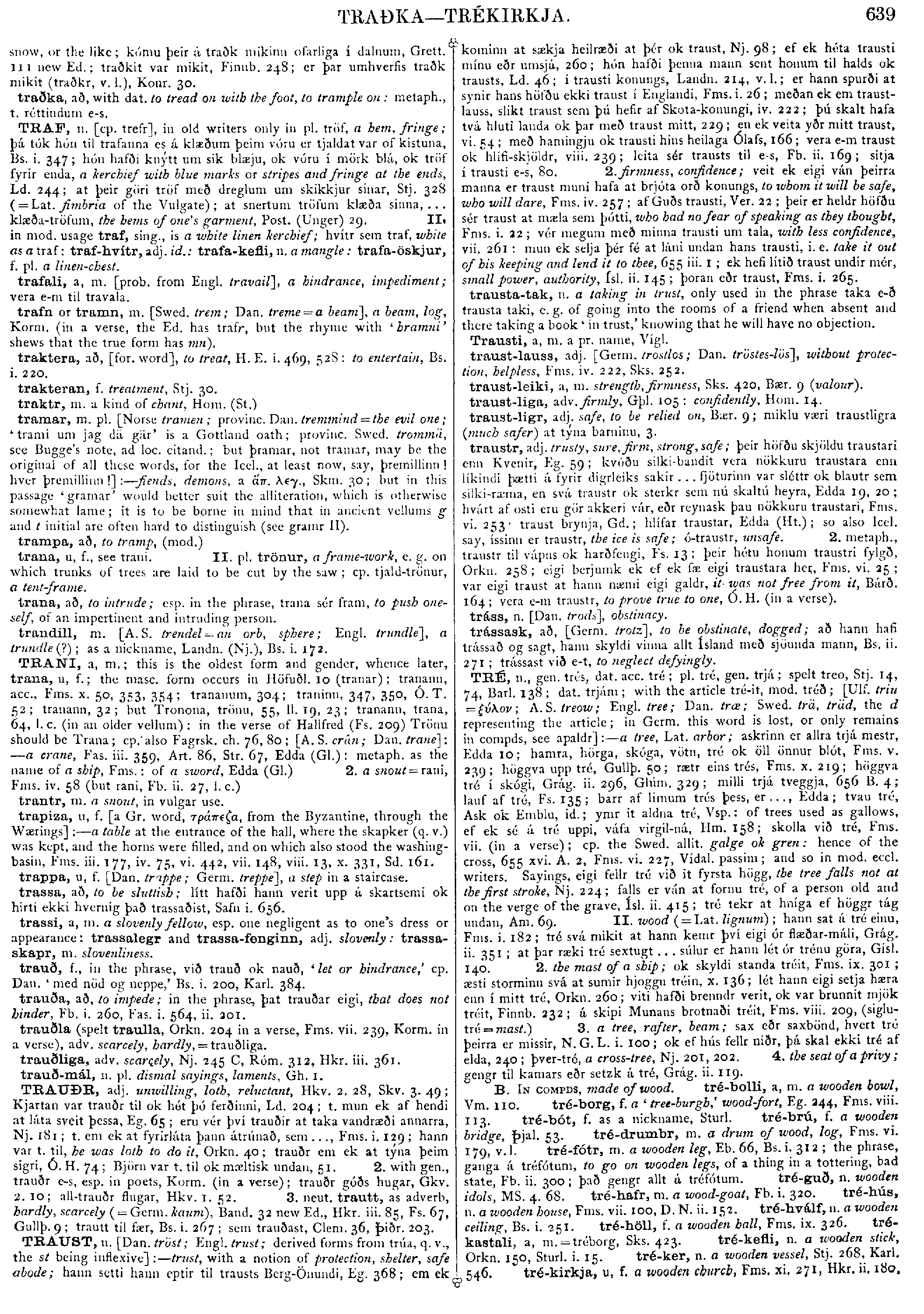
TRANI, a, m.; this is the oldest form and gender, whence later, trana, u, f.; the masc. form occurs in Höfuðl. 10 (tranar); tranann, acc., Fms. x. 50, 353, 354; trananum, 304; traninn, 347, 350, Ó.T. 52; tranann, 32; but Tronona, trönu, 55, ll. 19, 23; tranann, trana, 64, l.c. (in an older vellum): in the verse of Hallfred (Fs. 209) Trönu should be Trana; cp. also Fagrsk. ch. 76, 80; [A.S. crân; Dan. trane] :-- a crane, Fas. iii. 359, Art. 86, Str. 67, Edda (Gl.): metaph. as the name of a ship, Fms.: of a sword, Edda (Gl.) 2. a snout = rani, Fms. iv. 58 (but rani, Fb. ii. 27, l.c.)
|
Source: Cleasby/Vigfusson, page b0641, entry 8 View original page image as: [TIFF] [PNG] [View previous entry] [View next entry] |
[Comment on this entry] [View comments] |
The following entry has been hand-corrected once. |
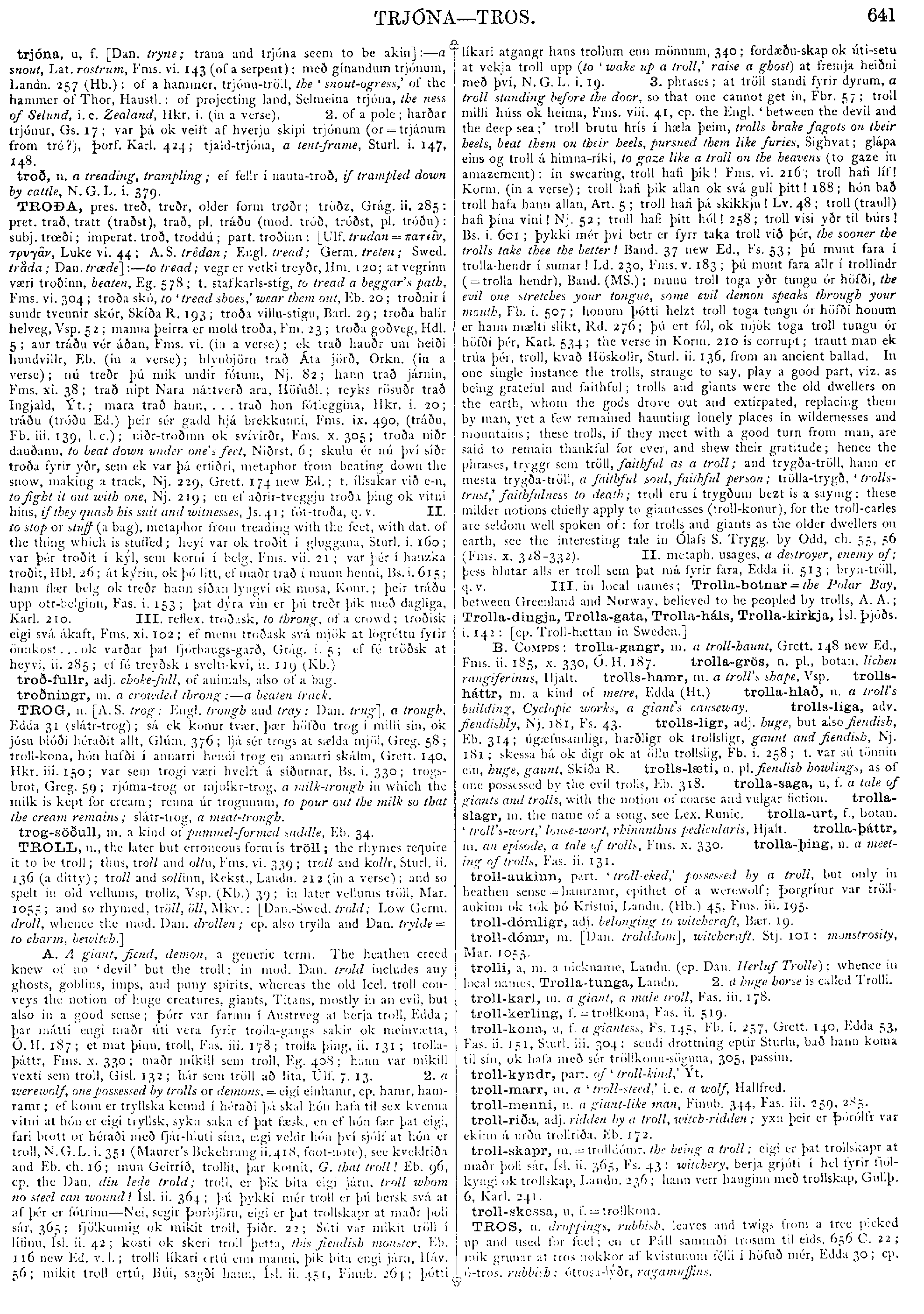
TROLL, n., the later but erroneous form is tröll; the rhymes require it to be troll; thus, troll and ollu, Fms. vi. 339; troll and kollr, Sturl. ii. 136 (a ditty); troll and sollinn, Rekst., Landn. 212 (in a verse); and so spelt in old vellums, trollz, Vsp. (Kb.) 39; in later vellums tröll, Mar. 1055; and so rhymed, tröll, öll, Mkv.: [Dan.-Swed. trold; Low Germ. droll, whence the mod. Dan. drollen; cp. also trylla and Dan. trylde = to charm, bewitch] A. A giant, fiend, demon, a generic term. The heathen creed knew of no 'devil' but the troll; in mod. Dan. trold includes any ghosts, goblins, imps, and puny spirits, whereas the old Icel. troll conveys the notion of huge creatures, giants, Titans, mostly in an evil, but also in a good sense; Þórr var farinn í Austrveg at berja troll, Edda; þar mátti engi maðr úti vera fyrir trolla-gangs sakir ok meinvætta, Ó.H. 187; et mat þinn, troll, Fas. iii. 178; trolla þing, ii. 131; trolla-þáttr, Fms. x. 330; maðr mikill sem troll, Eg. 408; hann var mikill vexti sem troll, Gísl. 132; hár sem tröll að líta, Ülf. 7. 13. 2. a werewolf, one possessed by trolls or demons, = eigi einhamr, cp. hamr, hamramr; ef konu er tryllska kennd í héraði þá skal hón hafa til sex kvenna vitni at hón er eigi tryllsk, sykn saka ef þat fæsk, en ef hón fær þat eigi, fari brott or héraði með fjár-hluti sína, eigi veldr hón því sjólf at hón er troll, N.G.L. i. 351 (Maurer's Bekehrung ii. 418, foot-note), see kveklriða and Eb. ch. 16; mun Geirríð, trollit, þar komit, G. that troll! Eb. 96, cp. the Dan. din lede trold; troll, er þik bíta eigi járn, troll whom no steel can wound! Ísl. ii. 364; þá þykki mér troll er þú bersk svá at af þér er fotrinn -- nei, segir Þorbjörn, eigi er þat trollskapr at maðr þoli sár, 365; fjölkunnig ok mikit troll. Þiðr. 22; Sóti var mikit tröll í lífinu, Ísl. ii. 42; kosti ok skeri troll þetta, this fiendish monster, Eb. 116 new Ed. v.l.; trolli líkari ertú enn manni, þik bita engi járn, Háv. 56; mikit troll ertú, Búi, sagði hann, Ísl. ii. 451, Finnb. 264; þótti líkari atgangr hans trollum enn mönnum, 340; fordæðu-skap ok úti-setu at vekja troll upp (to 'wake up a troll,' raise a ghost) at fremja heiðni með því, N.G.L. i. 19. 3. phrases; at tröll standi fyrir dyrum, a troll standing before the door, so that one cannot get in, Fbr. 57; troll milli húss ok heima, Fms. viii. 41, cp. the Engl. 'between the devil and the deep sea;' troll brutu hrís í hæla þeim, trolls brake fagots on their heels, beat them on their heels, pursued them like furies, Sighvat; glápa eins og troll á himna-ríki, to gaze like a troll on the heavens (to gaze in amazement): in swearing, troll hafi þik! Fms. vi. 216; troll hafi líf! Korm. (in a verse); troll hafi þik allan ok svá gull þitt! 188; hón bað troll hafa hann allan, Art. 5; troll hafi þá skikkju! Lv. 48; troll (traull) hafi þína vini! Nj. 52; troll hafi þitt hól! 258; troll vísi yðr til búrs! Bs. i. 601; þykki mér því betr er fyrr taka troll við þér, the sooner the trolls take thee the better! Band. 37 new Ed., Fs. 53; þú munt fara í trolla-hendr í sumar! Ld. 230, Fms. v. 183; þú munt fara allr í trollindr (= trolla hendr), Band. (MS.); munu troll toga, yðr tungu ór höfði, the evil one stretches your tongue, some evil demon speaks through your mouth, Fb. i. 507; honum þótti helzt troll toga tungu ór höfði honum er hann mælti slíkt, Rd. 276; þú ert fól, ok mjök toga troll tungu ór höfði þér, Karl. 534; the verse in Korm. 210 is corrupt; trautt man ek trúa þér, troll, kvað Höskollr, Sturl. ii. 136, from an ancient ballad. In one single instance the trolls, strange to say, play a good part, viz. as being grateful and faithful; trolls and giants were the old dwellers on the earth, whom the gods drove out and extirpated, replacing them by man, yet a few remained haunting lonely places in wildernesses and mountains; these trolls, if they meet with a good turn from man, are said to remain thankful for ever, and shew their gratitude; hence the phrases, tryggr sem tröll, faithful as a troll; and trygða-tröll, hann er mesta trygða-tröll, a faithful soul, faithful person; trölla-trygð, 'trolls-trust,' faithfulness to death; troll eru í trygðum bezt is a saying; these milder notions chiefly apply to giantesses (troll-konur), for the troll-carles are seldom well spoken of: for trolls and giants as the older dwellers on earth, see the interesting tale in Ólafs S. Trygg. by Odd, ch. 55, 56 (Fms. x. 328-332). II. metaph. usages, a destroyer, enemy of; þess hlutar alls er troll sem þat má fyrir fara, Edda ii. 513; bryn-tröll, q.v. III. in local names; Trolla-botnar = the Polar Bay, between Greenland and Norway, believed to be peopled by trolls, A.A.; Trolla-dingja, Trolla-gata, Trolla-háls, Trolla-kirkja, Ísl. Þjóðs. i. 142: [cp. Troll-hættan in Sweden.] B. COMPDS: trolla-gangr, m. a troll-haunt, Grett. 148 new Ed., Fms. ii. 185, x. 330, Ó.H. 187. trolla-grös, n. pl., botan. lichen rangiferinus, Hjalt. trolls-hamr, m. a troll's shape, Vsp. trolls-háttr, m. a kind of metre, Edda (Ht.) trolla-hlað, n. a troll's building, Cyclopic works, a giant's causeway. trolls-liga, adv. fiendishly, Nj. 181, Fs. 43. trolls-ligr, adj. huge, but also fiendish, Eb. 314; úgæfusamligr, harðligr ok trollsligr, gaunt and fiendish, Nj. 181; skessa há ok digr ok at öllu trollslig, Fb. i. 258; t. var sú tönnin ein, huge, gaunt, Skíða R. trolls-læti, n. pl. fiendish howlings, as of one possessed by the evil trolls, Eb. 318. trolla-saga, u, f. a tale of giants and trolls, with the notion of coarse and vulgar fiction. trolla-slagr, m. the name of a song, see Lex. Runic. trolla-urt, f., botan. 'troll's-wort,' louse-wort, rhinanthus pedicularis, Hjalt. trolla-þáttr, m. an episode, a tale of trolls, Fms. x. 330. trolla-þing, n. a meeting of trolls, Fas. ii. 131.
|
Source: Cleasby/Vigfusson, page b0642, entry 26 View original page image as: [TIFF] [PNG] [View previous entry] [View next entry] |
[Comment on this entry] [View comments] |
The following entry has been hand-corrected once. |
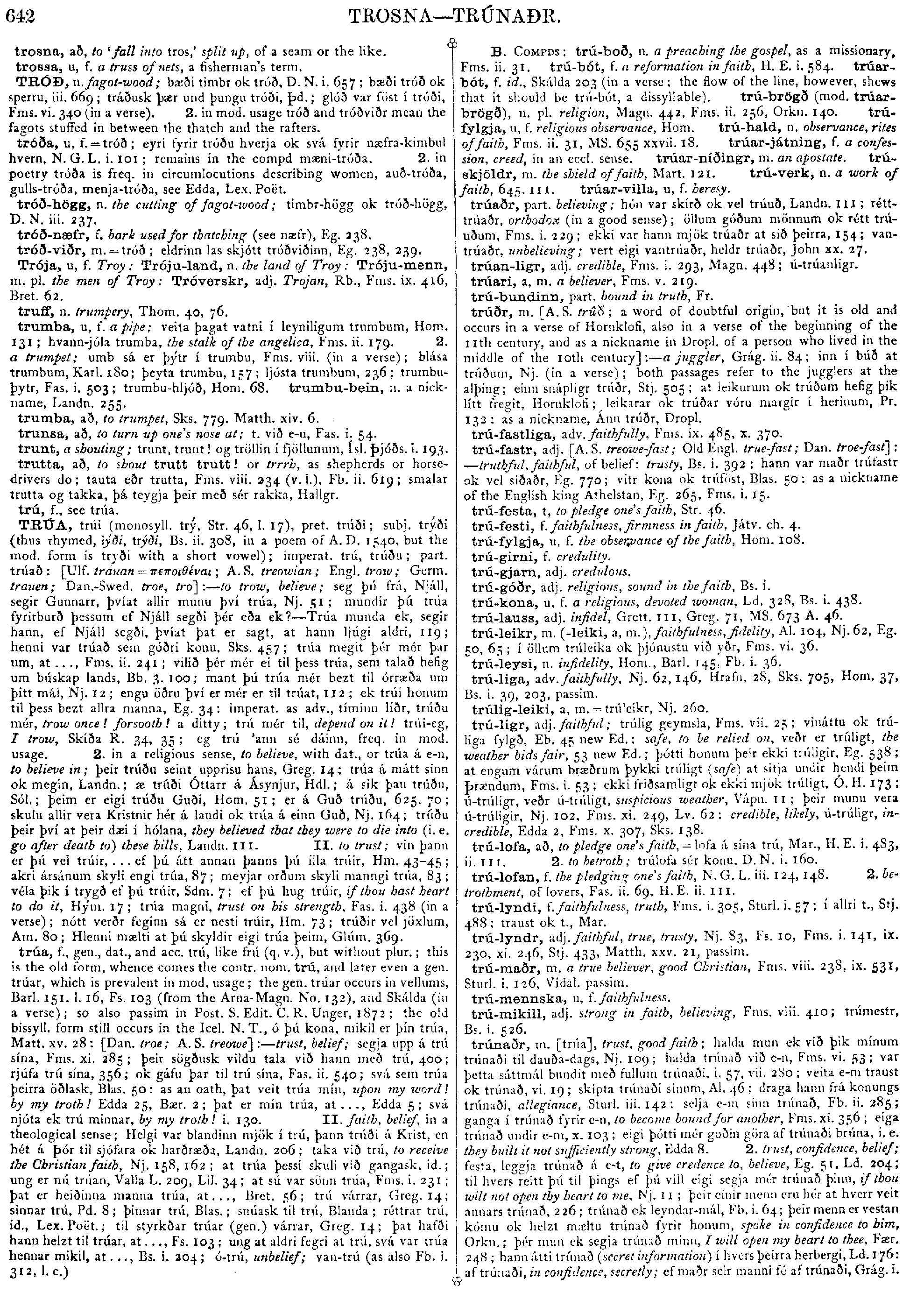
trú-festi, f. faithfulness, firmness in faith, Játv. ch. 4.
| Result Page: |  |
Previous | 42 43 44 45 46 47 48 49 50 51 52 53 54 55 56 57 58 59 60 | Next |  |
Germanic Lexicon Project (main page)
This search system was written by
Sean Crist
Please consider
volunteering
to correct the data in these online dictionaries.
No rights reserved. Feel free to use these data in any way you please.