|
|

Tip: In the search results, you can click on any word or abbreviation for more information.
|
Source: Cleasby/Vigfusson, page b0508, entry 19 View original page image as: [TIFF] [PNG] [View previous entry] [View next entry] |
[Comment on this entry] [View comments] |
The following entry has been hand-corrected once. |
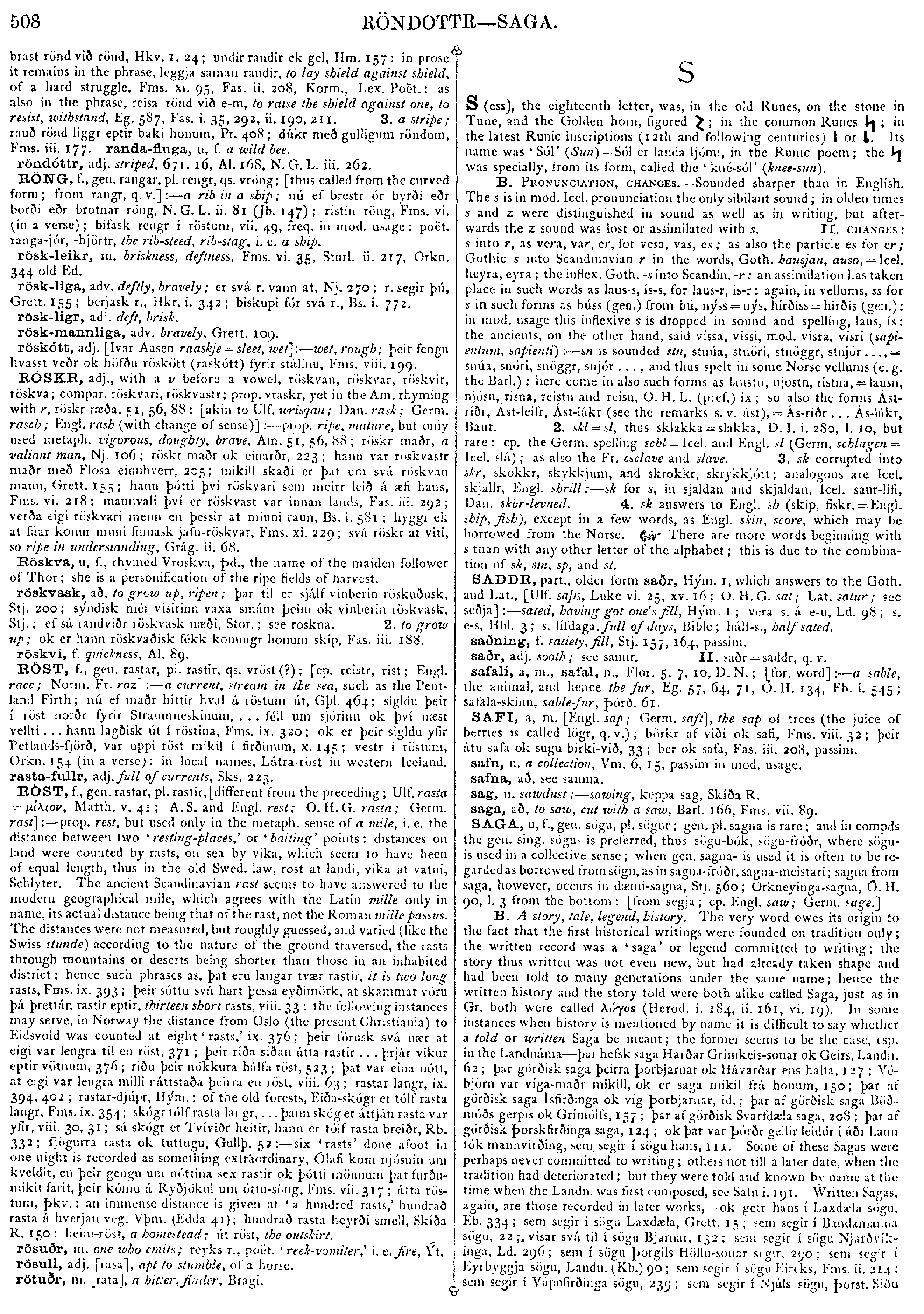
S (ess), the eighteenth letter, was, in the old Runes, on the stone in Tune, and the Golden horn, figured RUNE; in the common Runes RUNE; in the latest Runic inscriptions (12th and following centuries) RUNE or RUNE Its name was 'Sól' (Sun) -- Sól er landa ljómi, in the Runic poem; the RUNE was specially, from its form, called the 'kné-sól' (knee-sun). B. PRONUNCIATION, CHANGES. -- Sounded sharper than in English. The s is in mod. Icel. pronunciation the only sibilant sound; in olden times s and z were distinguished in sound as well as in writing, but afterwards the z sound was lost or assimilated with s. II. CHANGES: s into r, as vera, var, er, for vesa, vas, es; as also the particle es for er; Gothic s into Scandinavian r in the words, Goth. hausjan, auso, = Icel. heyra, eyra; the infiex. Goth. -s into Scandin. -r: an assimilation has taken place in such words as laus-s, ís-s, for laus-r, ís-r: again, in vellums, ss for s in such forms as búss (gen.) from bú, nýss = nýs, hirðiss = hirðis (gen.): in mod. usage this inflexive s is dropped in sound and spelling, laus, ís: the ancients, on the other hand, said víssa, víssi, mod. vísra, vísri (sapientum, sapienti) :-- sn is sounded stn, stnúa, stnöri, stnöggr, stnjór ..., = snúa, snöri, snöggr, snjór ..., and thus spelt in some Norse vellums (e.g. the Barl.): here come in also such forms as laustn, njostn, ristna, = lausn, njósn, risna, reistn and reisn, O.H.L. (pref.) ix; so also the forms Ást-ríðr, Ást-leifr, Ást-lákr (see the remarks s.v. ást), = Ás-ríðr ... Ás-lákr, Baut. 2. skl = sl, thus sklakka = slakka, D.I. i. 280, l. 10, but rare: cp. the Germ. spelling schl = Icel. and Engl. sl (Germ. schlagen = Icel. slá); as also the Fr. esclave and slave. 3. sk corrupted into skr, skokkr, skykkjum, and skrokkr, skrykkjótt; analogous are Icel. skjallr, Engl. shrill :-- sk for s, in sjaldan and skjaldan, Icel. saur-lífi, Dan. skör-levned. 4. sk answers to Engl. sh (skip, fiskr, = Engl.ship, fish), except in a few words, as Engl. skin, score, which may be borrowed from the Norse. (???)UNCERTAIN There are more words beginning with s than with any other letter of the alphabet; this is due to the combination of sk, sm, sp, and st.
|
Source: Cleasby/Vigfusson, page b0508, entry 29 View original page image as: [TIFF] [PNG] [View previous entry] [View next entry] |
[Comment on this entry] [View comments] |
The following entry has been hand-corrected once. |
SAGA, u, f., gen. sögu, pl. sögur; gen. pl. sagna is rare; and in compds the gen. sing, sögu- is preferred, thus sögu-bók, sögu-fróðr, where sögu-is used in a collective sense; when gen. sagna- is used it is often to be regarded as borrowed from sögn, as in sagna-fróðr, sagna-meistari; sagna from saga, however, occurs in dæmi-sagna, Stj. 560; Orkneyinga-sagna, Ó.H. 90, l. 3 from the bottom: [from segja; cp. Engl. saw; Germ. sage.] B. A story, tale, legend, history. The very word owes its origin to the fact that the first historical writings were founded on tradition only; the written record was a 'saga' or legend committed to writing; the story thus written was not even new, but had already taken shape and had been told to many generations under the same name; hence the written history and the story told were both alike called Saga, just as in Gr. both were called GREEK (Herod, i. 184, ii. 161, vi. 19). In some instances when history is mentioned by name it is difficult to say whether a told or written Saga be meant; the former seems to be the case, esp.in the Landnáma -- þar hefsk saga Harðar Grímkels-sonar ok Geirs, Landn. 62; þar görðisk saga þeirra Þorbjarnar ok Hávarðar ens halta, 127; Vé-björn var víga-maðr mikill, ok er saga mikil frá honum, 150; þar af görðisk saga Ísfirðinga ok víg Þorbjarnar, id.; þar af görðisk saga Böðmóðs gerpis ok Grímólfs, 157; þar af görðisk Svarfdæla saga, 208; þar af görðisk Þorskfirðinga saga, 124; ok þar var Þórðr gellir leiddr í áðr hann tók mannvirðing, sem segir í sögu hans, 111. Some of these Sagas were perhaps never committed to writing; others not till a later date, when the tradition had deteriorated; but they were told and known by name at the time when the Landn. was first composed, see Safn i. 191. Written Sagas, again, are those recorded in later works, -- ok getr hans í Laxdæla sögu, Eb. 334; sem segir í sögu Laxdæla, Grett. 15; sem segir í Bandamanna sögu, 22;. vísar svá til í sögu Bjarnar, 132; sem segir í sögu Njarðvíkinga, Ld. 296; sem í sögu Þorgils Höllu-sonar segir, 290; sem segir í Eyrbyggja sögu, Landn. (Kb.) 90; sem segir í sögu Eireks, Fms. ii. 214; sem segir í Vápnfirðinga sögu, 239; sem segir í Njáls sögu, Þorst. Síðu
|
Source: Cleasby/Vigfusson, page b0510, entry 17 View original page image as: [TIFF] [PNG] [View previous entry] [View next entry] |
[Comment on this entry] [View comments] |
The following entry has been hand-corrected once. |
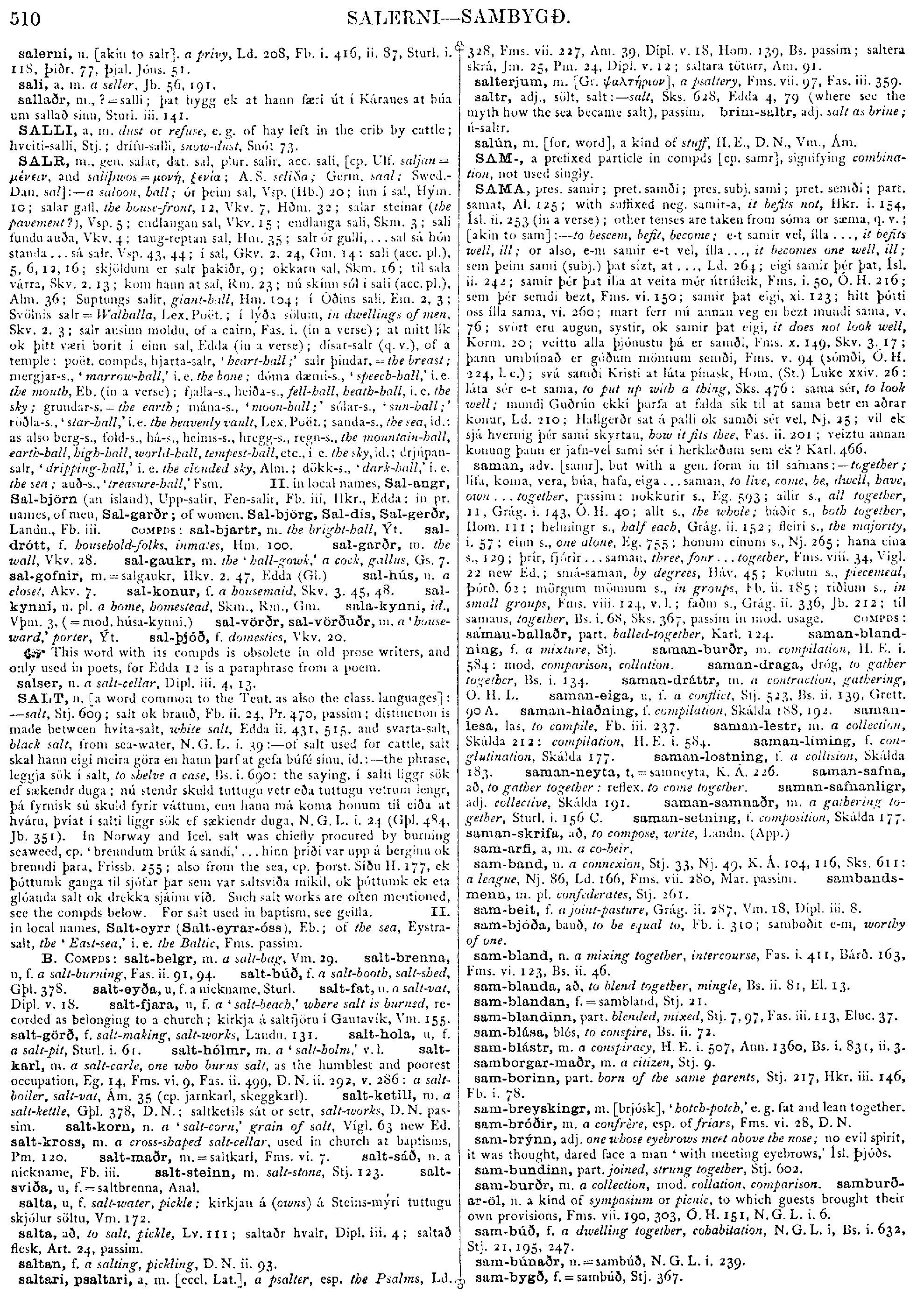
saman, adv. [samr], but with a gen. form in til samans :-- together; lífa, koma, vera, búa, hafa, eiga ... saman, to live, come, be., dwell, have, own ... together, passim: nokkurir s., Eg. 593; allir s., all together, 11, Grág. i. 143, Ó.H. 40; allt s., the whole; báðir s., both together, Hom, 111; helmingr s., half each, Grág. ii. 152; fleiri s., the majority, i. 57; einn s., one alone, Eg. 755; honum einum s., Nj. 265; hana eina s., 129; þrír, fjórir ... saman, three, four ... together, Fms. viii. 34, Vígl. 22 new Ed.; smá-saman, by degrees, Háv. 45; kötlum s., piecemeal, Þórð. 62; mörgum mönnum s., in groups, Fb. ii. 185; riðlum s., in small groups, Fms. viii. 124, v.l.; faðm s., Grág. ii. 336, Jb. 212; til samans, together, Bs. i. 68, Sks. 367, passim in mod. usage. COMPDS: saman-ballaðr, part. balled-together, Karl. 124. saman-blandning, f. a mixture, Stj. saman-burðr, m. compilation, H.E. i. 584: mod. comparison, collation. saman-draga, dróg, to gather together, Bs. i. 134. saman-dráttr, m. a contraction, gathering, O.H.L. saman-eiga, u, f. a conflict, Stj. 523, Bs. ii. 139, Grett. 90 A. saman-hlaðning, f. compilation, Skákla 188, 192. saman-lesa, las, to compile, Fb. iii. 237. saman-lestr, m. a collection, Skálda 212: compilation, H.E. i. 584. saman-líming, f. conglutination, Skálda 177. saman-lostning, f. a collision, Skálda 183. saman-neyta, t, = samneyta, K.Á. 226. saman-safna, að, to gather together: reflex, to come together. saman-safnanligr, adj. collective, Skálda 191. saman-samnaðr, m. a gathering together, Sturl. i. 156 C. saman-setning, f. composition, Skálda 177. saman-skrifa, að, to compose, write, Landn. (App.)
|
Source: Cleasby/Vigfusson, page b0512, entry 28 View original page image as: [TIFF] [PNG] [View previous entry] [View next entry] |
[Comment on this entry] [View comments] |
The following entry has been hand-corrected once. |
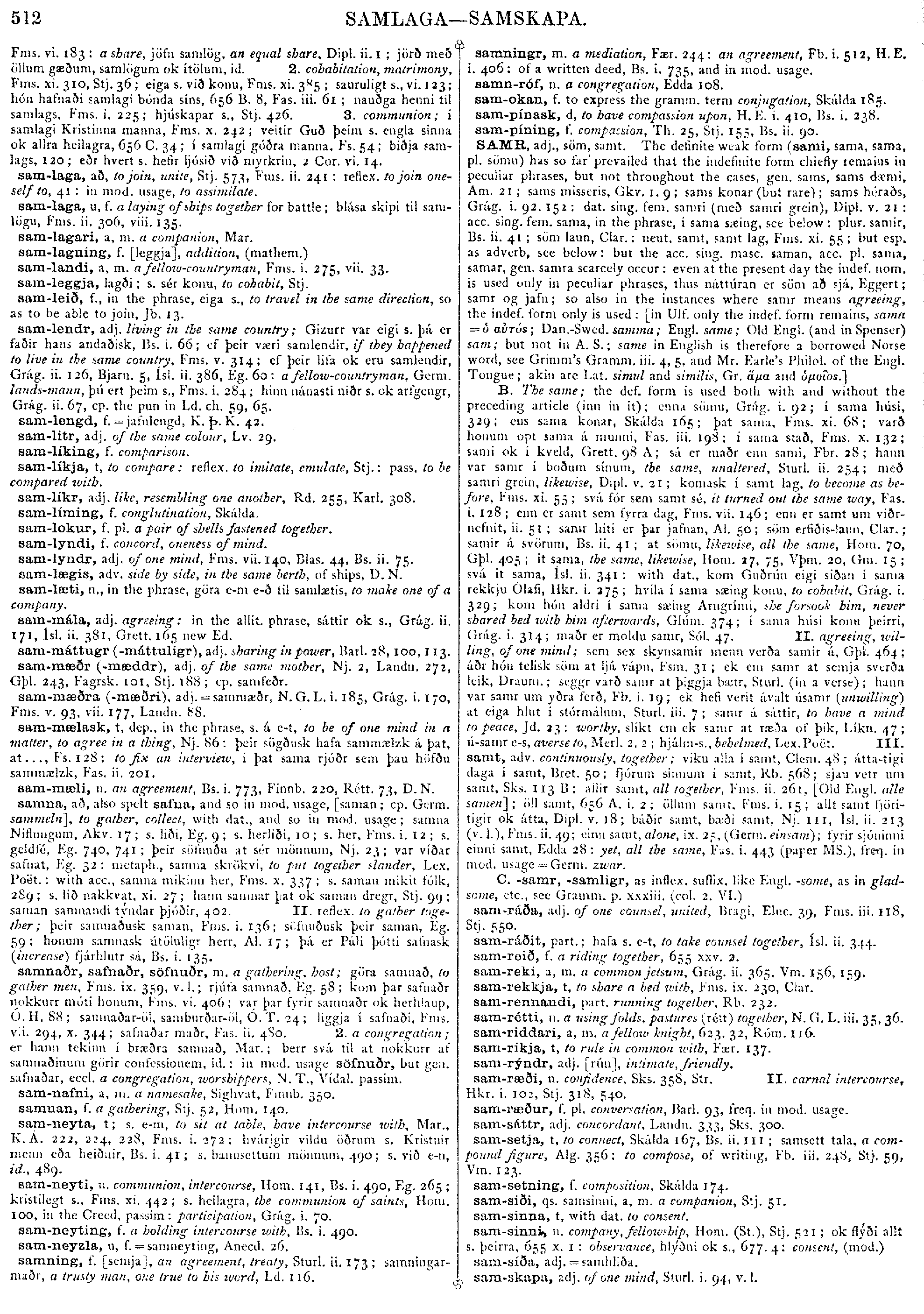
samnaðr, safnaðr, söfnuðr, m. a gathering, host; göra samnað, to gather men, Fms. ix. 359, v.l.; rjúfa samnað, Eg. 58; kom þar safnaðr nokkurr móti honum, Fms. vi. 406; var þar fyrir samnaðr ok herhlaup, Ó.H. 88; samnaðar-öl, samburðar-öl, Ó.T. 24; liggja í safnaði, Fms. vii. 294, x. 344; safnaðar maðr. Fas. ii. 480. 2. a congregation; er hann tekinn í bræðra samnað, Mar.; berr svá til at nokkurr af samnaðinum görir confessionem, id.: in mod. usage söfnuðr, but gen. safnaðar, eccl. a congregation, worshippers, N.T., Vídal. passim.
|
Source: Cleasby/Vigfusson, page b0512, entry 41 View original page image as: [TIFF] [PNG] [View previous entry] [View next entry] |
[Comment on this entry] [View comments] |
The following entry has been hand-corrected once. |
SAMR, adj., söm, samt. The definite weak form (sami, sama, sama, pl. sömu) has so far prevailed that the indefinite form chiefly remains in peculiar phrases, but not throughout the cases, gen. sams, sams dæmi, Am. 21; sams misscris, Gkv. i. 9; sams konar (but rare); sams héraðs, Grág. i. 92. 151: dat. sing. fem, samri (með samri grein), Dipl. v. 21: acc. sing. fem, sama, in the phrase, í sama sæing, see below: plur. samir, Bs. ii. 41; söm laun, Clar.: neut. samt, samt lag, Fms. xi. 55; but esp. as adverb, see below: but the acc. sing. masc. saman, acc. pl. sama, samar, gen. samra scarcely occur: even at the present day the indef. nom.is used only in peculiar phrases, thus náttúran er söm að sjá, Eggert; samr og jafn; so also in the instances where samr means agreeing, the indef. form only is used: [in Ulf. only the indef. form remains, sama = GREEK; Dan. -Swed. samma; Engl. same; Old Engl. (and in Spenser) sam; but not in A.S.; same in English is therefore a borrowed Norse word, see Grimm's Gramm. iii. 4, 5, and Mr. Earle's Philol. of the Engl. Tongue; akin are Lat. simul and similis, Gr. GREEK and GREEK.] B. The same; the def. form is used both with and without the preceding article (inn in it); enna sömu, Grág. i. 92; í sama húsi, 329; ens sama konar, Skálda 165; þat sama. Fms. xi. 68; varð honum opt sama á munni, Fas. iii. 198; í sama stað, Fms. x. 132; sami ok í kveld, Grett. 98 A; sá er maðr enn sami, Fbr. 28; hann var samr í boðum sínum, the same, unaltered, Sturl. ii. 254; með samri grein, likewise, Dipl. v. 21; komask í samt lag, to become as before, Fms. xi. 55; svá fór sem samt sé, it turned out the same way, Fas. i. 128; enn er samt sem fyrra dag, Fms. vii. 146; enn er samt um viðrnefnit, ii. 51; samr hiti er þar jafnan, Al. 50; söm erfiðis-laun, Clar.; samir á svörum, Bs. ii. 41; at sömu, likewise, all the same, Hom. 70, Gþl. 405; it sama, the same, likewise, Hom. 27, 75, Vþm. 20, Gm. 15; svá it sama, Ísl. ii. 341: with dat., kom Guðrún eigi síðan í sama rekkju Ólafi, Hkr. i. 275; hvíla í sama sæing konu, to cohabit, Grág. i. 329; kom hón aldri í sama sæing Arngrími, she forsook him, never shared bed with him afterwards, Glúm. 374; í sama húsi konu þeirri, Grág. i. 314; maðr er moldu samr, Sól. 47. II. agreeing, willing, of one mind; sem sex skynsamir menn verða samir á, Gþl. 464; áðr hón telisk söm at ljá vápn, Fsm. 31; ek em samr at semja sverða leik, Draum.; seggr varð samr at þiggja bætr, Sturl. (in a verse); hann var samr um yðra ferð, Fb. i. 19; ek hefi verit ávalt úsamr (unwilling) at eiga hlut í stórmálum, Sturl. iii. 7; samr á sáttir, to have a mind to peace, Jd. 23: worthy, slíkt em ek samr at ræða of þik, Líkn. 47; ú-samr e-s, averse to, Merl. 2. 2; hjálm-s., behelmed, Lex. Poët. III. samt, adv. continuously, together; viku alla í samt, Clem. 48; átta-tigi daga í samt, Bret. 50; fjórum sinnum í samt, Rb. 568; sjau vetr um samt, Sks. 113 B: allir samt, all together, Fms. ii. 261, [Old Engl. alle samen]; öll samt, 656 A. i. 2; öllum samt, Fms. i. 15; allt samt fjöri-tigir ok átta, Dipl. v. 18; báðir samt, bæði samt. Nj. 111, Ísl. ii. 213 (v.l.), Fms. ii. 49; einn samt, alone, ix. 25, (Germ. einsam); fyrir sjóninni einni samt, Edda 28: yet, all the same, Fas. i. 443 (paper MS.), freq. in mod. usage = Germ. zwar. C. -samr, -samligr, as inflex. suffix. like Engl. -some, as in gladsome, etc., see Gramm. p. xxxiii. (col. 2. VI.)
|
Source: Cleasby/Vigfusson, page b0514, entry 21 View original page image as: [TIFF] [PNG] [View previous entry] [View next entry] |
[Comment on this entry] [View comments] |
The following entry has been hand-corrected once. |
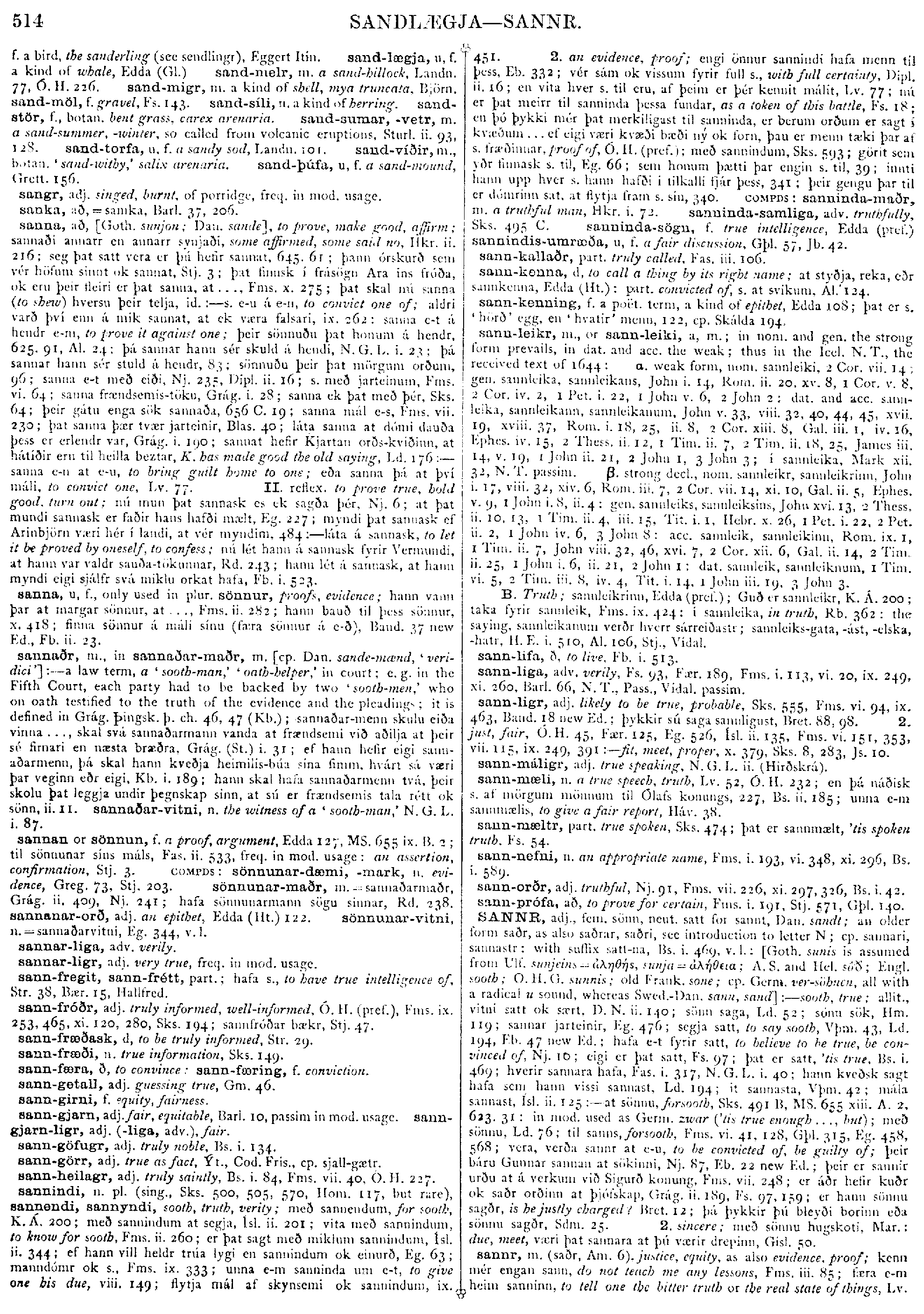
sannindi, n. pl. (sing., Sks. 500, 505, 570, Hom. 117, but rare), sannendi, sannyndi, sooth, truth, verity; með sannendum, for sooth, K.Á. 200; með sannindum at segja, Ísl. ii. 201; vita með sannindum, to know for sooth, Fms. ii. 260; er þat sagt með miklum sannindum, Ísl. ii. 344; ef hann vill heldr trúa lygi en sannindum ok einurð, Eg. 63; manndómr ok s., Fms. ix. 333; unna e-m sanninda um e-t, to give one his due, viii. 149; flytja mál af skynsemi ok sannindum, ix. 451. 2. an evidence, proof; engi önnur sannindi hafa menn til þess, Eb. 332; vér sám ok vissum fyrir full s., with full certainty, Dipl. ii. 16; en vita hver s. til eru, af þeim er þér kennit málit, Lv. 77; nú er þat meirr til sanninda þessa fundar, as a token of this battle, Fs. 18; en þó þykki mér þat merkiligast til sanninda, er berum orðum er sagt á kvæðum ... ef eigi væri kvæði bæði ný ok forn, þau er menn tæki þar af s. fræðinnar, proof of, Ó.H. (pref.); með sannindum, Sks. 593; görit sem yðr finnask s. til, Eg. 66; sem honum þætti þar engin s. til, 39; innti hann upp hver s. hann hafði í tilkalli fjár þess, 341; þeir gengu þar til er dómrinn sat, at flytja fram s. sín, 340. COMPDS: sanninda-maðr, m. a truthful man, Hkr. i. 72. sanninda-samliga, adv. truthfully, Sks. 495 C. sanninda-sögn, f. true intelligence, Edda (pref.) sannindis-umræða, u, f. a fair discussion, Gþl. 57, Jb. 42.
|
Source: Cleasby/Vigfusson, page b0514, entry 35 View original page image as: [TIFF] [PNG] [View previous entry] [View next entry] |
[Comment on this entry] [View comments] |
The following entry has been hand-corrected once. |
SANNR, adj., fem. sönn, neut. satt for sannt, Dan. sandt; an older form saðr, as also saðrar, saðri, see introduction to letter N; cp. sannari, sannastr: with suffix satt-na, Bs. i. 469, v.l.: [Goth, sunis is assumed from Ulf. sunjeins = GREEK, sunja = GREEK; A.S. and Hel. sôð; Engl.sooth; O.H.G. sunnis; old Frank, sone; cp. Germ. ver-söhnen, all with a radical u sound, whereas Swed. -Dan. sann, sand] :-- sooth, true; allit., vitni salt ok sært, D.N. ii. 140; sönn saga, Ld. 52; sönn sök, Hm. 119; sannar jarteinir, Eg. 476; segja satt, to say sooth, Vþm. 43, Ld. 194, Eb. 47 new Ed.; hafa e-t fyrir satt, to believe to be true, be convinced of, Nj. 10; eigi er þat satt, Fs. 97; þat er satt, 'tis true, Bs. i. 469; hverir sannara hafa, Fas. i. 317, N.G.L. i. 40; hann kveðsk sagt hafa sem hann vissi sannast, Ld. 194; it sannasta, Vþm. 42; mála sannast, Ísl. ii. 125 :-- at sönnu. forsooth, Sks. 491 B, MS. 655 xiii. A. 2, 633. 31: in mod. used as Germ. zwar ('tis true enough ..., but); með sönnu, Ld. 76; til sanns. forsooth, Fms. vi. 41, 128, Gþl. 315, Eg. 458, 568; vera, verða sannr at e-n, to be convicted of, be guilty of; þeir báru Gunnar sannan at sökinni, Nj. 87, Eb. 22 new Ed.; þeir er sannir urðu at á verkum við Sigurð konung, Fms. vii. 248; er áðr hefir kuðr ok saðr orðinn at þjófskap, Grág. ii. 189, Fs. 97, 159; er hann sönnu sagðr, is he justly charged? Bret. 12; þá þykkir þú bleyði borinn eða sönnu sagðr, Sdm. 25. 2. sincere; með sönnu hugskoti, Mar.: due, meet, væri þat sannara at þú værir drepinn, Gísl. 50.
|
Source: Cleasby/Vigfusson, page b0515, entry 57 View original page image as: [TIFF] [PNG] [View previous entry] [View next entry] |
[Comment on this entry] [View comments] |
The following entry has been hand-corrected once. |
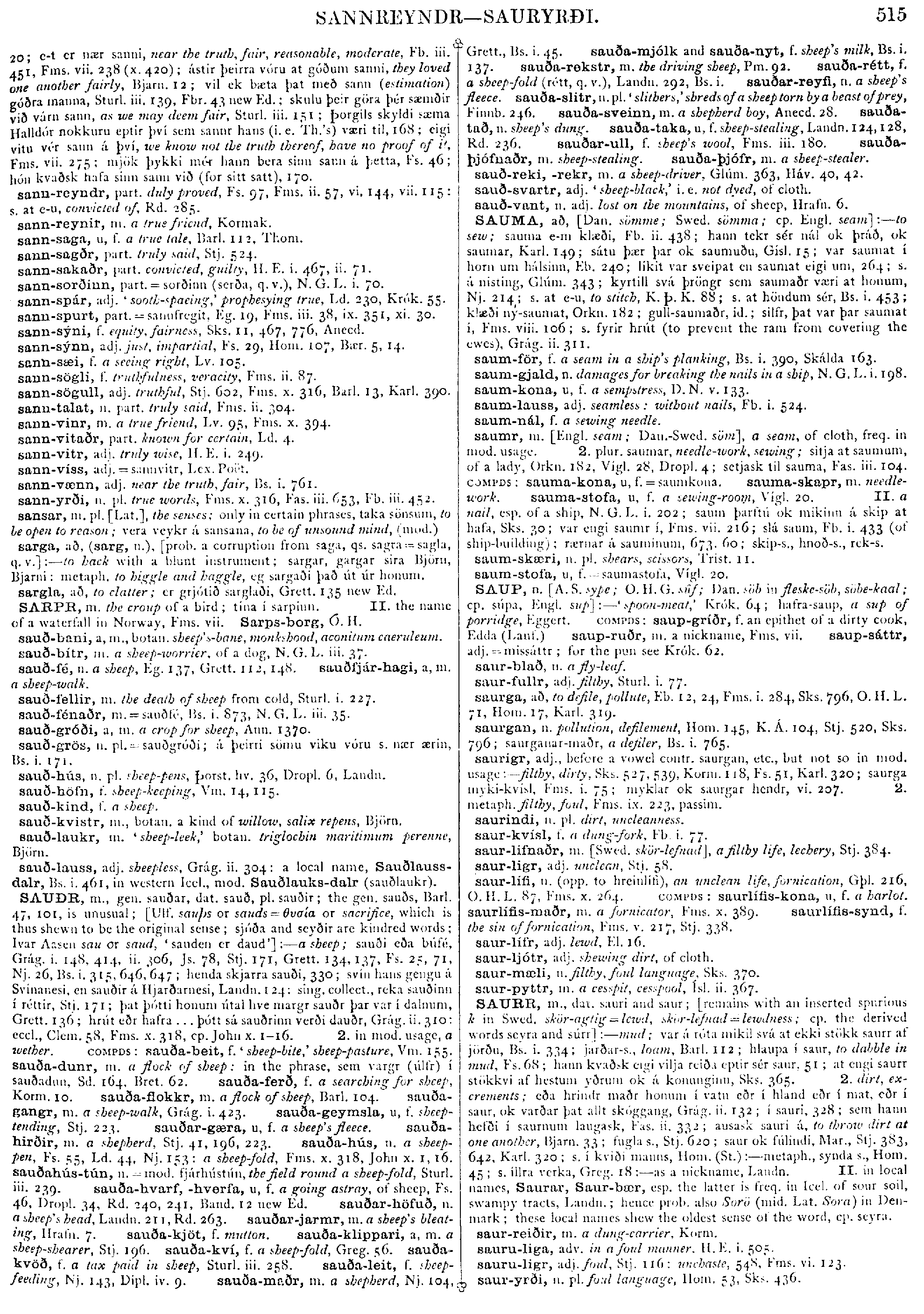
saurigr, adj., before a vowel contr. saurgan, etc., but not so in mod. usage :-- filthy, dirty, Sks. 527, 539, Korm. 118, Fs. 51, Karl. 320; saurga myki-kvísl, Fms. i. 75; myklar ok saurgar hendr, vi. 207. 2. metaph. filthy, foul, Fms. ix. 223, passim.
|
Source: Cleasby/Vigfusson, page b0516, entry 12 View original page image as: [TIFF] [PNG] [View previous entry] [View next entry] |
[Comment on this entry] [View comments] |
The following entry has been hand-corrected once. |
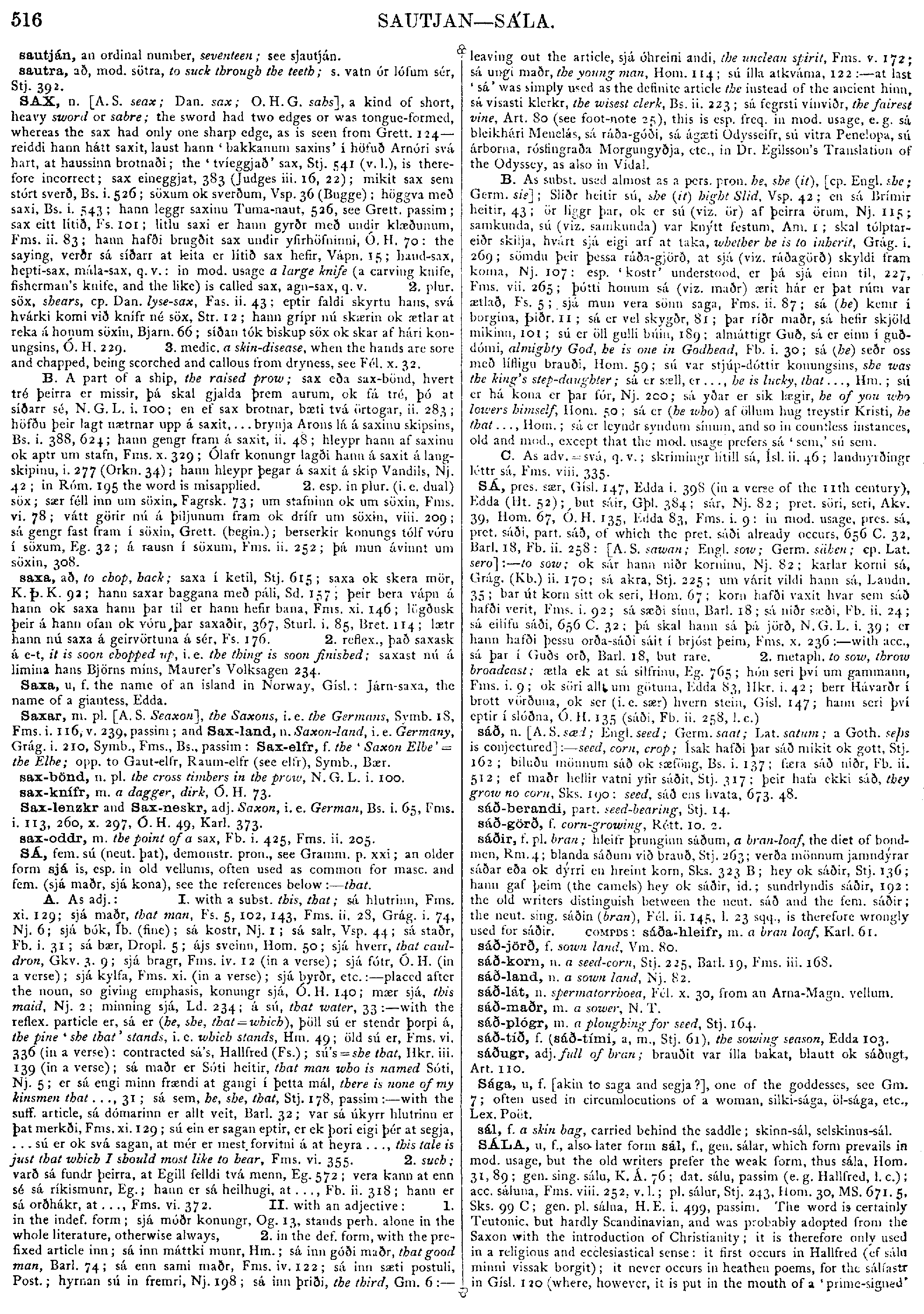
SÁ, pres. sær, Gísl. 147, Edda i. 398 (in a verse of the 11th century), Edda (Ht. 52); but sáir, Gþl. 384; sár, Nj. 82; pret. söri, seri, Akv. 39, Hom. 67, Ó.H. 135, Edda 83, Fms. i. 9: in mod. usage, pres. sá, pret. sáði, part, sáð, of which the pret. sáði already occurs, 656 C. 32, Barl. 18, Fb. ii. 258: [A.S. sawan; Engl. sow; Germ. säben; cp. Lat. sero] :-- to sow; ok sár hann niðr korninu, Nj. 82; karlar korni sá, Grág. (Kb.) ii. 170; sá akra, Stj. 225; um várit vildi hann sá, Landn. 35; bar út korn sitt ok seri, Hom. 67; korn hafði vaxit hvar sem sáð hafði verit, Fms. i. 92; sá sæði sínu, Barl. 18; sá niðr sæði, Fb. ii. 24; sá eilífu sáði, 656 C. 32; þá skal hann sá þá jörð, N.G.L. i. 39; er hann hafði þessu orða-sáði sáit í brjóst þeim, Fms. x. 236 :-- with acc., sá þar í Guðs orð, Barl. 18, but rare. 2. metaph. to sow, throw broadcast; ætla ek at sá silfrinu, Eg. 765; hón seri því um gammann, Fms. i. 9; ok söri allt um götuna, Edda 83, Hkr. i. 42; berr Hávarðr í brott vörðuna, ok ser (i.e. sær) hvern stein, Gísl. 147; hann seri því eptir í slóðna, Ó.H. 135 (sáði, Fb. ii. 258, l.c.)
|
Source: Cleasby/Vigfusson, page b0516, entry 27 View original page image as: [TIFF] [PNG] [View previous entry] [View next entry] |
[Comment on this entry] [View comments] |
The following entry has been hand-corrected once. |
SÁLA, u, f., also later form sál, f., gen. sálar, which form prevails in mod. usage, but the old writers prefer the weak form, thus sála, Hom. 31, 89; gen. sing, sálu, K.Á. 76; dat. sálu, passim (e.g. Hallfred, l.c.); acc. sáluna, Fms. viii. 252. v.l.; pl. sálur, Stj. 243, Hom. 30, MS. 671. 5, Sks. 99 C; gen. pl. sálna, H.E. i. 499, passim. The word is certainly Teutonic, but hardly Scandinavian, and was probably adopted from the Saxon with the introduction of Christianity; it is therefore only used in a religious and ecclesiastical sense: it first occurs in Hallfred (ef sálu minni vissak borgit); it never occurs in heathen poems, for the sálfastr, in Gísl. 120 (where, however, it is put in the mouth of a 'prime-signed'
| Result Page: |  |
Previous | 202 203 204 205 206 207 208 209 210 211 212 213 214 215 216 217 218 219 220 | Next |  |
Germanic Lexicon Project (main page)
This search system was written by
Sean Crist
Please consider
volunteering
to correct the data in these online dictionaries.
No rights reserved. Feel free to use these data in any way you please.