|
|

|
Source: Bosworth/Toller, page b0284, entry 26 View original page image as: [TIFF] [PNG] [View previous entry] [View next entry] |
[Comment on this entry] [View comments] |
The following entry has been hand-corrected once. |
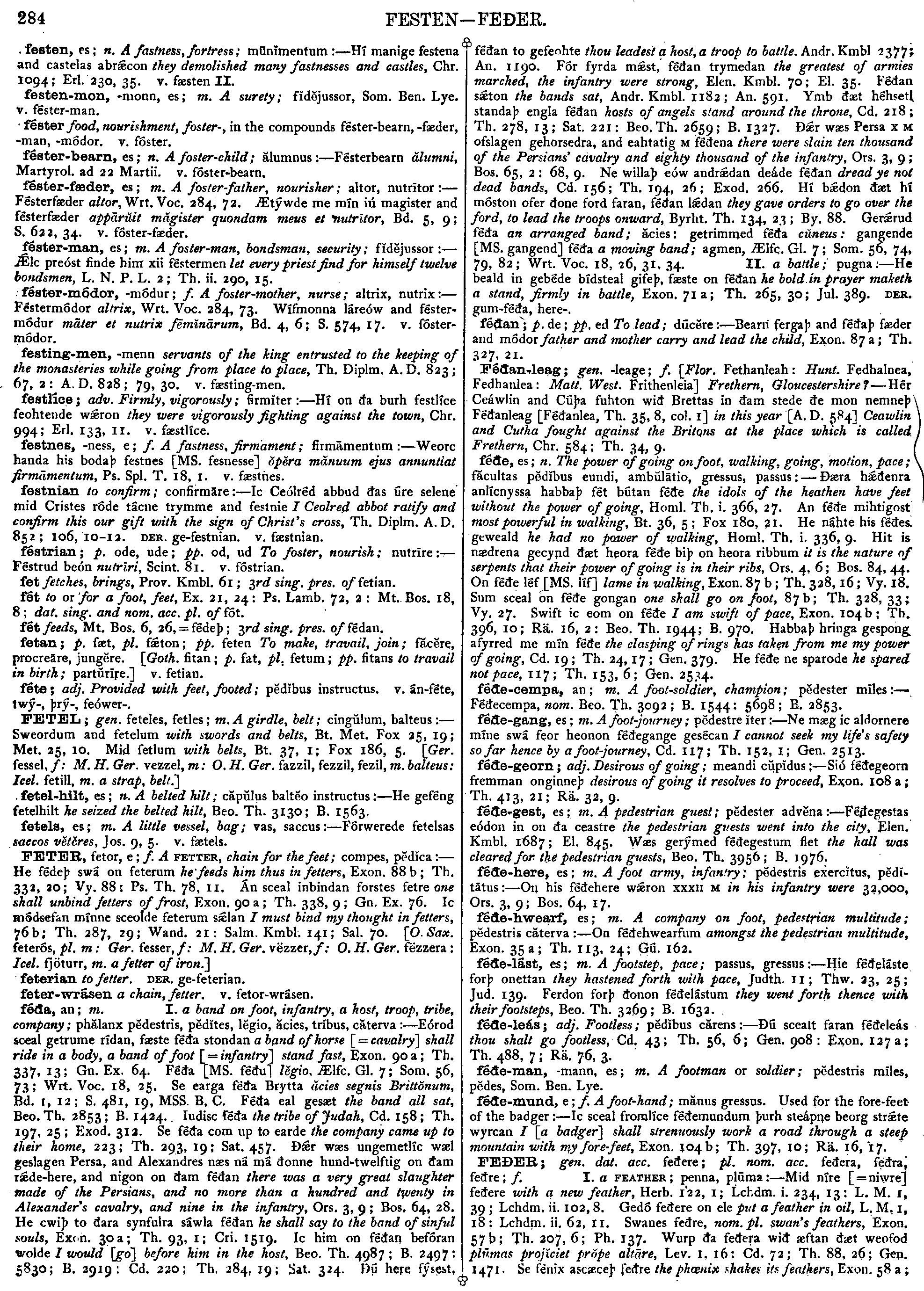
Féðan-leag; gen. -leage; f. [Flor. Fethanleah: Hunt. Fedhalnea, Fedhanlea: Matt. West. Frithenleia] Frethern, Gloucestershire? -- Hér Ceáwlin and Cúþa fuhton wið Brettas in ðam stede ðe mon nemneþ Féðanleag [Féðanlea, Th. 35, 8, col. 1] in this year [A. D. 584] Ceawlin and Cutha fought against the Britons at the place which is called Frethern, Chr. 584; Th. 34, 9.
|
Source: Bosworth/Toller, page b0408, entry 9 View original page image as: [TIFF] [PNG] [View previous entry] [View next entry] |
[Comment on this entry] [View comments] |
The following entry has been hand-corrected once. |
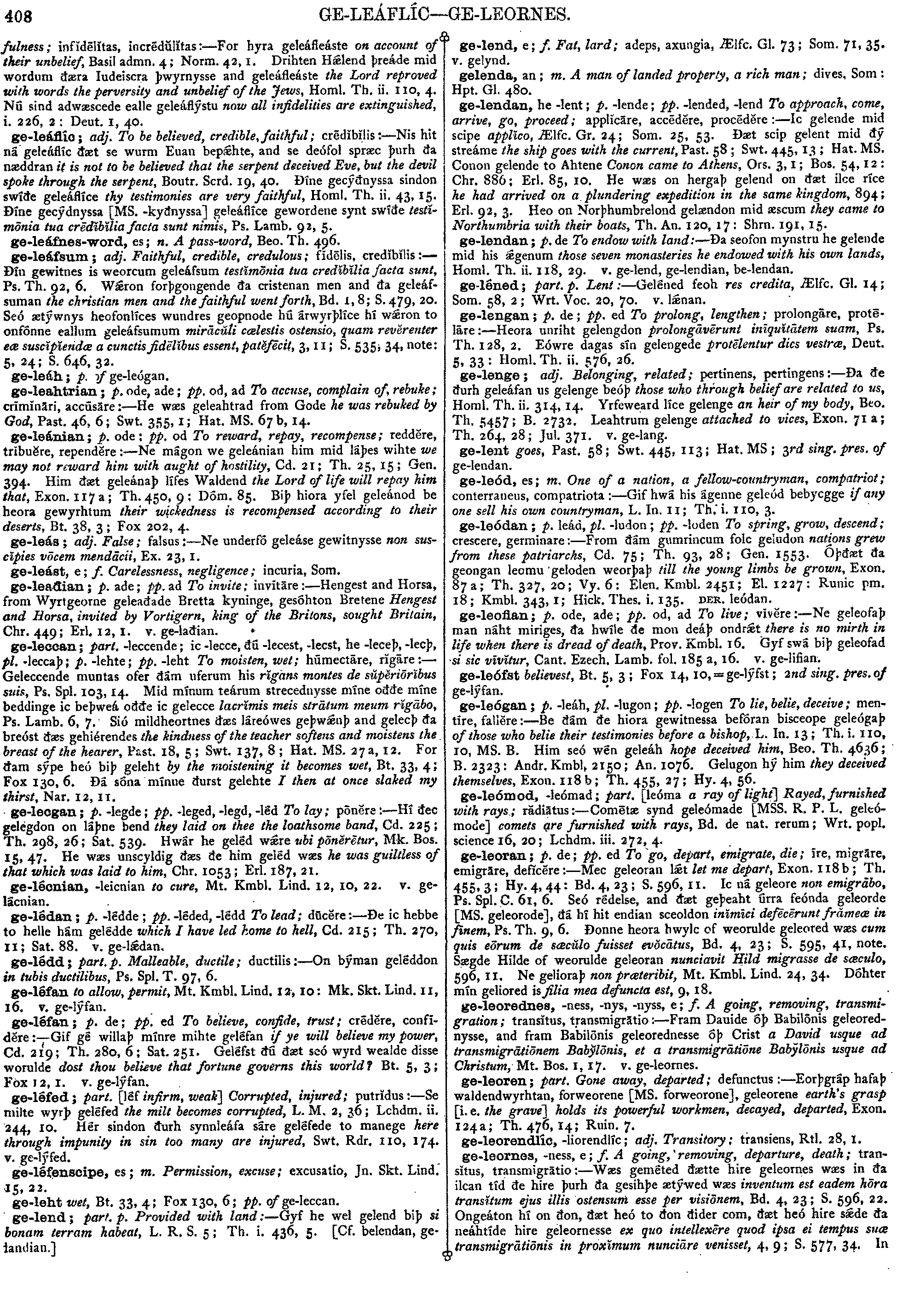
ge-leaðian;
p.
ade;
pp.
ad
To
invite;
invit re
:--
Hengest
and
Horsa,
from
Wyrtgeorne
geleaðade
Bretta
kyninge,
gesóhton
Bretene
Hengest
and
Horse,
invited
by
Vortigern,
king
of
the
Britons,
sought
Britain,
Chr.
449;
Erl.
12,
1.
v.
ge-laðian.
re
:--
Hengest
and
Horsa,
from
Wyrtgeorne
geleaðade
Bretta
kyninge,
gesóhton
Bretene
Hengest
and
Horse,
invited
by
Vortigern,
king
of
the
Britons,
sought
Britain,
Chr.
449;
Erl.
12,
1.
v.
ge-laðian.
|
Source: Bosworth/Toller, page b0438, entry 33 View original page image as: [TIFF] [PNG] [View previous entry] [View next entry] |
[Comment on this entry] [View comments] |
The following entry has been hand-corrected once. |
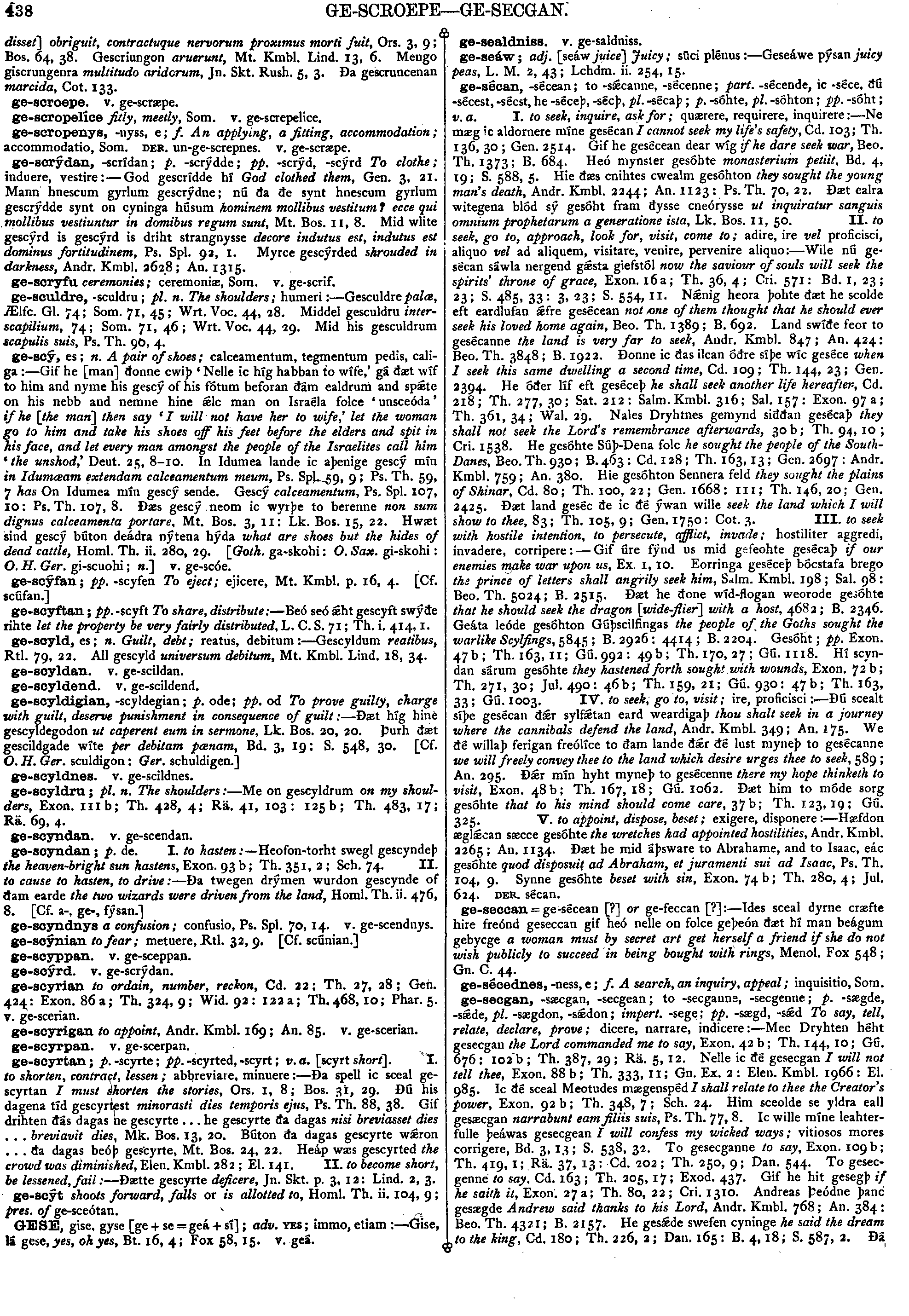
ge-secgan,
-sæcgan,
-secgean;
to
-secganne,
-secgenne;
p.
-sægde,
-s de,
pl.
-sægdon,
-sdon;
impert.
-sege;
pp.
-sægd,
-sd
To
say,
tell,
relate,
declare,
prove;
dicere,
narrare,
indicere
:--
Mec
Dryhten
héht
gesecgan
the
Lord
commanded
me
to
say,
Exon.
42
b;
Th.
144,
10;
Gú.
676:
102
b;
Th.
387,
29;
Rä.
5,
12.
Nelle
ic
ðé
gesecgan
I
will
not
tell
thee,
Exon.
88
b;
Th.
333,
11;
Gn.
Ex.
2:
Elen.
Kmbl.
1966:
El.
985.
Ic
ðé
sceal
Meotudes
mægenspéd
I
shall
relate
to
thee
the
Creator's
power,
Exon.
92
b;
Th.
348,
7;
Sch.
24.
Him
sceolde
se
yldra
eall
gesæcgan
narrabunt
eam
filiis
suis,
Ps.
Th.
77,
8.
Ic
wille
míne
leahterfulle
þeáwas
gesecgean
I
will
confess
my
wicked
ways;
vitiosos
mores
corrigere,
Bd.
3,
13;
S.
538,
32.
To
gesecganne
to
say,
Exon.
109
b;
Th.
419,
1;
Rä.
37,
13:
Cd.
202;
Th.
250,
9;
Dan.
544.
To
gesecgenne
to
say,
Cd.
163;
Th.
205,17;
Exod.
437.
Gif
he
hit
gesegþ
if
he
saith
it,
Exon.
27
a;
Th.
80,
22;
Cri.
1310.
Andreas
Þeódne
þanc
gesægde
Andrew
said
thanks
to
his
Lord,
Andr.
Kmbl.
768;
An.
384:
Beo.
Th.
4321;
B.
2157.
He
gesde
swefen
cyninge
he
said
the
dream
to
the
king,
Cd.
180;
Th.
226,
2;
Dan.
165:
B.
4,
18;
S.
587,
2.
Ðá
gesægdon
Rómáne
Bryttum
then
the
Romans
said
to
the
Britons,
Bd.
1,
12;
S.
481,
3.
Gesege
me
dicito
mihi,
Bd.
2,
12;
S.
514,
1.
Ðæt
ðú
gesecge
sweostor
mínre
that
thou
mayest
say
to
my
sister,
Exon.
50
a;
Th.
172,
31;
Gú.
1152:
Bd.
4,
3;
S.
568,
27.
Wæs
gesd
hwám
ðæt
sweord
geworht
wre
it
was
said
for
whom
that
sword
was
wrought,
Beo.
Th.
3396;
B.
1696.
Ic
sceall
ealle
forltan
ða
ðe
of
Perseo
and
of
Cathma
gesde
syndon
I
must
pass
over
all
things
that
are
said
of
Perseus
and
Cadmus,
Ors.
1,
8;
Bos.
31,
33.
34.
Ðæt
is
gesd
that
is
proved,
Bt.
34,
9;
Fox
146,
25,
27.
DER.
secgan.
de,
pl.
-sægdon,
-sdon;
impert.
-sege;
pp.
-sægd,
-sd
To
say,
tell,
relate,
declare,
prove;
dicere,
narrare,
indicere
:--
Mec
Dryhten
héht
gesecgan
the
Lord
commanded
me
to
say,
Exon.
42
b;
Th.
144,
10;
Gú.
676:
102
b;
Th.
387,
29;
Rä.
5,
12.
Nelle
ic
ðé
gesecgan
I
will
not
tell
thee,
Exon.
88
b;
Th.
333,
11;
Gn.
Ex.
2:
Elen.
Kmbl.
1966:
El.
985.
Ic
ðé
sceal
Meotudes
mægenspéd
I
shall
relate
to
thee
the
Creator's
power,
Exon.
92
b;
Th.
348,
7;
Sch.
24.
Him
sceolde
se
yldra
eall
gesæcgan
narrabunt
eam
filiis
suis,
Ps.
Th.
77,
8.
Ic
wille
míne
leahterfulle
þeáwas
gesecgean
I
will
confess
my
wicked
ways;
vitiosos
mores
corrigere,
Bd.
3,
13;
S.
538,
32.
To
gesecganne
to
say,
Exon.
109
b;
Th.
419,
1;
Rä.
37,
13:
Cd.
202;
Th.
250,
9;
Dan.
544.
To
gesecgenne
to
say,
Cd.
163;
Th.
205,17;
Exod.
437.
Gif
he
hit
gesegþ
if
he
saith
it,
Exon.
27
a;
Th.
80,
22;
Cri.
1310.
Andreas
Þeódne
þanc
gesægde
Andrew
said
thanks
to
his
Lord,
Andr.
Kmbl.
768;
An.
384:
Beo.
Th.
4321;
B.
2157.
He
gesde
swefen
cyninge
he
said
the
dream
to
the
king,
Cd.
180;
Th.
226,
2;
Dan.
165:
B.
4,
18;
S.
587,
2.
Ðá
gesægdon
Rómáne
Bryttum
then
the
Romans
said
to
the
Britons,
Bd.
1,
12;
S.
481,
3.
Gesege
me
dicito
mihi,
Bd.
2,
12;
S.
514,
1.
Ðæt
ðú
gesecge
sweostor
mínre
that
thou
mayest
say
to
my
sister,
Exon.
50
a;
Th.
172,
31;
Gú.
1152:
Bd.
4,
3;
S.
568,
27.
Wæs
gesd
hwám
ðæt
sweord
geworht
wre
it
was
said
for
whom
that
sword
was
wrought,
Beo.
Th.
3396;
B.
1696.
Ic
sceall
ealle
forltan
ða
ðe
of
Perseo
and
of
Cathma
gesde
syndon
I
must
pass
over
all
things
that
are
said
of
Perseus
and
Cadmus,
Ors.
1,
8;
Bos.
31,
33.
34.
Ðæt
is
gesd
that
is
proved,
Bt.
34,
9;
Fox
146,
25,
27.
DER.
secgan.
|
Source: Bosworth/Toller, page b0533, entry 15 View original page image as: [TIFF] [PNG] [View previous entry] [View next entry] |
[Comment on this entry] [View comments] |
The following entry has been hand-corrected once. |
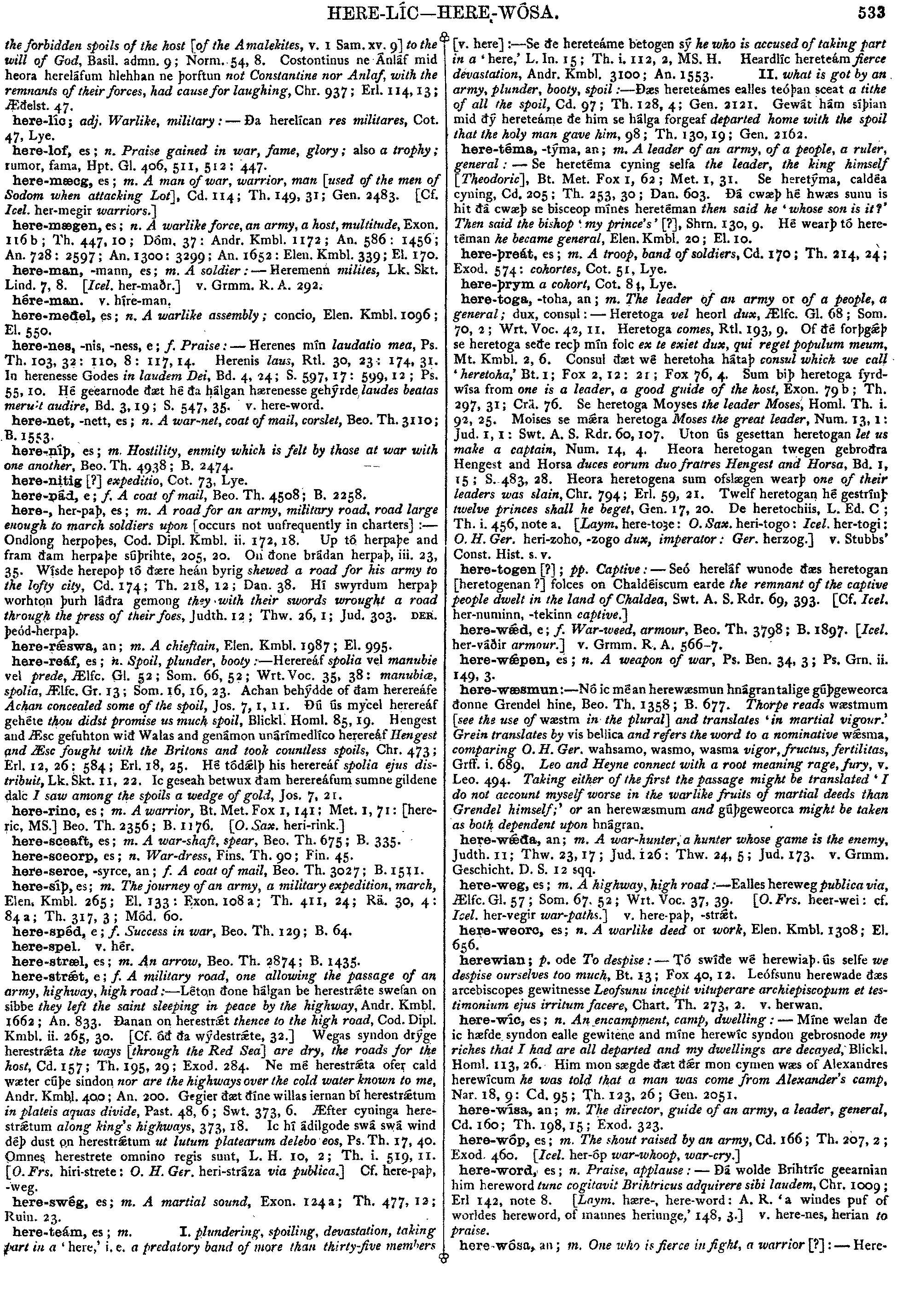
here-reáf,
es:
n.
Spoil,
plunder,
booty:--
Herereáf
spolia
vel
manubie
vel
prede,
Ælfc.
Gl.
52;
Som.
66,
52;
Wrt.
Voc.
35,
38:
manubiæ,
spolia,
Ælfc.
Gr.
13;
Som.
16,
16,
23.
Achan
behýdde
of
ðam
herereáfe
Achan
concealed
some
of
the
spoil,
Jos.
7,
1,
11.
Ðú
ús
mycel
herereáf
gehéte
thou
didst
promise
us
much
spoil,
Blickl.
Homl.
85,
19.
Hengest
and
Æsc
gefuhton
wið
Walas
and
genámon
unárímedlíco
herereáf
Hengest
and
Æsc
fought
with
the
Britons
and
took
countless
spoils.
Chr.
473;
Erl.
12,
26:
584;
Erl.
18,
25.
Hé
tódlþ
his
herereáf
spolia
ejus
distribuit,
Lk.
Skt.
11,
22.
Ic
geseah
betwux
ðam
herereáfum
sumne
gildene
dalc
I
saw
among
the
spoils
a
wedge
of
gold,
Jos.
7,
21.
|
Source: Bosworth/Toller, page b0693, entry 8 View original page image as: [TIFF] [PNG] [View previous entry] [View next entry] |
[Comment on this entry] [View comments] |
The following entry has been hand-corrected once. |
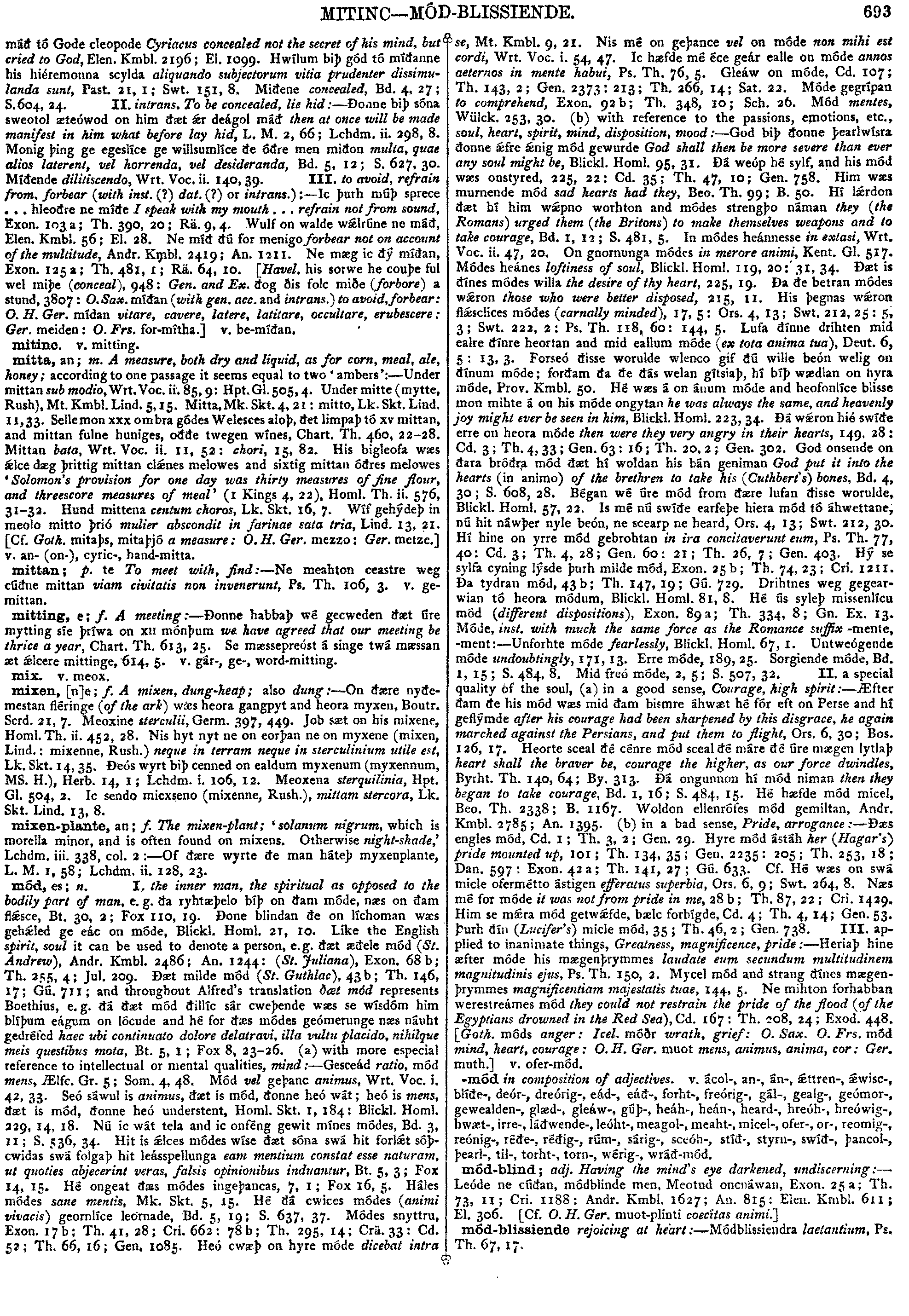
mód,
es;
n.
I.
the
inner
man,
the
spiritual
as
opposed
to
the
bodily
part
of
man,
e.g.
ða
ryhtæþelo
bíþ
on
ðam
móde,
næs
on
ðam
flsce,
Bt.
30,
2;
Fox
110,
19.
Ðone
blindan
ðe
on
líchoman
wæs
gehled
ge
eác
on
móde,
Blickl.
Homl.
21,
10.
Like
the
English
spirit,
soul
it
can
be
used
to
denote
a
person,
e.g.
ðæt
æðele
mód
(St.
Andrew),
Andr.
Kmbl.
2486;
An.
1244:
(St.
Juliana),
Exon.
68
b;
Th.
255,
4;
Jul.
209.
Ðæt
milde
mód
(St.
Guthlac),
43
b;
Th.
146,
17;
Gú.
711;
and
throughout
Alfred's
translation
ðæt
mód
represents
Boethius,
e.
g.
ðá
ðæt
mód
ðillíc
sár
cweþende
wæs
se
wísdóm
him
blíþum
eágum
on
lócude
and
hé
for
ðæs
módes
geómerunge
næs
náuht
gedréfed
haec
ubi
continuato
dolore
delatravi,
illa
vultu
placido,
nihilque
meis
questibus
mota,
Bt.
5,
1;
Fox
8,
23-26.
(a)
with
more
especial
reference
to
intellectual
or
mental
qualities,
mind
:--
Gesceád
ratio,
mód
mens,
Ælfc.
Gr.
5;
Som.
4,
48.
Mód
vel
geþanc
animus,
Wrt.
Voc.
i.
42,
33.
Seó
sáwul
is
animus,
ðæt
is
mód,
ðonne
heó
wát;
heó
is
mens,
ðæt
is
mód,
ðonne
heó
understent,
Homl.
Skt.
1,
184:
Blickl.
Homl.
229,
14,
28.
Nú
ic
wát
tela
and
ic
onféng
gewit
mínes
módes,
Bd.
3,
11;
S.
536,
34.
Hit
is
lces
módes
wíse
ðæt
sóna
swá
hit
forlt
sóþcwidas
swá
folgaþ
hit
leásspellunga
eam
mentium
constat
esse
naturam,
ut
quoties
abjecerint
veras,
falsis
opinionibus
induantur,
Bt.
5,
3;
Fox
14,
15.
Hé
ongeat
ðæs
módes
ingeþancas,
7,
1;
Fox
16,
5.
Háles
módes
sane
mentis,
Mk.
Skt.
5,
15.
Hé
ðá
cwices
módes
(animi
vivacis)
geornlíce
leornade,
Bd.
5,
19;
S.
637,
37.
Módes
snyttru,
Exon.
17
b;
Th.
41,
28;
Cri.
662:
78
b;
Th.
295,
14;
Crä.
33:
Cd.
52;
Th.
66,
26;
Gen.
1085.
Heó
cwæþ
on
hyre
móde
dicebat
intra
se,
Mt.
Kmbl.
9,
21.
Nis
mé
on
geþance
vel
on
móde
non
mihi
est
cordi,
Wrt.
Voc.
i.
54,
47.
Ic
hæfde
mé
éce
geár
ealle
on
móde
annos
aeternos
in
mente
habui,
Ps.
Th.
76,
5.
Gleáw
on
móde,
Cd.
107;
Th.
143,
2;
Gen.
2373:
213;
Th.
266,
14;
Sat.
22.
Móde
gegrípan
to
comprehend,
Exon.
92
b;
Th.
348,
10;
Sch.
26.
Mód
mentes,
Wülck.
253,
30.
(b)
with
reference
to
the
passions,
emotions,
etc.,
soul,
heart,
spirit,
mind,
disposition,
mood
:--
God
biþ
ðonne
þearlwísra
ðonne
fre
nig
mód
gewurde
God
shall
then
be
more
severe
than
ever
any
soul
might
be,
Blickl.
Homl.
95,
31.
Ðá
weóp
hé
sylf,
and
his
mód
wæs
onstyred,
225,
22:
Cd.
35;
Th.
47,
10;
Gen.
758.
Him
wæs
murnende
mód
sad
hearts
had
they,
Beo.
Th.
99;
B.
50.
Hí
lrdon
ðæt
hí
him
wpno
worhton
and
módes
strengþo
náman
they
(the
Romans)
urged
them
(the
Britons)
to
make
themselves
weapons
and
to
take
courage,
Bd.
1,
12;
S.
481,
5.
In
módes
heánnesse
in
extasi,
Wrt.
Voc.
ii.
47,
20.
On
gnornunga
módes
in
merore
animi,
Kent.
Gl.
517.
Módes
heánes
loftiness
of
soul,
Blickl.
Homl.
119,
20:
31,
34.
Ðæt
is
ðínes
módes
willa
the
desire
of
thy
heart,
225,
19.
Ða
ðe
betran
módes
wron
those
who
were
better
disposed,
215,
11.
His
þegnas
wron
flsclices
módes
(carnally
minded),
17,
5:
Ors.
4,
13;
Swt.
212,
25:
5,
3;
Swt.
222,
2:
Ps.
Th.
118,
60:
144,
5.
Lufa
ðínne
drihten
mid
ealre
ðínre
heortan
and
mid
eallum
móde
(ex
tota
anima
tua),
Deut.
6,
5:
13,
3.
Forseó
ðisse
worulde
wlenco
gif
ðú
wille
beón
welig
on
ðínum
móde;
forðam
ða
ðe
ðás
welan
gítsiaþ,
hí
bíþ
wædlan
on
hyra
móde,
Prov.
Kmbl.
50.
Hé
wæs
á
on
ánum
móde
and
heofonlíce
blisse
mon
mihte
á
on
his
móde
ongytan
he
was
always
the
same,
and
heavenly
joy
might
ever
be
seen
in
him,
Blickl.
Homl.
223,
34.
Ðá
wron
hié
swíðe
erre
on
heora
móde
then
were
they
very
angry
in
their
hearts,
149,
28:
Cd.
3;
Th.
4,
33;
Gen.
63:
16;
Th.
20,
2;
Gen.
302.
God
onsende
on
ðara
bróðra
mód
ðæt
hí
woldan
his
bán
geniman
God
put
it
into
the
hearts
(in
animo)
of
the
brethren
to
take
his
(Cuthbert's)
bones,
Bd.
4,
30;
S.
608,
28.
Bégan
wé
úre
mód
from
ðære
lufan
ðisse
worulde,
Blickl.
Homl.
57,
22.
Is
mé
nú
swíðe
earfeþe
hiera
mód
tó
áhwettane,
nú
hit
náwþer
nyle
beón,
ne
scearp
ne
heard,
Ors.
4,
13;
Swt.
212,
30.
Hí
hine
on
yrre
mód
gebrohtan
in
ira
concitaverunt
eum,
Ps.
Th.
77,
40:
Cd.
3;
Th.
4,
28;
Gen.
60:
21;
Th.
26,
7;
Gen.
403.
Hý
se
sylfa
cyning
lýsde
þurh
milde
mód,
Exon.
25
b;
Th.
74,
23;
Cri.
1211.
Ða
tydran
mód,
43
b;
Th.
147,
19;
Gú.
729.
Drihtnes
weg
gegearwian
tó
heora
módum,
Blickl.
Homl.
81,
8.
Hé
ús
syleþ
missenlícu
mód
(different
dispositions),
Exon.
89
a;
Th.
334,
8;
Gn.
Ex.
13.
Móde,
inst.
with
much
the
same
force
as
the
Romance
suffix
-mente,
-ment
:--
Unforhte
móde
fearlessly,
Blickl.
Homl.
67,
1.
Unstweógende
móde
undoubtingly,
171,
13.
Erre
móde,
189,
25.
Sorgiende
móde,
Bd.
1,
15;
S.
484,
8.
Mid
freó
móde,
2,
5;
S.
507,
32.
II.
a
special
quality
of
the
soul,
(a)
in
a
good
sense,
Courage,
high
spirit
:--
Æfter
ðam
ðe
his
mód
wæs
mid
ðam
bismre
áhwæt
hé
fór
eft
on
Perse
and
hí
geflýmde
after
his
courage
had
been
sharpened
by
this
disgrace,
he
again
marched
against
the
Persians,
and
put
them
to
flight,
Ors.
6,
30;
Bos.
126,
17.
Heorte
sceal
ðé
cénre
mód
sceal
ðé
máre
ðé
úre
mægen
lytlaþ
heart
shall
the
braver
be,
courage
the
higher,
as
our
force
dwindles,
Byrht.
Th.
140,
64;
By.
313.
Ðá
ongunnon
hí
mód
niman
then
they
began
to
take
courage,
Bd.
1,
16;
S.
484,
15.
Hé
hæfde
mód
micel,
Beo.
Th.
2338;
B.
1167.
Woldon
ellenrófes
mód
gemiltan,
Andr.
Kmbl.
2785;
An.
1395.
(b)
in
a
bad
sense,
Pride,
arrogance
:--
Ðæs
engles
mód,
Cd.
1;
Th.
3,
2;
Gen.
29.
Hyre
mód
ástáh
her
(Hagar's)
pride
mounted
up,
101;
Th.
134,
35;
Gen.
2235:
205;
Th.
253,
18;
Dan.
597:
Exon.
42
a;
Th.
141,
27;
Gú.
633.
Cf.
Hé
wæs
on
swá
micle
ofermétto
ástigen
efferatus
superbia,
Ors.
6,
9;
Swt.
264,
8.
Næs
mé
for
móde
it
was
not
from
pride
in
me,
28
b;
Th.
87,
22;
Cri.
1429.
Him
se
mra
mód
getwfde,
bælc
forbígde,
Cd.
4;
Th.
4,
14;
Gen.
53.
Þurh
ðín
(Lucifer's)
micle
mód,
35;
Th.
46,
2;
Gen.
738.
III.
applied
to
inanimate
things,
Greatness,
magnificence,
pride
:--
Heriaþ
hine
æfter
móde
his
mægenþrymmes
laudate
eum
secundum
multitudinem
magnitudinis
ejus,
Ps.
Th.
150,
2.
Mycel
mód
and
strang
ðínes
mægen-þrymmes
magnificentiam
majestatis
tuae,
144,
5.
Ne
mihton
forhabban
werestreámes
mód
they
could
not
restrain
the
pride
of
the
flood
(of
the
Egyptians
drowned
in
the
Red
Sea),
Cd.
167:
Th.
208,
24;
Exod.
448.
[Goth.
móds
anger:
Icel.
möðr
wrath,
grief:
O.
Sax.
O.
Frs.
mód
mind,
heart,
courage:
O.
H.
Ger.
muot
mens,
animus,
anima,
cor:
Ger.
muth.]
v.
ofer-mód.
|
Source: Bosworth/Toller, page b0802, entry 8 View original page image as: [TIFF] [PNG] [View previous entry] [View next entry] |
[Comment on this entry] [View comments] |
The following entry has been hand-corrected once. |
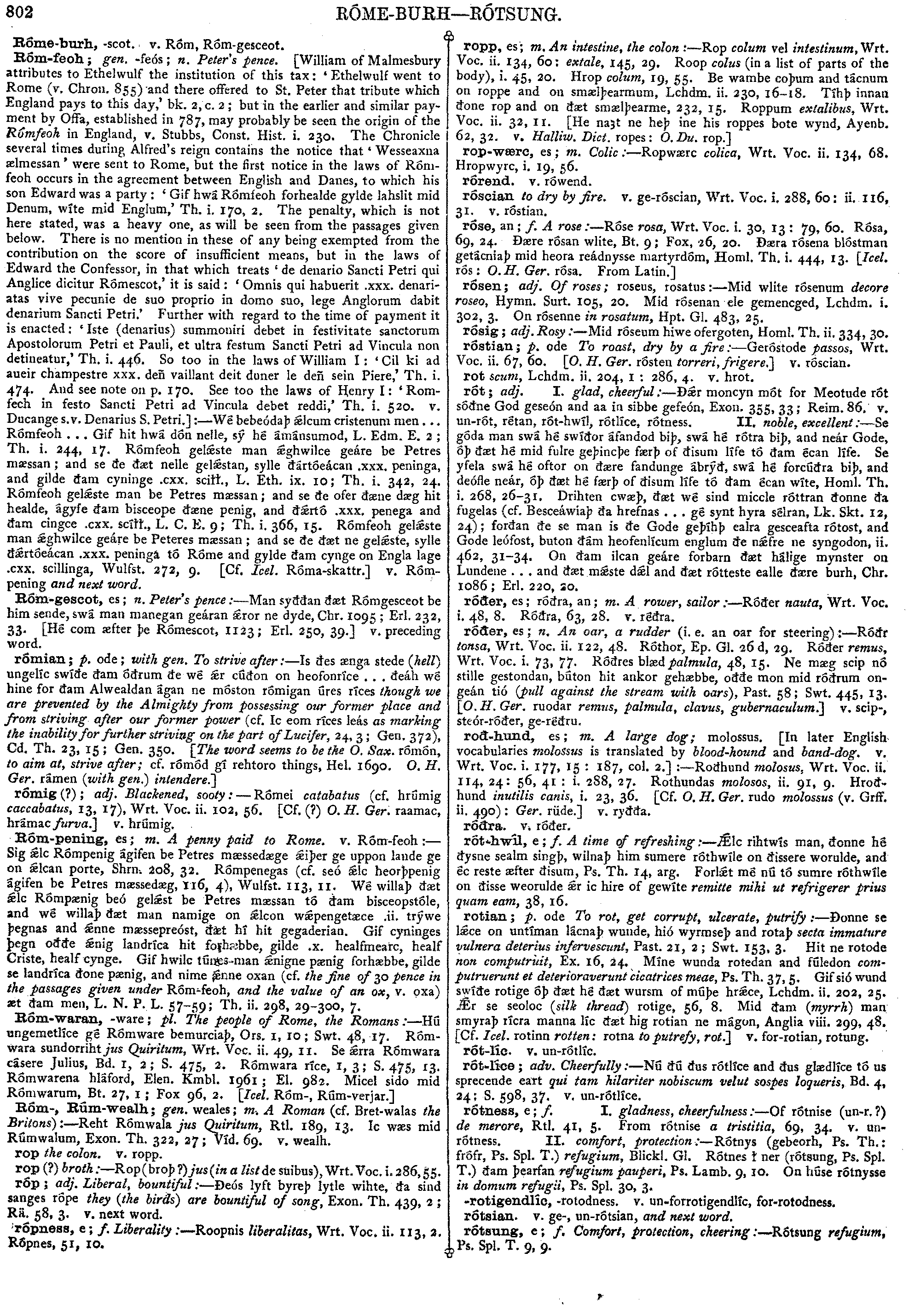
Róm-, Rúm-wealh; gen. weales; m, A Roman (cf. Bret-walas the Britons) :-- Reht Rómwala jus Quiritum, Rtl. 189, 13. Ic wæs mid Rúmwalum, Exon. Th. 322, 27; Víd. 69. v. wealh.
|
Source: Bosworth/Toller, page d0136, entry 5 View original page image as: [TIFF] [PNG] [View previous entry] [View next entry] |
[Comment on this entry] [View comments] |
The following entry has been hand-corrected once. |
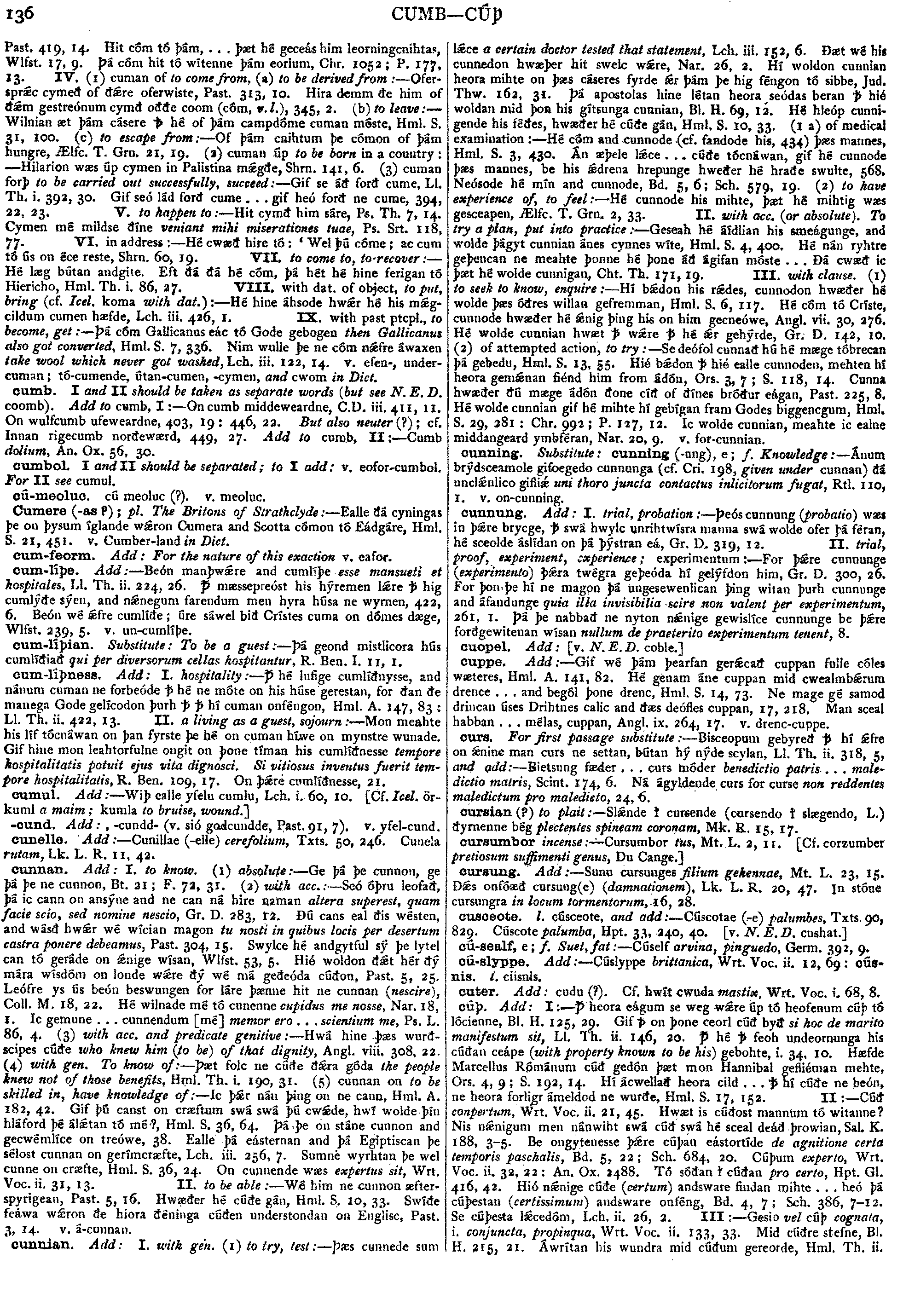
Cumere
(-as
?);
pl.
The
Britons
of
Strathclyde:--Ealle
ðá
cyningas
þe
on
þysum
íglande
wron
Cumera
and
Scotta
cómon
tó
Eádgáre,
Hml.
S.
21,
451.
v.
Cumber-land
in
Dict.
|
Source: Bright's OE Grammar, page b0259, entry 23 View original page image as: [TIFF] [PNG] [View previous entry] [View next entry] |
[Comment on this entry] [View comments] |
The following entry has been hand-corrected once. |
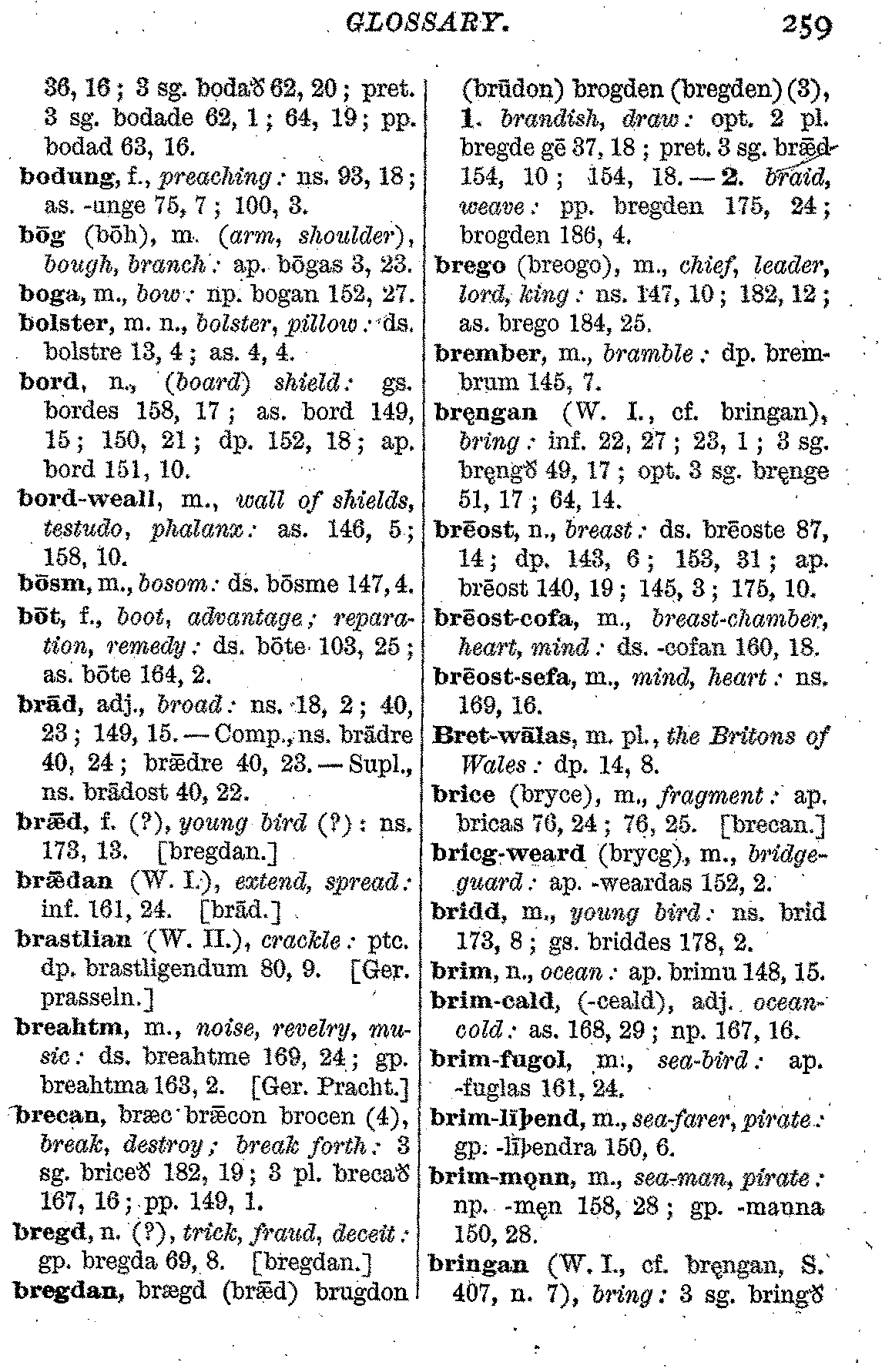
Bret-wlas
m
pl
the
Britons
of
Wales
|
Source: Bright's OE Grammar, page b0260, entry 19 View original page image as: [TIFF] [PNG] [View previous entry] [View next entry] |
[Comment on this entry] [View comments] |
The following entry has been hand-corrected once. |
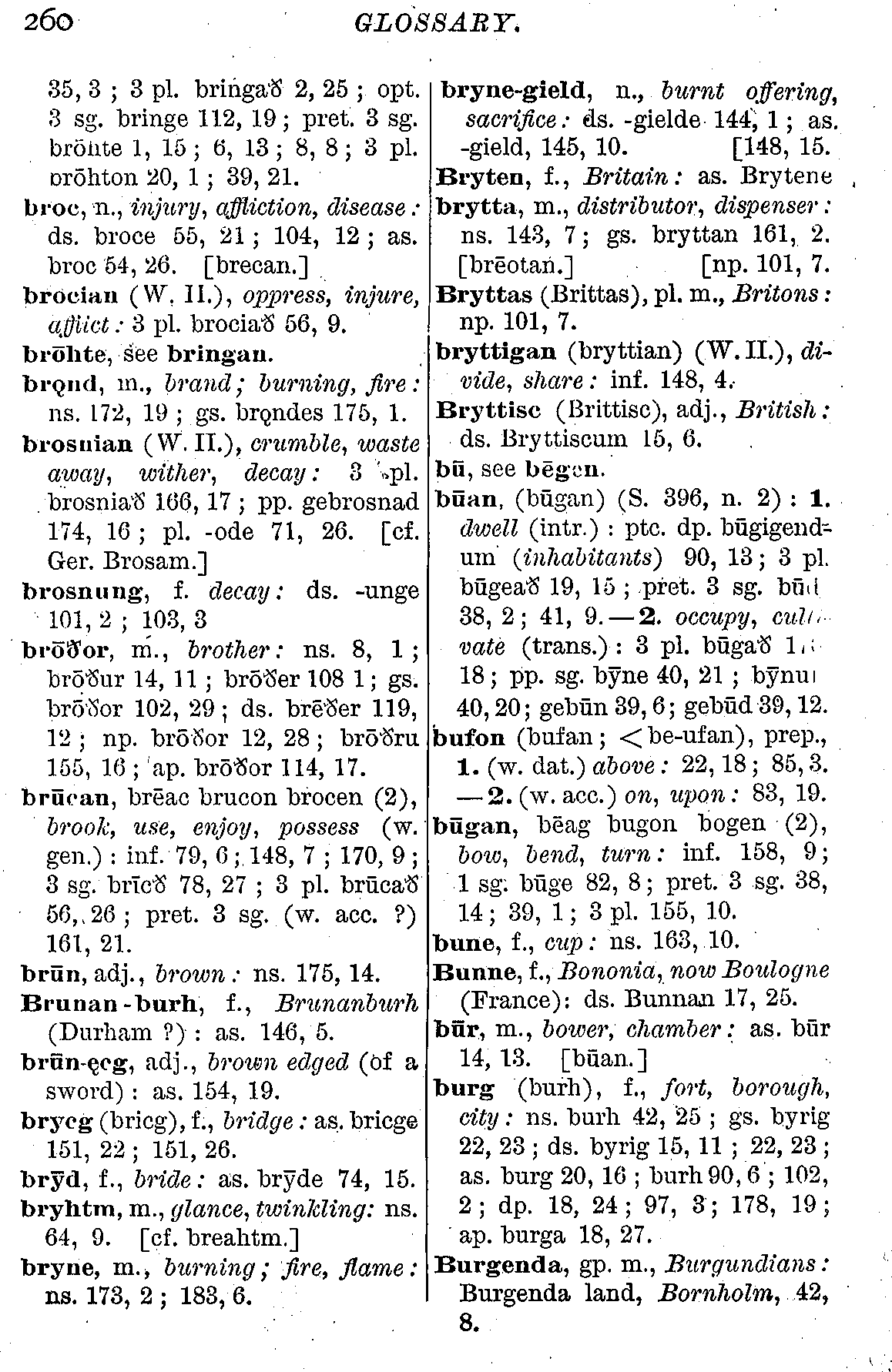
Bryttas (Brittas) pl m Britons
|
Source: Cleasby/Vigfusson, page b0352, entry 2 View original page image as: [TIFF] [PNG] [View previous entry] [View next entry] |
[Comment on this entry] [View comments] |
The following entry has been hand-corrected once. |
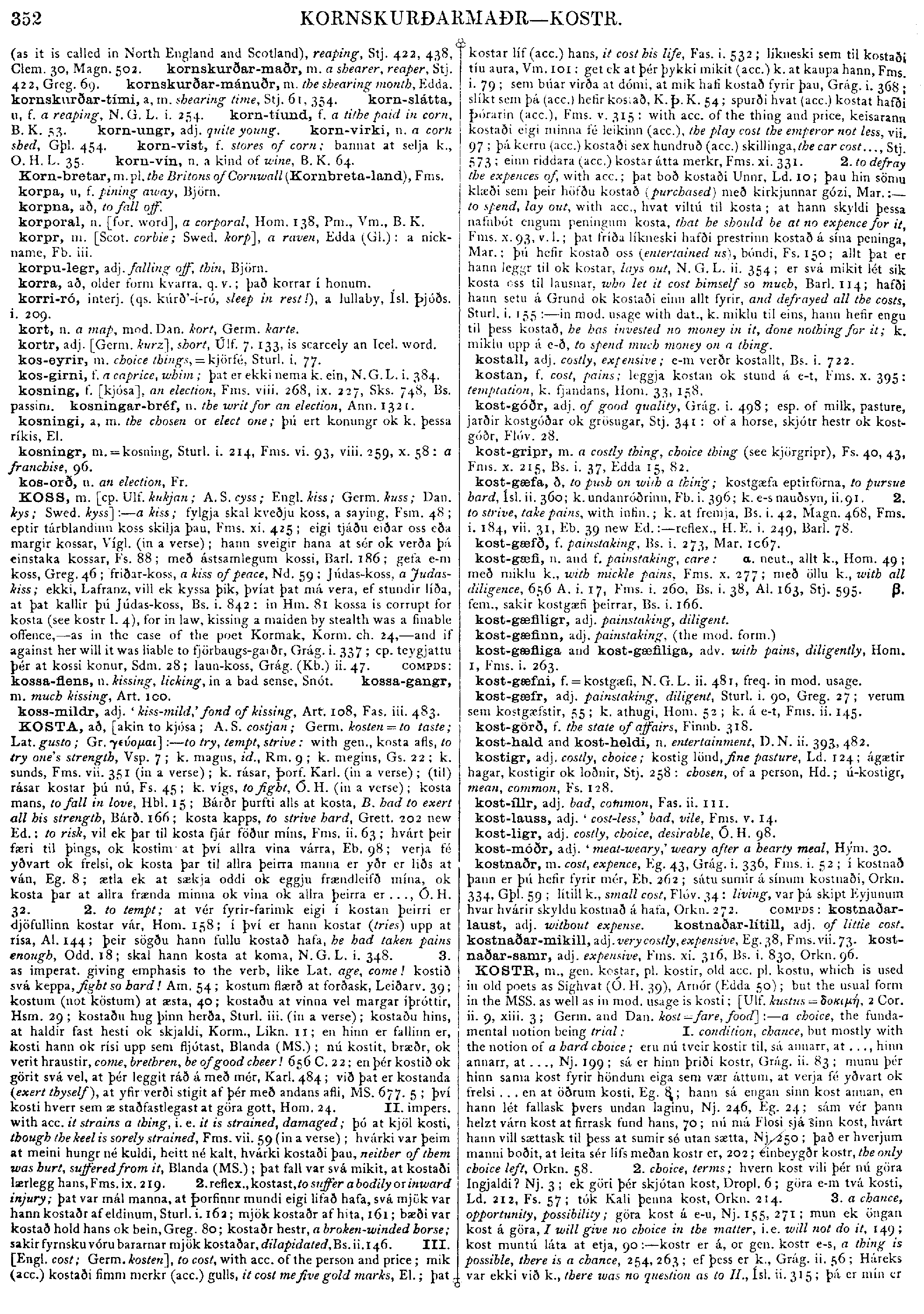
Korn-bretar, m. pl. the Britons of Cornwall (Kornbreta-land), Fms.
| Result Page: |  |
Previous | 1 2 3 |
Germanic Lexicon Project (main page)
This search system was written by
Sean Crist
Please consider
volunteering
to correct the data in these online dictionaries.
No rights reserved. Feel free to use these data in any way you please.